

Crypto World
Samsung Wallet to add stablecoin support as crypto push expands



Samsung has unveiled plans to add stablecoin support to Samsung Wallet, extending its mobile payment platform into blockchain-based digital value transfers.
Summary
- Samsung has announced plans to add stablecoin support to Samsung Wallet, expanding the app beyond payments and rewards.
- The company has not disclosed the supported stablecoins, launch timeline or technology partners for the new Wallet feature.
- The move builds on Samsung’s recent crypto initiatives, including Coinbase integration and investments tied to South Korea’s digital asset market.
During the company’s Galaxy Unpacked event, Samsung Electronics said Samsung Wallet will support stablecoins as part of its next phase of development, combining payments, rewards and digital assets within a single mobile experience. The company has not disclosed which stablecoins it will integrate, when the feature will launch or which partners will support the rollout.
Speaking at the event, Samsung product manager Lee Dinham said Samsung Wallet will expand beyond cash and savings to include stablecoins. He said the company intends to become one of the first major smartphone brands to offer native stablecoin functionality, allowing users to transfer digital value directly from their devices.
Although Samsung outlined the direction of the product, it stopped short of announcing technical details. The company has not identified supported blockchain networks, reserve-backed assets or regional availability for the feature. Cointelegraph said it contacted Samsung for additional comment but had not received a response at the time of publication.
Samsung builds on existing crypto services
The planned Wallet upgrade follows several digital asset initiatives Samsung has introduced over the past year, indicating that the company has been steadily adding blockchain services to its mobile ecosystem rather than treating stablecoins as a standalone product.
In October 2025, Samsung expanded its partnership with U.S.-based crypto exchange Coinbase, allowing Galaxy users in the United States to buy cryptocurrencies directly through Samsung Wallet. The integration initially covered more than 75 million Galaxy users, with Samsung and Coinbase saying they planned to expand the service to additional markets over time.
At the time, Coinbase Chief Business Officer Shan Aggarwal said the partnership combined Samsung’s global user base with Coinbase’s crypto platform to make digital assets easier to access. Samsung also introduced promotional incentives, including a three-month Coinbase One subscription for new users and trading credits for eligible customers making their first crypto purchase through Samsung Wallet.
Samsung has continued adding financial services to the application alongside its crypto offerings. Samsung Wallet already stores payment cards, digital identification documents, rewards programs and other credentials, while the company recently introduced Galaxy Card as another financial product connected to the ecosystem.
Stablecoins remain part of Samsung’s expanding blockchain strategy
Outside its consumer wallet business, Samsung has also increased its involvement in South Korea’s digital asset sector through investments and partnerships linked to blockchain infrastructure.
In May 2026, Samsung Securities, Samsung SDS and Samsung Card agreed to acquire a combined 4% stake in Dunamu, the operator of South Korea’s largest cryptocurrency exchange, Upbit. According to ETNews, the three affiliates paid 612.8 billion won, or about $408 million, for 1.39 million Dunamu shares.
The investment came as South Korea prepared legislation covering stablecoins, tokenized securities and digital asset service providers. Samsung Securities said it planned to work with Dunamu on tokenized securities issuance and digital asset services, while Samsung Card identified potential collaboration on digital asset payments and possible won-backed stablecoins through Samsung’s Monimo financial platform. Samsung SDS also outlined plans to combine its cloud, AI and cybersecurity capabilities with Dunamu’s blockchain infrastructure.
Samsung has nevertheless remained selective about external stablecoin initiatives.
Earlier this month, the company distanced itself from Open Standard’s proposed OUSD stablecoin consortium after being listed as one of more than 140 founding partners. According to South Korean newspaper Chosun, a Samsung official said the company had not held official consultations with Open Standard and did not know what role it was expected to play in the project.
Other organizations, including Dunamu, Shinhan Bank and K-Bank, also told Chosun they were still reviewing the proposal and had not formally agreed to participate. Their responses raised questions about the composition of the consortium announced by Open Standard.
Against that backdrop, Samsung’s latest announcement focuses on integrating stablecoins into its own wallet platform instead of participating in an external stablecoin governance structure.
The company has yet to disclose which stablecoins it intends to support or when users will gain access to the new functionality. Even so, the planned integration adds another blockchain feature to Samsung Wallet as the company continues expanding digital asset services across its mobile ecosystem.



Mubadala Capital has launched tokenized access to an evergreen private market strategy through UAE-based infrastructure provider KAIO.
Summary
- Mubadala Capital’s tokenized private markets strategy attracted about $75 million across Solana, Base and Sui.
- Coinbase will add undisclosed fund exposure to its balance sheet, moving beyond infrastructure support alone.
- KAIO limits access to qualified investors while handling regulated issuance, administration and multichain fund distribution.
The offering is available on Base, Solana and Sui and has attracted about $75 million from traditional and digital-asset investors.
Coinbase will take an undisclosed position in the product and place the exposure on its balance sheet. The exchange is acting as an investor rather than only a network or service provider. Access remains limited to qualified institutional and accredited investors.
Mubadala private markets strategy moves onchain
The product is tied to the Mubadala Capital Alternative Solutions Fund, an evergreen strategy with exposure to private equity, direct investments and credit. KAIO handles the tokenized structure, investor access and onchain administration across the three networks.
Mubadala Capital is the alternative asset management subsidiary of Abu Dhabi’s Mubadala Investment Company. Its official website says the platform manages, advises and administers more than $600 billion through its businesses and partnerships. Its alternative investment operations report about $60 billion in assets under management.
The launch follows an official partnership announced in December 2025. Mubadala Capital and KAIO said they would explore regulated digital access to private market investments for eligible investors. They said the structure would retain governance, regulatory controls and investment oversight.
Max Franzetti, head of Mubadala Capital Solutions, said, “Bringing it onchain extends that access to a new class of qualified investors.” The companies did not disclose minimum investments, fees, redemption terms or the number of participating investors.
Coinbase adds the fund to its balance sheet
Coinbase’s role goes beyond providing Base as one settlement network. The company said it would add exposure to the tokenized offering to its balance sheet. It did not disclose the value, timing or accounting treatment.
Brett Tejpaul, head of Coinbase Institutional, linked the purchase to growing use of regulated tokenized assets. The transaction gives Coinbase economic exposure to a sovereign-backed private markets product while it continues building services for onchain funds.
Coinbase Asset Management launched the CUSHY tokenized credit strategy in April. That product targets public digital credit, private asset-backed lending and tokenization-related returns across Ethereum, Solana and Base. The Mubadala position adds a separate private markets asset to Coinbase’s holdings.
Coinbase’s involvement does not make the product available to retail users. The fund keeps the eligibility requirements attached to private investments. Transfers must follow KAIO’s compliance controls and rules set by the fund and its regulated providers.
KAIO distributes the product across three networks
KAIO provides infrastructure for regulated issuance and management of tokenized funds. Its platform documentation says the system supports compliance and lifecycle management while allowing tokenized assets to move across public networks. Deployment on Base, Solana and Sui gives approved investors several network options.
Tokenization can shorten administrative steps and provide faster ownership updates. It may also allow approved fund interests to interact with digital custody, collateral and settlement systems. However, a blockchain token does not remove lockups, valuation limits or transfer rules tied to private assets.
KAIO previously supported onchain products linked to BlackRock, Brevan Howard, Hamilton Lane and Nomura’s Laser Digital. As previously reported, Tether led an $8 million KAIO funding round in April, bringing total funding to $19 million.
The firm later launched its KAIO governance token and foundation. Crypto.news reported that KAIO had about $100 million in tokenized fund value then. The Mubadala launch adds a sovereign-backed manager and about $75 million in announced commitments.
Solana tokenization activity continues to grow
Solana promoted the launch as the arrival of Mubadala Capital’s Alternative Solutions Fund on its network. Base and Sui also host the structure, so it is not exclusive to Solana. KAIO has not published how the $75 million is divided across the chains.
Institutional fund launches on Solana have increased during 2026.State Street and Galaxy launched the SWEEP tokenized cash management fund on Solana in May. Securitize later brought an AAA-rated collateralized loan obligation fund to the network, with Ethena planning a $250 million allocation.
The Mubadala product differs from tokenized Treasury and cash funds because it gives eligible investors exposure to an evergreen private markets strategy. Private assets usually have longer holding periods and less frequent pricing than cash-equivalent products.
The companies have not announced retail access or open secondary trading. They also have not said whether the tokens can serve as collateral in outside applications. The launch provides regulated, multichain access to qualified investors while Coinbase tests the product as a corporate balance-sheet asset at this early stage.


A wallet tied to the $285 million Drift Protocol exploit moved 23,095.1 Ether, worth about $44.4 million, into Tornado Cash after roughly three months of inactivity.
Summary
- Drift’s exploiter deposited 23,095 ETH into Tornado Cash after remaining inactive for three months.
- ZachXBT declined further tracking, citing resources required to monitor and freeze a nine-figure DPRK theft.
- Drift previously announced a recovery bounty program with Arkham and Bybit, contrary to online claims.
The same address sent 0.85 ETH to wallets labeled as Bybit deposit addresses, according to Etherscan records and monitoring attributed to PeckShield.
Transfers began on July 23 and continued into July 24, on-chain records show. Researcher JL, known as 0xJaelle, flagged the movement and tagged ZachXBT. The investigator replied that he did not plan to keep following the funds without institutional support.
Drift exploiter empties an Ethereum wallet
The Etherscan address labeled “Drift Exploiter 4” processed hundreds of transactions during the movement. Records show repeated deposits of 100 ETH, 10 ETH and 1 ETH into the Tornado Cash router. Four other transfers totaling 0.85 ETH went to addresses labeled as Bybit deposits.
Onchain Lens first reported that the attacker had resumed activity and was sending 100 ETH batches into the mixer several times per minute. The wallet had remained largely inactive since the April attack.
Tornado Cash pools deposits and permits later withdrawals through different addresses. That can weaken the direct public link between sending and receiving wallets. Investigators may still use timing, transaction patterns and exchange activity, but the process requires more data and staff.
The movement covers only part of the original theft. Drift’s April recovery update valued stolen assets at $295.7 million across JLP, USDC, Bitcoin-linked tokens, SOL, WETH and other assets. The protocol said much of the converted value remained across four flagged Ethereum wallets.
ZachXBT cites cost of tracking North Korea-linked funds
ZachXBT wrote, “Sorry I currently do not have any plans to track these funds further.” He said monitoring a nine-figure North Korea-linked exploit and working toward possible freezes would require resources beyond one independent investigator.
He described the task as “difficult for a team and not feasible for a single person.” ZachXBT also said Drift was not a donor or client. His response on X drew attention to the cost of investigations that continue for months.
The comments do not show that no organization is watching the wallets. Drift has said it works with law enforcement, Mandiant and blockchain intelligence firms. Etherscan continues to label the address, while exchanges can review deposits connected to flagged wallets.
Elsewhere, ZachXBT criticized Circle after about $232 million in stolen USDC crossed from Solana to Ethereum during the April attack. The funds moved through Circle’s cross-chain system before the attacker converted much of the value into ETH.
Drift had announced a recovery bounty program
JL later said it was surprising that Drift had not created a recovery bounty. Drift’s public record shows that it had announced plans for one. On April 16, the protocol said it was developing a bounty program with support from Arkham and Bybit.
However, the update did not provide a final reward amount, eligibility rules or payment schedule. It remains unclear whether the program became fully active, whether it covered continuing wallet monitoring, or whether independent researchers could claim payment for later tracing work.
Drift also created a user recovery plan separate from stolen-fund tracking. Tether proposed up to $127.5 million in support. Drift plans to issue recovery tokens and fund redemptions through remaining assets, partner capital and future exchange revenue.
The protocol’s June investigation update said Mandiant attributed the attack to UNC6862, a North Korean threat group. Drift said the attackers used social engineering and compromised operational access rather than a smart contract flaw. As crypto.news reported, the attackers emptied key vaults within about 12 minutes.
Recovery continues as the trail becomes harder to follow
Drift has focused on rebuilding its platform and funding user claims while forensic teams pursue the stolen assets. Its recovery framework states that recovered funds will enter the user recovery pool. The protocol also plans stronger signing controls for critical transactions.
The April attack affected other Solana projects. As previously reported, yield platform Carrot decided to shut down after losses linked to Drift erased most of its deposited value.
The Tornado Cash deposits do not prove that the attacker converted the ETH into usable cash. The deposits remain public, and investigators may still identify later withdrawals. However, they remove a simple wallet-to-wallet trail and make the next phase harder.
Neither Drift nor Solana had publicly responded to ZachXBT’s comments at the time of writing. Bybit had not announced whether it reviewed the small deposits shown on Etherscan. The remaining stolen funds and the status of Drift’s planned bounty program remain unresolved.


The crypto market ended the week higher even as U.S. equities slipped.
Summary
- Bitcoin gained 4.16% as total crypto capitalization rose 2.30% to $2.22 trillion during the week.
- CLARITY Act passage odds improved despite resistance over ethics, enforcement powers and political conflict concerns.
- Bridge attacks drained AFX and Allbridge while BitMEX scheduled its September exchange shutdown for users.
CoinMarketCap’s six-part recap placed total crypto capitalization at $2.22 trillion, up 2.30%, with Bitcoin gaining 4.16% and Ether rising 2.98%. The S&P 500 lost 0.53%, while the Nasdaq Composite barely moved. Altcoins also posted selective gains during the week.
CoinMarketCap described the week’s theme as “crypto market seeks clarity.” Liquidations remained contained, with shorts closing earlier and longs later. Funding rates stayed near neutral, suggesting leverage had not reached levels seen during sharper market swings.
Bitcoin leads while policy returns to focus
Bitcoin and Ether led the recovery as traders watched the latest U.S. market structure bill. Senator Cynthia Lummis released updated CLARITY Act text on July 22 after Senate Banking and Agriculture committees merged their work. The draft covers regulator duties, developer protections, stablecoin rules, ethics, anti-money laundering controls and law enforcement provisions.
Lummis called the coming weeks the “last real chance” to pass the legislation for years. However, Senator Elizabeth Warren and other Democrats criticized its ethics language and enforcement structure. As crypto.news previously reported, disputes over political conflicts, decentralized finance protections and crime investigations have repeatedly slowed the bill, even as prediction-market estimates for passage rose.
Corporate balance-sheet activity added another signal. Strategy increased its U.S. dollar reserve by $225 million to roughly $3.2 billion after selling common shares, while keeping 843,775 BTC. The reserve supports preferred-stock dividends and debt interest rather than new Bitcoin purchases.
Shutdowns and project changes reshape the sector
BitMEX announced that it will close on Sept. 23 at 04:00 UTC after reviewing its business and the wider market. The derivatives platform stopped new registrations and will block new positions from Aug. 26. Users can reduce positions and withdraw assets before the final shutdown.
The closure ends an 11-year run for a platform that helped popularize perpetual swaps and high-leverage crypto derivatives. As crypto.news reported before the announcement, BitMEX replaced senior executives in June while reports of a possible sale continued. The shutdown added pressure to smaller centralized exchanges competing for liquidity and paying higher compliance costs.
Other projects also changed direction. CoinMarketCap’s project update said Hyperliquid outlined permissionless HIP-4 outcome markets requiring 500,000 HYPE in staking support. Pump.fun introduced BOOST Mode for new launches, while ENS DAO activated a two-year security council able to stop transactions considered malicious.
Bridge attacks bring security risks back into view
Several cross-chain systems reported attacks. AFX Trade lost about $24.15 million in USDC after attackers obtained enough validator signatures to approve a bridge withdrawal. Arbitrum said the attack did not affect its native bridge. AFX paused operations while investigators reviewed the compromised signing setup.
Allbridge also halted its core bridge after a $1.65 million flash-loan attack on Solana liquidity pools. The attacker manipulated pool balances, withdrew assets at favorable rates and moved proceeds toward Ethereum. Across Protocol faced a separate Solana incident, but the project said the loss affected a Risk Labs-operated relayer rather than customer funds. It later restored Solana deposits.
The incidents returned bridge design and key management to the center of DeFi security. As crypto.news reported in earlier coverage, attacks have continued through 2026, including losses involving Kelp DAO and Axelar routes connected to Secret Network.
Institutional capital and tokenization continue expanding
Institutional deals provided a different market narrative. Crypto.com announced a $400 million investment from Citadel Securities at a $20 billion valuation. The company said it will use the funding to expand tokenized securities, derivatives and other asset classes across a planned 24/7 financial platform.
S&P Dow Jones Indices and Pantera Capital also launched the S&P Pantera Digital Asset Index. The benchmark uses a rules-based method focused on productive blockchain assets and companies with measurable use or revenue, rather than relying only on token popularity or price momentum.
Meanwhile, xStocks moved beyond U.S. shares by adding tokenized exposure to Hong Kong-listed equities through Payward and GTN. The companies plan to consider U.K., European and South Korean securities after securing required approvals. Tokenized equity value and trading activity have expanded as exchanges and traditional firms build around-the-clock products.
The week combined a market rebound with unresolved policy talks, security failures and infrastructure investment. Bitcoin and Ether finished higher, but stronger prices did not remove operational risks. The next market test will depend on the CLARITY Act’s Senate path, responses to bridge attacks and whether institutional funding converts into sustained trading and settlement activity. Traders will also watch funding rates and liquidation pressure closely.


Lien Finance has lost about $542,000 in USDC after an attacker exploited a flaw in its bond token logic to mint unsupported assets and drain liquidity from the protocol.
Summary
- Lien Finance lost about $542,000 in USDC after attackers exploited a flaw in its bond token exchange logic.
- Security researchers said the exploit allowed unsupported bond tokens to be minted and exchanged for real liquidity from the protocol.
- The incident adds to a series of DeFi exploits this month as researchers continue to examine weaknesses in protocol pricing and validation logic.
Blockchain security firm SlowMist said the exploit targeted Lien Finance’s bond exchange mechanism, allowing the attacker to create bond tokens without destroying the corresponding input bonds before swapping them for USDC. The firm estimated the loss at roughly 542,144.63 USDC and identified the attacker wallet as 0x0d7d…1808a.
According to SlowMist, the vulnerability was located in the exchangeEquivalentBonds function of the BondMakerCollateralizedEth contract. Its analysis said the function failed to properly verify the integrity of bond groups during exchanges. Instead of checking whether every bond ID appeared the required number of times, the contract counted only the total number of exception entries. By repeatedly using the same exception bond ID in the output group, the attacker satisfied the validation logic while omitting another required bond from the input.
SlowMist said the flaw allowed the attacker to mint new BondTokens that appeared valid even though no matching collateral had been consumed. The newly created assets were then exchanged for USDC through three pre-authorized endpoints, resulting in the withdrawal of about 542,144.63 USDC from the victim address 0xa961684a3a654fb2cca8f8991226c0cefc514d80.
The security firm identified the affected contracts as 0xda6fc5625e617bb92f5359921d43321cebc6bef0 and 0x843225cf6e663e4454732d6b551a737ac7b47de0.
Permissionless bond registration and pricing logic under scrutiny
Separate on-chain analysis from DefimonAlerts, later amplified by researcher exvulsec, described the incident as a protocol logic failure that combined permissionless bond registration with pricing weaknesses inside Lien Finance’s over-the-counter bond pools.
According to that analysis, the attacker first deployed an orchestration contract before registering a new bond group through the BondMakerCollateralizedEth contract. Because the registration process did not require governance approval, the attacker was reportedly able to introduce a bond group built around a malicious payoff function.
The report said the crafted bond tokens were then routed into Lien Finance’s GeneralizedDotc OTC pools. It pointed to the protocol’s internal _calcRateBondToErc20 function, saying it appears to have assigned excessive value to the newly created bonds despite their lack of genuine collateral backing.
As a result, the attacker exchanged what researchers described as effectively unsupported structured products for real USDC liquidity held in the protocol’s pools. The primary affected liquidity pool was the GeneralizedDotc contract at 0x656e…9ef18, while the attacker wallet received the proceeds through the main exploit transaction.
Researchers examining the exploit have described it as a protocol pricing and validation failure rather than a conventional smart contract exploit such as reentrancy or an access control bypass. According to the published analysis, the attack relied on introducing synthetic financial instruments whose economic value was not sufficiently validated before they became eligible for OTC swaps.
The researchers compared the incident with April’s Drift Protocol exploit, where attackers reportedly introduced fabricated collateral that the protocol accepted at inflated values before real assets were withdrawn. They noted that the two cases differ in implementation but share a similar pattern of exploiting valuation logic instead of breaking cryptographic protections.
Latest incident adds to a string of DeFi exploits
The Lien Finance exploit comes during an active period for decentralized finance security incidents.
Just one day earlier, on-chain analytics platform Lookonchain described July 23 as “Hackers’ Day” after three separate exploits resulted in combined reported losses of about $35.55 million. Those incidents included a $24.15 million exploit involving AFX Trade’s bridge infrastructure, a $7.54 million attack on the Verus Ethereum Bridge, and a separate $3.86 million exploit affecting B² Network.
In the AFX incident, blockchain security firm Blockaid said attackers drained about $24.15 million in USDC from infrastructure operated by the protocol rather than Arbitrum’s native bridge. Offchain Labs separately confirmed that Arbitrum’s core bridge was not compromised and said the incident involved third-party infrastructure.
Meanwhile, Blockaid also linked the latest Verus Ethereum Bridge exploit to the same bridge contract, entry path and apparent bug class involved in the project’s May breach. The firm said the July attack generated unbacked Ethereum-side payouts through the bridge’s import process, although a complete technical explanation had not yet been published.
Earlier this month, Lazy Summer Protocol lost about $6.04 million in a share price manipulation attack, while Bonzo Finance on Hedera reported losses of around $9 million following an oracle-related exploit. Allbridge Core also suffered a flash-loan-driven stable pool attack that drained roughly $1.65 million, and Polychain-backed Cascade lost approximately $1.34 million in another exploit during July.
Researchers tracking decentralized finance attacks have estimated cumulative losses exceeding $630 million during the first seven months of 2026. Their data identifies oracle manipulation, pricing flaws, compromised credentials and bridge validation weaknesses among the most common attack vectors recorded this year.
BondMaker architecture has faced security issues before
For long-time Ethereum developers, the latest exploit revisits an architecture that has drawn security attention before.
In September 2020, a white-hat group led by security researcher Samczsun prevented the loss of roughly $10 million after identifying a flaw in Lien Finance’s original BondMaker system.
Security researchers at the time said the earlier vulnerability allowed attackers to create empty bond groups that could be exchanged for properly collateralized ones through an equivalence function, making it possible to extract Ether without matching backing. The issue was intercepted before malicious actors could exploit it, and the recovery became one of Ethereum’s most prominent coordinated white-hat rescue efforts.
Unlike the 2020 incident, the latest exploit resulted in an actual loss after attackers used weaknesses in bond validation and pricing logic to withdraw USDC from live liquidity pools. At the time of publication, Lien Finance had not released a detailed technical postmortem or announced whether any of the stolen funds had been frozen or recovered.


Mirae Asset has rebranded South Korean cryptocurrency exchange Korbit as Digital X after completing its acquisition of a controlling stake, positioning the platform as the centerpiece of its digital asset strategy.
Summary
- Mirae Asset has renamed South Korean crypto exchange Korbit to Digital X after completing its acquisition of a 97.15% stake.
- The group said Digital X will focus on RWA tokenization, security tokens, stablecoins and products linking traditional and digital assets.
- Existing Korbit services will continue without changes while the exchange strengthens compliance and customer protection measures.
South Korean outlet Herald Business reported that Mirae Asset Group founder and Global Strategy Officer Park Hyeon-joo informed employees in an internal email on July 23 that Korbit had officially joined the group and would begin operating under the new name, Digital X. The announcement came after Mirae Asset Consulting completed its purchase of a 97.15% stake in the exchange.
Park described the rebranding as part of the group’s “Mirae Asset 3.0” strategy, under which Digital X will combine traditional financial services with digital asset businesses. According to the report, he said the new name represents the intersection of different forms of value and the possibilities created by bringing them together rather than serving as only a corporate identity change.
The company plans to build products around real-world asset tokenization, security token offerings, stablecoins and investment products that connect traditional and digital assets. Park said Digital X would serve as a core business unit supporting that strategy as digital assets become more integrated with mainstream finance.
Compliance and customer protection remain central
Alongside the business roadmap, Park outlined governance priorities for the newly rebranded exchange. Herald Business reported that he instructed employees to treat compliance as a non-negotiable standard by maintaining strict controls across anti-money laundering, know-your-customer verification, information security and fraud detection systems.
He also said the company should closely follow regulatory requirements as South Korea continues refining its Virtual Asset User Protection Act and prepares rules for security token offerings. According to the report, Park urged Digital X to become a model for implementing financial regulators’ guidance during the country’s evolving digital asset regulatory framework.
Park further linked the exchange’s future operations to Mirae Asset’s long-standing management philosophy, saying customer wealth creation should remain the foundation for every business decision. He added that products lacking sufficient value should not be introduced under the Mirae Asset brand, according to Herald Business.
The executive also said Mirae Asset intends to combine more than three decades of experience in global financial markets with Korbit’s operational knowledge in digital assets. According to the report, the company sees that combination as a way to help define the next stage of South Korea’s digital asset industry.
Acquisition completed after regulatory approval
The rebranding follows the completion of Mirae Asset’s acquisition of Korbit, which closed after the financial group’s affiliate, Mirae Asset Consulting, secured the required regulatory approvals.
Korbit confirmed on Thursday that Mirae Asset Consulting had completed its purchase of the remaining 5.42% stake, increasing its ownership to 97.15%. Earlier this week, the company disclosed plans to acquire an additional 7.35 million shares worth approximately 7.2 billion won ($5.32 million), raising its holding from 92.06%.
Earlier this month, South Korea’s Fair Trade Commission approved the transaction, which The Korea Herald described as the country’s first acquisition of a cryptocurrency exchange by an affiliate of a traditional financial group. Mirae Asset Consulting previously said the investment was intended to secure future growth opportunities connected to digital assets.
Despite the ownership change, Korbit said customers would continue using the exchange without disruption. The company stated that its operating entity would remain unchanged and that existing services, including trading, deposits, withdrawals and account access, would continue as before.
The exchange also said customer funds and virtual assets would remain segregated from company assets under South Korea’s Virtual Asset User Protection Act. It added that Korbit would continue acting as the controller of users’ personal information, meaning customers would not need to take any action following the acquisition.
Traditional finance expands crypto presence
Mirae Asset’s entry into the cryptocurrency exchange business comes as South Korea’s financial institutions continue increasing their involvement in digital assets through acquisitions, investments and infrastructure partnerships.
CoinGecko data showed Korbit processed roughly $4.3 million in spot trading volume over a recent 24-hour period, placing it among the country’s leading exchanges behind market leader Upbit.
Several similar transactions have emerged across the market in recent months. In May, OKX Ventures agreed to acquire a 19.6% stake in Coinone through an 80 billion won ($53 million) investment alongside Korea Investment & Securities, subject to regulatory approval. The companies said they would cooperate on user protection, security systems and risk management while exploring opportunities related to security tokens and stablecoins.
Binance has also pursued expansion in South Korea through its acquisition of Gopax, while Samsung affiliates announced plans earlier this year to acquire a combined 4% stake in Dunamu, the parent company of Upbit.
At the same time, major financial institutions including KB Kookmin Bank, Shinhan Bank and NHN KCP have entered partnerships involving tokenized deposits and stablecoin payment infrastructure.
Before joining Mirae Asset, Korbit had also expanded its international partnerships. In November 2024, the exchange integrated Coinbase’s Ethereum layer-2 network Base, allowing users to move Ether between Ethereum and Base while supporting future collaboration on on-chain technology, developer programs and community initiatives in South Korea.


SpaceX’s broken IPO has crypto media narrating every tick against its 18,712 BTC. One division destroys the story: the coins are eight basis points of the company.
Summary
- SPCX has collapsed 48% from its June peak of $225.64 to about $117, below its $135 IPO price, and a persistent narrative frames the stock as a leveraged Bitcoin proxy because of the 18,712 BTC on its balance sheet.
- The decomposition kills the frame: at a roughly $1.56 trillion market value, SpaceX’s $1.18 billion in Bitcoin is approximately 0.076% of the company, eight basis points. A normal 3% daily move in SPCX shifts more value than the entire coin position.
- The honest comparisons make the point: Strategy’s Bitcoin exceeds its enterprise value, Tesla’s 11,509 BTC is about 11 basis points of its valuation, and neither the stock’s 48% collapse nor Bitcoin’s drawdown explains the other.
- The proxy myth survives because it serves everyone: crypto media gets a $1.5 trillion protagonist, wallet-watchers get content from $88 test transactions, and the industry gets to claim the world’s most valuable startup as a holder.
- SpaceX’s real crypto footprint is elsewhere: a shadow market of perpetuals and mirror tokens that traded the IPO before and after it existed, scrapped tokenized-share products that refunded buyers, and the disclosure precedent of the S-1 that revealed 10,400 BTC on-chain analysts never saw.
Here is the decomposition, why the proxy myth survives arithmetic, and where SpaceX actually touches crypto, which is stranger than the myth.
There is a genre of crypto headline that has attached itself to SpaceX like a barnacle since June 12, when the company completed the largest IPO in history and promptly broke: every move in the stock, now 48% below its peak and under its own offer price, gets narrated against the 18,712 Bitcoin on the company’s balance sheet. The stock falls, and the coins are in danger. A dormant wallet moves $88 of test dust, and a selloff looms. The framing has a name, the Bitcoin proxy, a listed stock that functions partly as leveraged BTC exposure from day one, and it has migrated from trading desks to research notes to the passive-flow analysis around the company’s Nasdaq-100 inclusion. It survives on one number, 18,712, and dies on one division. SpaceX is worth roughly $1.56 trillion at Thursday’s price. Its Bitcoin is worth roughly $1.18 billion. The coins are 0.076% of the company, eight basis points, a rounding error inside a rounding error, and every trader positioning in SPCX for Bitcoin exposure is buying a rocket company with a satellite business and receiving, as a bonus, less BTC sensitivity than the cash drag in a money-market fund. This piece does the decomposition the narrative skips, explains why the myth is immortal anyway, and maps where SpaceX actually matters to crypto, which turns out to be a better story than the one being told.
The decomposition
Start with the arithmetic, because it takes one paragraph and settles the headline question permanently.
SpaceX disclosed 18,712 BTC in its S-1, acquired at a cost basis around $661 million, roughly $35,300 per coin, and worth approximately $1.29 billion at the March 31 balance-sheet date. At Bitcoin’s current price near $63,000, the position marks at about $1.18 billion. The company’s fully diluted valuation at its $135 IPO price was approximately $1.8 trillion; at Thursday’s $116.72, call it roughly $1.56 trillion. Divide: $1.18 billion into $1.56 trillion is 0.0757%, between seven and eight basis points of the company. For scale, SPCX’s average daily move since listing has exceeded 3%, which at current valuation is roughly $47 billion of market value, about forty times the entire Bitcoin position, swinging on ordinary days for reasons that have nothing to do with crypto: a Starship abort, an AI-sector rotation, a lockup headline, an analyst initiation. If Bitcoin doubled tomorrow, all else equal, it would add about eight basis points of net asset value to SpaceX, an amount the stock gains or sheds in the first minute of a routine session. If Bitcoin went to zero, the damage would be less than the market-cap impact of one scrubbed launch.
Now place the honest comparisons beside it. Strategy, the archetype the proxy language borrows, holds Bitcoin worth more than its own enterprise value, with an mNAV below 1; its stock is not Bitcoin-correlated, it is Bitcoin-constituted, and this publication’s coverage of its flywheel reversal is coverage of what an actual Bitcoin proxy looks like. Tesla holds 11,509 BTC against a roughly trillion-dollar valuation, about eleven basis points, and a decade of trading history shows TSLA moving on cars, margins, and Musk, with its Bitcoin line a quarterly footnote. SpaceX sits below Tesla on the exposure scale. The category error is treating membership in the largest-corporate-holders list, where SpaceX truly ranks high in absolute coins, as equivalent to balance-sheet materiality, where it ranks nowhere. A big number inside a vastly bigger number is a small number, and eight basis points is where the proxy thesis goes to die.
The same division embarrasses the causation stories running in both directions. SPCX’s 48% collapse has named, boring, equity-native causes, profit-taking from a euphoric debut, a failed Starship V3 test flight, an unpopular AI acquisition, a 911.5 million share lockup looming, and a valuation that reached 109 times trailing revenue in a market suddenly repricing AI-adjacent growth. Bitcoin’s simultaneous weakness has its own macro causes. The two declines share a risk regime, not a mechanism, and the wallet-move theater of early July, in which $88 of on-chain dust generated a week of selloff speculation, including coverage in these pages, measured the narrative’s appetite, not the balance sheet’s importance.
Why the myth is immortal
If one division kills the frame, why does the frame keep walking? Because the proxy myth is load-bearing for everyone who repeats it, and none of the load is analytical.
For the crypto industry, SpaceX-as-holder is a legitimacy asset of the highest grade: the world’s most valuable startup, run by its most famous entrepreneur, keeps a tenth of its liquid reserves, and that is the honest framing buried in the S-1, the coins are material relative to SpaceX’s cash, not its capitalization, in Bitcoin. The largest-holders leaderboard needs SpaceX on it, and the leaderboard does not publish a basis-points column. For content economics, the equation is even simpler: SPCX is among the most-watched tickers on earth, Bitcoin is crypto’s protagonist, and any sentence containing both outperforms any sentence containing either, which is why an $88 wallet transaction, a sum that would not cover the gas to discuss it, commanded a news cycle. For the wallet-tracking industry, SpaceX is the franchise client: Arkham’s tagged addresses made the company’s coins the most-watched corporate stack on-chain, and the S-1’s revelation that on-chain analysis had missed 10,427 BTC sitting invisible in custodial accounts, more than half the true position, was quietly the most important methodological event of the year for that discipline, a subject this publication has treated separately. And for traders, the proxy frame licenses a story trade: SPCX options and perps are liquid, Bitcoin conviction is abundant, and a narrative connecting them creates flow, which creates the correlation the narrative claims, briefly, reflexively, on exactly the days everyone is watching.
None of this is conspiracy; it is incentive gravity. But it has a cost, which is that the actual SpaceX-crypto story, the one the proxy myth crowds out, goes underreported, and it is novel.
Where SpaceX actually touches crypto
Strip away the treasury myth and three real interfaces remain, each stranger and more consequential than eight basis points.
The first is the shadow market, the crypto-native venues that traded SpaceX before SpaceX was tradable. Hyperliquid’s SPCX perpetual, launched pre-IPO against an implied valuation, ran to an all-time high of $228.74, tracked the listed stock’s collapse tick for tick, and hosted the kind of position the equity market cannot: a whale running a combined 40x-leveraged $60 million Bitcoin short against a 10x $14 million SpaceX short, a pure risk-regime trade executed entirely on crypto rails. The xStocks tokenized version, SPCXx, trades on offshore exchanges at a $28.7 million market cap, down 46% from its peak. These venues made SpaceX crypto’s most-traded equity story of the year, not because the company holds coins, but because crypto built the only infrastructure through which global retail could touch the IPO of the decade, before, during, and after. That is a market-structure fact with regulatory consequences, and it needs no treasury myth to matter.
The second is the tokenized-equity reckoning the IPO forced, the subject of this publication’s continuing settlement audit. Multiple platforms sold pre-IPO SpaceX exposure, mirror tokens, contingent notes, SPV claims, at implied valuations up to $1.6 trillion, and the listing was the stress test: some products converted, some paid out against reference prices that the broken IPO has since undercut, and some were scrapped entirely, with platforms unable to secure share allocations refunding buyers, a quiet admission that the products’ connection to the underlying was aspirational. A $117 stock against vintages sold at $1.35 to $1.6 trillion implied valuations means the late buyers of tokenized SpaceX lost money on the most successful IPO in history, which is the single best case study yet in what these instruments actually are, and the industry has mostly declined to run the numbers.
The third is the disclosure precedent. The S-1 converted the world’s most speculated-about private Bitcoin position into an SEC-filed fact, revealed that the true stack was double the on-chain estimate, and placed the position inside quarterly reporting forever: the September 2 earnings report will mark the coins to market in public, every quarter, applying fair-value accounting to a treasury the company has never once explained the purpose of. Combined with Tesla, Musk-controlled entities now disclose 30,221 BTC, about $1.9 billion, across two public balance sheets, and the honest version of the treasury story is forward-looking: not that the coins move the stock, but that a company this large filing Bitcoin on its balance sheet normalizes the line item for every CFO who reads S-1s for a living, at eight basis points of risk, which may be precisely the allocation size that makes imitation thinkable. The proxy myth claims SpaceX matters to Bitcoin’s price. The truth is smaller and larger: it matters to Bitcoin’s paperwork.
The index backdoor, sized honestly
One thread of the proxy narrative deserves separate treatment, because unlike the rest it contains a real mechanism, just at a scale its retellers never compute: the claim that SpaceX’s Nasdaq-100 inclusion put Bitcoin into every index fund in America.
The mechanism is genuine. SpaceX qualified for accelerated Nasdaq-100 entry under the revised eligibility rules for large new listings, and JPMorgan’s estimate put the resulting passive demand around $4.3 billion as index-tracking funds bought their required weight. Every dollar of that flow purchased a claim on all of SpaceX’s assets, coins included, which means QQQ holders, target-date funds, and every 401(k) with Nasdaq-100 exposure now do, in the strictest sense, own Bitcoin through SPCX. The backdoor exists. Now size it.
Eight basis points of the position bought means the $4.3 billion of passive inflows acquired roughly $3.3 million of look-through Bitcoin exposure, in aggregate, across every fund tracking the index. A single QQQ investor with a $100,000 position holds, through SpaceX, on the order of a few dollars of Bitcoin, less than the round-up feature on a coffee app. Add Tesla’s basis points and the grand look-through Bitcoin content of the American index complex via Musk vehicles remains a sum that would not fund a mid-tier ETF’s marketing budget.
The honest version of the index story is therefore not about exposure; it is about normalization, and there it has real content. Index membership means the Bitcoin line survives every quarterly rebalance without any active manager’s decision, appears in the look-through disclosures of fiduciary products, and gets audited, footnoted, and carried by administrators who a decade ago would have escalated its existence to a risk committee. The precedent stack matters more than the dollars: Strategy entered major indices as a de facto Bitcoin fund and forced the classification conversation; Tesla normalized the treasury line for operating companies; SpaceX now normalizes it at IPO scale, inside the index complex, at a size, eight basis points, small enough that no fiduciary objects. That last clause is the strategic insight the proxy myth obscures. The meaningful corporate-Bitcoin question was never whether giant companies would bet themselves on the asset, Strategy exists for that, but whether the line item could become boring, a standard minor allocation that passes every committee precisely because it is immaterial. SpaceX’s eight basis points, held wordlessly, filed routinely, and now owned fractionally by every indexed retirement account in the country, is what boring looks like at the moment of its creation. The coins do not move the stock, and that, not the proxy fantasy, is exactly why they matter.
What to watch
September 2. The first earnings report puts the Bitcoin line under fair-value accounting in public, with whatever explanation management finally offers, the first ever, for why the coins exist. Any addition, disposal, or stated policy would be real news, as opposed to the wallet-dust genre.
The December lockup. 911.5 million shares unlock around the 180-day mark, the genuine overhang the proxy narrative keeps misattributing to crypto. Watch whether the coverage narrates lockup-driven weakness as Bitcoin contagion; it will, and it will be wrong for the reason this piece exists.
The shadow-market basis. The spread between SPCX equity, the Hyperliquid perp, and the tokenized versions is a live measure of what crypto rails price that Nasdaq does not, and the first venue to break correlation in a stress event will teach everyone which market leads.
Any actual treasury motion. The July test transactions preceded nothing, but a company below its IPO price with $1.18 billion in non-core coins and a history of one prior custody consolidation is a company whose CFO knows the position is sellable. A disposal would be the one event that converts eight basis points into a story, not for SpaceX’s stock, but for the corporate-treasury imitators watching what the biggest name on the holders list does under pressure.
The Bitcoin proxy is the rare market myth that a single division refutes and no division will kill, because it is not a claim, it is a content format. SpaceX’s coins are eight basis points of a rocket company; its actual gravity in crypto runs through the shadow markets that traded it, the tokenized products it stress-tested, and the disclosure regime it just joined. The stock will keep falling or recover on launches, lockups, and Starlink, the coins will keep being 18,712, and the headlines will keep connecting them, because the headline economy, unlike the balance sheet, genuinely does run on Bitcoin.
One final decomposition completes the audit: the time dimension. The proxy narrative is not only too large by a factor of a thousand; it is also aimed at the wrong date. SpaceX’s Bitcoin position, at eight basis points, cannot matter to SPCX holders now, but the ratio is not a constant, it is a quotient with two moving parts, and both are volatile. If the AI-era valuation reset that has taken the stock 48% off its peak continued severely, and Bitcoin simultaneously ran a strong cycle, the arithmetic compresses: a hypothetical SpaceX at a quarter of its current valuation against Bitcoin at a prior-peak $126,000 would put the coins near seven-tenths of a percent of the company, still small, but an order of magnitude toward mattering, and the reflexive coverage would finally have a number worth quoting. The scenario is not a prediction; it is a boundary condition that clarifies what the proxy claim would require to become true: a catastrophic equity repricing paired with a Bitcoin supercycle, which is to say, the exact configuration in which SPCX holders would have far larger problems than their look-through coin exposure. The more realistic time-path runs the other way. SpaceX’s revenue is compounding through Starlink, its valuation, whatever its multiple, is a claim on growth, while the Bitcoin position is static at 18,712 coins absent new purchases, meaning the default trajectory of the ratio is toward zero, the coins mattering less every quarter the company grows. The proxy myth, examined closely, is therefore a bet against SpaceX dressed as a bet on Bitcoin, which is perhaps the most concise demonstration available of how little arithmetic its retellers have run. The position’s real future is the boring one this piece has argued throughout: a footnote that compounds nothing, disturbs nothing, and normalizes everything, marked to market every quarter in the world’s most-read filings.
Frequently asked questions
How much Bitcoin does SpaceX hold, and what is it worth?
18,712 BTC, disclosed in the company’s S-1 ahead of its June 12 IPO, acquired at a cost basis of roughly $661 million, about $35,300 per coin, and valued near $1.29 billion at the March 31 balance-sheet date. At current Bitcoin prices near $63,000 the position marks at approximately $1.18 billion, ranking SpaceX among the largest corporate Bitcoin holders in absolute terms.
Why is the Bitcoin-proxy framing wrong?
Proportion. Against SpaceX’s roughly $1.56 trillion market value, the Bitcoin position is about 0.076% of the company, eight basis points. An ordinary 3% daily move in SPCX shifts roughly $47 billion of value, about forty times the entire coin stack, so Bitcoin’s price cannot meaningfully drive the stock. By contrast, Strategy’s Bitcoin exceeds its enterprise value, which is what an actual proxy looks like; even Tesla’s exposure, about 11 basis points, is marginally higher than SpaceX’s.
Then why did SPCX fall 48% while Bitcoin also fell?
Shared risk regime, separate mechanisms. The stock’s decline has named equity causes: profit-taking from a $225.64 peak, a failed Starship V3 test, the unpopular Cursor AI acquisition, a 911.5 million share lockup approaching, and a valuation that reached triple-digit multiples of revenue amid a broad AI repricing. Bitcoin’s weakness has macro causes. Correlated drawdowns across risk assets do not make one asset a proxy for another.
What was the significance of the July wallet movement?
Almost none, which is the point. A tagged SpaceX address moved about $88 of Bitcoin on July 8, its first activity in six months, and the transaction generated days of selloff speculation despite being test-transaction dust. The episode measured the proxy narrative’s appetite rather than any balance-sheet event, and no disposal followed.
What did the S-1 reveal that on-chain analysts missed?
More than half the position. Blockchain trackers had tagged roughly 8,285 BTC to SpaceX, while the filing disclosed 18,712, meaning about 10,427 BTC sat invisible in custodial arrangements that on-chain analysis cannot see. The gap is a landmark case study in the limits of wallet-tracking as a source of corporate treasury intelligence. Crypto.news has also explained reading corporate positions honestly when market narratives rely on incomplete institutional disclosures.
Where does SpaceX actually matter to crypto markets?
Three places. The shadow market: Hyperliquid’s SPCX perpetual and tokenized versions like SPCXx made SpaceX tradable on crypto rails before and after the IPO, hosting institutional-scale positions the equity market cannot. The tokenized pre-IPO products the listing stress-tested, some of which were scrapped with refunds while late vintages went underwater. And the disclosure precedent: quarterly fair-value reporting of a major Bitcoin treasury, normalizing the line item for other corporates.
Combined, how much Bitcoin do Musk’s companies hold?
Approximately 30,221 BTC across the two public companies, SpaceX’s 18,712 and Tesla’s 11,509, worth roughly $1.9 billion at current prices. Both positions are small relative to the companies’ valuations, and neither firm has articulated a treasury strategy for the holdings, which is part of what the September 2 SpaceX earnings report may finally address.
What would make SpaceX’s Bitcoin genuinely newsworthy?
Action or explanation. A disclosed purchase, disposal, or stated treasury policy at the September 2 earnings report would be the first substantive information about the position’s purpose since it was accumulated. A sale in particular would matter less for SPCX, where the sums are marginal, than as a signal to the corporate-treasury sector about what the largest name on the holders list does under a broken-IPO share price. This is not investment advice.
Disclaimer: This article is for information and educational purposes only and does not constitute financial or investment advice. Market values, prices, and percentages reflect data available at the time of writing and change continuously. Nothing here is a recommendation to buy, sell, or hold any security or asset. Always do your own research. Information is accurate as of July 24, 2026.

Three major crypto advocacy groups have urged U.S. Senate leaders to allow the Digital Asset Market Clarity (CLARITY) Act to receive “floor consideration,” pushing for a full vote before the chamber departs for state work periods in August. In a joint letter sent Friday to Majority Leader John Thune and Minority Leader Chuck Schumer, the organizations said bipartisan negotiations are still underway and asked senators to keep discussions moving.
The appeal lands as the bill has cleared the Senate Banking and Agriculture committees, but the political math and remaining policy disputes have left uncertainty around timing. With Republicans holding a 52–47 majority over Democrats in the Senate, passage would require 60 votes—meaning cross-party support remains essential.
Key takeaways
- Crypto advocacy groups are requesting Senate leadership schedule the CLARITY Act for a floor vote (“floor consideration”) before August recess.
- The bill has progressed through the Senate Banking and Agriculture committees, but some lawmakers plan to delay voting until specific provisions are addressed.
- Republicans released the CLARITY market structure text earlier this week, including ethics provisions aimed at public corruption concerns.
- Democrats have criticized the ethics package as insufficient, raising the odds of stalled negotiations and a delayed vote.
- Markets are already pricing in uncertainty: Kalshi event contracts showed about a 40.3% chance of a Senate vote before the August recess as of Friday.
Advocates press for a floor vote amid legislative uncertainty
In their letter, the Crypto Council for Innovation, the Digital Chamber, and the Blockchain Association urged senators to prioritize bringing CLARITY to the floor. The groups acknowledged that “constructive bipartisan negotiations remain underway” and encouraged lawmakers to continue good-faith discussions between both parties.
Committee progress does not guarantee that the bill reaches the chamber in time. While the legislation has advanced through Senate banking and agriculture panels, the letter suggests that political leaders are still weighing whether the final language will satisfy key concerns. The timing matters: if senators fail to vote before the August recess, the debate could spill into the weeks leading up to the 2026 U.S. midterms, potentially reshaping the incentive structure for lawmakers on both sides.
Ethics and market structure provisions become the sticking point
CLARITY is widely framed as one of the most consequential U.S. bills for the crypto sector, in part because it aims to provide clearer rules for digital asset markets. The latest Republican effort included ethics provisions designed to bar public officials from issuing or sponsoring cryptocurrencies, according to reporting that referenced the bill text released earlier this week.
However, those measures appear to be at the center of Democratic skepticism. Politico reported that Senator Ruben Gallego criticized the GOP’s counterproposal as not matching what Democrats said had been promised during negotiations. Gallego said, according to Politico, that after extensive work with Republican colleagues, the new offer did not reflect a serious attempt to address concerns raised during earlier bargaining.
“[…] After all the work that we’ve done with our Republican colleagues, that they would take the months and months of work and somehow interpret that and turn around and think what they offered was even remotely close.”
That criticism underscores a central tension: even as the bill’s broader market-structure goals gain traction, lawmakers may be reluctant to move without stronger agreement on ethics and enforcement-related safeguards.
Industry groups argue CLARITY matters for both compliance and innovation
While the legislative fight focuses heavily on ethics provisions, industry leaders are also emphasizing what they see as CLARITY’s practical impact on how the U.S. regulates digital assets—especially outside traditional custody models.
Coinbase CEO Brian Armstrong argued that the U.S. still lacks a comprehensive federal framework and that the absence of such rules has allowed harmful behavior to reach customers while business activity migrates beyond U.S. oversight. In a Wednesday X post, Armstrong said the bill would provide consumer protections, tools for law enforcement, and a path for the country to lead in the industry.
Orest Gavryliak, chief legal officer of DeFi platform 1inch, discussed the bill on Cointelegraph’s Chain Reaction podcast on Friday. He said CLARITY would help recognize a legal framework for non-custodial protocols, contrasting that approach with what he described as regulators trying to fit decentralized systems into custodial frameworks. Gavryliak’s argument was that rules designed for custodial models do not translate cleanly to non-custodial protocols—an issue he said makes passage “very important.”
What markets are signaling about timing—and what to watch next
Even with committee approvals, reaching the 60-vote threshold remains the main challenge. That requirement creates a built-in incentive for lawmakers to negotiate hard on unresolved provisions rather than accept a narrow coalition. The result is that procedural timing—whether leadership can secure enough alignment to schedule a floor vote—may become as consequential as the final bill text itself.
As of Friday, Kalshi’s event contracts offered users a 40.3% chance that the Senate would vote on the CLARITY Act before the August recess, reflecting a market view that passage may not be immediate even if the bill is moving.
For investors, traders, and developers, the next key question is not simply whether the CLARITY Act survives procedural hurdles, but what changes—if any—are made as senators try to reconcile ethics-related disagreements. If the ethics language remains the primary point of contention, negotiations could continue to expand rather than converge. Conversely, if the Senate leadership finds a pathway to unify enough support for floor consideration, CLARITY could become a central reference point for U.S. crypto compliance planning well before lawmakers turn to the broader midterm political cycle.


Belarusian nationals and residents have been barred from owning, controlling, or managing crypto-asset service providers regulated under the European Union’s Markets in Crypto-Assets framework from Aug. 25, extending the bloc’s sanctions on the country.
Summary
- The European Union has barred Belarusian nationals and residents from owning or managing MiCA regulated crypto firms from Aug. 25.
- The new sanctions extend earlier restrictions beyond crypto wallets and custody services to cover all crypto asset services under MiCA.
- The move comes as Belarus continues expanding its domestic crypto sector while the EU tightens sanctions linked to Russia’s war in Ukraine.
According to Council Decision (CFSP) 2026/1847, adopted by the Council of the European Union on Thursday, the bloc has expanded its sanctions framework against Belarus by preventing Belarusian nationals and residents from owning, controlling or serving on the governing bodies of crypto-asset service providers authorized under the Markets in Crypto-Assets (MiCA) regulation.
The decision entered into force on July 24, while the new crypto-related restrictions will begin applying from Aug. 25.
The latest measure goes beyond earlier sanctions that covered only providers of crypto wallet, account and custody services. Once the rule takes effect, the restriction will extend to every crypto-asset service category recognized under MiCA.
Under the regulation, Belarusian nationals and residents will no longer be allowed to own or control EU-based firms offering crypto services or hold positions on their governing bodies. MiCA defines those services to include operating crypto trading platforms, exchanging crypto assets, executing and transmitting client orders, placing crypto assets, providing transfer services, offering investment advice and managing crypto portfolios.
Restrictions follow MiCA transition and new Russia sanctions
The timing of the measure comes shortly after the European Union completed MiCA’s transition period on July 1. Crypto firms operating without authorization were instructed to wind down their activities or face enforcement action once the transition ended.
The Belarus-related restriction also forms part of the European Union’s continuing sanctions policy linked to Russia’s war against Ukraine. EU authorities have increasingly focused on crypto infrastructure that they believe could facilitate sanctions evasion or alternative financial channels.
Earlier on Thursday, the European Union adopted its 21st sanctions package against Russia, extending its transaction ban to 14 crypto-related service platforms located outside the bloc. The package also introduced a mechanism allowing the EU to prohibit transactions with foreign crypto service providers that authorities determine are being used to help Russia circumvent sanctions.
The final measures expanded on a proposal published on June 11, when the European Commission had proposed targeting 11 crypto platforms. The approved package ultimately increased that number to 14.
The proposal itself followed action taken by the United Kingdom on May 26, when British authorities sanctioned Huobi Global S.A., the Panama-based company behind HTX. UK officials alleged the company supported Russia-linked financial networks connected to sanctioned entities A7 and Garantex.
Responding to those allegations at the time, HTX told Cointelegraph that regulatory compliance remained its highest priority and said the exchange strictly followed the regulatory frameworks in every jurisdiction where it operates.
Belarus has promoted crypto despite mounting sanctions
The European Union’s latest restrictions arrive as Belarus has increasingly promoted cryptocurrency use inside the country while facing years of financial sanctions from Western governments.
In September 2025, Belarusian President Alexander Lukashenko urged the country’s banking sector to expand the use of cryptocurrencies and modern digital payment systems, arguing that traditional financial methods were no longer sufficient for an economy operating under extensive international sanctions, according to the Belarusian Telegraph Agency.
During the meeting with central and commercial bank leaders, Lukashenko said digital assets should play a larger role in cross-border payments and domestic financial operations. He argued that cryptocurrencies could reduce dependence on financial intermediaries while enabling automated transactions through smart contracts and giving users more control over their assets.
At the time, he also said Belarusian crypto exchanges were on track to potentially double the value of external payments by the end of the year and instructed banks to actively support the country’s growing use of cryptocurrency transactions.
That push came only days after Lukashenko publicly criticized his government for failing to deliver a comprehensive cryptocurrency oversight framework that he had first requested in 2023.
According to the Belarusian Telegraph Agency, the president cited findings from an unscheduled inspection conducted by the State Control Committee, which reported that about half of the funds Belarusian investors transferred to foreign crypto platforms failed to return. Lukashenko said the findings demonstrated the need for stronger supervision and investor protection.
He instructed officials to establish transparent rules and new oversight mechanisms that would protect citizens, businesses and the state’s financial interests while allowing legitimate Belarusian and foreign companies to continue operating in the country’s digital asset sector.
Belarus has permitted cryptocurrency transactions since 2018 under a legal framework administered through the country’s Hi-Tech Park. More recently, Lukashenko has supported additional measures, including directing retail crypto trading toward domestic exchanges and encouraging the development of a state-backed cryptocurrency mining industry to take advantage of Belarus’ surplus electricity.
The European Union’s latest sanctions now place additional limits on how Belarusian nationals and residents can participate in the regulated crypto market inside the bloc, even as Belarus continues pursuing digital assets as part of its domestic financial strategy.
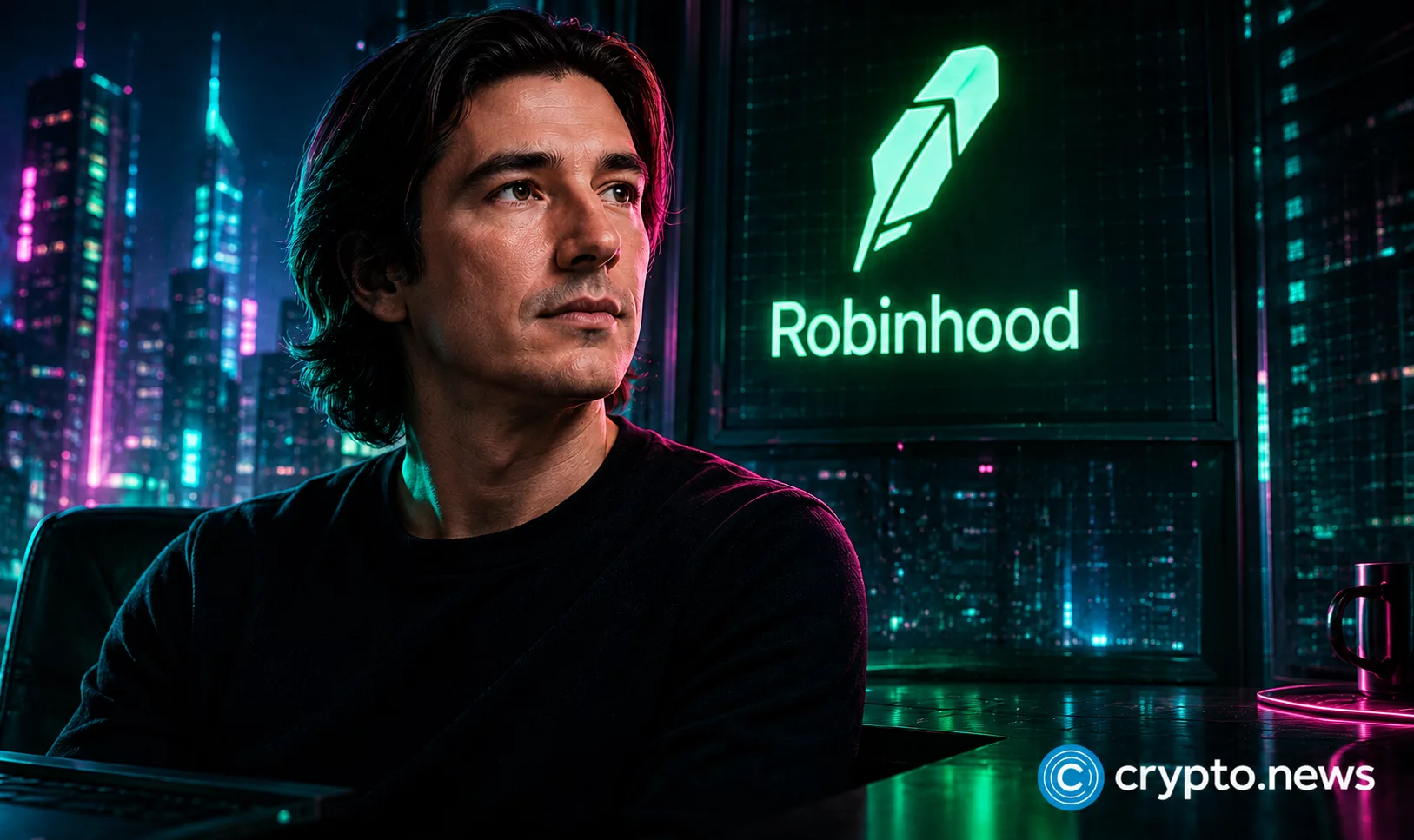
When hackers hijacked Robinhood’s CEO’s X account, they did not run the usual smash-and-grab. They launched a token whose liquidity is locked forever, un-ruggable by design, and are collecting trading fees from it in perpetuity. The rug pull just evolved into a yield product, and the anti-scam infrastructure built the machine.
Summary
- Hackers compromised Robinhood CEO Vlad Tenev’s X account on Thursday and promoted Vladhood ($VLAD) as the “official mascot” of Robinhood Chain, drawing 175,000 views in under 20 minutes and $22 million in trading volume.
- The operation was premeditated, not opportunistic: the token contract deployed 46 minutes before the hacked post, through the Pons launchpad, with Tenev’s own X profile listed as the token’s official website.
- The mechanism is the story: Pons locks a token’s liquidity permanently, making rug pulls impossible, but lets creators claim trading fees, so the attacker farms income from every trade, roughly $59,000 claimed in the first hours and still accruing, atop total proceeds estimated at $1.2-1.3 million.
- The design inverts a decade of scam economics: instead of one exit event, the scammer holds a perpetual annuity on victim activity, and the anti-rug protection that legitimizes the launchpad is precisely what guarantees the income.
- It is the second executive-account token scam on Robinhood Chain in eleven days, six days before the company’s earnings call, and it poses a question the industry has not answered: who is liable when scam-proofing infrastructure becomes the scam’s business model.
Crypto crime has a classical form, refined over a decade: create a token, manufacture credibility, collect the victims’ money, and vanish, the rug pull, a crime with a beginning, a middle, and above all an end. What happened on Thursday, when hackers seized the X account of Robinhood’s chief executive and pointed 15 million followers at a memecoin called Vladhood, had the beginning and the middle and then, deliberately, no end.
The attackers launched $VLAD through a launchpad whose signature safety feature locks a token’s liquidity forever, which means the token cannot be rugged, which means, and here is the inversion worth an entire article, the scam never has to stop. The locked pool collects trading fees on every swap, the launchpad pays those fees to the token’s creator, and the creator is the hacker, who called the fee-collection function six times in the first two hours and has no reason ever to stop calling it. The rug pull was a robbery. This is a toll booth, built on stolen credibility, operated in public, generating income for its architect with every trade, protected by the exact mechanism the industry built to protect traders. The Defiant’s on-chain forensics documented the machine within hours; what the machine means, for scam economics, for the launchpads, and for the brokerage whose chain now hosts its second executive-impersonation token in eleven days, is the subject here.
The operation, reconstructed
The timeline, assembled from on-chain records and the forensic work of The Defiant and Onchain Lens, settles the fact that reframes everything else: this was a single coordinated operation, planned around the account takeover, not a scammer riding a lucky hack.
At 12:38 pm ET on Thursday, a wallet with no prior history launched Vladhood through Pons, the busiest of the Pump.fun-style launchpads that colonized Robinhood Chain in its first month. The launch parameters included a detail that functions as a confession of premeditation: the token’s official website field listed Tenev’s X profile URL, meaning the creators configured the token around an account they did not yet publicly control. Forty-six minutes later, the post appeared on that account: Does Robinhood love memes? The answer is yes, introducing $VLAD as the official mascot of Robinhood Chain, falsely promising a Robinhood app listing, signed off, Welcome to the Hood, with the contract address attached. The credibility stack was complete: a verified account, a CEO’s voice, a chain the CEO actually launched three weeks earlier, and a claim, app listing, that sat exactly on the boundary of plausible.
The market did what engineered credibility makes it do. The post drew more than 175,000 views in under 20 minutes; the token ran up more than 90,000% from launch; volume reached $22 million across roughly 85,000 swaps in the main pool; the market cap touched somewhere between $4 million and $10 million depending on the snapshot; 5,266 holders and 137,000 transfers accumulated on a contract deployed that afternoon. Robinhood’s communications team confirmed the compromise roughly 41 minutes after the post and worked with X to delete it; the chain’s own explorer flagged the contract as a likely scam. On-chain monitors estimate wallets tied to the operation extracted around 650 to 690 ETH, between $1.2 million and $1.3 million, through the classic half of the play, early wallets, holding a reported 70% of supply, selling into the spike.
And then the part that makes this a new genre: the sale was not the payday’s end. It was the down payment.
The mechanism: anti-rug as annuity
To see the innovation, start with the protection it exploits, because the protection is real and the exploitation is parasitic on its virtue.
Launchpads in the Pump.fun lineage answered the rug pull structurally: when a token graduates to a trading pool, the platform locks the liquidity in a locker contract the creator cannot drain. The creator cannot pull the pool, so the classic exit, remove liquidity, collapse the price to zero, vanish, is mechanically impossible, which is the safety pitch that lets these platforms describe themselves as scam-resistant and lets traders ape into anonymous tokens with one category of fear removed. Pons implements the standard design with the standard incentive attached: locked liquidity still generates trading fees on every swap, and those fees are claimable by the token’s creator, a reasonable arrangement meant to reward legitimate builders whose tokens sustain volume.
Now run the $VLAD operation through that machinery. The attacker cannot rug, and does not need to. Every trade in the pool, the panic selling after the exposure, the bagholders averaging down, the day traders playing the volatility, the bots arbitraging the chaos, pays a fee, and the fee flows to the creator wallet on demand. Starting seven minutes after the fake post, the wallet called the locker’s fee-collection function six times over roughly two hours, netting about 31.6 ETH, roughly $59,000, and the meter is still running: the balance grows as long as anyone, for any reason, trades the token. The Defiant’s framing captures the inversion precisely: the wallet did not need to pull liquidity to cash out. The token never rugged. It just collects.
The economics deserve to be stated as the design they are. A rug pull monetizes credibility once, in a single extractive event that ends the scam and starts the manhunt. The locked-liquidity structure converts the same stolen credibility into an income-producing asset: a perpetual claim on the trading activity of a token that cannot die by its creator’s hand, whose infamy itself sustains volume, and whose victims’ every attempt to trade out of their position pays the person who put them in it. The scam has acquired a business model, and the business model was donated by the anti-scam infrastructure. Eleven days earlier, crypto.news covered the predecessor eleven days earlier, the SCATMAN operation, run through SpaceX’s hijacked accounts onto this same chain, which took $135,000 in the classical style and ended. $VLAD’s operators took ten times that in the opening hours and, structurally, have not ended at all. That delta, between a robbery and a franchise, is the evolution this incident marks.
The venue, the timing, and the liability question
The setting compounds the story, because the chain hosting this evolution belongs to a licensed brokerage six days from its earnings call.
Robinhood Chain’s first month, as this publication has documented in the venue’s first-month composition problem, delivered $700 million in assets, 300,000 daily active addresses, top-tier DEX volume, third place in seven-day chain revenue, and a composition problem: memecoins driving the overwhelming majority of activity against roughly $13 million in the tokenized real-world assets the chain was built for. The scam wave is the composition problem’s sharpest edge, SCATMAN through hijacked SpaceX accounts on July 12, a launchpad going dark mid-boom with an estimated $12 million in fees, and now the chain’s own founder’s face on its most sophisticated fraud, a token the chain’s explorer flags as a scam while the chain’s fee mechanics, this is the uncomfortable part, collect revenue on every one of its trades, as does the sequencer’s operator. A brokerage whose regulatory identity is bringing compliant rails to digital assets is earning protocol revenue, however small, on a fraud impersonating its own CEO, and its earnings call, where management must frame the chain’s first month for analysts and its Say-platform retail questioners, now has its opening exhibit. That is the earnings call this incident now precedes.
The liability question is the one the industry has not answered, and $VLAD converts it from hypothetical to operational. The launchpad designed the locker; the locker guarantees the scammer’s income; the design choice that prevents one crime funds another. Is Pons, which profits from launch fees and whose factory contract the explorer flagged, a neutral tool provider, the Section 230 of token creation, or does operating a fee-annuity machine that any account thief can drive create obligations, to freeze creator-fee claims on flagged tokens, to require identity for fee withdrawal, to build the kill switch the anti-rug design deliberately omitted? Every answer has a cost: freezable fees reintroduce the trusted operator the architecture exists to remove, identity requirements gut the permissionless launch model that generates the volume, and doing nothing leaves the annuity running. The same trilemma applies one level up, to the chain, and one level higher, to X, whose verified-account security has now been the entry point for two nine-figure-audience token frauds in eleven days on the chain the scams chose alone, part of a lineage running from the 2024 celebrity-account wave through this month’s fake Armstrong coin. Executive social accounts have become, functionally, financial infrastructure, secured like consumer products.
The economics of borrowed trust, quantified
Step back from the mechanism and the incident yields something rarer than a forensic timeline: a clean measurement of what stolen credibility is worth per minute, and a market structure that prices it.
Run the numbers as a conversion funnel. The hijacked account held roughly 15 million followers; the post survived approximately 20 minutes in primary distribution and drew 175,000 views; the token processed $22 million in volume and accumulated 5,266 holders within hours; the operators extracted $1.2 to $1.3 million in direct proceeds plus the ongoing fee stream. That is roughly $65,000 of extraction per minute of post uptime, about $7.40 per view, and around $250 of eventual volume per view, numbers that explain, better than any security advisory, why executive account compromise has become a professionalized industry with its own supply chain: access brokers who source the credentials, operators who build the token infrastructure in advance, and distribution specialists who time the post. The 46-minute pre-deployment is the industrial tell, the attack was inventory waiting for its distribution moment, and the same funnel mathematics applied to the SCATMAN operation, a smaller account constellation and a cruder mechanism, yielded a tenth of the proceeds, which is exactly the relationship a maturing industry’s cohort analysis would predict: returns scale with audience quality and mechanism sophistication, and both are improving.
The funnel also identifies where defense actually binds, and it is not where the industry spends. Post-hoc measures, explorer flags, account restoration, post deletion, all activated within the hour here, and the operation was profitable within seven minutes; the deletion ended distribution after the extraction window had already closed. The binding constraint is upstream: the account security that gates the distribution moment, and the launch infrastructure that lets the monetization machine be assembled anonymously in advance. Which is why the two reforms with actual leverage are unfashionable ones, hardware-key mandates and session-hygiene requirements for accounts above an audience threshold, effectively treating large verified accounts as the financial infrastructure they now are, and creator-fee escrow periods on launchpads, a delay between fee accrual and fee claim long enough for flags to propagate, which would have converted $VLAD’s annuity into a frozen exhibit without touching the permissionless launch itself. Neither reform requires identifying anyone; both attack the funnel’s throughput rather than its aftermath. The industry’s current posture, in which a nine-figure-audience account is secured by whatever its owner chose and a flagged scam’s fees flow to its operator in real time, is not a policy. It is a bounty schedule, published daily, and Thursday’s operators simply read it.
What to watch
The fee meter. The creator wallet’s claims are public and ongoing. Whether the balance crosses six figures, and whether anyone, Pons, the chain, a court, ever interrupts it, is the cleanest measure of whether the industry treats this as an incident or a precedent. As of the first day, nothing in the architecture can stop it.
The launchpad’s response. Pons faces the trilemma first: freeze mechanics, identity gates, or explicit neutrality. Its choice, and whether Robinhood Chain pressures it, writes the first draft of the fee-annuity era’s rules, and every copycat is watching. The design is trivially replicable on any chain with a locked-liquidity launchpad, which is all of them.
The earnings call, July 29. Whether analysts or Say questioners force management to address the scam wave on the record, and whether the answer gestures at curation, moderation, or enforcement, would mark the first time a public brokerage defines its responsibility for frauds conducted on infrastructure it operates and profits from.
The security postmortem. How the attackers took the account, SIM swap, session theft, insider access, matters for every executive in the industry, because the $VLAD operation’s real innovation was pairing patient token engineering with account compromise as a single planned instrument. The 46-minute gap between deployment and post is the tell: this was manufactured, and manufacturing scales.
The rug pull is dying the way all crimes die, by evolving into something the law has not named yet. $VLAD’s architects understood what the industry’s own safety engineering had built: a machine that converts stolen credibility into permanent income, legally ambiguous, mechanically unstoppable, and hosted on the most scrutinized new chain in crypto. The $59,000 in claimed fees is a small number. The design it proves out is not, because every locked pool on every launchpad on every chain is now, visibly, a potential annuity for whoever can manufacture one hour of borrowed trust, and the industry that built the locks has not built the thing that comes after: a way to stop paying the thief.
A closing note on the naming problem, because it will shape the response. The legal system has vocabulary for the rug pull: theft, wire fraud, market manipulation, each with elements prosecutors know how to plead against an exit event. The fee annuity fits none of them cleanly. The initial impersonation is straightforwardly criminal, identity theft and securities-adjacent fraud in the account takeover and the false listing claim, and any eventual defendant will face those counts. But the ongoing income stream is stranger: after the exposure, every subsequent trader in $VLAD acts with full knowledge that the token is flagged, the fees are disclosed by the mechanism itself, and the operator extracts value not by deceiving anyone still present but by having once deceived people no longer trading. Whether collecting contractually-defined fees from a pool of informed speculators constitutes ongoing fraud, unjust enrichment, or merely distasteful legality is a question no court has answered, and the answer determines whether the annuity can be seized, whether launchpads face aiding liability for paying it out, and whether the design spreads with impunity. It is another case of when mechanism design meets adversaries. The industry’s enforcement history suggests the question gets answered slowly and by the worst possible case: some future iteration of this design, at ten times the scale, attached to a fraud egregious enough to force the doctrine. Until then, the $VLAD wallet keeps calling its function, the locker keeps paying, and the gap between what the mechanism permits and what the law has named sits open, collecting fees.
Frequently asked questions
What happened to Vlad Tenev’s X account?
Hackers took control of the Robinhood CEO’s verified X account on Thursday, July 23, and posted a promotion for a fake memecoin called Vladhood ($VLAD), presenting it as the official mascot of Robinhood Chain and falsely claiming it would be listed on the Robinhood app. The post drew over 175,000 views in under 20 minutes before removal. Robinhood confirmed the compromise about 41 minutes after the post and said it was working with X to restore access.
Was this an opportunistic hack?
No, it was premeditated and coordinated. On-chain records show the token contract was deployed through the Pons launchpad 46 minutes before the fraudulent post appeared, and the launch configuration listed Tenev’s own X profile as the token’s official website, meaning the operation was built around an account takeover that had not yet happened publicly. The account compromise and token launch were parts of a single planned instrument.
How much did the attackers make?
Two figures describe it. On-chain monitors estimate total proceeds of roughly 650 to 690 ETH, about $1.2 to $1.3 million, largely from early wallets, holding a reported 70% of supply, selling into the spike. Separately, the locked liquidity pool has paid the creator wallet approximately $59,000 in trading fees in the first hours, claimed across six withdrawals, and that stream continues to accrue with every trade.
Why is the token impossible to rug pull, and why does that matter?
The Pons launchpad locks a token’s liquidity in a locker contract the creator cannot drain, a standard anti-rug protection. That makes the classic exit scam impossible, but the locked pool still generates trading fees that the creator can claim. The attacker therefore holds a perpetual income stream from all trading in the token, converting a one-time scam into an ongoing annuity that the protection itself guarantees.
How does this compare to the SCATMAN incident?
SCATMAN, eleven days earlier, used hijacked SpaceX and Starlink accounts to promote a token on the same chain and extracted roughly $135,000 in the traditional pump-and-dump style, an operation with an end. $VLAD extracted roughly ten times more in its opening hours and structurally has no end, because the fee stream persists. The two incidents mark an evolution in method on the same venue within two weeks.
Does Robinhood bear responsibility for scams on its chain?
That is the unresolved question the incident sharpens. The chain is permissionless, and Robinhood did not authorize the token, but the network and its sequencer earn revenue on all activity, including fraud, and the chain’s explorer flagging cannot stop trading or fee claims. The launchpad faces the same trilemma: freezing fees or requiring identity would compromise the permissionless model, while inaction leaves the annuity running. No platform has yet defined its obligations.
What should users take from this?
That verified executive accounts are now a primary fraud vector: two major incidents in eleven days used hijacked official accounts, and posts announcing surprise tokens should be treated as compromises by default, checked against official company channels, which stayed silent in both cases. Locked liquidity means a token cannot be rugged; it does not mean the token is legitimate, and in this design, trading a flagged token pays its creator.
Could this scam model spread?
Easily, which is its significance. Any launchpad that combines locked liquidity with creator-claimable fees, the dominant design across chains, can host the same structure, and the required ingredient, an hour of borrowed credibility, can come from any compromised account with reach. Until platforms build mechanisms to interrupt fee claims on flagged tokens, each such pool is a potential perpetual payout for whoever manufactures the trust. This is educational analysis, not financial or legal advice.
Disclaimer: This article is for information and educational purposes only and does not constitute financial, investment, or legal advice. It describes an ongoing security incident based on on-chain data and reporting available at the time of writing, and figures may change as investigations continue. Never interact with tokens promoted through unverified or compromised channels. Always do your own research. Information is accurate as of July 24, 2026.
Bitcoin price has slipped back toward $65,000 after spot ETF outflows, a major options expiry and rising oil prices stopped its rebound from extending beyond $66,800.
Summary
- Bitcoin price retreated to $65,000 after spot ETFs recorded $225 million in net outflows.
- A $1.2 billion options expiry placed the closely watched maximum-pain level at $64,500.
- Losing $63,700 could expose Bitcoin to a deeper decline toward the $60,000 area.
According to data from crypto.news, Bitcoin (BTC) price traded near $65,050 on July 24, down about 2.6% from its July 21 peak. Traders remained cautious as the pullback brought the price closer to a large derivatives settlement level and a rising trendline that has supported the recovery since late June.
U.S. spot Bitcoin exchange-traded funds recorded $225 million in net outflows on July 23, according to SoSoValue data. BlackRock’s IBIT accounted for about $202 million of those withdrawals, reversing the steady institutional inflows that had helped Bitcoin recover from its June low near $58,000.
At the same time, U.S. technology shares suffered their sharpest sell-off since April 2025. The Magnificent Seven fell 4.8% on July 23 and lost about $797 billion in combined market value as investors questioned the scale of corporate spending on artificial intelligence. The Nasdaq 100 dropped 1.9%, while the S&P 500 lost 1.2%.
Bitcoin fell less than 1% during the equity sell-off, which showed relative strength against technology stocks. However, the decline in risk appetite denied BTC the new capital needed to clear the $66,800 resistance area.
Oil prices added another obstacle. West Texas Intermediate crude eased to about $90.59 on Friday but remained on course for a weekly gain of nearly 10%, while Brent held near $98.87 after briefly trading above $100.
The United States carried out a 13th consecutive night of strikes on Iran as Washington and Tehran rejected immediate negotiations. President Donald Trump also threatened “major military punishment” against Iran and the Houthis after the militant group attacked two Saudi oil tankers in the Red Sea.
Higher energy costs could keep inflation elevated and reduce the Federal Reserve’s room to cut interest rates during the second half of 2026. Rising Treasury yields would also increase the appeal of income-producing assets over Bitcoin, which pays no interest.
Bitcoin price remains above its rising trendline despite weaker momentum
Bitcoin’s 4-hour chart shows an ascending support line connecting a series of higher lows formed since the price bottomed near $58,000 in late June. The trendline now sits between $63,700 and $64,300, placing the current price about 1.5% above the structure.
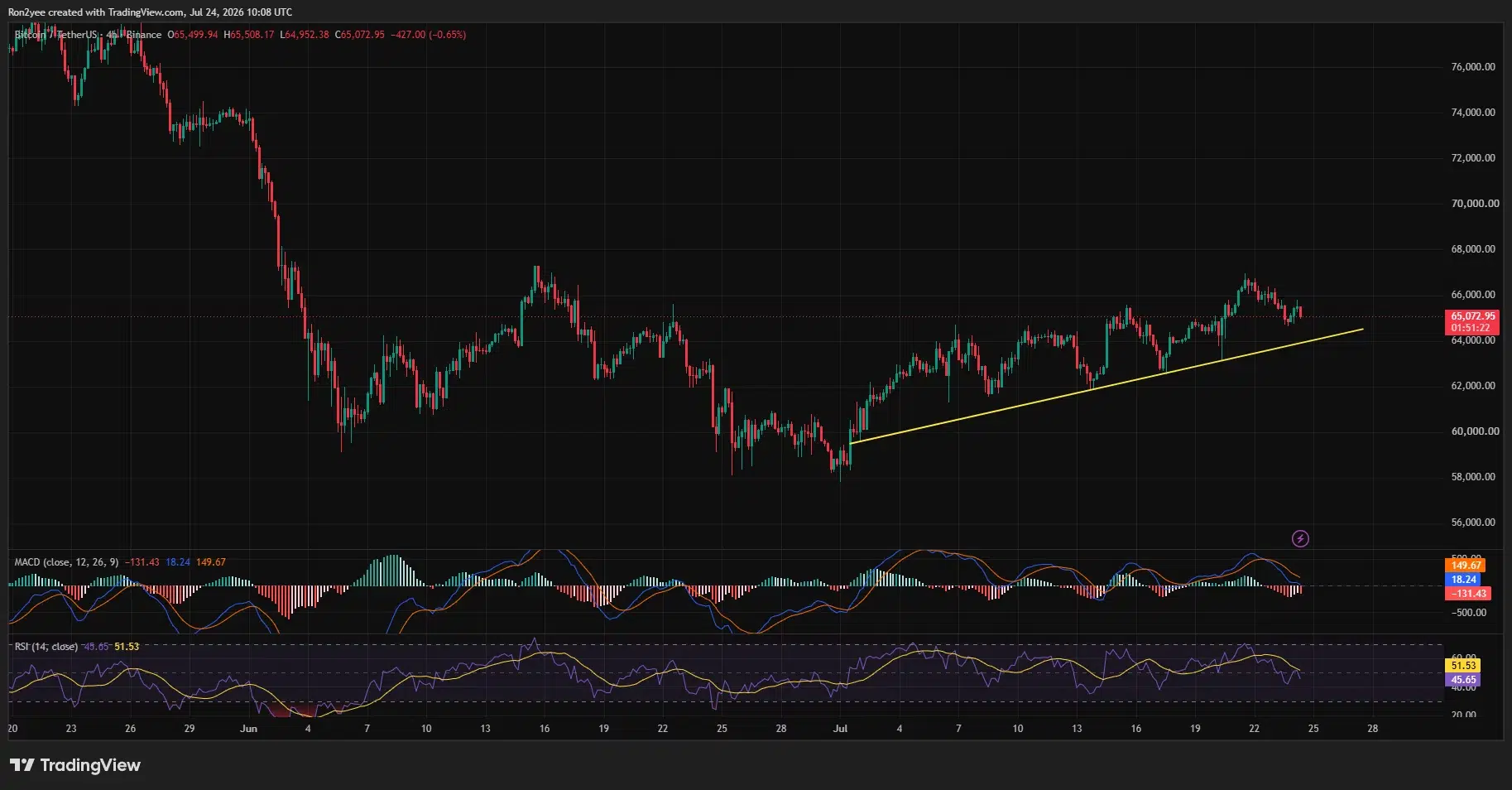
Momentum has weakened after BTC failed to hold above $66,000. The 4-hour Relative Strength Index fell to 45.65, below its signal average of 51.53, but remained above the oversold threshold of 30.
Meanwhile, the Moving Average Convergence Divergence line dropped below its signal line. The histogram reached negative 131, which shows that sellers have controlled the latest 4-hour candles following the rejection near $66,800.
On the daily chart, Bitcoin remains above its 20-day and 50-day simple moving averages at $64,293 and $63,181. The price must hold those levels to preserve the recovery structure formed since June.
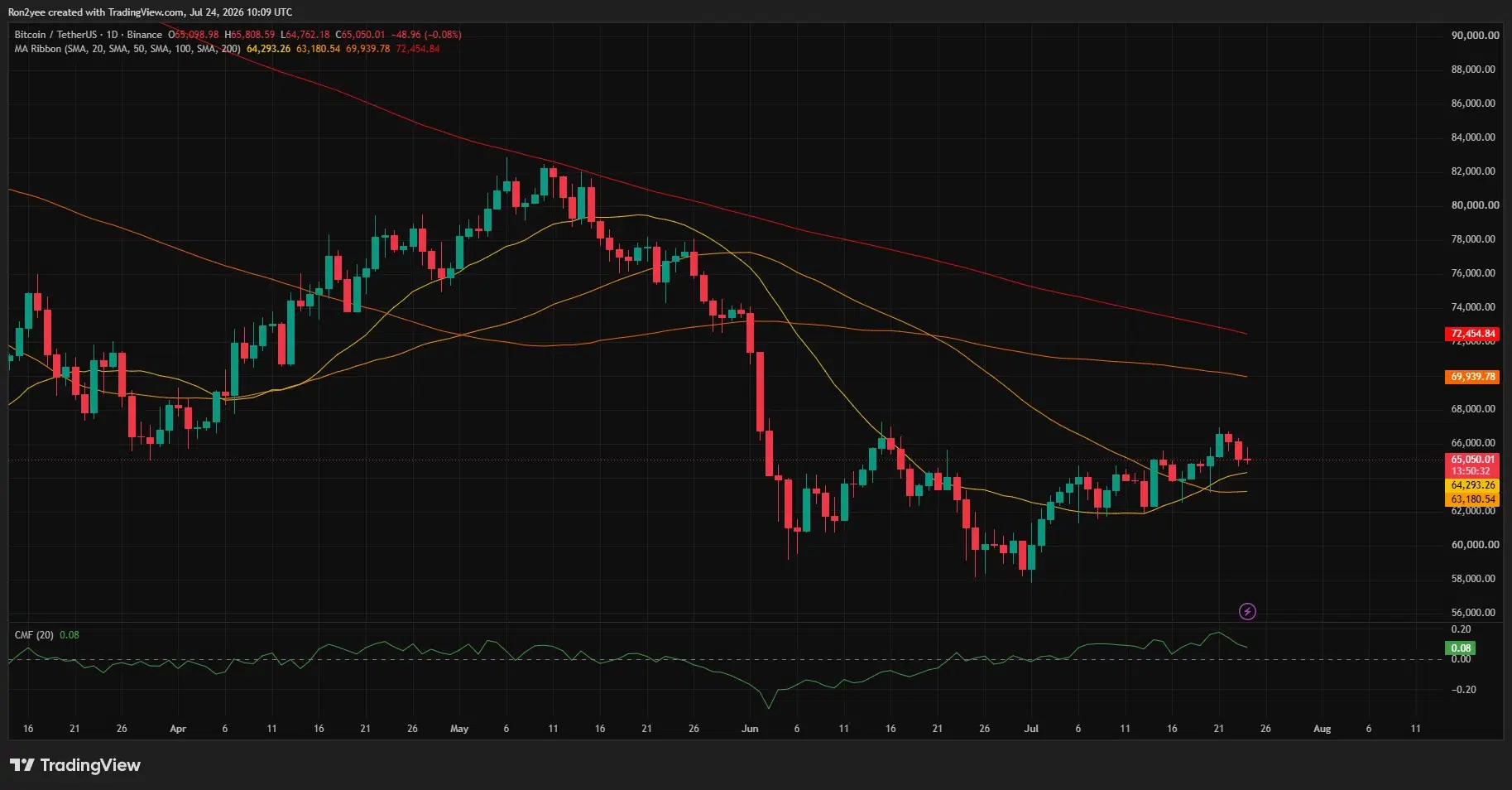
Chaikin Money Flow remained positive at 0.08, showing that buying volume has not fully left the market despite the ETF withdrawals. However, BTC still trades below its 100-day and 200-day moving averages at $69,940 and $72,455, leaving the long-term trend under seller control.
A daily close above $66,800 would open the path toward the 100-day average near $70,000. Bitcoin would then need to reclaim $72,455 to establish a stronger trend reversal.
The one-week CoinGlass liquidation heatmap places the nearest large pool of leveraged positions around $64,200–$64,500. Another dense cluster sits near $63,500, while upside liquidity has accumulated around $65,700 and between $66,500 and $67,300.
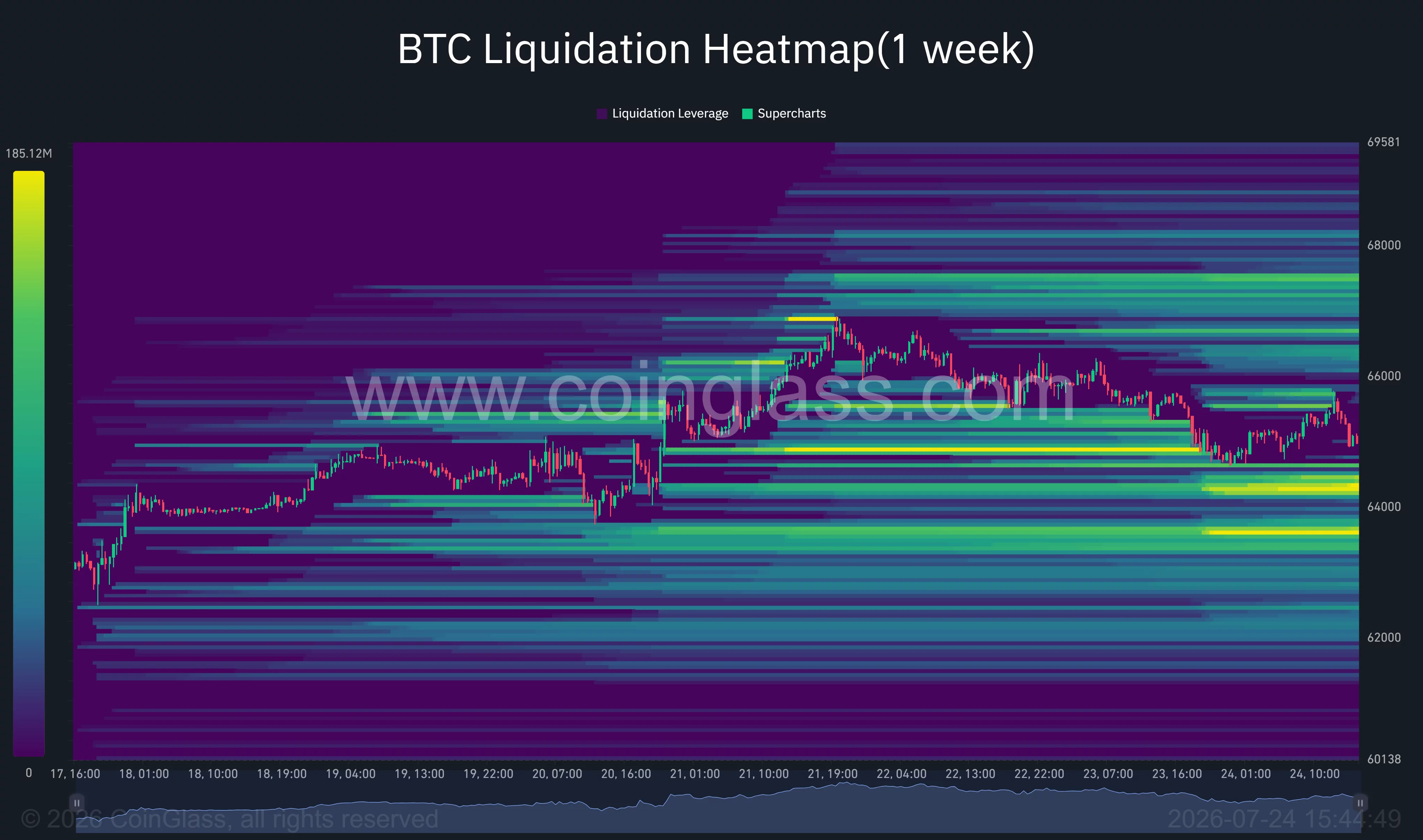
Those levels could attract price as traders approach the weekly derivatives settlement. About 19,000 Bitcoin options worth $1.2 billion expire on July 24, with a put-call ratio of 0.89 and maximum pain at $64,500, according to Greeks.live data. Implied volatility has also fallen toward 35%, while gamma exposure is concentrated at $65,000 and $72,000.
Drop under $63,700 would invalidate the local recovery
According to crypto analyst Lennaert Snyder, Bitcoin’s long setup remains active after BTC swept the $65,000 lows. Snyder identified $64,600 as a possible second-entry area and $67,000 as the next liquidity target.
“The invalidation for the local long thesis is the 63.7K low,” Snyder wrote.
A 4-hour close beneath $63,700 would break the rising trendline and expose the liquidation cluster near $63,500. Continued selling could then push BTC toward $62,000, followed by the June support zone between $58,000 and $60,000.
On the upside, $67,000 and $68,100 remain the immediate resistance levels. Snyder views $68,100 as both a profit-taking zone for long positions and a possible short entry, with $60,000 as the bearish target after a liquidity sweep.
Bitcoin’s outlook therefore depends on whether buyers defend the $63,700–$64,500 area after the options expiry. A renewed oil surge, further ETF withdrawals or an escalation in the U.S.-Iran conflict would raise the risk of a trendline breakdown, while a close above $66,800 would return control to buyers.
Disclosure: This article does not represent investment advice. The content and materials featured on this page are for educational purposes only.

Jaspah Too shop reopens in new Consett location

‘That’s the world we live in’: Travis Head breaks silence on wife’s online abuse after Virat Kohli handshake row | Cricket News
Will IEA/OECD countries release more strategic oil stocks?


-

 Crypto World7 days ago
Ripple Payments Joins MiCA With 14 Firms, Does It Mean Anything For XRP?
-

 Politics7 days ago
The House | The City of London can help the new chancellor deliver growth in every postcode
-

 Fashion8 hours ago
Weekend Open Thread: Brooks Brothers
-

 Politics6 days ago
Democrats look to World Cup watch parties to register thousands of voters
-

 Crypto World4 days ago
Grayscale Files For Worldcoin ETF, WLD Registers Sharp Rise
-

 Tech4 days ago
Sail Virtually Aboard The “Itanic” With IA-64 Emulator
-

 NewsBeat5 days ago
Unregistered fitter used Gas Safe logo on business flyers
-
 Tech4 days ago
Turtle Beach Command Series KB7 review: a nifty screen-equipped gaming keyboard
-
 Business3 days ago
New Jersey voter registration controversy explained: How 6,600 noncitizens got on the rolls, and what happens next
-

 News Videos5 days ago
Big Money Is Entering XRP
-

 Crypto World7 days ago
Kaspersky exposes OkoBot’s 20-module crypto wallet attack
-
 Entertainment3 days ago
Johnny Depp’s R-Rated Gothic Cult Classic Gets New Release Ahead of Sydney Sweeney Remake
-

 NewsBeat7 days ago
Durham County Council to send out electoral registration emails
-

 Crypto World7 days ago
MiCA Licensing Faces Delays as ESMA Adds 14 CASPs to Register
-

 Crypto World2 days ago
Ethics, other provisions in crypto Clarity Act to be further discussed
-

 Crypto World7 days ago
Chip Stocks Enter Bear Market After Moonshot Ai Unveils Kimi K3 Model
-

 Tech4 days ago
Watch Flock Safety CEO Garrett Langley discuss the future of surveillance at TechCrunch Disrupt 2026
-
 NewsBeat4 days ago
Shanghai science forum photos show China’s AI and robotics advances in rivalry with US
-

 Crypto World5 days ago
Circle’s President Sold Over 360,000 Shares, The Filings Explain Why
-

 Tech5 days ago
Subway Sandwich Computers Get a Second Life as Gaming Machines
You must be logged in to post a comment Login