
Crypto World
SEC proposal could remove crypto from OTC reporting requirements



The U.S. Securities and Exchange Commission has put forward a proposal which, according to SEC commissioner Hester Peirce, could help clear up years of confusion around how a key broker-dealer rule applies across markets.
Summary
- SEC has proposed limiting Rule 15c2-11 to equity securities, reversing its broader 2021 interpretation that raised questions for crypto assets.
- A 60-day public comment period has been opened as regulators seek feedback on how the rule should apply and whether crypto falls outside its scope
On Monday, the SEC proposed an amendment to Rule 15c2-11 that would limit reporting requirements for broker-dealers in the over-the-counter market to equity securities only, effectively reversing the broader interpretation introduced in 2021.
The SEC Rule 15c2-11 was first introduced in 1971 to ensure broker-dealers maintain up-to-date issuer information before they can publish over-the-counter quotes.
By placing obligations for firms to review and maintain current information about an issuer, the rule was designed to reduce risks in thinly traded markets, particularly in penny stocks.
Without this information, a broker-dealer is not allowed to initiate or resume quotations for a security in OTC markets.
However, the rule was reinterpreted in 2021 to extend beyond equities into other asset classes, and as a result, there have been questions around whether it can apply to crypto assets if they are classified as securities.
The SEC’s proposal would limit the rule’s scope to equity securities.
As such, broker-dealers won’t be required to apply these reporting requirements to crypto assets, even in cases where questions around their classification as securities remain unresolved.
This could make it easier for broker-dealers to support crypto trading and quote digital assets without having to rely on disclosure standards that do not align with how these assets function.
A public comment period has been opened where the commission is seeking feedback on whether the definition of equity securities should extend to crypto assets and how the rule should apply going forward.
According to Commissioner Peirce, who also leads the agency’s crypto task force, the proposal could help address confusion created by the earlier interpretation.
“By its terms, the text of Rule 15c2-11 always has applied to quotations of a ‘security.’ Market participants and other observers including me, however, understood the rule to apply only to quotations of over-the-counter (‘OTC’) equity securities,”
However, it must be noted that there is still no final decision on whether “equity securities” could include crypto assets.
Peirce said she would closely watch “questions about the definition of ‘equity security,’ the rule’s application to crypto assets, and the appropriate next steps with respect to the formation of an ‘expert market.’”


China’s tax and financial regulators on Monday urged banks and local authorities to use blockchain and privacy computing to upgrade the “bank-tax interaction” model and expand financing for small businesses.
The State Administration of Taxation and National Financial Regulatory Administration said in a joint policy notice that banks and taxpayers should standardize data sharing and reduce information asymmetry between tax authorities, banks and enterprises.
The report also urged banks to improve credit models, enhance credit approval efficiency and increase the supply of financing services to “honest, tax-paying enterprises.”
The directive aligns with China’s broader effort to integrate blockchain into data infrastructure, following a National Development and Reform Commission roadmap released in January 2025 targeting nationwide implementation by 2029.
Shen Zhulin, the deputy director of the National Data Administration, said in a January 2025 press conference that China expects blockchain-based data infrastructure to attract 400 billion yuan (about $58 billion) in yearly investments.

Chinese regulators outline data infrastructure push with 400 billion yuan target
While China has issued strict controls on cryptocurrencies and speculative digital asset trading, it also pushed for the incorporation of blockchain initiatives in finance and data infrastructure.
In October 2019, Chinese President Xi Jinping highlighted the technology as an important “breakthrough” for independent innovation of core technologies, urging the acceleration of the development of blockchain-based applications and their integration in the real-world economy.
Related: Trump: US has to ‘make it so that China doesn’t get the hold‘ of crypto
In April 2021, the Shenzhen Tax Bureau expanded the country’s first blockchain electronic invoice system.
However, in September that same year, China issued a nation-wide ban on crypto transactions and mining as part of a wider crackdown across multiple government agencies.

Despite the ban, China is still cited as the third-largest Bitcoin (BTC) mining country. In January 2026, it accounted for 11.7% of the global hashrate, according to data from Compass Mining.
Magazine: China’s ‘50x’ blockchain boost, Alibaba-linked AI mines Bitcoin: Asia Express
Crypto World
Bitcoin (BTC) price rallies on Iran ceasefire talks, Algorand (ALGO) extends gains: Crypto Markets Today


Bitcoin climbed to near $70,000 as traders reacted to signs of possible de-escalation in the Iran war and amid a short squeeze that liquidated more than $270 million in shorts.
Crypto prices rose, along with equity index futures and equities, as Axios reported that the U.S. and Iran are discussing a potential 45-day ceasefire. The report raised hopes that hostilities could ease, potentially lowering the risks for ships sailing through the Strait of Hormuz.
That is improving appetite for risk assets across markets, and the U.S. Dollar Index (DXY) fell. The retreat is being amplified as reports suggest Pakistan is brokering what’s being called the “Islamabad Accord.”
Under the deal, a ceasefire would take effect immediately and the Strait of Hormuz would be reopened. Nevertheless, markets still need convincing.
On Polymarket, the odds of a ceasefire this month are at around 30%, up from 18% before the Islamabad Accord came to light. Oil prices remain elevated, and the Federal Reserve is still widely expected to keep interest rates unchanged.
If a ceasefire materializes and the conflict winds down, a relief rally could further benefit risk assets. For now, though, traders appear to be treating the headlines with skepticism.
Derivatives Positioning
- Notional open interest (OI) in bitcoin and ether (ETH) has risen by 7% and 11%, respectively, outpacing spot price gains. This suggests fresh capital inflows into the market, likely chasing bullish exposure, as both funding rates and cumulative volume deltas for BTC and ETH remain positive.
- Among altcoins, ADA, AVAX and LINK stand out with double-digit increases in open interest alongside positive funding rates. In contrast, sentiment appears bearish for BCH and HYPE, which are sporting negative funding rates.
- Bitcoin’s volatility meltdown continues, signaling market calm and supporting bullish price action. The 30-day implied volatility index, BVIV, has dropped below 50% for the first time since early February. Ether’s index, EVIV, also fell to the lowest level in weeks.
- On Deribit, bitcoin’s $60,000 put and the $80,000 call are the most popular options bets, each boasting a notional open interest of $1.40 billion at press time. These, therefore, are key levels to watch, as they represent areas where traders are heavily positioned for either downside protection or upside participation.
- Volatility, therefore, could pick up sharply if prices move outside of the $60,000-$80,000 range.
- Broadly speaking, the mood in options market remains cautious despite bullish hints in futures. BTC and ETH puts remain pricier than calls, a sign of sticky demand for downside hedging. Some of the bias for puts also stems from persistent overwriting of calls, a yield-generating strategy.
Token Talk
- Algorand’s ALGO token has surged nearly 50% in the past 30 days after a Google Quantum AI research paper highlighted its approach to quantum-resistant security.
- The Google report examined how blockchains can defend against future threats from quantum computers, which might be able to break current encryption methods. Algorand drew notable attention for its use of FALCON, a post-quantum signature scheme selected by U.S. standards body NIST.
- The network already uses the system for features like state proofs, which confirm ledger updates, and for certain transaction types.
- ALGO rose from about $0.08 to near $0.12 so far, bringing its market capitalization past $1 billion. It’s up more than 7.3% in the last 24 hours amid a wider market rally.
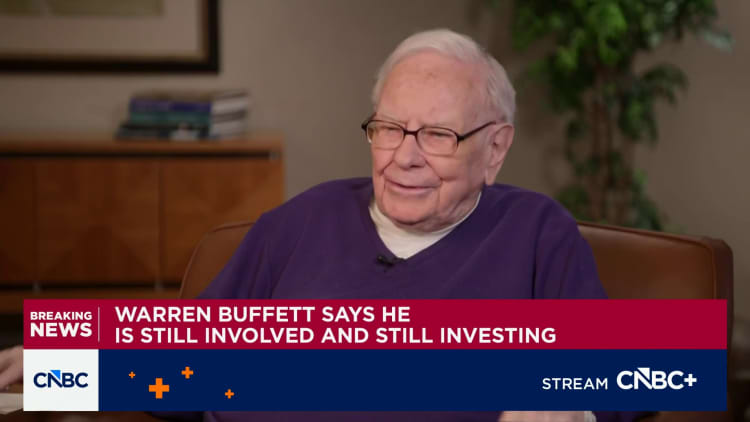

Warren Buffett said Tuesday he remains closely involved in investment decisions at Berkshire Hathaway even after stepping down as chief executive, adding that he recently made a “tiny” new purchase.
The 95-year-old investor, in an interview with Becky Quick on “Squawk Box,” said he still comes into the office daily and stays engaged with markets, working alongside colleagues on trades. Buffett described a routine that includes calling Mark Millard, Berkshire’s director of financial assets, before the opening bell to discuss market developments.
Millard, whose office sits about 20 feet away, executes trades based on those conversations, Buffett said, underscoring that he remains hands-on despite handing over the CEO role to Greg Abel in the beginning of 2026.
“I won’t make any [investments] that Greg thinks are wrong. … Greg gets the sheet every day,” Buffett said, referring to the firm’s regular investment updates. Asked whether he has made any new investments, he replied that he recently made “one tiny purchase,” without elaborating.
Buffett also downplayed recent market volatility, suggesting current conditions fall far short of past periods that created major buying opportunities.
“Three times since I took over, for sure it’s gone down more than 50%. … This is nothing to make you get excited,” Buffett said.
The “Oracle of Omaha” also revealed that Berkshire purchased $17 billion worth of Treasury bills this week at the weekly auction. Berkshire reported more than $370 billion in cash equivalents on the books at year-end, largely held in Treasury bills.
Read more from CNBC’s interview with Warren Buffett


Disclosure: This article does not represent investment advice. The content and materials featured on this page are for educational purposes only.
AI crypto trading apps is gaining popularity in 2026 as beginners seek automated ways to earn passive income.
Summary
- AI crypto trading apps surge in 2026, offering beginners automated strategies and passive income opportunities
- MoneyFlare leads AI trading platforms with no-code automation and 24/7 algorithm-driven crypto execution
- Rising demand for passive crypto income drives adoption of AI tools using real-time data and smart trading strategies
As the cryptocurrency market continues to evolve, many beginners are turning to AI crypto trading apps to automate their trading processes and earn passive income without the need for coding skills.
In 2026, AI trading technology has become more advanced, allowing investors to use smart algorithms and real-time data to make profitable trades. These tools are particularly appealing to newcomers who want to earn money without the complexities of manual trading.
In this article, we will explore the 7 best AI crypto trading apps for 2026, with MoneyFlare taking the top spot, helping anyone get started with automated trading and passive income.
1. MoneyFlare — Best AI Crypto Trading App for Beginners
Why Choose MoneyFlare?
MoneyFlare stands out as one of the leading AI-powered crypto trading platforms for beginners in 2026. Its key strength lies in its fully automated trading system. No coding experience is needed. Simply choose a strategy, and the AI executes trades on a user’s behalf 24/7, optimizing their potential profits.
Key Advantages of MoneyFlare:
- One-Click Activation: Get started quickly without any technical setup.
- Precision Algorithms: The AI uses advanced algorithms to analyze market trends in real time and adjust trading strategies for optimal performance.
- Low-Risk Settings: MoneyFlare provides tools to manage and reduce risk while maximizing profits.
- 24/7 Trading: The AI runs continuously, trading even when the user is not actively monitoring the market.
- User-Friendly Interface: The platform’s intuitive design makes it perfect for beginners who are just starting their trading journey.
How MoneyFlare works: A Step-by-Step Guide for Beginners
- Sign Up and Create an Account: New users who register will receive a free $10 real reward and a $50 trial credit!
- Deposit Funds: Choose a preferred method and fund an account to start trading.
- Select a Trading Strategy: Choose from a variety of automated strategies designed for beginners.
- Start Automated Trading: With just one click, activate the AI system, and let it handle all trades.
2. Cryptohopper — Best for Automated Portfolio Management
Why Choose Cryptohopper?
Cryptohopper offers an ideal solution for users who wish to manage multiple exchanges and portfolios with minimal effort. It combines technical analysis tools and automated strategies to help users optimize their crypto investments.
Key Advantages of Cryptohopper:
- Multi-Exchange Compatibility: Supports several major exchanges, allowing users to manage trades across multiple platforms.
- Signal Marketplace: Provides trading signals from the market, enabling users to make informed decisions.
- Pre-Built Strategy Templates: Helps beginners implement various strategies with minimal setup.
3. 3Commas — Best for experienced beginners
Why Choose 3Commas?
3Commas is ideal for beginners who are ready to move beyond basic trading and explore more complex strategies. It offers smart trading bots and provides a platform for both automated and manual strategy adjustments based on real-time market conditions.
Key Advantages of 3Commas:
- Smart Bots: Automatically adjust strategies based on real-time market fluctuations.
- Risk Management Tools: Built-in tools like stop-loss and take-profit features to limit risk.
- Social Trading Feature: Allows users to follow and copy the strategies of successful traders.
4. Pionex — Best for beginners who want to start with no fees
Why Choose Pionex?
Pionex is a no-fee platform that is perfect for beginners looking to reduce trading costs. The platform offers multiple automated trading bots to execute trades on a user’s behalf.
Key Advantages of Pionex:
- Zero Trading Fees: No extra charges on transactions, making it an affordable platform for beginners.
- Variety of Bots: A wide selection of automated bots to cater to different trading styles.
- Simple to Use: The user interface is clean and easy to navigate, making it perfect for new traders.
5. Bitsgap — Best for arbitrage trading
Why Choose Bitsgap?
Bitsgap specializes in arbitrage trading, which allows users to profit from price discrepancies across different exchanges. This is ideal for traders who want to take advantage of short-term market inefficiencies.
Key Advantages of Bitsgap:
- Cross-Exchange Trading: Connects to multiple exchanges, enabling users to trade across different platforms.
- Automated Arbitrage: Detects and capitalizes on price differences automatically to generate profit.
- Demo Account: Test strategies and learn the platform without risking real funds.
6. WunderTrading — Best for social trading
Why Choose WunderTrading?
WunderTrading is an excellent platform for those who want to participate in social trading. Beginners can follow and copy strategies of successful traders, taking advantage of their experience.
Key Advantages of WunderTrading:
- Social Trading: Users can choose to follow successful traders and automatically copy their strategies.
- Easy Setup: The platform is designed to be intuitive, so users can start trading with just a few clicks.
- Trading Community: Access to a community of traders for the latest market insights and strategies.
7. TradeSanta — Best for short-term traders
Why Choose TradeSanta?
TradeSanta is a great choice for investors who prefer short-term trading strategies. The platform provides various short-term trading strategies to help users quickly capitalize on market fluctuations.
Key Advantages of TradeSanta:
- Short-Term Focus: Optimized for traders looking to capture short-term price movements.
- Customizable Strategies: Offers a wide variety of customizable strategies for users to tailor according to their preferences.
- Cloud-Based Trading: All trading functions are executed via the cloud, allowing users to trade from anywhere.
FAQ: Common questions about AI crypto trading apps
1. How can I earn passive income with AI crypto trading apps as a beginner?
AI crypto trading apps automate the trading process, allowing anyone to earn passive income without actively managing trades. After selecting a strategy and depositing funds, the AI does the work 24/7, making profitable trades.
2. Do I need coding skills to use AI crypto trading apps?
No, these platforms are designed for beginners. There is no need for any coding knowledge. Simply choose a trading strategy, and the AI will handle everything.
3. How do AI crypto trading bots work for beginners?
AI bots use algorithms to analyze the market and execute trades automatically. As a beginner, just select a strategy and the AI does the rest, trading based on real-time market conditions.
4. How long does it take to set up an AI trading app as a beginner?
Setting up is quick and easy. Sign up, deposit funds, choose a strategy, and start trading. Most platforms, like MoneyFlare, offer a demo account to practice first.
5. Can I make money with AI crypto trading without constantly watching the market?
Yes! AI bots trade 24/7, automatically capturing profitable opportunities without active involvement. Once set up, anyone can earn passive income while focusing on other things.
6. What if I don’t understand how AI crypto trading works? Can I still use it?
Yes! Platforms like MoneyFlare are designed for beginners. No need to understand the details of how AI works; just follow the simple setup steps, and the AI will do the rest.
7. How much do AI crypto trading apps cost to use?
Most platforms offer a free trial or basic plan. Some charge a small fee when a user starts trading with real funds. Always check for any fees before using advanced features.
Conclusion
Selecting the right AI crypto trading platform can help beginners easily get started with automated trading and begin earning passive income. From MoneyFlare’s fully automated trading system to Cryptohopper’s portfolio management and Pionex’s no-fee structure, each platform offers unique benefits. Whether someone is new to crypto trading or looking to optimize their strategies, these apps will support them along the way.
For those who are ready to start their AI trading journey, begin with MoneyFlare for its simple interface and automated strategies, and watch the crypto trading experience grow!
Disclosure: This content is provided by a third party. Neither crypto.news nor the author of this article endorses any product mentioned on this page. Users should conduct their own research before taking any action related to the company.

Key insights:
- The HYPE coin has dipped below the critical $37 support line, indicating weakening buying pressure and more bearish power.
- Fibonacci ratios imply that the $32.44 and $29.5 marks can be considered significant demand points.
- Negative readings from RSI and CMF confirm weakening momentum and capital flow, validating the prevailing bearish sentiment.
Breaking Below Crucial Support Level
The price action of Hyperliquid’s HYPE is now trading below the crucial support at $37, indicating a fundamental change in the price structure in the short term.
The support area was seen as a solid floor, having been tested on multiple occasions and bouncing back each time. However, the current breakdown shows that buying interest has diminished significantly.
Moreover, previous attempts to make a push towards the local resistance near $43.7 have not been successful, demonstrating the lack of ability of bulls to keep momentum going.
Another interesting thing to note is the breakout above $40, which took place in late March, was short-lived, as sellers took advantage of this situation.
Market Weakness in Wider Crypto Sector
The fall in the HYPE price is not an isolated incident. In the wider crypto market sector, Bitcoin, along with other cryptocurrencies, suffered declines during the same period.
The market weakness witnessed by the wider crypto sector has led to a decline in investor sentiment, which has made it difficult for HYPE to attempt any recovery moves. This has kept the bullish pressure limited, leading to further price weakness over the last two weeks.
Although there have been some negative developments in the short term, the overall picture remains positive in the long term. Earlier this year, in February 2025, HYPE reached almost $60 but declined rapidly to reach $20. Subsequently, the rise up to $43.7 was a part of a recovery phase.
Thus, the latest fall in HYPE prices can be seen as a retracement from its previous gains.
Levels Highlight Possible Drawdown
Fibonacci retracement levels through technical analysis point towards the possibility of additional drawdown in HYPE. The two levels of $32.44 and $29.5 appear significant, acting as areas for potential buying from traders.
The levels lie inside an established demand zone, which is crucial for the future movement of the crypto asset. However, trading activity currently reveals that there are no aggressive accumulations happening in these levels.
Bearishness Validated by Momentum Indicators
The momentum indicators also confirm the bearish scenario. In this regard, the RSI indicator has breached the 50 neutral level, pointing to an increase in selling activity and a slowdown in buying power.
Moreover, the CMF indicator continues to record negative readings, trading close to -0.15. This indicates that the capital is being withdrawn from the asset.
In terms of the smaller timeframes, especially the 4-hour timeframe, HYPE keeps forming lower highs, indicating the continuation of the bearish scenario. The rejection at the $42 mark in late March has formed a key resistance level that the bulls have failed to surpass.
The Resistance Level Determines the Chance for Reverse
If the stock is going to make a full recovery, HYPE needs to get past the resistance level at $41.59. Crossing this level will demonstrate new buying power and can be considered the start of the return to the $43.7 level.
Prior to that happening, the trend will remain bearish. The market’s dynamics will show that the market still approaches trading with caution and monitors vital areas of supply and demand.
In the short term, the demand zone from $29.5 to $32.5 is essential to pay attention to. If this zone is successfully maintained by buyers, there are good chances for a reversal to happen; otherwise, there might be even lower prices.
Cautious Outlook Continues
Generally speaking, the current trading prices of HYPE show that the market is under stress. The weak momentum, falling indicators, and uncertainties in the market environment are exerting significant pressure on the price of the cryptocurrency.
Even though the long-term chart shows possibilities for a recovery, it appears that the near-future prospects for HYPE remain bearish until it manages to reclaim the key resistance areas.
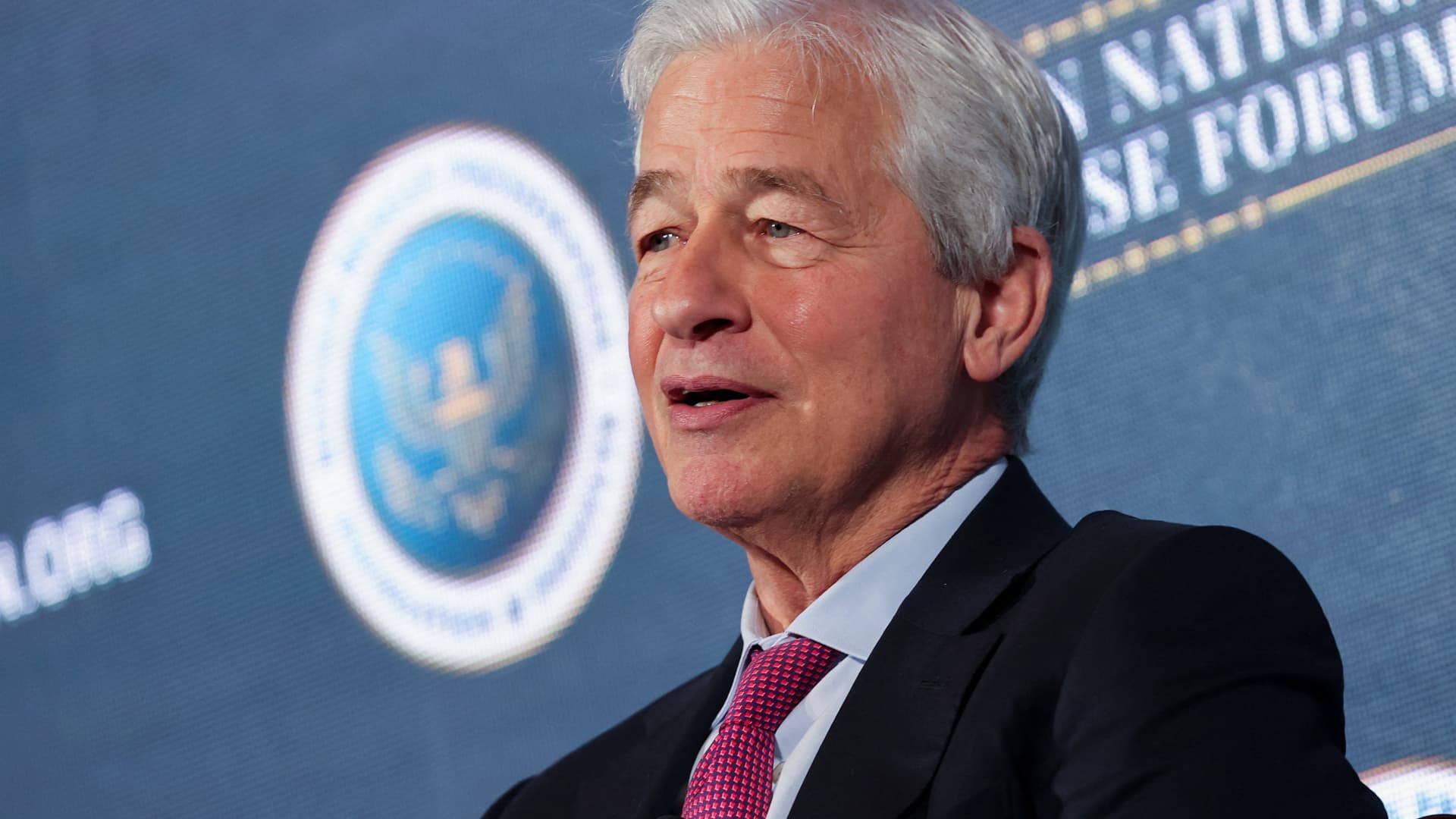
Jamie Dimon, Chairman and CEO, JPMorganChase, speaks during the Reagan National Defense Forum at the Ronald Reagan Presidential Library in Simi Valley, California, U.S. December 6, 2025.
Jonathan Alcorn | Reuters
JPMorgan Chase CEO Jamie Dimon is calling for a broad recommitment to American ideals as his bank navigates geopolitical uncertainty, a teetering economy and the revolutionary impact of artificial intelligence.
Dimon in his annual letter to shareholders, published Monday, noted the country’s 250th anniversary as “the perfect time to rededicate ourselves to the values that made this great nation of ours — freedom, liberty and opportunity.”
“The challenges we all face are significant. The list is long but at the top are the terrible ongoing war and violence in Ukraine, the current war in Iran and the broader hostilities in the Middle East, terrorist activity and growing geopolitical tensions, importantly with China,” Dimon said. “Even in troubled times, we have confidence that America do what it has always done — look to the values that have defined our singular nation and sustained our leadership of the free world.”
Dimon, the longtime leader of the world’s largest bank by market cap, is among the most outspoken of U.S. corporate leaders. His annual letter offers not only a matter of record for his firm’s performance, but also sweeping perspectives on the global state of affairs.
In Monday’s letter, Dimon noted headwinds including global conflicts, persistent inflation, private market upheaval and what he called “poor bank regulations.”
Dimon said that while regulations like those put in place after the 2008 financial crisis “accomplished some good things … they also created a fragmented, slow-moving system with expensive, overlapping and excessive rules and regulations — some of which made the financial system weaker and reduced productive lending.”
He specifically cited negative consequences of capital and liquidity requirements, the current construction of the Federal Reserve’s stress test and a “badly handled” process at the Federal Deposit Insurance Corporation.
Dimon also said JPMorgan’s reaction to revised proposals for Basel 3 Endgame and a global systemically important bank (GSIB) surcharge — issued by U.S. regulators last month — were “mixed.”
“While it was good to see that the recent proposals for the Basel 3 Endgame (B3E) and GSIB attempted to reduce the increase in required capital from the 2023 proposals, there are still some aspects that are frankly nonsensical,” Dimon said.
The CEO said the aggregate proposed surcharges of about 5%, the bank would need to hold “as much as 50% more capital across the vast majority of loans to U.S. consumers and businesses when compared with a large non-GSIB bank for the same set of loans.”
“Frankly, it’s not right, and it’s un-American,” he said.
On trade and geopolitics
Dimon identified geopolitical tensions as the primary risk facing his bank, namely the wars in Ukraine and Iran and their impacts on commodities and global markets — deeming war “the realm of uncertainty.”
“The outcome of current geopolitical events may very well be the defining factor in how the future global economic order unfolds,” he said. “Then again, it may not.”
He also cited a “realignment of economic relations in the world” brought on by U.S. trade policy. U.S. President Donald Trump has made tariffs a signature policy of his second term in office, introducing higher duties on dozens of trade partners and import categories.
“The trade battles are clearly not over, and it should be expected that many nations are analyzing how and with whom they should create trade arrangements,” Dimon said. “While some of this is necessary for national security and resiliency, which are paramount, it is hard to figure out what the long-term effects will be.”
On private markets
Dimon also spoke to recent upheaval in the private markets, as fears around loans made to software firms spur massive redemption requests at private credit funds.
“By and large, private credit does not tend to have great transparency or rigorous valuation ‘marks’ of their loans — this increases the chance that people will sell if they think the environment will get worse — even if actual realized losses barely change,” Dimon said.
The executive added that actual losses are already higher than they should be relative to the environment.
“However this plays out, it should be expected that at some point insurance regulators will insist on more rigorous ratings or markdowns, which will likely lead to demands for more capital,” he said.
On AI
Dimon reiterated Monday that the pace of AI adoption is unlike any technology that came before it. He said while its implementation will be “transformational,” it remains to be seen how the AI revolution will unfold.
“Overall, the investment in AI is not a speculative bubble; rather, it will deliver significant benefits. However, at this time, we cannot predict the ultimate winners and losers in AI- related industries,” Dimon said.
“We will not put our heads in the sand. We will deploy AI, as we deploy all technology, to do a better job for our customers (and employees),” he wrote.
JPMorgan has been at the forefront of Wall Street firms introducing AI at every level of its business. Last year, JPMorgan Chief Analytics Officer Derek Waldron gave CNBC an early demonstration into how it’s using agentic AI to speed up work and improve results for customers and shareholders.
In February, Dimon said AI was reshaping JPMorgan’s workforce and that the bank had “huge redeployment plans” for employees.
“We have focused on some of the ‘known and predictable’ and some of the ‘known unknown’ events,” he said. “But huge technological shifts like AI always have second- and third-order effects as well that can deeply impact society. … We should be monitoring for this kind of transformation, too.”
— CNBC’s Leslie Picker and Ritika Shah contributed to this report.

Key Highlights
- Shares of Soleno Therapeutics (SLNO) jumped more than 30% during premarket hours Monday following acquisition news
- Neurocrine Biosciences (NBIX) is nearing a deal to purchase Soleno in a transaction valued at $2.5B or higher
- The proposed acquisition could price SLNO shares in the low-to-mid $50 range
- According to the Financial Times, an agreement may be reached as early as Monday, April 6
- Shares of Neurocrine declined 0.4% premarket following the report
Soleno Therapeutics has experienced a challenging start to 2026 — posting losses of approximately 14% year to date — but Monday morning brought a dramatic reversal.
Soleno Therapeutics, Inc., SLNO
According to a Financial Times report, Neurocrine Biosciences has entered late-stage negotiations to acquire the rare disease-focused biotech company in a transaction exceeding $2.5 billion. News of the potential deal propelled SLNO shares more than 30% higher in premarket activity.
The proposed acquisition would place Soleno’s valuation in the low-to-mid $50s per share range. Negotiations are progressing at a rapid pace, with the FT indicating an announcement could come as soon as Monday.
Soleno’s primary commercial product is Vykat XR, which the company brought to market last year for treating hyperphagia — a medical condition associated with Prader-Willi syndrome. This condition triggers relentless, overwhelming hunger that can result in severe health complications such as gastric rupture, aspiration risks, morbid obesity, and heart disease.
Prader-Willi syndrome represents a rare genetic disorder with an incidence rate of approximately one case per 15,000 births. Vykat XR became the first FDA-approved therapeutic specifically targeting the insatiable appetite symptoms characteristic of this syndrome.
Industry analysts have projected Vykat XR could achieve peak yearly revenues reaching $2.3 billion — a commercial opportunity that has evidently attracted Neurocrine’s strategic interest.
Neurocrine’s Strategic Expansion Into Rare Diseases
Neurocrine currently maintains a market capitalization of approximately $13.21 billion. The company’s existing product lineup features Ingrezza, which addresses tardive dyskinesia and chorea associated with Huntington’s disease, alongside additional commercialized therapies and developmental pipeline assets.
Acquiring Vykat XR would establish Neurocrine’s presence in the rare disease and orphan drug sector, where companies typically benefit from premium pricing dynamics and reduced competitive pressure.
Neurocrine’s shares fell 0.4% in premarket activity Monday. Such modest declines are common when acquisition news breaks, as investors account for the premium the acquiring company must pay.
Understanding SLNO’s Recent Performance
Despite Monday’s dramatic surge, SLNO had posted year-to-date losses of roughly 14% in 2026 prior to this week’s news. The stock had underperformed despite analyst enthusiasm regarding Vykat XR’s revenue potential.
According to TipRanks, SLNO carries a Strong Buy rating based on assessments from 11 analysts. The consensus price target stands at $101.09, with the most bullish forecast reaching $125.
At the reported acquisition price in the low-to-mid $50s per share, the deal would fall considerably short of analyst price targets — although it would still represent a significant premium compared to SLNO’s recent trading levels.
The Financial Times report referenced individuals with knowledge of the negotiations, emphasizing that discussions are advancing smoothly and accelerating toward a potential finalization.


Key takeaways
- ADA is up 6% in the last 24 hours, making it the best performer among the top 20 cryptocurrencies by market cap.
- The coin could rally towards the $0.2772 resistance level if the rally persists.
Cardano (ADA) is building on recent gains, trading above $0.25 as of Monday after posting a modest recovery last week. A combination of stronger on-chain signals and improving derivatives data suggests the uptrend could continue. Technical indicators also point to growing momentum, reinforcing the case for a near-term rally.
On-chain and derivatives data lean bullish for Cardano
Data from Santiment’s Social Dominance metric supports a constructive outlook. This indicator tracks the proportion of ADA-related discussions across the broader crypto landscape. It has edged higher to 0.206% on Monday, signaling increased market attention and improving sentiment among investors.
On the derivatives front, CoinGlass shows Cardano’s long-to-short ratio at 1.01. A reading above 1 indicates that more traders are positioning for upside, reflecting a bullish bias in the market.
Meanwhile, Cardano’s funding rates turned positive on Thursday and have continued to climb, reaching 0.0076 on Monday. Positive funding rates suggest that long-position holders are paying shorts, a sign of strong demand. Historically, similar shifts from negative to positive funding, followed by rising rates, have coincided with upward price movements for ADA.
Cardano Price Forecast: ADA could extend gains towards $0.2772
The ADA/USD 4-hour chart is bearish and efficient as Cardano is trading above $0.25 on Monday. The near-term bias is mildly bullish as the price extends its recovery, nearing the key resistance at the 50-day EMA at $0.27. A breakout suggests an upward move.
Currently, the momentum indicators have switched bullish. The Relative Strength Index (RSI) on the 4-hour chart at 67 leans bullish, signalling an impulsive buying pressure.
The Moving Average Convergence Divergence (MACD) indicator has turned back above the signal line just under the zero mark, hinting at fading downside pressure.

If the market undergoes a correction, ADA would likely retest the first major support at $0.24. Breaking this support level would expose the $0.22 swing low where buyers previously emerged.
However, if the rally persists, ADA could surge towards the $0.2772 resistance, coinciding with its 50-day EMA. A daily break above this level could see ADA surge towards the $0.2991 resistance level.
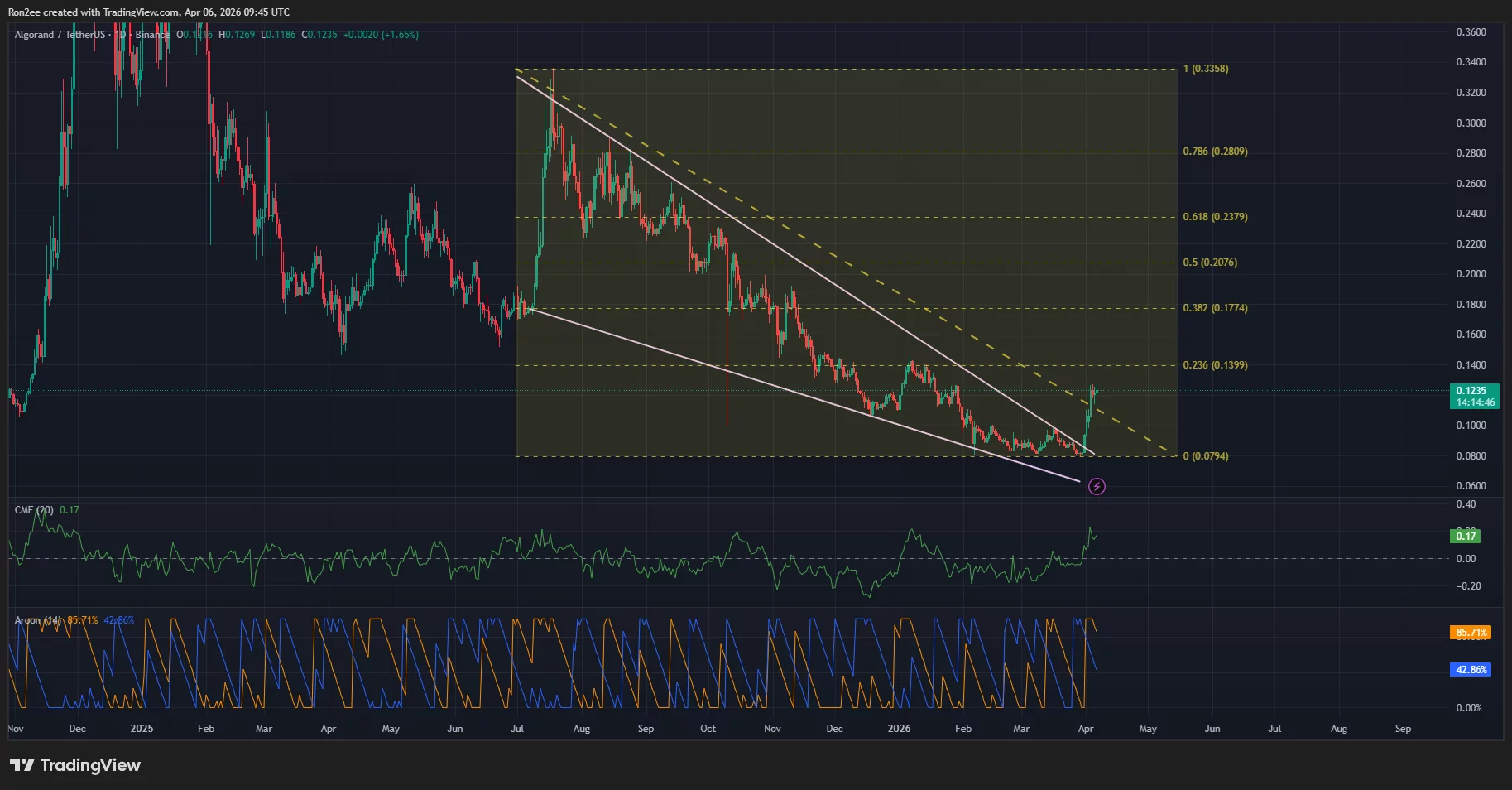
Algorand price surged more than 50% over the past week, climbing to $0.126 on Monday and emerging as the top-performing cryptocurrency on the weekly timeframe.
Summary
- Algorand price rose over 50% in a week to an 11-week high of $0.126, driven by recognition in a Google Quantum AI paper and new staking access via Revolut
- A breakout from a multi-month falling wedge, alongside strong Aroon and positive money flow readings, signals continued bullish momentum toward $0.20
- Futures open interest surged to $75 million, with bullish positioning and a negative funding rate pointing to a potential short squeeze and further upside pressure
According to data from crypto.news, Algorand (ALGO) rallied to an 11-week high of $0.126 on April 6, bringing its market cap near the $1.1 billion mark.
This rally followed a citation by Google Quantum AI in a research paper focused on the threats major blockchains face from quantum computing. The paper made several mentions of Algorand for its post-quantum security and advanced Falcon signature technology.
The token also gained significant traction after Revolut rolled out native ALGO staking, opening access for its 70 million-plus users to participate directly through the app.
There are three reasons why this rally could continue.
First, Algorand has confirmed a breakout from a multi-month falling wedge pattern on the daily chart. A falling wedge is formed by two descending and converging trendlines, and a breakout is often a precursor to sustained rallies. As such, the token could continue its climb to as high as $0.20, which aligns with the 50% Fibonacci retracement level.
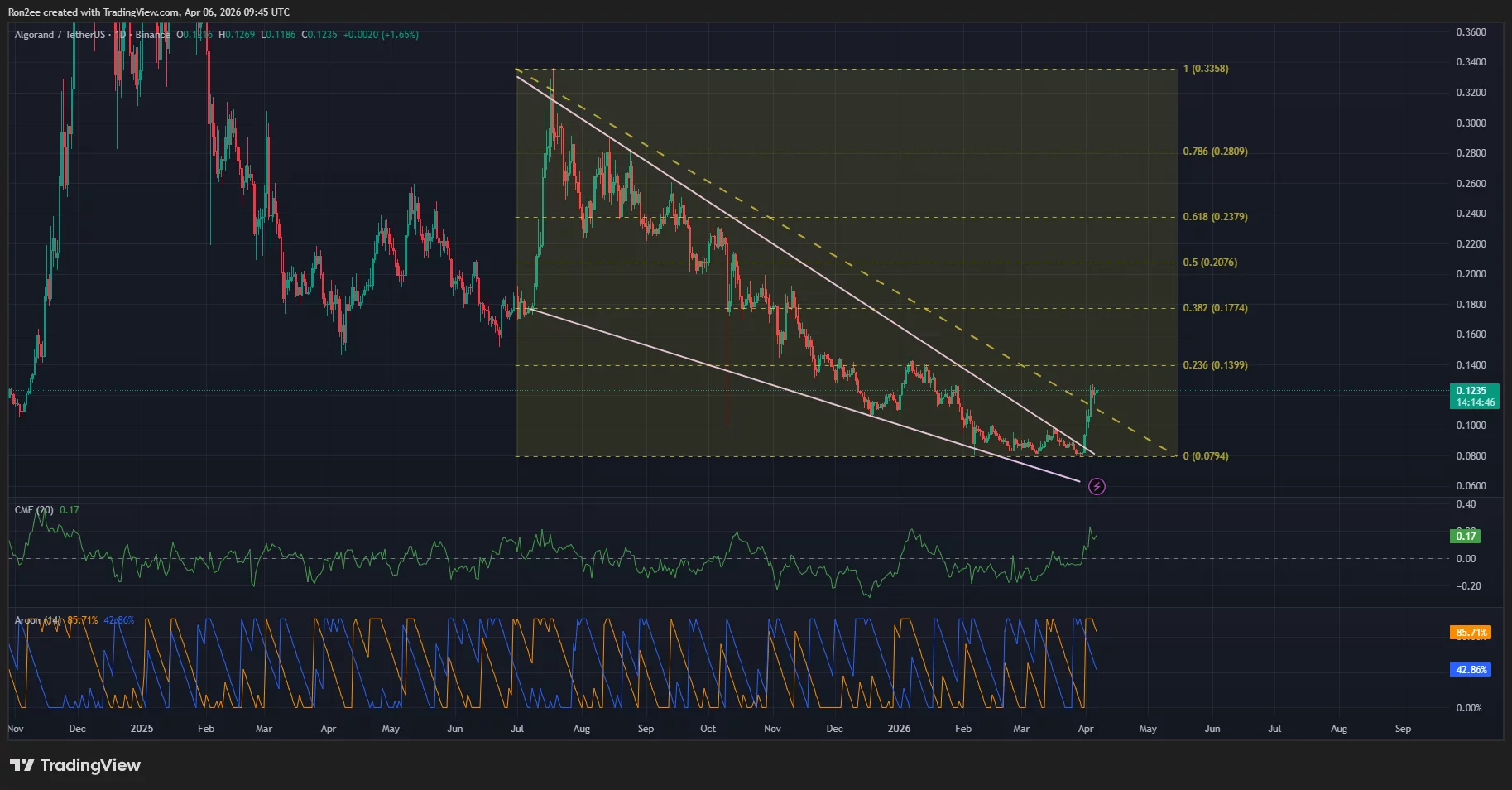
The forecast is supported by bullish technical indicators. Notably, the Aroon Up at 85.71% lies significantly above the Aroon Down, while the Chaikin Money Flow index showed a positive reading of 0.17, a sign that investors have been pouring capital into the asset.
Second, demand from its derivatives traders has been strong this week.
Data from CoinGlass shows that open interest in its futures market has increased from $30 million to $75 million within a single week. Adding to this, the long/short ratio has moved above 1, suggesting that most traders are leaning bullish. This means that market sentiment is heavily skewed toward further price appreciation as participants bet on higher targets.
Third, the weighted funding rate for the token has turned negative. With the sudden surge in Algorand price, this environment creates the perfect conditions for a potential short squeeze.
A short squeeze would force sellers to cover their positions, providing the necessary momentum to propel the token rally toward the $2 target.
Disclosure: This article does not represent investment advice. The content and materials featured on this page are for educational purposes only.
MicroStrategy raised $1.56 billion through its Stretch (STRC) preferred stock in March 2026, funding roughly half of the month’s Bitcoin (BTC) purchases. Meanwhile, some peers across the Digital Asset Treasury (DAT) sector liquidated holdings.
The divergence highlights a widening gap between Strategy and a growing list of DAT firms forced to sell BTC amid suppressed prices and thinning margins. It also raises a key question for the sector. Could preferred equity instruments be the primary capital-raising tool for BTC-focused companies?
Strategy’s STRC Playbook Funds Billions in BTC as Rivals Sell
Strategy has accumulated nearly 90,000 BTC worth approximately $7.25 billion in 2026. That figure already equals 40% of its total 2025 purchases and represents 10 times the BTC it accumulated during the entire 2022 bear market.
STRC offers a cumulative dividend of 11.5% annually, paid monthly and adjusted to keep the instrument trading near its $100 par value. The yield and low volatility have driven significant demand.
Binance Research noted that trading volume in March hit a record $4.35 billion, up 95% from the prior month.
Follow us on X to get the latest news as it happens
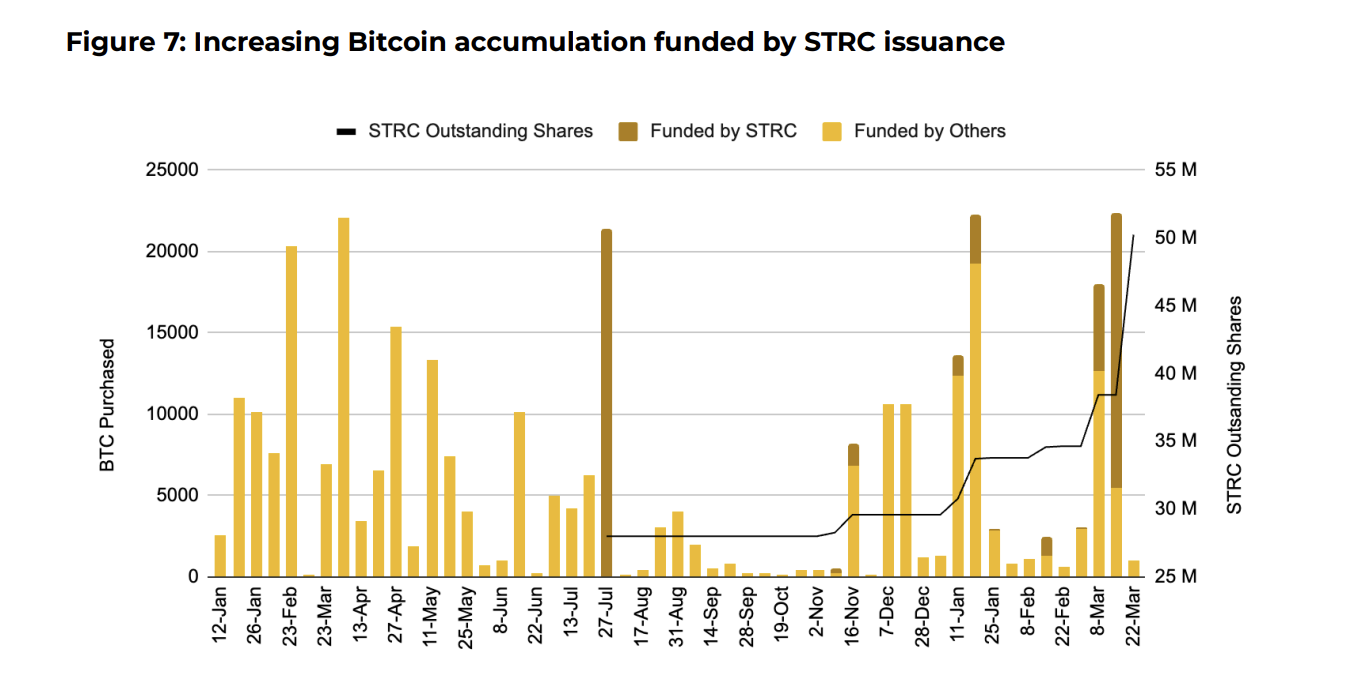
Meanwhile, some firms are heading in the opposite direction. For instance, MARA Holdings sold 15,133 BTC for roughly $1.1 billion to retire convertible debt. Riot Platforms offloaded 3,778 BTC worth $289.5 million in Q1 2026. Core Scientific sold 1,900 BTC in January.
Genius Group liquidated its entire 84.15 BTC treasury on April 1. Nakamoto Holdings trimmed its reserves by approximately 284 BTC in March for about $20 million.
“While the broader Digital Asset Treasury (DAT) sector faces liquidity constraints amid suppressed BTC price action and shrinking mNAV premiums, Strategy is aggressively distancing itself from peers,” Binance Research wrote.
The contrast is stark. DAT firms are burning through BTC reserves to fund operations and manage debt while also battling heavy stock losses. Strategy, through STRC stock, has built an alternative funding channel that allows it to keep buying.
Preferred Equity Contagion Has Begun
Strategy is no longer alone in this approach. Strive has raised over $250 million through SATA, a similarly structured preferred equity instrument with a 12.75% dividend.
“If the STRC model proves continuously successful, sector-wide replication is imminent,” Binance Research suggested.
For DAT firms currently forced to sell BTC to cover operating costs and service debt, a preferred equity vehicle could offer an alternative. Rather than liquidating reserves at suppressed prices, companies could issue yield-bearing instruments that attract fixed-income capital and convert it into BTC purchases.
If this model gains broader adoption, it could establish what Binance Research describes as a “new sector-wide structural bid for Bitcoin.”
“However, aggressive issuance of STRC could quickly consume Strategy’s US$2B cash reserve, especially during unfavorable BTC price action. Critically, there is no baked-in structural floor for STRC if market conditions severely deteriorate,” the report added.
Whether this model spreads further may depend on how it performs through a sustained downturn. For now, MicroStrategy is buying while others sell, and the preferred stock playbook is at the center of it.
Subscribe to our YouTube channel to watch leaders and journalists provide expert insights
The post MicroStrategy Wrote the Corporate Bitcoin Playbook Once: Can It Do It Again With STRC? appeared first on BeInCrypto.

Finance Tableau Sequence BOUL RALE BOUL + Conseil financier

Real Madrid vs Bayern Munich: Prediction, kick-off time, TV, live stream, team news, h2h results, odds

Oil, War And The Global Economy: The Market's Narrative In March 2026

Smart energy pays enters the US market, targeting scalable financial infrastructure

Why Israel is blocking foreign journalists from entering

Bitcoin: We’re Entering The Most Dangerous Phase
Finance Tableau Sequence BOUL RALE BOUL + Conseil financier

Govinda hurt his wife Sunita Ahuja now he is going through financial struggles #shortvideo

April 1 New Rules That Will Affect Your Money | India Financial Changes 2026
-

 NewsBeat4 days ago
Steven Gerrard disagrees with Gary Neville over ‘shock’ Chelsea and Arsenal claim | Football
-

 Business3 days ago
No Jackpot Winner and $194 Million Prize Rolls Over
-

 Fashion3 days ago
Weekend Open Thread: Spanx – Corporette.com
-
Entertainment7 days ago
Fans slam 'heartbreaking' Barbie Dream Fest convention debacle with 'cardboard cutout' experience
-

 Crypto World5 days ago
Gold Price Prediction: Worst Month in 17 Years fo Save Haven Rock
-

 Business11 hours ago
Three Gulf funds agree to back Paramount’s $81 billion takeover of Warner, WSJ reports
-
Crypto World6 days ago
Dems press CFTC, ethics board on prediction-market insider trades
-

 Sports2 days ago
India men’s 4x400m and mixed 4x100m relay teams register big progress | Other Sports News
-

 Business4 days ago
Login and Checkout Issues Spark Merchant Frustration
-

 Tech7 days ago
Apple will hide your email address from apps and websites, but not cops
-

 Tech6 days ago
EE TV is using AI to help you find something to watch
-

 Sports6 days ago
Tallest college basketball player ever, standing at 7-foot-9, entering transfer portal
-

 Politics7 days ago
Should Trump Be Scared Strait?
-
Tech6 days ago
Daily Deal: StackSkills Premium Annual Pass
-

 Tech6 days ago
Flipsnack and the shift toward motion-first business content with living visuals
-

 Fashion7 days ago
The Best Spring Trends of 2026
-

 Crypto World6 days ago
U.S. rule change may open trillions in 401(k) funds to crypto
-

 Sports6 days ago
Women’s hockey camp eyes fitness boost, tactics ahead of WC 2026 campaign | Other Sports News
-

 Politics7 days ago
BBC slammed for ignoring author of The Fraud
-

 Tech6 days ago
How to back up your iPhone & iPad to your Mac before something goes wrong
You must be logged in to post a comment Login