

Crypto World
SecondFi Plans Two-Week Return After Cardano Wallet Exploit Forensics


Cardano wallet SecondFi says it has identified a recovery pathway for users affected by a Tuesday exploit and expects to begin returning assets in roughly two weeks. The plan follows forensic work, security reviews, and additional testing to ensure the process can safely operate across the wallet states involved in the incident.
In an update shared on Saturday, Phillip Pon, CEO of SecondFi developer Emurgo, said the company completed its forensic investigation and “established a recovery pathway” for affected users. Pon added that the coming week would be used to build the solution, followed by another week devoted to testing before any assets are returned.
Key takeaways
- SecondFi says recovery should start in about two weeks after building and testing a new solution.
- The affected incident was traced to an address-level issue in SecondFi’s Cardano web wallet generation software that exposed private keys.
- SecondFi transferred approximately 129 million ADA secured via emergency measures to an independent third-party custodian while verification and recovery are pending.
- Users are warned not to migrate funds or follow instructions outside SecondFi’s official guidance, as this could complicate safe returns.
- SecondFi also cautioned that scammers are impersonating the wallet and soliciting private keys, seed phrases, and other access details.
Forensics complete; recovery build then testing
SecondFi’s recovery roadmap is centered on work Pon said has already been completed: forensic investigations and the establishment of a recovery pathway tailored to the wallet conditions created by the exploit. Pon indicated that the company’s next step is engineering the recovery mechanism, with a dedicated testing phase immediately afterward.
Importantly, Pon urged users to avoid moving assets or taking actions outside SecondFi’s official instructions while the recovery process is prepared. He said the recovery approach is designed around existing wallet states, and independent user actions could introduce variables that make a secure return of funds harder to complete.
What the Tuesday breach involved
SecondFi previously disclosed the security breach on Tuesday, reporting that it affected approximately 16 million ADA, worth about $2.4 million at the time, across 374 addresses. According to the wallet’s earlier reporting, the incident was traced to an address-level issue tied to SecondFi’s Cardano web wallet generation software, which exposed users’ private keys.
Separate from the impact on those exposed addresses, SecondFi said it secured roughly 129 million ADA through emergency measures. The company then moved those funds to an independent third-party custodian, where they will remain until SecondFi completes verification and recovery.
As of the Saturday update, SecondFi has not published a full post-mortem describing the vulnerability in detail or outlining precisely how the exploit was carried out.
SecondFi pushes back against recovery-related scams
Alongside the recovery timeline, SecondFi warned that malicious actors are spreading fraudulent messages while its recovery effort is underway. The wallet emphasized that no recovery actions requiring user participation have begun.
SecondFi said it will never ask users for private keys, seed phrases, wallet credentials, or direct wallet access. It urged users to treat any messages instructing them to submit wallet information, migrate assets, or take immediate steps outside verified communication channels as scams.
For users who need help, SecondFi directed them to submit a ticket through its official support portal while the recovery process is still being built and tested.
Why the timeline and custody details matter
For affected users, the most practical element of Saturday’s update is the sequencing: SecondFi is not requesting immediate user action, and it is framing the recovery work around wallet states that already exist from the time of the incident. That matters because ad hoc user behavior—such as moving funds or switching wallet setups during a recovery window—can create mismatches between what a recovery solution expects and what is actually on-chain.
The custodian step also signals that SecondFi is treating the recovered funds as subject to verification before release. While this does not eliminate uncertainty for users whose keys were exposed, it does provide an explicit holding point that, in principle, can reduce the risk of funds being moved without a defined recovery process.
Readers should watch for SecondFi’s testing milestones and any further technical disclosures about what went wrong, as the company has not yet released a comprehensive post-mortem. In the meantime, the practical priority remains clear: follow only verified SecondFi guidance and ignore any unsolicited messages demanding wallet access or recovery “assistance.”



The company’s STORJ token fell 16% to about 6 cents. Almost $20 million worth of the token changed hands against a market value of about $27 million, meaning close to the entire supply turned over in a day. The token is down 79% over the past year and 98% from its March 2021 peak of $3.81.
The restructuring proposal contains a provision rarely seen in bankruptcy: Storj said it plans to share ownership of the reorganized company among management, token holders and investors.
Token holders normally have no legal claim on an issuer and receive nothing in a Chapter 11 process.
The filing extends an unusually heavy week. BitMEX, the exchange that invented the perpetual swap, said on July 23 it would shut down after 11 years, with daily volume down to roughly $400,000 and its BMEX token falling more than 90%.
Its parent, HDR Global Trading, said the platform was not insolvent and that assets exceeded liabilities, pointing instead to a strategic review that followed some $200 million in regulatory fines and a sale process that found no buyer.
BitMart announced its own wind-down on Sunday, halting new deposits and trading orders immediately, ending all trading on Aug. 26 and setting a January 2027 closure, with its BMX token down 58% on the news.
Crypto World
Memory Chip “Supercycle” Sends Micron and SanDisk Soaring in 2026. WEEX Opens the Trade to Everyone Through Tokenized Stocks

With DRAM and NAND prices skyrocketing on AI demand, WEEX lists MU and SNDK perpetual futures plus DRAM spot, giving traders round the clock exposure to the storage rally, all denominated in USDT.
Singapore, July 27, 2026. A memory supercycle driven by artificial intelligence is reshaping the semiconductor landscape, and the numbers behind it are extraordinary. Global exchange WEEX is bringing that theme to a wider audience through tokenized stocks, letting traders access the storage rally without a brokerage account and without waiting for stock market hours.
Through 2026, DRAM and NAND spot prices have continued to surge, driving both earnings and share prices sharply higher for memory makers. As of July 24, Micron Technology (MU) was trading around $921, up roughly 230% YTD, while SanDisk (SNDK) was trading near $1,590, up about 570% YTD. The fundamentals have largely kept pace with the rally. In its latest quarter, Micron reported revenue growth of approximately 346% year over year, while SanDisk’s datacenter revenue soared 645% year over year, underscoring strong AI-driven demand across the memory market.
The core driver is a widening supply gap. Deutsche Bank projects a roughly 10% DRAM shortfall in 2026, widening to about 29% by 2028, with tight conditions potentially lasting through 2030. High bandwidth memory, known as HBM, is the key growth engine. Micron’s HBM4 has entered volume production, and SanDisk has signed supply agreements with multiple hyperscale cloud customers. Analysts including UBS argue the pricing upcycle is far from over.
“Retail traders have watched this rally from the sidelines because getting exposure meant opening a U.S. equity account and trading only during market hours,” said a WEEX spokesperson. “Tokenized stocks remove that friction. The storage story is one of the biggest macro trades of the year, and now anyone can express a view on it.”
On WEEX, users can trade MU/USDT futures and SNDK/USDT futures, denominated in USDT, with up to 100x leverage and both long and short direction, to track Micron and SanDisk price action. Those who prefer spot can position around the storage theme through DRAM spot. All markets trade round the clock, free from U.S. session constraints.
WEEX urges caution in a crowded trade. Memory names have already risen sharply this year and pulled back hard at times. Micron and SanDisk each fell roughly 8% and 16% over the past month. Combining tokenized equities with leveraged contracts multiplies both volatility and liquidation risk, and traders should size positions accordingly.
Risk notice: Tokenized stocks and leveraged contracts are highly volatile and can result in partial or total loss of capital. Leverage magnifies losses and can trigger liquidation. The storage sector’s large gains this year carry valuation and pullback risk. This release is for informational purposes only and does not constitute investment advice.
About WEEX
Founded in 2018, WEEX has developed into a global crypto exchange with over 6.2 million users across more than 150 countries. The platform emphasizes security, liquidity, and usability, providing over 1,200 spot trading pairs and offering up to 400x leverage in crypto futures trading. In addition to the traditional spot and derivatives markets, WEEX is expanding rapidly in the AI era delivering real time AI news, empowering users with AI trading tools, and exploring innovative trade to earn models that make intelligent trading more accessible to everyone. Its 1,000 BTC Protection Fundfurther strengthens asset safety and transparency, while features such as copy trading and advanced trading tools allow users to follow professional traders and experience a more efficient, intelligent trading journey.
Follow WEEX on social media
X | Instagram | Tiktok | Youtube | Discord | Telegram
The post Memory Chip “Supercycle” Sends Micron and SanDisk Soaring in 2026. WEEX Opens the Trade to Everyone Through Tokenized Stocks appeared first on BeInCrypto.
Crypto World
Crypto News, July 27: Why Crypto Up? ETH BTC Ratio Just Flashed a Massive Alt Season Signal

Crypto has started the week with a completely different mood. Just days ago, traders were preparing for another round of geopolitical escalation. Instead, the United States and Iran have now held fire for a second consecutive day, oil prices have dropped by 5%, and risk appetite has returned. If you’re wondering why crypto is up today, this shift in sentiment is where the news and story begin. Today, we also see the ETH BTC ratio breaking higher, adding another bullish signal.
— Coin Bureau (@coinbureau) July 26, 2026

 JUST NOW: The US paused its bombing of Iran after Omani officials visited Tehran Friday for talks.
Iran has since halted its own retaliatory strikes. Both sides have signaled interest in returning to ceasefire negotiations. https://t.co/2gGgG1Wmmu
Bitcoin climbed back above $65,000, Ethereum led gains among major crypto coins, and bearish traders were caught offside. More than $200 million worth of crypto positions were liquidated over the past day, with the vast majority coming from shorts forced to cover their positions.
For the first time in weeks, the rally feels supported by improving macro conditions instead of speculation alone.
Discover: The Best Crypto to Diversify Your Portfolio
Why Crypto Up? Peace Trade Meets Fresh Crypto Optimism
The biggest catalyst behind today’s rally came from outside the crypto space. A second day without fresh military strikes between the United States and Iran pushed oil prices sharply lower, encouraging investors to rotate back into risk assets. Bitcoin reclaimed $65,000 while Ethereum accelerated even faster, reviving talk that the market may be entering the early stages of a recovery.

Institutional demand has also remained healthy. Spot Bitcoin, Ethereum, Solana, and XRP ETFs attracted a combined $152 million in weekly inflows despite minor Bitcoin ETF outflows earlier in the week. Meanwhile, attention is returning to Washington as reports suggest the final version of the CLARITY Act could arrive this week, although Senate hurdles still remain.
Another closely watched story involves Strategy. The company has now gone four straight weeks without purchasing additional Bitcoin as it builds cash reserves ahead of earnings. Michael Saylor has teased “another color” on social media, fueling speculation that another announcement could be approaching.
One of today’s more surprising headlines came from BitMart. The exchange announced plans to wind down operations after nearly nine years, following recent exits by AscendEX and BitMEX. We have noticed this pattern before. During previous bear markets, weaker exchanges often disappeared as liquidity dried up, with stronger platforms eventually emerging after the dust settled. Many still view exchange capitulation as a sign that the market may be moving closer to a long-term bottom.
— Crypto Rover (@cryptorover) July 26, 2026
 EVERY BITCOIN BEAR MARKET ENDS WITH CASUALTIES.
2014 had Mt. Gox.
2018 had BitGrail.
2022 had FTX.
Now BitMEX and BitMart are shutting down within days of each other.
This confirms that the final phase has begun… https://t.co/RhmgsbxvXO pic.twitter.com/F6gWgOVG8n
Discover: The Best Token Presales
ΩETH BTC Ratio Breakout Puts Ethereum in the Spotlight
Bitcoin is trading around $65,300 to $65,500 after reclaiming the key $65,000 level. Today’s crypto recovery is being supported by improving sentiment, positive ETF flows, and heavy short liquidations rather than excessive leverage from buyers.
Ethereum has stolen the spotlight. The second-largest crypto is trading around $1,950 to $1,965 after gaining more than 4% in a day. More importantly, the ETH BTC ratio has climbed back toward 0.030 after breaking above a multi-month downtrend.
ETH BTC ratio has historically strengthened before capital rotates into the wider altcoin market. Previous bull cycles saw Ethereum outperform Bitcoin before gains spread across larger altcoins and eventually smaller projects. It is not a guarantee, but the pattern has repeated often enough to stay on traders’ radar.
Other signs of improving risk appetite are emerging. Shiba Inu has climbed roughly 25% over the past week, while long-term Bitcoin holders continue showing little interest in selling. At the same time, fresh discussion around quantum computing has resurfaced, although many experts argue governance remains a bigger challenge than any immediate technological threat.
Today’s crypto news reflects easing geopolitical tensions, falling oil prices, healthy ETF inflows, aggressive short liquidations, and a strengthening ETH BTC ratio. Together, they paint a much stronger picture than the market offered only a few days ago. If Bitcoin continues holding above $65,000 and the ETH BTC breakout extends, today’s rally could become the first chapter of a much broader recovery rather than another short-lived bounce.
Trade ETH, BTC, and Major Coins on Bybit and Get a Chance to Win Our $1,000 USDT Airdrop
The post Crypto News, July 27: Why Crypto Up? ETH BTC Ratio Just Flashed a Massive Alt Season Signal appeared first on Cryptonews.


Japan has moved closer to easing its cryptocurrency leverage trading rules after a senior ruling party lawmaker said the current 2x cap is too restrictive for market liquidity and price discovery.
Summary
- Japan’s ruling party is considering easing the country’s 2x crypto leverage limit to improve market liquidity and price discovery.
- Lawmaker Seiji Kihara said the current restriction is too strict and backed regulatory changes for leveraged crypto trading.
- The proposal follows Japan’s recent decision to classify cryptocurrencies as financial products under updated financial laws.
- The regulatory overhaul also lays the groundwork for lower crypto taxes and domestic Bitcoin ETFs in the coming years.
According to Nikkei, Seiji Kihara, who heads the Liberal Democratic Party’s Next Generation AI and On-Chain Finance Project Team, said during a financial conference in Tokyo on July 14 that Japan’s current leverage limit on crypto trading is limiting market activity and should be relaxed as part of the country’s ongoing digital asset reforms.
Speaking at the event, Kihara said the existing two-times leverage cap is “too strict” and argued that a healthy market requires enough liquidity and an effective price discovery mechanism. He said easing the restriction is a natural step if Japan wants to strengthen its cryptocurrency market.
His comments add another piece to Japan’s wider regulatory overhaul, which has gathered pace in recent months as lawmakers move crypto regulation closer to the country’s traditional financial markets.
Japan considers higher crypto leverage limits
Kihara’s project team is working on policy changes that would adjust existing regulations governing cryptocurrency trading. According to Nikkei, the proposal is intended to encourage more capital to return to Japan’s domestic crypto market by improving trading activity and liquidity.
Leverage trading allows investors to borrow funds against collateral deposited in their trading accounts, enabling them to control positions larger than the capital they initially commit. Japan currently limits leverage to two times the value of posted margin, one of the strictest caps among major crypto markets.
Kihara argued during the conference that active markets rely on sufficient liquidity and efficient price discovery, adding that relaxing leverage restrictions would help support those functions. While he outlined the project’s direction, Nikkei did not report a specific timetable for introducing revised rules.
The comments also come as policymakers continue discussing how digital assets should fit within Japan’s broader financial system instead of remaining under a framework originally designed for payment services.
Financial reforms continue to reshape Japan’s crypto market
The discussion over leverage follows major legislative changes approved earlier this month.
As previously reported by crypto.news, Japan enacted amendments to the Financial Instruments and Exchange Act that reclassify cryptocurrencies as financial products instead of treating them primarily as payment instruments under the Payment Services Act.
The legislation introduces insider trading rules for crypto transactions, requires annual disclosures from issuers of certain crypto assets and increases penalties for businesses operating without registration.
According to CoinPost, the maximum prison sentence for operating an unregistered crypto business will increase from three years to 10 years, while the maximum fine will rise from 3 million yen to 10 million yen.
The amended law also establishes the legal basis for separate taxation of crypto gains at an effective rate of about 20%, together with a three-year loss carry-forward deduction. Those tax changes are expected to take effect in January 2028 because enforcement is scheduled during the 2027 fiscal year, according to CoinPost.
Although cabinet ordinances and supervisory guidelines are still required before the new framework is fully implemented, the legislation has laid the legal foundation for several additional market reforms.
Bitcoin ETF plans continue to gather momentum
The same legislative changes have also advanced Japan’s plans for domestic cryptocurrency exchange-traded funds.
Earlier this month, crypto.news reported that the Financial Services Agency is preparing revisions to investment trust rules that would allow ETFs and investment trusts to hold crypto assets directly. According to Nikkei, the first domestic Bitcoin ETF could launch as early as 2028 once the regulatory framework is completed.
The legal amendments themselves do not authorize immediate ETF listings. Instead, regulators still need to finalize detailed investment trust rules before asset managers can introduce products that directly invest in cryptocurrencies.
Japan Exchange Group Chief Executive Hiroki Yamamichi previously said a crypto ETF could be introduced once the legal framework and tax treatment are completed.
Several large financial institutions have already begun preparing products ahead of the rule changes. Previous reporting has shown that SBI Securities, Rakuten Securities, Nomura, Daiwa, Asset Management One and firms affiliated with SMBC are studying crypto investment products that could enter the market after regulators complete the framework.
Beyond spot Bitcoin ETFs, SBI Global Asset Management has also explored funds focused on highly liquid cryptocurrencies, including Bitcoin and Ethereum, while Osaka Exchange has discussed launching Bitcoin futures if spot ETFs become legal.
Government continues expanding its Web3 strategy
The leverage discussion also fits within Japan’s broader effort to develop its digital asset sector alongside startup and technology policies.
Earlier this month, Prime Minister Sanae Takaichi told attendees at WebX 2026 that Web3 forms part of Japan’s national innovation strategy rather than serving as a standalone cryptocurrency initiative. Her remarks focused on encouraging collaboration between startups, investors and technology companies, although they did not include new funding commitments or immediate regulatory announcements.
Separately, Japan’s Comprehensive Startup Support Package and the government’s five-year startup plan continue supporting investment into emerging technology companies while lawmakers advance crypto-specific reforms covering taxation, market conduct and investment products.
If leverage limits are eventually revised, the change would add another regulatory adjustment alongside the country’s new financial product classification for crypto assets, proposed tax reforms and the ongoing work to establish a domestic Bitcoin ETF framework.
For now, however, Nikkei reported that Kihara’s project team remains focused on preparing policy changes designed to improve market liquidity and attract cryptocurrency trading activity back to Japan without announcing when those proposals could be implemented.


POSCO International is testing blockchain-based trade finance with LG CNS and Injective.
Summary
- POSCO is testing tokenized receivables created from real trades between overseas subsidiaries and commercial counterparties.
- LG CNS and Injective support issuance, transfer, compliance controls and settlement on one shared ledger.
- POSCO plans production use after testing, but has not disclosed performance data or transaction values.
The South Korean trading company has placed receivables from real commercial transactions into a proof-of-concept system that can issue, transfer and settle the claims onchain.
The trial uses trade data from POSCO International’s overseas subsidiaries and their counterparties, rather than simulated invoices. The companies aim to create one shared record for buyers, sellers and financing partners while keeping compliance rules linked to each digital claim.
POSCO tests real commercial receivables on Injective
Trade receivables are amounts that customers owe after a company delivers goods or services. Businesses often record the same invoice across separate systems. Each party must check documents and payment status before settlement.
CoinDesk reported that the pilot covers live trade between POSCO units and outside counterparties. The partners are using Injective, a layer-1 blockchain built for financial applications, to test the issuance, transfer and settlement of the claims. A Korean business report said the project also tests AI-based trade-document processing.
POSCO International recorded 32.37 trillion won in 2025 sales, according to its. Its operations cover steel, energy and battery materials. However, the companies have not disclosed the total value or number of receivables entered into the system.
A POSCO spokesperson said the proof of concept “validated the applicability of AI and blockchain technology based on real trade data and processes.” However, the companies have not published figures on processing speed, costs, error rates or settlement savings. POSCO plans to consider live production after the test phase later this year.
Shared ledger targets slow reconciliation work
The project aims to replace separate invoice records with a common ledger. Approved participants can view the same transaction status and ownership history. The system can also carry conditions that control who may receive or transfer a tokenized receivable.
This structure could reduce repeated checks when a shipment, invoice or payment moves between countries. It may also give banks and financing firms a clearer record when they assess a receivable for early payment. However, the pilot does not remove legal agreements, identity checks, accounting rules or local trade requirements.
Tokenization turns a financial or commercial claim into a digital record on a blockchain. In this case, the token represents money owed to POSCO International or one of its subsidiaries. It does not represent POSCO shares or give a holder ownership in the company.
The project has not announced an open market for the receivables or said whether outside investors will buy them. The current test focuses on business processes, transfers and settlement between approved parties rather than public trading.
LG CNS brings experience from Korean finance projects
LG CNS serves as the technology partner. The LG Group company has built blockchain systems for financial institutions. It also took part in the Bank of Korea’s central bank digital currency work and operates tokenization platforms for Koscom and Mirae Asset Securities. (
Injective supplies the blockchain layer used to record and move the receivables. The partners have not disclosed how they divide data between onchain records and private company systems. They also have not explained what access controls protect sensitive commercial information.
POSCO International has already tested blockchain in corporate funding. In April, it announced South Korea’s first foreign-currency digital bond issued by a non-financial company. The company said blockchain reduced the bond’s settlement period from five days to three.
The receivables pilot moves that work into daily trade finance. Bonds raise funds from investors, while receivables arise from normal sales. Both projects use digital records to shorten processing and provide a shared view of ownership and settlement.
South Korean companies expand corporate blockchain tests
The POSCO project follows other corporate blockchain trials in South Korea. As crypto.news previously reported, Hyundai Motor’s U.S. and Mexican operations completed a $20,000 treasury payment using USDT on Avalanche. The companies said the transfer took about seven minutes.
Meanwhile, Circle signed agreements with Kakao Group and Toss to study stablecoin payments, remittances and merchant settlement in South Korea. Separately, Mirae Asset placed tokenization, security tokens and stablecoins within the strategy for its newly renamed Digital X business.
POSCO’s pilot differs because it places a business claim onchain rather than sending a stablecoin payment. The receivable can carry ownership information and compliance conditions before payment occurs. A stablecoin may later serve as the settlement asset, but the companies have not announced that step.
The partners have not released technical documents, contract addresses or a production date. They also have not named participating banks or counterparties. POSCO is expected to decide whether to apply the system across more subsidiaries after completing the testing process.
Bitcoin has reacted positively to the de-escalating war news from the weekend on Monday morning, jumping to over $65,000 for the first time since Friday.
Most larger-cap alts are in the green today as well, led by ETH. The altcoin leader touched $1,980 for the first time in almost two months before retreating slightly.
BTC Above $65K
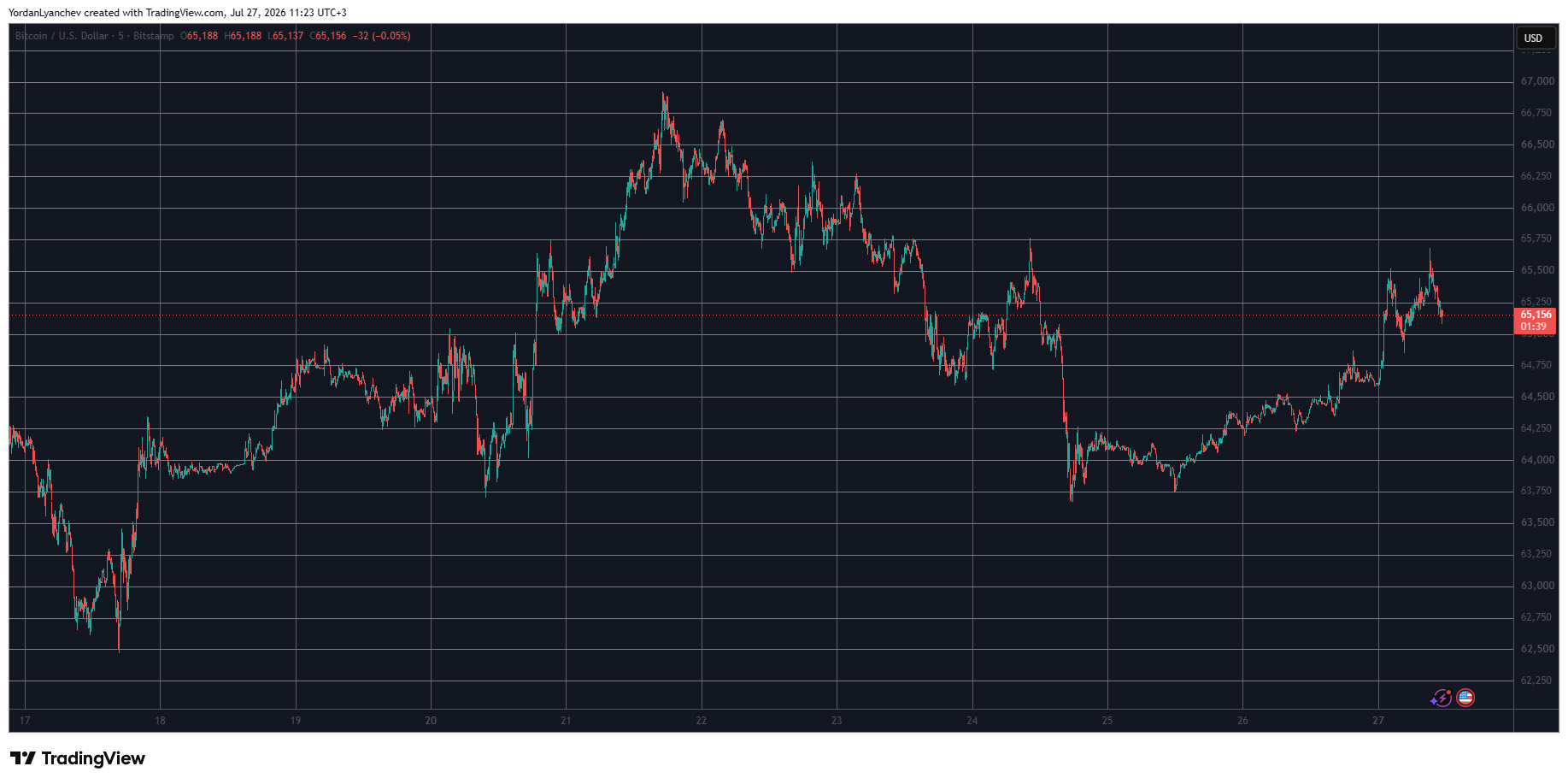
The primary cryptocurrency rallied hard last week, going from under $64,000 to $67,000 within 36 hours to post a monthly peak. However, it couldn’t sustain this momentum and quickly started to lose value. It first dipped to $65,500 on Wednesday before another leg down brought it to under $65,000.
It rebounded on Friday to $65,750, where it was rejected and pushed south. The bears managed to drive it down by $2,000, where it finally found support and returned to $64,000 on Saturday. Then came the aforementioned de-escalation news in the Middle East. Trump halted the planned attacks against Iran after new talks resumed with Oman about the potential reopening of the Strait of Hormuz.
As it typically happens when such news comes during the weekend, the immediate reaction was minimal, but BTC remained above $64,000. It priced the development on Monday morning when it jumped to $65,600 (on Bitstamp). Although it failed there, it still trades above $65,000 as of press time.
Its market capitalization has reclaimed the $1.3 trillion mark, while its dominance over the alts remains just shy of 57%.
ETH Leads the Pack
The largest altcoin has pumped impressively over the past 24 hours. It touched $1,980 for the first time since June 2, and even though it has retraced slightly, it’s still 4.5% up on the day and sits above $1,960. Other notable gainers from this cohort of assets include AAVE (9%), ONDO (8%), UNI (6.5%), and LINK (4.65%). PUMP has rocketed by over 11%.
BNB, XRP, SOL, TRX, RAIN, HYPE, and ZEC are also in the green but in a more modest manner. In contrast, XMR and DOGE have slipped by 1-3%. SHIB has dumped by over 8% in the past 24 hours after its massive rally yesterday that pushed it to a multi-month peak.
The cumulative market cap of all crypto assets is up by roughly $30 billion daily to $2.310 trillion on CG.

The post ETH Hits a 2-Month High Near $2K, Bitcoin Reclaims $65K: Market Watch appeared first on CryptoPotato.
Crypto World
Blockchain in Manufacturing: Building Smarter, Safer, and More Transparent Supply Chains

Manufacturing is undergoing a digital transformation. Automation, artificial intelligence (AI), the Internet of Things (IoT), and cloud computing have already reshaped factory floors. Now, blockchain technology is emerging as another game-changing innovation—one that promises greater transparency, efficiency, and trust across the entire manufacturing ecosystem.
While blockchain is often associated with cryptocurrencies like Bitcoin, its real-world applications extend far beyond digital assets. In manufacturing, blockchain has the potential to solve long-standing issues such as counterfeit products, supply chain inefficiencies, poor traceability, and fragmented data management.
As global supply chains become increasingly complex, manufacturers need reliable systems that ensure every component, transaction, and process can be verified. Blockchain delivers exactly that.
What Is Blockchain in Manufacturing?
Blockchain is a decentralized digital ledger that records transactions in a secure, immutable, and transparent manner. Every participant in the network shares access to the same information, making it nearly impossible to alter records without consensus.
In manufacturing, blockchain can record every stage of a product’s lifecycle—from raw material sourcing to production, shipping, distribution, and even recycling.
Instead of relying on disconnected databases across suppliers and manufacturers, blockchain creates a single trusted source of truth.
Why Manufacturing Needs Blockchain
Modern manufacturing depends on hundreds—or even thousands—of suppliers operating across multiple countries.
This complexity creates challenges such as:
- Limited supply chain visibility
- Counterfeit materials
- Manual paperwork
- Delayed quality inspections
- Data inconsistencies
- Regulatory compliance issues
- Product recalls that take weeks instead of hours
Blockchain addresses these problems by creating an auditable record that everyone involved can trust.
Improving Supply Chain Transparency
One of blockchain’s strongest advantages is end-to-end visibility.
Every shipment, quality inspection, ownership transfer, and production milestone can be permanently recorded on-chain.
This enables manufacturers to:
- Track raw materials back to their origin
- Verify supplier authenticity
- Detect bottlenecks quickly
- Reduce fraud
- Improve inventory planning
For industries like aerospace, pharmaceuticals, electronics, and automotive manufacturing, complete traceability is becoming a competitive necessity.
Fighting Counterfeit Products
Counterfeit components cost manufacturers billions of dollars annually.
Fake electronic chips, industrial parts, automotive components, and medical equipment can cause severe safety risks.
Blockchain creates a digital identity for every legitimate product.
Manufacturers can assign unique identifiers such as QR codes, RFID tags, or NFC chips linked to blockchain records.
Customers and distributors can instantly verify:
- Manufacturing date
- Factory location
- Batch number
- Quality certifications
- Shipping history
- Authenticity
This dramatically reduces the circulation of counterfeit goods.
Better Quality Control
Quality assurance often involves paperwork, spreadsheets, and disconnected databases.
Blockchain enables inspectors to upload quality reports directly onto a shared ledger.
Every inspection becomes permanent and timestamped.
If a defect is discovered months later, manufacturers can quickly identify:
- Which production batch was affected
- Which suppliers provided materials
- Which customers received the products
Instead of recalling millions of products, companies can perform highly targeted recalls, saving both time and money.
Smart Contracts Automate Manufacturing Processes
Smart contracts are self-executing programs stored on blockchain networks.
They automatically execute agreements when predefined conditions are met.
Examples include:
- Automatically paying suppliers after delivery confirmation
- Releasing shipments after passing quality inspections
- Triggering inventory replenishment
- Managing warranty claims
- Tracking equipment maintenance schedules
Automation reduces paperwork, speeds up operations, and minimizes human error.
Real-Time Collaboration Across Suppliers
Manufacturing often involves dozens of independent companies.
Suppliers, logistics providers, warehouses, distributors, and retailers all maintain separate records.
Blockchain creates shared visibility without requiring participants to surrender control of their private systems.
Everyone sees the same verified transaction history, reducing disputes and improving collaboration.
Supporting Sustainable Manufacturing
Consumers increasingly want proof that products are ethically sourced and environmentally responsible.
Blockchain allows manufacturers to verify:
- Responsibly sourced raw materials
- Carbon emissions data
- Renewable energy usage
- Recycling history
- Environmental certifications
Companies can provide customers with verifiable sustainability data rather than relying solely on marketing claims.
Integrating Blockchain with IoT
IoT sensors continuously collect data from machines, warehouses, and transportation systems.
When integrated with blockchain, sensor data becomes tamper-resistant.
Examples include:
- Temperature monitoring during shipping
- Machine operating hours
- Equipment maintenance logs
- Warehouse conditions
- Production line performance
This creates trustworthy operational records that improve decision-making and predictive maintenance.
Enhancing Regulatory Compliance
Manufacturers must comply with strict regulations across industries.
Blockchain simplifies audits by maintaining immutable records of:
- Safety inspections
- Product certifications
- Supplier compliance
- Testing results
- Manufacturing standards
Auditors can verify records quickly without reviewing mountains of paperwork.
This reduces compliance costs while improving accountability.
Challenges to Adoption
Despite its advantages, blockchain adoption in manufacturing still faces several obstacles.
Integration with Legacy Systems
Many manufacturers rely on decades-old enterprise software that wasn’t designed for blockchain integration.
Industry-Wide Collaboration
Blockchain delivers its greatest value when suppliers, manufacturers, distributors, and logistics companies participate together.
Achieving industry-wide adoption takes time.
Data Privacy
Not every piece of manufacturing information should be publicly visible.
Permissioned blockchain networks help balance transparency with confidentiality.
Initial Investment
Implementing blockchain infrastructure requires upfront investment in technology, employee training, and process redesign.
However, long-term savings often outweigh the initial costs.
The Future of Blockchain Manufacturing
As Industry 4.0 continues to evolve, blockchain will become an essential layer connecting AI, IoT, robotics, cloud computing, and advanced analytics.
Future factories may operate with:
- Autonomous procurement systems
- AI-driven supply chain optimization
- Blockchain-based digital product passports
- Real-time supplier verification
- Automated compliance reporting
- Tokenized manufacturing assets
- Decentralized industrial marketplaces
Rather than replacing existing technologies, blockchain strengthens them by providing trusted, verifiable data that every participant can rely on.
Final Thoughts
Manufacturing is built on precision, efficiency, and trust. Blockchain enhances all three by creating secure, transparent, and tamper-resistant records that span the entire production lifecycle.
From combating counterfeit products and improving quality control to streamlining supplier collaboration and enabling sustainable manufacturing, blockchain is becoming a powerful foundation for the factories of the future.
As global supply chains grow more interconnected and customer expectations for transparency continue to rise, manufacturers that embrace blockchain will be better positioned to reduce costs, improve resilience, and build lasting trust with partners and consumers alike.
REQUEST AN ARTICLE
Bitcoin (BTC) price is close to ending July green for the third year running, a streak no other month can match. August now arrives with the worst seasonal record on the board.
BTC trades near $65,300 after a quiet, range-bound week. Meanwhile, three forces decide the next leg. Fading fund inflows, a split between whales and long-term holders, and a bearish chart pattern.
July’s Winning Streak Runs Into Its Weakest Month
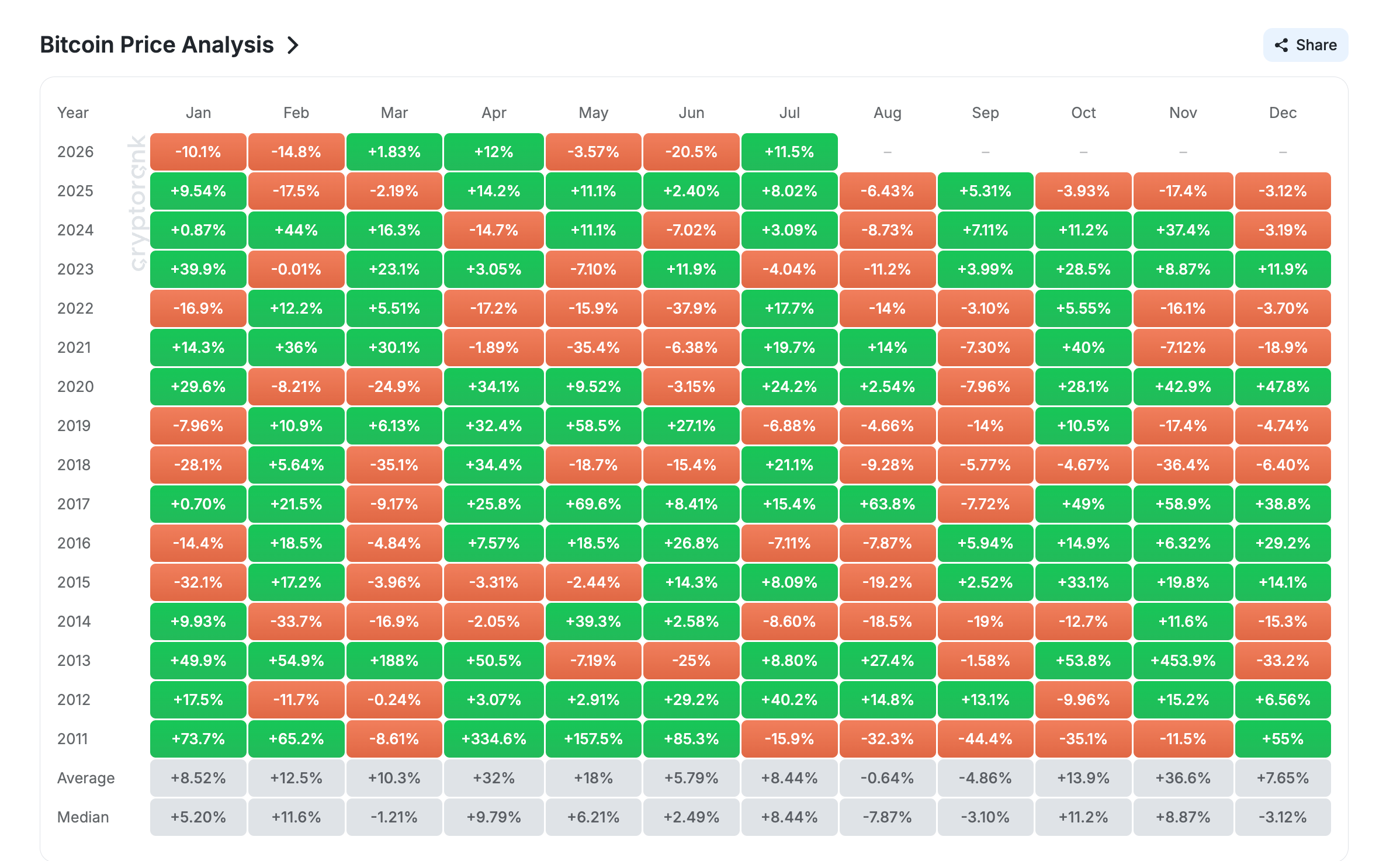
History frames the risk first. July has closed green three years running, in 2024, 2025 and 2026 (still forming), a significantly rare pattern.
Want more token insights like this? Sign up for Editor Harsh Notariya’s Daily Crypto Newsletter here.
This July is up 11.5% even though BTC spent most of the last week stuck in a range. That gain matters because Bitcoin had ignored seasonality for most of the year. June fell 20.5% against a positive average, and June’s weak close shaped July’s Bitcoin price prediction as well.

August is where the script turns. Its -7.87% median is the weakest of any month on the table, and its -0.64% average is one of only two negative readings. August has also closed red every year since 2022.
Fund flows already echo the caution. Weekly Bitcoin ETF inflows peaked at $197.40 million in the week to July 10, then slid to $75.67 million, and finally $33.79 million by July 24.
That is a 55% drop in one week and an 83% fall from the July peak. Institutions are not selling, but US spot Bitcoin ETF demand is clearly cooling into the weakest month.

Fund desks may be stepping back. The largest on-chain wallets are doing the opposite.
Bitcoin Whales Buy While Conviction Holders Retreat
Bitcoin whales turned buyers on July 23. The number of entities holding at least 1,000 BTC rose from 1,263 to roughly 1,267 within three days.
The same setup appeared exactly a month earlier. Whale entities climbed on June 23 , all the way to mid-July, and Bitcoin gained nearlyt 4% over that stretch. The data suggests whales may be positioning for another short-term rebound.

Long-term Bitcoin holders tell a different story. The hodler net position change, a metric tracking how much supply long-term wallets add or shed each month, peaked at 42,301 BTC on May 24 with Bitcoin near $77,039.

It then fell to roughly 20,500 BTC by July 2, a drop of about 52%, while price slid to $61,486.
That pattern is repeating. The reading dropped from 29,838 BTC on July 11 to 15,766 BTC on July 26, a 47% decline, even though price held near $65,000.

Holders are still adding coins, just far more slowly. The slowdown suggests this group may be bracing for a correction, echoing what fund flows already show.
Retail offers no counterweight. A whale-retail divergence score of 4.4 on the daily timeframe reads as aligned, meaning small and large traders are moving the same way. That alignment cuts both ways, because if whales flip, retail has no reason to hold the line.

With institutions easing off and holders slowing, the chart becomes the decider.
Bitcoin Price Prediction Hinges on One Level Below $61,000
The chart backs the cautious camp. On the three-day timeframe, Bitcoin has traded inside a head and shoulders pattern since early March, a bearish formation where one high peak sits between two lower peaks.
Buying volume has fallen since June 30 even as price rose. Weak volume behind a rising right shoulder is a textbook sign of exhaustion, and it validates the pattern’s 25% breakdown risk.

Levels decide the rest. Since July 3, Bitcoin has traded between $66,885 and $60,965.
A three-day close above $66,885 would restore strength and open a path toward $76,118, keeping Bitcoin’s route back to $100,000 alive. Losing $60,965 breaks the floor and exposes the neckline near the $54,000 zone.
A neckline break could trigger the measured move toward roughly $41,266. The Bitcoin price prediction for August therefore stacks a technical breakdown on top of a median seasonal loss near 8%.

A caveat applies. Head and shoulders patterns fail often, and a slide to the $41,000 zone needs a catalyst the market does not currently have. Only a reclaim of $82,931 cancels the bearish structure outright, which looks as far-fetched as the downside target. For now, $60,965 separates a rangebound August from a slide toward $41,266.
The post Bitcoin Price Prediction for August 2026: Whales Bet Against a 4-Year Losing Streak appeared first on BeInCrypto.
On 21 July, Stats NZ reported an acceleration in inflation: the Consumer Price Index rose 1.5% in the second quarter, while the annual inflation rate climbed to 4.1%, its highest level in more than two years and slightly above analysts’ consensus forecast of 4.0%. The increase was driven primarily by higher fuel prices amid tensions in the Middle East. The data was released after the Reserve Bank of New Zealand raised the official cash rate to 2.50% on 8 July, reinforcing expectations of further monetary tightening in September. However, the impact proved short-lived, as escalating tensions between the US and Iran boosted demand for the US dollar as a safe-haven asset, causing the New Zealand dollar to surrender part of its recent gains during the second half of the week.
Technical Outlook
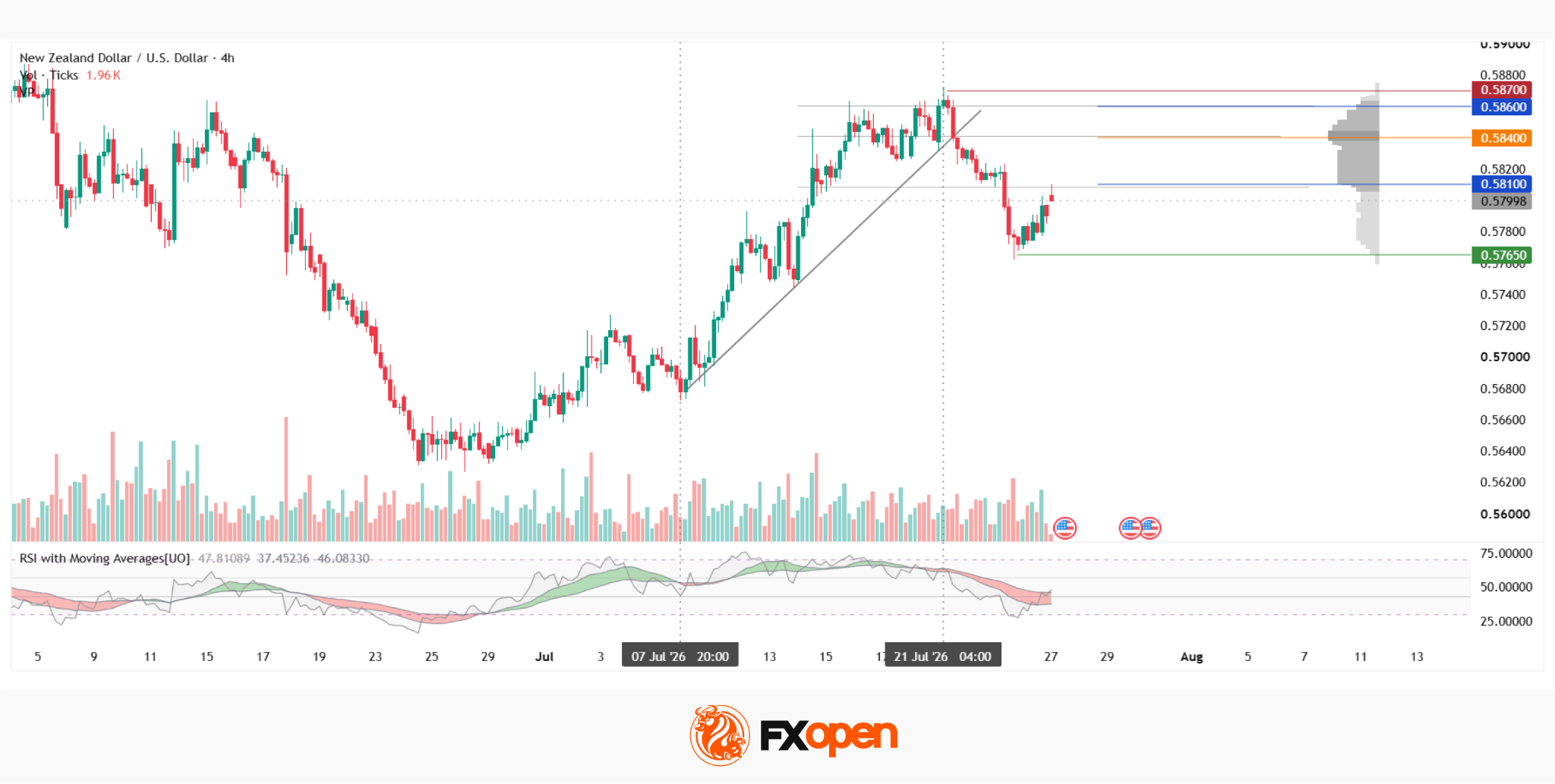
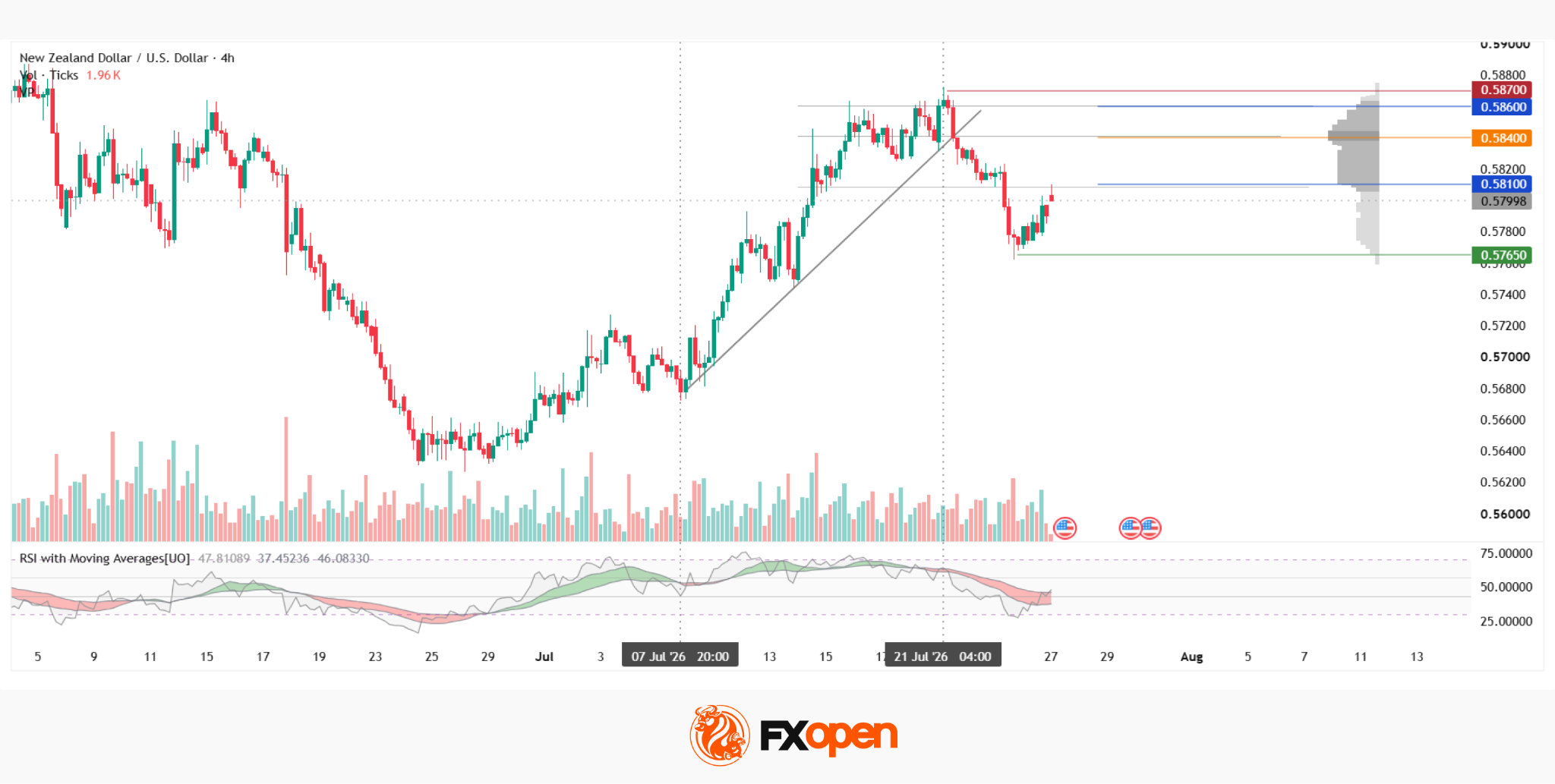
On the four-hour chart, NZD/USD has been developing a short-term uptrend since 26 June, with a trendline forming as the pair advanced towards 0.5870, where resistance emerged. The pair subsequently broke below the trendline, fell beneath the lower boundary of the current market profile and declined to the 0.5765 area, where the green support level is now located. Following a rebound from this zone, the pair moved on to test the lower boundary of the market profile at 0.5810. If this level holds and the price turns lower, the green support at 0.5765 could provide support. Should the pair continue to rise, attention may return to the POC area at 0.5840.
It is worth noting the close proximity of the upper boundary of the market profile at 0.5860 and the red resistance zone at 0.5870, making this a potentially strong resistance area. The RSI + MAs indicator currently reads 46, 37 and 46. It is also worth noting that the slower moving average has yet to leave the neutral zone, while the RSI briefly entered oversold territory before returning to neutral, casting doubt on the strength of the current breakout.
Summary
The pair’s near-term direction will likely depend on whether sellers can defend the lower boundary of the market profile. From a fundamental perspective, interest in the pair will hinge on whether the support provided by the stronger US dollar amid tensions in the Middle East proves more durable than the positive impact of New Zealand’s unexpectedly strong inflation data.
Trade over 50 forex markets 24 hours a day with FXOpen. Take advantage of low commissions, deep liquidity, and spreads from 0.0 pips (additional fees may apply). Open your FXOpen account now or learn more about trading forex with FXOpen.
This article represents the opinion of the Companies operating under the FXOpen brand only. It is not to be construed as an offer, solicitation, or recommendation with respect to products and services provided by the Companies operating under the FXOpen brand, nor is it to be considered financial advice.
The U.S. Commodity Futures Trading Commission has issued a second warning this year to prediction-market operators over broad, template-style self-certifications for event contracts.
Summary
- CFTC told prediction markets that template certifications cannot replace contract-specific terms, analysis, and compliance reviews.
- The July advisory follows a March warning as event-contract listings and trading activity continue expanding.
- Proposed rules would apply a three-step public-interest review to gaming, war, terrorism, and assassination contracts.
The agency’s Division of Market Oversight said registered exchanges must provide the terms, settlement method, data sources and compliance analysis for each contract they plan to list.
Meanwhile, the July 24 advisory does not remove the self-certification route. Designated contract markets can still list event contracts without waiting for prior Commission approval when they meet the Commodity Exchange Act and CFTC rules.
However, the agency said one filing cannot cover an open-ended set of possible contract variations without enough product-level detail.
CFTC rejects cookie-cutter event-contract filings
The CFTC said some exchanges had submitted broad certifications covering many possible versions of an event contract. Those filings did not always include the terms and conditions for each version or a short explanation of the underlying commodity and legal compliance. The agency said that approach limits staff’s ability to review settlement rules, source data and manipulation controls.
In its latest guidance, the regulator stated that “broad, template-style certifications should not be submitted.” Closely related contracts may still qualify for one class filing under specific CFTC rules. Exchanges can also request formal approval. Even then, the submission must describe the covered products clearly enough for staff to assess each proposed contract.
Second advisory follows March compliance warning
The latest notice follows a March 12 advisory issued as prediction markets expanded their sports, political, economic and current-event offerings. That earlier notice reminded exchanges that they act as front-line regulators. It also directed them to review whether contracts could be manipulated, whether settlement sources were reliable and whether product submissions met CFTC requirements.
The March guidance also addressed sports contracts, which remain at the centre of disputes between federal derivatives regulators and state gambling authorities. The CFTC says federal law gives it authority over swaps and futures listed on registered contract markets. Several states argue that some sports products operate like gambling and must follow local licensing and consumer-protection rules.
Proposed rule would create three-step review
The new certification warning arrived days before the July 27 comment deadline for the CFTC’s proposed amendments to Rule 40.11. The proposal would create a three-step process for contracts tied to activities named in the Commodity Exchange Act. Those activities include unlawful conduct, terrorism, assassination, war and gaming.
Under the proposed test, the Commission would determine whether a product is an event contract and whether its settlement depends on one of those listed activities. If both tests are met, the agency would apply public-interest factors before deciding whether to block listing or clearing. The proposal would also define “gaming,” clarify the word “involve” and structure the existing 90-day review period.
Law firm Ropes & Gray said the plan would create the most extensive federal framework for prediction markets so far if adopted. Its analysis said the proposal would review contracts case by case rather than ban complete categories in advance. It would also distinguish games from contests, placing elections and award events outside the proposed gaming definition.
Prediction-market growth raises filing pressure
The CFTC’s March rulemaking notice showed how quickly the market had changed. Registered exchanges listed an average of about five event contracts each year from 2006 through 2020. That figure rose to 131 in 2021 and reached about 1,600 new contracts during 2025. The contracts covered economics, weather, politics, science, culture, sport and international events.
More recent testimony cited by crypto.news placed 2025 trading volume across CFTC-registered prediction markets above $25 billion. It also said daily listings on one large platform rose from about 1,600 in April 2025 to roughly 162,000 in April 2026. That pace makes complete contract submissions more important because small changes in settlement terms can create different legal and market risks.
As crypto.news previously reported, the CFTC’s proposed public-interest rules could affect platforms such as Kalshi and Polymarket. The agency may examine sports products and markets tied to war, terrorism or political violence more closely.
Meanwhile, related coverage said Robinhood was discussing adding Crypto.com contracts as it builds a broader prediction-market network. The talks came as platforms added more event-contract suppliers and federal and state regulators continued to dispute who controls sports-linked products.
The July advisory does not identify any platform or announce an enforcement case. It acts as a compliance notice to all designated contract markets using self-certification. Exchanges can continue listing qualifying products, but each filing must give CFTC staff enough information to judge contract terms, settlement design, data quality and adherence to market rules.

Storj files for Chapter 11, extending a week of crypto failures. Token slides 16%

Lando Norris claims his first victory of the 2026 F1 season

Transfer news LIVE: Arsenal prepare record-breaking Vinicius Jr offer, Liverpool learn Bradley Barcola price, Yan Diomande nears move


-

 Fashion3 days ago
Weekend Open Thread: Brooks Brothers
-

 Crypto World6 days ago
Grayscale Files For Worldcoin ETF, WLD Registers Sharp Rise
-

 NewsBeat6 days ago
How a former Blue Peter presenter stunned America’s Got Talent judges
-

 Tech6 days ago
Sail Virtually Aboard The “Itanic” With IA-64 Emulator
-
 Tech6 days ago
Turtle Beach Command Series KB7 review: a nifty screen-equipped gaming keyboard
-

 NewsBeat7 days ago
Unregistered fitter used Gas Safe logo on business flyers
-

 Tech9 hours ago
Intel is reversing course and bringing hyper-threading back to its server chips
-
 Business5 days ago
New Jersey voter registration controversy explained: How 6,600 noncitizens got on the rolls, and what happens next
-
 Entertainment6 days ago
Johnny Depp’s R-Rated Gothic Cult Classic Gets New Release Ahead of Sydney Sweeney Remake
-

 Tech7 days ago
Watch Flock Safety CEO Garrett Langley discuss the future of surveillance at TechCrunch Disrupt 2026
-

 Crypto World4 days ago
Ethics, other provisions in crypto Clarity Act to be further discussed
-
 NewsBeat6 days ago
Shanghai science forum photos show China’s AI and robotics advances in rivalry with US
-

 Crypto World7 days ago
Circle’s President Sold Over 360,000 Shares, The Filings Explain Why
-
 Sports13 hours ago
Commonwealth Games boxing: Jadumani Singh seals dominant 5-0 win over Pakistan’s Sumama Rehman to enter quarter-finals | Commonwealth Games News
-

 News Videos4 days ago
The Peugeot Family: How 200 Years of an “Old Money” Dynasty Died in A Boardroom
-

 Sports3 days ago
2026 3M Open leaderboard: Scottie Scheffler finds putter in Round 1, sits three back
-

 Politics21 hours ago
Spain sweeps the board at 2026 World Cup with individual awards
-

 Fashion3 days ago
16 Dresses for the High Summer Event
-

 Crypto World6 days ago
Andrew Cuomo joins OKX board as crypto exchange expands in U.S.
-

 Tech7 days ago
The 35 Best Board Games for Family Game Night
You must be logged in to post a comment Login