

Crypto World
SEI Drops 94% to $0.06: Can This “Do or Die” Demand Zone Trigger a 100x Recovery?


TLDR:
- SEI has dropped nearly 94% from its $1.145 all-time high, now trading near a critical $0.06 demand zone.
- The $0.065–$0.045 range is flagged as a high-risk accumulation zone based strictly on descending channel structure.
- A weekly close below $0.040 would fully invalidate the current bullish setup and signal deeper price decline.
- Analysts outline expansion targets from $0.157 up to $5.05, contingent on a confirmed weekly Change of Character.
SEI is trading near $0.06, testing a critical macro demand zone after a steep price decline. The cryptocurrency has dropped approximately 94% from its all-time high of $1.145.
Technical analysts are now watching the lower boundary of a long-term descending parallel channel closely. Patient investors are being directed toward the $0.065–$0.045 range as a potential accumulation window before any structural trend shift occurs.
SEI Tests Long-Term Channel Support After Historic Markdown
SEI has been confined within a descending parallel channel since its 2024 all-time high. This channel structure has consistently produced lower highs and lower lows across multiple timeframes.
The pattern reflects prolonged selling pressure without any confirmed bullish reversal on higher timeframes. At present, the lower boundary of this channel serves as the only remaining structural reference for traders.
The $0.160 support level, previously a major price floor for SEI, has since flipped into strong resistance. This classic support-resistance role reversal has made recovery attempts difficult for buyers.
Each rally attempt toward that region has been met with sustained selling activity. The breakdown of all prior historical support levels reinforces the significance of this technical shift.
Crypto analyst Crypto Patel posted on X, stating that SEI was trading “at the lower boundary of a macro descending parallel channel after an aggressive ~94% markdown.”
The post further described this zone as a “Do or Die” demand area for the asset. The framing reflects the absence of any conventional support structure below current prices. Only channel mechanics are defining the structural floor at this stage.
Given this backdrop, the current setup carries elevated risk for traders entering positions. However, the zone between $0.065 and $0.045 is being flagged as a high-risk accumulation region for patient capital.
A weekly close below $0.040 would fully invalidate the current bullish thesis. Traders are advised to watch weekly candle closures for early confirmation signals.
SEI Price Targets Outlined as L1 Narrative Rotation Comes Into Focus
Should SEI successfully hold the current demand zone, the analysis identifies several expansion targets. These levels range from $0.157 upward through $0.351, $0.701, $1.146, $2.013, and ultimately $5.05.
Each target corresponds to prior structural areas or measured projection levels from the channel. Reaching those targets would require a confirmed market structure shift across higher timeframes.
A potential weekly Change of Character, or CHoCH, is being monitored as a primary confirmation trigger. A CHoCH would signal a shift in price behavior from bearish to early bullish structure.
Without that confirmation, the descending trend technically remains intact and active. Analysts emphasize that buyers need structure to change before positioning aggressively.
The broader 2026–2027 recovery case ties closely to Layer-1 narrative rotation in the crypto market. L1 blockchains have historically attracted capital rotation during mid-to-late altcoin market cycles.
SEI’s ongoing ecosystem expansion could support renewed interest if market sentiment improves broadly. External macro conditions, however, remain a variable that technical analysis alone cannot address.
Crypto Patel’s analysis also noted that all prior support levels have been invalidated for SEI. The accumulation zone is derived strictly from channel structure and price action, not traditional supply-demand zones.
This makes current price behavior more challenging to interpret using conventional technical frameworks. The channel’s lower boundary remains the sole structural anchor guiding current market analysis.



Excess leverage in crypto markets has virtually dissappeared which could result in a healthier spot-based market recovery, say analysts.
Global tensions, particularly the Iran-US conflict, have rattled crypto markets and pushed investors away from risk-taking.
“Periods like this are generally not favorable for risk-taking, and this can be clearly observed in the sharp decline of Bitcoin’s Estimated Leverage Ratio on Binance,” said CryptoQuant analyst Darkfost on Monday.
The metric measures the intensity with which investors use leverage and is calculated by comparing the futures Open Interest (OI) with the amount of BTC reserves held on the exchange. Since February, this ratio has fallen sharply from 0.198 to 0.152 — coinciding with Bitcoin dropping from $96,000to $69,000.
A Healthier Market Dynamic
If the ratio remains low while Bitcoin consolidates, it likely signals that spot buying rather than leveraged speculation is becoming the dominant price driver, which is a generally healthier dynamic.
“Lower leverage generally means less systemic pressure, which can help stabilize price action before the market enters a new directional phase.”
🗞️Bitcoin leverage reset after market volatility
“Since February, Bitcoin’s Estimated Leverage Ratio on Binance has dropped from 0.198 to 0.152, representing a significant and rapid decline. This type of move is typically observed after periods of strong volatility and major… pic.twitter.com/q1MVOR5CZa
— Darkfost (@Darkfost_Coc) March 9, 2026
In a separate post, CryptoQuant analyst “IT tech” said that “bottom callers are multiplying.” One metric just hit 29 consecutive days in distress territory, they added, highlighting the Bitcoin long-term holder-to-short-term holder SOPR ratio, which is at 0.89.
“Recent buyers are underwater. LTHs aren’t selling, but they’re not absorbing either. STH capitulation building, but nowhere near extremes. Calling a structural low here is premature.”
Meanwhile, Glassnode reported on Monday that momentum has “firmed modestly,” with RSI lifting from recent lows, “but price action still lacks the strength of a decisive bullish shift.”
“Spot activity remains subdued, with lower trading volume pointing to softer participation even as conditions begin to stabilize.”
Crypto Market Outlook
Spot markets have climbed 4.3% on the day to reach $2.46 trillion in a move that follows US President Trump’s comments that the war with Iran could be “over soon.” Bitcoin reclaimed $70,000 in early trading in Asia on Tuesday as oil prices tanked 28% from Monday’s high of $120.
You may also like:
Ether remained weak, but it was holding above the $2,000 level at the time of writing. Meanwhile, some altcoins were seeing larger gains, including Hyperliquid and Zcash, which surged more than 11% each.
Binance Free $600 (CryptoPotato Exclusive): Use this link to register a new account and receive $600 exclusive welcome offer on Binance (full details).
LIMITED OFFER for CryptoPotato readers at Bybit: Use this link to register and open a $500 FREE position on any coin!
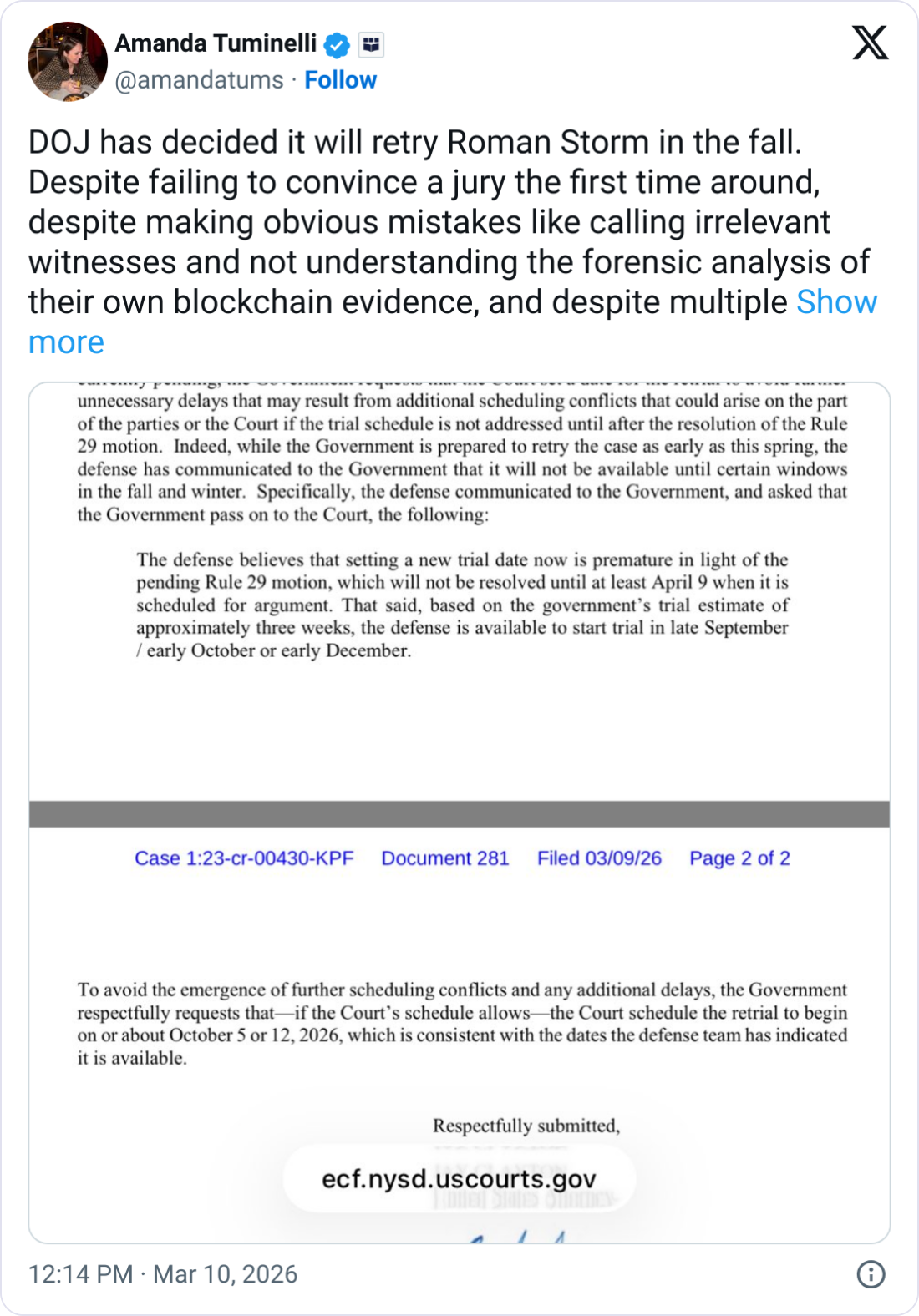
US prosecutors have requested a retrial of crypto mixer Tornado Cash co-founder Roman Storm after a jury failed to reach a unanimous verdict on two charges at his trial last year.
US Attorney for Manhattan Jay Clayton asked federal Judge Katherine Polk Failla in a letter on Monday for a trial date to retry Storm on charges of conspiracy to commit money laundering and conspiracy to violate sanctions.
The letter asked the court for the retrial to begin on or around Oct. 5 to 12, with the trial expected to last three weeks. It said prosecutors were prepared to retry the case as early as spring, between March and May, but Storm’s defense lawyers said they weren’t available until late 2026.
In August, a jury convicted Storm of conspiring to operate an unlicensed money transmitting business, but was deadlocked on the money laundering and sanctions violation conspiracy charges, which has allowed prosecutors to retry those charges.
Storm had pleaded not guilty and asked Judge Polk Failla in October to acquit him of the money transmitting charge, arguing prosecutors failed to prove he intended to help bad actors use Tornado Cash.
Clayton wrote in his letter that Storm’s lawyers told prosecutors that setting a new trial date was premature due to the pending acquittal motion, which wouldn’t be resolved until early April, when it is scheduled for argument.
Prosecutors hope for “different answer,” says Storm
Storm posted on X that the two counts the government plans to retry him on could see him spend “up to 40 years in federal prison. For writing open-source code. For a protocol I don’t control. For transactions I never touched.”
“A jury already couldn’t agree this was criminal. But the SDNY [Southern District of New York] prosecutors want to keep trying with the hope of getting a different answer,” he added.
Amanda Tuminelli, the legal chief at crypto advocacy group the DeFi Education Fund, said the Justice Department’s decision to retry Storm was “incredibly disappointing.”

“Despite failing to convince a jury the first time around, despite making obvious mistakes like calling irrelevant witnesses and not understanding the forensic analysis of their own blockchain evidence, and despite multiple legal and logical fallacies to their allegations of third-party dev liability, the SDNY will retry Roman Storm,” she added.
Related: DOJ finalizes $400M crypto forfeiture in Helix Bitcoin mixer case
Clayton’s letter comes as a report that the US Treasury submitted to Congress this month acknowledged some lawful uses of crypto mixers, including those who use such services “to maintain more privacy in their consumer spending habits.”
In his X post, Storm also noted that US Deputy Attorney General Todd Blanche had issued a memo in April saying the Justice Department “is not a digital assets regulator,” and the agency would “no longer pursue litigation or enforcement actions that have the effect of superimposing regulatory frameworks on digital assets.”
“Same country, same DOJ — just filed to retry me anyway,” Storm said.
Magazine: Can privacy survive in US crypto policy after Roman Storm’s conviction?


Non-fungible token lending platform Gondi has vowed to compensate users affected in a Monday exploit during which the attacker stole roughly $230,000 worth of NFTs from the protocol.
Summary
- Gondi confirmed an exploit in its Sell & Repay contract allowed an attacker to steal about $230,000 worth of escrowed NFTs, prompting the platform to disable the feature.
- The protocol said affected users will be compensated by purchasing comparable NFTs from the same collections.
According to a post-incident update, Gondi confirmed that an exploit of its “Sell & Repay contract” allowed an attacker to withdraw roughly $230,000 worth of escrowed NFTs from the protocol. The contract allows borrowers to sell escrowed NFTs and subsequently repay outstanding loans on the platform.
An updated version of the contract was deployed on Feb. 20, but Gondi did not clarify how the vulnerability was exploited.
The exploit did not impact any other parts of the protocol, and the platform has paused the contract as it works on a fix while other services remain operational.
“All users who interacted with this contract and were impacted have been contacted directly by our team,” Gondi wrote. In a subsequent update, the protocol said it plans on making affected users whole by purchasing comparable items from the same collection.
“While not the exact same piece, we believe this is a fair and meaningful resolution and are coordinating directly with each owner,” it added.
Gondi has since been reviewed by the team at Blockaid and an independent auditor, who have concluded that the protocol is safe to use.
According to Blockaid, the attacker started selling some of the stolen NFTs after the exploit. As of the last update, Gondi said that the attacker’s wallet still contained some of the stolen NFTs while the remainder was sold to “innocent buyers who had no knowledge of the exploit.”
“We reached out to each of them directly and asked for their help in returning the items to their rightful owners,” it added.
Meanwhile, at least four NFTs were recovered and returned by the NFT community, including Aluminum Gazer, Servant of the Muse, Doodle, and Lil Pudgy.
The platform said it was using its protocol fees to buy back recovered items and compensate affected users.
The Gondi exploit marks the second attack in two weeks. As previously reported by crypto.news, Bitcoin-focused DeFi platform Solv Protocol was exploited late last week, allowing the hacker to drain roughly $2.7 million worth of funds from one of its token vaults.
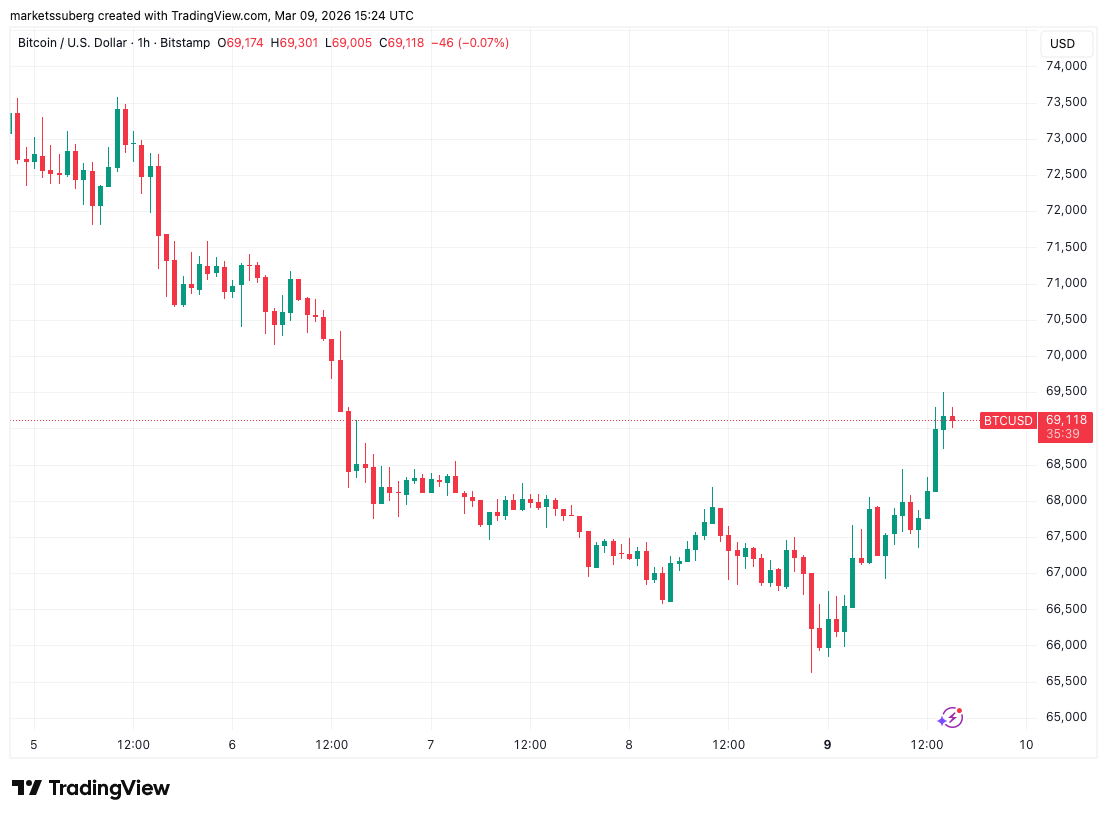
Bitcoin managed to avoid losses suffered by global stock markets over oil supply uncertainty, with a 5% relief bounce from its weekly open level.
Bitcoin (BTC) returned to $69,000 at Monday’s Wall Street open with markets in limbo over the Middle East oil crisis.
Key points:
-
Bitcoin sees a rebound after dropping below $68,000 for the weekly close.
-
Oil woes continue as the G7 fails to agree on a timeline for the release of reserve oil supplies.
-
Bitcoin derivatives traders stay level-headed on the mid-term outlook.
Analysis: Trump wants to buy time with oil
Data from TradingView showed BTC price action continuing a rebound that began just before the weekly close.

Now up 5% on the day, BTC/USD showed strength relative to global stock markets, with Asia particularly sensitive to the ongoing suspension of oil traffic through the Strait of Hormuz.
A dedicated meeting of the G7 countries to discuss the release of 400 million barrels of crude from their joint reserves ended in indecision on the day.
“The G7 countries have ~1.2 billion barrels of crude oil reserves, which is equivalent to ~60 days of oil flows through the Strait of Hormuz. 400 million barrels can supply roughly 20 days worth of Strait of Hormuz oil flows,” trading resource The Kobeissi Letter responded in a post on X.
“But, it’s a risk. If the war rages on once these stockpiles are depleted, the world would enter an unprecedented energy crisis.”
Kobeissi argued that US President Donald Trump was “looking to ‘buy’ a couple more weeks” with the initiative.

WTI oil was still up 9% on the day at the time of writing, circling $100 per barrel amid considerable volatility.
Gold, meanwhile, lacked the momentum to head closer toward all-time highs after starting the week with a retest of $5,000.

Commenting, trading company QCP Capital noted a rotation from gold to the US dollar as a hedge against the current geopolitical uncertainty.
“With uncertainty rising, global equity markets have turned defensive. That said, US Treasuries and gold also failed to provide their usual haven bid, with both coming under pressure as surging crude prices stoke inflation fears and push yields higher,” it wrote in its latest “Market Color” analysis post.
“Instead, the US dollar has emerged as the preferred defensive asset, supported by elevated yields and the US’s status as a net energy exporter.”

Bitcoin options traders see no “one-way decline”
Bitcoin thus eyed key price points that bulls had failed to reclaim at the weekly close.
Related: Bitcoin braces for oil shock and death crosses: 5 things to know this week
Here, crypto trader, analyst and entrepreneur Michaël van de Poppe hoped that oil would settle down, allowing for BTC price relief.
“Bitcoin continues to show strength and it’s already back up to $69K,” he acknowledged.
“If Oil continues to fall and indices break back upwards, I would assume that we’ll start to see a continuation towards the range high again.”

QCP pointed to the “more nuanced outlook” for the market being created by derivatives traders.
“For example, the purchase of 500x BTC 24APR26 72k straddle points to expectations of continued volatility rather than a sharp, one-way decline,” it continued about options.
“Notably, March’s highest open interest is concentrated at the 75k and 125k call strikes. While a rapid recovery to these levels remains unlikely, this positioning signals pockets of renewed optimism in BTC despite ongoing macro and geopolitical uncertainty.”
This article does not contain investment advice or recommendations. Every investment and trading move involves risk, and readers should conduct their own research when making a decision. While we strive to provide accurate and timely information, Cointelegraph does not guarantee the accuracy, completeness, or reliability of any information in this article. This article may contain forward-looking statements that are subject to risks and uncertainties. Cointelegraph will not be liable for any loss or damage arising from your reliance on this information.
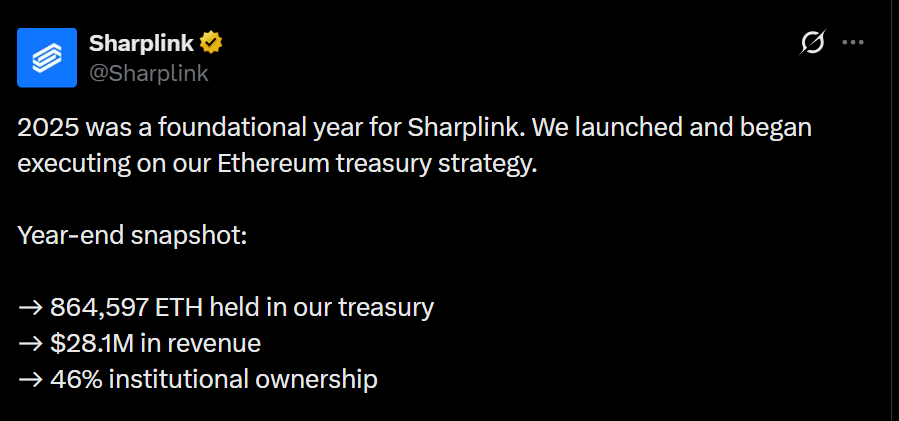
Ethereum treasury company Sharplink has reported a $734.6 million net loss for 2025 due to a crypto market decline in the second half of the year.
The firm posted its financial results for the year on Monday, revealing that its full-year net loss was primarily driven by a $616.2 million paper loss on the 868,699 Ether (ETH) it has accumulated to date.
Adding to its losses was a $140.2 million impairment charge related to converting its staked Ether.
Ethereum saw rocky performance in the second half of 2025. While its price climbed to $4,829 in August, the October market crash saw it spiraling down to close the year at roughly $3,000.
Despite the losses, the firm said it will continue to buy more Ether, arguing that its strategy is designed to weather crypto volatility.
“While short-term market volatility impacted GAAP financial results, our strategy is designed to excel through cycles. Our mandate is simple: increase ETH per share responsibly and maximize the productivity of our treasury through time,” Sharplink said.
Sharplink, chaired by Ethereum co-founder Joseph Lubin, pivoted from being a sports betting marketing company to becoming a digital asset treasury in June 2025.
Sharplink is looking to gradually increase its Ether-per-share ratio to create long-term shareholder value. The firm said it managed to more than double this ratio in 2025, going from 2 ETH per share to 4.01 ETH per share.

Despite taking a hit on the value of its ETH holdings, total revenue jumped 659% from $3.7 million to $28.1 million in 2025. Meanwhile, ETH staking revenue increased by 48.5% from Q3 to Q4 to hit $15.3 million.
For the year, the firm also banked $55.2 million from its ETH-to-liquid-staked-ETH conversions and redemptions.
Related: Ether’s path to $2.5K may be trickier than expected: Here’s why
After securing $3.2 billion in funding across 2025, Sharplink has become the second-largest publicly traded Ethereum holder behind BitMine Immersion Technologies, which now holds over 4.5 million ETH, representing 3.76% of the total supply.
BitMine also reportedly has major paper losses on its Ethereum holdings, with some estimates hitting as high as $8.8 billion amid a 60% drop in ETH over the past six months.
The price of Sharplink’s stock, SBET, has been volatile over the past 12 months and is up 67% since this time last year to sit at $7.60 at the time of writing.
The price skyrocketed 1,000% in the span of a week to hit almost $80 following its initial Ether treasury announcement in late May, before falling after the firm made its pivot.
Over the last six months, the price has declined by more than 50%.
Magazine: What’s a ‘Network State’ and are there real-life examples? Big Questions


Cryptocurrencies linked to artificial intelligence, such as Bittensor’s TAO, NEAR Protocol, Internet Computer, and others rallied after Wired reported that Nvidia is preparing a new open-source platform for autonomous AI agents, a concept similar to the OpenClaw framework, ahead of its annual developer conference.
The broader artificial intelligence token category rose about 4.8% to roughly $14.17 billion in market value, outperforming the wider crypto market, where the CoinDesk 20 index was up 2.86%. Among the majors, Bittensor’s TAO led the move, with NEAR Protocol and Internet Computer also advancing.
Nvidia’s new platform, according to Wired, will be called NemoClaw. The system would allow enterprise software companies to deploy AI agents that can perform multi-step tasks for employees, and Nvidia has reportedly approached firms including Salesforce, Cisco, Google, Adobe, and CrowdStrike about potential partnerships ahead of its developer conference next week.
Wired says NemoClaw is expected to include security and privacy tools for enterprise use and is part of Nvidia’s broader strategy to expand its software ecosystem while maintaining its dominance in AI infrastructure.
Nvidia’s GTC developer conference begins March 17.
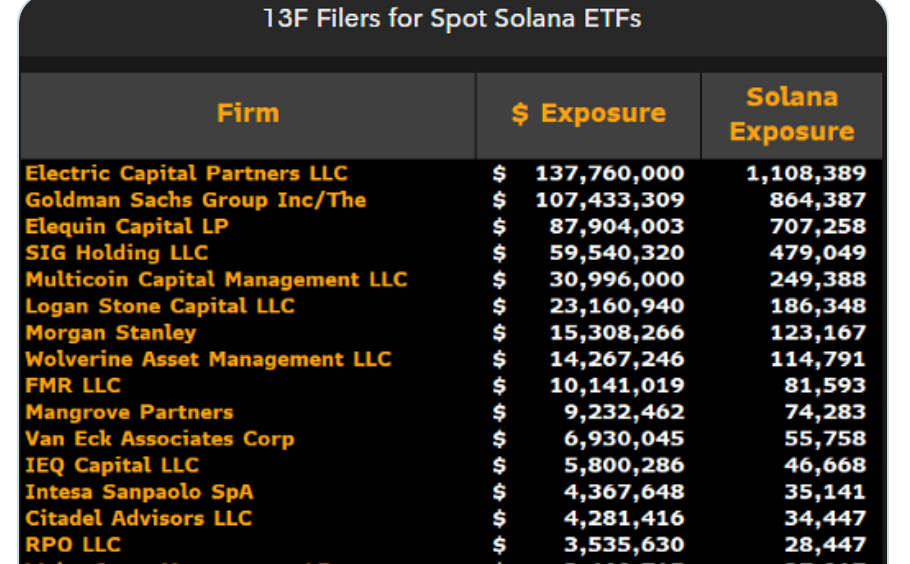
Investment advisors were the biggest buyers of the US-based spot Solana ETFs at over $270 million, while hedge fund managers came in next at $186 million.
Silicon Valley-based venture capital firm Electric Capital Partners and investment bank Goldman Sachs were the two largest buyers of spot Solana exchange-traded funds, which launched for trading in the US in October last year.
Data shared by Bloomberg ETF analyst James Seyffart on Monday shows that the top 30 institutional holders of US spot Solana (SOL) exchange-traded funds bought over $540 million worth of the ETFs in the quarter.
Electric Capital and Goldman Sachs took out the top two positions with $137.8 million and $107.4 million worth of Solana ETF exposure, while Elequin Capital, SIG Holding and Multicoin Capital rounded out the top five.
Morgan Stanley and Citadel Advisors were among the other notable institutions that bought spot Solana ETFs after Bitwise launched the first Securities and Exchange Commission-approved spot Solana ETF on Oct. 28.

Seyffart’s data comes from 13F filings submitted to the SEC in mid-February, where institutions managing over $100 million in assets are required to disclose their Q4 holdings and position sizes.
Investment advisors accounted for by far the largest share of spot Solana ETF ownership at over $270 million, while hedge fund managers came in next at $186.4 million.
Holding companies and brokerage firms held $59.5 million and $20.3 million, while banks held $4.5 million.

The $540 million in Solana ETF holdings was backed by approximately 4.3 million SOL tokens.
However, those 4.3 million SOL tokens have fallen over 30% in market value since the end of Q4, from $124.95 to $86.53 at the time of writing.
SOL ETF net flows steadying despite price fall
Bloomberg ETF analyst Eric Balchunas noted on Thursday that cumulative flows into spot Solana ETFs have held strong in recent months despite Solana’s price fall.
Related: US banking lobby considers suing OCC over crypto bank charters: Report
Balchunas also noted that 50% of Solana ETF assets are held by these 13F-filing firms, arguably making for a more serious investor base.
Farside Investors data shows that US spot Solana ETFs have accumulated $952 million worth of inflows since launching in the US.
Magazine: What’s a ‘Network State’ and are there real-life examples? Big Questions


Major tokens snapped back on Tuesday as ceasefire optimism rippled through risk markets.
Ether reclaimed $2,029, up 2.6% over the past 24 hours and back above the $2,000 level that has served as a psychological pivot for weeks. Solana led the recovery at 2.9% to $85.67. BNB added 2.6% to $639. XRP gained 1.7% to $1.37. Dogecoin lagged at just 1% and remains down 1.4% on the week, continuing to underperform the broader market on every bounce.
The catalyst was U.S. president Donald Trump telling reporters late Monday that the Iran conflict would resolve “very soon” and that U.S. military objectives were “pretty well complete.” Asian equities surged 2% after Monday’s 3.7% plunge. Tech stocks in the MSCI Asia Pacific index jumped 3.5%. Oil fell from Monday’s spike above $100.
Analysts at Nansen said in an email that crypto had “already absorbed the negatives and priced them in,” arguing the market was responding to headlines rather than broader macro deterioration.
The institutional flow data supports that read. CoinShares reported $619 million in crypto fund inflows for the week ending Friday, with $521 million going to bitcoin products and total AUM reaching $108.3 billion.
That capital came in during a week where the S&P lost $1 trillion in a single session and the economy shed 92,000 jobs. “Spot Bitcoin ETFs continue to attract capital even as price weakens, which suggests institutional allocators are treating this as a tactical entry rather than capitulation,” said Ryan Kirkley, co-founder and CEO of Global Settlement, in an email to CoinDesk.
Ethereum’s position above $2,000 is the one to watch this week. The second-largest cryptocurrency has been fighting to hold that level since late February, and FxPro analysts flagged $2,500 and the 200-week moving average as the zone that would confirm a genuine recovery rather than a series of dead cat bounces. The gap between $2,000 and $2,500 is where the narrative shifts from “surviving the drawdown” to “starting a new trend.”
For solana, the recovery has been structurally weaker. SOL remains down roughly 55% from its cycle highs and has underperformed ether on every major bounce since the October crash.
The memecoin economy that fueled solana’s 2024 rally has evaporated, and without that speculative engine the token is trading more on macro sentiment than ecosystem activity.
XRP has been the most range-bound of the majors, hovering between $1.30 and $1.45 for most of March. ETF inflows have been positive and the legal clarity from Ripple’s settlement should be a tailwind, but the token has failed to decouple from broader market direction.
The Fed meeting on March 17-18 looms as the next real test.
Global Settlement’s Kirkley noted that the 90-day correlation between bitcoin and the S&P 500 has climbed to 0.78, one of the highest readings since mid-2022. When bitcoin trades in lockstep with equities, altcoins amplify every move in both directions.
A hawkish dot plot or any hint that rate hikes are back on the table would hit the higher-beta end of crypto hardest.
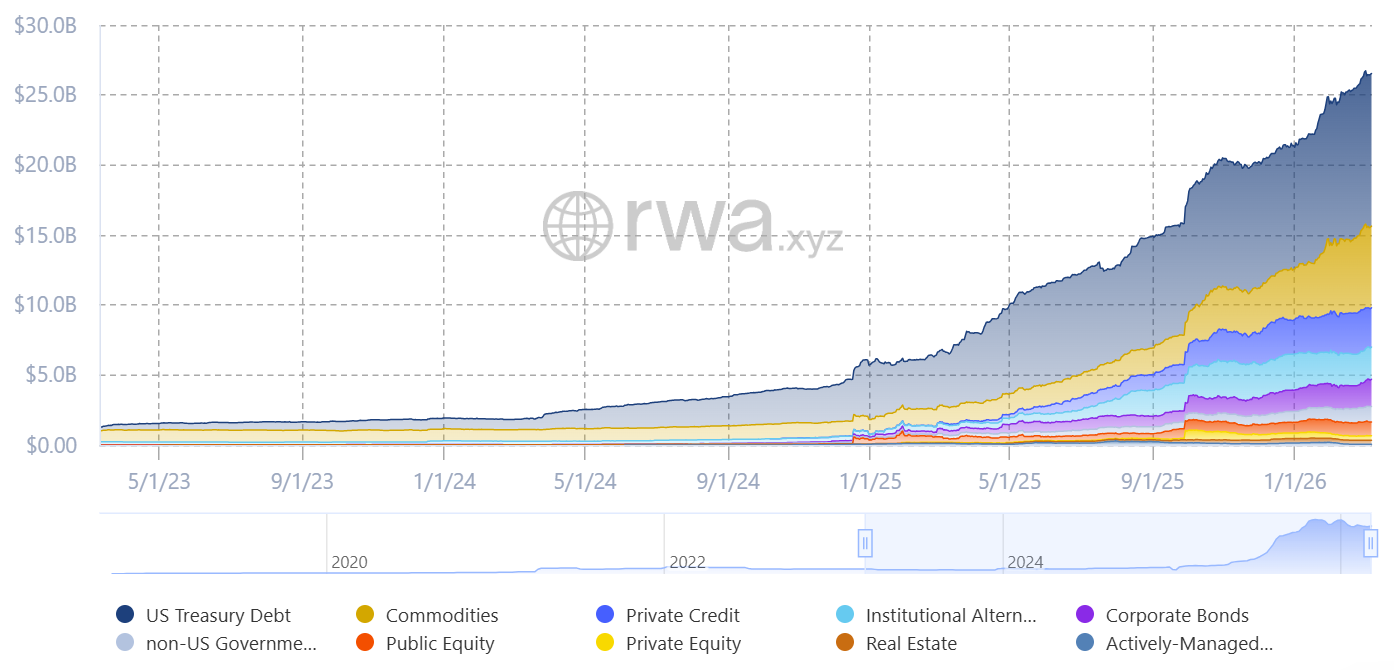
Amina, a Swiss-regulated crypto bank, has joined a blockchain-based settlement platform for tokenized securities operating under the European Union’s DLT pilot regime, marking another step toward integrating digital asset infrastructure with traditional capital markets.
The Zug, Switzerland-based company announced Monday that it has become a listing sponsor on the EU-regulated platform 21X, making Amina the venue’s first fully regulated bank participant.
Amina said the move will allow it to support companies issuing tokenized securities on 21X through its partnership with Tokeny, a Luxembourg-based company that provides technology for creating and managing tokenized financial assets.
The collaboration aims to address a key barrier to institutional adoption of tokenized assets by connecting regulated banks with the issuance and trading of tokenized securities.
21X received an infrastructure permit under the EU’s DLT pilot regime in December 2024, allowing it to run a regulated market for blockchain-based securities in a regulatory test environment.
“A lack of interoperability of tokenized asset platforms” was cited by Baker McKenzie’s European Financial Services practice in June as one of the main obstacles to the adoption of tokenization among financial institutions. “Scale will only be achieved when numerous market players are transacting with each other on common or interconnected platforms,” Zurich partner Yves Mauchle wrote on the firm’s blog.
Introduced in 2023, the DLT framework allows market operators to experiment with blockchain-based trading and settlement of financial instruments within a regulatory sandbox. The program is intended to help regulators evaluate how the technology could fit into existing market infrastructure.
Despite early uptake, the regime has faced scrutiny from industry participants, who warn that its current limits could prevent European onchain markets from scaling and competing with other jurisdictions. It remains unclear whether participation from regulated banks such as Amina will help accelerate adoption.
Related: Crypto exchanges gain as tokenized commodity market climbs to $7.7B
Strong growth of tokenized real-world assets
The development comes as financial institutions increasingly invest in blockchain infrastructure for tokenized assets. In the United States, institutions including BNY, Nasdaq and S&P Global recently backed the expansion of the Canton Network, while Europe is testing regulated blockchain trading venues such as 21X under the EU’s DLT pilot regime.
In February, eight EU-regulated digital asset companies urged policymakers to accelerate digital asset legislation, warning that the bloc risks falling behind the United States and other jurisdictions in developing tokenized financial markets.

To be sure, positive developments are taking place. In September, crypto exchange Kraken launched tokenized securities trading for European users through its xStocks platform, which offers blockchain-based versions of US-listed equities.
Two months later, tokenization platform Ondo received regulatory approval in Liechtenstein to offer tokenized equities trading to European investors.
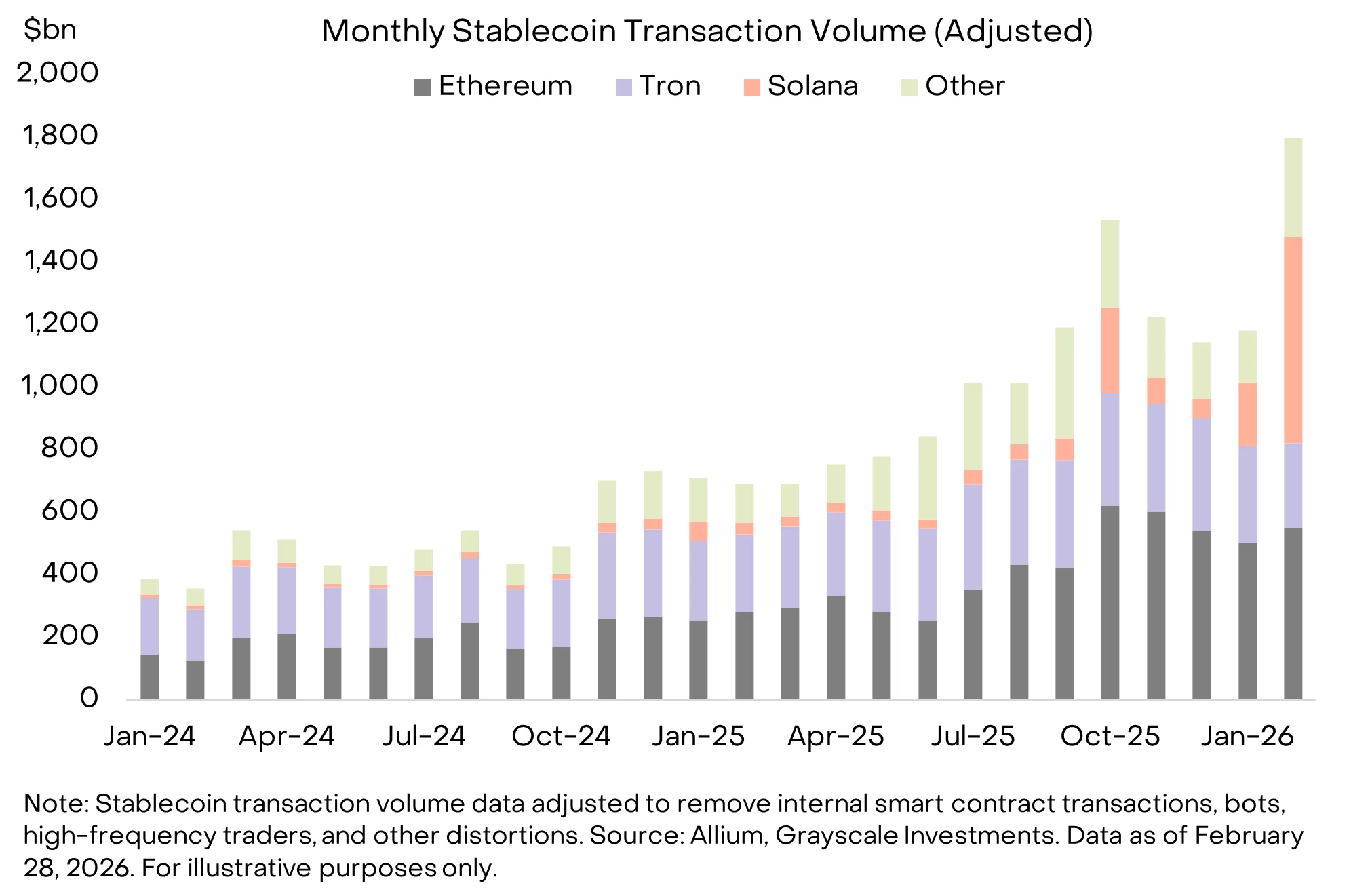
Solana has achieved a historic milestone in the digital asset sector, officially surpassing both Ethereum and Tron in monthly stablecoin transaction volume for February 2026.
Summary
- Solana processed a record $650 billion in stablecoin volume, more than doubling its previous peak from late 2025.
- The network overtook Ethereum and Tron, capturing the largest share of the $1.8 trillion global stablecoin activity.
- SOL is consolidating near $84, with $80 acting as key support and $90 as the first major resistance for a potential trend reversal.
According to latest data, Solana’s (SOL) adjusted stablecoin volume hit a record $650 billion, representing a massive surge in on-chain payment activity that more than doubled its previous peak from late 2025.
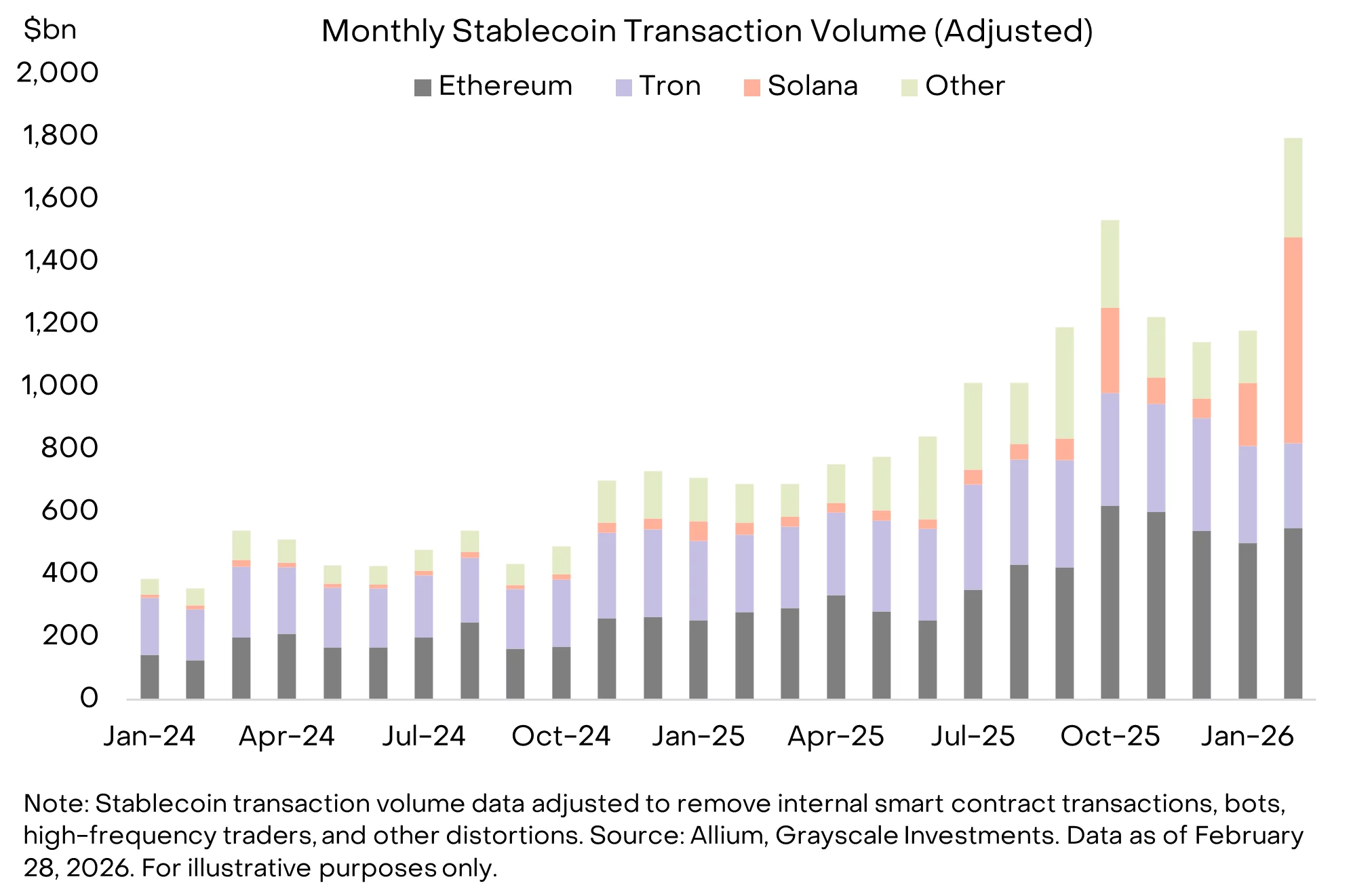
This explosive growth marks a fundamental shift in the network’s utility, moving away from a primary reputation as a hub for meme coin speculation toward becoming the leading infrastructure for global stablecoin settlements.
Solana’s low transaction fees and high throughput have made it the preferred rail for high-frequency, economically meaningful transfers, outperforming traditional heavyweights like Tron, which previously dominated the USDT payment market.
This surge occurred against a backdrop of record global stablecoin volume reaching $1.8 trillion, with Solana now accounting for the largest single share of that activity, solidifying its position as the dominant network for the emerging digital dollar economy.
SOL price analysis
The current price action for SOL on the daily chart indicates a period of cautious consolidation following a long-term downtrend from the January highs. After crashing from the $140 level earlier in the year, Solana has spent the last month attempting to carve out a stable bottom.
Currently, the asset is trading at approximately $84.12, showing a 3.10% gain in the most recent session as it attempts to move away from a local floor.
The immediate support is firmly established at the $80.00 psychological level, which bulls have defended multiple times over the past week. On the upside, the first major hurdle for a recovery is the $90.00 resistance mark, where recent rallies have faced selling pressure.
A decisive break and hold above $90.00 would be the first major signal that a trend reversal is underway, potentially opening the door for a run toward $100.
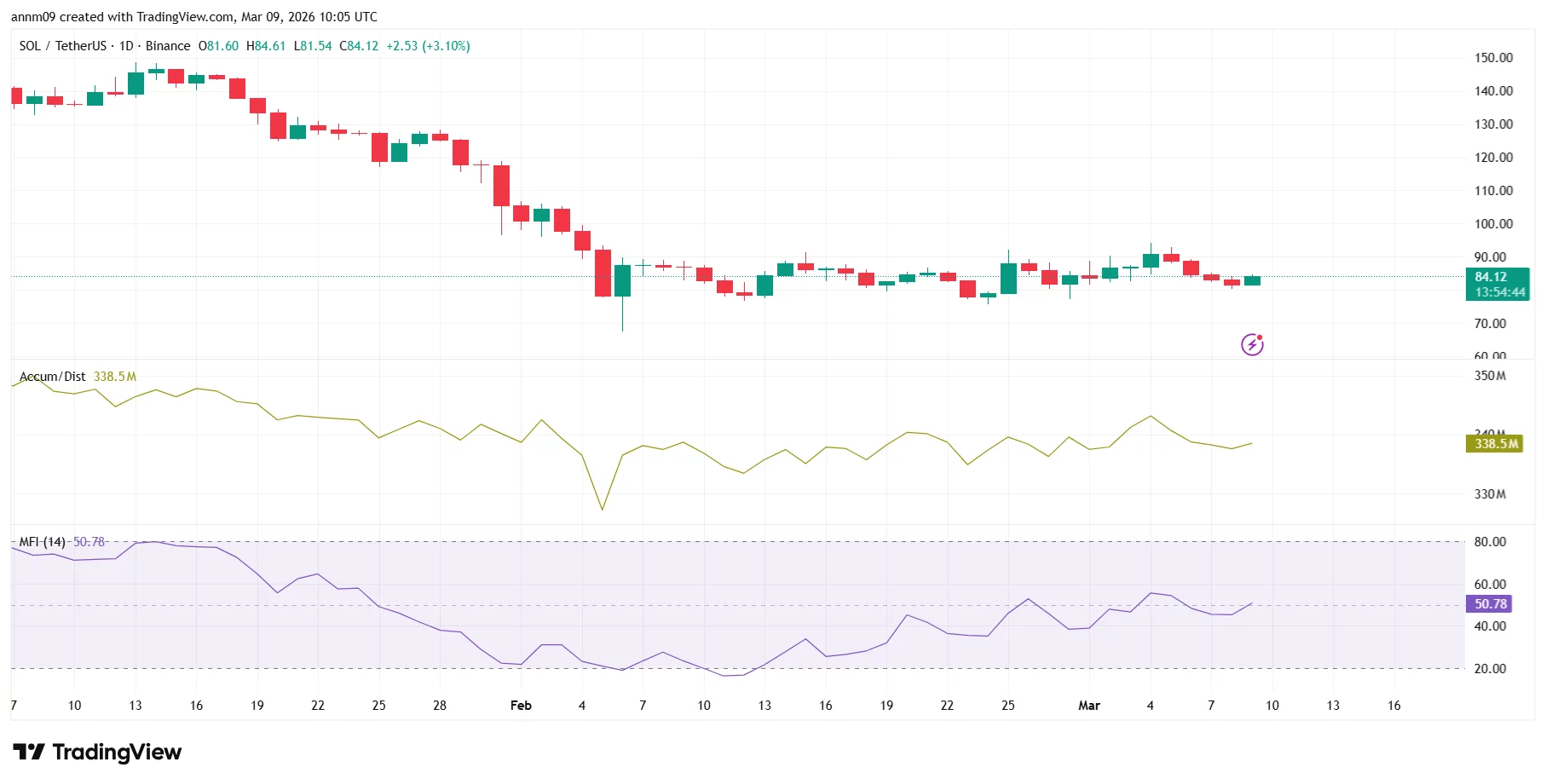
Technical indicators provide a nuanced view of this consolidation phase, suggesting that while the trend remains neutral, bearish momentum is fading.
The Money Flow Index (MFI-14) is currently sitting at 50.78, a perfectly neutral reading that indicates a balance between buying and selling pressure after recovering from an oversold dip in early February.
Furthermore, the Accumulation/Distribution line is positioned at 338.5 million, remaining relatively flat over the last several weeks. This lack of aggressive distribution despite the lower price points suggests that long-term holders are largely staying put, awaiting a catalyst for the next leg up.
If the record-breaking stablecoin utility translates into sustained demand for SOL to cover transaction fees, the next major resistance beyond $90.00 lies at $105.00. However, if the $80.00 support fails to hold, investors should watch for a secondary defensive line at the $70.00 mark.

Rihanna Leaves Los Angeles After Woman Shoots at Her Home

Opinion: Open for business, closed at home

Bitcoin’s Leverage Ratio Drops Sharply

Smart energy pays enters the US market, targeting scalable financial infrastructure

Why Israel is blocking foreign journalists from entering

Bitcoin: We’re Entering The Most Dangerous Phase

I Bought a Storage Unit for $170! Look What I Found! #money #shorts #reels #cash #hustle

Live Gold, Crypto Trading | 9 March | #goldtrading #cryptotrading #bitcoin – MANSI

How to grow your money without paying taxes on it #shorts #finance
-

 Politics7 days ago
Alan Cumming Brands Baftas Ceremony A ‘Triggering S**tshow’
-
Business4 days ago
Form 8K Entergy Mississippi LLC For: 6 March
-

 Fashion3 days ago
Weekend Open Thread: Ann Taylor
-

 News Videos18 hours ago
10th Algebra | Financial Planning | Question Bank Solution | Board Exam 2026
-

 Crypto World14 hours ago
Paradigm, a16z, Winklevoss Capital, Balaji Srinivasan among investors in ZODL
-

 Tech5 days ago
Bitwarden adds support for passkey login on Windows 11
-
 Sports4 days ago
499 runs and 34 sixes later, India beat England to enter T20 World Cup final | Cricket News
-

 Sports2 days ago
Three share 2-shot lead entering final round in Hong Kong
-

 Sports2 days ago
Braveheart Lakshya downs Lai in epic battle to enter All England Open final | Other Sports News
-

 Business6 days ago
Guthrie Disappearance Enters Fifth Week as Family Visits Memorial
-

 Politics4 days ago
Top Mamdani aide takes progressive project to the UK
-

 NewsBeat5 days ago
Piccadilly Circus just unveiled ‘London’s newest tourist attraction’ and it only costs 80p to enter
-

 Business2 days ago
Search for Nancy Guthrie Enters 37th Day as FBI Probes Wi-Fi Jammer Theory
-

 Entertainment3 days ago
Hailey Bieber Poses For Sexy Selfies In New Luscious Lip Thirst Traps
-
 NewsBeat5 hours ago
Pagazzi Lighting enters administration as 70 jobs lost and 11 stores close across Scotland
-
 Sports7 days ago
Jack Grealish posts new injury update as Man City star enters crucial period
-

 Tech16 hours ago
Despite challenges, Ireland sixth in EU for board gender diversity
-

 Crypto World5 days ago
New Crypto Mutuum Finance (MUTM) Reports V1 Protocol Progress as Roadmap Enters Phase 3
-

 Tech5 days ago
ACIP To Discuss COVID ‘Vaccine Injuries’ Next Month, Despite That Not Being In Its Purview
-
Entertainment5 days ago
Harry Styles Has ‘Struggled’ to Discuss Liam Payne’s Death