
Crypto World
Seven-Day Countdown to MEGA Begins as MegaETH Clears First KPI



The deployment of 10 Mega Mafia apps satisfies the first of three performance triggers tied to the long-awaited token launch.
Ethereum Layer 2 blockchain MegaETH has cleared the first of its three self-imposed performance hurdles and scheduled the token generation event (TGE) for its native MEGA token for April 30.
According to MegaETH’s Road to TGE dashboard, all 10 Mega Mafia applications required under KPI-2 are now fully deployed on mainnet. These include stablecoin payments protocol Cap, DEX Kumbaya, onchain game Showdown, lending market Avon, decentralized telecom protocol Ubitel, World, Stomp, HitOne, Nectar AI, and yield tokenization platform Brix.
The milestone triggers a seven-day countdown to MEGA’s launch, the team confirmed on X, ending a stretch of uncertainty that began when MegaETH went live in February without a fixed token launch date, instead tying issuance to three on-chain milestones: a $500 million circulating supply of its native USDM stablecoin with at least 25% deposited into smart contracts, 10 deployed Mafia apps with verified contracts and functioning core loops, or three apps generating $50,000 in daily fees for 30 consecutive days. Per the network’s TGE FAQ, only one KPI needs to be hit to start the seven-day clock.
As The Defiant previously reported, none of those conditions were close to being met in the immediate weeks following the mainnet launch, with the Mafia apps counter sitting at 5 of 10 a week after launch.
MegaETH’s public KPI dashboard shows that USDM circulation currently sits at $62.9 million, or roughly 13% of the $500 million target. The daily fees KPI also remains untriggered.
Tokenomics and Unlocks
MEGA’s total supply is fixed at 10 billion tokens, per the MEGA MiCA Whitepaper. Of that, 53.3% will be released over time as staking rewards tied to four topline KPI goals, 5% was offered in a public Sonar-based token auction, 7.5% was earmarked for an ecosystem and foundation reserve, 9.5% will vest for the team and advisors, and 14.7% was allocated to early investors.
Unlock terms vary by cohort. Echo round investors will see 20% unlocked at TGE, then a one-year cliff followed by a three-year vest, while Fluffle NFT holders unlock 50% at TGE with a six-month linear vest for the remainder. Sonar participants either unlock fully at TGE or accept a one-year lock in exchange for a discount.
The October Sonar auction drew $1.39 billion in commitments for a $50 million allocation, making it one of the most oversubscribed token sales of the cycle. A subsequent USDM pre-deposit bridge campaign was refunded after a multisig misstep in late November.
Once live, MEGA will function as the bidding currency for MegaETH’s proximity markets, where market makers and applications pay to colocate near the sequencer for sub-millisecond latency. The MegaETH Foundation has also committed to using USDM yield to accumulate MEGA tokens through ongoing buybacks.
MEGA premarket perpetuals on Hyperliquid have been trading in the $1.5 billion to $2 billion implied valuation range in recent days, well below the pre-launch peak above $6 billion recorded last October.
This article was written with the assistance of AI workflows. All our stories are curated, edited and fact-checked by a human.

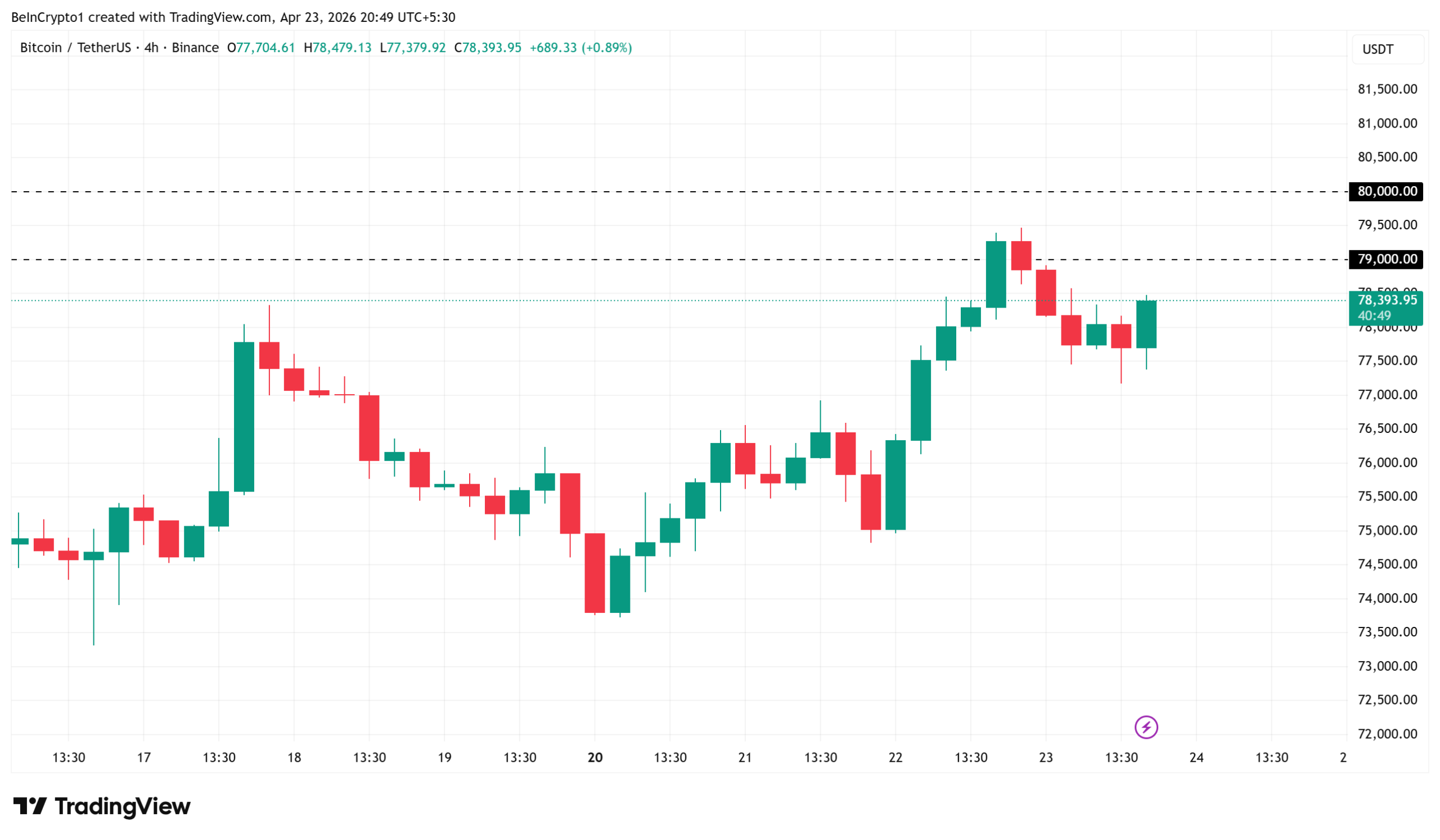
Bitcoin (BTC) traded near $78,000 on Thursday but continued to face resistance at the $80,000 level as fresh US-China friction weighed on risk sentiment.
The White House accused Chinese entities of running deliberate campaigns to steal American AI technology, adding to geopolitical uncertainty weeks before a planned Trump-Xi summit.
White House Escalates AI Dispute With China
In a Thursday memo Michael Kratsios, Director of the White House Office of Science and Technology Policy, said foreign entities based in China are conducting “industrial-scale campaigns to distil US frontier AI systems.”
The campaigns allegedly use tens of thousands of proxy accounts and jailbreaking techniques to extract proprietary data from American AI models.
The administration said it would share intelligence with US AI firms and explore measures to hold foreign actors accountable.
This announcement arrives weeks before President Trump’s scheduled visit to China in mid-May for talks with President Xi Jinping.
Bitcoin Faces $80,000 Resistance
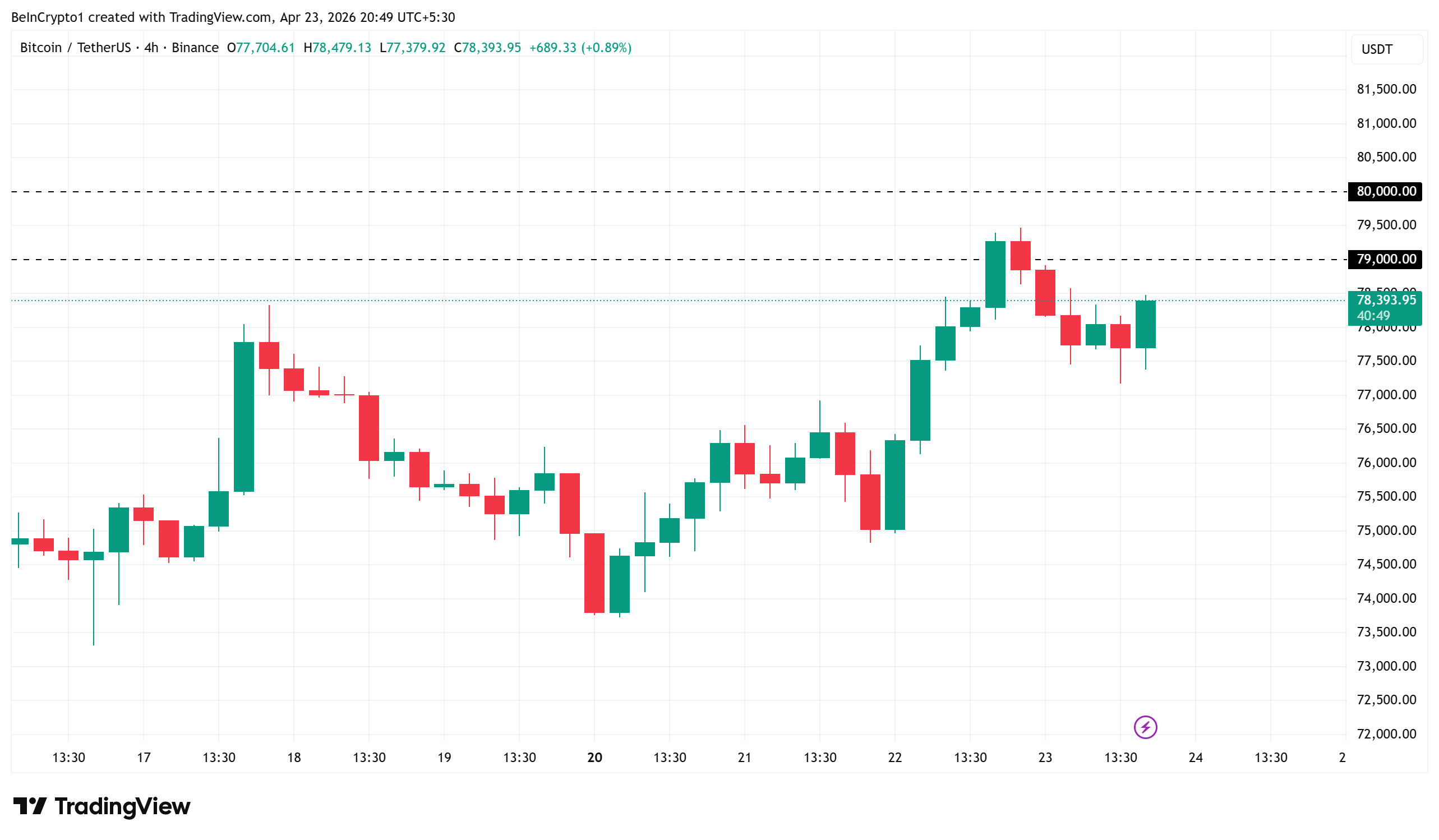
BTC opened at $78,193 on Thursday before retreating to roughly $77,465 by early morning trading. The $80,000 to $80,600 band has acted as a consistent ceiling throughout April.
On-chain data shows the Traders’ On-Chain Realized Price at $76,800 has capped recent relief rallies. On Deribit, the $80,000 call has become the most popular options trade, recording a notional value of $1.78 billion.
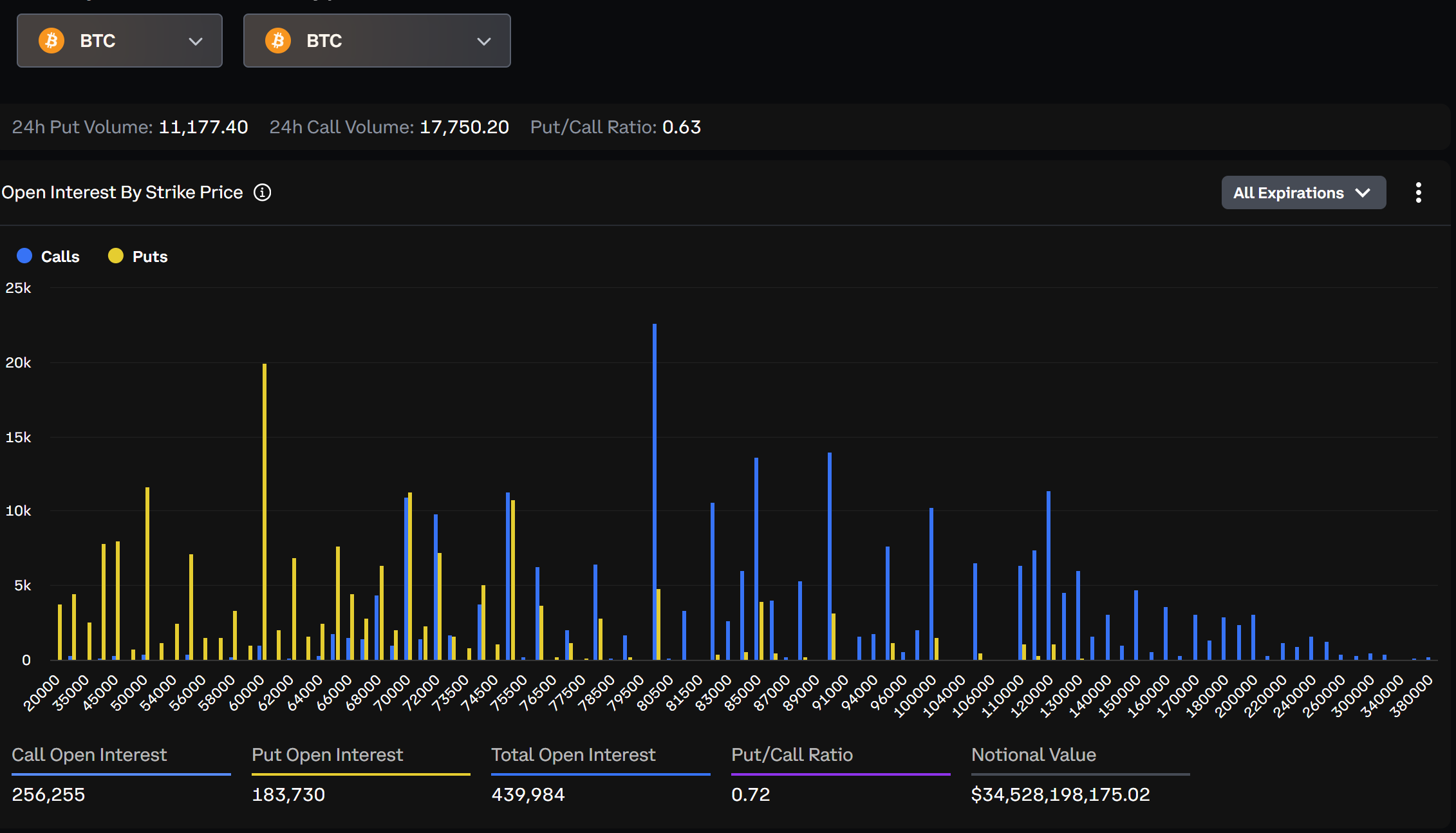
This suggests traders are positioning for a breakout that has yet to materialize, with call options (buy orders) exceeding put options (sale orders) highlighting higher investor optimism.
While the AI dispute carries no direct technical link to Bitcoin, escalating US-China friction has historically dampened risk appetite across crypto markets.
The Bitcoin price being able to reclaim the $80,000 psychological level,. last tested in February, may hinge on broader sentiment heading into the Trump-Xi meeting.
The post Bitcoin’s $80,000 Target Remains Elusive Amid New US-China Tensions appeared first on BeInCrypto.
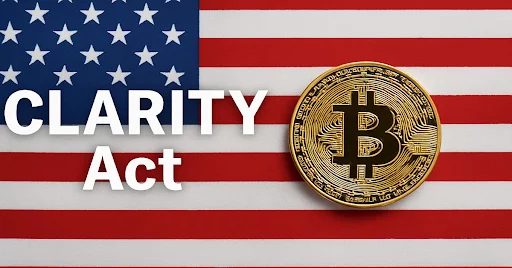
More than 120 crypto organizations, led by the Crypto Council for Innovation and the Blockchain Association, sent a joint letter to the Senate Banking Committee on April 23 demanding an immediate markup of the CLARITY Act, warning that continued congressional inaction risks a dangerous regulatory deadlock that could drive investment and jobs offshore.
Summary
- A coalition of over 120 crypto organizations sent an emergency letter to the Senate Banking Committee on April 23 demanding an immediate CLARITY Act markup.
- The letter warns that delay risks pushing crypto investment, jobs, and technological development offshore and cedes the regulatory standard-setting role to other jurisdictions.
- The push comes as Senator Bernie Moreno has warned that missing the May window could shelve the bill indefinitely, and Galaxy Research puts 2026 passage odds at roughly 50-50.
More than 120 crypto organizations from across the digital asset ecosystem, including Ripple, have jointly urged the Senate Banking Committee to move forward with a markup on the CLARITY Act, in the most coordinated industry lobbying push the bill has seen since clearing the House 294 to 134 in July 2025. The letter, led by the Crypto Council for Innovation and the Blockchain Association, was submitted on April 23 and warns that failure to act risks pushing digital asset investment and jobs offshore while ceding America’s chance to set the global standard for crypto market regulation.
CLARITY Act Crypto Letter Delivers Clearest Industry Ultimatum Yet
The letter’s core argument is that years of bipartisan work have produced a bill that is ready to move, and that further delay is no longer a negotiating posture but a threat to the legislation’s survival. As crypto.news reported, the CLARITY Act’s April Banking Committee markup was derailed by renewed bank lobbying over stablecoin yield provisions, with the North Carolina Bankers Association urging members to call Senator Thom Tillis’s office directly to demand changes to a compromise that had already been negotiated with crypto firms. The White House Council of Economic Advisers responded by publishing a 21-page analysis concluding that banning stablecoin yield would increase bank lending by just 0.02% while imposing an $800 million welfare cost on consumers, but the pushback from banking groups nonetheless delayed the committee calendar. Anil Oncu, CEO of Bitpace, told Disruption Banking that the greatest danger is now prolonged congressional inaction: “The greatest danger now is that the current deadlock continues to push the global standard-setting role away from Washington and toward other jurisdictions.”
What the Letter Is Asking the Senate to Do
The coalition’s priorities include drawing clear lines between SEC and CFTC oversight roles, protecting non-custodial software developers from broker registration requirements, simplifying disclosure rules for digital asset issuers, and avoiding the regulatory fragmentation that would result from a patchwork of state-by-state laws filling the federal vacuum. As crypto.news has tracked, the bill faces a four-way standoff among crypto firms, banks, the SEC, and structural critics over stablecoin yield, DeFi oversight, and ethics provisions barring government officials from profiting from crypto. Ripple CEO Brad Garlinghouse has publicly projected the bill will pass by end of May, while Coinbase CEO Brian Armstrong backed the latest version after reversing the company’s earlier opposition in January.
Why the May Deadline Is Now Non-Negotiable for the Industry
Senator Bernie Moreno has stated explicitly that if the bill does not reach the full Senate floor by May, digital asset legislation may not advance before the midterm election cycle closes the window. Senator Cynthia Lummis has gone further, warning publicly that this is “our last chance” and that missing the May window means waiting until at least 2030. As crypto.news documented, the bill must still clear the Senate Banking Committee, pass a full Senate floor vote requiring 60 votes, be reconciled between the Agriculture and Banking Committee versions, and then be reconciled with the House-passed text before reaching President Trump’s desk. Each of those steps is a potential delay point, and the midterm campaign calendar leaves only weeks of operational legislative time before Congress shifts its focus entirely.
The Senate Banking Committee has not yet scheduled a markup date as of publication, with Chairman Tim Scott yet to formally notice the bill for action.
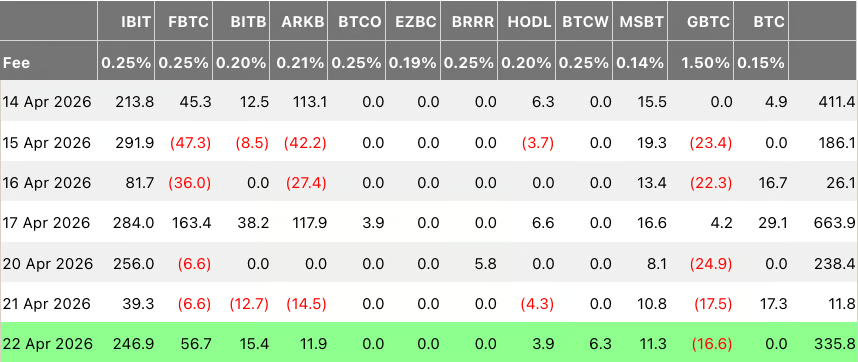
US-listed spot Bitcoin exchange-traded funds (ETFs) have been gaining momentum amid Bitcoin’s price recovery, showing steady inflows since mid-April.
Spot Bitcoin (BTC) ETFs logged $335.8 million in inflows on Wednesday, marking the seventh consecutive day of inflows, according to Farside data.
During the inflow streak, the ETFs drew around $1.9 billion in total inflows, surpassing the previous seven-day inflow streak in March, which totaled $1.2 billion.
According to Wallet Pilot data, Bitcoin ETFs hold a combined 1.3 million Bitcoin in assets under management, worth around $103 billion.
The steady inflows to Bitcoin ETFs were accompanied by a rising BTC price, which has surged 11% over the past 30 days. BTC briefly rose above $79,000 on Wednesday, its first time reaching that level since late January, according to CoinGecko.
BlackRock leads inflows at $1.4 billion as Morgan Stanley fund adds to streak
Out of $1.9 billion in the latest inflow streak, BlackRock’s iShares Bitcoin Trust ETF (IBIT) accounted for more than 73% of all the inflows at $1.4 billion. The fund holds 809,870 Bitcoin, accounting for 62% of total AUM in US-listed spot Bitcoin ETFs.
The Morgan Stanley Bitcoin Trust (MSBT) strongly contributed to the momentum, posting $95 million within the total streak. Notably, the fund itself has not yet seen a single day of outflows, generating $163 million since launch on April 8.
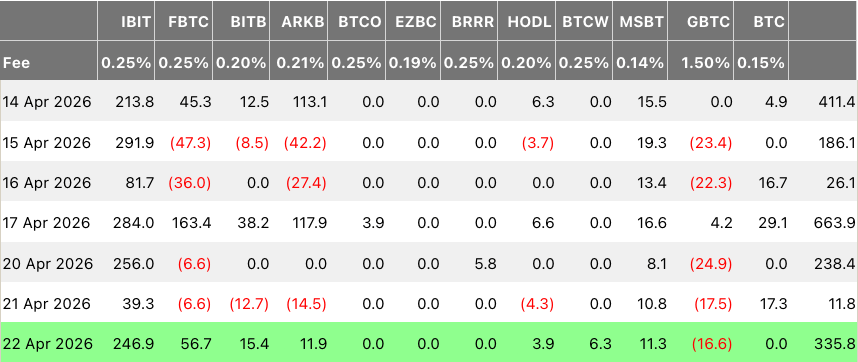
Daily spot Bitcoin ETF inflows since April 14. Source: Farside.co.uk
Still, several funds have clocked losses during the past seven trading sessions. The Grayscale Bitcoin Trust ETF (GBTC) led redemptions during the period, with net outflows of around $100 million.
Ether (ETH), the second-largest crypto asset by market capitalization, has also been gaining traction in US-listed spot ETFs, with these funds posting a 10-day inflow streak totaling $633.6 million, according to Farside.
Related: Market maker GSR launches first ETF tracking Bitcoin, Ether and Solana
Last week, broader ETH investment products recorded their strongest week since January, finally flipping to positive flows year-to-date, according to CoinShares.
The ongoing recovery in spot markets came as the Crypto Fear & Greed Index surged to 46 for the first time since late January. Still, the index remains in “fear” territory, as Bitcoin remains down about 11% year-to-date
Magazine: Adam Back says current demand is ‘almost’ enough to send Bitcoin to $1M


The UAE announced a directive to transition 50% of federal government sectors, services, and operations to Agentic AI within two years, positioning itself as the first nation to deploy autonomous systems at that scale.
Sheikh Mohammed bin Rashid Al Maktoum, Vice President and Prime Minister, revealed the framework during a Cabinet meeting on April 23 under directives from President Sheikh Mohamed bin Zayed Al Nahyan.
What the UAE’s Agentic AI Plan Involves
Unlike conventional digital tools, Agentic AI systems independently analyze data, make decisions, execute multi-step processes, and improve without constant human input.
Follow us on X to get the latest news as it happens
The UAE plans to embed these as operational partners across federal workflows, with Sheikh Mohammed describing the shift as a fundamental change in how government works.
“AI will be our government executive partner to support decisions, enhance services, boost the efficiency of operations, and even evaluate results and introduce improvements in real time,” read an excerpt in the announcement citing the Vice President and Prime Minister, Sheikh Mohammed.
The directive includes mandatory AI training for all federal employees. Ministers and directors-general will face performance evaluations based on adoption speed, implementation quality, and how effectively they redesign operations around AI.
Sheikh Mansour bin Zayed Al Nahyan will oversee execution, with a dedicated taskforce chaired by Mohammad Al Gergawi, Minister of Cabinet Affairs.
A Decade of AI Groundwork
The announcement builds on the UAE’s existing infrastructure. In 2017, the country became the first to appoint a Minister of State for Artificial Intelligence and launched its AI Strategy 2031.
The appointment built on the belief that AI would be the next major revolution, with the UAE leveraging the first-mover advantage.
“Artificial Intelligence is the next major revolution of our times – our goal is to be one of the most advanced countries in this regard,” Sheikh Mohammed said at the time.
It later established a dedicated ministry for AI, digital economy, and remote work in 2020.
Other nations are pursuing similar goals. Estonia’s KrattAI network and Singapore’s Smart Nation initiative both integrate autonomous agents into public services.
However, no government has set a comparable scope or deadline for deploying Agentic AI across half its federal operations.
Subscribe to our YouTube channel to watch leaders and journalists provide expert insights
The post UAE Orders 50% of Government Operations to Run on Agentic AI by 2028 appeared first on BeInCrypto.


JPMorgan says repeated DeFi hacks, a $20B TVL drop after Kelp’s rsETH exploit, and flat ETH‑denominated TVL are souring institutional appetite for onchain lending and yield.
Summary
- JPMorgan says repeated DeFi exploits and flat ETH-denominated TVL are curbing institutional interest.
- A recent rsETH bridge exploit tied to Kelp DAO wiped roughly $20 billion from DeFi TVL in days.
- Attackers minted around $292 million of unsecured rsETH, leaving about $230 million in bad debt on Aave and pushing investors toward USDT.
JPMorgan analysts told The Block that “frequent security incidents in DeFi and the stagnation of total locked value (TVL) in ETH terms continue to limit institutional interest in DeFi,” highlighting how repeated exploits are eroding confidence at scale.
JPMorgan flags DeFi security drag on institutions
Citing the latest cross-chain bridge incident involving Kelp DAO’s rsETH, the bank said the episode “led to a loss of approximately $20 billion in DeFi TVL within a few days,” underscoring just how quickly nominal liquidity can evaporate when trust breaks.
In their note, the analysts described how attackers “minted about $292 million in unsecured rsETH and borrowed real ETH on Aave using it as collateral, resulting in approximately $230 million in bad debt,” turning what began as a smart contract loophole into a systemic hit across blue-chip lending markets.
Flight to USDT and stalled growth
JPMorgan also argued that these blow‑ups are changing user behavior, writing that “after security incidents, users tend to turn to Tether’s USDT for safety,” as capital rotates from riskier protocol-native assets and yield strategies into perceived stable harbors.
The bank pointed to the stagnation of DeFi TVL when measured in ether, rather than in dollar terms, as another structural warning sign, noting that flat or declining ETH-denominated TVL suggests “underlying activity is not growing even when token prices rise.”
According to The Block, the analysts concluded that until DeFi can demonstrate “sustained improvements in security, risk management, and insurance mechanisms,” large institutions will remain cautious about allocating more capital to on-chain lending, derivatives, and cross-chain infrastructure.

MN Trading Capital founder Michael van de Poppe doesn’t expect Bitcoin to drop below $75,000 in the near term, even as Polymarket traders price in a different outcome.

A crypto-aligned political action committee has disclosed more than $3 million in advertising expenditures across U.S. Senate and House races, according to a filing with the Federal Election Commission. The spending, orchestrated by Fellowship PAC—led by the head of government affairs for the stablecoin issuer Tether—appears to tilt toward a Texas Republican contest in the 2026 cycle. The FEC document shows a notable focus on Texas Attorney General Ken Paxton, who faces a runoff on May 26 to determine the party’s nominee for the next Senate race.
The disclosure outlines a sequence of targeted ad buys: approximately $1.75 million in support of Paxton; $350,000 backing Mike Collins in Georgia’s Senate race; $350,000 supporting Barry Moore in Alabama’s Senate bid; and $250,000 for Blake Miguez along with $350,000 for Julia Letlow in Louisiana’s House and Senate races. All expenditures flowed through Nxum Group, a marketing firm co-founded by Bo Hines, described as a former White House crypto adviser and Tether US CEO. Fundraising and organizational disclosures suggest Fellowship launched in September with claims of more than $100 million from crypto-industry-aligned backers.
In its public communications, Fellowship has since reported about $11 million in contributions to the FEC, but public records have not identified other backers explicitly tied to crypto. The broader ecosystem of crypto-backed PACs, including groups such as Fairshake, is expected to influence the 2026 midterms through media and advertising activity considered favorable to crypto-friendly candidates. Context from industry reporting indicates that Fairshake and its affiliates spent more than $131 million in 2024, underscoring the growing scale of crypto-aligned political outreach.
Beyond the fundraising dynamic, the political and regulatory environment surrounding crypto influence remains a focal point for observers. The Texas landscape features ongoing scrutiny of Paxton, who faced corruption allegations culminating in impeachment efforts in 2023 before acquittal by the Texas Senate. Whether Paxton or Cornyn will emerge as the Republican standard-bearer in November’s contest against a Democratic challenger—likely James Talarico—has become part of a broader conversation about how crypto-aligned political activity shapes regulatory and enforcement expectations.
Key takeaways
- Fellowship PAC reports more than $3 million in advertising expenditures directed at U.S. Senate and House races, with $1.75 million spent in support of Ken Paxton in Texas.
- Additional targeted ad buys include $350,000 for Mike Collins (Georgia), $350,000 for Barry Moore (Alabama), and $250,000 for Blake Miguez plus $350,000 for Julia Letlow (Louisiana), all routed through Nxum Group, a firm co-founded by Bo Hines.
- The PAC claimed upward of $100 million in crypto-aligned funding when it launched, but public filings show $11 million in contributions to the FEC and no publicly identified crypto backers beyond that disclosure.
- Crypto-backed political committees like Fellowship and Fairshake are anticipated to influence the 2026 midterms through paid media; Fairshake reportedly spent more than $131 million in 2024.
- Kalshi, a prediction-market platform regulated by the CFTC, announced penalties and bans on three candidates for improper trading activity related to their races, including a five-year suspension for Texas candidate Ezekiel Enriquez and a $784.20 fine.
Regulatory and enforcement context for crypto-influenced political financing
The Fellowship disclosures illuminate how crypto-aligned entities are attempting to participate in the U.S. political process through traditional fundraising channels and targeted advertising—an area governed by the Federal Election Commission’s rules on contributions and expenditures. While the FEC provides the framework for disclosures, the interpretation and enforcement of crypto-linked fundraising activities remain an evolving frontier, particularly as projects and personalities within the crypto sector seek political influence through PAC structures. In this context, the absence of clearly identified crypto backers in public records beyond the disclosed $11 million contribution list raises questions about transparency, disclosure thresholds, and the sufficiency of current registries to capture the full scope of crypto-related political financing.
Another dimension involves market-based platforms that touch politics. Kalshi’s recent settlement and penalties—disclosing that three candidates faced restrictions for trading on their own races, including Texas’ Ezekiel Enriquez—underscore the cross-cutting regulatory risk at the intersection of political activity and financial markets. Kalshi’s action illustrates the import of strict compliance with securities- and commodities-market oversight, given its status as a regulated prediction-market operator under the CFTC. The five-year suspension and nominal monetary penalty for Enriquez reflect a broader policy objective: deter self-serving market behaviors that could distort electoral outcomes or erode trust in market-based mechanisms tied to governance questions.
From a policy and risk-management perspective, these developments intersect with ongoing regulatory conversations around AML/KYC programs, political contributions, and the evolving treatment of crypto-native entities within the U.S. financial and regulatory ecosystem. For institutional readers, the implications extend to licensing considerations, due-diligence protocols for crypto-linked entities engaging in political activity, and the necessity of robust disclosure practices to satisfy oversight obligations. While the discussion around MiCA is primarily a European framework, the U.S. focus here highlights divergent regulatory approaches to crypto fundraising, political exposure, and market conduct across jurisdictions.
According to Cointelegraph’s reporting framework, the evolving landscape reflects a convergence of political financing, crypto industry advocacy, and enforcement actions that collectively shape compliance expectations for exchanges, custody providers, stablecoin issuers, and other crypto firms active in or around political campaigns. This interplay reinforces the need for clear governance standards, auditable disclosure trails, and risk controls that align with both regulatory requirements and internal risk appetites.
Closing perspective
Early disclosures point to a continuing trajectory where crypto-aligned political activity intersects with traditional campaign finance and market-regulated environments. As regulators refine disclosure standards and enforcement approaches, institutions should monitor filings, enforcement actions, and policy proposals that could redefine how crypto sectors participate in political processes and how prediction-market platforms operate within compliant boundaries.


Senator Cynthia Lummis endorsed Admiral Samuel Paparo’s case for Bitcoin (BTC) as a national security tool, calling on Congress to pass the Clarity Act.
Lummis responded to Paparo’s April 21 Senate Armed Services Committee testimony, where the Indo-Pacific Command chief described proof-of-work as a means of American power projection.
Lummis Calls for Clarity Act After Paparo Hearing
In a post on X (Twitter), the Wyoming senator said she was “incredibly impressed” by Paparo’s foresight and his use of BTC for national security.
“We’re watching digital assets integrate into global power infrastructure. It’s time we welcome them back on our soil. Pass the Clarity Act, secure America’s future,” wrote Lummis in the post.
Her remarks arrive as the Clarity Act faces a critical deadline. Lummis previously warned that the Senate Banking Committee must advance the bill by April 25 or risk losing it until 2030.
Proof-of-Work as a Cyber Defense Layer
During his testimony, Paparo told senators that INDOPACOM runs a live Bitcoin node and is actively testing the protocol for military network security.
He stated that proof-of-work protocols “impose more cost” on adversaries than traditional algorithmic network defenses alone.
The testimony aligns with a broader push from military and policy figures who view BTC’s energy-intensive mining process as a deterrent against cyberattacks.
Treasury Secretary Scott Bessent has separately framed the Clarity Act as a national security priority.
Meanwhile, the crypto industry continues to ramp up pressure on the US Senate Banking Committee, urging them to move forward with a Clarity Act markup.
Today, the Blockchain Association and the Crypto Council for Innovation, alongside a broad coalition of over 120 organizations from across the digital asset ecosystem, urged the Senate Banking Committee to move forward with a markup on market structure legislation.
“Years of bipartisan work have brought Congress to an important moment. The U.S. needs clear, durable rules that protect consumers, provide certainty, and reinforce American leadership in digital asset innovation,” the Blockchain Association shared in a post.
Subscribe to our YouTube channel to watch leaders and journalists provide expert insights
The post Senator Lummis Backs Bitcoin for US Cyber Defense After Admiral Paparo Testimony appeared first on BeInCrypto.

In a fresh disclosure to the U.S. Federal Election Commission, Fellowship PAC—the crypto-aligned political action committee led by Bo Hines, the head of government affairs for Tether US—reported spending more than $3 million on advertising tied to U.S. Senate and House races. The majority of the outlay appears aimed at backing a Texas Republican candidate in a runoff that could shape the GOP’s midterm strategy.
According to the FEC filing, Fellowship disclosed $1.75 million backing Texas Attorney General Ken Paxton, who is contending with incumbent Sen. John Cornyn in a May 26 runoff to determine the Republican nominee for the 2026 Senate race. The committee also reported advertising spend of $350,000 for Mike Collins in Georgia’s Senate race, $350,000 for Barry Moore in Alabama’s Senate race, and either $250,000 for Blake Miguez or $350,000 for Julia Letlow in Louisiana races, with all purchases routed through the Nxum Group. The marketing firm is co-founded by Bo Hines, described as a former White House crypto adviser and the CEO of Tether US.
The Fellowship PAC’s filing underscores a broader pattern in which crypto-aligned political committees seek to shape messaging and candidate support through targeted media buys. Fellowship launched last September, claiming to have more than $100 million from undisclosed investors aligned with the crypto industry. While the PAC has since reported $11 million in contributions to the FEC, public records to date do not show other backers publicly tied to crypto in the filings. The balance of funding and the ultimate sources remain unclear, a detail that has become a point of scrutiny as crypto-faithful donors pursue influence ahead of the 2026 midterms. For reference, coverage from Cointelegraph noted the $11 million in reported contributions and the lack of corroborating backers in other filings.
Beyond Fellowship, other crypto-connected political committees, such as Fairshake, are active in mobilizing voters through media campaigns in 2024 and anticipated activity in 2026. Analysts note that the spending cadence and donor profiles could offer a window into how crypto interests seek to shape public policy and the regulatory environment as the political cycle intensifies.
Kalshi penalties highlight ethics in prediction-market activity
As primaries advance and general elections loom, participants in prediction markets have increasingly intersected with political campaigns—sometimes triggering compliance actions. Kalshi, the regulated prediction-market platform, announced penalties and restrictions on three candidates in Minnesota, Texas and Virginia after they placed bets related to their own races. In the Texas case, Ezekiel Enriquez reportedly purchased less than $100 worth of contracts tied to his candidacy for Texas’ 21st Congressional District. Kalshi described the settlement as imposing a five-year suspension from direct or indirect access to Kalshi and a financial penalty of $784.20.
The enforcement move, including the public settlement notice on Kalshi’s site, underscores the ongoing tension between candidate involvement in prediction markets and established rules around insider trading and conflicts of interest. The settlement notice linked to Enriquez’s case provides a concrete example of how regulators and platforms are policing self-betting and related activities in the growing ecosystem of crypto-adjacent markets.
These developments arrive at a moment when political actors are increasingly engaging with crypto-native funds, media campaigns, and prediction-market platforms to influence electoral outcomes. The frontier between fundraising, political advocacy, and market-based engagement remains murky, inviting closer regulatory scrutiny and greater transparency for all participants.
As the 2026 midterm cycle unfolds, observers will be watching not only which candidates gain the party’s nomination but also how crypto-linked money flows, PAC disclosures, and market-based political tools evolve under tightening governance and potential legislative changes. The next disclosures from Fellowship and related entities will help clarify the scale of crypto-backed political activity and its implications for investors, voters, and policymakers alike.
Sources: Federal Election Commission filings cited by Fellowship PAC; note on the Kalshi settlement from Kalshi’s regulatory notices, including the Enriquez case and the linked settlement document.
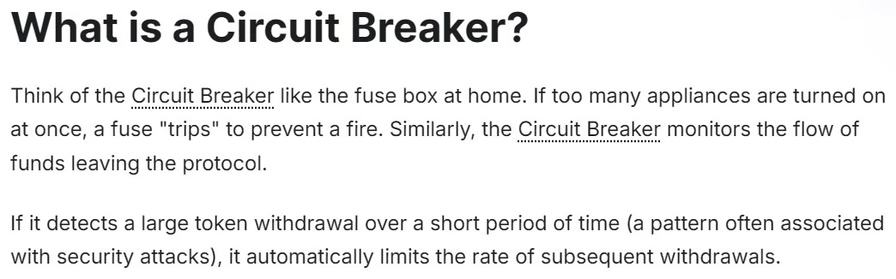
Flying Tulip, a decentralized finance (DeFi) platform founded by DeFi developer Andre Cronje, has added a circuit breaker that can delay or queue withdrawals during abnormal outflows, as April DeFi losses climbed amid a string of major exploits.
According to Flying Tulip’s documentation, the mechanism is designed to slow funds leaving the protocol if outflow capacity is exceeded, giving the team time to investigate suspicious activity and limiting how much an attacker could drain in a worst-case scenario.
Flying Tulip said the circuit breaker works differently across products. In the first version of the circuit breaker, used in its Perpetual PUT product, withdrawals can revert and users must retry later. In the second version, used in Flying Tulip’s stable asset and settlement currency, ftUSD, withdrawals are queued and become claimable after a delay instead of being rejected outright.
Flying Tulip said the circuit breaker is built with a “fail-open” design, meaning transactions would still be allowed if the safety mechanism itself were to malfunction. The platform said users can track the feature through a dedicated status page.
The design adds a new layer of protection for the DeFi platform as recent industry exploits exposed risks that extend beyond smart contract code.
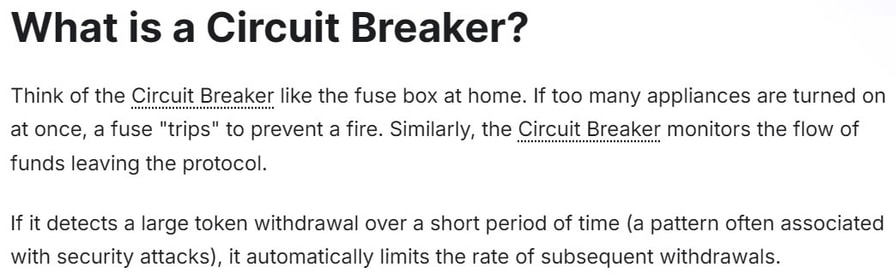
Circuit breaker definition. Source: Flying Tulip
Recent exploits put broader security failures in focus
The added attention to outflow controls comes as recent exploits underscored vulnerabilities tied to signers, infrastructure and collateral design rather than only smart contract bugs.
Amir Hajian, a digital assets researcher at trading firm Keyrock, said the biggest failures in April were increasingly linked to operational and infrastructure weaknesses, including compromised multisigs, configuration flaws and key leaks.
The new mechanism deployed by Flying Tulip is designed to slow abnormal outflows and give the protocol time to respond when losses stem from failures outside of the smart contract itself.
Related: Phishing, deepfakes, supply chain attacks to fuel 2026’s biggest crypto hacks: CertiK
Hajian highlighted April’s DeFi losses, which reached over $600 million in the first 18 days of the month, with two incidents accounting for 95% of the damage.
On April 2, Solana-based decentralized exchange Drift Protocol suffered an exploit, with estimated losses at about $280 million. On April 19, liquid restaking platform Kelp was exploited for about $293 million, prompting lending protocol Aave to freeze rsETH markets on V3 and V4.
Magazine: 53 DeFi projects infiltrated, 50M NEO tokens could be ‘given back’: Asia Express

Profligate filly from Begg eyes 2026 Anzac Day Stakes success

Authorities arrest special forces soldier who allegedly made $400K on Polymarket bet involving Maduro operation

Ranking Grandparents Secretly Giving Money #raghavchadha #babygirl

Manchester United reach agreement with Casemiro over contract clause amid transfer speculation

US brings back mandatory military draft registration

Steven Gerrard disagrees with Gary Neville over ‘shock’ Chelsea and Arsenal claim | Football


-

 Sports7 days ago
NWFL Suspends Two Players Over Post-Match Clash in Ado-Ekiti
-

 Fashion6 days ago
Weekend Open Thread: Theodora Dress
-

 Politics6 days ago
Palestine barred from entering Canada for FIFA Congress
-
Entertainment4 days ago
NBA Analyst Charles Barkley Chimes in on Ice Spice McDonald’s Fiasco
-

 Tech5 days ago
Auto Enthusiast Scores Running Tesla Model 3 for Two Grand and Turns It Into Bare-Bones Go-Kart
-

 Business4 days ago
Powerball Result April 18, 2026: No Jackpot Winner in Powerball Draw: $75 Million Rolls Over
-

 Politics5 days ago
Zack Polanski demands ‘council homes not luxury flats for foreign investors’
-

 Crypto World6 days ago
Russia Pushes Bill to Criminalize Unregistered Crypto Services
-

 Politics3 days ago
Gary Stevenson delivers timely reminder to register to vote as deadline TODAY
-

 Business2 days ago
Rolls-Royce Voted UK’s Most Iconic Trade Mark as IPO Register Hits 150
-

 Politics1 day ago
Disabled people challenge government SEND proposals over segregation concerns
-

 Politics1 day ago
Making troops accountable for war crimes threatens US alliance, ex-SAS colonel warns
-

 Crypto World6 days ago
Russia Introduces Bill To Criminalize Unregistered Crypto Services
-

 Politics1 day ago
Starmer handler McSweeney to be dragged from shadows by Foreign Affairs Committee
-
Politics1 day ago
Wings Over Scotland | How To Get Away With Crimes
-

 Politics1 day ago
Zack Polanski responds to home secretary’s taser threat
-
 Crypto World5 days ago
Kelp DAO rsETH Bridge Hack Drains $292M as DeFi Losses Top $600M in Two Weeks
-

 Politics1 day ago
‘Iran is still a nuclear threat’
-

 Crypto World2 days ago
New York sues Coinbase, Gemini over prediction market offerings
-
 Sports7 days ago
Kevin Kisner apologizes for Masters criticism: ‘I crossed the line’
You must be logged in to post a comment Login