

Crypto World
Shareholders revolt over Bitcoin treasury

Bitcoin (CRYPTO: BTC) treasuries have become a flashpoint for investors weighing the merits and risks of corporate crypto bets, as activists push for governance changes and potential sales. After a multi-quarter stretch of price softness across the sector, several high-profile treasury strategies are facing renewed scrutiny, underscoring a broader debate about the long-term viability of treating digital assets as corporate balance-sheet anchors. On the other side of the ledger, stablecoins continue to provide on-chain liquidity ballast, even as the sector evolves under regulatory and market pressure. Empery Digital, a company that converted its business into a Bitcoin treasury holder, sits at the center of activist scrutiny, underscoring how a single treasury policy can become a flashpoint for shareholders. Empery Digital has accumulated 4,081 BTC, placing it among the top 25 public holders. The broader market is watching how such large holdings influence liquidity, capital allocation, and corporate governance during crypto’s latest cycle of volatility and recalibration. Circle, a stalwart in the stablecoin space, reported a stronger-than-expected fourth quarter, reinforcing the staying power of dollar-backed liquidity despite a broader downturn in crypto prices. In parallel, PayPal is navigating a different form of pressure, as the company’s crypto ambitions collide with investor sentiment and potential consolidation activity in the payments space. The week’s Crypto Biz survey tracks the tension around Bitcoin treasuries, the durability of stablecoins, and the headwinds facing legacy payments players embedded in crypto’s next phase.
Key takeaways
- Activist investor pressure intensifies around Empery Digital’s Bitcoin treasury, with calls for leadership changes and a potential sale of roughly 4,000 BTC, highlighting investor divergence on capital allocation.
- Empery Digital holds 4,081 BTC, reinforcing its position as one of the 25 largest public holders of the asset.
- Circle delivers a robust Q4, with revenue of $770 million (up 77% year over year) and USDC growth, as supply expands 72% to $75.3 billion by year-end, signaling sustained demand for on-chain dollar liquidity.
- Circle’s full-year results show a $2.7 billion revenue stream but a net loss of $70 million, largely due to stock-based compensation tied to its IPO, while shares reacted positively to the quarterly performance.
- PayPal draws takeover chatter after a prolonged stock decline, with discussions reportedly exploring a full acquisition or targeted asset splits, including involvement from Stripe among potential bidders.
- Tokenized real-world assets gain traction as Better and Framework Ventures launch a $500 million stablecoin-backed mortgage initiative, aiming to bridge DeFi liquidity with traditional housing finance.
Tickers mentioned: $BTC, $USDC, $PYPL
Sentiment: Neutral
Price impact: Positive. The mixed earnings signals and ongoing stablecoin expansion contributed to an overarching sense of cautious optimism in related equities and liquidity metrics.
Trading idea (Not Financial Advice): Hold. While activist actions and strategic reorganizations unfold, the mix of treasury risk and stablecoin demand suggests a wait-and-see approach until governance outcomes and asset flows clarify the near-term trajectory.
Market context: The period highlights how liquidity anchors like stablecoins are shaping on-chain activity even as traditional equities linked to crypto face volatility and scrutiny from investors, regulators, and market participants. The interplay between corporate treasuries, real-world asset tokenization, and ongoing payments industry consolidation reflects a sector-wide shift toward more nuanced risk, governance, and valuation frameworks.
Why it matters
The debate over corporate Bitcoin treasuries matters because it tests how much value companies can extract from crypto holdings when faced with activist investor demands and evolving regulatory expectations. Empery Digital’s situation underscores a broader question: can a Bitcoin-heavy treasury deliver durable shareholder returns, or does it anchor capital in an asset class characterized by macro-driven volatility? As Empery’s 4,081 BTC stake sits among the top 25 public holders, the outcome of investor pressure could influence how other companies deploy crypto in their balance sheets. The narrative around treasuries is not just about price swings; it’s about governance, capital return policies, and the signaling effect that large crypto positions convey to the market about a company’s strategic risk tolerance.
Meanwhile, Circle’s quarterly performance reinforces the enduring appeal of stablecoins as a liquidity mechanism. The company’s results show that demand for dollar-denominated liquidity remains robust even when sentiment toward broader crypto is mixed. The rapid growth in USDC supply—an expansion to $75.3 billion by year-end—emphasizes the role of on-chain dollars in enabling borrowing, lending, and cross-border payments within decentralized ecosystems. This trend matters not only for traders and liquidity providers but for developers building on-chain financial rails who rely on dependable stablecoin rails to anchor pricing and risk management. The stability-centric narrative also intersects with regulatory scrutiny around stablecoins, reserve composition, and transparency, shaping how these digital dollars are perceived by auditors, investors, and policymakers alike.
The PayPal development adds another layer to the ongoing transformation of the digital payments landscape. As the company explores consolidation options and deepens its digital asset ambitions, investors are weighing how such moves could recalibrate competition, product strategy, and the integration of crypto services with mainstream finance. The discussions surrounding a potential full acquisition or asset-focused deals demonstrate that traditional payments players remain in the crosshairs of market restructuring opportunities, which could accelerate vertical integration and open new channels for crypto-enabled commerce. The involvement of players such as Stripe in takeover chatter signals a possible shift in how the payments ecosystem could consolidate, a dynamic that could influence funding, regulatory attention, and consumer access to crypto-enabled payments in the near term.
Finally, the collaboration between Better and Framework Ventures on a $500 million stablecoin mortgage initiative signals that tokenized real-world assets are inching closer to scale. If successful, the program could demonstrate a viable model for channeling stablecoin liquidity into the housing sector, potentially reducing funding frictions and expanding the reach of mortgage products to crypto-native capital. While the project remains in its early stages, it highlights a broader trend: the search for practical, de-risked uses of crypto-enabled liquidity beyond trading and speculation, with implications for liquidity provisioning, risk management, and the integration of decentralized finance with everyday financial services.
What to watch next
- Empery Digital’s governance moves and any announced leadership changes or strategic reviews following activist pressure.
- Circle’s ongoing earnings trajectory and any shifts in USDC reserve management, auditing, or regulatory disclosures in 2025.
- PayPal’s strategic review outcomes and any concrete steps toward deeper crypto integration or potential consolidation in the payments space.
- Progress and scaling milestones for the Better–Framework mortgage initiative, including regulatory approvals and pilot results.
- Regulatory signals around stablecoins and corporate crypto treasuries that could influence capital allocation and asset-liquidity policies across the sector.
Sources & verification
- Empery Digital’s Bitcoin holdings and shareholder revolt details as listed on BitcoinTreasuries.NET and cited by Empery-related coverage: https://bitcointreasuries.net/public-companies/volcon-inc.
- Empery Digital shareholder-demands article detailing calls for sale of Bitcoin holdings and leadership changes: https://cointelegraph.com/news/empery-digital-shareholder-demands-bitcoin-sale-ceo-resignation.
- Circle Q4 earnings and USDC growth, including revenue, net income, and USDC supply data: https://cointelegraph.com/news/circle-q4-earnings-usdc-75b-revenue-2025-shares-surge.
- PayPal takeover interest reporting, including Bloomberg references and related coverage: https://cointelegraph.com/news/paypal-buyout-approaches-share-decline-report.
- Stablecoin mortgage initiative between Better and Framework Ventures and its funding implications: https://cointelegraph.com/news/better-500m-stablecoin-mortgage-defi-deal.
Bitcoin treasuries, stablecoins and payments in crypto’s next phase
The evolving story of corporate crypto treasuries, stabilizing on-chain dollars, and traditional payments incumbents reshaping strategy highlights a sector transitioning from narrative to implementation. As activist investors scrutinize treasury strategies, the market is increasingly demand-aware and governance-conscious. Stablecoins’ on-chain footprint continues to expand, reinforcing the critical role of liquidity and price stability in enabling broader DeFi and real-world asset use cases. Meanwhile, the potential for consolidation in the payments space and the prospect of tokenized real-world assets moving from concept to scale suggest a crypto-adjacent ecosystem maturing toward more integrated financial services.

Solana-based nonfungible token (NFT) marketplace Magic Eden is winding down its support for Bitcoin and Ethereum as it plans to double down on its upcoming online casino and sportsbook, Dicey.
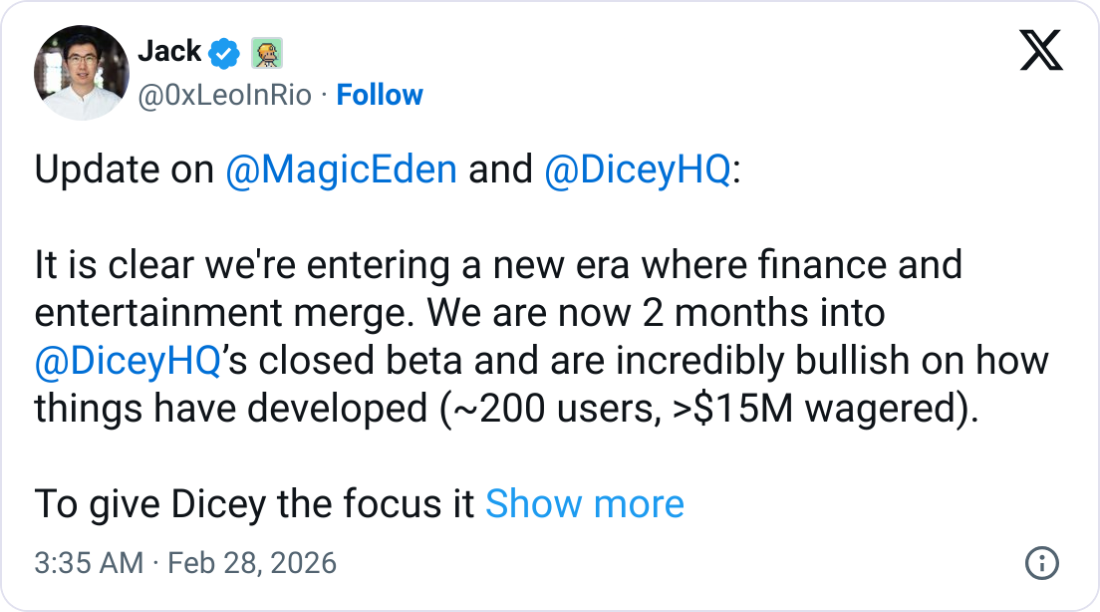
Magic Eden CEO and co-founder Jack Lu said in an X post on Friday that it is winding down support for its Ethereum Virtual Machine and Bitcoin-based Runes and Ordinals marketplaces on March 9, followed by its Bitcoin API on March 27, and its crypto wallet on April 1.
He added that the platform will end its NFT buyback program and would be “doubling down” on Dicey, with Lu saying there is a “massive opportunity” in iGaming, or online gambling.
“It is clear we’re entering a new era where finance and entertainment merge,” Lu said, adding he was “incredibly bullish” on Dicey’s two-month-old closed beta, which has seen 200 users wager over $15 million.

Dicey offers an on-chain casino and plans to launch a sportsbook in a similar fashion to blockchain gambling sites such as Stake.
Magic Eden cutting NFTs to streamline toward gambling
The changes see Magic Eden, once one of the most popular NFT marketplaces, significantly scale back its focus on NFTs.
Lu said the platform will “exclusively” focus on NFT packs, which bundle random NFTs from various collections, similar to physical trading card packs.
Related: Logan Paul sells Pokémon card for $16.5M, years after fractional NFT row
Lu said the shift was ultimately down to most of the platform’s products not contributing significantly to revenues.
“80% of our cost are tied to products generating only 20% of our revenue. By winding down these products, we’re refocusing on our Solana roots [and] retaining our most profitable products, betting on deep on crypto entertainment, and positioning our products for long term growth.”
The NFT market has been impacted significantly amid a broader crypto market downturn over the past few months, with big names such as Nifty Gateway announcing in January that it was shutting down.
In early February, the total NFT marketplace had retraced to levels not seen since before the market boomed in 2021, falling below a $1.5 billion market cap.
Magazine: AI won’t make you rich but crypto games might, Axie founder steps down: Web3 Gamer
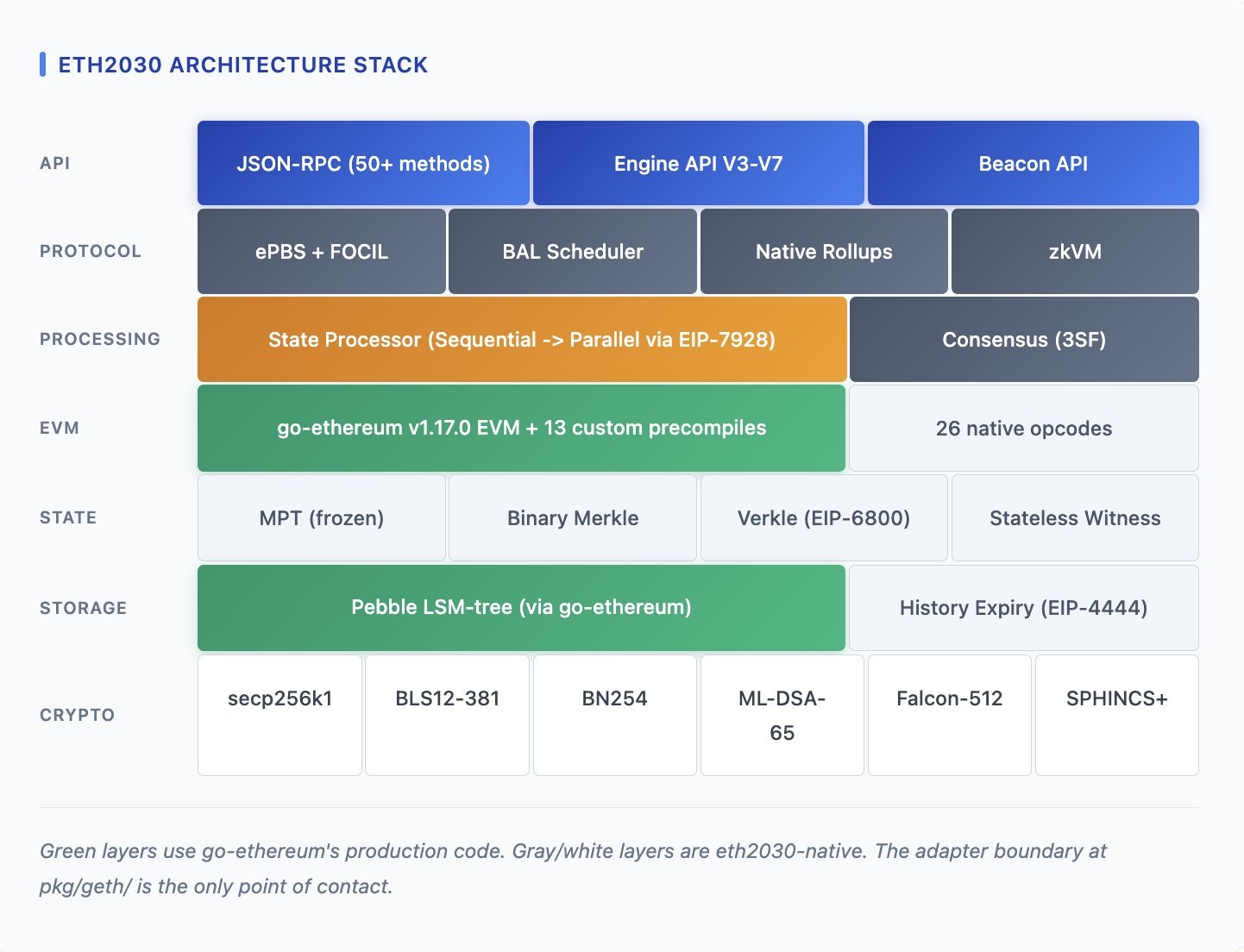
Ethereum co-founder Vitalik Buterin says an experiment that used artificial intelligence to prototype the blockchain’s roadmap out to 2030 in just a few weeks could have lessons for developers.
“This is quite an impressive experiment. Vibe-coding the entire 2030 roadmap within weeks,” Buterin posted to X on Saturday after a developer made a bet with Vitalik in February that one person could use AI to code a reference implementation of the blockchain’s roadmap.
Buterin added that AI is “massively accelerating coding” and that people “should be open to the possibility that the Ethereum roadmap will finish much faster than people expect, at a much higher standard of security than people expect.”
Vibe coding is where AI creates the code for an application, allowing developers to quickly create software. The practice has become more popular as AI models have improved at coding; however, some warn that AI-generated code can be insecure.

Vitalik says AI code would have “critical bugs”
Vitalik said that there were “massive caveats” to using AI, as the speed at which the code was written means it “almost certainly lots of critical bugs, and probably in some cases ‘stub’ versions of a thing where the AI did not even try making the full version.”
“But six months ago, even this was far outside the realm of possibility, and what matters is where the trend is going,” he added.
Related: Ethereum smart accounts are finally coming ‘within a year’ — Vitalik Buterin
Buterin cautioned that instead of focusing on speed, more emphasis should be dedicated to security.
“The right way to use it is to take half the gains from AI in speed, and half the gains in security: generate more test-cases, formally verify everything, make more multi-implementations of things.”
He said that he was personally excited about the possibility that bug-free code, “long considered an idealistic delusion,” will finally become first possible and “then a basic expectation.”
Buterin has been active commenting on the recently released roadmap from the Ethereum Foundation called “Strawmap,” which lays out all upgrades planned for the next four years.
He has previously proposed plans to make Ethereum quantum-resistant and on Sunday said that account abstraction, or smart accounts, would “happen within a year.”
Magazine: 6 massive challenges Bitcoin faces on the road to quantum security

Trump Media & Technology Group is weighing a structural pivot that could redefine its crypto playbook: spinning Truth Social into a publicly traded entity as part of ongoing talks with energy-fusion developer TAE Technologies and Texas Ventures Acquisition III, a SPAC that would take the platform public. If the merger advances, Truth Social would become a stand-alone company named SpinCo, which would subsequently merge with Texas Ventures III, with SpinCo shares distributed to Trump Media shareholders. The arrangement follows a December merger agreement valued at more than $6 billion and aligns with the company’s broader strategy to monetize its platform through fintech and crypto ventures while pursuing energy-tech ambitions. The moves come against a backdrop of Trump Media’s forays into crypto and digital assets, including a Bitcoin treasury that has been built up over time and a slate of crypto product filings that signal a broader push into tokenized finance.
Key takeaways
- The Truth Social spin-out would be paired with a merger between TAE Technologies and Trump Media, with SpinCo expected to merge into Texas Ventures Acquisition III and distribute SpinCo shares to Trump Media shareholders once closed.
- Truth Media’s crypto arm, launched as Truth.Fi in 2025, now anchors a broader crypto strategy that includes a Bitcoin treasury and a portfolio of crypto ETFs filed in the US, including those tracking Bitcoin (BTC), Ether (ETH), and Cronos (CRO) with staking options.
- The SPAC-backed deal and spin-out are tied to a merger with TAE Technologies, a project that could accelerate Trump Media’s interests in energy fusion and related data-center deployments driven by AI workloads.
- Financial disclosures from 2025 show a significant unrealized drag from crypto prices, with a stated loss of about $712.3 million for the year and end-2025 assets around $2.5 billion, illustrating the volatility and risk in crypto-focused corporate ventures.
- Regulatory and market developments in the near term—SEC filings, merger approvals, and ETF approvals—will shape whether SpinCo can launch as planned and how quickly Truth Social’s crypto ambitions scale.
Tickers mentioned: $BTC, $ETH, $CRO
Sentiment: Neutral
Market context: The unfolding discussions reflect a broader wave of corporate actors pursuing crypto and blockchain-related products within SPAC-structured deals and strategic partnerships, even as macro liquidity and regulatory scrutiny shape the pace of such initiatives.
Why it matters
The potential spin-out of Truth Social into a separately listed company marks a notable shift in how Trump Media plans to monetize its user base and brand footprint. By isolating Truth Social within a public vehicle—SpinCo—the group could unlock capital markets’ interest in a platform with significant reach, while kaleidoscopically aligning with a diversification strategy that extends into fintech, crypto, and energy tech. The arrangement would place SpinCo in a position to pursue crypto product innovations and tokenized offerings without immediate interference from the parent’s other lines of business, potentially attracting investors drawn to crypto-enabled social platforms and revenue streams tied to digital assets.
Truth Media’s crypto arm, launched under the Truth.Fi umbrella, has evolved into a broader fintech initiative that includes a Bitcoin treasury and an appetite for crypto exchange-traded products. The company has filed for Truth Social-branded crypto ETFs in the United States, including ones focused on Bitcoin (BTC) and Ether (ETH) as well as Cronos (CRO), with staking features linked to its ecosystem and a backend partnership framework with Crypto.com. This suite of filings signals an intent to create regulated, investable crypto products that could broaden the company’s investor base and provide diversified exposure to digital assets beyond the social media platform. The plan incorporates the Crypto.com partnership as a crucial enabler for the CRO-related ETF strategy and treasury mechanics.
On the energy front, the merger with TAE Technologies is pitched as a synergy play: a fusion-focused technology developer that could support the power needs of expanding AI data centers and other high-demand workloads. The tie-up would integrate Trump Media’s media and fintech ventures with a long-horizon energy project, aligning with a broader industry trend where crypto mining and blockchain infrastructure searches intersect with energy procurement and efficiency initiatives. The combination could create a framework for deploying fusion-powered energy solutions in data centers, potentially reducing energy costs and capacity constraints for crypto and fintech operations that require robust compute resources.
Financial disclosures from 2025 illustrate the risk profile of such ambitious ventures. Trump Media reported a loss of about $712.3 million for the year, driven largely by unrealized losses tied to crypto prices and related securities. At year’s end, the company noted roughly $2.5 billion in assets, a figure that dwarfs the $776.8 million cash and short-term investments reported for 2024. These numbers underscore the sensitivity of crypto ventures to price cycles and market sentiment, while also highlighting the capital intensity of pursuing a combined media, fintech, and energy-tech agenda. The public-private nature of the SpinCo proposition means investors will be scrutinizing how the tech stack—from Truth.Fi-powered products to fusion-energy capabilities—can scale and become financially material over time.
The storyline also hints at a broader narrative around governance, valuation, and timing. The proposed path—Truth Social’s spin-out followed by a merger with a SPAC—depends on closing conditions, regulatory clearances, and market reception. If the merger with TAE Technologies proceeds, SpinCo would be positioned as a listed vehicle that retains exposure to the crypto product suite while benefiting from the potential upside of energy-tech partnerships. The discussions reflect a strategic attempt to combine a high-visibility social platform with a diversified set of growth engines, including digital assets and energy innovation, in a bid to create value across multiple cycles and market conditions.
From a market-structure perspective, the plan underscores how corporate entities pursue crypto-adjacent strategies by leveraging SPAC frameworks and multi-industry combinations. It also raises questions about risk management, liquidity, and concentration risk in a portfolio that spans social media, fintech, and energy tech. As the parties move through due diligence, investors will be looking for clarity on how SpinCo’s governance, earnings potential, and asset allocation will be balanced against the volatility inherent in crypto markets and the evolving regulatory landscape surrounding crypto ETFs and digital assets.
For now, Trump Media’s narrative remains a blend of strategic ambition and regulatory navigation. The company has not announced a closing date for the merger or SpinCo listing, and the outcome will hinge on regulatory approvals, investor sentiment, and the successful execution of the merger with TAE Technologies. Stakeholders will be watching the timeline for SpinCo’s listing, any subsequent stock distributions to Trump Media holders, and updates on the Truth.Fi roadmap, including ETF approvals and the performance of the Bitcoin treasury and CRO treasury-backed initiatives.
What to watch next
- Clearance and timing of the SpinCo formation and its merger with Texas Ventures Acquisition III; any regulatory milestones or approvals with a timeline.
- Status updates on the TAE Technologies merger, including closing conditions and any amendments to the original >$6B valuation.
- Progress of Truth Social-branded crypto ETFs, with updates on SEC approvals, product launches, and staking features.
- Development and deployment schedules for Truth.Fi products and the performance of the Bitcoin and Cronos treasuries under Crypto.com and Yorkville Acquisition partnerships.
- Regulatory or market developments affecting SPAC activity and crypto-centric offerings that could influence investor appetite for SpinCo and related assets.
Sources & verification
- Trump Media & Technology Group discusses spinning Truth Social into SpinCo as part of a potential deal with TAE Technologies and a SPAC vehicle (the merger agreement listing and SPAC structure).
- The merger agreement with TAE Technologies for a deal valued at more than $6 billion.
- Truth.Fi crypto initiative and a Bitcoin treasury reported by Trump Media, including holdings exceeding 11,500 BTC as of late September.
- Truth Social-branded crypto ETFs filed in the US for BTC, ETH, and CRO, including staking arrangements, tied to partnerships with Crypto.com.
- Partnerships and related disclosures connecting CRO ETFs to the CRO treasury and Yorkville Acquisition.
Trump Media’s potential spin-out ties Truth Social to broader crypto and fusion-energy ambitions
Trump Media & Technology Group is exploring a path that could redefine how a presidential brand expands into crypto, while layering in energy-tech ambitions. The core idea is to spin Truth Social, the company’s flagship social platform, into its own publicly traded entity—SpinCo—then merge that vehicle with Texas Ventures Acquisition III, a blank-check company. The hailed trigger is the ongoing merger with TAE Technologies, the energy-fusion startup that has been positioned as a strategic partner in the broader plan. The deal landscape suggests a multi-layered strategy: a public listing for Truth Social within SpinCo, followed by a merger with SPAC sponsor Texas Ventures III, and a distribution of SpinCo shares to Trump Media shareholders, all contingent on the closing of the merger with TAE Technologies, which itself has a reported value exceeding $6 billion.
Within this framework, Truth Media has emphasized crypto as a growth vector. In 2025, the company expanded its fintech footprint under the Truth.Fi banner, laying the groundwork for crypto products and services that could sit alongside a social platform with a global footprint. A key element of this expansion has been a Bitcoin treasury reported to be in excess of 11,500 BTC as of late September, underscoring a deliberate accumulation of digital assets that could support future product launches or collateral arrangements. The crypto strategy is further reflected in the filing of Truth Social-branded crypto ETFs in the United States—facilities that would allow investors to gain exposure to BTC, ETH, and the Cronos ecosystem while embedding staking features. The ETFs are linked to ongoing partnerships that include Crypto.com, a connection that appears central to the CRO ETF and related treasury operations.
Beyond the crypto dimension, the merger with TAE Technologies signals a parallel emphasis on energy innovation. TAE’s fusion technology is portrayed as a mechanism to address the growing power demands of AI data centers and other data-intensive infrastructure. If realized, the combination would tether a social-media-centric fintech venture to a fusion-energy roadmap, marrying user engagement with a long-horizon energy supply strategy. The ambition is not merely to diversify revenue streams but to create an integrated platform where crypto products, fintech services, and energy tech coalesce under a single corporate umbrella. The public listing—which SpinCo would pursue through the SPAC route—could also broaden access to capital, enabling more ambitious product development and potential partnerships in the crypto and high-performance computing ecosystems.
Of course, the path forward remains contingent on a series of milestones. The 2025 financials already reveal a challenging year, with a reported loss of about $712.3 million largely tied to unrealized crypto losses and related securities, alongside end-of-year assets around $2.5 billion. The figures illustrate the risk profile inherent in crypto-centered corporate bets, where price swings and regulatory shifts can swiftly impact balance sheets. Investors will be evaluating whether SpinCo’s governance, capital structure, and cash flow prospects demonstrate a credible route to profitability, or whether the proposals remain predominantly strategic, with upside tied to future crypto adoption and energy-tech commercialization. As always, the timing of regulatory approvals, due diligence, and market conditions will ultimately shape whether SpinCo’s vision becomes a measurable segment of Trump Media’s portfolio or remains an aspirational blueprint for a broader ecosystem that blends social media, crypto, and fusion energy.

Tangem has announced a limited-time Spring Flash Sale running from March 2 to March 8, offering a 20% discount across its website. The promotion applies to all products, giving customers a timely opportunity to secure a hardware wallet at a reduced price.
For readers of Crypto Breaking News, the offer becomes even more attractive. By using the partner promo code CRYPTO at checkout, customers can unlock an additional 10% discount on top of the existing 20% sale price. This means significantly lower costs for those looking to enhance their crypto security while taking advantage of stacked savings.
Importantly, the current BTC Reward campaign remains valid during the Spring Flash Sale. This means buyers not only benefit from discounted pricing but may also qualify for the ongoing Bitcoin reward initiative, adding further value to their purchase.
Tangem Wallet has gained recognition in the crypto community for its card-based hardware design, mobile-first experience, and focus on self-custody. As the industry continues to emphasize the importance of owning private keys, hardware wallets remain a core tool for long-term holders and active users alike. Solutions like Tangem aim to simplify self-custody without compromising on security, offering an alternative to traditional seed phrase storage methods.
With increasing attention on exchange risks, phishing attempts, and wallet exploits, many users are reassessing how they store digital assets. A hardware wallet can help reduce exposure to online threats by keeping private keys offline, under the direct control of the user.
This Spring Flash Sale provides a limited window to secure Tangem products at a combined discount while the BTC Reward is still active. Readers can apply the promo code CRYPTO at checkout or use our affiliate link to ensure the additional 10% discount is automatically applied.
The offer runs from March 2 through March 8, and discounts will revert to standard pricing once the campaign ends.


BitMEX co-founder Arthur Hayes published a new essay on March 2 arguing that prolonged US military engagement with Iran would increase the likelihood of Federal Reserve rate cuts and money printing, ultimately driving Bitcoin higher.
His thesis rests on a four-decade pattern: every major US military campaign in the Middle East has been followed by Fed easing, and he expects Iran to be no different.
War and the Fed: A Recurring Pattern
In “iOS Warfare,” Hayes presented a historical analysis linking US military operations in the Middle East to subsequent monetary easing by the Fed. He noted that every US president since 1985 has launched missile strikes or full-scale wars against Middle Eastern countries, and that the Fed consistently lowered interest rates in the aftermath.
Hayes cited three precedents. During the 1990 Gulf War under President George H.W. Bush, the Fed held rates steady at its first post-war meeting but signaled easing was likely if the conflict dragged on. The central bank cut rates at its November and December 1990 meetings, even as oil-driven inflation persisted.
After the September 11 attacks in 2001, Fed Chair Alan Greenspan pushed through an emergency 50-basis-point rate cut, citing downward pressure on asset prices and the need to restore economic confidence. The wars in Iraq and Afghanistan that followed were accompanied by an extended easing cycle.
Under President Obama’s 2009 troop surge in Afghanistan, rates were already at zero, and quantitative easing was underway, leaving no further room for cuts.
Turning to the present, Hayes framed Trump’s apparent endorsement of regime change in Iran as following the same pattern. He argued that Iranian regime change has been a bipartisan objective among US policymakers since 1979, giving the Fed political cover to ease monetary policy to finance the effort.
Hayes supported his argument with a chart showing that the percentage of the federal budget allocated to the Department of Veterans Affairs rose twice as fast as aggregate federal spending since 1985, alongside declining effective Fed Funds Rates following major military engagements.
Wait for the Cut
Despite his bullish long-term outlook, Hayes advised caution in the near term. He recommended investors wait for the Fed to actually cut rates or begin printing money before adding exposure to Bitcoin and select altcoins.
“We do not know how long Trump will remain interested in spending billions, if not trillions, of dollars reshaping Iran’s politics to his liking,” Hayes wrote. “The prudent action is to wait and see.”
Bitcoin was trading around $66,200 at the time of publication, down nearly 30% year-over-year and roughly 47% below its all-time high of $126,000 reached in October 2025. The coin has fallen for five consecutive months, with the Crypto Fear and Greed Index stuck in extreme fear territory.
Asian markets plunged on Monday as the fallout from US and Israeli military strikes on Iran sent oil surging, stocks tumbling, and investors scrambling for safe havens — but Bitcoin held up better than expected, trading around $66,500 after a weekend that saw it swing between $63,000 and $68,000.
With the Strait of Hormuz effectively shut and Brent crude up as much as 13%, the conflict is now testing whether Bitcoin’s 24/7 liquidity makes it a crisis shock absorber or just another risk asset caught in the downdraft.
Asia Opens in the Red, Then Pares Losses
Japan’s Nikkei plunged as much as 2.15% at the open, shedding over 1,260 points. By midday, it had pared the drop to 1.66%, trading at 57,875. Hong Kong’s Hang Seng fell 2.54%, and Singapore’s Straits Times fell 2.13%. Shanghai held up better, dipping just 0.45%.
Airline stocks across the region — Qantas, Singapore Airlines, and Japan Airlines among them — fell more than 5% as the Hormuz closure disrupted flight routes and sent fuel costs soaring. Chinese airlines were also hit hard.
Oil’s initial surge faded sharply through the session. Brent had jumped as much as 13% at the open, but WTI was up just 4.24% by midday. US equity-index futures also recovered, with the S&P 500 down 0.67% and the Dow off 0.71% — well off earlier lows of over 1%. Gold rose 1.76%.
China’s energy sector bucked the trend. PetroChina opened up 7% in Shanghai, and the CSI Energy Index jumped 5%. Korea’s Kospi, one of Asia’s top-performing markets this year, was closed Monday for a national holiday — delaying what could be a sharp reaction on Tuesday.
Bitcoin, down 2.2% on the day, outperformed the steep losses in equity futures and Asian stock benchmarks.
A Wild Weekend for Crypto
The turbulence began Saturday when US-Israeli strikes hit targets across Iran, killing Supreme Leader Ayatollah Ali Khamenei. Bitcoin dropped below $64,000 within hours as the total crypto market shed roughly $128 billion in value, with forced liquidations cascading across derivatives markets.
The bounce came fast. After Iranian state media confirmed Khamenei’s death, traders bet the power vacuum could accelerate de-escalation, pushing Bitcoin back above $68,000 in thin Sunday liquidity. But the optimism faded as Iran launched retaliatory missile and drone strikes across the Gulf, hitting targets in Israel, the UAE, and Bahrain, dragging the price back below $66,000 by Sunday evening in New York.
By early Monday in Asia, Bitcoin was trading at around $66,543, with a 24-hour range of $65,149 to $68,043. The 24-hour trading volume topped $43.6 billion, reflecting heightened activity as traders repositioned ahead of the US market open.
Hormuz: The Real Risk
The biggest market risk is the effective closure of the Strait of Hormuz. Roughly 20% of global seaborne oil passes through the waterway. Digital signals indicate tanker traffic has nearly halted. At least three ships have been attacked near the mouth of the Persian Gulf. Economists have warned that a sustained closure could push oil prices as high as $108 per barrel.
OPEC+ moved to ease supply fears on Sunday, announcing a production increase of 206,000 barrels per day starting in April — more than analysts had expected. Saudi Arabia, Russia, Iraq, the UAE, and four other members are set to boost output. But analysts cautioned the move may offer limited relief. If Gulf flows remain constrained, additional production means little. Export routes matter more than headline output targets.
For crypto, the oil shock creates a dual threat. Higher energy prices feed directly into inflation expectations, potentially delaying Federal Reserve rate cuts that the market has been counting on. Even with OPEC+ stepping in, prolonged disruption to Hormuz could keep crude elevated long enough to push inflation readings higher, which is negative for risk assets, including Bitcoin.
Pressure Valve or Risk Asset?
The weekend reinforced Bitcoin’s evolving identity in geopolitical crises. When traditional markets are closed, crypto absorbs selling pressure from equities, bonds, and commodities. Analysts call this the “pressure valve” effect. Bitcoin is the only large liquid asset trading around the clock. It took the brunt of weekend risk-off flows. The real price discovery is expected on Monday when US equity markets and Bitcoin ETFs reopen.
That ETF dynamic adds a new variable. Spot Bitcoin ETFs drew nearly $254 million in net inflows over three sessions last week. Monday’s open could test whether institutional holders maintain positions through escalating geopolitical turmoil.
Bitcoin futures funding rates have turned sharply negative, with the CMC Crypto Fear and Greed index at 15 — deep in “Extreme Fear” territory where it has been stuck for weeks. Some analysts view this as a contrarian signal, arguing that the market is mechanically paying traders to go long.
What Comes Next
Some initial panic has faded after President Trump told the New York Times he was open to dropping sanctions on Iran if its new leadership proves pragmatic. A senior White House official also said to the press that Iran’s new interim leadership had suggested it was open to talks, and Trump said he had agreed to engage.
Some Wall Street strategists warned against buying the dip too quickly. This episode risks lasting longer than the geopolitical flare-ups investors have grown accustomed to.
For Bitcoin, which has already fallen 47% from its October all-time high of $126,000, the $60,000 support level remains the line in the sand. A break below could open the path to the mid-$50,000 range. A sustained move above $70,000, on the other hand, could trigger a short squeeze given the heavy bearish positioning currently built up in derivatives markets.
With CPI data due March 11 and the Fed decision on March 18, the crypto market faces a gauntlet of catalysts that the Iran conflict has made exponentially harder to navigate.


Trump Media & Technology Group said it is considering spinning out its flagship social media platform, Truth Social, into a publicly traded company, a move that could see it prioritize its crypto ambitions.
The Donald Trump-founded company said on Friday that it is discussing the potential deal with energy fusion startup TAE Technologies and Texas Ventures Acquisition III, a blank check company that would take control of the social media platform.
The discussions build on Trump Media’s merger agreement with TAE Technologies in December in a deal worth more than $6 billion.
When that merger is closed, Truth Social could be spun into a new public company called SpinCo, which would then merge with Texas Ventures III. SpinCo shares would also be distributed to Trump Media shareholders.
Trump Media expanded into crypto in 2025, establishing the fintech brand Truth.Fi to support its crypto products and services while also establishing a Bitcoin treasury with over 11,500 BTC in late September.
The company has also filed for several Truth Social-branded crypto exchange-traded funds in the US, including one for Bitcoin (BTC) and Ether (ETH) and another for Cronos (CRO) with staking, in connection with its partnership with Crypto.com.
The latter of those ETFs would build on the CRO treasury that Trump Media established in September with Crypto.com and Yorkville Acquisition.
The company is also rapidly expanding into the energy sector, a move that could be accelerated through its merger with TAE Technologies, which develops nuclear fusion technology solutions to meet the surging power demands of artificial intelligence data centers.
Related: X to label paid promotions but prohibits crypto promos in EU, UK
The potential deal comes as Trump Media reported on Friday that it lost $712.3 million in 2025, largely driven by unrealized losses from declining prices of crypto and related securities.
The company said it closed 2025 with approximately $2.5 billion in assets, more than triple the $776.8 million in cash and short-term investments it reported for 2024.
Magazine: A ‘tsunami’ of wealth is headed for crypto: Nansen’s Alex Svanevik

X has updated its labeling framework to allow paid promotional crypto posts under a revamped framework, paving the way for influencers and projects to monetize content on the platform while maintaining disclosures. The change comes with persistent geographic caveats, as promotions tied to crypto remain banned in several large markets, notably the United Kingdom and the European Union, where stringent financial-promotion rules apply to digital assets. The policy shift was framed by X’s head of product, Nikita Bier, who described the move as intended to foster transparency and help creators build their businesses on the platform. At the same time, the broader vision around X Money, Elon Musk’s payments initiative for the app, is poised to move from concept to a limited beta in the near term, with a wider rollout anticipated thereafter. Separately, X has signaled plans for in-app trading features, including a Smart Cashtags function designed to support stock and crypto trading within the service.
Key takeaways
- X has lifted its ban on paid crypto and gambling promotions, but regional restrictions remain in place for the UK, EU, and Australia due to strict financial-promotion laws.
- The platform now requires paid-partnership labeling and permits third-party compensation for promoting products and services, subject to visibility controls in restricted regions.
- Promotions for other regulated categories—such as sex products, alcohol, drugs, tobacco, weapons, and certain health products—continue to be barred or heavily restricted, along with political content used commercially.
- X Money, the planned payments feature, is slated to enter a limited beta within the next two months, with a wider global launch to follow if pilot tests proceed smoothly.
- The company also plans an in-app trading capability through a Smart Cashtags feature, enabling users to trade stocks and crypto within the platform in the coming weeks.
- The move underscores X’s broader ambition to evolve into an “everything app” that blends social networking, messaging and financial services, though regulatory and user-experience considerations remain.
Sentiment: Neutral
Market context: The policy update arrives amid heightened scrutiny of crypto advertising and a broader push by major platforms to monetize content through transparent sponsorships. Regional enforcement of financial-promotion rules continues to shape how digital-asset messaging is presented and amplified on social networks.
Why it matters
The change in X’s advertising and sponsorship rules signals a practical shift for crypto projects and influencers who rely on social channels to reach audiences. By enabling paid partnerships, creators can monetize content more directly, but they must comply with labeling requirements that help followers distinguish between organic posts and paid promotions. The absence of a universal global rollout means a substantial portion of the crypto community—especially in the UK, EU, and Australia—will still encounter visibility restrictions on paid content. For advertisers, the policy introduces a structured framework that could unlock new revenue streams while requiring stricter compliance discipline to avoid regulatory penalties.
Beyond monetization, the policy update aligns with X’s broader strategy to build an integrated platform that combines social and financial capabilities. Musk has described X Money as a potential cornerstone of an “everything app” akin to WeChat, a vision that would integrate payments into everyday social activity. The beta for X Money is expected within the next couple of months, offering a testbed for how payments, social engagement and transactions might intertwine in a single interface. If the beta proves successful, the wider rollout could intensify competition among fintech-enabled social platforms and raise questions about data privacy, cross-border regulatory compliance, and the monetization of user attention in a market still dominated by traditional advertising models.
Today we’re announcing Paid Partnership labels on posts. X’s core value is providing on authentic pulse on humanity.
While we want to encourage people to build their businesses on X, undisclosed promotions hurt the integrity of the product and lead people to distrust the content… pic.twitter.com/CmrRDx5tU1
— Nikita Bier (@nikitabier) March 1, 2026
Even with the removed blanket ban on paid crypto content, the updated exclusions are explicit. Promotions tied to adult services, recreational or prescription drugs, tobacco, weapons and other restricted categories remain out of scope for commercial posts. Political content intended for commercial purposes is also restricted, underscoring a continued tension between monetization goals and compliance with advertising standards. The delineation between what constitutes an authentic, monetized collaboration and what crosses into promotional manipulation remains an ongoing area of governance for platform operators and policymakers alike.
X’s roadmap and what to watch next
The company has flagged a slate of developments tied to its broader product strategy. In particular, the two-pronged push of X Money and Smart Cashtags points to an in-app ecosystem that could blur lines between social activity and financial transactions. The beta timeline for X Money—described by Musk as a limited rollout in the near term—will be a critical test for how a payments feature integrates with social interactions, identity verification, and compliance controls across diverse jurisdictions. Meanwhile, the Smart Cashtags initiative, announced as a forthcoming feature, would enable users to trade stocks and crypto directly within the X interface, potentially expanding content monetization channels while attracting a broader cadre of financial-toward audiences and creators.
Observers will be watching how these features interact with regulatory expectations in the UK, EU, and Australia, where strict guidelines govern the advertising of financial products and crypto offerings. If X can maintain a transparent, compliant approach while expanding monetization opportunities for creators, the platform could become a more attractive venue for crypto projects seeking to leverage social reach. Conversely, continued geographic restrictions could hamper scale and limit the impact of the new policy on the global crypto marketing landscape.
What to watch next
- Arrival of X Money in limited beta within the next two months, with early user feedback and merchant adoption metrics to follow.
- Rollout and user uptake of Smart Cashtags for in-app trading of stocks and crypto, along with regulatory confirmations on feasibility.
- Regulatory developments in the UK, EU, and Australia that could alter the visibility of paid crypto promotions and influencer partnerships.
- Disclosures and labeling practices by creators, including verification mechanisms to ensure compliance with the paid partnership framework.
Sources & verification
- Paid partnerships policy page: https://help.x.com/en/rules-and-policies/paid-partnerships-policy
- Nikita Bier’s statement tweet: https://twitter.com/nikitabier/status/2028172473624395976?ref_src=twsrc%5Etfw
- X Money external beta article: https://cointelegraph.com/news/elon-musk-x-money-external-beta-live-next-1-2-months
- X Money Smart Cashtags in-app trading article: https://cointelegraph.com/news/x-nikita-bier-in-app-trading-couple-weeks
X’s paid partnerships for crypto content: policy, roadmap and regulatory caveats
X recently updated its approach to paid promotional content related to crypto, introducing a formal framework that requires partnerships to be labeled as such and to comply with a set of visibility rules. While the update loosens the previous blanket restrictions on crypto promotion, it simultaneously narrows the field by excluding promotions in regions with stringent financial-promotion laws. The practical effect is a more transparent promotional environment for creators on X, coupled with a robust set of regional constraints intended to protect users from misleading or undisclosed endorsements.
The centerpiece of the change is a paid partnership mechanism designed to give influencers and brands a clear path to monetize their crypto content, provided they disclose sponsorships and adhere to platform policies. As part of this approach, X allows partnerships to be blocked or hidden in the UK, EU, and Australia, reflecting the realities of global compliance regimes that govern digital asset advertising. This creates a bifurcated experience for users: audiences in permissive markets may see promoted content more readily, while users in restricted zones will encounter limited visibility or no exposure to paid crypto promotions at all.
Beyond the policy mechanics, the platform continues to restrict the promotion of certain product categories even as it expands opportunities for crypto creators. The updated exclusions include sex products and services, alcohol, dating platforms, recreational and prescription drugs, health and wellness supplements, tobacco, and weapons. Content that involves politics or social issues remains off-limits when used for commercial purposes, underscoring ongoing considerations about the lines between free expression, advertising, and user trust. These guardrails aim to balance monetization with consumer protection and regulatory compliance, a tightrope that several social platforms are navigating in real time.
The public-facing rationale behind these changes centers on encouraging a healthier ecosystem of creators who can monetize their work while maintaining transparency with their followers. Bier’s commentary, captured in a widely circulated post, emphasizes that paid partnerships should reflect authentic collaboration and be labeled clearly to preserve the integrity of the platform. The overarching narrative is one of experimentation, with X seeking to merge social activity with financial services in a manner that remains compliant with a patchwork of regulatory environments around the world.
As X presses ahead with its “everything app” ambitions, the fate of crypto monetization on the platform will likely hinge on regulatory clarity and the ability of creators to build sustainable businesses under the new labeling regime. The platform’s bet is that a structured, transparent recruitment of paid promotions will reduce the ambiguity that often surrounds influencer campaigns, while the planned introduction of X Money and Smart Cashtags could create new pathways for engagement, liquidity and value capture within the X ecosystem. The coming months will reveal how these interlocking pieces perform in concert, and whether users, creators and financial services partners will respond with greater adoption and confidence.


Social media platform X is now permitting paid promotional crypto posts under its updated labeling policy, though crypto advertisements will continue to be banned in several key markets, including the UK and European Union.
X lifted its ban on crypto and gambling promotions on Sunday, enabling industry influencers to monetize crypto content, provided they comply with the platform’s new paid partnership framework.
However, crypto influencers will be responsible for ensuring that partnerships are blocked or not visible in the European Union, the UK and Australia, regions with strict financial promotion laws that represent a sizable share of global crypto activity.
X, formerly Twitter, has long been the go-to platform for crypto companies, projects and communities to communicate.
X’s head of product, Nikita Bier, said the feature aims to encourage people to build their businesses on X while ensuring they are transparent with their followers.
X said that partnerships are the involvement of a third-party brand providing compensation or incentives to a user, such as an influencer or content creator, to promote their product or service. Users can also flag content as a paid partnership to X.
Today we’re announcing Paid Partnership labels on posts. X’s core value is providing on authentic pulse on humanity.
While we want to encourage people to build their businesses on X, undisclosed promotions hurt the integrity of the product and lead people to distrust the content… pic.twitter.com/CmrRDx5tU1
— Nikita Bier (@nikitabier) March 1, 2026
While the platform’s ban on sponsored crypto posts has been lifted, the updated exclusion list continues to bar promotions for sex products and services, alcohol, dating platforms, recreational and prescription drugs, health and wellness supplements, tobacco, and weapons.
Content related to politics and social issues is also prohibited when used for commercial purposes.
X to roll out new features in coming months
The platform’s owner, Elon Musk, said on Feb. 11 that its planned payments system, X Money, is scheduled to come out as a “limited beta” in the next two months before it will launch to X users worldwide.
Related: Musk’s xAI seeks crypto expert to train AI on market analysis
X Money is part of Musk’s “everything app” plan for X that aims to offer social networking, messaging and financial services, similar to China’s WeChat.
It still isn’t clear whether crypto will be integrated into X Money.
On Feb. 14, Bier said X would also launch a Smart Cashtags feature to allow users to trade stocks and crypto directly on the platform.
Magazine: IronClaw rivals OpenClaw, Olas launches bots for Polymarket — AI Eye


Unstaked WLFI cannot vote; stakers earn rewards, Node privileges, and Super Node partnership opportunities.
World Liberty Financial has proposed a new staking-focused governance system for WLFI holders – the WLFI Governance Staking System. It makes WLFI tokens the primary tool for community governance, and allows holders to influence the ecosystem while promoting long-term participation.
The proposal’s main goals are to encourage active governance, require staking for voting with unlocked tokens, reward participation, create a tiered node system for committed holders, and prioritize partnerships with supportive projects.
Tiered Governance
According to the official announcement, the initiative aims to redirect value from intermediaries and market makers, who captured millions in arbitrage profits during the USD1 expansion phases, to long-term participants, while also applying structural pressure on competing stablecoins.
Under the system, holders of unlocked WLFI tokens must stake to participate in governance. The minimum lock-up period is 180 days. Voting power depends on both the staked amount and the remaining lock-up period. Governance rights adjust dynamically as the lock-up period decreases. Stakers must vote at least twice during the lock-up period to receive staking rewards, which target an annual percentage yield of around 2%. This will be paid from the WLFI treasury.
The proposal introduces a Node tier for participants staking 10 million WLFI (about $1 million). Nodes gain access to over-the-counter USD1 conversion through licensed market makers, receive team-building rights, and earn rewards based on USD1 conversion volume. WLFI subsidizes market makers to maintain 1:1 parity and redirects arbitrage benefits to long-term participants.
Super Nodes are holders staking 50 million WLFI (approximately $5 million). They receive all Node privileges, guaranteed access to the WLFI team for partnership discussions, and potential eligibility for economic incentives on approved integrations. Super Node status does not guarantee a partnership with WLFI.
Implementation is planned in three phases. First is the governance staking for unlocked tokens with rewards and USD1 incentives. Second, includes node tier activation with KYC onboarding and OTC conversion rights. Third, Super Node tier activation with partnership access and revenue-sharing frameworks.
You may also like:
Timelines for each phase will be shared by the WLFI team after voting concludes.
Pakistan Explores USD1 Stablecoin
The latest proposal comes a month after Pakistan signed a memorandum of understanding (MoU) with SC Financial Technologies, an entity affiliated with World Liberty Financial, to explore the use of its USD1 stablecoin. The agreement aims to support technical dialogue and understanding around digital payment systems.
SC Financial Technologies will work with Pakistan’s central bank to integrate USD1 into regulated digital payments, allowing it to operate alongside the country’s digital currency infrastructure.
Binance Free $600 (CryptoPotato Exclusive): Use this link to register a new account and receive $600 exclusive welcome offer on Binance (full details).
LIMITED OFFER for CryptoPotato readers at Bybit: Use this link to register and open a $500 FREE position on any coin!
Tour Confidential: Lowry’s collapse, the future PGA Tour schedule

Anthropic acquires Vercept, the AI job crisis scenario, and Microsoft’s past Epstein connections

Ukraine-Russia war latest: Belgium releases video showing forces boarding Russian shadow fleet oil tanker


-

 Sports6 days ago
Women’s college basketball rankings: Iowa reenters top 10, Auriemma makes history
-

 Fashion2 days ago
Weekend Open Thread: Iris Top
-

 Politics6 days ago
Nick Reiner Enters Plea In Deaths Of Parents Rob And Michele
-

 Business5 days ago
True Citrus debuts functional drink mix collection
-

 Politics3 days ago
ITV enters Gaza with IDF amid ongoing genocide
-

 Tech1 day ago
Unihertz’s Titan 2 Elite Arrives Just as Physical Keyboards Refuse to Fade Away
-
Sports2 days ago
The Vikings Need a Duck
-

 Crypto World6 days ago
XRP price enters “dead zone” as Binance leverage hits lows
-

 Tech5 days ago
Unsurprisingly, Apple's board gets what it wants in 2026 shareholder meeting
-
 NewsBeat1 day ago
Dubai flights cancelled as Brit told airspace closed ’10 minutes after boarding’
-

 NewsBeat4 days ago
Cuba says its forces have killed four on US-registered speedboat | World News
-
 NewsBeat2 days ago
The empty pub on busy Cambridge road that has been boarded up for years
-

 NewsBeat14 hours ago
‘Significant’ damage to boarded-up Horden house after fire
-
 NewsBeat4 days ago
Manchester Central Mosque issues statement as it imposes new measures ‘with immediate effect’ after armed men enter
-
 NewsBeat7 days ago
‘Hourly’ method from gastroenterologist ‘helps reduce air travel bloating’
-

 NewsBeat1 day ago
Abusive parents will now be treated like sex offenders and placed on a ‘child cruelty register’ | News UK
-
 NewsBeat5 days ago
Police latest as search for missing woman enters day nine
-

 Business4 days ago
Discord Pushes Implementation of Global Age Checks to Second Half of 2026
-
 Sports7 days ago
2026 NFL mock draft: WRs fly off the board in first round entering combine week
-

 Business3 days ago
Only 4% of women globally reside in countries that offer almost complete legal equality