

Crypto World
SHR Miner launches free cloud mining service for BTC, XRP, DOGE, ETH holders


Disclosure: This article does not represent investment advice. The content and materials featured on this page are for educational purposes only.
SHRMiner launches free crypto mining service for BTC, XRP, DOGE, LTC, and ETH passive income seekers.
Summary
- SHRMiner launched a free cloud mining service for BTC, XRP, DOGE, LTC, and ETH holders in 2026.
- The platform promotes beginner-friendly cloud mining without hardware costs or advanced technical knowledge.
- SHRMiner says it operates 150+ renewable-powered mining farms serving over 5 million global users.
As cryptocurrencies gain increasing popularity worldwide, more and more investors are seeking ways to generate a steady stream of passive income without the need for expensive hardware or specialized skills.
SHR Miner’s new free mining service allows holders of BTC, XRP, DOGE, LTC, and EHT to easily earn passive income without expensive equipment or specialized technical knowledge.

In the rapidly evolving world of cryptocurrency, simplicity and high returns are paramount. For those seeking an accessible, entry-level investment method to generate a steady income with minimal effort, cloud mining undoubtedly presents a highly attractive option.
This article will delve into the concept of cloud mining, using the leading brand SHRMiner as a case study to demonstrate how it can help its users achieve daily earnings of $8,900, or even more.
The appeal of cloud mining
Due to its ease of use and convenience, cloud mining has long been highly favored by cryptocurrency enthusiasts. Unlike traditional mining, it requires no expensive hardware, specialized technical expertise, or constant monitoring.
Cloud mining simplifies the process, enabling anyone — regardless of their level of experience — to participate in the cryptocurrency revolution. Instead of investing in costly mining equipment and managing complex systems, users simply lease mining algorithms from remote data centers to earn a share of the profits.
Recently, the UK-based cloud mining platform SHRMiner officially launched a new “free cloud mining service.” Designed specifically for holders of mainstream cryptocurrencies, such as BTC, XRP, DOGE, LTC, and ETH, this service offers users a new opportunity to participate in cryptocurrency mining with no barriers to entry.
Meanwhile, SHRMiner has also launched a new mobile application, enabling users to manage their mining activities anytime, anywhere — effectively ushering in the “era of mobile mining.”
SHRMiner: The perfect blend of laziness and profit
SHRMiner takes the simplicity of cloud mining to the extreme, making it the ideal choice for novice users. The platform’s user-friendly interface ensures that even newcomers to the world of cryptocurrency can get started with ease.
For SHRMiner, simplicity is not a weakness, but rather the path to success. As a pioneer in cloud mining services, SHRMiner operates over 150 mining farms worldwide — equipped with more than 600,000 mining devices powered entirely by modern renewable energy sources — and has earned the trust and support of over 5 million users thanks to its stable returns and robust security.
How can SHRMiner serve as a source of passive income?
The entire process takes just three simple steps to start earning income:
1. Register an Account
By visiting the SHRMiner official website, users can register a free account in less than 2 minutes and receive a $15 sign-up bonus. This bonus helps users quickly experience the platform’s services and earn $0.60 per day from the free trial contract.
2. Select a Cloud Mining Plan
Choose a cloud mining plan that aligns with needs and budget. The platform offers a wide range of flexible plans — ranging from $100 to $200,000 — to accommodate the diverse investment goals of different users.
3. Start Earning
Upon purchasing a contract, earnings are automatically settled within 24 hours, requiring no additional management or manual intervention. Users may withdraw their earnings to their cryptocurrency wallet addresses at any time to suit their needs, or they may choose to reinvest their profits to capitalize on the power of compound interest.
The primary advantage of this model lies in its significant lowering of the barrier to entry. Users need not research specific mining hardware models or hash rate configurations, nor do they need to set up their own system environments; they simply need to register an account, deposit assets, and select a mining plan to begin generating returns.
SHRMiner Platform Advantages:
- Supports daily automatic settlements.
- Requires no additional electricity or maintenance costs.
- Utilizes advanced ASIC mining hardware, powered by renewable energy sources including hydroelectric, wind, and solar power.
- Supports multi-currency mining: Earn major cryptocurrencies such as BTC, XRP, ETH, DOGE, USDC, USDT, SOL, LTC, BCH, and more.
- Features SSL encryption and DDoS protection, along with a real-time earnings dashboard for convenient monitoring of mining performance.
- 100% Remote Access: Enjoy full access without the need for physical hardware via the SHRMiner app or web browser, complemented by 24/7 online technical support.
- Affiliate Program: Refer friends to earn commission rewards of up to 4.5%, with the opportunity to receive additional bonuses of up to 30,000.
Examples of Common Contracts:
Contract Name
Price
Profit
Days
Principal+TotalReturn
NewUserExperienceAgreement
$100
$4
2
$100+$8
Bitdeer Sealminer A2 Pro
$500
$6.25
5
$500.00 + $31.25
Litecoin Miner L9
$1000.00
$13.00
10
$1000.00 + $130
Bitcoin Miner S21 XP Imm
$5000.00
$70.00
25
$5000.00 + $1750
Bitcoin Miner S21e XP Hyd
$10000.00
$150.00
35
$10000.00 + $5250
ANTSPACE HW5
$50000.00
$900.00
45
$50000.00 + $40500
After purchasing a contract, earnings will be automatically credited to an account within 24 hours. (Hash rate, investment amount, duration, and earnings vary for different contracts. For more contract information, please visit the official SHRMiner website or click on “Contract Details” to view.)
Unimaginable money-making opportunities
What sets SHRMiner apart is its extraordinary daily passive income potential; users have the opportunity to earn $8,900 — or even more — every day, thereby realizing their dream of getting rich online. Imagine generating substantial income without the need for constant effort or complex setups — that is precisely what SHRMiner offers.
Safety and sustainability
In the mining sector, trust and security are paramount; SHRMiner fully recognizes this and places user safety at the forefront. Committed to transparency and legitimacy, SHRMiner ensures that investments are protected, allowing investors to focus on profitability. All mining facilities utilize clean energy, making our cloud mining operations carbon-neutral. By harnessing renewable energy, we safeguard the environment from pollution while delivering superior energy efficiency.
In short
For those who are looking for ways to generate passive income, cloud mining is an excellent choice. When utilized effectively, these opportunities can help users effortlessly accumulate cryptocurrency wealth on “autopilot,” requiring only a minimal time commitment. At the very least, they should be far less time-consuming than any form of active trading. Passive income is the ultimate goal for every investor and trader, and with SHRMiner, maximizing passive income potential has never been easier.
For more information, visit the official website.
Disclosure: This content is provided by a third party. Neither crypto.news nor the author of this article endorses any product mentioned on this page. Users should conduct their own research before taking any action related to the company.



Tokenized stocks could move trading activity away from traditional exchanges as regulators weigh new rules for onchain equities.
Summary
- Tiger Research says tokenized stocks could split exchange liquidity across competing blockchain venues and platforms.
- Revenue may move offshore if exchanges lose fee control over tokenized stock trading flows globally.
- Hyperliquid’s $2.6B RWA open interest shows demand for onchain market access is rising fast globally.
Tiger Research said tokenized stocks could create two main risks for traditional markets: liquidity fragmentation and revenue fragmentation. The report linked those risks to the SEC’s reported innovation exemption, which may allow third parties to tokenize listed stocks such as Apple and Tesla without issuer approval.
The research said traditional finance treats the break-up of centralized liquidity as a “serious structural threat.” In simple terms, trading that usually sits on exchanges such as the NYSE or Nasdaq could move across several blockchain networks and decentralized venues.
That shift could create different prices for the same stock-linked asset across venues. It could also make large trades harder if buyers and sellers spread across many platforms instead of one deep market.
Revenue could move away from domestic exchanges
Tiger Research also warned that exchange revenue could split if tokenized stocks trade on competing venues. Fees that normally flow to domestic exchanges, brokers, and clearing systems could instead move to offshore platforms or new blockchain-based markets.
The report said this issue also affects national financial competitiveness. If one country delays tokenized market rules while another moves faster, trading fees and market activity can shift across borders.
This is why the SEC’s reported exemption matters. Related coverage said the SEC may allow tokenized public stocks on blockchain platforms, but tokens may need to carry the same rights as traditional shares, including dividend and voting access.
SEC Commissioner Hester Peirce has also warned that blockchain does not change the legal nature of the asset. In a July 2025 statement, she said “Tokenized securities are still securities.” She added that market participants must follow federal securities laws when dealing with tokenized instruments.
Hyperliquid shows onchain RWA demand
The shift is already visible in crypto markets. Hyperliquid said RWA trading open interest reached $2.6 billion on May 18, setting a new all-time high and doubling from two months earlier.
Tiger Research used Hyperliquid’s growth to argue that capital is already moving toward 24/7 onchain access to real-world assets. That demand puts pressure on exchanges and regulators that still rely on older trading hours, settlement systems, and venue models.
RWA.xyz data also shows that tokenized stocks remain small but active. Its dashboard lists $1.53 billion in tokenized stock value, $3.40 billion in monthly transfer volume, and more than 272,000 holders.
Exchanges are already moving onchain
Traditional exchanges are not ignoring the shift. Reuters reported in March that the NYSE partnered with Securitize to develop tokenized versions of traditional financial securities for a future NYSE-affiliated digital platform.
NYSE planned to work with Securitize on digital transfer agent standards, trade processing, and tokenized security infrastructure. Reuters also noted that U.S. exchanges, including NYSE and Nasdaq, have been increasing efforts to put stocks, bonds, and funds on blockchain rails.
The core question is now control. If tokenized stocks develop inside regulated exchange systems, traditional venues may keep part of the flow. If third-party platforms grow faster, stock trading could become more fragmented.
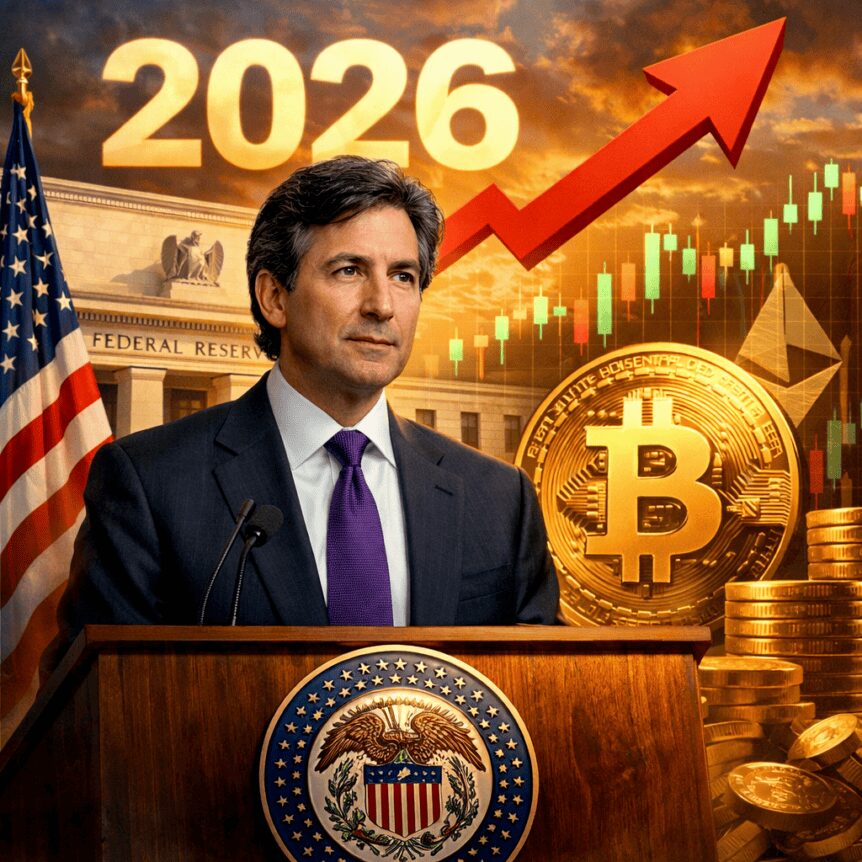
Kevin Warsh was sworn in as chair of the United States Federal Reserve, but the market’s focus quickly shifted to the policy path that will shape crypto markets and broader risk assets through 2026. The latest CME Group FedWatch data suggests investors are pricing in virtually no chance of rate cuts this year, signaling a higher-for-longer stance that could influence liquidity and risk appetite across crypto and equities.
During the swearing-in ceremony, President Donald Trump framed Warsh’s tenure as one defined by independence from the Executive Branch on monetary policy, while underscoring a belief that a booming economy should guide growth alongside inflation containment. “We want to stop inflation, but we don’t want to stop greatness,” Trump said, a line that captured the tension between price stability and growth the new administration seeks to navigate.
“We want to stop inflation, but we don’t want to stop greatness.”
Warsh inherits a policy backdrop where inflation, employment, and debt dynamics intersect with a market environment that had been pricing little relief in the near term. The Trump administration’s emphasis on growth as a lever to manage debt sits beside persistent macro uncertainty, complicating how traders read even the first signals from the new leadership at the Fed.
Key takeaways
- No rate cuts expected in 2026, based on CME FedWatch data, reinforcing a higher-for-longer policy trajectory.
- Near-term odds of a 25 basis point hike at the June meeting sit at about 3.5%, with the current federal funds target at 3.50%–3.75%.
- Probability of a rate hike at the July meeting rises to roughly 17%, and about 67% of traders expect a hike at the December meeting.
- The leadership change at the Fed comes amid inflation concerns and growth considerations, with markets parsing how the new chair’s approach will balance these forces.
- Crypto and other risk assets could face headwinds if the expected pause on rate cuts persists, as liquidity and risk sentiment remain sensitive to policy signals.
Fed leadership and policy signals
The swearing-in of Warsh as chair places the Fed at a critical inflection point. While details of his forthcoming policy communications remain to be seen, the market is already responding to the prevailing assumption that monetary easing via rate cuts is unlikely in the near term. In a regime where the Fed’s stance on inflation and growth will guide the tempo of liquidity, crypto traders are attuned to any shift in language or data that might alter the balance between price stability and economic expansion.
Trump’s remarks at the event underscored a deliberate narrative: Warsh’s independence should enable a policy path that prioritizes growth while attempting to keep inflation in check. The president’s framing, coupled with inflation and employment dynamics, creates a backdrop in which the Fed’s credibility will be tested as markets weigh the odds of future policy moves against evolving macro data releases.
Markets, rates and crypto implications
Market pricing through the CME FedWatch tool indicates a remarkably low likelihood of rate cuts in 2026. The immediate implication is a constrained environment for policy ease, which tends to support tighter financial conditions. In practice, this translates into higher real interest rates and a spotlight on the trajectory of inflation, growth signals, and debt sustainability as the Fed’s mandate remains in focus.
The June 17 FOMC meeting is seen as a potential touchpoint for a small policy adjustment, with a 3.5% probability of a 25 basis point rate hike. With the current target range at 3.50% to 3.75%, even a modest move would be read as a continuation of the higher-for-longer theme, rather than the start of a rapid easing cycle.
Beyond June, the odds shift toward a greater probability of action later in the year. A July hike carries roughly a 17% chance, while the December meeting is seen as the more likely period for a rate move, with about two-thirds of traders expecting a hike then. Taken together, the data imply a policy stance that remains tight through the year, creating a backdrop of higher borrowing costs and a slower easing pace than many crypto and equity markets had priced in during earlier cycles.
In the crypto ecosystem, this environment has a nuanced set of implications. Historically, lower interest rates have been supportive of risk-on assets, including Bitcoin and broader crypto markets, by boosting liquidity and search for yield in higher-risk corners of the market. Yet the flip side is that cheap credit can fuel inflationary pressures or misallocation if it leads to a wave of leveraged speculation. As the Fed maintains a careful watch on inflation and growth, crypto traders will be watching not only the headline rate moves but also any shifts in the Fed’s communications that could tilt expectations for the cost of capital and the availability of liquidity.
What this means for investors and builders
For investors, the current outlook reinforces the idea that capital will continue to be priced with an eye toward central bank policy and macro data. Portfolios with exposure to crypto and other risk assets may need to tolerate continued volatility as rate expectations swing with new data releases and statements from Fed leadership. The absence of imminent rate cuts suggests a period of consolidation for risk assets, even as the underlying fundamentals of blockchain networks, DeFi protocols, and institutional involvement in crypto continue to evolve.
For builders and developers in the crypto space, the environment underscores the importance of funding resilience and product-market fit independent of a passive liquidity tailwind. Projects that demonstrate real utility, robust security, and clear paths to revenue may fare better in a regime where liquidity remains tethered to policy signals, rather than a broad, rate-driven liquidity flood.
And for regulators and policymakers outside the Fed, the ongoing conversation around inflation control, debt management, and economic growth will intersect with how the crypto sector is treated within the broader financial system. As policy makers weigh the CLARITY Act and other regulatory contours, the market will assess whether legislative actions could alter the risk-and-reward dynamics that crypto projects navigate daily.
The immediate takeaway is clear: the Fed’s leadership transition arrives at a moment when policy clarity, inflation momentum, and growth trajectories will jointly shape the path of crypto and risk assets. Investors should stay attentive to the Fed’s communications, inflation prints, and any shifts in the rate-path narrative that could alter funding conditions for digital assets and their traditional counterparts.
Readers should monitor upcoming FOMC communications and macro data releases, as any hint of a policy pivot or a renewed emphasis on price stability could recalibrate sentiment across cryptocurrencies and the broader market.
South Korea’s planned cryptocurrency tax has come under renewed political scrutiny after a public petition seeking its repeal cleared the signature threshold required for legislative review.
Summary
- South Korea’s proposed crypto tax repeal petition has crossed 50,000 signatures and moved to a National Assembly committee for review.
- The petition argues that taxing crypto gains while exempting stock and bond investment income creates unfair treatment for digital asset investors.
- South Korea is set to launch the 22% crypto tax in January 2027, with the National Tax Service already coordinating compliance rules with local exchanges.
According to South Korea’s National Assembly petition system, the motion surpassed 50,000 signatures at around 11:23 a.m. local time on Thursday, eight days after submission, automatically sending the proposal to a parliamentary committee for examination.
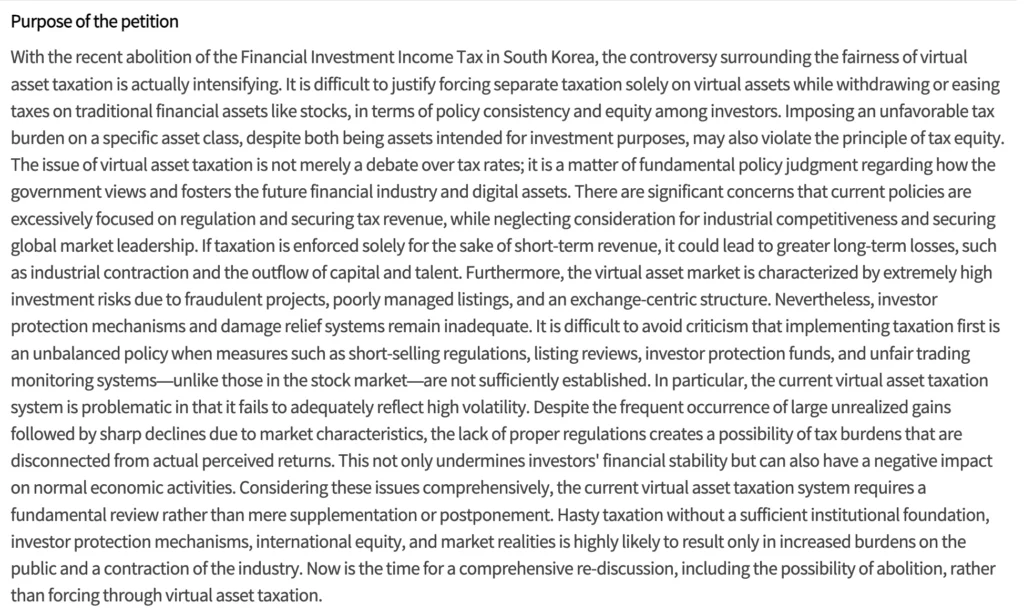
In the petition, an anonymous author argued that taxing crypto investors while exempting traditional financial investment income creates an unfair imbalance.
The motion pointed to South Korea’s decision to abolish taxes on gains from stocks and bonds, while virtual asset investors still face a planned 22% levy on annual gains above 2.5 million won, or roughly $1,650.
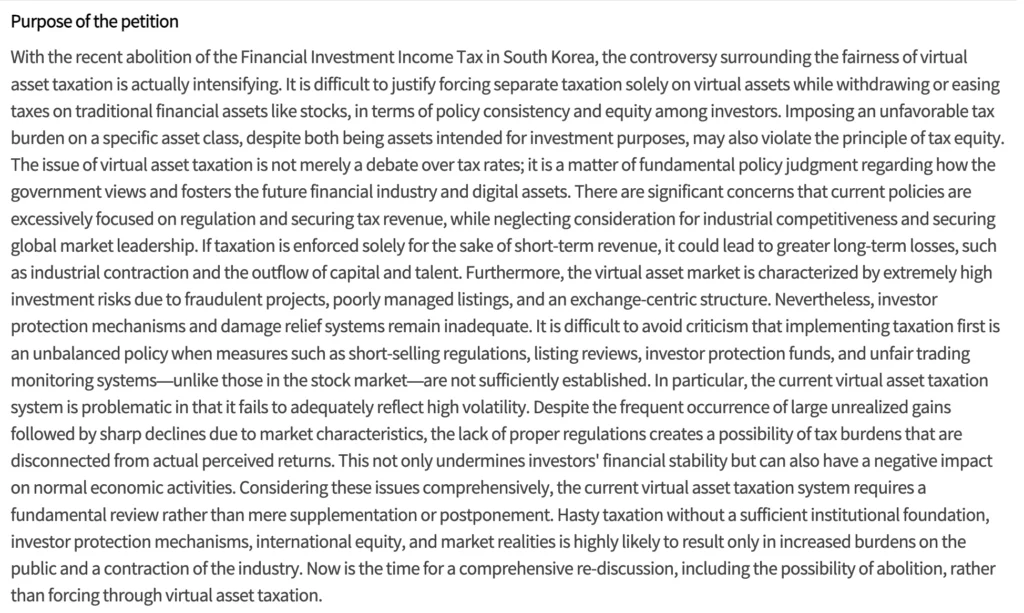
A translated excerpt of the petition. Source: South Korean National Assembly
Set to take effect from Jan. 1, 2027, the tax includes a 20% income tax and a 2% local income tax under South Korea’s Income Tax Act.
Earlier this month, Moon Kyung-ho, director of the Ministry of Economy and Finance’s income tax division, said during a National Assembly forum that the government intended to proceed with the tax as scheduled.
At the same time, South Korea’s National Tax Service has continued preparing implementation guidance with domestic exchanges including Upbit, Bithumb, Coinone, Korbit, and Gopax. Local reports previously said the agency plans to release detailed compliance guidelines later in 2026 before the first full filing period opens in May 2028 for income earned during 2027.
Petition raises investor protection concerns
Alongside criticism over tax fairness, the petition argued that South Korea’s crypto market still lacks sufficient investor safeguards. The motion cited fraudulent activity and poor-quality token listings as ongoing risks that authorities have not fully addressed before introducing taxation.
Translated text from the petition stated that the issue extends beyond tax rates and concerns how the government intends to treat digital assets and the future of the financial industry.
Additional criticism focused on market volatility. According to the motion, the current framework fails to properly account for large price swings that can rapidly alter investor positions.
Political disagreement over the crypto tax has delayed the measure three times already. Per earlier crypto.news reporting, lawmakers postponed implementation from 2025 to 2027 after debates over exchange infrastructure, reporting systems, and whether the 2.5 million won threshold was too low compared with other investment products.
More recently, South Korea’s People Power Party proposed legislation to abolish the tax before its scheduled rollout. However, the Finance Ministry’s latest public comments suggested authorities are still preparing for implementation unless lawmakers amend the law beforehand.
Elsewhere in South Korea’s digital asset sector, regulators have continued advancing new crypto oversight rules ahead of 2027. Earlier this month, the National Assembly passed amendments to the Foreign Exchange Transactions Act requiring firms involved in overseas crypto transfers to register with the finance minister.
Separately, the Financial Services Commission said on May 15 that it plans to release detailed tokenized securities rules in July ahead of amendments to the Capital Markets Act and Electronic Securities Act scheduled to take effect in February 2027. Samsung SDS is also building infrastructure for the Korea Securities Depository’s token securities platform as authorities prepare blockchain-based issuance and settlement systems.


THORChain node operators are voting on ADR028, a recovery plan that would restart the network after a $10.7 million exploit without minting new RUNE.
Summary
- THORChain’s ADR028 plan would use protocol-owned liquidity first before sharing remaining losses with synth holders.
- The proposal avoids new RUNE minting, token sales, or holder dilution while node operators vote on recovery.
- Recent DeFi exploits add pressure on THORChain to restart safely after patching its GG20 vulnerability.
THORChain said node operators are now voting on ADR028 after the May 15 incident. The proposal sets the direction for recovery, while exact figures remain open to later changes through Mimir governance.
The official exploit report said the attacker drained about $10.7 million from one of five vaults. THORChain said the attacker was a newly churned node operator who exploited a GG20 Threshold Signature Scheme vulnerability. The other four vaults were not affected.
Recovery plan avoids new RUNE
Under ADR028, protocol-owned liquidity would absorb the loss first. Any remaining shortfall would then be shared across synth holders. THORChain said the split is still being reviewed and will be adjusted later.
The proposal says no new RUNE will be minted, no RUNE will be sold, and holders will not be diluted. Protocol-owned liquidity would be reduced to zero, with part of future system income redirected to rebuild it over time.
Moreover, THORChain said GG20 will stay in place for now, but it must be patched and upgraded before trading resumes. The network will also need a successful churn before normal activity returns.
The exploit report said automatic solvency checks detected the vault imbalance within minutes. Node operators then used manual pauses and Mimir votes to halt trading, signing, chain observation, and churning within about two hours of the community alert.
Recent DeFi exploits add pressure
The THORChain vote comes after earlier reports said the protocol halted trading when ZachXBT warned that losses could top $10 million across Bitcoin, Ethereum, BSC, and Base. Related coverage noted that RUNE fell after the alert as users waited for clearer details from protocol operators.
The incident also follows a busy period for crypto exploits. Recent reports said the Verus Ethereum bridge lost more than $11.5 million after attackers used a forged cross-chain transfer message. Security firms linked that exploit to missing validation checks in the bridge process.
April also showed how heavy the pressure on DeFi security has become. Crypto protocols lost more than $606 million in the first 18 days of April, led by the $292 million KelpDAO breach and the $285 million Drift Protocol exploit.
TRM Labs also reported that North Korea-linked actors drove about 76% of global crypto hack losses in the first four months of 2026. The firm put those losses at about $577 million through April.
Attacker faces slashing and bounty offer
ADR028 proposes full slashing for the attacker’s node. THORChain said innocent nodes assigned to the same vault would be protected. Recovered RUNE would be paired with any assets recovered from the affected vault, while surplus RUNE would be burned.
The proposal also offers the attacker a bounty to return the funds. If funds are returned in part, the recovery plan would roll back by the same share. THORChain also said the protocol will remain neutral and permissionless, meaning the attacker’s swaps will not be censored once trading resumes.
The vote now gives node operators a path to approve the recovery direction. It does not finalize every number. The main test is whether THORChain can restart safely, absorb losses without new RUNE, and restore confidence after another high-profile DeFi exploit.
Pi Network is trying to link token design with real product use as PI continues to trade near the lower end of its recent range.
Summary
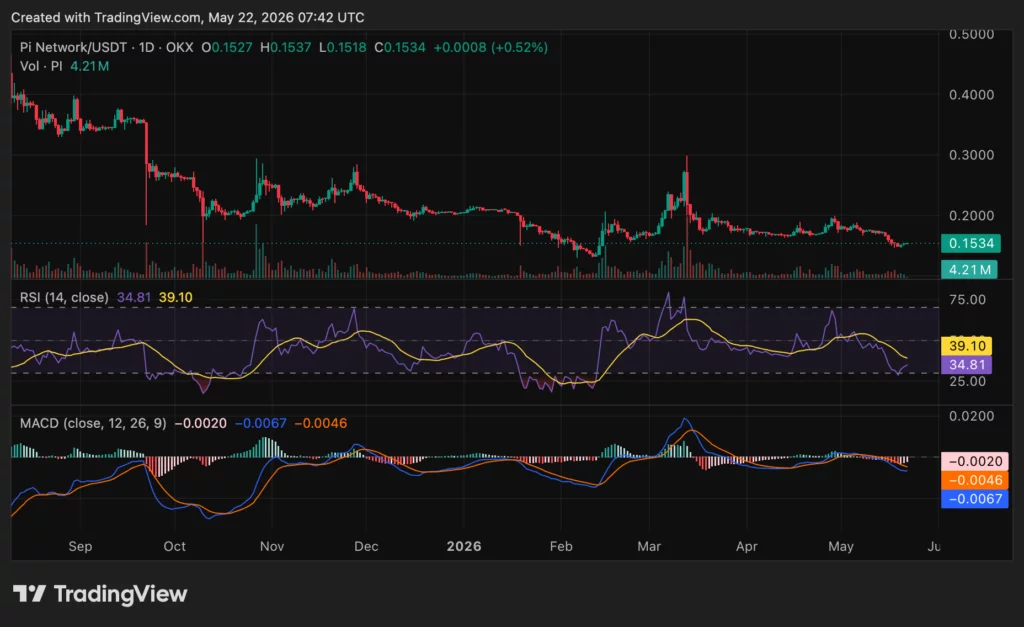
- Pi Network price holds near $0.153 after losing about 10% over the last seven days.
- Chengdiao Fan said token design should support user growth, engagement, feedback, and long-term utility.
- Pi’s utility push follows Protocol 23, but PI still faces weak momentum near key support.
Pi Network said founder Chengdiao Fan’s Consensus 2026 talk focused on a common problem in crypto: the gap between token design and real product innovation. The project said her session, “Aligning Web3, AI, and Blockchain for Utility,” framed tokens as tools for user growth, engagement, and long-term use.
Fan’s presentation also discussed Pi Launchpad, a proposed model for ecosystem tokens and launch mechanisms. The goal is to help products reach real users who can test, give feedback, and use tokens inside actual product experiences, rather than only trading them.
Pi Network’s own blog said Fan argued that AI has made it easier to create applications. That changes the main challenge for builders. In Pi’s view, distribution, verified users, and real usage now matter more than the ability to launch another app.
The Consensus event page used similar language. It said the session would show how Pi combines blockchain infrastructure, verified identity, and a large engaged network to support utility-driven products and AI-era business models.
PI price remains under pressure
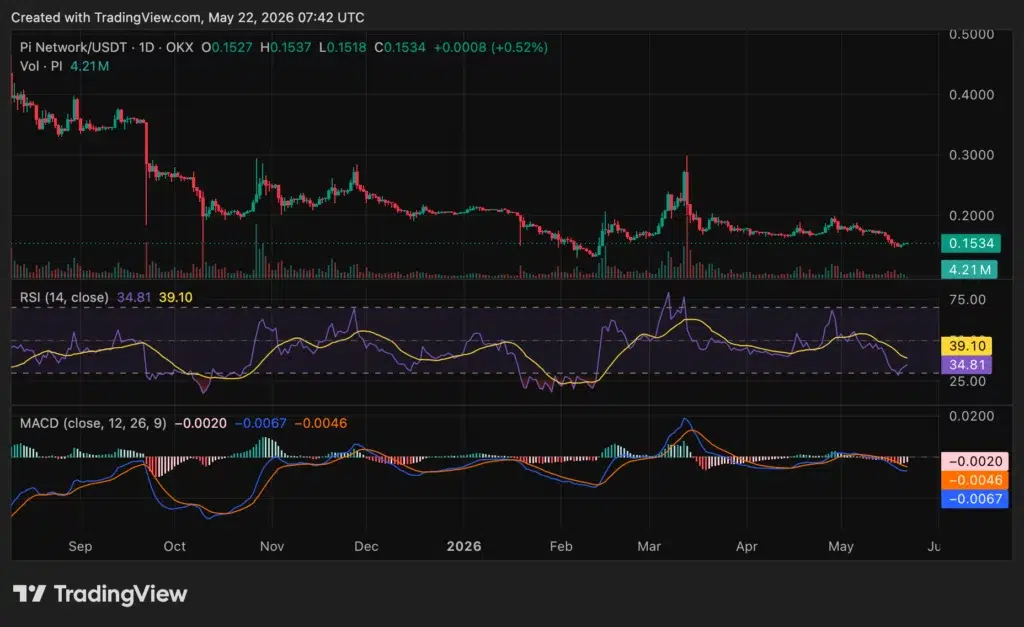
Pi Network’s market data still shows a weak price setup. PI traded near $0.152949 on May 22, with a 24-hour range between $0.150275 and $0.153973. The token was down 10.02% over seven days and 10.14% over 30 days, according to crypto.news price data.
The same data showed Pi Network with a market cap of about $1.62 billion and a fully diluted valuation of about $2.49 billion. PI ranked #54 by market cap, with 24-hour trading volume near $11.5 million.
Pi’s longer-term price picture remains weak. The token is down more than 81% over the past year and remains far below its all-time high of $2.99, reached on Feb. 26, 2025. It is still above its all-time low of $0.131244 from Feb. 11, 2026.
Chart signals also point to limited demand. PI/USDT is trading with muted volume, while the price is struggling to reclaim the $0.17 to $0.20 zone. RSI near 35 shows weak momentum, and the MACD remains negative, keeping sellers in control for now.
Protocol 23 keeps ecosystem hopes alive
Pi Network’s utility message follows a major technical phase for the project. Recent coverage said Protocol 23 activated on May 11, shortly after the project’s Consensus 2026 appearance. The upgrade introduced full smart contract functionality to the Pi blockchain for the first time.
Earlier reports also said Pi’s co-founders used Consensus 2026 to discuss AI, online identity, and Web3 use cases. Fan spoke about utility and token design, while Nicolas Kokkalis joined a panel on proving human identity online without exposing personal data.
That timing matters because Pi is trying to move beyond its long-running mobile mining identity. Protocol 23 gives the network a path toward more programmable applications, while Pi Launchpad would support ecosystem tokens and product launches.
Still, the market has not yet priced in a clear recovery. PI needs a stronger move above $0.17 to $0.18 to weaken the bearish setup. A break below $0.15 could expose another move toward lower support.
Token design becomes Pi’s main test
Fan’s message puts Pi Network inside a wider debate about what tokens should do. Many crypto projects have used tokens mainly for fundraising, speculation, or short-term incentives. Pi is arguing that tokens should help products find users and keep them active.
That pitch fits the project’s existing focus on identity. Pi says its verified user network can help businesses reach real people at a time when AI tools can create fake users, bots, and content at scale. The project says this creates value for apps that need trusted human participation.
The challenge is execution. Utility claims only matter if developers build products that users want and if PI becomes useful inside those products. Price action shows traders remain cautious while they wait for stronger signs of demand.
Polymarket has reportedly appointed a Japanese representative as the prediction market platform moves toward securing approval to operate legally in the country by 2030.
Summary
- Bloomberg reported that Polymarket has appointed a Japan representative as it works toward regulatory approval in the country by 2030.
- Japan remains on Polymarket’s restricted access list while local gambling laws continue imposing strict penalties on unauthorized betting activity.
- Expansion efforts in Japan have surfaced as regulators in India, Argentina, and parts of the U.S. continue tightening oversight on prediction markets.
According to a Friday Bloomberg report citing people familiar with the matter, Polymarket sees Japan as a long-term expansion market even as the platform remains blocked or restricted across several jurisdictions over gambling and financial compliance concerns.
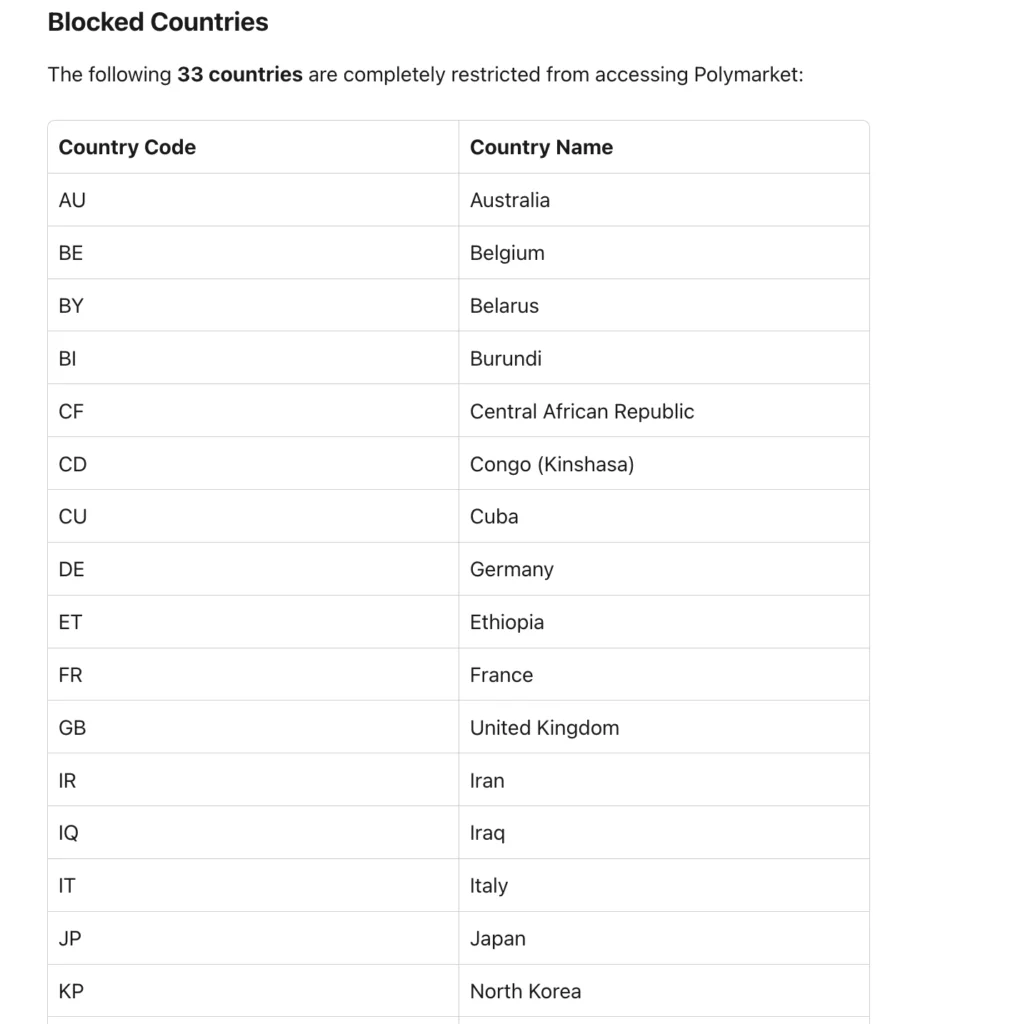
Polymarket’s list of restricted countries. Source: Polymarket website.
Leading the effort is Mike Eidlin, who Bloomberg identified as the current head of Japan at Jupiter. According to the report, Eidlin has been appointed to oversee Polymarket’s local strategy as the company begins discussions around regulatory access in the country.
At present, Japan remains on Polymarket’s restricted jurisdiction list. The platform’s website states that users from the country are blocked due to “regulatory requirements and compliance with international sanctions.”
Japanese law maintains strict restrictions on gambling activity. Under the country’s Penal Code, habitual gambling can carry prison terms of up to three years, while operating gambling businesses can result in imprisonment ranging from three months to five years.
Government-approved horse racing and public lotteries remain exempt under existing rules, while pachinko parlors continue operating through a long-standing legal gray area tied to token exchange systems.
Polymarket pushes expansion amid rising regulatory pressure
Outside Japan, regulators have continued increasing scrutiny of prediction market platforms, particularly those tied to crypto-based payments and speculative contracts.
Earlier on Friday, Indian authorities blocked access to Polymarket after the Ministry of Electronics and Information Technology instructed internet providers and VPN operators to restrict access to what officials classified as illegal online betting and prediction market services. Local outlet ThePrint reported that authorities are also preparing similar action against Kalshi, a U.S.-regulated prediction platform overseen by the Commodity Futures Trading Commission.
Regulatory documents tied to India’s Promotion and Regulation of Online Gaming Act 2025 have categorized platforms that allow users to place money on uncertain outcomes as prohibited betting services, regardless of whether operators describe them as forecasting tools or researching markets.
Pressure has surfaced in other regions as well. Earlier this year, authorities in Argentina ordered internet providers to block Polymarket after a Buenos Aires court found the platform operated outside the country’s gambling framework. Colombia and Romania imposed similar restrictions last year after classifying the service as unauthorized gambling activity.
At the same time, parts of the U.S. have also moved against prediction markets tied to sports contracts. Minnesota recently became the first U.S. state to ban prediction markets, while the CFTC and the Department of Justice filed a lawsuit earlier this week challenging the state’s legislation.
Even with growing regulatory pushback, Polymarket has continued expanding its institutional presence.
Earlier this month, the company partnered with Nasdaq Private Market to launch prediction markets linked to private-company valuations, IPO timelines, and secondary-market pricing. Under the agreement, Nasdaq Private Market serves as the resolution data provider for those contracts using verified transaction data tied to private companies.
Reuters previously reported that Polymarket has also been exploring a fresh funding round that could value the company at roughly $15 billion.
Back in the U.S., Polymarket has also returned through its acquisition of federally regulated derivatives exchange QCEX. Bloomberg and other outlets have reported that the company remains in talks with the CFTC as it seeks to restore broader access to its main exchange operations in the country.
Ethereum sentiment has weakened sharply in May as traders react to price pressure, ETF outflows, Foundation exits, and slower network growth.
Summary
- Santiment says Ethereum’s market cap fell 11.6% in 15 days as trader sentiment weakened.
- ETF outflows, Foundation exits, and slower network growth have fueled fresh Ethereum doubts in May.
- JPMorgan says ETH needs stronger network activity and real-world use to close Bitcoin’s widening lead.
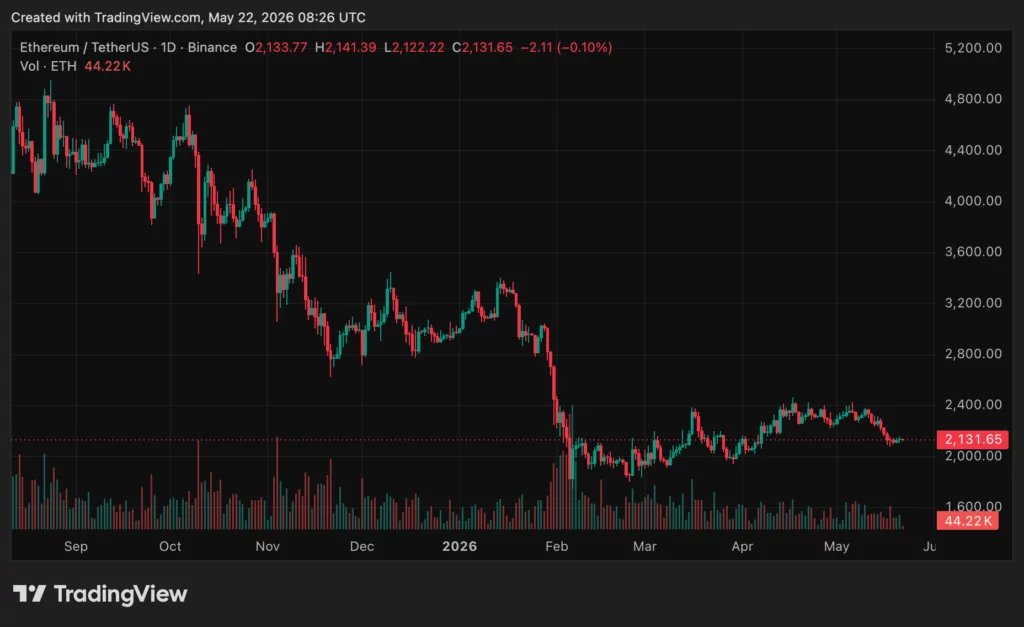
Santiment said Ethereum has seen a sharp shift in market mood, with its market cap down 11.6% over 15 days. The data platform said ETH is now at risk of falling below $2,000 for the first time since late March if selling pressure continues.
The report said Ethereum’s social dominance rose while price kept falling. That pattern can point to higher attention, but Santiment said the tone of discussion moved toward fear and frustration instead of optimism.
Santiment also said bullish and bearish comments about ETH moved closer to balance in May. In late April, bullish comments were still well above bearish ones. By May, the ratio had moved closer to 1.0, showing that traders had become far less confident.
ETF outflows weigh on ETH demand
ETF flows are one of the main pressure points. Santiment said several Ethereum ETF products saw outflows through May, including large exits from BlackRock-related funds. It also said no total Ethereum ETF inflow day above $50 million had been recorded in three weeks.
📉 Ethereum sentiment has flipped hard, and retail has jumped from crypto’s #2 market cap quickly. ETF outflows, Foundation exits, slowing network growth, and nonstop bearish narratives have traders questioning $ETH like never before. Here’s our take. 👇https://t.co/RDpVPbdIZs pic.twitter.com/y7JPlcZEPK
— Santiment Intelligence (@SantimentData) May 22, 2026
Related reports also show why traders are watching the $2,000 area. Earlier market coverage said Ethereum ETFs recorded more than $340 million in net outflows over six trading sessions, while ETH struggled to reclaim $2,150.
JPMorgan has also flagged weaker Ethereum demand compared with Bitcoin. The bank said Bitcoin ETFs recovered about two-thirds of recent outflows, while Ether ETFs recovered only about one-third. It also said ETH and altcoins may keep lagging without stronger DeFi activity and real-world use cases.
Foundation exits add to trader doubts
Ethereum Foundation changes have also fed the weaker mood. Recent coverage noted that Carl Beek and Julian Ma announced exits from the Ethereum Foundation, adding to broader Protocol Cluster changes.
Santiment said traders often react quickly to these narratives. It added that reports about Foundation exits and public claims about ETH supporters reducing exposure helped build the current bearish mood. Some of those claims lacked full context, but they still shaped trader behavior.
The report also noted that Ethereum remains strong in development activity. Santiment said Ethereum still leads in raw developer work, even as retail traders focus more on faster price moves from rival ecosystems.
Network growth remains the market test
Santiment said daily active addresses and network growth have cooled from stronger periods in 2024 and 2025. Fewer new wallets are interacting with Ethereum, which traders may read as a sign of weaker demand for ETH.
Ethereum was trading near $2,125 to $2,135 on May 22, based on market data crypto.news. That keeps ETH close to the support zone watched by traders after recent outflows and technical weakness.
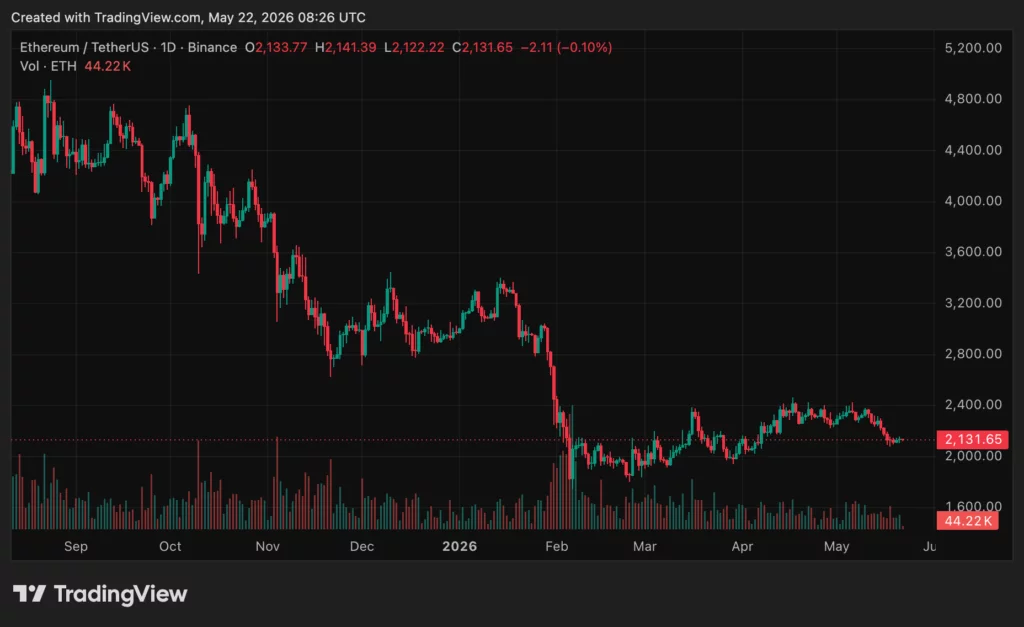
Santiment said “Whether ETH is actually approaching one of those moments remains uncertain,” referring to whether extreme bearish sentiment could turn into a contrarian setup. For now, the market is focused on whether Ethereum can restore demand, defend the $2,000 area, and prove that network use can recover faster than trader confidence is falling.
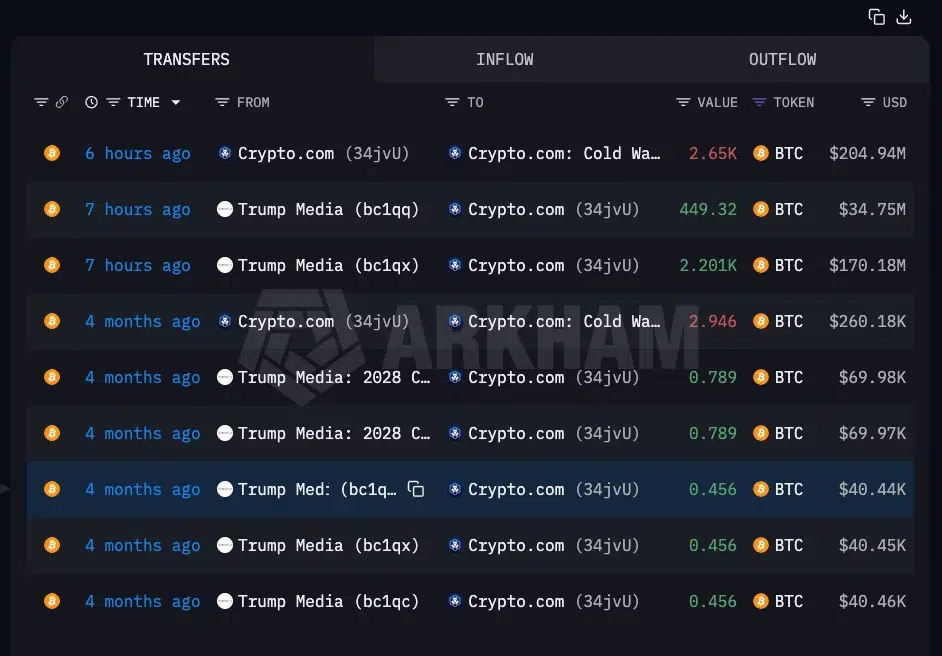
Trump Media & Technology Group has transferred another 2,650 Bitcoin worth about $205 million to Crypto.com, adding fresh scrutiny to the company’s crypto treasury strategy as its holdings remain deeply underwater.
Summary
- Trump Media moved 2,650 Bitcoin worth about $205 million to Crypto.com, according to Lookonchain data.
- The company’s Bitcoin treasury has fallen sharply below its reported average purchase price of about $118,522 per coin.
- Trump Media previously disclosed a $405.9 million quarterly loss, with most of the hit tied to unrealized crypto asset markdowns.
According to blockchain analytics platform Lookonchain, the transfer was detected from wallets linked to Trump Media, the company behind Truth Social and majority owned by the Donald J. Trump Revocable Trust.
Although deposits to exchanges do not automatically confirm a sale, traders often treat large inflows as a possible signal that liquidation could follow.
Transferred funds remain in the Crypto.com wallet. Source: Arkham.
Earlier this year, Trump Media moved 2,000 Bitcoin valued at roughly $175 million when Bitcoin (BTC) traded around $87,378. Since then, the market has weakened further, with Bitcoin hovering near $77,700 at the time of the latest transfer.
Corporate treasury losses deepen
Based on Trump Media’s previous disclosures, the company originally accumulated 11,542 BTC at an average purchase price of about $118,522 per coin, spending close to $1.37 billion on the position. At current market prices, the remaining treasury has fallen well below its entry level.
Quarterly filings released by the company showed that its Bitcoin holdings had already declined to 9,542 BTC after the first transfer. Following the latest 2,650 BTC movement flagged by Lookonchain, the stash now appears to stand near 6,889 BTC.
Recent financial results have already shown the impact of the downturn. Trump Media reported a $405.9 million net loss for Q1 2026, with $368.7 million tied to unrealized markdowns on digital assets, pledged crypto assets, and equity securities.
Within the filing, the company disclosed that its Bitcoin holdings carried a cost basis of roughly $1.13 billion while their fair value had dropped to about $647 million by the end of March. Trump Media also disclosed ownership of around 756 million Cronos tokens linked to its partnership with Crypto.com.
What does this mean for Bitcoin?
Large exchange inflows such as these can create temporary fear among traders because visible supply on an exchange order book may act as a potential resistance zone.
However, it must also be noted that the $205 million transfer remains relatively small compared with Bitcoin’s multi-billion dollar daily spot and derivatives trading volume. For now, the market impact would depend on whether the coins are sold directly on the exchange or moved through over-the-counter channels.
Separately, on-chain supply data has continued to show strong long-term holder activity despite weakness among some corporate treasury buyers.
Market analytics cited in recent reports estimated that more than 70% of Bitcoin’s circulating supply has remained unmoved for over a year, suggesting long-term investors have continued holding through the current downturn.
🚨 $BTC Long Term Holders Just Flashed The Signal That Preceded Every Major Expansion Phase Since 2012.#Bitcoin The 1Y+ Long Term Holder metric has now dropped back into the historical “oversold” accumulation zone, a region that previously appeared before explosive upside… pic.twitter.com/9ZHwKFJRm9
— CryptoZeno (@CrypZeno) May 20, 2026
Bitcoin has fallen back toward the $77,000 region after losing a key ascending trendline support that had guided its recovery from April lows.
Summary
- Bitcoin fell back toward $77,000 after breaking below a key ascending trendline support and failing to reclaim the 200-day moving average near $80,800.
- U.S. spot Bitcoin ETFs recorded roughly $1.4 billion in weekly outflows, while over $744 million worth of BTC moved to exchanges over the past five days.
- CoinGlass liquidation data showed dense long liquidation clusters near $76,000 as traders monitored rising oil prices, Fed uncertainty, and U.S.–Iran tensions.
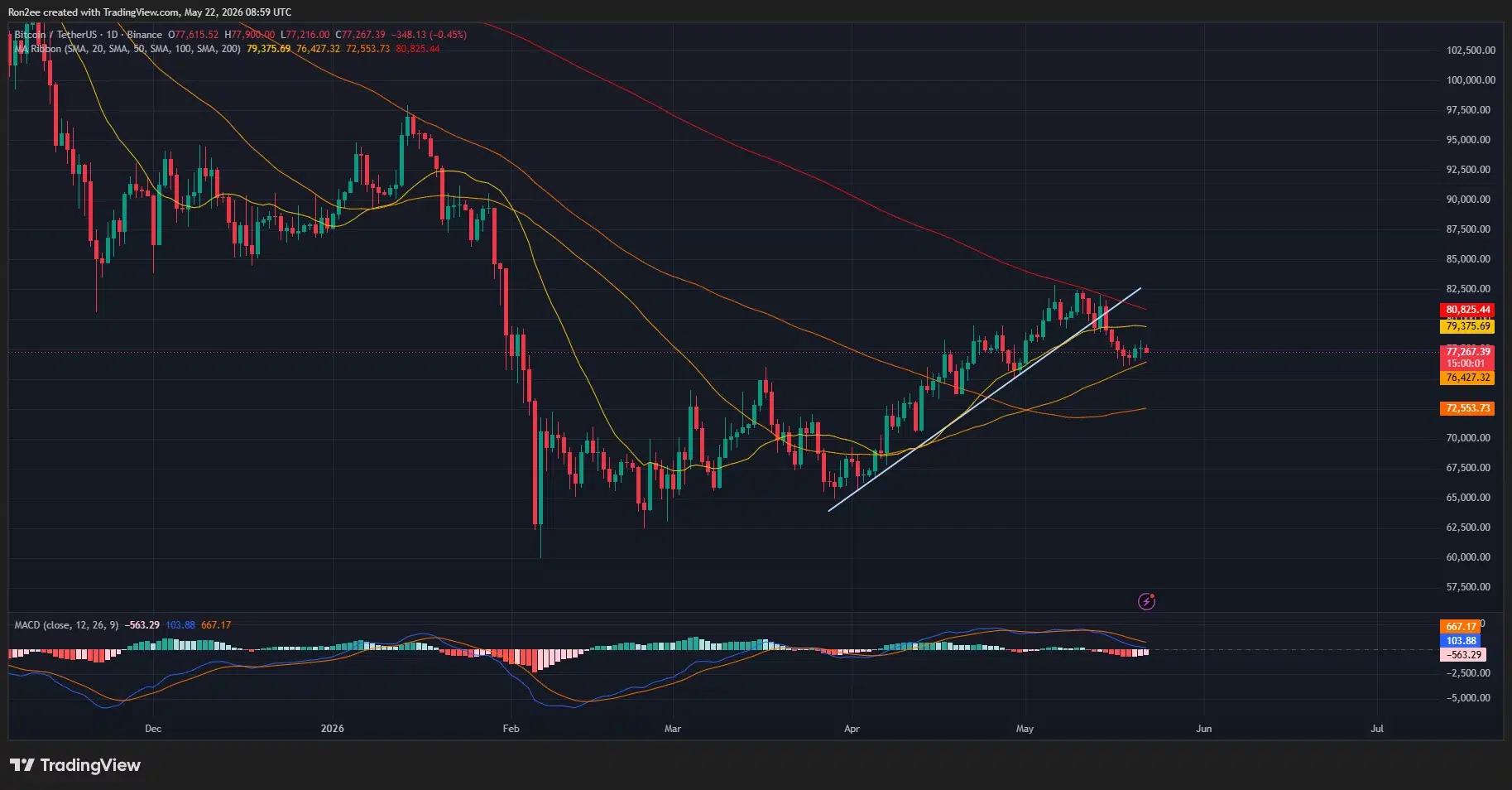
According to data from crypto.news, Bitcoin (BTC) price traded near $77,200 during Friday’s session after briefly losing the rising support structure that had guided its recovery from April lows. Selling pressure accelerated after Bitcoin once again failed to reclaim the $82,000 resistance area, a level that coincides with a descending local trendline and the 200-day moving average near $80,825 on the daily chart.
Over the past week, leveraged bullish positions have absorbed the bulk of the damage. According to derivatives data, nearly $661 million to $850 million in long liquidations were wiped out across exchanges as Bitcoin reversed lower from its May highs. The liquidation cascade amplified downside momentum as forced selling pushed spot prices into lower liquidity zones.
At the same time, U.S. spot Bitcoin ETFs recorded roughly $1.4 billion in cumulative net outflows over the past week. It signals a sharp slowdown in institutional demand following months of post-halving accumulation. BlackRock’s IBIT reportedly registered one of its largest daily outflow sessions during the move, while other major issuers also posted consistent redemptions as traders reduced risk exposure.
On-chain flows added another bearish signal. Analysts noted that 9,664 BTC worth more than $744 million had been transferred to exchanges over the last five days, often interpreted as a sign of rising sell-side intent. Separately, on-chain tracker Lookonchain reported that Trump Media & Technology Group moved another 2,650 BTC valued at roughly $205 million to Crypto.com, further increasing market focus on potential large-holder distribution.
Adding to market sensitivity, Friday’s decline unfolded during Bitcoin Pizza Day week, a period that historically draws elevated trading activity and renewed attention to Bitcoin’s long-term gains. Instead of celebratory momentum, traders encountered rising volatility and deteriorating macro conditions.
Outside crypto markets, oil prices reintroduced another layer of pressure. WTI crude futures climbed back above $98 per barrel after reports suggested Iran’s Supreme Leader ordered enriched uranium reserves to remain inside the country, complicating ongoing negotiations with Washington.
The geopolitical dispute intensified after reports emerged that Iran and Oman were working on a framework for permanent toll systems through the Strait of Hormuz, though President Donald Trump reportedly rejected the proposal and insisted the shipping route remain unrestricted.
Even with crude oil price still down more than 3% for the week, energy traders remained cautious as U.S.–Iran negotiations showed mixed signals.
U.S. Secretary of State Marco Rubio said there were “some encouraging signs” surrounding a possible deal, while Pakistani mediators were expected to travel to Tehran during the latest review phase of Washington’s proposal.
Higher oil prices have compounded inflation concerns that were already building after recent U.S. CPI and PPI readings came in above expectations. Treasury yields climbed toward yearly highs as markets reduced expectations for aggressive Federal Reserve rate cuts. Investors are also preparing for a potential leadership transition from Jerome Powell to Kevin Warsh at the Fed, a scenario many traders associate with a more hawkish policy outlook.
Under those conditions, capital rotation away from speculative assets accelerated across global markets. Bitcoin, which had benefited from strong institutional inflows earlier this quarter, now faces a more difficult liquidity environment as investors prioritize yield-bearing instruments and reduce leveraged exposure.
Can Bitcoin hold the $76K region after losing ascending support?
Technically, Bitcoin’s daily structure has weakened after the price broke below a rising white trendline that had connected higher lows since early April. The breakdown occurred shortly after repeated rejection beneath the descending red resistance trendline near $82,000, reinforcing the formation of a lower high on the daily timeframe.
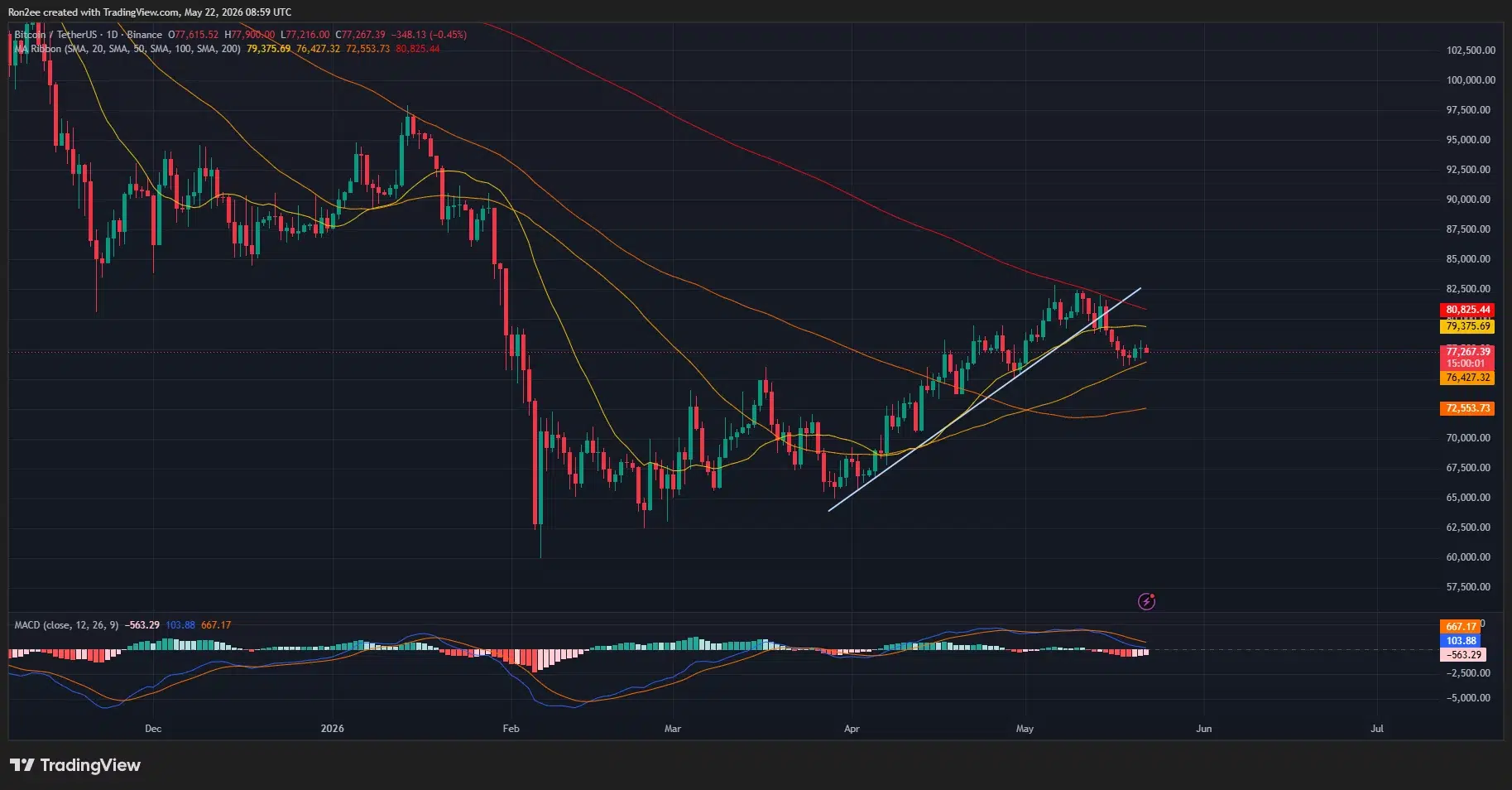
The breakdown also pushed Bitcoin beneath its 20-day moving average around $79,375 while keeping the price trapped below the 200-day moving average near $80,825.
Meanwhile, the 50-day moving average around $76,427 has emerged as the next major technical support. Daily candles are now compressing between declining short-term resistance and the rising 100-day moving average near $72,553.
The MACD histogram on the daily chart has turned negative, while the MACD line itself is beginning to cross lower beneath the signal line. Earlier bullish momentum from April’s recovery phase has faded steadily throughout May as buyers failed to produce a convincing breakout above resistance.
Liquidation data from CoinGlass suggests Bitcoin may still be vulnerable to another sweep lower before stabilization occurs. The 24-hour liquidation heatmap shows dense long liquidation clusters sitting between $76,000 and $76,500, with another concentration near $74,000. Large liquidity pockets above the current price remain concentrated near $78,000 to $79,000, potentially acting as short-term magnets during relief bounces.
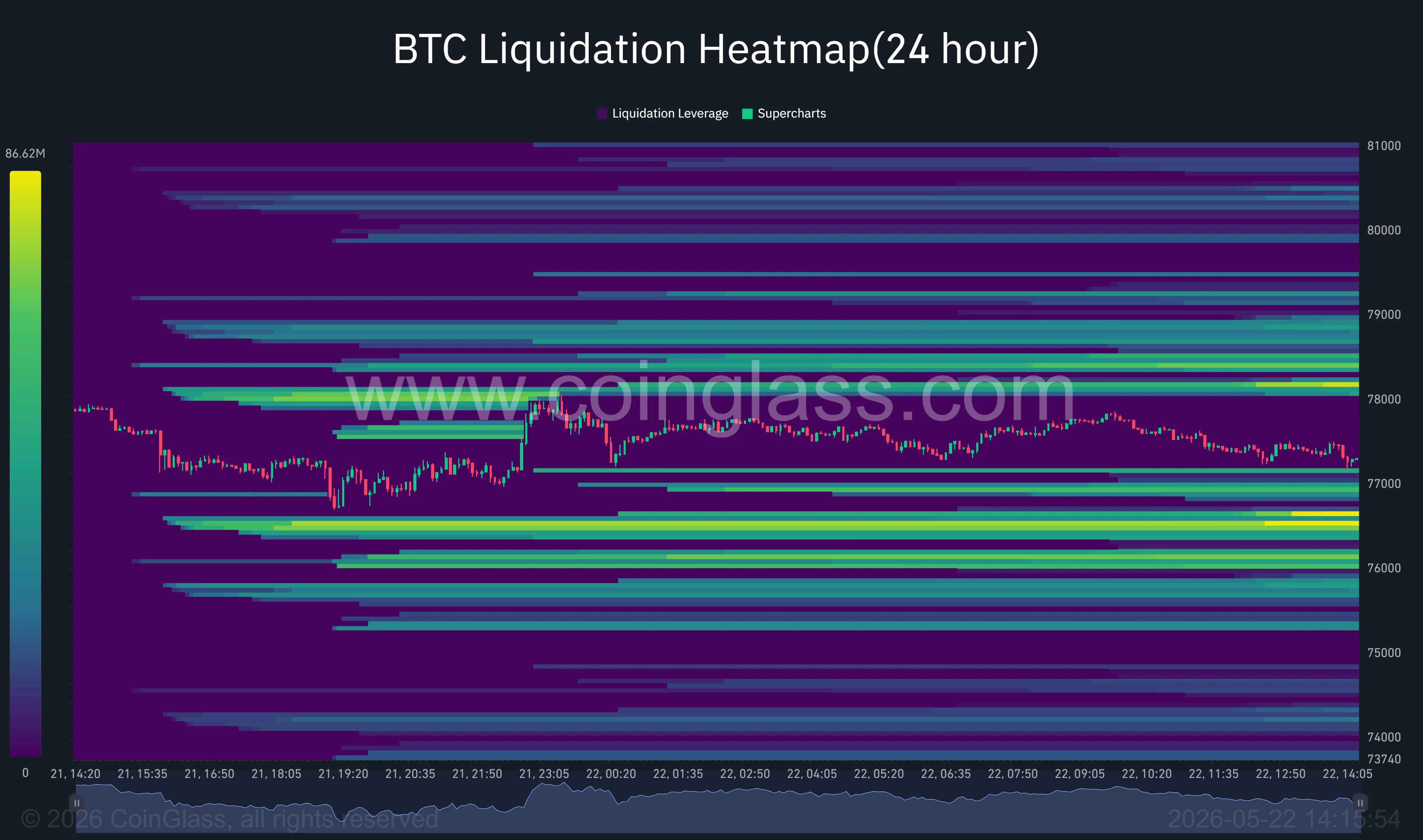
Crypto trader Lennaert Snyder said Bitcoin’s daily candle had closed “pretty weak” after failing to reclaim the $78,200 highs. According to Snyder, the market remains trapped in a choppy mid-range structure, with a likely sweep of “sell-side liquidity at the $76.4K range lows” before any meaningful recovery attempt develops.
Meanwhile, Daniel Reis-Faria, CEO of ZeroStack, told crypto.news that Bitcoin’s rejection near its 200-day moving average signaled weak buying pressure.
“Bitcoin turning lower after struggling to move above its 200-day moving average suggests there still may not be enough buying to push prices higher…If buying starts to pick up again, Bitcoin can move higher pretty quickly. But until that happens, Bitcoin is likely to stay under pressure.”
Daniel Reis-Faria, CEO of ZeroStack.
Derivatives positioning also points to lingering caution rather than aggressive dip buying. Funding rates across several perpetual futures platforms have cooled significantly compared to earlier May levels, while open interest has fallen alongside price, signaling ongoing deleveraging instead of fresh speculative participation.
What could invalidate the bearish Bitcoin outlook?
Bitcoin’s recovery back above $79,000 would be the first sign that sellers are losing short-term control. Beyond that, Bitcoin would still need to reclaim the 200-day moving average near $80,800 and invalidate the descending resistance trendline before traders begin discussing a sustainable reversal structure.
Any breakthrough in U.S.–Iran negotiations capable of pulling oil prices lower could ease inflation concerns and reduce pressure on Treasury yields. Softer economic data or renewed expectations for Federal Reserve easing would likely improve sentiment across crypto and equity markets simultaneously.
ETF demand also remains a critical variable. Persistent outflows have weighed heavily on spot liquidity during the latest correction. A reversal back into net positive inflow territory could stabilize price action quickly, especially given how aggressively leverage has already been flushed from the system over the past week.
Failure to hold the $76,000 region, however, could expose Bitcoin to a deeper move toward the $74,000 liquidity zone highlighted on derivatives heatmaps. Below that level, traders may begin targeting the 100-day moving average near $72,500 as the next major structural support during a prolonged risk-off phase.
Disclosure: This article does not represent investment advice. The content and materials featured on this page are for educational purposes only.
Polymarket’s UMA CTF Adapter contract on Polygon has reportedly been targeted in a suspected exploit, with onchain analysts warning users to pause activity.
Summary
- ZachXBT flagged a suspected UMA CTF Adapter exploit on Polygon with losses above $520K reported.
- PeckShield said two addresses were drained and some stolen funds were deposited into ChangeNOW already.
- Bubblemaps warned attackers were removing 5,000 POL every 30 seconds as losses kept rising quickly.
A ZachXBT community alert said Polymarket’s UMA CTF Adapter contract on Polygon was suspected of being attacked. The alert listed losses above $520,000 and named the attacker address as 0x8F98075db5d6C620e8D420A8c516E2F2059d9B91.
PeckShield later said ZachXBT had reported that the contract had “potentially been exploited.” The security firm said two addresses, 0x871D…9082 and 0xf61e…4805, were drained of about $520,000. It also said part of the stolen funds had already moved to ChangeNOW.
Polymarket protocol contributor Shantikiran Chanal said the security reports were linked to rewards payout activity. He said user funds and market resolution are safe, adding that early findings point to “a private key compromise of a wallet used for internal operations, not contracts or core infrastructure.”
Bubblemaps warns users to pause activity
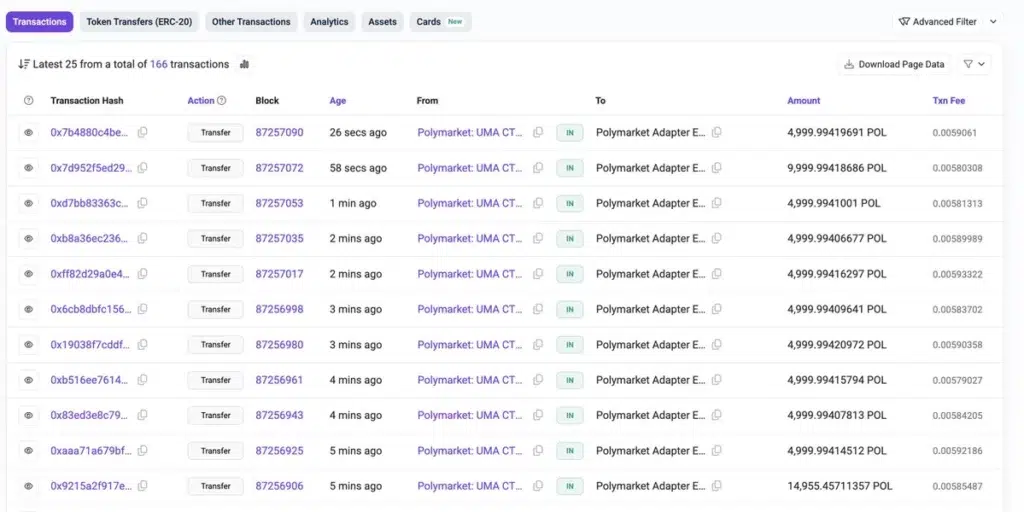
Bubblemaps also warned that a Polymarket contract had been exploited. The firm said attackers were removing 5,000 POL every 30 seconds and estimated losses at about $600,000 at the time of its alert.
PolygonScan data for 0x871D…9082 shows repeated outgoing transfers of 5,000 POL to an address tagged as Polymarket’s UMA CTF Adapter Admin. Several transfers occurred about 30 seconds apart, matching the pattern flagged by Bubblemaps.
Meanwhile, Polymarket’s documentation says the UMA CTF Adapter connects markets to UMA’s Optimistic Oracle. The adapter is used to request and retrieve resolution data for prediction markets built on the Conditional Tokens Framework.
Polymarket’s newer documentation says all outcomes on the platform are tokenized through CTF, with outcome tokens backed by locked pUSD. That makes the affected contract area relevant to how markets are created, resolved, and redeemed onchain.
This is not Polymarket’s first UMA-related controversy. Earlier coverage noted that a UMA whale allegedly influenced a Polymarket market outcome tied to a Trump-Ukraine mineral deal, raising questions over oracle voting power and market resolution trust.
Attack comes as Polymarket expands
The incident comes as Polymarket has been moving from a crypto-native prediction platform into a larger market structure debate. Recent crypto.news coverage said prediction markets led by Polymarket and Kalshi have grown into one of finance’s fastest-moving sectors.
The platform has also faced regulatory and market-design pressure. Earlier coverage noted Wisconsin’s lawsuit against Polymarket, Kalshi, Coinbase, Robinhood, and Crypto.com-linked entities, arguing some prediction markets function as unlicensed gambling products.
The suspected exploit adds a new technical risk layer to that debate. Polymarket is already watched for questions around regulation, resolution rules, and market integrity. A contract-level incident now puts user safety and smart contract controls back in focus.
The latest alert also follows a wider run of DeFi security incidents. Recent reports covered Echo Protocol’s paused bridge after unauthorized eBTC minting, while the Verus Ethereum bridge case took a different turn after the exploiter returned 4,052 ETH, following an $11.5 million forged-transfer attack.

Shrek at 25: How everyone’s favourite ogre went from development hell to all-star smash

Energy Transfer's Valuation Can't Be Justified In Light Of Its Surging NGL Exposure

SEC tokenized stock plan raises exchange revenue fears


-

 Crypto World1 day ago
Blockchain.com files with SEC for U.S. IPO
-

 Fashion11 hours ago
Holiday Weekend Open Thread – Corporette.com
-

 Fashion6 days ago
On the Scene at Gucci’s Cruise Show in New York City: Mariah Carey, Kim Kardashian, Lindsay Lohan, Iman, and More!
-
 Crypto World6 days ago
Intesa Sanpaolo’s crypto holdings jump to $235M as XRP enters
-

 Politics7 days ago
Watch: far-right flag-fanatics run over victim, attack locals – Setup By the Left wing for your entertainment
-

 Fashion7 days ago
Trending Western Style Vests Perfect for Summer
-

 Crypto World14 hours ago
Space X IPO Is ‘Bad News’ for Tech Stocks: But What About Bitcoin?
-

 Fashion6 days ago
Amazon Sundays: Memorial Day Hosting
-

 Entertainment6 days ago
Off Campus Easter Eggs Explained: Characters, Stories, More
-

 Business14 hours ago
Dell Technologies DELL Stock Surges 15% on AI Server Momentum and Analyst Upgrades in 2026
-
 Crypto World4 days ago
Revolut Launches Dogecoin Debit Card Across UK and EU
-
 Tech16 hours ago
A 0.12% parameter add-on gives AI agents the working memory RAG can’t
-
Business6 days ago
Australia defends property tax changes designed to fix ‘broken’ housing
-
 NewsBeat2 days ago
Charity run by Reform leader Malcolm Offord accused of ‘law breaking’ over Scottish registration
-

 Politics7 days ago
Anti-Zionists attacked in Jerusalem as ethnofascists chant race-hate
-

 Tech1 day ago
WhatsApp ads could make Irish debut after discussions with DPC
-

 Sports1 day ago
2026 CJ Cup Byron Nelson leaderboard: Brooks Koepka finds putting stroke in Round 1
-
Politics6 days ago
Wings Over Scotland | The Land Of No Laws
-

 Crypto World22 hours ago
Trump Media’s Bitcoin Stash Shrinks Again as 2,650 BTC Lands on Crypto.com
-

 Politics7 days ago
Cassidy defiant as Trump's revenge campaign closes in
You must be logged in to post a comment Login