
Crypto World
Silver Price Falls Back Below $70

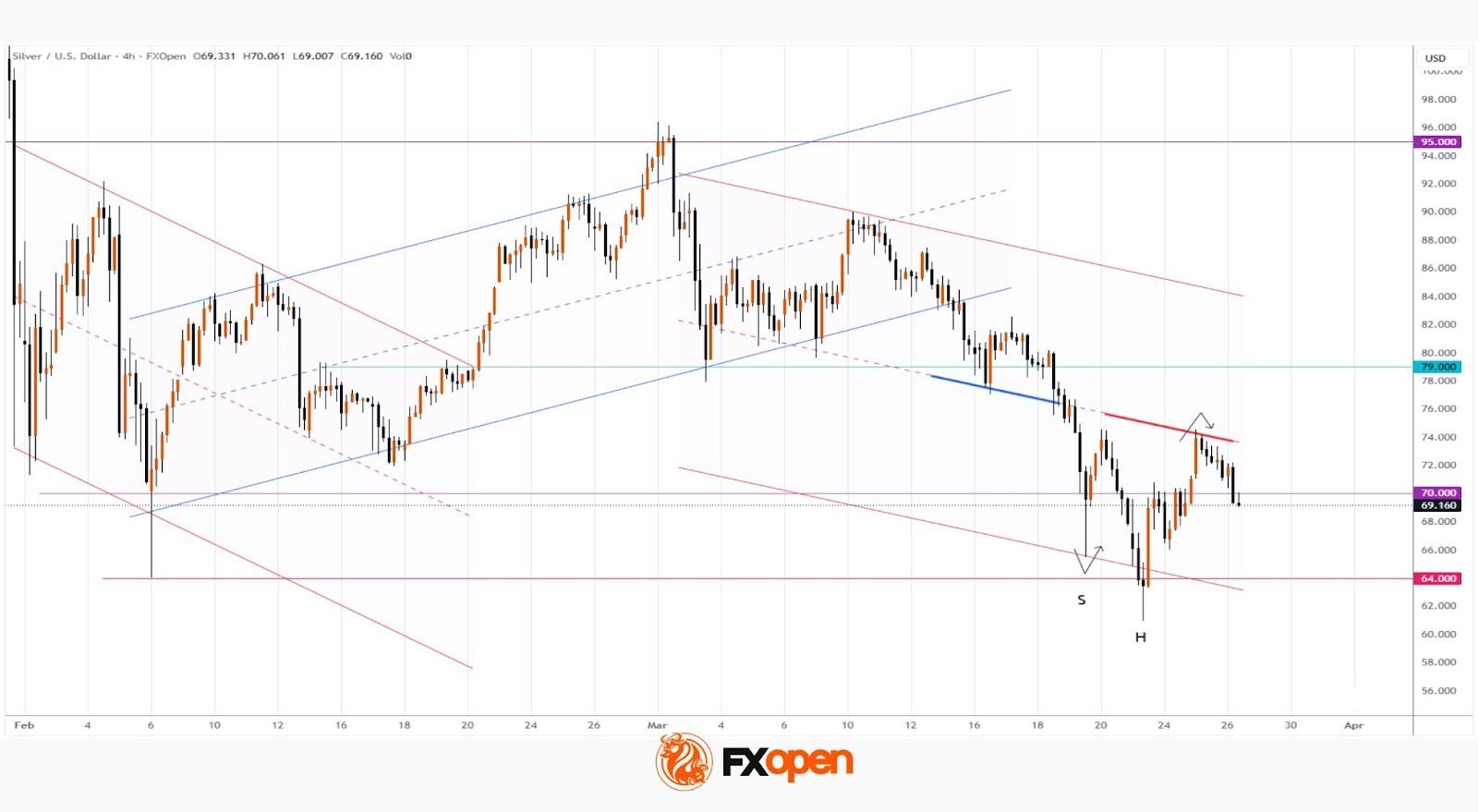
As can be observed on the XAG/USD chart, the price of silver has once again dropped below the psychological $70 level. At the same time, this week has been marked by sharp fluctuations: on Monday, prices traded below $65, while as recently as yesterday, silver reached $74 per ounce.
Market volatility is being driven by ongoing geopolitical uncertainty. Conflicting statements from the United States and Iran regarding potential peace negotiations continue to unsettle financial markets. According to media reports:
→ Washington maintains that negotiations are ongoing, with the Trump administration reportedly delivering a 15-point proposal to Iran via intermediaries, aimed at resolving the conflict and reopening the Strait of Hormuz.
→ Iran, in turn, has stated that it does not intend to negotiate with the US, rejecting the proposed ceasefire and instead putting forward its own conditions.
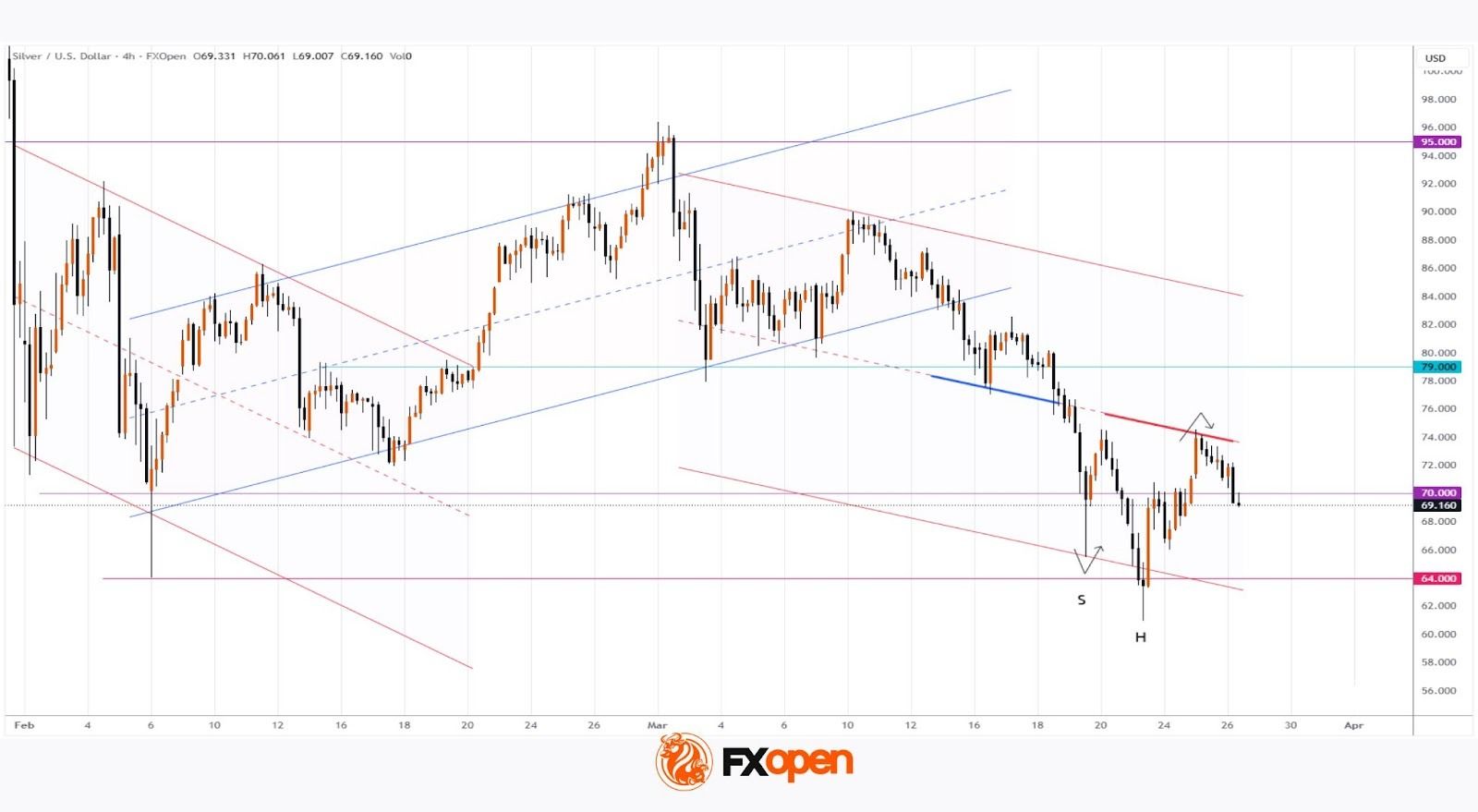
On the morning of 19 March, analysing the XAG/USD chart, we:
→ concluded that the market was under significant pressure;
→ identified and plotted a descending channel (marked in red) on the silver price chart;
→ suggested that the channel’s median line could act as near-term resistance, thereby validating the structure.
Indeed, subsequent price action confirmed this framework, as indicated by the arrows:
→ the lower boundary acted as support on the same day;
→ yesterday, price reversed lower from the median line (which shifted from support to resistance), reinforcing the prevailing bearish sentiment observed throughout March.
From a bullish perspective:
→ the break below the 6 February low around the $64 level highlights aggressive demand — so-called “smart money” may have absorbed liquidity in this zone, positioning for higher prices;
→ silver may be in the process of forming an inverse head and shoulders pattern.
However, as long as price continues to trade below the red median line of the active channel, it would be premature to speak of any meaningful bullish conviction.
Start trading commodity CFDs with tight spreads (additional fees may apply). Open your trading account now or learn more about trading commodity CFDs with FXOpen.
This article represents the opinion of the Companies operating under the FXOpen brand only. It is not to be construed as an offer, solicitation, or recommendation with respect to products and services provided by the Companies operating under the FXOpen brand, nor is it to be considered financial advice.

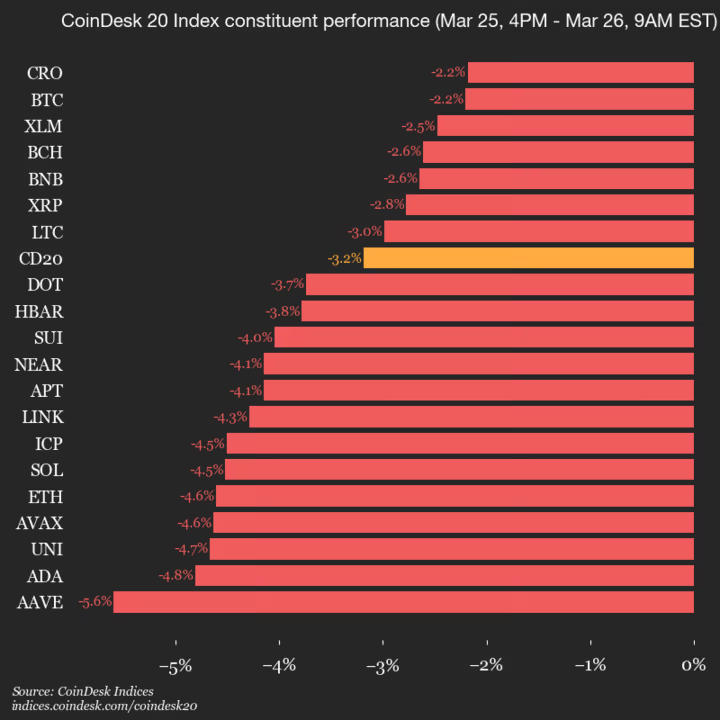
CoinDesk Indices presents its daily market update, highlighting the performance of leaders and laggards in the CoinDesk 20 Index.
The CoinDesk 20 is currently trading at 1985.11, down 3.2% (-65.39) since 4 p.m. ET on Wednesday.
None of the 20 assets are trading higher.

Leaders: CRO (-2.2%) and BTC (-2.2%).
Laggards: AAVE (-5.6%) and ADA (-4.8%).
The CoinDesk 20 is a broad-based index traded on multiple platforms in several regions globally.

SpaceX Moves Toward IPO Filing With Strong Valuation Target
SpaceX moves toward IPO filing with the SEC, targeting up to a $1.75 trillion valuation as tokenized stock dips and Bitcoin holdings remain steady.
Key Highlights
- SpaceX Nears IPO Filing as Tokenized Stock Drops Below Recent Highs
- Musk’s SpaceX Targets $1.75T Valuation Amid Shifting Market Signals
- Tokenized SpaceX Shares Slip Despite Strong IPO Momentum
- SpaceX Lines Up Banks While Crypto-Linked Assets Show Mixed Trends
- IPO Buzz Rises as SpaceX Tokenized Stock and Volume Decline
SpaceX is preparing a confidential IPO filing with the SEC, possibly within days. The company aims to raise over $75 billion. It could seek a valuation between $1.5 trillion and $1.75 trillion.
Reports indicate that the filing timeline may shift slightly due to internal factors. However, preparations continue at a steady pace. The company has not issued an official statement on the matter.
Major financial institutions are supporting the process with underwriting roles. Morgan Stanley, Bank of America, Goldman Sachs, and JPMorgan Chase are involved. The listing is expected to take place in June 2026.
Tokenized SpaceX Stock Declines Despite IPO Momentum
The tokenized SpaceX stock currently trades at $681.74 after a recent drop. The price declined by 0.8% over the past 24 hours. Trading volume also fell by 31% during the same period.
The token recorded a daily low of $681.23 and a high of $699.50. It remains more than 22% below its all-time high. Market activity shows reduced momentum despite rising IPO interest.
The decline reflects short-term adjustments in secondary markets. However, broader attention toward tokenized assets remains steady. The IPO narrative continues to shape sentiment across related markets.
Institutional Push for Tokenization Gains Strength
Institutional activity in tokenized securities has increased due to evolving regulatory clarity. The SEC recently approved Nasdaq’s proposal for tokenized securities trading. This move signals growing acceptance of blockchain-based financial instruments.
Large firms such as BlackRock, NYSE, and Invesco have announced tokenization initiatives. These developments support wider adoption across traditional finance sectors. Market infrastructure continues to evolve alongside these plans.
Meanwhile, SpaceX maintains exposure to digital assets through its Bitcoin holdings. The company holds 8,285.45 BTC valued at nearly $600 million. Bitcoin trades at $71,113 at the time of reporting.
$ASTS added ~$5B in market cap today as SpaceX moved closer to an IPO with a prospectus filing expected this week.
This looks like a repricing of early-stage winners in what could be one of the most important infrastructure buildouts of the next 20 years. https://t.co/Ajyb45rcc8 pic.twitter.com/ZQe0uaOA7R
— Shay Boloor (@StockSavvyShay) March 25, 2026
Strategic Expansion Strengthens SpaceX Position
SpaceX recently completed the acquisition of Elon Musk’s artificial intelligence firm xAI. The deal makes xAI a wholly owned subsidiary. The combined private valuation stands near $1.25 trillion.
This integration supports broader technological alignment within Musk’s ecosystem. It also strengthens SpaceX’s long-term strategic outlook. The move reflects ongoing consolidation across advanced technology sectors.
In addition, Musk confirmed early public access for X Money in April. This development expands the company’s financial ecosystem. It aligns with efforts to integrate payments and digital services.
IPO Structure and Market Expectations Take Shape
The IPO may allocate more than 20% to individual participants. This structure could widen access beyond institutional allocations. It also reflects a broader distribution strategy.
Advisers expect strong demand given SpaceX’s market position and growth profile. The company leads in commercial space launches and satellite deployment. Its Starlink network continues to expand globally.
Market conditions will influence final pricing and valuation adjustments. However, current projections indicate significant scale. The IPO could become one of the largest in financial market history.

Key Highlights
- A groundbreaking partnership between Coinbase (COIN) and Better Home & Finance (BETR) introduces cryptocurrency-collateralized home loans with Fannie Mae’s backing.
- Homebuyers can use bitcoin or USDC as down payment collateral without liquidating their digital assets.
- The financing structure eliminates capital gains tax liabilities and margin call risks — crypto price fluctuations won’t trigger additional collateral requirements.
- Borrowers will pay rates that are 0.5 to 1.5 percentage points above conventional 30-year mortgage rates.
- Fannie Mae’s acceptance of crypto-collateralized mortgages represents a watershed moment for digital asset integration into traditional finance.
Coinbase (COIN) has partnered with digital mortgage provider Better Home & Finance (BETR) to introduce a cryptocurrency-collateralized mortgage offering that enables prospective homeowners to leverage bitcoin or USDC as down payment security, now supported by Fannie Mae.
This represents an unprecedented milestone for Fannie Mae, which has never previously endorsed such financial products. As a government-sponsored enterprise regulated by the Federal Housing Finance Agency, Fannie Mae’s participation in U.S. housing finance is pivotal. This endorsement could catalyze broader institutional acceptance.
The financing solution targets ordinary homebuyers rather than exclusively serving wealthy individuals. Coinbase characterized the offering as quintessentially accessible to all Americans.
According to Better’s CEO Vishal Garg, approximately 41% of American households cannot purchase homes due to insufficient down payment funds. Many prospective buyers possess substantial assets in alternative forms, including cryptocurrency holdings.
The mechanics are straightforward: purchasers secure a conventional 15- or 30-year Fannie-backed home loan through Better. Rather than providing cash upfront, a secondary loan is collateralized by bitcoin or USDC stored with Coinbase.
The digital assets move into a custodial wallet managed by Better, though borrowers maintain ownership privileges. USDC holders continue receiving staking returns on their pledged collateral.
Rates for these cryptocurrency-backed products will exceed standard 30-year mortgage rates by 0.5 to 1.5 percentage points, varying based on individual borrower qualifications. Prospective buyers must factor this premium into their financial calculations.
Protection From Market Volatility and Forced Sales
Among the product’s most attractive characteristics is built-in protection against cryptocurrency price volatility. Bitcoin value declines don’t alter mortgage conditions or trigger additional collateral demands.
Liquidation occurs exclusively after 60 days of payment default — identical to conventional mortgage standards. Market volatility alone cannot result in collateral forfeiture.
Mark Troianovski, Coinbase’s head of consumer and platform business development, drew parallels to private banking for affluent clients. “They leverage assets rather than liquidating them for purchases; they secure loans against their holdings,” he explained.
Previous Crypto Mortgage Products Existed, But With Limited Scope
Cryptocurrency-backed home financing isn’t entirely novel. Miami-based Milo has provided such products since 2022, serving more than 100 clients. However, earlier offerings primarily served specialized markets — frequently foreign buyers or luxury property transactions.
Fannie Mae’s participation fundamentally alters the landscape. As the institution that purchases, securitizes, and guarantees mortgages on a massive scale, its underwriting criteria influence industry-wide lending standards.
Better had already pioneered similar territory in February 2023, permitting Amazon employees to pledge company stock for down payment collateral. The cryptocurrency variant employs comparable frameworks while expanding accessibility to Coinbase’s substantial user base.
Gallup data indicates that 14% of American adults held cryptocurrency in 2025. A Redfin survey from 2025 revealed nearly 13% of millennial and Gen Z purchasers liquidated crypto holdings to finance down payments — creating taxable consequences this product is specifically designed to circumvent.
The Trump administration previously instructed Fannie and Freddie Mac to establish protocols for recognizing cryptocurrency as qualifying mortgage application assets last June, demonstrating governmental support for digital asset industry growth.

Crypto World
Everyone’s calling bitcoin (BTC) pricing resilient, may be it’s just complacent: Crypto Daybook Americas
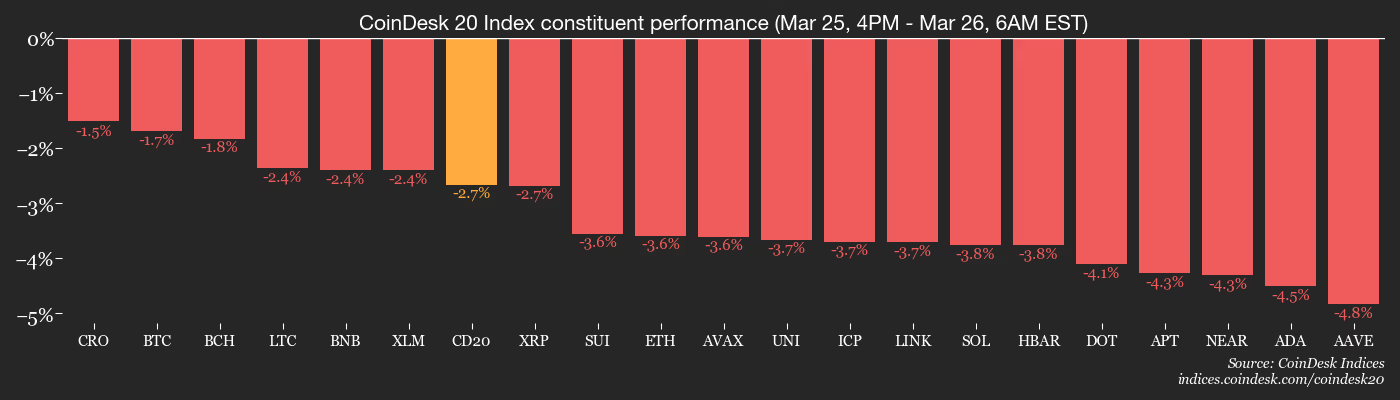
By Omkar Godbole (All times ET unless indicated otherwise)
Bitcoin’s been trading in a tight range lately, with volatility indices surprisingly calm despite the Iran war, oil shocks and Fed rate-hike expectations hanging over the market.
Bulls are calling it resilience. But if you zoom out and look at other markets, maybe it is just complacency — and could lead to a brutal reality check.
Take oil, for example. WTI has jumped 37% this month to $91.84, and some analysts are saying $200 isn’t out of the question. Call options on oil are now three times pricier than puts. That’s a pretty clear sign of outsized bullish positioning. All this means more inflation and economic shocks ahead.
In the U.S. Treasury market, the MOVE index, which tracks expected volatility in the backbone of global finance, has shot up 33% to 98.00. Increased volatility in debt of the world’s largest economy, which underpins global finance, typically leads to tightening of credit worldwide.
Compare that with bitcoin’s implied volatility index, BVIV, which has actually slipped 7% to 54%. Resilience or complacency? Some firms think it’s latter.
“Notably, short-dated implied volatilities have compressed to their lowest levels since February, signaling a degree of market complacency regarding this tail risk,” TDX Strategies said in a market note.
The firm recommends “accumulating gamma,” basically, betting on big moves on select altcoins, as a proxy hedge for your portfolio.
As of now, bitcoin is down 2.4% on the day at $69,500. Ether (ETH), XRP (XRP), and solana (SOL) are following suit, while non-serious tokens like are taking a bigger hit, down nearly 5%.
The backdrop isn’t helping: Iran just rejected the U.S. peace plan, laying out conditions that include closing all U.S. bases in the Gulf, reparations for attacks, lifting all sanctions, and keeping its missile program unrestricted. The U.S. probably isn’t going to agree, which leaves the situation deadlocked and risk assets on edge.
The dollar index is climbing, Treasury yields are ticking up, and U.S. stock index futures are in the red. Stay alert!
Read more: For analysis of today’s activity in altcoins and derivatives, see Crypto Markets Today
What to Watch
For a more comprehensive list of events this week, see CoinDesk’s “Crypto Week Ahead“.
- Crypto
- Macro
- March 26, 8:30 a.m.: U.S. Initial Jobless Claims for week ending March 21 est. 210K (Prev. 205K)
- March 26, 4:00 p.m.: Fed Gov. Lisa Cook speech on “Reflections on Financial Stability” at Yale
- March 26, 7:00 p.m.: Fed Vice Chair Philip Jefferson speech on “Economic Outlook and Energy Effects” at Global Perspectives Speaker Series, Dallas
- March 26, 7:10 p.m.: Fed Gov. Michael Barr speech on “Economy”, Washington, D.C.
- Earnings (Estimates based on FactSet data)
- March 26: Hyperion DeFi (HYPD), pre-market, -$4.62
Token Events
For a more comprehensive list of events this week, see CoinDesk’s “Crypto Week Ahead“.
- Governance votes & calls
- Unlocks
- Token Launches
- March 26: Katana Network (KAT) Epoch 1 for KAT rewards begins
Conferences
For a more comprehensive list of events this week, see CoinDesk’s “Crypto Week Ahead“.
Market Movements
- BTC is down 1.63%% from 4 p.m. ET Wednesday at $69,946.60 (24hrs: -2.67%)
- ETH is down 4.04% at $2,079.75 (24hrs: -4.84%)
- CoinDesk 20 is down 2.78% at 1,991.19 (24hrs:-3.91%)
- Ether CESR Composite Staking Rate is unchanged at 2.74%
- BTC funding rate is at -0.0023% (-2.5032% annualized) on Binance

- DXY is up 0.10% at 99.70
- Gold futures are down 2.91% at $4,417.60
- Silver futures are down 6.11% at $67.94
- Nikkei 225 closed down 0.27% at 53,603.65
- Hang Seng closed down 1.89% at 24,856.43
- FTSE 100 is down 1.23% at 9,982.48
- Euro Stoxx 50 is down 1.50% at 5,564.52
- DJIA closed on Wednesday up 0.66% at 46,429.49
- S&P 500 closed up 0.54% at 6,591.90
- Nasdaq Composite closed up 0.77% at 21,929.83
- S&P/TSX Composite closed up 1.38% at 32,382.60
- S&P 40 Latin America closed up 2.35% at 3,562.75
- U.S. 10-Year Treasury rate is down 6 bps at 4.33%
- E-mini S&P 500 futures are down 0.83% at 6,585.50
- E-mini Nasdaq-100 futures are down 0.96% at 24,135.00
- E-mini Dow Jones Industrial Average futures are down 0.76% at 46,355.00
Bitcoin Stats
- BTC Dominance: 59.98% (0.01%)
- Ether-bitcoin ratio: 0.0299 (-1.65%)
- Hashrate (seven-day moving average): 976 EH/s
- Hashprice (spot): $32.89
- Total fees: 2.65 BTC / $188,510
- CME Futures Open Interest: 117,100 BTC
- BTC priced in gold: 15.6 oz.
- BTC vs gold market cap: 4.64%
Technical Analysis

- The chart shows XRP’s daily price swings (UTC) in candlestick format since November 2025.
- XRP’s price has dropped below a triangular consolidation pattern represented by the two converging trendlines.
- That’s a signal that bears have established the path of least resistance lower, opening the doors for deeper slides.
Crypto Equities
- Coinbase Global (COIN): closed on Wednesday at $181.10 (+0.03%), -2.07% at $177.36 in pre-market
- Galaxy Digital (GLXY): closed at $21.33 (+0.14%), -1.73% at $20.96
- MARA Holdings (MARA): closed at $8.28 (+0.36%), -2.42% at $8.08
- Riot Platforms (RIOT): closed at $15.16 (+5.79%), -2.51% at $14.78
- Core Scientific (CORZ): closed at $17.05 (+1.19%), -2.87% at $16.56
- CleanSpark (CLSK): closed at $9.96 (+3.97%), -2.01% at $9.76
- Exodus Movement (EXOD): closed at $7.29 (+1.25%)
- CoinShares Bitcoin Mining ETF (WGMI): closed at $40.30 (+3.68%)
- Circle Internet Group (CRCL): closed at $103.86 (+2.66%), -2.52% at $101.24
- Bullish (BLSH): closed at $37.43 (+0.16%), -1.63% at $36.82
Crypto Treasury Companies
- Strategy (MSTR): closed at $139.13 (+2.11%), -2.03% at $136.31
- Strive Asset Management (ASST): closed at $10.85 (+9.26%), -1.84% at $10.65
- Sharplink (SBET): closed at $7.28 (+1.53%), -3.98% at $6.99
- Upexi (UPXI): closed at $1.19 (+7.21%), -1.68% at $1.17
- Lite Strategy (LITS): closed at $1.20 (+0.00%)
ETF Flows
Spot BTC ETFs
- Daily net flows: $7.8 million
- Cumulative net flows: $56.31 billion
- Total BTC holdings ~1.29 million
Spot ETH ETFs
- Daily net flows: -$8.5 million
- Cumulative net flows: $11.69 billion
- Total ETH holdings ~5.75 million
Source: Farside Investors
While You Were Sleeping
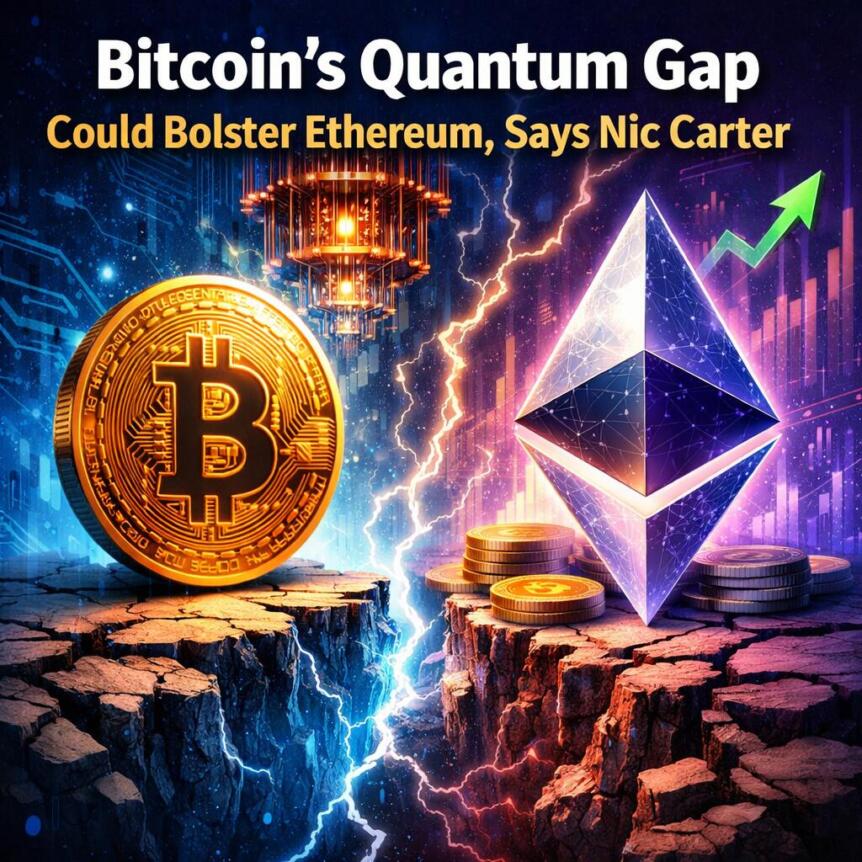
Bitcoin’s cryptographic foundations are once again in the spotlight as prominent voices warn that post-quantum security will soon demand more than minor tweaks. Crypto entrepreneur Nic Carter has pressed Bitcoin developers to confront the quantum threat head-on, arguing that Ethereum already possesses a clearer post-quantum roadmap and momentum. The debate arrives amid broader signals that quantum risks are climbing higher on the industry agenda, with Google warning of a migration deadline and researchers warning that a significant portion of BTC could be exposed to quantum attacks in the long run.
Elliptic curve cryptography underpins Bitcoin’s security. Users generate a private key and derive a public address through operations on a curved mathematical surface, a process that quantum computers could potentially undermine in the future. While the timeline remains debated, the risk is considered non-zero enough to fuel ongoing discussions about how to adapt. Carter has been vocal on X, asserting that “elliptic curve cryptography is on the brink of obsolescence,” and that the community should acknowledge the inevitability of change within a finite horizon. He argues that the current design is overly rigid and that a plan for cryptographic mutability—where the network can upgrade or swap cryptographic primitives—will become essential.
On the other side of the debate, Ethereum developers have already signaled progress. Carter notes that Ethereum has established a dedicated post-quantum security effort and a roadmap that places post-quantum readiness as a top strategic priority for 2029. In his view, Ethereum’s proactive posture stands in contrast to Bitcoin’s approach, which he characterizes as hesitant or slow to move beyond the current standards. The Ethereum Foundation’s post-quantum security team is pursuing concrete steps toward a migration path that could preserve security guarantees in a quantum-enabled world. A detailed post-quantum roadmap is available through Ethereum’s planning pages, underscoring a deliberate, institution-backed push for resilience.
Key takeaways
- Ethereum is actively advancing post-quantum security with a formal roadmap and a dedicated security team, targeting 2029 as a strategic milestone.
- Bitcoin’s core developers face sustained scrutiny over their handling of quantum risk, with critics calling for greater openness to cryptographic mutability and upgrades (e.g., BIP-360 discussions).
- ARK Invest estimated in a March report that roughly one-third of BTC could be exposed to quantum threats in the long term, highlighting a potential structural risk that may influence long-horizon planning.
- Google’s 2029 migration deadline for post-quantum cryptography signals that quantum-resilience is a cross-industry priority and could accelerate timelines for crypto networks and other digital systems.
- The market implication is a potential divergence in how networks prepare for quantum threats, with investors watching who moves fastest and how upgrades affect usability, security, and governance.
Bitcoin’s risk debate and the call for cryptographic mutability
Nic Carter has argued that Bitcoin’s cryptographic design is at a crossroads. In public posts, he described elliptic curve cryptography as edging toward obsolescence and warned that the window to address this threat is finite. The thrust of his argument is pragmatic: if quantum adversaries advance, networks built on fixed cryptographic assumptions might struggle to adapt without a pathway to evolve their security primitives. He has stressed that a rethinking of how cryptography is integrated—potentially moving toward more flexible, upgradable security layers—could be necessary for Bitcoin to remain secure in a post-quantum era.
The debate around BIP-360—an explicit attempt to introduce quantum-resistant considerations into Bitcoin’s improvement process—has been a focal point. Carter has publicly critiqued Bitcoin Core’s responsiveness to proposals that aim to future-proof the protocol, warning of a “worst in class” approach if the community does not confront the issue. In response, Ethan Heilman, a co-author of BIP-360, asserted that Core contributors have engaged with the proposal and that BIP-360 has attracted more comments than any prior Bitcoin Improvement Proposal, signaling active discussion even amid controversy. The exchange illustrates a wider tension in Bitcoin development: how aggressively to pursue changes that could alter the network’s operating model versus preserving a conservative, minimally invasive upgrade path.
Beyond the debate within Bitcoin circles, the question remains: what is the practical path to quantum resilience for a system designed to be censorship-resistant and autonomous? Carter has argued for a reimagining of how cryptography is embedded in the network, suggesting that “cryptographic mutability” will have to become a core design consideration. The trade-offs—between security, governance, and user experience—will shape what an eventual mutability framework looks like and how it is implemented in a way that preserves user trust and network integrity.
Ethereum’s post-quantum momentum and the broader market signal
Ethereum’s posture toward quantum resistance appears more proactive, according to Carter and observers familiar with the ecosystem. The chain’s post-quantum roadmap, supported by the Ethereum Foundation’s post-quantum security team, frames quantum resilience as a concrete, near-term objective rather than a distant hypothetical. The roadmap aligns with a broader industry push to future-proof critical cryptographic infrastructure against increasingly capable quantum machines. As investor attention sharpens on long-horizon risk, Ethereum’s approach may illustrate a more concrete path to maintaining security guarantees as the cryptographic landscape evolves.
Vitalik Buterin himself has flagged a set of areas where quantum threats could affect network security and usability. In late February, he indicated that validator signatures, data storage, accounts, and proofs would need updates to withstand quantum attacks, and he has proposed a quantum resistance roadmap that seeks to normalize these transitions across the network. The Ethereum community’s emphasis on concrete milestones and governance readiness reflects a preference for a structured evolution of cryptographic primitives, which could reduce disruption for users yet requires careful coordination across upgrades and client implementations. The roadmap is also supported by public posts and community planning resources, including a dedicated post-quantum page linked to by the ecosystem’s planning resources.
For developers and users, the contrast between Bitcoin’s cautious stance and Ethereum’s forward-looking plan carries practical implications. If quantum-resistant upgrades become commonplace in major networks, the industry could see a shift in how wallets, exchanges, and infrastructure providers design their security models and upgrade paths. The BIP-360 discourse and Ethereum’s roadmap illustrate how different communities balance risk, governance, and user experience when addressing a threat that could redefine digital signatures and key management in the years ahead.
Cross-industry signals and what readers should watch next
The quantum threat is no longer purely theoretical. In parallel to crypto-focused discussions, major tech players are signaling urgency. Google recently raised the stakes by setting a 2029 deadline for migrating to post-quantum cryptography, underscoring that the shift to quantum-resilient standards may arrive sooner than expected for many digital systems. The move adds external pressure for crypto projects to demonstrate practical, implementable paths toward durable security in a quantum-enabled era. For investors, this alignment with mainstream tech timelines adds a layer of accountability to networks’ security roadmaps.
ARK Invest’s March 11 report adds another dimension to the discussion. The firm estimated that about a third of BTC could be at risk from quantum threats in the long term, highlighting a potential material vulnerability for a substantial portion of the market’s capitalization. While the firm characterizes the risk as long-term, the data point reinforces the urgency for credible, actionable plans that go beyond theoretical risk assessments. The market’s interpretation of this risk will hinge on how quickly developers and communities can implement robust quantum-resistant mechanisms without undermining network efficiency or governance.
In this evolving landscape, several questions remain. How quickly can cryptographic mutability be introduced in a way that preserves Bitcoin’s core properties and user trust? Will Ethereum’s current roadmap translate into a scalable, user-friendly pathway to quantum resilience, or will it require additional innovations across layer-one and layer-two ecosystems? How will exchanges, wallets, and institutional participants adapt their security architectures to accommodate quantum-resistant primitives? And as Google’s deadline looms, will other tech domains accelerate their own transitions in tandem with crypto networks?
What matters for readers is the growing acknowledgement that quantum resistance is not a distant “would-be” feature but an imminent design consideration. As developers weigh upgrade paths, investors should monitor the pace of concrete milestones, the degree of community consensus, and the practical impact on usability and security. The coming years will reveal whether the crypto sector can deliver smooth, scalable transitions that preserve user trust while hardening networks against quantum threats.
Readers should keep an eye on updates to Ethereum’s post-quantum roadmap and any new Bitcoin proposals that move beyond high-level rhetoric toward implementable, tested solutions. As the quantum horizon approaches, the sector’s ability to translate theoretical risk into actionable upgrades will be the defining metric of resilience and long-term value creation. For now, the signal is clear: quantum resistance is rising up the agenda, and the race to implement credible, community-supported safeguards is well underway.
What to watch next: the pace and scope of Bitcoin’s response to quantum risk, the concrete milestones in Ethereum’s post-quantum plan, and cross-industry developments that could pressure timelines across the broader crypto and tech ecosystems. The coming quarters will show whether a convergent path toward practical quantum resilience emerges or if divergent approaches persist across networks.
Further reading and sources include: ArK Invest’s March 11 report on BTC quantum risk, Ethereum’s post-quantum security roadmap and team, Vitalik Buterin’s comments on quantum-resistant upgrades, BIP-360 discussions and community responses, and Google’s 2029 migration deadline for post-quantum cryptography.


Brazilian President Luiz Inácio Lula da Silva signed into law a sweeping set of reforms aimed at dismantling organized crime, and cryptocurrencies are at the center of the strategy.
Under Law No. 15.358, enacted March 25, cryptoassets confiscated from criminal organizations can be funneled into Brazil’s public security system.
This includes funding for police equipment, intelligence operations and officer training. The law explicitly allows the provisional use of these assets before a final conviction, provided it is approved by a judge.
Rather than treating seized cryptocurrencies as a potential reserve of value for the state, an idea floated by some crypto advocates, the government is using it as a tool in the crackdown on groups like the PCC and Comando Vermelho.
The decision aligns with Brazil’s broader efforts to modernize the justice system’s handling of digital property and organized crime.
The legislation also significantly expands judicial authority to freeze, block or seize cryptoassets during investigations, including suspending access to exchanges, digital wallets and online platforms. Once convicted, individuals permanently lose access to the formal financial and crypto systems.
The law defines the use of encrypted messaging apps or privacy tools to conceal criminal activity as an aggravating factor, increasing potential sentences.
It also enables international cooperation for asset recovery and intelligence sharing, and creates a national criminal database integrating financial structures of known criminal groups.


Congressional Republicans are already on the ropes in this year’s U.S. midterm elections, and Congress is likely to shift in ways that deeply affect crypto efforts. So, advocacy group Stand With Crypto is gearing up with a slate of candidate endorsements and a new political poll that says neither party has a majority advantage as crypto’s best advocate.
Stand With Crypto, established initially by Coinbase as a pro-crypto group populated by retail investors, is known for its political advocacy, including maintaining a grading system for U.S. politicians. It announced endorsements in six “battleground” races on Thursday, backing congressional incumbents — such as Republican Zach Nunn in Iowa and Democrat Don Davis in North Carolina — who have been supportive of the industry.
The organization will deploy efforts to marshal its membership to vote and will also pay for media campaigns. In two other districts, it said it will oppose politicians with records against crypto interests. And more races will be named as the year goes on, the group said.
In these consequential elections, Stand With Crypto commissioned a survey that outlined a sense of crypto-owning voters in battleground states. The results, released Thursday, show that neither the Republican nor Democratic party has locked down a majority who think they’re better for the industry, though Republicans are favored 45% to 26%, according to the Impact Research study conducted last month.
The snapshot of potential voters, which had a margin of error of 4.4%, said crypto enthusiasts were highly motivated to cast ballots this year, and 64% of those who hold crypto said they’re enthusiastic about supporting pro-crypto candidates.
These midterms could bring significant consequences for the industry. Even if Congress finishes the Digital Asset Market Clarity Act before the November general elections, a number of other crypto legislative needs remain — including a tailoring of the U.S. tax system for crypto, and the establishment of a U.S. strategic bitcoin reserve that President Donald Trump ordered. But it’s very likely that Democrats will be running at least one of the congressional chambers by then, and crypto may not be as high a priority as it’s been for Republicans.
Wagers at prediction market firm Kalshi have the chances of Democrats taking the House majority at more than 84%. The odds for the more difficult Democratic path in the Senate is considered closer to a coin flip.
The other House lawmakers endorsed by Stand With Crypto include:
- Representative Susie Lee, a Nevada Democrat;
- Representative Mike Lawler, a New York Republican;
- Representative Greg Landsman, an Ohio Democrat;
- Representative Rob Bresnahan, a Pennsylvania Republican.
Read More: Stand With Crypto advocacy group sees nearly 700,000 new members ahead of 2026 election

MemeCore hard fork is driving a sharp repricing in the meme coin segment, with its native M token up more than 35% over the past 24 hours to around $2.36. The move lifted M’s market cap above $3.1 billion, while daily trading volume more than doubled to $32.9 million, underscoring a broader return in speculative risk appetite across the category.
The immediate catalyst was operational rather than thematic. MemeCore completed the second and final stage of its blockchain upgrade yesterday, delivering a 100-fold reduction in gas fees and introducing account abstraction. In a sector where traders often chase momentum, infrastructure changes that materially improve cost and usability can quickly redirect capital.
That rotation is now extending beyond M itself. One of the clearest examples is Maxi Doge (MAXI), whose presale has raised more than $4.7 million and is nearing its $5 million target at a token price of $0.000281.
The MemeCore development team activated the final stage of the hard fork at 2am UTC yesterday. Gas fees dropped from 1,500 gwei to 15 gwei, a change that materially lowers friction for active traders, token launches, and on-chain meme coin activity. The upgrade also introduced account abstraction, tighter EVM compatibility and early Layer 2 scaling components.
For node operators, the process required downloading the latest Go MemeCore Client version. For users and dApps, the transition was designed to be seamless.
The official MemeCore X account confirmed the fork and outlined its main changes.
The MemeCore Hardfork is officially LIVE and STABLE!
Combined with our new Account Abstraction, your transactions aren't just cheaper—they're smarter!
Just sit back and enjoy the smooth, cheaper cost-effective ride in the MemeCore ecosystem!
https://t.co/CHwMmOj9A8
— MemeCore (@MemeCore_M) March 25, 2026
Market reaction was immediate. M trading volume climbed by roughly 147% after the fork went live, although activity remains below the levels typically associated with a broader market breakout. On-chain data has started to recover from a recent slowdown, while price action has tested support around $2.25.
For traders, the main implication is straightforward: lower transaction costs can make meme-focused chains more viable for higher-frequency participation and for new token launches. That tends to benefit not only the underlying chain token, but also adjacent speculative plays drawing fresh attention.
Capital Rotation Reaches MAXI as Presale Nears $5 Million
Maxi Doge (MAXI) is among the projects seeing that spillover. The presale, which launched in July 2025, has maintained steady traction through its pricing stages and has now collected more than $4.7 million.
Maxi Doge (MAXI) is built around a high-risk trader persona, giving the token a clear identity within the meme coin market’s leverage-heavy culture. In the current environment, that positioning appears to be resonating as traders look for earlier-stage vehicles with stronger upside torque than more established meme assets.
Momentum indicators are also visible in the campaign itself. The presale is approaching its $5 million target, while the project continues to use community-driven branding, staking incentives, and event plans to sustain attention.
Worth the journey. Worth the wait. pic.twitter.com/JiVkrta4He
— MaxiDoge (@MaxiDoge_) March 20, 2026
Beyond branding, the project says staking rewards are already active through the presale smart contract, with a 66% APY currently on offer. The team is also planning community trading contests with prize distributions to top performers.
Maxi Doge has allocated 25% of total supply to a Maxi Fund intended to support visibility and liquidity after listing. Longer-term plans include partnerships with futures exchanges and gamified campaigns aligned with the project’s trading-focused identity.
The setup leaves MAXI positioned as a higher-risk, higher-upside play on the same rotation, lifting interest in meme infrastructure. According to presale commentators such as Borch Crypto, the token could potentially deliver 100x returns, though such projections remain speculative. What is concrete for now is that the raise has passed $4.7 million, and the next presale price increase is due tomorrow.
How Traders Can Access the Maxi Doge Presale
Buyers can join the sale through the official Maxi Doge presale website by connecting a wallet through the project’s purchase widget and buying MAXI at the current $0.000281 price.
The widget supports ETH, BNB, USDT, and USDC, while bank card purchases are also available. Staking can be activated immediately after purchase, with the current rate set at 66% APY.
Mobile users can also access the sale through Best Wallet, available via the Apple App Store and Google Play, by using the app’s “Upcoming Tokens” tab. Tokens bought through Best Wallet will be claimable once the presale ends and exchange listings begin.
For ongoing updates on pricing stages and community events, users can follow the Maxi Doge project on X and join the active Telegram group.
The post MemeCore Hard Fork Sends M Up 35% as Speculative Flows Extend to Maxi Doge Presale appeared first on Cryptonews.

The Death of APR as a Metric
(And why your “yield” is probably lying to you)
There was a time when APR ruled DeFi.
Scroll any dashboard, and it screams the same thing:
“1,245% APR 🚀” — like a neon sign pulling you into the casino.
And for a while, it worked.
But today? APR is less of a signal… and more of a decoy.
Let’s break down why APR is dying—and what actually matters now.
APR Was Always a Half-Truth
APR (Annual Percentage Rate) assumes one big thing:
That everything stays the same.
- Same rewards.
- Same token price.
- Same liquidity.
- Same user behavior.
In DeFi, that assumption lasts about… 12 minutes.
The moment emissions change, token prices drop, or whales rotate—your “1,000% APR” quietly collapses into something far less exciting.
APR doesn’t measure reality. It measures a snapshot of a moment that’s already gone.
The Illusion of High Yield
Here’s the uncomfortable truth:
High APR is often a symptom of high inflation, not high returns.
Protocols boost APR by flooding rewards:
- Printing tokens
- Emitting aggressively
- Incentivizing short-term liquidity
At first, it looks like profit.
But zoom out:
- Token price dumps
- Liquidity exits
- Late users hold the bag
What looked like yield was actually dilution.
APR Ignores the Only Thing That Matters: Net Profit
Let’s say you farm:
- 300% APR
- But the reward token drops 70%
- And you get hit with impermanent loss
Did you win?
APR says yes.
Your wallet says otherwise.
APR doesn’t account for:
- Price volatility
- Slippage
- Gas fees
- Impermanent loss
- Exit liquidity
It’s like judging a business by revenue… while ignoring expenses.
The market is evolving.
The Rise of “Real Yield”
Protocols are shifting from:
- Emissions → Revenue sharing
- Incentives → Sustainable fees
- Inflation → Actual cash flow
“Real yield” means:
Earnings come from users paying for a service—not from printing tokens out of thin air.
Think:
- Trading fees
- Borrowing interest
- Protocol revenue redistribution
It’s slower.
Less flashy.
But infinitely more real.
APR Is Now a Marketing Tool
Let’s be blunt:
APR today is often just a growth hack.
A way to:
- Attract liquidity quickly
- Bootstrap a network
- Create hype
And sometimes…
to distract you.
Because if a protocol leads with APR instead of fundamentals, you should ask:
What are they not showing me?
What You Should Look At Instead
1. Revenue Sources
Where does the money actually come from?
2. Token Emissions
Is yield being printed or earned?
3. Liquidity Quality
Can you exit without nuking the price?
4. User Demand
Are people using the product—or just farming it?
5. Sustainability
Will this still exist in 6 months?
The Bottom Line
APR isn’t completely useless.
But treating it as your north star?
That’s how you get wrecked.
In today’s DeFi landscape:
- Attention is gamified
- Yield is engineered
- Narratives move faster than fundamentals
The edge now belongs to those who look past the headline number.
Because the real game isn’t about earning the highest APR.
It’s about keeping the most value when the music stops.
Final Thinking
If someone is still selling you on APR alone…
You’re not looking at an opportunity.
You’re looking at an exit strategy—just not yours.
REQUEST AN ARTICLE


MARA Holdings (MARA) sold 15,133 bitcoin for approximately $1.1 billion between March 4 and March 25 to fund a major balance sheet overhaul.
The company is using the proceeds to repurchase roughly $1.0 billion of its 0.00% convertible senior notes due 2030 and 2031 at a discount.
In total, MARA will buy back $367.5 million of its 2030 notes for $322.9 million and $633.4 million of its 2031 notes for $589.9 million. The discounted purchases, about 9% below par, will generate approximately $88.1 million in value, said the company.
MARA was higher by 10% in premarket trading.
Beyond the immediate savings, the transaction materially reshapes MARA’s capital structure. The repurchases will reduce its convertible debt by around 30%, cutting total outstanding convertible notes from about $3.3 billion to $2.3 billion. This also reduces the risk of future shareholder dilution associated with conversions.
“Our decision to sell a portion of our bitcoin holdings reflects a strategic capital allocation move designed to strengthen our balance sheet and position the company for long-term growth,” said CEO Fred Thiel.
MARA now holds 38,689 BTC following the sale.

Woman Accused In Rihanna Home Shooting Pleads Not Guilty

Sunderland councillor quits Labour for Green Party

UK risks 44,000 shortfall in EV mechanics as electric vehicle transition accelerates


-
 Crypto World6 days ago
NIO (NIO) Stock Plunges 6.5% as Shelf Registration Sparks Dilution Worries
-

 Fashion6 days ago
Weekend Open Thread: Adidas – Corporette.com
-
 NewsBeat1 day ago
Manchester United reach agreement with Casemiro over contract clause amid transfer speculation
-

 Politics6 days ago
Jenni Murray, Long-Serving Woman’s Hour Presenter, Dies Aged 75
-

 Crypto World5 days ago
Best Crypto to Buy Now: Strategy Just Spent $1.57 Billion on Bitcoin During Fear While Early Investors Quietly Enter Pepeto for 150x Potential
-

 Crypto World5 days ago
Bitcoin Price News: Bhutan Sells $72 Million in BTC Under Fiscal Pressure, but the Smart Money Entering Pepeto Sees What the Market Does Not
-

 Tech6 days ago
inKONBINI Lets You Spend Summer Days Behind the Register
-

 News Videos11 hours ago
Parliament publishes latest register of MPs’ financial interests
-

 Sports3 days ago
Remo Stars and Kano Pillars Strengthen Survival Hopes in NPFL
-

 Politics7 days ago
Gender equality discussions at UN face pushbacks and US resistance
-

 Business4 days ago
No Winner in March 21 Drawing as Prize Rolls to $133 Million for Next
-

 Sports3 days ago
Gary Kirsten Accuses Pakistan Cricket Board Of ‘Interference’, Mohsin Naqvi Responds
-

 Tech4 days ago
Give Your Phone a Huge (and Free) Upgrade by Switching to Another Keyboard
-

 Sports6 days ago
2026 Kentucky Derby horses, odds, futures, preview, date: Expert who nailed 12 Derby-Oaks Doubles enters picks
-

 Tech4 days ago
AI enters the chat: New Seattle dating app relies on tech to facilitate meaningful human connections
-

 Politics7 days ago
Scotland’s rejection of assisted dying is a victory for humanity
-

 Business7 days ago
DLocal: Entering 2026 At Escape Velocity
-
Business6 days ago
Columbia Sportswear enters $500 million credit agreement with JPMorgan Chase
-

 NewsBeat7 days ago
Missile lands next to presenter during live report
-

 Tech5 days ago
Today’s NYT Connections Hints, Answers for March 22 #1015
You must be logged in to post a comment Login