

Crypto World
Circle backs Tazapay extension, boosting Series B to $36M

Tazapay, a cross-border payment infrastructure provider, has closed an extension to its Series B funding round, lifting total funding to $36 million. The extension was led by Circle Ventures and included participation from Coinbase Ventures, CMT Digital, Peak XV Partners and Ripple. The new capital will be used to expand digital settlement technology for cross-border payments, secure additional licenses, broaden geographic reach across Asia, Latin America, the Middle East and the Americas, and build infrastructure for what the company calls “agentic payments.”
Tazapay serves more than 1,000 enterprises and fintechs across 30 countries, and holds licenses in Singapore, Canada, Australia and the United States, with active applications underway in the European Union, United Arab Emirates and Hong Kong. “The demand we’re seeing from enterprises and fintechs across Asia, LATAM, and the Middle East is unmistakable; businesses want to move money faster, cheaper, and with full regulatory confidence,” said Kanupriya Sharda, chief business officer at Tazapay.
Cointelegraph asked Tazapay for the size of the extension tranche and the company’s valuation, but did not receive a response by publication.
Related: Ripple joins Singapore sandbox to test RLUSD in trade finance
Key takeaways
- Tazapay’s Series B extension brings total fundraising to $36 million, with Circle Ventures leading and participation from Coinbase Ventures, CMT Digital, Peak XV Partners and Ripple.
- The fresh capital targets expansion of cross-border digital settlement tech, licensing pursuits, and regional growth into Asia, LATAM, the Middle East and the Americas, plus development of “agentic payments.”
- The funding news comes against a backdrop of growing interest in stablecoin–based cross-border rails, with Ripple expanding its institutional stablecoin platform to over 60 markets and processing more than $100 billion in volume.
- Other early-stage fintechs are also scaling stablecoin–fiat payment networks, such as Conduit, which raised $36 million in May 2025 to broaden its fiat and stablecoin offerings and serve as an alternative to SWIFT.
- Regulatory licensing, interoperability, and real-world adoption remain pivotal for pushing these rails from pilots to mainstream use.
Tazapay’s expansion blueprint and regulatory footprint
According to the company, the new funding will accelerate the rollout of its cross-border settlement technology by pursuing additional licensing and expanding in key regions, including Asia, Latin America, the Middle East and the Americas. Tazapay currently maintains licenses in Singapore, Canada, Australia and the United States, with active applications in the European Union, United Arab Emirates and Hong Kong. The firm reported serving more than 1,000 enterprises and fintechs across 30 markets, underscoring growing demand for faster, cheaper, and regulation-compliant cross-border payments. The chief business officer, Kanupriya Sharda, highlighted “unmistakable” demand from enterprises and fintechs across Asia, LATAM, and the Middle East for improved money movement capabilities.
Stablecoins and the race to upgrade cross-border rails
The extension of Tazapay’s Series B comes as a wave of fintech and crypto companies push to embed stablecoins into cross-border payment workflows. Ripple, for example, has expanded Ripple Payments into an end-to-end stablecoin and fiat platform for banks and fintechs. The platform is live in more than 60 markets and has processed over $100 billion in volume, signaling a meaningful move toward institutional-grade stablecoin rails in global payments.
In the same ecosystem, regulatory and sandbox activity around stablecoins continues. For instance, Ripple recently joined Singapore’s sandbox to test RLUSD in trade finance, illustrating how regulated pilots are shaping the rollout of new settlement tools across jurisdictions.
Beyond Tazapay and Ripple, the market has seen other notable fundraising tied to cross-border rails. In May 2025, Conduit announced a $36 million Series A round led by Dragonfly and Altos Ventures to scale its fiat and stablecoin payment network, positioning the project as a potential alternative to traditional messaging corridors such as SWIFT.
These developments reflect a broader industry shift: a push to replace or augment legacy rails with programmable, regulator-friendly settlement networks built on stablecoins and crypto rails, designed to cut settlement times and costs while preserving compliance and risk controls.
What this means for readers and market watchers
For investors, Tazapay’s extension signals continued appetite for platforms that can operationalize cross-border liquidity with robust licensing and multi-jurisdictional reach. For enterprises and fintechs, the move reinforces a trend toward using stablecoin-based settlement to reduce friction in international payments while maintaining regulatory confidence. For builders, the emphasis on “agentic payments”—where payment flows can be orchestrated and automated at the edge of networks—points to a future where payment rails are more integrated with enterprise workflows and financial ecosystems.
As the sector scales, observers will want to watch licensing progress, regional execution, and the ability of these platforms to deliver truly cost-effective and faster settlement at scale. Regulatory clarity across key markets—especially around stablecoins and cross-border fintech operations—will continue to shape how quickly and broadly these rails can be adopted.
Readers should keep an eye on further disclosures from Tazapay about the extension’s size and valuation, as well as ongoing updates from Ripple, Conduit and other players as they publish new milestones and regulatory milestones in the coming quarters.
The story continues to unfold as more regional licenses, pilot programs, and enterprise deployments come online, potentially reshaping the architecture of global payments over the next few years.

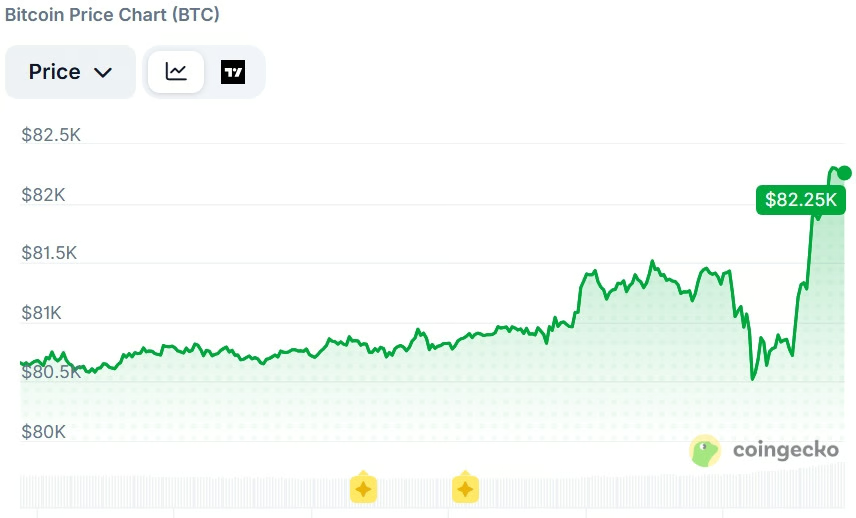
Bitcoin briefly dipped before surging over $82,000 on Sunday as US President Donald Trump rejected Iran’s counteroffer to a peace deal, which could prolong tension in the Middle East.
“I don’t like it — TOTALLY UNACCEPTABLE, Trump said in a post to Truth Social on Sunday after reading Iran’s proposal to end the war. Iran has previously requested that the US pay for war reparations and unfreeze blocked Iranian financial assets.
Bitcoin (BTC) fell from $81,430 to $80,520 within 45 minutes of Trump’s post before whipsawing nearly 2.3% to $82,347 less than three hours later, according to CoinGecko data. Bitcoin’s rise also resulted in nearly $64 million worth of short positions being wiped out over the last four hours, according to Coinglass data.

Bitcoin’s change in price over the last 24 hours. Source: CoinGecko
The US-Iran war and dispute over control of the Strait of Hormuz — which handles one-fifth of oil trade — has caused significant disruption in the financial markets over the past ten weeks, particularly in oil markets, which rose another 4.6% to $98.7 per barrel on Trump’s latest comments.
The S&P 500 futures index has risen 0.13% since the market opened about two hours after Trump’s post.
Trump’s refusal to accept Iran’s counteroffer dashes hopes of an imminent end to the war on Wednesday. Israeli Prime Minister Benjamin Netanyahu also said the war won’t be over until Iran’s uranium sites are dismantled.

Source: Rapid Response 47
Bitcoin could see more regulatory momentum in US this week
Bitcoin’s strength at the $80,000 level could be supported by two favorable decisions in the US Senate this week, 10x Research CEO Markus Thielen told Cointelegraph.
“Two catalysts stand out this week,” a Senate vote on Monday for Kevin Warsh’s confirmation as Federal Reserve chair and the Senate Banking Committee’s markup on the CLARITY Act on Thursday, Thielen said.
Related: Bitcoin price may dip toward $70K as Fed estimates hotter inflation print
Thielen noted that while “Warsh is widely regarded as more hawkish on inflation” than the current Fed Chair, Jerome Powell, his confirmation would remove “uncertainty overhang.”
Thielen described the CLARITY Act as the “most significant piece of crypto legislation in years,” adding that it could be a “turning point for regulatory certainty across digital assets.”
“Both events lean bullish for Bitcoin: regulatory clarity reduces institutional friction, and a smooth Fed leadership transition avoids the policy uncertainty that typically pressures risk assets.”
Bitcoin up 29.7% since the US-Iran war began
Despite the US-Iran conflict, Bitcoin has now risen 29.7% since the US-Iran conflict started on Feb. 28, when a US airstrike killed Iran’s Supreme Leader Ayatollah Ali Khamenei.
Bitcoin has outperformed the S&P 500 and gold since the US-Iran war started, clawing back some lost ground from October when Bitcoin hit a high of $126,080.
Magazine: Adam Back says current demand is ‘almost’ enough to send Bitcoin to $1M


A bitcoin whale came back to life Sunday, moving coins worth $40 billion to a new address after more than a decade of inactivity.
The transfer took place at around 19:16 UTC, according to blockchain tracking service Whale Alert. The coins were moved from address “1KAA8GGhVjjUjVTz1HKAjCyGNzAKQd882j” to “bc1qm6m6d33d02edr0k8yj9jgt027zl6dvx6thjrxy.”
The wallet had remained inactive since November 2013, when BTC was originally acquired and subsequently held untouched for more than a decade.
The reason behind the latest transfer remains unclear. Large holders often move coins between wallets for address management or security purposes, though such activity can also precede sales or transfers to exchanges. In this case, the destination address does not appear to be linked to a known exchange wallet.
Dormant bitcoin wallets have increasingly resurfaced since BTC first crossed the $100,000 mark in late 2024. Several early investors and miners have moved long-held coins over the past year, with some ultimately taking profits after bitcoin’s massive rally.
The trend was most intense in July last year, when blockchain analytics firms flagged eight Satoshi-era wallets, each holding 10,000 BTC, moving their coins for the first time in 14 years. Those transfers came as bitcoin traded above $100,000 and hovered near all-time highs.
As of writing, bitcoin changed hands near $80,700, down over 1% since midnight UTC, according to CoinDesk’s market data.
Strategy, the Bitcoin treasury vehicle co-founded by Michael Saylor, signaled it would resume BTC purchases this week after its first-quarter earnings call, during which executives floated selling portions of its Bitcoin reserve to fund dividends on its corporate credit facilities. Saylor, who has historically marked new buys with an X post, sent a Sunday message: “Back to work, BTC.” The cadence has often preceded fresh accumulation.
The last known buy occurred on April 27, when Strategy purchased 3,273 BTC for roughly $255 million, lifting total holdings to 818,334 BTC. Strategy’s own purchases page at the time valued the stash at about $61.8 billion. The company had paused its BTC buying streak for one week ahead of the Q1 2026 earnings call, where management indicated it could periodically sell portions of BTC to fund dividends on its debt instruments.
Key takeaways
- Strategy plans to resume BTC purchases this week after pausing ahead of its Q1 2026 earnings call, continuing a pattern that has accompanied prior buying waves.
- During the earnings call, executives flagged the possibility of selling portions of its Bitcoin to fund dividends on corporate credit instruments, marking a shift from an earlier stance against selling.
- Strategy’s BTC stake stands at about 818,334 BTC, roughly 4% of the total supply, with the group asserting purchases and sales should not meaningfully move Bitcoin’s price.
- Reaction within the crypto community has been mixed: some view periodic sales as a way to finance future buys, while others warn of potential price pressure or a “doom loop” for the spot market.
- The firm cited an estimated $1.5 billion per year in dividend-equivalent payments, arguing Bitcoin’s high daily liquidity—over $60 billion on average—could absorb such demand without destabilizing prices.
Strategy restarts BTC purchases as a revised treasury playbook
On the earnings call, Strategy executives indicated that the company could periodically liquidate portions of its Bitcoin holdings to fund dividends on its corporate credit products. In a direct nod to this approach, Saylor told the call that the firm would “probably sell some Bitcoin to fund a dividend, just to inoculate the market, just to send the message that we did it.” The remark underscored a strategic pivot toward treasury management that blends accumulation with targeted selling for yield support.
The move drew a spectrum of responses from investors and observers. Some supporters argued that measured sales could provide a predictable mechanism to nurture future BTC purchases, effectively broadening Strategy’s financing toolkit. Others cautioned that even small, regular sales could add selling pressure to a market already sensitive to large holders’ actions.
Industry voices highlighted differing interpretations of the plan. Samson Mow, a prominent Bitcoin advocate, argued that Strategy’s sales would grant the firm additional optionality in the financial landscape. Critics, meanwhile, raised concerns about potential market implications and referred to the risk of reinforcing negative sentiment if sales appeared episodic or unpredictable. Strategy’s leadership tried to temper these concerns, with CEO Phong Le stressing that any sales would occur in specific, defensible circumstances—such as dividend distributions or tax deferral—while insisting that neither the company’s actions nor their timing should materially move Bitcoin’s price.
Le also framed the size of the operation in context: Strategy owns about 4% of the total BTC supply, and he pointed to Bitcoin’s substantial daily trading volume as a cushion. In an interview with CNBC, Le noted that the market’s liquidity could readily absorb the targeted cash flow associated with annual dividend payments—roughly $1.5 billion—without creating outsized price volatility. He reinforced the message that the firm does not intend to manipulate prices and that its buying and occasional selling are not expected to move the market significantly.
Market context, risks, and what to watch next
Strategy’s approach sits at the intersection of treasury policy and market dynamics. By expanding the toolbox beyond passive holding to include strategic liquidations, the firm aims to sustain its BTC holdings while delivering yields to creditors. Yet the decision to monetize a portion of the reserve raises questions about long-term price discovery for Bitcoin and the potential signaling effect for other large holders contemplating similar moves.
Analysts and traders will be watching several factors: the cadence and size of any future BTC sales, how the dividends on Strategy’s credit instruments are structured, and whether other institutions with sizable BTC treasuries adjust their strategies in response. The company’s reported scale—standing around 4% of the total supply—ensures that even modest shifts can become meaningful talking points for market participants. At the same time, observers point to Bitcoin’s liquidity as a mitigating factor; with daily volumes well north of $60 billion, the market could theoretically absorb substantial on-chain activity tied to dividends without a wholesale price revaluation in the near term.
Beyond market mechanics, regulatory and macro considerations loom. If Strategy proceeds with a measurable program of sales, nearby observers will scrutinize tax treatment, dividend timing, and the broader implications for corporate treasury strategies in the crypto space. As always with Bitcoin’s largest treasury holders, the balance between long-term accumulation and opportunistic monetization will shape both the price narrative and the strategic calculus of other institutions contemplating similar moves.
For now, the sequence is clear: Strategy intends to resume BTC purchases this week, while leaving open the possibility of measured sales to support its credit instrument dividends. The coming weeks will reveal how the market prices this nuanced treasury playbook and whether Strategy’s approach becomes a blueprint for a new era of corporate crypto treasury management.

Three of DeFi’s relatively young applications — Hyperliquid, EdgeX and Pump.fun — collectively returned $96.3 million to token holders over the last 30 days, according to data compiled by DefiLlama. The results underscore a shift in the sector’s focus from pure on-chain activity to actual earnings that can be distributed to holders.
Hyperliquid led the pack, distributing $50.95 million in revenue to token holders for the period, with zero incentives spent, DefiLlama’s figures show. Pump.fun ranked second, returning $22.09 million to holders from $38.81 million in total revenue. EdgeX distributed $23.26 million to holders from $8.26 million in protocol revenue, a pattern that suggests the project is leveraging reserves or alternative income streams to reward its holders.
On an annualized basis, the momentum is even more pronounced: Hyperliquid has generated $945.87 million in revenue over the past year, all returned to holders; Pump.fun sits at $481.15 million; and EdgeX at $236.42 million.
Across the broader DeFi landscape, other major protocols reported distributions as well: Chainlink returned $4.63 million to holders, Aerodrome $3.53 million and Uniswap $3.29 million, spread across 44 chains. PancakeSwap generated $3.94 million in revenue, but returned $2.48 million to holders while spending $905,260 on incentives.
Related: DeFi can freeze stolen funds, but not everyone agrees it should
Crypto community now focuses on revenue
The data comes as revenue is becoming the metric that matters most in crypto, with token holders pushing protocols to justify their valuations through actual earnings rather than transaction volumes or network growth figures.
“Nobody cares that your chain does 10x the TPS anymore,” wrote Robbie Klages, co-founder of The Rollup, in a widely cited post on X. “The market is ‘show me the money right now.’ Treat it like a business, not a network-growth thesis.”
Another commentator on X framed the shift as potentially permanent: the move from a narrative-driven backdrop to a transparency of earnings could reprice projects that fail to demonstrate real revenue, especially in a rising-rate environment where capital becomes more expensive for speculative assets.
Top DeFi protocols by Holders Revenue. Source: DefiLlama
DeFi is becoming backend for onchain economy
Andre Cronje, founder of Yearn.Finance, described a future where DeFi resembles essential financial infrastructure rather than a speculative playground. In his view, stablecoins have grown into a $320 billion market led by Tether and Circle, decentralized exchanges are processing over $160 billion in monthly spot volume, and perpetuals are handling roughly $540 billion in monthly volume. Lending protocols like Aave, Morpho and Maple Finance collectively support around $28 billion in active loans, while real-world assets increasingly appear as on-chain collateral. “DeFi is no longer just competing for APY. It is becoming the backend for the onchain economy,” Cronje wrote on X.
The broader context is shaping how market participants assess risk and opportunity in the sector. As traditional finance channels scrutinize on-chain revenue and the sustainability of distributed earnings, observers are watching whether more protocols will translate engagement into verifiable cash flows that can be shared with holders.
For readers seeking deeper context on DeFi’s evolving role, Cointelegraph’s coverage on related topics remains a useful resource, including discussions around recovery plans and real-world asset integration within DeFi ecosystems.
Magazine: Guide to the top and emerging global crypto hubs — Mid-2026
Notes: This article relies on data from DefiLlama for revenue distributions and is intended to reflect observed patterns in the DeFi sector. Citations include public posts and prior reporting from industry figures and outlets referenced above.
What to watch next: as more protocols publish holder distributions and audited revenue figures, investors will increasingly evaluate projects on earnings quality and sustainability rather than growth narratives. The next several quarters could reveal whether the current revenue-centric approach endures, or if broader market dynamics reintroduce balance between on-chain activity and real-world cash flows.
Digital Asset Holdings, the firm behind the Canton Network, is reportedly raising about $300 million at a roughly $2 billion valuation, according toBloomberg, which cited people familiar with the matter. The round is said to be led by a16z crypto and could close in the coming weeks, signaling continued investor appetite for enterprise-grade, privacy-forward blockchain rails designed for regulated finance.
The potential financing would come less than a year after Digital Asset disclosed a $135 million strategic round led by DRW Venture Capital and Tradeweb Markets to accelerate Canton Network adoption. The fresh capital would help scale Canton Network’s ecosystem as financial institutions explore on-chain workflows that preserve privacy and governance controls while enabling asset-tokenization use cases.
In December, Digital Asset, the Canton Network, and the Depository Trust & Clearing Corporation (DTCC) announced a collaboration to tokenize DTCC-custodied assets on Canton Network, underscoring a concrete path to moving regulated instruments onto a private, interoperable ledger.
DTCC’s latest push adds to a broader momentum around on-chain asset handling. The clearinghouse said it would pilot trading of tokenized versions of a portion of the $114 trillion in assets it custody, with activity slated to begin in July and a full-service launch planned for October, according to reports linked to the initiative.
Meanwhile, Moody’s announced in March that it had deployed its ratings data on the Canton Network, enabling financial institutions to use independent credit analysis directly within blockchain workflows. The move marked Moody’s as the first credit ratings agency to publish data on-chain for use in a financial-infrastructure context.
In April, the Japan Securities Clearing Corporation (JSCC) announced that it would test the use of on-chain government bonds on Canton Network, evaluating whether ownership of Japan’s sovereign bonds can be transferred on-chain and used as digital collateral.
Swiss crypto bank Amina disclosed custody and trading support for Canton Coin, the network’s utility token, becoming the first FINMA-regulated bank to back the token, according to an announcement from Amina.
As the Canton Network pushes deeper into regulated rails, it has drawn mixed reactions within the broader crypto community regarding its approach to decentralization and governance. Yet institutional actors—from clearinghouses to credit-rating agencies—continue to experiment with Canton as a bridge between traditional assets and on-chain processes.
Key takeaways
- Fresh funding at a $2 billion valuation signals ongoing investor confidence in Canton Network’s enterprise-use case and privacy-oriented design for regulated finance.
- The ecosystem is expanding beyond pilots to tangible tokenization workflows, with DTCC’s collaboration, Moody’s on-chain data, and JSCC’s government-bond testing illustrating a broadening operational agenda.
- Regulated adoption is advancing alongside the Canton Coin ecosystem, highlighted by Amina’s custody and trading support as a FINMA-regulated bank.
- The funding cycle comes amid persistent debates about decentralization versus controlled, permissioned rails in the traditional-finance layer of the crypto stack.
- Investors will watch how the upcoming DTCC tokenization pilots and related on-chain implementations perform in real markets and how regulators respond to tokenized assets and on-chain collateralization.
Enterprise rails in motion: what’s changing for investors and users
The reported $300 million round, if completed, would place Digital Asset in a clearer position to accelerate Canton Network’s commercial ambitions. By drawing capital into a permissioned, privacy-preserving ledger tailored for banks, asset managers, and other financial institutions, the project aims to reduce counterparty risk and operational friction traditionally associated with moving complex assets onto public blockchains. The leadership by a16z crypto—an investor with a broad portfolio in infrastructure and selective, enterprise-grade blockchain bets—underscores a continuing tilt toward assets and workflows that require regulatory-grade controls.
Meanwhile, the DTCC collaboration and its tokenization agenda are particularly noteworthy. Tokenizing DTCC-custodied assets on Canton could serve as a proving ground for how institutional-grade custody, settlement, and risk management operate when assets exist as tokenized representations on a private, auditable ledger. The announced July pilot and October full rollout set clear milestones for market participants watching for scalable, on-chain settlement and collateral frameworks.
Moody’s on-chain data integration adds a complementary dimension: credit analytics flowing into blockchain workflows could streamline risk assessment and due diligence across tokenized instruments. The once-dominant silos between credit ratings and settlement infrastructure may gradually blur as data becomes clickable within tokenized processes. The on-chain access to independent credit analysis signals a maturation of the use cases anchored in Canton’s network design.
The on-chain government-bond experiments by JSCC push further the notion that sovereign debt can function as digital collateral within a regulated, interoperable environment. If successful, such tests could influence how central-bank-like operations or cross-border collateral agreements evolve in a hybrid of traditional and digital finance.
Finally, Amina’s Canton Coin custody and trading support marks a visible step for regulated banks toward integrating native network tokens into their custody and liquidity frameworks. As the first FINMA-regulated bank to back Canton Coin, Amina’s move may serve as a reference point for other regulated banks considering similar digital-asset rails, while also inviting regulatory scrutiny and clarity about tokenization standards and custody risk.
Taken together, these developments illustrate a broader shift: institutional finance is quietly exploring controlled, auditable, and privacy-conscious blockchain networks as the backbone for on-chain asset tokenization, while investors seek clarity on governance and long-term decentralization dynamics.
As the Canton Network ecosystem pursues live deployments and scale, readers should watch how regulatory signals unfold around on-chain assets and collateral, how tokenized workflows perform in real-market conditions, and which traditional institutions partner most aggressively to harness private-ledger innovation.
Crypto World
Quantum-Proof Wallets: Crypto Firms Race to Secure Digital Assets Ahead of Protocol Upgrades

TLDR:
- Crypto firms are upgrading wallets to post-quantum MPC signatures before blockchain protocols make the same shift.
- NIST-approved algorithms like ML-DSA are being evaluated for distributed signing compatibility across wallet systems.
- Institutions with existing MPC infrastructure can migrate to quantum-resistant wallets through a simple code upgrade.
- Wallet-level upgrades alone cannot fully protect users if underlying blockchain networks do not follow with protocol changes.
Quantum-proof wallets are becoming a priority for crypto companies as the threat of quantum computing draws closer. Firms are now upgrading their wallet infrastructure faster than blockchain networks can update their core protocols.
The concern stems from estimates suggesting a “Q-Day” scenario could arrive as early as 2030. One recent report by Project Eleven warns that quantum computers could break the cryptographic foundations securing trillions in digital assets within four to seven years.
Wallet-Level Upgrades Lead the Charge
Crypto infrastructure firms are not waiting for blockchain-level changes to roll out quantum-resistant protections. Silence Laboratories recently added support for distributed multi-party computation (MPC) signatures using ML-DSA.
This is a cryptographic algorithm selected by the National Institute of Standards and Technology (NIST). The company spent six months evaluating three NIST-approved algorithms: SPHINCS+, Falcon, and CRYSTALS-Dilithium.
Not every algorithm suits every use case, however. Silence Laboratories CEO Jay Prakash addressed this directly, stating: “Not all of SPHINCS+, Falcon, and CRYSTALS-Dilithium will meet the criteria of MPC friendliness — whether they support efficient distributed transaction signing.”
He added that fragmentation across chains is also a factor, as each network is optimizing for different criteria. This complexity makes a one-size-fits-all approach difficult to achieve.
The approach used by Silence Laboratories generates private key shares across isolated nodes. A signature is then produced jointly without ever reconstructing the full key.
This method protects against quantum attacks while staying compatible with existing MPC infrastructure. Prakash noted that institutions have already embraced this model: “Whether it’s a partner like BitGo or a bank building a digital asset practice, they all understand that keys can’t sit in one place.”
Prakash confirmed that the transition would be seamless for end users. Whether using MetaMask or another wallet interface, users would not notice any change. The upgrade happens entirely at the infrastructure level.
As he explained: “Any bank or custodian with existing MPC infrastructure can now migrate to a post-quantum MPC-based wallet, without changing their infrastructure. It’s a code upgrade.”
Alternative Approaches and Remaining Gaps
Other developers are exploring protocol-adjacent solutions rather than pure wallet-level fixes. Developers behind Postquant Labs are building quantum-resistant signatures on top of Bitcoin using a separate smart contract layer.
This avoids changes to the Bitcoin base protocol entirely. StarkWare researcher Avihu Mordechai Levy has proposed replacing Bitcoin’s elliptic-curve cryptography with hash-based signatures that operate within the existing network rules.
That proposal, however, is described as a last-resort option rather than a scalable solution. It could also prove costly to implement at scale.
Meanwhile, a researcher recently cracked a 15-bit elliptic curve cryptography key using a quantum computer and a variant of Shor’s algorithm. Project Eleven awarded its 1 Bitcoin “Q-Day Prize” to the researcher for this demonstration.
Coordination between wallet providers and blockchain networks remains a key challenge. Prakash was direct about the limits of a wallet-only fix: “If wallets are upgraded to post-quantum and chains are not upgrading, it won’t work.”
The timeline pressure is pushing firms to act now, even as true quantum threats have not fully materialized. User behavior and coordination across the ecosystem remain the weakest links in the rollout.

TLDR:
- Hyperliquid channels trading fees into buybacks, linking perpetual volume directly to token demand
- Pump.fun monetizes memecoin launches, turning speculative cycles into recurring protocol revenue
- EdgeX shows a payout-revenue mismatch, raising questions over the sustainability of the distribution model
- Revenue-sharing tokens now prioritize fee generation over inflation-based incentive structures
DeFi $96.3M token holder payouts reflect a growing shift toward fee-backed distribution models across leading decentralized protocols.
Hyperliquid, EdgeX, and Pump. fun now channel real trading and launch revenue directly to users, reshaping how token economics is evaluated in 2026 markets.
Hyperliquid and Pump.Fun Drive Fee-Based Market Cycles
Hyperliquid continues to anchor the largest share of distributions through derivatives trading activity across decentralized markets. Its fee structure converts perpetual futures volume into direct token buybacks, linking usage with holder returns.
Pump.fun operates differently by monetizing memecoin launches, where each token creation contributes to platform revenue streams. Both models demonstrate how trading behavior and viral engagement now serve as direct revenue engines in crypto.
Together, they contribute a major portion of the recent market-wide distribution tracked across decentralized finance ecosystems.
Market participants’ revenue generation is at the center of valuation models across leading decentralized applications.
Liquidity depth and fee consistency now carry more weight than short-term token sentiment across trading platforms. As a result, protocols are increasingly evaluated based on how effectively they convert activity into revenue.
Hyperliquid’s dominance reflects deeper liquidity participation from perpetual traders across global markets. Pump.fun sustains relevance through continuous launch activity, even as broader memecoin cycles fluctuate sharply.
Together, these mechanisms form a fee-driven loop that supports recurring token holder distributions. Structure continues shaping how decentralized exchanges and launchpads compete for sustainable on-chain revenue.
EdgeX Distribution Gaps and the Rise of Revenue-Backed Tokens
EdgeX contributes to the overall distribution but shows a mismatch between revenue and token payouts. Reported figures indicate higher holder distributions compared to organic revenue generation from platform activity.
This gap introduces scrutiny around funding sources and the long-term sustainability of payout structures. Market observers note that such models may rely on reserves or incentive-driven liquidity programs. Despite this, EdgeX remains part of the broader trend toward fee-linked token economics.
Protocols across decentralized finance increasingly adopt buyback mechanisms tied to trading or launch activity. This structure reduces reliance on inflation-based rewards and shifts focus toward measurable cash flows.
Investors now compare revenue coverage ratios when evaluating token models across competing ecosystems. Buybacks funded through fees are increasingly treated as a benchmark for protocol maturity.
However, volatility in trading cycles means revenue-linked payouts remain sensitive to market conditions. The combined $96.3M distribution demonstrates how far token economics has shifted in recent cycles.
Across protocols, fee generation now competes directly with traditional valuation narratives in crypto markets. This environment places a stronger emphasis on real transaction activity rather than speculative token growth stories
EdgeX remains under observation as analysts evaluate its ability to sustain payouts without external support. Revenue-backed models continue to reshape expectations across decentralized trading infrastructure.
TLDR:
- UNI has broken above long-term weekly descending resistance after months of bearish market pressure.
- Weekly RSI breakout signals improving momentum structure and possible bearish exhaustion for UNI.
- A bullish crossover on the Stochastic RSI supports the case for sustained upside continuation on higher timeframes.
- The $3.90 level remains the decisive reclaim zone needed to confirm UNI’s broader trend reversal.
Uniswap price analysis shows UNI approaching a critical market structure test after breaking long-standing weekly resistance.
Momentum indicators are improving, and traders are now focusing on whether the price can reclaim $3.90 to validate a broader bullish trend reversal.
Uniswap Breakout Strengthens Weekly Technical Setup
UNI has finally broken above a descending resistance trendline that controlled price action for months. This breakout marks an important technical shift after a prolonged sequence of lower highs limited bullish momentum across the broader market cycle.
For most of the recent downtrend, sellers defended every recovery attempt near trendline resistance. Price repeatedly failed to establish sustained upside, which kept UNI trapped inside a weakening market structure. However, the latest breakout changes that narrative significantly.
The move above the diagonal resistance suggests bearish control is starting to weaken. On higher timeframes, these breakouts often signal the early stages of structural recovery. Still, diagonal breakouts alone rarely confirm full reversals in crypto markets.
What adds strength to this setup is the supporting momentum breakout beneath price action. UNI’s weekly RSI has also moved above its descending resistance line after months of rejection. Since momentum often leads price during macro reversals, this breakout increases the probability of continuation.
At the same time, stochastic RSI is forming a fresh bullish crossover from oversold territory. On weekly charts, these signals usually support multi-week upside expansion instead of short-lived recovery rallies.
This alignment between price and momentum creates a stronger technical foundation than isolated breakout attempts seen earlier this cycle.
Uniswap Price Analysis Focuses on $3.90 Reclaim
Despite the breakout, UNI is challenging the $3.90 horizontal resistance zone, which previously acted as a major support level before the breakdown.
In technical analysis, former support often turns into resistance after market breakdowns. This usually happens when trapped holders use recovery rallies to reduce exposure near previous entry zones.
That behavior appears visible around the current reclaim area. While UNI has pushed above trendline resistance, price has not yet secured a decisive weekly close above $3.90.
This distinction matters because trend reversals require more than a breakout. Price must reclaim lost market structure and convert resistance back into support to validate stronger continuation.
Meanwhile, UNI’s market capitalization is reinforcing the improving outlook. Over the past week, market cap climbed from roughly $2.05 billion toward the $2.5 billion region, reflecting sustained capital inflows.
More importantly, the expansion has been orderly rather than speculative. UNI continues printing higher highs and higher lows while maintaining elevated levels after each breakout attempt.
If the price closes above $3.90 and holds that level, the bullish case strengthens considerably. Until then, Uniswap price analysis suggests UNI remains in a transition phase between recovery and confirmed macro reversal.
TLDR:
- $PENGU is backed by a brand generating roughly one billion social media views daily across global platforms.
- Pudgy Penguins holds retail placement in over 10,000 stores, including Walmart, Target, and GameStop worldwide.
- $PENGU became only the second memecoin after DOGE to enter the SEC’s formal 19b-4 ETF filing process.
- Asia expansion into Japan, Korea, and China positions $PENGU inside a proven global IP-scaling cultural system.
$PENGU, the token tied to the Pudgy Penguins brand, is drawing comparisons to Dogecoin across crypto circles. Built on years of consumer brand development, $PENGU combines cultural reach with real-world retail presence.
Unlike most memecoins, it operates through a structured distribution engine. Analysts point to its institutional backing, Asia expansion, and mainstream recognition as key differentiators. The question now is whether the market has fully priced in what the brand has already built.
From Meme to Social Currency: How $PENGU Differs From Past Tokens
Most memecoins follow a predictable cycle — launch, narrative, peak, and fade. Once attention shifts, the token loses relevance because nothing sustains it. $PENGU is structured differently, with continuous content, retail, and partnerships driving ongoing momentum.
The Pudgy Penguins brand currently generates roughly one billion views per day across social and GIF platforms. It holds over five million followers and has retail placement in more than 10,000 stores globally. Those stores include Walmart, Target, Walgreens, and GameStop.
Dogecoin captured global attention through organic internet culture. However, it never built a structured system to sustain or expand that attention. $PENGU is designed to do exactly that, through coordinated brand activity across multiple channels.
Retail Presence and Institutional Backing Drive Mainstream Credibility
Pudgy Penguins rang the NASDAQ opening bell alongside VanEck, marking a rare milestone for a crypto-native brand.
Firms like Bitwise and Canary Capital have publicly aligned with the ecosystem. The brand also appeared in Ethereum ETF commercials, reaching traditional finance audiences directly.
$PENGU became only the second memecoin-style asset after DOGE to enter the SEC’s formal 19b-4 ETF filing process.
That regulatory recognition carries weight in institutional circles. It separates $PENGU from the vast majority of tokens that never reach that stage.
Beyond finance, the brand has expanded into politics and media. Congressman William Timmons publicly engaged with Pudgy Penguins, and outlets like the New York Times and Forbes have covered the brand. Partnerships with Manchester City, NASCAR, PEZ, and Sotheby’s further extend its mainstream reach.
Asia Expansion Opens a New Growth Chapter for $PENGU
Pudgy Penguins is actively entering the Japanese collectibles market, valued at $15.4 billion. Distribution agreements with Don Quijote, 7-Eleven, and FamilyMart place the brand inside high-traffic retail environments. This move targets a market that already understands how to scale character-based IP globally.
In Korea, a partnership with Lotte strengthens retail distribution across one of Asia’s most brand-conscious markets. In China, Suplay provides a similar foothold. These agreements reflect a deliberate strategy, not casual expansion.
Cultural trends in Asia frequently move westward, compounding global brand recognition over time. If Pudgy Penguins gains traction across these markets, the effect on $PENGU’s visibility and adoption could grow steadily. The brand is aligning itself with a proven cultural system that scales.
The gap between DOGE and $PENGU in market valuation still exists, but the trajectory tells a different story. DOGE built cultural relevance without a structured engine behind it.
$PENGU has retail, institutions, content, and global expansion working together. Markets price future adoption, and $PENGU is building the infrastructure for exactly that.
TLDR:
- Jensen Huang says AI will make intelligence a commodity accessible to billions worldwide for the first time.
- NVIDIA chips power data centers at Amazon, Microsoft, Google, and Meta, driving the global AI buildout.
- Huang argues AI automates tasks but elevates human purpose, pushing back against job displacement fears.
- The NVIDIA CEO urges scientists, engineers, and policymakers to advance AI capabilities and safety together.
NVIDIA chief executive Jensen Huang addressed graduates at Carnegie Mellon University on Sunday, May 10. He received an honorary doctorate at the commencement ceremony.
Huang said artificial intelligence will make intelligence a commodity for everyone. He argued the technology will reach billions who have never accessed computing power before. His remarks touched on jobs, safety, and America’s industrial future.
AI as a Tool for Closing the Technology Divide
Huang told graduates that AI represents a historic opportunity to reach underserved populations. He stated, “We have the opportunity to close the technology divide—and bring the power of computing and intelligence to billions of people for the very first time.”
He named carpenters and shopkeepers as people who would benefit from this shift. These are groups that have traditionally been left outside the technology economy.
He framed the current AI buildout as America’s reindustrialization moment. According to Huang, building chip factories and data centers requires plumbers and ironworkers, not just engineers.
NVIDIA’s chips currently power data centers run by Amazon, Microsoft, Google, and Meta. This positions the company at the center of the global AI supply chain.
Huang pushed back against the view that AI will displace human workers. He drew a clear line between tasks and purpose in his argument.
A radiologist, he explained, does more than read scans — they care for patients. AI handles the repetitive task, while the human focus shifts to higher-level care.
He closed this section with a broader historical point. “Every major technological revolution in history created fear alongside opportunity,” he told the graduating class.
When society engages technology openly and responsibly, human potential expands, he added. He urged graduates to approach AI with optimism rather than resistance.
Safety and Innovation Must Advance Together
Huang called on scientists, engineers, and policymakers to develop AI capabilities and safety in parallel. He warned that guardrails must keep pace with the technology’s rapid growth.
Addressing this directly, he said society must engage technology “openly, responsibly, and optimistically” to expand human potential. His remarks added a measured voice to the ongoing global debate on AI regulation.
He honored Carnegie Mellon’s long history in AI research during the address. The university’s Logic Theorist program from the 1950s was among the examples he cited.
He also referenced its Robotics Institute, founded in 1979, calling both pillars of American technological leadership. Huang described these contributions as a foundation the current generation must build upon.
He challenged graduates to treat AI as an inclusive tool, not one reserved for the elite. The moment, he said, is a mandate to build.
That charge was directed at everyone in the room — scientists, engineers, and policymakers alike. The message was clear: progress requires active participation, not observation.

Hamstring Strain Clouds Lakers’ Desperate Game 4 Bid vs. Thunder
Bitcoin Rises 2.3% After Trump Rejects Iran’s Peace Offer

NBA scores today: Knicks vs 76ers, Timberwolves vs Spurs

Manchester United reach agreement with Casemiro over contract clause amid transfer speculation

US brings back mandatory military draft registration

Steven Gerrard disagrees with Gary Neville over ‘shock’ Chelsea and Arsenal claim | Football


-
 Crypto World3 days ago
HarrisX Poll Found 52% of Registered Voters Support the CLARITY Act
-

 Crypto World4 days ago
Upbit adds B3 Korean won pair as Base token gains Korea access
-

 Fashion2 days ago
Weekend Open Thread: Marianne Dress
-

 Tech6 days ago
Image AI models now drive app growth, beating chatbot upgrades
-
 NewsBeat4 days ago
NCP car park operator enters administration putting 340 UK sites at risk of closure
-
 Business2 days ago
Ignore market noise, India’s long-term story intact, say D-Street bulls Ramesh Damani and Sunil Singhania
-

 Politics2 days ago
Politics Home Article | Starmer Enters The Danger Zone
-

 Sports7 days ago
Inter Milan Win Serie A Title After Victory Over Parma
-
 Sports7 days ago
2026 NHL playoff picks: Second-round predictions, series odds, Stanley Cup bracket
-

 Crypto World6 days ago
UAE Free Zone Deploys Blockchain IDs to Verify Registered Firms
-
 Sports7 days ago
Every word of Arne Slot’s heated rant after Manchester United win vs Liverpool
-

 Crypto World5 days ago
BlackRock CEO Larry Fink Discusses a New Asset Class
-

 Crypto World4 days ago
Robinhood says Wall Street is building onchain
-

 Tech5 days ago
Apple and Samsung are dominating smartphone sales so thoroughly that only one other company makes the top 10
-
Entertainment6 days ago
Serena Williams hits Met Gala in metallic dress after GLP-1 reveal
-

 Fashion4 days ago
The Best Work Pants for Women in 2026
-

 Tech7 days ago
The best life advice I ever followed was deleting Instagram, and it soothed my frustrated soul
-

 Tech5 days ago
I tested the Xiaomi 17 Ultra’s camera and I don’t think I’ll ever go back to an iPhone
-
 Sports7 days ago
Hearts v Rangers LIVE: Prediction, team news and line-ups as Scottish Premiership title rivals meet at Tynecastle
-

 Politics6 days ago
Met Gala 2026: Madonna’s Dramatic Red Carpet Look Steals The Show
You must be logged in to post a comment Login