

Crypto World
Single BTC trader loses $61 million on HTX as price dives 4%

Bitcoin’s price losses on Monday wiped out a massive leveraged bullish bet.
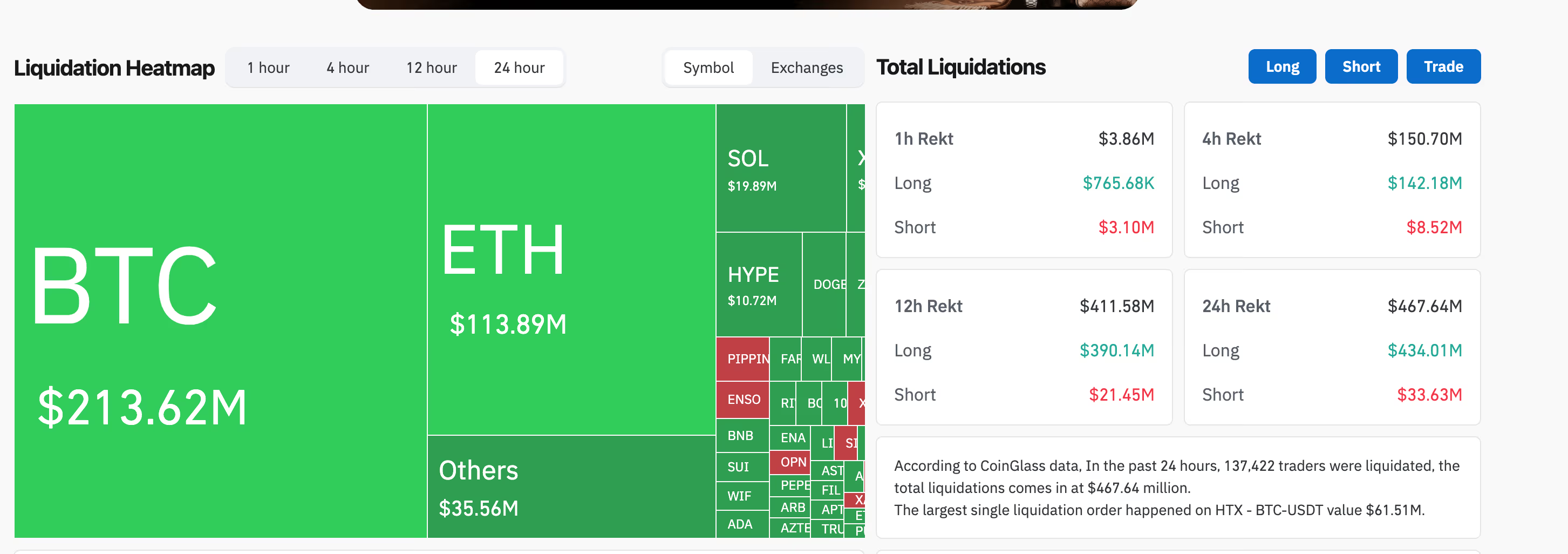
The trade worth $61.5 million was forcibly closed by cryptocurrency exchange HTX, marking the largest single liquidation in the past 24 hours, according to data source Coinglass.
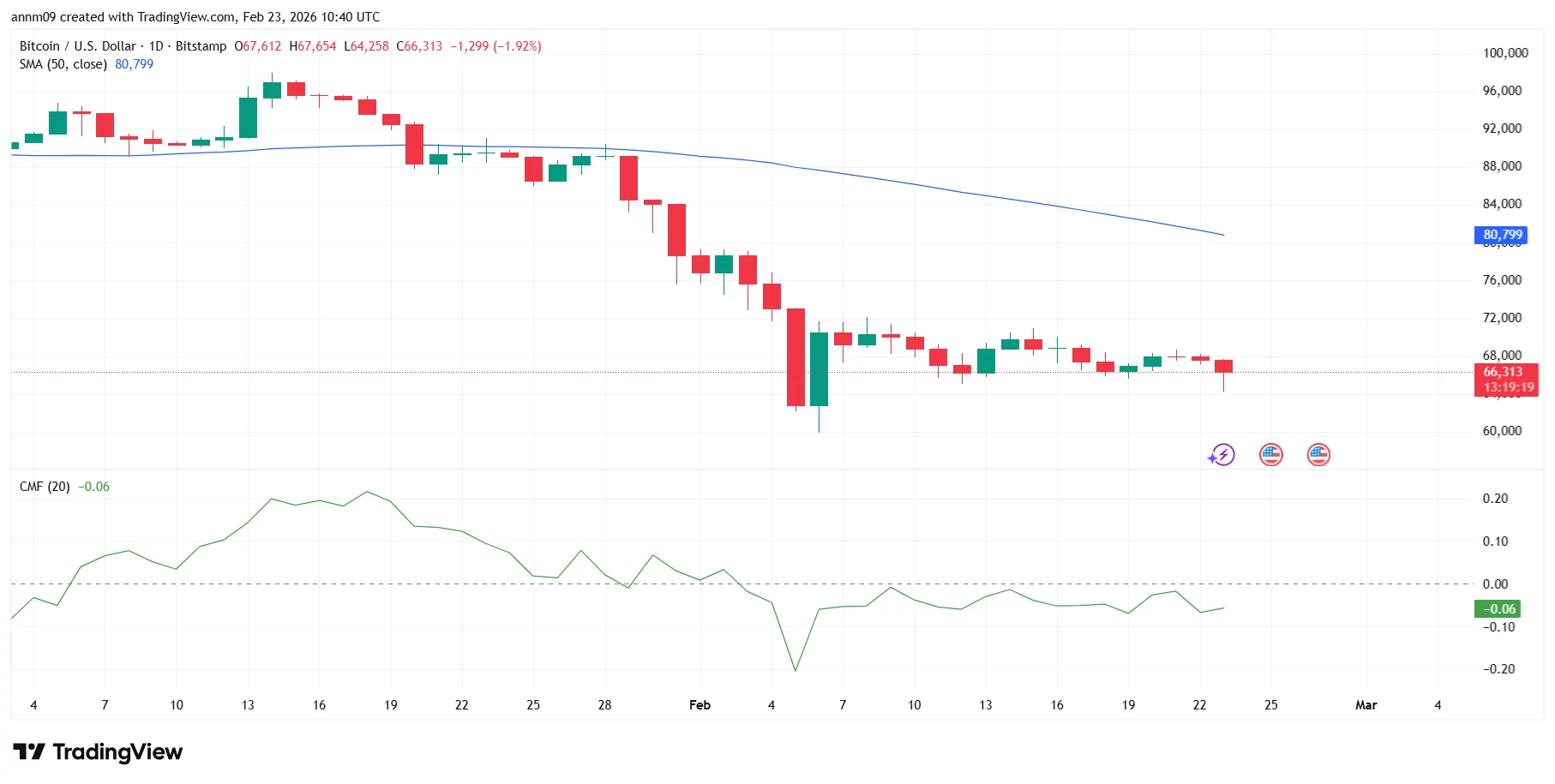
The so-called liquidation happened as bitcoin slid from Saturday’s $68,600 high back to $64,400, erasing the weekend’s gains in a matter of hours. CoinDesk reached out to HTX for comment.

The outsized hit — large enough to suggest a concentrated whale or fund position rather than a retail margin call — landed amid a broader wipeout that saw $467.64 million in total liquidations across 137,422 traders, according to CoinGlass. Long positions accounted for $434 million of that, roughly 93% of the total, pointing to a market that was still positioned for upside heading into the week and got flushed when bids disappeared.
Bitcoin futures alone saw $213.62 million in forced closures, followed by ether (ETH) at $113.89 million and solana (SOL) at $19.89 million. Hyperliquid’s HYPE token added another $10.72 million, a notable figure for an asset outside the usual top-five liquidation leaderboard.
Fear reigns supreme
The selloff dragged Alternative.me’s Crypto Fear and Greed Index back to 5 out of 100, a reading categorized as “extreme fear” that has only been matched three times since the index launched in 2018: August 2019, June 2022, and earlier this month during bitcoin’s slide to $60,000.
Glassnode data reinforces the stress. The firm said Monday that the seven-day moving average for net realized losses among recent bitcoin buyers was still running near $500 million per day, meaning short-term holders are continuing to capitulate even after the initial February flush.
“While the intensity has cooled, the broader regime still signals a market under pressure,” Glassnode noted, “with participants in the base formation phase continuing to capitulate.”
Bitcoin now sits 48% below its October all-time high of $126,000 and 5.5% below its 2021 bull-market peak of $69,000 — a level that once felt like the ceiling and now looks like a floor that keeps getting tested. Monday’s wreckage cleared leverage but the pattern remains intact: traders reload longs into every bounce, and the market keeps punishing them for it.



Ethereum founder Vitalik Buterin is offloading ether (ETH) worth millions, adding bearish pressure in an already weak market.
Buterin has sold 1,869 ether, worth $3.67 million, over two days, having withdrawn 3,500 ether from Aave, according to data tracked by blockchain sleuth Lookonchain.
Ether’s price has declined nearly 3% over the past 48 hours, hitting a 20-day low of $1,844 at one point early Monday, CoinDesk data shows. The token has been in a downtrend since hitting a high of over $4,900 in August last year.
Since Feb. 2, Buterin has supposedly sold almost over 8,000 ether. These sales follow a Jan. 30 announcement that he would withdraw and liquidate his 16,384 ether to finance ecosystem development, open-source software and other key initiatives while the Ethereum Foundation enters a “mild austerity” phase.
Still, as of writing, Buterin held over 224,000 ether, worth $429 million, according to Arkham Intelligence.
While Buterin has been trimming his holdings, this supply is being gobbled up by the likes of ShapeShift Founder Erik Voorhees and a whale associated with crypto services provider Matrixport.
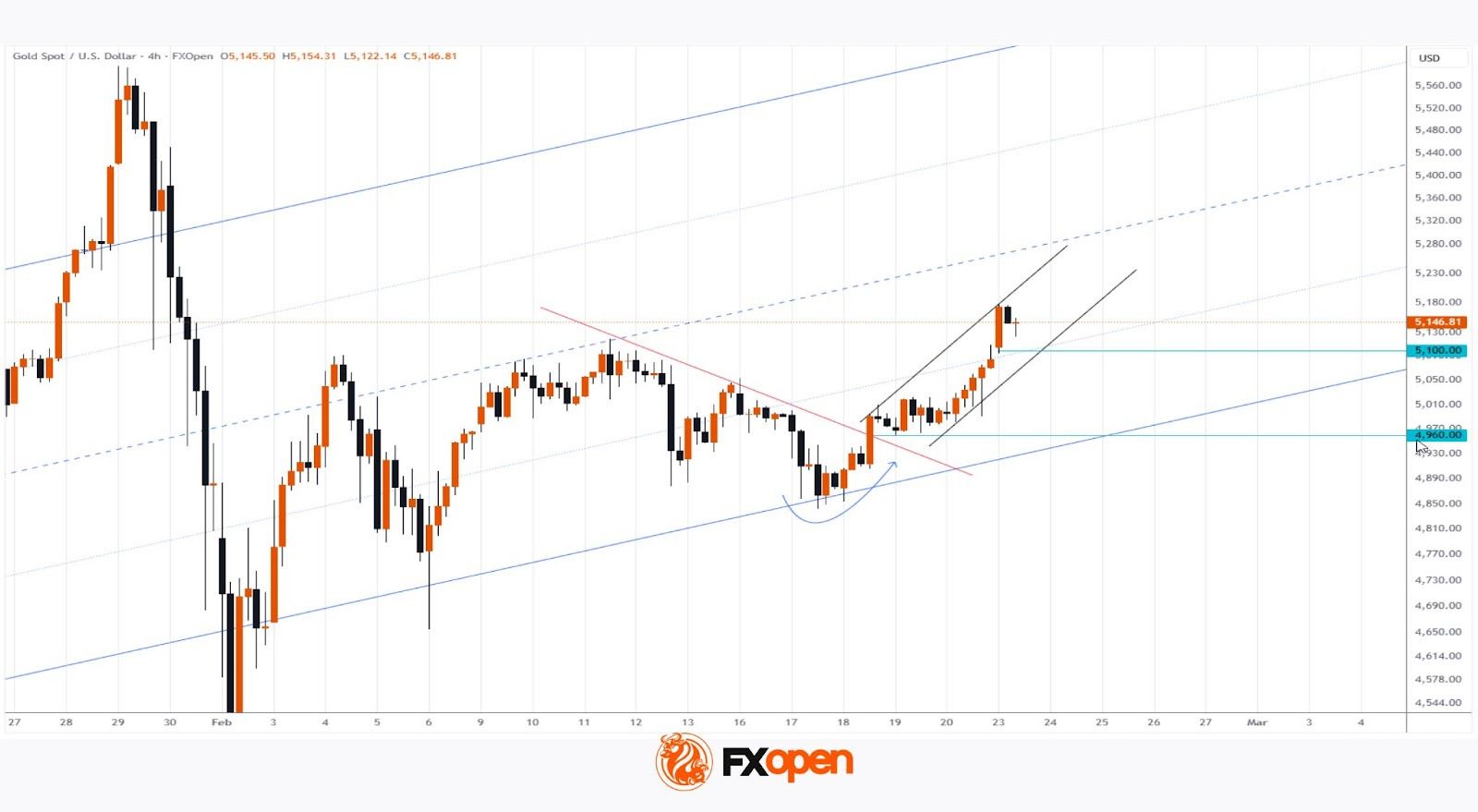
As shown on the XAU/USD chart today, gold climbed above $5,170, reaching its highest level so far this month. The main bullish factors are:
→ US tariff uncertainty – after the Supreme Court struck down Trump’s tariffs on Friday, the US president reinstated them, initially at 10% and then announcing an increase to 15% on Saturday.
→ Heightened geopolitical tensions – media reports indicate that the US is prepared not only for targeted strikes against Iran but also for a longer military operation. The presence of two aircraft carrier groups in the region raises the risk of direct confrontation, traditionally boosting gold demand.
→ End of the Chinese holiday season – the People’s Bank of China, pursuing a reserve diversification strategy away from the US dollar, may continue purchasing physical gold.
Technical Analysis of XAU/USD
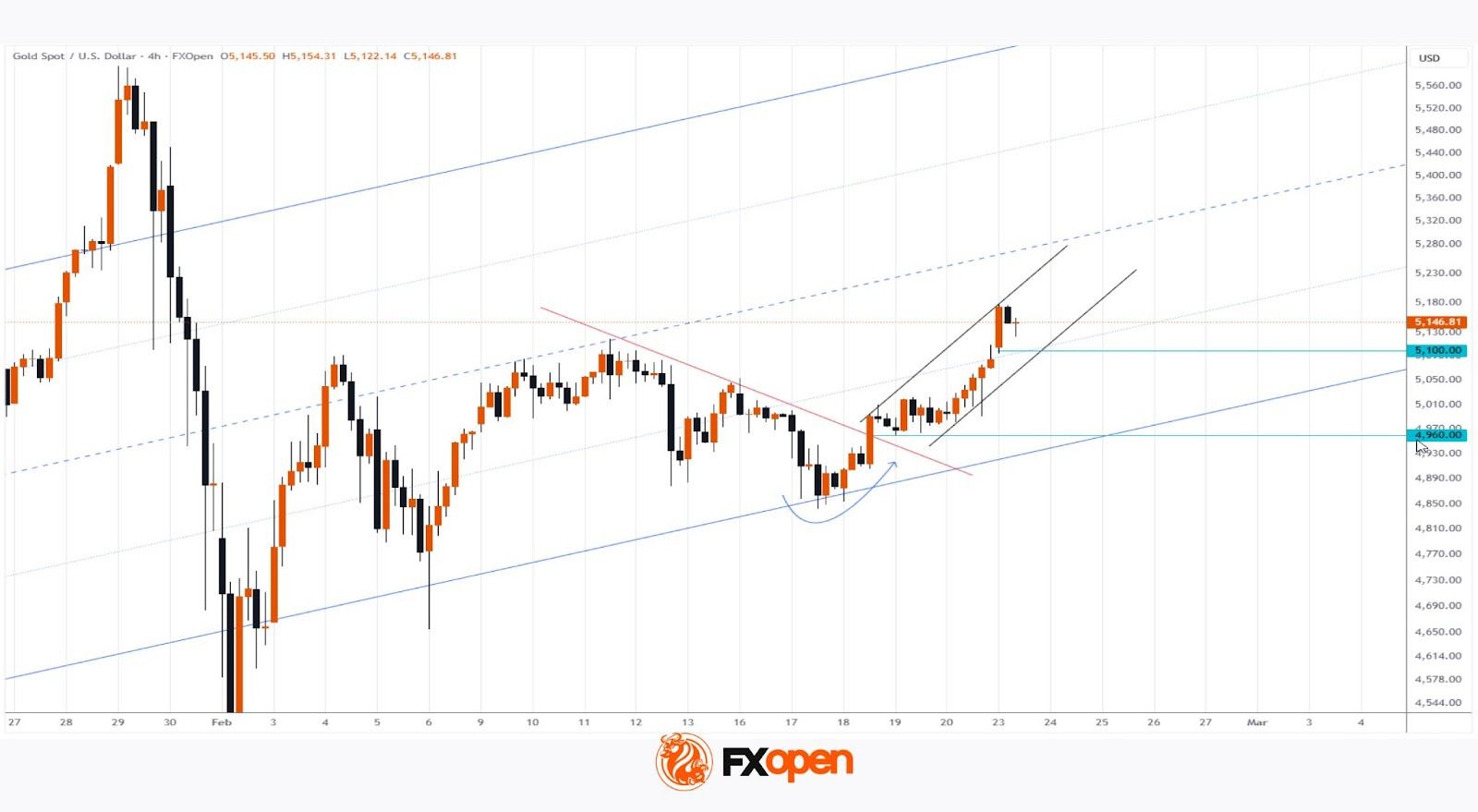
On 17 February, analysis of gold price movements confirmed the long-term ascending channel and highlighted:
→ Bearish activity visible through the descending resistance line (R);
→ Bulls could rely on the channel’s lower boundary as support.
Indeed (as the arrow shows), the market remained within the channel. Moreover, bulls broke above the resistance line (R), which then acted as support around $4,960.
This formed an upward trajectory (black lines). Bullish behaviour is notable around $5,100, where price:
→ Gapped higher at the open;
→ Rose above the line dividing the lower half of the channel into two quarters.
Considering the chart, it is reasonable to suggest bulls currently hold the initiative, supported by fundamentals. They may aim for the channel’s median, with $5,100 providing support in case of a pullback.
Start trading commodity CFDs with tight spreads (additional fees may apply). Open your trading account now or learn more about trading commodity CFDs with FXOpen.
This article represents the opinion of the Companies operating under the FXOpen brand only. It is not to be construed as an offer, solicitation, or recommendation with respect to products and services provided by the Companies operating under the FXOpen brand, nor is it to be considered financial advice.


The crypto market experienced a rare period of volatility during Asia hours on Monday, with bitcoin tumbling more than 5% to $64,270 shortly after midnight UTC before bouncing back to $66,300 by 11:00 UTC.
The selloff and subsequent bounce mirrored the action in U.S. equities. Futures tracking the S&P 500 index fell by 0.84% after opening on Sunday evening before starting to recover five hours later.
Gold futures did the opposite, rising on Sunday evening’s open to the highest since Jan. 30 before giving back some of those gains during European hours. Silver tracked the more expensive metal.
The surge in precious metals alongside weak performance in risk assets comes after U.S. President Donald Trump said he planned to impose new 15% global tariffs on trading partners and increased U.S. military presence near Iran fueled a rush toward haven assets.
Altcoins succumbed to low liquidity conditions overnight as solana (SOL) and tumbled by between 7% and 8% before both bouncing back in European hours, a move that led to $270 million in altcoins liquidations, according to CoinGlass.
Derivatives positioning
- Demand for leveraged products remains tepid, as evidenced by total crypto futures open interest staying below $100 billion for over two weeks.
- Liquidations aren’t helping either. In the past 24 hours, crypto futures bets worth $500 million have been forcibly closed by exchanges due to margin shortages.
- Traders continue to deploy capital in futures linked to tokens associated with traditional assets such as gold. For instance, open interest in Tether gold (XAUT) futures has increased by 14% in 24 hours even as BTC, ETH, SOL, HYPE, DOGE and others continue to see capital outflows.
- ZEC and CRO are the only tokens boasting a 24-hour positive cumulative volume delta (CVD), a sign of buyer dominance. Meanwhile, BTC and other majors have negative CVDs, a sign of selling pressure overpowering buyers.
- Bitcoin’s 30-day implied volatility index, BVIV, has jumped 9% to over 60%, indicating renewed jitters.
- Traders chased bitcoin put options at levels $58,000, $60,000 and $62,000 as Trump’s new tariffs injected fresh uncertainty into the market.
- On Deribit, bitcoin and ether puts traded at a premium to calls across all time frames, indicating lingering downside fears.
Token talk
- The altcoin market remains in the red on Monday after an exaggerated selloff was triggered by weakness in bitcoin and U.S. equities.
- Low liquidity conditions led to pump.fun’s native PUMP token losing 8.5% of its value before staging a bounce, while layer zero (ZRO) began selling off early on Sunday, losing 16.5% over 24 hours before recovering at 04:00 UTC.
- A small number of tokens outperformed the wider market. Restaking token ETHFI rose by more than 10% from Monday morning’s low.
- Telegram-linked toncoin (TON) showed more stability overnight, falling by just 3.6% before bouncing by 4.9%.
- CoinDesk’s DeFi Select Index (DFX) was the best-performing benchmark over the past 24 hours, losing just 1.84% while the CoinDesk Smart Contract Platform Select Index and CoinDesk Computing Select Index lost 3.56% and 3.23%, respectively.
- The altcoin market has largely been tracking bitcoin during February, though with a lack of liquidity that’s led to exaggerated moves. If bitcoin can put in a local low and bounce back above $70,000, for example, several altcoins are primed for extended upside after order books were wiped in early February.


Ethereum co-founder Vitalik Buterin has thrown his support behind the Fork-Choice Enforced Inclusion Lists (FOCIL) upgrade, calling it a critical reinforcement of the network’s cypherpunk principles.
The protocol change, slated to headline the Hegota hard fork in 2026, aims to neutralize transaction censorship by forcing validators to include all valid transactions in the blockchain.
Specifically, FOCIL mandates the inclusion of valid transactions to prevent validators from filtering activity in response to external sanctions or pressure. The upgrade works synergistically with EIP-8141 to designate smart accounts and privacy protocols as first-class network citizens.
Developers have scheduled the mechanism for the Hegota upgrade, targeting a mainnet rollout in the second half of 2026.
Why the Ethereum FOCIL Upgrade Matters In The Push for Neutral Blockspace
Developers confirmed FOCIL (EIP-7805) for the upcoming Hegota upgrade during a February 19 All Core Devs meeting initiated by researcher Alex Stokes.
The move targets the centralization risks inherent in current block production, where sophisticated actors can selectively filter transactions to comply with local regulations. Previously, following OFAC sanctions on Tornado Cash, compliant validators censored up to 90% of blocks that contained related interactions.
While Consensys and other major infrastructure providers have historically navigated these legal gray areas via voluntary exclusion, the protocol itself remained vulnerable.
FOCIL changes the consensus rules so that any block ignoring valid inclusion lists is immediately orphaned by the network. This ensures that the base layer remains neutral regardless of the validator’s jurisdiction.
Vitalik Talks FOCIL Mechanism and Ethereum Validator Impact
In a recent post, Buterin stated that FOCIL “enables censorship-resistant rapid inclusion” by utilizing 17 random actors per slot to curate transaction lists.
There is also an important synergy between FOCIL and AA (EIP-8141, which is based on 7701):
8141 makes not just smart accounts (including multisig, quantum-resistant signatures, key changes, gas sponsorship) first-class citizens, it also can do the same for privacy protocols… https://t.co/wLCEuq66eI
— vitalik.eth (@VitalikButerin) February 19, 2026
Writing on X, he highlighted the synergy with EIP-8141, noting that the duo makes smart accounts, including key changes and gas sponsorship, “first-class citizens.”
The technical specification requires that if a proposed block ignores valid transactions from these lists, the chain automatically forks away from it. This mechanism specifically addresses criticisms regarding Vitalik’s broader views on sovereignty, proving a commitment to neutral, uncapturable infrastructure.
Industry observers note that this guarantees any public-mempool transaction settles within a bounded timeframe.
According to the proposal, smart wallet transactions, gas-sponsored transfers, and privacy protocol interactions will share the same inclusion guarantees as standard ETH transfers.
How Will This Hit Ethereum Markets?
The complexity of the Hegota upgrade has drawn mixed reactions from the developer community. While Layer 2 developer Tim Clancy called it essential for neutral blockspace, others warn of potential friction with U.S. regulations if validators are forced to process sanctioned funds.
The market response has been measured but stable, with Ether holding strong at suppressed levels as traders digest the long-term timeline.
Before Hegota, the network must successfully navigate the Glamsterdam hard fork, which focuses on Enshrined Proposer-Builder Separation (EPBS).
As investors analyze current crypto price predictions, the successful implementation of censorship resistance is increasingly viewed as a fundamental value driver.
The post Vitalik Buterin Supports Ethereum Protocol Upgrade for Censorship Resistance appeared first on Cryptonews.


Austria’s financial regulator said it prohibited the European arm of KuCoin from conducting new business and onboarding customers after the crypto exchange lost key compliance staff just months after gaining a Markets in Crypto Assets (MiCA) permit to operate across the European Union.
KuCoin EU no longer has key function holders in anti-money laundering (AML) and prevention of terrorist financing roles, according to a statement from the regulator, the FMA, which granted the license in November. The freeze will last until the firm appoints the necessary compliance reporting staff, it said.
“The effective staffing of these key functions is a prerequisite for the orderly conduct of business,” the FMA said. The exchange is “prohibited with immediate effect from concluding business relationships of any kind with new customers and from concluding new contracts or new products within the scope of existing business relationships until these key functions have been appropriately filled.”
Kucoin said the positions are being filled as part of an expansion of the compliance team in Austria.
“Our priority in Austria is to establish a governance framework that reflects the expectations of European regulators and the responsibility we carry toward the EU market,” said Sabina Liu, managing director of KuCoin EU. “By investing in experienced local compliance professionals, we are reinforcing a compliance-first operating model designed for long-term stability and transparency.”
Austria has become a popular destination for crypto exchanges looking to passport into Europe via MiCA, with the companies including Bitpanda, Bybit and Bitget establishing bases in Vienna.
When the license was granted, the FMA said the key functions of AML officer and sanctions compliance officer and their respective deputies were occupied in accordance with MiCA and the Financial Markets Anti-Money Laundering Act (FM-GwG; Finanzmarkt-Geldwäschegesetz).
“According to the FMA’s knowledge, this is no longer the case,” the FMA said.
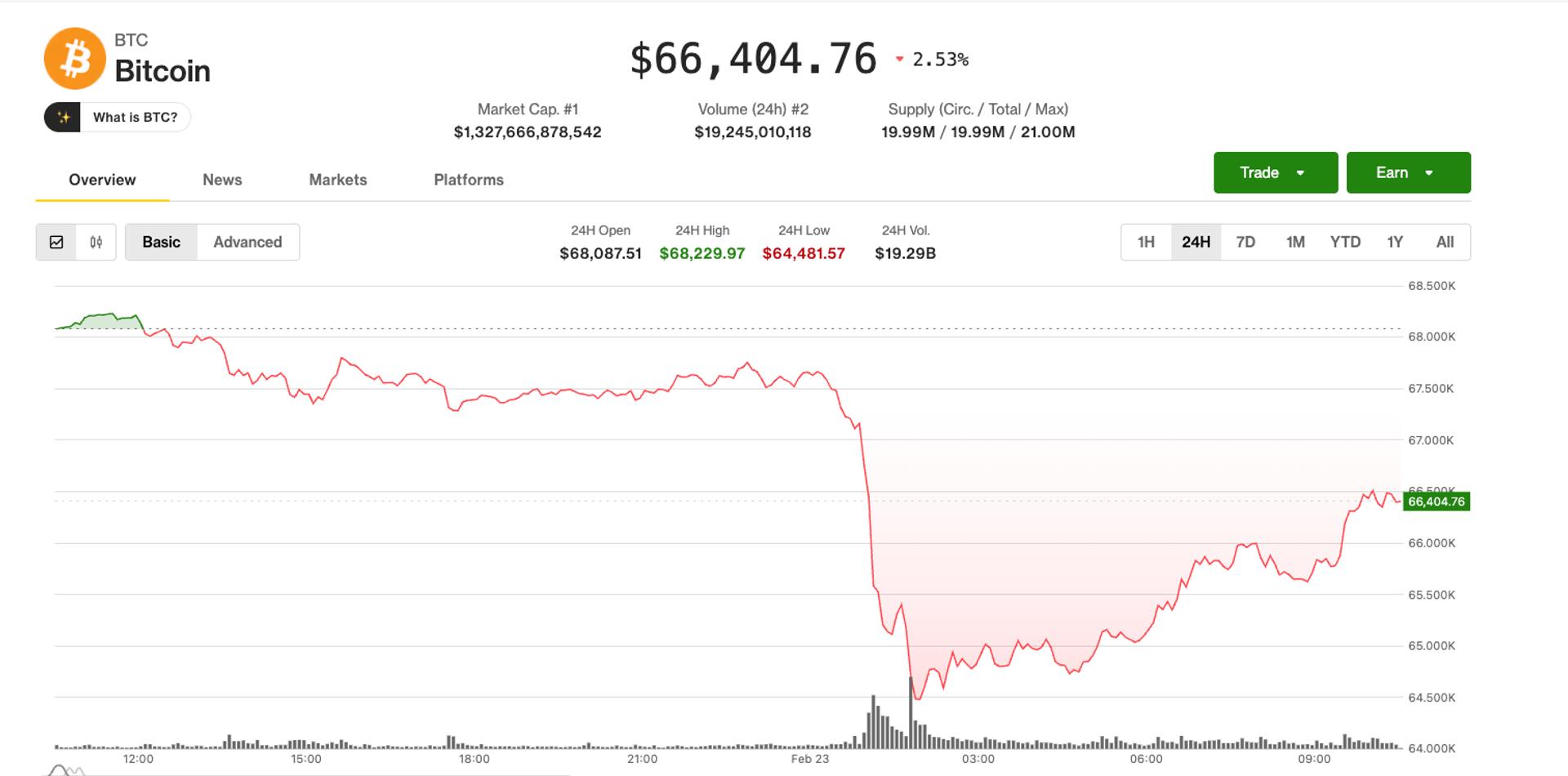
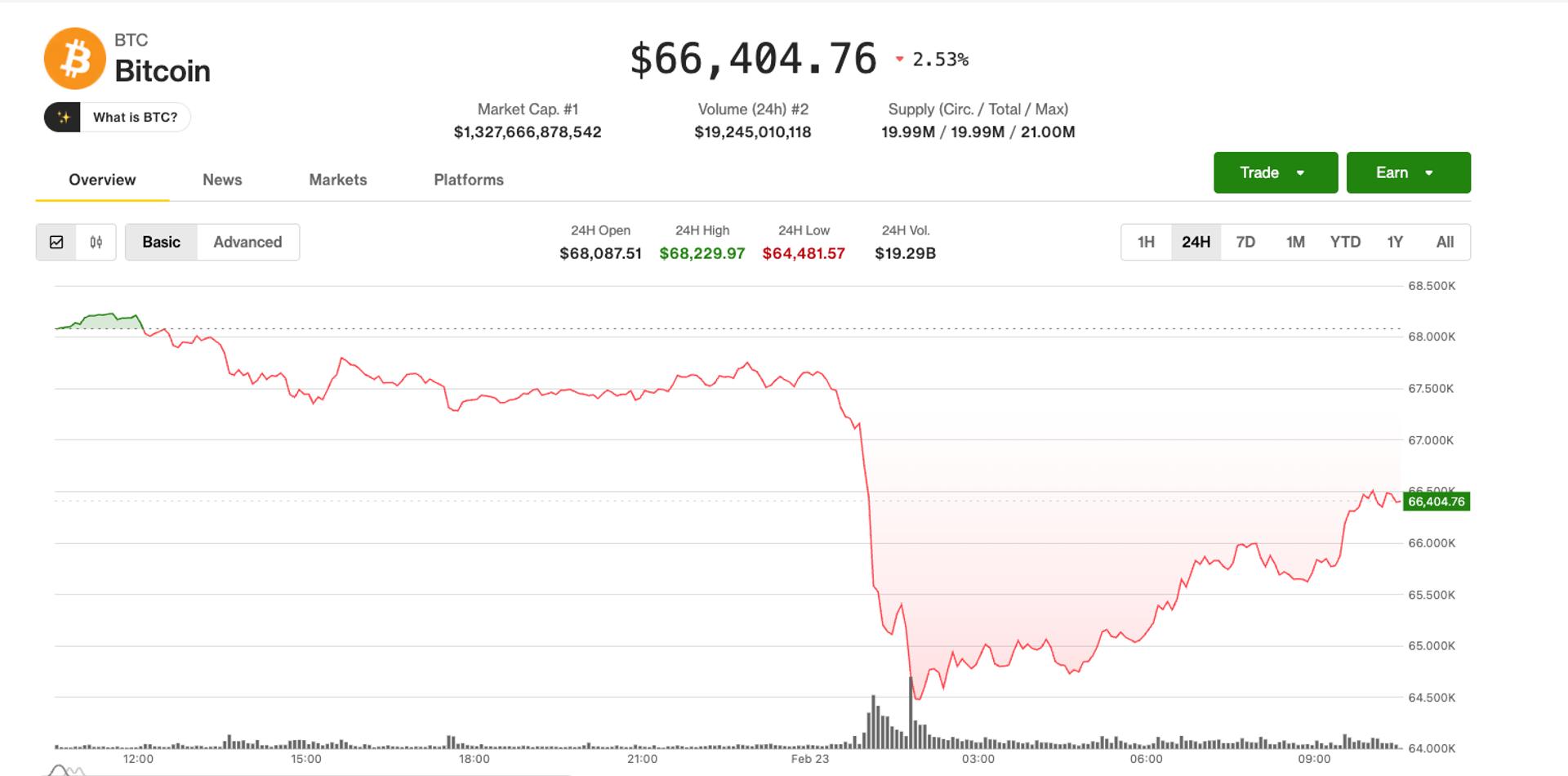
Pre-market trading is showing signs of stabilization, with bitcoin rebounding above $66,000 after briefly falling to $64,400 on Sunday.
The move higher comes amid continued uncertainty surrounding President Trump’s proposed tariffs and U.S. tensions with Iran, factors that have weighed on broader risk sentiment.
Strategy (MSTR), the largest publicly traded holder of bitcoin, is down 2% in pre-market trading as it prepares to announce its 100th bitcoin purchase since embarking on its BTC treasury strategy in 2020.
Other crypto related equities have also pared earlier losses, with MARA Holdings (MARA), Coinbase (COIN), and Bullish (BLSH) are each down about 2%, trimming prior steeper declines. AI focused miners such as IREN (IREN) and Cipher Mining (CIFR) are faring slightly better, off roughly 1%.
The sharp Sunday drop pushed the Fear and Greed Index down to 6, marking fresh lows and extending a seven day stretch of extreme fear. Despite that, bitcoin’s recovery suggests dip buying interest is emerging at lower levels.
The broader selloff appears relatively contained within tech. Invesco QQQ (QQQ) is down just 0.3%, while the iShares Expanded Tech Software Sector ETF, (IGV), is lower by 1% near $80, underscoring the ongoing correlation between bitcoin and software stocks.
Precious metals are the clear beneficiaries of the risk aversion. Gold has climbed above $5,100 per ounce and silver is approaching $87. Meanwhile, the DXY index is hovering just below 98, reflecting a firm US dollar, weighing on risk appetite.


Brent, WTI fell ~3–5% Monday after Trump’s 15% tariffs and easing Iran war risk.
Summary
- Brent and WTI declined sharply, testing key technical support levels as futures markets repriced lower demand from higher U.S. import tariffs.
- Trump lifted temporary tariffs from 10% to 15% on all U.S. imports after a Supreme Court ruling, a move analysts say will weigh on trade, industry and fuel consumption.
- Iran–U.S. nuclear talks in Geneva cut perceived war risk, reducing the geopolitical premium in crude even as Goldman Sachs still expects a 2026 surplus with modest WTI forecast tweaks.
Oil prices declined sharply on Monday as markets reacted to increased U.S. tariffs and developments in diplomatic negotiations with Iran, factors that analysts said are reshaping near-term expectations for crude demand and supply.
Brent and West Texas Intermediate (WTI) crude both fell, testing key technical support levels, according to market data.
President Donald Trump raised temporary tariffs from 10% to 15% on all U.S. imports over the weekend, according to a White House announcement. The increase followed a U.S. Supreme Court ruling that struck down the previous tariff program.
Financial markets responded with gold prices rising and U.S. equity futures declining. Market analysts stated that oil prices were affected by the same risk-averse trading sentiment. Higher tariffs typically reduce trade volumes, weaken industrial output, and suppress fuel demand, factors that are considered bearish for crude prices, according to commodity analysts.
A third round of nuclear negotiations between the United States and Iran is scheduled for Thursday in Geneva, Oman’s foreign minister confirmed. Iranian officials have indicated the country may offer concessions on its nuclear program in exchange for sanctions relief, according to diplomatic sources.
Concerns about potential military conflict in the Middle East had recently supported higher oil prices, but that geopolitical risk premium has diminished as traders assign a lower probability to supply disruptions from the region, market observers said.
Goldman Sachs forecasts the global oil market will remain in surplus in 2026, assuming no major disruption to Iranian supply, the investment bank stated in a research note. The bank revised its fourth-quarter price forecasts, citing lower inventories among Organisation for Economic Co-operation and Development (OECD) countries as a factor in its WTI adjustment.
Market direction remains uncertain in the short term due to unresolved factors including tariff policy, Iran diplomacy, and the Russia-Ukraine conflict, suggesting continued volatility in oil prices, according to market analysts.
Crypto markets are flashing deep stress signals as geopolitical tensions surrounding a potential U.S. strike on Iran intensify and liquidity continues to drain from the system.
Summary
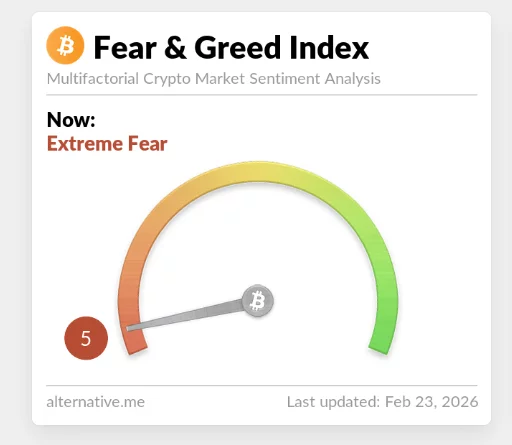
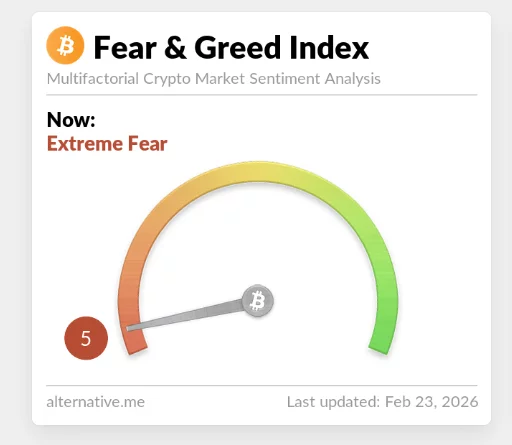
- The Crypto Fear & Greed Index has plunged to 5, signaling extreme panic as geopolitical tensions around a potential U.S. strike on Iran intensify.
- Bitcoin has dropped below key technical levels, while the broader crypto market has erased over $2.22 trillion — down more than 50% from its peak, marking one of the largest drawdowns in history.
- Despite the selloff, shrinking USDT supply down over $3 billion in 60 days suggests liquidity contraction that has historically appeared near late-stage market bottoms.
Iran strike fears spill into crypto markets
The Crypto Fear & Greed Index has plunged to 5 — “Extreme Fear”, one of the lowest readings in years, showing panic-level sentiment. Historically, such extreme readings have only appeared during major market dislocations, including the 2020 COVID crash and the 2022 bear market lows.
The collapse in sentiment mirrors Bitcoin’s sharp drop below key technical levels, reinforcing the view that traders are positioning defensively amid geopolitical uncertainty.
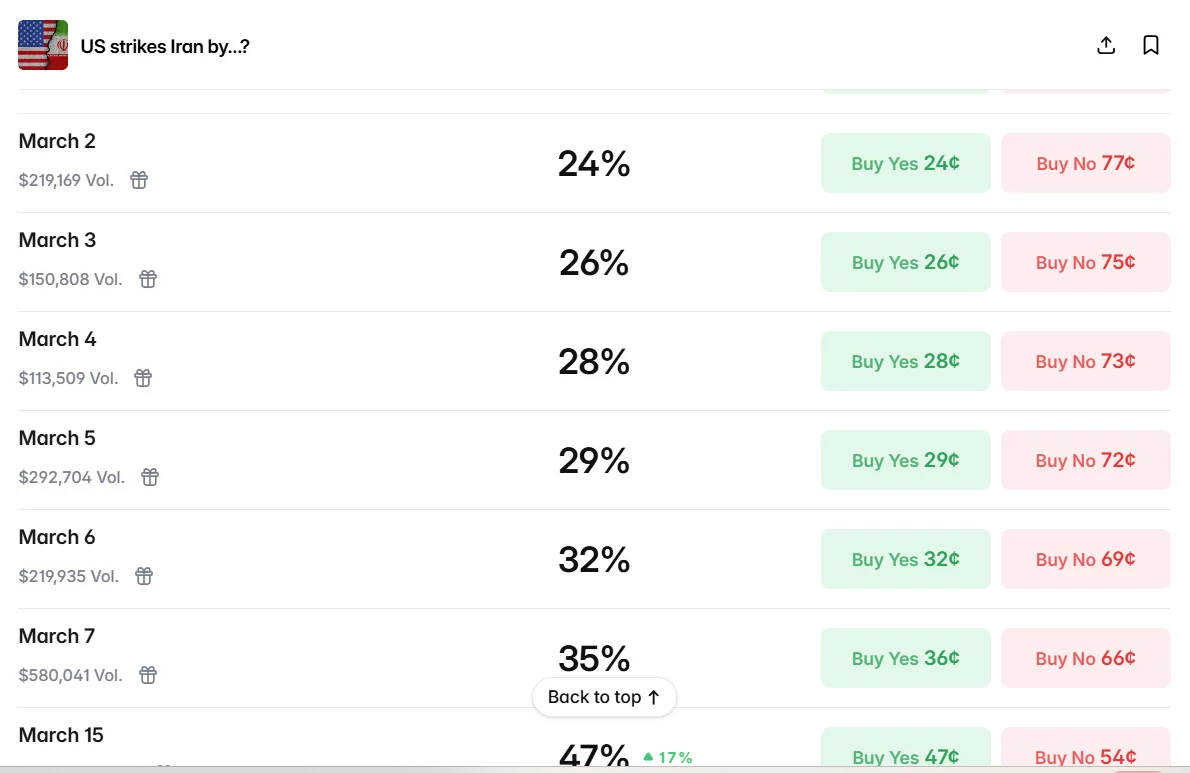
At the same time, prediction market Polymarket shows rising bets on possible U.S. military action in early March, with probabilities climbing steadily day by day, reflecting growing geopolitical uncertainty priced into markets.
Meanwhile, price action mirrors the anxiety. Bitcoin has fallen sharply from recent highs and is trading well below its 50-day moving average, while the broader crypto market has shed more than $2.22 trillion, down over 50% from its peak.
In a widely shared post, Coin Bureau warned that “CRYPTO MAY BE HEADING TOWARD ITS LARGEST CRASH EVER,” noting that the current drawdown is now the second-biggest dollar loss in history, just $60 billion shy of the all-time record.
Yet liquidity data suggests a more nuanced picture. Another Coin Bureau analysis highlighted that USDT supply has fallen by more than $3 billion in 60 days, a contraction last seen during the FTX collapse.
Historically, shrinking stablecoin supply signals capital leaving the market but similar conditions in 2022 marked Bitcoin’s cycle bottom.
Ultimately, while a potential U.S. strike on Iran could trigger another wave of short-term volatility, the data suggests markets may already be pricing in extreme risk. With sentiment at capitulation levels, over $2.22 trillion erased, and stablecoin liquidity contracting to levels previously seen near cycle lows, the conditions resemble late-stage selloffs more than the early phases of a collapse.


South Korea’s central bank has reportedly renewed its push to keep Korean won-pegged stablecoin issuance in the hands of commercial banks, warning lawmakers that privately issued digital tokens could undermine monetary policy and create new foreign-exchange and financial-stability risks.
In a report submitted to South Korea’s National Assembly Strategy and Finance Committee, the Bank of Korea (BOK) described won stablecoins as “currency-like substitutes” and said their introduction must account not only for industrial benefits but also for monetary policy, foreign exchange stability and financial risks, according to local reporting.
The central bank reiterated concerns that stablecoins could be used to bypass foreign exchange regulations, including prior reporting requirements, and argued that allowing non-bank entities to issue them independently could conflict with Korea’s separation of banking and commerce principles.
It added that banks, which are subject to capital, governance and compliance standards, should be permitted first, with any expansion beyond banks proceeding gradually after risk assessments.
The report lands as lawmakers debate a delayed stablecoin framework, with one of the main sticking points being who should be eligible to issue won-pegged tokens and how much control banks should hold in any issuing entity.
Cointelegraph reached out to the Bank of Korea for more information, but had not received a response by publication.
Central bank proposes safeguards against stablecoin risks
The bank reportedly said programmable stablecoins could support digital asset innovation and function as payment tools, but it also floated structural safeguards, including a bank-centered consortium model and a statutory interagency policy body that could coordinate approvals and supervision across regulators.
The BOK reportedly cited the United States’ GENIUS Act framework as an example of cross-agency supervision that involves the Treasury Department, Federal Reserve and the Federal Deposit Insurance Corporation.
Related: Wemade taps Chainlink for Korean won stablecoin infrastructure
Debate stalls broader stablecoin framework
The BOK’s report echoes its earlier warnings, which argue that banks should lead the rollout for stablecoin issuance since they are already subject to strict regulatory requirements. However, that approach has faced pushback from industry participants and some lawmakers.
Sangmin Seo, the chair of the Kaia DLT Foundation, previously told Cointelegraph that the argument for banks leading the stablecoin rollout lacks a “logical foundation.” Seo said that establishing clearer rules for issuers could minimize risks.
On Nov. 25, 2025, regulators remained split over whether banks should hold a majority stake in stablecoin issuers, leading to a delay in legislation initially expected in October.
On Dec. 15, lawmakers said they expected a resolution in January. However, a final legislative timeline has yet to be announced.
Magazine: Hong Kong stablecoins in Q1, BitConnect kidnapping arrests: Asia Express


Final bottom predictions have been revised lower to $35,000-$45,000 as global liquidity conditions deteriorate.
Bitcoin fell briefly below $65,000 on Monday following US President Donald Trump’s proposal to increase global tariffs to 15%.
Alongside tariff-driven uncertainty, data suggest that the asset is currently trading in a phase with maximum psychological damage to traders.
BTC Enters “Psychological Torture” Phase
The asset is now in Stage 4 of the cycle, following a sequence driven by liquidity dynamics, leverage positioning, and recurring patterns in investor psychology, according to the analysis by Doctor Profit. The analyst stated that Stage 1 unfolded during Bitcoin’s rally between $115,000 and $125,000, a period which witnessed euphoric sentiment, extreme buying appetite, aggressive leverage, and widespread belief that downside risk had disappeared.
This phase typically ends with sideways consolidation at high levels or brief upside spikes and masks underlying market fragility. Stage 2 began when Bitcoin broke below the psychologically critical $100,000 level, triggering stress among short-term investors and leveraged traders. The move was described as fast and deliberate, designed to limit reaction time. The sharp October 10 crash was cited as a defining example that produced the largest liquidation event in crypto history within hours.
Stage 3 followed as the fastest and most severe phase, which confirmed the bear market through an extreme drawdown of 38% from the all-time high. Doctor Profit described this stage as the most brutal, which saw panic and depression, as investors were unable to hedge or de-risk in time.
During this period, BTC lost 50% of its market cap as a result of the rapid “mechanical repricing.” The analyst now places the market in Stage 4, a long sideways period defined by low volatility but high psychological stress. This phase is described as exhausting rather than violent, and price is expected to move within a defined range that allows market makers to generate liquidity on both sides while gradually wearing down participants.
Doctor Profit characterized Stage 4 as a weak-hands selling zone, where frustration, regret, and anxiety dominate, and where most short-term holder capitulation occurs as retail investors exit at a loss after missing earlier selling opportunities. He further explained that a breakdown into Stage 5, the full capitulation phase, is more likely to occur in a few months rather than imminently, while short-term bounces within the $57,000-$60,000 range remain possible.
You may also like:
Capitulation Before Recovery
Stage 5 is projected as the most emotional phase, and is often associated with systemic stress or black swan events. Revised downside targets are now between $35,000 and $45,000 amid broader macro and liquidity concerns.
The final Stage 6 would involve stabilization and structural reversal, as selling pressure fades and large players accumulate while retail investors anticipate even lower prices. Doctor Profit concluded that while the fastest downside may be over, the most damaging psychological phase has begun, which is consistent with patterns observed across previous Bitcoin cycles.
Binance Free $600 (CryptoPotato Exclusive): Use this link to register a new account and receive $600 exclusive welcome offer on Binance (full details).
LIMITED OFFER for CryptoPotato readers at Bybit: Use this link to register and open a $500 FREE position on any coin!

East Kilbride Hiking Club travelled east to the Pentlands

Major lettings boost for Festival Park in Ebbw Vale

Ethereum founder Vitalik Buterin accelerates ETH sales


-

 Video7 days ago
Bitcoin: We’re Entering The Most Dangerous Phase
-

 Crypto World6 days ago
Can XRP Price Successfully Register a 33% Breakout Past $2?
-

 Video3 days ago
XRP News: XRP Just Entered a New Phase (Almost Nobody Noticed)
-

 Fashion3 days ago
Weekend Open Thread: Boden – Corporette.com
-

 Sports6 days ago
GB's semi-final hopes hang by thread after loss to Switzerland
-

 Politics1 day ago
Baftas 2026: Awards Nominations, Presenters And Performers
-
 Tech6 days ago
The Music Industry Enters Its Less-Is-More Era
-

 Business5 days ago
Infosys Limited (INFY) Discusses Tech Transitions and the Unique Aspects of the AI Era Transcript
-

 Entertainment5 days ago
Kunal Nayyar’s Secret Acts Of Kindness Sparks Online Discussion
-

 Video6 days ago
Financial Statement Analysis | Complete Chapter Revision in 10 Minutes | Class 12 Board exam 2026
-

 Tech5 days ago
Retro Rover: LT6502 Laptop Packs 8-Bit Power On The Go
-
 Sports4 days ago
Clearing the boundary, crossing into history: J&K end 67-year wait, enter maiden Ranji Trophy final | Cricket News
-

 Business23 hours ago
Mattel’s American Girl brand turns 40, dolls enter a new era
-

 Business19 hours ago
Law enforcement kills armed man seeking to enter Trump’s Mar-a-Lago resort, officials say
-

 Entertainment5 days ago
Dolores Catania Blasts Rob Rausch For Turning On ‘Housewives’ On ‘Traitors’
-

 Business5 days ago
Tesla avoids California suspension after ending ‘autopilot’ marketing
-

 Tech18 hours ago
Anthropic-Backed Group Enters NY-12 AI PAC Fight
-
 NewsBeat1 hour ago
‘Hourly’ method from gastroenterologist ‘helps reduce air travel bloating’
-

 Politics6 days ago
Eurovision Announces UK Act For 2026 Song Contest
-

 NewsBeat17 hours ago
Armed man killed after entering secure perimeter of Mar-a-Lago, Secret Service says