

Crypto World
SlowMist Debuts Web3 Security Stack for Autonomous AI Agents


SlowMist has unveiled a five-layer security framework intended to help crypto firms navigate the mounting risks tied to AI and Web3 agents performing on-chain actions. In a midweek blog post, the cybersecurity company described a holistic approach that blends governance controls, an AI development security solution (ADSS), and a set of execution-layer tools to create a closed-loop process: checks before execution, constraints during execution, and a structured review after actions complete. By design, the system seeks to defend against prompts injection, supply-chain poisoning, and data leaks, while preserving the efficiency and speed that autonomous agents can deliver for trading, wallet interactions, and other on-chain workflows.
Key takeaways
- The framework fuses governance via ADSS with execution-layer tools—OpenClaw, MistEye Skill, MistTrack Skill, and MistAgent—to create a phased workflow that anticipates risk at every stage of decision and action.
- It targets core attack vectors such as prompt injection, supply-chain poisoning, data leaks, and asset loss arising from unauthorized AI actions or agent exploits.
- ADSS establishes auditable security standards, including AI agent permission constraints, real-time threat checks for external interactions, and stronger on-chain risk detection.
- SlowMist positions the framework against a backdrop of rising autonomous trading tools in crypto, citing no-code AI agents from several platforms and cross-chain execution on Base and Solana.
- Officials say the aim is to convert scattered security actions into a repeatable, executable, auditable, and sustainable process that can scale with AI-driven automation.
Market context: The push to formalize security for autonomous agents aligns with a broader market shift toward programmatic trading and automated on-chain interactions. As liquidity and risk sentiment shift in response to macro developments and regulatory signals, firms seek standardized, auditable controls that can reduce operational risk without throttling AI-driven efficiency. The emergence of no-code AI trading interfaces and cross-chain execution capabilities adds urgency to governance frameworks that can scale across Layer-1 and Layer-2 ecosystems.
Why it matters
For users and investors, the SlowMist framework offers a blueprint for safeguarding assets as AI agents increasingly operate across wallets and decentralized protocols. The five-layer approach, anchored by ADSS, promises a transparent trail of permission settings, risk checks, and post-action reviews that can be audited by internal security teams or external auditors. This could improve trust in automated workflows, especially in volatile market conditions where rapid execution is both a strength and a risk.
For builders and protocol teams, the framework underscores the need for integrated security into product design rather than relying on ad hoc safeguards. By codifying a closed-loop model—checks before execution, constraints during execution, and post-action review—developers can embed risk controls into AI agents without sacrificing performance. In practice, this means developers might implement standardized permission schemas, real-time external interaction checks, and on-chain anomaly detection as core components of any AI-enabled automation feature.
In a broader sense, the initiative reflects how the crypto and AI sectors are intertwining governance with execution. As autonomous agents become more capable, there is a parallel demand for auditable standards that can reassure users, exchanges, and regulators. The industry conversation around AI-enabled automation has grown alongside headlines about the growing value and potential of AI technologies, including coverage on OpenAI’s market trajectory and speculation about a trillion-dollar IPO, which highlights the high stakes involved in AI-enabled innovation. For context, related coverage has explored the business value and regulatory considerations of AI-driven platforms (see related coverage linking to ongoing discussions about AI-driven economic potential).
What to watch next
- Adoption of the five-layer framework by crypto firms implementing AI agents and autonomous trading tools.
- Public audits, case studies, or user reports detailing how ADSS and the accompanying tools performed in practice.
- Updates to the execution-layer tools (OpenClaw, MistEye Skill, MistTrack Skill, MistAgent) and any interoperability efforts with major networks like Base and Solana.
- Regulatory guidance or standards developments that address governance and security for autonomous on-chain actions.
Sources & verification
- SlowMist’s blog post: Comprehensive security solution for AI and Web3 agents — https://slowmist.medium.com/comprehensive-security-solution-for-ai-and-web3-agents-9d56ce85f619
- AI agents article: AI agents crypto wallets safe risks — https://cointelegraph.com/news/ai-agents-crypto-wallets-safe-risks
- Nansen autonomous trading tools on Base and Solana — https://cointelegraph.com/news/nansen-autonomous-ai-crypto-trading-base-solana
- OpenAI trillion-dollar IPO discussion — https://cointelegraph.com/news/openai-ipo-1t-valuation-late-2026-report
Five-layer security framework for AI and Web3 actions
SlowMist’s auditable approach centers on a structured, end-to-end cycle designed to tame risk without throttling AI-driven advantage. At the core is the ADSS governance solution, a control plane that sits alongside a set of execution tools collectively described as the digital fortress. The governance layer is not merely a policy document; it is an operational framework that imposes permission constraints on AI agents, enabling administrators to specify who can do what, when, and under which conditions. Real-time threat checks monitor external interactions as actions unfold, and the system’s on-chain risk detection capabilities provide visibility into anomalous patterns that might indicate unauthorized behavior or compromised inputs.
In tandem with ADSS, SlowMist deploys a quartet of execution-layer components—OpenClaw, MistEye Skill, MistTrack Skill, and MistAgent. While the article detailing the framework does not exhaustively enumerate every function, the naming suggests a clear division of labor: OpenClaw potentially handles permissioned access and command execution paths, MistEye Skill may observe and interpret agent activity, MistTrack Skill could monitor execution traces for anomalies, and MistAgent might be the autonomous control layer that interfaces with on-chain actions. The overall architecture is intended to be a closed-loop system: a checks-before-execution phase curtails potentially unsafe instructions, constraints during execution limit the range of permissible actions, and a post-action review captures data for audits and future improvements.
The security fortress aims to counter a spectrum of risks that increasingly concern operators of autonomous systems. Prompt injection stands as a primary worry; AI agents can be steered to perform unintended actions if adversarial inputs are crafted to manipulate prompts. Supply-chain poisoning also looms large, where trusted software components or data feeds could be subverted to introduce backdoors or misleading behavior. Data leaks risk exposure of sensitive keys, strategies, or user data, while unauthorized operations threaten asset safety and compliance. SlowMist emphasizes that the framework is designed to mitigate these threats while preserving the speed and efficiency that automated agents deliver for trading and other on-chain tasks.
Industry context matters here. Crypto firms have been testing autonomous tools for trading and execution, with examples of no-code AI trading agents expanding access to individual traders and institutions alike. The referenced no-code solutions, including those from Nansen and other platforms, illustrate a trend toward user-friendly automation that can operate across networks such as Base and Solana. While these advancements lower barriers to entry, they also elevate the importance of robust governance and risk controls. The ADSS-driven approach provides a vocabulary and a blueprint for organizations aiming to deploy AI-powered automation with auditable safety nets, rather than relying on bespoke, one-off safeguards. In parallel discussions about the broader AI ecosystem, ongoing analyses of market potential and regulatory considerations continue to shape how autonomous tools are developed and deployed.


TLDR:
- Ghana admits 11 firms into crypto sandbox to test exchanges and tokenization under VASP Act.
- Over 3 million Ghanaians use crypto, with transaction volumes rising 80% amid growing adoption.
- Blockchain.com expands to Ghana after 700% growth in Nigeria’s digital asset market.
- Sandbox supports regulatory compliance, investor protection, and responsible innovation for firms.
Ghana’s crypto regulatory sandbox has launched under the 2025 VASP Act, allowing 11 firms to test digital asset services.
The initiative aims to regulate the market, protect consumers, and build a structured framework for the country’s growing crypto ecosystem.
Ghana opens regulatory sandbox for virtual asset providers
The Ghana crypto regulatory sandbox allows selected firms to operate under regulatory supervision. The Securities and Exchange Commission and Bank of Ghana oversee the 12-month pilot.
Eleven firms, including Hyro Exchange, Koinkoin, and Africoin, have been admitted. The sandbox is the first operational step following the Virtual Asset Service Providers Act (2025), which legally recognizes digital asset companies.
The programme permits firms to test cryptocurrency exchanges, tokenization of assets, and custodial services within a controlled environment.
Companies meeting the regulatory requirements may receive full licences after six months. Others can continue testing until the program ends. The SEC will use lessons from the sandbox to prepare final licensing guidelines for virtual asset service providers.
Regulators have emphasized compliance with anti-money laundering and counter-terrorism financing standards. The sandbox aims to encourage responsible innovation while strengthening investor protection and market integrity.
Ghana’s framework contrasts with Nigeria’s approach, where the SEC has paused new sandbox admissions. Ghana’s pilot indicates a structured path for regulated digital asset adoption, positioning the country as a potential hub for crypto innovation in West Africa.
The programme also includes local and international players like Blockchain.com, Hanypay, and Vaulta. Their participation demonstrates confidence in Ghana’s regulatory clarity and the growing potential of its crypto market.
Growth of crypto adoption and Blockchain.com expansion
Crypto adoption in Ghana has increased rapidly, with more than 3 million users now participating in the market. Transaction volumes have surged by 80 percent, reaching over $3 billion by 2024.
These figures highlight the demand for regulated digital asset services in the country.
Blockchain.com, which reported over 700 percent growth in Nigeria, is expanding into Ghana to meet rising regional demand.
The company has already seen a 140 percent increase in active Ghanaian users and an 80 percent growth in transactions. The firm is focusing on infrastructure development, regulatory engagement, and local partnerships.
Stablecoins and other digital assets are expected to improve cross-border payments and support expanding digital commerce ecosystems in West Africa.
The sandbox provides an environment for firms like Blockchain.com to test market-ready products while maintaining compliance.
Ghana’s approach aligns market growth with investor protection and responsible innovation, creating a regulated framework for virtual asset services.
The regulatory pilot demonstrates Ghana’s commitment to balancing rapid crypto adoption with legal and operational oversight.
With the sandbox, firms can innovate safely while contributing to a structured and secure digital asset ecosystem.



XRP futures traders appear to be pulling back as open interest dropped, funding rates weakened, and exchange transaction activity fell significantly.
XRP failed to break above $1.40 on Wednesday despite early-week optimism about a potential resolution to the Iran conflict. At the same time, derivatives data suggest speculative activity in the market has been cooling.
Open interest in XRP derivatives has declined sharply across major trading platforms after a period of strong speculative activity that accompanied the asset’s rally toward its cycle peak in July 2025.
Signs of Cooling After Heavy Long Liquidations
New data tracking multi-exchange open interest shows that the total value of active futures contracts has dropped noticeably across nearly all major exchanges, which indicates a reduction in leveraged participation. Open interest represents the total number of futures contracts that remain active in the market, and a decline typically means that traders are closing positions or reducing exposure.
Despite the broader decline, Binance continues to hold the largest share of XRP derivatives activity, as open interest currently stands at approximately $222 million. Bybit follows with about $195 million in open interest. While these figures remain higher than the lowest levels recorded in 2024, they are significantly below the high readings observed during mid-2025 when XRP reached its cycle high and speculative trading activity intensified.
After examining liquidation data across exchanges, CryptoQuant found a clear dominance of long liquidations compared with short liquidations, both in frequency and total value. This pattern suggests that bullish traders have been disproportionately affected by recent market volatility.
The report also said that heavy long liquidations typically push funding rates lower, and often bring them back toward neutral levels or even into negative territory. Such conditions generally reflect weakening bullish sentiment and increased caution among derivatives traders.
Market Participation Slows
Meanwhile, activity involving XRP transfers to and from major cryptocurrency exchanges has dropped to its lowest level since the indicator was introduced. The data comes from the Multi Exchanges Daily Depositing/Withdrawing Transactions Delta, a metric that tracks the number of XRP deposit and withdrawal transactions across 15 major trading platforms.
You may also like:
According to the analysis, the sharp decline in transaction activity comes after XRP’s price fell by more than 60% from the highs recorded last summer. The drop in deposits and withdrawals means that fewer users are currently interacting with exchanges, in what appears to be a notable slowdown in overall exchange-related activity for the cryptocurrency.
Binance Free $600 (CryptoPotato Exclusive): Use this link to register a new account and receive $600 exclusive welcome offer on Binance (full details).
LIMITED OFFER for CryptoPotato readers at Bybit: Use this link to register and open a $500 FREE position on any coin!
TLDR:
- February CPI rose 2.4% YoY with core inflation at 2.5%, remaining above the Fed’s 2% target.
- Monthly CPI growth slowed slightly, aided by stable vehicle prices and lower rental inflation.
- Rising oil prices after the Iran conflict may push March inflation higher than February levels.
- Weak payroll growth and higher unemployment complicate the Fed’s March 18 policy decision.
February CPI data showed stable inflation in the United States during February. The figures matched expectations and indicated slower price growth.
However, rising oil prices and weaker employment data now place the Federal Reserve in a difficult position before its March policy meeting.
February CPI Shows Cooling Trend Before Energy Shock
February CPI increased 2.4% compared with the same period last year. The figure matched January’s reading and aligned with market expectations.
Core inflation also remained steady at 2.5%, still above the Federal Reserve’s 2% inflation target. Monthly price growth reached 0.3% in February after a 0.2% increase in January.
Core CPI rose 0.2%, slightly lower than the previous month. Lower rental inflation and stable vehicle prices helped keep monthly increases relatively moderate.
Some consumer categories still experienced rising costs. Grocery prices climbed 0.4% during February and rose 2.4% compared with a year earlier.
Clothing prices also increased sharply, rising 1.3% during the same month. Energy prices moved higher during February but remained manageable.
Gasoline prices increased 0.8% during the month yet remained lower than last year’s levels. These numbers represent conditions before the recent geopolitical conflict affected global energy markets.
Bull Theory noted the timing challenge surrounding the data release. The post stated that the Federal Reserve received the “perfect inflation report at the worst possible time.”
Oil Price Surge and Weak Jobs Data Complicate Fed Decision
Energy markets changed rapidly after the conflict involving Iran began near the end of February. Shipping disruptions in the Persian Gulf pushed oil prices sharply higher within days.
Energy costs, therefore, started rising after the February CPI measurement period ended.
Oil prices briefly approached $120 per barrel before falling back to near $87.
The market remains unstable because shipping routes through the Strait of Hormuz face ongoing risks. Around 20% of global oil shipments normally pass through this route.
Fuel prices are already increasing in the United States. The national average price for regular gasoline reached about $3.58 per gallon.
That represents an increase of roughly 20% within one month. Higher fuel costs often affect transportation, logistics, and airline travel.
Businesses may also experience higher shipping expenses if energy prices remain elevated. Economists, therefore, expect fuel costs to influence inflation in the next report.
At the same time, labor market data shows signs of slowing. Payroll growth reached only 58,000 jobs in February, far below expectations of 126,000.
The unemployment rate also rose to 4.4%. The Bull Theory summarized that policymakers now face three signals: cooling inflation, weakening jobs, and rising energy costs.

VanEck has made some of its digital asset exchange-traded products (ETPs) available to 401(k) holders in the United States, signaling a push to integrate crypto-focused investments into traditional retirement accounts.
On Wednesday, the fund issuer said a selection of its digital asset ETPs will be offered through Basic Capital, a fintech platform that provides employer-sponsored 401(k) plans.
The companies did not specify which VanEck digital asset ETPs will be available on the platform. Within crypto, VanEck is best known for the VanEck Bitcoin Trust (HODL) and the VanEck Ethereum Trust (ETHV), its spot Bitcoin (BTC) and Ether (ETH) exchange-traded funds (ETFs).
The asset manager also offers the VanEck Digital Transformation ETF (DAPP), often referred to as its “Onchain Economy” ETF, which invests in companies involved in the digital asset ecosystem.
VanEck expanded its crypto product lineup earlier this year by launching a spot Avalanche ETF in the United States.
The US Department of Labor in May backtracked on previous federal guidance that discouraged 401(k) plan providers from offering crypto among their investment options.

Basic Capital was founded in 2021 and raised $25 million in a Series A funding round last year led by venture capital firms Forerunner and Lux Capital. The company’s 401(k) platform gives investors access to alternative assets beyond traditional stocks and bonds.
Related: Ethereum is very much ‘the Wall Street token,’ VanEck CEO says
Policy shift opens retirement plans to alternative assets
The move comes amid growing regulatory momentum to integrate digital assets into traditional retirement planning.
In August, US President Donald Trump signed an executive order directing federal agencies to expand access to alternative assets in 401(k) plans, including digital assets.
The directive called on agencies such as the Treasury Department and the Securities and Exchange Commission to coordinate on potential rule changes to support the broader adoption of alternative investments in retirement accounts.
The policy shift comes as more Americans rely on workplace retirement plans to build long-term savings.
Employer-sponsored defined contribution plans held about $13.9 trillion in assets as of September, including roughly $10 trillion in 401(k) plans, according to the Investment Company Institute.

Separate data from Vanguard’s “How America Saves 2025” report suggests savings rates are also rising. Nearly half (45%) of participants increased their contribution rates in 2024, reflecting the growing use of automatic contribution features in employer plans.
Related: Crypto’s 2026 investment playbook: Bitcoin, stablecoin infrastructure, tokenized assets

The one thing that remains constant in the crypto market, irrespective of whether it’s booming or not, is hacks. Thursday, hackers grabbed Bonk.fun’s domain, the Raydium- and BONK-backed Solana token launchpad, and planted a wallet drainer there.
Operator Tom announced the hack to the community through his X account @SolportTom. “Do not use the http://bonk.fun domain until further notice, hackers have hijacked a team account forcing a drainer on the DOMAIN,” he said. Bonk’s official X handle confirmed the same.
The breach underscores persistent vulnerabilities in crypto frontends, even as institutional participation booms and ecosystems become bigger.
Tom added that past connections to bonk.fun remain safe, as do trades executed through third-party terminals. Only those who signed a bogus terms-of-service message on the compromised site after the breach were hit and swift community alerts appear to have limited the damage.
“We’re doing everything in our power to fix the situation,” the operator said, prioritizing users who have trusted the platform for the past eight months. The operator did not disclose the exact amount of dollar losses, but emphasized that the incident was caught quickly.

TLDR:
- Marathon transfers 298 BTC to Cumberland, adding miner-linked supply to the market.
- Spot Taker CVD shows buyers absorbing miner sell pressure efficiently.
- Bitcoin NVT drops 33.8%, indicating rising transaction activity across the network.
- Funding Rates turn negative, signaling increased short positioning in derivatives markets.
Marathon moves 298 BTC to Cumberland, introducing miner-linked supply into Bitcoin markets. Spot buyers continue absorbing sell pressure, while derivatives funding rates indicate rising bearish positioning among traders.
Miner Transfers Add Supply While Spot Buyers Absorb Pressure
Marathon Digital recently transferred 298 BTC, valued at approximately $20.57 million, to Cumberland. Lookonchain data indicated multiple transactions leaving MARA-linked wallets roughly six hours before reporting.
Such miner movements often attract attention because miners tend to liquidate coins to meet operational or liquidity requirements. Despite the influx, the transfer’s size remains moderate relative to overall Bitcoin liquidity.
Historically, similar miner distributions have been absorbed without creating substantial price disruptions. Traders still watch these flows closely, as miner selling has previously preceded short-term volatility spikes.
Spot order-book dynamics indicate strong buyer absorption of the incoming supply. The Spot Taker CVD (90-day) shows that aggressive buyers continue executing trades at the ask.
When taker demand dominates, sellers must incrementally raise offers to match ongoing buying activity. Such market behavior contributes to price stability during periods of miner distribution.
Even amid new supply, buyers maintain control, preventing abrupt declines or disorderly trading conditions. The MARA transfer has so far not disrupted broader demand across Spot exchanges, signaling market resilience.
Additionally, social sentiment reflects trader awareness, with discussions around miner transfers and buyer absorption circulating online. Monitoring these conversations complements quantitative metrics in assessing short-term market behavior.
Combined Spot data and social tracking provide insight into how miner-linked supply interacts with active demand.
On-Chain Metrics and Derivatives Indicate Mixed Market Signals
Bitcoin’s NVT Ratio fell to 27.7 after a 33.8% decline, signaling rising network transaction activity. A lower NVT suggests more coins are moving relative to market capitalization, reflecting a more active ecosystem.
Analysts often combine NVT data with other metrics to evaluate broader market conditions, including miner-related movements. The Stock-to-Flow Ratio increased by roughly 100%, showing heightened structural scarcity.
Fewer newly minted coins relative to the circulating supply reinforce Bitcoin’s long-term scarcity narrative. This metric remains relevant for assessing the ecosystem’s fundamental strength, even during minor distribution events.
Derivatives markets reveal contrasting sentiment, with Funding Rates dropping to −0.0007 after a 294.54% decline. Negative funding indicates growing short positioning, where short traders receive payments from long traders in perpetual futures.
Such heavily negative funding can also create short-squeeze conditions if spot prices stabilize or rise. Market participants interpret these dynamics as a divergence: Spot demand absorbs supply efficiently while derivatives sentiment grows bearish.
Traders track both on-chain metrics and funding rates to gauge potential volatility and supply-demand shifts. Overall, miner transfers, network activity, and scarcity measures continue to support Bitcoin’s structural fundamentals despite mixed short-term signals.
Mobile phone chipmaker MediaTek patched a vulnerability affecting its chipsets in January that could have allowed an attacker to steal crypto seed phrases on affected devices using just a USB cable and the right software.
The flaw was discovered by Ledger’s white-hat security team, Donjon, who had shared the vulnerability with MediaTek before a patch was rolled out on Jan. 5, though users who have not installed the latest security patches are advised to do so, said Ledger.
Test device compromised in 45 seconds
According to Ledger, the flaw came from MediaTek’s secure boot chain, a security mechanism built into its chips that ensures a phone starts safely and only with authorized software during startup.
In a statement shared with Cointelegraph, Ledger explained that the flaw meant an attacker with access to an Android phone could connect it to a computer via USB and bypass security protections, potentially gaining access to sensitive data on the device, including crypto wallet seed phrases.

Around 25% of Android phones use the Trustonic Trusted Execution Environment (TEE) and MediaTek processors, which the security flaw exploits.
Donjon demonstrated the hack by connecting a Nothing CMF Phone 1 to a laptop and compromising the device’s security in approximately 45 seconds.
“Without ever even booting into Android, the exploit automatically recovered the phone’s PIN, decrypted its storage, and extracted the seed phrases from the most popular software wallets: Trust Wallet, Base, Kraken Wallet, Rabby, Tangem’s Mobile Wallet and Phantom,” Ledger said.
While Ledger urged users to update their devices, a Ledger spokesperson told Cointelegraph they “don’t anticipate this to be an ongoing issue.”
Mobile phones are never safe, Ledger says
With almost 36 million people managing digital assets on their phones as of early 2025, even a single vulnerability could put a significant number of wallets at risk.
In December 2025, Ledger revealed that it tested an attack on the MediaTek Dimensity 7300 (MT6878), and bypassed its security measures to gain “full and absolute control over the smartphone, with no security barrier left standing.”
Ledger chief technology officer Charles Guillemet told Cointelegraph in June 2020 that mobile phones, whether Android or iPhone, are “very difficult to have secure applications.”
Related: SlowMist introduces Web3 security stack for autonomous AI agents
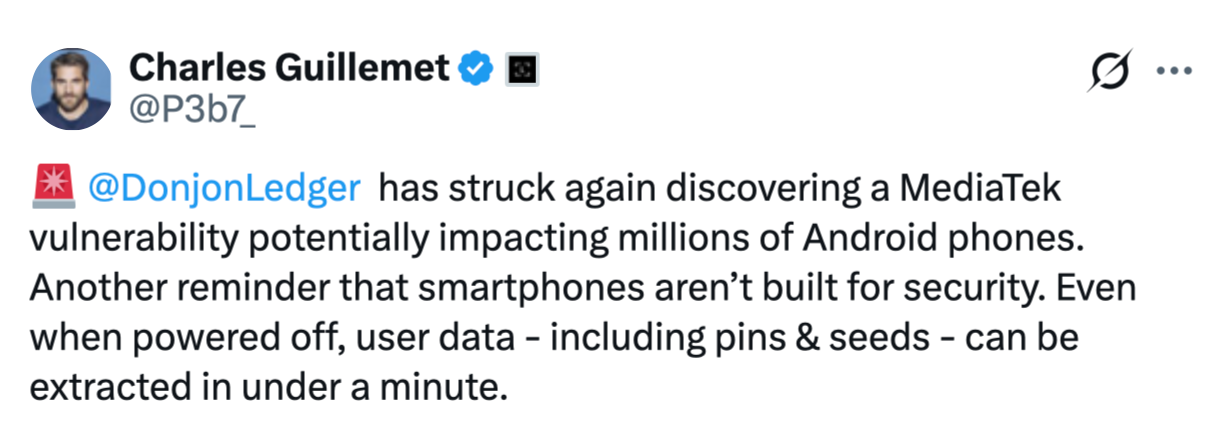
He reinforced a similar view on Wednesday, posting on X: “Smartphones aren’t built for security. Even when powered off, user data – including pins & seeds – can be extracted in under a minute.”
“This research highlights a fundamental architectural difference: General-purpose chips are built for convenience. Secure Elements are built for key protection. A dedicated Secure Element isolates secrets from the rest of the system, protecting them even under physical attack,” he said.
Magazine: All 21 million Bitcoin is at risk from quantum computers
TLDR:
- U.S. inflation steady at 2.4% in February 2026, unchanged from January’s rate.
- Core CPI held at 2.5%, marking the lowest reading since 2021, showing easing pressures.
- Energy prices rebounded, with natural gas rising 10.9% and fuel oil up 6.2%.
- Shelter and food costs contributed steadily to monthly CPI changes, supporting stability.
U.S. inflation in February 2026 remained stable at 2.4%, reflecting moderate price growth and balanced sector performance.
Energy and core inflation trends offset other declines, indicating a steady and predictable price environment for the early 2026 economy.
Energy Prices Influence Headline Inflation
Energy costs were a primary factor in February 2026 inflation trends. Overall energy inflation rose to 0.5%, reversing the -0.1% decline from January.
This shift contributed to maintaining headline inflation at 2.4% year-over-year. Gasoline prices declined at -5.6%, a smaller decrease than January’s -7.5%, while fuel oil surged 6.2%, counteracting disinflation in other categories.
Natural gas prices continued strong growth, rising 10.9%, slightly higher than January’s 9.8% increase. These energy price movements reflect ongoing volatility within the sector.
Despite the rebound in energy, overall inflation remained moderate, suggesting that price increases are currently controlled. This stability aligns with market expectations and indicates a predictable inflation environment.
Monthly changes show how energy prices affected headline CPI. Gasoline contributed 0.8%, fuel oil added incremental pressure, and natural gas continued to elevate costs for households and businesses.
Without these energy rebounds, the 2.4% inflation rate might have fallen further. Food and shelter trends further shaped inflation dynamics.
Food prices held at 3.1%, while shelter increased by 0.2% monthly, reflecting consistent demand. Together, these sectors moderated the net impact of volatile energy prices.
Used vehicle prices declined by -3.2%, accelerating from January’s -2% drop, further balancing inflation. The vehicle market continues to normalize after supply disruptions, helping prevent excessive overall price growth.
Producer and consumer indicators support this stabilization. PPI fell slightly to 2.9%, while consumer inflation expectations dropped to 3.0%, reflecting confidence in moderate inflation.
The combination of energy, food, and shelter trends demonstrates how sector-specific movements influence headline inflation. February 2026’s 2.4% rate shows that price growth remains contained despite volatility in select areas.
Core Inflation and Economic Stability
Core inflation, excluding food and energy, remained at 2.5% year-over-year in February 2026. Monthly core CPI increased 0.2%, lower than January’s 0.3%, indicating a modest slowdown in underlying price pressures.
This moderation highlights that services and housing costs are growing steadily, without extreme fluctuations. The lowest core inflation reading since 2021 reflects a stable environment for policy and economic planning.
Shelter, contributing the largest weight in the consumer price index, remained at 3.0% annual growth. Food stayed at 3.1%, while energy’s rebound offset declines elsewhere.
Combined, these movements created a balanced CPI outcome for the month. Used car and truck prices, declining 3.2% monthly, point to a normalization in markets previously disrupted by supply shortages.
These declines also provide relief to consumers, helping maintain overall inflation stability. Historical trends illustrate that 2025 saw inflation peaks around 3.0% in September before gradually falling to 2.4% by early 2026.
This cyclical pattern confirms that inflationary pressures are easing steadily across sectors. Producer Price Index movements also support this view, with PPI easing to 2.9%.
Consumer expectations fell to 3.0%, indicating moderated perceptions of future inflation. The stable headline and core inflation, combined with predictable sector trends, signal that price growth is under control.
Energy rebounds and shelter costs balanced disinflation elsewhere, producing steady and manageable U.S. inflation.
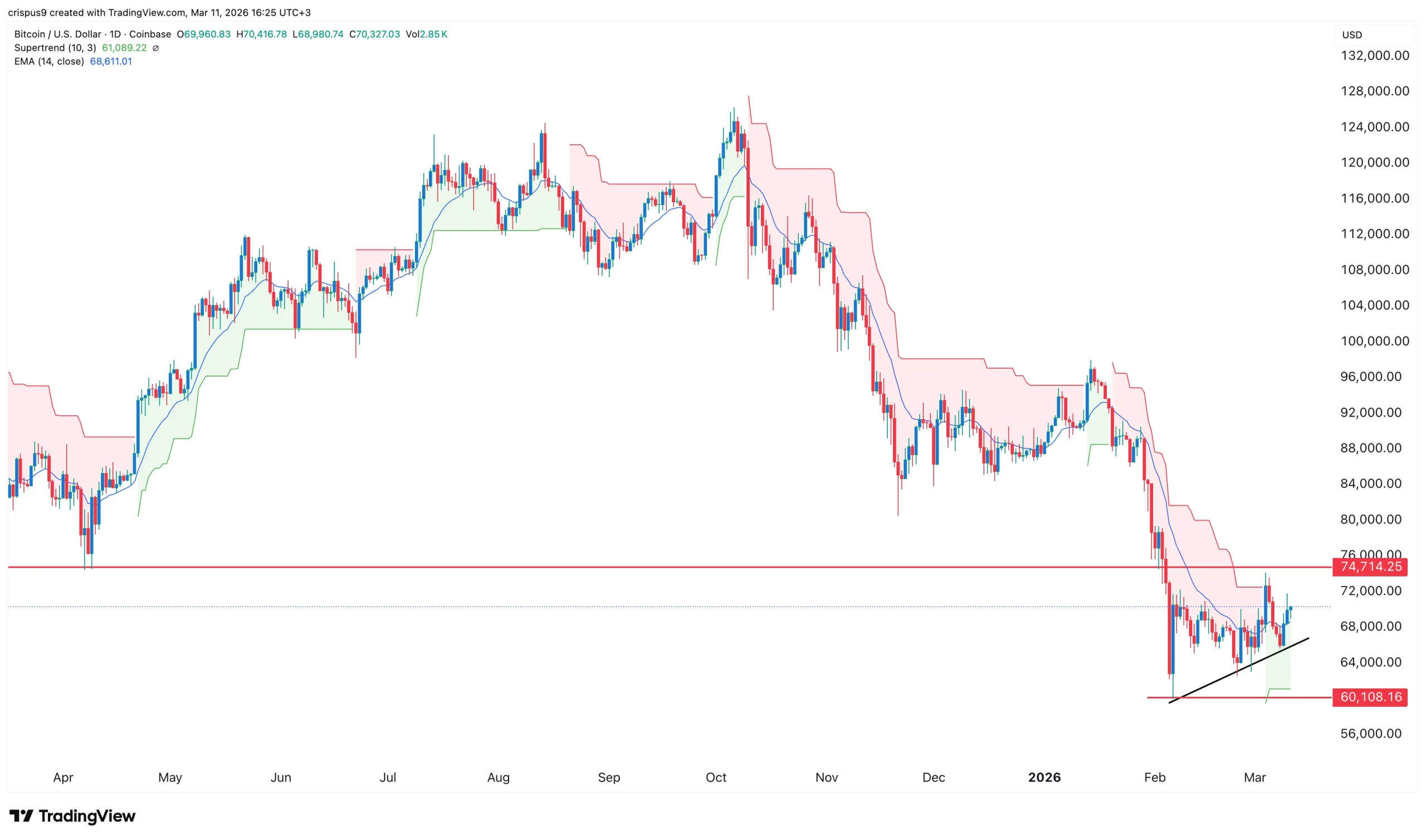
Bitcoin price has jumped by 16% from its lowest point this year, and is hovering at the crucial resistance at $70,000. This recovery may continue in the near term amid robust ETF inflows and falling core inflation.
Summary
- Bitcoin price remained above the key resistance level at $70k.
- Data shows that the US core inflation eased to 0.2% in February.
- Spot Bitcoin ETF inflows are nearing $1 billion this month.
Bitcoin (BTC) was trading at $70,000 today, March 11, up from the lowest point this year. Its daily volume soared to $47 billion, while the market capitalization moved to $1.3 trillion.
US core inflation cooled, while Bitcoin ETF inflows rose
Bitcoin price may benefit from the ongoing demand from American investors. After shedding over $6 billion in assets in the last four months, data shows that spot Bitcoin ETFs are adding millions in assets this month.
They added $250 million in assets on Tuesday after adding $167 million a day earlier. As a result, they have now added $986 million this month, erasing the $206 million losses made in February.
The ongoing ETF inflows are happening even as the Iran war and instability in the Middle East continues. As such, there are signs that some investors are embracing Bitcoin as a safe-haven asset as geopolitical risks rise.
Meanwhile, data released on Wednesday showed that the US core inflation slowed in February from a month earlier. The figure, which excludes the volatile food and energy prices, rose 0.2% from 0.3% in the previous month.
The headline and core CPI held steady at 2.4% and 2.5% on an annualized basis. These numbers mean that inflationary concerns were ending before the Iran war started earlier this month.
Inflation will likely bounce back in the near term now that crude oil prices have rebounded. Brent jumped to $90, while the West Texas Intermediate (WTI) jumped to $86.
On the positive side for Bitcoin, there is a possibility that this conflict will end soon, driving energy prices and inflation lower.
Bitcoin price may jump to $80k if it flips key resistance
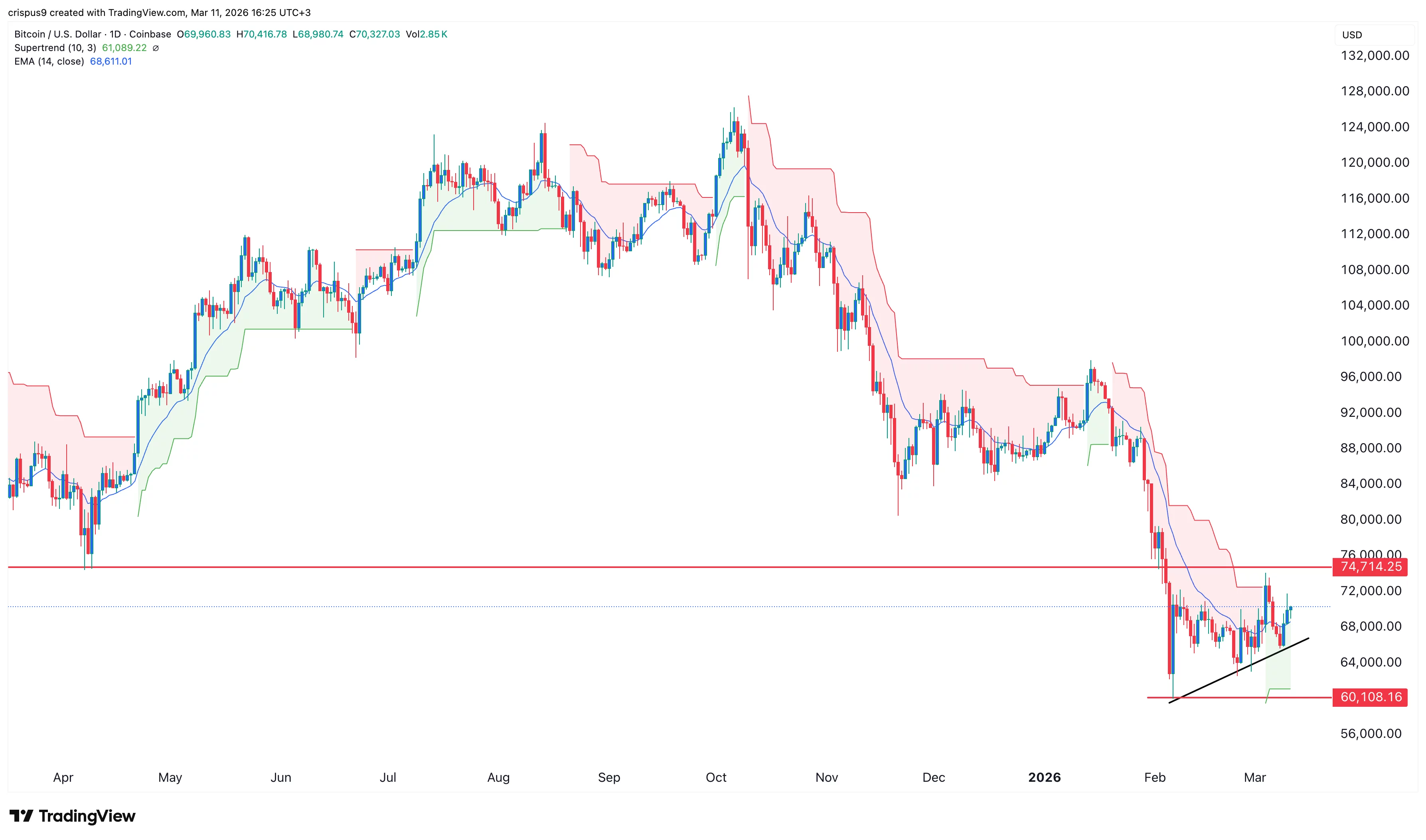
Technicals suggest that Bitcoin may be ripe for a strong comeback if it flips the key resistance level at $74,715, its lowest point in April last year.
It has already moved above the Supertrend indicator for the first time since January this year. Also, it has remained above the ascending trendline that connects the lowest swings since February.
BTC price has moved above the 14-day moving average. Therefore, the coin may keep rising in the coming weeks, potentially to the psychological level at $80,000.
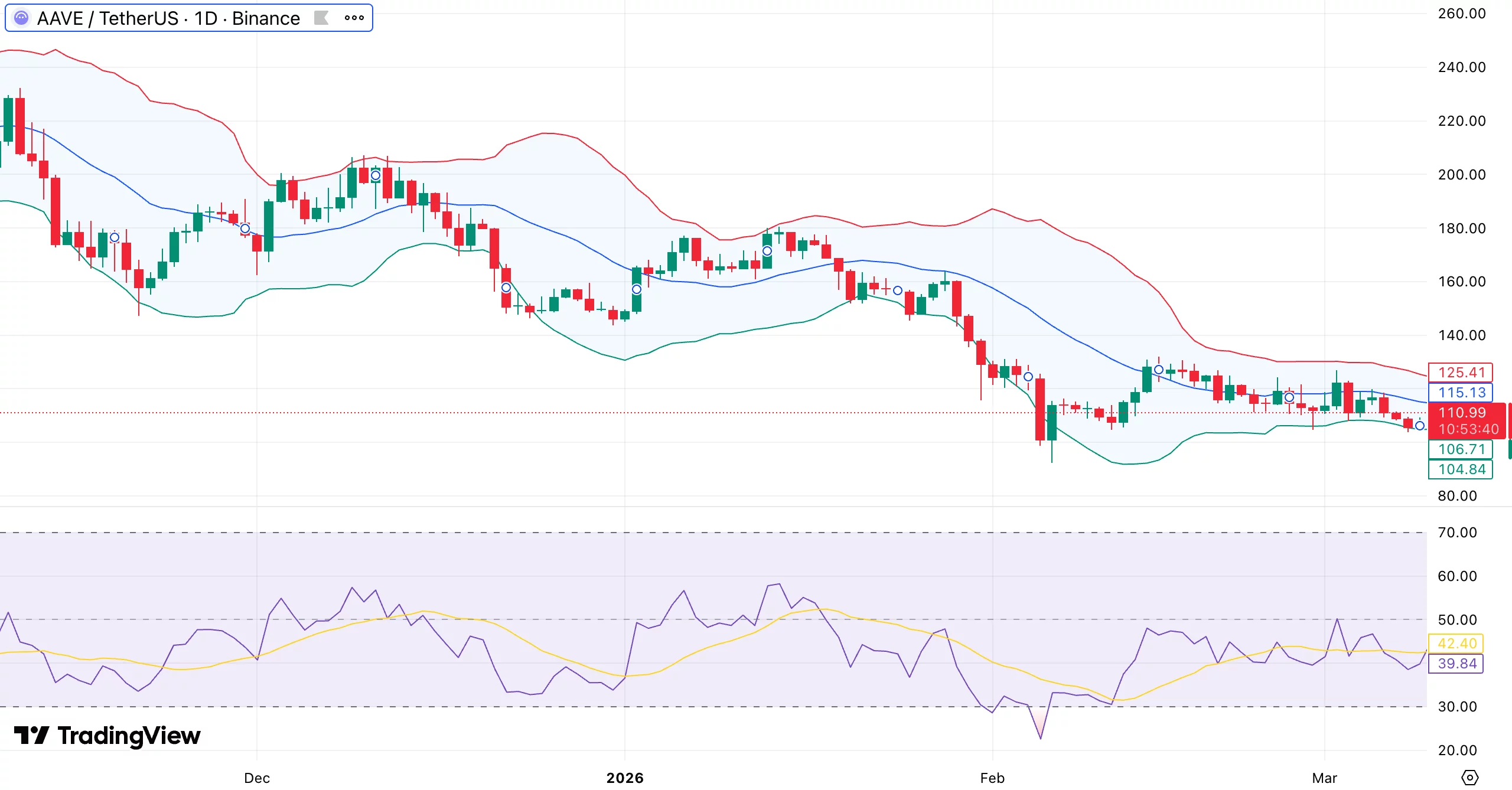
Aave price is trading near $111 as traders react to a $27 million liquidation error that briefly shook confidence in the lending protocol.
Summary
- Aave price dropped after a $27M liquidation caused by a CAPO oracle error.
- 34 accounts using wstETH were liquidated, but the protocol stayed solvent and users will be reimbursed.
- AAVE trades in a descending channel with support at $110–$115, resistance at $125–$130, and weak momentum.
Aave (AAVE) slipped on Wednesday as traders reacted to a recent liquidation incident on the protocol. At press time, AAVE was trading at $111.45, down 2.2% over the past 24 hours.
During the past week, the token moved between $105.31 and $118.70. The price has attempted to recover from the February lows, but it has repeatedly stalled. The market has not yet returned to the levels observed prior to the earlier decline, and momentum is still weak.
Trading activity has cooled slightly. Daily trading volume reached about $29 million, which is 11% lower than the previous day. CoinGlass data also shows softer activity in derivatives markets. Futures volume fell 14% to $300 million, while open interest dropped 4.97% to $190 million.
When both volume and open interest fall at the same time, it usually means traders are stepping back and closing positions.
Liquidation glitch sparks concerns among traders
The decline in sentiment follows an unusual liquidation event on March 10 that affected several users of the Aave lending platform.
The incident was not caused by a hack or a sudden market crash. Instead, it stemmed from a configuration problem in CAPO, Aave’s internal risk management oracle used to monitor collateral prices.
The issue affected positions that used wstETH, the wrapped staked ether token issued by Lido, as collateral. A mismatch between an exchange-rate snapshot and its timestamp caused the system to read the wstETH-to-ETH price incorrectly.
Because of the error, the oracle undervalued the asset by roughly 2.85%. Several accounts suddenly appeared under-collateralized even though their positions were healthy on-chain.
As a result, around 34 user accounts were liquidated, and approximately 10,938 wstETH, worth about $27 million, was sold through automated liquidation processes. Liquidation bots earned close to 499 ETH through bonuses and fees.
After the issue was identified, Chaos Labs, which helps monitor risk parameters on Aave, worked with the protocol team to correct the configuration. The protocol itself remained solvent and did not accumulate bad debt.
Aave said affected users would be compensated using recovered funds and DAO resources. The Aave DAO and Lido both signaled support for reimbursing impacted accounts.
Although the problem was quickly fixed, the event reminded traders that technical errors can still trigger liquidations in DeFi systems.
Technical analysis: Aave price stuck inside descending channel
On the chart, Aave is trading inside a descending channel, a pattern that appears when prices register lower highs and lows. The upper trendline of the channel continues to act as resistance, while the lower boundary has provided support during recent dips.
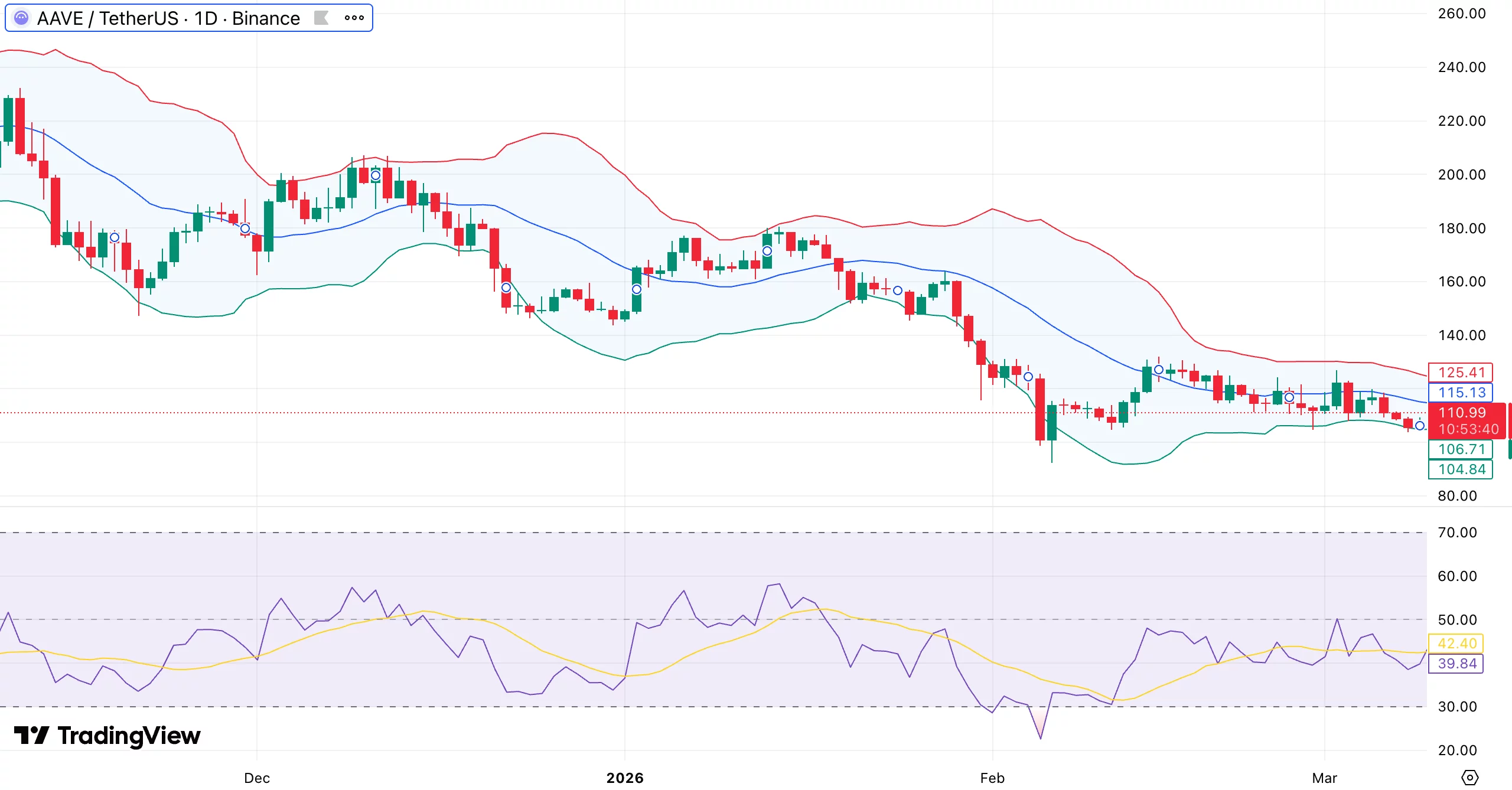
This structure often shows a bearish bias until a breakout occurs. The token is also trading below its short-term moving averages, such as the 50-day and 20-day averages, which act as overhead resistance.
Sellers will probably maintain control of the trend until the price rises above these levels. Volatility has been relatively muted. Bollinger Bands are slightly narrowing, which can happen when the market pauses before the next larger move.
Momentum indicators also lean negative. Buying strength is still restricted, as indicated by the relative strength index, which is below the 50 mark. However, the indicator is not yet in oversold territory, allowing for additional declines.
Within the channel, $110 to $115 is currently serving as a short-term support zone. If the price breaks below that range, it may move into the next demand zone.
On the upside, resistance sits around $125 to $130, where the upper channel trendline and short-term moving averages meet. A clear move above that range would be needed to shift momentum back in favor of buyers.

Dow: Turnaround Is Taking Shape, But Much Of The Optimism Is Priced In
Ghana Positions Itself as Africa’s Hub with First Crypto Regulatory Sandbox

Every Cast Reunion at the 2026 Oscars

Smart energy pays enters the US market, targeting scalable financial infrastructure

Why Israel is blocking foreign journalists from entering

Bitcoin: We’re Entering The Most Dangerous Phase

Confronting George Kamel on credit cards, student loans, and financial infidelity

The Hidden Truth of Women’s “Financial Independence | Double Burden of Work & Home #shorts

O segredo financeiro de Gregory Em Bridgerton #familiaBridgerton #bridgerton #series
-
Business6 days ago
Form 8K Entergy Mississippi LLC For: 6 March
-

 Tech7 days ago
Bitwarden adds support for passkey login on Windows 11
-

 News Videos3 days ago
10th Algebra | Financial Planning | Question Bank Solution | Board Exam 2026
-

 Fashion5 days ago
Weekend Open Thread: Ann Taylor
-

 Crypto World3 days ago
Paradigm, a16z, Winklevoss Capital, Balaji Srinivasan among investors in ZODL
-
 Tech21 hours ago
A 1,300-Pound NASA Spacecraft To Re-Enter Earth’s Atmosphere
-
 Sports6 days ago
499 runs and 34 sixes later, India beat England to enter T20 World Cup final | Cricket News
-

 Politics6 days ago
Top Mamdani aide takes progressive project to the UK
-

 Business2 days ago
ExxonMobil seeks to move corporate registration from New Jersey to Texas
-

 Sports4 days ago
Braveheart Lakshya downs Lai in epic battle to enter All England Open final | Other Sports News
-

 Sports4 days ago
Three share 2-shot lead entering final round in Hong Kong
-

 NewsBeat10 hours ago
Residents reaction as Shildon murder probe enters second day
-

 NewsBeat6 days ago
Piccadilly Circus just unveiled ‘London’s newest tourist attraction’ and it only costs 80p to enter
-

 Entertainment5 days ago
Hailey Bieber Poses For Sexy Selfies In New Luscious Lip Thirst Traps
-

 Business3 days ago
Search for Nancy Guthrie Enters 37th Day as FBI Probes Wi-Fi Jammer Theory
-

 Business21 hours ago
Search Enters Sixth Week With New Leads in Tucson Abduction Case
-
 NewsBeat2 days ago
Pagazzi Lighting enters administration as 70 jobs lost and 11 stores close across Scotland
-

 Tech3 days ago
Despite challenges, Ireland sixth in EU for board gender diversity
-

 Tech7 days ago
ACIP To Discuss COVID ‘Vaccine Injuries’ Next Month, Despite That Not Being In Its Purview
-

 Business2 days ago
Search Enters 39th Day with FBI Tip Line Developments and No Major Breakthroughs