Societe Generale-FORGE, the crypto arm of the French lender, has completed a multichain expansion of its euro-denominated stablecoin, EUR CoinVertible (EURCV), by deploying it on the Stellar network. The move closes a circuit in a rollout the firm began outlining in 2025 and signals a broader push to normalize euro-backed digital assets across major blockchains. EURCV is designed to be MiCA-compliant and fully collateralized on a one-to-one basis with reserves comprised of bank deposits and high-quality liquid assets. The Stellar deployment aims to unlock new on-chain uses for tokenized assets and digital markets, leveraging Stellar’s fast settlement, low fees, and built-in support for tokenized assets. The euro-stablecoin’s on-chain footprint now spans Ethereum, Solana, and the XRPLedger, with Stellar added to the roster and multiple deployments planned to expand liquidity and interoperability. DefiLlama places EURCV’s market cap at around $452 million, reflecting steady interest in euro-denominated liquidity tools in a market still dominated by dollar-pegged assets.
Key takeaways
SG-FORGE’s EURCV is now live on the Stellar network, adding a fourth major chain to a multichain rollout that began with Ethereum and Solana and included the XRPLedger previously.
Stellar’s on-chain DEX and low transaction costs are highlighted as features that could improve the accessibility and efficiency of euro-denominated tokenized assets.
EURCV remains fully backed 1:1 by reserves of bank deposits and high-quality liquid assets, aligning with MiCA requirements in the European Union.
A January SWIFT pilot demonstrated the exchange and settlement of tokenized bonds using both fiat and digital currencies, underscoring cross-border interoperability for euro-denominated instruments.
The euro-stablecoin push in Europe continues amid MiCA and licensing debates, while the broader stablecoin market in the United States has gained regulatory clarity after recent legislative developments; US dollar-backed tokens still dominate market share.
Market context: European policymakers are pursuing MiCA compliance as a framework for issuers, with a regulatory emphasis on licensing and oversight that contrasts with the more permissive or evolving regimes in other regions. In the United States, regulatory clarity for stablecoins gained momentum after supporting legislation, while the sector remains heavily weighted toward dollar-backed assets, a dynamic underscored by the ongoing growth of USDT and USDC in global markets.
Why it matters
The expansion of EUR CoinVertible onto Stellar matters because it demonstrates a deliberate effort to diversify the on-ramp and liquidity options for euro-denominated digital assets beyond the dominant Ethereum ecosystem. By placing EURCV on Stellar, SG-FORGE taps into an infrastructure designed for speed and scale, including a built-in decentralized exchange component that can facilitate on-chain trading of tokenized assets without requiring users to leave the network. The move also signals confidence that MiCA-compliant euro stablecoins can operate effectively across multiple rails, potentially reducing fragmentation in European digital asset markets while preserving the ability to settle tokenized instruments in a regulated framework.
From a risk and liquidity perspective, EURCV’s 1:1 backing by bank deposits and high-quality liquid assets anchors its value and aligns with European regulators’ expectations for reserve quality. The euro-stablecoin ecosystem in Europe has lagged behind the US dollar-centered stablecoin crowd, but the EU’s regulatory regime—emphasizing licensing, consumer protections, and capital requirements—aims to create a more stable operating environment for issuers and users. The DefiLlama data cited in the broader narrative shows EURCV as a meaningful, if still niche, component of the euro-denominated segment, contributing to greater diversification within a market that has grown from roughly $260 billion in July 2025 to over $314 billion in more recent readings. In parallel, the U.S. landscape has benefited from regulatory clarity around stablecoins, even as competition remains intense among USDT and USDC, underscoring a global race to build trusted, compliant euro- and dollar-pegged assets on-chain.
Advertisement
Another layer of significance is the cross-border interoperability demonstrated by the SWIFT tokenized-bonds pilot. By bridging fiat and digital currencies in a tokenized-bonds context, the pilot points to a potential path for faster settlement and greater liquidity for euro-denominated debt instruments. While the technical and regulatory hurdles are nontrivial, the episode illustrates how traditional financial infrastructure can converge with blockchain rails to create more efficient capital markets. Taken together, the Stellar deployment, the SWIFT pilot, and MiCA’s evolving requirements underscore a broader shift: euro-denominated stablecoins are moving from proof-of-concept experiments to practical tools for everyday settlement, collateralization, and liquidity provisioning in regulated markets.
The trajectory also highlights a fundamental tension in the crypto ecosystem: regulatory clarity versus market opportunity. European authorities aim to codify safeguards and licensing, while market participants seek speed and utility across diverse networks. EURCV’s emergence on Stellar illustrates how institutions can align with regulatory expectations while exploring value-adding features such as native on-chain trading, faster settlement, and broader access for tokenized assets. The ongoing dialogue between policymakers, banks, and crypto-native issuers will influence how quickly such euro-stablecoins achieve scale, and which networks emerge as the most effective rails for cross-border, on-chain euro settlements.
What to watch next
Adoption metrics for EURCV on Stellar: transaction volume, on-chain liquidity, and any new issuer partnerships.
Additional network deployments: any further moves to other blockchains beyond Stellar, and the timeline for potential integrations with major on/off-ramp providers.
MiCA regulatory developments: licensing decisions and any updates to capital requirements or disclosure standards that could influence future euro-stablecoin issuance.
Cross-border use cases: uptake in tokenized euro-denominated assets and further SWIFT-like interoperability experiments beyond bonds.
Sources & verification
Official page: SG-FORGE — Stellar network stablecoin launch details (https://www.sgforge.com/stellar-network-stablecoin/)
EURCV on Ethereum: historical launch information (https://cointelegraph.com/news/societe-generale-launches-euro-pegged-stablecoin-on-ethereum)
DefiLlama: EURC stablecoin data and market cap (https://defillama.com/stablecoin/eurc)
EURCV on XRP Ledger deployment reference (https://cointelegraph.com/news/societe-generale-forge-expands-euro-stablecoin-to-xrp-ledger-in-multi-chain-push)
MiCA framework and European stablecoin regulation discussion (https://cointelegraph.com/learn/articles/markets-in-crypto-assets-regulation-mica)
Market reaction and key details
Societe Generale-FORGE’s multi-chain approach to EURCV reflects a broader push to de-risk and diversify euro-denominated liquidity in a crypto market that has been historically dominated by U.S. dollar-backed tokens. The Stellar deployment aims to enhance throughput and reduce friction for on-chain settlements and tokenized asset services, aspects that could become important as European issuers seek regulated, interoperable rails for cross-border activity. The ongoing regulatory backdrop—MiCA’s licensing requirements and the EU’s caution around euro-denominated assets—frames the pace and scale of adoption, even as the U.S. market advances new regulatory clarity around stablecoins. With EURCV now live on Stellar, the door opens to additional use cases such as tokenized bonds, on-chain collateralization, and more efficient settlement flows in a regulated European context.
Looking ahead, investors and builders will watch not only the rate of EURCV’s on-chain activity but also how Stellar’s ecosystem, DeFi integrations, and stablecoin usage converge with MiCA’s licensing standards. The cross-chain momentum—moving from Ethereum to Solana, XRP Ledger, and now Stellar—suggests a potential template for other euro-denominated assets seeking regulated, scalable rails. As with all stablecoins, the ultimate test will be resilience under stress: reserve quality, transparency, and the ability to maintain 1:1 parity in diverse market conditions. If EURCV maintains robust backing and gains practical traction on Stellar, it could become a more visible, trusted option for institutions and decentralized markets seeking regulated euro exposure within a crypto-enabled settlement infrastructure.
Risk & affiliate notice: Crypto assets are volatile and capital is at risk. This article may contain affiliate links. Read full disclosure
Thai digital asset operators froze 47,692 mule accounts in 2025 alone.
Thailand’s digital asset industry has stepped up its efforts to tackle money laundering linked to mule accounts.
Crypto exchanges in the Southeast Asian country have frozen more than 10,000 suspicious accounts under a newly enforced measure known as the “Speed Bump,” according to the Thai Digital Asset Operators Trade Association (TDO).
Advertisement
Major Anti-Money Laundering Push
While speaking to the Bangkok Post, Att Thongyai Asavanund, chief executive of KuCoin Thailand and chairman of the TDO, said mule accounts remain one of the most significant vulnerabilities within the crypto ecosystem.
Criminal groups typically move illicit funds through a network of multiple bank accounts before combining the money into a single account that is used to transfer funds to a crypto platform. Once the funds arrive on the platform, they are quickly converted into digital assets and transferred overseas.
Although blockchain technology enables operators to track wallet addresses and observe transaction flows across the network, Asavanund acknowledged that a major limitation remains the difficulty of identifying the real person controlling a wallet. He explained that while operators can see a wallet address and its activity on the blockchain, determining the true beneficial owner behind that address is often extremely challenging.
To address the problem and slow the movement of suspicious funds, the TDO has introduced the Speed Bump mechanism, which imposes a 24-hour transaction lock on transfers of 50,000 baht or more. During this holding period, users are required to complete additional know-your-customer checks, including video verification, before the funds can be released.
Advertisement
According to Asavanund, the delay is designed to disrupt the speed that criminal networks rely on to move money through the system before it can be detected. The association said the enhanced screening process has already led to the suspension of thousands to tens of thousands of accounts suspected of operating as mule accounts.
However, crypto operators are facing rising compliance costs and operational pressures as they manage frozen accounts and investigate suspicious transactions. Criminal groups have also attempted to bypass these controls by recruiting new individuals to open replacement accounts once previously used accounts are blacklisted.
In addition to the Speed Bump measure, the TDO is coordinating with authorities to strengthen broader safeguards within the financial system. These efforts include linking suspect databases with the Bank of Thailand’s payment system and law enforcement agencies to help screen individuals classified as high risk under different risk categories.
Other Industry Measures
Last August, Thailand launched a program called TouristDigiPay, allowing foreign visitors to convert cryptocurrency into Thai baht for payments during their stay. Under the scheme, tourists must open an account with a regulated digital asset business and e-money provider and complete strict identity checks.
Advertisement
In June, the government approved a five-year tax exemption on cryptocurrency profits for domestic traders to encourage more funds to remain within the country. The decision followed a sharp decline in foreign inflows after authorities introduced stricter taxation on foreign income brought into Thailand the previous year. Meanwhile, the Thai Revenue Department said it is preparing to implement the Crypto-Asset Reporting Framework (CARF), which supports global sharing of digital asset account data.
SPECIAL OFFER (Exclusive)
Binance Free $600 (CryptoPotato Exclusive): Use this link to register a new account and receive $600 exclusive welcome offer on Binance (full details).
LIMITED OFFER for CryptoPotato readers at Bybit: Use this link to register and open a $500 FREE position on any coin!
The Bank Policy Institute is reportedly weighing filing a lawsuit against the OCC over it granting more bank trust charters to crypto firms.
A lobbying group for some of the largest banks that do business in the United States may be heading to court over crypto’s growing access to the U.S. banking system. The Guardian first reported the news, citing a source familiar with the lobby’s thinking.
The Bank Policy Institute (BPI) — whose members include Bank of American, Citi, Goldman Sachs, Wells Fargo, Santander, and HSBC, among many others — is considering filing a lawsuit against the Office of the Comptroller of the Currency (OCC) over the regulator’s move to grant national trust bank charters to crypto and fintech firms. The BPI has not yet decided whether to proceed with legal action, per The Guardian.
At the heart of the dispute is a question of competitive fairness. Banks argue the OCC’s move grants federal approval to bank-like activities without the same supervision, controls, and safeguards required of traditional banks.
Advertisement
BPI’s board includes JPMorgan Chase CEO Jamie Dimon, Goldman Sachs chief David Solomon, and Bank of America’s Brian Moynihan, among other executives of Wall Street’s largest players.
The banking charter pipeline for crypto firms has grown rapidly under OCC Comptroller Jonathan Gould, who was appointed by President Donald Trump and sworn in last July.
In December, the OCC granted conditional national trust bank charter approvals to several crypto firms, including BitGo, Ripple, and Paxos. A growing number of other companies have followed since.
Most recently, as The Defiant reported, Crypto.com received conditional approval to charter Foris Dax National Trust Bank, and Revolut and Zerohash became the latest crypto-linked firms to file applications with the OCC in early March.
Advertisement
The question of crypto firms competing with banks has extended beyond the OCC. Amid the ongoing Senate consideration of a broad crypto market structure bill, JPMorgan’s CEO told CNBC that stablecoin issuers paying interest on customer balances should face the same rules as traditional lenders — a position that has become a central sticking point holding up passage of the CLARITY Act in Congress.
This article was generated with the assistance of AI workflows.
Bitcoin surged above $71K, triggering a crypto short squeeze that liquidated over $100M in bearish positions.
Ethereum followed Bitcoin’s breakout, reclaiming $2,050 as the crypto market cap expanded rapidly.
Over $150B flowed back into the crypto market within 36 hours as momentum traders returned.
Analysts identify $75K BTC and $2,100 ETH as major liquidation zones in derivatives markets.
Crypto Short Squeeze is driving renewed momentum across digital asset markets after Bitcoin climbed above $71,000 and Ethereum moved past $2,050. The rally triggered more than $100 million in short liquidations across major exchanges within 36 hours.
Bitcoin Breakout Triggers $100M Short Liquidation Cascade
Crypto Short Squeeze activity intensified after Bitcoin reclaimed the $70,000 psychological resistance level. The breakout triggered forced liquidations across derivatives markets.
Data from trading platforms shows that more than $100 million worth of short positions were liquidated. Traders who expected lower prices were forced to close their positions.
When short traders exit losing positions, they must buy the asset back. That process creates additional upward pressure on price.
BREAKING: $100 Million worth of short positions liquidated as Bitcoin reclaims $71,000 and Ethereum reclaims $2,050.
BTC is up 8.61% in the last 36 hours, adding $113 billion to its market cap.
Advertisement
ETH is up 8.18% in the last 36 hours, adding $19 billion to its market cap.
Bitcoin’s price increased by roughly 8.61% during the last 36 hours. The rally added nearly $113 billion to the asset’s total market capitalization.
Advertisement
Technical charts show consecutive higher highs and higher lows during the surge. This pattern reflects steady buying pressure during the breakout.
The move above $70,000 also triggered clusters of stop-loss orders. Many short sellers placed liquidation levels just above that resistance zone.
Once those orders were activated, automated buying accelerated the rally. Such chain reactions often amplify volatility in derivatives-driven markets.
Meanwhile, total cryptocurrency market capitalization expanded by nearly $150 billion during the same period. This rapid increase suggests both liquidation-driven demand and fresh spot buying.
Advertisement
Ethereum Rally and Key Liquidation Zones at $75K and $2,100
Crypto Short Squeeze momentum extended to Ethereum as the asset climbed above $2,050. The second-largest cryptocurrency mirrored Bitcoin’s breakout strength.
Ethereum recorded an 8.18% gain during the same 36-hour period. The move added about $19 billion to Ethereum’s market capitalization.
Price action shows buyers defending higher support levels since the $1,930 consolidation region. This structure indicates continued participation across large-cap cryptocurrencies.
While both assets moved higher, derivatives heatmaps reveal new liquidation zones forming. These zones could influence the next price movements.
Advertisement
Bitcoin currently faces a dense cluster of short positions between $74,000 and $75,500. Analysts describe this area as a liquidity magnet for leveraged traders.
If Bitcoin reaches $75,000, forced buying from liquidated shorts could accelerate the rally. Some traders expect rapid movement toward $78,000 if liquidation pressure builds.
Ethereum faces a separate liquidation structure near $2,100. Many leveraged long traders placed liquidation levels around that support region.
Estimates indicate nearly $850 million in Ethereum long positions remain exposed near that price range.
Advertisement
If Ethereum drops toward $2,100, automated selling could trigger a long liquidation cascade. Under that scenario, the next major support level appears near $1,900.
Such divergence between Bitcoin and Ethereum would increase volatility across crypto markets. Traders would also watch Bitcoin dominance as capital shifts between major digital assets.
Brian Armstrong says AI agents cannot open bank accounts but can hold crypto wallets.
Coinbase launched Agentic Wallets via the x402 protocol for fast AI-to-AI payments.
Wallets enable gasless trading on Base, Coinbase’s Ethereum layer-2 network.
Mastercard and crypto firms build solutions to support AI agent commerce.
Brian Armstrong’s AI agents and crypto wallets discussion gained attention after the Coinbase CEO highlighted that autonomous AI programs will soon dominate financial transactions.
Armstrong stated that AI agents cannot open bank accounts, but they can generate crypto wallets and transact globally.
Coinbase Launches Agentic Wallets for Machine Transactions
On March 9, Brian Armstrong posted on X explaining that AI agents will soon outnumber humans in financial activity. He argued that traditional banks cannot serve AI because of the Know Your Customer requirements.
Very soon there are going to be more AI agents than humans making transactions.
They can’t open a bank account, but they can own a crypto wallet. Think about it.
AI agents require payment capabilities to execute assigned tasks autonomously. Without bank accounts, agents cannot pay for services like server hosting or software tools.
Coinbase introduced Agentic Wallets on February 11, 2026, via its x402 protocol. The protocol is designed for machine-to-machine payments and has processed over 50 million transactions by the time of Armstrong’s post.
The wallets can be created and funded quickly through Coinbase developer tools. They also allow gasless trading on Base, Coinbase’s layer‑2 network built on Ethereum.
Armstrong emphasized that AI agents can own crypto wallets immediately, bypassing the human identity verification barrier. This capability positions crypto as a natural infrastructure for the coming machine economy.
Advertisement
Other crypto leaders have shared similar views on AI-driven financial activity. Former Binance CEO Changpeng Zhao predicted that AI agents will produce millions of times more transactions than humans.
Industry Prepares for AI Agent Commerce
Traditional financial companies are developing systems to accommodate agent-driven transactions. Mastercard launched Verifiable Intent, a framework co-developed with Google, to track AI purchases securely.
The system creates a cryptographic record linking the consumer’s authorization, the AI agent’s action, and the transaction. It uses selective disclosure to share only the necessary information with merchants and issuers.
Meanwhile, crypto platforms continue to expand blockchain-based payment rails for AI agents. EigenCloud partnered with Google Cloud to serve as a verifiable backbone for agent transactions.
Advertisement
The Ethereum Foundation also established the dAI Team to make Ethereum a preferred settlement layer for machine-driven commerce.
These efforts illustrate two approaches: traditional finance builds trust layers, while crypto platforms provide blockchain-native solutions.
Taken together, these developments indicate that AI agents are likely to rely on crypto wallets for autonomous transactions.
Coinbase’s Agentic Wallets and blockchain infrastructure offer immediate solutions for machine-to-machine financial operations.
BitGo will provide custody and trading services for StableX Technologies’ digital asset treasury as it plans to acquire up to $100 million in crypto tokens tied to the stablecoin sector.
According to Tuesday’s announcement, BitGo Bank & Trust, N.A. will serve as the custodian for StableX’s digital asset holdings, while BitGo’s trading platforms will help execute the company’s planned acquisitions through its over-the-counter liquidity desk.
StableX (SBLX) is a publicly traded company focused on stablecoin infrastructure and related technologies. Shares of the Nasdaq-listed company gained as much as 9% in afternoon trading following the news, before closing up 1.6%.
Chen Fang, chief revenue officer at BitGo, told Cointelgraph that the “partnership underscores BitGo’s expanding role as the go-to infrastructure provider for a new wave of publicly traded companies building digital asset treasury strategies.” He added:
Advertisement
“The StableX deal is notable because it goes beyond Bitcoin-centric treasury strategies. It signals demand for institutional custody infrastructure around stablecoin ecosystem tokens.”
StableX has already begun building its digital asset treasury, previously announcing purchases of tokens including FLUID and Chainlink’s LINK (LINK) in October.
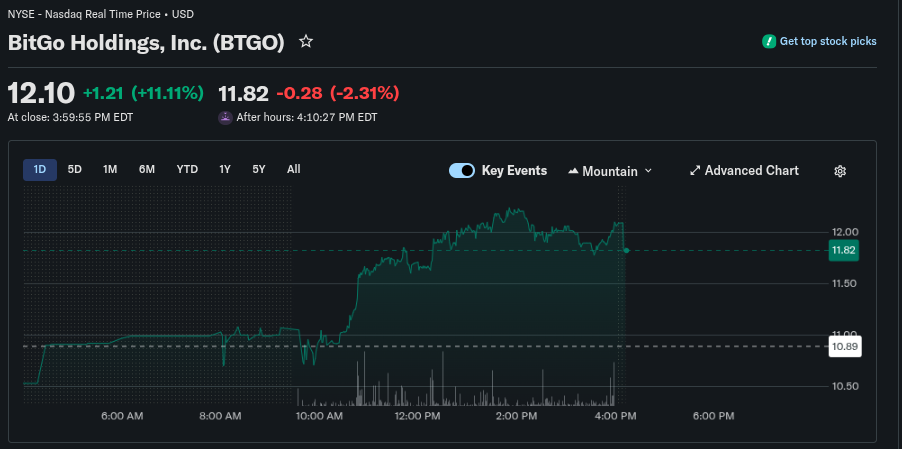
BitGo, a digital asset infrastructure company founded in 2013, provides custody, trading and other services for institutional crypto clients. The company went public on the New York Stock Exchange in January, pricing its shares at $18 in its initial public offering.
The stock rose about 25% on its first day of trading before reversing course and later falling below its IPO price. The NYSE-traded shares closed up more than 11%.
Interest in the stablecoin sector has grown as the total stablecoin market capitalization has climbed to more than $314 billion, according to the latest DefiLlama data. Though dedicated investment products remain limited, some investors are beginning to focus on the infrastructure that supports these tokens.
Advertisement
In September, Bitwise filed with the US Securities and Exchange Commission to launch a Stablecoin & Tokenization ETF designed to track companies and digital assets tied to the stablecoin and tokenization sectors.
The proposed exchange-traded fund would follow an index composed of companies involved in stablecoin issuance, infrastructure, payments and exchanges, alongside crypto assets such as Bitcoin (BTC) and Ether (ETH).
In January, MarketVector Indexes also launched benchmarks focused on stablecoin and real-world asset tokenization infrastructure, which underpin two exchange-traded funds from Amplify ETFs: the Amplify Tokenization Technology ETF (TKNQ) and the Amplify Stablecoin Technology ETF (STBQ).
Several stablecoin issuers are also publicly traded companies. Circle issues the USDC stablecoin, the second-largest dollar-pegged token in circulation, while PayPal launched its PayPal USD stablecoin (PYUSD) in 2023 to support blockchain-based payments and settlement.
Western Union, one of the world’s largest remittance providers, recently announced its planned stablecoin settlement system will run on Solana and include a US Dollar Payment Token (USDPT), which the company expects to launch in the first half of 2026.
Cointelegraph is committed to independent, transparent journalism. This news article is produced in accordance with Cointelegraph’s Editorial Policy and aims to provide accurate and timely information. Readers are encouraged to verify information independently. Read our Editorial Policy https://cointelegraph.com/editorial-policy
CFTC Chairman Michael Selig is trying to drag prediction markets and crypto out of the legal grey zone by scrapping a de facto ban and replacing it with a derivatives‑style rulebook the agency, not the states, will control.
Summary
Selig withdrew the 2024 event‑contracts ban proposal and a 2025 staff advisory, ordering a new rulebook meant to “support the responsible development” of event markets.
The CFTC is asserting “exclusive jurisdiction” over prediction markets and moving to back a registered exchange against Nevada’s gambling rules, setting up a federal–state pre‑emption fight.
Through Project Crypto with the SEC, Selig wants unified crypto rules, a shared token taxonomy and onshored perps and tokenized assets, in return for tighter surveillance and insider‑trading enforcement.
CFTC Chairman Michael Selig is trying to drag prediction markets and crypto out of a legal grey zone and into a federal framework that looks more like traditional derivatives – while fighting off states and gamblers at the same time.
According to a new report in CoinDesk, “Selig reiterated the CFTC will issue guidance to clarify how prediction markets, known as event contracts in regulation, can list and trade products under U.S. law and will launch a rulemaking process seeking public input on how the fast-growing sector should be overseen.”
Advertisement
Event contracts: from ban threat to rulebook
In his first major policy speech on January 29, 2026, Selig said the CFTC will scrap a 2024 proposal that would have effectively banned sports‑ and politics‑related event contracts and withdraw a 2025 staff advisory that warned platforms off sports markets, admitting the advisory had “inadvertently added to the uncertainty present in our markets.” Instead, he ordered staff to draft a new “event contracts rulemaking” to “establish clear standards for event contracts that provide certainty to market participants” and “support the responsible development of event contract markets,” which the CFTC views as tools to hedge risk and aggregate information, not just wagers.
At the same time, Selig is asserting turf. In speeches, an Axios interview and an AP‑covered Wall Street Journal op‑ed, he has argued that prediction markets fall under the Commodity Exchange Act and that the CFTC has “exclusive jurisdiction” over them, vowing the agency “will no longer remain passive while overly aggressive governments undermine [its] jurisdiction… by attempting to impose statewide bans on these innovative products.” The commission has already asked the Ninth Circuit for permission to file an amicus brief backing a CFTC‑registered exchange in its fight against Nevada’s attempt to regulate event contracts as gambling, setting up an eventual pre‑emption clash that could go as high as the Supreme Court.
Insider trading, surveillance and Project Crypto
Selig’s stance is not a free pass. He has repeatedly framed exchanges as the “first line of defense” against insider trading, and law‑firm summaries of his agenda stress that prediction platforms should upgrade compliance, particularly around the “permissible use of material non‑public information.” The Department of Justice is already circling: the U.S. Attorney for SDNY has publicly warned that “placing a bet through a prediction market doesn’t insulate you from fraud,” citing cases where bettors used inside information about a basketball player’s availability to rig prop bets – the same logic that could apply to political, policy or war‑related markets.
Advertisement
Crypto is woven into this. In the same speech, Selig announced “Project Crypto,” a formal coordination with the SEC intended to deliver “clear, durable rules of the road” for digital‑asset markets, including joint work on a crypto‑asset taxonomy and expanded eligibility for tokenized collateral. He also said he wants to “onshore perpetual and other novel derivative products so that they can flourish… subject to appropriate safeguards,” signalling that the CFTC is willing to own perps, tokenized stocks and prediction markets – as long as they move inside its regulatory perimeter.
Put bluntly: Selig is offering crypto and prediction markets a deal. The CFTC will fight states that want to treat everything as gambling and will abandon blanket bans on sports and political contracts – but in exchange, platforms like Polymarket and Kalshi must accept heavy surveillance, insider‑trading enforcement and a derivatives‑style rulebook rather than the degen free‑for‑all that built the first wave of volume.
In South Korea, authorities have recovered and liquidated a tranche of cryptocurrency seized in a phishing-linked custody incident, while prosecutors signal a broader shift in how crypto losses are treated in debt-restructuring cases. The Gwangju District Prosecutors’ Office disclosed that 320.8 Bitcoin were sold at prevailing market prices, yielding roughly 31.59 billion won (about $21.5 million) that was transferred to the national treasury. The sale was staged over an 11-day window in late February and early March to minimize market impact, according to local coverage. The episode follows a complex chain of events that began with a custody breach and culminated in a government-controlled wallet and subsequent liquidation.
Key takeaways
Authorities sold 320.8 Bitcoin at market prices, transferring about 31.59 billion won to the state treasury.
The liquidation occurred over 11 days, from Feb. 24 to March 6, to limit potential market disruption.
The Bitcoin was originally seized from a suspect tied to an illegal gambling operation that allegedly handled roughly 390 billion won in wagers between 2018 and 2021.
Bitcoin had been lost during a custody handover in August 2025 after a phishing scheme compromised asset managers, with funds traced to a hacker’s wallet.
On Feb. 17, the assets were moved to a government-controlled wallet after exchanges were asked to freeze the address; on Feb. 19, prosecutors reported the hacker had returned 320.88 BTC.
Separately, courts in Daegu, Daejeon and Gwangju are reevaluating how crypto losses are treated in personal rehabilitation, potentially excluding crypto losses from liquidation value calculations.
Price impact: Neutral. The staged sale aimed to minimize market disruption by spreading liquidations over more than a week.
Market context: The case underscores how authorities manage liquidations of crypto assets recovered from criminal activity and how regulators are weighing crypto losses within broader debt-restructuring frameworks, reflecting a maturing approach to crypto custody and asset recovery in a tightening regulatory environment.
Advertisement
Why it matters
The events illuminate how public authorities handle crypto assets recovered through law enforcement. By selling the seized Bitcoin in measured, market-aware batches, the prosecutors sought to avoid abrupt price movements that could ripple through exchanges and related markets. The proceeds, funneled into the national treasury, also demonstrate a tangible channel through which illicit activity—now partly deterred by stricter controls—contributes to public financing. The episode illustrates both the challenges of asset tracing in the wake of phishing scams and the practical steps governments are taking to re-integrate recovered funds into legitimate channels.
Beyond the immediate liquidation, the incident feeds into a broader discussion about how crypto losses are treated in personal debt restructurings. Local outlets reported that newly established rehabilitation courts in three cities are moving toward guidelines that would generally exclude crypto investment losses from liquidation calculations. In effect, losses tied to cryptocurrency investments could be treated more like ordinary asset losses rather than speculative debts, potentially reducing repayment obligations for individuals entering court-supervised debt relief. The shift would align crypto losses with other non-liquid assets in some rehabilitation scenarios, signaling a nuanced stance as courts adapt to digital assets in financial distress cases.
The broader regulatory and judicial response matters because it shapes risk and recovery dynamics for investors, creditors, and service providers operating in Korea’s crypto ecosystem. The February and March developments show that authorities are increasingly capable of tracing and recovering stolen or misappropriated crypto, and they are prepared to take decisive steps—such as freezing exchange addresses and coordinating with overseas partners—to facilitate recovery and orderly liquidations when possible.
What to watch next
Follow-up guidelines from rehabilitation courts in Daejeon, Daegu, and Gwangju detailing how crypto losses are treated in liquidation calculations, with potential implementation timelines.
Any additional recoveries or reversals related to the phishing incident, including further tracing of the hacker’s wallet or subsequent asset movements.
Regulatory clarifications on how crypto assets are valued in debt restructurings and how this may affect individuals undergoing rehabilitation in Korea.
Further actions by prosecutors or financial authorities to coordinate with exchanges or international partners in asset freezes or return processes.
Sources & verification
Gwangju District Prosecutors’ Office statements and reported sale details (local coverage via Chosun Ilbo English edition).
BTC sale details and the related transfer amount to the national treasury as reported by The Chosun Ilbo.
Reports on the custody breach and the phishing incident that led to the loss and subsequent recovery of Bitcoin (linked in coverage of the case).
EToday’s report on rehabilitation courts and proposed guidelines for crypto-loss treatment in debt restructuring cases.
What the article topic means for readers
South Korea’s handling of recovered crypto assets demonstrates a practical approach to asset recovery and governance, highlighting how authorities balance market stability with the need to return funds to public coffers. The development also reflects a broader trend: as crypto markets mature and regulatory scrutiny intensifies, legal frameworks are increasingly capable of integrating digital assets into traditional financial processes, from custody management to debt resolution. For investors and builders, the episode underscores the importance of robust custody controls, vigilant monitoring of phishing risks, and a clear, evolving set of rules that can affect how crypto holdings are valued during legal proceedings.
What to watch next
Expected publication of rehabilitation guidelines in the three cities and any formal adoption timelines.
Updates on any additional recoveries or legal actions tied to the phishing incident or the illegal gambling operation.
Regulatory clarifications on crypto asset valuation in debt restructurings and potential implications for individual borrowers.
Sources & verification
Chosun Ilbo English coverage on the 320.8 BTC sale and the 31.59 billion won transfer.
Official statements from the Gwangju District Prosecutors’ Office regarding the timing and rationale of the sale.
EToday reporting on rehabilitation courts’ evolving treatment of crypto losses in debt restructuring.
Market reaction and key details
Bitcoin (CRYPTO: BTC) movements in this case illustrate how public institutions are integrating digital assets into traditional financial operations. The phased sale approach aimed to minimize market impact while generating visible state revenue from assets formerly tied to criminal activity. The broader takeaway is a signal that regulatory and judicial ecosystems are adapting to the realities of crypto custody, theft, and recovery, with potential downstream effects on liquidity, investor sentiment, and the design of future enforcement actions.
Risk & affiliate notice: Crypto assets are volatile and capital is at risk. This article may contain affiliate links. Read full disclosure
Editor’s note: In the UAE market backdrop, geopolitical headlines and oil swings are driving short-term moves even as long-term fundamentals remain the guiding principle for patient investors. This piece previews the context behind the latest downdrafts in the Dubai Financial Market and Abu Dhabi Securities Exchange, highlights which sectors are leading the selling, and sets up what readers should watch as markets react to headlines and macro signals. The aim is to provide a concise, balanced view before the official press release details.
Key points
DFM down ~17% since March 4 reopening; ADX down ~6% over eight sessions.
Banking and property names led the selloff; Emaar, Emirates NBD, Dubai Islamic Bank, Aldar, and First Abu Dhabi Bank hit 5% daily limit-down.
Oil volatility and geopolitical headlines are driving sentiment; intraday moves highlight headline sensitivity.
Defensive, dividend-paying companies may offer stability during volatility.
Why this matters
Volatility is being driven by headlines and macro shifts, with Gulf markets sensitive to oil flows and disruptions in the Strait of Hormuz. While the market treats the oil shock as temporary, sentiment remains fragile. For long-term investors, focusing on solid balance sheets and reliable cash flows can help weather short-term turbulence, as suggested by the analyst commentary.
What to watch next
Look for de-escalation signals or policy actions that could lift Gulf market sentiment.
Monitor upcoming US CPI data and energy prices for hints on global monetary policy and oil direction.
Watch for any shifts in oil markets tied to Middle East developments that could set the tone for sentiment.
Disclosure: The content below is a press release provided by the company/PR representative. It is published for informational purposes.
UAE Markets Face Sharp Volatility as Geopolitical Headlines Drive Investor
Investors urged to focus on long-term fundamentals as regional markets react to oil swings and geopolitical developments
Abu Dhabi, United Arab Emirates – March 10, 2026: UAE equity markets have experienced a difficult stretch in recent sessions, reflecting the heightened volatility currently dominating global financial markets. According to market analysis from eToro, the Dubai Financial Market (DFM) has fallen around 17% since reopening on March 4, marking six consecutive days of losses, while the Abu Dhabi Securities Exchange (ADX) has declined close to 6% across eight straight sessions.
Banking and property stocks have led the selloff, with major names including Emaar, Emirates NBD, Dubai Islamic Bank, Aldar, and First Abu Dhabi Bank repeatedly hitting the 5% daily limit-down cap. Dubai’s real estate index has been particularly affected, dropping roughly 20% over five sessions and erasing all gains made earlier this year.
Advertisement
Commenting on the current market environment, Josh Gilbert, Market Analyst at eToro, said volatility has become a defining feature of global markets.
Josh Gilbert, Market Analyst At Etoro
“Volatility is the price of entry in markets right now, and investors who understand that will be far better positioned than those who try to time their way around it. This is a market being driven by headlines and those headlines can turn on a dime, making this a particularly challenging environment for investors,” Gilbert said.
Market sentiment remains heavily influenced by geopolitical headlines. On Monday, global markets demonstrated how quickly sentiment can shift, with the S&P 500 reversing early losses to close 0.8% higher after comments from US President Donald Trump suggested that tensions with Iran could be nearing resolution. That late-session rebound has carried into Asian markets, where indices opened higher following the US recovery.
Oil markets have been at the center of recent volatility. Crude prices experienced dramatic swings during Monday’s session, trading in a nearly USD 40 range before retreating after signals of potential de-escalation in the Middle East.
“Such extreme intraday moves in oil markets highlight just how headline-driven the current environment has become,” Gilbert added. “A single comment from a political leader can reverse billions of dollars in market losses within hours.”
While higher oil prices typically strengthen fiscal positions across the Gulf region, this particular surge is different because it is tied directly to disruption within the region itself. Infrastructure, trade flows, and broader economic activity have all been affected, offsetting some of the benefits governments typically receive from higher crude prices.
Advertisement
The Strait of Hormuz remains heavily disrupted, forcing several Gulf producers to scale back output, while the G7 has indicated it stands ready to release strategic petroleum reserves if supply disruptions intensify. For now, markets appear to be treating the current oil shock as temporary rather than structural, an important distinction for investors assessing the outlook.
Periods of heightened volatility can often lead investors to make decisions driven by fear. However, history shows that some of the strongest market rebounds occur immediately after the sharpest declines.
“The worst time to make investment decisions is when fear is at its highest,” Gilbert said. “Selling after a sharp market decline risks locking in losses and missing the early stages of a recovery, which can have long-term implications for portfolio performance.”
In uncertain market environments, defensive and dividend-paying companies often provide greater stability. Businesses with strong balance sheets, consistent cash flows, and resilient demand tend to perform better during periods of geopolitical stress.
“During times like this, boring can be brilliant,” Gilbert said. “Investors should be focusing on companies with strong balance sheets, reliable cash flows, and businesses that people continue to spend with regardless of geopolitical developments.”
Looking ahead, de-escalation signals could create room for a recovery in UAE markets, especially given how much negative sentiment has already been priced into equities. While the recent selling has been severe, it has also been broad-based, suggesting that any relief rally could be equally sharp.
Advertisement
Investors will also be closely watching upcoming US inflation data, with the latest Consumer Price Index (CPI) figures expected later this week. Rising energy prices have already prompted markets to reassess the outlook for interest rate cuts, and a stronger-than-expected CPI reading could further influence global monetary policy expectations.
For now, investors should expect continued volatility driven by geopolitical headlines and macroeconomic developments. However, for patient long-term investors, such periods can also present opportunities to focus on fundamentally strong companies positioned to weather short-term market turbulence.
About eToro
eToro is the trading and investing platform that empowers you to invest, share and learn. We were founded in 2007 with the vision of a world where everyone can trade and invest in a simple and transparent way. Today we have 40 million registered users from 75 countries. We believe there is power in shared knowledge and that we can become more successful by investing together. So we’ve created a collaborative investment community designed to provide you with the tools you need to grow your knowledge and wealth. On eToro, you can hold a range of traditional and innovative assets and choose how you invest: trade directly, invest in a portfolio, or copy other investors. You can visit our media centre here for our latest news.
Risk & affiliate notice: Crypto assets are volatile and capital is at risk. This article may contain affiliate links. Read full disclosure
An Ohio federal court denied Kalshi’s bid for a preliminary injunction aimed at blocking state regulators from enforcing sports-betting contracts on the prediction markets platform. Chief Judge Sarah Morrison of the Southern District of Ohio ruled that Kalshi had not shown the platform’s sports-event contracts fall under the exclusive jurisdiction of the Commodity Futures Trading Commission, at least to halt Ohio’s regulatory regime. Kalshi contended that federal commodities laws preempt state gambling statutes, a central question in the broader friction between federal oversight of prediction markets and state-licensed gaming. Kalshi said it would promptly seek an appeal, signaling that the dispute is far from settled.
Key takeaways
The Ohio court denied Kalshi’s motion for a preliminary injunction aimed at blocking the Ohio Casino Control Commission and state attorney general from regulating sports-event contracts traded on Kalshi’s platform.
The decision hinges on Kalshi failing to prove that the Commodity Exchange Act (CEA) provides exclusive jurisdiction to the CFTC over sports-event contracts, or that it would preempt Ohio’s sports gambling laws.
The ruling follows broader regulatory contention, including past statements from CFTC Chair Michael Selig about the agency’s exclusive jurisdiction over prediction markets and potential lawsuits against authorities challenging that view.
Kalshi signaled it would appeal the decision, noting a contrasting outcome in a Tennessee court case and stressing that the legal fight is far from over.
Regulatory momentum around prediction markets continues, with anticipation of forthcoming CFTC guidance that could clarify the federal lens on sport-related prediction markets.
Market context: The Ohio ruling arrives amid a broader regulatory conversation about how federal commodities law intersects with state gambling statutes in the niche area of prediction markets. While the CFTC has signaled a push to provide formal guidance on these markets, courts have yet to establish a consistent nationwide precedent. The case highlights the friction between states seeking to regulate gambling activities and federal authorities asserting jurisdiction over commodities contracts that sit at the center of prediction markets.
Why it matters
The decision matters because it underscores the ongoing legal ambiguity surrounding prediction markets in the United States. Kalshi, a platform that lets users bet on real-world events, argued that state-level sports betting rules could be superseded by federal commodities law, potentially allowing prediction markets to operate under a uniform federal framework. The court’s ruling does not categorically close the door on preemption; rather, it emphasizes the procedural threshold Kalshi had to clear to obtain an injunction. In practical terms, the ruling means Kalshi must contend with ongoing regulatory risk in Ohio while pursuing any appeal, rather than receiving an immediate shield from state enforcement.
The opinion also reflects the uncertainty around the CEA’s reach. The court remarked that even if sports-event contracts were swaps subject to the CFTC’s exclusive jurisdiction, it did not automatically follow that the CEA would preempt Ohio’s sports gambling statutes. This nuance matters because it points to a potential future where a plausible federal framework could coexist with state regulations, rather than rendering state laws obsolete. As the CFTC continues to develop guidance on prediction markets, platforms like Kalshi must navigate a patchwork of state rules that could complicate product design, licensing, and user access in different jurisdictions.
From the users’ perspective, the legal back-and-forth can affect liquidity, product availability, and the level of regulatory clarity that endows prediction markets with long-term viability. If courts or regulators converge on a coherent federal standard, prediction-market operators could offer markets with a clearer risk profile and potentially broader user bases. Conversely, if state authorities maintain stringent enforcement and the federal framework remains unsettled, operators may face a spectrum of compliance costs and operational constraints across the country.
Advertisement
The court’s decision also echoes a broader trend in the crypto and digital asset space, where the line between gambling regulation and securities/commodities regulation continues to be a moving target. While Kalshi’s platform sits at the intersection of gaming-style bets and financial-like contracts, the question of which agency should oversee them—and under what rules—remains unsettled. The situation is further complicated by parallel actions in other states and by the CFTC’s stated intent to publish guidance that could shape the permissible contours of prediction markets in the near term.
Kalshi’s spokesperson, in a statement after the ruling, noted the company’s disagreement with the court and indicated an appeal would be pursued promptly. The spokesperson contrasted the Ohio outcome with a recent Tennessee decision that appeared more favorable to Kalshi’s position in similar regulatory disputes, underscoring how jurisdictional nuances can yield different results across states. The acknowledgment also signals that Kalshi intends to test the robustness of the court’s reasoning and the scope of CFTC preemption in subsequent filings.
“Even if this Court were to find that sports-event contracts are swaps subject to the CFTC’s exclusive jurisdiction, Kalshi has not shown that the [Commodity Exchange Act, or CEA] would necessarily preempt Ohio’s sports gambling laws,” the opinion stated, later underscoring that “Kalshi argues that Ohio’s sports gambling laws are field and conflict preempted by the CEA when it comes to sports-event contracts traded on its exchange […] Kalshi fails to establish that Congress intended the CEA to preempt state laws on sports gambling.”
Looking ahead, market observers will be watching for the CFTC’s forthcoming guidance, which regulators said would come “in the very near future.” The chair’s comments have framed a period of anticipated clarity around prediction markets, but until such guidance is issued and tested in courtrooms, Kalshi and similar platforms will remain exposed to a shifting regulatory landscape. The Tennessee decision cited by Kalshi’s representatives suggests that different judicial interpretations can shape outcomes in related disputes, dampening a single, nationwide legal narrative for now.
In sum, the Ohio ruling reinforces the central tension at the heart of prediction-market regulation: whether federal commodity laws should or must preempt state gambling statutes when the contracts traded resemble financial instruments more than traditional bets. It also highlights the practical consequences for operators who must design products to comply with divergent regulatory regimes across states while awaiting a more definitive federal framework. The interplay between state enforcement actions, anticipated federal guidance, and ongoing appellate activity will continue to drive the regulatory risk profile for prediction markets in the near term.
Advertisement
Source material and court documents referenced in this coverage include the Ohio court’s order denying Kalshi’s injunction, the court document linked in Courtlistener, and public statements from Kalshi and the CFTC’s leadership. These materials provide the basis for understanding the legal arguments around preemption, jurisdiction, and the evolving regulatory posture for prediction markets in the United States.
What to watch next
Kalshi’s appeal timeline and any appellate court rulings that could influence the federal preemption question.
Results or opinions from related cases in other states, including Tennessee, that could indicate a circuit-wide trend.
Timelines and details of forthcoming CFTC guidance on prediction markets and their regulatory interpretation.
Any legislative developments at the state level that could affect the availability or legality of sports-betting contracts on prediction-market platforms.
Sources & verification
Order denying Kalshi’s preliminary injunction in the Southern District of Ohio (Court document). Verify the court’s reasoning and the specific preemption analysis.
Kalshi’s post-ruling statement indicating intent to appeal.
CFTC Chair Michael Selig’s remarks about exclusive jurisdiction and upcoming guidance on prediction markets.
A Tennessee federal court decision referenced in Kalshi’s communications regarding related actions in other states.
Courtlistener link to the court’s PDF of the Ohio ruling for primary verification.
Legal setback sharpens regulatory debate over prediction markets
In the wake of the Ohio ruling, Kalshi’s path forward hinges on a potential appeal that could bring the court’s analysis of preemption into sharper focus for federal appellate review. The decision does not rid the legal landscape of the possibility that the CEA could preempt state sports-gambling laws in certain circumstances; rather, it emphasizes that the evidence presented at this stage did not suffice to enjoin Ohio’s enforcement actions. The court’s careful delineation between exclusive CFTC jurisdiction and preemption under the CEA reflects a judiciary still calibrating how federal statutes apply to novel financial instruments that resemble bets on outcomes in the real world.
As regulators prepare to issue clearer guidance, the market will be watching for how the CFTC squares prediction-market activities with existing state licensing regimes. The evolving dialogue among federal and state authorities will help determine whether prediction markets can flourish under a unified federal framework or if divergent state rules will persist, shaping where users can access these markets and under what terms. The coming months are likely to bring more legal skirmishes, appellate briefs, and regulatory guidance that will collectively shape the trajectory of prediction markets in the United States.
For users and builders in this space, the Ohio decision is a reminder that regulatory risk remains a constant feature of the landscape. Platforms seeking to offer sports-event contracts must navigate a mosaic of legal requirements, licensing standards, and potential enforcement actions. However the same dynamics underscore the importance of clear, principles-based guidance from federal regulators to create accountability, transparency, and a sustainable path forward for prediction-market offerings in the United States.
Risk & affiliate notice: Crypto assets are volatile and capital is at risk. This article may contain affiliate links. Read full disclosure
Global headlines may be rattling investors, but when fed with a carefully calibrated prompt, Gemini AI unlocks surprising medium-and long-term outlook for XRP, Solana, and Cardano.
According to Gemini AI, the next ten months will bring a lot of new capital into crypto thanks to a combination of technical indicators, news developments and a maturing regulatory environment.
So, here’s why Gemini just might be right.
XRP (XRP): Gemini AI Sees 10x Potential Within 10 Months
Advertisement
In a recent statement, Ripple emphasized that XRP ($XRP) remains central to its strategy of turning the XRP Ledger (XRPL) into a global, enterprise-level payments infrastructure.
Source: Gemini
The company designed XRPL for fast low-cost transaction settlement, while giving it an early lead in two of crypto’s biggest use cases: stablecoins and tokenized real-world assets.
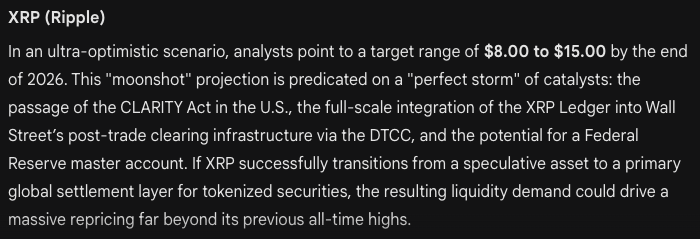
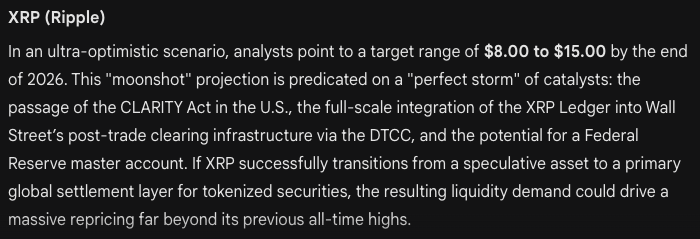
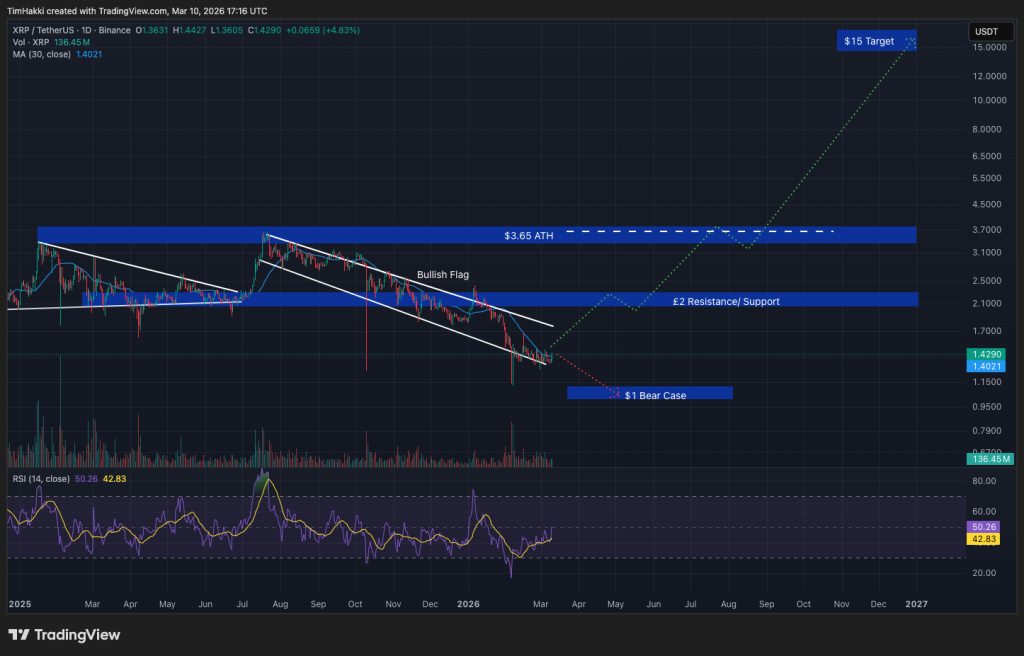
XRP is currently trading near $1.42, and Gemini’s projections indicate the asset could climb toward $15 before the end of the year, representing a more-than-tenfold increase.
Technical indicators also point toward improving momentum. XRP’s recent support and resistane lines form a bullish flag that often foreshadows a breakout.
Several price drivers to watch include sustained institutional investment via the recently launched US XRP ETFs, Ripple’s growing list of international partnerships, and the possibility of the CLARITY Act passing Congress this year.
Solana (SOL): Could Solana Double Its Previous Record in 2026?
Institutional adoption accelerated after asset managers Bitwise and Grayscale launched Solana spot ETFs in the US.
SOL experienced a steep downturn toward the end of 2025 and spent much of this February trading below $100.
Gemini’s most optimistic scenario sees Solana surging from $88 to as high as $600 by Christmas, a gain of 7x that would double SOL’s January 2025 ATH of $293.
Advertisement
Supporting the long-term thesis, major financial institutions including Franklin Templeton and BlackRock have begun deploying tokenized financial products on Solana, highlighting its early advantage in a potentially ubiquitous future crypto use case.
Cardano (ADA): Gemini AI Suggests Potential Gains of Up to 1,000%
Developed by Ethereum co-founder Charles Hoskinson, Cardano ($ADA) takes a a research-driven approach to development that prioritizes academic rigor, security, scalability, and sustainability.
With a market capitalization exceeding $10 billion and more than $140 million in TVL, Cardano’s ecosystem continues growing in step with its rivals.
Advertisement
Gemini’s forecast suggests ADA could rise by 826%, from roughly $0.27 today to around $2.50 by Christmas. Such a move would allow the token just below its record of $3.09 reached in 2021.
Like with all altcoins targeting institutional capital, comprehensive cryptocurrency legislation in the United States would massively expand ADA’s price prospects. Clear regulatory could also enable leading altcoins to move more independently from Bitcoin’s price cycles.
Maxi Doge: Early-Stage Meme Coin Aims for Major Breakout
If a bull run or altseason arrives, the momentum could drive the price of meme coins sky high, as they notoriously exaggerate the price movements of the wider market
Advertisement
One new meme coin tipped to explode tis Maxi Doge ($MAXI). The token has already raised $4.7 million through its ongoing presale as traders bet it could unseat stalwarts like BONK or Floki.
Maxi Doge is Dogecoin’s loud, proud hard-pumping, risk-loving distant cousin, recapturing the viral degen comic culture that ignited the 2021 meme coin boom.
The is an ERC-20 asset on Ethereum’s proof-of-stake network, giving it a smaller environmental footprint than Dogecoin’s proof-of-work architecture.
Presale investors can currently stake MAXI tokens for rewards reaching as high as 67% APY, although yields gradually decrease as more tokens enter the staking pool.
Advertisement
The token is $0.0002808 during the current round, with nominal price increases scheduled at each new funding round.


















 News Videos2 days ago
 Fashion4 days ago
 Tech6 days ago
 Crypto World1 day ago

 Sports3 days ago
 Sports3 days ago
 Politics5 days ago
 Business9 hours ago
 Business7 days ago
 NewsBeat5 days ago
 Entertainment4 days ago
 Business2 days ago

 Tech1 day ago
 Crypto World6 days ago
 Tech6 days ago
 Business1 day ago