

Crypto World
Solana Launches Onchain Governance With Stake-Weighted Voting for Validators



Solana Foundation announced Wednesday that onchain governance is live on the network, letting validators propose and vote on protocol-level decisions through a system called Solana Governance Proposals, or SGPs. The mechanism is fully onchain, stake-weighted and verified by Merkle proof, according… Read the full story at The Defiant

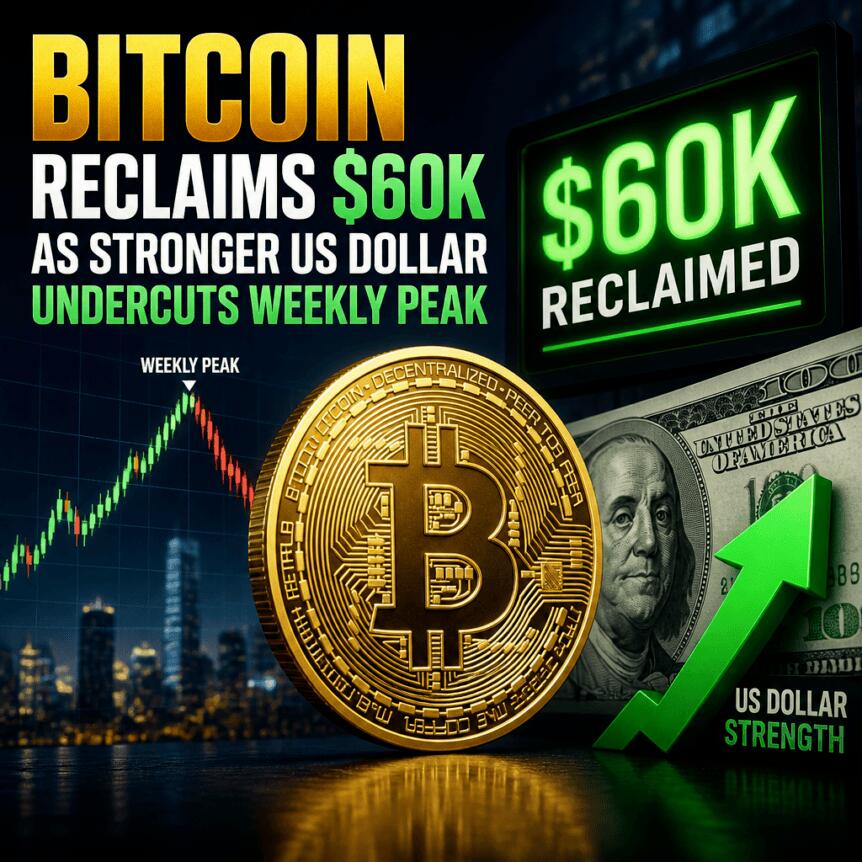
Bitcoin pushed higher at the Wall Street open on Wednesday, briefly trading up to the $60,000 area as broader risk sentiment improved and the US dollar eased.
TradingView data showed BTC/USD reaching $60,475 on Bitstamp, translating into nearly a 3% gain on the day. The move came after the pair’s June selloff had started July with a bounce from recent multiyear lows, while liquidations across crypto derivatives reportedly totaled more than $200 million over the prior 24 hours, according to CoinGlass.
Key takeaways
- BTC climbed toward $60,500 at the start of the first US session of July, adding nearly 3% intraday.
- Some of the tailwind appears linked to a cooling in US dollar strength, with DXY reversing off local highs.
- CoinGlass data points to large 24-hour liquidation totals, highlighting how sensitive leverage remains.
- Traders are framing July as a potential “relief” period, while still watching for a continuation of the broader downtrend later.
- Market participants note crowded positioning in the US dollar, which could affect cross-asset flows if it unwinds.
Bitcoin’s early July bounce targets a key $60,000 level
The rally gained momentum during the early New York session, with BTC/USD spiking to $60,475 on Bitstamp, per TradingView. At the time of the move, daily gains were running close to 3%, suggesting dip-buying interest rather than a sustained breakout at that moment.
Derivatives flows reinforced that volatility was still in play. CoinGlass data cited in the coverage put 24-hour crypto long liquidations above $200 million at the time of writing—an indicator that leveraged longs had been forced out during the prior decline, clearing some room for upside rebounds.
Trader Lennaert Snyder described the move as a “lovely pump” and suggested that exhaustion on lower time frames could precede another push toward roughly $60,700, based on his intraday charting. Snyder’s comments, posted on X, pointed to a near-term sequence: a brief cooling after the initial surge, followed by an attempt higher.
Range traders watch whether $58,000–$61,000 holds
While the price action looked constructive, several traders focused on range behavior rather than immediately calling for a trend reversal.
Daan Crypto Trades highlighted the possibility that BTC could turn the $58,000 to $61,000 area into a temporary range. In an X post earlier in the session, he argued that if price revisited either end of that range, it could produce a “decisive break” and a larger directional move.
“I think there’s a good chance that the next attempt at the range high or low will cause a decisive break and bigger move.”
US dollar weakness and “crowded” positioning add context
Alongside crypto-specific signals, the broader macro backdrop appeared to matter. The US dollar index (DXY) reportedly reversed from local highs of 101.6 at the open, giving Bitcoin room to rise as dollar strength cooled.
Commentary from The Kobeissi Letter emphasized that the larger dollar trend could shift “soon.” In a post cited in the coverage, it warned that the “long US Dollar trade is crowded,” claiming speculative long positioning surged to +$34.3 billion as of June 23—its highest level in 18 months.
That matters for crypto because BTC often trades as a high-beta asset sensitive to dollar liquidity conditions. If crowded positioning unwinds or if expectations for dollar strength fade, it can influence risk assets quickly—sometimes amplifying moves once markets already have momentum.
Why traders are calling July a potential “relief rally”
Beyond the immediate bounce, market participants continued to discuss the possibility of a relief rally through July, even as they acknowledged that the path beyond mid-summer remains uncertain.
Trader Titan, referenced in the report, pointed to a base-case scenario tied to the monthly structure—specifically that a relief move in July could occur before the downtrend resumes. In his view, Bitcoin’s monthly performance would need to navigate the broader trend pressures rather than simply break away from them.
“My base case: a relief rally in July before the downtrend resumes.”
Rekt Capital also reiterated a historical pattern he associates with Bitcoin’s calendar behavior: “Red June. Green July. Red August.” In a post cited in the coverage, he suggested that while downside “wicking” could happen early in July—potentially dipping below the new Monthly Open—history implies the price may expand upward as the month progresses.
Still, this framing is not a blanket bullish call. The same analysis points to a likely two-step process: near-term volatility and potential testing of levels early in the month, followed by an upside stretch—followed by a watchful stance for bearish moves in August.
In other words, the rally appears to be treated by many traders as a tactical reprieve within a larger uncertainty band, rather than evidence that the broader trend has definitively reversed.
What to watch next
Bitcoin’s move above $60,000 is attracting attention because it interacts with both leverage dynamics and macro inputs like the dollar. Traders will likely focus on whether BTC can hold gains through key intraday levels and whether DXY continues to lose momentum; at the same time, many market participants are watching the early-July monthly structure for signs that the “relief rally” thesis is developing or failing.

1,700 UK investors have launched a group lawsuit in London’s High Court against Binance and founder Changpeng Zhao.
The claimants say the pair sold risky crypto derivatives products to retail investors without authorization.
UK Investors Demand $200M from Binance
The plaintiffs allege that between around late 2019 and 2020, Binance offered products such as leveraged tokens, options, contracts, and futures without the approval of the UK’s Financial Conduct Authority (FCA).
The victims filed the lawsuit under the Financial Services and Markets Act, claiming the derivatives are “specialized investments” under the rules. The UK regulator banned Binance from selling these complex investment products in 2021, but the exchange continued to sell them to its users, they say.
The crypto traders also accuse it of promoting the products through advertising campaigns, online materials, social media posts, and email communications.
Hannah Sharp, a partner at the law firm representing the victims, said its clients had suffered lots of financial losses and that it was determined to hold CZ and the exchange accountable.
The Financial Times reported that traders lost tens of thousands of dollars, and in some cases millions. The claimants are now seeking about $200 million in compensation.
Binance Acknowledges Lawsuit
Binance has yet to respond to the accusations in the lawsuit, but has acknowledged it’s aware of the proceedings.
“We do not comment on ongoing litigation. We will defend against these claims through the appropriate legal process in due course,” said the firm in a statement.
The case adds to a list of legal and regulatory challenges it has faced in recent years, including its recent failure to secure an EU crypto license.
Following the setback, Binance initially informed customers that it would stop offering services in the region. However, CZ later emphasized that it remains committed to Europe and plans to apply for a permit through another jurisdiction.
This was after the European Securities and Markets Authority (ESMA) ordered all unauthorized digital asset firms to wind down their operations by July 1 if they failed to obtain a MiCA license before the deadline. Meanwhile, crypto executives say that the directive is expected to affect more than 80% of crypto platforms in the region.
UK regulators have long been known for their cautious approach, warning users that crypto is a high-risk investment. The FCA also recently unveiled its long-awaited rules for the sector, which will see firms have to meet financial safety standards, comply with anti-money laundering and market abuse laws, and satisfy consumer protection requirements.
The post UK Investors Sue Binance and Former CEO Changpeng Zhao for $200M appeared first on CryptoPotato.


Binance and Anchorage Digital launched an off-exchange settlement integration, letting institutional traders access Binance's liquidity while keeping their assets in Anchorage's custody rather than on the exchange itself. The service runs on Atlas, Anchorage's settlement infrastructure suite. The… Read the full story at The Defiant
Crypto World
SEC Opens 60-Day Comment Period on 'Novel' ETF Rules as Prediction Market Funds Pile Up


The Securities and Exchange Commission has opened a formal review of how it regulates "Novel ETFs," a category covering crypto-asset funds and products tied to prediction markets, publishing a request for comment as release 33-11426. The filing seeks comment on ways to facilitate innovation in the… Read the full story at The Defiant


Self-custody means holding your own keys instead of trusting an exchange to hold them for you. After FTX, Celsius, and Mt. Gox, the case is obvious. Yet most people still leave their crypto on a platform. Here is why, and how to change it.
Summary
- Self-custody means you control the private keys to your crypto, so no exchange, company, or third party can freeze, lose, or spend your funds. The trade is that you carry full responsibility for keeping those keys safe.
- The alternative is custodial storage, where an exchange holds your keys for you. It is convenient and offers support and recovery, but it exposes you to counterparty risk if the platform is hacked, goes insolvent, or freezes withdrawals.
- The phrase “not your keys, not your coins” captures the core lesson from collapses like FTX, Celsius, and Mt. Gox, where users who left funds on a platform lost access when it failed.
- Self-custody wallets come in two forms: hot wallets, which stay connected to the internet for convenience, and cold wallets, which keep keys offline for maximum security, usually on a hardware device.
- Despite the risks, surveys show most users still keep crypto on exchanges, because self-custody means managing a seed phrase and accepting that a lost phrase or a phishing mistake can mean permanent loss.
Self-custody is one of the founding ideas of crypto and one of the least practiced. The promise of Bitcoin and the systems that followed was that you could hold value directly, without a bank or a broker standing between you and your money. Self-custody is that promise made real: you hold the keys, and no one else can touch your funds. The catch is that holding the keys means holding all the responsibility, and after years of exchange collapses that wiped out users who trusted platforms to hold their crypto, most people still do exactly that. This guide explains what self-custody is, how it differs from leaving crypto on an exchange, the difference between hot and cold wallets, how to set it up, and the real risks on both sides.
What self-custody means
To understand self-custody, you first have to understand what a crypto wallet actually holds. Your crypto does not sit inside your wallet the way cash sits in a leather one. The coins live on the blockchain, a public ledger copied across thousands of computers. What you truly own is the private key, a secret piece of data that authorizes moving those coins. Whoever controls the private key controls the crypto. A wallet is really just a tool for storing and using that key.
Self-custody, also called non-custodial storage, means you hold the private keys yourself. You alone can authorize transactions, and no company sits between you and your funds. Because no third party has your keys, no exchange bankruptcy, no regulatory seizure, and no corporate decision can freeze or take your crypto. You have complete control, and with it complete responsibility, since there is no help desk that can recover your funds if you lose your key.
The opposite arrangement is custodial storage, the default when you buy crypto on an exchange. There, the platform holds the private keys on your behalf. You see a balance in your account, and you can trade and withdraw, but the exchange controls the keys and therefore the crypto. You are trusting the company to safeguard your funds and to let you access them when you want. That trust is convenient, and it is also the entire source of the risk that self-custody is designed to remove.
Not your keys, not your coins
The phrase that has circulated in crypto for years is “not your keys, not your coins,” and it is the single most important idea in this whole subject. It means that if you do not control the private keys, you do not truly control the crypto, no matter what balance an app shows you. When your funds sit on an exchange, what you own is a claim against that company, not the coins themselves. As long as the company is solvent and honest, the claim is as good as the coins. When it is not, the difference becomes everything.
History has proven the point repeatedly. When large exchanges and lenders collapsed, users who had left their crypto on those platforms found they could not withdraw, and many never recovered their funds. The failures of Mt. Gox years ago, and of FTX, Celsius, and other platforms more recently, all delivered the same lesson: a balance on a platform is only as safe as the platform, and platforms fail. In each case, users who held their own keys were untouched, while those who trusted a custodian shared in its collapse.
This is the argument for self-custody in one sentence: it removes counterparty risk. There is no company that can go bankrupt with your coins, no platform that can freeze your account, no custodian that can be hacked and drained. The price of removing that risk is taking on the responsibility yourself, which is exactly where the difficulty, and the reason most people still avoid it, begins.
Hot wallets versus cold wallets
Within self-custody, wallets divide into two families based on whether they are connected to the internet. A hot wallet is a self-custody wallet that stays online, usually as a phone app or a browser extension. It is convenient: you can send, receive, and interact with on-chain applications quickly, which makes it well suited to small balances and daily use. The trade is exposure, because anything connected to the internet is more reachable by attackers, malware, and phishing.
A cold wallet keeps the private keys offline, most often on a dedicated hardware device that looks like a small USB stick. The keys are generated and stored on the device and never leave it; when you want to send crypto, the transaction is signed on the device itself, so the secret key is never exposed to your internet-connected computer or phone. This offline design makes cold wallets far more resistant to remote attacks, which is why they are the standard for larger amounts and long-term holding. The trade is convenience, since using one takes more steps and the physical device can be lost, damaged, or stolen.
It is worth separating two ideas that are often confused. Hot versus cold describes internet exposure. Custodial versus non-custodial describes who holds the keys. A hardware cold wallet is non-custodial and offline. An exchange account is custodial and online. You can have self-custody that is hot, such as a phone wallet, or self-custody that is cold, such as a hardware device. The safest arrangement for meaningful sums is self-custody that is also cold, because it combines your control of the keys with their isolation from the internet.
The seed phrase
At the center of nearly every self-custody wallet sits the seed phrase, and understanding it is non-negotiable. When you set up a wallet, it generates a sequence of 12 to 24 ordinary words, called the seed phrase or recovery phrase. Those words are a human-readable form of your master key. From them, the wallet derives all of its private keys, which means the seed phrase can restore your entire wallet on any compatible device if your phone breaks or your hardware wallet is lost.
That power cuts both ways. Anyone who obtains your seed phrase can recreate your wallet and take everything in it, from anywhere in the world, with no way to reverse the theft. And if you lose your seed phrase and lose access to your device, your funds are gone permanently, because no company holds a copy and no one can regenerate it for you. The seed phrase is the thing you are really protecting in self-custody, and the rules are strict: write it down and store it offline in a secure place, never type it into a website or share it with anyone, and never store it as a photo or in a cloud account where it could be leaked or hacked.
The seed phrase is also the reason self-custody feels intimidating, and it should command respect rather than fear. It replaces the bank’s password-reset and fraud-reversal safety nets with a single artifact that you alone are responsible for. Most catastrophic self-custody losses trace back to a seed phrase that was lost, exposed, or handed to a scammer, so mastering how to store it safely is most of the battle.
How to set up self-custody
The path is more approachable than it sounds. Start by deciding how much you are protecting and for how long. Small amounts you actively trade can live in a hot wallet or on a regulated exchange; larger amounts you intend to hold belong in cold storage. That decision drives which wallet you set up.
To set up a hot wallet, download a reputable wallet app or extension, triple-checking that you are on the official site to avoid the fake wallet apps that scammers publish. The wallet will generate your seed phrase; write it down on paper, store it securely offline, and never save a digital copy. To set up a cold wallet, buy a hardware device directly from the manufacturer or an authorized seller, never secondhand, then follow its setup to generate and record the seed phrase on the device. Once the wallet exists, you fund it by sending crypto to its receiving address.
A concrete example shows the flow. Suppose you hold Ether on an exchange and want to move it into self-custody. In your wallet, you find your receiving address for Ether and copy it. On the exchange, you choose to withdraw Ether, paste in your wallet’s address as the destination, confirm the network is correct, and review the fee before sending. After the network confirms the transaction, the Ether now sits in your self-custody wallet, controlled by your keys, and it will stay there untouched until you decide to move it. That single transfer is the moment custody changes hands, from the exchange to you.
The mixed approach
In practice, most experienced users do not choose between an exchange and self-custody; they use both, with a deliberate split. The common model is to keep the bulk of holdings in cold self-custody, isolated from the internet and from platform risk, while keeping a smaller working balance on an exchange or in a hot wallet for active trading and quick access. A frequently cited starting ratio is roughly 70% in cold storage and 30% on a platform or hot wallet, adjusted to how actively you trade.
The logic is that different funds have different jobs. Money you may need to move or trade at short notice benefits from the speed and liquidity of an exchange, and keeping only a small operational balance there limits how much is exposed if the platform fails. Money you intend to hold for the long term has no reason to sit exposed to counterparty risk, so it belongs in cold storage where your keys, offline, protect it. Splitting deliberately captures the convenience of a platform for the funds that need it while keeping the majority safe.
This is also the arrangement that shows up at the level of large holders and institutions, who typically hold reserves in cold storage, sometimes behind multiple required approvals, and keep only operational liquidity on exchanges. The broader on-chain trend of crypto leaving exchanges and moving into private wallets, often read as a sign of accumulation, is the same behavior at scale: participants moving coins they intend to keep off platforms and into custody they control.
Newer options and the responsibility trade
The seed phrase problem has driven a wave of newer wallet designs aimed at keeping self-custody while removing its sharpest edge. Multi-party computation, or MPC, wallets split the signing key into several encrypted shares held in different places, so there is no single seed phrase to lose or steal, and no one share can move funds alone. Some seedless wallets use this approach with familiar phone-based security like biometrics, letting beginners hold their own keys without memorizing or safeguarding a 24-word phrase. These designs aim to make self-custody accessible to people who found the seed phrase too risky to manage.
Even so, self-custody remains a trade-off instead of a free upgrade, and that is why most people still leave crypto on exchanges despite the risks. Surveys of crypto users capture the gap clearly: a large majority say self-custody is important and many fear a major exchange breach, yet most still keep their assets on centralized platforms and only a minority use a cold wallet. The reasons are convenience and fear of self-inflicted loss. An exchange offers password resets, customer support, and the comfort of not being solely responsible, while self-custody offers control at the cost of accepting that a lost phrase or a single phishing mistake has no undo.
The honest framing is that self-custody removes counterparty risk and replaces it with personal responsibility. Neither approach is strictly correct for everyone. A beginner with a small balance may reasonably start on a reputable exchange while learning, and a long-term holder with meaningful sums has a strong case for cold self-custody. The goal is to match the method to the amount, the time horizon, and your own comfort with responsibility, and to make that choice deliberately rather than by default.
The main risks to manage
Self-custody shifts the risks instead of removing them, so it helps to name what you are now guarding against. The first is seed phrase loss: misplace the phrase and lose your device, and the funds are unrecoverable, so secure, redundant, offline backups matter.
The second is exposure: a seed phrase photographed, stored in the cloud, or typed into a website can be stolen, so it must stay offline and private. The third is phishing and scams, the most common way self-custody users actually lose funds, where attackers trick you into entering your seed phrase on a fake site, signing a malicious transaction, or downloading a counterfeit wallet app.
The fourth risk is physical, since a hardware device can be lost, damaged, or stolen, which is why the seed phrase backup, stored separately from the device, is what actually protects you rather than the device itself. Practical defenses follow directly from these risks: store the seed phrase offline in more than one secure location, never share it or enter it anywhere online, verify every website and app through official channels, and treat any unexpected request for your phrase or an urgent prompt to sign something as an attack until proven otherwise.
The reassuring part is that these risks are manageable with discipline, and none of them involve trusting a company that could fail. The custodial user worries about the platform’s security, which they cannot see or control. The self-custody user worries about their own practices, which they can. For many people, trading a risk they cannot control for one they can is the entire appeal, and the reason the phrase “not your keys, not your coins” has outlasted every platform that tested it.
Frequently Asked Questions
What does self-custody mean in crypto?
Self-custody means you hold the private keys to your crypto yourself, so you alone can authorize transactions and no exchange or company can freeze, lose, or spend your funds. Your coins live on the blockchain, and the private key is what controls them. The trade is that you take on full responsibility for keeping those keys safe, with no help desk to recover them if lost.
What is the difference between a custodial and a non-custodial wallet?
A custodial wallet, such as an exchange account, has a third party hold your private keys for you. It is convenient and offers support and recovery, but it exposes you to counterparty risk if the platform fails. A non-custodial wallet, meaning self-custody, has you hold the keys, removing counterparty risk but making you solely responsible for security. The distinction is simply who controls the keys.
What does “not your keys, not your coins” mean?
It means that if you do not control the private keys, you do not truly control the crypto, regardless of what balance a platform shows you. Funds on an exchange are a claim against that company, not the coins themselves. If the company is hacked, goes bankrupt, or freezes withdrawals, that claim can fail, as users learned when platforms like FTX, Celsius, and Mt. Gox collapsed.
What is the difference between a hot wallet and a cold wallet?
A hot wallet is a self-custody wallet that stays connected to the internet, usually as a phone app or browser extension. It is convenient for small amounts and daily use but more exposed to online attacks. A cold wallet keeps the private keys offline, typically on a hardware device, signing transactions without exposing the key to the internet, which makes it far more secure for larger, long-term holdings.
What is a seed phrase and how should I protect it?
A seed phrase is a sequence of 12 to 24 words generated when you set up a wallet, and it is a human-readable master key that can restore your entire wallet on any compatible device. Anyone who obtains it can take your funds, and losing it can mean permanent loss. Write it down, store it offline in secure locations, never share it, and never save it online or as a photo.
Is self-custody safer than keeping crypto on an exchange?
It removes counterparty risk, the danger that a platform is hacked, goes insolvent, or freezes withdrawals, which is a real and repeatedly proven threat. But it adds personal responsibility, since a lost seed phrase or a phishing mistake has no undo. Self-custody is safer against platform failure and riskier against your own errors, so the right choice depends on the amount, your horizon, and your discipline.
Can I use both an exchange and self-custody?
Yes, and most experienced users do. The common approach keeps the bulk of holdings in cold self-custody, protected from platform risk, while keeping a smaller working balance on an exchange or hot wallet for trading and quick access. A frequently cited split is around 70% in cold storage and 30% on a platform, adjusted to how actively you trade. Different funds get matched to different needs.
What are MPC or seedless wallets?
Multi-party computation wallets split the signing key into several encrypted shares held separately, so there is no single seed phrase to lose or steal and no one share can move funds alone. Some seedless wallets use this with phone-based security like biometrics, letting users hold their own keys without safeguarding a 24-word phrase. They aim to keep the control of self-custody while reducing the seed phrase risk.
Disclaimer: This article is for information and educational purposes only and does not constitute financial, investment, or security advice. Self-custody carries the risk of permanent loss if keys or seed phrases are lost or stolen. Nothing here is a recommendation to use any specific product or service. Always do your own research and consider consulting a qualified professional before making decisions about storing digital assets. Information is accurate as of July 1, 2026, and may change.
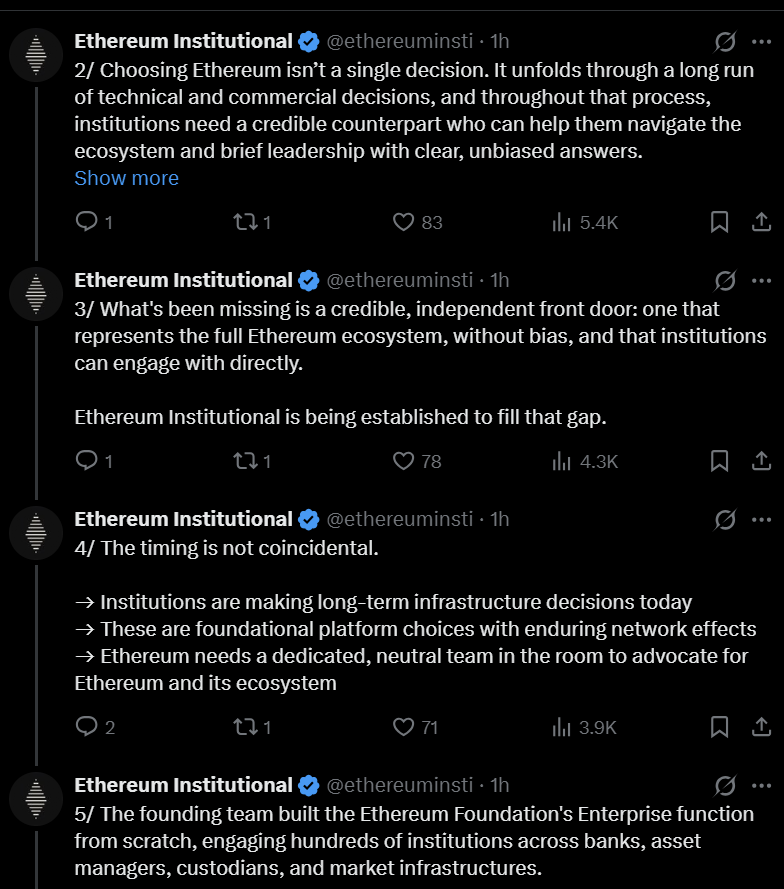
An Ethereum founder and some of its biggest treasury holders are behind a new independent nonprofit launched to coordinate the blockchain’s institutional outreach, underscoring the ecosystem’s push to attract more banks, asset managers and financial institutions as competition from rival blockchains intensifies.
The nonprofit, Ethereum Institutional, was introduced on Wednesday with backing from Ether (ETH) treasury companies BitMine Immersion Technologies and SharpLink, as well as blockchain co-founder Joe Lubin and other contributors. It plans to expand beyond New York, London, Hong Kong and Singapore into additional financial hubs while offering education, standards development, industry research and institutional events.
In a social media post announcing the launch, Ethereum Institutional said the ecosystem has lacked “a credible, independent front door” for engaging financial institutions, arguing that such a role is needed to accelerate institutional adoption.
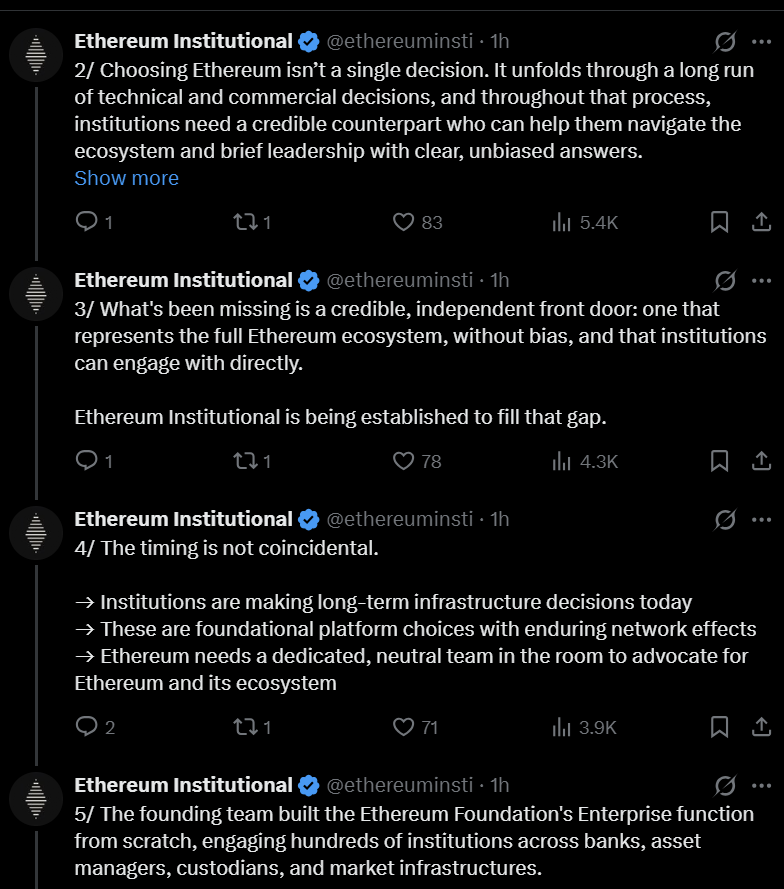
Source: Ethereum Institutional on X.com
The launch comes as Ethereum continues to dominate the markets for stablecoins and tokenized real-world assets (RWAs), even as rival blockchains step up efforts to attract institutional users. According to Token Terminal, Ethereum hosts nearly 58% of the tokenized RWA market. Data from DeFiLlama also shows the network accounts for roughly half of the $311 billion stablecoin market.
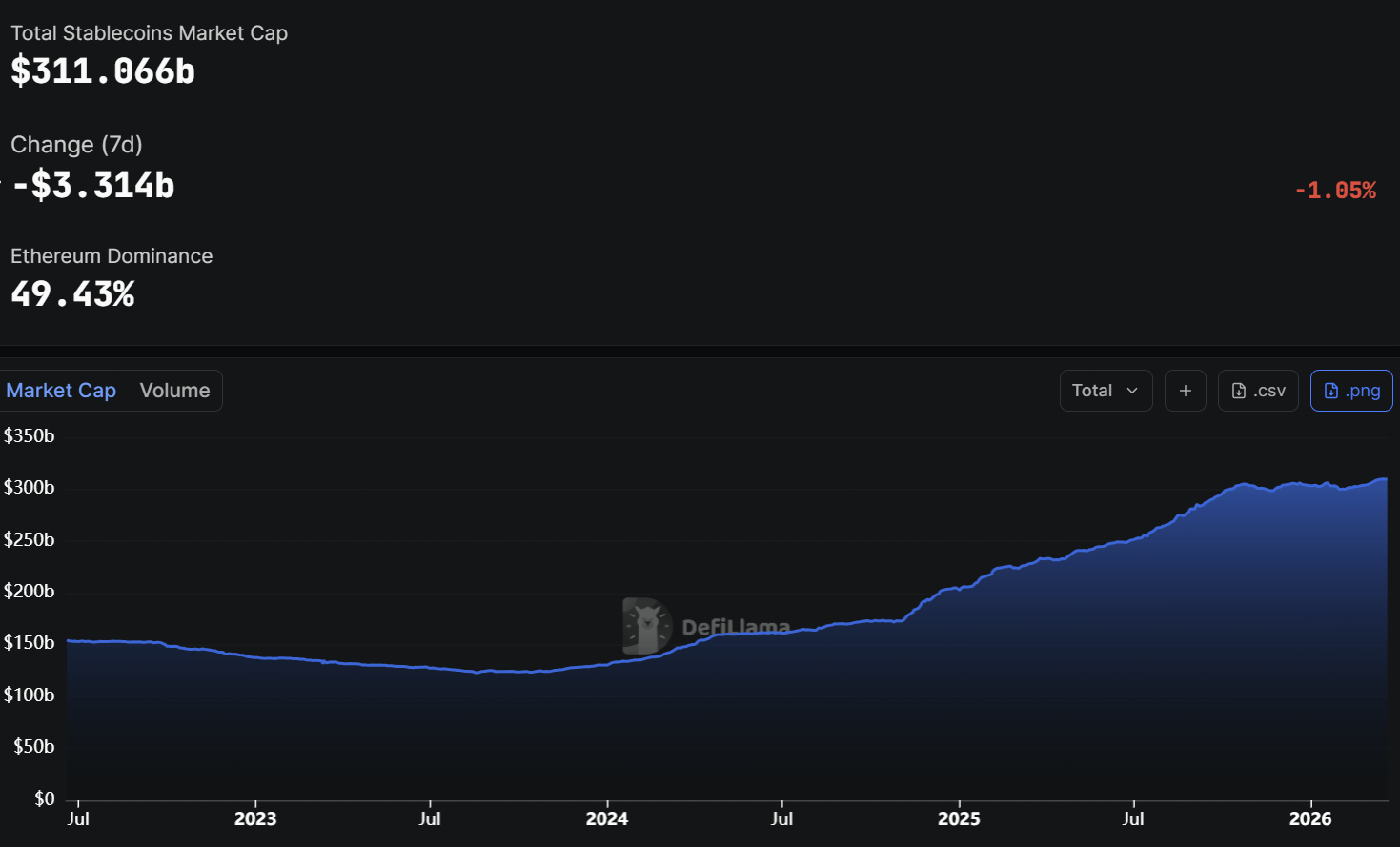
Although competition is intensifying, Ethereum remains the dominant blockchain for stablecoins. Source: DeFiLlama
To be sure, the development also comes as Ether prices remain under pressure, weighing on the balance sheets of companies with large ETH treasuries. BitMine and SharpLink are both sitting on sizable unrealized losses, with the cryptocurrency’s price recently falling to a low near $1,500.
ETH was trading at more than $1,620 at last look on Wednesday, with a market cap of $195.4 billion, Coingecko data showed. It was trading above $4,000 as recently as Oct. 27.
Nevertheless, institutional adoption remains one of the crypto industry’s strongest trends. According to 21shares, current asset prices have yet to reflect growing demand from portfolio managers, asset managers and financial institutions.
Related: Credit unions managing $25B in assets join stablecoin infrastructure program
Ethereum Foundation overhaul reshapes institutional strategy
The institutional push comes as the Ethereum Foundation undergoes a broad organizational overhaul. The nonprofit, which supports Ethereum’s core protocol development and ecosystem growth, has spent the past year navigating leadership changes, internal debates over governance and development priorities, growing competition from rival blockchains and criticism over Ether’s market performance.
Last month, co-executive director Hsiao-Wei Wang stepped down, one of roughly 19 reported departures from the foundation this year. The leadership shake-up was followed by a restructuring that included laying off 20% of the foundation’s workforce.
Amid the restructuring, the ecosystem has also seen the emergence of new independent organizations aimed at advancing Ethereum’s long-term development. In June, the same backers behind Ethereum Institutional launched Ethlabs, a nonprofit research organization focused on advancing Ethereum’s scalability.
Related: Buterin fires back at Ethereum Foundation critics, recommits to neutrality
StanChart sees positives in news
Standard Chartered’s Geoff Kendrick said that today’s announcement, paired with the earlier launch of Ethlabs, has “direct positive implications for both Ethereum layer 1, layer 2s and the Ethereum originated DeFi protocols.”
“Very importantly the anchor funders for both organizations are the three commercial giants in the Ethereum ecosystem,” he said in a Wednesday note to clients. “Their expertise will drive commercialisation of the Ethereum ecosystem at the time TradFi is entering at scale.”
Kendrick recently reaffirmed his ETH price forecasts of $4,000 at the end of 2026 and $40,000 at the end of 2030.
Crypto World
Robinhood Launches Robinhood Chain Mainnet, Adds Stock Tokens, Onchain Lending, and Agentic Crypto Trading


Robinhood put its blockchain ambitions into production on July 1, launching the public mainnet of Robinhood Chain and pairing it with a wave of trading and lending products built to run on top of it. The announcements came during a keynote called "Robinhood Presents: The World is Flat," streamed… Read the full story at The Defiant
Crypto World
Aave Wallet Growth Hits 5-Year High Even as Standard Chartered Revises Crypto Forecasts


Aave logged its largest single-day wallet growth in nearly five years, with 1,806 new addresses created on Ethereum on June 30, according to on-chain analytics firm Santiment.
The surge lines up with a $3,500 price target on Aave (AAVE) from Standard Chartered, a bank that has repeatedly cut its own Bitcoin (BTC) and Ethereum (ETH) forecasts this year.
A Familiar Pattern of Forecasts
Standard Chartered initiated coverage of AAVE with a target implying nearly 50 times upside by 2030, built on an Aave $3,500 forecast tied to tokenized assets flooding decentralized finance (DeFi). The bank made a similar call on Uniswap (UNI) weeks earlier, and that forecast also triggered a jump in Uniswap network activity before it cooled off.
The same research desk cut its 2026 Bitcoin target from $150,000 to $100,000 and slashed its Ethereum price target 47%, from $7,500 to $4,000, within the same three-month stretch.
“We forecast significant upside for digital asset token prices into year-end, and we think Aave has moved beyond the April incident.”
Geoff Kendrick, Standard Chartered
That April incident was the KelpDAO exploit, which drained roughly $292 million and fed a KelpDAO exploit fallout that briefly cut Aave’s deposits nearly in half. Aave has since restarted its AAVE buyback program under Aavenomics 3.0, confirmed by founder Stani Kulechov, adding a direct revenue-to-token mechanism behind the current move.
Whether new wallets convert into deposits and borrowing, rather than short-lived attention, will decide if Aave’s growth outlasts Standard Chartered’s own forecasting record.
The post Aave Wallet Growth Hits 5-Year High Even as Standard Chartered Revises Crypto Forecasts appeared first on BeInCrypto.

A Democratic candidate in Colorado’s 8th congressional district, Manny Rutinel, has won his party’s primary and will face the general election in November after receiving support from crypto-aligned political groups. Rutinel reported early Wednesday that he captured the nomination with 61.7% of the vote against Shannon Bird’s 33.6%.
Before the primary, the You Can Push Back Super PAC—backed by $3.5 million from Ripple Labs co-founder Chris Larsen—reportedly spent $1 million on media to help Rutinel’s campaign, according to The Guardian. Rutinel also holds a “strongly supports crypto” rating from the Coinbase-affiliated Stand With Crypto organization, which said its score is based on his answers regarding stablecoins, market structure and regulatory clarity. Coinbase is meanwhile listed as a major contributor to Fairshake PAC, another crypto-backed political committee supporting candidates described as “pro-crypto” in the 2026 cycle.
Key takeaways
- Manny Rutinel won the Colorado 8th district Democratic primary with 61.7% of the vote, setting up a November general election.
- Crypto-aligned political spending is part of the campaign backdrop, including reported Super PAC media buys linked to Chris Larsen.
- Rutinel has received a high rating from Stand With Crypto, an advocacy group tied to Coinbase.
- Consumer advocacy group Public Citizen reported the crypto industry has spent about $189 million so far to influence the 2026 elections, mostly through PACs.
- A new poll indicates many Americans across party lines worry crypto donors have too much influence over lawmakers and crypto rules.
Crypto-aligned backing meets campaign momentum in Colorado
Rutinel’s primary win consolidates a political lane that increasingly intersects with cryptocurrency policy. In the materials surrounding his candidacy, Stand With Crypto—affiliated with Coinbase—has emphasized Rutinel’s stated positions on topics central to current crypto regulation debates, including stablecoins and the clarity of market and regulatory frameworks.
Stand With Crypto’s rating, along with the broader Fairshake ecosystem, signals how major industry players and aligned PACs are attempting to translate policy positions into electoral outcomes. Rutinel’s campaign is therefore occurring not in isolation, but within a larger pattern of crypto-focused political advocacy aiming to shape how lawmakers approach enforcement, market rules and regulatory standards.
Cointelegraph reached out to a spokesperson for You Can Push Back for comment but did not receive an immediate response.
Spending race around the 2026 elections draws scrutiny
The Colorado race is unfolding amid continued political spending tied to crypto. On Tuesday, Public Citizen said the cryptocurrency industry had spent about $189 million so far to influence the 2026 US elections, largely through PACs, according to an earlier Cointelegraph report.
Public Citizen’s framing suggests the industry is repeating a strategy used in the 2024 cycle: deploy political spending through aligned committees to support candidates seen as favorable to crypto policy goals. For investors and builders in the sector, this matters because electoral outcomes can affect how aggressively regulators pursue enforcement, how quickly legislation moves, and whether policy proposals emphasize consumer protection, market structure, or both.
Voters question the industry’s access to lawmakers
While crypto-aligned groups are backing candidates, public concern about influence in Washington is also rising. A new poll commissioned by Americans for Financial Reform, released on Wednesday, found that a majority of Americans are concerned about the influence the crypto industry has on US lawmakers, according to the group’s press release.
The poll’s release followed disclosures tied to President Donald Trump’s cryptocurrency investments. Cointelegraph previously reported that filings showed Trump profited by more than $1.4 billion from crypto investments, according to Cointelegraph coverage.
Americans for Financial Reform associate director of crypto and fintech Mark Hays said voters have “serious crypto corruption” concerns, pointing to reported profits for high-ranking officials alongside losses and scams experienced by everyday people. Hays argued that voters want crypto companies to follow the same kinds of rules as other financial businesses rather than receiving special privileges.
When asked about potential conflicts of interest, White House Deputy Press Secretary Anna Kelly said on Tuesday that neither Trump nor his family “has ever engaged — or will ever engage — in conflicts of interest.”
What to watch as crypto politics heads toward November
Rutinel’s nomination win highlights how crypto policy advocacy is increasingly tied to electoral results—both through candidate endorsements and through political committee activity. With Public Citizen describing large, PAC-driven spending and a fresh poll showing broad voter unease about industry influence, the key uncertainty going into November is whether lawmakers respond to pressure through tougher regulation, clearer market rules, or a reassessment of how the political process interacts with financial oversight.


The headline number is income, not a wallet balance. Trump’s disclosure shows more than a billion dollars in crypto earnings, but what he holds today is a smaller and more specific story worth reading carefully.
Summary
- President Trump’s annual financial disclosure, released June 30, 2026, reports more than $1 billion in crypto-related income for 2025, with some outlets totaling the figure near $1.4 billion.
- The largest single line is about $635 million in royalties tied to the $TRUMP meme coin, paid through CIC Digital LLC under a licensing arrangement described as Celebration Coins.
- World Liberty Financial, the Trump-linked venture that issues the WLFI token and the USD1 stablecoin, accounts for the bulk of the rest, roughly $515 million to $592 million across token sales and an equity sale.
- Income is not the same as holdings: the filing lists current cold-wallet positions of over $50 million in Bitcoin and a smaller Ethereum position, plus staking rewards, figures far below the headline earnings number.
- The disclosure has drawn conflict-of-interest criticism, which the White House denies, and it lands as crypto market-structure legislation remains stalled in the Senate.
The number everyone repeated was “more than a billion dollars,” and it is accurate. But it answers a different question from the one most readers think they are asking. Trump’s disclosure reports crypto income, the money his ventures earned and distributed over the year, not a snapshot of a wallet. What he actually holds today is a separate and smaller figure, and the gap between the two is the most important thing in the filing.
This piece separates the earnings from the holdings, walks through where each number comes from, explains the vehicles behind them, and covers the conflict question honestly, with the criticism and the denial both on the page. The goal is the real picture, not the headline. Trump’s crypto ventures were extraordinarily lucrative in 2025, but that does not mean the disclosure shows a billion-dollar crypto wallet. It shows a much more specific mix of licensing income, token-sale proceeds, Bitcoin holdings, Ethereum exposure, staking rewards, and Trump-linked token businesses.
What the disclosure is
The document is a routine but revealing instrument: the annual public financial disclosure that federal officials must file, submitted on the Office of Government Ethics Form 278e and covering the 2025 reporting year, the first full year of Trump’s second term. It was released on June 30, 2026, after a 45-day extension, and it is enormous, running to roughly 900 pages by most counts, with one tally at 847. For comparison, recent predecessors filed forms in the single or low double digits of pages. That scale alone explains why the first wave of headlines focused on the biggest and easiest number to repeat.
Two features of the format matter for reading it correctly. First, values are reported in dollar ranges, or brackets, not exact amounts, which is standard for government ethics filings. When the disclosure says a holding is worth “over $50 million,” that is the top bracket on the form, and the true figure could be higher. Second, the filing mixes income and assets throughout, listing what ventures earned alongside what the filer holds.
Conflating the two is the single most common error in the coverage, and avoiding it is the whole point of reading the document carefully. Income tells you what flowed in during the year. Holdings tell you what remained as assets at the reporting date. The filing contains both, and the difference between them changes the story.
The income: where the billion-plus came from
The earnings side is where the large numbers live, and it breaks into two main sources. The single biggest line on the entire filing is roughly $635 million in royalties tied to the $TRUMP meme coin, paid through CIC Digital LLC under a licensing arrangement the filing describes as Celebration Coins. That one item accounts for more than half of the crypto income by itself. It is also why the TRUMP meme coin category matters here: the biggest number in the disclosure came from a politically branded token business, not from ordinary trading gains.
The second major source is World Liberty Financial. Across the filing, WLF-linked proceeds run to roughly $515 million to $592 million, depending on how the line items are grouped. That total includes general token-sale distributions in the low hundreds of millions, an equity sale of about $65 million tied to a Trump-affiliated entity that held a 38.25% stake in the venture, and a wallet-by-wallet breakdown of token proceeds. That breakdown is unusually granular: Ethereum proceeds of about $150.6 million, Bitcoin proceeds of about $33.5 million, USDC proceeds of about $56 million, and smaller distributions in tokens including Link, Aave, ENA, Move, and Ondo.
Add the two sources together and the crypto income clears $1 billion, with some outlets putting the full-year figure near $1.4 billion. The key word across all of this is income. These are proceeds from selling tokens and licensing a brand, realized and distributed over the year. They describe money that came in, not a pile of assets sitting in a wallet today.
The holdings: what he actually owns now
This is the part the headlines skip. Separate from the income, the disclosure lists current crypto holdings, and they are far smaller than the earnings. The filing shows a cold-wallet Bitcoin position valued at over $50 million, the top bracket on the form, and a smaller Ethereum position, reported in a multimillion-dollar range that varies across readings of the filing’s line items. It also notes ether staked through a Coinbase arrangement that produced about $1.8 million in validator rewards, meaning some of the Ethereum is generating yield.
The contrast is the story. More than a billion dollars flowed through Trump’s crypto ventures as income, but the disclosed holdings amount to a Bitcoin stake above $50 million and a smaller Ethereum stake, plus whatever exposure runs through the WLFI token and USD1 stablecoin tied to World Liberty Financial. In other words, the ventures earned enormously, but the reported end-of-period crypto assets are a fraction of that, consistent with income being distributed or moved rather than accumulated as a growing on-chain balance. Anyone picturing a billion-dollar wallet is misreading the filing.
That does not make the holdings trivial. A cold-wallet Bitcoin position above $50 million is still a large disclosed crypto asset for any public official, and it sits inside a much wider portfolio. But it is not the same thing as the income number. The more accurate read is that the crypto businesses generated the headline money, while the disclosed direct crypto holdings show a smaller ongoing exposure led by Bitcoin.
Income versus holdings: why the distinction matters
The gap between the two numbers is not a technicality. It changes what the disclosure actually tells you. Income measures the flow of money a venture generated and paid out over a period. Holdings measure the stock of assets held at a point in time. A licensing deal can generate $635 million in royalty income without any of it remaining as a crypto holding, because royalties are paid in cash or converted, not held as tokens.
Token sales generate proceeds precisely by selling the tokens, which reduces holdings even as it produces income. That is why a venture can produce hundreds of millions of dollars in crypto-related income while the end-of-period balance sheet shows a much smaller direct crypto position. The same logic applies to staking rewards: a reward is income, while the staked ether is a holding. Mixing those categories makes the disclosure look like a single giant pile of crypto, when it is actually a set of different flows and assets.
So the honest framing is this: Trump’s crypto ventures were extraordinarily lucrative in 2025, and his disclosed crypto holdings at the end of the period were comparatively modest, led by a Bitcoin position above $50 million. Both facts are true, and reporting only the first inflates the picture. The holdings figure is the better guide to ongoing exposure, while the income figure is the better guide to how much the ventures earned. Reading them as one number, a billion-dollar hoard, is simply wrong.
World Liberty Financial and the token machine
Understanding the income requires understanding the vehicle behind most of it. World Liberty Financial is the Trump-linked crypto venture, co-founded by family members including Eric Trump and Donald Trump Jr., that issues the WLFI governance token and the USD1 stablecoin. It is the engine that produced the bulk of the non-meme-coin crypto income in the disclosure, through token sales and the equity stake held by an affiliated entity. For readers trying to parse the structure, the WLFI governance token and the USD1 stablecoin are different instruments with different economics.
WLF matters beyond the 2025 figures because it is an ongoing business, not a one-time event. A governance token and a stablecoin are products that keep generating activity, fees, and potential proceeds, which means the venture is a recurring source of income rather than a closed chapter. For anyone tracking the crypto-market implications, WLFI and USD1 are the live instruments to watch, since their adoption and trading are where the venture’s future value, and the associated exposure, will show up. The disclosure quantifies what WLF generated in one year; the tokens are how the story continues.
That is also why the WLF portion of the filing is politically and commercially important. It is not merely a passive investment line. It is a live Trump-linked crypto business operating in the same sector the administration is regulating. The financial disclosure does not settle the ethics question, but it gives the market a clearer picture of how large the business has already become.
The $TRUMP meme coin
The largest single income line deserves its own look. The $TRUMP meme coin launched on the Solana network just days before Trump returned to office in January 2025, and the roughly $635 million in the filing came almost entirely from royalties on a licensing agreement, routed through CIC Digital LLC and described as Celebration Coins. This is a licensing structure: the earnings are royalty income from the use of the brand and the coin, not proceeds from Trump trading the token himself. That distinction matters because it explains why the line can be so large without matching a current token balance.
The meme coin is also the clearest illustration of the income-versus-holdings point. A licensing royalty of $635 million is a payment for the use of a name and a product, and it does not imply a corresponding crypto holding. It is cash income generated by the coin’s existence and trading, flowing to the licensor. The meme coin made a great deal of money as a business line, which is a separate fact from whether the president holds a large position in the token today.
It also carries the heaviest headline risk. A politically branded meme coin is not just a crypto product; it is a financial instrument tied to a public officeholder’s name and political identity. That makes it commercially powerful and ethically sensitive at the same time. The disclosure confirms the scale of the income, but it does not make the token safer, less volatile, or less politically exposed.
The conflict-of-interest question
No honest account of this disclosure can skip the controversy, and no fair one can take a side on it. The scale of a sitting president earning more than a billion dollars from crypto ventures, while his administration pursues favorable crypto policy, has drawn sharp conflict-of-interest criticism, including from lawmakers. Some Democrats opposing crypto market-structure legislation have argued it should not pass without ethics language barring the president and his family from crypto businesses. Critics frame the overlap between Trump’s crypto income and his crypto policy as the core problem.
The White House rejects the framing. A spokesperson has said neither the president nor his family has engaged or will engage in conflicts of interest, and the Trump Organization says the assets are managed by third-party institutions with trades executed through automated technology, meaning the president does not direct the investments. The administration casts its crypto stance as promoting American innovation and economic growth rather than personal benefit. Both positions are part of the record.
The disclosure documents the numbers; whether they represent an improper conflict is a contested judgment, and this article reports the dispute without resolving it. The market implication is that the Trump-linked tokens now sit at the center of both commercial opportunity and legislative scrutiny. That scrutiny matters because the market-structure legislation remains part of the broader policy backdrop for every major crypto business in the U.S. The more directly presidential crypto interests enter that debate, the harder the politics become.
What it means for the Trump-linked tokens
For the crypto market specifically, the disclosure sharpens attention on the instruments tied to Trump: the $TRUMP meme coin, the WLFI governance token, and the USD1 stablecoin. Quantifying how much these ventures earned confirms they are significant, active businesses instead of novelties, which is relevant context for anyone assessing the tokens. Heavy political attention, regulatory debate, and the ongoing legislative fight over crypto rules all bear on how these assets trade. They now carry both market risk and political risk in a way few crypto assets do.
None of that is a reason to buy or avoid them, and this is not advice. It is a note that the tokens now carry a documented commercial and political weight that will keep them in the headlines, and that headline risk cuts both ways, drawing interest and scrutiny in equal measure. The disclosure is a data point about the ventures behind the tokens, not a signal about where their prices go. It proves the businesses generated enormous income; it does not prove the tokens are good investments.
The distinction matters most for the meme coin. A meme coin can generate royalty income for a brand owner while still being volatile, speculative, and structurally risky for traders. A stablecoin can grow as a payments product while its token remains designed to hold a dollar peg. A governance token can represent influence over a protocol without automatically producing cash flows for every buyer. The disclosure makes the businesses legible, not the token outcomes predictable.
The stocks alongside the crypto
Crypto was the headline, but it sat inside a much larger portfolio that the filing also details, and that context matters for reading the crypto numbers correctly. The disclosure lists hundreds of individual company stocks, including large purchases of Apple, Microsoft, and Nvidia, each recorded in a bracket between $5 million and $25 million, among the biggest single transactions in the document. It also follows an earlier disclosure that covered stock trades made in the first part of the year, including crypto-adjacent names such as Robinhood and Coinbase, and it references investment-account activity in companies including the private-prison operator GEO Group. The filing is not a crypto-only document; it is a broad financial map.
The timing of some trades drew attention. One reading noted that a large Nvidia purchase came shortly after an announcement affecting the company’s China revenue, the kind of overlap that fuels the conflict questions covered above. The Trump Organization has said the president does not direct these trades, which are handled by third-party managers through automated technology, a point the White House emphasizes when the timing is raised. Those denials are part of the same record as the critics’ concerns.
The broader portfolio is relevant to the crypto story because it shows the crypto income and holdings as one slice of a diversified balance sheet, not the entirety of it. The meme-coin royalty was the largest single line, but the disclosure describes a wide spread of assets, which is part of why the crypto holdings, at over $50 million in Bitcoin, look modest against the income figures and against the rest of the portfolio. For market context, the Bitcoin market context is separate from the disclosure itself: Trump’s reported Bitcoin holding is an exposure line, not a forecast for BTC.
How the picture has changed in a year
The disclosure also marks a trajectory, and the trajectory is as striking as any single number. Trump’s estimated net worth has climbed to roughly $6 billion, up from about $2.3 billion a year earlier, according to Forbes, and crypto is a central reason for the jump. In the space of a single reporting year, digital-asset ventures moved from a smaller part of the picture to among the largest income lines on the entire filing, driven by the meme-coin licensing and the World Liberty Financial token sales. That speed is the real story.
It is not just that a sitting president earned a great deal from crypto; it is how quickly crypto became a dominant contributor to a rapidly growing fortune. The pace raises the stakes of the conflict debate, because the larger and faster-growing the crypto income, the sharper the questions about the overlap with crypto policy, and the firmer the White House denials in response. It also signals that the ventures behind the numbers, the $TRUMP meme coin and World Liberty Financial, are likely to keep generating income and attention, since they are active businesses instead of one-year events. For the crypto market, the takeaway is that these instruments are now tied to a high-profile, fast-growing financial story that will keep them in the spotlight.
The year-over-year change, more than any single figure, is what makes this disclosure a marker instead of a footnote. Crypto is no longer a side interest in the financial picture. It is one of the central engines of the reported income and wealth expansion. That makes the next filings, and the policy fights around them, worth watching.
Why the disclosure matters beyond the numbers
Strip away the specific figures and the document still marks something without a clear precedent: a sitting president whose personal fortune is now deeply entangled with an industry his administration actively regulates. Historians reviewing the filing have noted that no modern president has had financial interests of comparable scale and complexity, and the crypto ventures are the sharpest example, because they sit at the intersection of the president’s private income and his public policy. That intersection is what makes the disclosure consequential regardless of where any single number lands. The size of the income turns an ethics debate into a market-structure issue.
The two readings of that fact are both worth stating plainly, because the debate is not going away. One view holds that the entanglement is a structural conflict: when the person setting crypto policy also earns enormously from crypto, the incentives are compromised no matter how the assets are managed, and disclosure alone does not cure it. The other view holds that transparency is the safeguard the system asks for, that the assets are handled by third parties without the president’s direction, and that pro-crypto policy reflects a genuine economic strategy instead of self-dealing. The Trump Organization frames the nearly thousand-page filing itself as evidence of transparency.
Critics frame the same length as evidence of how tangled the interests have become. Both can point to the same document. For the crypto industry specifically, the disclosure is a double-edged moment: it confirms that crypto has reached the highest levels of American wealth and power, while also tying the industry’s public image to a politically charged figure and an unresolved ethics fight. That scrutiny could shape the very legislation the sector is watching.
The stalled market-structure bill, and the push by some lawmakers to attach ethics language limiting presidential crypto involvement, shows how directly the president’s holdings feed back into the rules the whole industry will operate under. That feedback loop, personal holdings shaping policy that shapes the market, is the real reason this filing matters beyond its dollar figures. It is why the crypto market will keep watching how the conflict debate resolves. The filing is not only about what Trump earned; it is about how crypto money, political power, and market rules now overlap.
Frequently asked questions
How much did Trump earn from crypto in 2025?
His annual financial disclosure, released June 30, 2026, reports more than $1 billion in crypto-related income for 2025, with some outlets totaling it near $1.4 billion. The largest piece is about $635 million in meme-coin licensing royalties, and most of the rest comes from World Liberty Financial token sales and an equity sale. These are earnings figures, not a wallet balance. That distinction is the main point: the disclosure shows very large crypto income, but not a billion-dollar crypto holding.
What crypto does Trump actually hold?
The disclosure lists current holdings far smaller than the income. It shows a cold-wallet Bitcoin position valued at over $50 million, the top bracket on the form, and a smaller multimillion-dollar Ethereum position, plus ether staked through Coinbase that produced about $1.8 million in rewards. He also has exposure through the WLFI token and USD1 stablecoin tied to World Liberty Financial. The filing therefore shows a meaningful direct crypto position, but one led by Bitcoin and far below the headline income figure.
Why is the income number so much bigger than the holdings?
Because income and holdings measure different things. Income is money the ventures earned and distributed over the year, such as licensing royalties and proceeds from selling tokens. Holdings are the assets still held at period end. Selling tokens produces income while reducing holdings, and royalties are paid in cash, not held as crypto, so large earnings can leave modest holdings.
What is the $635 million meme-coin figure?
It is royalty income from a licensing agreement tied to the $TRUMP meme coin, paid through CIC Digital LLC and described in the filing as Celebration Coins. The meme coin launched on Solana just days before Trump returned to office in January 2025. The $635 million is a licensing payment for the brand and coin, the single largest line item on the entire disclosure. It is not the same as saying Trump holds $635 million of the token today.
What is World Liberty Financial?
World Liberty Financial is the Trump-linked crypto venture, co-founded by family members including Eric Trump and Donald Trump Jr., that issues the WLFI governance token and the USD1 stablecoin. It produced most of the non-meme-coin crypto income in the disclosure, roughly $515 million to $592 million across token sales and an equity sale by an affiliated entity that held a 38.25% stake. It matters because it is an ongoing token and stablecoin business, not just a one-time income line. Future WLFI and USD1 activity will shape how the story develops.
Are the disclosed figures exact?
No. Government ethics filings report values in ranges, or brackets, not exact amounts. A holding listed as “over $50 million” reflects the top bracket on the form, and the actual figure could be higher. Income line items are more specific, but the holdings figures in particular should be read as bracketed ranges instead of precise balances. That is why exact wallet-style claims should be treated carefully.
Why is the disclosure controversial?
Because a sitting president earning more than a billion dollars from crypto while his administration pursues favorable crypto policy has drawn conflict-of-interest criticism, including from lawmakers seeking ethics limits in crypto legislation. The White House denies any conflict, says the assets are managed by third parties with automated trades, and casts its crypto policy as pro-innovation. Both positions are part of the public record. The disclosure provides the numbers, while the ethics judgment remains contested.
What does this mean for the Trump-linked tokens?
It confirms that the $TRUMP meme coin, the WLFI token, and the USD1 stablecoin sit behind real, sizable businesses, which is relevant context for assessing them. It also means they carry heavy political and regulatory attention that can move sentiment in either direction. This is context, not investment advice, and the disclosure is a data point about the ventures instead of a signal about token prices. The businesses may be significant even if the tokens remain volatile and politically exposed.
Disclaimer: This article is for information purposes only and does not constitute financial, investment, or trading advice, and it takes no political position. Figures are drawn from public reporting on a government disclosure that uses bracketed ranges, and details may be revised as the filing is analyzed further. Nothing here is a recommendation to buy or sell any asset. Always do your own research and consider consulting a licensed professional before making financial decisions. Information is accurate as of July 1, 2026, and will change.

Jaylen Brown trade: How did his relationship with the Celtics crumble?

How people in the UK are marking America’s 250th independent anniversary

Home listing prices fall at fastest annual pace in at least 9 years

No Jackpot Winner as $257 Million Prize Rolls Over to $269 Million Monday Draw

Renter of Home in Anne Heche Crash Denies Settlement With Son

Weekend Open Thread: Staud – Corporette.com

What The Treasury Just Said Reveals The BIG Plan With Crypto!! Crypto Has A MicroStrategy Problem!!!

GTA 5 ONLINE MONEY GLITCH 2026! Truco DINERO INFINITO en GTA ONLINE (PS4/PS5/XBOXONE/SERIES/PC)

“Bitcoin’s 4-year cycle is FAKE!” Why Smart Money Is Getting Bullish On Crypto
-
 Fashion5 days ago
Weekend Open Thread: Staud – Corporette.com
-

 Politics6 days ago
The House | Manchesterism won’t survive the painful trade-offs unless it gets citizens on board
-

 Crypto World2 days ago
Strategy authorizes up to $1.25B in Bitcoin sales under new capital plan
-

 Politics6 days ago
Potential 2028er World Cup attendee leaderboard
-

 Business6 days ago
Asia stock markets slide as tech shares slump
-

 News Videos3 days ago
MAJOR BITCOIN & MARKET UPDATE!!!! (MUST WATCH ASAP!!!)
-

 Tech6 days ago
A Look At A Gaggle Of Transputer Boards
-
 Crypto World6 days ago
Dell (DELL) Shares Tumble Over 5% Following Analyst Downgrade to Hold
-

 Crypto World4 days ago
Coinbase, Circle Deepen Crypto Stock Losses Despite Resilient S&P 500
-

 Business2 days ago
Australia treasurer says alleged access of prime minister’s bank data ’incredibly concerning’
-

 Crypto World5 days ago
Kraken's xStocks Opens Bending Spoons IPO Registration to EEA Retail
-

 Sports5 days ago
FIH Pro League: India defeat Pakistan 7-1, register biggest win of campaign | Other Sports News
-

 Crypto World6 days ago
Bitcoin Sparks $600M Hourly Liquidations With $65,000 Set To Become Resistance
-

 Tech4 days ago
Bluekit phishing kit adopts browser-in-the-middle for login theft
-

 Tech5 days ago
Russian hackers now target Signal backup recovery keys
-
 Crypto World6 days ago
Hyperliquid Named on Singapore MAS Investor Alert Register
-

 Crypto World5 days ago
RTX holders must register wallets before token distribution begins
-

 Crypto World7 days ago
Ripple and SBI launch RLUSD in Japan after JFSA approval
-

 Tech2 days ago
Anonymous researcher drops 0-day ‘exploitarium’ repo
-

 Sports13 hours ago
Broncos roster: OL Ben Powers (No. 74) entering final year of contract
You must be logged in to post a comment Login