

Crypto World
South Korea Funeral Firm Hit by $33M Loss on Crypto ETF Trade


TLDR
- A South Korean funeral company reported a $33 million unrealized loss from a leveraged Ethereum ETF investment.
- The firm used prepaid customer funeral funds to invest in a high-risk crypto-linked exchange-traded fund.
- The investment dropped from 59.5 billion won to 10.2 billion won by the end of 2025.
- The ETF aimed to deliver twice the daily returns of a crypto mining company tied to Ethereum.
- Company officials described the loss as temporary and linked it to global market volatility.
A South Korean funeral services company has reported a $33 million unrealized loss tied to an Ethereum ETF-linked investment. The firm used prepaid customer funds to buy a leveraged crypto-related ETF, raising concerns in South Korea. The loss highlights risks tied to holding leveraged Ethereum ETF products over extended periods.
South Korea Ethereum ETF Bet Triggers Major Loss
Bumo Sarang disclosed an unrealized loss of 49.3 billion won, or about $33 million. The company confirmed the figures in a recent financial update.
The firm had invested 59.5 billion won into a leveraged exchange-traded fund. That position fell to 10.2 billion won by the end of 2025.
The ETF tracks BitMine Immersion Technologies, a crypto mining company with exposure to Ethereum. It trades under the ticker BMNU and aims to deliver twice daily returns.
Bumo Sarang ranks as South Korea’s seventh-largest funeral service provider. The company manages prepaid funeral service contracts from customers.
Company representatives described the loss as temporary. They said it reflects “short-term unrealized loss due to global market volatility.”
The investment relied on a 2x leveraged ETF structure. This structure amplifies both gains and losses daily.
The ETF tracks BitMine Immersion Technologies, which trades under BMNR. The firm’s operations include Ethereum mining activities.
Leveraged ETF Structure Drives Losses
Leveraged ETFs rebalance daily to maintain target exposure. This design makes them unsuitable for long-term holding.
Daily compounding can erode value during volatile trading periods. This effect is widely known as volatility decay.
If the underlying stock rises 5%, the ETF targets a 10% gain. However, a 5% drop results in a 10% loss.
Over multiple days, price swings can reduce overall returns. This happens even if the underlying asset ends near its starting level.
Prepaid funeral funds require careful risk management. Customers expect those funds to remain stable until needed.
Using such funds for leveraged crypto-related investments creates a mismatch. The investment carries a higher risk than the obligation it supports.
The ETF involved is part of the T-REX leveraged product family. These funds include clear warnings about short-term usage.
Bumo Sarang has not reported realized losses yet. The company stated the position remains on its balance sheet as of late 2025.



Bitcoin miners are having one of the most challenging cycles in crypto history due to lower block subsidies, thinner margins, and volatile hashprice. Recent BeInCrypto analysis showed Bitcoin’s ‘Electrical Cost’ floor sits near $48,694, while the realized price is around $54,000.
So, the profit margin is shrinking fast, while competition is intense across the board. Adding to this stress is the next Bitcoin halving cycle, less than 2 years away.
The 2024 halving reduced the Bitcoin block subsidy to 3.125 BTC, while the next halving is expected to cut it to 1.5625 BTC around 2028. For miners, this means every watt, chip, cooling decision, and hour of uptime now feeds into profitability.
BeInCrypto spoke with Michael Jerlis, CEO and Founder of EMCD; Bradley Peak, Global Head of Sales at VNISH; and Fernando Lillo Aranda, CMO of Zoomex, about how mining strategy is changing as the business becomes more dependent on energy economics and operational control.
From Raw Hashrate to Profitable Hashrate
For years, mining strategy was relatively simple: deploy more machines, secure cheap electricity, and wait for Bitcoin’s price cycle to lift margins. According to Peak, this model is under pressure as rewards decline and transaction fees remain too small to carry miner revenue on their own.
“The biggest change is that miners are becoming much more disciplined operators,” Peak said. “In 2026, we are seeing miners move from ‘maximum hashrate’ to ‘maximum profitable hashrate.’”
He pointed to firmware tuning, fleet segmentation, underclocking during weak hashprice periods, selective overclocking, flexible power contracts, and stronger treasury discipline as part of this new operating model.
Michael Jerlis spoke about the same trend.
“Buy-mine-sell is mostly dead,” Jerlis said. “With hashprice near $29 per PH/s per day and fees around 1% on most days, the reward alone doesn’t cover the bill. Miners stopped chasing raw hashrate and now squeeze margin per kilowatt-hour.”

In this environment, rejected shares, pool fees, chip performance, voltage settings, and downtime become financial variables. Jerlis described the modern mining business as one where “the money lives in the details now.”
Peak added that miners are also exploring new revenue streams, including demand response, grid services, and AI or high-performance computing where the site design allows it.
“Mining is increasingly an energy and infrastructure business with Bitcoin as one revenue line,” he said.
Firmware, Curtailment, and Load Control Decide Margins
As profitability tightens, software-level optimization is becoming one of the fastest ways to improve mining economics. Peak said firmware is powerful because it acts directly at the ASIC level, allowing operators to tune voltage, frequency, thermal behavior, fan curves, and operating profiles according to real site conditions.
“At VNISH, our focus is giving miners control over voltage, frequency, thermal behavior, fan curves, autotuning, and operating profiles,” Peak said. “The goal is to help each ASIC run according to real site conditions instead of using one generic factory setting for every machine.”
Jerlis said firmware optimization, curtailment, heat reuse, and dynamic load management have moved from optional improvements to basic survival tools.
“Factory firmware can leave up to 25% of a chip unused while still burning watts you pay for,” Jerlis said. “Tuning, curtailment, and heat reuse don’t sound exciting, but at $29 hashprice they’re often the difference between a site that earns and one that quietly bleeds.”
Curtailment has become especially valuable in power markets where large flexible consumers can earn revenue or reduce costs by lowering demand during grid stress. Mining fleets are well suited for this because they can reduce load quickly without disrupting a traditional production line.
Heat reuse is developing more slowly, but both the economic and reputational case is growing. Mining sites able to redirect waste heat into greenhouses, district heating, drying systems, industrial processes, or buildings can reduce net energy costs and create a second layer of value from the same electricity input.
“In 2026, profitability comes from stacking several small advantages together,” Peak said.

Energy-Backed Mining Sites Look Best Positioned
The experts broadly agreed that the strongest mining models are those built around power access rather than machine ownership alone.
Peak ranked energy-backed mining sites first because they control the most important input: electricity. Sites with low-cost or stranded energy, flexible load rights, strong cooling, and the ability to change operating modes have the strongest base for the next cycle.
“Bitcoin mining margins are increasingly won before the ASIC is even plugged in,” Peak said.
Low-cost private operators also remain competitive, especially when they run lean operations and avoid the pressure public companies face from quarterly reporting and capital markets.
Jerlis said the best-positioned miners are those with cheap power and the ability to redeploy hardware quickly.
“Lean private operators with all-in costs near $50,000 to $64,000 per coin, along with energy-backed sites, look best,” he said. “Public miners are becoming AI data centers that mine on the side. The pure buy-mine-sell crowd struggles most. It’s about staying flexible, not being the biggest.”
Public mining companies are splitting into different categories. Some are evolving into data center businesses through AI and high-performance computing contracts, while others remain highly exposed to Bitcoin mining economics. Peak said the second model becomes harder without exceptional power costs and modern fleets.
Hosting providers can still succeed, but only when they offer strong power quality, uptime, pricing transparency, and site-level energy strategy. Pool-integrated firms may capture more of the value chain, but integration alone cannot overcome expensive electricity or poor hardware efficiency.
Mining Will Stay Energy-Intensive, but the Business Model Will Change
Looking ahead 10 years, the experts expect Bitcoin mining to remain profitable for strong operators, while becoming less forgiving for inefficient fleets.
Peak said mining will likely remain energy-intensive in absolute terms because proof-of-work depends on global competition for block rewards. However, the way miners consume energy should become more flexible and economically integrated with power markets.
“More mining will be tied to flexible load programs, stranded energy, renewable curtailment, behind-the-meter generation, heat reuse, and grid services,” Peak said.
Fernando Lillo Aranda, CMO of Zoomex, expects mining to become more industrialized and less speculative over the next decade. He said miners will compete on access to stranded, renewable, curtailed, or flexible power, while also adopting more hedging, treasury management, and hybrid revenue strategies.
“Energy becomes a strategy, not just a cost,” Aranda said. “Miners increasingly compete on access to stranded, renewable, curtailed, or flexible power rather than simply buying electricity.”
He also expects mining to become more closely connected with grid operations, with some operators earning value by balancing demand, absorbing excess generation, and participating in energy markets.
Jerlis sees a similar future, where mining becomes one workload inside a larger power and compute business.
“In ten years the rigs will share buildings with AI and HPC, and the real asset will be the power and the site, not the machine,” he said. “Mining turns into one workload among several. The garage era is over, and honestly, that’s healthy.”
The next decade of Bitcoin mining will likely reward operators with energy expertise, software control, flexible sites, and diversified revenue. Hashrate will still count, but profitability will depend on how intelligently miners convert electricity into revenue across changing market conditions.
The post Is Bitcoin Mining Becoming an Energy and Infrastructure Business? appeared first on BeInCrypto.
Key takeaways:
- Bitcoin’s sudden decoupling from a strong Nasdaq index highlights shifting capital flows into the AI sector.
- A strengthening US dollar and high Treasury yields are weighing heavily on non-yielding crypto assets.
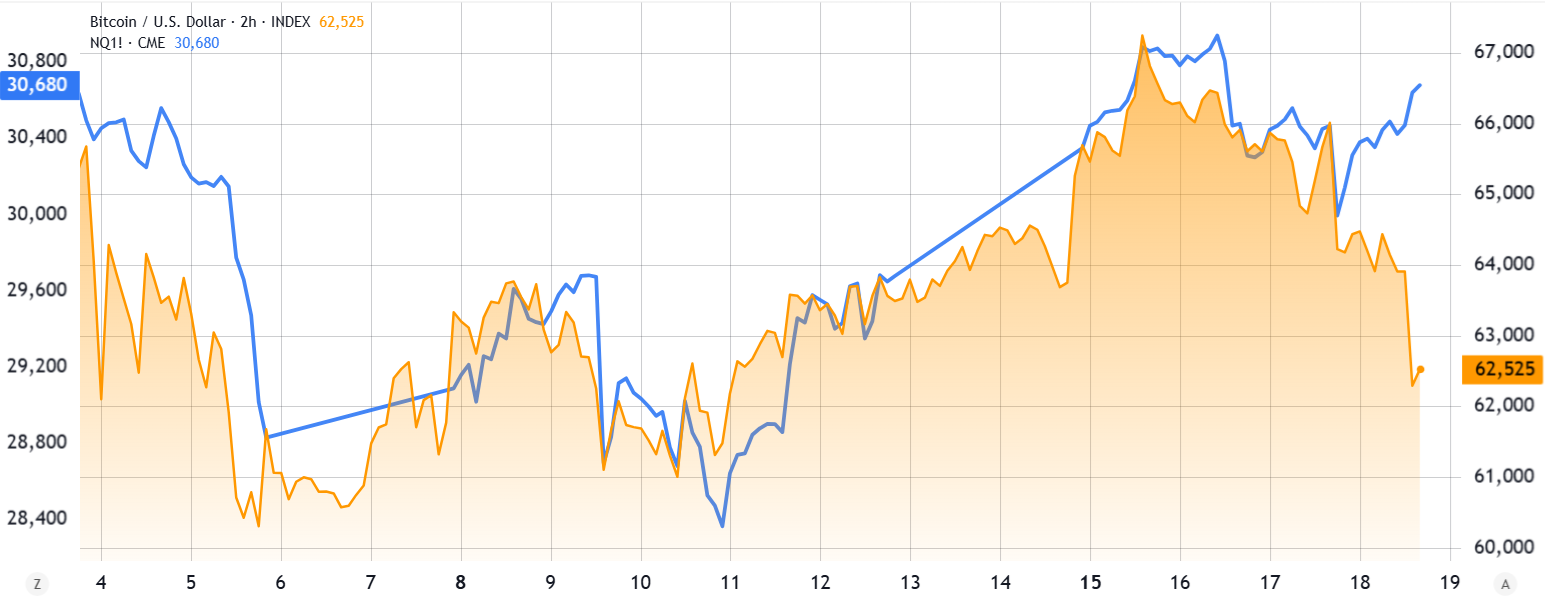
Bitcoin (BTC) faced a 7% correction after failing to reclaim the $67,200 level on Monday, triggering $330 million liquidations in bullish leveraged positions. More concerningly, the drop happened while the Nasdaq 100 index showed strength, trading 1% away from its all-time high. Should Bitcoin traders brace for a $60,000 retest?
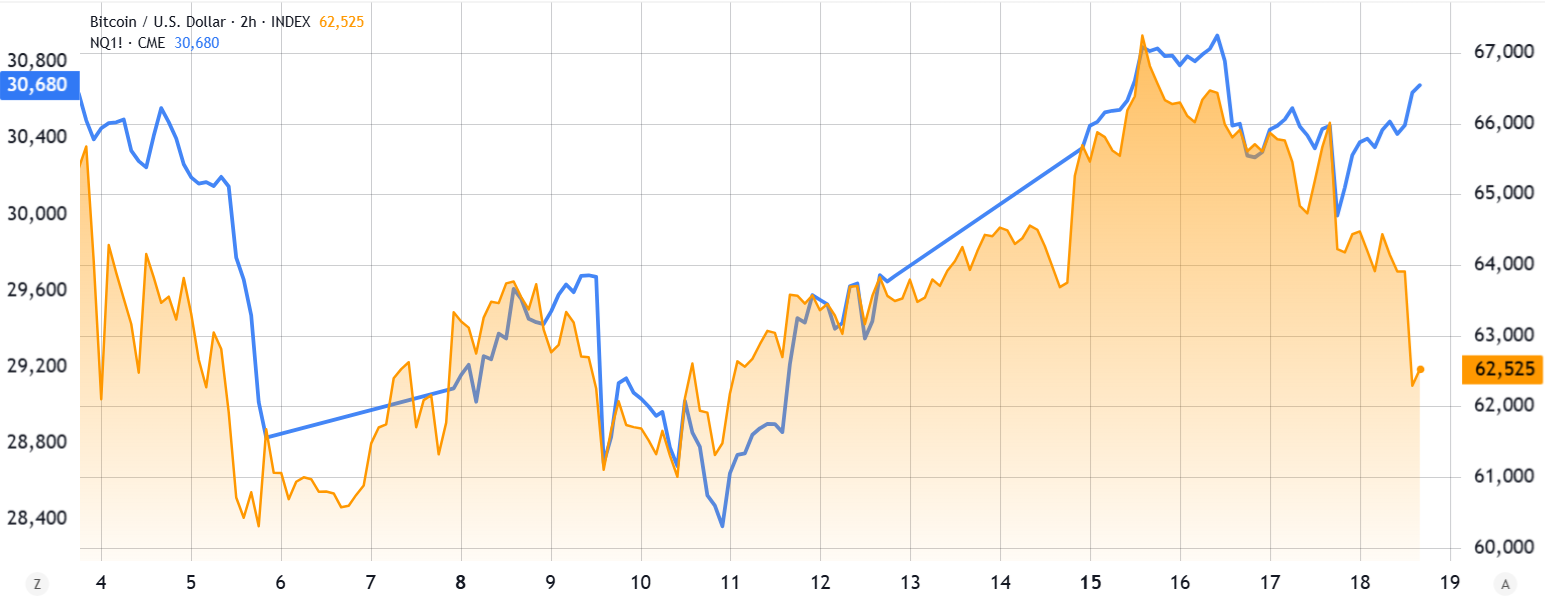
Nasdaq 100 futures (left) vs. Bitcoin / USD. Source: TradingView
The bullish momentum in the stock market likely came from the memorandum of understanding signed by US President Donald Trump and Iran’s President Masoud Pezeshkian. Crude oil prices fell to their lowest level in 15 weeks to $74, easing inflation risks. Moreover, US job market data boosted investors’ morale as continuing jobless claims held flat at 1.81 million.
Bitcoin’s decoupling from tech stocks coincides with US Federal Reserve (Fed) Chair Kevin Warsh’s remarks on Wednesday. The term “price stability” was cited by Warsh on multiple occasions, leading investors to believe that the new Fed mandate will keep a closer eye on inflation trends, according to CNBC. The US 5-year Treasury yield remained relatively high at 4.21%.
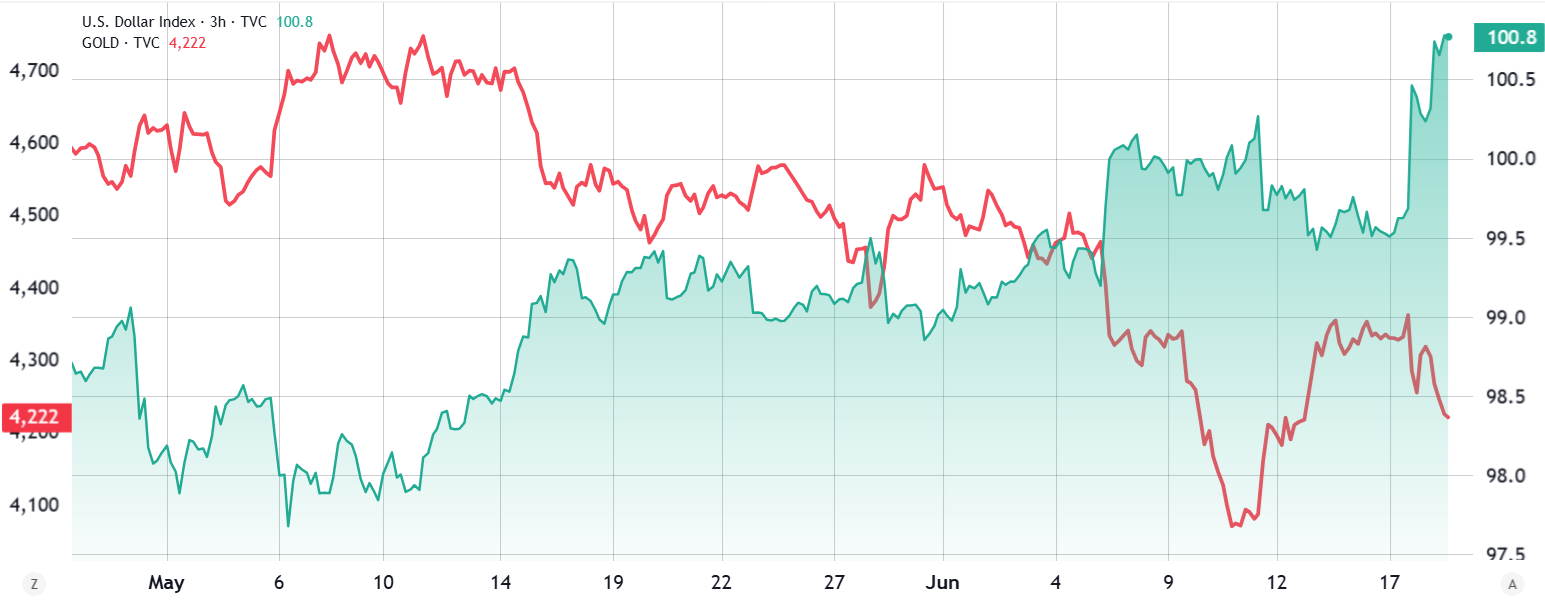
Gold / USD (left) vs. US dollar strength index (right). Source: TradingView
The US dollar strengthened against a basket of foreign currencies, signaling confidence in the US government’s strategy to sustain economic growth despite inflationary pressures. The move hurts non-yielding assets, since fixed income remains profitable longer, as seen in gold prices trading down 3.3%.
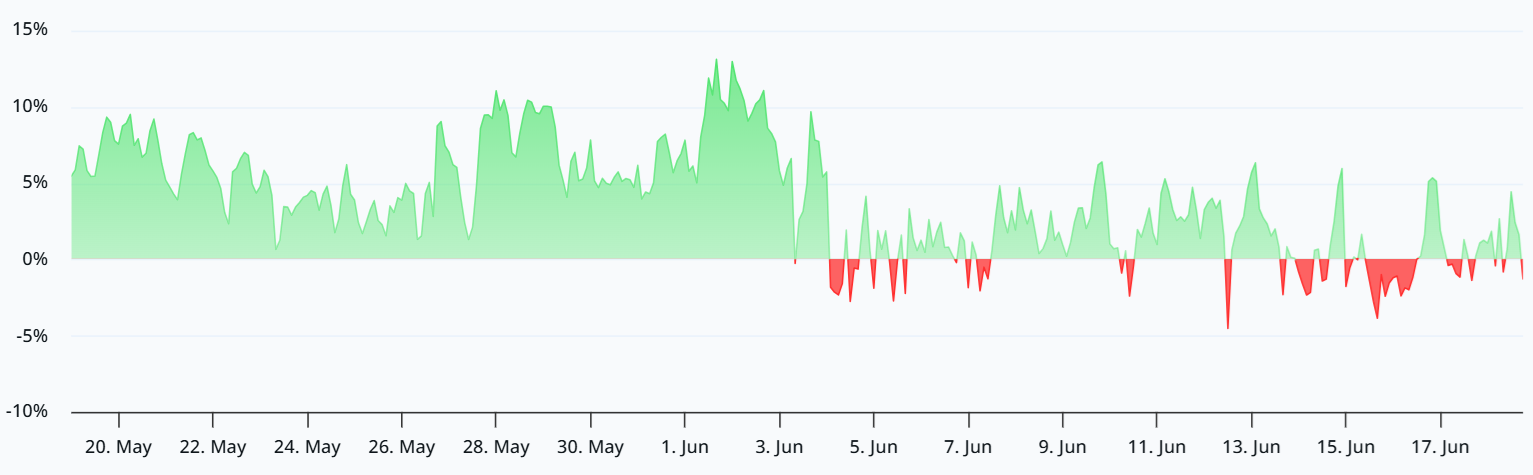
Bitcoin perpetual futures annualized funding rate. Source: Laevitas
Demand for bullish leveraged Bitcoin positions has faded since June 4, indicating a lack of confidence after the crash from $73,700 to $61,300 in just three days. Bitcoin’s bearish momentum contrasts with rising demand in the artificial intelligence sector. SpaceX (SPCX US) market capitalization soared to $2.4 trillion within days of its IPO.
AI sector narratives contrast with weak Bitcoin narratives
Intel (INTC US) shares jumped 10% on Thursday after President Trump announced that Apple (APPL US) had agreed to work with the chipmaker to build its processors. Memory chip and data storage producers Micron (MU US) and SK Hynix (000660 KS) have also recently joined the select list of companies valued at $1 trillion or higher.
Source: X/JoeCarlasare
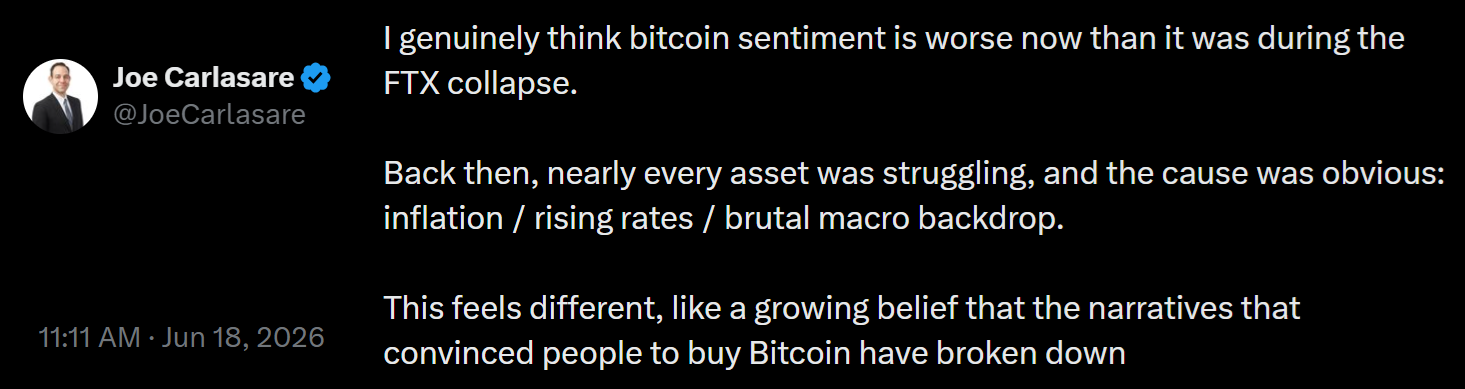
According to Joe Carlasare, commercial litigator and Bitcoin supporter, traders’ sentiment is currently worse than it was during the FTX exchange collapse. For Carlasare, nearly every asset class was struggling back in November 2022 due to the macroeconomic backdrop. This time around, the “narratives that convinced people to buy Bitcoin have broken down”.
Related: Bitcoin’s deeply discounted versus AI-stocks, but hawkish Fed risk lingers–Bitwise
Bitcoin’s presence in the traditional finance industry is far more mature than during the previous halving cycle. The US-listed spot Bitcoin exchange-traded funds (ETFs) accumulated over $102 billion in assets, and major financial institutions initiated Bitcoin investment offerings to clients, including Morgan Stanley, Bank of America and Goldman Sachs.
A retest of the $60,000 level should not be ruled out as the AI sector stays in the spotlight with massive investments and potential new IPOs and follow-on offerings, but institutional demand for Bitcoin will likely dictate price trends.


Blockstream CEO and Hashcash inventor Adam Back argued this week that Bitcoin’s core mathematics represent a discovery, not an invention, and pushed back directly on claims that developer Peter Todd is Satoshi Nakamoto. The remarks emerged from a social media exchange that revived one of crypto’s oldest debates.
The conversation started with a post by Todd, who said he discussed Bitcoin-like concepts with Back and Hal Finney as a teenager. Todd made the comment while criticizing proposed social media age restrictions in the UK.
Is Todd Satoshi?
Todd’s post did not amount to a Satoshi claim, despite headlines framing it that way. He argued that restricting teenagers from technical forums could cut off future innovators from the conversations that helped shape Bitcoin. The reference was to a “Bitcoin-like system” grounded in proof of work and decentralized design, not an admission of authorship.
When one user interpreted Back’s response as confirmation that Todd is Satoshi, Back rejected it directly.
Back confirmed, Todd took part in research communities where such ideas circulated long before Satoshi’s 2008 whitepaper. He pointed to a 1997 cypherpunks mailing list thread and a 2001 exchange between Todd and Finney on the peer-to-peer research list. Satoshi, moreover, contacted Back among the first people before publishing. Cypherpunks who built on those early ideas remain a vocal presence at Bitcoin events today.
Discovery, Not Invention
The broader argument centers on what kind of thing Bitcoin is. Back compared it to mathematical theorems and physical constants, things that exist within an extremely narrow design space that leaves no room for arbitrary choices.
“another discovery hallmark: bitcoin exists only in a narrow design space. more like pythagoras theorum, DNA, physical gold as commodity money. the discovery here being the scarce digital commodity,” says Back via X.
When critics argued that discoveries cannot exist in a narrow design space, Back held the opposite view. His position is that the narrowness is exactly what defines a discovery; the Pythagorean theorem works, and if you tweak it, it fails. DNA works the same way. Bitcoin, he argued, breaks whenever developers alter its core architecture, a pattern that mirrors physical law rather than software flexibility.
Critics counter that Bitcoin is a specific implementation without a clear spec, and that discouraging alternative node implementations in memory-safe languages reflects brittleness, not inevitability. Satoshi reportedly had to build the system before writing the whitepaper to verify it worked at all, a detail Back cites as further evidence that the design could not have taken a different form.
He denied being Satoshi when a 2026 Satoshi writing analysis named him the top candidate, a conclusion Saylor and others disputed. Some maintain that the Satoshi identity should stay unknown, while critics also noted the attention coincided with interest in Blockstream’s BSTR token project. Whether Bitcoin reflects discovery or design, the question Back raised cuts deeper than identity.
The post A 1997 Mailing List Holds a Clue to the Satoshi Puzzle appeared first on BeInCrypto.


Ireland has identified crypto assets as a “very significant” money laundering and terrorism financing risk and has committed to introducing industry standards governing crypto-related sources of funds by the second half of 2027.
Summary
- Ireland has classified crypto assets as a major money laundering and terrorism financing risk in its latest assessment.
- Authorities plan to introduce new standards for crypto-related sources of funds by the second half of 2027.
- The report comes as regulators worldwide tighten oversight of digital asset firms and compliance controls.
According to Ireland’s Department of Finance, the policy forms part of an implementation plan released alongside the country’s latest National Risk Assessment, the first government review in seven years to examine risks linked to digital assets.
The assessment said the growth of crypto-related fraud, money laundering prosecutions, and financial crime involving digital assets has increased pressure on authorities to strengthen oversight.
The report stated that crypto assets present challenges beyond criminal financing. Irish officials warned that digital assets can facilitate sanctions evasion, complicate tax enforcement efforts, and create opportunities for corruption involving officials responsible for supervising the sector.
At the same time, the assessment pointed to weaknesses stemming from inconsistent international regulation and activity occurring in less-regulated segments such as decentralized finance.
Although Ireland is part of the European Union, the report noted that the country still lacks some of the regulatory and legislative measures adopted in other major jurisdictions to address risks tied to the crypto industry.
New compliance standards are scheduled before 2027
Under the implementation plan, Irish authorities intend to establish industry standards covering the acceptance of crypto-related activities as a source of funds by the latter half of 2027. The proposal forms part of a wider effort to strengthen anti-money laundering and counter-terrorism financing controls across the financial sector.
Data from the Central Bank of Ireland cited in the assessment showed that roughly 10% of the country’s population had invested in crypto assets as of December, highlighting the growing role of digital assets in the domestic financial system.
Recent enforcement actions have already brought compliance shortcomings into focus. In November 2025, the Central Bank of Ireland fined Coinbase Europe Limited approximately $24 million for Anti-Money Laundering and Countering the Financing of Terrorism breaches. The regulator said the company failed to promptly report deficiencies in its transaction monitoring system.
Separately, the assessment highlighted concerns that crypto is being used more frequently in payments connected to corruption. Political donations involving digital assets, however, have already been restricted in Ireland. In 2022, policymakers proposed a ban preventing Irish political parties from accepting cryptocurrencies, including Bitcoin, Ether, and privacy-focused tokens.
Regulators increase focus on crypto crime controls
Ireland’s review arrives as regulators in several jurisdictions tighten supervision of crypto businesses through anti-money-laundering frameworks.
Earlier this year, Zimbabwe placed crypto firms under the supervision of the Reserve Bank of Zimbabwe through Statutory Instrument 99 of 2026. The rules require businesses involved in buying, selling, transferring, or safeguarding digital assets to register as Virtual Asset Service Providers and comply with financial crime controls.
Industry compliance standards have also become stricter, according to a May report preview from Chainalysis. The blockchain analytics firm found that nearly 47% of organizations entering the market in 2026 adopted alerting standards that would have ranked among the top 10% most stringent settings in 2020.
Chainalysis reported that monitoring of direct exposure to illicit funds has become relatively consistent across regions. The company said the remaining challenge lies in tracking indirect exposure, where funds move through intermediary wallets before reaching a platform.
According to Chainalysis, alert thresholds for indirect exposure linked to ransomware, scams, darknet markets, fraud operations, and sanctioned jurisdictions are often set 10 to 20 times higher than thresholds applied to direct exposure, leaving potential gaps that criminals can exploit.
Malta’s financial regulator has issued a discussion paper outlining a potential legal framework for decentralized finance (DeFi), including recognition of decentralized autonomous organizations (DAOs), as European policymakers continue to grapple with how to regulate blockchain-based financial services.
On June 12, the Malta Financial Services Authority (MFSA) opened a public consultation on DeFi under the European Union’s Markets in Crypto-Assets (MiCA) regulation. The paper invites industry feedback through July 10 and proposes a new legal category for so-called “software-based organizations,” which would encompass DAOs and other software-governed DeFi entities.
Rather than treating DAOs as a standalone legal concept, the MFSA suggests recognizing them as a type of software-based organization, separating the legal framework governing the organization itself from the rules governing the underlying protocol and software.
The discussion paper builds on Malta’s long-standing role in the digital asset industry, having introduced one of the region’s first comprehensive crypto regulatory frameworks in 2018. While stressing that fully decentralized services generally fall outside MiCA’s scope, the regulator argues that many DeFi projects retain centralized features that complicate claims of decentralization and raise questions about regulatory accountability.
“MiCA excludes fully decentralised models from its regulatory scope, meaning that projects without intermediaries or central control may not need to comply with MiCA,” the paper states.
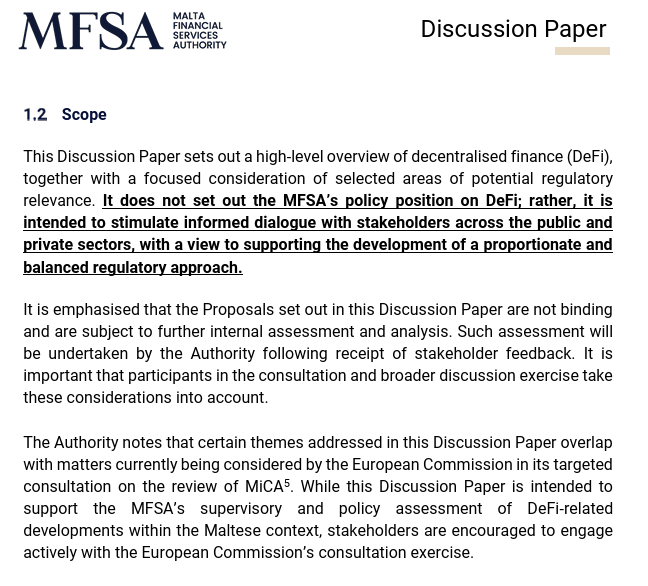
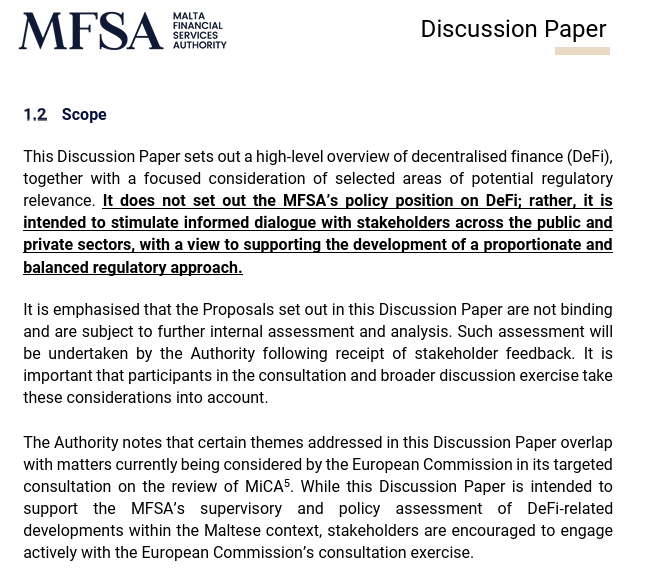
The MFSA outlines the scope of the DeFi discussion paper. Source: MFSA
Related: DAOs may need to ditch decentralization to court institutions
EU regulators increasingly turn attention to DeFi
Malta’s discussion paper comes amid a broader push across the European Union to clarify how decentralized finance and decentralized autonomous organizations should be treated under MiCA.
In March, a European Central Bank working paper found that governance and control across four major DeFi protocols remained highly concentrated, suggesting many projects may struggle to qualify as “fully decentralized” and therefore fall outside MiCA’s scope.
The debate continued in May, when the European Commission launched a targeted review of MiCA seeking feedback on issues including stablecoin interest payments, the treatment of DeFi and whether gaps in the framework warrant additional regulation.
However, not everyone believes a new DeFi rulebook is necessary. Speaking to Cointelegraph at the WAIB Summit Monaco earlier this month, European Commission adviser Peter Kerstens said policymakers should prioritize integrating tokenization into a broader digital asset framework rather than pursuing a second version of MiCA focused on DeFi.

European Commission adviser Peter Kerstens (right) speaks with Cointelegraph’s Zoltan Vardai. Source: WAIB Summit 2026
Related: Crypto firms face July 1 EU cutoff as MiCA grace period ends
Bitcoin (BTC) is carving out a possible floor near $60,000 as spot buyers step back in, yet on-chain valuation and profitability data confirm the market remains firmly in bear territory.
The recovery from the early June low has eased pressure on recent buyers without resolving it. Several indicators now point toward stabilization rather than a confirmed bottom.
BTC trades around $64,171, down 1% over the past 24 hours, with a market capitalization near $1.29 trillion.
Realized Losses Still Dominate Bitcoin Flows
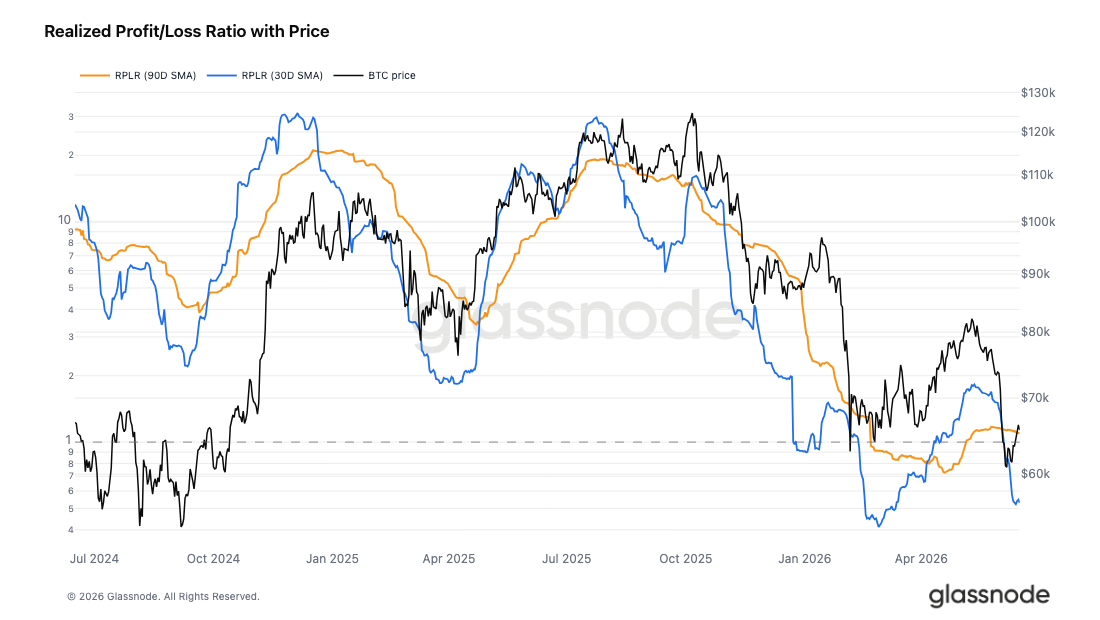
The Realized Profit/Loss Ratio measures the dollar value of coins moving in profit against those moving at a loss. Readings below 1 show that loss realization is the prevailing force.
The 30-day average sits at 0.53, while the 90-day average holds at 1.10. That split confirms loss-taking has outpaced profit-taking across most of the past month.

Valuation tells the same story. Glassnode places the True Market Mean at $77,200, roughly 15% above spot, so the on-chain regime stays bearish. Short-Term Holder MVRV has recovered to 0.90 but remains under the 1.0 breakeven line.
A sustained move in both averages toward 2 would be the first real signal that the bias is turning.
Spot Order Books Build a Bitcoin Floor Near $60K
The flow data leans bearish, yet spot liquidity has shifted in the opposite direction. That divergence is where the repair thesis begins.
Binance Spot Orderbook Depth Imbalance has moved decisively in favor of bids. Buy-side liquidity now outweighs resting sell orders by the widest margin in recent months.

This suggests traders are positioning to absorb supply at lower prices rather than sell into rallies. Passive bids near the $60,000 region appear to be defending current support.
Open interest also compressed off its late-May peak, while funding cooled toward neutral. The deleveraging points to a more patient buyer base instead of crowded leverage.
Macro Index Flags Rare Deep Value for Bitcoin
A longer-term gauge adds weight to the stabilization case. The Capriole Macro Index Oscillator reads -2.03, one of the deepest prints in its history.
Analyst Charles Edwards notes prior visits to these depths were brief. They lasted about four months in late 2018 and two months in mid-2022. Both periods preceded major cycle recoveries.
“In the past 10 years Bitcoin has only spent 6 months at these levels of deep value (5% of time). That should be a great long-term opportunity… If you believe these will be solved, you probably love Bitcoin here.”
He balances the call with two caveats absent in earlier cycles. Edwards points to digital-asset-treasury risks and the looming quantum threat as open questions. That tension keeps the deep-value read constructive rather than a confirmed bottom.

Bitcoin Floor: Price Hinges on the $64K to $66K Zone
Price action remains neutral on the daily chart. Bitcoin broke down from a parallel ascending channel and reached its $59,000 to $60,000 target quickly.
That drop carried a sharp volume spike and an extreme volatility reading, confirming the flush rather than a slow bleed. The bounce since then has lifted the price into the $64,000 to $66,000 pivot.
This zone is the decisive level for the next move. A reclaim opens a path toward the lower channel band near the $74,000 to $76,000 resistance.

A rejection here would likely trap Bitcoin in a range between $60,000 and $65,000. The $59,000 to $60,000 floor is the support that must hold, while the $74,000 to $76,000 caps any recovery attempt.
Whether the patient’s bid can outlast the weak profitability backdrop is the question that decides the next leg.
The post Bitcoin Builds a Floor Near $60,000, but On-Chain Data Says the Bear Isn’t Over appeared first on BeInCrypto.
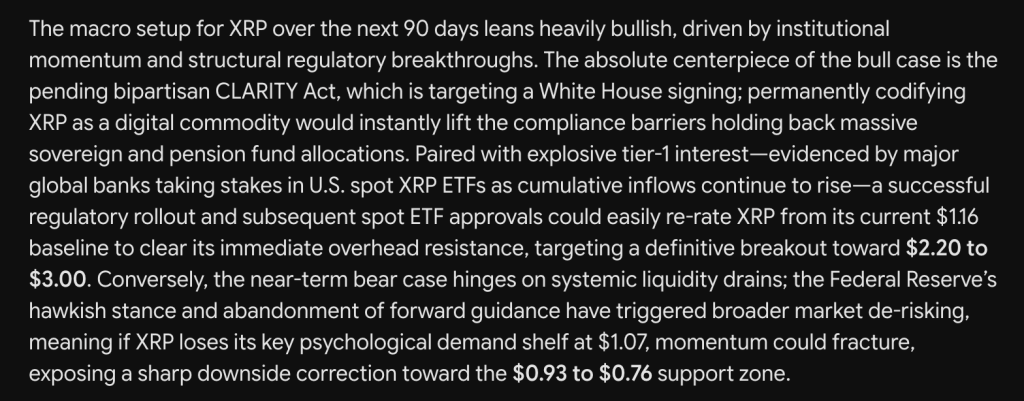
There is a word choice in this XRP price predicts that tells you everything about how Google Gemini AI is thinking, instantly. Permanently codifying XRP as a digital commodity would instantly lift the compliance barriers holding back massive sovereign and pension fund allocations.
Not gradually, not eventually, instantly. Gemini is treating the CLARITY Act not as one more incremental catalyst but as a single legislative event capable of flipping a switch that years of litigation kept locked. That framing alone separates this prediction from the slower adoption stories elsewhere in this series.
The bull case over the next 90 days targets a breakout toward $2.20 to $3.00 from the current $1.16 baseline, an 89% to 158% move, and the centerpiece is the pending bipartisan CLARITY Act targeting a White House signing.
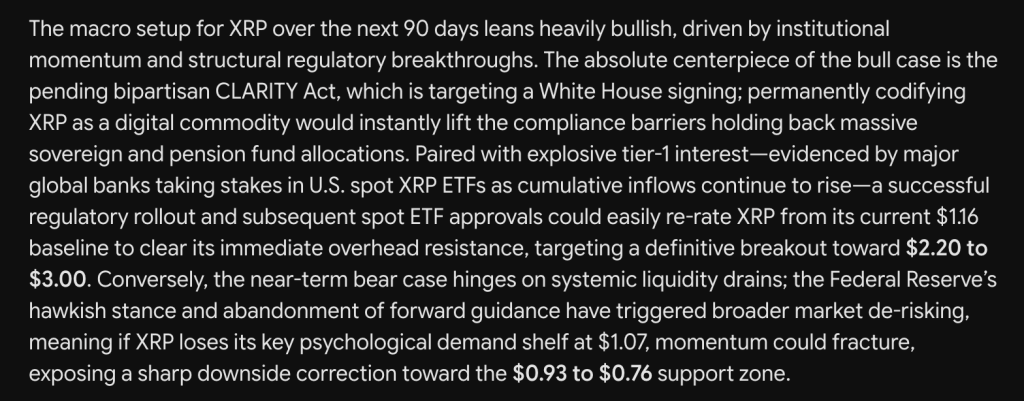
Pair that regulatory unlock with what Gemini calls explosive tier-1 interest, major global banks taking stakes in U.S. spot XRP ETFs as cumulative inflows continue climbing, and you get a setup where the re-rating happens fast rather than slowly.
This is not a story about XRP earning its way higher over years. It is a story about a legal switch flipping and capital that was already waiting on the sidelines moving in within weeks.
The bear case is built on a different kind of switch, a liquidity one. The Federal Reserve’s hawkish stance and abandonment of forward guidance have triggered broader market de-risking, and Gemini is explicit that this is a systemic issue rather than an XRP-specific one.

If XRP loses its key psychological demand shelf at $1.07, momentum could fracture, exposing a sharp downside correction toward the $0.93 to $0.76 support zone.
The bear case here is not about XRP failing. It is about XRP getting dragged down by a macro current it cannot fight, regardless of its own fundamentals.
XRP Price Prediction: The Shelf That Decides Which Switch Flips First
XRP is at $1.16765 today, sitting just above the $1.07 level Gemini flagged as the line between the bull and bear scenarios, and the daily chart shows why that specific number matters.
Price spent the back half of 2025 grinding down from the $3.65 peak in a relentless descending staircase, and the June low at $1.05 marked the first real test of territory the chart had not visited since early in this entire downtrend.
The bounce since then has held for several sessions without immediately rolling over, which gives the $1.07 shelf some structural weight rather than treating it as an arbitrary round number.
The immediate resistance sits at $1.30, the floor of a multi-month consolidation range that held through most of February through May before the latest breakdown.
Reclaiming that zone would be the first sign the chart is shifting from defense to offense, and from there the $1.60 region becomes the next real test before any conversation about Gemini’s $2.20 to $3.00 target gains technical credibility.
The RSI is sitting at 42.64 with the signal line at 35.94, a gap of nearly 7 points, modest but consistently positive. Momentum dipped into the low 30s during the June flush and has climbed back above its average without yet reaching neutral, a pattern that suggests the selling pressure has eased but has not yet been replaced by genuine accumulation.
That actually mirrors the prediction’s own structure well. The chart, like Gemini’s macro setup, is sitting precisely between two outcomes right now, the regulatory catalyst that could send it sharply higher and the liquidity drain that could send it sharply lower, with $1.07 standing as the line that decides which switch flips first.
Google Gemini AI Predicts that Liquidchain Could Be The Next Big Thing
There is a moment in every cycle where the money stops chasing what everyone already owns.
Large caps do not stop working all at once. They slow down gradually. Returns compress. The same resistance levels hold for weeks. The narrative stays intact but the price stops responding to it. Bitcoin is there right now. So is Ethereum. So is XRP, which has been perpetually one catalyst away from its next move for longer than most traders want to admit.
When that happens, capital does not sit still. It finds the next thing. It always does.
The next thing never looks ready when the rotation starts. Early presale. Small raise. Unproven team. A problem the entire industry acknowledges and complains about, and has never actually fixed. That combination is exactly what gets ignored until it can no longer be ignored.
Cross-chain liquidity is that problem. Bitcoin, Ethereum, and Solana are three dominant ecosystems with three completely isolated liquidity systems.
There is no native way to connect them. Every user and developer who needs to operate across all three pays for that limitation directly, in fees, in slippage, in failed transactions, and in time. The fragmentation cannot be patched. It is hardwired into how these networks were originally built.
LiquidChain is building the layer that makes the entire problem irrelevant. One execution environment connecting all 3 ecosystems simultaneously. Deploy once, reach everywhere, with no cross-chain tax extracted from every interaction.
The presale is at $0.01454. Just over $800,000 raised.
The market has not looked at this yet. That changes eventually.
The risk profile is what you would expect at this stage. Nothing is proven. Adoption, liquidity, and execution are all still unknowns. That is not a disclaimer. That is the nature of the bet.
The projects that return 10x or 100x are not the ones that looked safe at entry. They are the ones who solved a real problem before the rest of the market understood it.
LiquidChain is still in that window.
The post Google’s Gemini AI Predicts Incredible XRP Price For Next 90 Days appeared first on Cryptonews.

Bitcoin pulled back sharply after failing to reclaim the $67,200 area, and the selloff stood out because broader risk markets appeared to be holding up. The move sparked heavy liquidations in leveraged long positions and renewed questions about whether capital is rotating away from crypto’s “non-yielding” profile and into the AI-driven parts of tech.
While stocks looked resilient—amid signs of easing oil prices and upbeat US labor-market signals—crypto struggled to follow. At the same time, a firmer US dollar and comparatively elevated Treasury yields added pressure for assets that don’t pay income, including BTC.
Key takeaways
- Bitcoin dropped about 7% after missing $67,200, triggering roughly $330 million in liquidations tied to bullish leverage.
- The selloff occurred as the Nasdaq 100 remained near its all-time high, underscoring a notable shift in crypto-vs-tech correlations.
- A strengthening US dollar and high Treasury yields continued to weigh on non-yielding assets like Bitcoin, with gold also sliding.
- Interest in AI-themed equities appeared to strengthen while leverage demand for BTC weakened after the early-June crash.
What drove the BTC correction
Bitcoin’s pullback accelerated after it failed to regain $67,200 on Monday. The decline—described as a “decoupling” from strength in major tech indexes—coincided with the Nasdaq 100 trading roughly 1% below its all-time peak.
Liquidation data cited in the report pointed to about $330 million wiped out from leveraged bullish positions, highlighting how quickly sentiment can turn when BTC breaks key levels. The article frames the question many traders are now watching closely: whether $60,000 becomes the next meaningful retest if selling pressure persists.
Macro backdrop: dollar strength and higher yields
Several macro signals were cited as supportive for equities even as crypto weakened. The stock-market tone, according to the report, was boosted by a memorandum of understanding signed between US President Donald Trump and Iran’s President Masoud Pezeshkian. It also noted that crude oil prices fell to their lowest level in 15 weeks, landing near $74, which can ease inflation concerns.
On the data side, continuing jobless claims were reported to have held steady at 1.81 million, helping underpin investor confidence.
However, crypto’s performance depended less on these equity tailwinds and more on rates and the dollar. The article attributes BTC’s stress to US dollar strength and “high” Treasury yields, emphasizing that non-yielding assets tend to struggle when fixed income remains attractive. It references the US 5-year Treasury yield staying around 4.21%.
CNBC is cited for the idea that Fed Chair Kevin Warsh repeatedly referenced “price stability,” strengthening expectations that the central bank will focus more directly on inflation dynamics. In that environment, the report suggests, the US dollar’s bid can tighten financial conditions for BTC even when equities hold up.
Leverage cooling after early-June volatility
The report also points to a shift in positioning: demand for bullish leveraged Bitcoin positions reportedly faded after June 4, following a fast drawdown from $73,700 to $61,300 over just three days. That earlier crash appears to have left traders more cautious, even as AI-related narratives kept capturing market attention.
Funding dynamics were referenced through Laevitas, with the article noting that perpetual-futures leverage metrics have weakened since the volatility spike. The implication for traders is straightforward: when leverage demand cools, recoveries can become less orderly because there’s less “fuel” behind the bid.
At the same time, the piece highlights that bearish momentum in crypto contrasts with strength in AI-linked markets, where new product cycles and public valuations continue to attract attention—and capital—at the expense of older “risk-on” themes.
Why AI narratives looked stronger than BTC’s
The article argues that the macro tape and the sector narrative are diverging. It describes AI-related equities showing renewed momentum, including a 10% jump in Intel shares on Thursday after Trump announced Apple had agreed to work with the chipmaker to build processors. It also notes that memory and data-storage companies, Micron and SK Hynix, have recently joined companies valued at $1 trillion or more.
More broadly, the report frames the AI sector as a growing magnet for investment. It references SpaceX’s market capitalization reaching $2.4 trillion within days of its IPO as an example of how quickly capital can concentrate around major AI/technology ecosystems.
In contrast, it cites Joe Carlasare—described as a commercial litigator and Bitcoin supporter—who argues that traders’ sentiment is currently worse than during the period surrounding the FTX collapse. Carlasare’s view, as presented in the article, is that the narratives that previously drew buyers to Bitcoin have “broken down” this time, even as the market retains reasons to believe in longer-term participation from traditional finance.
That maturity point is supported by the article’s reminder that institutional access to Bitcoin is far more established than in earlier halving cycles. It notes that US-listed spot Bitcoin ETFs have accumulated more than $102 billion in assets, and that major financial firms have launched Bitcoin investment offerings to clients, naming Morgan Stanley, Bank of America, and Goldman Sachs.
What to watch next for BTC
With Bitcoin struggling to reclaim $67,200 and leverage interest reportedly cooling after a rapid early-June selloff, the next test—particularly around the $60,000 level—may depend less on whether stocks stay strong and more on whether rates and the dollar continue to tighten conditions for non-yielding assets. If the AI rally keeps drawing capital, traders will likely continue to measure BTC not just against its own prior highs, but against how quickly institutional appetite returns to the asset as macro pressure eases or persists.

US financial regulators have proposed customer identification rules for stablecoin issuers, aiming to align identity verification practices with requirements applied to banks and other covered financial institutions under federal law. The initiative, issued by multiple agencies, is part of the broader implementation framework for the GENIUS Act, a stablecoin-focused statute enacted in July 2025.
The proposal would require stablecoin issuers to perform “customer identification” in connection with onboarding and account access, alongside related recordkeeping and screening obligations tied to the Bank Secrecy Act (BSA). For regulated firms, the move signals an expectation that stablecoin-related activities will be treated within established AML/CFT compliance structures—raising practical questions around supervision, data handling, and how identity requirements apply across different stablecoin business models.
Key takeaways
- US agencies have issued a proposed rule that would require stablecoin issuers to implement customer identification procedures comparable to those used by banks under the BSA.
- The proposal is positioned as part of the GENIUS Act implementation process and is intended to address AML/CFT obligations for stablecoin providers.
- The notice will be open for public comment for 60 days after formal filing in the Federal Register.
- Regulators cite baseline BSA standards including identity verification, retention of identity information, and screening for potential terrorist affiliations.
- Treasury has already issued related GENIUS proposals on illicit-finance requirements, indicating a multi-agency rulemaking path for stablecoin compliance.
Proposed customer identification requirements under GENIUS
According to the agencies’ notice, the Federal Deposit Insurance Corporation (FDIC), the Federal Reserve, the Office of the Comptroller of the Currency (OCC), the National Credit Union Administration (NCUA), and the US Treasury’s Financial Crimes Enforcement Network (FinCEN) jointly proposed that stablecoin issuers be treated as regulated financial institutions for purposes of verifying customer identity.
The action is linked to the GENIUS Act’s implementation timeline. The law is expected to enter effect 18 months after enactment or 120 days after federal authorities finalize implementing regulations, depending on the administrative schedule for the rulemaking process. In practical terms, the proposal represents regulators translating statutory obligations into operational compliance expectations for stablecoin issuers.
The agencies stated the proposal is designed to meet AML and Countering the Financing of Terrorism (CFT) requirements through GENIUS. In the BSA framework, covered financial institutions are generally expected to verify the identity of a person seeking to open an account, maintain records of identity information, and apply risk-based determinations that include whether the person may be associated with terrorism or terrorist organizations.
For institutional stakeholders, the significance lies in how customer identity and onboarding procedures can affect both compliance operations and product design. Identity verification requirements may necessitate enhanced onboarding controls, clearer definitions of “customer” and “account” for stablecoin use, and more robust governance over identity data retention, access controls, and audit trails.
How the Bank Secrecy Act baseline is likely to map onto stablecoin issuers
The BSA standards cited in the notice provide a concrete benchmark: verifying customer identity, keeping records, and determining potential terrorist connections. While those obligations are familiar for banks, applying comparable expectations to stablecoin issuers introduces implementation questions—particularly where stablecoins are issued or distributed via programs, intermediaries, or digital-asset rails rather than through conventional deposit account structures.
Institutions will likely need to assess how customer identification obligations interact with existing compliance programs. Many stablecoin providers and partners already run onboarding and transaction monitoring processes, but the proposed rule would more explicitly anchor identity verification in the same legal and supervisory logic used for covered financial institutions.
That alignment may also affect compliance risk assessments and regulator expectations regarding accountability. Firms may face increased scrutiny over who performs the verification (issuer versus downstream counterparties), what information is considered sufficient for “verification,” and how firms document and retain records to support investigations and examinations.
Broader GENIUS implementation: AML/CFT rulemaking and related deposit coverage issues
The customer identification proposal is not occurring in isolation. Treasury has previously proposed GENIUS-related AML and CFT requirements targeting illicit finance involving stablecoins. In addition, other GENIUS-linked implementation activity has already touched on the contours of insurance coverage for stablecoin issuers.
Earlier, the FDIC suggested that rules allowing deposit insurance for certain corporate deposits of stablecoin issuers would not automatically extend to holders. That distinction matters because it signals regulators are attempting to define regulatory treatment not only for issuers’ activities but also for how stablecoin users and balances fit into existing consumer protection and prudential frameworks.
While the identification proposal focuses on onboarding and screening obligations, the broader GENIUS implementation path suggests a phased approach: first establishing AML/CFT compliance structure and supervision expectations, then refining other areas such as how stablecoin balances interact with deposit-like protections.
From a compliance monitoring perspective, these parallel threads increase the likelihood that stablecoin programs will be evaluated through multiple regulatory lenses—identity verification, transaction monitoring, illicit finance risk controls, and potentially prudential or insurance-related requirements—depending on how each firm’s activities are classified.
Regulatory landscape beyond GENIUS: CLARITY Act timing remains uncertain
Even as stablecoin-specific rules progress under GENIUS, broader US crypto regulatory clarity remains unresolved. The Digital Asset Market Clarity (CLARITY) Act—intended to reshape roles and enforcement mechanisms across financial agencies—has not yet established a defined timeline.
Coverage of the legislative environment indicates that while many stakeholders expect progress by the August recess, there are unresolved concerns raised within Congress, including Democratic objections related to potential conflicts of interest by lawmakers and elected officials. That political uncertainty can influence how quickly the government can harmonize crypto oversight across agencies, even when stablecoin rules move forward.
For regulated entities, this matters because GENIUS addresses stablecoins specifically, but firms operating in the broader digital asset ecosystem may still need to contend with overlapping or inconsistent regulatory treatment depending on the asset category, the structure of the offering, and the designated regulator under any future CLARITY framework.
As a result, institutions should treat the GENIUS customer identification proposal as part of a longer regulatory process rather than a final endpoint. Compliance programs may need to be designed for iterative updates as implementing rules expand, agencies issue additional guidance, and Congress potentially advances wider statutory frameworks for digital asset regulation.
Closing perspective
With the proposed customer identification rule now open for a 60-day comment period after Federal Register filing, stablecoin issuers and their compliance teams will need to prepare for changes that bring identity verification expectations closer to bank-style BSA requirements. The next key step will be how agencies finalize the rule after public feedback and whether broader crypto oversight legislation—such as CLARITY—clarifies agency roles and enforcement priorities alongside GENIUS implementation.
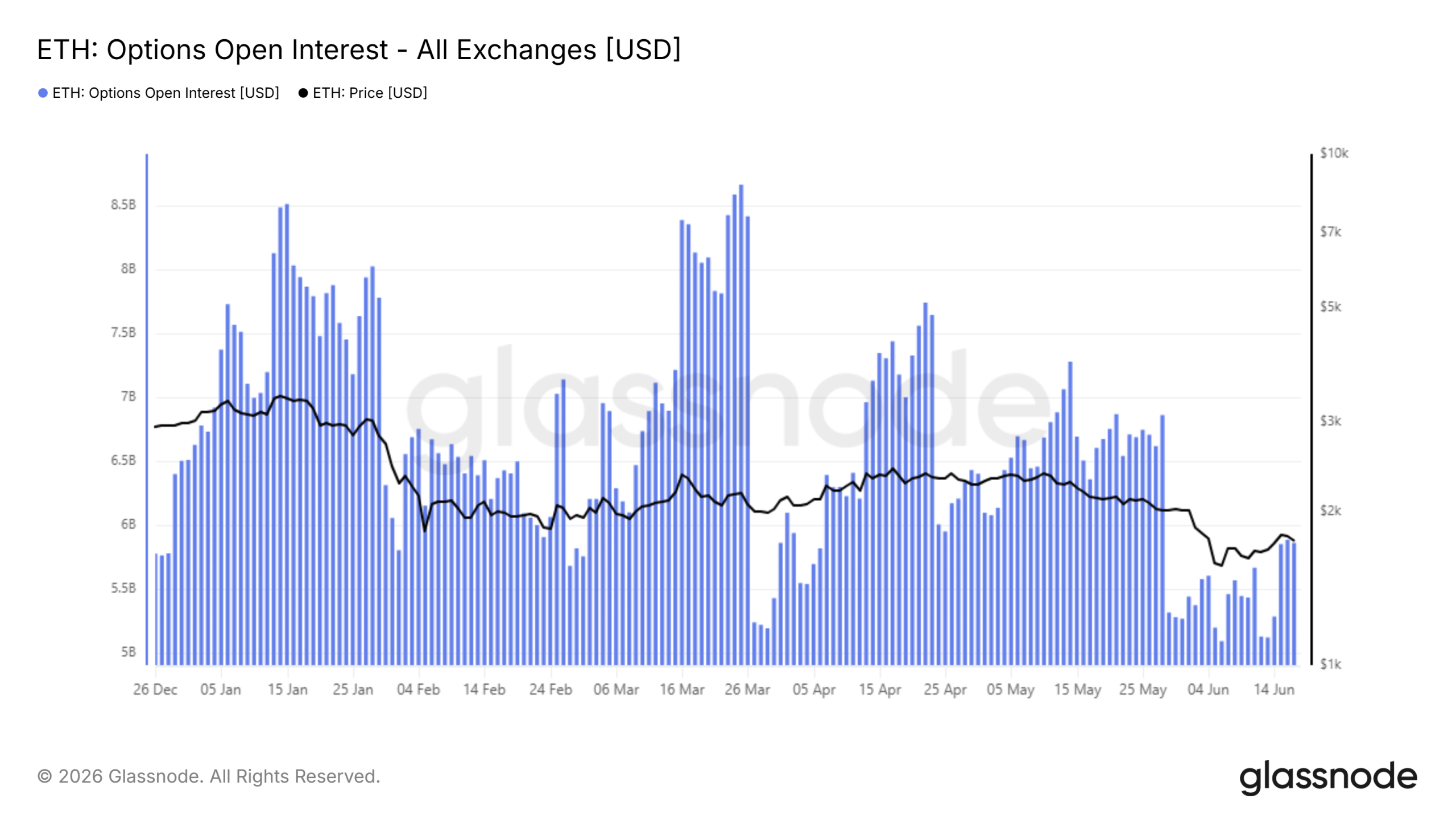
Ethereum (ETH) derivatives and ETF flows have gone quiet at the same time, with options open interest, perpetual funding, and spot inflows all sitting near multi-month lows. Ethereum Price trades around $1,682, down nearly 5% on the day.
That broad calm arrives as the daily chart shows volatility compressing again after a sharp June flush. Quiet conditions like these often precede an outsized move, though the direction stays unresolved.
Derivatives Activity Has Drained Toward Multi-Month Lows
ETH options open interest across all exchanges has fallen to roughly $5.5 billion. That sits well below the $8.5 billion peaks recorded in January and March. Traders have closed out futures positions rather than adding new bets.

Perpetual funding rates tell a similar story. After a brief negative spike near the early-June low, funding has flattened close to zero. Neither longs nor shorts hold a crowded edge right now.

This combination points to washed-out positioning. Low open interest and neutral funding mean less leverage feeding the price. A clear catalyst could therefore move ETH quickly with little resistance.
ETF Flows Hint at Returning Demand
The bearish read has one complication. Spot Ethereum ETF net flows have stopped bleeding after months of steady outflows. June printed a handful of small green inflow days.
The amounts stay modest, well under the $250 million inflow spikes seen in January. However, the shift from persistent selling to mild buying matters. It suggests institutional demand is no longer pointed in one direction.

A sustained return of positive flows would strengthen the case that $1,500 marked a durable floor. Without it, the recent bounce risks fading.
Ethereum Price Prediction Hinges on $1,500 and $1,920
ETH lost two important supports in recent weeks. Price broke an ascending trendline and the $2,150 level on May 17. It then lost the descending channel and support near $1,920.
The decline reached roughly $1,500 before buyers stepped in. Ether has since bounced to retest the lower band of the descending channel near $1,750. That retest now acts as resistance.
Volume contracted through most of the year, spiked on the channel breakdown, then contracted again. The Bollinger Band Width Percentile shows the same pattern. Volatility compressed into June, spiked at the low, and is compressing once more.

A rejection here could send ETH back toward $1,500, about 13% below current levels. Losing that floor would open lower targets and likely revive bearish predictions.
A $1,920 reclaim would flip the structure instead. That path points toward $2,150, roughly 25% above the current price, where prior resistance sits. Until then, the bearish structure holds the edge.
The setup leaves Ethereum coiled between a tested floor and stacked resistance. The next volatility expansion should decide which level breaks first.
The post Ethereum Could be Nearing a Violent Move as Price Drops 6% appeared first on BeInCrypto.
Hip-hop producer Tay Keith found dead in apartment at 29

Will Smith Borrowed Money From A Fan

PSNI traffic warning ahead of Mid and East Antrim Pride parade in Ballymena


-

 Business4 days ago
No Jackpot Winner as $257 Million Prize Rolls Over to $269 Million Monday Draw
-

 Fashion6 days ago
Weekend Open Thread: Tuckernuck – Corporette.com
-
Crypto World4 days ago
Zimbabwe Requires Crypto Businesses to Register Annually Under New FIU Regulations
-

 Crypto World6 days ago
Bitget enters Argentina’s regulated crypto market through PSAV registration
-

 Tech6 days ago
NanoClaw integrates JFrog registries to secure AI agent downloads
-

 Tech6 days ago
This Week In Security: Microsoft On Microsoft, Register Your Domains, Linux On ARM, And FreeBSD Joins The File Cache Club
-

 NewsBeat6 days ago
FBI searches office of Ohio voter registration group
-
 Tech7 days ago
Anthropic is spending $150M to embed 1,000 AI fellows inside nonprofits. No degree required.
-
 Entertainment7 days ago
‘The Pitt’s Fan-Favorite Doctor Confirms Noah Wyle Gave His Blessing to Return [Exclusive]
-
 Crypto World7 days ago
Ripple and Bitso Bring MXNB Stablecoin to XRP Ledger
-

 Tech7 days ago
Former AWS CEO Adam Selipsky to lead new $10B AI data center venture
-
 Entertainment4 days ago
Matt Damon’s Viral Sci-Fi Thriller Has Taken Over HBO Max
-

 Business4 days ago
Anthropic staff to meet White House officials next week, Axios reports
-

 Tech4 days ago
As AI companies race to go public, who else is along for the ride?
-
 Crypto World4 days ago
Bitcoin could crash to $48,000, if this historical pattern is triggered
-
 Tech7 days ago
Euro-Office 1.0 Arrives To Open-Source Infighting: ‘Compatibility Is Not Sovereignty’
-

 Politics4 days ago
“Israel’s” ban on ICRC visits ruled illegal, but Knesset moves to stop them permanently
-
Entertainment7 days ago
Ana Navarro unleashes explosive tirade on ex-Trump aide, Disney Channel star in epic on-air fight: 'Have you no shame?'
-
 NewsBeat4 days ago
Warning of disruption as Cardiff Crossrail works to start
-

 News Videos4 days ago
Financial Accounting | Last Day Revision Strategy and Booster | CMA Inter – June 2026
You must be logged in to post a comment Login