
Crypto World
South Korea Turns to Private Firms for Crypto Custody Following $4.8M Security Breach


Key Highlights
-
National Tax Service transitions to external custodians following $4.8M breach.
-
Public exposure of seed phrase triggers comprehensive custody reform.
-
Custodian selection prioritizes insurance coverage and proven track records.
-
Dedicated oversight team will centralize confiscated asset management.
-
Reform initiative matches international best practices for digital custody.
Following a significant security incident, South Korea’s National Tax Service has announced plans to engage private custody solutions for managing confiscated digital currencies. The agency inadvertently revealed a wallet’s recovery phrase in publicly released documentation on February 26, enabling unauthorized withdrawals totaling $4.8 million. Officials are implementing comprehensive safeguards to eliminate similar vulnerabilities and enhance asset protection protocols.
The security lapse centered on an insufficiently redacted photograph displaying a Ledger hardware wallet alongside its complete mnemonic recovery sequence. This episode exposed critical gaps in South Korea’s current framework for managing government-controlled digital holdings. The tax authority intends to transfer custody responsibilities to specialized providers equipped with robust security infrastructure and comprehensive insurance policies.
This strategic pivot occurs as regulatory expectations intensify for appropriate virtual asset stewardship. The National Tax Service has established a target completion date within 2026’s first two quarters for finalizing custodian partnerships. The initiative represents South Korea’s commitment to professionalizing its approach to handling seized cryptocurrency holdings.
Evaluation Framework and Administrative Safeguards
The tax agency is constructing comprehensive benchmarks for assessing prospective custody partners. Security qualifications encompass cutting-edge cybersecurity protocols, multi-party authorization systems, and hardened storage infrastructure. Candidates must carry insurance mandated by South Korea’s Virtual Asset User Protection Act, providing safeguards against system breakdowns and operational mishaps.
Company scale and fiscal soundness represent critical evaluation components in South Korea’s vetting framework. Prospective custodians must showcase expertise managing substantial digital currency portfolios for governmental or institutional clientele. Operational clarity, comprehensive audit mechanisms, and robust contingency planning will serve as fundamental prerequisites during the selection phase.
South Korea’s NTS is assembling a dedicated supervisory unit to manage the custodian selection initiative. This team will develop standardized operating procedures, employee education programs, and comprehensive management strategies for confiscated digital holdings. The centralization effort seeks to consolidate functions presently distributed among various administrative units.
Historical Context and Legal Framework
South Korea’s recent custody failure adds to previous incidents, including municipal law enforcement’s loss of 22 Bitcoin. Responding to these setbacks, government authorities initiated a multi-department investigation examining asset management practices and identifying preventive measures. This coordinated response demonstrates a systematic commitment to protecting South Korea’s expanding inventory of confiscated cryptocurrencies.
The Virtual Asset User Protection Act establishes the regulatory foundation supporting South Korea’s custody transformation. This legislation requires insurance coverage, regulatory compliance, and reserve holdings for all authorized service operators. South Korea’s policy direction aligns with worldwide patterns where governmental bodies increasingly depend on specialist custodians for blockchain-based assets.
The forthcoming custody infrastructure will create uniform processes governing seizure activities, secure storage, and eventual liquidation of digital currencies. South Korea plans to strengthen technical capabilities, encompassing wallet administration, cryptographic key management, and distributed ledger surveillance. This framework additionally prepares South Korea to extend professional custody services throughout various governmental departments.
South Korea’s National Tax Service anticipates that engaging private custodians will substantially diminish security vulnerabilities and procedural breakdowns. This strategic shift demonstrates enhanced institutional capacity for cryptocurrency-related enforcement activities. The implementation of specialized custody partnerships underscores South Korea’s dedication to secure, compliant administration of seized virtual assets.


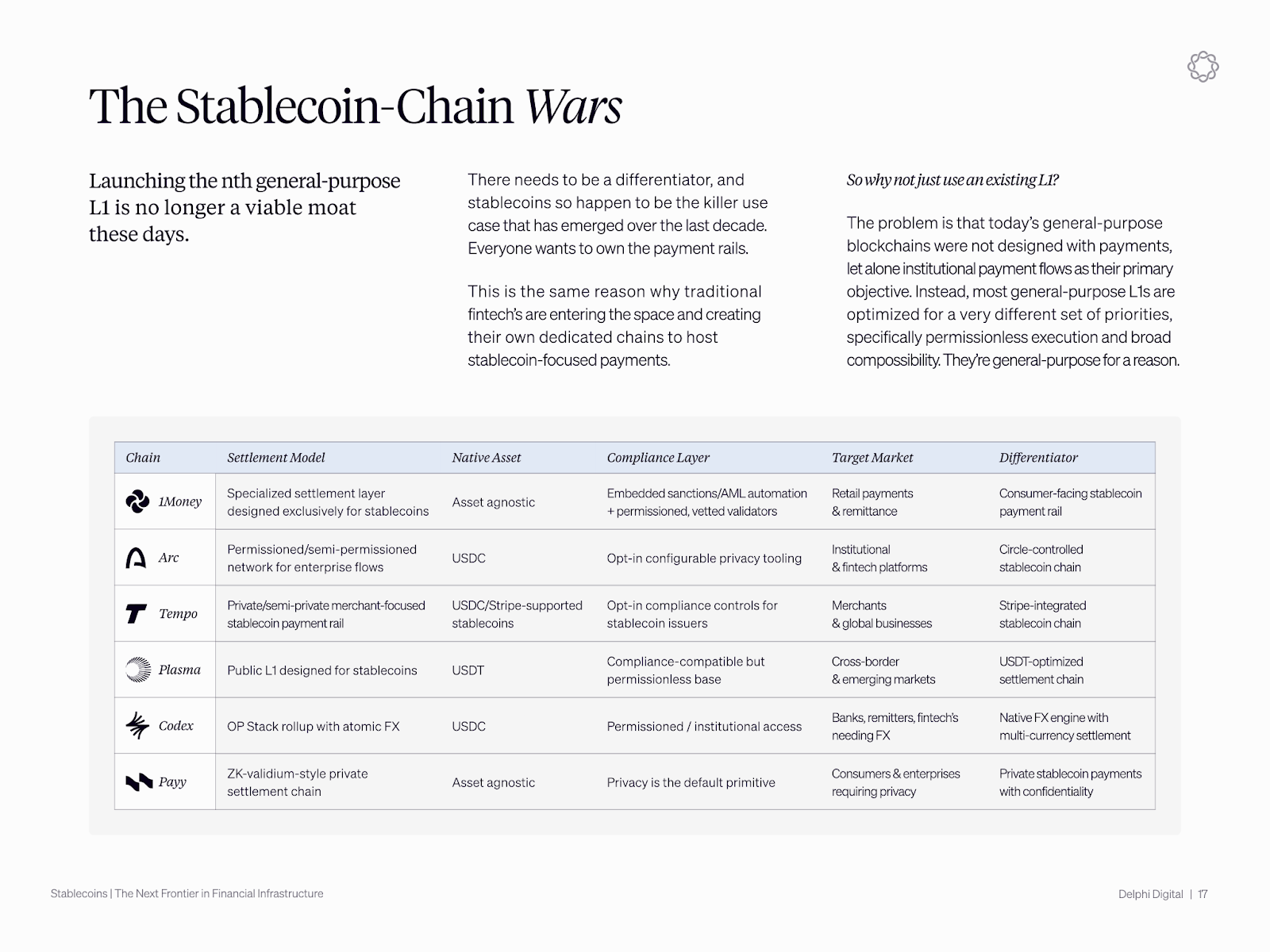
Stablecoin issuers and fintech-linked firms are launching payment-focused blockchains as they try to control more of the settlement infrastructure behind US digital-dollar transfers.
Some stablecoin issuers and fintech-linked companies are building a new wave of blockchain networks designed for institutional payment flows rather than the broader token issuance and smart-contract activity associated with general-purpose layer-1 networks, according to Delphi Digital.
These include stablecoin giant Tether-backed Plasma, a public L1 network optimized for cross-border USDt (USDT) transactions, which launched on mainnet on Sept. 25, 2025 after it raised $24 million in February. A month later, stablecoin issuer Circle launched the public testnet for Arc, which it describes as an open L1 blockchain purpose-built for stablecoin finance.
The developments add to signs of a structural shift from generic blockchain infrastructure toward payment-focused networks, as companies compete to control the rails underpinning stablecoin settlement, which Delphi Digital described as one of crypto’s clearest real-world use cases.
Fintech companies have also joined the payments infrastructure push, seeking to carve out a market share of the growing stablecoin payments sector.

Owning the payment rails is becoming “strategically important,” Ran Goldi, senior vice president of payments and network at digital asset custody platform Fireblocks, told Cointelegraph. He said:
“Instead of relying on external networks and paying fees to ecosystems like Ethereum, companies are looking to capture more of that value themselves by building or controlling the settlement layer.”
For payment companies, owning the underlying rails means they avoid being “taxed” for the mint and burn operations of the stablecoin, added Goldi.
Fintech companies are also joining the stablecoin chain wars
Tempo said Wednesday that its mainnet is live, describing the network as a merchant-focused settlement layer built for high-throughput stablecoin transactions. The project says it is incubated by Paradigm and Stripe.

In October 2024, Stripe acquired stablecoin infrastructure startup Birdge for $1.1 billion. In June 2025, it acquired crypto wallet infrastructure provider Privy and later bought billing platform Metronome on Jan. 14.
Delphi Digital said those deals positioned Stripe to control more of the issuance, wallet and billing layers around stablecoin payments alongside settlement infrastructure.
Stablecoin payment infrastructure is increasingly seen as a new “revenue layer,” positioning entities controlling the end-to-end payment workflow to capture fees on every transaction, according to Alvin Kan, chief operating officer at Bitget Wallet.
“As settlement costs at the protocol level trend lower, value capture shifts to the orchestration layer around the rail: compliance, FX conversion, wallet infrastructure, on- and off-ramps, local payout connectivity and merchant integration,” he told Cointelegraph.
Related: Stablecoins to replace old FX rails, but off-ramps remain a chokepoint
Controlling the settlement infrastructure behind stablecoins is the next battleground among crypto and fintech firms, according to Irina Chuchkina, chief growth officer of Wallet in Telegram. She said:
“Stablecoin payment rails could become the defining revenue driver of this cycle, for the same reason Visa and Mastercard became indispensable: not because they issued currency, but because they owned the pipes.”
Companies building settlement rails interoperable with agentic artificial intelligence stand to “capture a disproportionate share of the value flowing through these networks,” she added.
Magazine: Crypto wanted to overthrow banks, now it’s becoming them in stablecoin fight


In the latest Cointelegraph interview, professional trader Alessio Rastani warns that Bitcoin could fall below $60,000 before a meaningful bottom forms.
Professional trader Alessio Rastani is back with a fresh market update, and the key question remains: has Bitcoin (BTC) already found its bottom — or is the real move still ahead?
In this latest interview, Rastani revisits his previous outlook and explains why his view has shifted as price action unfolded. While Bitcoin managed a short-term recovery earlier this year, he argues that the structure of the recent bounce is not yet convincing enough to signal a sustained uptrend.
In fact, he warns that the probability still favors another move lower, potentially below the $60,000 level, before a more meaningful bottom forms.
But that’s only part of the picture.
Rastani highlights a range of key levels he’s closely watching, suggesting that even if Bitcoin does break lower, the downside may be more limited than many fear. According to his analysis, major support zones could emerge between roughly $59,000 and $46,000, where conditions may become increasingly attractive for longer-term opportunities.
At the same time, he remains skeptical that Bitcoin will reach new all-time highs in 2026, pointing instead to a more delayed recovery timeline.
Beyond crypto, the conversation expands to the broader macro landscape. Rastani shares his outlook on the stock market, noting a possible top forming in the coming months. He also explains why relying too heavily on fixed frameworks, such as the four-year halving cycle, can lead investors astray in unpredictable markets.
If you want to understand where Bitcoin could be headed next — and where the real opportunities might lie — check out the full interview on our channel and don’t forget to subscribe!
This interview has been edited and condensed for clarity.

FX markets have become increasingly reactive in March, with geopolitical developments—particularly the US–Iran conflict—driving price action across currencies, commodities, and interest rate expectations.
In this update, we examine the key forces shaping the FX market right now, including:
✔️ The impact of rising oil prices on inflation and currency dynamics
✔️ Shifting central bank expectations and delayed rate cut outlook
✔️ Elevated volatility and what it signals for near-term market conditions
Stay ahead of market moves — follow for timely insights into FX, macro trends, and volatility conditions.
Gain insights to strengthen your trading knowledge.
Watch it now and stay updated with FXOpen.
💬 Don’t forget to like, comment, and subscribe for more professional market insights every week.
This article represents the opinion of the Companies operating under the FXOpen brand only. It is not to be construed as an offer, solicitation, or recommendation with respect to products and services provided by the Companies operating under the FXOpen brand, nor is it to be considered financial advice.

Professional trader Alessio Rastani has revised his Bitcoin outlook, suggesting the market could slip below $60,000 before a meaningful bottom forms. In a recent Cointelegraph interview, Rastani explained that while Bitcoin staged a brief recovery earlier this year, the shape of that bounce does not yet justify a sustained uptrend.
Rastani has not abandoned his broader bearish-to-neutral stance; he argues that the current price action remains structurally fragile. The result, he says, is a heightened probability of another test of lower levels before buyers regain conviction and a durable bottom takes root.
Key takeaways
- Bitcoin may trade under $60,000 again before a lasting bottom appears, according to Alessio Rastani.
- A critical support corridor could emerge between about $59,000 and $46,000, where longer-term buying opportunities might materialize.
- Rastani remains skeptical of Bitcoin reaching new all-time highs in 2026, signaling a delayed recovery timeline.
- Beyond crypto, he cautions about macro risks and cautions against overreliance on fixed cycle frameworks, such as the four-year halving cycle.
Rastani’s revised stance: why the bounce isn’t enough yet
In detailing his updated view, Rastani emphasized that the most recent upward movement failed to create a convincing base for a sustained rally. He notes that price action needs to demonstrate more structure, breadth, and durability before market participants can reasonably anticipate a durable uptrend. Until such signals emerge, the door remains open to another downswing that could test important support levels.
While the near-term path remains uncertain, Rastani highlights a potential downside scenario in which Bitcoin tests sub-$60,000 prices again. He argues that the risk-reward calculus at current levels favors waiting for clearer confirmation of a bottom rather than chasing the next leg higher based on a fleeting bounce.
Where the chart could find footing: the $59k–$46k range
Looking beyond the immediate price action, Rastani identifies a key support zone that could act as a magnet for buyers if price declines resume. He points to a band roughly spanning $59,000 down to $46,000 as a critical area where conditions might become favorable for longer-term positioning. In such a range, traders often find a balance between downside risk and potential upside catalysts, creating opportunistic entry points for patient investors.
That said, the extent to which this range can hold—and whether a durable bottom forms within it—depends on a confluence of factors, including broader risk sentiment, liquidity conditions, and macroeconomic developments. If Bitcoin breaks decisively below the lower end of that corridor, the path to fresh lows could accelerate; if it holds, the market might spend time consolidating before any sizable bounce materializes.
Macro context, cycles, and what to watch next
Rastani’s broader market commentary stretches beyond Bitcoin. He sketches a view of a potential top forming in equities in the months ahead, underscoring the risk of a broader risk-off environment that can weigh on crypto assets as part of a correlated sell-off. More importantly, he cautions against overreliance on fixed, cyclical narratives. In his view, the four-year halving cycle and similar frameworks can mislead investors when markets move in ways that defy predictable patterns.
For readers tracking the crypto market, the takeaway is to balance micro-price action with macro signals. The proximity of Bitcoin to the $59k–$46k support window, combined with the direction of equity markets and liquidity conditions, will shape the near-term trajectory. In other words, the next move may hinge less on a single indicator and more on a lattice of price action, risk sentiment, and external economic pressures.
Readers seeking a deeper dive into Rastani’s reasoning can review the full Cointelegraph interview, where he revisits his prior calls and outlines how price action has reshaped his outlook. As always, investors should remain wary of drawing conclusions from a single data point and instead watch how key levels and macro cues interplay in the coming weeks.
What remains uncertain is how quickly a durable bottom could form and whether the market can sustain any multi-month rebound. As the chart continues to unfold, attention will stay tuned to whether Bitcoin can establish a meaningful base or if the next move tests the downside once again.
TLDR:
- The Trump administration released a six-part National AI Legislative Framework on March 20, 2026, targeting key policy areas.
- The White House urged Congress to give parents stronger tools to protect children from AI-driven exploitation and harmful content.
- The framework proposes removing outdated barriers to AI innovation while expanding workforce training programs across U.S. industries.
- A uniform federal AI policy is being prioritized to prevent conflicting state laws from weakening America’s global AI competitiveness.
The National AI Legislative Framework, released by the Trump Administration on March 20, 2026, outlines a broad national policy. The White House stated the framework addresses six key objectives tied to AI development and governance.
These objectives range from protecting children to enabling innovation across American industries. The administration also called on Congress to convert this framework into enforceable legislation. Federal leadership, the White House noted, is essential to maintaining public trust in AI.
Children’s Safety and Community Protections Take Center Stage
One of the framework’s primary areas of focus is protecting children online. The administration is calling on Congress to give parents tools to manage their children’s digital environments.
These tools include account controls to safeguard privacy and regulate device use among minors. The White House further called on AI platforms to reduce the sexual exploitation of children.
Beyond child safety, the framework also addresses broader community concerns. The administration stated that AI development should support economic growth for small businesses and communities.
It further proposed that ratepayers should not bear the financial burden of powering data centers. Congress is being asked to streamline permitting so data centers can generate on-site power.
The framework additionally proposes expanding federal capacity to combat AI-enabled scams. This addresses a growing concern among Americans about fraudulent activity powered by artificial intelligence.
The administration views these measures as essential to maintaining community safety nationwide. Together, these proposals form a layered approach to protecting the public.
Free speech is another concern the framework directly addresses. The administration proposed guardrails to prevent AI systems from censoring lawful political expression.
Federal protections are being sought to stop AI from suppressing ideological or political dissent. The administration stated that AI must be able to pursue truth without limitation.
Innovation, Workforce Development, and the Push for AI Dominance
The framework also focuses heavily on removing barriers that slow AI innovation. Congress is being asked to eliminate outdated regulations that hinder the deployment of AI.
The administration wants to accelerate AI use across multiple industry sectors simultaneously. Broader access to testing environments for building world-class AI systems is also being sought.
On intellectual property, the framework takes a balanced approach. It calls for respecting the creative works of American innovators, publishers, and creators.
At the same time, it acknowledges that AI must learn from existing content fairly. The administration proposed a middle-ground approach to address both concerns effectively.
Workforce development is another area the framework directly tackles. The administration encouraged Congress to expand AI skills training and workforce programs.
These programs are meant to help American workers participate in AI-driven economic growth. New jobs in an AI-powered economy are expected to follow from these efforts.
The administration also stressed the need for a uniform national policy. A patchwork of conflicting state laws, the White House said, would weaken American innovation.
Federal consistency is being presented as the path to winning the global AI race. The administration plans to work with Congress in the coming months on final legislation.
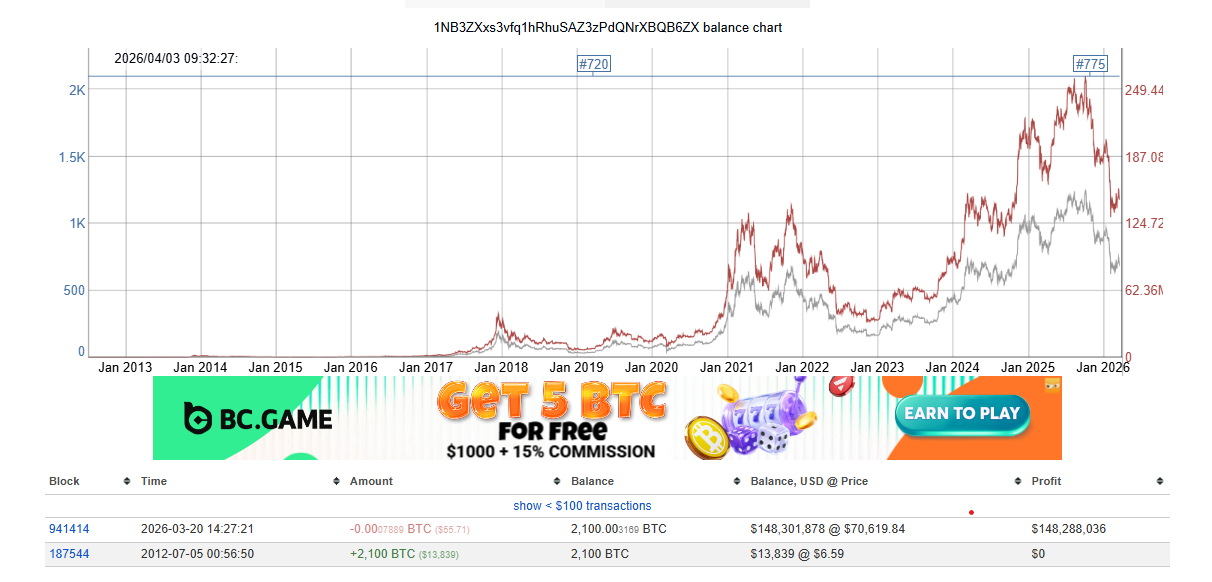
A long-dormant Bitcoin whale wallet has reactivated after 13 years and seven months of inactivity, shifting 0.00079 BTC ($56), a tiny fraction of a fortune now worth around $147 million.
Onchain data from BitInfoCharts shows that the legacy address “1NB3ZX…” received 2,100 Bitcoin (BTC) on July 5, 2012, when BTC traded at about $6.59 per coin. At today’s prices, that stash is valued at roughly $147 million, turning an initial outlay of about $13,800 into an unrealized gain of more than 10,000x.
The move caught the eye of onchain trackers like Whale Alert and LookonChain that monitor so-called Satoshi-era addresses, a term often used for coins acquired in Bitcoin’s early years.
BitInfoCharts shows the address was funded in a single large inflow on July 5, 2012, and then left untouched for almost 14 years.

Traders debate diamond hands vs recovered keys
Bitcoin traders are split between reverence and speculation. Some praised the HODLer’s apparent discipline for holding through multiple boom-and-bust cycles without selling, “No leverage. No day trading. No stress. Just conviction and time. The hardest strategy is also the most profitable.”
Related: Bitcoin whales shift $100M+ as oil spike rattles markets
Others argued that a more likely explanation was that the owner recently recovered their seed phrase or private key, and was sending a test transaction before cashing out a meaningful amount.
Test transactions of a few tens of dollars are common practice among long-inactive holders, who often move a tiny amount first to confirm they still control the wallet and that the destination address is correct.
Traders will now watch closely to see whether the wallet sends more of its 2,100 BTC to exchanges or fresh addresses in the coming days.
Satoshi-era whale echoes earlier $85 million move
The reawakened 2012 wallet follows another recent move by a Satoshi-era BTC holder in January. On that occasion, a separate address that first accumulated Bitcoin in 2013 transferred its entire balance of about 909 BTC (worth roughly $85 million) to a new wallet after more than 13 years of dormancy.
The whale locked in a gain of around 13,900x on coins originally bought for less than $7 each.
Magazine: Bitcoin may take 7 years to upgrade to post-quantum — BIP-360 co-author


- Stellar price hovered near $0.16 as bulls looked for a bounce despite the recent sell-off.
- XLM is among the coins designated as digital commodities under SEC and CFTC interpretations.
- €2.3 trillion asset manager Amundi launched a $100 million tokenized fund on Stellar.
Stellar Lumens (XLM) trades near $0.16 as bulls eye a rebound to month-to-date highs following recent sell-off.
Could this outlook materialize amid renewed investor attention on Stellar, with multiple potential catalysts in place? Developments across the ecosystem suggest so, and immediate targets include the psychological $0.20 mark.
Stellar gets key boost alongside Ethereum
The XLM token has pared recent gains to $0.18, and market data shows bulls are 41% down since touching highs of $0.50 in July 2025.
An overall downtrend puts bulls at risk of new pain.
However, the Stellar blockchain network is headlining crypto market sentiment amid a significant regulatory tailwind.
A Europe-based asset manager has also shown confidence in Stellar.
On the regulatory front, XLM is among several coins to receive official designation as digital commodities.
This follows a joint interpretation by the US SEC and CFTC, which listed XLM among other coins as digital commodities.
This clarity positions XLM favorably for compliant institutional adoption, reducing longstanding uncertainties that have hindered growth.
Elsewhere, Europe’s €2.3 trillion asset manager Amundi launched a $100 million tokenized fund on both Stellar and Ethereum networks.
The move reinforces the altcoin project’s potential in real-world asset tokenization.
On top of this news, on-chain data shows Stellar had a robust Q4, 2025.
The real-world asset (RWA) market cap grew 196% year-over-year to more than $890 million, and the stablecoin market cap jumped 53% to $243 million.
The other notable developments are a spike in DeFi TVL as a major US bank teased a stablecoin issuance on Stellar.
These ecosystem advancements highlight Stellar’s expanding role in bridging traditional finance and blockchain.
XLM price forecast: is $0.20 next?
Stellar price paints a bullish picture on the daily chart, with the decrease in intraday volume suggesting waning selling pressure.
According to data from CoinMarketCap, daily trading volume was down 16% in the past 24 hours to around $88 million.
Meanwhile, daily RSI reflects a neutral-to-bullish stance, hovering near 54 to indicate ample upside potential before overbought conditions.
The divergence suggests buyers are regaining control after recent consolidations around below $0.17.

If prices move higher, a breakout to $0.20 could allow bulls to revisit the 0.236 Fibonacci retracement level at $0.22.
More gains and bulls could eye $0.32 (aligns with the 0.5 Fibonacci retracement level).
However, downside risks include a drop in Bitcoin prices. XLM below $0.16 risks bearish continuation $0.13 or lower.
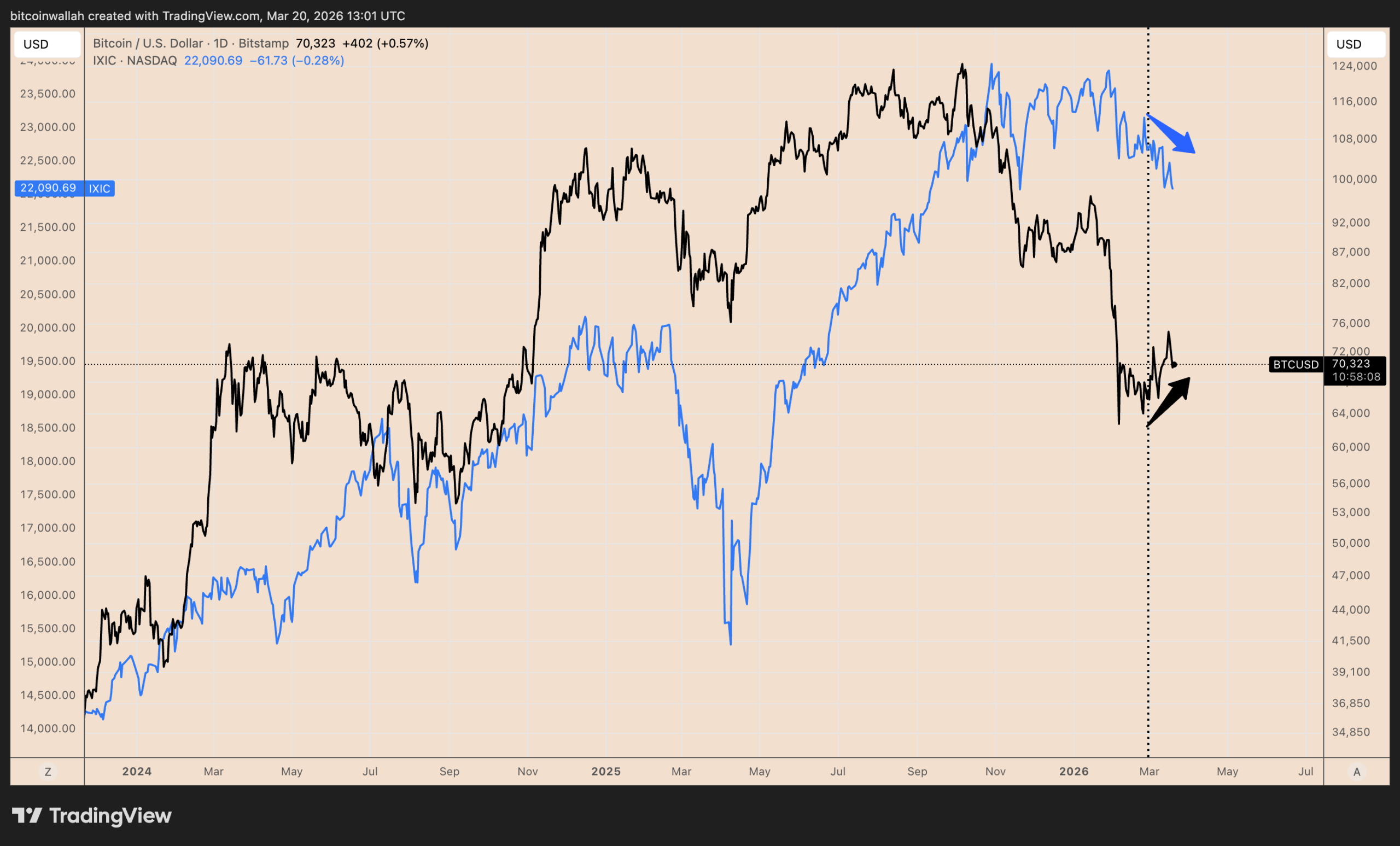
Bitcoin (BTC) has outperformed US equities and gold since the US and Israel’s attack on Iran on Feb. 28, underscoring its strength amid one of the year’s biggest geopolitical shocks.
However, BTC’s rally may face a serious challenge if oil prices spike toward $180 per barrel, a scenario some Saudi Arabian officials now see as plausible if Middle East supply disruptions persist beyond April.

Key takeaways:
-
US headline inflation may rise to 5% if oil supply shock persists, lowering rate cut odds in 2026.
-
Such macro headwinds risk sending the Bitcoin price to $51,000 in the coming months.
Oil boom may double US inflation and hurt Bitcoin
As of Friday, Brent crude was trading for around $105 per barrel, up roughly 50% since the US and Israel-Iran war started.

Oil transits through Iran’s Strait of Hormuz fell to 9.71 million barrels per day by mid-March from 25.13 million in February, according to Kpler data.

Vortexa, an energy data tracker, estimates a steeper drop to 7.5 million barrels per day, highlighting the scale of the Middle East supply shock and why experts anticipate oil to rise another 70%.
A 2023 US Federal Reserve study said that every 10% rise in crude price can add about 0.35–0.40 percentage points to US CPI.
By that measure, an extended oil rally could lift inflation by roughly 2.5–2.8 points, enough to push CPI well above its current 2.4% level and further above the Fed’s 2% target.
Markets are already adjusting to that risk.
Policy easing expectations have shifted more hawkish, with markets no longer pricing in a second rate cut in 2026 and the odds of the first cut now pushed further to October 2027.

Higher rates tend to keep borrowing costs high, tighten liquidity, and weaken investor appetite for risk assets such as Bitcoin and stocks.
Related: Trump ups pressure for Fed chair Powell to cut rates ‘right now’
Any signs of de-escalation in the conflict could quickly cool the oil rally.
Historically, such spikes have been short-lived, with prices normalizing over time and Bitcoin regaining strength as market fears fade.
Oil shock raises Bitcoin’s odds of hitting $51,000
The $180 oil warning appears as Bitcoin’s uptrend shows signs of fatigue.
BTC’s price has dipped 9.50% from its local high of nearly $76,000, trading under $70,000 as of Thursday. Its correction has painted a bear flag pattern with a $51,000–$52,000 measured downside target.

Bitcoin’s pullback also coincides with a complete halt in STRC-led BTC buying by Michael Saylor’s Strategy.
The firm did not buy Bitcoin this week, after purchasing 22,337 BTC in the week ending March 15 and 17,994 BTC the week before that.

That matters because Strategy had recently been absorbing supply at a pace equal to multiple weeks of global mining output. Its absence removes a major source of demand just as macro risks are building.
Coinbase premium has also turned negative, signaling softer US demand amid the ongoing oil supply shock.
This article does not contain investment advice or recommendations. Every investment and trading move involves risk, and readers should conduct their own research when making a decision. While we strive to provide accurate and timely information, Cointelegraph does not guarantee the accuracy, completeness, or reliability of any information in this article. This article may contain forward-looking statements that are subject to risks and uncertainties. Cointelegraph will not be liable for any loss or damage arising from your reliance on this information.
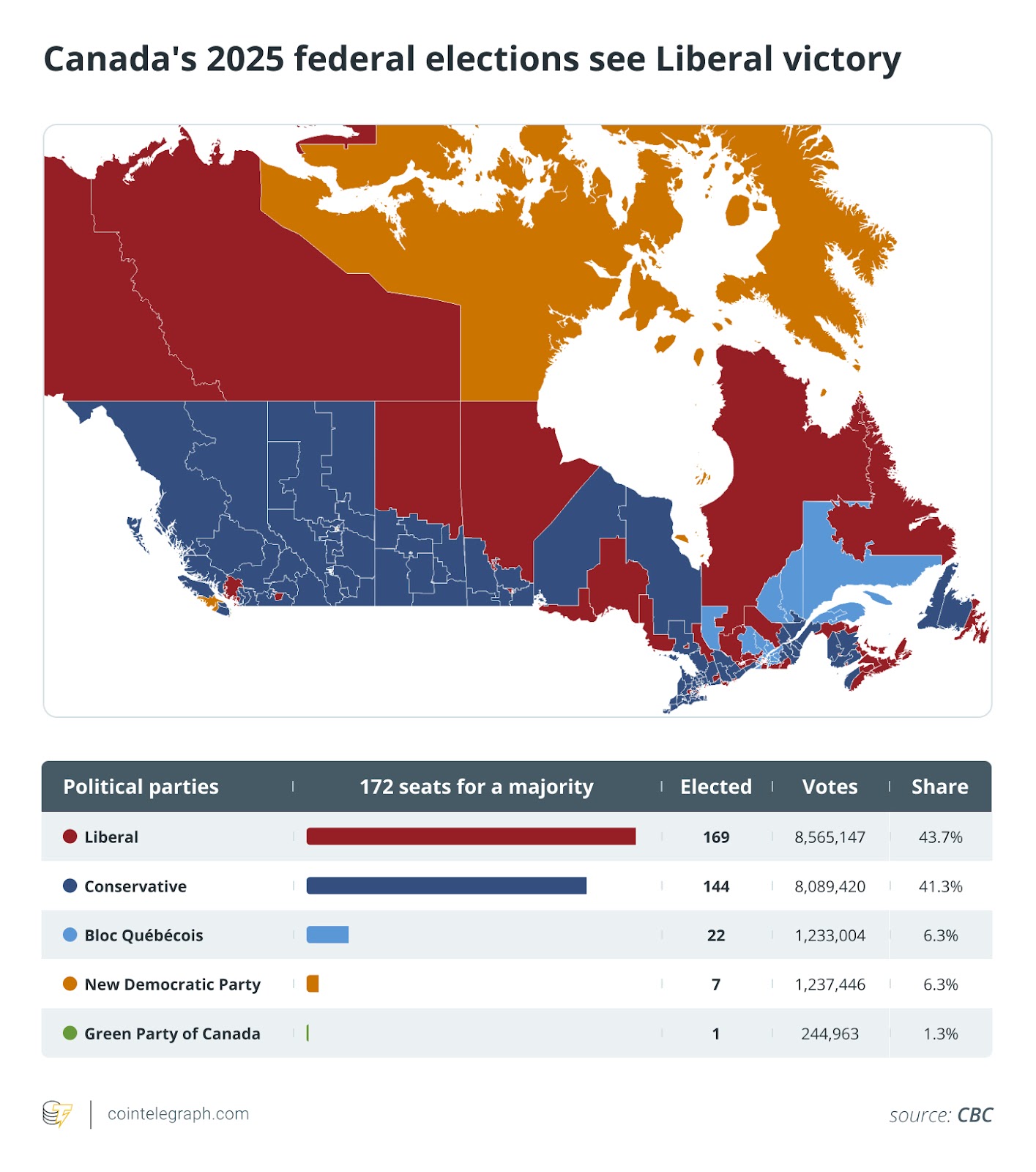
Cryptocurrencies and blockchain technology have increasingly become part of Canada’s core financial system over the past year.
In November, the country introduced stablecoin regulations as part of the Canada Stablecoin Act. Introduced as part of the budget, it gives the Bank of Canada the power to regulate stablecoins in the country.
Elsewhere, policymakers are finalizing amendments to laws for crypto asset funds, including those for cold wallets and custodians.
The changes highlight a pragmatic, but regulation-first approach to crypto, which observers have come to expect from Prime Minister Mark Carney’s government.
Increased scrutiny and new standards for crypto raise the bar
When Canadian Prime Minister Mark Carney assumed office last year, industry observers expected a cautious approach to crypto in Canada.
Carney had previously expressed skepticism about crypto. As Governor of the Bank of England, he said that “Cryptocurrencies act as money, at best, only for some people and to a limited extent, and even then only in parallel with the traditional currencies of the users. The short answer is they are failing.”
Still, he called for regulating the crypto space, and said that the underlying technologies could “improve financial stability; support more innovative, efficient and reliable payment services as well as have wider applications.”
In May 2025, Morva Rohani, executive director of the Canadian Web3 Council, said, “With Mark Carney at the helm of the Liberal Party, we anticipate a pragmatic but regulation-first approach to crypto and stablecoins.”

Focusing on regulation has led to increased scrutiny and higher standards for the cryptocurrency industry in Canada.
Naveen Maher, chief compliance officer of Canadian crypto exchange operator WonderFi, noted that the Canadian Securities Administrators (CSA) had closed off the “restricted dealer” registration category. The status was created for targeted firms that do not fit into traditional dealer categories, such as crypto trading platforms. Now they have to become full investor dealers through the CSA, and become members of the Canadian Investment Regulatory Organization (CIRO), a non-profit, national self-regulatory organization.
It led to some consolidation. “That’s a significant shift and it’s removed several players who were sitting in that interim status with a hope that the rules wouldn’t tighten further,” said Maher.
WonderFi “made the call early to get fully registered under CIRO” through its trading platform Coinsquare. This required significant investment and compliance, but now allows the firm to operate “under the highest available regulatory standard in Canada.”
“The firms that delayed that transition are now looking at a much steeper climb,” Maher said.
Policymakers are also finalizing amendments to National Instrument 81-102, the primary Canadian regulation investment funds and mutual funds, including those containing crypto.
“These rules raise the bar across the industry and favor established firms like ours, who already have the infrastructure to absorb them,” Maher said.
Ottawa is also moving to implement the Crypto Assets Reporting Framework from the Organisation for Economic Co-operation and Development. Implementation has been delayed until Jan.1, 2027, but according to Maher, “It will impose annual reporting obligations on every crypto service provider operating […] For other smaller or offshore players, this may be a real issue.”
Rohani told Cointelegraph on Friday that regulators are also enforcing registration requirements more visibly. On Monday, Canada’s Financial Transactions and Reports Analysis Centre (FINTRAC) revoked the money services businesses (MSB) registrations of 47 crypto businesses.
“Industry reaction has been that this is a counterparty risk moment, if your partners are not fully compliant, your own operations are exposed,” she said.
Crypto industry and regulators still have different priorities
Standards for crypto in Canada may have come closer to those governing the rest of the financial industry, but the policymakers and the blockchain industry are still apart on certain issues.
For the government, the big one was stablecoins, according to Maher. “Once the US moved on stablecoin legislation, Ottawa followed.” After stablecoins, everything else points in the same direction, which is bringing crypto into the traditional financial system, on regulators’ timeline,” she said.
Rohani said that “Canada is beginning to treat parts of crypto as closer to the core financial system rather than purely peripheral, but the primary lens is still risk management.”
The stablecoin legislation was part of this latter concern. “This shift is being driven by Carney in response to rapid developments in the US, particularly frameworks like the GENIUS Act, which are viewed as a geopolitical risk.”

Furthermore, the government is “focused on stability, consumer protection, and ensuring that new digital instruments do not introduce systemic risk,” said Rohani.
The industry, meanwhile, is seeking more “clear, workable” rules concerning stablecoins, custody and asset tokenization.
Per Maher, the crypto sector needs harmonization. “Right now, you have FINTRAC, the CSA, CIRO, the CRA [Canada Revenue Agency], and provincial regulators all touching different parts of the same business. The coordination is improving but it’s still fragmented.”
She also noted issues of product access. Stating that Canadians can’t hold crypto in their registered retirement savings plans or their tax-free savings accounts “in any straightforward way.”
Some policymakers still not sold on crypto
In 2018, Carney said that the “underlying technologies” behind crypto “are exciting.” This separation of blockchain from crypto still continues and is visible in the Canadian government’s regulatory approach.
Rohai said, ”There is still a clear distinction. Policymakers are more comfortable with blockchain as infrastructure.” This is exemplified with Project Samara, where Export Development Canada issued a $100 million Canadian dollar bond on Hyperledger.
Policymakers, “remain cautious on crypto assets themselves, which are still viewed primarily through a risk and investor protection lens.”
Maher said that the blockchain/crypto split is “not subtle,” stating that Carney has a preference for central bank digital currencies over decentralized assets.
“This view shapes the administration’s posture which is comfortable with digital assets as a regulated investment category and considerably less comfortable with anything which sits outside that box,” she said.
Financial products which “map cleanly on the existing frameworks” like Bitcoin exchange-traded funds move forward. “DeFi, self-custody, on-chain settlement sits in a different category, and the industry is aware of it.”
Magazine: Are DeFi devs liable for the illegal activity of others on their platforms?
Since draining Japanese crypto platform UXLINK six months ago (and losing a chunk of the proceeds), the hacker behind the attack has been trying to hit it big on-chain.
It’s not going great.
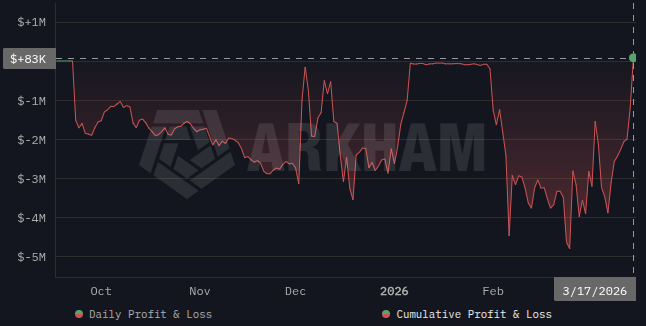
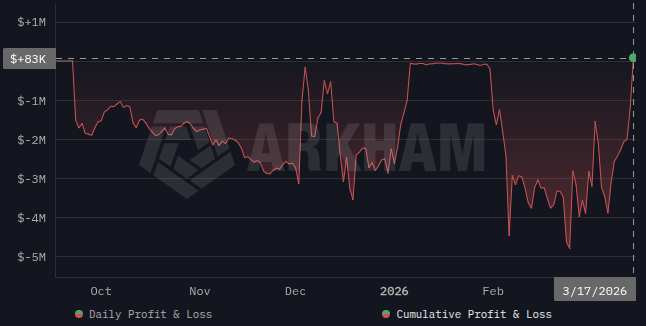
Blockchain analytics platform Arkham has been tracking the hacker’s trading history, highlighting recent ETH sales which brought them back to breakeven.
But given the market over the past six months, one could argue that breakeven is nothing to be sniffed at.
Read more: UXLINK goes from bad, to worse, to weird after hacker loses stolen tokens
The September attack unfolded in two stages. First, UXLINK’s multi-signature wallet was compromised and drained for $11 million worth of assorted crypto tokens.
Hours later, the project’s token contract, which had also been compromised, minted a billion tokens, with a theoretical dollar value in the nine figures.
The drama didn’t stop there, however. While dumping the UXLINK tokens, and cratering its price as liquidity depleted, the hacker fell for a phishing link, losing half the freshly-minted tokens.
Trading with house money
Since then, the hacker’s trading history shows swaps made mainly between the stablecoin DAI and WETH or WBTC.
Arkham’s profit and loss (PnL) calculations put the hacker’s cumulative PnL at $83,000 in the green.
While the gains are small, just 0.2% of the $36.6 million held in the wallets, it’s currently performing better than at any time since the hack.
PnL has been down-only, aside from brief periods of clawing back close to breakeven. But recent weeks have seen a sudden recovery from an all-time low of -$4.8 million in late February.
Read more: Venus Protocol hacker lost $4.7M after nine months of planning
Easy come, easy go
Hackers trading stolen funds have had mixed results in recent years.
Members of North Korea’s Lazarus Group traded the proceeds of 2024’s $50 million Radiant Capital attack, ending up $40 million in profit by last summer.
In October last year, a hacker who previously stole 400 bitcoins from a Coinbase user “panic sold” ether which they had bought with the ill-gotten gains.
During two crypto market crashes, a week apart, they realized a total of $10 million in losses.
Read more: Outdated algorithm caused $650M excess losses on Hyperliquid, report
A slightly more unsettling incident saw Lazarus-linked addresses liquidated for $500,000 on Hyperliquid in late 2024.
While some were happy to see the bad guys get wiped out, others were concerned the activity was testing for a potential future exploit.
Also on Hyperliquid, a wallet linked to the $30 million zKasino “rug pull” in April 2024 suffered a $27 million liquidation a year later.
Got a tip? Send us an email securely via Protos Leaks. For more informed news and investigations, follow us on X, Bluesky, and Google News, or subscribe to our YouTube channel.

Bournemouth vs Man United LIVE Early team news and how to watch Premier League clash

CISA orders feds to patch max-severity Cisco flaw by Sunday

Nicola Peltz’s brutal dig at Beckhams as she says her parents consider Brooklyn their son


-
Crypto World7 days ago
HYPE Token Enters Net Deflation as HyperCore Buybacks Outpace Staking Rewards
-

 Tech5 days ago
Your Legally Registered ‘Motorcycle’ Might Not Count Under Proposed US Law
-

 Fashion7 days ago
Weekend Open Thread: Addict Lip Glow
-
 Tech3 days ago
Are Split Spacebars the Next Big Gaming Keyboard Trend?
-
Sports6 days ago
Why Duke and Michigan Are Dead Even Entering Selection Sunday
-

 Business5 days ago
Search for Savannah Guthrie’s Mother Enters Seventh Week with No Arrests
-

 Business6 days ago
US Airports Launch Donation Drives for Unpaid TSA Workers as Partial Government Shutdown Enters Fifth Week
-
Crypto World6 days ago
Coinbase and Bybit in Investment Talks: Could Bybit Finally Enter the US Crypto Market?
-

 Business4 days ago
Australian shares drop as Iran war enters third week
-

 Business6 days ago
Country star Brantley Gilbert enters growing non-alcoholic beer market
-

 Crypto World4 days ago
Crypto Lender BlockFills Enters Chapter 11 with Up to $500M in Liabilities
-

 Sports7 days ago
College Basketball Best Bets: Conference Tournament Semifinal Picks
-

 Politics2 days ago
The House | The new register to protect children from their abusers shows Parliament at its best
-

 News Videos2 days ago
RBA board divided on rate cut, unusually buoyant share market | Finance Report | ABC NEWS
-

 Fashion4 days ago
25 Celebrities with Curly Hair That Are Naturally Beautiful
-

 Tech12 hours ago
inKONBINI Lets You Spend Summer Days Behind the Register
-

 Crypto World2 days ago
Canada’s FINTRAC revokes registrations of 23 crypto MSBs in AML crackdown
-
 Politics3 days ago
Real-time pollution monitoring calls after boy nearly dies
-

 Crypto World6 days ago
Crypto Losses Drop 87% in February, But Hackers Are Now Targeting People, Not Code
-
 NewsBeat2 days ago
Residents in North Lanarkshire reminded to register to vote in Scottish Parliament Election


You must be logged in to post a comment Login