

Crypto World
South Korea weighs opening crypto transfer licenses to fintech firms



South Korea has begun considering rules that could allow fintech firms, not just cryptocurrency exchanges, to participate in a new licensing regime for cross-border digital asset transfers scheduled to take effect in December.
Summary
- South Korea is considering allowing fintech firms to join a new virtual asset transfer licensing regime set to take effect in December.
- Companies approved under the framework will be able to offer blockchain based cross border remittance and foreign exchange services under formal regulatory oversight.
Officials from relevant government agencies and industry participants told local media that authorities have started drafting enforcement regulations for amendments to the Foreign Exchange Transactions Act and are reviewing registration requirements for businesses seeking to operate virtual asset transfer services.
The South Korean government promulgated the revised law on June 2 after cabinet approval. The legislation includes a six-month grace period and will take effect in December.
Under the new framework, cross-border transfers involving virtual assets will become a regulated foreign exchange activity. Companies that wish to provide such services must register with the Ministry of Economy and Finance and report overseas transfer transactions through the Bank of Korea’s foreign exchange reporting network.
Authorities have argued that cross-border cryptocurrency transactions previously operated outside the country’s foreign exchange oversight system, creating risks related to illicit foreign exchange activity and money laundering. The revised framework brings those transactions under formal supervision and reporting requirements.
The law requires applicants to complete Virtual Asset Service Provider registration, connect their systems to institutions responsible for relaying foreign exchange and digital asset transaction information, and satisfy additional requirements related to facilities and professional personnel that will be defined by presidential decree.
Current VASP rules limit eligible firms largely to cryptocurrency exchanges and certain custodians registered with the Financial Intelligence Unit under the Financial Services Commission. Industry participants had therefore expected the new regime to be dominated by major domestic exchanges such as Upbit and Bithumb.
Fintech firms could gain access to the market
Government officials are also reviewing whether registration should extend beyond exchanges to fintech companies capable of handling cross-border virtual asset transfers.
A Bank of Korea official told local media that authorities do not necessarily need to restrict the business to existing VASPs if other entities can perform transfer services. The official added that businesses seeking to engage in virtual asset transfer activities may still need foreign exchange-related registration under applicable regulations.
The Bank of Korea said it has been holding meetings with industry participants and providing guidance on registration requirements and integration with the foreign exchange reporting system.
Industry attention has increasingly focused on whether the final enforcement decree will open the sector to new entrants beyond traditional cryptocurrency trading platforms.
Many fintech firms have faced obstacles entering the digital asset market because of VASP registration requirements and difficulties securing real-name banking relationships. Industry participants believe a separate licensing framework for virtual asset transfers could create opportunities in blockchain-based remittances and foreign exchange services.
The Ministry of Economy and Finance and the Bank of Korea are continuing consultations with industry participants as they finalize detailed rules ahead of the December launch of the virtual asset transfer licensing regime.
South Korea expands digital asset oversight
The latest regulatory initiative follows recent efforts by South Korean authorities to define how blockchain-based financial products fit within existing financial rules.
Earlier this month, the Ministry of Economy and Finance said tokenized stocks could be taxed under existing securities regulations if the Financial Services Commission formally classifies them as securities. Officials stated that the legal treatment of an asset should depend on its economic characteristics rather than the technology used to issue it.
The Financial Services Commission is expected to release updated token securities guidelines in July as it continues work on a roadmap covering tokenized versions of conventional financial assets, including listed equities.

Bitcoin (BTC) is once again approaching its yearly low near $59,000 after a failed recovery attempt left bulls unable to reclaim key resistance levels. BTC traders are now anticipating new lows for 2026 as the price drifts back toward a major support zone.
However, exchange inflows from mid-sized investors across Binance and Coinbase recently dropped to their lowest levels since April 4, easing further selling pressure.
Liquidation data also shows more than $4 billion in leveraged positions concentrated near the $59,000 level, a setup that may lead to a downside liquidity sweep before a recovery rally towards the $68,000 range.
Bitcoin traders target liquidity pocket below $59,000
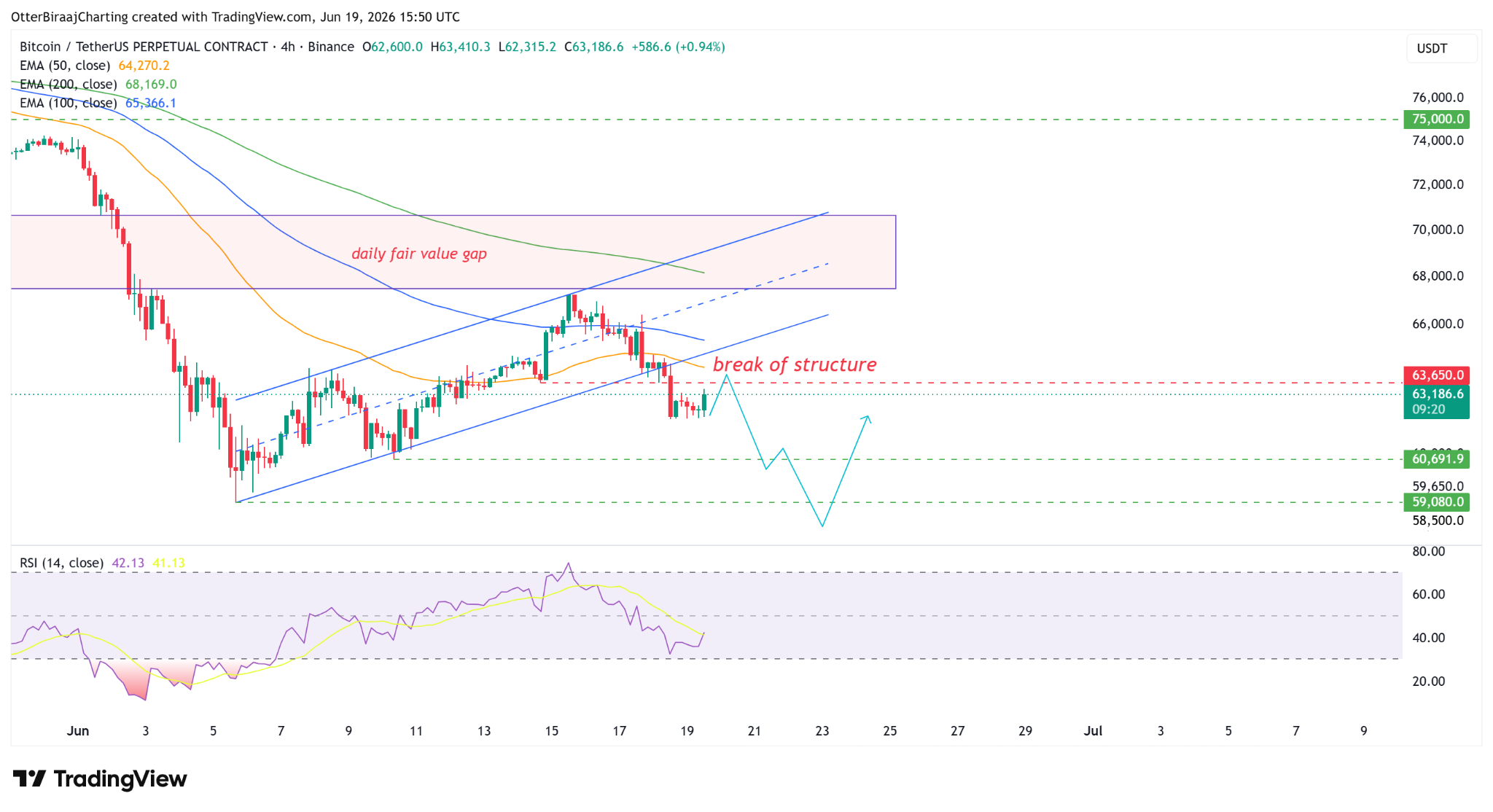
Bitcoin’s recovery attempt stalled before reaching the daily fair-value gap between $67,500 and $70,500. The sellers regained control near the 50-day and 100-day exponential moving averages, which continue to act as overhead resistance.
The rejection pushed BTC below an ascending channel, confirming a bearish break of structure on the four-hour chart. The price is currently trading below the channel range, with internal liquidity support near $60,700 as the next area of interest, followed by the yearly low at $59,000.
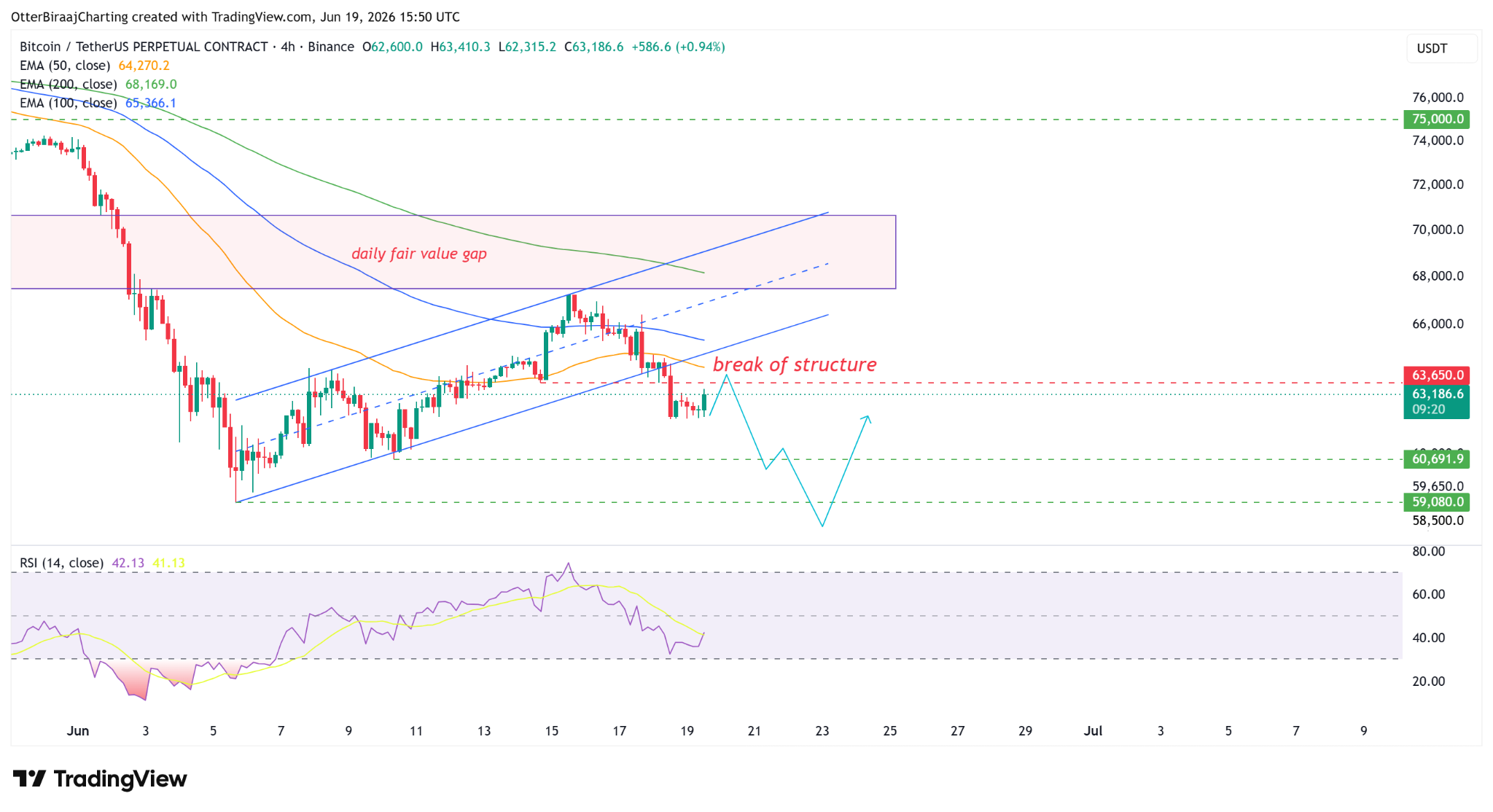
BTC/USD, four-hour chart. Source: Cointelegraph/TradingView
The liquidation data adds weight to that zone. Around $4 billion in cumulative leveraged long positions is concentrated near $59,000. A move into that area could trigger forced selling and flush out late long positions. Beyond that level, the next major liquidity concentration is near $68,000, where more than $4.75 billion in cumulative positions are clustered.
The momentum conditions are also approaching an extreme. The relative strength index (RSI) is hovering near oversold territory. Another push toward yearly lows would likely drive the indicator below 30, a level that may precede a sharp relief bounce after liquidations.
Crypto analyst Killa said Bitcoin could still front-run the liquidity pool below $60,000 rather than fully sweeping it. The trader argued that markets often move in the opposite direction of levels that attract widespread attention, similar to how Bitcoin front-ran liquidity above $140,000 in October 2025.
BTC trader LP also warned against becoming “too bearish here” in the short term, pointing to a potential bottom forming toward late June.
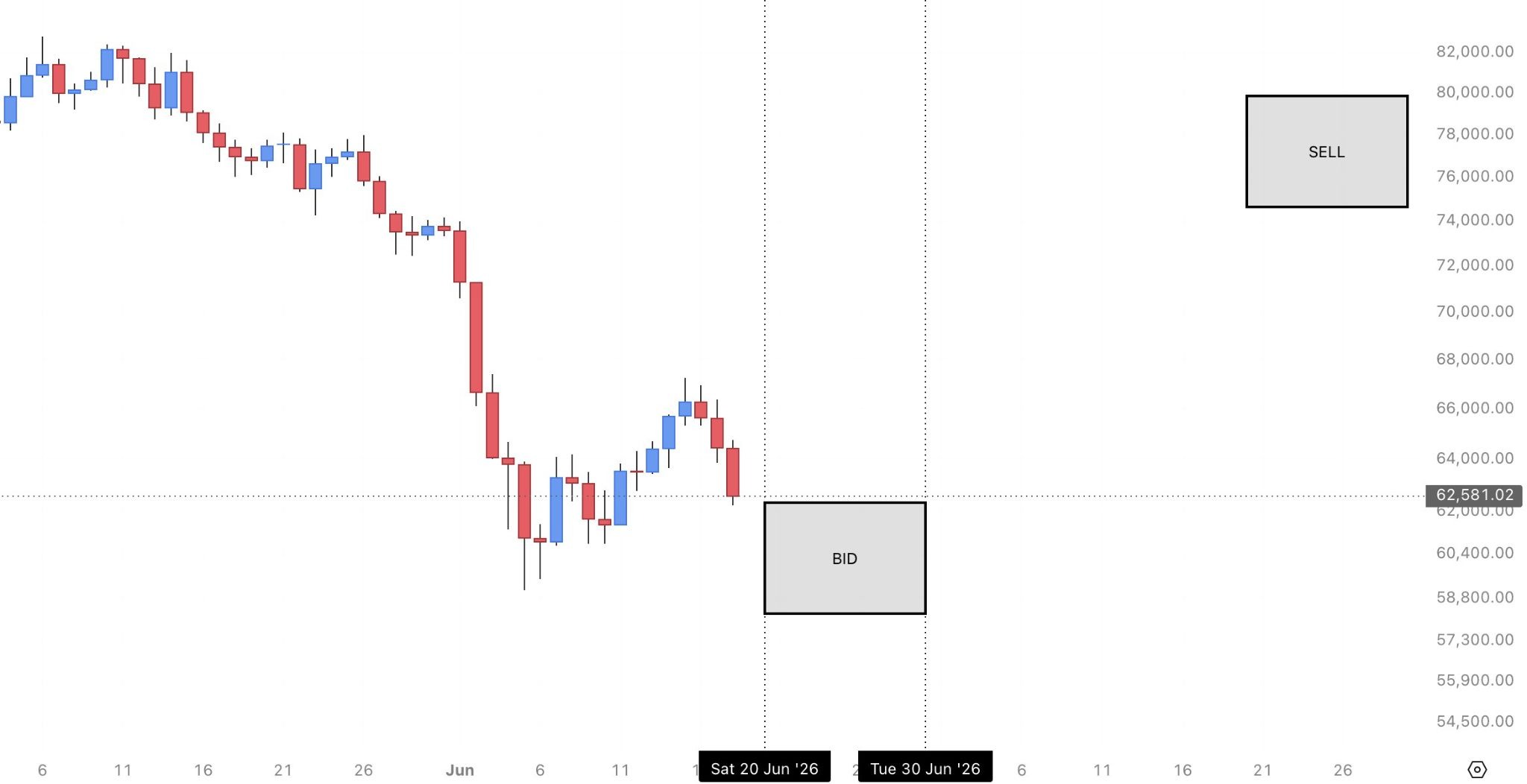
BTC/USD, one-day chart analysis by LP. Source: X
Related: Bitcoin’s deeply discounted versus AI-stocks, but hawkish Fed risk lingers: Bitwise
BTC exchange inflows continue to decline
According to CryptoQuant analyst Amr Taha, inflows from mid-sized Bitcoin investors declined simultaneously across Binance, Coinbase, and Coinbase Prime on June 19. Binance recorded roughly 3,500 BTC in inflows, Coinbase nearly 3,000 BTC, and Coinbase Prime about 1,700 BTC, the lowest readings since April 4.
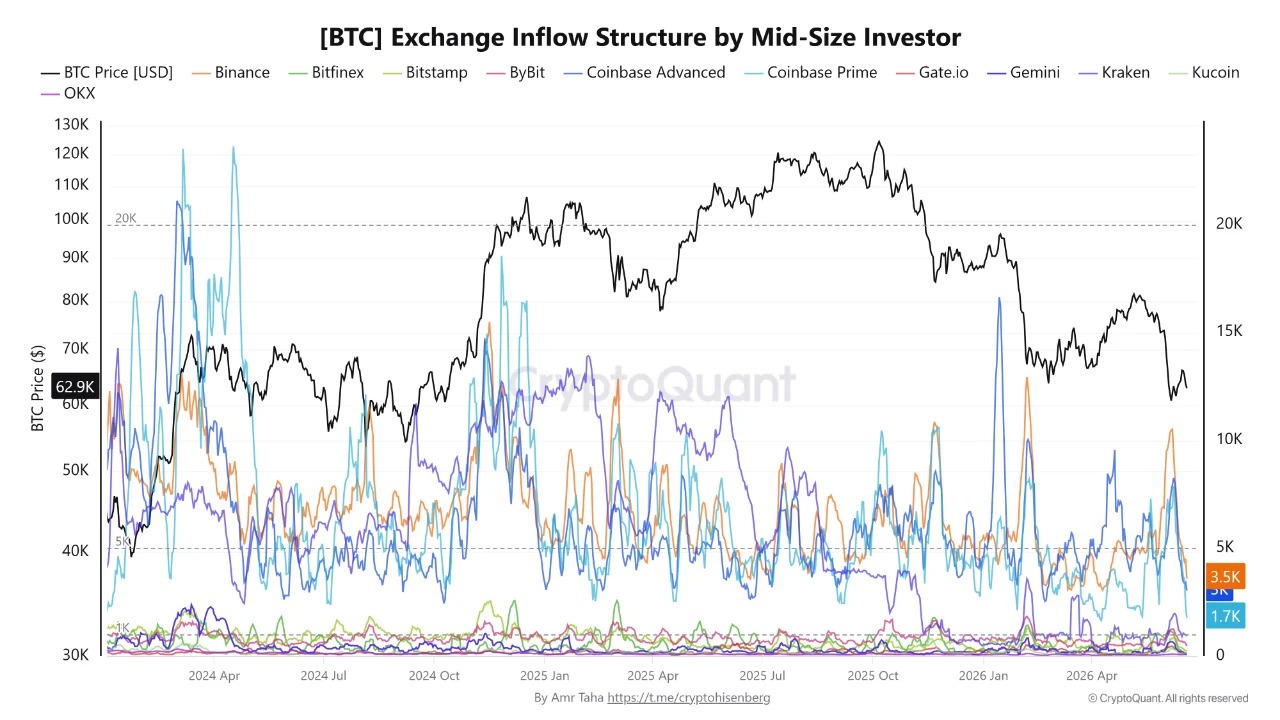
BTC exchange inflow structure by mid-size investors. Source: CryptoQuant
Exchange inflows are commonly tracked as a measure of potential selling intent. Lower deposits mean fewer coins are being positioned for immediate sale. This indicates one source of near-term sell pressure has eased.
The trend does not signal new demand on its own. It shows that mid-sized holders are reducing transfers to trading venues as Bitcoin trades near $62,000. For now, the flow data points to lighter exchange-side pressure even as price tests a major liquidity concentration near yearly lows.
Related: Bitcoin tipped for Q3 ‘macro bottom’ near $50K as major liquidity grab looms
Crypto World
CME Group to Sue CFTC Over Perpetual Futures Approval, Citing Dodd-Frank Swaps Definition


CME Group plans to sue the Commodity Futures Trading Commission over the agency's approval of crypto perpetual futures, the world's largest derivatives exchange operator announced Wednesday evening on CNBC. Outgoing Chief Executive Terrence Duffy said the case would be filed as soon as Thursday and… Read the full story at The Defiant

At the start of June, the two largest cryptocurrencies by market capitalization tumbled to their lowest levels in years. However, many analysts believe the cycle bottoms have not occurred yet.
The big question now appears to be whether Bitcoin (BTC) or Ethereum (ETH) will find its floor first, and here’s the take of one popular market observer.
Is ETH First in Line?
X user Ted argued that the second-biggest cryptocurrency is more likely to bottom before the industry’s undisputed leader. He claimed that most of the downside liquidity has been taken out, projecting a plunge to $1,300-$1,400.
“But after that, upside liquidity will start to look more interesting,” he added.
Shortly after, Ted noted ETH’s drop below the critical $1,700 mark and warned that the asset could post a further 5-6% decline if it doesn’t reclaim this level.
There are plenty of other analysts who believe the worst for Ethereum is ahead. Ali Martinez said the asset is breaking down from its channel and is trading below the 200-hour SMA. That said, he expects a drop toward $1,580.
Niels also claimed that ETH hasn’t bottomed for this cycle, predicting a crash to as low as $1,200 sometime this year. At the same time, they see the current price level as a great buying opportunity.
How About BTC?
Earlier in June, the primary cryptocurrency plummeted to nearly $59,000 for the first time since late 2024. Ted, like many other industry participants, thinks this was not the bottom.
He spotted a massive liquidity cluster around $50,000-$60,000, describing it as the same zone with large BTC buy orders on exchanges. With that in mind, Ted said that the price will likely sink to $50K “with a possible wick.”
X users bee and Crypto Lens have also made bearish forecasts. The former opined that BTC is “on the verge of the final flush,” expecting a drop to $51,000-$52,000, while the latter envisioned a downturn to $43,000 by August this year.
However, it’s not all doom and gloom. Certain factors, such as the declining amount of BTC held on exchanges, suggest a rebound is also possible. As CryptoPotato reported, the figure recently dipped to a six-year low, meaning that investors have abandoned centralized platforms in favor of self-custody, thereby reducing immediate selling pressure.
Meanwhile, whales scooped up more than 30,000 BTC in a week: a strong signal that they are positioning for the next rally and something that could encourage retail investors to jump on the bandwagon, too.
The post Bitcoin (BTC) or Ethereum (ETH): Which Will Bottom First? appeared first on CryptoPotato.

Ethereum may be heading toward a funding crisis that could begin to emerge within the next three to nine months, according to former Ethereum Foundation contributor Trent Van Epps.
In a recent article on X, Van Epps, who recently ended his five-year stint at EF, said the risk is not simply the result of a temporary funding gap but originates from deeper structural changes taking place across the ecosystem.
Funding Crunch
Van Epps spoke about EF’s long-standing philosophy of “Subtraction,” a strategy that aims to gradually reduce the Foundation’s influence and encourage the broader Ethereum community to take on a larger role in supporting the network.
While he said the approach has been successful in conveying that the EF does not want to remain Ethereum’s sole center of power, he believes it has been less effective at ensuring other institutions step in to fill the gaps left behind.
According to Van Epps, the Ethereum Foundation still occupies a unique position within the ecosystem due to factors such as its reputation, historical role in leading the protocol, connection to Ethereum co-founder Vitalik Buterin, ownership of major communication channels and trademarks, as well as its long-standing support of core developers and researchers.
However, he added that one of the Foundation’s most important resources, its treasury, is becoming increasingly constrained.
The EF has spent much of its ETH holdings over the last decade helping bootstrap Ethereum’s growth and has already begun reducing spending to preserve remaining funds. He highlighted the Foundation’s treasury plan announced in June 2025, which outlined a gradual reduction in annual spending from 15% to a 5% endowment-style level by 2030.
Van Epps also pointed to the expiration of Ethereum’s Client Incentive Program (CIP) in April 2026. The four-year initiative provided funding to client teams through staking rewards, and no replacement program has been announced so far.
Shrinking Resources
Based on conversations across Ethereum’s core development community, he said these developments have created a real risk that funding pressures could start building over the coming months. He estimated that maintaining Ethereum’s current development capacity requires roughly $30 million per year to support client teams, researchers, and coordination efforts across the ecosystem.
Without stable funding, Van Epps warned that Ethereum could lose contributors who have accumulated years of critical expertise, which makes it harder to tackle major challenges such as scaling the network and preparing for future threats like quantum computing. According to the former contributor, the consequences of underinvestment may not be immediately visible but could become apparent within the next 12 to 18 months, when reversing the damage would be significantly more difficult and expensive.
Van Epps believes the Ethereum Foundation is unlikely to remain the network’s primary steward over the next decade, as he echoed recent comments from Vitalik Buterin that the organization was never intended to serve as Ethereum’s permanent caretaker. He called for new institutions and sustainable funding mechanisms capable of supporting Ethereum’s long-term development and maintaining the shared resources the ecosystem depends on.
The post Ethereum’s Biggest Risk May Be a Funding Crunch, Former EF Contributor Warns appeared first on CryptoPotato.


Nikita Bier, head of product at X, targeted Meta workers with a public recruitment pitch this week. He promised to match or beat any corporate snack budget the company could offer.
Meta CTO Andrew Bosworth admitted on an internal call that employee morale is near its worst ever. The May 2026 layoffs cut 8,000 jobs. Meta also forced roughly 7,000 more workers into AI units, giving them little say in the transition.
X Sees an Opening in Meta’s Morale Problem
Bier announced open roles for web and data engineers and data scientists. He aimed the message directly at workers he described as “neglected.”
His pitch was a direct dig at Meta’s crisis response. Rather than leading with salary, he zeroed in on the snack budget. That was the same perk Meta had scrambled to expand after morale collapsed. He pledged X would match or exceed whatever Meta could offer.
Workers on internal forums described Meta’s culture as “dead and depressing.” The core issue runs deeper than office perks, however. Applied AI, a division formed in March, absorbed around 6,500 engineers and product managers with little input from those transferred. Some employees compared it to a labor camp.
Meanwhile, 2026 tech layoff odds on prediction market Polymarket sit at 67%, with Meta’s situation among the factors traders cite. The Meta job cuts wiped out roughly 10% of its workforce in a single round.
Bier is no stranger to weighing in on Meta. He previously defended Mark Zuckerberg after backlash over a whistleblower documentary trailer. That move showed a pattern of engaging publicly with debates around Meta’s leadership and culture.
The post Who Needs Salary? X’s Nikita Bier Is Poaching Meta Talent With Better Snacks appeared first on BeInCrypto.


Amazon Web Services on Monday turned on AI traffic monetization inside AWS WAF, letting any site behind Amazon CloudFront charge AI agents per request in stablecoins through Coinbase's x402 protocol. It is the first time a hyperscale cloud has wired onchain settlement directly into its… Read the full story at The Defiant
Crypto World
CLARITY Act Reaches Senate Floor With House Ready to Move Fast; Seven-Democrat Math Becomes the Gate


The Digital Asset Market Clarity Act sits on the Senate Legislative Calendar as Calendar No. 423, eligible for a floor vote at any time leadership chooses to schedule one. House Agriculture digital-assets subcommittee chair Dusty Johnson said Thursday the House will move fast on a companion if the… Read the full story at The Defiant


Reform UK leader Nigel Farage has been threatened with a referral to the UK’s parliamentary authorities after he allegedly under-declared a private jet donation from billionaire crypto investor Christopher Harborne.
The threat came from Labour Chair Anna Turley, who wrote to Farage claiming that the donation he declared doesn’t match the market rates of private jet flights.
Farage took the private jet to the Chagos Islands earlier this year, where he attempted to undermine a UK sovereignty deal. He originally declared Harborne’s donation as £12,500 ($16,500), but later adjusted it to £25,000 ($33,500).
Turley claims that the cost of hiring the jet, and the 23-hour duration of his flight, mean his trip should’ve cost anywhere between £189,000 ($250,000) and £529,000 ($700,000).
She told Farage, “If you fail to provide anything less than a full and accurate account, I will be obliged to raise the matter with the Parliamentary authorities.”
Farage lobbied the Bank of England on crypto regulation
Turley then went after the controversial right-wing politician again, reportedly referring him to a UK financial regulatory body.
In this case, during a private meeting in September 2025, he allegedly urged Bank of England Governor Andrew Bailey to shelve plans for a state-backed stablecoin dubbed “Britcoin.”
One month later, Farage said at the crypto event Zebu Live that he would be “prepared to go to prison” in order to stop Britcoin, describing the plans for a state-backed stablecoin as “total and utter horror.”
The introduction of a state-backed stablecoin would dilute the private stablecoin market and, in doing so, reduce the value of Harborne’s 12% stake in multi-billion-dollar stablecoin giant Tether.
Read more: Nigel Farage aide George Cottrell bets US war will last four more months
Harborne’s lawyers told the Guardian that the story contained “a number of unsupported insinuations, hallucinations, and conspiracy theories bearing no basis in reality.”
Harborne has altogether given Reform UK a whopping £25 million ($33 million). By September 2025, Harborne had already donated £19 million ($25 million).
Reform UK loses key local election
One particular £5 million sum from Harborne, which Farage kept a secret, has already led to parliamentary authorities investigating the Reform UK leader.
This gift was made weeks before Farage U-turned and decided to stand in the general election. He claims he didn’t have to declare the sum as it was a personal gift given to him for security reasons and Brexit campaigning.
Farage has also been facing pressure this week outside of crypto.
Newsletter Democracy For Sale reported on Tuesday that his personal firm, Thorn in the Side Ltd, was breaking British company law by failing to file a confirmation statement and verify Farage’s ID.
To top it off, a Reform UK candidate lost in a key UK local election yesterday to Labour MP and Manchester Mayor Andy Burnham.
Read more: Reform UK isn’t sharing crypto wallets with UK regulators, report
It’s believed that Burnham may challenge Sir Keir Starmer’s position as prime minister and spark a leadership contest.
Got a tip? Send us an email securely via Protos Leaks. For more informed news and investigations, follow us on X, Bluesky, and Google News, or subscribe to our YouTube channel.


The CLARITY Act has entered another round of Senate negotiations, with Senate Agriculture Committee Chairman John Boozman saying that limited understanding of the bill among lawmakers remains one of the biggest obstacles to its progress.
Summary
- John Boozman says many senators still do not fully understand the CLARITY Act.
- David Nage estimates lawmakers and industry participants are 80%–85% aligned on the bill.
- Cynthia Lummis believes a Senate vote before the August recess is more likely than before July 4.
According to a report from Punchbowl News, senators met on Thursday, June 18, to discuss the next phase of work on the crypto market structure legislation. Much of the proposal falls under the jurisdiction of the Senate Agriculture Committee, placing the panel at the center of efforts to move the bill toward a floor vote.
Speaking after the meeting, Boozman said discussions were advancing but acknowledged that many lawmakers are still unfamiliar with the legislation. He stated that most members do not fully understand the bill, describing that knowledge gap as a challenge as negotiators attempt to build support across the Senate.
The comments arrive as congressional leaders face increasing pressure to resolve remaining issues before lawmakers leave Washington for the August recess. Several last-minute meetings have been scheduled as Senate offices continue working through outstanding provisions tied to digital asset regulation.
Senate support appears stronger than public debate suggests
While Boozman highlighted concerns about member awareness, separate discussions on Capitol Hill suggest that disagreements over the substance of the legislation may be narrower than they appear.
As previously reported by crypto.news, David Nage, managing director and portfolio manager at Arca, said conversations with Senate offices led him to conclude that lawmakers and industry participants are roughly 80% to 85% aligned on the core elements of the bill.
In Nage’s assessment, stablecoin yield provisions no longer rank among the most contentious issues, despite continued criticism from JPMorgan CEO Jamie Dimon. Instead, Nage said attention has increasingly turned toward ethics and conflict-of-interest rules governing government officials involved in crypto-related business activities.
Following discussions with congressional staff, Nage stated that lawmakers are largely debating how such restrictions should be implemented rather than whether they should exist. He described the remaining divide as a political and enforcement matter rather than a disagreement over digital asset market structure itself.
Under Nage’s base-case scenario, lawmakers would settle the ethics language and reconcile competing proposals in the coming weeks, allowing the legislation to reach the Senate floor after Congress returns from recess on July 13.
Senate timeline remains the key uncertainty
Despite growing optimism from some supporters, the expected timing of passage remains unsettled.
During a recent interview with FOX Business, Senator Bill Hagerty said he hopes Congress can complete work on the legislation before the July 4 recess. Hagerty argued that the measure would provide the regulatory certainty needed for the U.S. digital asset sector to expand domestically rather than abroad.
Earlier, White House crypto advisor Patrick Witt also expressed optimism that lawmakers could approve the bill by Independence Day.
Other lawmakers have pointed to a longer timeline. Senator Cynthia Lummis has said a Senate floor vote before the August recess appears more likely than passage before July 4. Lummis has also noted that the legislation includes $150 million in funding intended to combat illicit cryptocurrency activity.
Supporters of the proposal contend that the bill would define the responsibilities of the Securities and Exchange Commission and the Commodity Futures Trading Commission while establishing compliance standards for digital asset firms.
Lummis has further warned that if Congress fails to advance market structure legislation during the current legislative window, meaningful action on the issue could be postponed until 2030.
SpaceX’s blockbuster public debut has pushed Elon Musk’s net worth above $1 trillion while creating a new class of billionaires among the company’s earliest investors, executives, and institutional backers.
Summary
- Elon Musk’s fortune climbed above $1 trillion after SpaceX’s IPO, briefly surpassing Bitcoin’s market value.
- Early investors, including Valor Equity, Founders Fund, Alphabet, and Sequoia recorded tens of billions in gains.
- SpaceX executives and employees also benefited, while the company explores a potential $20 billion bond sale.
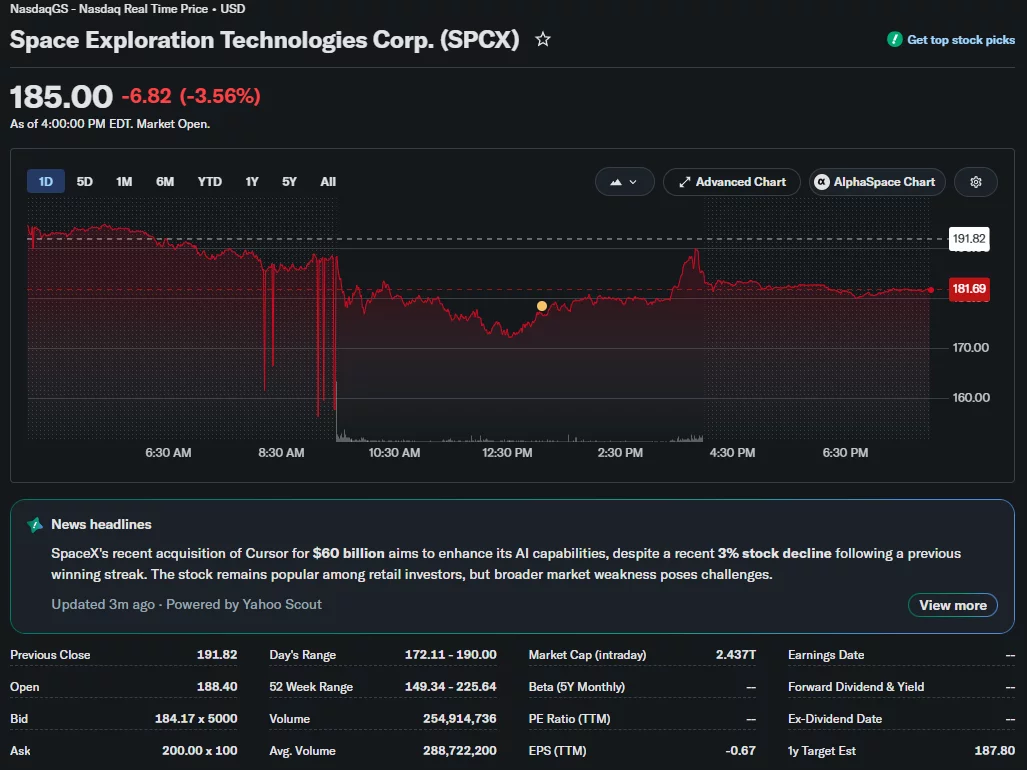
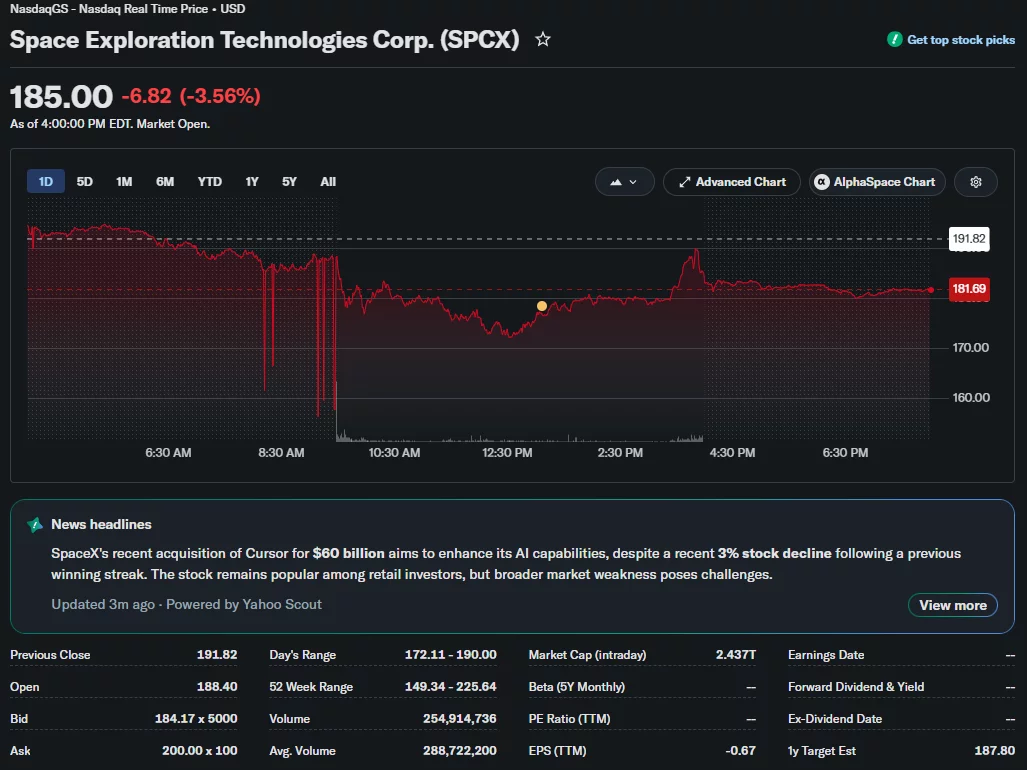
According to CNBC, SpaceX shares remained about 37% above their $135 IPO price even after retreating from post-listing highs, leaving the company with a market capitalization of roughly $2.43 trillion. The valuation surge briefly lifted SpaceX above Amazon and, for a short period, Microsoft, dramatically increasing the value of long-held stakes across its shareholder base.
Before the listing, crypto.news reported that retail investors rushed to secure allocations in the offering, with some reportedly seeking personal and bank loans as demand for shares far exceeded available supply. The scramble unfolded while SpaceX was preparing to enter public markets at a valuation of roughly $1.75 trillion.
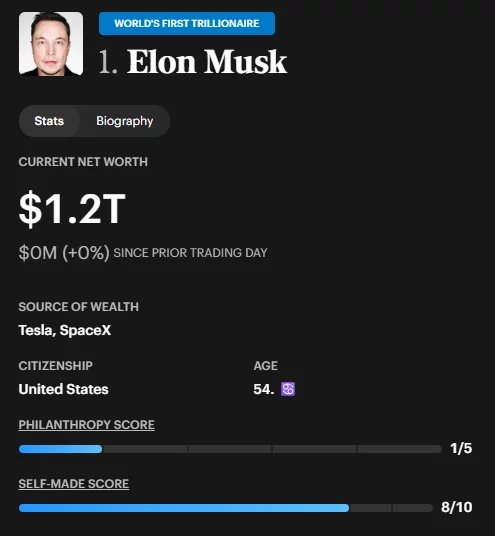
For Musk, who controlled about 42% of SpaceX at the time of the offering, the gains were historic. Estimates cited by multiple reports place the value of his SpaceX holdings at more than $750 billion following the IPO. When combined with his interests in Tesla and xAI, several wealth trackers estimated Musk’s net worth briefly reached nearly $1.4 trillion on June 16 before falling back to roughly $1.2 trillion, making him the first person to surpass the trillion-dollar mark.
During the rally, Yahoo Finance data showed SpaceX shares reaching an intraday high of about $225.84 on June 16, pushing the company’s valuation close to $3 trillion. As crypto.news reported earlier, the surge briefly lifted the value of Musk’s holdings above Bitcoin’s market capitalization of roughly $1.31 trillion at the time.
The jump in wealth later drew political attention after Senator Elizabeth Warren argued that the financial system disproportionately rewards the wealthiest Americans while many households continue facing rising costs.
Early investors have emerged as the biggest winners
Among the largest beneficiaries is Antonio Gracias, founder of Valor Equity Partners and a longtime SpaceX board member. CNBC reported that Valor’s SpaceX stake is worth approximately $96.6 billion, although most of those holdings belong to the firm’s clients. Gracias, who has backed Musk’s ventures for years, has seen the value of his investment rise alongside SpaceX’s rapid growth.
Another major winner is Peter Thiel’s Founders Fund. The venture firm became SpaceX’s first institutional investor in 2008, investing while the company was recovering from multiple Falcon launch failures. According to investment records cited in reports following the IPO, Founders Fund invested roughly $600 million across several funding rounds and built a stake of around 3%, which is now worth more than $50 billion.
Alphabet has also recorded one of the largest gains. Google invested approximately $900 million in SpaceX alongside Fidelity in 2015, acquiring a stake that was later diluted to about 6%. Based on SpaceX’s post-IPO valuation, reports estimate Alphabet’s holding at roughly $132 billion, representing a return of nearly 147 times its original investment.
Several other investors also benefited from the listing. Reports indicate that Sequoia Capital’s roughly 1.5% stake has grown to more than $20 billion after investments totaling around $2 billion, while Kingdom Holding, controlled by Saudi Prince Alwaleed bin Talal, holds approximately 42.4 million shares valued at nearly $7 billion.
Executives and employees have shared in the windfall
Beyond institutional investors, the IPO has substantially increased the wealth of long-serving executives. CNBC estimates that SpaceX President and CEO Gwynne Shotwell holds a stake worth about $2.4 billion, making her one of the company’s largest individual shareholders.
Speaking to CNBC on the day of the IPO, Shotwell described her role as supporting Musk’s vision through operational execution while he focuses on strategy and engineering. Former SpaceX engineer Nathan Silvernail told CNBC that Shotwell has played a central role in managing customers, contracts, and daily business operations.
Chief Financial Officer Bret Johnsen has also joined the billionaire ranks. CNBC reported that the executive, who joined SpaceX in 2011 and oversees the company’s financial strategy, holds shares worth roughly $1.2 billion.
The gains have extended well beyond senior leadership. Reports on employee compensation programs indicate that thousands of current and former workers benefited from stock options accumulated over years of private ownership. One example cited in post-IPO coverage involved welder Juan Hernandez, whose employee stock awards reportedly grew from an initial value of about $10,000 to nearly $1 million after the listing.
While the IPO created substantial wealth for investors and employees, some of the initial gains have moderated. SpaceX shares later fell more than 9% from their post-listing highs, trimming Elon Musk’s fortune from its peak as the stock retreated from record levels.
Even as the stock pulled back, Bloomberg reported that SpaceX has explored a bond offering worth as much as $20 billion to refinance a bridge loan due in September 2027. According to Bloomberg, the proposed transaction could become one of the largest corporate debt offerings in recent years, although its final size and timing remain under discussion.
Despite the retreat from peak valuations, SpaceX’s market debut remains one of the largest wealth-creation events in recent corporate history. The listing generated billions of dollars in gains for early venture investors, institutional backers, executives, and employees who accumulated shares during the company’s years as a private business.

The Sci-Fi Action Movie On Netflix Continues An Epic Franchise

Election-year friction between Trump and Republican senators is growing

Councillors say ‘Loss of local power to decide major housing plans is an attack on democracy’

Blockchain.com files with SEC for U.S. IPO

No Jackpot Winner as $257 Million Prize Rolls Over to $269 Million Monday Draw

Israel says it has killed new Hamas military leader in Gaza City airstrikes

Luxury Sirf Dikhava Nahi The Ultimate Financial Guide #InvestmentStrategy #MoneyManagement #YTShorts

Crypto Market-la Iniku Ena Update? | June 19, 2026 #crypto #cryptocurrency #bitcoin #ethereum

#shortsfeed #shorts #shortvideo #gk #finance
-
 Business5 days ago
No Jackpot Winner as $257 Million Prize Rolls Over to $269 Million Monday Draw
-

 Fashion7 days ago
Weekend Open Thread: Tuckernuck – Corporette.com
-
 Crypto World5 days ago
Zimbabwe Requires Crypto Businesses to Register Annually Under New FIU Regulations
-

 Crypto World6 days ago
Bitget enters Argentina’s regulated crypto market through PSAV registration
-

 Tech7 days ago
NanoClaw integrates JFrog registries to secure AI agent downloads
-

 NewsBeat7 days ago
FBI searches office of Ohio voter registration group
-
 Entertainment5 days ago
Matt Damon’s Viral Sci-Fi Thriller Has Taken Over HBO Max
-

 Business5 days ago
Anthropic staff to meet White House officials next week, Axios reports
-

 Tech5 days ago
As AI companies race to go public, who else is along for the ride?
-
 Crypto World5 days ago
Bitcoin could crash to $48,000, if this historical pattern is triggered
-

 Politics5 days ago
“Israel’s” ban on ICRC visits ruled illegal, but Knesset moves to stop them permanently
-
 NewsBeat5 days ago
Warning of disruption as Cardiff Crossrail works to start
-

 News Videos5 days ago
Financial Accounting | Last Day Revision Strategy and Booster | CMA Inter – June 2026
-
 NewsBeat5 days ago
Tributes to former deputy head teacher at Cambridge school among death and funeral notices
-
 NewsBeat5 days ago
what doctors are seeing in ebike crashes
-

 Entertainment6 days ago
Deion Sanders Shares Powerful Post After Viral Advice To Deiondra
-
 Entertainment5 days ago
Kate Middleton Glare Goes Viral After Kids Booed At Royal Event
-

 Crypto World5 days ago
XRP ETFs Outperform As Bitcoin And Ethereum Funds Extend Outflow Trend
-
 Crypto World5 days ago
Market Preview: SpaceX (SPCX) IPO Record, Federal Reserve Meeting, and Iran Nuclear Agreement
-

 Business5 days ago
Invesco Quality Income Fund Q1 2026 Commentary
You must be logged in to post a comment Login