

Crypto World
South Koreans Liquidate Savings and Insurance to Chase SK Hynix and Samsung Rally

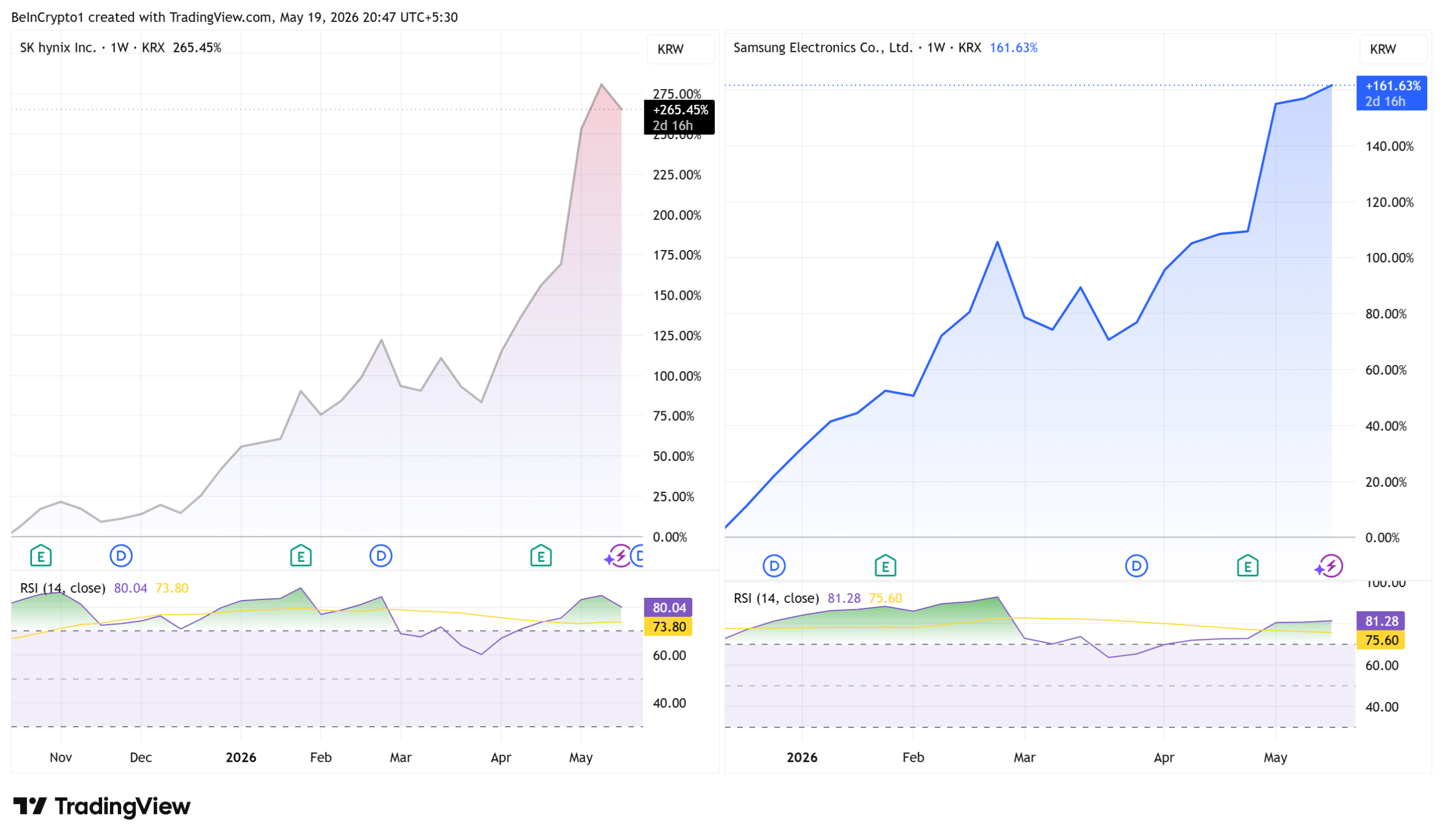
South Korean retail investors are pulling savings, fixed deposits, and life insurance funds to buy SK Hynix and Samsung Electronics. Both stocks trade near record highs on AI chip demand.
Savings bank deposits fell below ₩100 trillion ($66.24 billion) for the first time in four years. Commercial bank time deposits dropped by roughly ₩12 trillion ($7.94 billion) since February as cash rotated into equities.
Older Investors Drive a Leveraged Bet on Two Stocks
Investors over 50 now hold about 62% of all margin loans at South Korea’s top brokerages. Margin debt among those in their 60s doubled from ₩3.9 trillion ($2.58 billion) to ₩8 trillion ($5.29 billion) in a year. Domestic securities firms disclosed the surge.
Insurance policy surrenders at the top three life insurers jumped 16% in Q1 2026. Savings-type policies surged 23% as households cashed out for equities.
“The marginal buyer is now liquidating insurance policies, withdrawing savings, borrowing on margin, and leveraging existing assets just to stay in the rally,” analayst and YouTuber Crypto Rover highlighted.
AI Chip Demand Fuels Concentration Risk
SK Hynix and Samsung Electronics together account for roughly 42% of the KOSPI after AI-fueled rallies. SK Hynix has gained 265% since November while Samsung climbed 162%, according to weekly TradingView data.

Korea’s government added a ₩33 trillion ($21.86 billion) support package for the chip sector, layering policy fuel onto record retail flows.
The KOSPI dropped 19% in March before recovering, with leveraged older investors averaging roughly 20% losses during the slide.

The same risk appetite has spilled into crypto. Korean Won handles about 30% of global spot volume on Upbit and Bithumb.
Weekly RSI readings above 80 on both stocks signal overbought conditions. The next Samsung and SK Hynix earnings cycle will test the leverage holding this rally together.
The post South Koreans Liquidate Savings and Insurance to Chase SK Hynix and Samsung Rally appeared first on BeInCrypto.

Key Takeaways
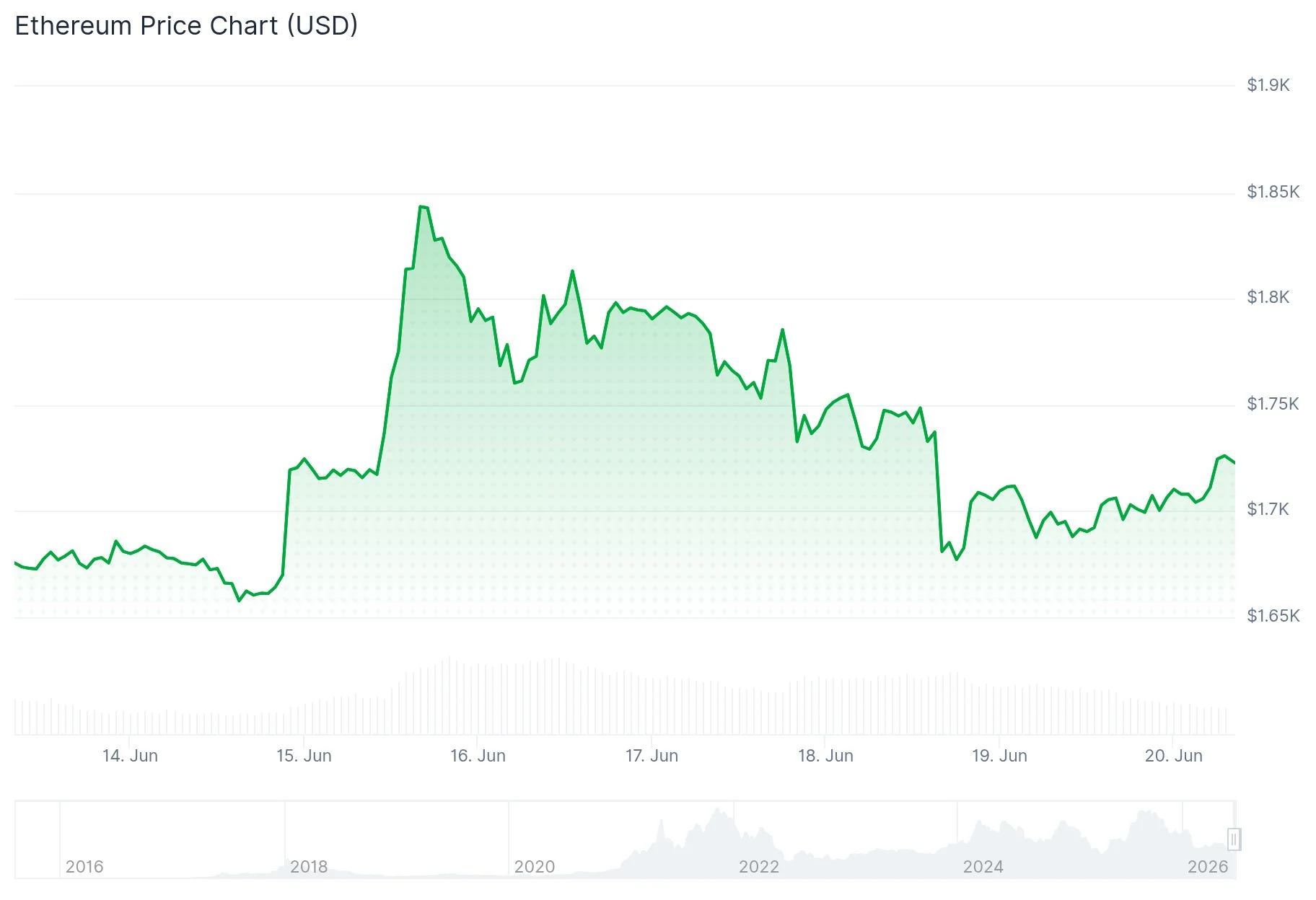
- BitMEX co-founder Arthur Hayes offloaded 6,000 ETH at approximately $1,690, realizing a loss of around $606,000 after purchasing at roughly $1,793 per token
- Hayes had recently acquired about $10.6 million in ETH before executing the loss-making sale
- During the identical timeframe, K3 Capital and a wallet associated with Chun Wang purchased more than 17,000 ETH collectively
- ETH currently hovers around $1,700, approaching the 78.6% Fibonacci retracement support threshold
- Momentum indicators like RSI and MACD continue showing bearish signals, while significant liquidity sits clustered around $1,800
Arthur Hayes, the co-founder of BitMEX, recently liquidated 6,000 Ethereum tokens at a significant loss, while contrasting whale activity shows major players adding to positions around critical support levels.
Data from Lookonchain, a blockchain analytics service, reveals that Hayes built up a position of approximately 5,900 ETH in recent trading sessions. His average entry price stood at $1,793 per coin, representing a total investment of about $10.58 million.
The crypto veteran subsequently liquidated 6,000 ETH at a mean price of $1,690, generating proceeds of approximately $10.14 million. This transaction resulted in an estimated deficit of roughly $606,000.
The decision stands out as atypical behavior for Hayes. His trading history typically demonstrates a pattern of acquiring digital assets during price weakness and exiting during strength. This loss-taking maneuver has sparked discussion among market participants monitoring his blockchain transactions.
Institutional Accumulation Contrasts Hayes’ Exit Strategy
While Hayes was reducing exposure, other significant market participants were moving in the opposite direction. On-chain intelligence from Lookonchain indicates substantial accumulation occurred at similar price points.
K3 Capital, an investment entity, transferred 10,000 ETH tokens valued at roughly $16.9 million off the Binance exchange. Separately, a cryptocurrency address tied to business figure Chun Wang acquired 7,650 ETH for approximately $12.9 million.
Combined, these two transactions represent accumulation exceeding 17,000 ETH, suggesting certain institutional players view present valuation levels as attractive entry points.
This activity follows an earlier transfer where a Hayes-connected wallet received 3,000 ETH worth approximately $5.42 million from liquidity provider Flowdesk on June 15, coinciding with a temporary market bounce linked to de-escalation in Middle Eastern geopolitical tensions.
Technical Analysis of Ethereum’s Current Position
Ethereum was changing hands near $1,700 during recent trading, representing a substantial decline from its April high above $2,400 and positioned above its June bottom around $1,507.
Chart analysis reveals ETH is currently testing the 78.6% Fibonacci retracement zone near $1,703. Technical analysts frequently monitor this level as a potential area for trend reversal following significant downward moves.
The daily Relative Strength Index continues trading beneath the neutral 50 threshold, while the MACD histogram remains in negative territory. These indicators collectively suggest bearish momentum persists in the near term.
Critical Price Zones for Traders
Liquidation mapping from CoinGlass reveals substantial order book depth concentrated between $1,780 and $1,820, with particularly dense clustering around the psychological $1,800 level.
Market analyst Team LAMBO highlighted on June 19 that Ethereum has established a defined trading corridor bounded by approximately $1,500 on the downside and $1,800 on the upside. A decisive breach of either boundary could determine the asset’s next directional move.
Examining the 4-hour timeframe, ETH continues trading beneath a downward-sloping trendline that has capped rallies since early May. The Supertrend technical tool maintains a bearish configuration.
A sustained move above the $1,780-$1,800 resistance band could pave the way toward the $1,856 level. Conversely, if the $1,700 support zone fails to hold, traders will likely focus on $1,620 as the next support target, followed by the June low near $1,507.
Hayes has also recently divested holdings in Worldcoin, Hyperliquid, and NEAR Protocol tokens, reinforcing perceptions of a more defensive approach to his overall cryptocurrency portfolio positioning.


Bitcoin miners have long been treated as high-beta exposure to BTC’s price cycle, but the operating model is shifting. With margin pressure squeezing traditional mining economics and the demand for AI compute steadily rising, major miners and infrastructure players are increasingly looking at power, data center capacity, and machine-hosting as their primary differentiators.
That broader pivot received fresh reinforcement this week after reporting that Nvidia was preparing a roughly $20 billion bond sale to fund the next phase of its AI expansion—underscoring how long-term capital spending in AI infrastructure is shaping adjacent parts of the crypto ecosystem.
Key takeaways
- Bloomberg reports Nvidia is seeking to raise $20 billion via a multi-part bond offering tied to AI investment plans, highlighting sustained AI infrastructure spending.
- As mining margins tighten, Bitcoin miners are increasingly positioning their power and data center assets for AI hosting and high-performance computing rather than only hash-rate competition.
- Tokenized real-world assets continue to grow: Token Terminal data shows onchain financial assets have surpassed $43 billion, up 37% over six months.
- Ripple is expanding payments in Africa through an investment in Flutterwave, bringing its RLUSD stablecoin and XRP Ledger infrastructure closer to a cross-border remittance hub.
- Sam Bankman-Fried’s bid to overturn his FTX fraud conviction failed, with an appeals panel in Manhattan upholding the verdict.
Nvidia’s $20 billion bond plan signals the next AI buildout era
According to Bloomberg, Nvidia is pursuing a multi-part bond issuance intended to fund AI-related investments and refinance existing debt. The report also notes that the longest-dated bonds are expected to carry meaningfully higher yields than comparable US Treasuries.
While the bond sale itself is an equity-free financing event for a chipmaker, its relevance to crypto infrastructure is indirect but important: it reinforces that the AI buildout is not a short-term fad. For miners, the implication is that power availability and data center throughput may become more valuable than pure hash rate when AI workloads and hosting demand are sustained.
Many mining operators are already exploring that direction. Cointelegraph previously highlighted how some companies are repurposing energy-intensive infrastructure for AI and high-performance computing hosting as mining economics face ongoing headwinds (see crypto mining’s AI/data center infrastructure shift).
In that context, operators including HIVE Digital, Hut 8, CleanSpark, and TeraWulf are increasingly described as moving toward roles that resemble data center operators—leveraging their existing power relationships and site footprints to serve compute-hungry customers.
Tokenized real-world assets keep expanding despite broader crypto weakness
The tokenized real-world asset (RWA) sector is showing resilience even as the broader crypto market faces periodic downturns. Token Terminal data cited by Cointelegraph indicates that total value across onchain financial assets has surpassed $43 billion, up 37% over the past six months.
Tokenized funds make up the bulk of the category—nearly 80% of onchain financial assets—though commodities and tokenized stocks are gaining attention as additional use cases develop.
The trend matters for traders and builders because tokenized RWAs represent a different adoption pathway than speculative crypto trading. Instead of relying on market cycles alone, the sector’s growth is tied to institutional infrastructure, distribution, and compliance frameworks—often with longer-term capital planning.
Two major bank-style projections highlighted in the reporting also illustrate the scale investors believe could be possible: Standard Chartered forecasts that tokenization could help drive decentralized finance toward a $2.7 trillion market capitalization by 2030, while Citigroup projects tokenized RWAs could reach $5.5 trillion by the same point.
Ripple pushes deeper into African payments via Flutterwave investment
Ripple has invested in Flutterwave, one of Africa’s fastest-growing remittance and payments companies, in a deal valued at $3.3 billion. The investment amount was not disclosed, but Cointelegraph reports that it connects Ripple’s RLUSD stablecoin, Ripple Payments platform, and XRP Ledger infrastructure with a payments provider operating across 35 countries.
The move aligns with a broader theme in cross-border finance: demand for faster and lower-cost transfers continues to rise as businesses and individuals look for alternatives to traditional remittance rails. By integrating into one of Africa’s major payment networks, Ripple is effectively betting that stablecoin-enabled settlement and ledger-based infrastructure will gain traction where payment friction has historically been higher.
Cointelegraph notes that the investment is also part of Ripple’s continuing expansion on the continent. Earlier, the company partnered with South Africa’s Absa Bank to provide institutional digital asset custody solutions, strengthening its presence in local financial infrastructure.
Court outcome: Sam Bankman-Fried’s conviction stands
In legal news with ongoing implications for the crypto industry’s regulatory trajectory, former FTX CEO Sam Bankman-Fried failed to overturn his fraud conviction. A three-judge appeals panel in Manhattan upheld the verdict, concluding that he received a fair trial.
As quoted in the reporting, Circuit Judge Barrington Parker wrote that while Bankman-Fried was publicly reassuring customers, investors, and regulators that FTX customer funds were safe, he was also using FTX as a personal source of funds—spending customer money on real estate, political contributions, and investments.
Bankman-Fried was convicted on fraud and conspiracy charges tied to FTX’s collapse and sentenced to 25 years in prison in 2024. Cointelegraph also points out that he formally applied for a presidential pardon, with the request appearing on the Pardon Attorney website in early June.
For market participants, the practical takeaway is that the case remains an enforcement reference point. Appeals outcomes shape how regulators, courts, and legal teams evaluate fraud, custody, and customer-protection frameworks across the sector.
What to watch next
Miners will be watching whether AI compute demand translates into durable hosting contracts and stable power-utilization economics, while tokenized assets investors will look for continued growth in onchain financial asset totals and broader institutional participation. On the legal front, further filings tied to Bankman-Fried’s pardon process could keep FTX’s compliance lessons in the spotlight.
Key Takeaways
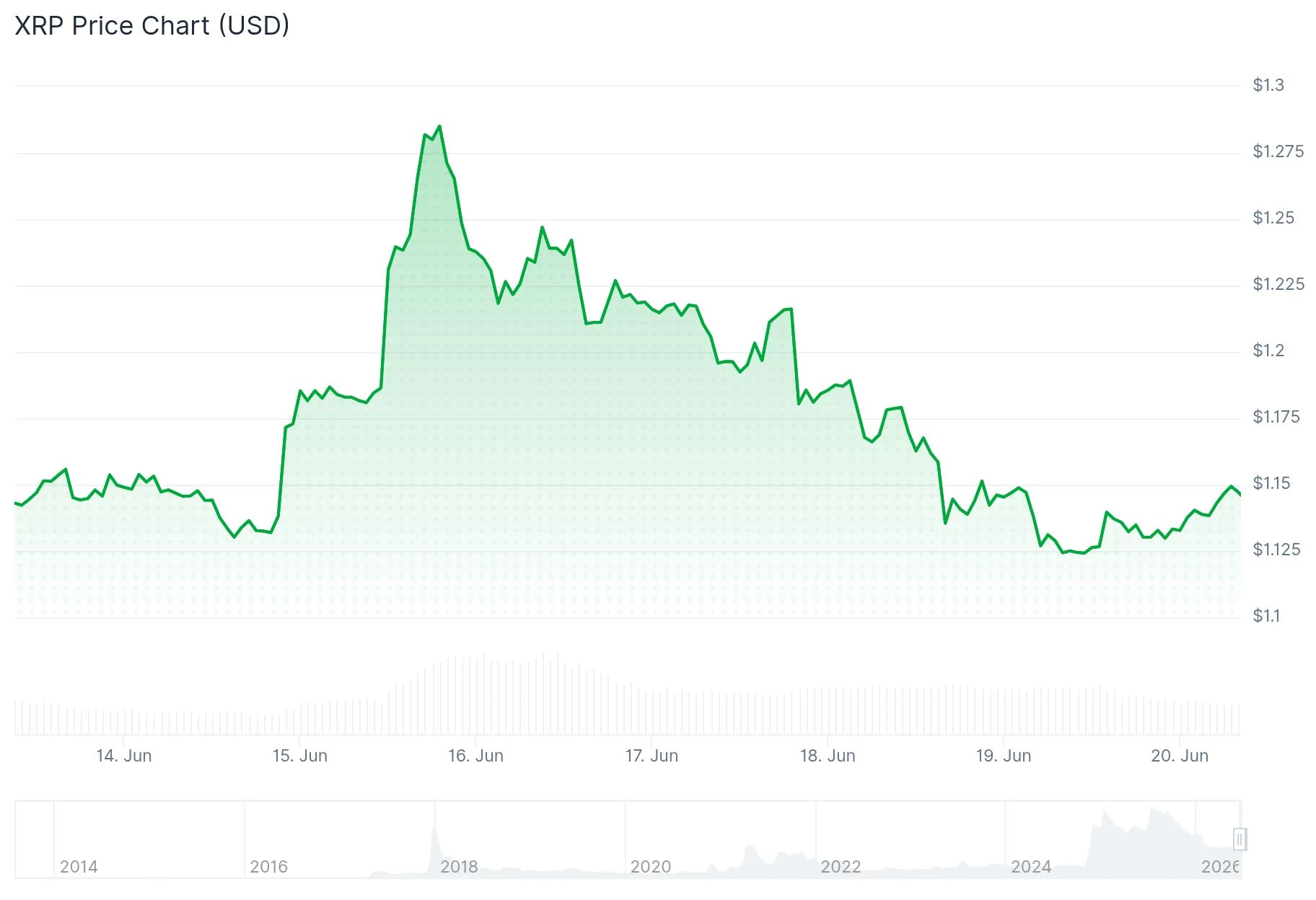
- XRP hovers around $1.13–$1.14, declining approximately 1.27% in recent trading
- Large holders distributed more than 30 million XRP between June 13–17, 2026
- Collapsed US-Iran diplomatic discussions amplified market jitters
- Analysis of moving averages reveals 14 bearish signals with no bullish indicators
- Despite tokenomics concerns, ETF capital flows and corporate partnerships provide modest tailwinds
XRP faces mounting headwinds as a combination of geopolitical instability and significant whale activity drags down its market value.
The cryptocurrency currently changes hands near $1.13, marking a decline of roughly 1.27% in the most recent trading period. This places the token significantly beneath its recent peaks, with its 52-week trading band stretching from $1.05 to $3.65.
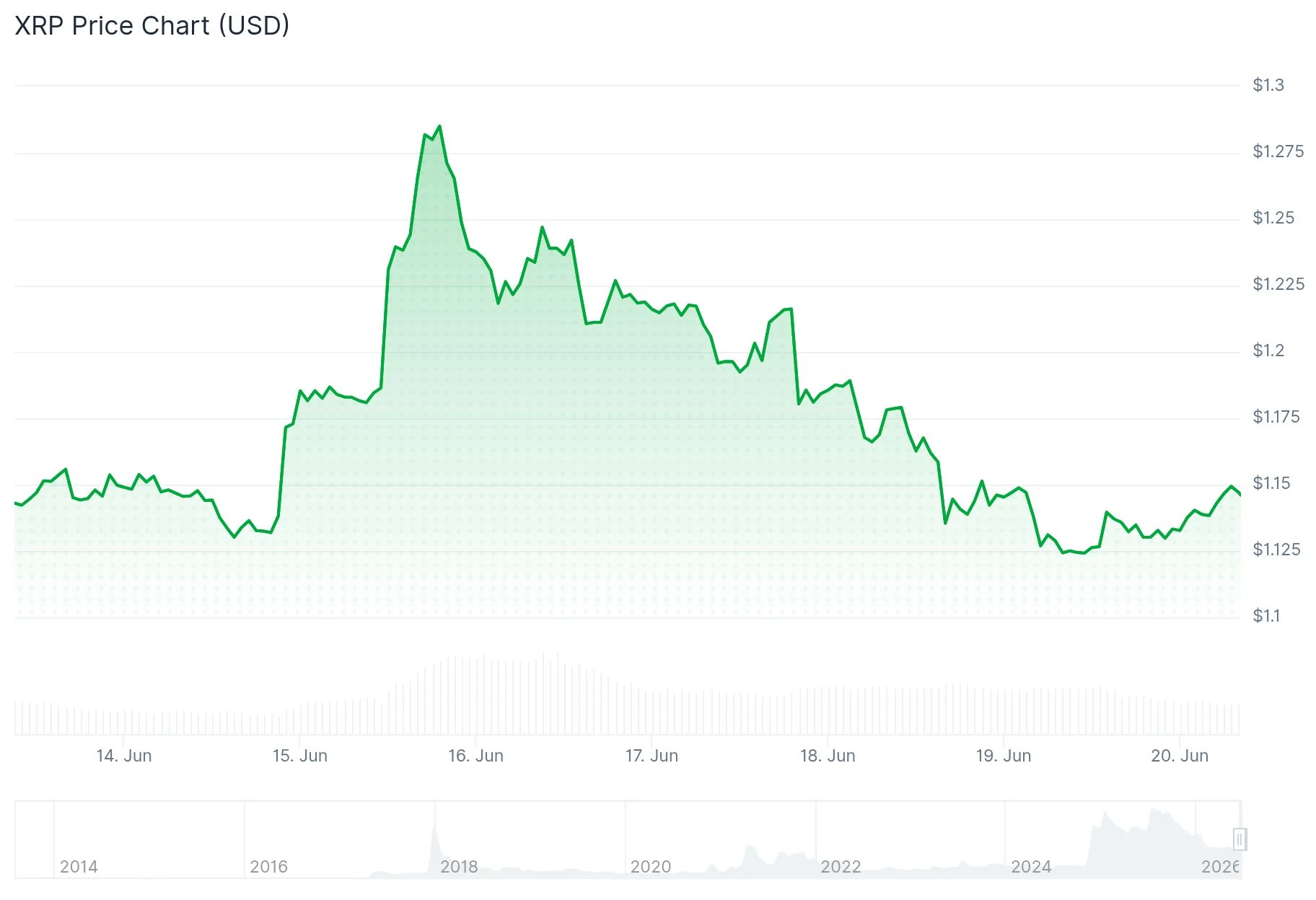
Blockchain analytics from Santiment reveal that whale wallets reduced their collective holdings from about 3.82 billion XRP down to 3.77 billion XRP during the four-day window from June 13 through June 17. This exodus exceeds 30 million tokens.
Cryptocurrency analyst Ali Martinez highlighted this shift on X, emphasizing the change in large holder positioning. Such whale movements frequently serve as advance indicators of near-term selling pressure, as substantial token transfers to trading platforms can inflate available supply.
Middle East Diplomatic Breakdown Fuels Broader Uncertainty
Scheduled diplomatic discussions between the United States and Iran, set for June 19 in Switzerland, were abruptly cancelled following Israeli military actions in southern Lebanon. Iran withdrew from the negotiations, which formed part of wider regional de-escalation initiatives.
The cancellation emerged during a US trading holiday, restricting immediate responses in stock and commodity markets. Nevertheless, derivatives traders started factoring in elevated volatility expectations for upcoming sessions.
Market observer Sjuul from AltCryptoGems noted on X that XRP finds itself “again in trouble,” highlighting how the previous $1.30 support threshold has now transformed into a resistance barrier. He cautioned that failure to maintain the $1.00 floor could lead to “even more ugly” outcomes.
While XRP’s valuation doesn’t directly mirror geopolitical developments, widespread risk aversion typically drains capital from cryptocurrency markets.
Chart Analysis Points to Continued Weakness
The technical landscape for XRP appears decidedly negative. Assessment of moving averages across multiple timeframes generates 14 sell recommendations and zero buy suggestions.
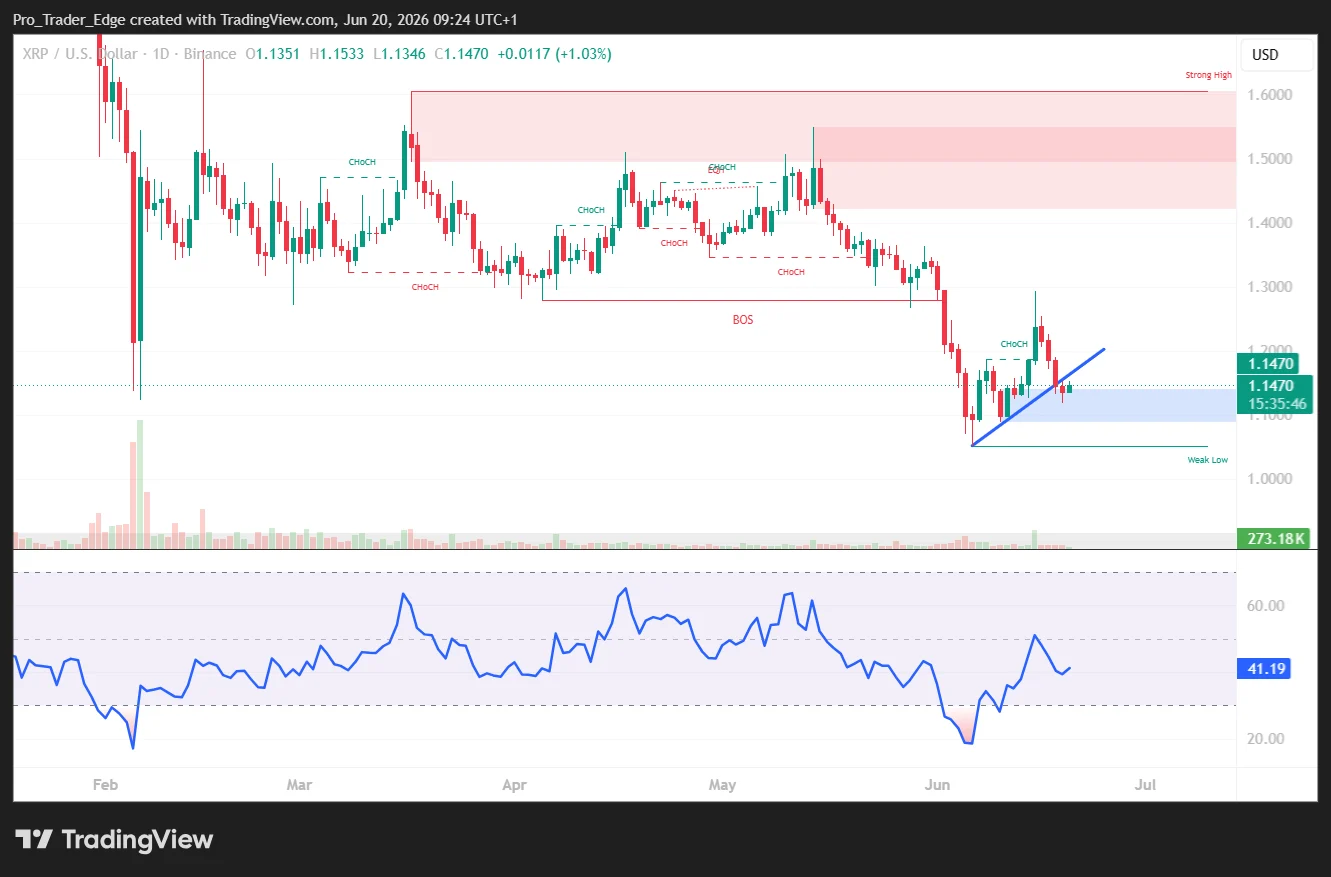
XRP trades beneath its 10 EMA ($1.167), 50 EMA ($1.267), 100 MA (approximately $1.36), and 200 MA (around $1.57). The Relative Strength Index registers 38.79, nearing oversold conditions without quite reaching that threshold.
Critical support zones emerge at $1.12 and $1.09. Overhead resistance appears at $1.49 and $1.66. Penetration below the $1.10 mark could trigger accelerated selling.
The MACD displays a modest bullish reading at -0.039, while momentum gauges show slight positive divergence. These factors hint at potential stabilization, though no definitive turnaround has materialized.
Supply Dynamics and Corporate Integration
Separate research questions XRP’s fundamental valuation metrics. The XRP Ledger eliminates merely 0.00001 XRP per transaction. Given approximately 1–2 million daily transactions, only 295 XRP were destroyed on June 14. Set against a circulating supply of 62 billion tokens, this reduction appears negligible.
Conversely, spot XRP exchange-traded funds have accumulated over $1.4 billion in net capital inflows since their late 2025 debut. Tokenized asset value on the XRPL has expanded from $128 million to $368 million within twelve months. Major financial institutions including Aviva Investors, Societe Generale, and Deutsche Bank have incorporated Ripple’s technology throughout 2026.
Analyst EGRAG CRYPTO has identified a larger ascending triangle formation on the 2-month timeframe, proposing that current conditions might represent an E-wave macro bottom corresponding with a 425-day cycle. Validation would necessitate recapturing the $2.00–$2.10 resistance area.
XRP spot valuation at publication: approximately $1.14.


Binance founder Changpeng Zhao has proposed freezing up to 1 million Bitcoin linked to Satoshi Nakamoto if those coins remain unmoved after a future transition to quantum-resistant cryptography.
Summary
- CZ proposed freezing inactive Bitcoin addresses after a future migration to quantum-resistant cryptography.
- His plan could affect up to 1 million BTC believed to be linked to Satoshi Nakamoto.
- Bitcoin developers remain divided between protecting vulnerable coins and preserving property rights.
Speaking during a June 18 appearance on the Galaxy Brains podcast hosted by Galaxy Research President Alex Thorn, Zhao said quantum computing does not pose an insurmountable threat to Bitcoin because quantum-resistant cryptographic systems already exist.
Zhao argued that the more difficult task would be coordinating a network-wide migration to those technologies if quantum computers eventually become capable of breaking Bitcoin’s current security model.
Speaking about Bitcoin addresses that have remained inactive for years, including those widely believed to belong to Satoshi Nakamoto, Zhao said the network should establish a migration period of roughly six to twelve months after any future upgrade to quantum-resistant cryptography.
Under his proposal, holders would be given time to move their coins to protected addresses before legacy addresses are retired.
If no movement occurs during that period, Zhao suggested the remaining Bitcoin should be frozen under the new protocol. He argued that allowing vulnerable addresses to remain active indefinitely could eventually result in quantum-capable attackers gaining access to coins whose owners are no longer participating in the network.
According to Zhao, such an outcome would create an unfair method of redistributing Bitcoin because ownership would effectively transfer to whoever first develops the ability to crack those addresses. He emphasized that the decision should not be his to make and said any change would need support from the Bitcoin community through consensus-driven processes.
Bitcoin developers remain divided over legacy coins
Zhao’s remarks arrive as Bitcoin developers, researchers, and advocates continue debating how the network should handle coins secured by older cryptographic standards.
According to a June report published by Coinbase’s advisory board, Bitcoin should begin preparing a migration path to post-quantum cryptography before quantum computers become a realistic threat.
The report, which includes contributions from Ethereum Foundation researcher Justin Drake, states that quantum computers do not currently endanger Bitcoin but argues that planning ahead could reduce future disruption.
The report outlines one proposal that would establish a deadline for migrating coins protected by existing ECDSA and Schnorr signatures. Supporters cited in the report argue that freezing unmigrated coins could prevent future attackers from obtaining large amounts of Bitcoin and potentially affect market stability.
Critics cited in the same report take the opposite position. According to Coinbase’s advisory board, opponents argue that making dormant coins unspendable would amount to confiscating private property and would conflict with Bitcoin’s principles of immutability and user control.
Property rights concerns shape the debate
Among the most vocal critics of freezing dormant Bitcoin is Galaxy Digital’s Alex Thorn.
As crypto.news reported in May, Thorn said many Bitcoin developers and advocates believe Satoshi’s coins should remain untouched regardless of future technological developments. Thorn argued that the issue extends beyond technical security because changing ownership rights could weaken Bitcoin’s credibility as a neutral monetary system.
Discussing the risk posed by Satoshi’s holdings, Thorn noted that the estimated stash is distributed across roughly 22,000 addresses, many of which contain around 50 BTC. According to Thorn, that structure makes a large-scale quantum attack more difficult than some observers assume.
Thorn also warned that any attempt to override ownership rights could face resistance from Bitcoin users. He said some members of the community may prefer enduring a severe market decline rather than approving protocol changes that alter control over long-dormant wallets, including those associated with Bitcoin’s creator.
Key Takeaways
- Andre Cronje, along with Michael Kong and David Richardson, has departed from Sonic Labs’ board of directors.
- Since its debut in January 2025, the S token has plummeted approximately 97%.
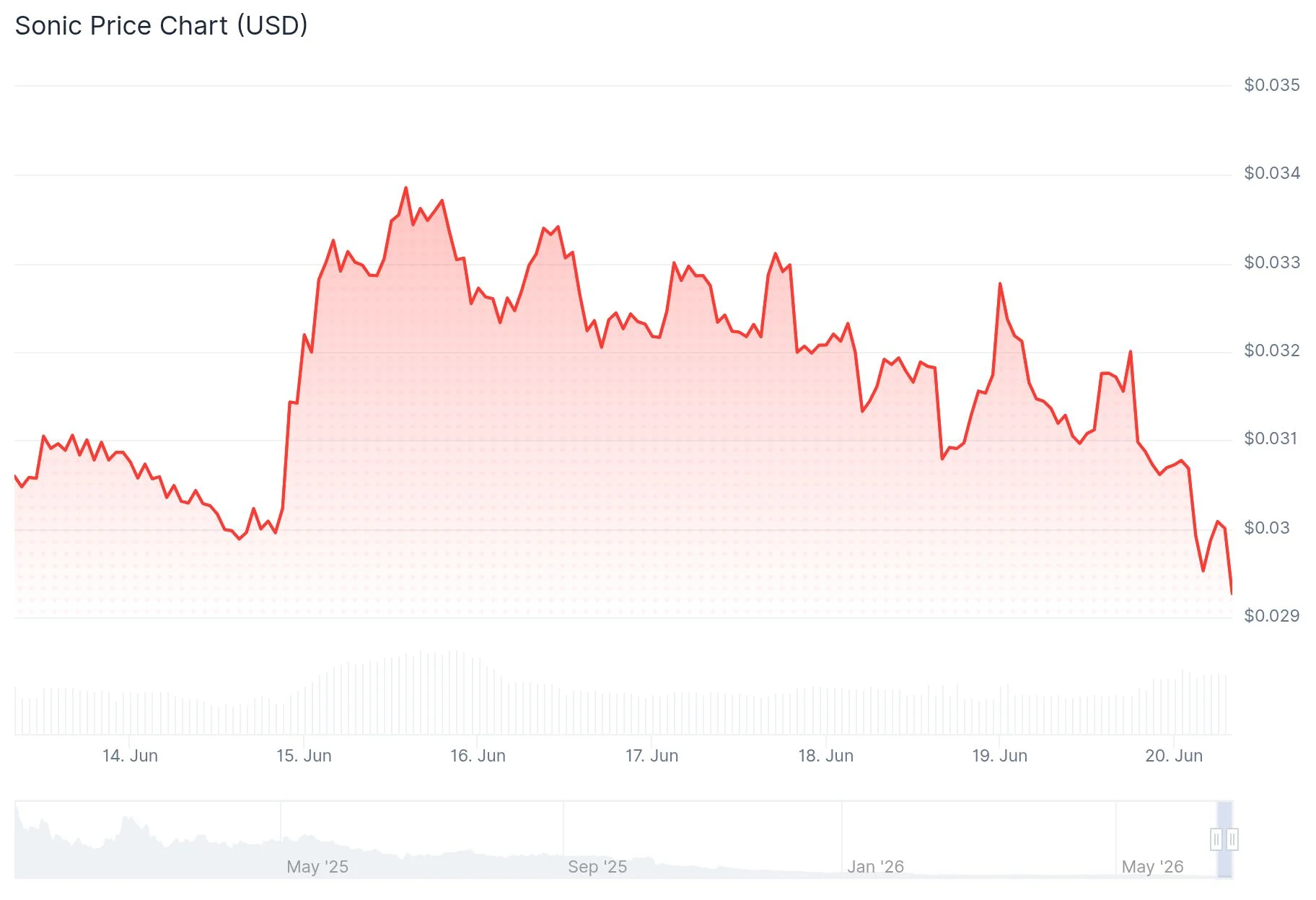
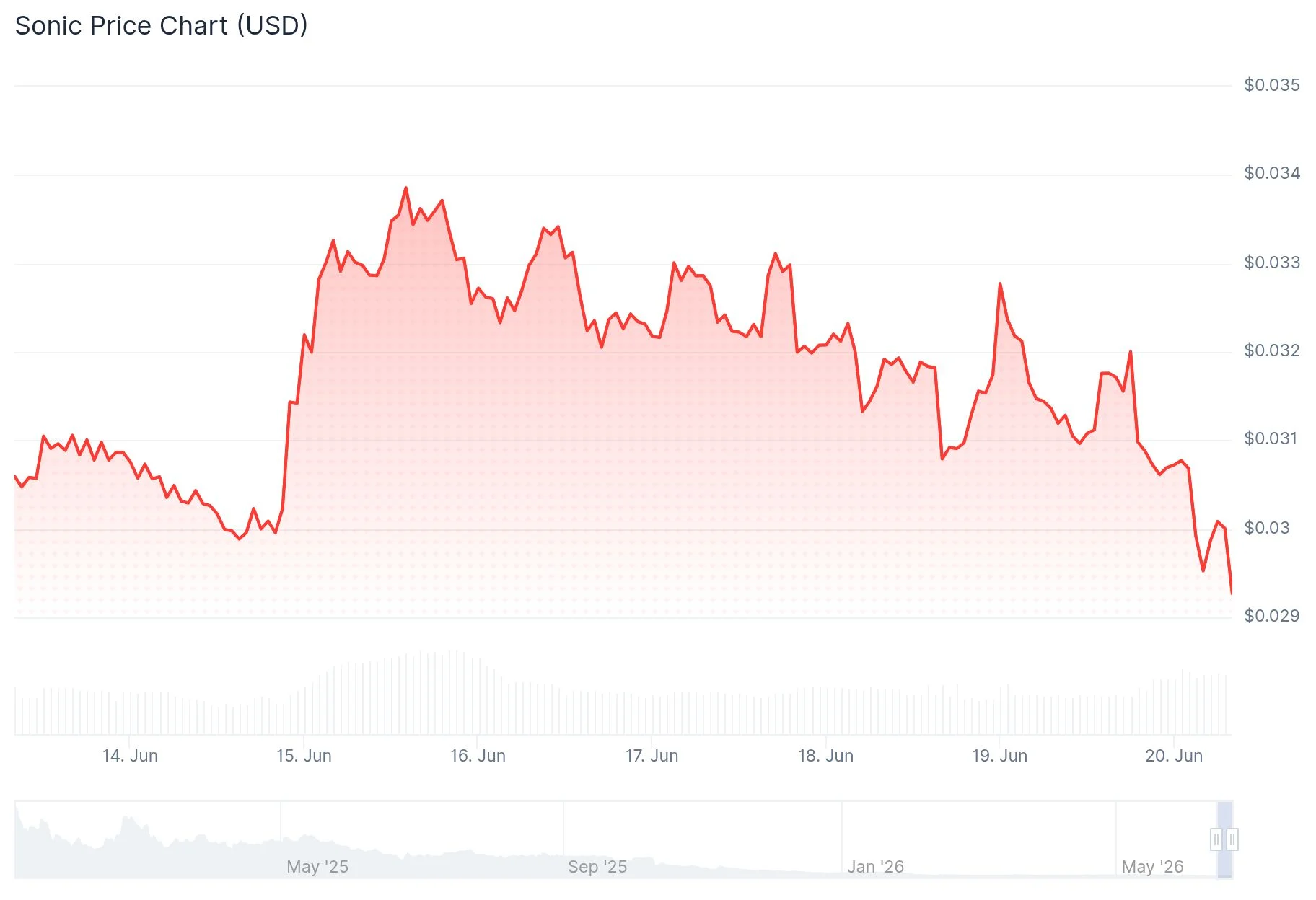
- The token currently trades around $0.029, reflecting a 5% decline over the last day.
- Matt Visser assumes the role of CEO while Kosta Kourkoumelis becomes COO at Sonic Labs.
- Chart analysis reveals bearish signals with RSI at 34 and negative MACD readings.
Sonic Labs is undergoing significant organizational changes as its native token experiences continued decline. The company announced the departure of Andre Cronje, its previous chief technology officer, alongside two other key executives from the board.
Michael Kong, who previously served as CEO of Fantom Foundation, and David Richardson, the executive chairman, have both stepped down. According to Sonic Labs, this represents a structured leadership transition.
The organization has promoted Matt Visser to the position of chief executive officer, with Kosta Kourkoumelis assuming responsibilities as chief operating officer. The departing executives will no longer participate in strategic business decisions moving forward.
In a public response to community concerns, Cronje clarified his role and responsibilities within the project. He emphasized his commitment to the technical aspects while distancing himself from certain controversial decisions.
“I stand behind the technology and technical decisions I led. I was not the author or decision owner of the migration, airdrop, tokenomics, or legacy-network decisions described above,” Cronje said.
The company acknowledged the difficult situation transparently, confirming that “the token is down” and recognizing declining community confidence.
Token Value Eroded 97% From Peak
The S token made its market debut in January 2025 during the transition from Fantom to the Sonic network. In the months following launch, it has shed approximately 97% of its initial value.
During the announcement period, S was changing hands near $0.029, representing roughly a 5% decrease in the preceding 24-hour period.
Sonic Labs traces its origins to 2018 when it was established as the Fantom Foundation. The organization underwent rebranding after implementing a substantial network upgrade that transitioned from Fantom Opera to the Sonic layer-1 infrastructure.
According to the platform, Sonic delivers capacity for as many as 10,000 transactions each second with finality achieved in under one second. The project expanded its ecosystem in March 2026 by introducing USSD, a stablecoin pegged to the dollar and collateralized by tokenized United States Treasury instruments.
Technical Analysis Signals
On daily timeframes, the S token descended through the lower boundary of a descending flag formation following intensive selling pressure in June. Price action retreated from approximately $0.049 to beneath $0.03 as bearish momentum intensified.
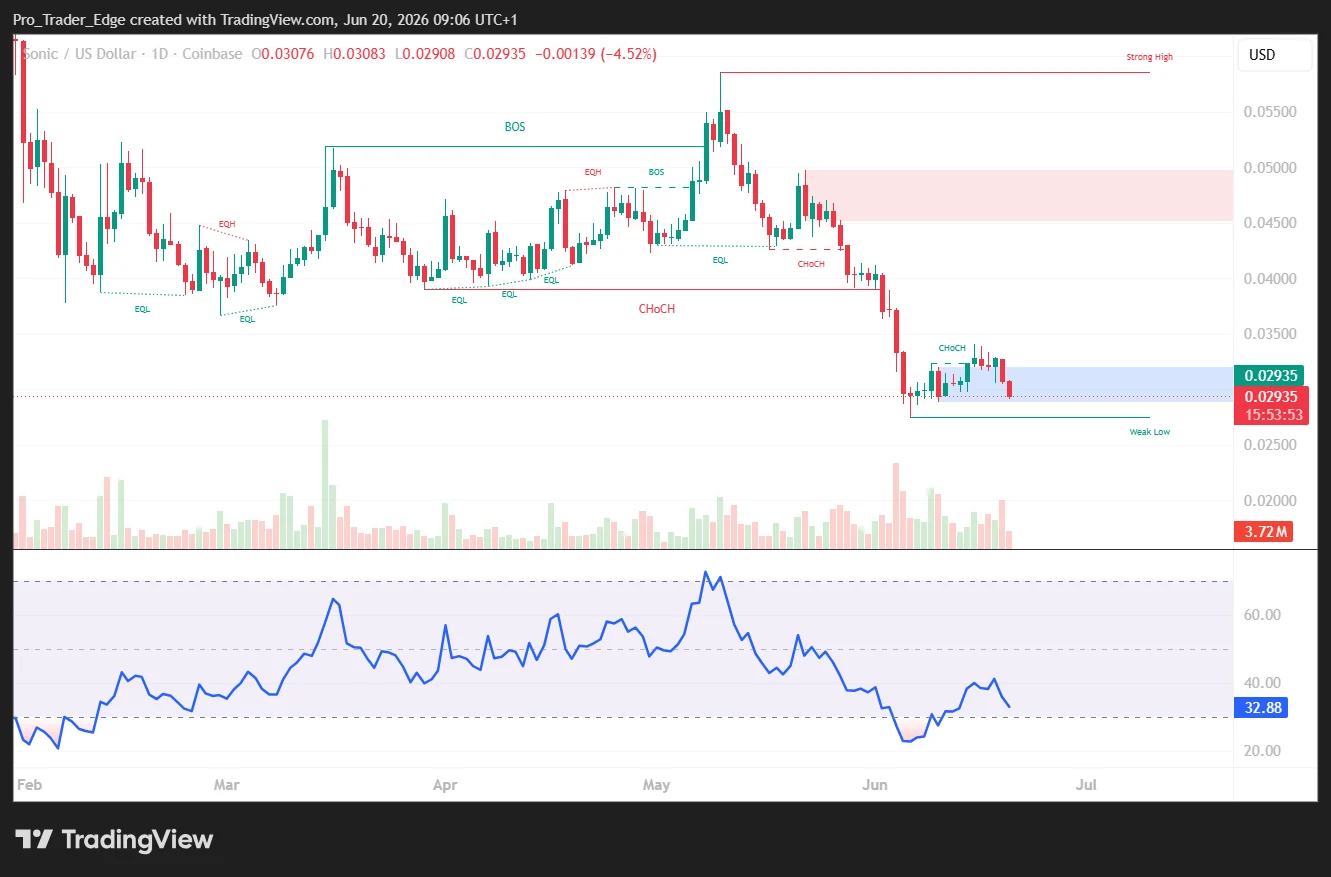
The Relative Strength Index hovers around 34, positioned below the midpoint of 50, indicating subdued buying pressure. The MACD indicator continues trading in negative territory despite showing signs of a potential bullish crossover.
Immediate price support exists at the recent low around $0.028. The previous flag pattern support level near $0.032 has now transformed into an overhead resistance zone.
As part of its organizational restructuring, Sonic Labs announced intentions to implement enhanced governance transparency measures and establish a specialized risk and compliance oversight committee.
Andre Cronje and two fellow founders have resigned from the Sonic Labs board, the company confirmed, as the S token trades near record lows. Matt Visser becomes the second chief executive in nine months.
Michael Kong and David Richardson stepped down alongside Cronje. The reshuffle lands while S sits about 91% below its January 2025 peak, reviving questions over whether it has bottomed.

Cronje and Cofounders Hand the Board to Visser
Sonic Labs framed the exits as an orderly handover. Kong, Cronje, and Richardson keep their stakes but will no longer make business decisions, per the team’s announcement.
The change caps a turbulent year in the C-suite. Sonic named Mitchell Demeter CEO last September to court institutional money, then lost him by February, leaving the founding board to run operations.
Cronje built much of decentralized finance (DeFi) and left those projects abruptly in 2022. He has lately turned to Flying Tulip, a new exchange he is raising money to build.
S Token Tests New Lows as Deposits Flee
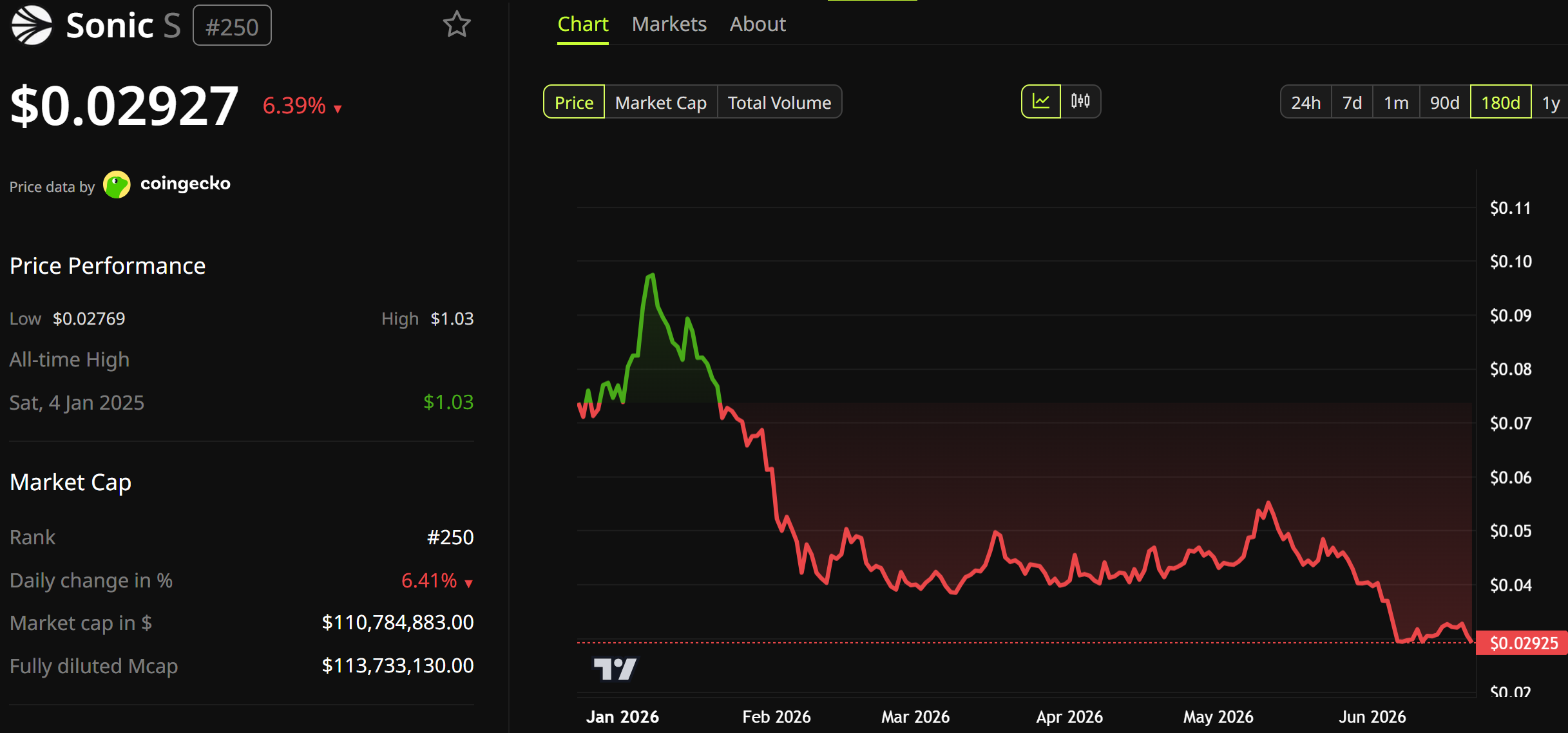
The market reaction has been harsh. S recently traded around $0.029, down about 6% in 24 hours and roughly 37% over the past month. It has fallen close to 91% this year.
The slide has cut Sonic’s value to about $111 million, ranking it near 250th. The token sits just above the record low it set on June 6, far below its $1.03 high from January 2025.
The capital flight runs deeper than price. Sonic, which grew from Fantom’s rebrand to Sonic, once hit $1 billion TVL within months of launch.
Total value locked has since collapsed to about $18 million, DefiLlama shows. That is a drop of roughly 98% from a 2025 peak above $1.1 billion.

“Woke up today to read about Andre Cronje resigning from Sonic Labs board. Checked CoinGecko and see that token is down 90% in last 1 year. Market cap $116m. So many projects are struggling so much this bear market. Tough year, but probably we haven’t bottomed yet unfortunately,” commented Bobby Ong, co-founder of CoinGecko.
Follow us on X to get the latest news as it happens
Sonic Promises a Reset as Critics Question Timing
Still, not everyone accepted the framing. Critics argue that stepping back during a downturn erodes trust.
Sonic insists its survival does not hinge on the token. The team says it carries no venture capital unlocks and funds development from a diversified treasury, giving it runway regardless of price.
Management also points to steady output, claiming 400 pull requests merged this year, two releases shipped, and a private testnet running for version 2.2.0.
Visser set expectations modestly, not promising a quick rebound.
“I am not here to promise an instant turnaround. I am here to make Sonic 1% better every single day and let that compound. Show up, do the work, prove it in public, repeat,” read an excerpt in the announcement, citing Matt Visser, Sonic CEO.
Could that discipline help steady the S token?
Sonic (S) Falls 40% In A Month as RSI Flashes Fresh Sell Signal
The Sonic price has slid back toward the record low it set earlier this month. Momentum indicators have turned sharply negative.
S now sits below every major moving average, with sellers firmly in control. Buyers have shown little appetite to defend current levels.

Momentum points to week demand, with the Relative Strength Index (RSI) sitting at 32.50, just above oversold territory and beneath its 33.25 signal line.
The chart marks this crossover as a fresh sell signal, given every time the RSI crossed below the signal line in the recent past, price extended the fall.
The reading echoes the mixed signals from a recent volume surge. An RSI reclaim of 40 would hint selling is cooling.
Now, the S price prediction hinges on $0.028 floor, as the Sonic token’s value remains pinned beneath a descending trendline and the 20-day EMA at $0.033.
A daily close under the $0.028 support could trigger a retest of the $0.0277 record low, roughly 5% lower.
Reclaiming $0.033 would invalidate the bearish setup. Longer-term forecast models stay cautious.
The Fantom Opera shutdown on June 30 may add volatility as holders finish migrating.
A hold above $0.028 keeps a rebound alive, while a break below confirms the downtrend.
The post Andre Cronje Exits Sonic Board as S Token Slides 40% appeared first on BeInCrypto.

Key Highlights
- Franklin Templeton has submitted SEC applications for two innovative ETFs that convert stock dividends into bitcoin purchases
- The proposed funds are named Franklin US Equity Bitcoin DRIP Index ETF and Franklin US Innovation Bitcoin DRIP Index ETF
- Each fund maintains a 95% U.S. stocks and 5% bitcoin allocation, with dividend proceeds channeled into bitcoin
- Potential launch date set for September 1, 2026, subject to regulatory approval
- This filing comes after BlackRock’s bitcoin-linked product and during a period when bitcoin trades under $62,500
Franklin Templeton has submitted applications to the U.S. Securities and Exchange Commission for two novel exchange-traded funds. These products would convert dividend payments from equities directly into bitcoin holdings.
The asset manager filed registration documents on Thursday for the Franklin US Equity Bitcoin DRIP Index ETF and the Franklin US Innovation Bitcoin DRIP Index ETF.
The investment structure is relatively simple. Each product maintains 95% of assets in U.S. large-capitalization stocks and 5% in bitcoin. Instead of distributing dividends to shareholders as cash payments, these proceeds are automatically deployed to acquire bitcoin exposure.
Bitcoin positions would be established using bitcoin ETPs, futures contracts, options, or alternative instruments. When quarterly rebalancing occurs, bitcoin allocations exceeding 5% would be reduced to 4.5%. Between rebalancing periods, a maximum threshold of 20% applies.
Product Structure and Mechanics
The first product follows the VettaFi US Large-Cap 500 Bitcoin DRIP Index, offering exposure to the broader equity market. The second concentrates on growth-oriented and innovative companies using a corresponding index variation.
As of April 30, the underlying equity index contained approximately 498 securities. These companies ranged from $7.5 billion to $4.9 trillion in market capitalization.
Should the SEC grant approval, trading could commence as soon as September 1, 2026. However, regulatory clearance remains uncertain.
This application represents another step in Franklin Templeton’s expanding cryptocurrency initiatives. The company’s current spot bitcoin ETF, EZBC, reported $358.9 million in net assets with cumulative net inflows totaling $329.6 million as of Thursday.
Expanding Digital Asset Initiatives
Franklin’s cryptocurrency involvement extends well beyond ETF products. In May, the company announced a collaboration with Payward, Kraken’s parent organization, to investigate tokenization of conventional investment vehicles.
More recently this month, Franklin revealed plans to incorporate its BENJI tokenized money market fund into MoonPay Trade. This integration enables institutional clients to exchange between stablecoins such as USDC and USDT and Franklin’s tokenized offering.
These new ETF applications arrive on the heels of BlackRock’s recent introduction of an income-focused ETF designed to allow institutions to capitalize on cryptocurrency market volatility.
The eleven spot bitcoin ETFs operating in the United States have collectively attracted over $53 billion in investor funds since their 2024 debut, based on SoSoValue statistics.
Bitcoin has experienced significant downward pressure lately. After reaching $126,000 in October 2025, the cryptocurrency has declined substantially. At the time of Franklin’s filing, bitcoin was changing hands below $62,500, representing a decline exceeding 2% over the previous 24 hours.
Market analysts identify approximately $59,000 to $60,000 as the critical support zone. A sustained close beneath $61,500 would signal a break in the prevailing trend.
Friday’s U.S. market closure for the Juneteenth holiday could contribute to reduced liquidity and heightened price volatility in the near term.
Key Takeaways
- Bitcoin slipped beneath the $63,000 threshold following escalating Middle East geopolitical concerns that dampened risk appetite across digital asset markets
- Approximately $4 billion in leveraged long contracts are concentrated around the $59,000 annual support level, creating potential for cascading liquidations
- Digital asset liquidations exceeded $1 billion, with long position holders bearing the majority of financial losses
- Mid-tier Bitcoin holder deposits to exchanges reached their lowest point since early April, signaling reduced immediate selling pressure
- Market analyst Ted Pillows forecasted a lower peak near $74,000 that could trigger one final capitulation event before meaningful recovery begins
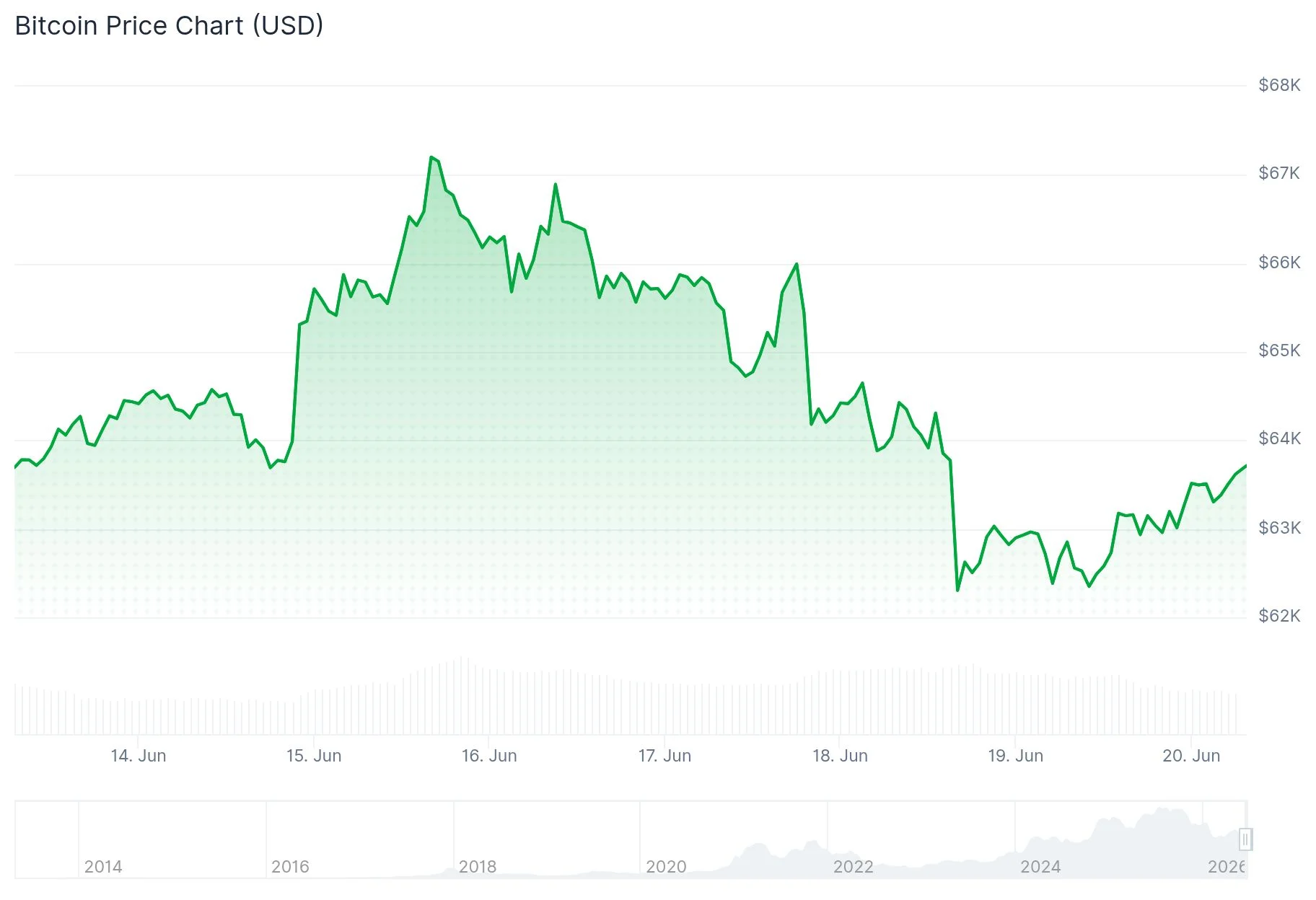
Bitcoin tumbled beneath the $63,000 price point on June 19 as escalating Israel-Lebanon geopolitical tensions prompted traders to reduce exposure across cryptocurrency markets. The leading digital asset touched an intraday floor around $62,500 after retreating from a session peak of $65,944.
The decline coincided with Israeli military operations expanding into southern Lebanese territory and ongoing diplomatic negotiations. Israeli authorities released updated territorial control maps indicating broader military presence, contradicting aspects of the recently signed U.S.-Iran diplomatic framework that outlined cessation of hostilities across multiple fronts.
Ethereum experienced parallel weakness, surrendering the $1,700 price threshold. ETH changed hands near $1,677, with market participants monitoring the $1,580 support area for potential stabilization.
According to CoinGlass data, cryptocurrency-wide liquidations surpassed $1 billion in response to the geopolitical developments. Leveraged long positions absorbed the preponderance of losses. While 24-hour liquidation volumes moderated to approximately $560 million, the bearish momentum remained evident.
Cryptocurrency analyst Ted Pillows shared a pessimistic market outlook via X, cautioning that Bitcoin has not yet established its cycle bottom. His analysis suggests a lower high formation could materialize around $74,000 — a critical resistance zone since the first quarter of 2024 — preceding Bitcoin’s ultimate downside move. This perspective reinforces the prevailing cautious sentiment reflected in current market metrics.
Concentrated Liquidation Risks Near $59,000 Support
Bitcoin’s rebound effort stalled before reaching the daily fair-value gap spanning $67,500 to $70,500. Both the 50-day and 100-day exponential moving averages maintain downward pressure, while BTC violated an ascending channel pattern on the four-hour timeframe.
Over $4 billion in aggregate leveraged long positions are concentrated near the $59,000 price level. Should Bitcoin test this zone, forced position closures could intensify downward momentum. The subsequent major liquidity concentration exists around $68,000, where cumulative positions exceed $4.75 billion.
The Relative Strength Index approaches oversold conditions. Additional movement toward annual lows could drive the indicator below 30, a threshold historically associated with pronounced relief rallies.
Analyst Killa proposed that Bitcoin might front-run the liquidity accumulation below $60,000 rather than executing a complete sweep. Trader LP similarly advised against excessive bearishness, identifying signals of potential bottom formation during late June.
Exchange Deposits Decline to Multi-Month Lows
CryptoQuant analyst Amr Taha documented that mid-tier BTC inflows to major exchanges declined concurrently across Binance, Coinbase, and Coinbase Prime on June 19. Binance registered approximately 3,500 BTC in deposits, Coinbase observed nearly 3,000 BTC, and Coinbase Prime recorded roughly 1,700 BTC — representing the lowest aggregate inflows since April 4.
Diminished exchange deposits indicate fewer coins are being staged for immediate liquidation. Mid-sized holders are curtailing transfers to trading platforms while BTC hovers around $62,000.
The annual low of $59,000 continues to represent the critical threshold commanding trader attention.
Key Takeaways
- Charles Schwab has announced a collaboration with Cboe Global Markets to introduce binary options contracts based on S&P 500 outcomes
- These contracts function as yes-or-no instruments, delivering either a predetermined payout or expiring with no value
- A potential “Plus Zone” mechanism may provide traders with partial returns when predictions come close to the actual outcome
- The brokerage follows in the footsteps of Coinbase and Robinhood, both of which have introduced prediction-based offerings
- The prediction markets industry continues to navigate regulatory challenges from the CFTC and Congressional lawmakers
Charles Schwab is making its debut in the prediction markets arena with an innovative product that enables clients to wager on whether the S&P 500 index will finish above or below a specified price point.
The financial services giant is collaborating with Cboe Global Markets on this initiative, which sources indicate could become available to retail customers in the coming months, based on reporting from the Wall Street Journal released on Friday.
Different from platforms like Polymarket and Kalshi that provide futures-based contracts across diverse events, Schwab’s offering will operate as a binary option instrument. These contracts deliver a predetermined cash settlement or become worthless, determined entirely by whether the prediction proves accurate.
Schwab and Cboe are exploring the addition of a “Plus Zone” component to their product. This innovation would enable participants to collect a proportional payout when their forecast approaches the final market close, even without hitting the exact target price.
Both organizations have explored broadening the product lineup beyond just the S&P 500, potentially incorporating additional financial indexes and market benchmarks. Schwab has made clear its intention to limit these offerings exclusively to events with objectively verifiable outcomes within financial markets, steering clear of political elections or sporting events.
Schwab Joins Coinbase and Robinhood in Prediction Trading
This move doesn’t make Schwab the pioneer among established financial institutions entering this territory. Coinbase and Robinhood have already introduced prediction market offerings within the past several months.
Kalshi and Polymarket, currently the dominant players in prediction markets, already provide event-based contracts linked to S&P 500 movements. Industry analysts project the entire prediction markets sector could achieve $1 trillion in yearly trading volume by the year 2030.
Schwab has been actively diversifying into cryptocurrency services. The company rolled out spot Bitcoin and Ethereum trading capabilities for its retail customer base in May 2026. During the first quarter of 2026, Schwab reported net income totaling $2.5 billion.
Regulatory Environment Remains Uncertain
Prediction market platforms are experiencing heightened examination from regulators at multiple government levels.
Numerous state gaming commissions have questioned the legality of platforms such as Kalshi and Polymarket offering contracts on sports events. Congressional representatives have additionally expressed concerns regarding the possibility of government officials exploiting privileged information for personal gain on these platforms.
A Republican legislator has put forward legislation to prohibit insider trading on prediction markets, although the proposed bill would exclude White House personnel from its provisions.
The US Commodity Futures Trading Commission, led by Chair Michael Selig, has maintained that event contracts on prediction markets should be classified as “swaps,” which would grant the agency sole regulatory jurisdiction over them.
Several ongoing legal disputes involving Kalshi, Polymarket, and the CFTC remain unresolved in the courts.
Schwab’s entrance into this market segment represents a notable evolution for an established brokerage institution, effectively introducing prediction market-style instruments to mainstream retail investors.


The Philippine SEC has reinforced its support for real-world asset tokenization as four companies, including a tokenized real estate project, advance through its regulatory sandbox.
Summary
- Philippine SEC says existing laws can support tokenized real-world assets and related investment products.
- Four companies are testing new financial products in the SEC’s Strategic Sandbox, including tokenized real estate.
- BSP has tightened crypto listing requirements while maintaining licensing scrutiny of digital asset firms.
Speaking at Philippine Blockchain Week 2026, SEC Commissioner Rogelio Quevedo said the regulator is now confident that existing laws and its regulatory framework can accommodate tokenized assets.
According to Quevedo, the SEC believes tokenization can introduce new forms of capital market activity and could eventually transform how securities are issued and traded.
During the event, Quevedo said the agency had reached a point where it was comfortable overseeing tokenized products within the country’s existing legal structure. He added that asset tokenization could encourage financial innovation while creating new opportunities for investors and market participants.
The comments come as the SEC continues to expand its use of StratBox, a regulatory sandbox that allows financial technology firms to test products and business models under direct supervision.
Sandbox participants are already testing tokenized products
According to the SEC, StratBox gives regulators the ability to temporarily modify or waive certain regulatory requirements for individual participants while products are being tested. The agency has stressed that sandbox participation does not exempt companies from existing laws and cannot be used to bypass regulatory obligations.
In November 2025, the SEC disclosed that four companies had been admitted into the program. According to the regulator, one participant was testing a tokenized real estate offering, while two others were evaluating products designed to provide access to United States equities. The SEC also granted BlockShoals Technologies in-principle approval to test crypto-related products and services within the sandbox environment.
Separately, Quevedo argued in a recent interview that tokenized investment products could help overseas Filipino workers gain access to regulated investment opportunities. He said many overseas workers have available capital but often struggle to identify legitimate ways to grow their savings, leaving them vulnerable to fraudulent investment schemes.
At the same time, Quevedo said the SEC has strengthened its enforcement capabilities as digital asset activity expands. According to his remarks, the regulator is using artificial intelligence tools to identify investment scams and is working with major online platforms, including Google and TikTok, to remove illegal offerings targeting Filipino investors.
Crypto oversight is tightening alongside tokenization efforts
While the SEC continues to explore tokenization, the country’s central bank, Bangko Sentral ng Pilipinas, has introduced stricter requirements for virtual asset service providers operating in the country.
Under new guidance from the central bank, VASPs must implement more extensive due diligence procedures before listing cryptocurrencies for customers.
The BSP said exchanges should evaluate digital assets based on issuer background, market maturity, use cases, transparency and security standards, liquidity conditions, and legal compliance before making them available on their platforms.
Licensing requirements have also remained a focus for regulators. According to reporting by BitPinas, the BSP recently said neither Binance nor BlockShoals currently holds a virtual asset service provider license, a requirement for firms offering crypto payment and transaction services in the Philippines.
BYD rejects allegations of environmental violations at Hungary EV plant

Ethereum (ETH) Faces Pressure as Arthur Hayes Exits 6,000 ETH at $606K Loss

Buying Another Flat Is Not a Financial Plan


-

 Business6 days ago
No Jackpot Winner as $257 Million Prize Rolls Over to $269 Million Monday Draw
-
Crypto World5 days ago
Zimbabwe Requires Crypto Businesses to Register Annually Under New FIU Regulations
-

 Fashion16 hours ago
Weekend Open Thread: Miami – Corporette.com
-
 Entertainment6 days ago
Matt Damon’s Viral Sci-Fi Thriller Has Taken Over HBO Max
-

 Tech6 days ago
As AI companies race to go public, who else is along for the ride?
-

 Business6 days ago
Anthropic staff to meet White House officials next week, Axios reports
-
 Crypto World6 days ago
Bitcoin could crash to $48,000, if this historical pattern is triggered
-
 NewsBeat6 days ago
what doctors are seeing in ebike crashes
-
 NewsBeat6 days ago
Warning of disruption as Cardiff Crossrail works to start
-
 NewsBeat6 days ago
Tributes to former deputy head teacher at Cambridge school among death and funeral notices
-

 Politics6 days ago
“Israel’s” ban on ICRC visits ruled illegal, but Knesset moves to stop them permanently
-

 Entertainment6 days ago
Deion Sanders Shares Powerful Post After Viral Advice To Deiondra
-

 News Videos6 days ago
Financial Accounting | Last Day Revision Strategy and Booster | CMA Inter – June 2026
-
 Entertainment6 days ago
Kate Middleton Glare Goes Viral After Kids Booed At Royal Event
-

 Tech5 days ago
Over 400 Arch Linux packages compromised to push rootkit, infostealer
-

 Crypto World6 days ago
XRP ETFs Outperform As Bitcoin And Ethereum Funds Extend Outflow Trend
-

 Business6 days ago
Invesco Quality Income Fund Q1 2026 Commentary
-
 Crypto World6 days ago
Market Preview: SpaceX (SPCX) IPO Record, Federal Reserve Meeting, and Iran Nuclear Agreement
-

 NewsBeat6 days ago
Singer Oliver Tree dies aged 32 in helicopter crash in Brazil
-

 Sports6 days ago
Dick Advocaat’s Curacao scores first-ever World Cup goal against Germany
You must be logged in to post a comment Login