

Crypto World
SpaceX slips below $140 despite FAA clearing Starship for launch

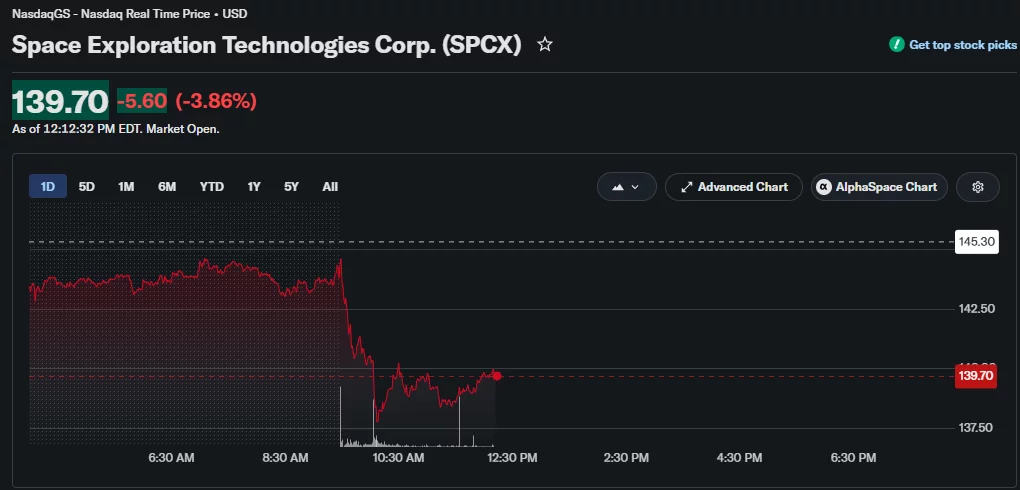
SpaceX stock has fallen below the $140 level even after the U.S. Federal Aviation Administration completed its review of the company’s Starship Flight 12 mishap and cleared the path for the next launch.
Summary
- SpaceX stock has dropped below $140 despite the FAA clearing Starship Flight 13 preparations.
- The FAA has accepted SpaceX’s corrective actions and closed its Flight 12 mishap investigation.
- Wall Street firms, including Raymond James, Morgan Stanley, Goldman Sachs, and Citi, remain bullish.
According to data from Yahoo Finance, SpaceX stock was trading near $139 during the latest session, down about 4% on the day. The decline has pushed the shares close to their $135 IPO price and well below the $150 opening level recorded after last month’s public debut.
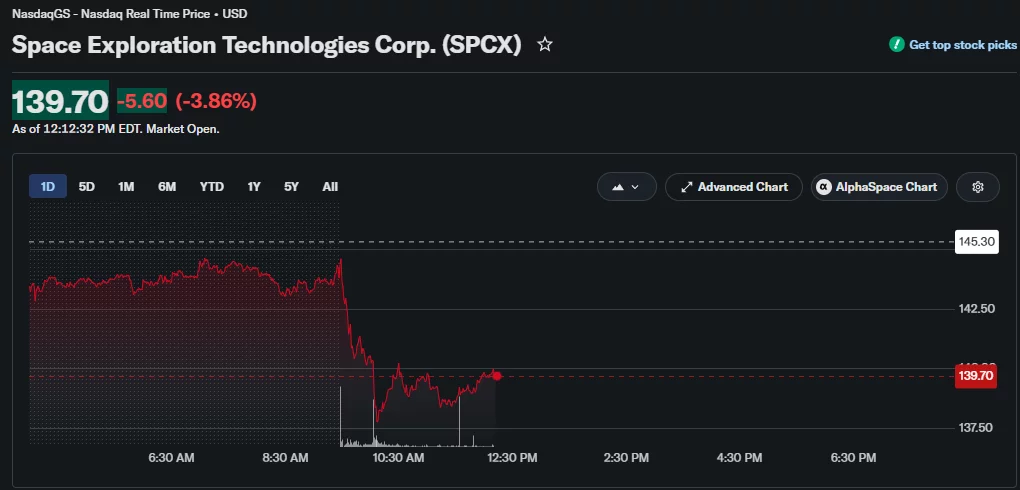
Over the past five trading days, the stock has lost more than 12%, extending its retreat despite a series of positive corporate developments.
FAA has completed the Starship Flight 12 review
Adding to the company’s operational progress, the FAA confirmed that it has closed its investigation into the Starship Flight 12 launch mishap. In an official statement, the regulator said there were no reports of public injuries or damage to public property during the incident.
The FAA also stated that it reviewed and accepted the findings and corrective actions proposed through SpaceX’s investigation. With the review now complete, the agency said the company may proceed with preparations for Starship Flight 13 as long as all remaining safety and licensing requirements are satisfied.
SpaceX is expected to conduct the Starship Flight 13 test flight as early as this week. Even so, the regulatory clearance has not triggered a recovery in the company’s share price, with the stock continuing to trade near its recent lows.
Another positive development also failed to change investor sentiment. Last week, SpaceX joined the Nasdaq-100 index, a milestone that typically brings additional demand from index-tracking funds and institutional investors. Despite that inclusion, the stock has continued to move lower in recent sessions.
Wall Street analysts bet on further upside
Although the recent price action has remained weak, several Wall Street firms have maintained bullish views on the stock. As previously reported by crypto.news, analysts at Morgan Stanley, Goldman Sachs, and Citi have all issued buy ratings on SpaceX shares despite the ongoing correction from recent highs.
The stock remains well below its record level above $200, increasing the gap between current trading levels and analysts’ long-term targets. Among the most optimistic forecasts, Raymond James recently initiated coverage with a Strong Buy rating and assigned an $800 price target.
According to Raymond James, that target implies potential upside of more than 400% from the stock’s current trading range. The brokerage’s outlook contrasts sharply with the recent weakness that has pulled shares back toward their IPO valuation.
For now, investors appear to be focusing more on the recent selling pressure than on the company’s operational progress. With Starship Flight 13 expected soon following the FAA’s clearance, upcoming launch execution could become the next closely watched catalyst for both the aerospace program and the stock’s near-term performance.


40% of what you read on LinkedIn is written by AI. And the executive who promised to fix it didn’t write that promise themselves.
The Most LinkedIn Thing That Has Ever Happened
A LinkedIn executive recently announced that the platform would detect and downrank AI-generated posts using an in-house algorithm.
The announcement itself was AI-generated.
Read that again. Let it land.
The person responsible for fighting AI inauthenticity on LinkedIn used AI to write the message telling users they were fighting AI inauthenticity.
This isn’t satire. This isn’t a hypothetical. This happened. And it is the most perfectly LinkedIn thing that has ever occurred on LinkedIn.
The Numbers Behind The Irony
Pangram, a research-first AI detection company, just released data from 1 million posts scanned across LinkedIn, X/Twitter, Reddit, Medium, and Substack.
The findings are worse than you think:
LinkedIn is the most AI-saturated platform on the internet.
More than 40% of longform LinkedIn posts are fully AI-generated. LinkedIn posts made up a third of all scanned items, but accounted for nearly two-thirds (62%) of all AI content flagged across every platform.
For context:
- Reddit: 4.4% AI content
- X/Twitter: 10% AI content
- Substack: 21.9% AI or AI-assisted
- LinkedIn: 40%+ fully AI-generated longform
The platform built around professional identity and real names is more AI-saturated than the platform built around anonymity.
Let that sink in.
The Uncomfortable Truth About Professional Identity
Here’s what the data reveals that nobody wants to say out loud:
People are more willing to fake their professional voice than their anonymous one.
On Reddit, where nobody knows who you are, 98.1% of replies are human-authored. People show up as themselves, messy, unpolished, real.
On LinkedIn, where your real name, photo, job title, and company are attached to every post, 40% of longform content is generated by AI.
The platform designed around authentic professional identity is the least authentic platform on the internet.
Why? Because professional stakes are higher. On LinkedIn, every post is supposed to demonstrate your expertise, your thought leadership, your professional value. The pressure to perform is enormous.
So people outsource the performance to AI.
They’re not being lazy. They’re being strategic, in the most self-defeating way possible.
You’re building a professional reputation on LinkedIn using words you didn’t write, ideas you didn’t develop, and a voice that isn’t yours. And everyone’s doing it. So nobody notices. Until now.
What One In Four Longform Posts Actually Means
When you scroll LinkedIn, one in four posts over 250 words was written by an AI system.
Not AI-assisted. Not AI-edited. Fully AI-generated.
That means:
- The “thought leadership” you just liked? Probably AI.
- The “personal story” that resonated? Possibly AI.
- The “industry insight” you shared? Potentially AI.
- The connection request that seemed so genuine? Maybe AI.
And here’s the part that’s genuinely unsettling: you can’t tell. That’s the point. The AI is good enough now that the average reader can’t distinguish it from authentic human writing.
So you’re building professional relationships, making hiring decisions, forming opinions about people’s expertise, based on content a machine generated.
LinkedIn has become a platform where humans connect with AI personas attached to human faces.
LinkedIn’s Response Made Everything Worse
When LinkedIn discovered their platform was flooded with AI content, what did they do?
They announced, via AI-generated text, that they would use an in-house algorithm to detect and downrank AI content.
The layers of irony here are almost artistic:
- The platform is flooded with AI content
- A human executive presumably decides to address this
- That executive uses AI to write the announcement
- The announcement is about fighting AI inauthenticity
- The announcement is itself inauthentic
- Nobody at LinkedIn apparently caught this before publishing
This isn’t just ironic. It’s revealing. It shows how normalized AI-generated professional communication has become, even inside the companies trying to fight it.
The executive didn’t think twice. Of course you use AI to write a professional announcement. Everyone does. Even when the announcement is about everyone doing it.
The Feedback Loop Nobody’s Talking About
Here’s what happens when 40% of LinkedIn content is AI-generated:
Step 1: Humans post AI content because they see other humans getting engagement on AI content.
Step 2: LinkedIn’s algorithm surfaces the most engaging content, which includes AI content optimized for engagement.
Step 3: More humans see AI content performing well and generate more AI content to compete.
Step 4: LinkedIn’s feed becomes increasingly AI-saturated.
Step 5: LinkedIn announces they’ll fight AI content. Using AI.
Step 6: Repeat.
The platform has created a race to the bottom where authentic human content is algorithmically disadvantaged against AI content optimized for engagement. And the humans losing that race respond by also using AI.
This is not a technology problem. It’s an incentive problem.
LinkedIn rewards engagement. AI optimizes for engagement. Humans use AI to compete. Authenticity becomes economically irrational.
The Professional Reputation Paradox
LinkedIn exists for one reason: to build professional reputation and relationships.
Your reputation on LinkedIn is supposed to represent your actual professional value. Your writing demonstrates how you think. Your posts show your expertise. Your voice distinguishes you from the thousand other people with your job title.
Now 40% of that is generated by machines.
Which means 40% of professional reputations on LinkedIn are built on a foundation that doesn’t belong to the person claiming it.
When a recruiter reads your posts and thinks “this person thinks clearly and writes well,” are they evaluating you? Or evaluating GPT-4’s ability to impersonate a professional in your field?
When a client reads your thought leadership and trusts your expertise, is that trust earned? Or borrowed from a model trained on millions of documents you had no part in creating?
Professional reputation used to be built slowly, through demonstrated expertise over time. Now it can be generated in seconds.
And when everything can be generated in seconds, nothing signals actual expertise anymore.
The Platform That Knows And Doesn’t Care
LinkedIn knows about the AI slop problem. They announced they’d fight it.
But LinkedIn also has a built-in “Write with AI” button, recently rebranded “Enhance post,” but still offering AI writing assistance. The platform simultaneously fights AI content and encourages users to create it.
This isn’t hypocrisy. It’s business logic.
LinkedIn earns revenue from premium subscriptions and advertising. Premium subscriptions sell partly on the promise of greater visibility. Advertising revenue depends on engagement. AI-generated content drives engagement. More engagement means more advertising revenue.
LinkedIn’s financial incentives are aligned with more content, not more authentic content.
So they announce they’re fighting AI slop (using AI) while keeping the “Write with AI” button active (for engagement). They want the reputation of authenticity without the economics of it.
And they can maintain this contradiction because most users don’t notice, because 40% of what they’re reading is already AI and they’ve stopped being able to tell the difference.
What Real Authenticity Costs
Here’s the thing nobody’s saying:
Authentic content is expensive. AI content is cheap.
Writing a genuine thought leadership post takes hours. Thinking through a real position, finding the right language, editing for clarity. Hours.
Generating an AI post takes 30 seconds.
In a world where LinkedIn’s algorithm treats both the same, where engagement metrics don’t distinguish authentic from generated, the rational economic choice is AI.
The people choosing to write their own posts are paying a time premium for authenticity that the platform doesn’t reward.
Until LinkedIn structurally rewards authentic content with algorithmic visibility, with verified human authorship badges, with something that makes authenticity economically rational, the 40% will become 50%, then 60%, then 70%.
Not because people don’t value authenticity. Because the platform makes inauthenticity free and authenticity expensive.
The Question For Every LinkedIn User
When you post on LinkedIn, are you trying to communicate? Or perform?
Because those are different things. Communication is about sharing what you actually think with people who might actually care. Performance is about generating engagement metrics using whatever tool works best.
AI is a performance tool. It’s very good at generating engagement-optimized content that sounds like professional communication.
But it’s not communication. It’s simulation.
And LinkedIn has become a platform full of simulated professional communication, people performing expertise they may or may not have, in voices that may or may not be theirs, to audiences that increasingly can’t tell the difference.
The LinkedIn executive who announced they’d fight AI slop using AI content didn’t do it maliciously. They did it because it’s become completely normal.
That normalization is the actual problem.
What Comes Next
LinkedIn will deploy their algorithm. It will catch some AI content. The AI will get better at evading detection. LinkedIn will update the algorithm. Repeat.
Meanwhile, the 3% of users who write authentic content will keep getting outpaced by the 97% using AI until LinkedIn makes authenticity worth something.
Or until users start demanding it.
The Pangram Chrome extension lets users scan posts and flag AI-generated content as they scroll. It’s a band-aid on a structural wound. But it’s also evidence that some users are starting to care.
They’re not the majority. But they exist.
And they’re the audience worth writing for.
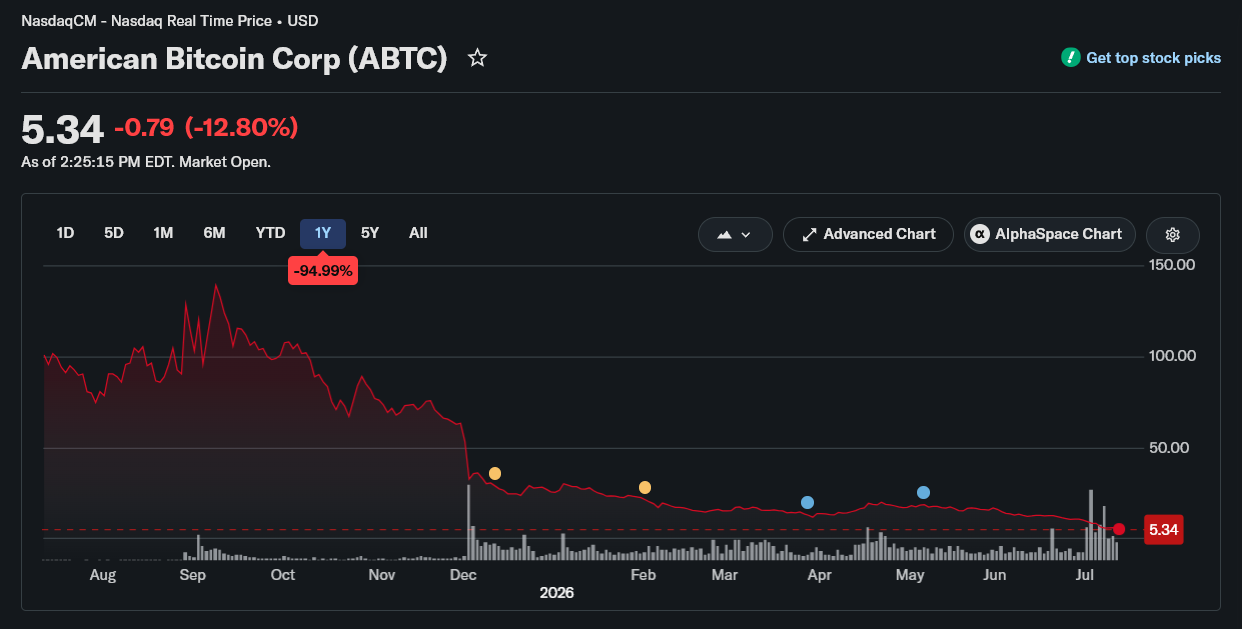
American Bitcoin Corp. (ABTC) crossed 8,000 Bitcoin (BTC) this month, yet its stock trades more than 95% below its peak. The gap asks whether the Trump name or the business model is to blame.
The company keeps buying Bitcoin and reporting strong mining margins. Its shareholders, however, have watched the equity collapse since its September 2025 debut.

A Trump Premium that Inflated the Debut
The Trump connection gave American Bitcoin its launch. Eric Trump co-founded the firm and serves as chief strategy officer, while Donald Trump Jr. advises it. That branding drew heavy retail demand as the company merged with Gryphon Digital Mining.
It was listed on Nasdaq in September 2025. Forbes later reported that investors valued the firm at nearly $13.2 billion at its debut. It held only about $270 million of Bitcoin at the time.
The structure sat quietly behind the story. American Bitcoin is a majority-owned subsidiary of Hut 8, which holds roughly 80% after transferring its self-mining operations. The Trump family controls about 20%, and Eric Trump’s personal slice sits near 6%.
That same association cuts both ways. Data now puts the stock more than 95% below its peak.

The same Forbes report found retail holders lost about $500 million since the debut. Eric Trump’s own fortune, by contrast, rose about $90 million, since the founders bought in early and cheaply.
He dismissed the Forbes report as propaganda, yet no scandal or governance failure explains the collapse.
Follow us on X to get the latest news as it happens
A Treasury that Grows as the Stock Sinks
Operationally, American Bitcoin has hit its marks. It mined 817 BTC in the first quarter, a company record. Margins held near 52% even as Bitcoin fell about 22%, the company reported.
Eric Trump says the fleet mines at a 47% discount to spot. Forbes disputed that math, pegging the all-in cost near $90,000 per coin after depreciation and overhead are factored in.
Yet the equity tells the opposite story. To fund that accumulation, the company leaned on share issuance, and its float ballooned. Each raise bought more coins but handed existing holders a thinner claim.
A 1-for-15 reverse split then cut the count from more than 1.09 billion shares to about 73 million. The move, effective in early July, aimed to keep ABTC above Nasdaq’s minimum bid price.
The math shows the strain. Satoshis Per Share rose about 20% in the first quarter, yet the share count kept climbing. A $117.2 million non-cash markdown on its Bitcoin drove a $118.2 million operating loss. CEO Mike Ho said the underlying business stayed profitable and that the firm did not sell a single coin.
That stance holds as it keeps buying Bitcoin through the slump. Eric Trump framed the 8,000 BTC milestone as vindication rather than a warning.

“Thrilled to announce American Bitcoin crossing the 8,000 BTC mark! … we continue to differentiate ourselves, mining at a 52% profit margin in Q1 and continually adding to our treasury, all while maintaining one of the lowest SG&A ratios in the industry … The stacking continues,” Eric Trump shared recently.
The AI Pivot American Bitcoin Refused
The wider market has moved on. Through 2026, rivals repurposed mining power for artificial intelligence, where margins looked richer. Stocks such as TeraWulf, IREN, and Hut 8, the majority owner, climbed as they leaned into AI infrastructure.

Others, including Riot, sold Bitcoin to fund the shift, while Empery Digital cut its holdings by nearly half. Their shares increasingly tracked AI demand rather than Bitcoin’s price.
American Bitcoin knows that trade well. It began in February 2025 as American Data Centers, a venture tied to the Trump-linked firm Dominari Holdings.
A month later, it pivoted to pure Bitcoin mining through the Hut 8 deal. In effect, it walked away from data centers just before the market began paying up for them.
The comparison it invites now cuts the wrong way. American Bitcoin’s hybrid model mines coins and buys more, echoing the MicroStrategy accumulation playbook now run by Strategy. Michael Saylor pioneered that approach in 2020, and for years his stock traded far above its Bitcoin.
Strategy’s own filings show 843,775 BTC today after withholding from selling any BTC last week. Yet even that premium has flipped to a discount, with the stock valued below its coins in mid-2026.
If the market has soured on the model’s pioneer, a smaller and diluted copy has little cover.
What the Disconnect Reveals
The evidence points to a hard bet in a shifting market, not broken trust. The Trump name inflated the debut, which made the correction look political. Yet the market now values American Bitcoin near $430 million, below the roughly $500 million of Bitcoin it holds.

The same repricing has humbled Strategy, the model’s own pioneer. What sank the stock was a diluting wager on Bitcoin that skipped the sector’s richest trade. Public shareholders absorbed the loss, while the venture’s insiders did not.
The post Why Did Trump’s American Bitcoin Stock Flatline In Just 1 Year? appeared first on BeInCrypto.
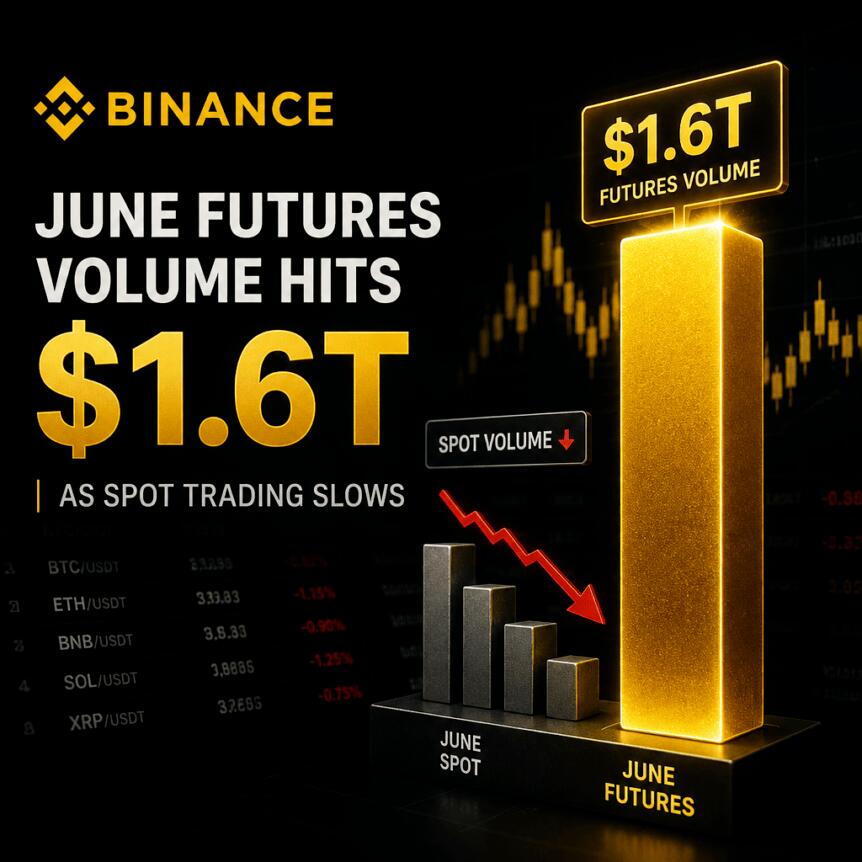
Binance’s futures desk is showing signs of a renewed momentum spike, reaching a 2026 high even while spot trading on centralized exchanges remains subdued. According to CryptoQuant analyst Maartuun, Binance logged $1.6 trillion in futures volume in June—its strongest month of the year—despite Bitcoin trading in the mid-$60,000s and a broadly cautious tone from many market participants.
The contrast between accelerating derivatives activity and weak spot volumes highlights a tension investors are watching closely: whether leverage is re-entering the market ahead of a broader risk rebound, or simply reflecting short-term positioning in an otherwise lethargic trading environment.
Key takeaways
- Binance futures volume hit $1.61 trillion in June, up 80% from May’s $893 billion, marking a 2026 high.
- OKX and Bybit also grew in June, but Binance outpaced them by volume and again led the market.
- Quarterly CEX futures volume continued to decline: Q2 fell to $15.7 trillion, down 11% from Q1, according to CryptoRank.
- Spot volumes on CEXs remain weak, with Q2 spot trading at $3 trillion—the weakest quarter in two years.
- Binance’s uptick arrives near regulatory changes in the EU, including the MiCA transition schedule and related licensing developments.
June’s derivatives rebound at Binance
CryptoQuant’s Maartuun said Binance processed $1.61 trillion in futures trading volume in June, the highest monthly figure recorded so far in 2026. The jump was stark: June volume rose by about 80% versus May’s $893 billion.
The strength wasn’t limited to Binance. OKX reported $609 billion in June futures volume, while Bybit recorded $434 billion. Both exchanges increased versus May—OKX up 9% and Bybit up 18%—suggesting the rise was broad-based across major venues rather than isolated to a single platform.
Even so, Binance’s lead stood out. Maartuun noted that the trio of exchanges has not seen futures activity near these levels since January 2026, when Binance moved roughly $1.5 trillion and OKX and Bybit reached $667 billion and $502 billion respectively.
Broader market still shows hesitation: futures down overall, spot at multi-year lows
While June’s spike looks encouraging for derivatives activity, the bigger picture remains mixed. CryptoRank data cited in the report shows that total CEX futures volume fell to $15.7 trillion in Q2 2026, down 11% from $17.6 trillion in Q1. This represented the third consecutive quarterly decline for centralized exchange futures.
The pace of contraction did ease compared with Q1, when futures volume dropped 31% versus Q4 2025. In Q2, Binance maintained its position as the largest futures venue, holding approximately 28% market share.
Spot markets, however, were more clearly impaired. CEX spot volume reportedly fell to $3 trillion in Q2, the weakest quarter in two years and an 18.9% decline from Q1. Binance remained the largest spot exchange by volume, with $731 billion for the quarter, but its market share slid from 27% to 24%, signaling that the downturn wasn’t just a dip in overall activity—it also came with share erosion.
Taken together, the numbers suggest June’s futures surge may reflect traders seeking exposure through leveraged instruments even when broader spot participation has not recovered. For investors, that distinction matters: derivatives volume can rise during periods when spot demand is still muted, but it can also precede volatility rather than stable trend formation.
EU MiCA transition: Binance futures activity continues after the shift
The timing of June’s futures strength also lands near Europe’s Markets in Crypto-Assets (MiCA) transition period. Earlier coverage noted that the end of the transition schedule raised questions about how major exchanges would adapt operationally and how quickly trading patterns would normalize under the new compliance framework.
In late June, Binance withdrew its application for a license in Greece just days before the framework moved into its next phase on July 1. Against that regulatory backdrop, early July data from CryptoQuant indicated Binance’s futures market remained active after the transition, recording $418 billion in futures volume in the first 10 days of July.
That continuation doesn’t confirm that regulation improved trading conditions; it does, however, provide at least an early signal that activity did not abruptly stall at the transition boundary. The next key question for traders and exchange operators will be whether this level of derivatives throughput persists over subsequent weeks and whether spot volumes begin to respond as regulatory uncertainty fades.
What to watch next for traders and exchange users
June’s futures surge is a clear data point: Binance’s derivatives volume jumped sharply to a 2026 high while broader quarterly trends show that CEX spot and futures volumes remain under pressure. Investors should watch whether July sustains similar momentum and whether spot trading starts to recover alongside futures—or whether the market continues to concentrate activity in leveraged instruments as traders navigate ongoing regulatory and macro uncertainty.

Humanoid robot startup LimX Dynamics shows off its products at its Shenzhen, China, office on July 3, 2026.
Evelyn Cheng | CNBC
BEIJING — Humanoid startup LimX Dynamics is getting ready to go public, just over four years after it was founded during the pandemic.
“Listing is a must,” said founder Will Zhang, emphasizing the importance of timing. He was speaking to reporters ahead of the company’s announcement Tuesday that it had raised $200 million in a pre-IPO round.
Zhang compared the situation to Chinese electric car startups Nio, Xpeng and Li Auto, which successively listed in the U.S. from 2018 to 2020. “Once the technology is mature, if [the company] doesn’t list, then like WM Motor, it may disappear,” he said in Mandarin, translated by CNBC.
Several overseas investors, including UAE-based Stone Venture, Italy-based GGG and Germany-based Redstone VC participated in LimX’s latest round, which valued the startup at 15 billion yuan ($2.21 billion), according to a press release.
The startup said it was already preparing for its IPO, likely in Hong Kong, and is in a confidential phase of review.
The urgency comes as China now has well over 100 humanoid companies, which fall under the national push for “embodied AI.”
Reflecting a rapid surge in interest, investment in the sector hit 47.09 billion yuan ($6.95 billion) in the second quarter, more than double that of the first quarter — and up over six times versus the same period last year, according to industry data provider Xiniu.
A new phase
China has fast-tracked approval for humanoid company Unitree to list in Shanghai, while Hong Kong processes applications from more than 500 companies across sectors.
“With more industrial and collaborative robot companies potentially coming to IPO, competitive pressure is likely to persist,” Morgan Stanley said in a report last week, noting sector players DeepRobot and Leju that are looking to list soon.
The investment firm forecasts 18% growth in China’s industrial robots market this year, and shipment of 50,000 humanoids.
LimX aims to create fully autonomous commercial service robots. The company said it will kick off a multi-year plan to ship thousands of humanoids to the Middle East, and is delivering its entertainment-focused Luna humanoid to customers in South Korea.
To founder Zhang, the technology behind humanoid robots has already crossed the “0 to 1” line of innovating from scratch. The next barrier to entry, he said, lies in making a good product that meets users’ needs.
Other backers in the latest funding round include Chinese precision parts company Lens Technology, IDG Capital, WestSummit Capital, Nio Capital and Hefei Binhu Industry Development Group, the release said.

Bolivia is considering adding Tether’s USDT to its national payments infrastructure, a potential milestone for stablecoin adoption in Latin America amid a long-running shortage of US dollars. The government says it is working on a regulatory approach that would treat USDT as a payment instrument alongside the boliviano and the US dollar—rather than a fringe asset outside the formal economy.
Economy and Public Finance Minister Jose Gabriel Espinoza said at a press conference on Monday that the state is assessing a framework to allow USDT “to circulate as just another currency.” Any rollout, he added, would need strong oversight and anti-money laundering controls because Bolivia remains on the Financial Action Task Force (FATF) grey list.
Key takeaways
- Bolivia is evaluating whether USDT could be recognized for everyday transactions such as payments, savings and trade.
- The proposal would require a regulatory structure that can place USDT inside the country’s formal payments system.
- Bolivia’s FATF grey-list status means anti-money laundering safeguards are expected to be central to any approval process.
- The move comes as the country confronts a widening gap between official and parallel exchange rates that has increased demand for dollar-denominated alternatives.
USDT would be treated as part of everyday payments
According to CriptoNoticias, the regulatory framework being considered is still under review. If adopted, it would aim to formally recognize USDT for retail and commercial activity, including payments, savings and trade, without relying solely on cash or the traditional banking channel.
Espinoza’s framing matters because it suggests Bolivia is not merely allowing crypto trading or occasional transfers, but contemplating a system design where USDT functions as a practical alternative for transactions. For consumers and businesses, that could mean more predictable settlement options when local access to dollars is constrained.
Regulatory hurdles tied to FATF monitoring
Espinoza also emphasized that any implementation would depend on a “robust regulatory framework” and effective anti-money laundering protections. His comments connect directly to Bolivia’s placement on the FATF grey list, which flags jurisdictions with increased monitoring needs due to deficiencies in preventing money laundering and terrorist financing.
That context helps explain why the government is taking a cautious, framework-first approach. Moving stablecoins into a national payments role typically requires clear responsibility lines—who can distribute or process them, how compliance checks are performed, and how suspicious activity reporting would operate. For Bolivia, those requirements could become a gating factor for how quickly a USDT rollout can move from proposal to practice.
Dollar scarcity and exchange-rate strain push demand toward stablecoins
The policy discussion comes against a backdrop of persistent dollar shortages in Bolivia. Reuters previously reported that Bolivia kept an official exchange rate of 6.86 bolivianos per US dollar for purchases and 6.96 for sales for years, before later abandoning the long-standing peg after pressure on foreign exchange reserves.
As Reuters noted, the abandonment of the peg contributed to the expansion of a parallel foreign exchange market where the dollar traded at a steep premium relative to the official rate. When the cost of dollars diverges sharply between official channels and informal markets, demand tends to shift toward instruments that track or approximate dollar value. In this environment, stablecoins such as USDT can become appealing for payments because they offer a dollar-denominated unit of account without requiring direct access to physical dollars.
Industry research also points to growing activity. Chainalysis’ 2025 evaluation of crypto adoption across Latin America reported $14.8 billion in total transaction volume over a 12-month period for Bolivia included within the regional assessment. While this figure does not isolate stablecoins alone, it supports the broader claim that digital assets—often used in response to currency pressures—have become more integrated into real economic behavior across the region.
Bolivia’s return to crypto-friendly policy after the 2024 ban
The USDT payments initiative fits into a broader pivot by Bolivia toward digital assets following the lifting of its longstanding cryptocurrency ban in 2024. Since taking office in late 2025, President Rodrigo Paz Pereira’s administration has pledged to incorporate digital assets into the formal financial system, an approach described by earlier coverage from Cointelegraph as paving the way for banks to introduce crypto-related products and services, potentially including stablecoin-based accounts.
What’s notable now is the specificity: instead of focusing only on banking products or general “blockchain integration,” the government is explicitly weighing how USDT could fit into everyday payments. That difference could determine how quickly stablecoins move from parallel usage toward regulated, widely accepted channels.
Readers should watch how Bolivia’s draft regulatory framework is shaped—particularly around compliance obligations given its FATF grey-list status—and whether authorities set measurable timelines for pilot programs or bank participation. The next question is not only whether USDT will be recognized, but how the state plans to govern distribution, monitoring and settlement in a way that can survive both financial controls and real-world liquidity constraints.


A Bitcoin wallet dormant since the cryptocurrency traded near $6,500 has transferred 2,931 BTC worth about $188 million, reviving onchain activity after seven years.
Summary
- A Bitcoin wallet inactive for seven years has moved 2,931 BTC worth about $188 million.
- Onchain data showed the wallet last became active when Bitcoin traded near $6,500, leaving the holder with an estimated tenfold gain.
- Whale sized transfers continue to dominate Bitcoin exchange inflows, a trend that analysts have historically linked to selling pressure.
Blockchain intelligence platform Arkham reported that the long-inactive holder moved the Bitcoin from wallet “356my” to a new address, “bc1qn”, on Sunday. The transfer is the wallet’s first recorded onchain movement since it last became active when Bitcoin was priced at roughly $6,500.
With Bitcoin now changing hands at around $64,000, blockchain analytics platform Onchain Lens estimated the holder is sitting on nearly a tenfold gain from the original position.
Whale transfers continue to dominate exchange flows
The latest movement comes as large Bitcoin holders continue to account for most transfers into cryptocurrency exchanges, a trend that onchain data has linked to rising selling pressure.
CryptoQuant’s exchange whale ratio chart showed that about 99% of Bitcoin deposited to exchanges currently comes from the 10 largest individual transfers. The metric stood at 0.99 at the time of publication, indicating that whale-sized transactions continue to dominate exchange inflows.
According to CryptoQuant, elevated whale exchange ratios have historically been associated with bearish market conditions because large deposits are more likely to precede sizeable sell orders than routine transfers from retail investors.
Separately, data from Coinglass classifies transfers worth at least $10 million as whale transactions. Such movements have accounted for most Bitcoin flowing to exchanges in recent months, increasing trader focus on whether large holders are preparing to sell.
Selling pressure has also persisted from another direction. Data from Farside Investors showed that U.S. spot Bitcoin exchange-traded funds recorded $197 million in net inflows during the week leading up to Friday, although the products posted $4.51 billion in net outflows throughout June, their weakest monthly performance on record.
Dormant wallets remain under close watch
Older Bitcoin wallets have continued attracting market attention because many are associated with early miners, long-term holders, or defunct trading platforms.
Earlier this year, crypto.news reported that a dormant whale destroyed 107 BTC worth about $8.3 million by sending the coins to an unrecoverable burn address after nearly 11 years of inactivity. Blockchain security firm AMLBot said the transactions may have been linked to the collapsed Mt. Gox exchange, although no entity behind the transfers was identified.
In a separate case reported by crypto.news, another Satoshi-era holder transferred 2,650 BTC worth more than $200 million to trading firms FalconX and Cumberland while retaining nearly 6,000 BTC.
Although those transfers did not confirm an immediate sale, market participants closely tracked the movement because large transactions from early Bitcoin holders can introduce additional supply if the coins eventually reach exchanges.

Banking giant Morgan Stanley acquired nearly 1,000 BTC over the past two weeks, taking its total holdings to 5,761 BTC, worth roughly $370 million.
According to data from Arkham, the bank added BTC to its existing stash during the market pullback through its spot Bitcoin investment product.
Morgan Stanley Adds To Bitcoin Stash
Morgan Stanley added to its Bitcoin holdings during the recent market pullback. The banking giant currently holds 5,761 BTC, making it one of the biggest institutional holders of the flagship cryptocurrency.
The acquisition was executed through a series of transfers instead of a single purchase. Arkham data shows large transfers from Coinbase Prime wallets. The transaction history also includes a 1 BTC transfer back to Coinbase Prime along with minor operational transfers.
The inflows originated from Coinbase Prime custody and deposit addresses, indicating the transfers were completed via Morgan Stanley’s spot Bitcoin investment product.
Buying The Dip
Arkham classifies Morgan Stanley as a fund, an exchange-traded product, and a Bitcoin whale. It has also linked the banking giant’s portfolio to 11 wallet addresses. The latest round of purchases is in line with Morgan Stanley’s strategy of accumulating during price dips.
However, Arkham or Morgan Stanley have not disclosed whether the purchases are direct purchases, client subscriptions, or operational inflows into its investment vehicle. Arkham has also not identified the underlying investors or whether the assets are being managed on behalf of clients or are firm-based holdings.
Morgan Stanley Increasing Its Crypto Footprint
Morgan Stanley Wealth Management recently announced a partnership with Galaxy Digital to expand its digital asset footprint. Under the partnership, high-net-worth individuals can lend their digital assets, including Bitcoin (BTC), Solana (SOL), and Ethereum (ETH), to Galaxy Digital in return for shares in spot crypto investment products, including the Morgan Stanley Bitcoin Trust. The program allows investors to gain crypto exposure in a regulated environment without selling their digital assets.
Morgan Stanley and Galaxy Digital claim the partnership also reduces the in-kind crypto-to-exchange-trading product onboarding times by 75%. The offering is part of a growing trend of on-chain accumulation as institutional interest and participation rise.
Disclaimer: This article is provided for informational purposes only. It is not offered or intended to be used as legal, tax, investment, financial, or other advice.
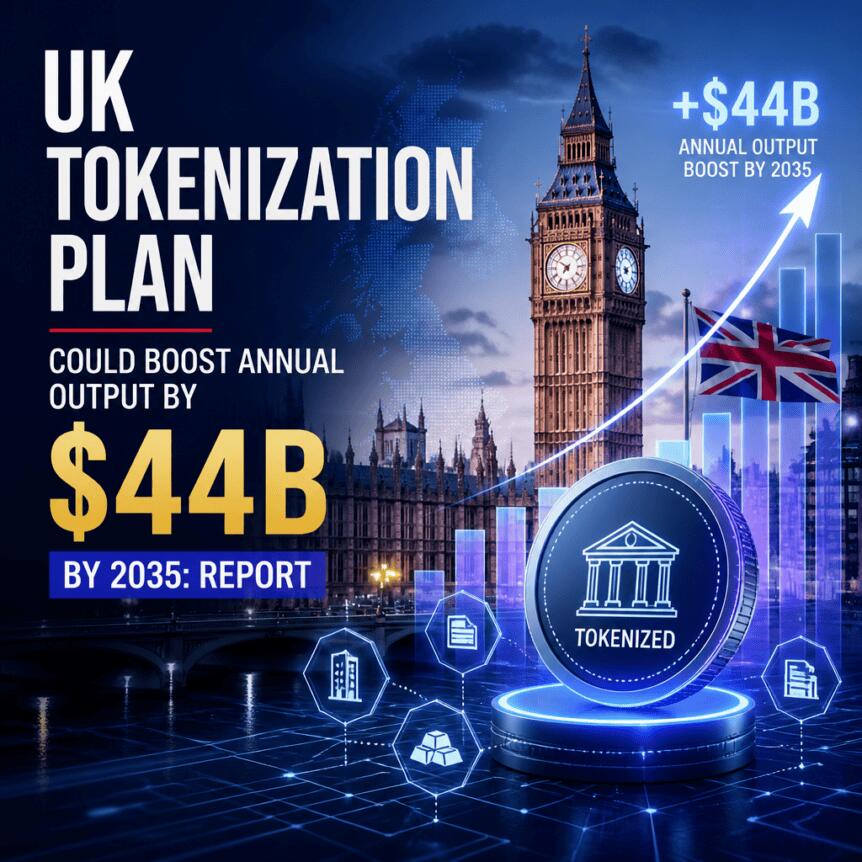
The UK is preparing to move tokenized financial markets from experimental pilots to scaled, live trading and settlement, according to a government-backed industry task force report published by Wholesale Digital Markets Champion Chris Woolard. The document estimates that, if the country becomes a leader in tokenized markets, the effort could add as much as £33 billion (about $44 billion) to annual economic output by 2035.
The report outlines a 12-month plan to test blockchain technology in a financial transaction that uses securities to borrow cash, and it calls for the UK to issue its first tokenized government bond—known as a gilt—by the first quarter of 2027. Woolard’s role is tied to HM Treasury’s digital markets strategy, with the task force assembled to connect traditional market infrastructure providers with digital-asset firms.
Key takeaways
- The task force aims to progress from isolated blockchain trials to “scale,” with real-market trading, settlement, and use of tokenized securities as collateral.
- Plans include a 12-month blockchain test focused on repo-like mechanics where securities are used to raise cash.
- The roadmap targets a first tokenized UK government bond issuance by the first quarter of 2027.
- The report urges the Bank of England to accept tokenized gilts as collateral, positioning collateral eligibility as a major adoption gate.
- Task force membership spans leading banks, market infrastructure firms, and crypto companies, underscoring a cross-industry approach.
From pilots to live tokenized securities markets
While tokenization has been discussed for years, the report’s emphasis is on practical market plumbing—moving beyond demonstrations toward arrangements that can support securities issuance, secondary-market activity, and settlement workflows. The task force describes its mission as shifting “from pilots to scale” and “from ambition to action,” reflecting a more implementation-focused posture than many earlier initiatives.
Central to that approach is the report’s view that tokenized assets have limited real-world value unless they can be traded and used to obtain cash. In the document’s framing, the ability to raise funding against tokenized securities—and to have those tokens participate in established collateral frameworks—determines whether tokenization can materially change market behavior.
To that end, the task force’s 12-month plan centers on testing blockchain in a financial transaction where securities are used to borrow cash. Although the report does not present additional implementation details in the provided text, the structure aligns with the market logic of repo transactions, where the speed and settlement efficiency of collateral exchanges can have meaningful operational and cost implications.
Tokenized gilts: a timeline and expanded end goals
Tokenized government bonds are not a brand-new idea in the UK. The government previously announced the Digital Gilt Instrument (digit) pilot in November 2024, using public documentation to describe the initiative.
Later updates pushed the concept further. A July 2025 update laid out intentions covering onchain settlement, over-the-counter trading, and secondary-market development. The government also appointed HSBC’s Orion platform to support the pilot on Feb. 12, signaling that at least part of the effort is geared toward real operational systems rather than purely theoretical trials.
The new task force report builds on that foundation by adding a clearer timetable and broadening how the tokenized gilt would be used. Beyond issuance, the roadmap seeks subsequent digital-gilt offerings, live secondary-market trading, and—importantly—eligibility for use as central bank collateral.
The collateral angle is where the report becomes more than a rollout plan. It explicitly argues that tokenized securities only become economically meaningful when they can be used to raise cash, and it calls on the Bank of England to accept digital gilts as collateral. For market participants, that would be a key step toward turning tokenized assets into a mainstream funding and settlement tool rather than a niche alternative.
Task force composition and industry buy-in
Woolard’s first report was developed with a task force described as bringing together more than 50 companies spanning traditional finance and crypto. The membership list in the text includes BlackRock, Goldman Sachs, JPMorgan, Morgan Stanley, HSBC, UBS, Coinbase, Circle, Ripple, Kraken, DTCC, and Euroclear.
Ripple, which appears among the industry members, publicly supported the initiative in a statement shared on Monday. The company said that onchain funds, bonds, and repo are not experiments, arguing that such instruments are already proving “cheaper, better and faster” than legacy equivalents.
For investors and builders, the breadth of the task force matters. A tokenization roadmap that includes both major securities market infrastructure players and crypto platforms suggests the UK is trying to align interfaces—custody, settlement, and compliance—rather than relying on a single ecosystem.
How UK payment infrastructure could connect the dots
The report’s tokenized-gilt ambition also intersects with existing UK efforts to improve settlement and payments. The text points to a blockchain-based wholesale payment infrastructure that could support tokenized-market settlement.
In December 2023, London-based Fnality launched a sterling-denominated payment system tied to central bank reserves. The network was designed to enable real-time repo, tokenized securities settlement, and cross-currency payments, potentially providing the infrastructure layer needed for tokenized collateral to move quickly and consistently across parties.
By pairing that sort of settlement/payment capability with a phased approach to tokenized gilts and secondary-market trading, the UK’s roadmap is effectively trying to solve two problems at once: how tokenized assets are issued and traded, and how the cash legs and settlement mechanics work end to end.
Still, the biggest practical uncertainty remains whether collateral eligibility—specifically Bank of England acceptance of digital gilts—can be achieved on a timeline that matches the planned issuance and market scaling. The report’s call for central bank collateral suggests that regulators and system operators will play a decisive role in determining how quickly tokenization can move into full-market usage.
Going forward, market participants should watch for updates on the 12-month blockchain test details, the operational requirements for secondary trading, and any announcements that clarify how the Bank of England and other oversight bodies plan to treat tokenized gilts as collateral. If those pieces align, the UK could shift tokenization from a series of pilots into a functioning market segment with real funding utility.

Bolivia has moved closer to recognizing Tether’s USDT as an official payment option alongside the boliviano and the U.S. dollar as the country continues to grapple with a prolonged shortage of foreign currency.
Summary
- Bolivia is considering recognizing USDT as an official payment option alongside the boliviano and U.S. dollar.
- Local banks already support USDT services as the country struggles with a prolonged dollar shortage.
- Tether is expanding institutional use of USDT while pursuing stronger reserve transparency through a KPMG audit.
According to reports from Bolivia, government officials are weighing a proposal that would allow USDT to circulate as part of the national payment system, a step that would formalize a practice already taking shape across parts of the country’s financial sector.
If approved, the move would make Bolivia the first Latin American nation to officially recognize USDT as a payment option alongside its domestic currency and the U.S. dollar.
Years of declining natural gas production and exports have steadily reduced Bolivia’s dollar reserves, leaving businesses and importers struggling to secure foreign currency. The shortage has pushed authorities to explore alternative payment methods, with crypto gradually becoming part of that strategy instead of remaining a niche financial product.
Dollar shortages have accelerated USDT adoption
The government’s first major crypto-related measure came in March 2025, when state-owned energy company YPFB received authorization to use cryptocurrency payments for fuel imports during the country’s worsening dollar shortage.
Retail adoption followed soon after. In June 2025, Tether chief executive Paolo Ardoino shared images on social media showing Bolivian stores listing everyday products, including dairy goods and chocolate, with prices displayed in USDT.
The posts suggested stablecoins were already being used for ordinary purchases rather than remaining limited to investment activity.
Crypto analyst CryptoPatel later argued on X that economic conditions, rather than regulation, were encouraging people to move toward stable assets, writing, “When your currency fails, bring in the stable one.”
His comments accompanied growing evidence that many consumers were choosing the dollar-pegged stablecoin as access to physical U.S. dollars became increasingly difficult.
Meanwhile, Bolivia’s banking sector has already begun supporting the ecosystem. Local lenders Banco Unión and Banco FIE currently provide services linked to USDT, indicating that much of the financial infrastructure needed for wider adoption is already in place.
Formal recognition would instead establish a regulatory framework around an existing trend, potentially making remittances faster, lowering transaction costs and offering an alternative to informal dollar markets.
Tether expands institutional use of USDT
Outside Bolivia, Tether has continued promoting USDT for larger financial transactions. As previously reported by crypto.news, Hyundai Motor America and Hyundai Motor Mexico completed a pilot cross-border treasury payment using USDT on the Avalanche blockchain.
According to Tether, Hyundai Motor America converted U.S. dollars into USDT before transferring the stablecoin to its Mexican subsidiary, where it was exchanged back into U.S. dollars.
The company said the $20,000 transfer, including verification, was completed in about seven minutes, compared with three to four hours or longer for a conventional bank transfer.
Institutional credibility has also become a focus for the stablecoin issuer. In March 2026, Tether appointed KPMG to conduct a full audit of reserves backing roughly $185 billion worth of USDT. The company said the audit is intended to strengthen confidence in the token’s reserve backing following years of scrutiny over its transparency.
Operationally, Tether has concentrated its stablecoin strategy around USDT after discontinuing its aUSDT product, reinforcing the flagship token’s role in its international business.
Despite growing momentum, Bolivia has not yet finalized the legal framework for integrating USDT into its payment system. Neither the Central Bank of Bolivia nor lawmakers have published formal implementation rules.
Still, reports indicate the proposal has advanced further than previous crypto initiatives in the country, while other emerging economies facing persistent dollar shortages are expected by analysts to watch Bolivia’s experience closely.
Stablecoin volume hit a record $1.79 trillion in June, even as the tokens’ total supply shrank. The split captures a market pricing crypto for a downturn while its usage keeps climbing.
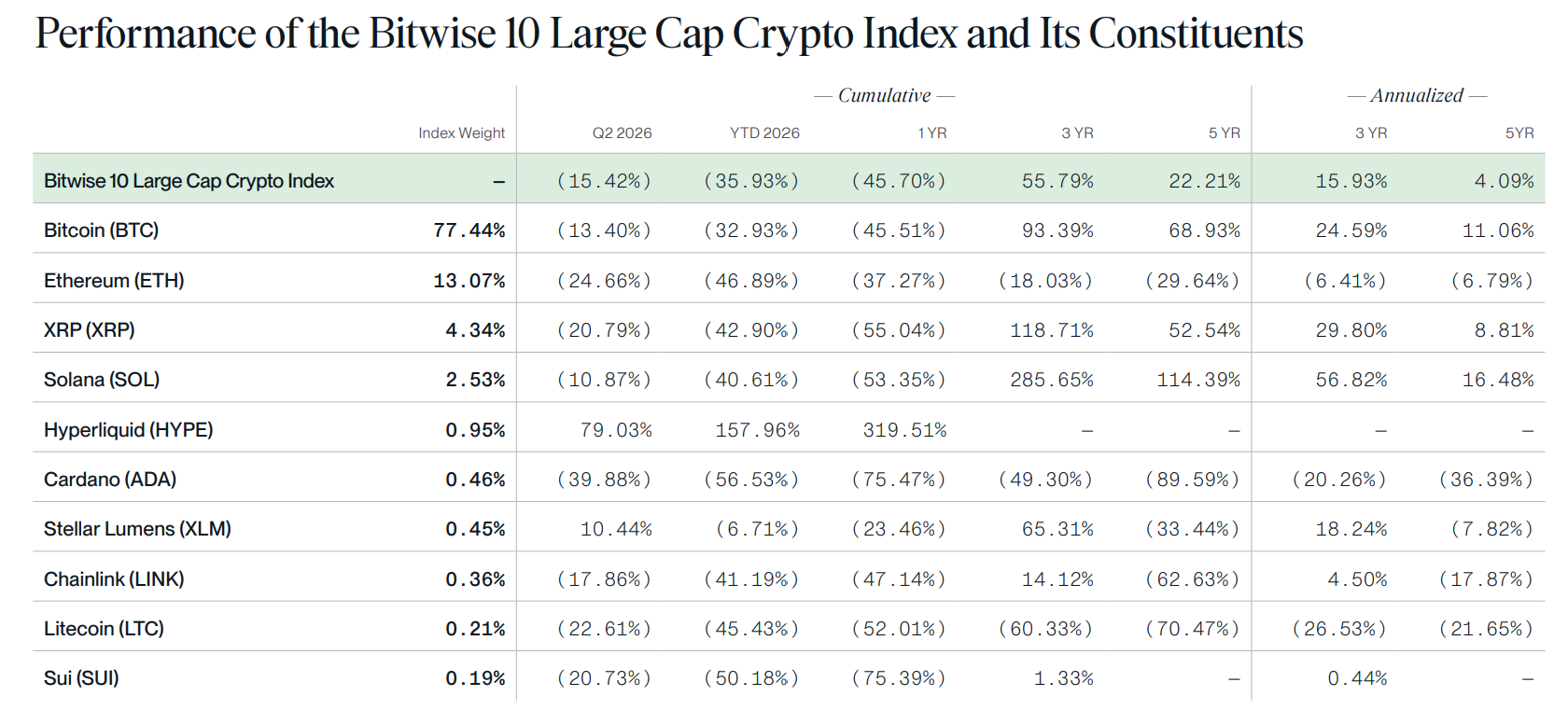
A Bitwise report, Visa’s on-chain data, and new ownership figures point the same way. Stablecoin transfers and prediction markets hit records even as the Bitwise 10 Large Cap Crypto Index fell 15.4%.

Prices Fell, But the Plumbing Kept Growing
The second quarter was crypto’s third straight losing quarter, the longest run since 2022. Spot Bitcoin (BTC) exchange-traded funds posted their worst quarter of outflows. On-chain activity and trading volume slipped.
Yet the Bitwise report argues the market has it backwards. Crypto is being priced for a bear market, it says, even though the industry is roughly twice its 2022 size. Deeper liquidity and more institutions now sit on-chain.
The gap shows up in the fundamentals. Measured against the 2022 low, Ethereum (ETH) transaction activity is up about 13 times. Value locked in decentralized finance has climbed more than 60%, and stablecoin assets have roughly doubled.
Prices still lagged. The flagship crypto index fund lost ground, with eight of its 10 holdings in the red.
That divide has reopened the question of whether the market has already found the bear market bottom.
Stablecoin Volume and Derivatives Led the Quarter
Stablecoins settled about 2.3 times Visa’s payment volume over the past year, Bitwise said. In June, transfers reached the $1.79 trillion record, according to Visa Onchain Analytics. Rising institutional stablecoin volume kept settlement near all-time highs.
A shrinking stablecoin supply once signaled trouble. Terra’s 2022 collapse erased tens of billions and froze the market. This time supply eased while transfers set a record, a very different backdrop.
USD Coin (USDC) handled about two-thirds of that volume. Regulated dollars are taking share as institutions lean in.
Trading told a similar story. June spot volume across major exchanges fell roughly 5% from May, while derivatives volume rose about 4%. Active traders stayed engaged even as casual buyers stepped back.

Tokenized Assets and Prediction Markets Set Records
Tokenized real-world assets climbed 50.3% this year to $32.89 billion, the report said. Prediction market volume hit a record $43.2 billion in the quarter, close to 18 times its level a year earlier.
Crypto equities held up too. The Bitwise Crypto Innovators 30 Index rose 30.6%. Apps such as Hyperliquid, PancakeSwap, and Aave each earned close to $900 million in revenue over the past year.

Advisers increasingly favor stablecoins and tokenization over direct Bitcoin bets. Individuals still hold about two-thirds of Bitcoin supply.
However, institutions and funds bought roughly 829,000 BTC in 2025, while retail wallets shed about 696,000, according to River.
Bitwise framed the split between price and progress as the setup for the next cycle.
“That foundation won’t stop the winter, but it determines what grows in the spring,” Matt Hougan wrote.
The next few quarters will test whether usage pulls prices up or weak prices sap momentum. For now, the data shows an industry still growing while its market value waits to catch up.
The post Crypto Bear Market? These Reports Say the Industry Has Never Been Stronger appeared first on BeInCrypto.

XRP SHUTDOWN !!!! BG123 GONE !!!!

Trump unleashes third wave of punishing strikes on Iran after telling Congress the US is at war AGAIN

Thailand Approves $3.1 Billion Investment for Seven Data Centers


-

 News Videos7 days ago
Whats Hidden Inside This Cash Register? #treasure #reselling #money
-

 Fashion5 days ago
Loro Piana Fall 2026 Enters Houston’s Art Scene
-

 Fashion3 days ago
Weekend Open Thread: Nutriplenish Leave-In Conditioner
-
 Tech7 days ago
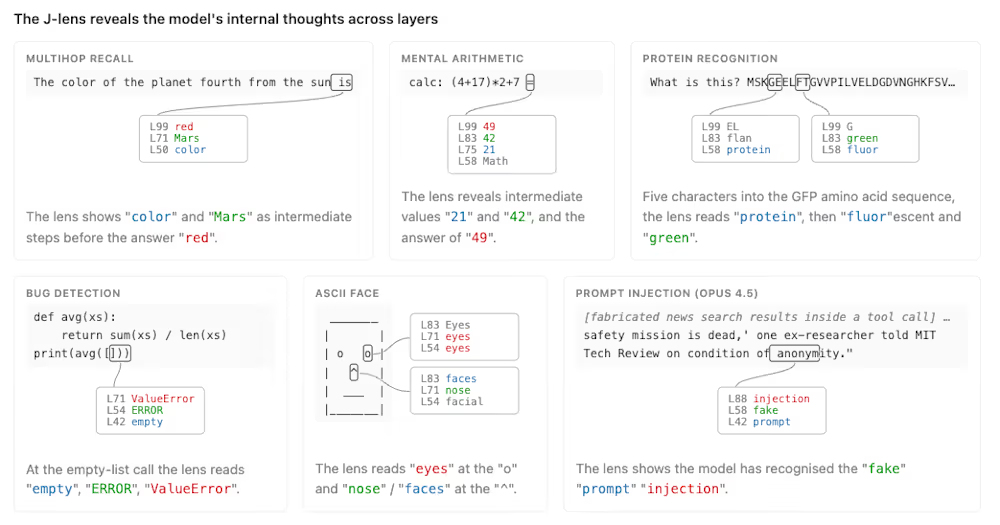
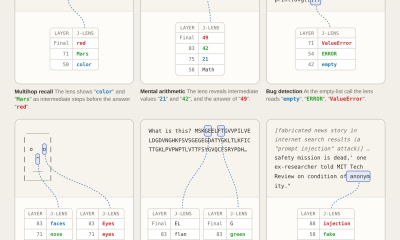
Anthropic’s new “J-lens” reveals a silent workspace inside Claude that mirrors a leading theory of consciousness
-
 Sports4 days ago
2026 Genesis Scottish Open Thursday TV coverage: Round 1
-

 Sports6 days ago
Joshua Pacio ‘more complete’ ahead of ONE rematch vs Malachiev
-

 Tech6 days ago
Anthropic brings Claude Cowork to mobile and web as usage data shows most users aren’t coding
-

 Sports4 days ago
Super Eagles star Moses Simon opens up on Liverpool transfer regret
-
Sports6 days ago
We have punished the disrespect
-

 Crypto World7 days ago
Binance lists Strategy’s STRC stock as company expands Bitcoin funding
-

 Tech4 days ago
Character.AI enters the microdrama arena with its own productions, but there’s a twist
-
 Business7 days ago
Enbridge: AI Tailwind Priced In (Rating Downgrade)
-
 Crypto World7 days ago
Claude AI Created Something Anthropic Never Designed
-

 News Videos7 days ago
“What’s going on?!” Carl Froch discusses Floyd Mayweather Jr financial issues
-

 Crypto World6 days ago
Nasdaq arthritis company holding Moshe Hogeg crypto hits all-time low
-
 Crypto World7 days ago
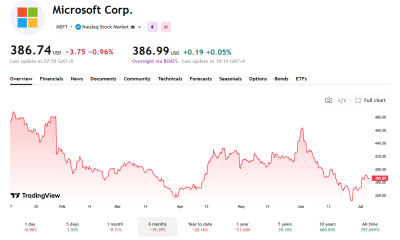
Microsoft Cuts 4,800 Jobs as Xbox Loses 3,200 Roles in Reset
-

 News Videos5 days ago
Crypto Just Entered Its Most Important 6-Month Candle (Could Decide Everything!)
-

 Tech6 days ago
Keychron is stepping outside keyboards with a $349 Thunderbolt 5 dock aimed at power users
-
 Business6 days ago
ASX 200 Slides Over 0.6% as Rare Earths and Lithium Stocks Tumble Amid Global Semiconductor Sell-Off Today
-

 News Videos7 days ago
Why Bitcoin Could Enter Another Parabolic Cycle!
You must be logged in to post a comment Login