

Crypto World
Spark Moves $150M in Stablecoins to Uniswap to Boost Shared Liquidity

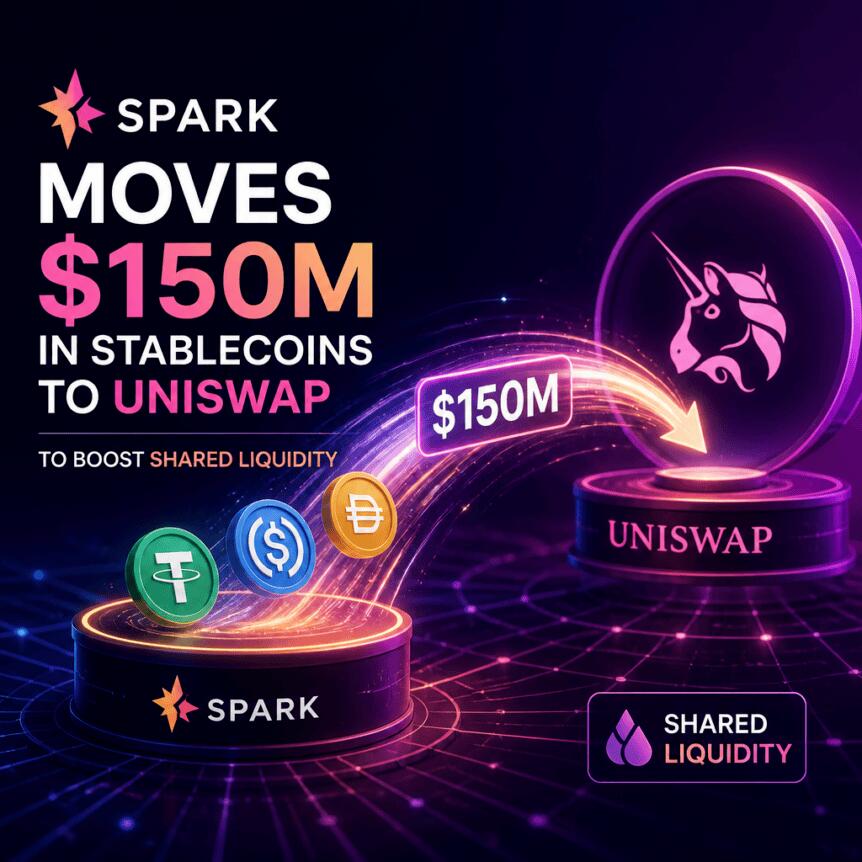
DeFi infrastructure provider Spark has initiated a major stablecoin liquidity deployment on Ethereum, moving roughly $150 million into two Uniswap v4 pools as part of a broader effort to standardize how stablecoin issuers access shared market-making liquidity.
According to a Spark spokesperson speaking to Cointelegraph, the initial liquidity is live in two pools pairing Spark’s USDS with PayPal USD (PYUSD) and USDT, with USDS positioned as the foundation. Spark frames the rollout as one of the largest AMM liquidity migrations in DeFi and describes it as the first phase of what it calls the “Stablecoin FX Layer,” aimed at bootstrapping shared liquidity on Uniswap v4.
Key takeaways
- Spark has deployed about $150 million in stablecoin liquidity across two Uniswap v4 pools on Ethereum, initially using USDS as the anchor asset.
- The rollout is intended to establish shared liquidity for stablecoin markets, reducing the need for each issuer to individually bootstrap separate liquidity networks.
- Spark plans to expand into a more programmable liquidity system later, using Uniswap v4 hooks after additional security review and testing.
- The project also functions as a real-world test of the broader thesis that decentralized venues can capture growing activity tied to tokenized finance.
From isolated pools to shared stablecoin liquidity
The core objective behind Spark’s deployment is coordination: rather than requiring every stablecoin issuer to assemble liquidity and trading inventory across multiple venues, Spark says it is building toward a shared liquidity framework. In the first phase, that approach is implemented through standard Uniswap v4 pools—avoiding the complexity of Spark’s planned programmable layer until later.
Spark’s spokesperson told Cointelegraph that the current deployment specifically focuses on “bootstrapping shared liquidity on Uniswap v4.” In other words, the near-term milestone is less about advanced routing or automation and more about proving that large-scale stablecoin liquidity can migrate into a common structure on Uniswap v4.
For market participants, the difference matters. Liquidity bootstrapping is often a slow and capital-intensive process, particularly when issuers need to align with market makers and manage balances across venues. A shared approach—if it reduces operational burden without sacrificing liquidity quality—could make onboarding new stablecoins faster and improve consistency across trading pairs.
Programmable liquidity and the planned DualPool hook
Spark said its longer-term plan involves introducing a Shared Liquidity Layer and a DualPool hook in subsequent phases, leveraging Uniswap v4’s programmable architecture. Uniswap v4 hooks are designed to allow integrations that can extend how liquidity and strategies are managed within the protocol’s framework.
In Spark’s description, a liquidity hook would enable idle or not immediately required capital to be deployed into governance-approved products, liquidity venues, or yield-generating strategies. That concept—turning capital from a static balance sheet into a programmable set of behaviors—is central to how DeFi seeks to compete with traditional finance infrastructure efficiencies.
Spark also noted that the DualPool hook will undergo a separate security review, along with additional testing and production-readiness steps before it is deployed. The distinction is important for users and developers: building on hooks can introduce new failure modes, and Spark’s statement implies that the initial pools are a “safe start,” with more experimental programmability coming only after a formal review process.
While Spark is working with additional partners across the stablecoin ecosystem, the spokesperson did not provide details on those integrations at this stage.
Why this fits the tokenization narrative
Even though Spark’s rollout focuses on stablecoins rather than tokenized securities, it aligns with a wider market narrative: as tokenization expands, trading venues that can efficiently provide liquidity for new onchain assets may see outsized benefits.
Earlier in the month, Standard Chartered pointed to Uniswap as a potential beneficiary of tokenized assets moving into DeFi. In its outlook, the bank forecast that total assets held in DeFi could reach $2.7 trillion by 2030, with Uniswap potentially positioned as a liquidity venue as tokenized markets grow.
Cointelegraph reports that the Spark deployment offers a more immediate test of that general infrastructure thesis, albeit in a stablecoin context. Stablecoins are not tokenized securities, but they are the rails many onchain financial products depend on—particularly when trading activity, hedging, and market-making require deep, reliable liquidity.
The timing also follows steps toward institutional tokenized-asset trading on Uniswap. On Feb. 12, BlackRock said it would bring its $2.1 billion tokenized Treasury fund, BUIDL, to Uniswap, enabling eligible institutional investors and market makers to trade the security through decentralized infrastructure.
Together, these developments highlight a pattern: as more real-world finance primitives move onchain, decentralized venues increasingly need to prove they can deliver not just execution, but also scalable liquidity and operational efficiency.
What to watch next
Investors and builders should watch whether Spark’s shared-liquidity approach can scale beyond two initial stablecoin pairs and whether the planned DualPool hook clears its security review without disrupting liquidity depth. The next phase—moving from standard pools into Spark’s programmable layer—will likely be the clearer signal of whether this “shared liquidity” thesis can deliver measurable efficiency gains across stablecoin markets.

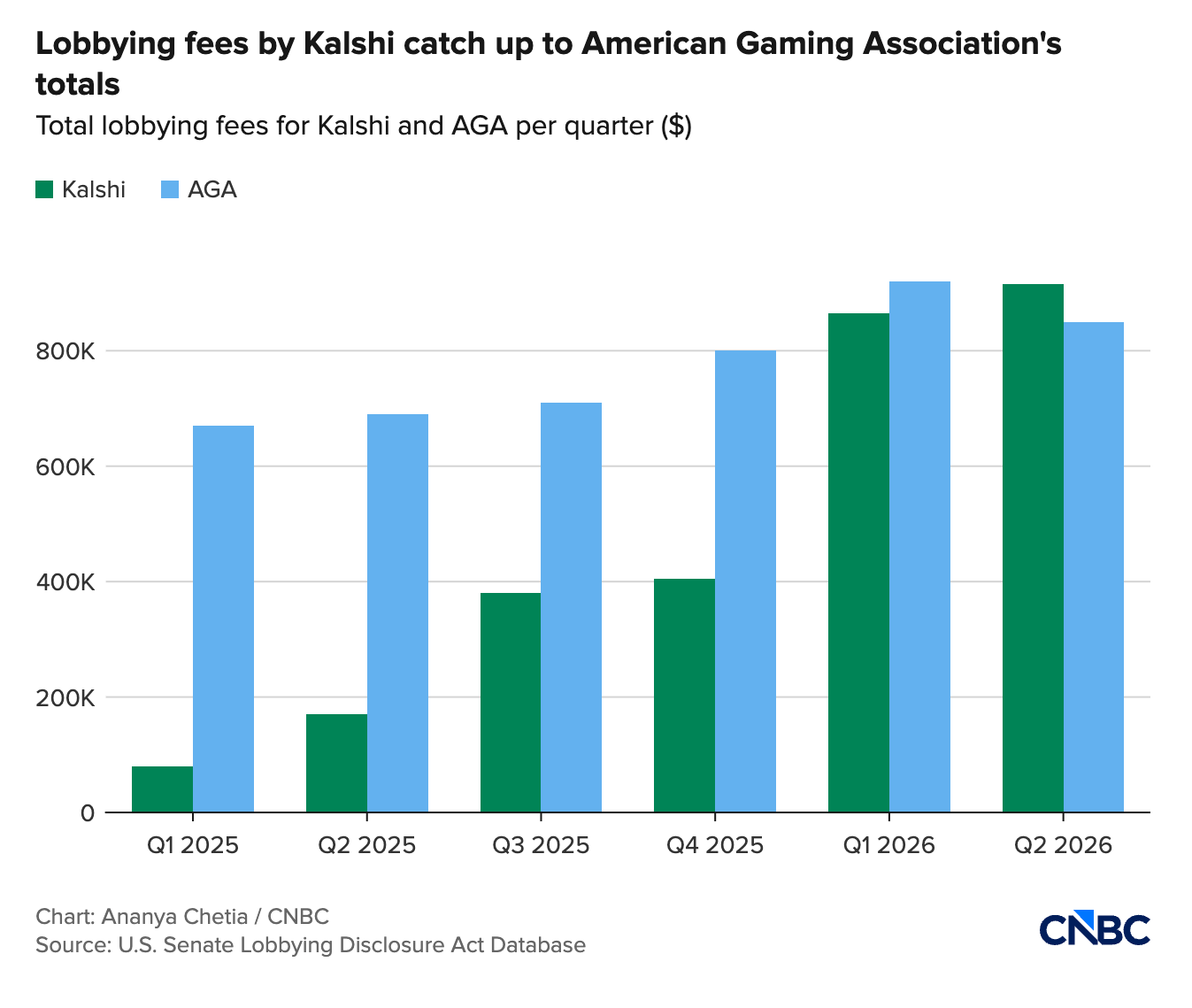
Kalshi spent $990,000 on federal lobbying in the first half of 2026, nearly matching its total for all of last year, as it races to counter the casino industry on Capitol Hill.
The prediction market operator and its gambling-sector rivals are both sharply raising spending. Kalshi’s direct lobbying alone nearly matches the American Gaming Association’s, signaling how hard each side is working to win over lawmakers.
The Prediction Market vs Gambling Lobbying Fight
Kalshi’s $990,000 closes in on the $1 million it spent across all of 2025. Including outside firms, its total nears $1.8 million, a record six-month figure disclosed in federal filings this week.
The company deploys seven lobbying firms, including its in-house team. It has hired former Biden and Obama administration officials to widen its reach. Kalshi also counts Donald Trump Jr. as a paid advisor.
Polymarket keeps a lighter presence. A single firm spent $180,000 on its behalf, pacing toward the $360,000 spent last year.

The gambling side is spending more, too. The American Gaming Association has committed $1.39 million in 2026, up 30% from the same period last year. The Cherokee Nation, which holds gaming interests, has spent $600,000.
Patrick McHenry, a former Republican congressman who now advises the Coalition for Prediction Markets, said the casino lobby has a structural head start.
“So much of the existing infrastructure of engagement on the Hill and at the states has been by the casino industry. The prediction markets are a new entrant into the policy debate in Washington, and are making great strides at communicating with lawmakers,” he said.
Follow us on X to get the latest news as it happens
Why the Two Sides Are Clashing
At the center of the tension is the rise of prediction markets and their growing pull on retail users. As these venues gain popularity, they are drawing bettors away from traditional sportsbooks.
That shift explains the gambling sector’s resistance. Operators view sports-event contracts as direct competition that bypasses state and tribal gaming rules.
The tension escalated in June, when the gambling industry pressed the Senate to ban sports contracts in the crypto market structure bill.
Prediction markets have also faced concerns about insider trading. Recent incidents highlight the scale of the problem.
That activity has renewed scrutiny from lawmakers, many of whom have introduced bills to curb the practice. The platforms themselves have moved to counter the growing concern.
Subscribe to our YouTube channel to watch leaders and journalists provide expert insights
The post Prediction Markets and Casinos Are Both Betting Big on Washington appeared first on BeInCrypto.


Coinbase Chief Executive Brian Armstrong said Base's yearlong push into creator "content coins" failed, telling a critic on X Monday that the Coinbase-incubated network "pivoted early this year" away from the strategy. "They didn't work and we pivoted early this year. We messed up, time to turn the… Read the full story at The Defiant
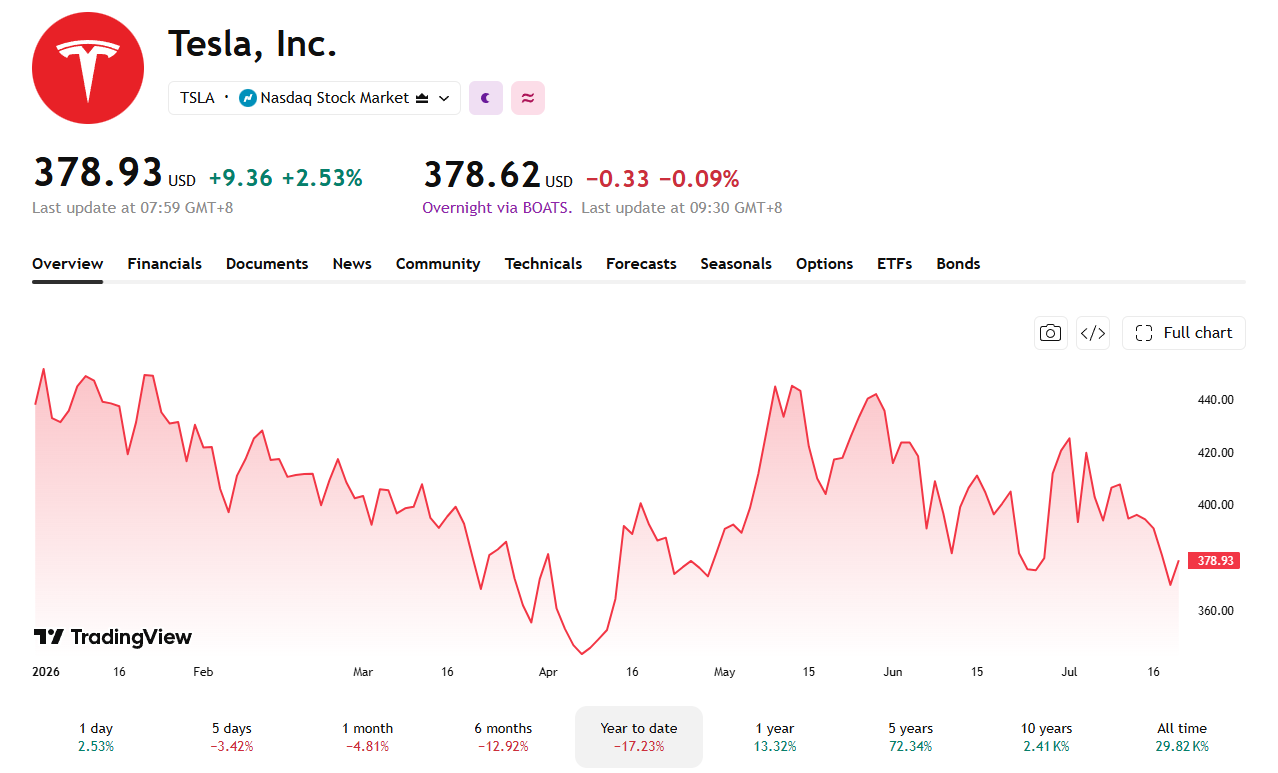
Tesla (TSLA) reports second-quarter earnings today after US markets close. Investors already know how many cars it sold, so the real test is profit.
Wall Street expects a sharp jump in earnings per share from last quarter. Most of Tesla’s good news already came out weeks ago, though.
What Wall Street Expects
Analyst estimates cluster between $0.50 and $0.55 per share. That marks a solid jump from the $0.41 Tesla earned in the first quarter.
Revenue forecasts range from about $25.7 billion to $27.6 billion. That is up from $22.39 billion in the prior quarter.

Tesla’s earnings record has been uneven, though, it has missed some estimates in six of its last 10 quarters, according to Zacks Investment Research. Still, it beat those estimates by double digits over the last two quarters, with an average surprise of 5.48% over the last four.
Why the Delivery Numbers Won’t Move Much
Tesla already told investors it delivered 480,126 vehicles in the second quarter. That is a 25% jump from a year earlier and well above the roughly 406,000 vehicles analysts expected.
Energy storage deployments rose more than 40% from last year too. Because these figures came out weeks ago, much of that good news likely already sits in Tesla’s share price.
What Could Actually Swing the Stock
The number investors will watch closest is Tesla’s automotive profit margin, excluding regulatory credits. Tesla earns these credits by beating emissions rules, then sells them to automakers that fall short.
Estimates point to a possible dip to around 18.1%, down from 19.2% in the first quarter. Discounts and cheap financing offers could explain the drop.
Investors will also listen for updates on three things: Tesla’s Cybercab robotaxi rollout, its Full Self-Driving software, and AI infrastructure spending. Analysts frame the stakes directly.
Tesla’s stronger automotive performance should improve near-term earnings and help finance its artificial intelligence investments, but Robotaxi, Full Self-Driving and Optimus remain the main drivers of the stock’s valuation, this according to analysts at Morgan Stanley and Barclays.
Tesla’s first-quarter earnings beat came alongside a $2 billion investment in Elon Musk’s SpaceX, a company that has seen a sharp share price slide of its own this year. The report also lands in the middle of a broader corporate earnings season, following strong results from major banks earlier this month.
The Bottom Line
Options markets are pricing a swing of roughly 6% to 8% in either direction once Tesla reports. A margin beat paired with a firm robotaxi timeline could support the stock. A vague update on autonomy, even with strong headline numbers, may not be enough to change the story.
The post Tesla Earnings Today: What to Expect as Investors Eye Profit Margins Over Deliveries appeared first on BeInCrypto.
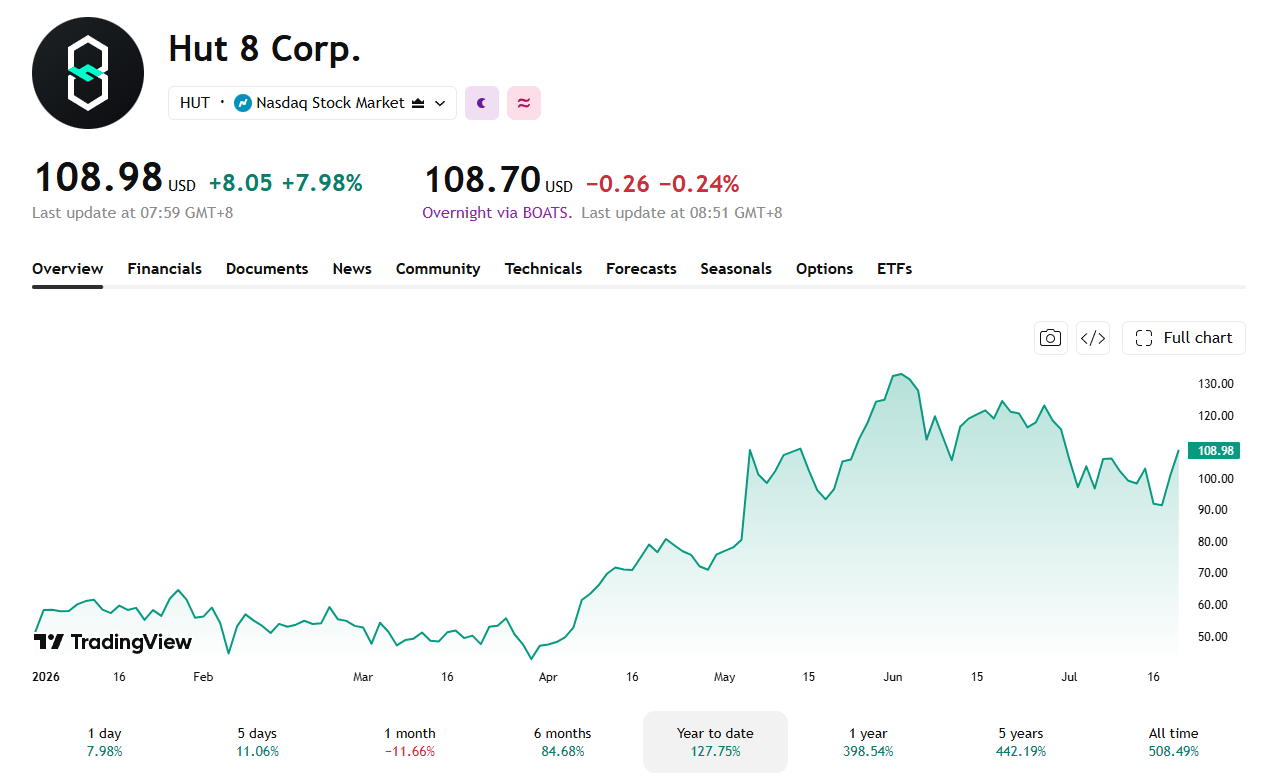
Hut 8 Corp. (HUT) shares have swung between $44 and $133 in 2026, a peak-to-trough gain of about 200%, according to TradingView data.
The stock now trades near $108, up about 128% for the year, after Hut 8 signed a $9.8 billion, 15-year lease with an unnamed technology hyperscaler.
The AI Pivot
Speaking to CNBC, CEO Asher Genoot said the was proof that Hut 8’s pivot from Bitcoin mining to artificial intelligence (AI) infrastructure is paying off for shareholders.
The new lease adds 704 megawatts of capacity to Beacon Point, Hut 8’s AI data center campus in Texas, and carries an implied $653 million in annual revenue. Genoot said Hut 8 had zero contracted AI revenue about a year ago.
He now counts roughly $27 billion in contracted AI revenue and about $1.75 billion in annualized earnings before interest, taxes, depreciation, and amortization (EBITDA).
What Happened to the Bitcoin Mining Business
Hut 8 was firstly known as a Bitcoin mining business, but the company technically no longer runs Bitcoin mining directly. In March 2025, it moved the business into American Bitcoin Corp. (ABTC), a separately traded subsidiary that Hut 8 majority owns and that Eric Trump and Donald Trump Jr. partly back.

Unlike Hut 8’s own AI pivot, ABTC has doubled down on mining, expanding its fleet capacity and its Bitcoin (BTC) reserve through 2026.
That bet has not paid off for ABTC’s backers. Its shares have fallen more than 76% in 2026, a drop that wiped out over $600 million from Eric Trump’s stake, echoing the pattern in American Bitcoin’s stock crash.

The AI Story, and the Pushback
Despite the successful pivot, Hut 8 has been under the microscope for its contribution to electricity prices. Genoot rejected a New York Times report that blamed data centers for $6.3 billion in added electricity bills across PJM Interconnection, the grid operator covering 13 states and Washington, D.C.
The report tied the increase to a capacity auction PJM held on June 30. “It’s not true,” Genoot said on air. He argued that most data center developers, including Hut 8, cover their own transmission upgrades and energy costs instead of passing them to ratepayers.
Independent analysts complicate that upbeat picture. A Seeking Alpha review of Hut 8’s first-quarter 2026 results found a $253 million net loss and negative margins in its digital infrastructure segment. The same analysis does not expect material AI revenue until the second quarter of 2027.
Hut 8’s stock chart and ABTC’s chart tell two very different stories right now. Whether Hut 8’s $27 billion in contracted AI revenue turns into real cash before ABTC’s mining bet recovers could decide which story wins out.
The post Hut 8 Stock Surges Up to 200% in 2026 as Bitcoin Mining Unit Struggles appeared first on BeInCrypto.


Blockchain security firms linked the collapse to a suspected attack on 42DAO, the decentralized organization that governs the Balance Protocol ecosystem.


The war against Iran has run up a heavy bill for the United States, now pegged at $37.5 billion.
The estimate, delivered by Defense Secretary Pete Hegseth, arrives as US strikes on Iran continue for an 11th straight night.
US Defence Secretary Puts Iran War Cost at $37.5 Billion
Hegseth presented the figure to the Senate Appropriations Committee on Tuesday. He said the $37.5 billion covered certain aspects of the war plus anticipated costs through September 30.
Cost estimates have risen sharply since the conflict. Reuters reported in March that the administration valued the first six days of fighting at a minimum of $11.3 billion.
The latest $37.5 billion figure sits roughly $12 billion above the $25 billion estimate Hegseth gave in late April. He offered that number just before Trump brokered a temporary ceasefire with Iran.
The administration is also pressing for more money. In late June, it asked Congress for $87.6 billion in extra funding.
The New York Times reported that as much as $70 billion of that would go to emergency military spending. The funds would cover war costs and pay for new weapons and personnel.
The Pentagon wants $46 billion to expand munitions production. That includes precision bombs, hypersonic missiles, and counter-drone systems.
“This is a new request based on new realities of a world we face, stepping up to meet that moment,” Hegseth stated.
Ordinary Americans are absorbing costs too. Brown University’s Watson Institute estimates that higher gasoline and diesel prices have added $71.8 billion in consumer spending since the war began. That works out to about $548 per US household.
Follow us on X to get the latest news as it happens
US-Iran Ceasefire Proposal Lands as Strikes Hit 11th Night
Diplomacy has run in parallel with the fighting. A senior Iranian official told Reuters on Monday that mediators had handed Tehran a de-escalation proposal.
The plan floats a 10-day ceasefire. The pause would create room to revive an interim deal struck last month.
Those talks have not slowed the strikes. CENTCOM said it finished its 11th consecutive night of operations against Iran on Tuesday evening.
According to CENTCOM, the strikes hit military command centers, aircraft hangars, drone storage sites, and naval assets. The stated goal is to blunt threats to shipping in the Strait of Hormuz.
Subscribe to our YouTube channel to watch leaders and journalists provide expert insights
The post How Much Has the Iran War Cost the US? Defence Secretary Puts a Number on It appeared first on BeInCrypto.


Aztec has launched the alpha version of its v5 execution layer, introducing a programmable privacy framework that allows Ethereum applications to process both public and private state within the same layer-2 environment.
Summary
- Aztec has released the alpha version of its v5 execution layer, bringing programmable privacy to Ethereum through zero knowledge powered smart contracts.
- The new architecture processes private computations on user devices while verifying transactions on chain without exposing sensitive data.
- Aztec said the execution layer supports confidential decentralized applications with features designed to reduce front running and MEV risks.
Aztec Labs announced the alpha release of its v5 execution layer, describing it as a step toward making privacy-native smart contracts practical on Ethereum.
The new architecture allows developers to build decentralized applications that combine confidential user data with public blockchain state while relying on zero-knowledge proofs to verify transactions without exposing sensitive information.
Unlike Ethereum’s base layer, where every validator processes and stores transaction inputs, outputs, and execution data to reach consensus, Aztec’s execution layer moves private computation to the user’s device. Instead of revealing transaction details to the network, the system generates cryptographic proofs locally before submitting them for verification on-chain, reducing the amount of visible transaction data while preserving Ethereum’s security guarantees.
Client-side execution changes how private transactions are processed
At the center of the release is a client-side zero-knowledge execution engine integrated with Noir, Aztec’s domain-specific programming language for private smart contracts. Rather than executing confidential transactions across every network node like the Ethereum Virtual Machine, the system performs private computations on user hardware before generating recursive Succinct Non-Interactive Arguments of Knowledge, or SNARKs.
Those proofs allow the network to verify that state changes are valid without exposing plaintext inputs, transaction values, or account identities. According to Aztec Labs, the model cuts unnecessary data disclosure while maintaining mathematical guarantees that transactions have been executed correctly.
The architecture also introduces a hybrid state model designed to overcome one of the biggest engineering challenges facing privacy-focused blockchains. Purely private execution environments often struggle when multiple users attempt to update the same public state at the same time, creating state contention that limits interaction with shared decentralized finance infrastructure.
To address that limitation, Aztec separates private and public state management. Private assets are stored in UTXO-like note trees, while public data is maintained through key-value trees. During execution, private functions can generate deferred public function calls that are processed later within the same transaction lifecycle, allowing confidential and public operations to work together without sacrificing deterministic execution or creating race conditions.
The execution model is intended to support applications that require confidential computation while still interacting with Ethereum’s public ecosystem, including shared liquidity pools and other decentralized finance protocols.
Privacy model targets decentralized finance and enterprise applications
Beyond transaction privacy, the execution layer introduces features that could reduce several long-standing issues in blockchain execution.
According to Aztec Labs, transaction details remain hidden before state commitment, making it significantly harder for external observers to reorder pending transactions or exploit visible transaction data through Maximal Extractable Value strategies.
The architecture also provides building blocks for applications such as confidential order matching, private liquidity provisioning, and selective compliance systems that disclose only required information through viewing keys instead of exposing complete user records.
Those capabilities build on Aztec’s long-standing focus on programmable privacy rather than simple anonymous token transfers.
Speaking to crypto.news in April 2025, Aztec Labs co-founder and CEO Zac Williamson said blockchain privacy should go beyond hiding wallet addresses.
He described user privacy, confidential transaction data, and private smart contract execution as the three pillars needed for practical on-chain privacy, calling them “the holy grail of blockchain privacy.”
Williamson also argued that privacy should not be treated as a separate segment of the industry, saying, “all crypto will be private” as programmable privacy becomes part of mainstream blockchain applications.
Discussing compliance, Williamson said privacy preserving systems should rely on selective disclosure instead of complete anonymity. He pointed to ZKPassport as an example, explaining that users can tap an NFC enabled passport to generate a zero knowledge proof and choose “what information you want to disclose,” whether it is nationality, age, or other identity attributes.
He said the technology is “permissionless, it’s privacy preserving, and it ensures strong compliance,” adding that such systems are “a lot more powerful” than existing privacy solutions because they combine privacy with programmable compliance.
That vision expanded further in May 2026 when Aztec Labs acquired ZKPassport while committing to keep the passport verification platform open source. The acquisition brought the privacy-focused identity infrastructure directly into Aztec’s ecosystem, allowing developers to combine programmable privacy with zero-knowledge identity verification across Ethereum-compatible networks.
The technology had already been tested on Aztec’s network to help reduce Sybil attacks by allowing participants to prove they were unique individuals without revealing their identities. It was also used during the AZTEC token sale to perform sanctions screening while keeping participant information private.
Alpha release follows security incidents involving legacy products
The execution layer arrives shortly after Aztec Labs dealt with security issues involving products that had already been retired.
Earlier this month, Aztec Labs disclosed that it was investigating a potential exploit involving a deprecated payments product launched in 2021 after roughly $2 million was transferred from an immutable smart contract. The company said the affected system had been discontinued in 2022 and operated without administrator keys, preventing the team from pausing or upgrading the contract.
Separately, another deprecated product, Aztec Connect, lost approximately $2.1 million after attackers exploited an old immutable RollupProcessorV3 contract. Aztec Labs said the incidents were unrelated to the active Aztec network.
The Aztec Foundation also stated that neither exploit had any connection to the current network or the AZTEC ERC-20 token, emphasizing that the affected contracts belonged to legacy infrastructure that had remained live on Ethereum after the products were sunset.

Balaji Srinivasan’s Network School is looking to expand into Kazakhstan after regulators moved against its Malaysia operations, according to a memorandum of understanding announced by Kazakhstan’s Ministry of Digital Development, Innovation and Aerospace Industry. The deal, signed with minister Zhaslan Madiyev, aims to establish what the ministry describes as the first Network School campus in the country.
The Kazakhstan announcement comes as Network School’s Forest City-area presence faces escalating regulatory pressure. Malaysia’s local authorities revoked the business license of the operator, NSO Malaysia Sdn Bhd, prompting the Malaysia Digital Economy Corporation (MDEC) to begin steps to remove the company’s Malaysia Digital status. The situation raises the question of how easily Network School can restart and maintain immigration- and incentives-related arrangements across borders.
Key takeaways
- Kazakhstan’s ministry says it has signed an MoU with Balaji Srinivasan to create the first Network School campus in the country.
- Malaysia’s Iskandar Puteri City Council revoked NSO Malaysia Sdn Bhd’s business license over alleged licensing and premises-use breaches.
- MDEC says it is taking immediate steps to revoke NSO Malaysia’s Malaysia Digital status, which comes with benefits such as tax incentives and employment flexibility.
- Local officials in Johor have urged federal authorities to keep investigating whether Network School violated immigration laws.
- Srinivasan has framed the developments as consistent with the “network state” concept, while also saying Malaysia issues are being addressed through a remedial process.
Kazakhstan MoU opens a new front for Network School
In a statement from Kazakhstan’s Ministry of Digital Development, Innovation and Aerospace Industry, the government said an MoU was signed with Zhaslan Madiyev and Network School founder Balaji Srinivasan to establish a campus in Kazakhstan. While the document signals a strategic expansion, details of implementation—such as timeline, campus location, and regulatory steps—were not included in the provided reporting.
Network School’s Kazakhstan pivot matters for prospective residents and investors because campus operations are closely tied to host-country regulatory conditions, especially around visas, employment rules, and corporate status benefits. Srinivasan has previously described Network School as a community built around attracting globally distributed talent and capital, and the Kazakhstan proposal positions the group to potentially preserve momentum rather than waiting for a resolution in Malaysia.
Kazakhstan has also been positioning itself as a technology hub, including plans connected to a “crypto city” in Alatau, as referenced in the source material. Against that backdrop, Network School’s presence could be marketed as part of a broader attempt to draw innovation-driven communities and companies to the region.
Malaysia: revoked license and a threat to Malaysia Digital status
Malaysia’s regulatory actions began after the Iskandar Puteri City Council (MBIP) revoked the business license of NSO Malaysia Sdn Bhd, the entity operating the Network School’s Johor-area campus. MBIP cited alleged breaches of licensing conditions and requirements related to how premises were used, according to a report linked in the source material from mediadigitaljohor.gov.my.
Following the license revocation, MDEC announced it was taking immediate steps to revoke NSO Malaysia’s Malaysia Digital status. The Malaysia Digital program recognizes qualified technology and digital companies and is described in the source material as offering incentives such as tax advantages, ownership flexibility, and permission to employ both local and foreign workers—benefits that can be critical for international communities that rely on a steady inflow of talent.
MDEC’s stated rationale is that Malaysia Digital status requires companies to comply with local and federal laws. Removing that status could complicate Network School’s ability to operate smoothly if the campus depends on the program’s employment and incentives framework.
Johor officials push for immigration-law scrutiny
The stakes extend beyond corporate licensing. The source material says Johor Chief Minister Onn Hafiz Ghazi urged Malaysia’s federal authorities to continue investigating whether Network School violated immigration laws. He characterized Johor as a “strategic entry point” because the state borders Singapore and therefore argued that any weaknesses or abuse of the immigration system should be addressed promptly and firmly.
That emphasis highlights a common tension for border-adjacent technology hubs: even when a concept has strong global appeal, enforcement actions tied to immigration compliance can quickly affect day-to-day operations, staffing, and residency arrangements for community members.
Earlier coverage referenced in the source material indicates that scrutiny has been ongoing, including questions about how the campus fits within existing legal frameworks. The current license revocation and the potential loss of Malaysia Digital status suggest authorities are not treating the matter as purely procedural.
Srinivasan denies shutdown claims and points to remediation
As the regulatory situation unfolded, Srinivasan denied reports that Network School was shutting down. According to the linked social media statement in the source material, he said Network School had received two notices: one reportedly requiring “change the text of a sign,” and another related to a coworking setup formed by combining two adjacent units, where one side had a valid license but the other did not.
Srinivasan said the issues fell within a remedial period and that the organization would remediate them, adding that its members were otherwise unaffected. Cointelegraph also notes that it reached out to Srinivasan and Network School for comment, but the provided text does not include any additional responses beyond the denial and remediation framing.
Interpreting these statements alongside the MBIP and MDEC actions reveals an important asymmetry: public guidance from local authorities and program administrators may move faster than a company’s internal remediation plan. In practical terms, even if a remedial path exists on paper, the uncertainty can still disrupt hiring, occupancy, and community planning—especially for international residents who rely on predictable compliance timelines.
Meanwhile, Dragonfly Capital managing partner Haseeb Qureshi, quoted in the source material, linked the “Malaysia drama” to the broader “network state” argument. He suggested that the outcome could be used to negotiate new arrangements with other jurisdictions—an interpretation Srinivasan appears to be leaning into as the Kazakhstan MoU emerges.
What to watch next for Network School
Readers should focus on two tracks as the story develops: whether MDEC’s Malaysia Digital revocation proceeds and how quickly Malaysia’s immigration inquiries translate into enforceable outcomes, and—on the other side—how Kazakhstan operationalizes the MoU into concrete regulatory approvals for a Network School campus. Until those details are clear, Network School’s ability to retain its community and recruitment momentum will likely depend on jurisdiction-by-jurisdiction compliance rather than a single global brand narrative.


The Digital Chamber sued the Illinois Department of Revenue on Tuesday, asking a Sangamon County court to strike down the state’s new Digital Asset Tax Act before it takes effect.
The trade group represents more than 250 blockchain firms. It argues the 0.2% levy unfairly singles out digital assets based on the technology used to record ownership.
Inside Illinois’ Digital Asset Tax Act
Illinois enacted the Digital Asset Tax Act as Article 3 of Public Act 104-0468. The measure sets a 0.2% tax on the exchange, transfer, or storage of a customer’s digital asset.
Brokers must also register with the Department of Revenue. Violating the Illinois statute exposes them to Class 3 felony charges. The tax takes effect January 1, 2027.
Governor JB Pritzker signed Senate Bill 3019 into law in June. It drew heavy backlash from the crypto industry at the time, and the courts are now involved.
Follow us on X to get the latest news as it happens
Illinois Crypto Tax Faces Legal Challenge Months Before Launch
The Digital Chamber’s lawsuit raises six claims under state and federal law. It argues that the tax treats identical property differently based only on how ownership is recorded.
“Put simply, this tax discriminates against people who transact in digital assets,” the group said.
A tokenized Treasury and a book-entry Treasury carry the same rights, the suit says. However, only the blockchain version is subject to tax. The filing compares the setup to taxing one email system but not another.
The group also warns that the definition could stretch far beyond crypto. It says future state taxes could reach AI-enabled settlement systems and cloud-based payment networks.
“Taxes should be carefully considered, not only for the revenue they produce but for the fairness of those being taxed. That was not the case here, as the provision slipped into legislation the night before the bill’s final consideration,” CEO Cody Carbone said.
The suit asks the court to declare the Act void and block enforcement. A repeal bill, House Bill 5798, remains pending in the legislature.
Subscribe to our YouTube channel to watch leaders and journalists provide expert insights
The post Digital Chamber Sues Illinois Over 0.2% Crypto Tax Law appeared first on BeInCrypto.


Uniswap said its Continuous Clearing Auctions, known as CCA, and Uniswap Auctions tool are now live on Robinhood Chain, letting teams run fully onchain token sales on the network. The official Uniswap account said the launch lets teams "run fully onchain token auctions," "discover a credible market… Read the full story at The Defiant

10 best whiskies for 2026, handpicked by an expert

Consumers developing their own definition of ultra processed

Prediction Markets and Casinos Are Both Betting Big on Washington


-
 NewsBeat6 days ago
London Mayor Sadiq Khan handed a peerage by Keir Starmer alongside 15 other Labour figures… just days before the PM leaves No10
-

 Fashion4 days ago
Weekend Open Thread – Corporette.com
-

 Politics4 days ago
The House | The City of London can help the new chancellor deliver growth in every postcode
-

 Politics7 days ago
Young campaigners urge incoming PM to act on outdoor junk food ads
-
 Crypto World5 days ago
Two July Windows Left: The CLARITY Act’s Senate Fight and What Failure Means
-

 Crypto World6 days ago
CFTC blocks Kalshi from unwinding Michigan trades after court order
-

 Crypto World4 days ago
Ripple Payments Joins MiCA With 14 Firms, Does It Mean Anything For XRP?
-

 Business6 days ago
Nvidia Stock Slips After Big Tuesday Rally as Huang Confirms Vera Rubin Chip Is Now in Production Today
-

 Politics3 days ago
Democrats look to World Cup watch parties to register thousands of voters
-
 Entertainment6 days ago
Disney’s Most Ambitious Failed Star Wars Attraction Is Coming to SDCC
-

 Crypto World4 days ago
Ripple wins EU-wide access as ESMA adds it to MiCA register
-

 Crypto World20 hours ago
Grayscale Files For Worldcoin ETF, WLD Registers Sharp Rise
-

 Crypto World5 days ago
Injective Submits SEC Transfer-Agent Registration to Onchain Ownership Records
-

 Business6 days ago
Palantir Shares Rise After Expanded Nvidia Partnership and Fresh Analyst Upgrades Ahead of Earnings Day
-

 Tech1 day ago
Sail Virtually Aboard The “Itanic” With IA-64 Emulator
-
 Tech1 day ago
Turtle Beach Command Series KB7 review: a nifty screen-equipped gaming keyboard
-

 NewsBeat5 days ago
Registration is now open for March for Men with Kev 2026
-

 NewsBeat2 days ago
Unregistered fitter used Gas Safe logo on business flyers
-
 Sports6 days ago
New Cornerback Enters Vikings Trade Rumor Mill
-

 News Videos5 days ago
Money | Class 12 Economics | CBSE Board Exam 2026-27
You must be logged in to post a comment Login