Crypto World
Stablecoins Emerge as Financial Infrastructure, but Banks Remain Cautious: S&P Report

Stablecoins are rapidly evolving beyond their original role in crypto trading, emerging as a key layer of financial infrastructure, according to new research from S&P Global Market Intelligence.
The report highlights a growing shift toward institutional use cases, particularly in cross-border payments, treasury operations, and capital markets, while traditional banks continue to take a cautious, exploratory approach.
Stablecoins Move Beyond Trading
“Stablecoins are evolving beyond a crypto trading tool into a new layer of financial infrastructure,” said Jordan McKee, Director of Fintech Research at S&P Global Market Intelligence.
According to the report, the most meaningful adoption is happening behind the scenes, where stablecoins are improving settlement speed, capital efficiency, and liquidity movement rather than being widely used at the consumer level.
Market Growth Accelerates
The stablecoin market is expanding rapidly:
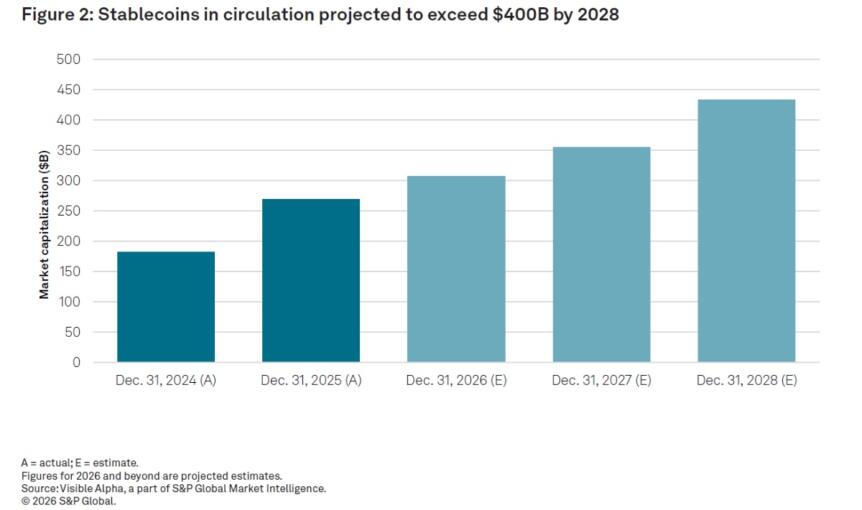
- Circulation reached approximately $269 billion in 2025
- Projected to grow to around $434 billion by 2028
- Mentions in earnings calls surged to 107 in 2025, up from just five in 2024

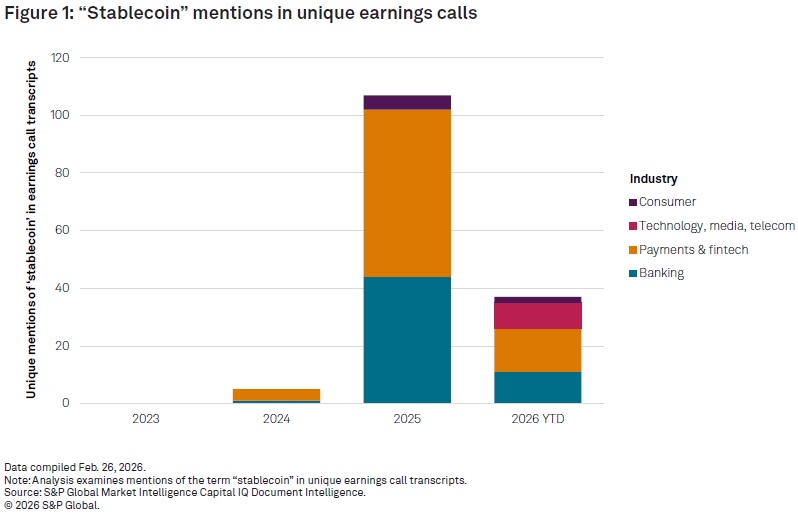
This sharp increase reflects rising interest from banks, fintech firms, and payment providers exploring the role of stablecoins in modern financial systems.

Institutional Use Cases Lead Adoption
Adoption remains concentrated in infrastructure-level applications, including:
- Cross-border payments
- Treasury and liquidity management
- Tokenized capital markets
In these areas, stablecoins are helping reduce settlement times and improve capital mobility across global markets.
Consumer Adoption Still Limited
Despite the growing institutional interest, consumer adoption remains low, especially in developed markets.
Only 12% of U.S. consumers report familiarity with stablecoins, with concerns around security, fraud, and lack of clear use cases acting as key barriers.
Banks Take a Wait-and-See Approach
The report also reveals a significant gap between infrastructure development and institutional readiness.
Among 100 primarily smaller U.S. financial institutions surveyed:
- Only 7% are developing internal stablecoin frameworks
- None are actively piloting stablecoin initiatives
This suggests that while the technology is advancing quickly, many banks are still evaluating how and when to engage.
Regulation and Competition to Shape the Future
Since the start of 2025, at least 19 applications for banking charters related to digital asset services have been submitted to the Office of the Comptroller of the Currency (OCC).
As the market matures, S&P Global Market Intelligence expects adoption to be driven less by consumer usage and more by:
- Institutional integration
- Regulatory frameworks
- Competition across issuance, liquidity, and distribution
The report concludes that stablecoins are entering a critical infrastructure buildout phase, which will likely define their role in the global financial system over the coming years.
You must be logged in to post a comment Login