

Crypto World
Standard Chartered and Circle Launch USDC Minting via Bank Rails

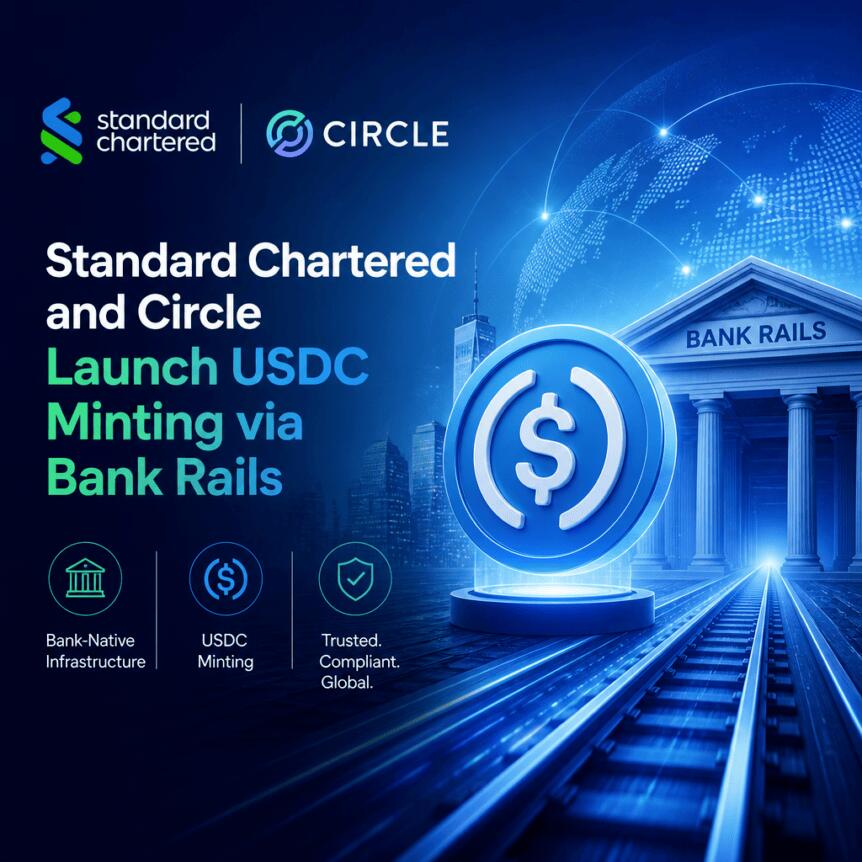
Standard Chartered and Circle have announced a new, bank-led workflow for institutional clients to mint and redeem USDC, positioning stablecoin access inside a traditional banking onboarding process. The system is designed to reduce the operational friction of dealing separately with a stablecoin issuer while aligning minting and redemption activities with the bank’s established risk, compliance, and governance controls.
In a press release, Standard Chartered said it will be the first Global Systemically Important Bank (G-SIB) to offer USDC minting and redemption through its own platform. Clients starting with the initial rollout will be able to mint and redeem the US dollar-backed stablecoin without opening additional accounts with Circle, with delivery beginning through the bank’s operations in the Dubai International Financial Centre (DIFC). The banks described the effort as an integrated offering that brings together banking, custody, and digital asset services under a single institutional relationship.
Key takeaways
- Standard Chartered and Circle are building a workflow that lets institutional clients mint and redeem USDC through a bank-led process.
- Standard Chartered says it is the first G-SIB to provide USDC minting and redemption services within its existing banking frameworks.
- The initial rollout is planned via Standard Chartered’s DIFC operations, with expansion to other jurisdictions depending on regulatory approval and client demand.
- The capability targets institutional needs such as on-chain settlement, treasury management, and liquidity management.
- The move reflects intensifying competition over stablecoin distribution, access, and governance as traditional banks deepen involvement in digital asset rails.
A bank channel for USDC minting and redemption
Standard Chartered said its collaboration with Circle embeds USDC access directly into the bank’s institutional offering. Instead of requiring clients to separately manage stablecoin issuance logistics with Circle, minting and redemption can be handled through the bank’s own platform. Standard Chartered framed this as a way to connect stablecoin operations to “banking, custody, and digital asset services” in one integrated setup.
For institutional users, the practical difference is that stablecoin issuance no longer has to be treated as an entirely separate operational track. Bank-led onboarding can also make it easier to map stablecoin activities to existing internal controls—particularly for firms that already depend on banks for custody, compliance, and settlement infrastructure.
Why DIFC first—and what comes next
According to the announcement, the service begins through the Dubai International Financial Centre, reflecting the role that regulated financial hubs often play in digital asset infrastructure rollouts. Standard Chartered also stated it intends to expand the capability to additional markets, but only “depending on regulatory approval and demand from clients.”
That conditional expansion matters for investors and institutional clients because the timeline for stablecoin access typically hinges less on technology than on licensing, regulatory interpretation, and operational approvals in each jurisdiction. Readers should expect further details as new markets are added and as banks refine which client segments and use cases can access the minting and redemption rails.
Institutional use cases now, payment rails later
Standard Chartered and Circle positioned the capability around current institutional workflows. The announcement says it supports on-chain settlement, treasury operations, and liquidity management. These are areas where firms often need predictable operational processes, clear governance boundaries, and connectivity to broader financial operations.
The collaboration also points beyond those immediate use cases. The banks described the system as providing infrastructure that could support payment-related use cases in the future—signaling a longer-term ambition to integrate stablecoin rails with payment and settlement workflows. While the announcement does not specify timelines or concrete payment deployments, the framing is consistent with how stablecoins are increasingly being assessed: not only as standalone tokens, but as components of regulated distribution and settlement stacks.
Stablecoin competition shifts toward distribution and governance
The Standard Chartered–Circle partnership arrives amid heightened attention on who controls stablecoin access and liquidity. Earlier coverage noted that Circle CEO Jeremy Allaire has publicly defended USDC’s network effects while responding to growing competition from new stablecoin entrants such as Open USD (OUSD). In that context, distribution channels and institutional partnerships can become decisive—even when multiple stablecoins are available—because liquidity and redemption pathways influence real-world usability.
Circle’s CEO previously said OUSD works closely with many of the founding members and expects those members to remain “large USDC partners and customers,” underscoring how relationships and access pathways are central to the stablecoin landscape. Standard Chartered’s announcement can be seen as an extension of that same logic: instead of focusing only on issuance, Circle and a major bank are working to embed USDC into an institutional distribution model that emphasizes governance and compliance.
More broadly, the integration trend suggests that traditional banks are not just observers of stablecoin growth. They are moving toward roles that resemble infrastructure providers—setting up onboarding, oversight, custody connections, and controlled minting/redemption access. For market participants, this can change how quickly stablecoin adoption spreads, because regulated, bank-mediated channels may lower barriers for large institutions that previously viewed direct stablecoin interaction as too operationally or compliance-heavy.
What to watch
As Standard Chartered rolls out USDC minting and redemption via DIFC, the key question will be how quickly the bank expands to other jurisdictions and which client segments gain access first. Observers should also watch whether similar integrations accelerate across other major banks, because the stablecoin race may increasingly be won—or slowed—by distribution, governance, and the ability to plug stablecoins into regulated settlement processes.


TLDR
- Netflix shares rose 3.95% on July 2, outperforming the Software & IT Services sector, which fell 1.01%.
- Market sentiment improved after concerns eased around possible Warner Bros Discovery and NBCUniversal acquisition activity.
- NFLX stock gained support from a lower valuation, which attracted buyers after recent selling pressure.
- Netflix’s advertising tier remained a major growth driver, supported by its Omnicom partnership and wider distribution reach.
- The $400 million Radford Studio Center acquisition signaled Netflix’s continued focus on production efficiency and cost control.
Netflix (NFLX) stock rose 3.95% on July 2, while Software & IT Services fell 1.01%, showing clear market outperformance. The move came with strong turnover, intraday swings, and confidence after weak sessions. NFLX stock also beat major sector peers.
Microsoft rose 1.24%, Meta fell 4.09%, and Palantir gained 2.72% among the sector’s busiest names. However, Netflix drew stronger attention because buyers entered after recent selling pressure. The price action showed renewed demand near depressed valuation levels.
NFLX stock benefited as traders shifted focus back to Netflix’s core business and away from deal speculation. The company faced concerns over large media deals that could raise leverage. Yet management avoided costly merger risks and preserved capital discipline during a volatile backdrop.
Deal Concerns Ease Around Netflix
Market sentiment improved after Netflix moved away from major acquisition speculation. Reports had linked the company with Warner Bros Discovery, but concerns eased after the overhang faded. Management also saw NBCUniversal rumors denied, which reduced deal pressure and stabilized expectations.
The market viewed that restraint as positive for NFLX stock because it reduced concern over large commitments. Large media mergers often create debt concerns, integration risks, and uncertainty over earnings. Therefore, Netflix’s decision helped restore attention to subscriber growth, advertising revenue, and content returns.
NFLX stock gained momentum as deal risks faded and organic growth returned to focus. Netflix did not issue a fresh statement on the move, and the stock traded on market interpretation. Still, the reduced deal noise supported a cleaner investment case for NFLX stock and strengthened the recovery.
Valuation and Ads Support Momentum
NFLX stock also attracted demand after trading near its 52-week low and a cheaper forward earnings multiple. The lower valuation encouraged dip buying from funds and active traders before the next earnings update. Technical signals also improved after earlier oversold readings, which helped short-term momentum.
The advertising business added another growth driver for NFLX stock as Netflix expands beyond standard subscription revenue. Its Omnicom partnership strengthens ad targeting, campaign tools, and monetization across the ad-supported base. The company also expands access through Spectrum’s app store distribution deal, which may support wider reach.
NFLX stock gained further support from cost controls and studio investments. Netflix bought Radford Studio Center for $400 million to improve production efficiency and manage content costs. Together, ads, valuation, and spending discipline drove the 3.95% move in NFLX stock.


Ondo Finance says it is moving beyond simple “tokenized ownership” by adding shareholder-style governance tools to its onchain securities. Through a partnership with financial infrastructure provider Broadridge, holders of certain Ondo-issued tokenized stocks and ETFs will be able to participate in proxy voting and receive corporate communications through a Web3-enabled workflow.
The announcement targets a recurring concern in tokenized securities: even when users can buy and hold tokenized shares, it has not always been clear how, or whether, they receive the voting and notice rights that come with traditional direct stock ownership.
Key takeaways
- Ondo plans to enable proxy voting and access to corporate communications for holders of more than 250 tokenized securities issued through its platform.
- The solution is powered by a Web3-enabled version of Broadridge’s investor communications platform, designed to authenticate via blockchain wallets.
- Ondo says the governance features will accompany the launch of its first US custodial tokenized securities, including tokenized products tied to iShares Core S&P 500 ETF (IVV) and Micron Technology (MU).
- The company frames the rollout as aligned with the US SEC’s third-party custodial framework for tokenized securities.
- The move arrives as the tokenized equities market continues expanding, with growing competition among tokenization providers.
Why governance rights matter for tokenized equities
Tokenization has helped reshape parts of capital markets by enabling digital settlement and potentially more flexible access to investment products. But governance—specifically proxy voting and access to corporate materials—is where tokenized products often face scrutiny from investors and market structure observers.
Ondo’s new integration with Broadridge is designed to close that gap. According to the companies, holders can participate in proxy voting and receive corporate communications such as regulatory filings and other shareholder documents, using an interface that connects onchain identity (blockchain wallet authentication) to services traditionally reserved for registered shareholders.
For investors, this matters because governance rights are not merely an administrative feature. They are tied to how shareholders influence corporate decisions, respond to proposals, and receive timely disclosures—elements that can be central to due diligence and long-term ownership strategies.
Broadridge integration brings Web3 wallet authentication to investor communications
Ondo said its implementation uses a Broadridge investor communications platform adapted for Web3 use. The goal is to let users authenticate with blockchain wallets while accessing governance services that typically operate through conventional shareholder channels.
While the market has increasingly focused on execution—how quickly assets can transfer and trade—Ondo’s emphasis is on the “investor experience” layer. By connecting wallet authentication to proxy voting and document delivery, the company is effectively targeting the part of tokenized securities that can otherwise feel incomplete compared with traditional brokerage ownership.
Ondo’s announcement also indicates that the governance capability is expected to scale across a broad set of tokenized instruments—specifically, more than 250 securities issued through Ondo that are covered by the rollout.
Custodial tokenized securities and the SEC’s third-party framework
Ondo said the voting and corporate communications functions will be included with the launch of its first US custodial tokenized securities. The company named tokenized versions of BlackRock’s iShares Core S&P 500 ETF (IVV) and Micron Technology (MU) as part of that initial offering.
In its explanation of the regulatory approach, Ondo linked the rollout to the US Securities and Exchange Commission’s third-party custodial framework for tokenized securities. That framework, as discussed in earlier coverage from Cointelegraph, is one of the core regulatory pathways that distinguishes how tokenized securities may be structured and held.
By anchoring governance features to the launch of custodial tokenized products, Ondo is also signaling that it views custody, investor rights, and compliance mechanics as interconnected—not optional add-ons.
Tokenized equities keep growing—competition intensifies
Ondo’s governance push lands as tokenized equities show continued momentum. Foresight Ventures data, cited in Ondo’s recent reporting, indicated the tokenized stocks segment first surpassed $1 billion in March. Ondo later said that the market grew to $1.67 billion and reached nearly 181,000 unique holders, referencing data shared in its own publication.
In addition to Ondo, other firms are expanding their tokenized-stock offerings. Backed Finance, for example, issues tokenized stocks via its xStocks platform and has broadened distribution across multiple crypto exchanges and blockchain networks, according to the article context.
The broader category—tokenized real-world assets—has also attracted attention even during periods of weaker overall crypto sentiment. A recent 21shares report attributed sustained growth in institutional participation to improving infrastructure, while Binance data referenced in the source material said the value of tokenized RWA assets, including stocks, surged nearly 600% over the past year.
Together, these figures help explain why governance integrations are becoming more strategic. As more providers enter the space and assets proliferate, investors will likely demand more complete “shareholder-equivalent” functionality rather than only trading access and settlement speed.
What to watch next for investors
Investors should watch how Ondo and Broadridge operationalize proxy voting and document delivery across supported securities, including how wallet authentication maps to investor eligibility and participation. As tokenized equities continue to scale, governance functionality may become a differentiator as important as liquidity and custody.
Standard Chartered has become the first Global Systemically Important Bank (G-SIB) to offer institutional clients direct access to USDC minting and redemption, through a partnership with issuer Circle announced on July 2.
Eligible clients can convert dollars to USDC and back inside their existing banking relationship, with no separate Circle accounts required. However, the launch covers Dubai only, and a rival bank rolled out similar services three days earlier.
Standard Chartered USDC Access Starts in Dubai
The capability, developed with Circle, runs through the bank’s Dubai International Financial Centre (DIFC) operations.
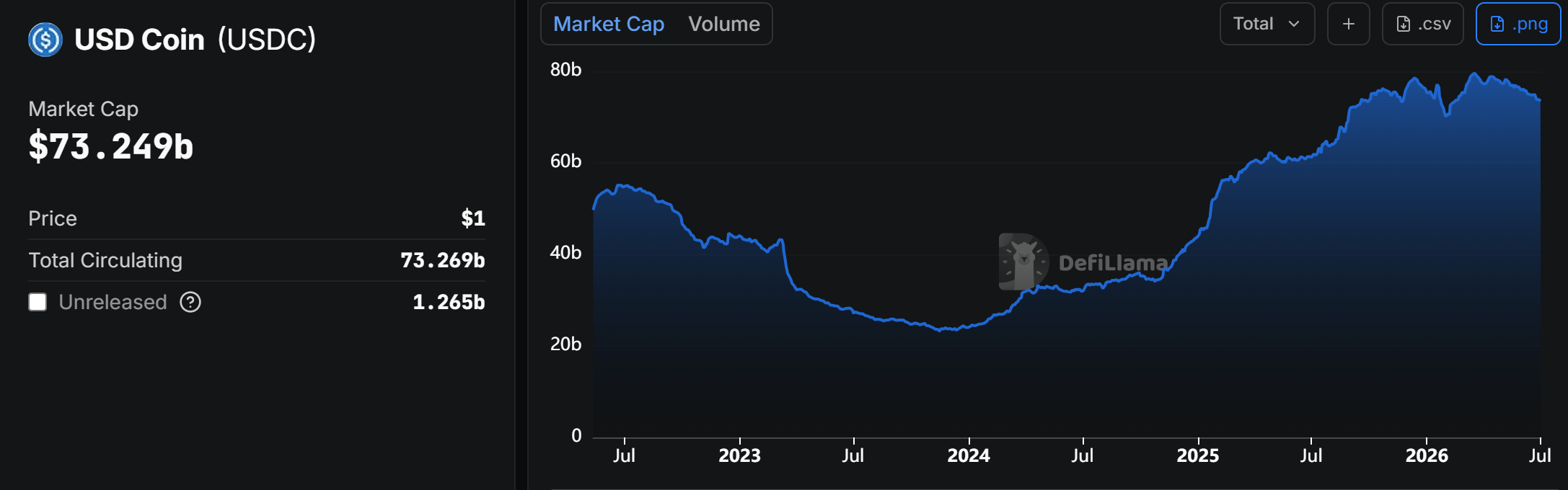
It gives institutions a single onboarding route into USDC, which commands a $73.2 billion market cap.

Standard Chartered says the service supports on-chain settlement, treasury operations, and liquidity management, with payment use cases planned later. Expansion into additional markets depends on regulatory approvals and market readiness.
“Digital assets are becoming an increasingly important component of global financial infrastructure, and institutional clients are seeking the same levels of trust and governance that underpin traditional markets,” Roberto Hoornweg, CEO of Corporate and Investment Banking at Standard Chartered, said in the announcement.
Follow us on X to get the latest news as it happens
The relationship runs deeper than one launch. Standard Chartered has helped design the Circle Payments Network since April 2025, alongside Santander, Deutsche Bank, and Société Générale.
This week, the bank also initiated coverage of the DeFi lending protocol Morpho.
Rivals are Already Moving on USDC
It is imperative to note, however, that Standard Chartered is not the first. On June 29, BNY enabled clients to mint, redeem, and hold USDC through its Digital Asset Custody platform.
BNY is no fringe player. It custodies USDC’s reserves and oversees $59.3 trillion in assets under custody or administration.
More may follow. BNY says it plans to add further stablecoin issuers over time, while Standard Chartered cites growing demand from institutions and corporations for regulated stablecoin infrastructure.
Circle, meanwhile, has its own reasons to court bank partners. Its stock fell 15% last week after 140 firms, including Visa and Coinbase, backed rival stablecoin Open USD.
Bank distribution hands USDC deeper institutional rails just as its enterprise lead comes under attack.
Regulation will set the pace. Circle kept its European listings under MiCA while Tether’s USDT exited, yet Standard Chartered’s global rollout still awaits approvals market by market.
Whether treasurers route real settlement flows through bank-issued USDC rather than pilots will determine how quickly the rest of the G-SIB pack moves.
The post Two Big Banks Adopt Circle’s USDC Stablecoin This Week appeared first on BeInCrypto.


Earlier this week, Strategy unveiled a capital framework allowing selective bitcoin sales to fund preferred dividends, while authorizing preferred share repurchases and stock buybacks. It also set a minimum cash reserve covering 12 months of preferred dividend and interest payments. Its $2.55 billion cash balance currently covers about 17 months.
Hougan said the episode marks a broader shift in Strategy’s role within bitcoin markets. Rather than serving as crypto’s dominant, one-way buyer, the firm is likely to become a more flexible participant whose bitcoin purchases or sales depend on market conditions.
Looking ahead, Bitwise believes institutional investors, including asset managers, banks, pensions, endowments and sovereign funds, are positioned to replace Strategy as bitcoin’s primary source of demand.
More broadly, STRC volatility is seen as part of the leverage unwind that typically marks the late stages of every crypto cycle. As speculative excess is flushed from the system, the market moves closer to establishing a durable bottom, though the exact timing remains impossible to predict, the report added.
Wall Street bank JPMorgan said Strategy’s new policy allowing selective bitcoin sales to fund preferred dividends creates avoidable two-way risk, increasing uncertainty and market volatility.
Read more: JPMorgan says Strategy’s bitcoin sales policy adds ‘two-way risk’ to crypto markets
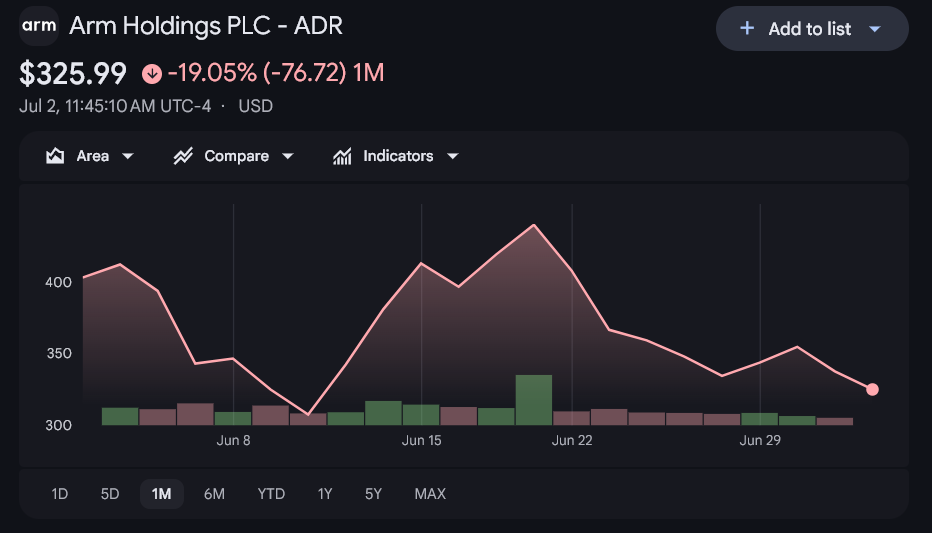
Arm Holdings (ARM) stock is up 194% this year. However, it has stalled and slipped since mid-June, and big investors are quietly selling. The reason is simple. Arm is the chip stock most exposed to rising interest rates.
The next test comes on July 14, when new inflation data is due. A hot reading would push the Federal Reserve closer to a rate hike. And Arm has the most to lose.

Big Money Started Leaving in Mid-June
The clearest warning comes from money flow. Chaikin Money Flow (CMF), a proxy for institutional buying, peaked at 0.37 around June 15 and has since fallen to 0.01. In plain terms, big buyers nearly vanished.

Note: Arm is based in the United Kingdom, but its shares trade in New York in US dollars, so Federal Reserve rate moves drive it like any American chip stock.
The timing is not random. Inflation hit 4.2% for the year on June 10, the hottest in three years. Days later, on June 17, the Federal Reserve held rates but signaled it may raise them. More so, institutional money began leaving in the run-up to the June 17 Fed meeting.
Since then, markets have gone back to pricing hikes. Robin Brooks, senior fellow at the Brookings Institution and former chief economist at the IIF, says one number will set the tone.
Here is why that hits Arm (ARM) hardest. A hot inflation report makes the Fed more likely to raise interest rates. Higher rates make profits expected years from now worth less today. Arm is the priciest big chip stock, and most of its profits sit far in the future. Investors are paying mainly for growth from its AI chip designs in the coming years, not for the money it makes today.
That makes Arm the most rate-sensitive name in its sector. Its price tends to move in the opposite direction of interest rates, and by more than any other big chip stock.

So it falls more than the average chip when rate fears rise. When a major bank warned of up to three more hikes on June 23, Arm dropped over 10% in a day.
Options Traders Turned Defensive Too
The options market flashed the same signal. Arm’s put-call ratio compares bets on a fall against bets on a rise. On June 15, with Arm near $412, the volume ratio was 0.51, so traders still bought more calls than puts.
Yet the open interest ratio was already 1.22, meaning longer-standing bets leaned bearish.

By July 1, with Arm near $337, both had turned bearish. The volume ratio jumped to 1.75, and open interest sat at 1.17.

In short, traders went from hopeful to defensive as rate-hike talk grew louder. The ARM price chart tells the same story.
The ARM Stock Chart Confirms the Warning
The rally was already running on empty. From May 6 to June 30, Arm rose, but the buying volume behind each move kept shrinking.
Want more insights like this? Sign up for Editor Harsh Notariya’s Daily Newsletter here.
That weakness stalled Arm at about $362. The stock now trades near $337, just under the $340 level it needs to hold.
If it breaks lower, $303, then $298, come into view. Far deeper support sits near $198 if the selling speeds up. To turn things around, Arm must reclaim $362 with strong buying, which would pull money flow back up. The real line, though, is $399 (the $400 zone).

Above $400, ARM regains genuine strength. Below it, with a hot July 14 report threatening another rate scare, every bounce is likely to be sold. The $400 mark separates a fresh leg higher from more selling into every rally.
The post Why a Hot July CPI Print Could Hit This Semiconductor Chip Hard appeared first on BeInCrypto.

Perpetual futures, once a niche crypto product, have become one of the industry’s fastest-growing markets. Alongside cryptocurrencies like bitcoin, trading platforms are increasingly listing contracts tied to equities, commodities and other real-world assets, blurring the line between crypto-native and traditional financial markets.
Led by former Revolut crypto head Ruslan Fakhrutdinov, Extended had processed more than $245 billion in trading volume as of June and supports more than 100 perpetual markets, according to the company.
The firm said it plans to expand into spot trading, tokenized real-world assets and multi-asset collateral.
“The first phase was building for DeFi natives,” Fakhrutdinov said in a statement. “The next is expanding the infrastructure and partnerships needed to support the next stage of onchain derivatives.”
The investment points to a broader race to become what is best described as the “everything exchange” or “everything app” for financial markets. Coinbase (COIN) has expanded into perpetual futures, Robinhood is pairing tokenized stocks with event contracts and commodity perps, and prediction market operator Kalshi recently entered the perpetual futures business.
As trading increasingly moves onto a blockchain environment, the lines separating brokerages, crypto exchanges and prediction markets are becoming harder to distinguish.
“Capital markets are increasingly converging with digital asset infrastructure,” Zengo managing director Ouriel Ohayon, said in a statement. “eToro’s investment in Extended reflects a mutual conviction that the future of trading will be digital, accessible and can operate 24/7, beyond the traditional trading week.”
[PRESS RELEASE – Victoria, Seychelles Islands, July 2nd, 2026]
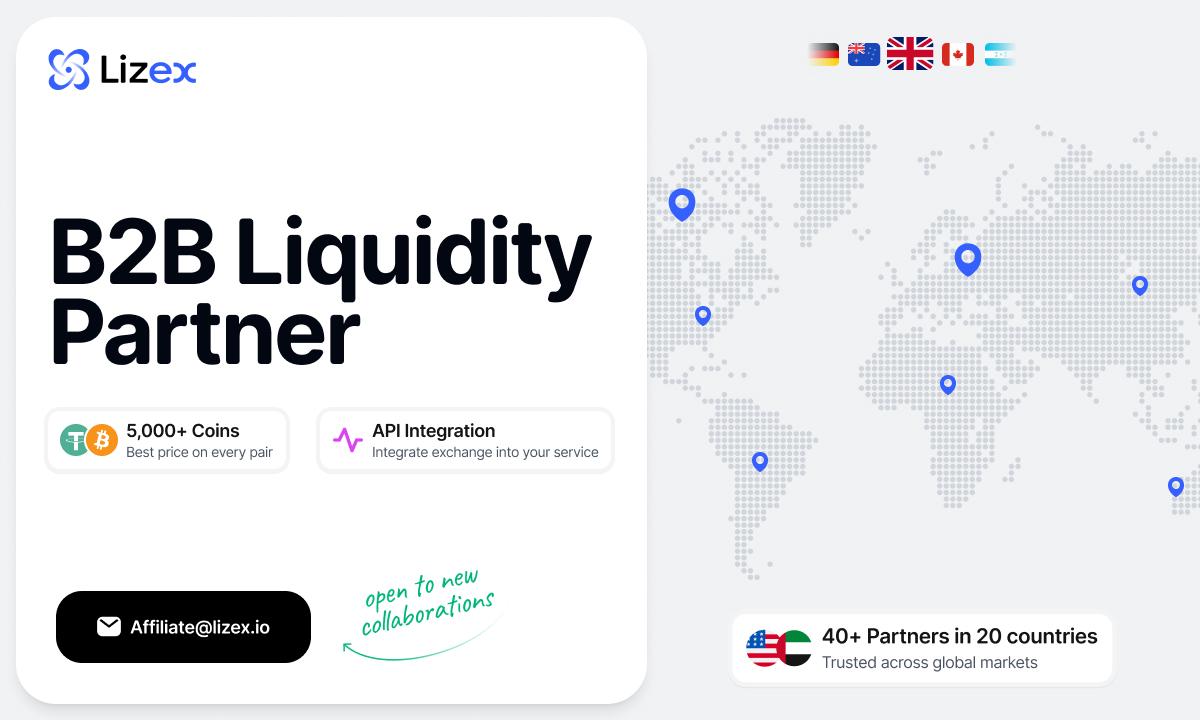
Lizex.io, a rapidly growing instant cryptocurrency exchange platform, announces the full launch of its B2B partnership program targeting crypto wallets, exchangers, rate aggregators, and fintech products. The company is opening access to its infrastructure for business partners worldwide.
About the Partnership Program
Lizex.io provides partners with direct access to an API for cryptocurrency exchange, offering aggregated liquidity across 5,000+ coins, including BTC, ETH, XMR, USDT, SOL, BNB, and other major assets. Integration takes just a few hours, backed by dedicated 24/7 technical support.
Lizex.io acts as a liquidity layer for both crypto wallets and aggregators, delivering a continuous stream of competitive quotes and instant order execution on the partner’s side. This allows B2B clients to offer their users best-in-class exchange rates without having to independently aggregate liquidity sources.
Key features for B2B partners:
- Access to 5,000+ crypto coins with deep aggregated liquidity
- Fixed and floating exchange rates at the partner’s discretion
- White-label integration: no Lizex.io branding in the partner’s interface
- Competitive revenue share of up to 60% of transaction fees
- Embeddable widget requiring no development from scratch
- Full transparency: all fees are displayed before transaction confirmation
Market & Positioning
According to the company, in the first six months of 2026, the volume of exchange transactions via the Lizex.io API exceeded $380 million. The platform currently serves more than 40 active B2B partners across 20 countries, with an average swap completion time under 4 minutes.
Lizex.io positions itself as a reliable liquidity backbone for the crypto ecosystem — an alternative to building in-house exchange infrastructure for services looking to add swap functionality without high operational costs.
How to Become a Partner
Companies interested in joining the Lizex.io B2B program can apply via the official website at lizex.io or contact the partnership team directly. A first response is guaranteed within 24 hours.
About Lizex.io
Lizex.io is a non-custodial instant cryptocurrency exchange platform operating since 2024. The service enables fast, secure, and private transactions with no registration required. Lizex.io offers both a retail interface for end users and B2B infrastructure for business clients, including API access, embeddable widgets, and white-label solutions.
Website: https://lizex.io
Telegram: https://t.me/Lizex_Partnership
The post Lizex.io Launches Large-Scale B2B Partnership Program for Crypto Services appeared first on CryptoPotato.
Circle is facing one of its biggest challenges following the announcement of Open USD (OUSD), a new stablecoin backed by major financial and payments companies, including Visa, Mastercard, American Express, BlackRock, and Coinbase.
As speculation grew over what the new initiative could mean for USDC, Circle’s stock came under pressure. It has fallen about 12.7% over the past five trading days.
While incumbents still control the vast majority of the market, industry experts believe OUSD could significantly reshape the competitive landscape.
OUSD vs. USDC
In a conversation with CryptoPotato, Alex Witt, General Partner at Verda Ventures, said that “distribution is king” and value will accrue to built-in distribution networks. He explained,
“Circle, unlike Tether, does not own its primary distribution channels, as evidenced by Circle sharing 90% of USDC reserve yield with Hyperliquid, demonstrating its weak competitive position.”
As a result, Witt believes OUSD could “dramatically erode” the company’s first-mover advantage.
Meanwhile, Trace Finance co-founder and CEO Bernardo Brites described Open USD as “a real structural break” in the stablecoin market.
He said markets read the announcement as a direct threat to Circle, but also noted that skeptics have flagged real execution risks, including bootstrapping liquidity from zero, the lack of trading pairs against major crypto assets, governance friction from coordinating many stakeholders, and a thin fee model that could leave OUSD under-resourced.
Even so, Brites argued that Open USD’s consortium is “bigger than anything the USDG consortium assembled,” referring to the consortium behind Paxos-issued USDG.
“Getting the major card networks, processors like Adyen, and banks like BNY and Cross River behind a single stablecoin is unprecedented. Distribution has always been the hardest problem in stablecoins, and OUSD is launching with more of it than any issuer before.”
Allaire: OUSD’s Model Could ‘Starve an Infrastructure’
Circle CEO Jeremy Allaire, however, pushed back against many of the arguments made in favor of the new stablecoin. In a tweet, Allaire said that stablecoin networks are platform and network effect businesses that tend towards “winner-take-most market structures,” while suggesting that years of network building matter more than newly announced consortia.
Responding to OUSD’s revenue-sharing model, the exec said Circle already shares the majority of its income with distribution partners, and added that “giving away all the income is a recipe for starving an infrastructure.” He also remains skeptical of OUSD’s governance model and argued that the track record of consortium products achieving scale, product-market fit, or even basic product agility is “absolutely dismal.”
“We actually tried this in the early days of USDC, and even with a very small group, ran into endless challenges and complexity.”
While acknowledging the new entrant, Allaire said Circle’s partnership with Coinbase “remains as strong as ever” and went on to say that he expects many of OUSD’s founding members to remain USDC partners and customers.
The post Can Circle Defend Its Stablecoin Lead Against OpenUSD? Experts Weigh In appeared first on CryptoPotato.
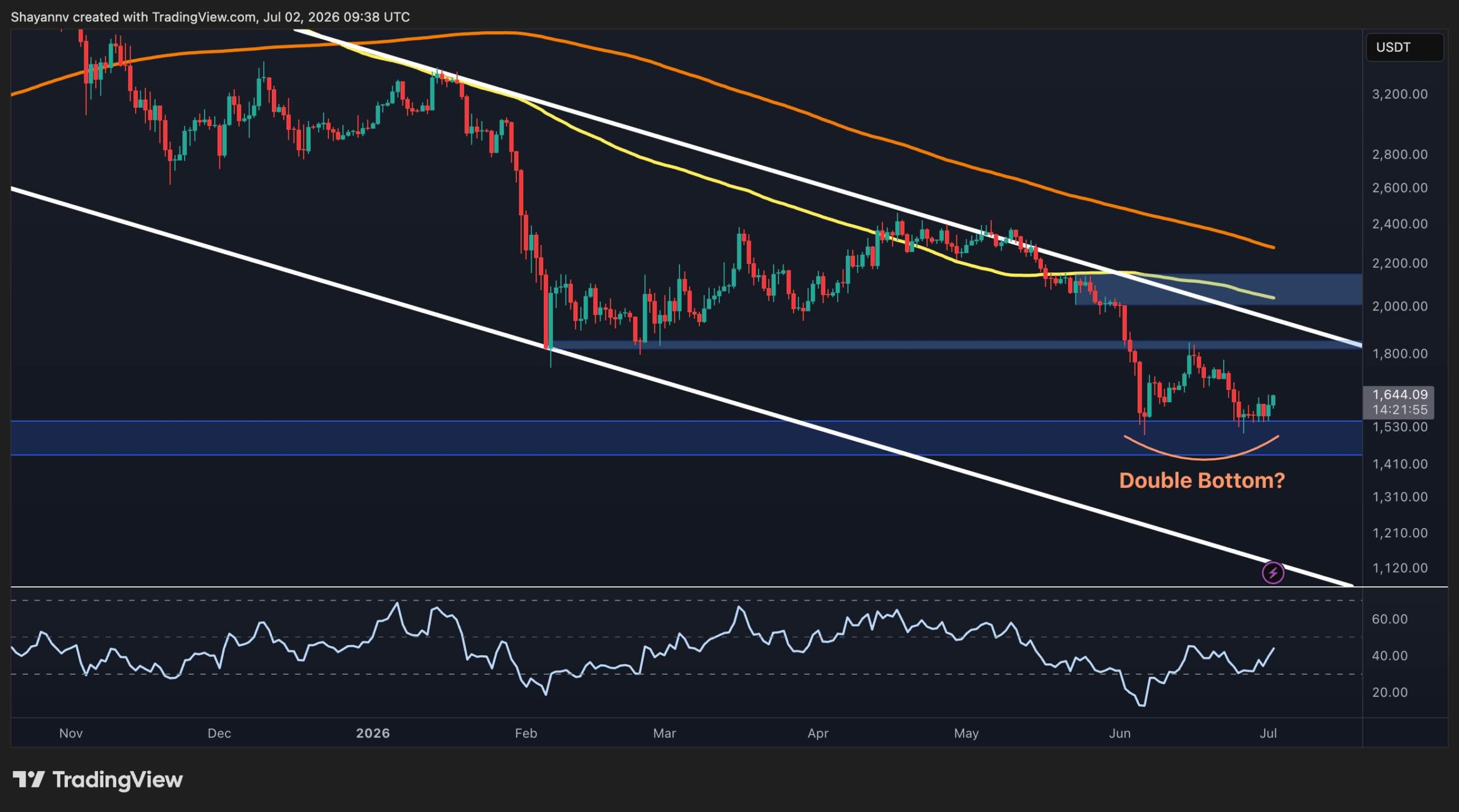
While Ethereum’s overall market structure is still dominated by the sellers, recent price action suggests sellers may be losing momentum after the market was held by the $1.5K support region twice. The emergence of a potential double bottom and improving short-term momentum could pave the way for a relief rally if buyers reclaim the next resistance cluster.
Ethereum Price Analysis: The Daily Chart
On the daily timeframe, ETH is still trading within the same long-term descending channel that has remained intact for months, with both the long-term moving averages sloping lower just above the channel’s higher boundary. The price remains well below the 100-day and 200-day moving averages, which are currently positioned around the $2K to $2.2K region, confirming that the macro trend is still bearish.
After the sharp sell-off a few weeks ago, the cryptocurrency found strong demand inside the $1.5K support zone. The price has now tested this area twice, raising the possibility of a double-bottom formation. Although the pattern is not confirmed yet, the repeated defense of this support suggests that bearish momentum is fading.
The RSI has also recovered from near-oversold conditions and is gradually pushing higher toward the midline, indicating improving momentum without reaching overbought territory.
For the bullish scenario to gain credibility, ETH needs to reclaim the $1.8K resistance zone to validate the double bottom setup. A successful move above that level would also expose the next major supply area around $2K to $2.2K, where the 100-day and 200-day moving averages converge.
Conversely, losing the $1.5K support zone could likely prove catastrophic, as it would invalidate the potential reversal structure and likely trigger a deeper leg lower within the broader downtrend.
ETH/USDT 4-Hour Chart
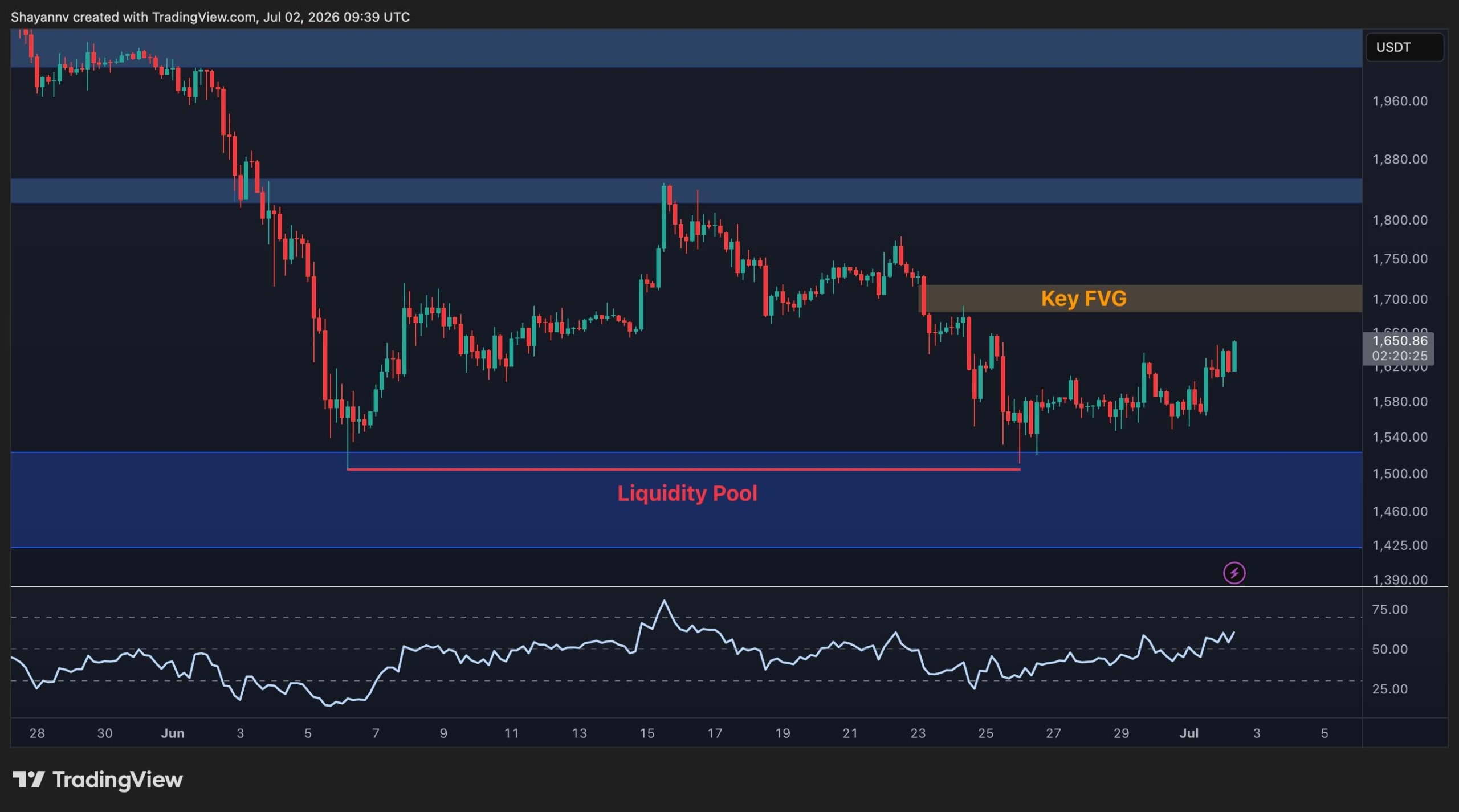
The 4-hour chart presents a clearer short-term picture. The price has built liquidity beneath the $1.5K lows, as buyers stepped back into the market, preventing a lower low. This demand is gradually pushing ETH toward the first area of overhead supply.
The price is currently approaching a key fair value gap at approximately $1.7k. This imbalance coincides with the latest bearish impulse and is likely to attract selling interest. A decisive breakout above this zone would signal improving short-term strength and could open the path toward the $1.85K resistance.
Momentum has also noticeably improved on the lower timeframe, with the RSI climbing toward bullish territory while printing higher lows alongside price. This suggests buyers have regained some control after the recent rebound.
However, unless ETH successfully clears the fair value gap and establishes higher highs, the current advance could still develop into nothing more than a corrective rally within the larger bearish trend.
Sentiment Analysis
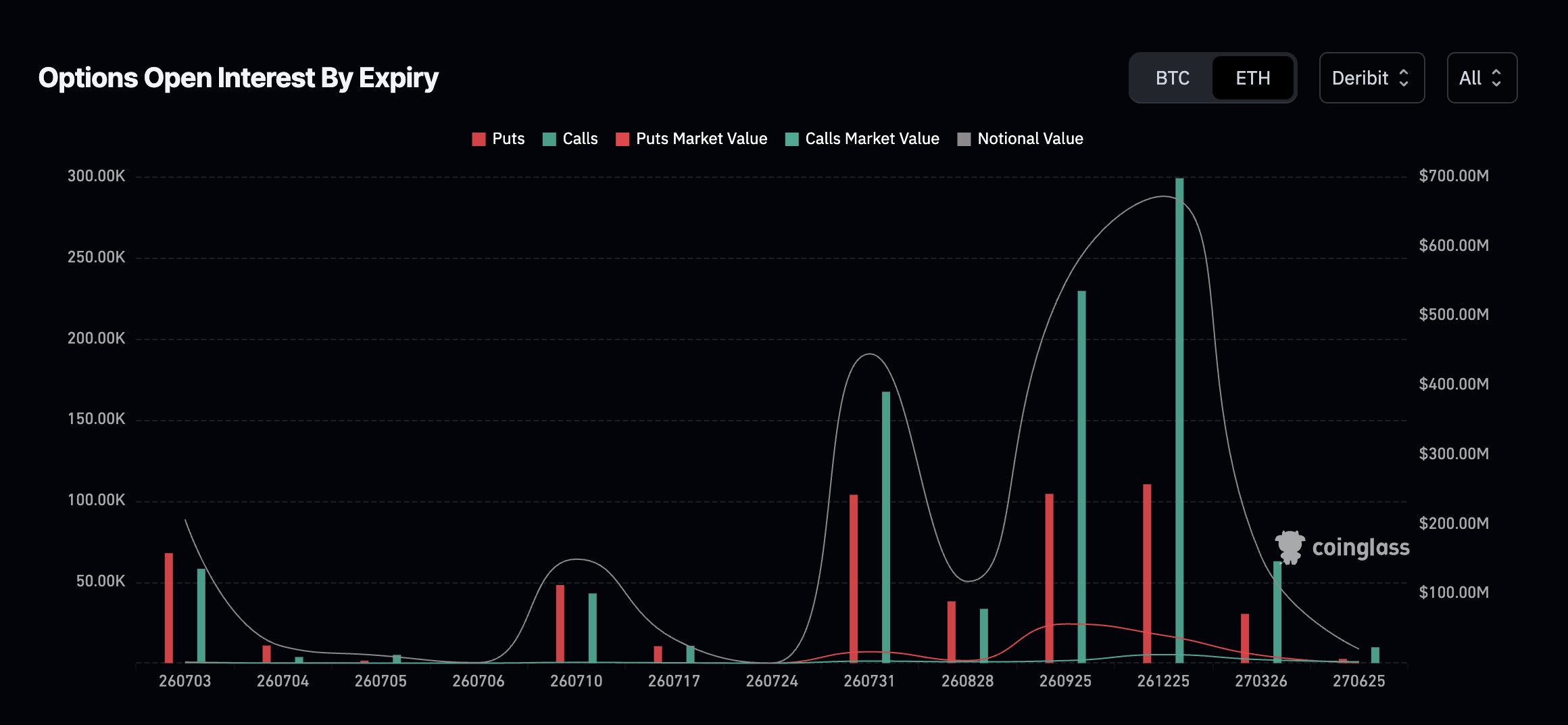
The distribution of open interest in options contracts shows that the largest concentration is positioned around the late December 2026 expiry, where call open interest significantly outweighs put open interest. Several other major expiries, including late September and late July, also display a clear dominance of call positioning.
This skew toward call options suggests that derivatives participants continue positioning for higher prices over the medium to long term despite Ethereum’s recent weakness. At the same time, the substantial notional value concentrated around the larger expiries indicates that these dates could become important volatility catalysts as expiration approaches.
While options positioning alone does not guarantee a bullish outcome, the current distribution reflects a market that still maintains longer-term upside expectations even as spot price remains trapped below major technical resistance. If ETH confirms the developing double-bottom structure and breaks above the nearby resistance cluster, the optimistic options positioning could provide additional tailwinds through improved market sentiment.
The post Ethereum Eyes Relief Rally as Double Bottom Forms Near $1.5K (ETH Price Analysis) appeared first on CryptoPotato.
Pi Coin price has edged higher after Pi Network introduced three ecosystem upgrades, while buyers stepped in following the token’s fresh all-time low and a broader crypto market rebound lifted sentiment.
Summary
- Pi Coin edged higher after Pi Network launched SoloHost, Pi Sign-In, and PiVerify during its Pi2Day event.
- A rebound from oversold conditions lifted PI, but a potential bearish flag continues to weigh on the short-term outlook.
- Large monthly token unlocks and limited exchange listings remain the biggest obstacles to a sustained recovery.
According to data from crypto.news, PI price traded near $0.115 on July 2, up around 0.5% over the past 24 hours after the Pi Core Team unveiled SoloHost, Pi Sign-In, and PiVerify during the Pi2Day event. The move also came as derivatives activity improved, with open interest climbing back above $20 million after falling during last week’s selloff.
Pi Network said SoloHost allows developers to build AI-powered applications on its infrastructure, while Pi Sign-In offers a unified authentication system for decentralized applications. PiVerify gives third-party businesses access to Pi’s network of more than 18 million KYC-verified users, creating an additional use case that requires developers and businesses to interact with the ecosystem.
At the same time, macro conditions favored risk assets. Bitcoin climbed back above $61,000 and briefly traded beyond $62,000 after weaker-than-expected U.S. June jobs data strengthened expectations that the Federal Reserve could cut interest rates later this year. The rally added roughly $50 billion to the total crypto market capitalization and helped several altcoins post intraday gains alongside PI.
Oversold bounce meets bearish chart structure
PI’s latest uptick followed a sharp decline that pushed the token to a fresh all-time low near $0.1141 on July 1. The daily Relative Strength Index dropped to around 27 before buyers returned, giving the token a foothold around the $0.115 support zone.
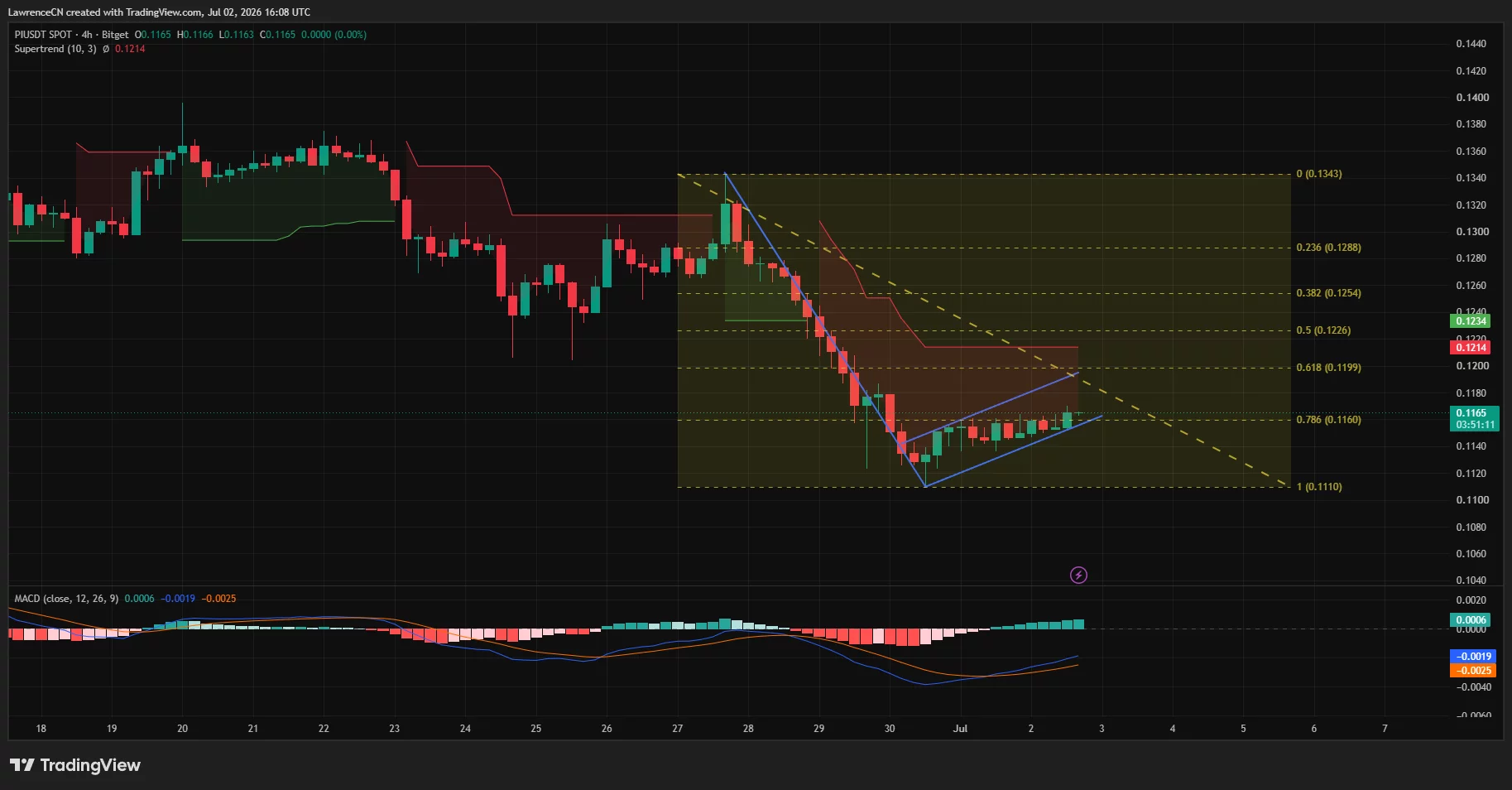
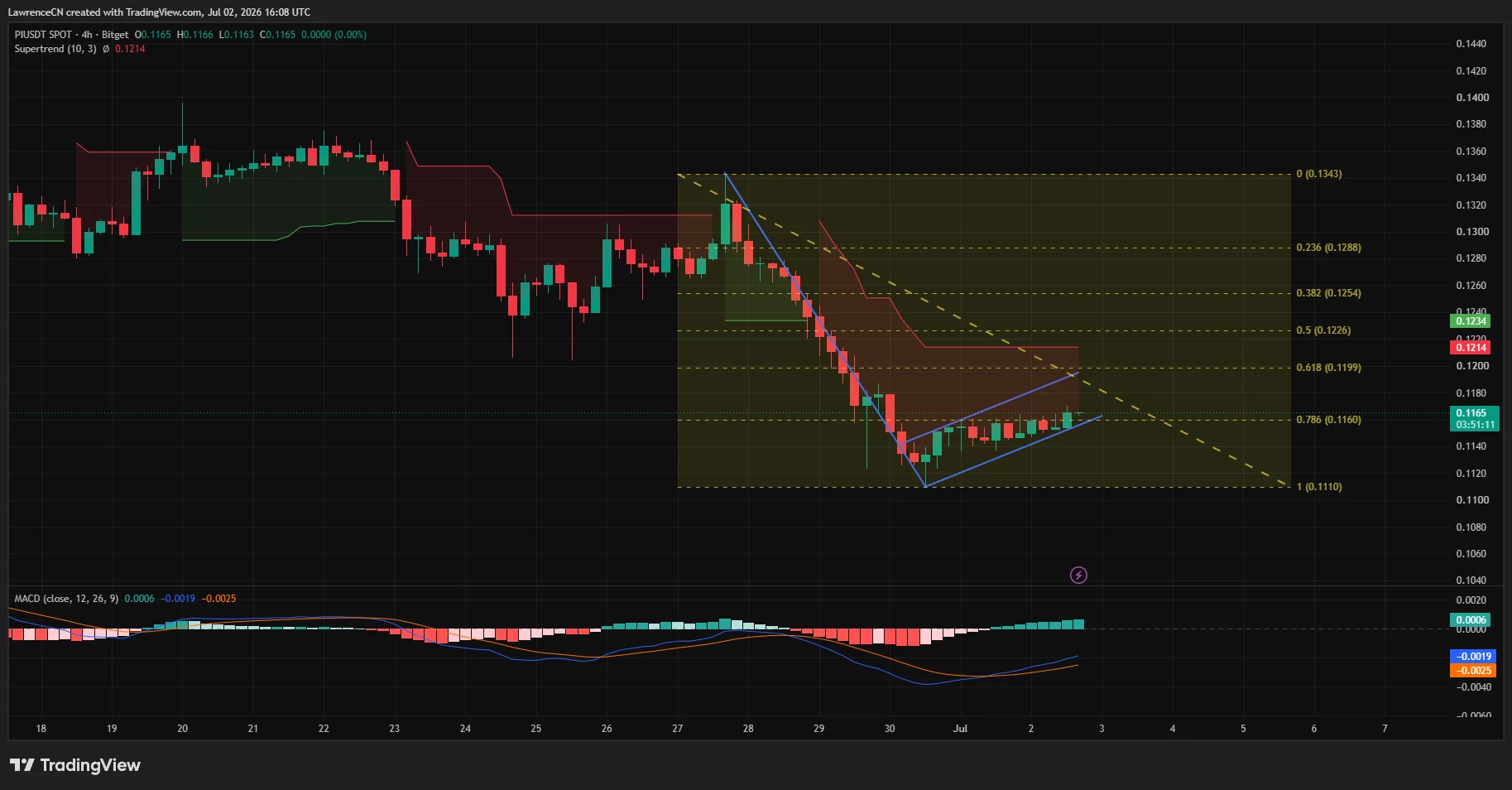
The 4-hour chart, however, continues to favor sellers. PI has formed what appears to be a potential bearish flag, with price moving inside a narrow ascending channel after the steep decline from roughly $0.132. A descending trendline has rejected every recovery attempt since late June, while the Supertrend indicator remains above price near $0.121.
The MACD has started to improve, with the histogram returning above zero and the MACD lines curling upward. Buyers still need to reclaim several resistance levels before the short-term structure changes. Fibonacci retracement levels place the first barriers near $0.116, $0.120, and $0.123, while a move above the descending trendline and Supertrend would weaken the bearish setup.
Token unlocks remain the biggest downside risk
Supply pressure continues to overshadow the network’s new utility releases. PiScan data shows between 76 million and 149 million PI tokens are scheduled to unlock during rolling 30-day periods, while more than 1.7 billion tokens are expected to enter circulation over the next 12 months.
The steady increase in liquid supply has consistently outpaced demand and remains the main reason PI continues to trade near record lows. Liquidity also remains limited because Binance, Coinbase, and Bybit have yet to list the token.
A breakdown below the lower boundary of the four-hour bearish flag and the recent $0.111 low would strengthen the bearish case and expose fresh all-time lows.
On the upside, sustained buying above $0.120-$0.121, supported by growing adoption of SoloHost, Pi Sign-In, and PiVerify, would invalidate the current bearish pattern and open the door for a recovery toward $0.123-$0.125.
Disclosure: This article does not represent investment advice. The content and materials featured on this page are for educational purposes only.

Instacart Down Now? Service Disruption Hits Hundreds of Users Across U.S. as Delivery App Experiences Outage
NFLX Stock Climbs 3.95% as Valuation and Ad Growth Lift Demand Now

World Cup 2026: Belgium and England escape elimination against Senegal and DR Congo


-

 Fashion6 days ago
Weekend Open Thread: Staud – Corporette.com
-

 Politics6 days ago
The House | Manchesterism won’t survive the painful trade-offs unless it gets citizens on board
-

 Crypto World3 days ago
Strategy authorizes up to $1.25B in Bitcoin sales under new capital plan
-

 Politics7 days ago
Potential 2028er World Cup attendee leaderboard
-

 Business6 days ago
Asia stock markets slide as tech shares slump
-

 News Videos4 days ago
MAJOR BITCOIN & MARKET UPDATE!!!! (MUST WATCH ASAP!!!)
-

 Tech7 days ago
A Look At A Gaggle Of Transputer Boards
-
 Crypto World7 days ago
Dell (DELL) Shares Tumble Over 5% Following Analyst Downgrade to Hold
-

 Crypto World5 days ago
Coinbase, Circle Deepen Crypto Stock Losses Despite Resilient S&P 500
-

 Tech3 days ago
Anonymous researcher drops 0-day ‘exploitarium’ repo
-

 Business3 days ago
Australia treasurer says alleged access of prime minister’s bank data ’incredibly concerning’
-

 Crypto World6 days ago
Kraken's xStocks Opens Bending Spoons IPO Registration to EEA Retail
-

 Sports6 days ago
FIH Pro League: India defeat Pakistan 7-1, register biggest win of campaign | Other Sports News
-

 Crypto World7 days ago
Bitcoin Sparks $600M Hourly Liquidations With $65,000 Set To Become Resistance
-

 Tech5 days ago
Bluekit phishing kit adopts browser-in-the-middle for login theft
-

 Tech5 days ago
Russian hackers now target Signal backup recovery keys
-
 Crypto World6 days ago
Hyperliquid Named on Singapore MAS Investor Alert Register
-

 Crypto World6 days ago
RTX holders must register wallets before token distribution begins
-

 Crypto World6 days ago
Tether (USDT) Passes Ether in Market Cap as ETH Drops Toward $1.5K
-

 Sports1 day ago
Broncos roster: OL Ben Powers (No. 74) entering final year of contract
You must be logged in to post a comment Login