

Crypto World
Standard Chartered Identifies 3 BTC Bottom Signals After Monday News

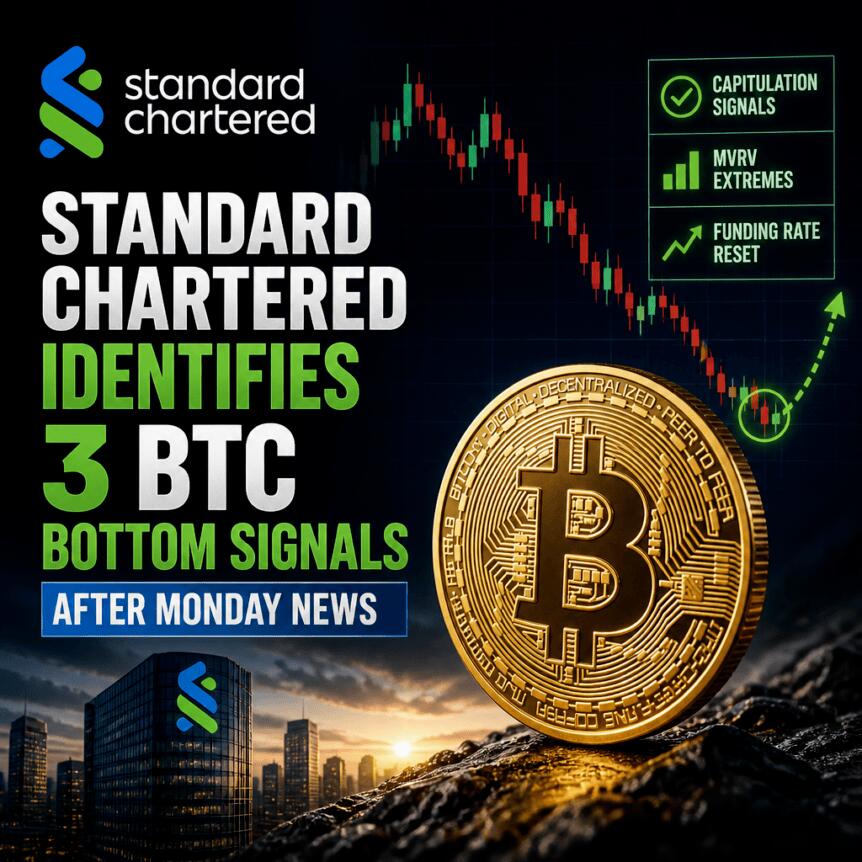
Standard Chartered analyst Geoff Kendrick says he believes crypto prices have already marked the low of the current cycle, pointing to a trio of signals he wants to see align before he fully confirms a turnaround. In his view, Strategy’s recent Bitcoin buying, renewed demand for US Bitcoin exchange-traded funds (ETFs), and continued weakness in oil prices are together shaping a more constructive backdrop for risk assets like crypto.
In a client note published Friday, Kendrick put a specific level on his “cycle low” framework, estimating the trough at $59,000 for Bitcoin—about 53% below the asset’s prior cycle peak near $126,000. He also cited market reference pricing, noting Bitcoin last traded on Sunday around $63,704, according to CoinMarketCap data.
Key takeaways
- Geoff Kendrick of Standard Chartered argues crypto has likely seen the cycle low, estimating Bitcoin’s trough at about $59,000.
- He highlights three confirmation indicators: additional Bitcoin purchases by Strategy, positive inflows into BTC ETFs on Friday, and further declines in oil prices.
- SoSoValue data shows US Bitcoin ETFs saw net inflows of $85.84 million on Friday, with money flowing into five funds.
- Oil futures fell for a second straight day on Friday, according to Yahoo Finance data—part of Kendrick’s broader “macro risk” read-through.
- The discussion comes as Strategy continues to provoke debate with its reported ability to sell Bitcoin for its “digital credit” business.
Standard Chartered’s “cycle low” checklist
Kendrick’s approach is not a single-price call—he ties his thesis to observable market flows and macro conditions. The most direct market-action item is Strategy’s Bitcoin accumulation, which he described in reference to reporting that the firm bought more Bitcoin last week.
In addition, Kendrick looked to ETF flows. According to data tracked by SoSoValue, Friday brought one-day net inflows of $85.84 million into US-traded Bitcoin ETFs. Kendrick’s note also reflects a distribution detail that matters for investors watching breadth: investors allocated into five of the funds, while eight saw no net change on the day.
The third leg of the framework is crude oil. Kendrick pointed to evidence that oil prices were continuing to break lower, with Yahoo Finance data showing crude oil futures fell on Friday for the second consecutive day. For investors, this is relevant because falling oil can shift expectations across inflation, growth, and broader risk appetite—variables that often influence liquidity-sensitive assets such as crypto.
After laying out the indicators, Kendrick ended his note with a seasonal metaphor: “Winter is over. Welcome back to crypto Spring.”
Strategy’s buying signals and Saylor’s “dots”
As Kendrick’s note circulated, Strategy founder Michael Saylor issued another social-media prompt that traders and long-time followers often treat as a prelude to further Bitcoin purchases. On Sunday, Saylor posted “Still adding dots,” alongside the bubble/dot chart format that has become closely associated with Strategy’s periodic purchase messaging.
The post drew significant attention on X by mid-afternoon ET, according to the article context, underscoring how retail and institutional audiences monitor Strategy’s communications as part of their own flow expectations—even when the underlying purchases ultimately depend on execution and timing.
What the ETF inflow data suggests—and what to watch next
ETF inflows are among the most watched behavioral indicators in Bitcoin markets because they translate a portion of demand into a regulated wrapper and can be tracked daily. On Friday, the $85.84 million net inflow figure cited by SoSoValue suggests that, at least for that session, buyers showed up even as the market had been testing a lower range.
However, Kendrick’s thesis is best read as a demand-for-confirmation setup rather than a guarantee. The “confirmation” theme matters: one strong inflow day is not the same as sustained accumulation, and oil’s trajectory can also change quickly. For investors, the practical question going forward is whether the combination Kendrick listed—Strategy accumulation, repeat ETF inflows, and continued pressure on oil—persists beyond isolated data points.
Another angle is that the distribution across funds matters. Kendrick’s referenced split (five funds receiving inflows, eight unchanged) hints that demand was not concentrated into a single vehicle, but it also stops short of signaling broad-based acceleration across every ETF immediately.
The “sell” debate inside Strategy’s digital credit model
The turnaround narrative arrives alongside a separate development that has shaped how some observers interpret Strategy’s Bitcoin policy. Cointelegraph previously reported that Strategy disclosed its first reported Bitcoin sale since 2022, offloading 32 BTC in a June 1 filing with the US Securities and Exchange Commission. The sale appeared to conflict with Saylor’s well-known “never sell your Bitcoin” messaging.
In defense of the decision, Saylor argued that the capacity to sell is necessary to support Strategy’s “digital credit” business. As he explained in remarks at BTC Prague, if the company’s policy prevented selling Bitcoin entirely, it could undermine the value proposition for the credit products tied to Bitcoin treasury holdings—because dividend-paying securities and other BTC-backed credit structures may require flexibility in how collateral is managed.
This matters for crypto investors because it reframes what “accumulation” means in Strategy’s context. Rather than portraying Bitcoin holdings as entirely untouchable, the company’s position—based on the reported comments—suggests a balancing act between keeping exposure and preserving the operational ability to support credit issuance and payout mechanics.
So while Kendrick is focused on signals that Strategy is buying more, the broader investor question is whether Strategy’s credit strategy could also introduce future episodes of selling that are conditional on market and product needs. For traders, that nuance can influence expectations around how much “buy-side” momentum to assume from headlines alone.
For the next phase, readers should watch whether ETF inflows continue across multiple sessions rather than just one day, and whether oil’s downtrend persists alongside ongoing signals of Strategy accumulation—while also tracking any additional disclosures that clarify how often Strategy’s “digital credit” requirements could translate into Bitcoin sales.

Samsung Electronics and SK Hynix signed a combined $950 billion in artificial intelligence (AI) chip supply deals with Nvidia and Broadcom over the weekend.
Both stocks still fell in Monday trading, a disconnect that shows how much of the AI rally already sits in the price.
A Massive AI Infrastructure Deal
SK Hynix will supply $750 billion in memory chips to Nvidia and other US companies over several years. Nvidia put its own portion of that deal at $500 billion. The agreement covers new data centers targeted for 2027, and SK Hynix affiliate SK Telecom will build a cloud business on Nvidia’s Vera Rubin systems.
Nvidia enterprise vice president Raj Mirpuri said the deal secures a stable supply of high-bandwidth memory (HBM), the specialized chips that power AI processors and graphics cards.
Samsung separately signed a memorandum of understanding worth an estimated $200 billion with Broadcom. The agreement expands their memory and foundry collaboration, the companies said in statements Friday.
Is the AI Boom Already Priced In?
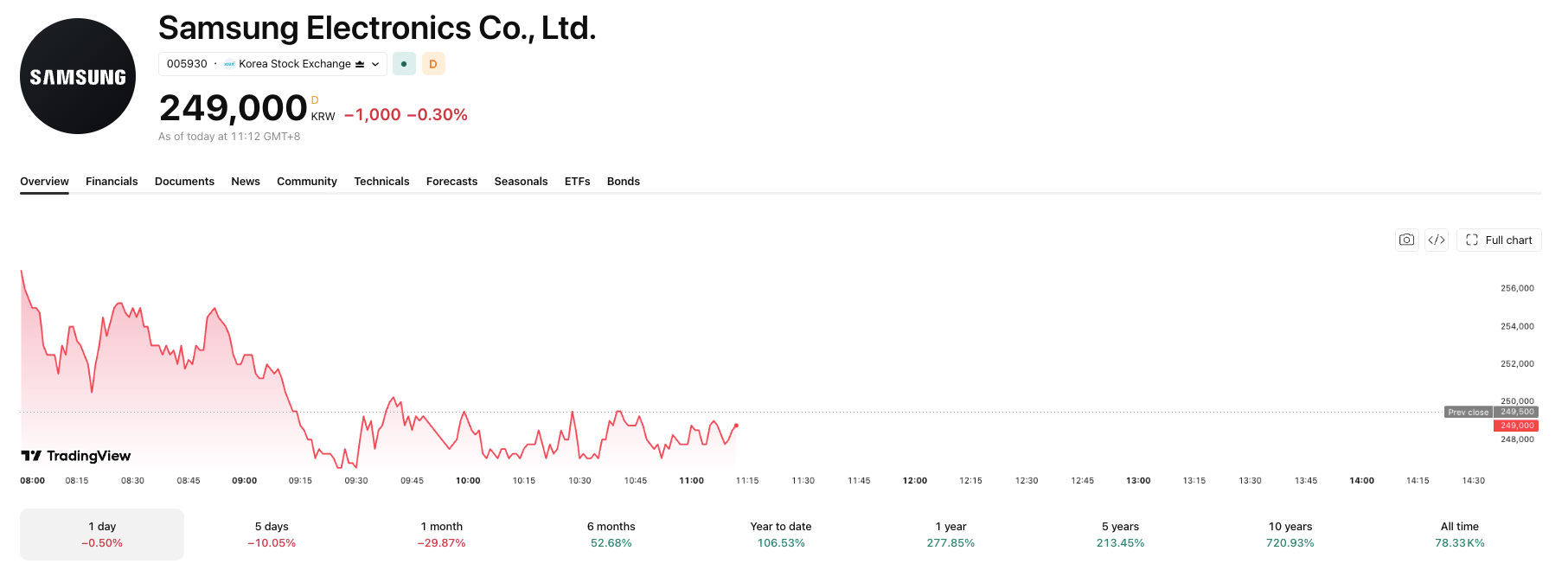
Despite the scale of the announcements, SK Hynix shares traded at 1,752,000 won Monday morning, down a little from Friday’s close, but also down 11.38% over five sessions. Samsung fell 0.50% to 248,500 won, extending its own 10.05% five-day slide. Nvidia closed down 0.92% at $206.84 in Friday’s session before edging higher in overnight trading.


The muted reaction fits a recent pattern. SK Hynix shares have slid even on positive news this month. US investors already pay a premium for its shares compared with Seoul, a gap that opened after its blockbuster Nasdaq listing earlier in July.
Both stocks are up sharply this year on AI demand, so traders appear to be booking profits rather than chasing another AI headline, regardless of the deal size.
The bigger test comes later this week. Samsung and SK Hynix report quarterly earnings that will show whether soaring chip orders are converting into profit. That result will tell investors whether this month’s record deal flow deserves a second look, or whether it is already old news.
The post SK Hynix, Samsung Ink $950 Billion AI Chip Deals, But Stocks Still Slide appeared first on BeInCrypto.
Federal Reserve Chairman Kevin Warsh keeps predicting a Fed “family fight.” Wednesday’s policy meeting could finally deliver a real one, with economists expecting at least two hawkish dissents over interest rates.
Warsh has used the phrase 13 times since his April nomination hearing, according to a CNBC tally. His first meeting as chair ended in a unanimous hold last month.
A Feud That’s Been Building for Months
Wall Street expects a different outcome this week. JPMorgan’s Michael Feroli predicts a contested vote. He names Cleveland Fed President Beth Hammack and Dallas Fed President Lorie Logan as likely dissenters.
“The July FOMC will be a family feud… just as Kevin Warsh intended.”
Oscar Munoz, TD Securities
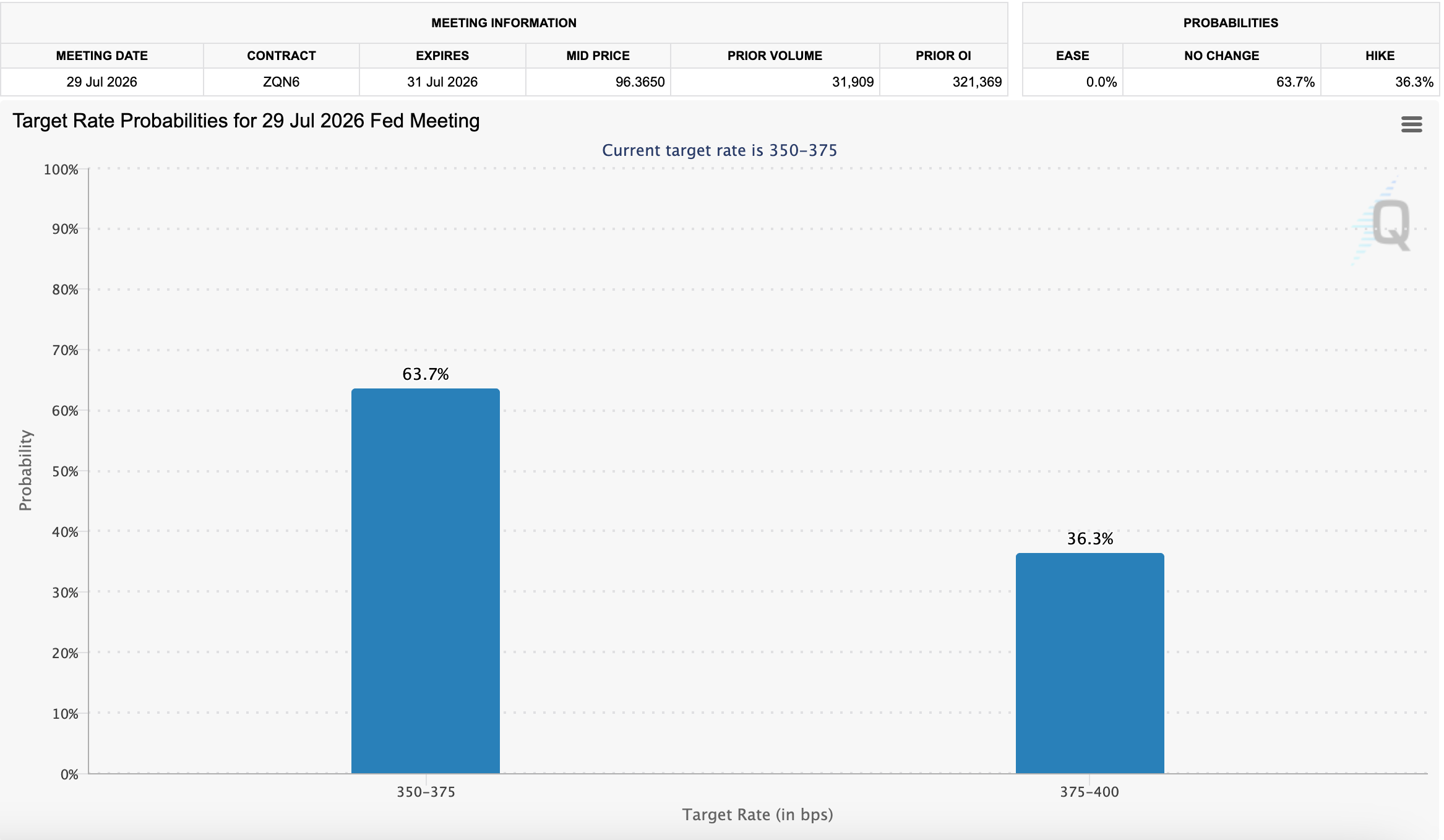
TD Securities’ Oscar Munoz agrees. Traders are already repricing the odds. CME Group’s FedWatch tool now shows 34.2% odds of a quarter-point hike, up from 12.8% just a week ago.

Oil and Chips Are Feeding the Feud
A collapsed U.S.-Iran ceasefire has pushed oil prices higher again. Brent crude climbed back above $100 a barrel, undoing the recent oil price relief. But a recent pause in hostilities has brought that price back down for the moment.
Chip shortages tied to the AI boom have raised consumer electronics prices too. Hyperscalers keep spending heavily on AI infrastructure, and that shows no sign of slowing. Fed Governor Chris Waller argues the central bank cannot just watch inflation and hope it fades, echoing Warsh’s own recent complaint about the Fed’s inflation framework mistake.
Cleveland Fed President Beth Hammack has been especially blunt about the stakes. She says businesses and consumers are both losing patience with prices.
“For the first time in my tenure, I’m hearing from businesses who say they think we need to take action to curb inflation, and from consumers who can’t make ends meet about a growing sense of despair.”
Beth Hammack, Cleveland Fed President
A softer June inflation report still favors a hold on Wednesday. The Fed’s next test also lands just as U.S. midterm elections near, adding political weight to the vote. But two hawkish dissents would turn Warsh’s family fight into the real feud he predicted all along.
The post Kevin Warsh Wanted a ‘Family Feud’ at the Fed; At Wednesday’s Meeting He Might Get One appeared first on BeInCrypto.
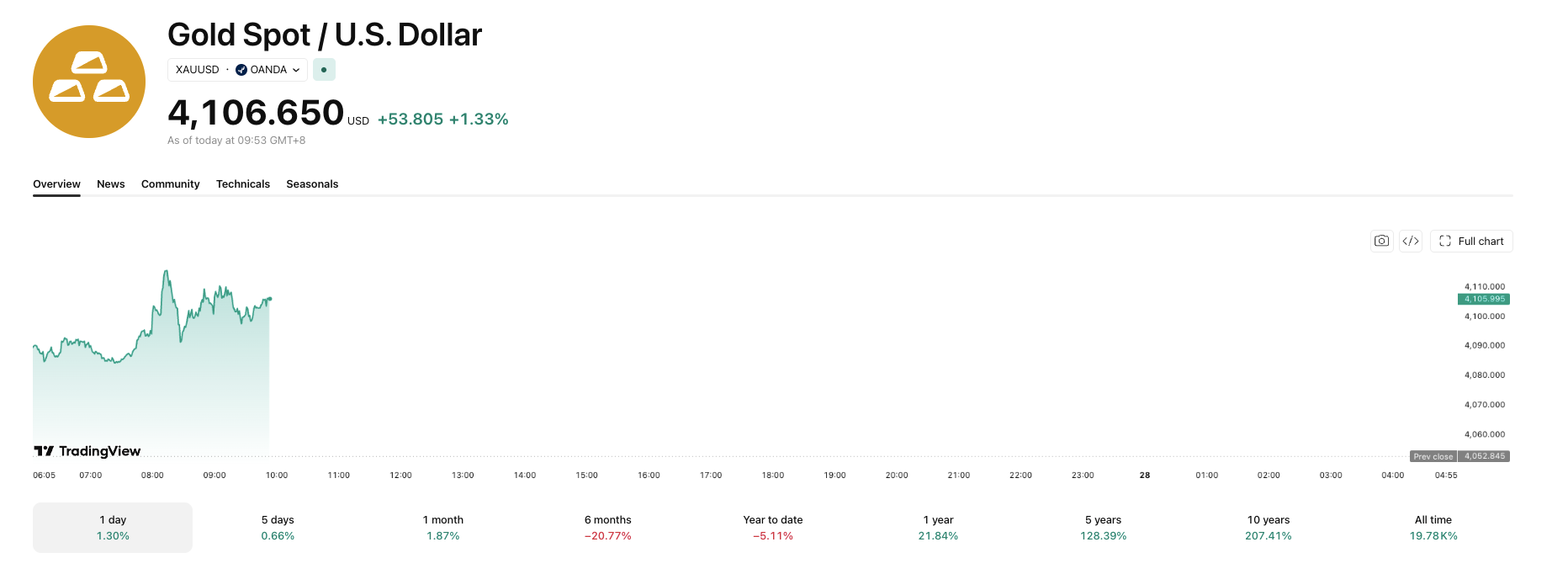
Gold climbed more than one percent in Asian trading Monday. A weekend pause in US-Iran hostilities pushed oil prices lower and eased fears of prolonged high interest rates.
Spot gold traded at $4,106.65 per ounce Monday, up 1.33% on the day, according to TradingView data.
Oil Retreat Lifts Precious Metals
The pause came as advisers reportedly warned Trump that the military was nearing the limit of viable targets in Iran. They also flagged concerns about draining U.S. munitions stockpiles, prompting the pause in strikes. Iran will halt its own attacks as long as Washington does the same, a senior Iranian official told Reuters.

Oil prices tumbled as much as 7% on hopes for a diplomatic resolution. That reverses recent forecasts that Brent crude could revisit its war-era peak near $120 after going above $100 at the weekend. Lower energy costs typically ease inflation, reducing the odds the Fed holds rates high for longer. Gold’s appeal fades when rates stay high since the metal pays no yield.
Traders are still pricing an 80% chance of a rate hike in September, according to the CME Group’s FedWatch Tool, which tracks futures-implied rate expectations.
Gold also Boosts Silver
Other precious metals rallied in tandem. Spot silver climbed 2.7% to $59.74 an ounce, building on a recent breakout above key resistance. Platinum gained 2% to $1,619.75, and palladium rose 2.3% to $1,271.93.
COMEX gold speculators added 4,438 contracts to their net long position in the week to July 21. That brought the total to 123,586 contracts, according to CFTC data.
The Fed’s rate decision this week will test whether the truce holds long enough to sustain the rally. A split among 104 economists over the central bank’s next move shows how uncertain the path remains. That uncertainty deepens if fighting resumes and oil prices reverse.
The post Gold Gains as US-Iran Pause Also Sends Oil Prices Lower appeared first on BeInCrypto.
Decentralized cloud storage provider Storj Labs has filed for voluntary Chapter 11 bankruptcy protection in the United States, opening a restructuring process that could test how—if at all—utility-token holders might participate in the equity of a company that emerges from bankruptcy. The filing was made in the US Bankruptcy Court for the Northern District of West Virginia, according to a statement published by Storj.
Storj says the restructuring is aimed at addressing legacy liabilities that it argues can’t be resolved through growth alone, while keeping its network running and preserving the token’s core utility. At the time of writing, STORJ appeared to have reacted mutedly to the news, trading around $0.072 based on CoinGecko data.
Key takeaways
- Storj Labs entered voluntary Chapter 11 in the Northern District of West Virginia while stating that ordinary operations and customer services will continue under court oversight.
- The company says its liabilities largely predate its current strategy and are too large to clear solely through business expansion.
- Storj management plans to propose a pathway for STORJ token holders to participate in the equity of a reorganized company, subject to bankruptcy priorities and court approval.
- Storj has not yet detailed how tokenholder eligibility would work, including whether a token snapshot, lockup, or other criteria would be used.
- STORJ’s market reaction to the filing was limited in the immediate term, with CoinGecko showing trading near $0.072 at publication time.
Chapter 11 filing framed as a legacy-liability fix
On Sunday, Storj announced that it filed for voluntary Chapter 11 “to resolve legacy liabilities and position the business for growth,” according to a post on its own website. The company indicated that day-to-day operations would not stop, and that customer services would continue during the process, but under supervision by the bankruptcy court.
Storj also said its parent company, Inveniam, would continue to support the business throughout the restructuring. That support, along with Storj’s insistence that the underlying network remains functional, is central to the company’s message to token holders: the technology and the token’s intended role should not be treated as collateral to be sidelined while legal obligations are worked through.
A proposal for tokenholder equity—without the mechanics yet
Storj’s open letter to its community argues that the restructuring need is driven by obligations from earlier stages of the company, rather than issues stemming from the present network model. The letter also states that the network is operating normally and that the token’s utility is unchanged.
Crucially, Storj said management intends to submit a plan that would create a mechanism for token holders to participate in the reorganized company’s equity. However, the company has not disclosed essential details, including how eligibility would be determined (for example, whether participation would depend on token ownership at a particular time), whether any tokens would be locked up, or what portion of equity might be offered.
Storj acknowledged that any proposal must align with bankruptcy requirements—meaning the reorganization plan has to follow established priority rules and receive court approval. That constraint matters because Chapter 11 restructurings typically involve complex treatment of different classes of creditors, equity holders, and other stakeholders. In this case, token holders are not automatically treated as equity holders, so Storj’s approach will likely hinge on how the court-approved plan defines who receives value and under what conditions.
Cointelegraph contacted Storj for additional comment but did not receive a response before publication.
Why the Storj case is a test for utility-token ownership
Storj’s bankruptcy filing is likely to draw attention beyond its community because it sits at the intersection of two unresolved questions in crypto: how regulators and courts may interpret token-related claims in insolvency, and whether “utility” token holders can convert their economic exposure into equity-like rights during a restructuring.
The company described the restructuring as a potential “ownership pathway” for STORJ token holders, which—if it moves from proposal to approved plan—could become a reference point for other projects with token distributions and decentralized networks. At the same time, uncertainties remain. Storj has not provided a framework for how a tokenholder-to-equity mechanism would be structured, and bankruptcy priorities could limit what any token holder pathway ultimately looks like.
For market participants and builders, this is also a reminder that decentralized infrastructure tokens can still carry company-level legal and financial risk. Even when networks continue operating, restructuring plans can reshape governance expectations, economic arrangements, and the distribution of future upside.
Part of a broader Chapter 11 wave in crypto
Storj’s filing comes amid a month in which multiple crypto-related businesses sought Chapter 11 protection. Earlier coverage highlighted Movement Labs filing under Subchapter V on July 15 after turmoil connected to its MOVE token, and a separate filing by Bitcoin mining pool Poolin on July 22 as it pursued a court-supervised sale of two Texas mining sites.
Meanwhile, other exchanges faced operational endpoints without filing for bankruptcy. BitMEX announced in July that it would shut down after 11 years, following announcements connected to legal action, while BitMart said it would end trading on Aug. 26 before fully ceasing operations on Jan. 31, 2027. Storj’s case differs in that it is explicitly pursuing a court-supervised reorganization with potential equity-related outcomes for token holders.
Storj itself traces its origins to 2014, when it began as an open-source peer-to-peer cloud storage concept designed to let users rent storage from network participants rather than rely on centralized providers, according to earlier reporting. That longer history may help explain why the company emphasizes continuity: the network has market credibility and operational history, and Storj is positioning Chapter 11 as a legal course-correction rather than a shutdown.
As the bankruptcy process develops, investors and token holders will be watching for what Storj’s eventual reorganization plan actually proposes—particularly the eligibility criteria for tokenholder participation and how (or whether) any proposed equity allocation can comply with Chapter 11 priorities and court approval. The next phase will also reveal whether the network’s stated “normal operation” stance can be maintained through the litigation and settlement decisions that typically follow a major restructuring filing.

Strategy has skipped four straight weekly Bitcoin (BTC) purchases, its longest buying pause in two years. The company reports second-quarter earnings Thursday, July 30, after the US market closes.
SEC filings confirm Strategy’s last purchase covered the week ending June 21. Since then, the company has sold Bitcoin instead of adding to its stack.
A Pause Built on Falling mNAV
Strategy’s stock traded at a premium to its Bitcoin holdings for years, a ratio called mNAV. That premium let the company sell shares above BTC value and grow Bitcoin per share for holders.
The model breaks once mNAV drops toward 1. New share sales then destroy value instead of creating it. mNAV touched roughly 0.99 in late June, its first sub-parity reading ever, before recovering to about 1.03. Strategy’s holdings now trade underwater against their purchase price, and management puts the real breakeven closer to 1.22.
Strategy sold 3,588 BTC in two tranches between June 29 and July 5 for about $216 million. The sales funded preferred stock dividends and topped up its cash reserve. Strategy adopted this capital framework in late June, and the reserve reached $3.225 billion by July 20.
What Thursday Could Show
Strategy posted a $14.5 billion operating loss in the first quarter on Bitcoin’s mark-to-market decline. LSEG’s consensus estimate points to a swing back to $3.86 billion in Q2 operating income, but two of the seven analysts behind that number submitted forecasts before June’s bitcoin slide.
Thursday’s results will show whether Strategy sticks with this trade-off, raising fresh capital while leaving its Bitcoin holdings untouched.
The post Strategy Earnings Loom as Bitcoin Buying Freeze Hits a Month appeared first on BeInCrypto.
Four Big Tech giants report second-quarter earnings this week, testing whether massive AI spending is translating into real returns. SK Hynix also delivers its first results since a record Nasdaq debut, and Tim Cook holds his final call as Apple’s chief executive.
The reports arrive a day before the Federal Reserve’s Wednesday rate decision, with markets already pricing a possible hike. Oil going above $100 a barrel, and subsequently dropping on a pause in hostilities, adds another layer of pressure to the week.
Microsoft and Meta report Wednesday
Microsoft and Meta open the busiest stretch on Wednesday. Analysts expect Microsoft to raise its 2026 capex forecast toward $238 billion. That would test whether spending discipline can offset rising memory chip costs.
Meta faces separate scrutiny. Investors have grown skeptical of Meta’s AI spending, rotating capital toward Google instead. Alphabet’s cloud unit grew 82% last quarter, the number Wall Street now wants Meta to match.
Apple closes an era Thursday
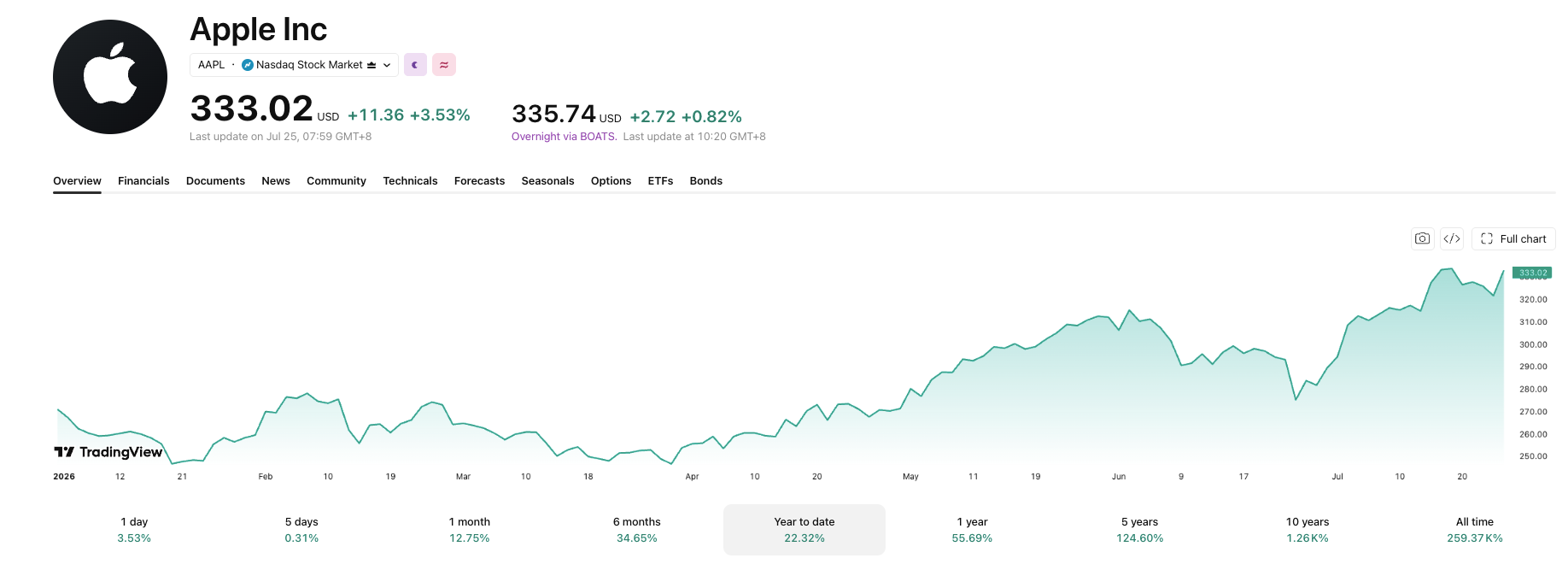
Apple reports Thursday alongside Amazon, in Tim Cook’s final earnings call as chief executive. Analysts expect revenue near $108.9 billion, per MarketBeat estimates. The company has leaned on a capital-light AI approach, avoiding the outsized spending pressuring rivals.
Apple stock hit a record high earlier this month as rising memory prices squeezed cheaper phone rivals.

SK Hynix reports first, on Tuesday
SK Hynix reports Tuesday, its first earnings since a record Nasdaq debut. Consensus points to 84.1 trillion won in sales, per Yonhap Infomax, which would set a new operating profit record. The report follows a volatile month, including a post-listing selloff and a KOSPI rebound past 7,000.
Brent’s climb past $100 adds another variable to the week. Investors are already juggling four earnings reports and a Fed decision in three days. Not to mention the price of oil has slid over 7% as hostilities eased in the Middle East
The post 5 Earnings Reports to Watch as Big Tech’s AI Spending Faces a Test appeared first on BeInCrypto.


Blockaid said an attacker drained about $450,000 in USDT from Garden Finance’s HTLC contracts across Ethereum, Base, Arbitrum and BNB Smart Chain.
Storj Labs, the decentralized cloud storage provider behind the STORJ token, has filed for voluntary Chapter 11 bankruptcy protection in the United States. The company says it will continue operating its network and providing customer services while it restructures legacy liabilities and seeks a court-approved pathway that could allow tokenholders to participate in the ownership of a post-bankruptcy entity.
In a statement released Sunday, Storj said the case was filed in the US Bankruptcy Court for the Northern District of West Virginia. Storj also stated that its parent company, Inveniam, will continue supporting the business during the restructuring process, subject to court oversight.
Key takeaways
- Storj Labs has entered voluntary Chapter 11, with the network and customer services expected to keep running during restructuring.
- The company is exploring a mechanism that could give STORJ tokenholders a route to equity in the reorganized business, but details remain undisclosed.
- Storj says its core network utility is unchanged and that its liabilities largely predate its current strategy.
- STORJ saw no immediate major price move at announcement time, trading around $0.072, according to CoinGecko.
Bankruptcy filing with continuity for the network
According to Storj’s filing announcement and accompanying community communication, the bankruptcy is primarily aimed at addressing legacy obligations that the company says are too significant to resolve through growth alone. Storj emphasized in an open letter to tokenholders that the platform’s operations were continuing normally and that the token’s utility would remain unchanged.
The company’s approach matters because decentralized infrastructure businesses rely on ongoing participation and service continuity. While Chapter 11 typically involves constraints around certain contracts and expenditures, Storj is positioning its restructuring as compatible with maintaining the storage network’s day-to-day functioning through the period of court supervision.
Tokenholders and the challenge of an equity pathway
Storj’s most notable claim is that management intends to propose a mechanism for STORJ tokenholders to participate in the equity of the reorganized company. The company, however, did not provide specifics on how eligibility would be determined—whether through a token snapshot, a lockup requirement, or other criteria. It also did not disclose what portion of equity, if any, might be reserved for tokenholders.
Storj acknowledged that any plan must comply with bankruptcy priority rules and receive court approval. That point is central: equity participation for token holders in bankruptcy typically depends on how the token’s legal and economic status is treated in the restructuring process, and on how the reorganization plan is structured relative to creditor claims.
The situation effectively becomes a live test of whether utility-token holders can secure a meaningful ownership role in a company emerging from Chapter 11, especially when the token’s utility is positioned as separate from the company’s preexisting liabilities.
Market reaction and what investors should watch
STORJ did not show an immediate sharp reaction following the news. CoinGecko data, as cited in the announcement coverage, indicated STORJ was trading around $0.072 at the time of writing.
For investors and network participants, the more consequential variable is unlikely to be the short-term token price—rather, it is the eventual shape of the Chapter 11 plan. The missing details from Storj’s statements include the criteria for tokenholder eligibility, the form participation might take (equity allocation versus other compensation structures), and whether there will be any valuation framework tied to token holdings.
As the process moves forward, readers should focus on court filings and confirmed reorganization terms: how Storj categorizes its liabilities, how claims are prioritized, and whether the proposed “shared ownership” pathway survives the restructuring review with creditor and court buy-in.
A broader pattern of crypto Chapter 11 filings
Storj’s bankruptcy comes amid a period in which at least two other crypto-related firms sought Chapter 11 protection. Movement Labs filed under Subchapter V on July 15 following months of turmoil connected to its MOVE token, while Bitcoin mining pool Poolin filed on July 22 as it pursued a court-supervised sale of two Texas mining sites. Separately, BitMEX announced in July that it would shut down after 11 years, choosing an orderly wind-down rather than filing for bankruptcy.
This clustering of Chapter 11 actions highlights a sector-wide reality: decentralized and blockchain-adjacent businesses still depend on traditional legal and financial structures when legacy obligations become unmanageable. For utility-token networks, that can create a difficult tension between keeping infrastructure running and negotiating outcomes that may reshape the relationship between token economics and corporate ownership.
What happens next for Storj
Storj’s next steps—especially the specifics of any tokenholder equity mechanism and the court-approved reorganization plan—will determine whether the company’s “shared ownership” vision is feasible within bankruptcy priorities. Until then, tokenholders will be watching for concrete filing details rather than assurances, and for confirmation that network continuity remains intact under court oversight.
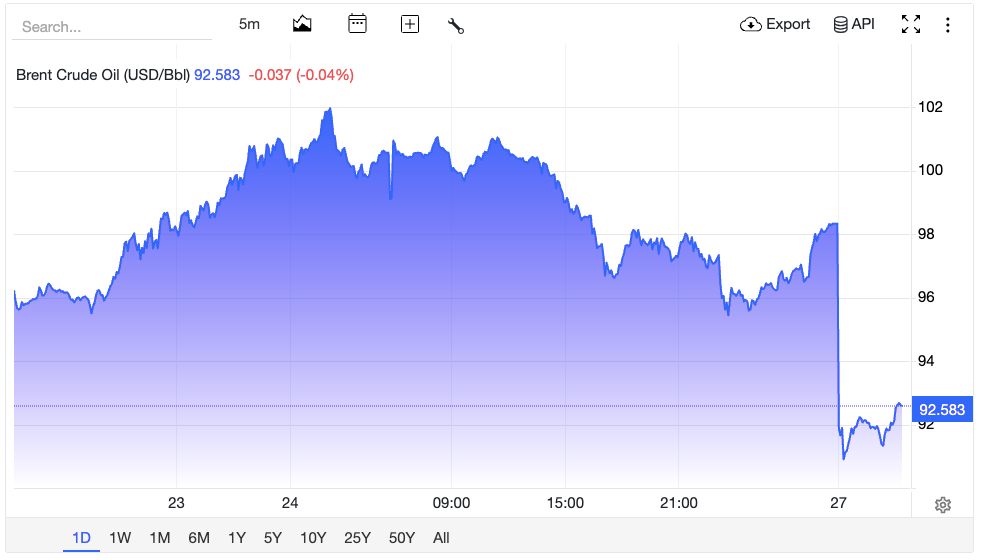
Oil prices tumbled Sunday after a senior Iranian official told Reuters that Tehran will halt its own attacks as long as the United States keeps its bombing pause in place. The move eased nearly two weeks of escalating conflict.
The price of Brent crude oil fell over 7% to touch a low of $90.9 a barrel. West Texas Intermediate crude oil also dropped as much as 7% to touch $84.
Tehran Sets Conditions for Oil
The Iranian source described Tehran’s stance as “attack for attack.” Iran will stop its operations once the US stops, and Tehran has already passed that message to Washington, according to the official’s account.
“There is more scepticism than optimism about the halt in attacks. The prevailing view is that the pause is tactical rather than genuine.”
The pause follows Washington’s decision to suspend its bombing campaign after 13 nights of US strikes. Advisers reportedly warned President Donald Trump that the military was running low on viable targets. They also raised concerns about depleting weapons stockpiles.

US Ambassador to the United Nations Mike Waltz said Trump chose the pause to give diplomacy room. Iranian officials voiced more doubt than hope that the calm will last.
Fed Watching Inflation Risk
HSBC US rates strategist Dhiraj Narula said pricier oil has revived bets that the Federal Reserve may hold rates higher for longer. He noted inflation expectations have stayed contained so far. Narula credited firm Fed messaging on price stability for that resilience, which has kept the energy rally from feeding into longer-term forecasts.
Brent held near $92 a barrel into Monday, confirming Sunday’s drop stuck rather than snapping back. Whether the halt lasts through the week will test if Tehran’s skepticism proves right, or if the pause turns into lasting de-escalation.
The post Oil Slides 7% as Iran Signals It Will Halt Attacks If US Pause Holds appeared first on BeInCrypto.


Decentralized cloud storage provider Storj Labs has filed for Chapter 11 bankruptcy protection. The company said it plans to keep its network running while restructuring legacy liabilities and exploring an ownership pathway for STORJ tokenholders.
On Sunday, Storj said it filed the voluntary case in the US Bankruptcy Court for the Northern District of West Virginia. The company said ordinary operations and customer services would continue during the process, subject to court oversight, while its parent company, Inveniam, would continue to support the business.
The restructuring could become an unusual test of whether utility-token holders can participate in the ownership of a company emerging from bankruptcy.
In an open letter to its community, Storj said its liabilities largely predate its current strategy and are too substantial to resolve through business growth alone. It said the network continues to operate normally and its token’s utility is unchanged.
STORJ showed no significant immediate price reaction following the announcement, trading around $0.072 at the time of writing, according to CoinGecko.
Storj explores equity pathway for tokenholders
Storj said management intends to propose a mechanism allowing tokenholders to participate in the reorganized company’s equity.
However, Storj has not disclosed how tokenholder eligibility would be determined, whether participation would involve a token snapshot or lockup, or how much equity might be allocated. The company acknowledged that any plan must follow bankruptcy priorities and receive court approval.
Cointelegraph reached out to Storj for comment but did not receive a response before publication.
Storj is among the crypto industry’s longest-running decentralized infrastructure projects. Storj began in 2014 as an open-source peer-to-peer cloud storage project that sought to let users rent storage from other network participants rather than rely on centralized providers.
Related: BitMEX hit with 623 BTC lawsuit on day it announces shutdown
Storj’s bankruptcy filing comes in the same month as at least two other crypto companies sought Chapter 11 protection.
Movement Labs filed under Subchapter V on July 15 after months of turmoil linked to its MOVE token, while Bitcoin mining pool Poolin filed on July 22 as it pursued a court-supervised sale of two Texas mining sites.
BitMEX also announced in July that it would shut down after 11 years. Still, the derivatives exchange did not file for bankruptcy, instead opting for an orderly wind-down following a strategic review.
Magazine: CLARITY hopes fade, BitMEX shuts as lawsuit looms: Hodler’s Digest

Kids eat free: Restaurants offering family meals this summer

Politics And The Markets 07/27/26

SK Hynix, Samsung Ink $950 Billion AI Chip Deals, But Stocks Still Slide


-

 Fashion2 days ago
Weekend Open Thread: Brooks Brothers
-

 Crypto World6 days ago
Grayscale Files For Worldcoin ETF, WLD Registers Sharp Rise
-

 NewsBeat5 days ago
How a former Blue Peter presenter stunned America’s Got Talent judges
-

 Tech6 days ago
Sail Virtually Aboard The “Itanic” With IA-64 Emulator
-
 Tech6 days ago
Turtle Beach Command Series KB7 review: a nifty screen-equipped gaming keyboard
-

 NewsBeat7 days ago
Unregistered fitter used Gas Safe logo on business flyers
-

 Tech4 hours ago
Intel is reversing course and bringing hyper-threading back to its server chips
-
 Business5 days ago
New Jersey voter registration controversy explained: How 6,600 noncitizens got on the rolls, and what happens next
-
 Entertainment5 days ago
Johnny Depp’s R-Rated Gothic Cult Classic Gets New Release Ahead of Sydney Sweeney Remake
-

 Tech7 days ago
Watch Flock Safety CEO Garrett Langley discuss the future of surveillance at TechCrunch Disrupt 2026
-

 Crypto World4 days ago
Ethics, other provisions in crypto Clarity Act to be further discussed
-
 NewsBeat6 days ago
Shanghai science forum photos show China’s AI and robotics advances in rivalry with US
-

 Crypto World7 days ago
Circle’s President Sold Over 360,000 Shares, The Filings Explain Why
-

 Tech7 days ago
Subway Sandwich Computers Get a Second Life as Gaming Machines
-
 Sports8 hours ago
Commonwealth Games boxing: Jadumani Singh seals dominant 5-0 win over Pakistan’s Sumama Rehman to enter quarter-finals | Commonwealth Games News
-

 News Videos3 days ago
The Peugeot Family: How 200 Years of an “Old Money” Dynasty Died in A Boardroom
-

 Sports3 days ago
2026 3M Open leaderboard: Scottie Scheffler finds putter in Round 1, sits three back
-

 Politics15 hours ago
Spain sweeps the board at 2026 World Cup with individual awards
-

 Fashion3 days ago
16 Dresses for the High Summer Event
-

 Crypto World6 days ago
Andrew Cuomo joins OKX board as crypto exchange expands in U.S.
You must be logged in to post a comment Login