

Crypto World
Strait of Hormuz Crisis Intensifies as Iran Arrests Suspects and Fuel Prices Soar


TLDR:
- Iran arrests dozens accused of assisting Israeli strikes amid rising Strait of Hormuz tensions.
- Trump urges U.S. allies to deploy warships to secure the strategic Strait of Hormuz.
- Shipping disruptions and drone threats trigger fuel shortages across Asia and global markets.
- Formula One cancels Bahrain and Saudi races due to regional security concerns in the Gulf.
The Strait of Hormuz crisis intensifies as Iran arrests dozens accused of helping Israeli strikes. Washington pressures allies to deploy warships, triggering energy supply disruptions across Asia and forcing global trade adjustments.
Iran Arrests and Regional Tensions
According to a report by Reuters, Iran has detained dozens of people accused of aiding Israel in targeting military sites. State-linked media reported that the arrests occurred across multiple provinces, involving coordinated security operations.
Authorities claim suspects gathered intelligence on sensitive military and economic infrastructure. Officials say these actions were part of a wider effort to prevent ground-level tip-offs to Israel.
The arrests coincide with U.S. President Donald Trump has warned of potential strikes on Kharg Island. Trump also pressed allies to deploy warships to safeguard the Strait of Hormuz, a vital shipping route for global oil.
Diplomatic efforts by Oman and Egypt to mediate ceasefire discussions have been rebuffed by Washington. Iran insists no talks will occur until U.S. and Israeli strikes stop, maintaining a firm stance on security concerns.
The ongoing tension has increased risks for vessels passing through the Strait of Hormuz.
Several countries continue to explore diplomatic channels to avoid further escalation, though results remain limited.
Fuel Shortages and Economic Ripple Effects
Shipping disruptions in the Strait of Hormuz have caused significant delays for tankers and cargo vessels. Drone attacks and regional military activity have raised concerns for commercial and fuel shipments.
Japan announced the release of 80 million barrels of oil from national reserves to stabilize supply. The release represents about 45 days of consumption but will reduce reserves by roughly seventeen percent.
India faces domestic unrest due to cooking gas shortages, with protests erupting across major cities. Residents queued for hours while some households resorted to burning wood and other materials for meals.
Iran has allowed limited passage to Indian vessels, yet several tankers remain stranded. Sailors reported drones and fighter jets nearby while awaiting clearance through the waterway, heightening anxiety.
Global sports have also been affected, with Formula One canceling races in Bahrain and Saudi Arabia. Security threats and airport closures across the Gulf made hosting these events unsafe, reducing the season calendar from twenty-four to twenty-two races.
The Strait of Hormuz crisis continues to disrupt global trade and fuel supplies. Governments, shipping companies, and international organizations are monitoring developments closely to manage risks.




Bitcoin’s price has risen past its key average for the first time in two months, signaling strengthening bullish momentum.
The cryptocurrency’s price has gained over 3% to $73,700 in 24 hours, topping the 50-day moving average, which stood at $71,125 at the time of writing. The positive price action follows days of resilient performance amid the Iran war and global equity turmoil, especially in Asian markets.
The so-called 50-day moving average is one of the most widely tracked momentum indicators in the market, which analysts recently cited as one of the formidable resistance levels holding back gains.
“This indicator often signals the medium-term trend, and a confident break above it would be an important turning point in the coming days,” Alex Kuptsikevich, senior market analyst at FxPro, said in an email.
Note, however, that the bullish breakout doesn’t necessarily promise a sustained uptrend. For instance, the previous one in early January was followed by an 8% price rise, but the momentum lasted just two weeks before selling resumed. Previous instances have delivered mixed results as well.
For now, the breakout, points to a continued move higher and perhaps increased volatility as prices move closer to the $75,000 mark. This is the level where market makers – those ensuring a smooth trading experience by providing liquidity on an exchange – hold net short gamma positions worth billions, as CoinDesk noted Friday.
So, as prices rise toward $75,000, they are likely to buy high to rebalance their net exposure to neutral. This could add to market volatility.
Blockfills, a Chicago-based crypto trading firm, has filed for bankruptcy, as the crypto winter takes its toll on the industry.
On Sunday, BlockFills operator Reliz Ltd. and three affiliated entities filed voluntary Chapter 11 restructuring petitions in the U.S. Bankruptcy Court for the District of Delaware, according to documents seen by CoinDesk.
The court filing shows Reliz reporting assets between $50 million and $100 million against liabilities of $100 million to $500 million, a stark indicator of the mounting pressures in its crypto trading operations.
The company decided to file for bankruptcy after consulting all stakeholders, it said in an official statement.
“After extensive discussions with investors, clients, creditors, and other stakeholders, BlockFills has determined that a voluntary chapter 11 filing is the most responsible path forward in order to preserve the value of the business and maximize recoveries for stakeholders. This filing will allow the firm to implement an orderly restructuring while maintaining transparency and oversight through the court-supervised process,” it said.
“To that end, on March 15, 2026, certain BlockFills-related entities filed a voluntary petition to restructure under Chapter 11 of the U.S. Bankruptcy Code in the U.S. Bankruptcy Court for the District of Delaware,” it added.
CoinDesk reported last month that the crypto lender had lost about $75 million and was seeking a buyer or emergency funding.
BlockFills is a crypto trading and lending firm that provides liquidity, financing and risk-management services to institutional clients. Its platform facilitates crypto lending and borrowing, derivatives trading and over-the-counter (OTC) execution for hedge funds, asset managers, market makers and mining companies.
The company is backed by institutional investors including Susquehanna Private Equity Investments, CME Ventures, Simplex Ventures, C6E and Nexo Inc.
A U.S. federal judge issued a temporary restraining order (TRO) against BlockFills last week in a lawsuit brought by Dominion Capital.
Dominion alleged that the firm had misappropriated and improperly retained millions of dollars in customer crypto assets, commingled client funds and concealed significant losses.
BlockFills said on Feb. 11 it was halting customer withdrawals and deposits due to recent market and financial conditions.
The company said at the time it was working with investors and clients to reach a swift resolution and restore liquidity to the platform. CoinDesk later reported that the crypto lender had lost about $75 million and was seeking a buyer or emergency funding.
CoinDesk also reported that BlockFills co-founder and CEO Nicholas Hammer had stepped down from his leadership role. Joseph Perry is the firm’s interim CEO.
BlockFills said it processed more than $60 billion in trading volume in 2025, up 28% from the prior year, and is among the more active institutional crypto lending and borrowing desks. The firm serves about 2,000 institutional clients, including hedge funds, asset managers and mining firms.
Read more: U.S. judge freezes BlockFills assets in dispute over 70 bitcoin with creditor Dominion Capital

A block on stablecoin yield payments in the US will likely prompt other countries to step up and offer the option, according to Takatoshi Shibayama, Asia-Pacific lead at crypto wallet company Ledger.
Shibayama told Cointelegraph that if a wider ban on stablecoin yields is enacted in the US, it “definitely opens up a conversation” between institutions, stablecoin issuers and regulators overseas about how to respond.
He said countries such as Australia have given stablecoin issuers a regulatory carveout, but most stablecoins, even outside of the US, are “not providing yields or rewards to their user base just so that they can protect the banks’ interest.”
“If that were to change in the US, then I think it definitely opens up a lot of conversation between the stablecoin issuers and the regulators to allow yields or rewards to be passed through to their user base,” Shibayama said.

The US Senate is currently working on a bill to outline how market regulators will police crypto, but a banking lobby-supported provision to ban third-party platforms from offering stablecoin yields has stalled the legislation, as crypto lobbyists have resisted the ban.
Meanwhile, Shibayama said there’s been a shift in how Asia’s financial heavyweights have approached crypto.
Asia’s institutions focused on blockchain, not crypto
Shibayama said that since last year, “there has been a bit of a decoupling of crypto and the rest of blockchain technology” in Asia, and institutions are not really looking at products offering exposure to cryptocurrencies.
“They’re really looking at: Can they tokenize their financial products? Can they issue stablecoins?” he said. “There’s been lots of talks around that as opposed to offering DeFi and staking.”
“The institutions have carefully selected what they want out of this blockchain technology and then leaving crypto — the Bitcoins and Ethereums of the world — out of the conversation.”
Related: Blockchain firm eyes $200M in tokenized water projects across Asia
Shibayama said asset managers “are a little bit different” and are still looking at launching crypto products to increase the variety of what they can offer to clients, and are also drawn to doing so as there aren’t “strict regulations around them having to have a regulated custodian.”
“Obviously, they prefer to have regulated custodians,” he added. “They’re becoming a lot more selective on how they choose their custody provider.”
Magazine: All 21 million Bitcoin is at risk from quantum computers
Additional reporting by Stephen Katte.
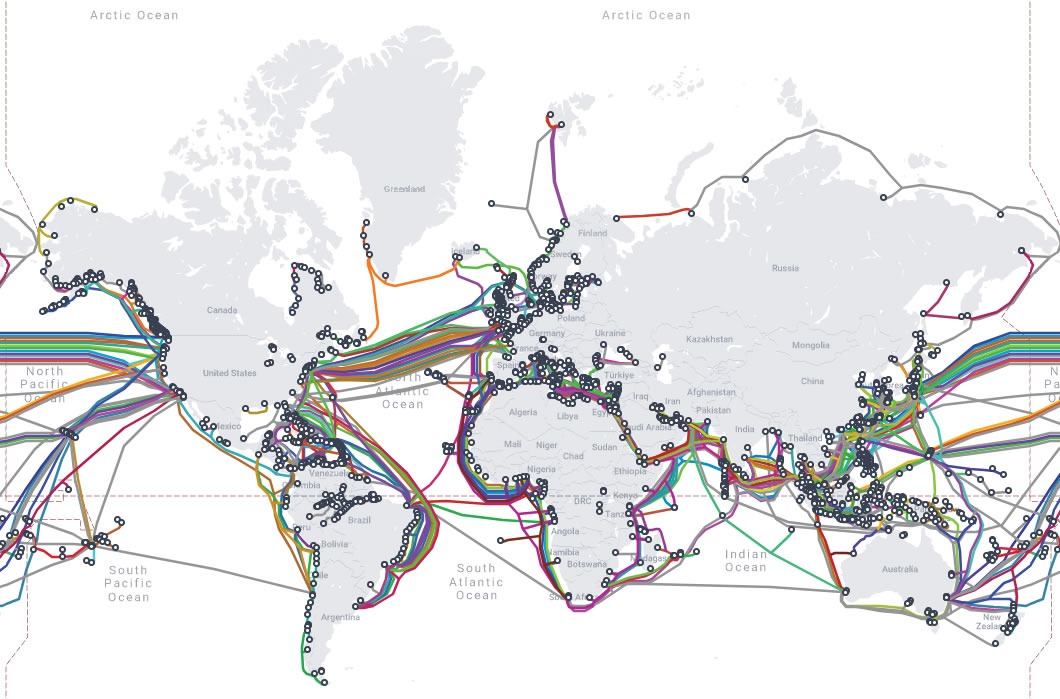
Nearly three-quarters of all undersea fibre optic internet cables (which carry about 99% of international internet traffic) would need to fail to have a significant impact on Bitcoin, according to a study released earlier this year.
In research first published in February and last revised on March 12, researchers Wenbin Wu and Alexander Neumueller from the Cambridge Centre for Alternative Finance said they used P2P network data from 2014 to 2025 and 68 verified cable fault events to apply a country-level cascade model to determine Bitcoin’s physical infrastructure resilience.
They claim it to be the first longitudinal study of Bitcoin’s resilience to submarine cable failures, and it helps to answer a long-standing question about what would happen to Bitcoin if the internet were to be disrupted.

The researchers found that the critical failure threshold for random cable removal sits at 0.72 to 0.92, meaning 72% to 92% of all “inter-country” submarine cables would need to fail before more than 10% of network nodes disconnect.
However, the Bitcoin network was more vulnerable to targeted attacks on certain subsea cable chokepoints, with researchers calling it an “order of magnitude more effective,” with a critical failure threshold of 0.05 to 0.20.
Tor routing provides greater resilience
The study also found that Tor (The Onion Router) “creates a compound barrier to disruption,” given the current concentration of relay infrastructure in well-connected European countries.
Tor is similar to VPNs (virtual private networks), bouncing web traffic through a chain of volunteer-run servers around the world, wrapping each hop in a layer of encryption for privacy, like the layers of an onion.
Related: Is Tor still safe after Germany’s ‘timing attack?’ Answer: It’s complicated…
The Bitcoin network uses Tor to obfuscate nodes, meaning their physical locations are hidden. The paper revealed that 64% of Bitcoin nodes are essentially “invisible” to researchers.
“Tor adoption increases resilience under current relay geography rather than introducing hidden fragility,” it stated.
This is because Tor relay infrastructure is concentrated in Germany, France, and the Netherlands — countries with extensive and redundant submarine cable connectivity — so cable failures rarely take down relay capacity.

Near-zero correlation between cable events and BTC price
The researchers concluded that 87% of the 68 verified historical cable fault events caused less than a 5% node impact, and cable events showed essentially zero correlation with Bitcoin (BTC) prices, or a statistically insignificant correlation coefficient of −0.02.
They also note that the geographic diversification of BTC mining “has not materially altered infrastructure resilience,” which is consistent with physical cable topology rather than with hashrate distribution.
Magazine: Big questions: Would Bitcoin survive a 10-year power outage?

BlockFills, a crypto lending platform that paused client deposits and withdrawals last month, has filed for Chapter 11 bankruptcy protection in the United States. The action, centered in a Delaware bankruptcy court, is being pursued by Reliz LTD—BlockFills’ operating company—along with three related entities, as management seeks to restructure the firm. The move comes as the firm confronts a liquidity environment deteriorating alongside a broad downturn in crypto markets, with stakeholders urged to participate in a process intended to preserve value and maximize recoveries where possible.
Key takeaways
- BlockFills’ operating entity Reliz LTD and three related companies filed for Chapter 11 bankruptcy in Delaware to pursue a restructuring plan.
- The company says the filing follows extensive discussions with investors, clients, creditors, and other stakeholders and aims to preserve value and maximize recoveries.
- The Chapter 11 process is described as a path to stabilize the business, pursue additional liquidity, and explore potential strategic transactions.
- Deposits and withdrawals had already been suspended last month as part of risk management during a sustained crypto-market downturn.
- The firm’s move reflects ongoing distress in the sector, where lending platforms face heightened liquidity scrutiny and regulatory considerations.
- Authorities and creditors will now evaluate reorganization options, with a focus on consensual restructuring rather than immediate liquidation.
Tickers mentioned: $BTC
Sentiment: Neutral
Price impact: Negative. The bankruptcy filing and prior suspension of customer funds signal adverse consequences for users and creditors amid a souring market backdrop.
Market context: The Chapter 11 filing occurs within a window of liquidity tightening and risk-off sentiment across crypto markets. As lending platforms recalibrate their balance sheets and fund flows, observers are watching for how regulatory signals and macro conditions shape opportunities for recovery and potential consolidation in the sector.
Why it matters
The BlockFills development marks a notable instance of distress within the crypto lending space, a sector that has drawn intensified scrutiny as the wider market has cooled. Chapter 11 protection gives the company time to reorganize its obligations under court supervision, with the objective of preserving enterprise value and providing creditors a framework to recover assets where possible. For customers, the case underscores the potential risk of fund exposure on platforms that pause access during periods of market stress, while creditors and investors will be seeking clarity on recovery prospects and the likelihood of a consensual resolution.
The operational backdrop matters because it illustrates how a downturn can compress liquidity horizons for mid-sized crypto lenders. When platforms suspend withdrawals and then file for Chapter 11, the path to liquidity generally shifts from organic cash flow toward a court-supervised process that may include asset sales, debt restructurings, or new financing. In this context, the industry’s resilience hinges on the ability of such firms to demonstrate robust governance, transparent access to information, and a credible plan to stabilize operations and rebuild trust with users and counterparties.
Beyond BlockFills itself, the episode signals to the market that Chapter 11 filings can be a tool for restructuring in an environment where crypto prices and institutional funding remain sensitive to macro shifts. While some observers see Chapter 11 as a means to salvage value and prevent outright liquidation, others warn that ongoing creditor negotiations and liquidity challenges can extend timelines and complicate outcomes. The situation also reinforces why regulators and platform operators have emphasized risk controls, transparent disclosures, and adherence to consumer protections as the sector continues to mature.
What to watch next
- Proceedings in the Delaware court: initial filings, the appointment of a bankruptcy trustee or debtors-in-possession, and the timeline for creditor meetings.
- Submission of a reorganization plan: terms of proposed debt restructuring, potential asset sales, and avenues for new liquidity commitments.
- Creditor committees and stakeholder negotiations: who signs onto a consensual restructuring, and what recoveries may be feasible for clients and lenders.
- Regulatory and compliance developments: any rulings or guidelines that could influence the restructuring, consumer protections, or platform governance.
Sources & verification
- BlockFills and Reliz LTD Chapter 11 filings with the Delaware bankruptcy court, including official court docket entries.
- Company statements describing extensive discussions with investors, clients, creditors, and other stakeholders and the intent to pursue consensual restructuring.
- Historical context of deposits and withdrawals suspension amid a broader crypto-market downturn.
- Market data indicating crypto price volatility and the general risk environment affecting lending platforms.
BlockFills files for Chapter 11 in Delaware amid market downturn
BlockFills moved to Chapter 11 protection in a bid to stabilize operations and pursue a path toward liquidity and potential strategic transactions. Reliz LTD, the platform’s operating company, together with three affiliated entities, filed the petition in a Delaware court after previously pausing user deposits and withdrawals. The decision to seek relief under Chapter 11 reflects a structured attempt to navigate a distressing period for the industry, with the objective of preserving enterprise value while balancing the interests of clients and creditors.
The company stressed that the bankruptcy filing followed “extensive discussions with investors, clients, creditors, and other stakeholders,” underscoring a collaborative approach to the restructuring process. The statement emphasized that initiating a Chapter 11 process—aimed at a consensual restructuring—would provide the necessary time and framework to stabilize the business, pursue additional liquidity and recovery options, and explore potential strategic transactions that could align with long-term value creation.
In the framing of the filing, BlockFills highlighted the broader market backdrop—the downturn that has weighed on crypto prices and liquidity across the sector. For context, Bitcoin price data illustrates a sharp swing as markets cooled, with Bitcoin (CRYPTO: BTC) price data showing a move from the high near $97,000 in mid-January to roughly the $64,000 level by early February (BTC). While the price move is a general market dynamic, it compounds the operational challenges faced by lending platforms that rely on customer inflows and lender funding to sustain activity and risk management programs.
The decision to suspend deposits and withdrawals last month had already signaled the severity of pressures in the market. Management suggested the step was taken to protect the business and clients amid a broad downturn, a move that preceded the bankruptcy filing and indicated the company’s need for a formal restructuring process rather than ad hoc liquidity measures. The filing itself does not necessarily imply liquidation; rather, it positions BlockFills to pursue a consensual restructuring with stakeholders under the shelter of court oversight, allowing for the orderly reallocation of assets and liabilities and the potential reinvigoration of strategic avenues.
As the case unfolds, observers will be watching for how the company interfaces with creditors and clients, and what form a viable recovery might take. This includes evaluating the potential for asset sales, new financing arrangements, or other strategic transactions that could restore confidence and provide a path to continued operations. The sector’s trajectory—shaped by regulatory clarity, risk controls, and macro conditions—will influence the pace and outcomes of any restructuring plan. The bankruptcy process, at its core, seeks to balance the immediate needs of customers and creditors with the long-term viability of the business, a delicate calculus that will unfold in the weeks and months ahead.
Developments in this case are being closely watched by market participants who weigh the implications for other lenders and borrowers in the ecosystem. While bankruptcy proceedings can be lengthy and complex, their results often center on whether a consensual restructuring can be achieved without a broad disruption to user access and without eroding the capital structure necessary to support future operations. In the meantime, the incident underscores the ongoing importance of robust risk controls, transparent disclosures, and proactive regulatory engagement for platforms operating in the crypto lending space.


BlockFills has filed for Chapter 11 bankruptcy in the US after suspending deposits and withdrawals last month, citing poor crypto market conditions.
Crypto lending platform BlockFills has filed for bankruptcy in the US after the company halted customer deposits and withdrawals last month.
Reliz LTD, BlockFills’ operating company, along with three other related companies, filed for Chapter 11 bankruptcy in a Delaware bankruptcy court in a bid to restructure the firm.
BlockFills said in a statement that filing for bankruptcy came after ”extensive discussions with investors, clients, creditors, and other stakeholders,” and the restructuring would “preserve the value of the business and maximize recoveries for stakeholders.”
“The BlockFills team has worked diligently to pursue and evaluate all available strategic and financial alternatives and believes initiating a chapter 11 process, with the intention of consummating a consensual restructuring with our clients and creditors, will provide the necessary time and structure to stabilize the business, pursue additional sources of liquidity and recovery, and explore potential strategic transactions,” the company said.
Related: Judge freezes 71 Bitcoin in BlockFills case over customer fund claims
Last month, BlockFills suspended customer deposits and withdrawals, citing the need to protect its business and clients amid a broad crypto market downturn that saw Bitcoin (BTC) tumble from over $97,000 to under $64,000 between mid-January and early February.
This is a developing story, and further information will be added as it becomes available.
Magazine: Bitcoin’s ‘biggest bull catalyst’ would be Saylor’s liquidation — Santiment founder
Crypto World
China’s factory output and consumption beat forecasts, while property investment contraction slows
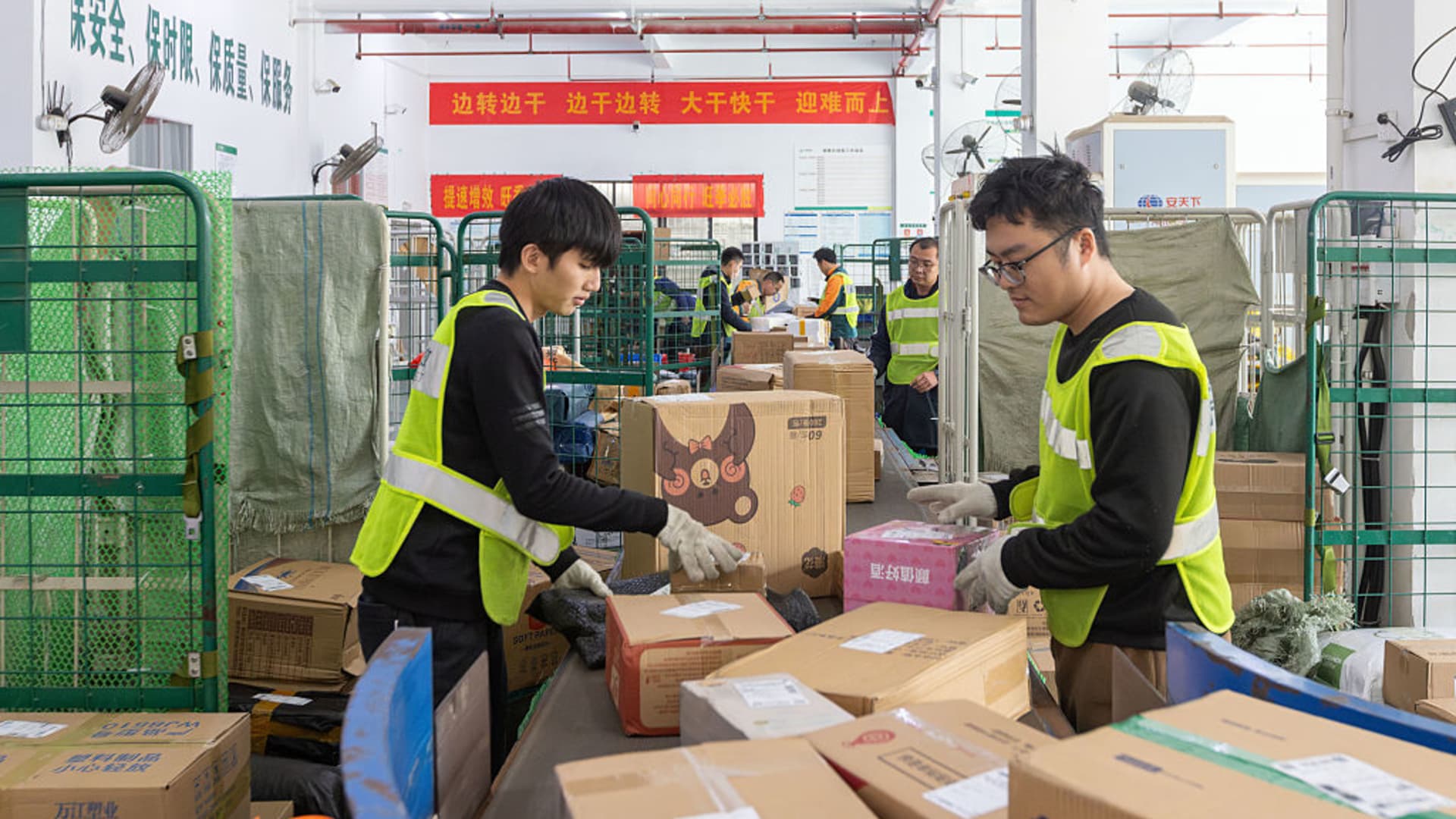
Staff sort parcels on the mail sorting assembly line at the Postal Delivery Logistics Joint Distribution Center in Mengshan County, Wuzhou City, Guangxi Province, China, on January 28, 2026. (Photo by Costfoto/NurPhoto via Getty Images)
Costfoto | Nurphoto | Getty Images
China’s economy started on a strong footing this year, with consumption and production both beating expectations as holiday spending and strong foreign demand provided an early boost.
Retail sales for the first two months of the year rose 2.8% from a year earlier, beating economists’ forecast for a 2.5% growth, while reflecting a notable slowdown from the 4% growth in the January-February period in 2025.
Industrial output climbed 6.3%, also exceeding expectations for a 5% jump in a Reuters poll. Industrial production has been a relative bright spot in the world’s second-largest economy, thanks to resilient external demand, particularly from European and Southeast Asian nations.
Investment in fixed assets, which includes property, advanced 1.8% from a year earlier, compared with the forecast of a 2.1% drop. Investment in real estate development declined further as a real estate crisis dragged on, falling 11.1% in January and February, moderating from the 17.2% drop in 2025.
The fixed asset investment saw an unprecedented slump in 2025, declining 3.8% year over year, as a deepening property downturn and tighter constraints on local governments’ borrowing hampered one of China’s traditional growth drivers.
Chinese leadership unveiled its annual economic goals for 2026 just last week, tamping down the GDP growth target to a range of 4.5% to 5%, the least ambitious goal on record going back to the early 1990s.
This is breaking news. Please refresh for updates.
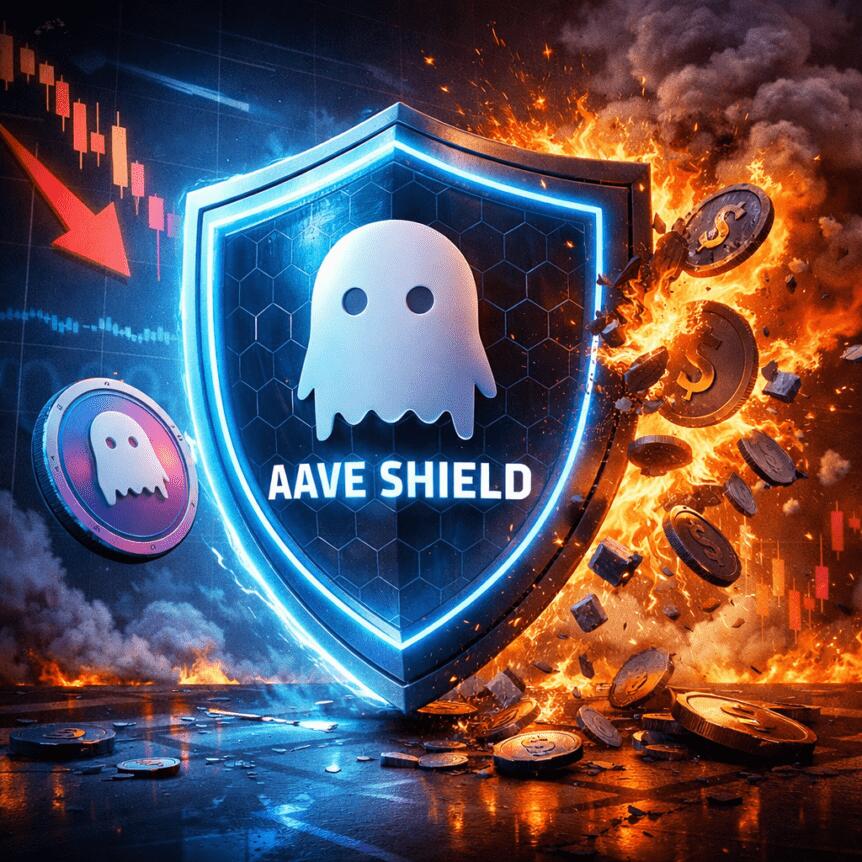
Decentralized finance protocol Aave is moving to tighten protections after a dramatic interaction on the CoW Swap interface led to a roughly $50 million loss in a single trade. The proposed safeguard, still described as a forthcoming feature, aims to cap price impact on swaps executed through Aave’s own interface, reflecting ongoing concerns about liquidity fragmentation and the risks that automated market-making can pose in stressed markets. The incident centered on a trader who attempted to swap about $50.4 million worth of USDt for Aave’s native token through CoW Swap but received only around $36,500 of the token, underscoring the fragility of routing in an illiquid environment. A substantial portion of the loss was magnified by a Maximal Extractable Value bot that executed a sandwich sequence, capturing nearly $10 million in the process.
Key takeaways
- Aave plans to deploy a feature called Aave Shield that blocks swaps with a price impact above 25% when using the Aave interface, addressing a recent large-value trade failure.
- The high-stakes trade involved converting USDt for AAVE via CoW Swap, where liquidity gaps produced a final payout of only a fraction of the intended amount, illustrating liquidity fragmentation concerns.
- A MEV bot executed a sandwich attack in the same event, contributing roughly $10 million to the total loss and highlighting incentive structures that attackers leverage in DeFi trades.
- A user reportedly saw multiple warnings on the platform, including notes that a route might return less due to low liquidity or small order size, and explicitly confirmed a potential 100% value loss before finalizing the swap.
- CoW DAO attributed the extreme price impact to liquidity deficiencies and several infrastructure failures, including an outdated gas limit that hindered better-priced quotes.
Tickers mentioned: $AAVE, $USDT
Price impact: Negative — the trade exceeded a 25% price-improvement threshold, contributing to a loss of about $50 million and underscoring liquidity-driven risk in cross-exchange routing.
Market context: The episode underscores ongoing fragility in DeFi trading infrastructure amid liquidity fragmentation, MEV-driven risks, and the need for clearer risk disclosures and guardrails as users navigate multiple on-chain venues.
Why it matters
In decentralized finance, liquidity is the lifeblood that enables large swaps to execute without slippage. When liquidity pockets are thin or misaligned, even sophisticated routing engines can deliver outcomes far from the expected fair value, especially on trades of tens of millions of dollars. The Aave Shield proposal signals a shift toward user protections that don’t necessarily rely on post-trade refunds or off-chain interventions. By setting a 25% price-impact guardrail, the protocol aims to prevent users from unintentionally triggering extreme slippage, a feature that could reduce the likelihood of catastrophic outcomes in high-volume trades conducted on Aave’s interface.
The incident also spotlights the persistent incentives for attackers within DeFi ecosystems. A MEV bot earned an estimated $10 million through a sandwich attack tied to the same trade, illustrating how opportunistic front-running and optimization strategies can exploit routing inefficiencies. This reality reinforces the argument that security and risk controls in DeFi must address both the mechanics of on-chain order execution and the broader economic incentives that shape mempool activity and liquidity provisioning. For builders and investors, the event emphasizes the value of robust monitoring, greater transparency around routing logic, and the potential benefits of standardized safeguards that reduce the chance of outsized losses in complex transactions.
CoW DAO’s assessment adds nuance to the discussion by pointing to infrastructure gaps, not just liquidity depth. It noted that an outdated gas limit in a solver used by CoW Swap hindered better-priced quotes from being submitted, leaving users with inferior options. A possible mempool leak was also discussed as a contributing factor to the outsized quote that informed the loss. The joint acknowledgment from Aave and CoW DAO that “not all issues are fully resolved” underscores the collaborative path ahead—fixes, audits, and perhaps new safeguards—needed to improve resilience in cross-ecosystem swaps that lean on multiple on-chain participants.
As the ecosystem matures, projects that overlap between lending protocols and decentralized exchanges increasingly rely on layered protections. Aave Shield, if implemented as described, would add a proactive defense rather than a reactive one, potentially reducing users’ exposure to price impact during volatile periods. The broader takeaway is that users must remain vigilant about routing expectations, price impact disclosures, and the liquidity conditions of the venues they choose for substantial trades. The episode serves as a litmus test for how DeFi platforms balance safety features with user autonomy, especially when dealing with high-value, cross-chain liquidity movements.
What to watch next
- Deployment timeline for Aave Shield and its configurable toggle, with a focus on whether it will be opt-in by default and how users can adjust risk settings.
- Formal updates from Aave and CoW DAO detailing findings from the incident and any roadmap shifts for liquidity provisioning, solver updates, or mempool protections.
- Any governance actions or community discussions about routing heuristics, price impact thresholds, and UX warnings on swap interfaces.
- Further investigations into MEV defense mechanisms and whether new protections integrate with CoW Swap’s routing logic or other DEX aggregators.
- Monitoring of liquidity depth changes across major stablecoins and DeFi venues during periods of market stress to gauge resilience improvements.
Sources & verification
Aave Shield aims to curb high-impact swaps after a $50 million loss
Aave Shield is designed to block swaps with a price impact above a defined threshold for trades conducted via the Aave interface. The feature, described in a post-mortem by the team, represents an attempt to introduce a guardrail before trades are signed, reducing the likelihood that users are exposed to extreme slippage in low-liquidity scenarios. The proposed guardrail is anchored to a 25% price impact limit and would be activated automatically for standard route options, with the option for users to disable Shield if they accept higher risk channels. The incident that prompted the plan involved a trader who moved USDt to AAVE on CoW Swap and encountered a dramatic discrepancy between expected and actual takedown values, highlighting how quickly liquidity conditions can shift in high-value trades.
The interaction underscores a broader challenge for DeFi—balancing user freedom with protective barriers that do not stifle legitimate, sophisticated trading strategies. While shield features cannot eliminate all forms of risk, they can help prevent traders from signing away too much value in a moment of liquidity stress, potentially safeguarding both retail and institutional participants. The ongoing collaboration between Aave and CoW DAO signals an intent to address root causes—ranging from liquidity provisioning to on-chain quote accuracy and gas-limit governance—that contribute to extreme price disclosures in real-world trades.
As the ecosystem continues to adapt, the industry will watch closely how these protections perform in live markets, especially during periods of volatility. If Aave Shield proves effective, it could set a precedent for more proactive risk controls across DeFi interfaces, encouraging exchanges and aggregators to refine their pricing models and warning systems. For users, the episode reinforces the importance of reading on-screen risk disclosures, understanding the consequences of high-impact routes, and considering the broader liquidity landscape when executing multi-million-dollar swaps.
Decentralized finance protocol Aave said it is introducing a new feature to block swaps with a price impact above 25% after a user lost $50 million in a trade while interacting with Aave’s interface last week.
“We are soon deploying a new feature, Aave Shield, which provides more protections for users who use the swap feature in the Aave interface aave.com,” Aave said in a post-mortem statement on Saturday.
Aave said users would need to manually disable the Aave Shield protection feature to proceed with high-risk trades.
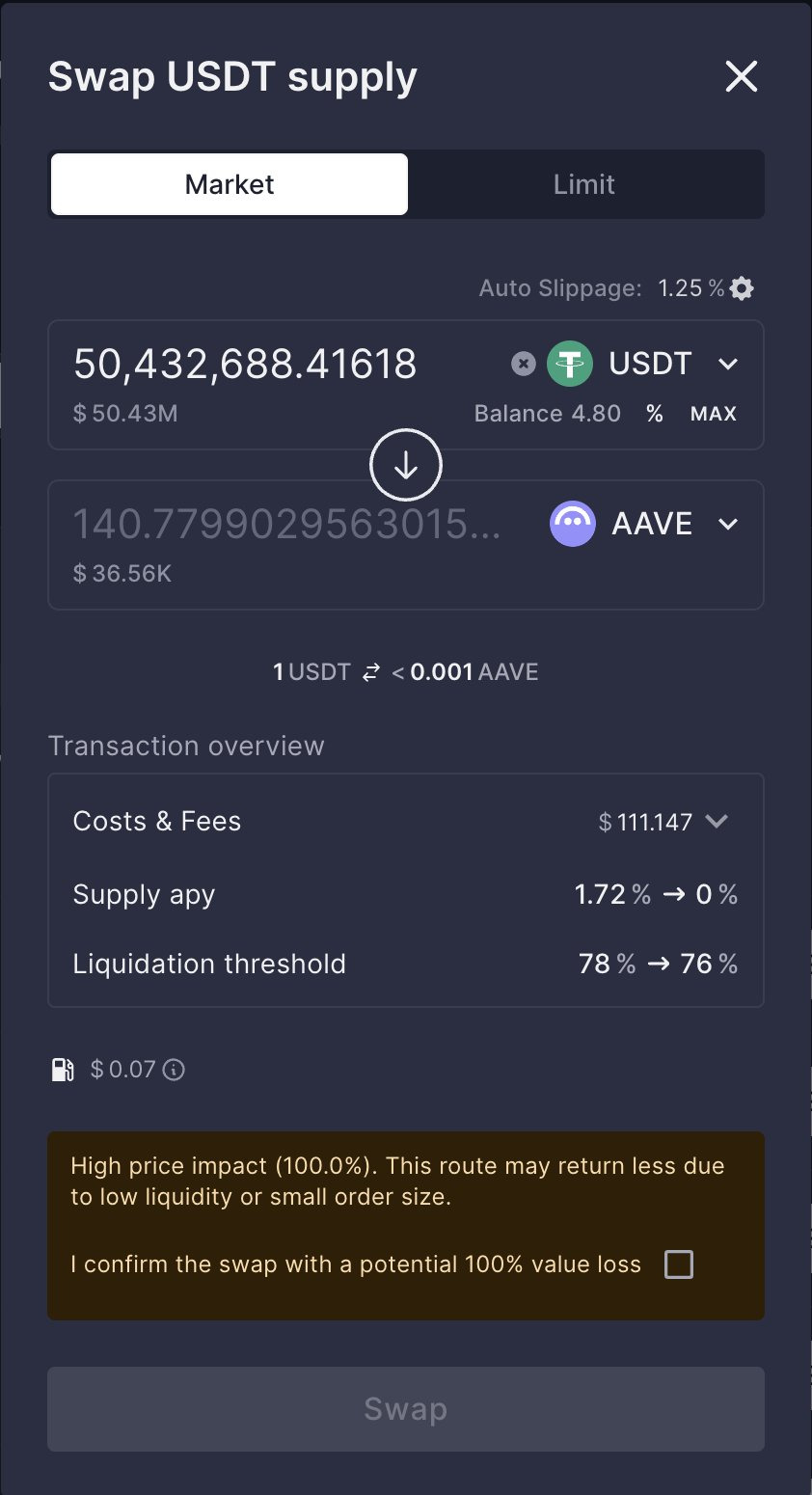
The incident occurred on Thursday, when the user went to convert $50.4 million worth of USDt (USDT) for Aave (AAVE) via decentralized exchange CoW Swap, but received only $36,500 worth of Aave due to a lack of liquidity and other infrastructure failures, generating a loss of just over $50 million.
Part of this loss was also a result of a Maximal Extractable Value (MEV) bot that executed a sandwich attack on the user, profiting nearly $10 million.
User ignored multiple warning signs
Aave said the user signed the transaction despite multiple warnings appearing on the platform’s interface.
This included alerts about a “high price impact” and a notice stating the route might return less due to low liquidity or small order size.
The user also ticked a confirmation box stating, “I confirm the swap with a potential 100% value loss,” Aave said.

Incident shows DeFi still needs work: CoW DAO
While Aave and CoW DAO, the team behind CoW Swap, said poor liquidity led to the “extreme price impact,” CoW DAO added that multiple infrastructure failures also played a role.
CoW DAO said a solver — a third-party service that finds the best way to do a trade — was affected by an outdated gas limit, which blocked better-priced quotes and left only a much worse option for the user to consider.
One solver, which had a far cheaper price quote, also failed to submit the transaction onchain when they had the opportunity, CoW DAO noted.
Related: Venus Protocol hit by $3.7M in ‘supply cap’ attack
CoW DAO said a possible mempool leak may have contributed to the $50 million price quote.
“We do not have final answers on all of the issues surfaced above yet,” CoW DAO said, adding that it is “committed to working through them transparently, with Aave and with the broader community.”
Magazine: What’s a ‘Network State’ and are there real-life examples? Big Questions
A threat actor bypassed Venus Protocol’s supply caps using Thena tokens to borrow multiple assets in what analysts suspect was a flash loan or price manipulation attack on BNB Chain.
Venus Protocol on BNB Chain has been hit with a $3.7 million exploit involving manipulation of the platform’s supply cap mechanisms. According to on-chain data, the threat actor used Thena (THE) tokens to bypass maximum supply restrictions and borrow several different digital assets from the protocol.
Analysts suspect the attack leveraged either flash loan tactics or price manipulation to artificially inflate the collateral’s value. Following the incident, Venus Protocol suspended borrowing and withdrawal functions for the THE token as a precautionary measure, though other markets on the platform remained unaffected.
Sources: Cointelegraph
This article was generated automatically by The Defiant’s AI news system from publicly available sources.

Bolton’s Yasmin Qureshi on why she abstained on jury vote

Don’t Confuse Small-Cap Benchmark With Small-Cap Strategy

What next as bitcoin’s price trades above its 50-day average?

Smart energy pays enters the US market, targeting scalable financial infrastructure

Why Israel is blocking foreign journalists from entering

Bitcoin: We’re Entering The Most Dangerous Phase

Raoul Pal: “This Bitcoin Crash Is WORSE Than Anyone Realizes And It’s Only The Beginning”

What if Bitcoin Creator Start Selling His 1 Million Bitcoin? Crypto Apocalypse?

FINANCIAL DERIVATIVES | COMMON POINTS | OPTIONS FUTURE FIRWARD SWAP | BCOM | CALICUT | SIXTH SEM
-
 Tech5 days ago
A 1,300-Pound NASA Spacecraft To Re-Enter Earth’s Atmosphere
-
Crypto World2 days ago
HYPE Token Enters Net Deflation as HyperCore Buybacks Outpace Staking Rewards
-

 News Videos7 days ago
10th Algebra | Financial Planning | Question Bank Solution | Board Exam 2026
-

 Business6 days ago
ExxonMobil seeks to move corporate registration from New Jersey to Texas
-

 Crypto World7 days ago
Paradigm, a16z, Winklevoss Capital, Balaji Srinivasan among investors in ZODL
-

 Fashion2 days ago
Weekend Open Thread: Addict Lip Glow
-

 Tech5 days ago
ChatGPT will now generate interactive visuals to help you with math and science concepts
-
Sports2 days ago
Why Duke and Michigan Are Dead Even Entering Selection Sunday
-

 NewsBeat4 days ago
Residents reaction as Shildon murder probe enters second day
-

 Business5 days ago
Search Enters Sixth Week With New Leads in Tucson Abduction Case
-
 NewsBeat6 days ago
Pagazzi Lighting enters administration as 70 jobs lost and 11 stores close across Scotland
-

 Business9 hours ago
Search for Savannah Guthrie’s Mother Enters Seventh Week with No Arrests
-

 Tech7 days ago
Despite challenges, Ireland sixth in EU for board gender diversity
-

 Business2 days ago
US Airports Launch Donation Drives for Unpaid TSA Workers as Partial Government Shutdown Enters Fifth Week
-
Crypto World1 day ago
Coinbase and Bybit in Investment Talks: Could Bybit Finally Enter the US Crypto Market?
-

 NewsBeat5 days ago
I Entered The Manosphere. Nothing Could Prepare Me For What I Found.
-

 Business6 days ago
Search Enters 39th Day with FBI Tip Line Developments and No Major Breakthroughs
-

 Business2 days ago
Country star Brantley Gilbert enters growing non-alcoholic beer market
-

 Sports7 days ago
Skateboarding World Championships: Britain’s Sky Brown wins park gold
-
 Crypto World6 days ago
Will Chainlink price reclaim $10 amid volatility squeeze?

