

Crypto World
Strategy announces $2 billion buybacks, bitcoin monetization plan and new capital framework

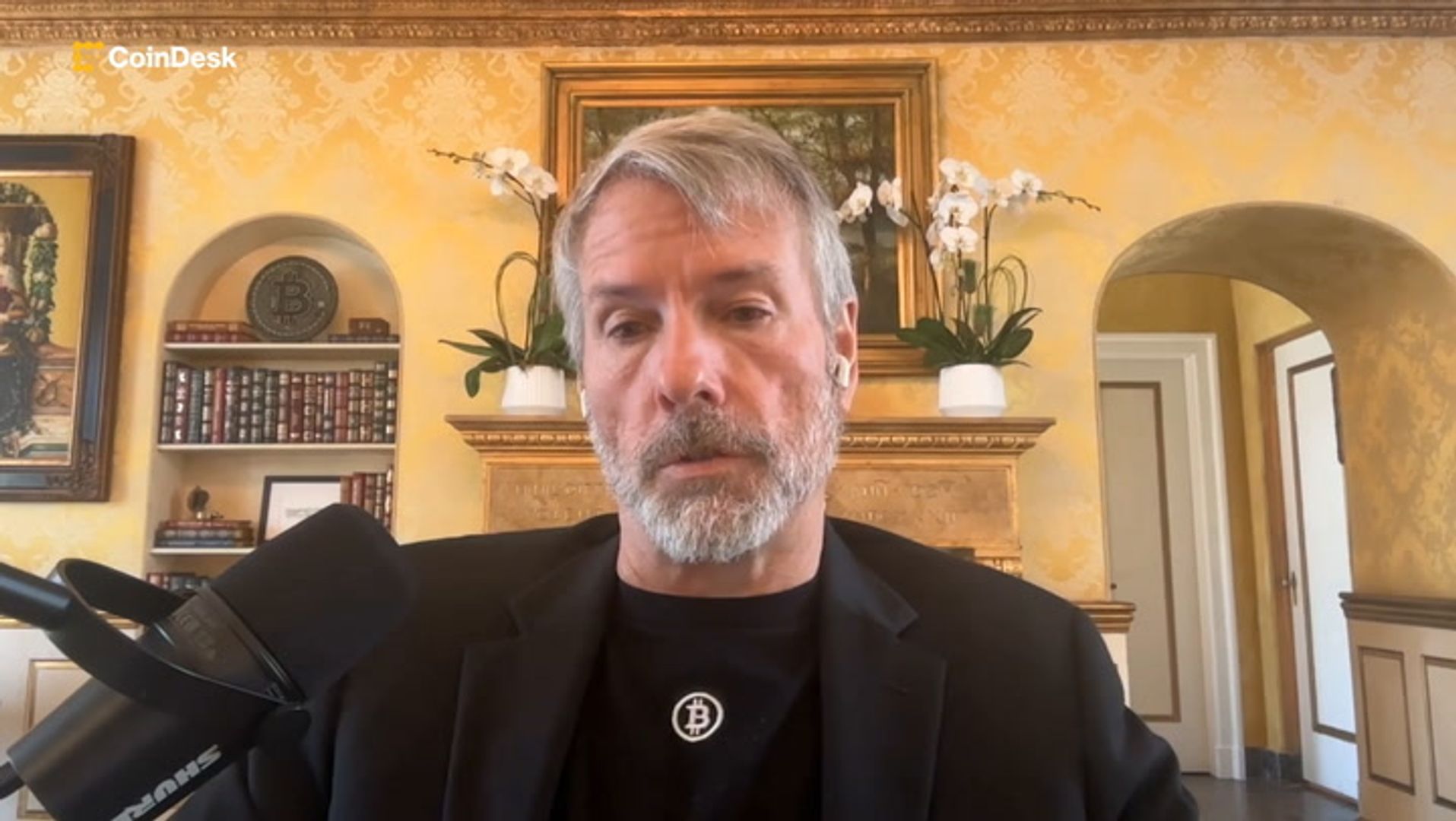
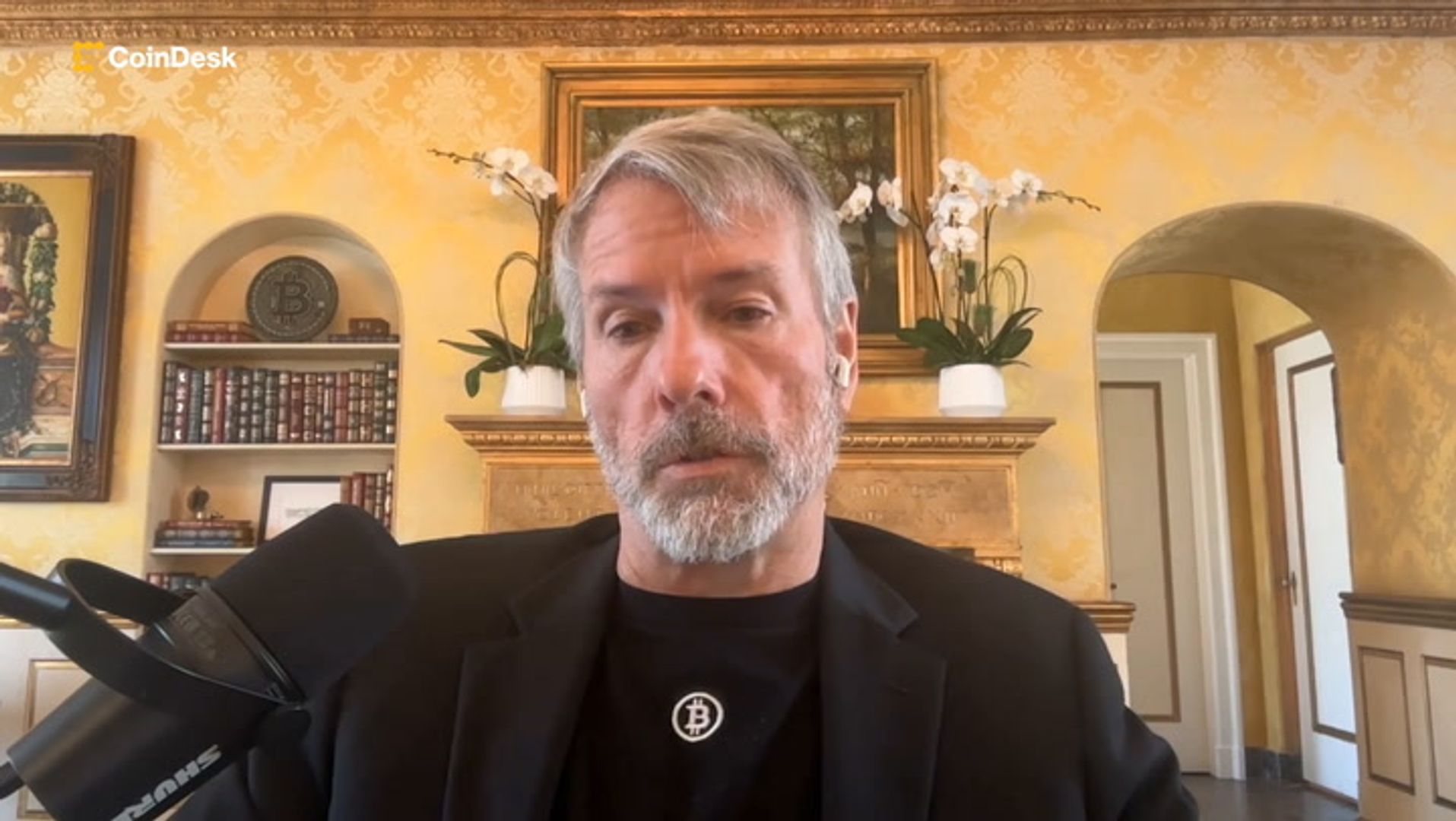
Strategy (MSTR) unveiled a new Digital Credit Capital Framework on Monday, introducing a series of capital management initiatives designed to strengthen its preferred securities, preserve long term bitcoin exposure, and improve balance sheet flexibility.
The company has already adopted a board approved U.S. dollar reserve policy and increased the annual dividend rate on its Variable Rate Series A Perpetual Stretch Preferred Stock (STRC) to 12%, effective for dividend periods beginning July 1. Strategy said its U.S. dollar reserve currently stands at approximately $2.55 billion, enough to cover about 17.4 months of preferred dividend and interest obligations.
The board also authorized, but did not commit to, up to $1 billion in repurchases of its Digital Credit Securities and up to $1 billion in buybacks of its Class A common stock. The programs have no fixed expiration date and may be modified, suspended, or terminated at any time. Actual repurchases will depend on market conditions and management’s assessment that they are accretive.

Crypto World
Bullish (BLSH) Stock Dips Despite Gibraltar Green Light for Digital Securities Platform

Key Highlights
-
BLSH stock declines 2.25% following Gibraltar Financial Services Commission authorization.
-
Gibraltar regulator clears path for regulated blockchain-based securities operations.
-
Platform designed for qualified international participants outside United States.
-
Planned Equiniti acquisition enhances end-to-end tokenization capabilities.
-
Platform rollout anticipated within several weeks pending final requirements.
Shares of Bullish (BLSH) experienced downward pressure Monday following announcement of regulatory clearance for digital asset trading. BLSH declined 2.25% to close at $22.77 despite initially dropping more sharply. Trading remained subdued throughout the late-morning session as investors digested the news.
GFSC Grants Authorization for Digital Asset Infrastructure
Bullish announced receiving clearance from Gibraltar’s Financial Services Commission to operate a tokenized securities platform. The authorization provides regulated infrastructure for blockchain-based financial instruments. This milestone deepens Bullish’s operational ties with Gibraltar’s supervisory authorities.
Collaboration between the firm and GFSC commenced in 2025 focusing on digital asset frameworks. Initial discussions centered on establishing compliant blockchain financial systems. The current authorization represents an extension of these efforts into the securities tokenization space.
Gibraltar has established itself as an early adopter of crypto regulation. The territory implemented specialized legislation governing Distributed Ledger Technology providers. Bullish considers Gibraltar strategically important for maintaining supervised digital market operations.
International Blockchain Trading Platform Excludes U.S. Participants
The company intends to launch tokenized asset trading for qualified international investors excluding U.S. persons. Services will operate under Gibraltar’s regulatory oversight utilizing blockchain technology. Final operational commencement awaits completion of pre-launch compliance requirements.
Tokenized securities leverage distributed ledger technology to digitally represent conventional financial instruments. This approach enables continuous trading cycles and accelerated settlement processes. Additionally, it minimizes inefficiencies associated with traditional clearing and settlement systems.
From an issuer perspective, tokenization delivers enhanced visibility and streamlined shareholder recordkeeping. The technology facilitates more direct investor relations management. Accordingly, Bullish positions this authorization as integral to its broader capital markets vision.
Transfer Agent Acquisition Strengthens Tokenization Ecosystem
Bullish connected the regulatory approval to its pending Equiniti acquisition. The company announced in May 2026 its intention to acquire the international transfer agent. Equiniti maintains relationships with approximately 3,000 corporate issuers and administers records for over 20 million beneficial owners.
This transaction would enable Bullish to provide comprehensive tokenized securities services. The integrated solution aims to encompass origination, registry management, and secondary market trading. It would bridge traditional transfer agent functions with Bullish’s distributed ledger and exchange technology.
Gibraltar’s regulatory clearance provides the secondary market component for this integrated strategy. Bullish now possesses regulatory infrastructure supporting tokenized asset liquidity. Management indicated platform launch could occur within weeks.



The immediate impact will fall on customers whose exchanges are withdrawing services, Fazel told CoinDesk
Several exchanges, including Binance, have announced changes to their European services ahead of the July 1 deadline, while others continue seeking MiCA authorization or adjusting their products.
“When a platform pulls back, users unfortunately absorb the shock, like a tenant being evicted by its landlord with no notice,” Fazel said. “People shouldn’t keep hunting for a new home. They should pick one built to stay.”
“When you’re choosing a new home, the price is one thing.”But we need to look at the identity match, the platform, its culture, its security, the features you’ll actually use, and the community you’re joining.”
“Incentives fade,” he added. “A home you trust doesn’t.”
Coinbase and OKX last week offered deposit and transfer incentives to attract new users amid some exchanges scaling back services in Europe.
Fazel said those offers may persuade some customers to switch, but argued they should not be the deciding factor.
“Every exchange is piling into the same rat race of bigger bonuses, louder cheques,” he said. “But money does not earn trust. A local track record does.”
Crypto World
J.P. Morgan broadens Kinexys blockchain settlement network as banks modernize cross-border payments


J.P. Morgan has expanded the number of currencies supported by its Kinexys blockchain payments platform, a move that could make it easier for multinational companies to move money between countries at any hour of the day.
The bank added the Australian dollar, Hong Kong dollar, Japanese yen, Chinese renminbi and Singapore dollar to Kinexys’ Blockchain Deposit Account network, a feature that lets clients move tokenized bank deposits over the platform. The new additions join the U.S. dollar, euro and British pound, giving institutional clients access to eight currencies for blockchain-based settlement and foreign exchange.
The announcement comes as banks look for ways to solve a longstanding problem in global finance: moving money faster across borders without transactions having to go through multiple banks limited by local banking hours.
Kinexys is designed to remove some of those delays. Instead of relying solely on traditional payment rails, it uses a permissioned blockchain network operated by J.P. Morgan to record and settle transfers between participating clients. Because the platform runs continuously, businesses can move funds, exchange currencies and manage liquidity 24 hours a day, seven days a week.


Arthur Hayes has revealed a $2.2 million investment in Synapse’s SYN token after backing its Hypercall options DEX, helping drive the token as much as 26% higher on Monday.
Summary
- Arthur Hayes disclosed a $2.2 million SYN purchase after backing Synapse’s Hypercall options DEX.
- Hayes said Hypercall could challenge Deribit as he seeks asymmetric exposure to the Hyperliquid ecosystem.
- SYN surged as much as 26%, while falling futures open interest pointed to profit-taking after the rally.
According to a June 29 post on X by BitMEX co-founder Arthur Hayes, he sees Hypercall, an options decentralized exchange built by the Synapse team and settled on Hyperliquid, as a credible challenger to crypto options exchange Deribit.
Explaining why he backed the project, Hayes wrote that he still wanted exposure to the Hyperliquid ecosystem but was looking for a more asymmetric opportunity.
“I still want to be long the Hyperliquid ecosystem but I need some asymmetry. It’s time for an options dex to properly take on Deribit. Hypercall, owned by SYN, is that challenger.”
On-chain data from Arkham later showed Hayes purchased 6.16 million SYN tokens worth about $2.2 million from Flowdesk. The purchase came shortly after his public endorsement and coincided with a sharp rally in the token.
Hayes has pointed to tokenomics behind the investment
Alongside his endorsement of Hypercall, Hayes shared a post by crypto investor Duncan, writing, “DYOR – but I found this pretty compelling.”
In the thread Hayes reposted, Duncan argued that SYN offered an attractive risk-reward profile because it had an estimated fully diluted valuation of about $81 million, no venture capital unlock overhang, roughly 88% of its supply already circulating, and listings on major exchanges including Binance and Kraken.
Duncan also compared SYN with Hyperliquid’s HYPE during its early rally, calling it one of the most asymmetric investment opportunities he has seen in crypto. According to Duncan, Hypercall also expands the utility of the SYN token through revenue mechanisms such as buybacks.
The endorsement comes only days after Hayes reduced exposure to several other digital assets. As previously reported by crypto.news, he exited positions in Worldcoin, Zcash, NEAR and Hyperliquid after arguing that higher energy prices, large artificial intelligence IPOs and political uncertainty could weigh on crypto markets.
More recently, he also sold 6,000 Ethereum at a loss despite having accumulated nearly $10.6 million worth of ETH in the preceding days, even as other large investors continued buying around a key support zone.
Traders lock in profits after the rally
As per data from crypto.news, Synapse (SYN) price initially climbed about 26% following Hayes’ comments before giving back part of those gains as traders took profits. Even after the pullback, the token remained up more than 1,100% over the past month, having outperformed much of the crypto market during a period of heightened volatility.
Derivatives data suggested the rally was followed by profit-taking. SYN futures open interest fell 13% during the previous four hours to $31.98 million, although it remained about 5% higher over the past 24 hours.
Exchange-level data showed the largest declines in open interest occurred on Binance, where it dropped roughly 15%, followed by more than 14% on Bitget and around 10% on MEXC. The reduction in outstanding positions indicates that some traders used the surge in liquidity after Hayes’ endorsement to close positions rather than open new leveraged bets.
Crypto World
Viral Altcoin VELVET Explodes 1,700% in a Month: More Gains Ahead or Perfect Short Setup?
The cryptocurrency sector may be stuck in a prolonged bear market, yet some tokens still manage to outperform with significant upward moves.
Velvet (VELVET) is a standout example, having jumped by quadruple digits in the past month. And while some analysts expect more short-term upside, others warn the altcoin could be a ticking time bomb.
Further Rally?
As of press time, the altcoin trades at around $1.58 (according to CG), representing a 250% increase on a weekly scale and a staggering 1,700% pump over the last 30 days.

Its market capitalization has risen to nearly $700 million, making VELVET the 90th-biggest cryptocurrency. One potential catalyst for the price explosion could be the project’s collaboration with AerodromeeFi.
“With the integration, you now:
– Get tighter pricing
– Pay less slippage
– Tap deeper liquidity on every trade
– Land better fills, automatically,” the announcement reads.
Later on, the project introduced Velvet-1: an Artificial Intelligence (AI) model for on-chain intelligence, which could also have positively impacted the price.
Several analysts have highlighted the coin’s performance and believe it might have more fuel for additional gains. X user Crypto With Gopal claimed that the price “is tightening inside a Symmetrical Triangle after a sharp bullish impulse.” He argued that sellers continue to lose control, setting a short-term target of $2.1.
The Boss also issued an optimistic prediction, arguing that the latest breakout attempt shows that buyers remain active after consolidation rather than immediately giving back gains. The analyst claimed that the current structure looks “healthier than it did 24 hours ago, with the chart transitioning from recovery mode into expansion mode.”
“If momentum persists and volume follows through, the market could begin testing higher liquidity zones that were previously rejected during the first impulsive move earlier this month,” they concluded.
‘Generational Short Opportunity?’
Many other analysts believe investors should stay away from the altcoin as it may experience a steep decline in the near future. Yesterday (June 28), X user Crypto with Haris ₿ predicted that VELVET could crash to $0.90 in the next six hours (which didn’t happen), calling the setup a “generational short opportunity.”
For his part, Vuori Trading claimed that the token is another “Binance Alpha aka. CZ scam.” In his view, the token seems to be nearing its top, but if it crosses $2, it might explode to $8.
The coin’s Relative Strength Index (RSI) reinforces the bearish outlook. The ratio has risen past 80, meaning VELVET has entered extreme overbought territory and could be on the verge of a collapse. The technical analysis tool ranges from 0 to 100, with anything below 30 considered a buying opportunity.

The post Viral Altcoin VELVET Explodes 1,700% in a Month: More Gains Ahead or Perfect Short Setup? appeared first on CryptoPotato.
Crypto World
Private keys, not smart contracts, caused 40% of crypto’s $16 billion hack losses. Here’s whats being done.


“Most blockchain infrastructure was originally built for a single-user, single-key model, one private key controls everything, and if that key is lost or stolen, all the assets are gone instantly. This goes against the basic security principles that traditional finance has relied on for decades: more than one person approving, separation of duties, and several layers of defense,” Wu told CoinDesk.
In a way, the system built to revolutionize global finance has weaker security than a typical email account.
Wu added that the number of routes through which an attack can be launched has increased significantly. “Cloud systems, third-party tools, social media accounts, and the people operating them, all of these can become a way in.”
Both Wu and Fan pointed to the Bybit hack of February 2025 as an example of a widening attack surface. Attackers compromised the software supply chain of a third-party developer tool, allowing them to inject malicious code into the wallet’s web interface and trick executives into unknowingly signing away $1.5 billion in Ethereum.
The fix
The industry is now moving to address the private key vulnerability issue, though not evenly, according to Wu.
“There’s progress on many fronts: MPC [multi-party computation] wallets, account abstraction with social recovery, passkey-based login, hardware wallet enforcement, and proper key management SOPs,” he said. “The problem is that these are often added as optional extras, instead of being built in from the start at the protocol level. Most chains still treat security as a feature to bolt on, not as a core design principle.”
TLDR;
- Bybit EU has become the main regulated route for EEA users as Bybit Global prepares phased service restrictions.
- EEA users will receive advance notices before restrictions begin, allowing them to manage open positions and balances.
- Bybit’s move reflects growing MiCA compliance pressure as crypto exchanges adjust services across European markets.
- Users will retain access to custodied assets while Bybit limits selected global platform services for EEA residents.
Bybit EU moved into sharper focus after Bybit announced phased limits for EEA users on its global platform. The exchange said access to certain global services will be progressively restricted as part of regulatory alignment across Europe. Affected users will receive notices before any changes take effect.
Bybit also said clients will keep access to assets held in their accounts while they manage positions and balances. The move comes before the MiCA transition window closes on July 1, 2026. It also pushes European clients toward the group’s regulated platform.
Bybit EU Becomes Main Route as Global Access Narrows
Bybit said EEA users will face gradual limits on selected services through Bybit Global. The company did not give a single cut-off date in the notice. Instead, it said users will receive clear instructions before specific measures begin.
The process covers residents across most EEA countries. Austria, France, Germany, Ireland, Italy, Spain, Sweden, and Norway are included. Malta is excluded from this process because Bybit EU does not actively offer services there.
The exchange framed the move as part of its broader regulatory alignment. MiCA now gives crypto firms one rulebook for serving European clients. That framework raises the pressure on platforms still operating through older national arrangements.
Bybit EU operates through a separate European entity based in Vienna. The platform holds authorization in Austria under MiCAR. Its permitted services include custody, crypto-fiat exchange, crypto-to-crypto exchange, placing crypto assets, and transfer services.
The shift means EEA users may need a separate account on the European platform. Existing Bybit Global accounts are not automatically the same as Bybit EU accounts. Users may also need to complete identity checks again before using local services.
For traders, the key issue is continuity. Open positions, balances, and service access may be handled under different timelines. Bybit said affected clients will receive direct communication before restrictions are applied.
Bybit EU Incentives Show MiCA Compliance Push
Bybit EU is also using incentives to attract European users before the July deadline. Its “Move Your Funds, Get Rewarded” campaign runs through July 31, 2026. The offer targets new EEA users who have not held a Bybit EU account.
The campaign includes several benefit tracks. Users may receive a welcome package, card bonuses, and subscription cashback. Eligible clients may also get faster VIP status after a qualifying deposit.
Larger deposits may receive USDC cashback under the campaign terms. The offer gives Bybit a commercial bridge while regulatory access changes across Europe. It also helps move activity from the global platform toward the regulated entity.
The broader backdrop is clear. MiCA has made authorization, supervision, and user protection central to European crypto access. Exchanges without the right license face higher legal risk after the transition period ends.
Bybit EU CEO Mazurka Zeng said users now value clarity and long-term readiness. That message fits the exchange’s new structure in Europe. Bybit Global remains available in other markets, but EEA users now face a different path.
The change may also shape competition among European crypto platforms. Licensed exchanges can market continuity while rivals adjust access. For Bybit, the near-term test is whether users migrate smoothly before service limits tighten.
Update 2:00 pm UTC, June 29: Added comment from Germany’s Federal Financial Supervisory Authority (BaFin).
The European Union’s Markets in Crypto-Assets Regulation (MiCA) framework is producing uneven crypto licensing across member states and European Economic Area (EEA) jurisdictions, with Germany leading approvals under the new regime that takes effect on Wednesday.
Data from the European Securities and Markets Authority (ESMA) interim register, compiled on Friday, shows Germany has 57 MiCA-authorized crypto-asset service providers (CASPs), accounting for about 23% of the 244 total licenses issued.
France follows with 26 companies, or roughly 11% of all approvals, placing it alongside the Netherlands as the bloc’s second-largest hub for MiCA licensing.
The pattern suggests that although MiCA is designed to create a single European crypto market, implementation remains fragmented across national regulators ahead of the July 1 transitional deadline.
France leads late-June approval wave
While Germany leads overall MiCA licensing, France has recently accelerated approvals, accounting for the largest share of last-minute authorizations.
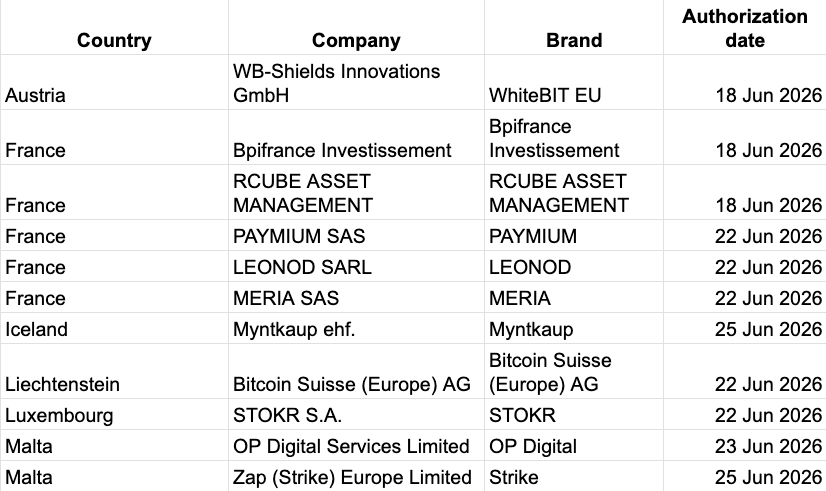
According to ESMA interim data, France issued five CASP approvals between June 18 and June 22, the most during that window. In total, 11 approvals were issued across EU and EEA jurisdictions during the period, with Malta following France with two authorizations.
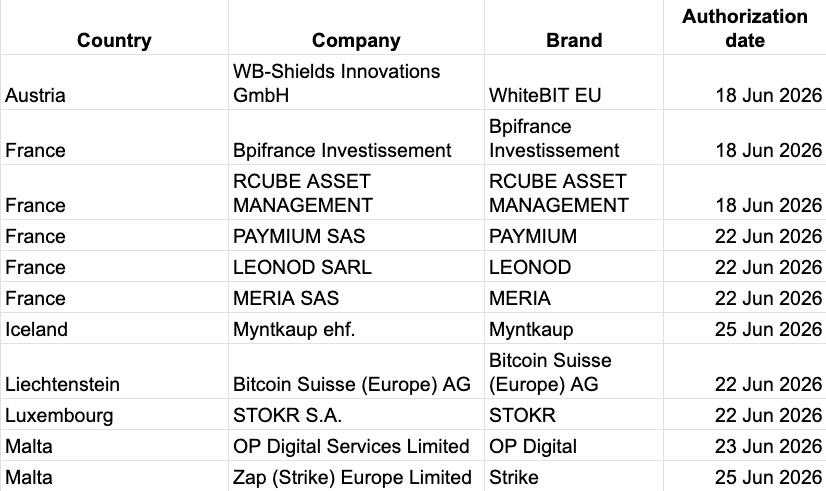
MiCA CASP licenses issued during the period from June 18-25, 2026. Source: ESMA
France’s authorizations include CASPs such as Bpifrance Investissement, RCUBE Asset Management, Paymium, Leonod and Meria.
Germany’s Federal Financial Supervisory Authority (BaFin) told Cointelegraph that the relatively high number of MiCA authorizations is partly driven by the country’s large financial sector, including a high number of credit institutions that can provide crypto asset services under MiCA.
It also pointed to Germany’s pre-existing national licensing regime, which allowed some CASPs to use simplified authorization pathways under MiCA transition rules, potentially accelerating approvals.
Related: Binance faces EU service limits next week as MiCA rules take effect
A spokesperson at BaFin also said it is difficult to predict whether Germany will maintain its dominant share of CASP authorizations as MiCA implementation progresses, noting that outcomes will depend on market developments, innovation trends and the volume of pending applications across member states. The representative added that approvals in other EU countries are expected to increase over time and broadly align with the size of national financial sectors.
Five EU states have not issued any MiCA licenses
Five EU member states, including Greece, Hungary, Poland, Portugal and Romania, have not issued any MiCA licenses as of June 26, according to ESMA interim register data.
Greece stands out after Binance applied for authorization in the country but later withdrew its application, shifting its eventually licensing plans to another MiCA jurisdiction.
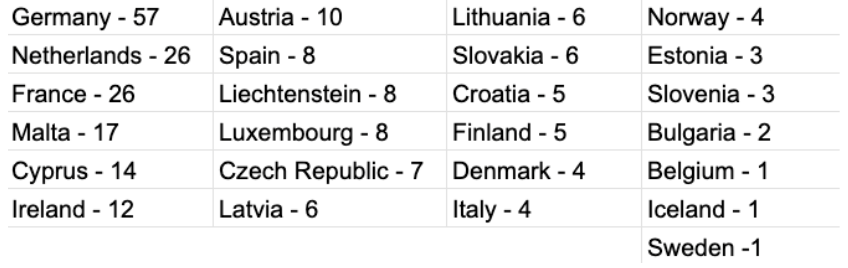
European jurisdictions ranked by the number of approved CASPs under MiCA as of Friday. Source: ESMA
Poland is also notable, with delays in MiCA implementation legislation followed by three reported presidential vetoes, leaving the country without an active licensing framework by the time of the EU deadline.
In contrast, Italy dominated ESMA’s non-compliant CASP register as of Friday, accounting for an overwhelming majority of entries with 160 out of 162, while the Netherlands and Slovakia recorded one each, linked to MEXC and LWEX, respectively.
Additional reporting by Yohan Yun.
Magazine: AI is banking the unbanked in Africa… faster than crypto


White House officials — especially lead crypto adviser Patrick Witt — have sought to keep the Clarity Act moving forward in the Senate, including holding previous meetings with those who have objected, such as law enforcement groups and Wall Street bankers. Representatives of the White House didn’t immediately respond to requests for comment on the expected Monday meeting, which meant to work through some of the remaining concerns, and few details were available.
Industry groups such as the Blockchain Association have defended the legislation’s crime-fighting tools, arguing that the bill includes a number of new powers for pursuing bad actors, and that the absence of a new law will leave a vacuum.
At an industry-hosted event earlier this month, White House adviser Witt said, “We’re putting real regulatory constraints on businesses and actors that currently live in a state of uncertainty.”
To law enforcement officials, he argued, “You should be the biggest cheerleaders for this bill, because this is really what is missing.”
Meanwhile, the Clarity Act’s political opponents, such as Senator Elizabeth Warren — the top Democrat on the Banking Committee, have maintained a steady stream of criticism on the legislation’s illicit-finance front. They routinely cite crypto’s use by criminal groups, drug cartels and human traffickers.

Key Takeaways
- Strategy is preparing to liquidate up to $1.25 billion in Bitcoin holdings to strengthen its cash position, currently sitting at $2.55 billion.
- Two separate $1 billion buyback initiatives have been authorized — targeting both common and preferred shares.
- The firm’s mNAV metric fell beneath the critical 1.0 threshold on June 27, eliminating its capital-raising edge.
- STRC preferred stock dividend increased to 12%, with new policies requiring cash reserves to cover a full year of obligations.
- Shares of MSTR were trading at $82.31, reflecting a 3.5% decline, as Bitcoin hovered around $60,275.
Strategy (MSTR) is executing a dramatic strategic reversal. The enterprise that staked its reputation on accumulating and never selling Bitcoin is now preparing to offload a significant portion — a development that has captured Wall Street’s full attention.
In a June 29 filing, Strategy outlined intentions to divest up to $1.25 billion in Bitcoin assets. The capital raised will strengthen the company’s treasury, finance preferred shareholder dividends, service debt obligations, and support general corporate requirements.
MSTR shares climbed approximately 5% during pre-market hours following the disclosure, though by regular trading the stock had retreated to $82.31, representing a 3.5% decline. Bitcoin was trading near $60,275, posting a modest 0.6% gain over the previous day.
According to the filing, Bitcoin disposals will occur opportunistically based on prevailing market dynamics and capital requirements — not according to any predetermined timeline.
The Economics Have Shifted
For an extended period, Strategy’s approach was remarkably straightforward: raise capital through securities offerings, acquire Bitcoin, then repeat the cycle. This framework delivered exceptional results during Bitcoin’s bull runs, particularly when the company’s mNAV — measuring enterprise valuation against Bitcoin holdings — remained substantially above 1.
That crucial metric slipped below parity on June 27. This development signals that the valuation premium enabling Strategy to access inexpensive capital for Bitcoin acquisitions has essentially vanished.
Both common and preferred securities have experienced severe declines tracking Bitcoin’s downturn. MSTR has plummeted nearly 80% during the past twelve months. The perpetual preferred instruments Strategy introduced in 2025 — initially conceived as a mechanism to expand Bitcoin holdings without diluting existing shareholders — have tumbled below $75, significantly beneath the $100 par value necessary for economically sensible purchases.
Management also indicated greater restraint regarding future common stock issuances, especially when share prices approach net asset value.
Dual share repurchase authorizations totaling $1 billion each were unveiled — one addressing Class A common stock, the other targeting preferred Digital Credit Securities.
A newly adopted board mandate now obligates Strategy to maintain treasury reserves sufficient to cover no less than twelve months of anticipated preferred dividends and interest charges. Current reserves total $2.55 billion.
Warning Signs Emerged Weeks Ago
The shift became evident as early as June 1, when Strategy revealed it had liquidated 32 Bitcoin — marking its first sale since 2022. While negligible compared to its approximately $51 billion total position, the symbolic significance was undeniable.
Bitcoin skeptic Peter Schiff quickly seized on the development. In a June 29 commentary, he characterized Strategy as “now a Bitcoin seller,” highlighting the company’s rebranded Bitcoin Monetization Program.
FalconX senior derivatives trader Bohan Jiang provided a more balanced perspective: “While there is more selling pressure on Bitcoin, it is definitely positive for the stock, and both the common and preferred shareholders.”
The STRC preferred dividend rate was elevated to 12% as part of the restructuring announcement.
Bitcoin has faced headwinds lately, dipping below $59,000 the previous week before staging a partial recovery.

Dame Penelope Keith: The Good Life and To The Manor Born actress dies aged 86

Supplements sold on Amazon, Walmart recalled over possible salmonella risk
Bullish (BLSH) Stock Dips Despite Gibraltar Green Light for Digital Securities Platform


-
 Sports6 days ago
Two goals and an assist by sheer aura: Cristiano Ronaldo just entered the World Cup chat
-

 Fashion3 days ago
Weekend Open Thread: Staud – Corporette.com
-

 Politics3 days ago
The House | Manchesterism won’t survive the painful trade-offs unless it gets citizens on board
-

 Politics4 days ago
Potential 2028er World Cup attendee leaderboard
-

 Business3 days ago
Asia stock markets slide as tech shares slump
-

 News Videos21 hours ago
MAJOR BITCOIN & MARKET UPDATE!!!! (MUST WATCH ASAP!!!)
-

 Tech4 days ago
A Look At A Gaggle Of Transputer Boards
-
Crypto World6 days ago
Bitcoin (BTC) Dips Below $62K, Ethereum (ETH) Plunges 6% Daily: Market Watch
-
 Crypto World4 days ago
Dell (DELL) Shares Tumble Over 5% Following Analyst Downgrade to Hold
-

 Crypto World5 days ago
Securitize Wraps Roubini's SEC-Registered ETF as Dubai VARA Digital Security
-

 Crypto World2 days ago
Coinbase, Circle Deepen Crypto Stock Losses Despite Resilient S&P 500
-
Business6 days ago
Entergy settles forward sale agreements, raises $672 million in cash proceeds
-

 Crypto World2 days ago
Kraken's xStocks Opens Bending Spoons IPO Registration to EEA Retail
-

 Sports3 days ago
FIH Pro League: India defeat Pakistan 7-1, register biggest win of campaign | Other Sports News
-

 Tech2 days ago
Russian hackers now target Signal backup recovery keys
-

 Crypto World3 days ago
RTX holders must register wallets before token distribution begins
-
Crypto World3 days ago
Hyperliquid Named on Singapore MAS Investor Alert Register
-

 Tech2 days ago
Bluekit phishing kit adopts browser-in-the-middle for login theft
-

 Crypto World4 days ago
Bitcoin Sparks $600M Hourly Liquidations With $65,000 Set To Become Resistance
-

 Sports4 days ago
India vs Bangladesh LIVE Score, Women’s T20 World Cup: Bangladesh Opt To Bat; India Enter ‘Do-Or-Die’ Stage As Semi-Final Race Heats Up
You must be logged in to post a comment Login