

Crypto World
Strategy Inc. Hints at More Bitcoin Purchases as Saylor Posts Cryptic Market Tease


TLDR:
- Strategy Inc. holds 845,256 BTC worth $54.36B, averaging $75,682 per coin and sitting 15% underwater.
- Saylor’s “still adding dots” post signals another Bitcoin buy following the June 8 purchase of 1,550 BTC.
- CEO Phong Le confirmed the 32 BTC sale was a process test, not a move to fund dividends or cut exposure.
- Public companies now hold 5.5% of Bitcoin’s supply, with Strategy remaining the largest corporate holder.
Strategy Inc. is signaling another Bitcoin purchase as founder Michael Saylor posted a cryptic hint on social media.
The company, formerly known as MicroStrategy, currently holds 845,256 BTC valued at approximately $54.36 billion.
With an average acquisition price of $75,682 per coin, the position sits roughly 15% underwater at current market prices near $64,000. Saylor’s latest post has reignited debate around the company’s aggressive treasury strategy.
Saylor’s X Post Sparks Fresh Bitcoin Speculation
Michael Saylor took to X with a brief but loaded message directed at Bitcoin watchers. Referencing Strategy’s current holdings of 845,256 BTC at a $54.36 billion value, he closed the post with the phrase “still adding dots.” The crypto community widely interprets that phrase as a signal that another purchase is imminent.
The timing of the post comes just days after Strategy’s most recent acquisition. The company purchased 1,550 BTC on June 8, continuing a buying pattern that stretches back several years. Each purchase reinforces Saylor’s long-standing belief in Bitcoin as a superior treasury reserve asset.
Strategy’s year-to-date Bitcoin yield stands at 12.8%. That figure measures the growth in Bitcoin per share, a metric the company uses to track the effectiveness of its strategy. Despite the current unrealized loss, the yield number remains a key talking point for Strategy bulls.
Critics, however, continue to raise concerns about the company’s financial exposure. Strategy carries over $10 billion in debt and share obligations tied to its Bitcoin strategy. Any sustained drop in Bitcoin’s price could put pressure on the company’s ability to service that debt.
Strategy CEO Addresses Bitcoin Sale and Company Financing Plans
Strategy CEO Phong Le appeared on CNBC on June 11 to address questions about a recent, small Bitcoin sale. Le confirmed the company sold 32 BTC, explaining that the move was done mainly “to inoculate the market and test its internal selling process.” The transaction was also structured to generate tax losses that can offset related tax liabilities.
On the question of dividends, Le was direct. “The sale was not meant to pay dividends,” he said, noting that Strategy still has access to several other financing channels for that purpose.
The transaction represented a procedural test rather than any shift in the company’s Bitcoin-first treasury philosophy.
However, Le left the door open for future Bitcoin sales under the right conditions. He stated that “if selling Bitcoin is beneficial to common shareholders, the company may choose to do so.” That position marks a nuanced but notable clarification of Strategy’s publicly stated approach.
Meanwhile, public companies collectively hold about 5.5% of Bitcoin’s total supply. Strategy remains by far the largest corporate holder, and its continued accumulation keeps it at the center of institutional Bitcoin conversations.




Bitcoin is likely to stay range-bound, said Jeff Ko, chief analyst at CoinEx, and he points to three reasons the backdrop has calmed.
Oil has retreated from last week’s highs after another pause in U.S.-Iran hostilities. The 10-year Treasury yield, approaching 4.7%, is doing part of the Fed’s tightening work on its own. And the Fed may want to keep its options open ahead of this week’s PCE inflation and second-quarter GDP data.
The bigger swing factor is corporate. Apple, Microsoft, Meta and Amazon all report this week, and Ko said their free cash flow and AI-spending guidance could move Treasury yields and the Nasdaq, indirectly shaping the liquidity that flows into crypto.
Ko added that the composition of ETF flows will matter as much as the headline numbers.
Shiba Inu (SHIB)’s team said on X that “OG culture never left, neither did SHIB,” pointing to a fresh rally as proof the token still commands attention.
Crypto commentator David Gokhshtein sparked the exchange, arguing that early meme coins, often called “OG” (original gangster) projects in crypto slang, are regaining relevance across the market.
Shiba Inu’s Team Doubles Down Online
Gokhshtein posted that SHIB’s move over the past two days left him more bullish. He said the shift points to an OG revival across meme coins broadly. Gokhshtein explained his reasoning in the original post that prompted Shibtoken’s reply.
Watching $SHIB move over the last two days has me even more bullish that the OG culture is making its way back to this industry. I also think this benefits the OG memes as a whole.
Therefore, the reply frames SHIB’s move as part of a bigger shift rather than an isolated bounce. Shiba Inu’s burn rate hit a six-month high earlier this month, though the spike failed to move the price at the time. Even so, the renewed rally suggests investor attention has returned, at least for now.
SHIB Rally Shows a Mixed Price Picture
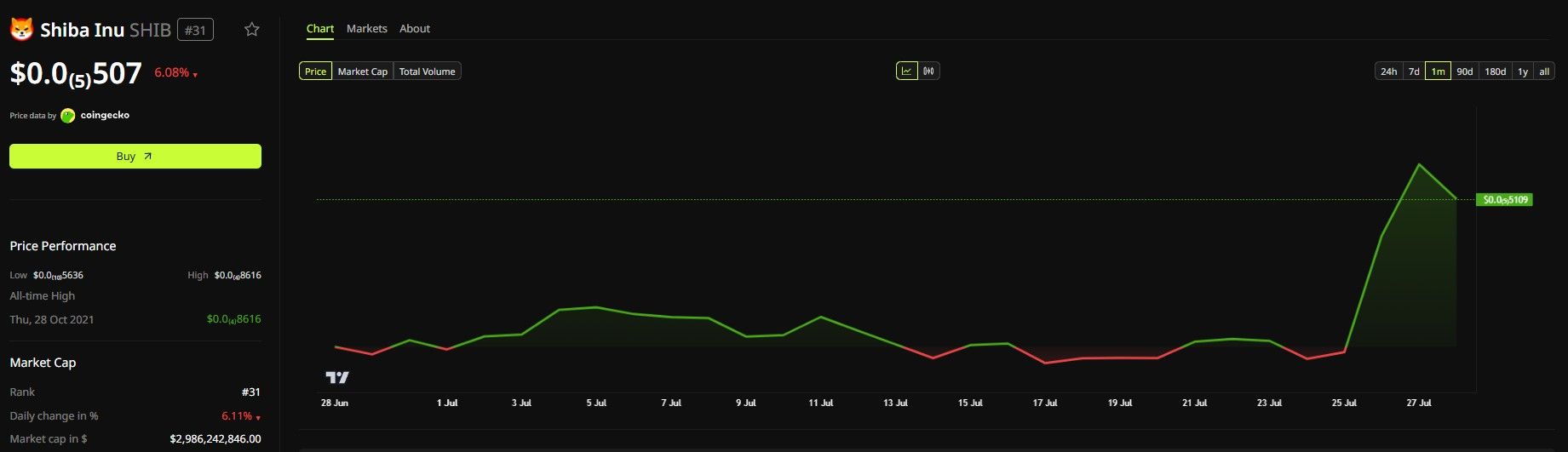
Shiba Inu (SHIB) trades near $0.00000507. The token is still up close to 22% over the past week.
In contrast, SHIB remains nearly 19% higher over the past 30 days. This suggests the broader uptrend remains intact despite the recent dip.
However, the rally has cooled in the short term. SHIB has fallen 6.08% over the past 24 hours. Its market cap now sits at $2.99 billion, ranking 31st overall among cryptocurrencies. Traders can follow SHIB’s live price data as the pullback continues.
The token remains far below its all-time high of $0.00008616, set in October 2021. That gap underscores how far Shiba Inu would need to climb before OG sentiment turns into a lasting recovery.

OG Meme Coins Regain Attention
The renewed optimism follows a rough stretch for Shiba Inu. On-chain data had recently pointed to a sad reality for the token. Trader James Wynn had dismissed SHIB as dead only a month earlier.
Historically, meme coin rallies triggered by social posts have faded within days. Some traders remain skeptical this one will prove different. Meanwhile, meme coin dominance overall hit a two-year low as holders exited the sector. That skepticism echoes a broader shift toward fundamentals-driven tokens across the market.
Still, the renewed attention marks a shift in tone for a token that many had written off. This development may indicate that market sentiment is moving back toward established names. Whether SHIB can hold its recent gains will likely depend on trading volume in the coming days.
The post Shiba Inu (SHIB) Team Says OG Culture Never Left, Neither Did SHIB appeared first on BeInCrypto.


Garden Finance has temporarily taken its application offline after an attacker compromised the off-chain database of an independent solver, leading to the loss of solver-owned digital assets while leaving protocol contracts and user funds unaffected.
Summary
- Garden Finance temporarily took its app offline after an independent solver’s off chain database was compromised, resulting in the loss of solver owned funds.
- The protocol said its smart contracts and user funds were not affected because the attack was limited to one solver’s infrastructure.
- Blockaid estimated the attacker drained about $450,000 in USDT from HTLC contracts across multiple blockchains before the incident was contained.
- Garden has engaged zeroShadow, Quantstamp and Blockaid to trace the stolen assets and support recovery efforts.
- The incident follows a similar 2025 solver breach and comes as crypto security researchers continue tracking multiple exploits across the sector.
Blockchain security firm Blockaid reported on Sunday that an attacker drained about $450,000 in USDT from Garden Finance’s hash time-locked contracts (HTLCs) deployed across Ethereum, Base, Arbitrum and BNB Smart Chain, describing the exploit as active while publishing wallet addresses linked to the attacker and the affected contracts.
Garden Finance later told Cointelegraph that the protocol itself had not been breached. Instead, the company said the incident originated from the off-chain infrastructure of an independent solver, where an attacker gained access to the solver’s database and inserted fraudulent transaction records that triggered releases of funds for swaps that had never been funded by the corresponding counterparty.
As a precaution, Garden temporarily took its application offline while engineers isolated the affected infrastructure and reviewed the incident. The protocol said no user funds were lost or exposed because only assets owned by the affected solver were involved.
The company added that it is still verifying the total amount lost, along with the exact assets and blockchain networks affected by the attack.
Off-chain solver targeted rather than protocol
While Blockaid initially associated the incident with Garden’s HTLC infrastructure, the protocol said its smart contracts continued operating as designed and were not exploited.
Garden explained that HTLCs serve as escrow contracts that enable atomic swaps between Bitcoin and assets on other blockchains by locking funds until predefined conditions are met or time limits expire. According to the company, those contracts remained secure throughout the incident.
Instead, Garden attributed the loss to manipulated records inside the compromised off-chain database used by one of its independent solvers. The fraudulent entries caused the solver to release funds for swaps despite the corresponding deposits never being completed.
According to Garden, the incident remained isolated to a single participant within its decentralized network of independent solvers rather than affecting the broader protocol.
“Garden’s protocol and HTLC smart contracts were not compromised, and no user funds were lost or at risk,” the company told Cointelegraph while emphasizing that only solver-owned assets were affected.
The protocol also noted that it does not control the infrastructure operated by independent solvers, which execute swaps within the network.
Recovery efforts underway with security firms
Garden said it has engaged blockchain security and incident response firms zeroShadow, Quantstamp and Blockaid to trace the stolen assets and support recovery efforts.
Alongside those investigations, the company said it expects to restore normal services after completing additional security reviews, although it has not provided a timeline for bringing the application fully back online.
The protocol added that its immediate priorities include securing the affected infrastructure, tracing the compromised solver’s assets and ensuring every required security check has been completed before services resume.
Garden also pointed to its recently completed SOC 2 Type II attestation, saying the certification demonstrates ongoing investment in operational controls and security processes even though the latest incident originated from infrastructure operated by an independent network participant.
The latest disclosure comes only days after Singapore-based stablecoin payments company Triple-A confirmed unauthorized access to company treasury wallets that resulted in the loss of corporate digital assets while customer funds remained unaffected.
According to Triple-A, the July 25 incident impacted only company-owned treasury assets because customer funds are held separately in safeguarded trust accounts rather than inside company wallets. The company temporarily placed certain services into maintenance mode before restoring normal payment operations after additional security checks.
Triple-A also said it is working with blockchain forensics specialists, cybersecurity experts and the Singapore Police Force to investigate the breach and trace the stolen assets. Although blockchain investigators estimated losses eventually reached about $11.8 million, the company has not confirmed the total amount or disclosed how the unauthorized access occurred.
Garden’s latest disclosure also follows an earlier security incident involving one of its independent solvers.
According to the protocol, an attacker compromised the operating environment of another solver in October 2025 and stole approximately $11.4 million. Garden said that the attack likewise did not affect its protocol contracts or place user funds at risk because the compromise remained limited to the solver’s operating environment rather than the protocol itself.
The latest attack adds to a series of security incidents reported across the cryptocurrency sector during 2026.
Last week, decentralized finance protocol Lien Finance disclosed the loss of approximately 542,144.63 USDC after attackers exploited weaknesses in its bond validation and pricing logic. Blockchain security firm SlowMist said the flaw allowed unsupported bond tokens to be minted and exchanged for real USDC liquidity without consuming the required collateral.
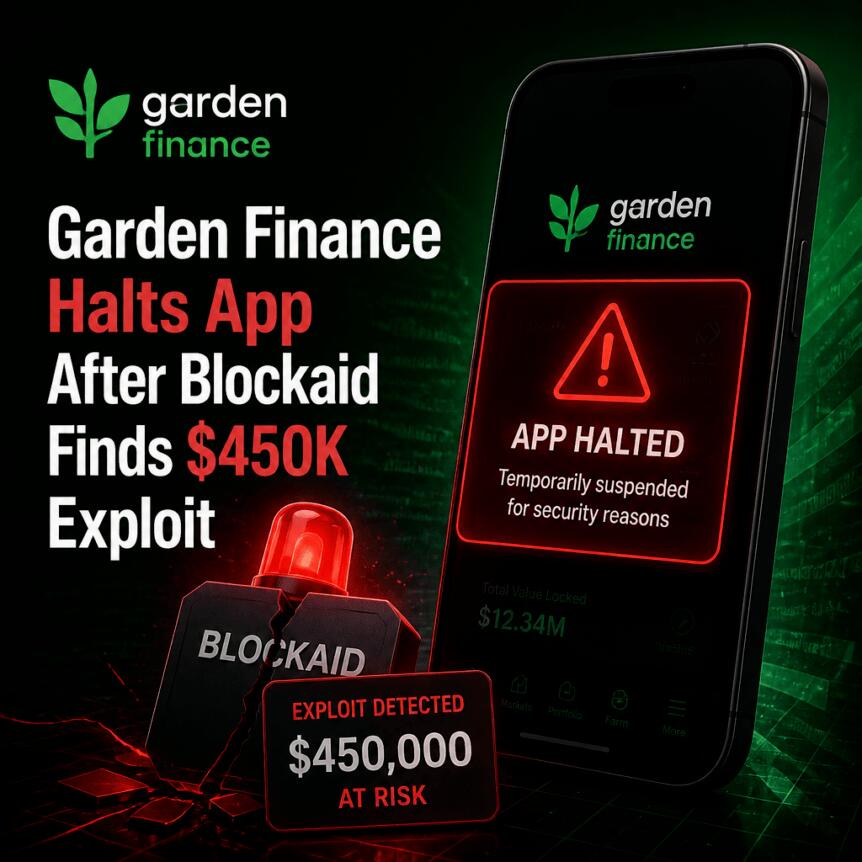
Garden Finance is investigating an exploit that reportedly involved its cross-chain bridge and atomic swap infrastructure after an attacker drained roughly $450,000 worth of USDT from Garden-linked hash time-locked contracts (HTLCs) across multiple networks, according to Blockaid. The incident has also triggered a temporary pause in Garden’s services while the affected systems are isolated and reviewed.
Garden’s position differs from the initial description of the breach: the company says its protocol and on-chain HTLC smart contracts were not compromised. Instead, Garden attributes the event to an intrusion into the off-chain database of an independent solver, where fraudulent transaction records were allegedly inserted—leading to incorrect swap releases.
Key takeaways
- Blockaid reported an attacker drained about $450,000 in USDT from Garden HTLCs on Ethereum, Base, Arbitrum, and BNB Smart Chain.
- Garden says the protocol and HTLC smart contracts were not altered or hacked; the compromise was limited to an off-chain database belonging to one independent solver.
- Garden stated no user funds were lost or placed at risk, and that only solver-owned assets were affected.
- Services were paused as a precaution while Garden, and multiple security firms, trace and recover the funds.
What Blockaid says happened
Earlier Sunday, Blockaid said the exploit was ongoing and involved Ethereum-based HTLCs used by Garden to coordinate atomic swaps. In its public update, Blockaid described the attacker draining approximately $450,000 in USDT from Garden’s HTLCs deployed across Ethereum, Base, Arbitrum, and BNB Smart Chain.
HTLCs function as time-bound escrow contracts that help ensure assets are released only under the correct conditions—an essential mechanism for atomic swaps spanning different chains. Blockaid also published addresses it linked to the attacker and the contracts believed to be affected.
Garden’s rebuttal: off-chain solver database breach
Garden Finance disputed the implication that its core contracts were compromised. A spokesperson told Cointelegraph that neither the Garden protocol nor its HTLC smart contracts were breached.
According to Garden, the attacker accessed the off-chain database of an independent solver and inserted falsified transaction records. In Garden’s account, those incorrect records led the solver to release funds for swaps that were not actually funded by the intended counterparty.
Garden added that the incident did not place user funds at risk and that no funds belonging to users were lost. Instead, the company said the impact was confined to solver-owned assets. Garden also indicated that it is still confirming the full extent of the event—total amount, assets, and the precise networks involved.
Why an off-chain compromise can matter
While HTLCs are executed on-chain, cross-chain swap systems often rely on off-chain infrastructure to coordinate actions, track swap state, and trigger settlement steps. Garden’s explanation centers on this split: the protocol’s on-chain components were allegedly left intact, but the solver’s off-chain data was manipulated in a way that caused settlement to occur incorrectly.
For market participants, this distinction is important. If the core smart contracts remain secure, the long-term trust impact may be smaller than in a scenario involving altered HTLC logic or compromised protocol contracts. Still, the incident highlights a persistent vulnerability class for cross-chain systems: even with audited or well-designed on-chain escrow logic, operational processes and off-chain databases can become critical attack surfaces.
Garden’s immediate response—pausing services and isolating the suspected infrastructure—reflects how quickly operational compromises can cascade into on-chain fund movements. The difference between a contract-level exploit and a solver-level data breach may affect remediation timelines, too, because recovery depends not only on stopping the bleeding but also on validating swap states and ensuring incorrect releases do not recur.
Security response and previous incident
Garden said it is working with zeroShadow, Quantstamp, and Blockaid to trace and recover the funds. The protocol expects to restore services shortly, contingent on completing security checks, but it did not provide a specific timetable.
Garden also pointed to its SOC 2 Type II attestation as evidence of security and operational controls, framing the incident as isolated to one solver’s off-chain infrastructure within its network of independent solvers. The company emphasized that its priorities are securing the affected systems, tracing the solver’s funds, and resuming services only after relevant reviews are completed.
The reported event follows an earlier pattern. In October 2025, Garden reported a breach in which an attacker stole about $11.4 million after compromising the operating environment of one of its solvers. Garden said that earlier incident similarly did not compromise its protocol contracts or put user funds at risk.
Taken together, the two episodes suggest that Garden’s risk exposure may be closely tied to the security posture and isolation of third-party solver environments rather than flaws in its HTLC contract code. That shifts where investors and integrators should focus their monitoring: operational security, access controls, and off-chain data integrity across the solver ecosystem.
As Garden continues tracing the funds and validating affected swap records, the key question for users and builders will be whether the investigation confirms a consistent “solver off-chain” failure mode or reveals broader compromise indicators. Readers should watch for Garden’s updated totals, the specific networks and assets involved, and the results of the security checks that will determine when services fully resume.


Triple-A has confirmed that unauthorized access to its treasury wallets resulted in the loss of company-owned digital assets while stating that client funds and payment operations have remained unaffected.
Summary
- Triple A confirmed unauthorized access to company treasury wallets while saying client funds were not affected.
- The company said the financial impact will be covered by its treasury reserves and normal operations have resumed.
- Onchain investigators had estimated the losses at about $11.8 million before the company acknowledged the breach.
- Triple A is working with cybersecurity experts and Singapore police to investigate and trace the stolen assets.
Triple-A said in a statement on Monday that it detected unauthorized access to certain wallets holding its own digital assets on July 25, prompting the company to temporarily place some services into maintenance mode for about three hours while it secured the affected infrastructure and completed additional security checks.
The Singapore-based stablecoin payments company said all services have since been restored and that transactions and settlements are processing normally across all markets. It added that the incident affected only its treasury assets, with the financial impact limited to specific operational accounts that will be fully absorbed through the company’s treasury reserves.
Client assets were not exposed, according to Triple-A, because the company does not provide digital asset custody services on behalf of customers. Instead, it said client funds are held separately in trust accounts maintained with safeguarding institutions that were not affected by the incident.
Triple-A also said it remains well capitalized, can meet all of its liabilities, and continues to operate globally at normal service levels despite the breach.
Company confirms breach after on-chain investigators flagged suspicious activity
The announcement follows reports from blockchain investigators over the weekend that identified unusual transactions involving wallets linked to Triple-A before the company publicly acknowledged the incident.
On-chain investigator Specter initially estimated that more than $9.3 million had been removed from wallets associated with Triple-A before revising the estimate to more than $9.7 million as additional transfers were identified. The investigator later estimated the losses at about $11.8 million, although Triple-A has not disclosed the total amount of digital assets lost.
Blockchain security firm PeckShield also drew attention to the suspicious transactions after Specter’s initial findings.
Before the company released its statement, researchers had not determined whether the affected wallets contained company funds, customer assets, or payment recipient balances. Triple-A’s latest update clarified that only company-owned treasury assets were impacted and that customer funds remained segregated from the affected infrastructure.
The company has also not disclosed how the unauthorized access occurred or whether the incident resulted from compromised credentials, infrastructure weaknesses, or another attack method. As a result, the exact cause of the breach remains under investigation.
Assets reportedly moved across multiple blockchains
Earlier analysis from Specter indicated that the suspicious activity involved wallets operating on Ethereum, Solana, TRON and TON, while some reports also identified transactions on Polygon and Arbitrum.
According to the on-chain findings, the transferred assets were swapped and bridged to Ethereum after leaving the affected wallets. Researchers reported that the receiving address accumulated approximately 5,226.66 ETH, valued at roughly $9.7 million when the activity was first identified.
Neither Triple-A nor investigators have publicly identified the suspected attacker. At the time of the company’s announcement, there was also no confirmation that the assets had been transferred to a cryptocurrency exchange, a mixer or another laundering service after reaching Ethereum.
Triple-A said it is working with internal and external cybersecurity experts, blockchain forensics specialists and relevant authorities, including the Singapore Police Force, to investigate the incident, trace the affected assets and support recovery efforts.
The company did not provide a timeline for completing the investigation or indicate whether any portion of the stolen assets has been frozen or recovered.
Latest incident adds to active year for crypto security breaches
The incident comes as blockchain security researchers continue to report a steady stream of attacks targeting cryptocurrency platforms and decentralized finance protocols throughout 2026.
Last week, decentralized finance protocol Lien Finance disclosed a loss of about 542,144.63 USDC after attackers exploited flaws in its bond validation and pricing logic. Blockchain security firm SlowMist said the exploit allowed unsupported bond tokens to be created and exchanged for real USDC liquidity without consuming the required collateral.
Separate analysis from DefimonAlerts and researcher exvulsec described the attack as a protocol validation and valuation failure rather than a conventional smart contract exploit, while researchers compared parts of the incident with the earlier Drift Protocol attack because both involved weaknesses in asset valuation rather than cryptographic protections.
Researchers tracking decentralized finance attacks have estimated cumulative losses exceeding $630 million during the first seven months of 2026, identifying oracle manipulation, pricing flaws, compromised credentials and bridge validation weaknesses among the most common attack methods recorded this year.
Another major investigation also remained active this week after wallets tied to the $285 million Drift Protocol exploit resumed moving funds following roughly three months of inactivity. On-chain records showed that more than 23,095 ETH, worth about $44.4 million, was transferred into Tornado Cash, making the movement of stolen assets more difficult to trace.


Coinbase chief executive Brian Armstrong said artificial intelligence and crypto are not rival trends.
Summary
- Armstrong expects autonomous AI agents to conduct more daily transactions than humans through crypto infrastructure.
- Coinbase is developing Agentic Finance around x402, Base, USDC, wallets, trading tools and business payments.
- Recent research questions x402 adoption metrics and identifies security weaknesses across facilitator-led machine payment systems.
Instead, he argued that crypto will provide financial infrastructure for autonomous AI agents.
In a July 27 post on X, Armstrong said agents “will eventually transact far more per day than all humans combined.” He presented that outcome as a forecast for payments and other financial actions online.
Armstrong said AI agents cannot use traditional banking services like people or companies. They may need to pay for data, software, computing power and other agents without human approval. He said blockchains and stablecoins can provide fast, programmable and global settlement.
Armstrong frames crypto as AI’s financial layer
Armstrong’s post responded to the idea that crypto companies should abandon blockchain work and move into AI. He rejected that choice. In his view, AI supplies programmable intelligence, while crypto supplies programmable money. He called the combined model “Agentic Finance,” or “AiFi,” and said Coinbase is building products for that market.
The Coinbase chief did not give a date for agents to exceed human transaction counts or estimate payment value. His statement focused on frequency, which could rise if software pays small amounts for every API call, data request or computing task. That model differs from consumer payments, which usually involve fewer and larger purchases.
Coinbase expands its Agentic Finance products
Coinbase has already released several products aimed at autonomous software. In June, it launched Coinbase for Agents, which connects AI systems to user accounts through a command-line interface and Model Context Protocol tools. Users can set limits while agents trade crypto, monitor markets, rebalance portfolios and execute defined financial tasks.
On July 23, Coinbase expanded that service with live market data and plain-language conditional commands. It also added x402 support for Coinbase Business, allowing companies to accept USDC payments initiated by AI agents. A new developer kit lets websites and API providers add x402 payment acceptance with a small amount of code. As crypto.news reported, the rollout covers businesses, users and developers building agent services.
The exchange introduced Agentic.market in April. The marketplace lets agents find and pay for data, search, computing, inference and trading tools. Coinbase calls it a discovery layer for machine commerce because agents can locate services and buy access without a conventional subscription or manually issued API key.
x402, Base and USDC anchor Coinbase’s strategy
Armstrong said Coinbase pioneered the model through x402, Base and USDC. x402 adapts the HTTP 402 “Payment Required” response so a website or API can request payment during an internet interaction. A wallet signs the payment, a facilitator checks it, and the service delivers the requested resource after approval.
Coinbase uses USDC as the main payment asset in many x402 products, while Base provides low-cost blockchain settlement. The protocol also supports other networks and assets. Coinbase’s developer documentation lists support across Base, Solana, Polygon, Arbitrum and World, depending on the payment method and facilitator.
As crypto.news previously reported, Coinbase said AI agents already use x402 to buy data, computing resources and digital services. Related coverage also reported that Coinbase Business customers can now receive USDC directly from agents. These products turn Armstrong’s wider claim into a commercial strategy built around wallets, stablecoins, trading access and payment tools.
Forecast remains unproven as researchers flag risks
Armstrong’s claim remains a prediction. Current totals do not prove that independent AI agents have formed an economy larger than human commerce. A July paper examining x402 activity on Base found highly concentrated transaction counts. Its authors also said some payments were internal or cheap to generate, making headline totals a weak adoption measure.
Separate July research tested 15 x402 facilitators and reported rule violations across every system examined. The researchers described risks involving unpaid services, asset theft, denial of service and gas abuse. They said affected providers, including Coinbase, received the findings and adopted fixes. The papers remain preprints and have not completed peer review.
Regulators are also studying automated finance. Bank of England Deputy Governor Sarah Breeden said in June that existing rules did not account for autonomous agents. She raised the possible use of guardrails, circuit breakers and stronger recovery systems if AI-driven trading or payments create wider problems.
Coinbase continues to position crypto as the payment layer for machine activity. Armstrong’s latest post connects that strategy to a larger claim: agents may become economic actors that hold funds and transact at high frequency. Whether they overtake humans will depend on real usage, security, regulation and demand for paid machine services.

Ripple and the wider XRP ecosystem saw several noteworthy developments over the past few days.
These included, but are not limited to, a new institutional platform for the RLUSD stablecoin, an investment in payments infrastructure, fresh Binance incentives, rising AI-agent activity, as well as continued demand for spot XRP ETFs.
The following breaks down the most important latest Ripple news and an update on XRP’s price action and the levels that traders currently monitor.
Ripple Launches Institutional RLUSD Platform
The firm launched Ripple Mint on July 23rd.
It gives institutional customers a single point to mint, redeem, bridge, and manage Ripple USD (RLUSD).
Companies can now use a standard interface or, alternatively, they can connect their internal systems through APIs and webhook notifications. The launch targets businesses that need automated stablecoin access for payments, treasury management, and trading operations.
Ripple Invests in Notabene
The company also announced a strategic investment in Notabene – a well-known compliance infrastructure provider.
Both firms plan to integrate RLUSD into Notabene Flow. This is a business-to-business stablecoin payments platform.
According to the announcement, Notabene’s network connects over 2,300 institutions across more than 100 jurisdictions and processes about $2 trillion in annualized transaction volume.
The agreement is aimed at giving RLUSD wider access to regulated payment providers and financial institutions.
XRP Ledger AI Transactions Pass a New Milestone
The XRP Ledger surpassed 1.4 million transactions initiated by AI agents on July 22nd.
Data from the XRPL AI Hub showed over 1.4 million agent-driven transactions and 129 participating merchants at the time of the report. The milestone followed Ripple’s launch of an AI starter kit in June, which is designed to help developers build automated payment applications on XRPL.
The numbers also suggest that developers are testing the network for machine-to-machine payments, as well as for other automated transactions.
Binance Introduces RLUSD and XRP Rewards
Binance announced new incentives for RLUSD users.
The exchange pointed out that the variable return for eligible holdings has reached 22.25%. Users who hold or trade RLUSD through Binance Earn and Margin products can also receive weekly rewards in XRP.
It’s important to note that the rate remains variable and can change depending on current market conditions and user participation.
XRP Price Action: Levels to Watch
As we pointed out in our most recent XRP technical analysis, the cryptocurrency trades around $1.10 after approaching $1.16 earlier in the week. This means that most of the gains made during the recent recovery are pretty much gone.
The cryptocurrency remains in a broad descending channel, meaning that the trend is negative and a break above certain levels has to happen for it to reverse.
Traders are currently watching $1.18 as the first line of resistance. A rejection there could extend the broader downtrend.
However, it’s also worth noting that buyers previously managed to defend the $1.02 – $1.04 zone of demand, which was a show of strength. That area has to hold to prevent a crash below $1. The biggest resistance in the short-term stands at $1.28.
The post Ripple (XRP) News and Price Update: July 27 appeared first on CryptoPotato.


Storj Labs has filed for Chapter 11 bankruptcy protection after raising about $35 million through venture funding, grants and its 2017 STORJ token sale.
Summary
- Storj filed Chapter 11 to restructure legacy debt while maintaining its decentralized cloud storage services.
- The company plans to propose shared ownership for management, investors, community members, and STORJ holders.
- STORJ fell after the filing, while token utility and network operations remained unchanged, Storj said.
The company filed the case on July 26 in the U.S. Bankruptcy Court for the Northern District of West Virginia under case number 5:26-bk-00512.
According to Storj’s official restructuring announcement, the filing aims to address older financial obligations while allowing the decentralized cloud storage company to continue operating. Storj said customer services, its network and its main business would continue during the court process, subject to bankruptcy rules and court approval.
Storj seeks to address legacy debt
Storj described the Chapter 11 case as a restructuring rather than a shutdown. The company said it plans to continue normal operations while it works through debts linked to an earlier stage of the business. However, the announcement did not provide a full list of assets, liabilities or creditors.
Kaloyan Raev, Storj’s director of software engineering, said the business was “strong and right-sized” but remained held back by “legacy obligations from an earlier chapter.” The statement reflects the company’s position, but the bankruptcy court will still review its finances, creditor claims and any proposed reorganization plan.
Storj also said it has narrowed its focus to its core cloud business. It is disposing of earlier acquisitions and non-essential operations as part of that process. Inveniam supports the restructuring and said the company should return its attention to distributed storage, compute and file-access services.
Inveniam announced an agreement to acquire Storj in October 2025. The companies said Storj would remain a separate legal entity and operate as an Inveniam subsidiary. They also said existing customer, supplier and community relationships would remain in place.
Services expected to continue during Chapter 11
Storj said it “does not anticipate any interruptions” to customer services during the bankruptcy process. That wording expresses an expectation rather than a guarantee. The company must continue meeting its obligations under bankruptcy law, and some business decisions may require approval from the court.
The Storj network uses independent storage providers to supply unused storage capacity. Customers can access distributed cloud storage through tools designed to work with common business systems. The STORJ token supports payments across parts of the network, including compensation for node operators who provide storage and bandwidth.
The company’s official website continued to advertise cloud storage, file access and compute products after the filing. Storj has not announced changes to the token’s network role. Still, the bankruptcy concerns Storj Labs as a company, and the court process may shape its ownership, finances and business structure.
Before the filing, Storj had also adjusted parts of its cloud storage business. The company announced new storage and egress prices that took effect on July 1, 2026, while maintaining separate terms for some customers using older plans.
Token holders may join ownership proposal
Storj said management, community members, STORJ holders, current investors and possible new investors could share ownership of the reorganized company. The announcement described this as a plan, not a completed arrangement. It did not state how many token holders could qualify or how ownership would be allocated.
Any ownership proposal must appear in a formal Chapter 11 plan and receive the required creditor support and court approval. Storj has not disclosed conversion terms, eligibility rules, valuation details or a timetable. Therefore, holding STORJ does not currently give a confirmed right to shares in the reorganized business.
The proposed structure differs from the court-supervised asset-sale approach used by some other crypto companies. As crypto.news reported, Poolin entered Chapter 11 while pursuing a sale of its Texas bitcoin mining assets. The mining company reported about $173.1 million in obligations before filing.
Similarly, Movement Labs filed for Chapter 11 in July with liabilities that could reach $10 million. Meanwhile, a separate developer said work on the Movement blockchain would continue despite the original company’s bankruptcy case.
Storj raised about $35 million before filing
Storj completed a $30 million STORJ token sale in May 2017. The sale reached its target in seven days, although the company had initially scheduled it to remain open until June 19. Participants received STORJ tokens that they could use within the storage ecosystem.
The company also raised traditional funding before and around the token sale. Storj announced a$3 million seed round in February 2017 to support development of its distributed cloud storage platform. The round included investors linked to Qualcomm Ventures and Techstars.
CB Insights funding data places Storj’s total equity funding at about $5.05 million across six rounds. Combined with the token sale, the publicly reported amount reaches roughly $35 million.
Inveniam’s October 2025 acquisition announcement said Storj would retain its existing services, leadership and community relationships. It also said the STORJ token would remain part of the company’s decentralized infrastructure.
The bankruptcy filing came about nine months after that acquisition announcement. Storj has not yet released a full reorganization plan, detailed creditor schedule or final ownership terms. Future court filings should provide more information about its debts, available financing, asset sales and the proposed role for token holders.


WEMIX confirmed that an attacker took control of owner privileges linked to its WEMIX$ stablecoin contract on July 26.
Summary
- Compromised owner privileges allowed an attacker to mint approximately 5.23 million new WEMIX$ without authorization.
- WEMIX suspended bridges, liquidity pools and related services while exchanges traced and froze suspect funds.
- The incident follows WEMIX’s 2025 bridge hack and comes during its transition toward USDC.e services.
The access allowed the attacker to create tokens without approval and move assets through several blockchain networks. An early Korean report valued the abnormal issuance and transfers at about $6.25 million. A later WEMIX update gave a more detailed figure of roughly 5.23 million WEMIX$ minted.
The company said the incident began at about 9:17 UTC, or 6:17 p.m. in South Korea. WEMIX identified suspected attacker wallets and asked exchanges and stablecoin issuers to help freeze the assets. It also started tracing the transactions with blockchain security companies. The cause of the owner-privilege compromise remains under investigation, and WEMIX warned that its initial figures may change.
Attacker converts minted WEMIX$ into other assets
According to WEMIX’s official incident update, the attacker issued about 5,225,525 WEMIX$ without permission. The attacker then converted the tokens into 30,736 WEMIX and 724,198.27 USDC.e. This official breakdown differs from the first $6.25 million estimate, which covered the wider abnormal issuance and movement reported on-chain.
The attacker bridged USDC.e to Ethereum and BNB Smart Chain before swapping parts of the funds into assets including ETH and USDT. Some assets also reached centralised exchanges. WEMIX said several exchanges had frozen linked addresses after receiving requests for help. However, the company has not named those exchanges or stated how much money remains frozen, recoverable or under attacker control.
The company has not said whether ordinary user balances were directly affected. It also has not published a full list of compromised contracts, transaction hashes or recovery amounts. Those details matter because the nominal value of tokens created does not equal the amount successfully converted and removed. WEMIX said its review now continues across several networks.
WEMIX suspends bridges and affected services
WEMIX temporarily stopped all bridges connected to the WEMIX3.0 network. The suspension covered Chainlink CCIP and the PLAY Bridge. The company also paused trading in affected liquidity pools, removed foundation-provided liquidity and stopped the WEMIX$ Module and PNIX decentralised exchange. These steps aimed to block additional transfers while the team reviewed contract permissions and related systems.
In its first notice, WEMIX said it had confirmed abnormal transactions and was “currently analysing the cause of the incident and taking emergency measures.” The company said it would publish more findings as investigators confirm them. It also asked users to rely on official channels instead of unverified posts. WEMIX may contact law enforcement agencies if tracing work identifies evidence that requires formal action.
Stablecoin loses peg during planned USDC.e transition
WEMIX$ was designed to track the U.S. dollar on the WEMIX3.0 network. CoinGecko data showed the stablecoin falling close to its recorded low after the breach, with a weekly decline of about 98.9%. The price move followed the unauthorised minting and rapid conversion of newly created tokens, although the final financial loss remains separate from the amount minted.
The incident came while WEMIX was already replacing WEMIX$ with USDC.e across its gaming and financial services. In March, the company announced that WEMIX PLAY would change its base currency from WEMIX$ to USDC.e. It scheduled the main service transition for April and began closing or reorganising older WEMIX$ pools. The breached contract therefore belonged to a stablecoin system already moving toward reduced use.
New breach follows the 2025 Play Bridge hack
The latest event follows a separate WEMIX security breach in February 2025. As crypto.news previously reported, attackers removed about 8.6 million WEMIX tokens, then worth roughly $6.04 million, from the Play Bridge Vault. WEMIX shut the affected server and reported the case to the Seoul Metropolitan Police Agency’s cyber investigation unit.
That earlier incident also led to criticism because WEMIX disclosed it several days after discovering the breach. South Korea’s major exchanges later delisted WEMIX in June 2025. As related crypto.news coverage noted, Upbit, Bithumb, Coinone, Korbit and Gopax coordinated the action through the Digital Asset Exchange Alliance. The new contract breach occurred as the project approached the period when a future domestic relisting application could become possible.
WEMIX has not released a final attack report, named the source of the stolen owner credentials or confirmed the total unrecovered loss. Its latest response focuses on wallet tracing, service suspensions, asset-freeze requests and contract analysis. Further notices are expected to clarify whether the attacker exploited code, obtained a private key or accessed an internal account with contract-control rights.


Senator Cynthia Lummis says the Clarity Act shuts financial gaps that North Korea’s Lazarus Group exploits for stolen funds. She argues the bill gives Treasury new sanctions tools and a legal shield for exchanges that freeze suspicious funds.
The Digital Asset Market Clarity Act is the crypto industry’s core market-structure bill. It cleared the House in 2025 and a Senate committee this year, but still awaits a full floor vote.
Where the Bill Stands
The bill, formally H.R. 3633, passed the House in earlier this month with bipartisan support. The Senate Banking Committee advanced it in May, then Senate Republicans released a merged draft on July 22 that adds ethics rules and illicit-finance language.
Lummis has pointed to three specific sections to counter such critics. Senator Elizabeth Warren, for instance, calls the bill a sanctions loophole.
Section 201 applies Bank Secrecy Act (BSA) and anti-money-laundering (AML) rules to crypto firms. Section 303 adds sanctions authority aimed at Iran. Section 305 lets exchanges freeze funds tied to suspicious activity, provided they cooperate with law enforcement.
Senate Majority Leader John Thune said Thursday he does not expect a final vote before the August recess. He still wants floor debate to begin. Republicans hold 53 seats and need roughly seven Democratic votes to reach the 60-vote threshold.
Polymarket traders now price 2026 passage at roughly 33% to 37%, down from above 80% in February. A slipped vote pushes the bill toward a midterm-election calendar, where floor time and political appetite both shrink.
Lazarus’ History of Billion-Dollar Heists
Lazarus Group has used crypto theft to fund North Korea’s weapons programs for years. The group stole roughly $625 million from the Ronin Bridge in 2022, which powers the game Axie Infinity. It stole another $1.5 billion from Bybit in February 2025, the largest crypto heist on record.
Treasury estimates Lazarus has taken at least $3.4 billion in crypto since 2007. Hackers have also posed as remote IT workers to infiltrate crypto firms directly.
What Happens Next
Industry groups continue pressing for a vote before recess. Democratic holdouts, however, want firmer ethics language on officials’ crypto holdings before committing support.
Lummis has framed the illicit-finance provisions as a response to real threats, not a talking point. Whether that wins over holdouts, or the bill slides into September, may decide if Congress passes crypto rules in 2026.
The post Lummis Says Clarity Act Will Aid in Crypto Sanctions Against Lazarus Group appeared first on BeInCrypto.

Ether leads crypto higher as bitcoin trades around $65,500

Kacey Musgraves Cancels 3 Tour Shows Without Explanation

Man United latest: Manu Kone strikes ‘agreement’ as target requests transfer


-

 Fashion3 days ago
Weekend Open Thread: Brooks Brothers
-

 Crypto World6 days ago
Grayscale Files For Worldcoin ETF, WLD Registers Sharp Rise
-

 NewsBeat6 days ago
How a former Blue Peter presenter stunned America’s Got Talent judges
-

 Tech6 days ago
Sail Virtually Aboard The “Itanic” With IA-64 Emulator
-
 Tech6 days ago
Turtle Beach Command Series KB7 review: a nifty screen-equipped gaming keyboard
-

 NewsBeat7 days ago
Unregistered fitter used Gas Safe logo on business flyers
-

 Tech7 hours ago
Intel is reversing course and bringing hyper-threading back to its server chips
-
 Business5 days ago
New Jersey voter registration controversy explained: How 6,600 noncitizens got on the rolls, and what happens next
-
 Entertainment6 days ago
Johnny Depp’s R-Rated Gothic Cult Classic Gets New Release Ahead of Sydney Sweeney Remake
-

 Tech7 days ago
Watch Flock Safety CEO Garrett Langley discuss the future of surveillance at TechCrunch Disrupt 2026
-

 Crypto World4 days ago
Ethics, other provisions in crypto Clarity Act to be further discussed
-
 NewsBeat6 days ago
Shanghai science forum photos show China’s AI and robotics advances in rivalry with US
-

 Crypto World7 days ago
Circle’s President Sold Over 360,000 Shares, The Filings Explain Why
-
 Sports11 hours ago
Commonwealth Games boxing: Jadumani Singh seals dominant 5-0 win over Pakistan’s Sumama Rehman to enter quarter-finals | Commonwealth Games News
-

 News Videos4 days ago
The Peugeot Family: How 200 Years of an “Old Money” Dynasty Died in A Boardroom
-

 Sports3 days ago
2026 3M Open leaderboard: Scottie Scheffler finds putter in Round 1, sits three back
-

 Politics18 hours ago
Spain sweeps the board at 2026 World Cup with individual awards
-

 Fashion3 days ago
16 Dresses for the High Summer Event
-

 Crypto World6 days ago
Andrew Cuomo joins OKX board as crypto exchange expands in U.S.
-

 Tech7 days ago
The 35 Best Board Games for Family Game Night
You must be logged in to post a comment Login