

Crypto World
Strategy Plan Sparks Debate as MSTR and STRC Stocks Jump


TLDR
- Strategy introduced a new capital framework that allows potential Bitcoin sales to raise liquidity.
- Strategy stocks MSTR and STRC recorded strong gains before easing in premarket trading.
- Benchmark reaffirmed a Buy rating and said the new model improves capital flexibility.
- Strategy shifted from pure Bitcoin accumulation to a more active balance sheet management approach.
- The company authorized up to $1.25 billion in Bitcoin sales, representing a small portion of holdings.
Strategy drew mixed reactions after unveiling a revised capital framework, even as its stocks posted strong gains. Analysts supported the changes, but some market participants questioned the long-term impact on Bitcoin holdings. The update introduces flexibility, yet it shifts Strategy away from its previous accumulation-only stance.
Strategy Gains Analyst Backing as Stocks Rise
Benchmark Equity Research reaffirmed a Buy rating on Strategy’s Class A stock MSTR with a $570 price target. The firm stated that the revised capital framework improves financial flexibility and strengthens balance sheet management. As a result, Strategy attracted renewed attention from institutional analysts.
Meanwhile, Strategy’s MSTR shares climbed 12.6% to about $92.70 during Monday trading sessions. At the same time, STRC preferred shares rose 12.2% to approximately $83.70, reflecting strong investor response. However, both Strategy stocks moved slightly lower in Tuesday premarket trading activity.
Benchmark analysts stated that Strategy no longer operates as a one-direction Bitcoin accumulator. Instead, Strategy now manages both assets and liabilities through an active capital structure approach.
They added, “Strategy is now an active manager of both sides of its capital structure.”
Strategy authorized potential Bitcoin sales worth up to $1.25 billion under its updated capital framework. This amount equals about 21,082 BTC based on current market prices, according to available data. The allocation represents nearly 2.5% of Strategy’s total holdings of 847,363 BTC.
Previously, Strategy relied mainly on issuing equity or debt to raise capital for operations. However, the new framework allows Strategy to access liquidity through direct Bitcoin sales when required. This shift reflects a broader approach to managing financial obligations and market conditions.
Strategy has executed Bitcoin sales before despite its long-term accumulation narrative. The company sold 32 BTC in May 2026 and previously sold 704 BTC in 2022. Later, Strategy repurchased a similar amount, maintaining its overall exposure to Bitcoin.
Strategy Plan Divides Market Participants
Investor Simon Dedic suggested the update could signal a local bottom for Strategy’s recent market performance. He added that some selling pressure likely reflected preparations for liquidity adjustments ahead of the announcement. His comments indicated partial confidence in Strategy’s revised approach.
Trader Scott Melker acknowledged that Strategy responded to investor concerns by increasing flexibility and cash reserves. However, he stated, “Only time will tell” whether the framework restores confidence in Strategy’s long-term outlook. His remarks reflected uncertainty about the sustainability of the changes.
Arca CIO Jeff Dorman argued that Strategy may need to sell between $2 billion and $3 billion in Bitcoin. He stated that such sales could remove persistent market overhang linked to Strategy’s large holdings.
Meanwhile, Ripple CEO Brad Garlinghouse said, “Financial engineering doesn’t drive long-term value,” criticizing Strategy’s approach.


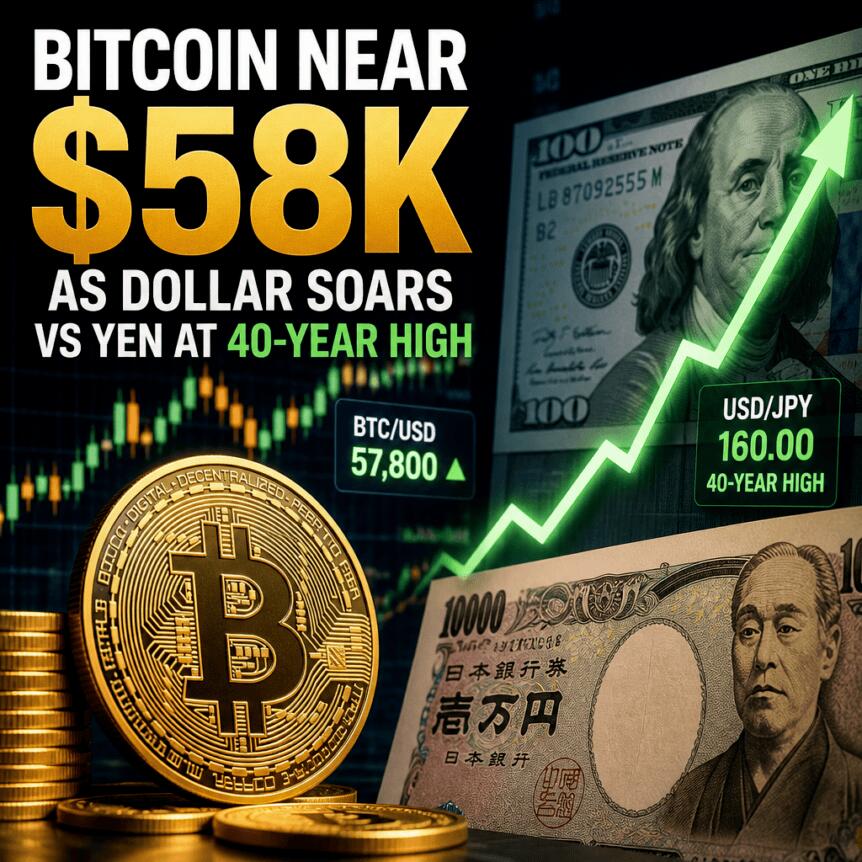
Bitcoin slid toward the $58,000 area during the early Tuesday Wall Street session, extending a broader risk-off feel that has left crypto lagging behind equities into the quarter’s final stretch. With traders heading into a “quarterly close” backdrop, BTC’s weakness stood out as US stocks logged strong gains for Q2.
At the same time, macro pressures tied to a firmer US dollar and renewed attention on Japan’s currency policy risk added another layer of uncertainty for crypto traders. On-chain signals from CryptoQuant also pointed to growing sell-pressure from investors associated with prior cycle highs, reinforcing the idea that hands are being shaken as price compresses.
Key takeaways
- Bitcoin fell toward about $58,000 during the US open, with volatility picking up into the session.
- US equities reported strong Q2 momentum while BTC continued to underperform, with Q2 losses approaching the high teens.
- A multi-decade USD/JPY move toward the mid-160s raised the odds of Japanese intervention and added pressure to risk assets.
- CryptoQuant analysis highlighted exchange inflows dominated by coins last moved around cycle-high periods, consistent with capitulation among late-cycle buyers.
Volatility rises as Bitcoin struggles to hold key levels
TradingView price action captured a shift toward bearish control as the US session began. Commentators noted that with $60,000 looking increasingly fragile as support, the market’s short-term “bulls vs. bears” battle remained active—particularly on lower time frames.
Exitpump, referencing open interest and positioning changes, suggested that the market could accelerate: “Open Interest pumping… it’s about to get spicy,” according to a fresh X post. Other traders described the price action as compressed, with BTC consolidating in a relatively narrow range and marginally higher lows alongside equal highs.
That type of structure can matter because it often sets up sharp directional moves when liquidity thins. As Daan Crypto Trades argued, the next breakout could arrive quickly after the consolidation tightens further. For short-term participants, the practical takeaway is that the range itself may be less important than what happens when it finally breaks—especially with volatility increasing into the session.
Crypto diverges from stocks as Q2 performance gaps widen
Bitcoin’s slide gained context when compared with US market performance. According to The Kobeissi Letter, the S&P 500 was up about 14% for the quarter—its best showing since 2020—while the Nasdaq 100 was up roughly 25%, also described as on track for its strongest quarterly performance in about five years.
That kind of divergence matters because it challenges a simple “crypto follows stocks” narrative. Even as equities absorbed risk positively into Q2, BTC remained under pressure. For investors, this gap suggests that crypto may currently be reacting more to its own internal liquidity/positioning dynamics and macro cross-asset stress—rather than simply mirroring equity beta.
Dollar strength and yen policy risk re-enter the trade
Macro conditions added a notable headwind. The US dollar pushed to new multi-decade highs versus the Japanese yen, raising the probability of government action—an issue traders often watch closely because intervention expectations can influence carry trades and global liquidity conditions.
In the reporting cited by Cointelegraph, USD/JPY reached 162.50 on the day, the highest level since the mid-1980s. The level is important not just as a data point, but as a proxy for how quickly currency volatility can transmit into broader risk sentiment—including markets where leverage is common.
Analyst George Gammon framed it in terms of “dollar liabilities” and the need to source dollars, warning that selling assets for dollar liquidity can place downward pressure on a range of holdings—from local currency exposures to speculative assets like Bitcoin. While that’s a general macro argument rather than a direct forecast, it aligns with why currency stress can quickly change the tone for crypto traders.
On-chain data points to capitulation pressure from late-cycle buyers
Beyond price charts, CryptoQuant’s latest work warned of a renewed capitulation dynamic among Bitcoin investors associated with cycle-top entries. In a new research Quicktake published by CryptoQuant, the platform argued that exchange inflows have been rising notably at sub-$70,000 price levels.
Crypto Sunmoon, a contributor to the Quicktake, noted that the coins moving into exchanges appear to be held for roughly six to twelve months—an age band often linked with accumulation during earlier bull phases, including portions of late-cycle buying near prior highs. The core claim was that “cycle-top buyers” are now selling at a loss, with the observed exchange flow pattern matching capitulation behavior.
CryptoQuant’s framing emphasizes not only the existence of selling, but the composition of it. When exchange inflows are skewed toward coin lots that last moved around all-time-high periods, it can indicate investors who bought during the mania phase are exiting during the drawdown. The report added that these capitulation events among cycle-top investors have historically coincided with long-term bottom formation, citing patterns seen in both the 2018 and 2022 cycles.
Importantly, CryptoQuant did not claim an immediate bottom is guaranteed—capitulation can occur over multiple stages. Still, the on-chain angle provides traders and longer-term holders with a clearer map of who may be selling (and why). If the inflows represent forced or loss-driven exit rather than fresh liquidation from new entrants, the market may be closer to a “supply digestion” phase than it would be if only new buyers were being squeezed.
As of this report, the data suggests investors are beginning to reduce exposure rather than fully capitulating through a one-off event. That nuance matters: steady distribution can keep price capped, while concentrated capitulation sometimes clears the way for a more durable reversal later.
Going forward, traders will likely watch two things closely: whether BTC breaks out of its compressed range on accelerating volatility, and whether exchange inflows tied to those late-cycle coin cohorts continue to rise or begin to fade. Until either the chart structure resolves or on-chain selling pressure stabilizes, the risk of further downside volatility remains high.
SharpLink (SBET) expanded its Ethereum (ETH) treasury this week, buying 10,000 ETH to reach 886,725 ETH in total holdings. The purchase came while Fundstrat strategist Tom Lee said sentiment looked worse than after the FTX collapse.
The company paired the purchase with a stock buyback, repurchasing 2.13 million shares after raising $75 million last week. SharpLink frames both moves as a single strategy, increasing the amount of ETH backing each share.
SharpLink Buys ETH and Repurchases Stock
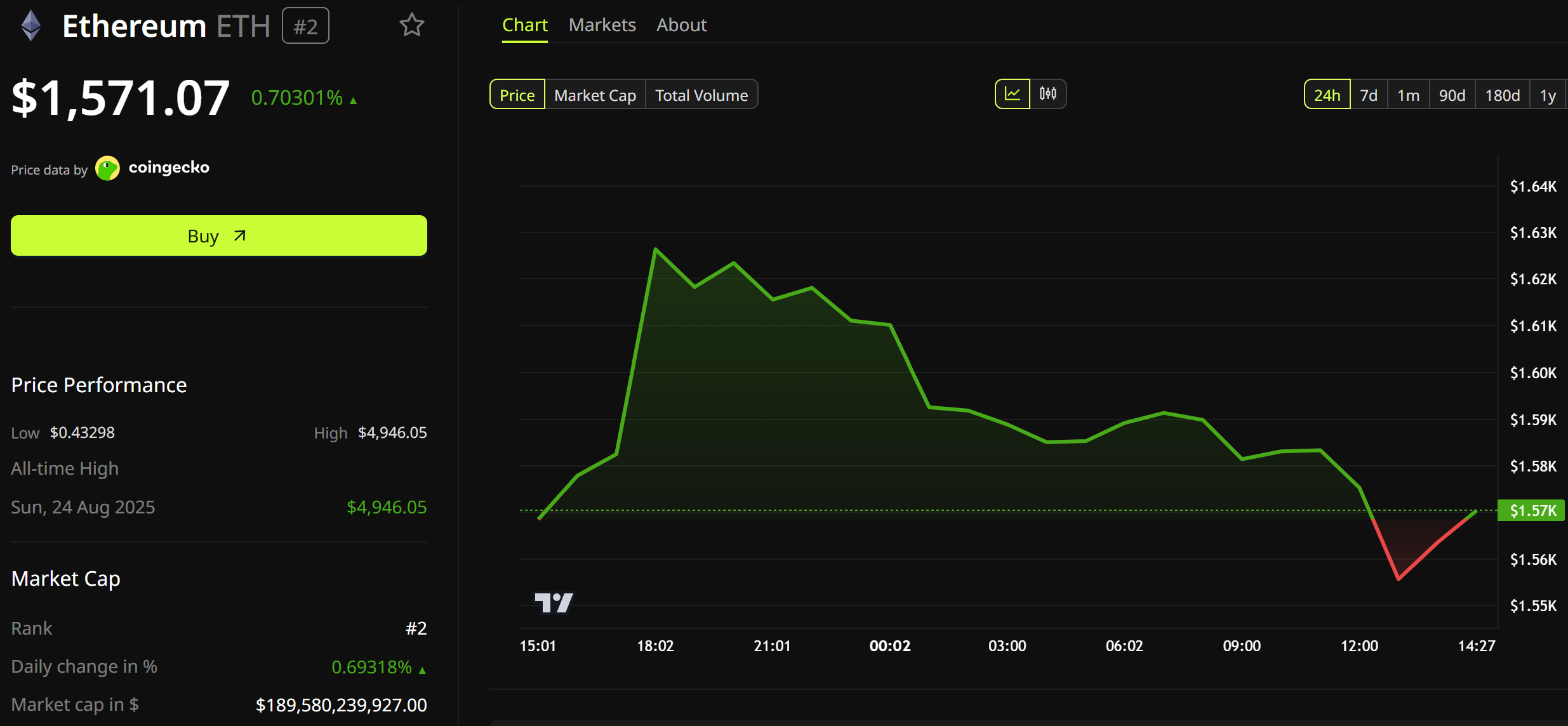
The Ethereum treasury company paid an average of $1,611 per 10,000 ETH, according to a company statement. That price already sits above ETH’s $1,570 level at press time, leaving the fresh tranche underwater within days.

The buy lifted holdings to 886,725 ETH as of June 28, the second-largest corporate stash after BitMine. The position is worth about $1.4 billion at Ethereum’s current price.
ETH set a record near $4,946 in August 2025, then shed roughly 69% of its value. It has dropped about 23% over the past month, well below the level at which SharpLink built most of its treasury.
The company also repurchased 2,132,773 shares at $4.69, spending close to $10 million. That $75 million came from a stock offering priced at about a 41% premium.
“We had the opportunity to buy ETH and repurchase our stock at attractive valuations, so we did both. This past week we added 10,000 ETH and repurchased 2,132,773 shares,” SharpLink CEO Joseph Chalom said in a post, tying the two decisions togethe.
Follow us on X to get the latest news as it happens
The firm had only recently resumed Ethereum purchases after an eight-month pause.
Tom Lee Says Sentiment Has Hit Post-FTX Lows
The buying contrasts with the wider mood. Lee chairs BitMine, the largest Ethereum treasury firm. It disclosed about 5.7 million ETH and $9.8 billion in crypto and cash this week, more than six times SharpLink’s holdings.

In a recent interview, Lee pointed to falling Google searches and a record-low RSI as signs of deep fear.
“The fear greed index is worse today than it was after the FTX debacle. So, usually that’s a good time to be buying something.”
Lee said Ethereum’s price is lagging its fundamentals, citing AI and tokenization as long-term tailwinds. He has also rejected Ethereum funding fears raised after staff exits at the Ethereum Foundation.
Staking income has helped Ethereum treasury firms offset paper losses through the slump. Whether SharpLink’s accumulation marks a bottom or just deeper conviction is not yet clear, but the firm keeps buying while much of the market sits on losses.
The post Ethereum Whale Tom Lee Flags Peak Market Fear as SharpLink Buys 10,000 ETH appeared first on BeInCrypto.


OKX has launched the beta version of an AI marketplace that allows autonomous agents to find work, complete tasks, receive onchain payments, and build portable reputations across transactions.
Summary
- OKX has launched the beta of OKX AI, an onchain marketplace where AI agents can find work and receive payments.
- The platform combines agent discovery, identity, escrow payments, reputation tracking, and decentralized dispute resolution.
- The launch expands OKX’s product lineup as it also advances tokenized finance initiatives and MiCA-regulated operations in Europe.
According to an announcement from OKX, the new platform, called OKX AI, combines agent discovery, identity, payments, reputation tracking, and dispute resolution into a single ecosystem designed for AI-powered services.
Rather than functioning as a simple directory, the marketplace lets software agents independently accept assignments, complete them, and settle payments onchain without relying on centralized intermediaries.
AI agents can now discover work and earn onchain
The platform consists of two connected marketplaces. In the Agent Marketplace, developers can list AI agents and define the services they provide. The Task Marketplace allows those agents to search for available work, complete assignments, and automatically receive payment once tasks are finished, according to OKX.
Payments are handled through either escrow-backed smart contracts or instant pay-per-call transactions. OKX said developers can receive compensation in either USDT or USDG, depending on the payment arrangement used.
At the same time, every completed transaction contributes to a shared onchain identity, allowing an agent’s reputation to grow across different applications instead of remaining tied to a single platform.
Disputes are handled differently from conventional freelance marketplaces. According to OKX, disagreements are reviewed by a decentralized network of evaluators rather than a centralized operator, with the outcome becoming part of the platform’s trust system.
The company also said the marketplace supports widely used AI development tools, including Claude Code and Codex. Launch partners include AWS, CertiK, the Ethereum Foundation, the Solana Foundation, StraitsX, and several other ecosystem participants.
OKX expands beyond crypto trading
The AI marketplace arrives as OKX continues adding products beyond its core exchange business.
As previously reported by crypto.news, OKX and Intercontinental Exchange have appointed former New York Governor Andrew Cuomo to co-chair a venture focused on tokenized and digitally native financial assets. The project, which remains subject to regulatory approval, is expected to connect OKX users with ICE futures products and tokenized equity markets linked to the New York Stock Exchange.
According to the companies, the initiative is intended to build blockchain infrastructure that can work alongside established financial markets rather than replace them.
The AI launch also comes shortly after OKX Europe highlighted the changing regulatory landscape in the European Union. As previously reported by crypto.news, the exchange estimated that more than 80% of crypto exchanges operating in Europe could disappear after the July 1 transition deadline under the Markets in Crypto-Assets regulation if they fail to obtain authorization.
Based on those estimates, OKX said only about 200 crypto asset service providers currently hold MiCA licenses despite between 1,100 and 1,300 firms previously operating under national regulatory frameworks. The company has also introduced a customer incentive program offering deposit bonuses of 5% to 8% for users transferring assets from exchanges that do not secure MiCA authorization.
With the addition of OKX AI, the exchange is extending its product lineup beyond digital asset trading and tokenized finance into infrastructure designed for autonomous software agents, combining identity, payments, reputation, and task execution within an onchain marketplace.
China just built a major AI model without Nvidia chips. Now OpenAI has found ways to run on far fewer of them, cutting inference costs by more than half. Even so, Nvidia stock rose.
That is the puzzle. OpenAI is one of Nvidia’s (NVDA) biggest customers. Yet the shares climbed even as it moved to need fewer chips.

OpenAI Cuts Inference Costs on Two Fronts
The first front is software. The Information reported that OpenAI engineers cut inference costs by more than half with new optimization methods. OpenAI has not published the technical details.
The savings reduce the number of Nvidia chips needed to handle some ChatGPT traffic. They could also let OpenAI lower prices or raise usage limits.
The second front is hardware. On June 24, OpenAI and Broadcom (AVGO) unveiled Jalapeño, its first custom chip. OpenAI said early tests point to far better performance per watt than today’s leading chips, with a nine-month design.
The first chips will deploy at a gigawatt scale by the end of 2026, with Microsoft as the lead partner. Nvidia still runs most of OpenAI’s inference, even as OpenAI funds its Broadcom chip partnership.
Big Tech Races to Build Its Own Chips
OpenAI is not alone. Google has built tensor processing units since 2016, and Amazon followed with its own. Research firm TrendForce projects ASIC-based systems will reach 27.8% of AI server shipments in 2026, the highest since 2023.
By TrendForce’s count, custom chips are set to grow faster than Nvidia’s GPUs for the first time. Suppliers like Broadcom and Marvell have become key custom chip makers in the build-out.
Sanctions are pushing the same trend in China. Meituan recently trained its 1.6 trillion parameter LongCat-2.0 model on China’s domestic chips, without any Nvidia hardware.
Why Nvidia Stock Keeps Rising
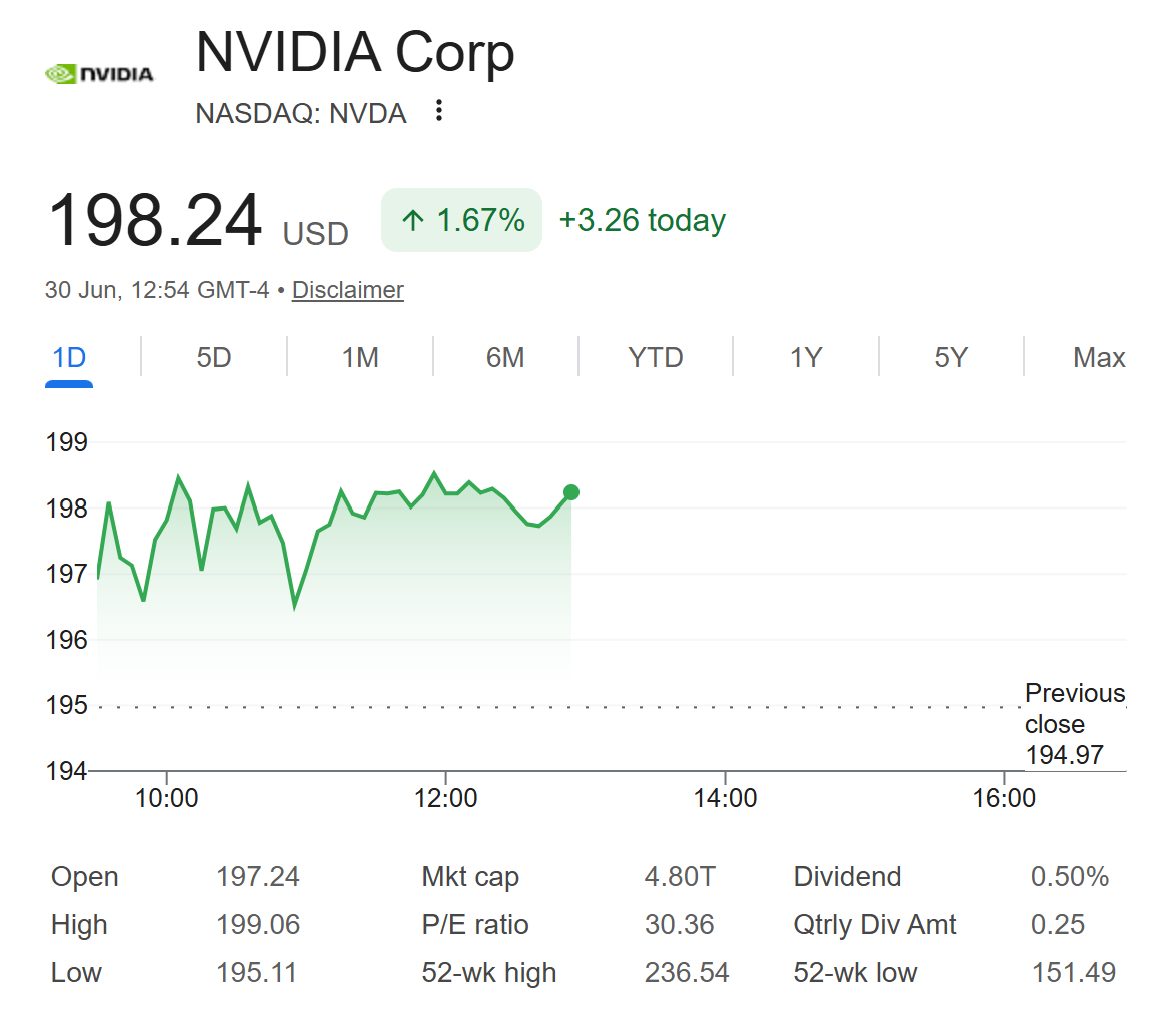
The threat is real, but the numbers explain the calm. Nvidia stock rose nearly 2% on June 30, near a $4.8 trillion value. Nvidia’s latest results showed data-center revenue up 75% to a record $62.3 billion in a single quarter.
Most of the pressure sits at inference, not training. Nvidia still dominates model training, where its CUDA software has locked in developers since 2006. Custom chips rarely match that flexibility.
Nvidia is also defending the inference layer it is accused of losing. At GTC, Nvidia said its upcoming Rubin platform cuts inference costs per token by up to 10 times compared to Blackwell. Cheaper inference also tends to lift usage and total compute with it.
Not everyone is convinced. Some investors have rotated into rival chip stocks, betting the inference shift compounds. Yet Nvidia guided to this quarter without counting any China sales, and still sees record demand.
Nvidia still sells every chip it can make. The real test is whether its biggest customers can cut it out faster than the market grows.
The post After China, OpenAI Chips Away at Nvidia: So Why is NVDA Stock Up? appeared first on BeInCrypto.

Crypto influencer Nick O’Neill said he deliberately sold off a community-created token after its developers sent him 60% of its supply.
The incident has sparked criticism from some traders, while others argue the entrepreneur had no obligation to support an unofficial token created without his approval.
O’Neill Defends Selling Unsolicited Token
It all started when the Fibonacci account on X shared a clip from O’Neill’s Choose Rich Live YouTube show, in which he had noted that The Black Bull (ANSEM) had surged 40% to a peak market cap above $120 million after the influencer it was named after, Ansem, teased weekly airdrops.
In the clip, he also pointed out that Ansem controls 60% to 65% of the token supply and fees through a public wallet that was valued at about $50 million at the time.
“Will it surge to similar highs? I don’t know. It’s hard for these to sustain…If you take a look at the charts of Ansem, it’s setting up for a pretty bad head and shoulders pattern. And I think the reality is, it’s like there’s not enough buyers in the market,” remarked O’Neill on ANSEM’s performance.
But even after expressing those doubts, a now-deleted post suggested that O’Neill could also have benefited if he had controlled 65% of a token’s supply, and, responding to the idea before the post disappeared, the podcaster replied, “I mean that would have been incredible.”
However, he said the opposite shortly after, telling his nearly 286,000 followers on X that he had no intention of supporting tokens launched in his name apart from the original RICH meme coin.
“I will literally rug any token anybody creates for me other than the original $RICH. I just rugged another token,” the influencer wrote.
When criticism started, O’Neill clarified that someone had independently created and distributed the token in question, named I Choose Rich Everytime (NICK), before sending him a large allocation.
Reserve, the account behind the coin, accused the influencer of selling the NICK tokens shortly after receiving them, something he did not deny, instead arguing that there was no reason for him to back another community-created asset when an existing cryptocurrency already carried his branding.
“If I wanted to do this I wouldn’t have some random person do it,” he responded.
ANSEM Comparison Hangs Over the Discussion
Some of O’Neill’s followers urged him to embrace the token anyway, suggesting it could rival ANSEM’s success. But others defended his decision, with one of them, ExcaliberArt, comparing the situation to receiving free shares in a company, which O’Neill was free to sell since he had never promised to promote or endorse the token.
As CryptoPotato reported yesterday, the deployer behind The Black Bull sent 650 million tokens, worth about $71 million at the time, directly to Ansem’s wallet for free while walking away with just $5,500 for themselves. According to on-chain analysts, the distribution suggested a pre-arranged promotional scheme, although some watchdogs, such as Rugcheck, warned that the token’s concentrated ownership had increased the risk of market manipulation.
The post Crypto Influencer Nick O’Neill Says He ‘Rugged’ Unsolicited Token Sent to Him appeared first on CryptoPotato.
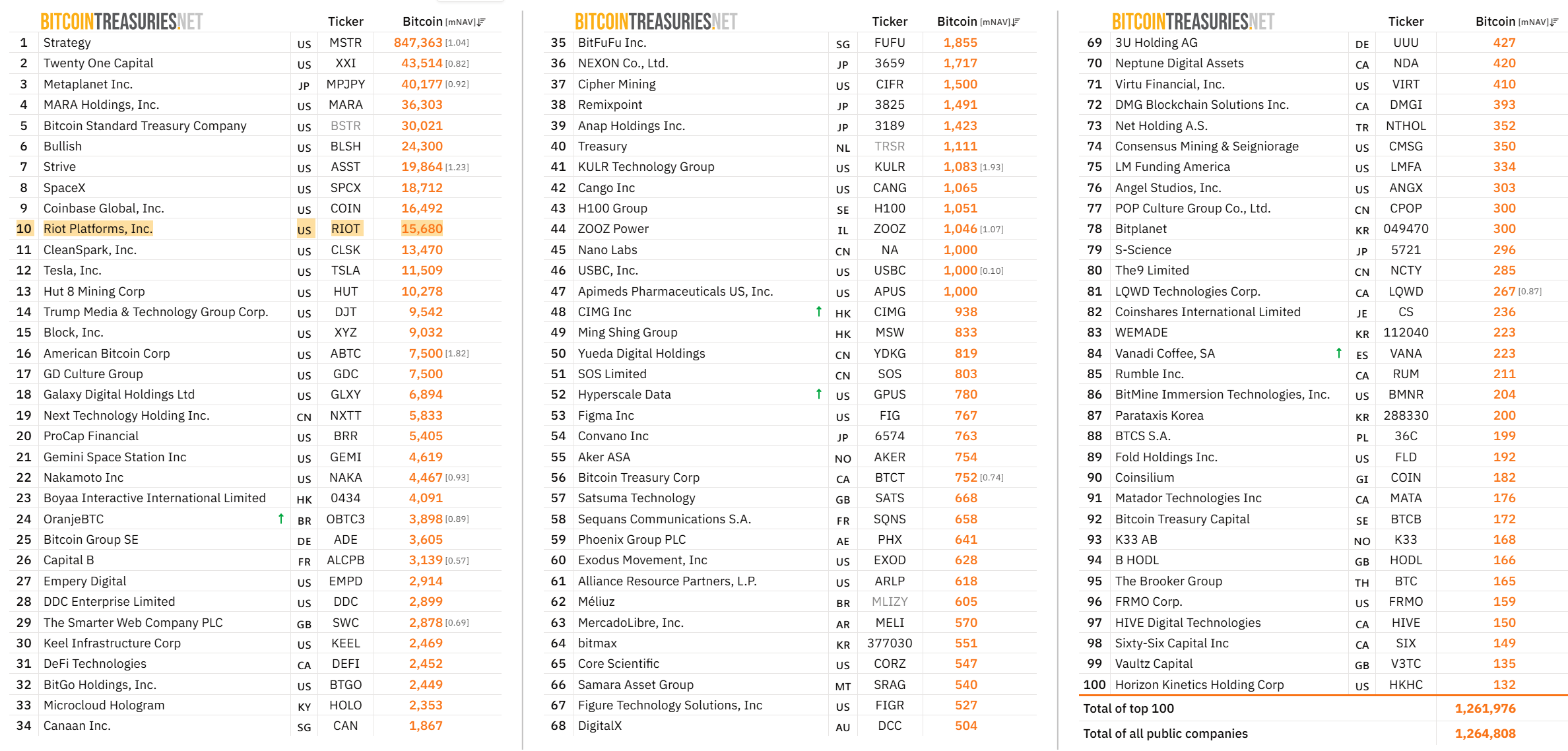
Bitcoin miner Riot Platforms (RIOT) has moved another 500 Bitcoin (BTC) to custody firm NYDIG, worth roughly $39 million, the latest move in a treasury strategy now funding its push beyond mining.
On-chain monitors spotted the deposit, which fits a familiar pattern. Riot has sold far more Bitcoin than it mines, converting its reserves into cash for a costly pivot into AI data centers.
A Familiar Pattern for Riot
Blockchain monitor Onchain Lens flagged the 500 BTC deposit on June 30. It mirrored a similar transfer that analytics firm Arkham tracked in early April. Such moves to custodians often precede sales.
The scale of the selling is striking. Riot disclosed selling 3,778 Bitcoin for $289.5 million last quarter, while mining just 1,473 coins. The first-quarter Bitcoin sell-off far outpaced production, draining the treasury.
Those sales cut holdings to about 15,680 BTC as of this writing, down 18% from a year earlier.

Other miners offloading Bitcoin have leaned on the same playbook. Rival MARA Holdings sold about $1.1 billion in Bitcoin this year, while Core Scientific began monetizing most of its coins.
Thinner margins since the 2024 halving have squeezed pure mining.
The Riot Bitcoin Sale Funds an AI Bet
The clearest link between the selling and the pivot came in January. Riot funded a $96 million land purchase at its Rockdale site in Texas entirely by selling about 1,080 Bitcoin.
That land now anchors a data center business. Anchor tenant AMD signed a 10-year lease worth about $311 million, then doubled its commitment to 50 megawatts last quarter. The segment brought in $33.2 million of revenue, its first contribution.
The economists explain the urgency. Once equipment depreciation is accounted for, Riot spent $96,283 to mine each Bitcoin last quarter, more than a Bitcoin was worth. It reported a net loss of about $500 million.
What the Sale Streak Signals
CEO Jason Les has cast the shift as a turning point rather than a retreat.
“The first quarter of 2026 marks a definitive inflection point for Riot, as we officially transitioned into an active, revenue-generating data center operator,” the miner’s CEO, Jason Les, said.
Follow us on X to get the latest news as it happens
Riot abandoned its long-standing hold-only policy in 2025 and now sells routinely. Still, the company has staked its future on tenants like AMD rather than on Bitcoin alone.
With Bitcoin trading near $58,700, Riot can still raise large sums from a shrinking treasury. The race for AI infrastructure has rewarded that bet, with miner stocks climbing even as mining margins fade.

The coming quarters will test whether data center income can replace what mining once delivered.
The post Nasdaq-Listed Riot Keeps Selling Bitcoin While Reinventing Its Business appeared first on BeInCrypto.


Anthropic and OpenAI opened a new front in their rivalry on Tuesday, both aiming at scientific research. Anthropic launched Claude Science, an AI workbench for researchers, while OpenAI released GeneBench-Pro, a benchmark for computational biology.
The same-day releases push the AI race beyond chatbots and coding into laboratory work. One company shipped a tool for scientists to use today. The other built a yardstick for how far the technology still has to go.
What Anthropic’s Claude Science Does
Claude Science brings the databases, code, and computing power scientists use into a single app. It connects more than 60 scientific databases across genomics, proteomics, and cheminformatics.
Claude Science is an app, not a new model. It lands while Anthropic’s most powerful Fable 5 and Mythos 5 models stay restricted under US export rules. Every result is auditable and traced back to the code that produced it.
The workbench extends a life sciences push Anthropic began in October 2025. In beta, the Allen Institute’s Jérôme Lecoq used it to compress reviews that once took up to two years.
Anthropic will also fund up to 50 research projects, with up to $30,000 in credits each.
OpenAI’s GeneBench-Pro Raises the Bar
Shortly after Anthropic’s Claude Science release, OpenAI released GeneBench-Pro. It tests whether AI agents can make the judgment calls that real biology research demands.
The benchmark contains 129 problems across genomics, quantitative biology, and translational medicine.
OpenAI’s strongest model, GPT-5.6 Sol, solved 28.7% of the problems at its highest reasoning level. That figure rose to 31.5% in Pro mode. The company’s earlier staggered GPT-5.6 release came at Washington’s request.
GPT-5 scored below 5% on the original GeneBench, while Anthropic’s Opus 4.8 reached 16% on the harder test.
Follow us on X to get the latest news as it happens
Two Strategies, One Race
The split reveals two paths to the same goal. Anthropic is shipping a product for daily lab use. OpenAI is measuring how reliably models reason through messy data.
Both launches also arrive as Chinese models gain ground in AI research. OpenAI’s own numbers temper the hype because its best model still fails most GeneBench-Pro tasks.
The pressure is both geopolitical and scientific. US export limits have already pushed Anthropic to weigh new host countries for its models.
Reviewers estimated each GeneBench-Pro problem would take a human expert 20 to 40 hours, costing thousands of dollars. OpenAI said its model finishes the same analysis for a few dollars.
Aubrey de Grey, a biomedical gerontologist, sees AI clearing key research bottlenecks even if broader gains take longer.
“What we’re going to see very very soon is that AI will make certain parts of the process, especially the development of drugs no longer rate limiting,” Aubrey de Grey, President and Chief Science Officer of the Longevity Escape Velocity Foundation, speaking on a BeInCrypto podcast.
De Grey cautioned that turning faster research into approved treatments still depends on regulation and public tolerance for risk.
Researchers Expect Faster Adoption
Some specialists argue the shift is already underway. Dr. Derya Unutmaz, a Professor of Immunology, told the same BeInCrypto panel that AI now outperforms his own judgment.
“I personally trust AI more than my own ideas in my field of 35 years.”
He expects that reliance to spread quickly across clinical practice.
“It is unethical and I believe that very soon it’s going to be malpractice not to use AI in medicine.”
That optimism still runs ahead of the benchmarks. The coming months will show whether scientists adopt these tools and whether GeneBench-Pro scores start to climb.
The post Anthropic and OpenAI Take Their AI War Into Scientific Research appeared first on BeInCrypto.

Key Takeaways
- Circle (CRCL) shares plummeted over 13% to approximately $65, reaching their lowest point in four months following the rival stablecoin announcement.
- More than 140 major corporations, including Visa, Stripe, Mastercard, BlackRock, and Coinbase, have unveiled Open USD, a new stablecoin project.
- Open Standard, the organization managing Open USD, is headed by Zach Abrams, who previously co-founded Bridge before its acquisition by Stripe in 2024.
- Open USD distinguishes itself from Circle’s USDC by offering zero-fee minting and redemption, plus shared reserve income distribution among consortium members.
- Circle’s CEO Jeremy Allaire dismissed concerns about the competition, asserting that USDC maintains its position as the most reliable stablecoin in the market.
Shares of Circle Internet Group experienced a significant decline on Tuesday. The stock plummeted as much as 14% during trading before closing down approximately 13%, hovering around $65—marking its weakest performance since the end of February.
The sharp decline came after news emerged that a consortium exceeding 140 corporations intends to introduce a rival stablecoin. This new digital asset, dubbed Open USD, represents a direct challenge to Circle’s flagship USDC token.
Coinbase shares also experienced downward pressure from the announcement, declining roughly 6% to $142.37. This decline carries particular significance given that Coinbase partnered with Circle to create USDC and has historically shared in its revenue stream.
The Consortium Behind Open USD
The alliance backing this initiative includes an impressive roster of industry leaders. Among the founding partners are payment giants Visa, Mastercard, and Stripe, alongside financial powerhouses BlackRock and Coinbase, plus banking institutions including BNY, Standard Chartered, and U.S. Bank.
Major technology corporations have also joined the effort. Google and IBM are both participants, along with prominent blockchain projects such as Ripple, Solana, Polygon, and Aave.
An independent entity named Open Standard oversees the project. Zach Abrams serves as its leader, bringing experience from co-founding Bridge, a stablecoin infrastructure company that Stripe purchased in 2024.
Abrams positioned the initiative as addressing market needs, stating that while current stablecoins have merits, the business community requires a solution that’s open, affordable, and structured to serve their interests at enterprise scale.
Industry observers weren’t completely caught off guard. CoinDesk had previously reported earlier this month that Stripe, Visa, and Mastercard were developing a competing stablecoin platform, with indications that Coinbase might participate.
Open USD’s Competitive Advantages Over USDC
The economic model represents the most significant challenge to Circle’s revenue stream. Open USD will allow businesses to create and redeem tokens without any associated fees.
The distribution of reserve income follows a similar collaborative approach. Rather than concentrating interest earnings from reserves within a single entity, Open USD intends to distribute yields among all participating partners following operational expense deductions.
This directly threatens Circle’s primary revenue source. Circle generates income by investing USDC reserves in short-duration Treasury securities and retaining the majority of interest generated—a model that Open USD explicitly aims to disrupt.
Governance authority will be distributed among consortium members instead of residing with a sole issuer. This approach resembles USDG, another consortium-based stablecoin supported by Paxos, Robinhood, Kraken, and Galaxy Digital.
USDC presently maintains approximately $73.6 billion in circulation, positioning it as the dominant U.S.-originated stablecoin. Tether’s USDT holds a larger global presence with roughly $145 billion in circulation, though it focuses primarily on cryptocurrency trading and developing economies.
The implications for Coinbase are substantial. Revenue connected to USDC accounted for 44% of Coinbase’s subscription and services division during the first quarter.
Circle’s CEO Jeremy Allaire took to X on Tuesday to defend his company’s position, characterizing USDC as “the most trusted, widely adopted, institutional-ready stablecoin in the world.” He emphasized that Circle collaborates with thousands of institutional partners.
A Coinbase representative maintained an optimistic perspective, suggesting that additional stablecoin issuers and applications ultimately expand the total addressable market, while affirming that USDC continues to be central to their platform strategy.
According to Open Standard’s official statement, Open USD is scheduled to debut later this year.
Bitcoin (BTC) has dropped roughly 20% over the past month, pulling most cryptocurrencies down with it. Even so, top 5 altcoins for July 2026 enter the new month carrying concrete catalysts that could lift them against the trend.
This selection favors dated July catalysts over raw momentum. Every pick ranks inside the top 50 by market cap, holds relative chart strength, and faces a specific upgrade, fork, or launch within weeks.
How We Picked Altcoins for July 2026
The market backdrop is bearish, so momentum alone means little right now. Each candidate had to clear four filters before making the list.
- Top 50 by market cap, for enough liquidity to matter.
- A dated July catalyst, such as an upgrade, fork, or launch.
- Relative technical strength while the major coins decline.
- Recent price behavior judged against a risk-off market.
Three names clear all four cleanly. Solana, Hyperliquid, and Zcash lead the group. Ondo and TRON join on the catalyst strength.
1. Solana (SOL) Targets a Channel Reclaim
Ranking: #7
Price: $73.33
Market Cap: $42.6 billion
Solana (SOL) heads into July with several drivers. Jito plans to launch its JTX trading terminal during the month. The Alpenglow upgrade is in testing toward Q3 activation, while Firedancer continues to expand across validators.
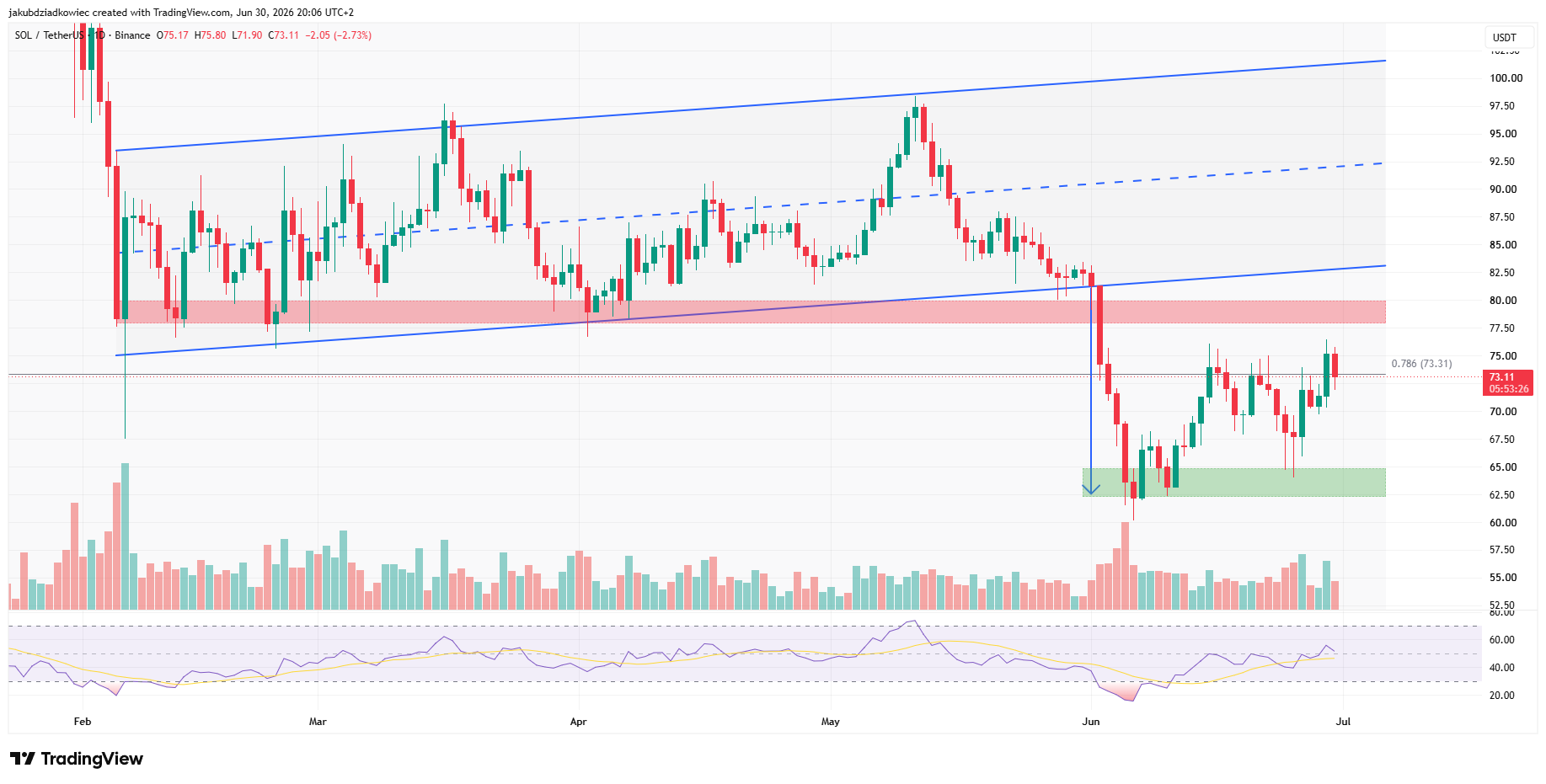
From February to May, SOL traded inside a rising channel between roughly $78 support and $100 resistance. That structure broke in early June. One high-volume candle cut through the floor and bottomed near $62.

Since then, SOL has been trading around $62 to $65 and recovered to about $73. Price is now testing the 0.786 retracement near $73.31 and the bottom of the old channel.
The Relative Strength Index (RSI) has climbed from oversold near 30 to the low 50s. That shift suggests momentum is turning higher rather than simply bouncing. Broader Solana ecosystem activity has also picked up.
A daily close above $78 to $80 would push SOL back inside its channel. That move would open the $88 to $92 zone.
Key risk. A rejection near $80 that breaks $62 would reopen the June lows.
2. Hyperliquid (HYPE) Holds Its Uptrend
Ranking: #10
Price: $64.76
Market Cap: $14.4 billion
Hyperliquid (HYPE) runs the leading on-chain perpetuals venue, with around 70% market share. Its HIP-3 permissionless markets are scaling fast, and a native options market is slated for Q3. Analysts at Multicoin also see large long-term upside for the token.
HYPE owns the strongest structure in this group. Price has followed a rising trendline from its February low near $21 for the past 5 months. It set an all-time high of around $77 in June before easing back.

The pullback looks orderly. HYPE is trading at the 0.236 retracement at $63.66, where it is now consolidating near $64.76. Resistance sits in the $73 to $76 supply zone. Support waits at the 0.382 band near $55, then the trendline around $48.
The RSI sits near 50, and volume has thinned during the range. That pattern reads as a healthy pause rather than a distribution. A break above $76 would reopen price discovery.
Key risk. Around 10 million HYPE unlock each month on the 6th. Buybacks absorb much of that supply, yet the overhang remains.
3. Zcash (ZEC) Defends Key Support Into a Fork
Ranking: #15
Price: $399.01
Market Cap: $6.7 billion
Zcash (ZEC) faces its biggest catalyst of the year in late July. The Ironwood network upgrade, also tracked as Network Upgrade 7, activates then. It promises higher shielded throughput and a new supply audit mechanism.
ZEC offers the most two-sided chart here. The token ran from $184 to a $680 head in May. That move formed a head-and-shoulders top, with the right shoulder near $600.

The neckline broke in early June on heavy volume. Price has since failed twice to reclaim the $520 to $540 area.
ZEC is now trading near the 0.382 retracement at $400. That level aligns with prior structure and marks the line bulls must defend. An earlier Orchard pool issue continues to weigh on sentiment.
Below it, support waits at $317 and the $240 base. A reclaim of $466 would invalidate the bearish pattern and reopen $530.
Key risk. The head-and-shoulders target sits below $400. A break there before the upgrade would pressure the price further.
4. Ondo (ONDO) Leans on a July Catalyst
Ranking: #47
Price: $0.3098
Market Cap: $1.5 billion
Ondo (ONDO) carries a strong institutional catalyst amongst our altcoins for July 2026. The token is tied to a tokenization deployment that involves major asset managers. The effort targets tokenized equities and Treasury bills.
ONDO holds the weakest chart of the five, which fits its catalyst-led role. After basing near $0.25 in the first quarter, it spiked to $0.49 in May. Every rally since has printed a lower high.

A descending trendline now caps price near $0.31. The token trades below the 0.382 retracement at $0.331 and the $0.36 supply band. It joins a wider RWA rotation theme.
The next downside magnet sits at the 0.236 level near $0.282. That zone matches the top of the old accumulation range. A higher low near $0.28 to $0.29, then a trendline reclaim, would flip the structure. The July catalyst could trigger that shift.
Key risk. Momentum points lower. Without the catalyst landing on time, a slide toward $0.28 looks likely.
5. TRON (TRX) Tests Its Yearlong Trendline
Ranking: #8
Price: $0.3149
Market Cap: $29.9 billion
TRON (TRX) offers steady rather than explosive catalysts. Regulators dismissed their case against the foundation, and Mastercard added TRON to a partner program. A post-quantum mainnet rollout is planned for Q3, per Messari research.
TRX runs the steadiest chart in the group. Price has tracked a rising trendline from its February low near $0.27 all year. It peaked at $0.377 in late May, then eased with the market.

TRX now trades near $0.315, pressed against that trendline. It sits between the 0.5 retracement at $0.323 and the 0.618 at $0.310.
The $0.31 zone is the support that must hold. Resistance waits at $0.336, then the $0.352 and $0.377 highs. The RSI near 40 looks soft but not extreme. As long as $0.31 holds, the longer uptrend stays intact.
Key risk. No single July event stands out. A close below $0.31 would break the trendline and expose $0.292.
Altcoins for July 2026: Summary
July 2026 rewards catalysts over momentum. Solana, Hyperliquid, and Zcash pair strong charts with real events. Ondo and TRON depend more on their catalysts than their charts.
Coin
Price
July Catalyst
Chart Posture
Key Risk
Solana (SOL)
$73.33
Jito JTX launch, Alpenglow testing
Reclaiming broken channel
Rejection at $80
Hyperliquid (HYPE)
$64.76
HIP-3 growth, Q3 options
Uptrend intact above $63
Monthly token unlocks
Zcash (ZEC)
$399.01
Ironwood fork in late July
Holding $400 support
Break below $400
Ondo (ONDO)
$0.3098
Tokenization go-live
Weak, below trendline
Slide toward $0.28
TRON (TRX)
$0.3149
Steady institutional adoption
Testing yearlong trendline
Close below $0.31
The post Top 5 Altcoins for July 2026 as Bitcoin Drops 20% appeared first on BeInCrypto.
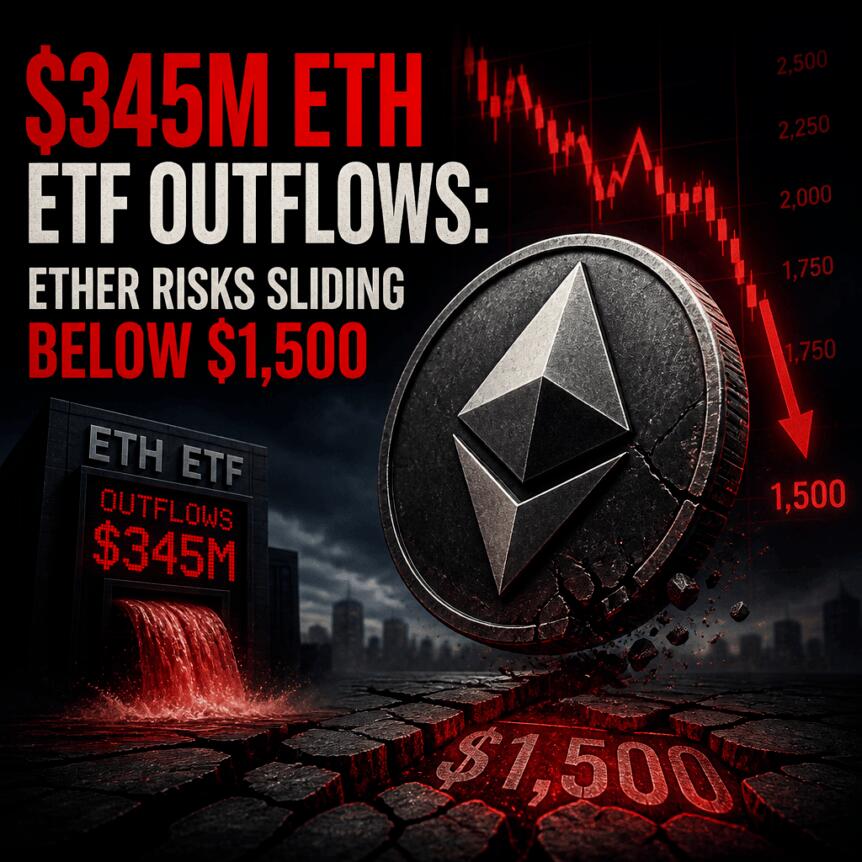
Ether has struggled to regain traction after failing to hold above the $1,600 area since Thursday, as a broader risk-off tone across crypto coincided with shifting expectations for macro policy. With oil prices easing and equities staying relatively supported, attention has leaned toward traditional markets—an environment that can drain momentum from high-beta assets like ETH.
Traders are now focused on whether ETH can defend the $1,500 support level. Negative flows into US spot Ether ETFs have erased recent “accumulation” narratives, while onchain signals—especially fading activity in Ethereum’s fee and decentralized application (DApp) economics—suggest the network’s incentives have not strengthened in tandem with tokenization ambitions.
Key takeaways
- US-listed spot Ether ETFs recorded net outflows of $345 million since June 17, counteracting ETH accumulation reported from Ether treasury-related companies.
- ETH’s pullback remains consistent with weak Ethereum fee and DApp revenue trends, which have not yet translated into stronger staking or ecosystem demand.
- Regulatory uncertainty in the US—around the proposed Digital Asset Market CLARITY Act—continues to complicate institutional confidence.
- Despite growing real-world asset (RWA) tokenization figures on Ethereum, the current pace of DeFi activity tied to tokenized assets remains limited.
Spot Ether ETF outflows overtake treasury accumulation
According to the figures cited in the source, US-listed Ether ETFs have seen $345 million in net outflows since June 17. That selling pressure has outweighed accumulation reported over the same period from Ether treasury strategies—specifically $182 million in ETH associated with BitMine Immersion (BMNR US) and Sharplink (SBET US).
Separately, the article notes that BitMine’s ETH holdings rose to 57 million, referencing earlier coverage from Cointelegraph. In practical terms for markets, the key issue is not whether ETH treasuries are buying, but whether those purchases are sufficient to absorb ETF-driven outflows. With spot ETF flows clearly running negative, near-term downside risk to ETH increases if demand fails to reappear.
That helps explain why traders are again prioritizing technical levels. If $1,500 does not hold, the narrative quickly shifts from “temporary correction” to a broader weakening in ETH positioning.
What’s weighing on ETH sentiment: regulation and capital rotation
Beyond ETF flows, the article points to US regulatory uncertainty as a continuing headwind. It highlights that the Digital Asset Market CLARITY Act has been awaiting a Senate vote since May 15. The bill is described as aiming to reduce “regulation-by-enforcement” and clarify which tokens are treated as securities.
However, lawmakers have raised objections related to stablecoin yield mechanics and anti-money-laundering standards. Even when a bill is seen by many market participants as supportive of decentralized finance, persistent uncertainty can delay institutional commitments—particularly for assets that remain highly sensitive to regulatory expectations.
Meanwhile, the source connects crypto’s muted tone to a stronger draw from traditional markets. Lower inflation expectations and ongoing focus on equities and earnings can support broader risk appetite, but it also tends to redirect incremental capital away from crypto if investors don’t see a clear catalyst specific to the sector.
Onchain economics: shrinking fees and DApp revenue
Ethereum’s current fundamentals, at least as reflected by onchain monetization, appear soft. The article cites DefiLlama data showing that Ethereum monthly network fees fell to $10.7 million in June, down from $24.4 million in April.
DApp revenue also declined: it reached $51.7 million in June, compared with $64.8 million two months earlier. The source lists several top contributors, including Sky (formerly Maker) at $12.7 million, Titan Builder at $7.2 million, and Chainlink at $4.6 million.
When fees and DApp revenue weaken, the incentive structure around ETH can look less compelling. The article argues that this contributes to a more inflationary supply dynamic and that staking yields remain limited—reducing the ecosystem’s “economic pull” for both holders and builders. It also notes that parts of DApp revenue that could otherwise reinforce the token economy flow back to users, which can further temper the case for sustained token price appreciation.
To be clear, this doesn’t mean Ethereum’s long-term thesis is broken. Instead, it suggests the network is not currently generating enough broad monetization to outweigh macro and flow-driven pressure.
Tokenization is rising, but DeFi incentives are not yet catching up
The article argues that tokenization remains early and that its long-term expansion could increase blockchain demand. It points to Ethereum real-world assets (RWA) activity, noting a tokenized market capitalization of $14.5 billion on Ethereum.
Yet the piece also emphasizes a gap: despite the growth in tokenized assets, that momentum has not produced meaningful DeFi activity so far. It also cites a staking yield of 2.7% alongside weak onchain metrics, concluding that the probability of ETH slipping below $1,500 remains “in play.”
This tension—rapid growth in one segment (RWA tokenization) alongside slower translation into ecosystem-wide DeFi traction—may be central to why ETH has struggled to regain strength. Investors may want confirmation that tokenization leads to higher fee-generating activity, deeper liquidity, and stronger DApp revenue—signals that, based on the cited numbers, have been deteriorating rather than improving.
Related coverage referenced in the source notes Ether treasury activity, including an earlier report that Sharplink bought $62.4M ETH last week. But until spot ETF flows stabilize and onchain economics improve, that kind of accumulation may have limited impact on near-term price behavior.
Looking ahead, the market’s next prompts are likely to be ETF flow direction, whether Ethereum’s fee and DApp revenue trends reverse, and any concrete progress on US regulatory clarity. If those catalysts fail to materialize, the $1,500 level remains the line traders will watch most closely.

Bitcoin Near $58K as Dollar Soars vs Yen at 40-Year High

How to watch Team USA vs Bosnia and Herzegovina in round of 32 at World Cup

Here’s How to Recycle Your Old Laptop, PC and Printer





-

 Fashion4 days ago
Weekend Open Thread: Staud – Corporette.com
-

 Politics5 days ago
The House | Manchesterism won’t survive the painful trade-offs unless it gets citizens on board
-

 Crypto World24 hours ago
Strategy authorizes up to $1.25B in Bitcoin sales under new capital plan
-

 Politics5 days ago
Potential 2028er World Cup attendee leaderboard
-

 Business5 days ago
Asia stock markets slide as tech shares slump
-

 News Videos2 days ago
MAJOR BITCOIN & MARKET UPDATE!!!! (MUST WATCH ASAP!!!)
-

 Tech5 days ago
A Look At A Gaggle Of Transputer Boards
-

 Crypto World7 days ago
Securitize Wraps Roubini's SEC-Registered ETF as Dubai VARA Digital Security
-
Crypto World7 days ago
Bitcoin (BTC) Dips Below $62K, Ethereum (ETH) Plunges 6% Daily: Market Watch
-
 Crypto World5 days ago
Dell (DELL) Shares Tumble Over 5% Following Analyst Downgrade to Hold
-

 Crypto World3 days ago
Coinbase, Circle Deepen Crypto Stock Losses Despite Resilient S&P 500
-

 Crypto World4 days ago
Kraken's xStocks Opens Bending Spoons IPO Registration to EEA Retail
-

 Business23 hours ago
Australia treasurer says alleged access of prime minister’s bank data ’incredibly concerning’
-

 Sports4 days ago
FIH Pro League: India defeat Pakistan 7-1, register biggest win of campaign | Other Sports News
-
 Crypto World5 days ago
Bitcoin Sparks $600M Hourly Liquidations With $65,000 Set To Become Resistance
-

 Tech3 days ago
Bluekit phishing kit adopts browser-in-the-middle for login theft
-

 Tech4 days ago
Russian hackers now target Signal backup recovery keys
-
Crypto World5 days ago
Hyperliquid Named on Singapore MAS Investor Alert Register
-
 Crypto World6 days ago
Ripple and SBI launch RLUSD in Japan after JFSA approval
-

 Crypto World4 days ago
RTX holders must register wallets before token distribution begins
You must be logged in to post a comment Login