
Crypto World
Taiwan Lawmaker Pushes for Bitcoin Reserve Amid Foreign Exchange Debate


TLDR:
- Taiwan legislator Dr. Ko Ju-Chun formally presented a Bitcoin reserve report to the premier on April 29.
- Over 80% of Taiwan’s $602B reserves are in U.S. dollar assets, raising concentration and debasement risks.
- The Bitcoin Policy Institute argues Bitcoin resists seizure and operates outside sovereign monetary control.
- Taiwan’s central bank has one month to submit a new report covering stablecoins and digital asset reserves.
Taiwan’s push for a Bitcoin reserve entered a new phase on April 29 when legislator Dr. Ko Ju-Chun formally presented a policy report to Premier Cho Jung-tai and Central Bank of China Governor Yang Chin-long.
The report, produced by the Bitcoin Policy Institute, urges the government to allocate a share of Taiwan’s $602 billion in foreign exchange holdings to Bitcoin.
The move signals growing momentum for digital asset integration within Taiwan’s financial policymaking circles.
Legislative Action Brings Bitcoin Reserve Debate to the Forefront
The formal session took place within Taiwan’s Legislative Yuan, which operates under the country’s semi-presidential system.
In that structure, the premier holds considerable authority over domestic economic policy. Dr. Ko presented the BPI report during an official interpellation session, making it the first time the document reached the premier directly.
Ko first raised these ideas with the central bank governor during a separate session on March 30. The April 29 session escalated the conversation by including the head of government.
Ko also requested that the CBC produce a new report within one month, covering stablecoins and broader digital asset reserve strategies.
The BPI report was written by BPI Fellow Jacob Langenkamp and published in March 2026. It draws attention to the fact that over 80% of Taiwan’s reserves are held in U.S. dollar-denominated assets.
This concentration creates exposure to currency debasement and potential geopolitical disruption, according to the report’s findings.
Langenkamp elaborated on why Bitcoin stands apart from traditional reserve assets, stating: “Taiwan faces a unique convergence of geopolitical risk and reserve concentration that makes the case for Bitcoin reserves especially compelling.”
He further explained that conventional assets fall short under extreme conditions, adding that “in a scenario where physical gold is stranded and dollar reserves face restrictions, Bitcoin remains fully accessible without physical transport.”
Central Bank History and the Road Ahead
Taiwan’s central bank had previously evaluated Bitcoin as a reserve asset in late 2025. At that time, the CBC concluded it was unsuitable, pointing to concerns around volatility, limited liquidity, and custody risks. However, the CBC also committed to a digital asset sandbox, using 210 seized Bitcoin to run future testing.
That earlier conclusion has not stopped lawmakers from revisiting the issue. Dr. Ko, who serves as vice co-chair of the Legislative Yuan’s US-Taiwan Caucus and founder of the Emerging Technology Exchange Association, has continued to push for a structured policy review. His follow-through demonstrates that the conversation is not fading.
Reflecting on the broader reach of BPI’s research, Sam Lyman, head of research at the Bitcoin Policy Institute, pointed to the weight of Ko’s actions: “BPI’s research is reaching the highest levels of government, both here in the United States and abroad.”
He added that the legislator’s direct presentation to Taiwan’s top officials showed how seriously Bitcoin is now being considered as a strategic asset, noting: “Our job is to educate the public on the benefits of Bitcoin, and this report is in furtherance of that goal.”
The CBC’s one-month deadline to respond on stablecoins and digital asset reserves sets a concrete timeline. Whether the bank revises its earlier position or defends it will likely shape the next phase of this policy debate in Taiwan.




Arbitrum’s Security Council seized 30,766 ETH from the KelpDAO hacker, but a US court order now blocks the DAO from touching the $71 million stash. Lawyers for North Korean kidnapping victims aim to claim the money under a 2015 judgment against Pyongyang.
The legal action stalls Aave and Kelp DAO’s plans to compensate users hit by the April 18 hack. The freeze shows how a centralized governance move pulled assets straight into US courts.
Centralized Action, Centralized Consequences
The Council froze the ETH last month after a bridge exploit drained $290 million from KelpDAO. It coordinated with law enforcement and routed the funds to governance control.
Han Kim and Yong Seok Kim are US nationals whose relative was killed by North Korea. They won more than $300 million in damages from Pyongyang in a 2015 ruling.
Their lawyers obtained an order on May 1 from the Southern District of New York. The order bars Arbitrum from transferring the seized assets.
LayerZero attributed the hack to the Lazarus Group, tying the ETH directly to Pyongyang.
Aave Recovery Hits a Legal Wall
Attorney Gabriel Shapiro reviewed the filing and said the freeze is real, not theoretical. Plaintiffs secured court approval under specific garnishment statutes, leaving the DAO without unilateral authority to redirect the assets.
“Arbitrum DAO is not allowed to do anything with the KelpDAO funds for now, until a divestiture hearing… they are supposed to actually litigate that not just decide on their own what to do with it,” Gabriel Shapiro stated in post on X.
The freeze stalls Aave’s coalition, which pooled ETH from Lido, Mantle, and EtherFi to backstop rsETH holders. Those plans relied on the seized stash flowing back through Arbitrum governance.
According to one of the economics leads at MegaETH, the seizure exposes the DAO to claims it never anticipated.
Identifiable DPRK assets carry legal weight regardless of which protocol holds them.
Once a DAO seizes assets through centralized rails, those assets sit inside the same legal regime as bank accounts.
The divestiture hearing will decide final control. Separate ETH from the heist still moves through laundering channels.
The post Arbitrum’s KelpDAO Freeze Backfires as US Court Blocks $71 Million Recovery appeared first on BeInCrypto.
TLDR:
- Senators Tillis and Alsobrooks finalized a bipartisan deal that unblocks the Crypto Market Structure Bill.
- Crypto platforms are now banned from offering passive stablecoin yield equivalent to bank deposit interest.
- Activity-based rewards like trading and staking remain permitted under the new stablecoin regulatory framework.
- Prediction markets place a 62% chance the Digital Asset Market Clarity Act becomes law in 2026.
The Crypto Market Structure Bill has moved closer to becoming law following a bipartisan Senate agreement. Senators Thom Tillis and Angela Alsobrooks finalized a deal on stablecoin yield this week.
Their agreement resolves the single issue that had blocked the Digital Asset Market Clarity Act for months. The deal also ended the Senate Banking Committee markup collapse from January.
Washington is now ready to give digital assets a comprehensive legal framework for the first time.
Stablecoin Yield Restrictions Draw a Firm Regulatory Line
Under the new agreement, crypto platforms are broadly prohibited from offering passive stablecoin rewards. Paying users a return simply for holding a stablecoin is no longer permitted.
Regulators determined these payments are too similar to interest on a traditional bank deposit. Banks had lobbied firmly against the practice, fearing customers would pull funds from checking accounts.
The deal does not eliminate all reward types, however. Activity-based compensation remains fully permitted under the new framework.
Users can still earn rewards through trading, staking, or using platform services. The regulatory dividing line now sits between passive holding rewards and active participation rewards.
Coinbase had been among the platforms pushing hardest to offer stablecoin yield. The company viewed it as a direct competitor to traditional savings accounts.
That approach is now off the table in the U.S. market. Banks secured this outcome after arguing passive yield would trigger widespread deposit flight.
Bull Theory flagged the outcome on X, noting the deal bars platforms from paying rewards that function like bank deposit interest.
The trade-off is straightforward: crypto platforms lose a key user acquisition tool. Banks retain their edge on passive yield over digital asset providers. Neither outcome was accidental—both sides negotiated with clear objectives.
Regulatory Clarity Opens a New Chapter for Digital Assets
The Crypto Market Structure Bill now has a clear path toward a full Senate vote. Removing the stablecoin yield dispute eliminates the legislation’s single biggest obstacle.
The digital asset industry now has a credible shot at comprehensive federal regulation. Every exchange, stablecoin issuer, and platform in the U.S. has long been waiting for this moment.
Treasury Secretary Scott Bessent has publicly targeted spring 2026 for the bill’s passage. The Senate Banking Committee markup is now expected in May.
Prediction markets currently price the odds of the Clarity Act becoming law in 2026 at 62%. That figure reflects real momentum building in Washington around digital asset legislation.
Bull Theory noted that banks secured their demand on yield while crypto gained the regulatory clarity it had long been seeking.
The deal represents a genuine compromise between two powerful financial interests. Both sides entered negotiations with clear priorities and left with partial wins.
The Crypto Market Structure Bill’s forward movement is the most consequential development for digital assets in years.
A formal legal framework for the industry in America now appears genuinely within reach. Regulatory certainty has long been the most requested outcome from the digital asset sector.
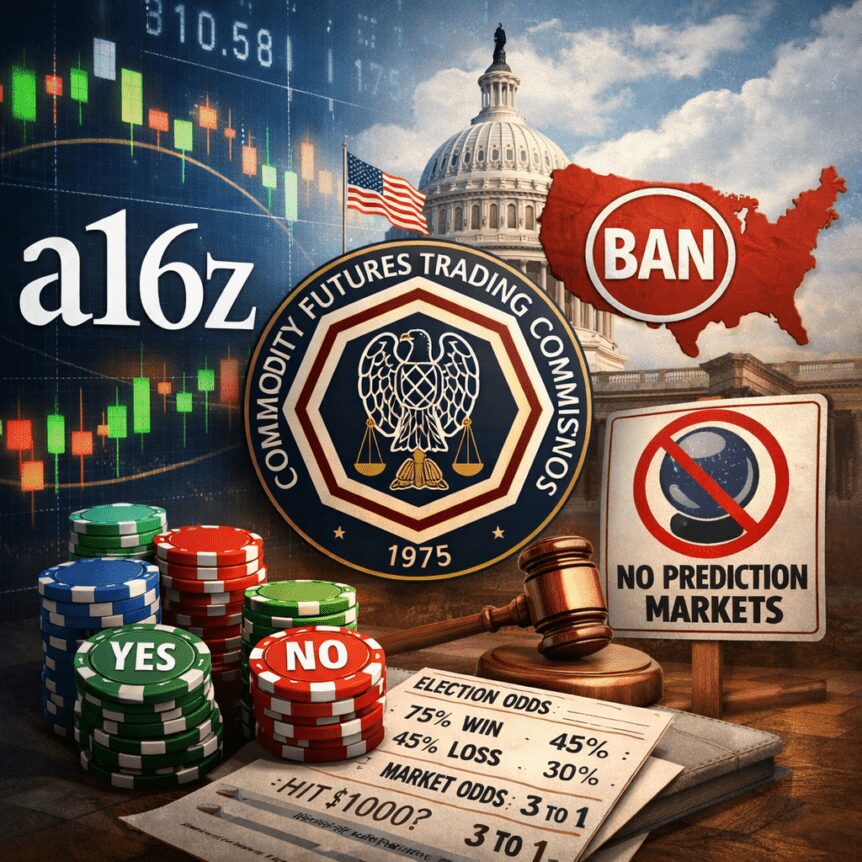
A16z has stepped into the federal-state clash over prediction markets by submitting a letter to the Commodity Futures Trading Commission (CFTC) that argues state-level crackdowns undercut the agency’s mandate to provide impartial access to its markets. The move comes as the CFTC advances its own rulemaking on how event contracts should be regulated and as enforcement actions against several states raise the stakes for platforms like Kalshi and Polymarket.
The venture-capital firm’s letter, filed on Thursday in response to the CFTC’s advance notice of proposed rulemaking, contends that a patchwork of state measures—ranging from cease-and-desist orders to criminal charges—creates barriers that hinder the federal framework designed to ensure open, unbiased access to prediction-market venues. A16z argues that such state interventions undermine the federal regulator’s ability to provide equal treatment for participants, liquidity, and predictable rules of engagement for operators and users alike.
Key takeaways
- A16z formally opposes state-level actions that restrict access to prediction-market platforms, urging the CFTC to preserve impartial access to markets and services.
- The CFTC has recently filed lawsuits against Illinois, Arizona, Connecticut, New York, and Wisconsin, accusing state authorities of overstepping by attempting to regulate markets that arguably fall under federal jurisdiction.
- A16z warns that forcing exchanges to block users based on state residency could severely limit liquidity, undermining the functionality and appeal of prediction markets.
- The letter argues that the CFTC—not state legislatures—should define what constitutes “gaming” under federal commodities law, citing decades of federal oversight over event contracts and market structures.
- Polymarket is seeking to regain access for U.S. users via discussions with the CFTC, following a 2022 settlement that barred the platform from serving U.S. customers for unregistered event contracts.
A16z’s intervention reframes the debate on access, liquidity, and regulatory authority
In its filing, A16z emphasizes a core tension in the current regulatory landscape: state authorities instinctively push back against online platforms that offer event-based contracts, while the CFTC contends it should oversee and harmonize these markets to protect consumers and preserve market integrity. The firm frames the issue as not merely a procedural mismatch but a question of market design and user access. “Being forced to deny impartial access to users in states that seek to license or prohibit certain event contracts will likely severely circumscribe available liquidity,” the letter states, underscoring a practical consequence of divergent regulatory approaches.
Beyond the legal arguments, A16z advances a broader case for prediction markets as legitimate price-discovery mechanisms. The firm argues that these platforms reveal crowd intelligence on uncertain outcomes and that their pricing processes contribute real-time information about how events are perceived to unfold. It also touts the potential for blockchain-based platforms to enhance regulatory oversight through on-chain auditability, which, in the firm’s view, can improve transparency and compliance without sacrificing access.
The stance aligns with a growing push from the crypto and digital-asset ecosystem to safeguard access to innovation even as regulators scrutinize risk. In the weeks surrounding the filing, enforcement activity has intensified on the state level, with governments pursuing action against platforms that operate in gray areas of state gambling or licensing regimes. The industry has watched closely for how federal authorities will balance consumer protection with the need for scalable, liquid markets that retail participants—often the majority in this niche—depend on for meaningful participation.
Regulatory framing and the ongoing jurisdictional contest
At the heart of the dispute is a question of jurisdiction: who gets to define what counts as “gaming” under federal commodities law—the CFTC or state attorneys general? State officials have argued that platforms offering bets on sports outcomes or political events are operating unlicensed gambling operations and should be regulated accordingly. A16z counters that only federal regulators have the authority to delineate the boundaries of gaming within the commodity-derivative regime, given the CFTC’s decades of oversight over event contracts and related markets.
The letter also foregrounds a social-value argument: prediction markets can surface price signals about uncertain futures, delivering a form of collective intelligence that complements traditional markets. A16z suggests that, when properly regulated, these markets can function as useful tools for information discovery and risk management. The firm highlights the potential benefits of on-chain transparency, arguing that blockchain-based platforms can render all transactions auditable in a way that may simplify regulatory oversight and reduce opportunity for malpractice.
As Cointelegraph has reported, prediction-market volumes have surged in recent months, underscoring the appeal of these venues to a broad spectrum of retail traders. March data showed roughly $25.7 billion in monthly trading volume, with more than four-fifths of participants categorized as retail traders by volume—an important signal of the democratization of access that regulators and policymakers are weighing in their own ways.
Polymarket’s US return and the broader market implications
Polymarket has become a focal point in the discussion about how US users might again participate in prediction markets. The platform is actively engaging with the CFTC to lift the ban that has barred American users from its main site since a 2022 settlement, in which Polymarket paid a $1.4 million penalty and agreed to block U.S. customers over unregistered event contracts. A successful return would require a formal vote by the commission, though the process could move more quickly if vacancies in four CFTC commissioner seats remain unfilled in the near term.
The potential re-entry of Polymarket would be a tangible test of whether the CFTC’s updated framework can accommodate a broader set of event contracts without compromising market safeguards. If the federal regulator clarifies or updates its stance on prediction-market governance, it could reduce the legal ambiguity that has spurred a patchwork of state actions. For investors and traders, such a shift would likely impact liquidity dynamics, geographic access, and the comparative attractiveness of multiple platforms that compete for user activity and capital flows.
What comes next for the prediction-market regime
The ongoing dialogue between A16z, the CFTC, and state regulators signals a broader trend: regulators are increasingly forced to reconcile a rapidly evolving technological landscape with established legal frameworks. While the current letter emphasizes preserving impartial access and clarifying regulatory authority, the outcome of the CFTC’s rulemaking will ultimately shape the architecture of prediction markets for years to come. Investors, traders, and builders should monitor how the agency weighs comments from major players, how it defines gaming and event contracts, and what safeguards—if any—will be codified to prevent abuses while preserving liquidity and access.
The fate of Polymarket’s U.S. participation remains a crucial live test. A federal path toward a clear, uniform regime could unlock a more robust, retail-friendly market structure, while a continued state-by-state approach might perpetuate fragmentation and liquidity fragmentation. In the near term, the next set of regulatory filings, court actions, and potentially new commission votes will help determine whether prediction markets can mature into a stable, compliant segment of the broader crypto-asset ecosystem.
Readers should stay attuned to updates from the CFTC’s rulemaking process and any new statements from A16z, Kalshi, and Polymarket as the regulatory framework for prediction markets continues to evolve—shaping both the opportunities and the risks for participants in this dynamic corner of the crypto economy.

Key Takeaways
- Q1 2026 earnings announcement scheduled for Monday, May 4, following market hours
- Analyst consensus points to $0.28 earnings per share, representing a 115% annual increase
- Anticipated revenue of $1.54 billion marks a 74% surge compared to last year
- Options market indicates approximately 10% volatility expected after earnings disclosure
- Shares have declined more than 20% year-to-date approaching the earnings release
Palantir is set to unveil its Q1 2026 financial performance on Monday, May 4, following the market close. Despite experiencing a decline exceeding 20% since the beginning of January, Wall Street analysts maintain optimistic projections for the data analytics company.
Palantir Technologies Inc., PLTR
Financial experts anticipate earnings per share of $0.28 for the three-month period, representing a substantial 115% increase compared to the corresponding quarter in 2025. Total revenue is forecast to reach an unprecedented $1.54 billion, marking a 74% year-over-year expansion.
Shares of PLTR concluded Thursday’s session trading around $138, while derivatives markets suggest potential price movement of approximately 9-10% in either trajectory by week’s end. This volatility estimate positions potential gains near $152 or potential losses approaching $126.
The year-to-date decline in PLTR stock has been attributed to widespread apprehension surrounding artificial intelligence software company valuations and concerns that the previous year’s extraordinary performance left shares trading at unsustainable levels.
Notwithstanding the recent downturn, the majority of equity analysts following the company maintain positive outlooks. Among nine analysts monitored by Visible Alpha, six recommend purchasing shares, with a consensus price objective approaching $201 — suggesting potential appreciation exceeding 40% from current trading levels.
Baird analyst William Power maintained his Outperform recommendation with a $200 price objective prior to the earnings announcement. He anticipates revenue expansion to continue for an 11th straight quarter, powered by robust performance across both U.S. Commercial operations and Government divisions.
Power additionally highlighted the recent price decline as a compelling opportunity for investors seeking exposure to high-growth technology companies.
Critical Metrics Under Scrutiny
Market participants will concentrate on commercial client expansion, uptake of Palantir’s Artificial Intelligence Platform (AIP), and traction within government procurement contracts.
Management’s forward-looking statements will receive significant attention, especially any insights regarding the trajectory of U.S. federal government technology spending patterns.
Wedbush analysts communicated to investors their conviction that Palantir possesses “a golden path to become the next stalwart software company over the coming years.” Both Wedbush and Baird indicated they anticipate Palantir will surpass revenue projections.
Extended Time Horizon Projections
Baird’s Power forecasts sustained expansion extending through 2026 and into 2027. His financial models suggest free cash flow could climb to $7.5 billion by 2027 assuming consistent operational performance.
The aggregate Wall Street rating consensus stands at Hold, derived from 15 Hold recommendations, five Buy ratings, and two Sell assessments. The mean price target of $191.74 implies approximately 37.8% appreciation potential.
Palantir’s AIP platform has served as a fundamental catalyst for commercial business growth, and the Q1 financial results will provide fresh insights into whether this expansion trajectory has persisted throughout early 2026.

Key Takeaways
- Zscaler (ZS) surged up to 6.99% on May 1, propelled by impressive earnings reports and upward forecast revisions from SaaS companies like Atlassian and Twilio.
- Citizens Financial reduced ZS price target from $290 down to $210 while maintaining an Outperform rating.
- ZS shares were changing hands at $139.58, representing a 36.7% decline year-to-date and sitting 58.5% beneath the 52-week peak of $336.27.
- A recent KeyBanc CIO survey identified increasing cybersecurity budgets driven by AI deployment as a favorable catalyst for security platforms.
- The shares have experienced 18 price swings exceeding 5% in the past year, underscoring persistent volatility.
Zscaler (ZS) rallied by as much as 6.99% on May 1, benefiting from a broader surge of optimism across the software industry following robust quarterly reports from multiple industry counterparts.
Shares were valued at $139.58 entering the trading session — a valuation representing a 58.5% discount from the 52-week peak of $336.27, achieved in November 2025.
The primary driver wasn’t company-specific news. Atlassian upgraded its full-year guidance, triggering gains in its own shares while simultaneously boosting software names including Salesforce and ServiceNow.
Twilio contributed to the optimistic atmosphere after delivering first-quarter revenue exceeding analyst expectations and elevating its forward outlook, with leadership highlighting AI as a significant growth engine.
This type of industry momentum typically elevates related stocks across the board, and ZS benefited accordingly.
Citizens Lowers Price Target While Maintaining Positive Stance
May 1 wasn’t entirely favorable for Zscaler. Citizens Financial reduced its price objective on the shares to $210 from a previous $290.
The revision stemmed from apprehensions that advanced AI technologies could amplify cybersecurity risks and necessitate a reassessment of how the market values cybersecurity companies sector-wide.
Nevertheless, Citizens preserved its Outperform designation — indicating the firm continues to anticipate appreciation from present levels, despite evolving valuation complexities.
Demand for zero-trust architecture and SASE (Secure Access Service Edge) solutions, which form the foundation of Zscaler’s offerings, remains robust according to analysts.
AI Adoption and Security Spending Come Into View
Approximately ten days prior to the May 1 rally, ZS advanced 4.1% following a KeyBanc CIO survey revealing expanding cybersecurity budgets connected to AI implementation.
The research emphasized Anthropic’s Mythos AI framework as a component likely to stimulate heightened enterprise investment in security infrastructure throughout the coming year.
The rationale is clear: expanded AI deployment creates additional vulnerability points, and organizations are anticipated to allocate more resources toward protection.
This favorable trend has partially counterbalanced the headwinds Zscaler has encountered in 2026.
ZS ranks among the more significantly impacted cybersecurity stocks this year, declining 36.7% since the beginning of January.
The equity has registered 18 daily movements surpassing 5% over the trailing twelve months, demonstrating exceptional sensitivity to both sector developments and broader market fluctuations.
An investor who allocated $1,000 to Zscaler five years ago would currently hold approximately $772.93 in value.
The stock’s typical daily volume hovers just above 3 million shares, with a present market capitalization of $21.01 billion.
Citizens’ updated price objective of $210 continues to suggest substantial upside potential from the $139.58 trading level observed on May 1.

Key Takeaways
- WOLF shares reached a fresh 52-week peak at $36.60, climbing approximately 24.6% from Thursday’s closing price of $29.53
- Year-to-date gains total 70%, with shares up 34% over the trailing 12-month period
- The semiconductor manufacturer finalized a debt restructuring transaction, securing roughly $475.9 million in total gross funding
- Wall Street maintains a bearish “Reduce” consensus view, with analyst price targets averaging just $14.33
- Financial metrics show continued struggles, including a -14% gross margin and quarterly loss of ($6.11) per share
Shares of Wolfspeed surged to a new 52-week peak of $36.60 during Friday’s trading session, ultimately settling at $36.49 — representing an impressive single-day jump of approximately 24.6% compared to Thursday’s $29.53 close. Trading activity was robust, with more than 4.7 million shares exchanging hands throughout the session.
This latest surge pushes WOLF’s year-to-date performance to an impressive 70% gain, while the stock has appreciated 34% when measured over a full year. The dramatic appreciation marks a significant reversal for shares that had previously hovered near their 50-day and 200-day moving average levels of approximately $20.60.
The explosive price action follows news of a significant balance sheet restructuring. Wolfspeed successfully completed a private placement transaction involving both convertible debt instruments and equity securities, generating total gross proceeds of approximately $475.9 million.
Those funds were immediately deployed to retire around $475.9 million worth of the company’s existing Senior Secured Notes scheduled to mature in 2030. The capital raise consisted of $379 million in new 3.5% Convertible 1.5 Lien Senior Secured Notes maturing in 2031, supplemented by roughly $96.9 million raised through common stock issuance and pre-funded warrant sales.
The transaction essentially provides the company with extended runway — and investors appear willing to reward management’s financial engineering, at least in the immediate term.
Wall Street Maintains Skeptical Stance
Despite the market euphoria, equity research analysts remain distinctly cautious on WOLF’s prospects. The Street’s consensus recommendation stands at “Reduce,” accompanied by an average 12-month price objective of $14.33 — representing substantial downside from current trading levels.
Among the six analysts actively covering Wolfspeed, just one maintains a Buy recommendation, two rate the stock at Hold, and three have assigned Sell ratings. Piper Sandler holds the most constructive view, maintaining its “Overweight” rating alongside a $20 price target. Susquehanna sits at “Neutral” with a matching $20 objective, while Weiss Ratings has issued a “Sell” recommendation.
The substantial disconnect between current market pricing and analyst expectations is striking.
Operating Performance Remains Challenged
The company’s operational results haven’t justified the market’s enthusiasm. Wolfspeed’s latest quarterly earnings report, released on January 28, revealed a loss of ($6.11) per share, dramatically missing the Street’s consensus forecast of ($0.74) by a margin of $5.37.
Quarterly revenues declined 6.6% on a year-over-year basis. The business continues to generate a negative gross profit margin of -14%, while sporting a price-to-earnings multiple of -5.23.
The company’s current market capitalization stands at approximately $1.66 billion.
InvestingPro data suggests potential undervaluation at present price levels, though the platform simultaneously highlights the firm’s ongoing profitability challenges.
Executive Restructuring Underway
Concurrent with the financial maneuvering, Wolfspeed unveiled several significant leadership transitions. Yasuhisa Harita has been tapped to assume the role of regional president for the Asia Pacific region, with responsibilities beginning June 1, 2026. Daihui Yu received appointment as regional president overseeing Greater China operations.
Brad Kohn will rejoin the organization in the capacity of Executive Vice President, Chief Legal and Global Affairs Officer.
Meanwhile, institutional ownership patterns show increasing interest. Renesas Electronics America established a fresh position valued at approximately $293.4 million during Q4. Goldman Sachs expanded its holdings by 176.7% in Q1, while UBS Group dramatically increased its stake by over 3,400% in the fourth quarter.
TLDR:
- Kalshi prediction markets show Bitcoin leaning toward the $59K level amid rising risk sentiment.
- Geopolitical tensions and macro uncertainty continue shaping Bitcoin downside probability pricing.
- Solana and Dogecoin contracts mirror Bitcoin’s defensive bias across prediction markets data.
- Traders assign stronger odds to sub-$75K levels than upside breakout scenarios in the current cycle.
Bitcoin forecasted to drop to $59,000 amid geopolitical tensions: Kalshi signals renewed pressure on crypto markets as prediction traders price higher downside risk.
Sentiment across derivatives reflects cautious positioning while macro uncertainty and geopolitical developments continue shaping Bitcoin expectations globally.
Kalshi pricing signals rising downside pressure
Prediction markets on Kalshi show Bitcoin traders increasing odds of a move toward lower price zones. Recent pricing data places stronger weight on sub-$60,000 outcomes as sentiment turns defensive. Liquidity across contracts remains moderate, with positioning shifting toward hedging strategies.
Bitcoin is forecasted to drop to $59,000 amid geopolitical tensions: Kalshi’s narrative reflects broader risk aversion across digital assets. Solana and Dogecoin contracts mirror similar downside bias, with traders pricing weaker near-term momentum.
Market participants continue adjusting exposure as macro uncertainty drives uneven liquidity across crypto markets. Geopolitical tensions continue shaping Bitcoin expectations as traders reassess risk exposure across global markets.
Strait of Hormuz concerns and broader macro uncertainty have strengthened demand for defensive positioning in prediction markets. Bitcoin price behavior remains sensitive to liquidity shocks and external policy signals from major economies.
Prediction market data suggests traders are prioritizing downside protection over aggressive upside positioning in Bitcoin contracts. Safe haven flows into gold, and other assets continue to reduce speculative appetite in crypto markets overall recently.
Technical analysis points toward key support clustering near the fifty-nine thousand dollar price region. Traders continue monitoring macro signals for directional clarity as volatility expectations remain elevated across market conditions.
Macro forces and range-bound Bitcoin expectations
Kalshi pricing shows Bitcoin expectations clustering within a defined trading range for near-term contracts. Upside probabilities remain present but weaken as price targets move above eighty-five thousand dollars.
Market participants assign a higher likelihood to moderate moves rather than sustained breakout scenarios in Bitcoin.
Downside probabilities remain structurally stronger, reflecting cautious positioning across derivatives and prediction market instruments currently priced in.
Liquidity conditions continue shaping probability distributions, especially in lower volume trading environments across crypto derivatives markets.
Short-term positioning reflects hedging activity rather than directional conviction among most market participants at current levels.
Overall price action remains contained within a narrow band as traders await clearer macro signals and emerging catalysts.
Solana and Dogecoin markets continue reflecting similar sentiment trends aligned with Bitcoin positioning. Prediction markets show synchronized downside pricing across multiple major crypto assets.
Trading volumes remain moderate, with participants maintaining cautious exposure across derivatives. Macro uncertainty continues to influence positioning, with traders responding to geopolitical developments and interest rate expectations shifts globally presently.
Market participants adjust exposure dynamically as prediction markets recalibrate probabilities across Bitcoin-related contracts within the current cycle phase range.
Liquidity remains sufficient for orderly pricing, though sentiment tilts toward cautious engagement across crypto derivatives markets, as currently observed trends. Bitcoin forecasted to drop to $59,000 amid geopolitical tensions: Kalshi remains a central reference for trader sentiment analysis signals.
TLDR:
- PACTs allow Bitcoin holders to timestamp private key ownership off-chain, requiring no transaction or on-chain activity.
- Satoshi Nakamoto holds over $75 billion in quantum-vulnerable Bitcoin addresses that a CRQC could potentially drain.
- A STARK proof would let holders reclaim sunsetted funds by proving key knowledge existed before quantum computers arrived.
- Multisig wallets, custodial setups, and complex scripts still require further standardization before PACTs can cover them.
Provable Address-Control Timestamps (PACTs) are a new scheme proposed by Paradigm researcher Dan Robinson.
The proposal offers Bitcoin holders a way to protect their assets from quantum computing threats. Robinson outlined the concept in a detailed post published on May 1, 2026.
The method allows holders to timestamp proof of key ownership without moving funds on-chain. It addresses a long-standing tension between privacy and security in any future quantum upgrade.
What the PACT Proposal Actually Does
PACTs work by letting holders create a silent, off-chain commitment tied to their private keys. The holder generates a random salt and uses BIP-322 to sign a standardized message proving address control.
That signed message is then hashed into a commitment and timestamped using OpenTimestamps, a free and open-source service.
No Bitcoin transaction is required for this process. OpenTimestamps batches many commitments into a single transaction on the Bitcoin blockchain. This makes the cost of participating effectively zero for individual holders.
Robinson described the Bitcoin network itself as the foundation for this approach, noting that Satoshi Nakamoto had already built the tool needed.
As Robinson wrote, the Bitcoin whitepaper described the network as a “distributed timestamp server,” a function that goes beyond recording transactions.
The commitment reveals nothing about the holder’s address, public key, or wallet balance. Only an opaque hash is published, keeping the entire process private.
Holders must store the salt, the BIP-322 proof, and the OTS file securely, as these become the foundation for any future rescue claim.
The Quantum Sunset Problem and Why It Matters
Bitcoin addresses with exposed public keys are vulnerable to cryptographically relevant quantum computers (CRQCs).
Addresses that have previously sent transactions, thereby revealing their public key, face the greatest risk. Robinson estimates that Satoshi Nakamoto alone holds around 1.1 million BTC in such addresses, worth over $75 billion today.
A “quantum sunset” refers to a potential soft fork that would freeze spending from quantum-vulnerable addresses.
Robinson warned of what inaction could mean, writing that without a sunset, “those holders will be forced to move those coins or let them be stolen.”
The problem is that a sunset forces dormant holders into a difficult position. They must either move their coins publicly, revealing identity and activity, or risk losing access entirely.
Robinson pointed out that “for an early holder like Satoshi, this would be a massive revelation — they would have to tell the world that they are alive and still in possession of their keys.”
PACTs offer a third path. Holders can record their ownership secretly now, then use a zero-knowledge proof later to claim coins under a rescue protocol, if Bitcoin ever adopts one. This separates the act of proving ownership from the act of moving funds publicly.
Rescue Process and Protocol Limitations
If Bitcoin adopts a sunset and a PACT-based rescue path, spending would require a STARK proof. This proof would confirm the holder knew the private key before a defined cutoff date. It would also bind to a specific rescue transaction to prevent replay attacks.
Robinson framed this in practical terms, describing a hypothetical scenario in which Satoshi returns in 2040. He wrote that if Satoshi “had the foresight back in 2026, he could have used a cryptographic timestamping service to timestamp a signature, establishing that he knew the private key before CRQCs existed.”
The salt and BIP-322 proof would never be revealed during a rescue claim. Only the cryptographic proof of their existence would be submitted to the network, maintaining privacy even through the redemption process.
There are real limitations to this approach. Robinson acknowledged that “multisig, complex scripts, custodial wallets, and hardware-wallet support would need careful standardization.”
There is also no guarantee Bitcoin will ever adopt this rescue mechanism, meaning holders should not treat PACTs as a substitute for migrating to quantum-safe addresses once those become available.
Crypto World
Cricket Road Game Casino Bonus Guide: Welcome Offers, Free Spins & Wagering Requirements


What is the Cricket Road Game Casino?
The cricket road game casino is an online betting platform that mixes classic casino games with a cricket‑themed interface. It targets fans who enjoy the sport and want to place bets on matches, while also offering slots, live dealer tables and a sports‑betting section. The site is licensed by a recognised European authority, which means the games are audited for fairness and the software runs on a reputable RTP (return‑to‑player) engine. For Indian users the design includes local language snippets and payment options that work with Indian rupees, so the experience feels native rather than a generic offshore portal.
Beyond the visual theme, the casino functions like any other regulated gambling site – you create an account, verify your identity, deposit funds and then can claim bonuses. The “cricket road” part is mostly branding, but it does affect the promotions calendar: during major tournaments you’ll see special cricket‑related bonus codes and free bet offers. This makes the platform attractive for both seasoned punters and beginners who are just learning the ropes of online gaming.
How to Register and Get Started on the Cricket Road Game Casino
Signing up is straightforward: click the “Join Now” button, fill in your name, email and a strong password, then confirm the registration link sent to your inbox. After the basic registration you’ll be prompted to complete KYC (Know Your Customer) verification – a copy of your ID, a proof of address and a selfie are usually enough. The verification step can feel a bit tedious, but it protects you from fraud and speeds up future withdrawals.
Once your account is verified you can explore the lobby, claim the welcome bonus and even try the demo version of the site. You can try the demo version here: https://cricket-roads.com/demo/. The demo does not require a deposit, so you can test the game flow before committing real money. Remember to set a personal deposit limit during registration – it’s a good habit for responsible gambling.
Welcome Bonuses and Wagering Requirements
The casino offers a layered welcome package that combines a match bonus, free spins and a cricket‑specific betting credit. Most Indian players find the 100% match up to ₹25,000 plus 50 free spins on a cricket‑themed slot to be the most appealing part. However, each bonus comes with wagering requirements – typically 30x the bonus amount before any winnings can be withdrawn.
Below is a quick comparison of the main welcome offers you’ll encounter on the cricket road game casino platform:
| Bonus Type | Maximum Value | Wagering Requirement | Expiry |
|---|---|---|---|
| Match Deposit Bonus | ₹25,000 | 30x | 30 days |
| Free Spins | 50 spins | 20x win amount | 7 days |
| Cricket Bet Credit | ₹5,000 | 15x stake | 14 days |
Always read the fine print – some games contribute only 10% towards the wagering, while others count 100%. Choosing low‑variance slots for the free spins can help you meet the requirements faster without risking your bankroll.
Payment Methods and Withdrawal Speed for Indian Users
Depositing funds into the cricket road game casino is simple thanks to a wide range of Indian‑friendly payment methods. You can use net banking (HDFC, ICICI, SBI), UPI, popular e‑wallets like Paytm, PhonePe and even prepaid cards. Most deposits are processed instantly, allowing you to start playing within minutes of confirming the transaction.
Withdrawals, on the other hand, depend on the method you choose. E‑wallets usually deliver money within 24‑48 hours, while bank transfers may take 3‑5 business days. The casino does not charge a fee for withdrawals, but your bank might apply a nominal service charge. Below is a short list of the most common deposit and withdrawal options:
- Net Banking – instant deposit, 3‑5 days withdrawal
- UPI – instant deposit, 1‑2 days withdrawal
- Paytm/PhonePe – instant deposit, 24‑48 h withdrawal
- Prepaid Cards – instant deposit, 2‑4 days withdrawal
Before you request a payout, ensure your account is fully verified; otherwise the casino may hold the funds until the documents are approved. Keeping a copy of the transaction receipt can speed up the support process if any issues arise.
Mobile Experience: App and Browser Play
Most Indian players prefer gaming on the go, and the cricket road game casino delivers a responsive mobile website that works on both Android and iOS browsers. The layout adapts to smaller screens without losing functionality – you still have access to the live casino, sports betting and the full bonus section.
For those who want a native feel, the casino offers a downloadable app available from the Play Store. The app supports push notifications for match‑day promotions, quick deposit shortcuts and fingerprint login for added security. It also respects the same responsible‑gambling tools as the desktop version – you can set daily limits, self‑exclude, or take a cooling‑off break directly from the mobile menu.
Security, Licensing and Fair Play
The cricket road game casino operates under a licence from the Malta Gaming Authority, a regulator known for strict player protection rules. All data transmission is encrypted with SSL 256‑bit technology, which means your personal details and payment information are shielded from prying eyes. The casino also employs third‑party auditors to verify the RNG (random number generator) used in slots and table games.
In addition to technical security, the platform runs a responsible‑gambling programme that includes deposit limits, loss limits and easy self‑exclusion. If you ever feel you need help, the site links to Indian support organisations such as the National Council on Problem Gambling (NCPG). This combination of licensing, encryption and player‑centred tools makes the environment safe for both new and experienced gamblers.
Live Casino and Sports Betting Options
Beyond the standard slots, the cricket road game casino hosts a live dealer section where you can play blackjack, roulette and baccarat with real‑time dealers. The live streams are HD and feature professional croupiers who speak English, making the experience feel like a brick‑and‑mortar casino in Mumbai. For cricket fans, there is a dedicated sports‑betting hub that covers international tours, IPL, and even domestic T20 leagues.
The betting market includes traditional options such as match winner, run‑line and top batsman, as well as in‑play bets that update every few seconds. Odds are competitive, and the platform offers a “cash‑out” feature that lets you settle a bet before the match ends – useful if you want to lock in profit or limit loss during a volatile game.
Customer Support and Responsible Gambling
Support is available 24/7 via live chat, email and a toll‑free number that works across India. The live chat is usually answered within a minute, and agents are trained to handle queries about bonuses, payment issues and account verification. If you have a dispute about a wager, you can open a ticket and the casino’s dispute resolution team will investigate within 48 hours.
Responsible gambling is woven into the user journey. On the account dashboard you will find a “Responsible Play” tab where you can set deposit caps, limit session time, or opt for a temporary self‑exclusion of 7, 30 or 90 days. The site also offers an educational hub with articles on how to gamble safely and links to professional counselling services.
Frequently Asked Questions About Cricket Road Game Casino
- Can I use my Indian rupee for deposits? Yes, the platform accepts INR through net banking, UPI and popular e‑wallets.
- Is the casino licensed? It holds a Malta Gaming Authority licence, which ensures fair play and player protection.
- How long do withdrawals take? E‑wallet withdrawals are usually processed within 24‑48 hours; bank transfers may need 3‑5 business days.
- Are there any restrictions for Indian players? The casino accepts Indian IP addresses and does not block access, but you must be 21 years or older.
- What should I do if I develop a gambling problem? Use the responsible gambling tools in your account or contact the NCPG for confidential help.
A16z has thrown its weight behind the Commodity Futures Trading Commission (CFTC) in a growing federal-state standoff over prediction markets, opposing state regulators that try to shut down platforms like Kalshi and Polymarket.
The venture capital heavyweight submitted the letter on Thursday in response to the CFTC’s advance notice of proposed rulemaking on prediction markets. It argues that state-level crackdowns, ranging from cease-and-desist letters to criminal charges, are creating barriers that undermine the federal agency’s mandate to provide “impartial access to its markets and services.”
In recent weeks alone, the CFTC has filed lawsuits against Illinois, Arizona, Connecticut, New York and Wisconsin, claiming that those states overstepped by trying to regulate markets that fall under federal jurisdiction. A16z backed that position, arguing that forcing exchanges to block users based on their state of residence directly conflicts with the CFTC’s impartial access rules.
“Being forced to deny impartial access to users in states that seek to license or prohibit certain event contracts will likely severely circumscribe available liquidity,” the firm wrote.
Related: Prediction market battle gets closer to Supreme Court
CFTC gets to define gaming: A16z
State attorneys general have countered that platforms offering contracts on sports outcomes and political events are running unlicensed gambling operations. A16z pushed back on that framing, arguing that the CFTC, not state legislatures, holds the authority to define what constitutes “gaming” under federal commodities law, given the agency’s decades of oversight over event contracts.
Beyond the jurisdictional fight, a16z also made a case for the social value of prediction markets, describing their pricing mechanisms as a distinct form of price discovery that surfaces crowd intelligence on uncertain outcomes. The firm also showed support for blockchain-based platforms, claiming that the onchain auditability of transactions makes regulatory oversight more effective.

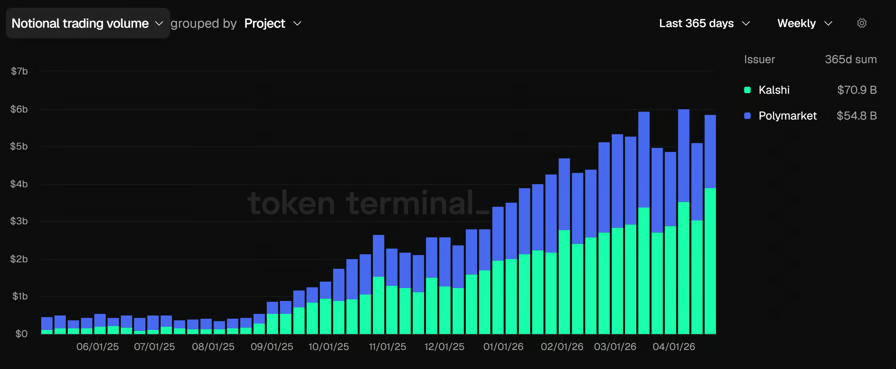
Kalshi and Polymarket trading volume. Source: Token Terminal
The letter arrives amid the growing popularity of these platforms. As Cointelegraph reported, monthly trading volume reached $25.7 billion in March, with more than 80% of users classified as retail, defined as those trading less than $10,000.
Related: Kalshi, Polymarket among 27 prediction platforms banned in Brazil
Polymarket wants back into the US
Polymarket is in talks with the CFTC to lift the ban that has kept American users off its main platform since a 2022 settlement, in which the company paid a $1.4 million penalty and agreed to block US customers over unregistered event contracts.
A full return would require a formal commission vote, though the process may move faster given that four of the CFTC’s commissioner seats are currently vacant.
Magazine: How to fix suspected insider trading on Polymarket and Kalshi

Arbitrum’s KelpDAO Freeze Backfires as US Court Blocks $71 Million Recovery

Paramount+ Has Already Found a ‘Call of Duty’ Replacement in This New Streaming Hit

Ian Wright Picks Okocha as Premier League’s Most Underrated Player

Manchester United reach agreement with Casemiro over contract clause amid transfer speculation

US brings back mandatory military draft registration

Steven Gerrard disagrees with Gary Neville over ‘shock’ Chelsea and Arsenal claim | Football


-

 Tech5 days ago
Register Renaming | Hackaday
-
Crypto World7 days ago
Hyperliquid $HYPE Rally Builds Momentum as AI Sector Enters Prove-It Phase
-

 Politics5 days ago
Drax board avoid their own AGM, accused of greenwashing & environmental racism
-

 Tech5 days ago
Why Blue Badges Disappeared From Toyota Hybrids
-

 Tech5 days ago
Images of Samsung’s rumored smart glasses have leaked
-
 Sports6 days ago
IPL 2026: Ruturaj Gaikwad registers slowest fifty of the season, enters all-time unwanted list | Cricket News
-
 Tech22 hours ago
Trump’s 25% EU auto tariff breaches Turnberry Agreement that also covers semiconductors and digital trade
-

 NewsBeat6 days ago
LK Bennett closes all stores after entering administration
-

 Fashion4 days ago
Kylie Jenner’s KHY Enters a New Era with ‘Born in LA’
-
 Entertainment7 days ago
Mariah Carey Slams Deposition Claims In Brother’s Lawsuit
-

 Business4 days ago
Most Commercial Energy Audits Miss the Real Losses
-

 Crypto World4 days ago
CFTC’s AI will review U.S. crypto registration applications, chairman tells CoinDesk
-

 Business5 days ago
(VIDEO) Charlize Theron Climbs Times Square Billboard to Promote New Netflix Thriller ‘Apex’
-

 Business3 days ago
Barclay Brothers Avoid Bankruptcy: HSBC Drops High Court Petitions After IVA Deal
-
 Sports21 hours ago
Paul Scholes issues Marcus Rashford reality check as agreement emerges over Man United star
-

 Tech7 days ago
Microsoft to roll out Entra passkeys on Windows in late April
-

 Tech6 days ago
OpenAI’s Sam Altman apologizes for not reporting ChatGPT account of Tumbler Ridge suspect to police
-
 Business3 days ago
Tesla Officially Registers Elon Musk’s Stock: What Investors Need to Know
-

 Tech7 days ago
OpenAI CEO apologizes to Tumbler Ridge community
-

 Tech4 days ago
Get Ready for More Brain-Scanning Consumer Gadgets
You must be logged in to post a comment Login