

Crypto World
Terraform Labs Sues Jane Street for Alleged Insider Trading Prior to Terra-Luna Collapse: Report



The suit filed by Terraform Labs’ bankruptcy administrator seeks damages tied to alleged pre-collapse positioning.
Terraform Labs’ bankruptcy administrator has filed a lawsuit against Jane Street, alleging the company used insider information to profit from and accelerate the collapse of Terra-Luna.
The lawsuit claims that these trades came at the expense of investors and creditors who lost billions in the crash.
Jane Street Denies Accusations
A Wall Street Journal (WSJ) report reveals that Todd Snyder, the court-appointed plan administrator overseeing Terraform’s wind-down, is seeking damages from Jane Street, its co-founder Robert Granieri, and employees Bryce Pratt and Michael Huang.
In a complaint filed in a Manhattan federal court on Monday, Snyder alleges that the trading firm obtained material nonpublic information from insiders and used it to trade ahead of the market, speeding up the company’s downfall.
“Jane Street abused market relationships to rig the market in its favor during one of the most consequential events in crypto history,” wrote the administrator in a statement.
The company first signed on to trade directly with Terraform in late 2018, but its involvement in the project’s tokens did not intensify until February 2022.
The lawsuit claims that Pratt, a former intern at the crypto company who later joined the trading firm, reconnected with his previous colleagues and created a private group chat called “Bryce’s Secret” to collect insider information. He is also accused of coordinating email introductions between the company’s head of business development and the firm’s DeFi team. The complaint claims that these communications were then used to obtain confidential details and inform highly profitable trades.
Meanwhile, Jane Street has rejected the allegations, calling the lawsuit “a desperate attempt to extract money” and insisting that Terraform’s losses were the result of a multibillion-dollar fraud by its management. The firm added that it will defend itself “vigorously against these baseless, opportunistic claims.”
You may also like:
Insider Trades Linked to Terraform Collapse
The lawsuit highlights a May 7, 2022, incident in which the crypto platform moved 150 million TerraUSD out of the Curve3pool without notifying the market. Less than ten minutes later, a digital wallet reportedly connected to Jane Street withdrew 85 million TerraUSD from the same pool. However, Do Kwon, its founder, said the withdrawal was meant to move TerraUSD to a new liquidity pool for stablecoins.
Two days later, as the digital asset began losing its dollar peg, Pratt allegedly set up a group message with Kwon, Huang, and firm representatives to discuss potential bids on Luna as the company continued to reap more profits from trading the stablecoin.
Terraform collapsed later that month after TerraUSD lost its peg to the dollar, with the sister token Luna also plunging to near zero.
The crash erased roughly $40 billion in value and affected hundreds of thousands of investors worldwide, leading the company to file for bankruptcy in January 2024 and formally establish a wind-down trust later that year. Kwon is now serving a 15-year prison sentence following guilty pleas on two criminal counts in August.
Binance Free $600 (CryptoPotato Exclusive): Use this link to register a new account and receive $600 exclusive welcome offer on Binance (full details).
LIMITED OFFER for CryptoPotato readers at Bybit: Use this link to register and open a $500 FREE position on any coin!



Mastercard is hiring a Director of Crypto Flows to lead stablecoin-linked card issuance, scale DeFi payment flows, and rewrite network rules for Web3 transactions.
The job posting, first surfaced by crypto journalist Frank Chaparro on Feb. 24, signals a structural push beyond the pilot-stage experiments the payments giant has run so far.
The Timing That Writes Itself
Days earlier, Citrini Research published “The 2028 Global Intelligence Crisis,” a doomsday scenario that rapidly went viral on Substack. The report maps a chain reaction in which AI agents progressively dismantle fee-based intermediaries — and payment networks sit squarely in the blast radius. Citrini specifically names Mastercard’s Q1 2027 earnings as a potential inflection point, the moment when agentic commerce begins routing around card interchange via stablecoins.
The logic is straightforward. When AI agents transact on behalf of consumers, a 2-3% card interchange fee becomes an irrational cost. Stablecoin rails settle the same transaction for near zero. In that world, Mastercard doesn’t lose to a competitor. It loses to a protocol.
The gap Mastercard needs to close
The vulnerability is not hypothetical. Stablecoins transferred $18.4 trillion in value in 2024, surpassing both Visa ($15.7 trillion) and Mastercard ($9.8 trillion) in raw volume, according to Artemis Analytics. The comparison is imperfect — much of that is trading, not payments — but the directional signal is clear.
Mastercard’s own CEO, Michael Miebach, told analysts in January that the company is “leaning in” to stablecoins and agentic commerce, calling the latter a trend in which “the train is leaving the station.” Yet he framed stablecoins as “another currency we can support within our network.”
That framing is precisely what Citrini challenges. The doomsday thesis is not that stablecoins replace card payments at today’s checkout counter. It is that a new category of commerce — machine-to-machine, micropayment-dense, 24/7 — will emerge entirely outside the card network’s design envelope.
Building rails or getting routed around
The new role suggests Mastercard is beginning to internalize this risk. Mastercard has laid the groundwork: onboarding multiple stablecoins onto its network in June 2025, expanding Circle’s USDC settlement across the Middle East and Africa, and reportedly pursuing a $2 billion acquisition of crypto infrastructure startup zerohash.
But the gap with Visa persists. Visa’s on-chain stablecoin settlement reached an annual run rate of $3.5 billion by late 2025. Crypto-native issuers like Rain and Reap built their card programs primarily on Visa rails, with Rain scaling to over $3 billion annualized after securing direct Visa membership. Industry analysis suggests Visa’s early crypto-native alignment translated into share, while Mastercard’s exchange-focused approach generated less volume.
Coincidence or confirmation
Regardless of whether Mastercard’s hiring push was triggered by Citrini’s report, the more important reading is that the diagnosis is converging. A research outfit writing from 2028 and a payments giant hiring in 2026 point at the same fault line. Card networks that cannot accommodate stablecoin-native commerce will be bypassed, not disrupted.
The canary, as Citrini wrote, is still alive. The question is whether Mastercard is building a bridge to close the gap—or just hiring someone to watch it widen.
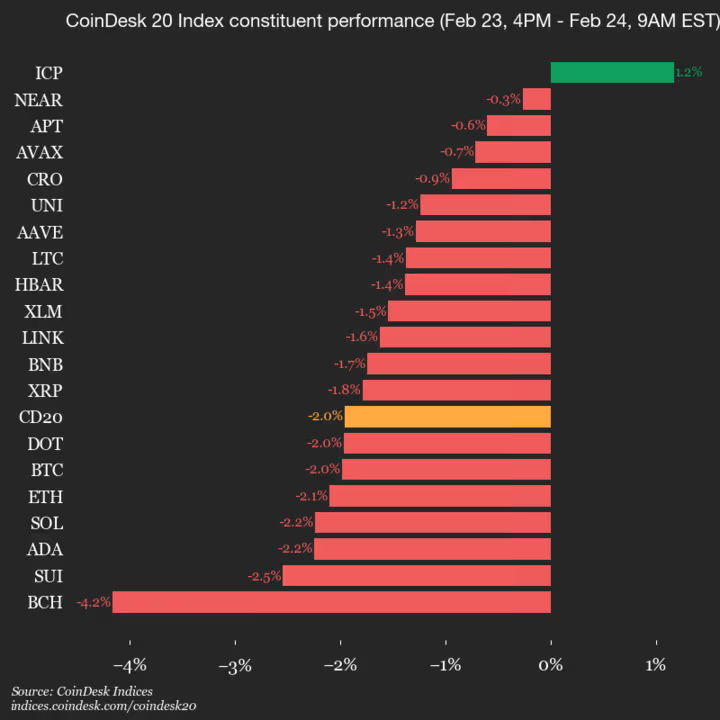
CoinDesk Indices presents its daily market update, highlighting the performance of leaders and laggards in the CoinDesk 20 Index.
The CoinDesk 20 is currently trading at 1816.14, down 2.0% (-36.33) since 4 p.m. ET on Monday.
One of the 20 assets is trading higher.

Leaders: ICP (+1.2%) and NEAR (-0.3%).
Laggards: BCH (-4.2%) and SUI (-2.5%).
The CoinDesk 20 is a broad-based index traded on multiple platforms in several regions globally.


The Ethereum Foundation has begun staking a portion of its treasury holdings, marking a significant shift in how the organization manages its ETH reserves.
Summary
- The Ethereum Foundation has begun staking its treasury, starting with a 2,016 ETH deposit and planning to stake approximately 70,000 ETH in total.
- Staking rewards will be directed back to the foundation’s treasury to help fund core operations, including protocol R&D, ecosystem grants and community development.
- The validator setup uses open-source tools from Attestant, including Dirk and Vouch, with a focus on distributed signing, minority clients and multi-jurisdiction infrastructure.
Ethereum Foundation puts treasury to work with 70K ETH staking plan
In a post on X, the foundation said it has made an initial deposit of 2,016 Ethereum (ETH) and plans to stake approximately 70,000 ETH in total, with staking rewards directed back into its treasury. The move follows a Treasury Policy announced last year and is designed to both support network security and help fund the foundation’s core operations.
The staking setup is being implemented using open-source tools developed by Attestant, including Dirk and Vouch.
Dirk functions as a distributed signer, allowing validators to be operated across multiple jurisdictions and reducing the risk of a single point of failure.
Vouch enables the use of multiple consensus and execution client pairings, helping mitigate client diversity risks, a key concern for Ethereum’s decentralization model. The foundation said its validator setup incorporates minority clients and a mix of hosted infrastructure and self-managed hardware spread across several regions.
The announcement comes at a notable moment for Ethereum. Recently co-founder Vitalik Buterin sold roughly $7 million worth of ETH amid a broader price pullback, sparking discussion about treasury management and market signals.
At the same time, the foundation has been expanding ecosystem support through new grant initiatives, including updates to its Ecosystem Support Program aimed at funding protocol research, community development and public goods projects.
By staking a portion of its holdings, the foundation is effectively putting dormant ETH to work, generating yield while reinforcing validator participation. The move aligns the treasury more closely with Ethereum’s proof-of-stake design and provides an additional funding stream for long-term development efforts without relying solely on asset sales.
Payment processing firm Stripe is reportedly considering an acquisition of all or parts of its rival PayPal Holdings.
Stripe is in early talks and has expressed preliminary interest in PayPal or parts of its business, though no deal is guaranteed, Bloomberg reported on Tuesday, citing people familiar with the matter.
It comes as Stripe, which enables enterprises to accept payments, make payouts, and automate financial processes, said on Tuesday that it was valued at $159 billion in a tender offer to shareholders and employees, a 74% jump from a year ago.
The move comes as PayPal has been reportedly struggling to compete with the likes of Google Pay and Apple Pay, which are embedded in consumer smartphones.
Stripe president John Collison told Bloomberg that “PayPal has had, obviously, a tough time over the past few years, and the landscape has changed quite a bit with Apple Pay and Google Pay and everything like that.”
“I can’t talk about any, you know, M&A [mergers and acquisitions] hypotheticals, but they’ve definitely had a tough time,” he added.
PayPal stock gains on the day
PayPal is also in leadership transition, with new CEO Enrique Lores set to take over on March 1 following the ouster of Alex Chriss, amid missed earnings estimates and slowing payment volumes.
Related: PayPal draws takeover interest following 46% stock slide: Report
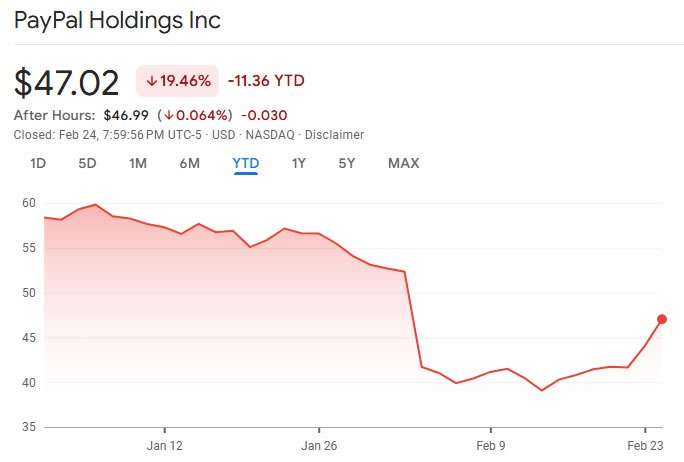
PayPal stock (PYPL) gained 6.74% on Tuesday to end the day trading at $47.02, according to Google Finance. However, shares in the payments platform have declined almost 20% since the beginning of this year and are down 85% from their 2021 all-time high of just over $300.

PayPal, Stripe have serious stablecoin ambitions
PayPal began offering crypto trading in the US in 2020 and launched its own stablecoin PYUSD in 2023. The dollar-pegged asset has gained traction in recent months with its market capitalization topping $4 billion for the first time on Feb. 14.
Stripe has also been dabbling in crypto with its stablecoin platform Bridge, which received conditional approval to operate as a federally chartered national trust bank under the US Office of the Comptroller of the Currency (OCC) on Feb. 17.
Stripe first offered stablecoin-based accounts globally in May 2025. A merger could see the new entity become a serious player in the stablecoin market.
Magazine: Bitdeer sells all Bitcoin, Metaplanet rejects misconduct claims: Asia Express


Bitcoin fell below 200-week EMA, over 52% off peak, risking death-cross capitulation.
Summary
- BTC closed last week under the 200-week EMA, a key confluence zone tied to post-halving re-accumulation range highs, after three weeks of elevated sell volume and weak demand.
- Analysts warn BTC may retest the underside of the 200-week EMA as new resistance, echoing 2018 and 2022 structures that triggered a second bearish acceleration wave.
- BTC has dropped over 52% from its October top and approaches a 3-day 50/200 SMA death cross by late February, historically followed by an additional 45%-52% drawdown.
Bitcoin (BTC) closed the week below a critical support level, falling beneath that threshold for the first time since early February and reaching a two-week low, according to market data. Analysts have warned that the cryptocurrency could face additional downward pressure.
Analyst Rekt Capital stated that Bitcoin closed last week below the 200-week Exponential Moving Average (EMA), which sits at the center of a major confluence zone. The 200-week EMA aligns with the Post-Halving Re-accumulation Range highs, while the Post-Halving Re-accumulation Range lows define the broader structure of Bitcoin’s current range, according to the analyst.
Over the past three weeks, the cryptocurrency attempted to develop a demand region around this area, which was previously a major supply area, Rekt Capital noted. The analyst stated that this level has not historically been a structurally reliable support, noting that it previously acted as a 10-month resistance.
“In the current structure, we have seen three consecutive weeks of elevated sell-side volume in this region, with limited meaningful buy-side response,” the analyst stated in a post. The imbalance led to a weekly close below the 200-week EMA, losing it as support in this timeframe, according to the analysis.
Rekt Capital stated that there is a strong probability that Bitcoin will press back toward the underside of that EMA to attempt turning it into new resistance. If the underside retest holds, the structure would shift from defending the support to confirming the resistance at this level, the analyst said. The analyst added that if that level begins to act as resistance, downside continuation will become increasingly probable.
The analyst also noted that Bitcoin’s recent performance aligns closely with its price action in prior cycles. In 2018 and 2022, a weekly close below the 200-week EMA acted as a structural trigger to the second wave of bearish acceleration, according to the analysis. “Bitcoin would attempt to reclaim the level, turn it into resistance, and then dissipate lower. That pattern is now attempting to replicate itself,” Rekt Capital stated.
Analyst Ali Martinez pointed to the cryptocurrency’s historical performance on the three-day chart, stating that this has been one of Bitcoin’s key timeframes from a macro perspective. Martinez said market observers must watch the upcoming interaction of the 50-day and 200-day Simple Moving Averages (SMAs), as the crossover between these two indicators on the three-day timeframe has historically preceded the final leg down of the bear market.
Bitcoin dropped approximately 50% to 72% from its cycle tops in past cycles before death crosses took place in subsequent years, according to historical data. Following those SMA crossovers, the cryptocurrency experienced another 45% to 52% decline, Martinez noted. Bitcoin has fallen more than 52% from its October peak and is approaching a potential death cross on the three-day chart by the end of February, according to the analyst.
“If history repeats — even partially — this could signal the beginning of the final leg down of this cycle,” Martinez stated. The analyst predicted that another substantial correction from current levels could follow, placing the cryptocurrency’s target near lower support levels. “If the cross confirms, it becomes a level to take very seriously,” Martinez said.


Binance has added support for tokenized U.S. stocks and exchange-traded funds on its Alpha trading platform, giving users new ways to access traditional assets through blockchain-based products.
Summary
- Binance Alpha listed Ondo tokenized securities on its platform.
- The launch includes 10 major U.S. stocks and ETFs with low or zero trading fees.
- The move marks Binance’s return to tokenized equities under clearer regulations.
The update allows users to trade tokenized securities directly using funds held on Binance Exchange, without moving assets to external wallets. Trading is available through the Alpha section of the platform.
The initial rollout includes 10 products, covering major technology stocks and the Nasdaq-100 ETF. At launch, supported assets include tokenized versions of Apple, Tesla, Nvidia, Amazon, Meta, Microsoft, Alphabet, and the Invesco QQQ ETF.
Regulated structure and trading features
Binance said the tokenized securities are classified as structured products under regulations issued by the Financial Services Regulatory Authority in Abu Dhabi’s Abu Dhabi Global Market. Under this framework, the products are offered in approved jurisdictions and are not available to users in the United States.
Each token is designed to reflect the market price of its underlying stock or ETF. While holders gain exposure to price movements, they do not receive voting rights or other shareholder privileges.
The exchange said users can place both market and limit orders through the Alpha interface. Trading fees may fall to 0%, and gas fees for placing and canceling orders are being waived for a limited period.
Binance also introduced a rewards system tied to the new listings. By trading or holding tokenized securities, users can accrue Alpha Points, which can then be redeemed for token sales, promotions, and airdrops.
Ondo Global Markets has reported a total value locked of more than $550 million since its launch last year. The company has focused on developing compliant infrastructure for tokenized stocks and ETFs.
Return to tokenized equities and market impact
After closing a similar product in 2021 due to regulatory pressure, Binance is making a comeback to tokenized stocks with this listing. Since then, the exchange has adopted a more cautious stance, emphasizing regional approvals and regulated structures.
Binance can now re-enter the market while lowering legal risk thanks to the partnership with Ondo. For users outside the U.S., the products offer access to popular equities that may otherwise be difficult to trade directly.
The integration has also drawn attention to Ondo’s wider plans, including its work on a dedicated blockchain for institutional real-world assets and its expansion into derivatives and structured finance products.
Following the announcement, Ondo (ONDO) token gained about 5% as trading activity surged. Market observers say the move reflects rising demand for regulated ways to trade traditional assets through crypto platforms.
Binance stated that it may expand its tokenized securities lineup in the future, depending on user demand and regulatory developments.


Binance, the world’s largest crypto exchange by trading volume, is returning to offer tokenized stocks nearly five years after shelving a similar product under regulatory pressure.
The exchange has teamed up with tokenization specialist Ondo Finance to list 10 tokenized U.S. stocks, ETFs and commodity-linked products on the Binance Alpha platform, the companies said in a Tuesday press release.
Binance Alpha is a platform within Binance Wallet, the exchange’s crypto wallet service, that allows users to trade early-stage, riskier crypto projects before listing them on the centralized spot marketplace.
The lineup includes blockchain-based token versions of Apple, Google, Tesla and Nvidia shares, along with the Invesco’s Nasdaq-tracking QQQ ETF.
The tokenized stocks are not available to users in the United States.
“Our users now have even more convenient ways to explore and trade tokenized securities, in line with our mission to offer innovative and accessible trading opportunities,” Jeff Li, Binance’s vice president of product, said in a statement.
The move marks a comeback for Binance, having offered tokenized stocks in April 2021 with Tesla and later added Coinbase, Strategy, Microsoft and Apple, before shutting the service after scrutiny from the U.K.’s Financial Conduct Authority and Germany’s BaFin.
Last month, Binance said it was weighing a fresh push into tokenized equities. Listing the Ondo-issued tokens on the platform now puts that plan into action.
Tokenized stocks have gained traction across crypto and traditional finance, with sector’s total value is approaching $1 billion, led by Ondo’s more than $550 million in locked value and $11 billion in cumulative trading volume since September 2025.
Trading venues such as Kraken, Bybit and Gemini and brokerages like Robinhood rolled out their versions of tokenized equities trading. Wall Street exchanges such as Nasdaq and the New York Stock Exchange (NYSE) also laid out plans to offer trading with stocks tokens.
Blockchain-based stocks can widen investor access, especially to retail users in developing countries without easy access to brokerage accounts offering U.S. stocks, proponents say. The tokens can also serve as collateral for borrowing in decentralized finance (DeFi).
Read more: NYSE’s 24/7 plan could fix key problem for stock tokens, Ondo’s de Bode says


Crypto payments platform MoonPay has introduced a new product designed to give artificial intelligence systems direct access to digital wallets and on-chain transactions.
Summary
- MoonPay launched MoonPay Agents on to support non-custodial AI wallets.
- The platform enables automated trading, funding, and machine-to-machine payments.
- The product targets developers building large-scale autonomous financial systems.
MoonPay Agents, a non-custodial software layer that enables AI agents to create wallets, manage funds, and trade on behalf of verified users, was officially launched by the company on Feb. 24.
The system is built on MoonPay’s command-line interface and is aimed at developers building automated programs that need to move money without relying on centralized custody. Once a user completes identity checks and funds a wallet, an AI agent can trade, swap, and transfer assets independently.
Connecting AI systems to digital money
MoonPay said the product supports the full financial cycle, including fiat-to-crypto funding, portfolio tracking, and conversion back to traditional currencies. Users can also receive funds through virtual accounts or payment services such as Apple Pay, PayPal, and Venmo.
“AI agents can reason, but they cannot act economically without capital infrastructure,” said Ivan Soto-Wright, the company’s chief executive officer. He said the goal is to make crypto the default financial layer for autonomous systems.
According to MoonPay, users can set up a working wallet and agent connection in minutes, allowing automated systems to begin executing strategies almost immediately.
MoonPay Agents includes tools such as recurring purchases, real-time cross-chain swaps, machine-to-machine payments, and automated fiat funding via on-ramps. These features are designed to ensure that agents always have access to liquidity when operating.
Additionally, the platform supports portfolio monitoring, token discovery, and basic risk analysis, enabling developers to incorporate financial management straight into their apps. Wallets are stored on users’ own devices, giving them direct control over private keys.
The product is built to scale from single-user setups to networks of thousands of agents. It runs on the same infrastructure that supports nearly 500 enterprise customers and more than 30 million users across 180 countries.
Part of a the growing “agent economy” trend
The launch comes amid growing interest in so-called “agentic” systems that can plan and act without continuous human oversight. Industry forecasts suggest the autonomous agent economy could reach $30 trillion by 2030, with AI systems managing a large share of routine financial decisions.
In crypto markets, this shift is already underway. AI-powered wallets are being used for trading, DeFi activity, and machine-to-machine payments. At ETHDenver 2026, developers showcased blockchain-based identity tools, automated treasuries, and agent-led trading systems, highlighting the rapid growth of this trend.
According to company executives, MoonPay Agents will serve as a default financial rail for developers building trading bots, gaming platforms, and automated payment systems. With AI systems increasingly taking on financial tasks, MoonPay is positioning its infrastructure as a foundation for this emerging market.
Thomas Fuller | SOPA Images | Lightrocket | Getty Images
PayPal‘s stock surged nearly 7% on Tuesday following a report that fintech startup Stripe is weighing buying the payments platform.
Bloomberg reported the news, citing people familiar with the matter, and said the discussions are in early stages. The report said Stripe is considering buying all or some segments of PayPal’s business.
The news comes a day after reports that buyer interest has picked up in the company following its recent stock slump.
PayPal and Stripe declined to comment on the report.
PayPal, which is grappling with slowing growth in an increasingly competitive financial payments industry, has plummeted more than 19% since the start of the year. The company shed nearly a third of its value in 2025.
Earlier this month, the stock plunged on lackluster profit guidance and its board appointed HP’s Enrique Lores as its new CEO to start at the beginning of March.
Meanwhile, fintech startup Stripe hit a $159 billion valuation on Tuesday following a secondary stock sale for employees and shareholders.
That’s up from the $91.5 billion a year ago. Stripe said in a business update that its revenue suite is slated to reach an annual run rate of $1 billion this year.
Stripe, which ranked 10th on CNBC’s Disruptor 50 list last year, has transformed into one of the most valuable private companies yet and recently acquired billing startup Metronome in January.
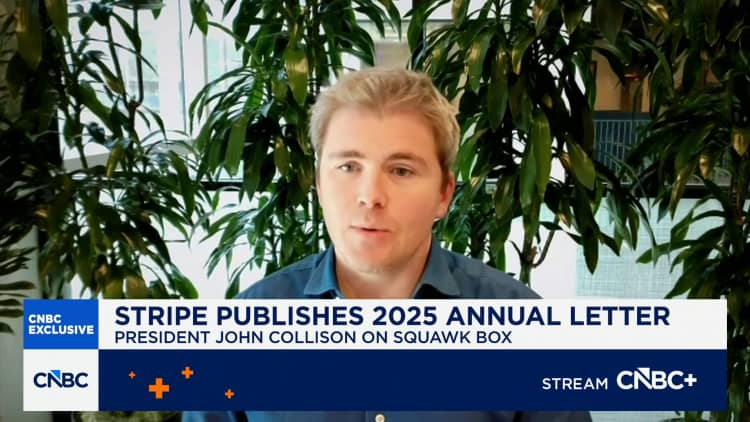
Stripe co-founder and president John Collison told CNBC’s Andrew Ross Sorkin on Tuesday that the company isn’t yet aiming for an IPO, which would sidetrack its current product and business growth.
Read the full Bloomberg article here.



Short-term coin activity remains near historic lows, highlighting weak participation from new buyers across the network.
Bitcoin faced renewed sell pressure on Tuesday, briefly dragging the price down to $62,700 after a 5% decline, as macro concerns continued to weigh on investor sentiment.
New data suggest that BTC remains in a defensive phase as capital continues to exit the network and supply ages steadily without signs of renewed accumulation.
Peak Buyers Now Frozen
Realized Cap, which measures the aggregate value of all coins at the price they last moved, has declined for a second consecutive month. According to the latest analysis by Axel Adler Junior, this indicates that capital continues to exit the network rather than flow into it.
The 30-day Realized Cap Net Position Change currently stands at -2.26% and has remained negative for several weeks, which means that coins are either being transferred below their cost basis or that incoming capital is insufficient to offset ongoing outflows. Realized Cap peaked on November 26, 2025, at approximately $1.127 trillion and has since fallen to around $1.094 trillion – a compression of roughly $33 billion.
Daily net position changes continue to hover around zero or remain negative, amidst the absence of new capital entering the market. As long as the 30-day Realized Cap metric stays below zero, the network remains in net outflow mode. A move back into positive territory is the first condition required for a shift toward accumulation.
In addition, HODL Waves data revealed a sharp structural change in coin age distribution that is consistent with this defensive regime. Coins that last moved 3-6 months ago now make up about 26% of Bitcoin’s supply, up from 19% earlier this month. These coins were mostly bought near the last market peak and haven’t moved since.
The share of Bitcoin held for 6-12 months has grown to just over 20%, while coins moved within the past month account for less than 10% of the supply. This shows that few new buyers are entering the market, as per Adler Junior. Most circulating coins were bought at higher prices and are now sitting at a loss, which has left holders reluctant to sell and effectively locking supply in place.
You may also like:
The growth of older cohorts does not represent strategic accumulation but rather forced holding due to unfavorable price conditions. The structure would only see a meaningful change if coins in the 3-6 month band begin migrating into longer-term cohorts without triggering renewed selling pressure, alongside a measurable return of short-term activity.
Familiar Bear Signal Is Back
Against the backdrop of bleeding capital, an important technical signal that has appeared near the end of past Bitcoin bear markets is starting to form again. According to analyst Ali Martinez, a potential death cross on Bitcoin’s three-day chart is projected to occur in late February.
In previous cycles, this signal consistently showed up just before the final major drop. With the crypto asset still 50% below its October 2025 peak, Martinez warned that a similar setup could open the door to further downside.
Binance Free $600 (CryptoPotato Exclusive): Use this link to register a new account and receive $600 exclusive welcome offer on Binance (full details).
LIMITED OFFER for CryptoPotato readers at Bybit: Use this link to register and open a $500 FREE position on any coin!

Elusive Shein boss hails Chinese roots in rare public appearance

Mastercard Hires for Crypto Just as Citrini Warns It Could Be Obsolete
Utah Inventor Behind the ‘Squatty Potty’ Arrested on Child Porn Charge


-

 Video5 days ago
XRP News: XRP Just Entered a New Phase (Almost Nobody Noticed)
-

 Fashion4 days ago
Weekend Open Thread: Boden – Corporette.com
-

 Politics3 days ago
Baftas 2026: Awards Nominations, Presenters And Performers
-

 Entertainment7 days ago
Kunal Nayyar’s Secret Acts Of Kindness Sparks Online Discussion
-

 Sports1 day ago
Women’s college basketball rankings: Iowa reenters top 10, Auriemma makes history
-

 Politics1 day ago
Nick Reiner Enters Plea In Deaths Of Parents Rob And Michele
-

 Tech7 days ago
Retro Rover: LT6502 Laptop Packs 8-Bit Power On The Go
-
 Sports6 days ago
Clearing the boundary, crossing into history: J&K end 67-year wait, enter maiden Ranji Trophy final | Cricket News
-

 Business3 days ago
Mattel’s American Girl brand turns 40, dolls enter a new era
-

 Crypto World20 hours ago
XRP price enters “dead zone” as Binance leverage hits lows
-

 Business2 days ago
Law enforcement kills armed man seeking to enter Trump’s Mar-a-Lago resort, officials say
-

 Entertainment6 days ago
Dolores Catania Blasts Rob Rausch For Turning On ‘Housewives’ On ‘Traitors’
-

 Business7 days ago
Tesla avoids California suspension after ending ‘autopilot’ marketing
-

 Tech2 days ago
Anthropic-Backed Group Enters NY-12 AI PAC Fight
-
 NewsBeat2 days ago
‘Hourly’ method from gastroenterologist ‘helps reduce air travel bloating’
-

 NewsBeat2 days ago
Armed man killed after entering secure perimeter of Mar-a-Lago, Secret Service says
-

 Politics3 days ago
Maine has a long track record of electing moderates. Enter Graham Platner.
-

 Crypto World6 days ago
WLFI Crypto Surges Toward $0.12 as Whale Buys $2.75M Before Trump-Linked Forum
-

 Tech10 hours ago
Unsurprisingly, Apple's board gets what it wants in 2026 shareholder meeting
-
 NewsBeat5 hours ago
Police latest as search for missing woman enters day nine