
Crypto World
Tether Rolls Out XAUt on BNB Chain as Gold Enters Crypto


TLDR
- Tether has launched XAUt on BNB Chain to expand access to its tokenized gold product.
- Binance has listed XAUt for spot trading against USDT, BTC, USDC, TRY, and U.
- XAUt holds a market cap of about $3.2 billion and is backed by roughly 1,800 gold bars in Swiss vaults.
- Spot gold reached $5,595 per ounce in January before falling to around $4,450 on March 26.
- Crypto.com now offers tokenized gold perpetual contracts alongside spot trading in XAUt and PAXG.
Tether has launched XAUt on BNB Chain to expand access to its tokenized gold product. Binance confirmed it will list XAUt for spot trading against USDT, BTC, USDC, TRY, and U. The move places tokenized bullion inside one of the largest exchange ecosystems as gold trading activity shifts into crypto markets.
XAUt and Tether Expand Tokenized Gold Access
Tether introduced XAUt on BNB Chain to widen the distribution of its gold-backed token. The company aligned the launch with Binance’s spot listing announcement. As a result, traders can access XAUt across several major trading pairs on the same day.
Binance stated it would enable spot trading for XAUt against USDT, BTC, USDC, TRY, and U. The exchange added the token to its main trading platform. Therefore, users can buy and sell tokenized gold within existing crypto portfolios.
BNB Chain reported that XAUt holds a market cap of nearly $3.2 billion. The network linked the token to about 1,800 gold bars stored in Swiss vaults. Reuters reported in January that XAUt controls about 60% of the global gold-backed stablecoin market.
BNB Chain ranks as the second-largest chain for RWAs by distributed asset value, according to RWA.xyz. The network also said it attracted new asset inflows and holders over the past month. Consequently, Tether gains broader onchain reach for its bullion-backed token.
Gold Price Swings Drive Crypto Market Activity
Gold prices recorded sharp moves earlier this year and drew fresh trading interest. Spot gold reached a record $5,595 per ounce in January as geopolitical tensions increased. However, prices later reversed direction and erased part of those gains.
Gold traded near $4,450 on March 26. The metal has fallen more than 15% since the war on Iran began on February 28. Higher oil prices, inflation concerns, and a stronger dollar pressured prices during that period.
Crypto platforms responded to the volatility by expanding gold-linked products. Crypto.com said its exchange now supports tokenized gold perpetual contracts. The platform also offers spot trading in XAUt and PAXG.
These products allow users to gain leveraged exposure to gold price movements around the clock. As a result, tokenized bullion now sits alongside traditional crypto assets. Traders can switch between digital tokens and gold exposure within the same exchanges.
Paolo Ardoino described the BNB Chain launch as a utility-driven step. He said the expansion aims to make gold more usable in digital markets. The rollout coincides with Binance activating spot trading for XAUt across multiple pairs.




Mezo will stream 2.25% of MEZO supply to Aerodrome’s veAERO voters over 30 days, betting Base’s vote-escrow whales can bootstrap deep MEZO and MUSD liquidity for Bitcoin DeFi.
Summary
- Mezo will route 2.25% of MEZO supply to Aerodrome’s veAERO voters over 30 days to seed MEZO and MUSD liquidity on Base.
- The campaign follows Mezo’s “Bring Bitcoin Home” push, which migrated roughly $23 million in BTC assets and helped lift its TVL to about $76.3 million.
- By plugging into Aerodrome’s vote-escrow flywheel, Mezo is betting Bitcoin can host the same deep, incentive-driven liquidity that has made Base one of DeFi’s fastest-growing hubs.
Mezo, a Bitcoin (BTC)-native lending layer, has struck a strategic deal with Aerodrome Finance, the largest decentralized exchange on Coinbase’s Base network, to make Aerodrome the primary DeFi liquidity hub for the MEZO token. Under the agreement, Mezo will allocate 2.25% of total MEZO supply to veAERO voters over a 30-day period, aiming to bootstrap deep, decentralized liquidity for both MEZO and MUSD, its Bitcoin-backed stablecoin. Aerodrome already anchors Base’s liquidity, having previously pushed its own total value locked (TVL) past $1 billion amid a surge in AERO emissions-driven yield.
Mezo taps Aerodrome’s veAERO to grow MEZO, MUSD
The move is explicitly designed to pull Base’s most sophisticated vote-escrow capital into Bitcoin’s emerging DeFi stack. Aerodrome’s veAERO voter base includes protocols, high-net-worth traders, and institutions such as Coinbase Ventures and Animoca Brands, which have used AERO’s ve(3,3) governance model to direct emissions and fees toward the most productive pools. “Aerodrome’s community wrote the playbook for sustainable DeFi yield through vote-escrow economics,” Mezo founder and CEO Matt Luongo said. “We partnered with them because we wanted that audience to see what happens when you apply those mechanics to Bitcoin. Their users understand the model better than anyone. Now we’re giving them a reason to expand their capital across.”
By directing veAERO voters to MEZO and MUSD pairs, Mezo is effectively importing a proven liquidity engine from Base into Bitcoin DeFi. Mezo’s own “Aerodrome for Bitcoin lending” design channels borrower interest on MUSD loans, origination charges, and DEX swap fees into yield for BTC lockers, who currently earn around 4% APR through incentives and rewards. That sits against a broader DeFi backdrop where sector-wide TVL rebounded to roughly $129 billion in 2024, up 137% year-on-year as rising crypto prices and cheaper Layer-2 infrastructure pulled capital back on-chain.
The Aerodrome Finance tie-up comes on the heels of Mezo’s “Bring Bitcoin Home” campaign, which migrated about $23 million in tBTC, cbBTC, WBTC, and USDT from Ethereum pre-deposit vaults on Mellow Protocol into Mezo’s mainnet, with deposits routed via DeFi yield network Turtle Club. Mezo’s TVL now sits near $76.3 million, with roughly $500 million in lifetime MUSD volume, more than 2,000 loans issued at a fixed 1% APR, and over 43,500 mainnet users. That footprint is still small next to leaders like Aerodrome or top DeFi chains tracked by dashboards such as DeFiLlama, but it signals growing appetite for Bitcoin-first yield strategies as BTC itself becomes a larger share of total DeFi TVL.
Behind the yield mechanics, Mezo has focused heavily on infrastructure, security, and institutional access. Its validator set includes P2P, Chorus One, and Everstake, while smart contracts have been audited by Quantstamp and Thesis Defense. Anchorage Digital provides custody and compliance rails for larger allocators, a piece traditional institutions increasingly prioritize when deploying into DeFi. On the capital side, Mezo has raised $28.5 million in seed funding led by Pantera, with Multicoin, Paradigm, Polychain, Draper, Nascent, a16z, and ParaFi among backers, placing it alongside other BTC-centric projects that venture firms have backed to capture the next leg of on-chain credit markets.
Bitcoin’s role in DeFi expanding
As Bitcoin’s role in DeFi expands, Mezo is positioning itself as the lending and liquidity layer that lets BTC holders borrow, earn, and deploy capital without leaving the Bitcoin economy. Its core products — MUSD, veBTC yield positions, and a native DEX — mirror the stack that has helped Base and Aerodrome dominate liquidity and trading in their own ecosystem. With Aerodrome’s veAERO voters now financially incentivized to seed MEZO and MUSD pools, Mezo is effectively testing whether the same vote-escrow incentives that drove Base’s growth can be replicated atop Bitcoin and its wrapped representations, potentially shifting a larger slice of DeFi’s $100 billion-plus collateral base toward BTC-backed credit.


XDC price is consolidating just above $0.03 as tokenized debt deals, trade-finance pilots and an Ethereum-aligned upgrade deepen its role in enterprise RWA infrastructure.
Summary
- XDC Network is trading around $0.032 per token, with a market cap near $640 million and 24-hour volume in the mid-teens of millions.
- Price has inched higher by roughly 2–3% over the last day, but remains down on the week, reflecting a slow grind after a broader altcoin pullback.
- Recent upgrades, tokenized debt deals and trade-finance pilots signal growing real-world asset usage even as speculative flows stay modest compared with higher-beta altcoins.
XDC Network (XDC), a hybrid Layer-1 focused on enterprise and trade-finance applications, is currently changing hands at about $0.032 per coin, according to both Binance and third-party price aggregators. Binance lists the live XDC price at $0.03206, with a market capitalization of roughly $639.15 million and 24-hour trading volume of $16.29 million, based on a circulating supply of 19.94 billion XDC. A parallel snapshot from 3Commas shows XDC at $0.03214, a 2.8% gain over the last 24 hours, on a $14.73 million trading volume and market cap of $640.9 million.
Historical data from Yahoo Finance place XDC’s recent trading range between $0.0304 and $0.0324 over the past several sessions, underscoring how the token has been consolidating just above $0.03 after earlier weakness in March. CoinMarketCap’s price-history table likewise records daily closes clustered in the $0.031–$0.034 band throughout early March 2026, with no single breakout day but a sequence of tight ranges. That pattern contrasts with the sharp spikes seen in high-volatility memecoins, and instead reflects more measured spot flows into and out of a large-cap infrastructure asset.
Under the hood, XDC Network markets itself as an EVM-compatible, enterprise-grade blockchain for real-world asset tokenization, cross-border payments and trade-finance settlement, placing XDC in the RWA and L1 categories rather than pure DeFi or meme segments. CoinGecko reports a circulating supply of 16 billion XDC in another widely used dataset, with a fully diluted valuation of roughly $3.49 billion assuming a maximum supply of 38 billion tokens. That configuration gives XDC one of the larger RWA/L1 market caps, even if daily volume remains below the most aggressively traded smart-contract platforms.
February’s XDC Network update outlined several major developments that help explain why institutions are watching the chain even as price moves remain subdued. The network completed its v2.6.8 “Cancun” upgrade at block 98,800,200, aligning with Ethereum’s Cancun standard and introducing EIP-1559-style fee mechanics, improved EVM efficiency, and stronger consensus performance on mainnet. Separate to the protocol changes, XDC supported a $75 million tokenized debt issuance in Brazil, expanding its Latin American footprint and positioning the chain as a settlement layer for structured credit in emerging markets.
The combination of hybrid architecture, compliance-by-design tooling and EVM compatibility has led some industry observers to describe XDC as part of a blueprint for institutional-grade blockchain adoption in 2026. At the same time, market data from CoinGecko show 24-hour XDC trading volume around $46.1 million on certain days, a figure that has recently risen by over 11% in a single session, signalling that liquidity is gradually deepening as more venues list the token.
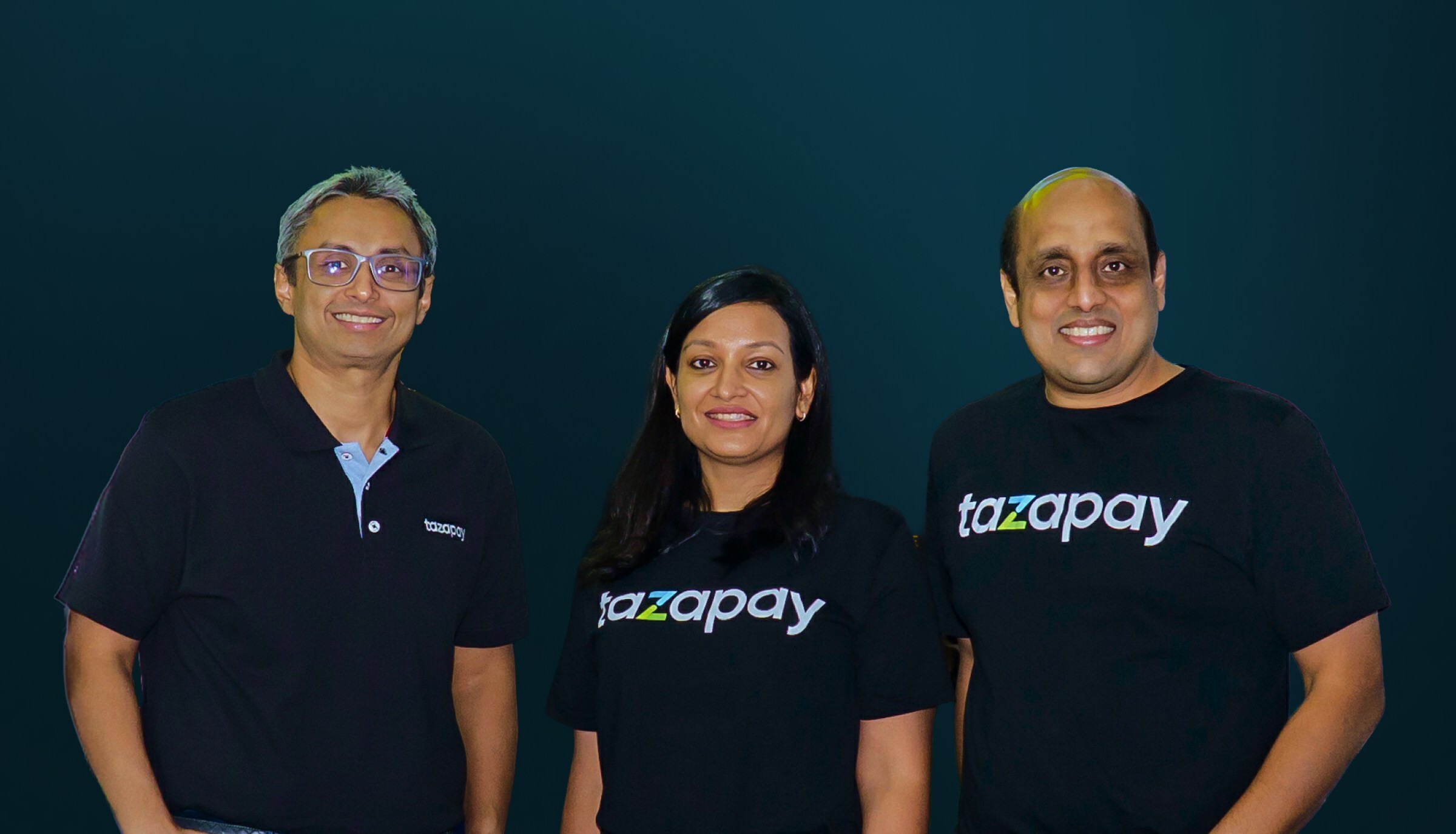
Cross-border payment infrastructure provider Tazapay said it closed an extension to its Series B funding round led by Circle Ventures, bringing the total raised to $36 million. The round included participation from Coinbase Ventures, CMT Digital, Peak XV Partners and Ripple.
Tazapay said on Thursday that the funding will be used to • expand its digital settlement technology for cross-border payments, secure additional licenses, expand across Asia, Latin America, the Middle East and the Americas, and build infrastructure for so-called “agentic payments.”
Tazapay said it serves over 1,000 enterprises and fintechs across 30 countries. It holds licences across Singapore, Canada, Australia, and the United States, with active applications underway in the European Union, United Arab Emirates and Hong Kong.
“The demand we’re seeing from enterprises and fintechs across Asia, LATAM, and the Middle East is unmistakable; businesses want to move money faster, cheaper, and with full regulatory confidence,” said Kanupriya Sharda, chief business officer at Tazapay.
Cointelegraph asked Tazapay whether it would disclose the size of the extension tranche and the company’s valuation, but had not received a response by publication.

Stablecoin payment infrastructure draws backers
The extension comes as crypto and fintech firms push deeper into stablecoin-based cross-border payments infrastructure.
On March 3, Ripple said it had expanded Ripple Payments into an end-to-end stablecoin and fiat platform for banks and fintechs. The company said the platform is live in more than 60 markets and has processed more than $100 billion in volume.
Related: Ripple joins Singapore sandbox to test RLUSD in trade finance
In May 2025, Boston-based cross-border payment company Conduit raised $36 million in a Series A funding round led by Dragonfly and Altos Ventures to scale its payment system and expand fiat and stablecoin currency offerings.
Conduit positions its payment system as an alternative to the SWIFT messaging network, which banks have relied on to process wire transfers since the 1970s.
Magazine: Crypto wanted to overthrow banks, now it’s becoming them in stablecoin fight


SIREN is trading near $2.35 after a 340% weekly spike to a $1.8b valuation, with one wallet cluster holding 88% of supply and nearly $1b in unrealized profit.
Summary
- SIREN trades around $2.35 after a volatile week that saw the token jump more than 340% and briefly surpass a $1.8 billion market cap.
- Trading volume remains elevated in the $50 million range over the last full day, but on‑chain data shows one cluster still controls roughly 88% of circulating supply.
- Analysts warn concentration and unrealized profit in whale wallets could amplify downside, even as SIREN remains one of the most talked‑about BNB Chain meme tokens this week.
SIREN, a BNB Chain meme coin built around high‑volatility speculation, is changing hands near $2.35 today after a week in which its price jumped from below $0.90 to above $3.00 before retracing. Historical data from CoinLore shows SIREN closing at $0.9422 on March 21, 2026, then $2.30 on March 22, and $2.35 on March 23, marking a gain of roughly 149% in 48 hours and over 340% across the week. Over that same March 22–23 window, reported daily trading volume ranged between about $53.7 million and $195 million, locking SIREN into the top tier of actively traded meme assets on BNB Chain.
MEXC’s market wrap notes that SIREN’s fully diluted valuation pushed past $1.8 billion at the height of the rally, driven by aggressive spot buying and options‑style speculation. Yet Arkham and Dune Analytics data cited in that report highlight a single wallet cluster holding around 644 million SIREN tokens, or roughly 88% of circulating supply, with more than $950 million in unrealized profit at peak prices. A separate technical summary from CoinCodex places SIREN’s daily relative strength index around 64.78, with multiple simple and exponential moving averages still flashing “buy,” underscoring how momentum indicators remain elevated despite the recent pullback.
Headline‑driven price action has also pulled SIREN into broader meme‑coin narratives. BeInCrypto recently listed Siren among three meme tokens to watch into the final week of March 2026, citing its outsized weekly move compared to other BNB Chain names. In that context, SIREN’s profile now sits alongside other speculative meme assets covered by outlets like crypto.news, which has tracked similar surges in tokens such as PEPE and BONK during prior market risk‑on phases.
The race to make blockchains quantum-resistant is shaping into a test of governance, and decentralized networks may be at a disadvantage.
Quantum upgrades don’t stop at protocol-level changes. For major networks, they require wallet-level migration across millions of users, making coordination the bottleneck.
“The hard part is not changing the node itself, it’s having the wallets do the same,” said Yoon Auh, founder of BOLT Technologies, adding that each asset holder would need to migrate and do so in a coordinated way.
“If you go talk to Bitcoin or Ethereum, it’s a bit more perplexing because of the really decentralized and kind of ad hoc participation. It seems like whenever I hear about it, it’s more like herding cats.”
A sufficiently powerful quantum computer could theoretically break the public-key cryptography that underpins digital signatures and secure communications, threatening both blockchain wallets and core financial infrastructure.
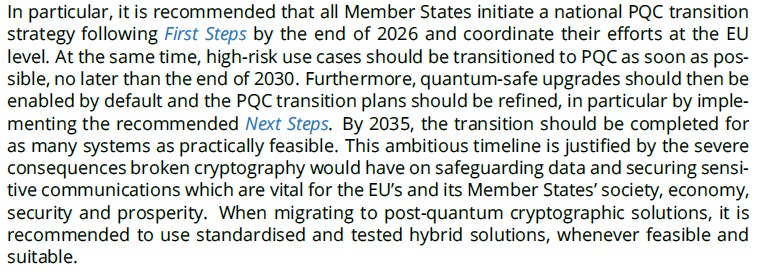
Post-quantum cryptography (PQC) is the proposed countermeasure, and the transition is already underway. The National Institute of Standards and Technology (NIST) has urged organizations to begin preparing for “harvest now, decrypt later” threats, while US policy sets 2035 as the target for completing migration across federal systems.

Institutional governance is accelerating quantum upgrades
One place coordination may be easier is in institutional blockchain networks, where governance is tighter and the chain of authority is clearer.
Auh’s BOLT Technologies is running a pilot with the Canton Network to test a system that allows institutions to use and switch between multiple cryptographic signature schemes. Canton describes itself as an open blockchain for regulated institutions, designed to let participants exchange data and value without giving up privacy or control.

In regulated financial markets, infrastructure changes must meet internal controls, risk management standards, privacy requirements and interoperability demands across firms.
Canton is built around those constraints, positioning itself as infrastructure for regulated institutions and a way to connect siloed financial systems without sacrificing control.
In August 2024, NIST finalized its first set of post-quantum cryptography standards and explicitly urged system administrators to begin transitioning to them as soon as possible.
For regulated institutions, that kind of guidance makes delays harder to justify. Once migration becomes a recognized security and compliance issue, the networks most likely to move first are the ones that can turn technical advice into a managed operational process. Auh said that is one reason permissioned networks may be better positioned to move first.
“Because of their governance structure, you only need a few people there who are very knowledgeable to understand what’s going on,” he said. “And then because their governance is a lot quicker and a lot more organized, you can make those changes quicker.”
That does not mean permissioned networks have solved the post-quantum problem. It means they may be better equipped to test, approve and stage upgrades under real-world constraints.
Related: Banks will run RWAs on two blockchain rails, says RedStone co-founder
Coordination slows quantum upgrades on public networks
Public blockchains face a different coordination problem because major protocol changes cannot be approved by a small governing group.
On Bitcoin, protocol changes are suggested through the Bitcoin Improvement Proposal (BIP) process, and the project’s own documentation says that “acceptance and adoption rests with the Bitcoin users.”
That makes a system-wide cryptographic migration harder to stage on public chains than on permissioned ones.

Given these coordination constraints, a post-quantum upgrade may require more disruptive upgrade paths, including a hard fork.
“I think it’s a very difficult thing to do with a soft fork,” he said. “They’re going to have to take the bitter medicine at some point and do a hard fork.
I know that it’s very traumatic for something like Bitcoin.”
On Ethereum, core changes move through the EIP process, where authors are expected to build consensus within the community and document dissenting opinions.
Ethereum’s governance documentation describes a process involving multiple stakeholder groups, including node operators, validators and EIP authors, while the AllCoreDevs process exists to coordinate technical work across contributors from different organizations.
Related: Are quantum-proof Bitcoin wallets insurance or a fear tax?
The real challenge in quantum migration is coordination
The post-quantum transition is often framed as a technical race to find the right cryptography, but the harder question may be whether a network can carry out the migration at all.
Auh said the industry should spend less time trying to predict the exact arrival of a cryptographically relevant quantum computer — often called “Q-Day” — and more time thinking about whether blockchain networks are structurally capable of responding.
“The recognition of the risk should spur you into action,” he said, arguing that preparation matters more than timeline guessing.
For permissioned blockchains, that process can be channeled through tighter governance, formal approval paths and institutional pressure to act. For public chains, the same migration has to pass through a wider and slower process shaped by developers, client teams, wallet providers and users.
General investors are more likely to focus on post-quantum readiness for networks like Bitcoin and Ethereum, whose growth has tracked the broader industry, though views on the risk remain split. Jefferies strategist Christopher Wood removed Bitcoin from a model portfolio, citing quantum concerns, while Blockstream CEO Adam Back has said the threat may still be decades away.
Magazine: Bitcoin may face hard fork over any attempt to freeze Satoshi’s coins


Kite is trading around $0.21–$0.22 with ~$400m market cap as profit‑taking and a broader AI‑token cooldown knock the AI payment chain about 30% off its early‑March high.
Summary
- Kite trades near $0.21–$0.22 with market cap around $400 million and 24h volume between roughly $114 million and $152 million.
- The AI-focused token sits around 30% below its early March all-time high near the $0.30–$0.32 range after a series of sharp rallies.
- Heavy volume, rapid gains since late 2025 and a broader cooldown in AI crypto have combined to push recent profit-taking.
Kite (KITE), a token tied to an AI-centric blockchain and payments ecosystem, is changing hands around $0.21–$0.22 today, easing back after a stretch of explosive gains. CoinMarketCap lists KITE at approximately $0.2148 with a 24-hour trading volume of $114.68 million and a live market capitalization of about $394.2 million, based on a circulating supply of 1.83 billion tokens. MEXC’s latest market note shows Kite trading at $0.22, up 20.3% in a prior 24-hour rally that saw volume hit $152.78 million, with the token briefly topping the platform’s gainer list. Those shifts underscore how quickly capital has rotated into and out of KITE as traders chase momentum.
Recent price action marks a comedown from early March highs. Phemex reported on March 5 that Kite surged 26% to a new all-time high, pushing above $0.30 amid what it described as strong market participation. By comparison, current prices near $0.21–$0.22 leave KITE roughly 30% off that peak, even as it remains up sharply versus late-2025 levels. Earlier coverage from AInvest highlighted Kite’s “market debut” in late 2025, noting rapid appreciation from initial listings and positioning the token as a high-beta AI play.
Kite is marketed as an AI-focused infrastructure and payments token, aligning it with the broader cluster of AI-related cryptocurrencies that saw outsized gains in late 2025 and early 2026. Binance’s coverage of the token’s early trading framed KITE as part of a wave of “AI payment chain” assets that rebounded alongside sector-wide AI sentiment. Mitrade’s February 2026 brief, titled “Kite Price Forecast: KITE surges 14%, outpacing other AI crypto tokens,” noted that Kite was outperforming its AI peers during that period, reflecting strong speculative demand. Together, those data points place KITE within the AI and infrastructure category rather than in DeFi or memecoin niches.
While detailed on-chain whale analytics for Kite are limited in public dashboards, the size and persistence of recent volume spikes hint at substantial large-trader participation. MEXC’s report emphasizes that KITE’s single-day volume of $152.78 million represented a jump of more than 70% versus its prior average, suggesting both new entries and active profit-taking. CoinMarketCap’s volume figures, consistently above $100 million in recent sessions, support the view that price swings are being driven more by short-term trading flows than by slow, organic accumulation.
Kite’s trajectory also mirrors a broader cooling in AI crypto after an overheated start to 2026. Sector-wide pieces have documented how AI tokens rallied aggressively before giving back part of their gains as traders reassessed valuations and rotated into other narratives. For readers tracking performance in real time, the Kite price page on the crypto.news market-cap dashboard offers live quotes, market cap and volume metrics, and can be used to compare KITE’s volatility and liquidity against other AI-focused tokens and major benchmarks like Bitcoin and BNB.


Stand With Crypto (SWC), the advocacy organization launched by cryptocurrency exchange Coinbase, said that its strategy for turning out crypto-minded voters in the 2026 US midterm elections will prioritize races in Ohio and Pennsylvania.
In a Thursday announcement, SWC said its November 2026 battleground races would include industry-supported candidates in Iowa, Nevada, New York, North Carolina, Ohio, and Pennsylvania, where “crypto voters represent a meaningful and potentially decisive share of the electorate.”
The advocacy group added that its priority for the midterms would be in Ohio’s 9th Congressional District and Pennsylvania’s 10th Congressional District, where the respective incumbents Democrat Marcy Kaptur and Republican Scott Perry “have concerning records on crypto policy.” Perry voted against the GENIUS Act in 2025, while Kaptur voted against the payment stablecoins bill and the CLARITY market structure bill.
Stand With Crypto said it would use an “aggressive, get-out-the-vote effort” with its advocates, including “paid media campaigns across digital and direct mail, targeted SMS outreach, and robust digital organizing through email and social platforms” as well as groundwork to turn out crypto voters. The group’s platform includes information on candidates’ positions on crypto policy based on their public statements, voting records and their responses to the organization’s questionnaire.
Launched in 2023 as part of an effort to “unite global crypto advocates,” SWC is one of several crypto-affiliated organizations expected to influence voters in 2026. The group reported about 270 “pro-crypto” candidates won seats in the US House of Representatives and Senate in 2024, with many of the same candidates up for reelection this year.
Related: Crypto-backed PAC spends $8.6M in Illinois races ahead of US midterms
Stand With Crypto said in November 2025 that how US lawmakers vote on a crypto market structure bill could impact their reelection prospects. At the time, the Senate was expected to move forward on market structure legislation, but it is still unclear if or when the bill will advance out of committee and for a full floor vote.
“[As] market structure legislation continues to be negotiated in Congress, 74% of crypto owners say they would be more likely to support a candidate who supports making clearer regulations for cryptocurrency, with nearly a third (31%) who say they would be much more likely to support such a candidate,” SWC said as part of a February survey of 1,000 crypto holders.
2026 races seen testing crypto industry’s impact on candidates
Money from the crypto industry funneled through political action committees (PACs) like Fairshake may have already influenced 2026 voters in early state primaries.
Protect Progress, a Fairshake affiliate spent $1.5 million opposing the reelection of Texas Representative Al Green, who has served in Congress since 2005. Although Green did not lose the Democratic primary, he will head to a runoff with Christian Menefee in May. SWC rated Menefee as “strongly supports crypto.”
However, in Illinois, Lieutenant Governor Juliana Stratton won the Democratic Senate primary against Representatives Raja Krishnamoorthi and Robin Kelly. The victory came despite crypto-tied lobbyists spending millions of dollars on media buys supporting Krishnamoorthi. Stratton is expected to win in the general election and take the seat of retiring Democratic Senator Dick Durbin.
In 2024, Ohio saw some of the biggest spending from the crypto industry and other PACs to unseat Senator Sherrod Brown. Although the Democrat lost to Republican Bernie Moreno, he announced in August 2025 that he plans to run again, potentially leading to the industry eyeing the US state as a battleground for crypto.
“I would assume given the politics and the candidates in Ohio that there will be a s–tload of money spent here again,” former Ohio Representative Tim Ryan, who also sits on Coinbase’s Global Advisory Council, told Cointelegraph.
Magazine: The dirty secret about quantum signatures: No one knows if they work

Elon Musk’s X has hired crypto-native product designer Benji Taylor as its new head of design, ahead of a wider rollout of the platform’s X Money payments product next month.
Taylor announced the move on X on Wednesday, saying he was “honoured” to join the company and looking forward to working closely with Musk and X’s head of product Nikita Bier. Taylor’s crypto-native background is notable, previously founding Los Feliz Engineering, a consumer software studio that was acquired by decentralized lending protocol Aave Labs in 2023.
Bier said that he had followed Taylor’s work for years and knew that he was “on track to become one of the best designers in the world,” and that X was “finally teaming up and building the greatest design team in the industry.”
The appointment comes as X prepares to expand X Money, an integrated payments and financial services layer that will introduce peer-to-peer payments, wallet services and a debit card tied to user accounts.
Aave and Base roles
After the Aave acquisition in 2023, Taylor became chief product officer until October 2025, according to his LinkedIn profile, overseeing the company’s product strategy and development for its decentralized lending protocol and related applications.

Before joining X, he led design for Coinbase’s Ethereum layer-2 network Base, where he was responsible for the network’s product and interface design across its user and developer-facing experiences. He earlier served as senior vice president of product and design at Avara, the renamed Aave Companies group.
Related: Musk confirms X Money beta testing ahead of planned 2025 launch
X Money rollout
The timing also stands out. In early March, Musk announced that X Money would begin public access next month, as an integrated payments and financial services layer for the social platform.
The product is currently in limited external beta and offers users a 6% annual percentage yield on cash balances held in an X Money wallet, a personalized metal Visa debit card engraved with the user’s X handle, and peer-to-peer payments linked directly to the X app.
Musk has described X Money as part of his plan to turn the platform into an “everything app” that combines social networking, messaging and financial services.
Magazine: How crypto laws changed in 2025 — and how they’ll change in 2026
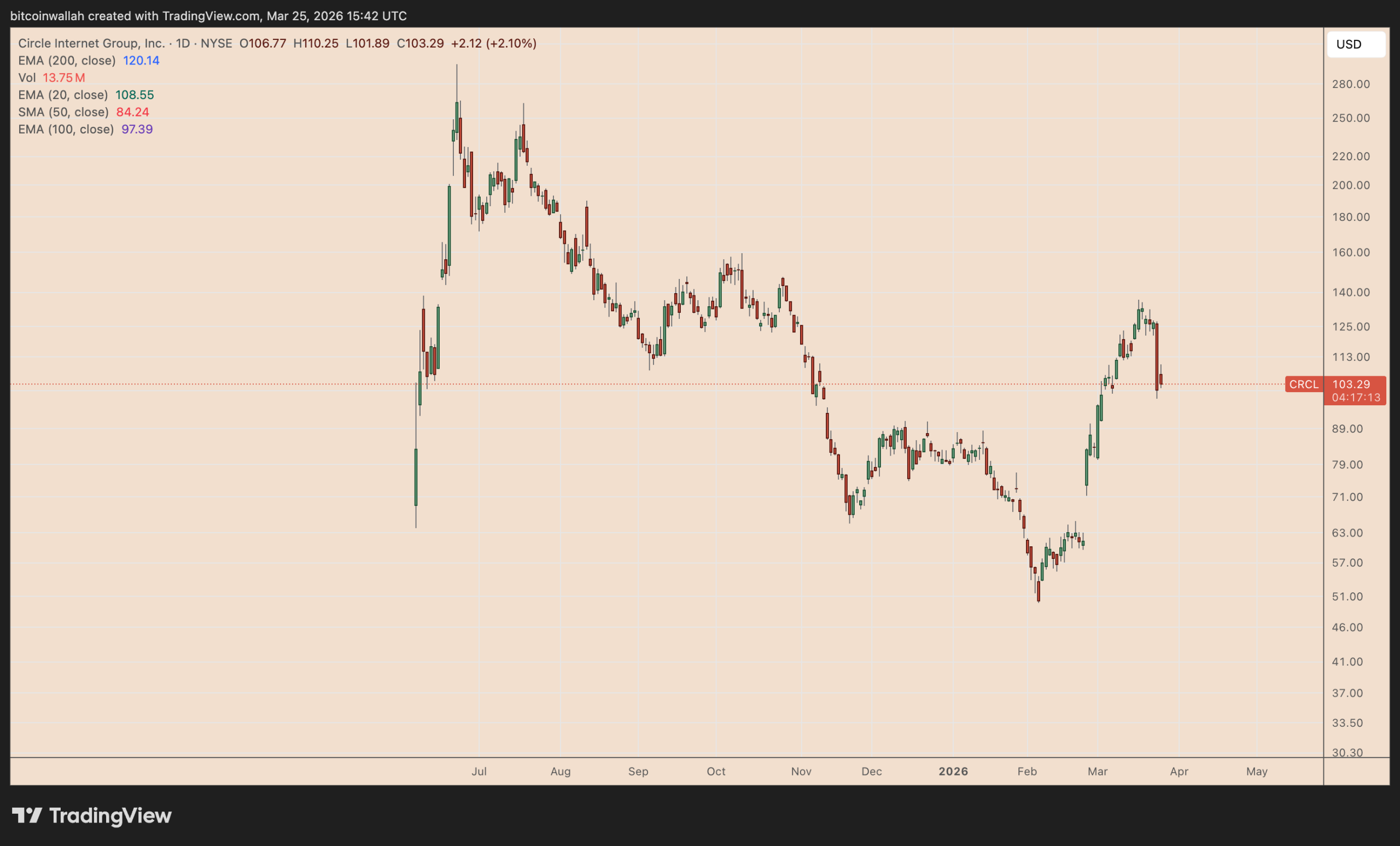
Circle Internet Group’s CRCL stock is showing signs of a potential 25% rebound after the market may have reacted too aggressively to fears surrounding draft CLARITY Act language tied to stablecoin yield restrictions.

Key takeaways:
-
CRCL is attempting to stabilize above a major support confluence near $100.75.
-
Analysts say draft CLARITY Act language may hurt distributor incentives more than Circle’s core reserve-income model.
CRCL stock holds support, opening path to $130
From a technical perspective, CRCL is trying to base near an important support cluster around $100.75, where the 100-day exponential moving average (100-day EMA) aligns with the 0.236 Fibonacci retracement level.

That confluence held even as the stock suffered a brutal 20% single-session decline, a sign that dip buyers stepped in around a historically relevant area on the chart.
The stock could rebound toward the 0.382 Fibonacci retracement level near $130 in the coming weeks if CRCL continues to hold the current floor, representing roughly 25% increase.
The bullish setup also gains some support from institutional buyers. Ark Invest bought about $16 million worth of Circle shares during the plunge on Tuesday, showing that some investors viewed the sell-off as an opportunity.

Still, the setup remains conditional. A decisive break below the $100.75 support confluence would weaken the rebound case and shift downside focus toward the 50-day EMA near $84.25.
That level also aligns with a pullback target shared by independent TradingView analyst Jackie.
CLARITY Act doesn’t affect Circle yield
CRCL fell after traders worried that draft CLARITY Act language could limit stablecoin-linked yield incentives and slow USDC growth.
But Bernstein kept its $190 price target, saying the proposal does not affect Circle’s ability to earn yield on reserves or pay distribution partners such as Coinbase, Binance, or OKX. Ark Invest’s Lorenzo Valente made a similar point.
I think people are misunderstanding what’s happening here.
The new draft of the CLARITY Act does not prohibit issuers from paying distributors such as @coinbase , @binance , or @okx . The discussion around yield is really about retail holders, meaning the end users who actually… https://t.co/hmXpIRyooi
— Lorenzo Valente (@LorenzoARK) March 25, 2026
Circle’s model is simple: it takes the cash backing its stablecoins, invests it in deposits and short-dated US Treasurys, earns yield on those reserves, and shares part of that income with partners.
In 2025, for instance, Circle earned about $2.64 billion in reserve income from roughly $75.3 billion worth of USDC reserves. It doesn’t pay yield directly to USDC holders but to its distribution partners.
Bernstein added that if yield competition becomes harder across the sector, Circle’s market position could actually improve.
Related: Circle taps African fintech Sasai to expand USDC adoption in cross-border payments
Presenting similar arguments, Bitwise said Circle’s market valuation may reach about $75 billion by 2030, almost three times its current worth.

This article does not contain investment advice or recommendations. Every investment and trading move involves risk, and readers should conduct their own research when making a decision. While we strive to provide accurate and timely information, Cointelegraph does not guarantee the accuracy, completeness, or reliability of any information in this article. This article may contain forward-looking statements that are subject to risks and uncertainties. Cointelegraph will not be liable for any loss or damage arising from your reliance on this information.


GameStop revealed on Tuesday that it pledged nearly all of its Bitcoin as collateral on Coinbase as part of a covered call strategy in January, ending two months of speculation over whether it had sold the coins.
In a 10-K annual report to the Securities and Exchange Commission on Tuesday, the video game retailer revealed it pledged 4,709 Bitcoin (BTC), nearly all of its Bitcoin, as collateral under an agreement with Coinbase Credit, using the position to sell covered call options.
The SEC filing clears speculation from January that GameStop was preparing to exit its Bitcoin position after onchain analysts pointed out that it transferred its entire Bitcoin holdings to Coinbase Prime.
The Bitcoin treasury industry has faced pressure in recent months as Bitcoin has fallen 45% from its all-time high, with some analysts casting doubt last year on the sustainability of buy-and-hold strategies.
The move shows GameStop sought to earn income on its Bitcoin by placing short-dated call options with strike prices between $105,000 and $110,000 that are set to expire Friday.
The disclosure shows a $2.3 million unrealized gain and a $700,000 liability tied to the options, while some covered-call contracts expired unexercised in January.
GameStop’s covered call strategy enables it to sell call options that give buyers the right to purchase its Bitcoin at a fixed price. GameStop earns premiums and retains the Bitcoin if the options aren’t exercised.
GameStop directly holds just one Bitcoin now
Since GameStop moved 4,709 Bitcoin to Coinbase, a counterparty that can rehypothecate or reuse the pledged Bitcoin, GameStop is no longer counting those assets as directly held.
Putting Bitcoin up as collateral “resulted in the derecognition of the pledged digital assets and the corresponding recognition of a digital asset receivable,” GameStop said in the filing.
“Although the classification of these assets has changed, our economic exposure is consistent with direct ownership of the underlying Bitcoin,” it added.
GameStop still holds one Bitcoin that wasn’t put up for collateral.
GameStop added that its pledged Bitcoin was worth $368.3 million by Jan. 31 and that it recorded an unrealized loss of $59.7 million on that date because of Bitcoin’s price drop.
Related: Bitcoin in ‘later stages’ of bear market: Watch these BTC price levels
GameStop launched a Bitcoin treasury after its CEO, Ryan Cohen, met with Strategy chair Michael Saylor in February 2025 to discuss how Bitcoin strategies can be implemented.
Prior to moving the 4,709 Bitcoin to Coinbase, GameStop’s Bitcoin stash ranked in the top 25 Bitcoin treasuries by holding size.
Magazine: Bitcoin may face hard fork over any attempt to freeze Satoshi’s coins

Lemonis calls out Florida Democrat’s ‘disingenuous’ Trump claim

Mezo leans on Aerodrome’s veAERO flywheel to grow MEZO and MUSD on Base

Green Left surges to second place in Danish elections


-
 Crypto World6 days ago
NIO (NIO) Stock Plunges 6.5% as Shelf Registration Sparks Dilution Worries
-
 NewsBeat2 days ago
Manchester United reach agreement with Casemiro over contract clause amid transfer speculation
-

 Fashion6 days ago
Weekend Open Thread: Adidas – Corporette.com
-

 Politics6 days ago
Jenni Murray, Long-Serving Woman’s Hour Presenter, Dies Aged 75
-

 Crypto World5 days ago
Best Crypto to Buy Now: Strategy Just Spent $1.57 Billion on Bitcoin During Fear While Early Investors Quietly Enter Pepeto for 150x Potential
-

 Crypto World5 days ago
Bitcoin Price News: Bhutan Sells $72 Million in BTC Under Fiscal Pressure, but the Smart Money Entering Pepeto Sees What the Market Does Not
-

 Tech7 days ago
inKONBINI Lets You Spend Summer Days Behind the Register
-

 News Videos23 hours ago
Parliament publishes latest register of MPs’ financial interests
-

 Sports4 days ago
Remo Stars and Kano Pillars Strengthen Survival Hopes in NPFL
-

 Sports4 days ago
Gary Kirsten Accuses Pakistan Cricket Board Of ‘Interference’, Mohsin Naqvi Responds
-

 Tech4 days ago
Give Your Phone a Huge (and Free) Upgrade by Switching to Another Keyboard
-

 Business4 days ago
No Winner in March 21 Drawing as Prize Rolls to $133 Million for Next
-

 Sports6 days ago
2026 Kentucky Derby horses, odds, futures, preview, date: Expert who nailed 12 Derby-Oaks Doubles enters picks
-

 Tech4 days ago
AI enters the chat: New Seattle dating app relies on tech to facilitate meaningful human connections
-
Business6 days ago
Columbia Sportswear enters $500 million credit agreement with JPMorgan Chase
-

 Tech5 days ago
Today’s NYT Connections Hints, Answers for March 22 #1015
-

 News Videos4 days ago
Ch 9 Financial Management Part 1 | Detailed One Shot | Class 12 Business Studies Boards 2026
-

 Business5 days ago
Will Duke Basketball Win It All? Duke Basketball Enters Second Round as Third Favorite to Claim NCAA Title
-

 Business5 hours ago
Instagram, YouTube Found Responsible for Teen’s Mental Health Struggle in Historic Ruling
-
 Crypto World6 days ago
Small-cap Russell 2000 enters correction territory
You must be logged in to post a comment Login