
Crypto World
Tether’s gold stash tops $23 billion as buying outpaces nation states, Jefferies says



Tether, the crypto firm behind the world’s most popular stablecoin , continued its gold hoarding over the past month, ranking within the top 30 global owners of the metal and surpassing several sovereign nations, according to a Sunday report from Wall Street investment bank Jefferies.
The stablecoin issuer’s gold reserves rose to an estimated 148 tonnes by Jan. 31, valued at roughly $23 billion, after buying about 26 tonnes in the last quarter of 2025 and adding another 6 tonnes in January, Jefferies analysts said.
Jefferies estimates show Tether’s quarterly gold buying exceeded that of most individual central banks, trailing only Poland and Brazil during that period.
At current levels, Tether’s holdings exceed those of countries such as Australia, the United Arab Emirates, Qatar, South Korea and Greece, placing the crypto firm among the top 30 holders of bullion worldwide and one of the largest non-sovereign buyers, the analysts said.
The 148 tonnes of bullion is held as reserves backing both its U.S. dollar-pegged stablecoin USDT and its gold-backed token XAUT. But the company may hold more gold than disclosed, the report added.
Because Tether is privately held, the figures represent a minimum estimate of its total gold exposure, with undisclosed additional purchases likely made on the company’s balance sheet.
According to the USDT’s fourth quarter attestation, some $17 billion of gold was in the reserves, amounting to 126 tonnes as of year-end gold prices.
XAUT’s supply grew to 712,000 tokens worth $3.2 billion by the end of January, an increase of 6 tonnes of gold backing the tokens. CEO Paolo Ardoino told CoinDesk in an October interview that the gold-back enjoyed strong retail demand mainly from emerging markets.
The accumulation coincided with a record-breaking rally in gold, topping $5,000 per ounces last month and advancing nearly 50% since September. The driving forces behind the move is central bank demand, rising long-term government bond yields and efforts by some investors to reduce reliance on the U.S. dollar.
The company’s buying spree may continue, Jefferies noted. Tether CEO Paolo Ardoino said the company plans to allocate 10%-15% of its investment portfolio to physical gold, formalizing a strategy that has already played out over several years.
Tether’s investment portfolio was valued at $20 billion as of the end of last year, CoinDesk reported.
Read more: Tether is buying up to $1 billion of gold per month and storing it in a ‘James Bond’ bunker

TLDR
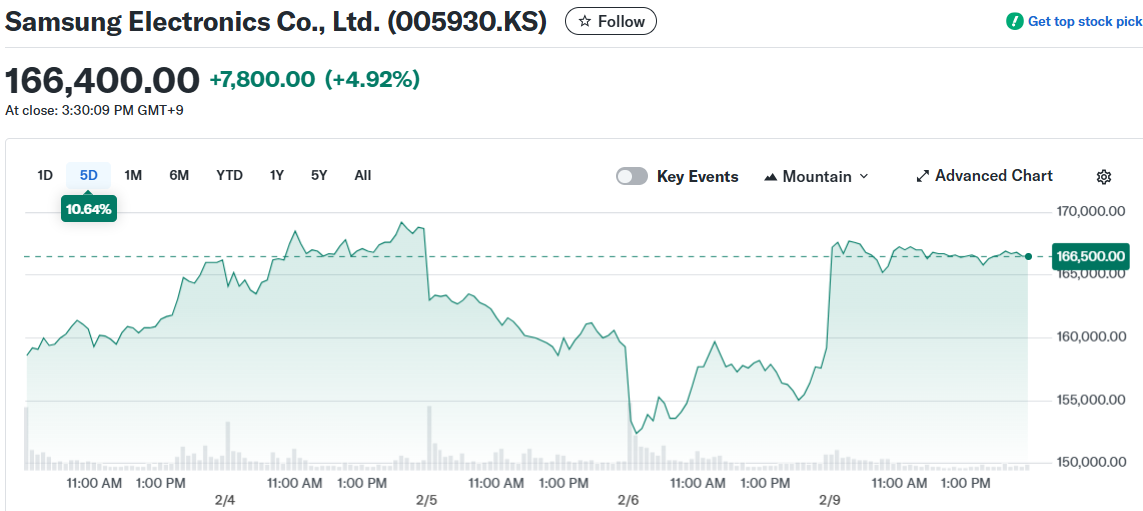
- Samsung Electronics stock climbed 4.9% to 6.4% after announcing mass production of HBM4 memory chips starting this month.
- The Korean chipmaker will supply HBM4 chips to Nvidia by mid-February for Vera Rubin AI accelerators.
- Samsung’s production timeline puts it ahead of Micron Technology, which plans HBM4 rollout in Q2 2026.
- Micron stock still rose 3.08% as analysts expect the company to hold its 20%-25% HBM market share.
- AI chip makers are adopting three-supplier strategies, creating space for Samsung, SK Hynix, and Micron.
Samsung Electronics shares popped on Monday following reports that the company will kick off mass production of next-generation memory chips this month. The stock gained between 4.9% and 6.4% depending on the source.
Industry insiders told South Korea’s Yonhap news agency that Samsung will begin producing HBM4 chips in late February. These high-bandwidth memory chips are critical components for artificial intelligence processors.
The company plans to ship these advanced semiconductors to Nvidia by mid-February. The chips will power Nvidia’s upcoming Vera Rubin AI accelerators, which represents a key win for Samsung in the AI supply chain race.
Nvidia stock jumped 7.87% on the news. SK Hynix, another South Korean memory chip manufacturer, saw shares rise 5.72%.
Race Against Micron Intensifies
Samsung’s announcement puts it in direct competition with Micron Technology for AI chip market share. Micron has seen its stock more than quadruple over the past year thanks to HBM chip demand.
Micron shares rose 3.08% despite the competitive pressure. The company plans to ramp up its own HBM4 production during the second quarter of 2026.
That timeline puts Micron roughly one quarter behind Samsung’s production schedule. Micron CEO Sanjay Mehrotra outlined the company’s HBM4 plans during the most recent earnings call.
Samsung’s stock has nearly tripled in the past 12 months. The memory chip boom has lifted valuations across the entire sector.
Wall Street Sees Room for Multiple Winners
Analysts aren’t overly concerned about market share battles between the three major HBM suppliers. Demand remains strong enough to support all players.
UBS analyst Timothy Arcuri noted that AI accelerator vendors are moving toward three-supplier sourcing strategies. Companies previously relied on just two suppliers for their HBM needs.
This shift benefits Micron. Analysts estimate the company can maintain the 20%-25% market share it captured last year despite increased competition.
HBM chips command higher profit margins than standard memory components. The lucrative margins make the market attractive for Samsung, Micron, and SK Hynix.
Financial Position Remains Strong
Samsung’s market capitalization sits at $694.62 billion. The company reported revenue of $223.32 billion with a 7% growth rate over three years.
The chipmaker maintains a current ratio of 2.63 and a debt-to-equity ratio of 0.04. These metrics indicate solid liquidity and low leverage.
Samsung’s gross margin stands at 36.65% with an operating margin of 9.51%. The Altman Z-Score of 7.78 suggests strong financial health.
The company’s P/E ratio of 32.73 sits near its one-year high. Technical indicators show an RSI of 100, suggesting the stock may be overbought.
Samsung didn’t immediately respond to requests for comment. The company’s HBM4 production represents a major milestone in the ongoing AI chip race.

Strategy (MSTR) added to its bitcoin holdings, but appears to have made all its purchases before the deep price plunge in the back half of the week.
Led by Executive Chairman Michael Saylor, the company added 1,142 bitcoin for $90 million, or an average price of $78,815 each. Strategy’s stack now stands at 714,644 bitcoin purchased for $54.35 billion, or an average price of $76,056 each.
Bitcoin Monday morning is trading at just under $69,000, down 2.6% over the past 24 hours. MSTR shares are lower by 3.9%.
Last week’s acquisitions were funded by the sale of common stock.
Given the average purchase price of $78,815, it appears Strategy made its buys on Monday or Tuesday last week, ahead of the rapid decline in bitcoin’s price, which took the crypto to as low as $60,000 at one point on Thursday.


Skeptics say ‘Zero-Dollar Bitcoin’ as a new selloff revives brutal questions about utility, cash flows, and whether confidence alone can sustain its price/
Summary
- Commentators Buck Sexton and Richard Farr argue Bitcoin has no long-term value, no “fundamental floor,” and has failed as either money or a hedge.
- Critics frame Bitcoin as a reflexive high-beta tech proxy whose value depends on flows and belief, not cash flows or enforceable claims on real assets.
- The debate intensifies as BTC trades near the low-70k region alongside choppy ETH and SOL markets, underscoring crypto’s sensitivity to macro risk-off shocks.
Bitcoin’s (BTC) latest drawdown has revived an old, brutal question: could the world’s largest cryptocurrency ultimately be worth nothing? As prices slide and faith wobbles, a “Bitcoin to $0” thesis is again echoing through markets and media.
Zero‑dollar thesis resurfaces
The spark this week came from conservative commentator Buck Sexton, who wrote that “every time I ask a Bitcoin true believer to explain why they think it has any long-term value… I come away more certain that Bitcoin has no long-term value, and a floor price of zero.” His post went viral after Bitcoin tumbled more than 20% over the past week, amplifying a bearish narrative that critics have pushed for years. The core claim is simple: in a full confidence crisis, an asset with no cash flows and no legal claim on anything tangible has “no ‘fundamental floor.’”
Richard Farr, chief market strategist at Pivotus Partners, put it more bluntly, saying his firm’s Bitcoin target is “$0.0,” arguing it has “failed as a hedge against the dollar,” tracks high‑beta tech, and has not gained real traction as money. “The miners (who are the network) are bleeding cash,” Farr wrote. “We think it’s a zero.”
Belief versus utility
Long‑time antagonist Peter Schiff again contrasted Bitcoin with gold, insisting that “Bitcoin’s value is purely subjective, as it has no utility beyond belief.” “Bitcoin can’t do anything. That’s the problem,” he added. “Yes you can store and transfer your Bitcoin, but beyond that you can’t do anything with it.” That critique dovetails with academic warnings that non‑yielding assets are ultimately hostage to reflexive flows, a point underscored during previous deleveraging waves in 2018 and 2022.
Yet the ferocity of the latest backlash also reflects how over‑financialized the asset has become, tethered to macro risk cycles and ETF flows rather than cypherpunk ideals. Sexton himself argued that the “anger” from online advocates is part of the problem, eroding mainstream credibility just as regulators and traditional finance are demanding more discipline.
Market snapshot
The debate comes as digital assets grind through another risk‑off stretch. Bitcoin (BTC) trades near $70,961, up roughly 2.4% over the last 24 hours on about $42.3b in volume. Ethereum (ETH) changes hands around $2,094, up about 0.65% over the same period, with spot and futures turnover exceeding $50b. Solana (SOL) sits close to $86.6, down roughly 1.4% on the day, with more than $6.1b traded.
These skittish flows mirror broader macro anxiety, from tightening financial conditions to renewed equity volatility, that has historically pressured high‑beta crypto assets. For now, the “zero” narrative is less a precise price target than a stress test of Bitcoin’s maturing, yet still fragile, social contract.
Related coverage: Bitcoin’s correlation with tech stocks has repeatedly spiked during risk‑off shocks, challenging the “digital gold” hedge story. Ethereum’s evolving fee and burn dynamics highlight how protocol cash‑flow narratives can bolster perceived intrinsic value. Solana’s outsized rally and sharp pullbacks underline how execution risk and network outages still shape the market’s tolerance for speculative layer‑1 bets.


The brief, partial U.S. government shutdown put paid to the Employment Situation report that was due Friday; it’s coming this week instead. Look for the bellwether nonfarm payrolls report on Wednesday. The world’s largest economy is forecast to have created 70,000 jobs last month, more than in December, while the unemployment rate is expected to hold steady at 4.4%.
The week also includes earnings from some of the biggest, highest-profile crypto companies, including crypto exchange Coinbase (COIN). Robinhood (HOOD), a trading platform that covers equities as well as crypto, is also on the roster.
Outside the U.S., there will be plenty of focus on Asia, where CoinDesk’s second annual Consensus Hong Kong conference takes place. There’s a high chance participating companies will use the event as a venue for corporate announcements.
What to Watch
(All times ET)
- Crypto
- Macro
- Feb. 9, 11 a.m.: U.S. consumer inflation expectations for January (Prev. 3.4%)
- Feb. 10, 7 a.m.: Brazil inflation rate YoY (Prev. 4.26%), MoM (Prev. 0.33%)
- Feb. 10, 8:30 a.m.: U.S. retail sales MoM for December Est. 0.5% (Prev. 0.6%)
- Feb. 10 8:30 a.m.: U.S. employment cost index QoQ (Prev. 0.8%)
- Feb. 10, 2 p.m.: Argentina inflation rate YoY (PRev. 31.5%), MoM (Prev. 2.8%)
- Feb. 10, 8:30 p.m.: China inflation rate YoY for January (Prev. 0.8%); MoM (Prev. 0.2%)
- Feb. 11, 8:30 a.m.: U.S. nonfarm payrolls for January Est. 70K (Prev. 50K)
- Feb. 11, 8:30 a.m.: U.S. unemployment rate for January Est. 4.4% (Prev. 4.4%)
- Feb. 11, 8:30 a.m.: U.S. average hourly earnings for January YoY Est. 3.8% (Prev. 3.6%)
- Feb. 12, 2:00 a.m.: U.K. GDP MoM for December. (Prev. 0.3%)
- Feb. 12, 5:30 a.m.: India inflation rate YoY for January (Prev. 1.33%); MoM (Prev. 0.05%)
- Feb. 12, 8:30 a.m.: U.S. initial jobless claims week ending Feb. 7 (Prev. 231K)
- Feb 12, 10 a.m.: U.S. existing home sales for January Est. 4.25M (Prev. 4.35M)
- Feb. 13, 8:30 a.m.: U.S. core inflation rate YoY for January (Prev. 2.6%); MoM Est. 0.3% (Prev. 0.2%)
- Feb. 13, 8:30 a.m.: U.S. inflation rate YoY for January (Prev. 2.7%); MoM Est. 0.3% (Prev. 0.3%)
- Feb. 14: Japan GDP growth rate QoQ for Q4 (Prel) est. 0.4% (Prev. -0.6%); Annualized est. 1.6% (Prev. -2.3%)
- Earnings (Estimates based on FactSet data)
- Feb. 10: Canaan (CAN), pre-market, -$0.03
- Feb. 10: Robinhood Markets (HOOD), post-market, $0.63
- Feb. 10: Upexi (UPXI), post-market, -$0.07
- Feb. 10: Lite Strategy (LITS), post-market
- Feb. 12: Coinbase (COIN), post-market, $1.04
- Feb. 12: Coincheck Group (CNCK), post-market, $0.01
- Feb. 12: Bitdeer Technologies Group (BTDR), pre-market, -$0.06
- Feb. 13: Trump Media & Tech Group (DJT), post-market
- Feb. 13: HIVE Digital Technologies (HIVE), post-market, -$0.07
Token Events
- Governance votes & calls
- Feb. 11: Ripple to host XRP Community Day on X Spaces discussing XRP adotion, regulated finance and innovation.
- Unlocks
- Token Launches
Conferences
Crypto World
Bitcoin value investors move in as BTC price drops, ‘capitulation’ searches rise: Crypto Daybook Americas
By Francisco Rodrigues (All times ET unless indicated otherwise)
Bitcoin has retreated by nearly 2.5% in the past 24 hours after failing to hold onto gains made during an end-of-week bounce that pushed it back up to $71,000.
The pullback followed a turbulent few days in which the cryptocurrency plunged to as low as $60,000 before rebounding. BTC is still down more than 11% in the past seven days.
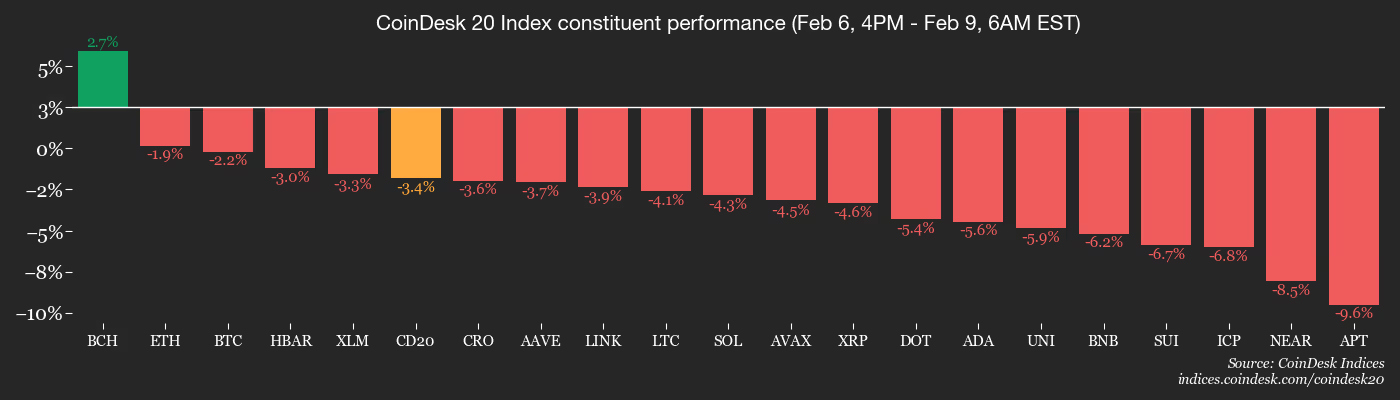
Even so, it’s outperforming the wider market, which saw the CoinDesk 20 (CD20) index drop 13.5% over 24 hours and 13.7% in a week.
The drop saw institutions move. Speaking to CNBC, Bitwise CEO Hunter Horsley said late last week that the firm saw significant inflows as prices dropped.
“I think long-time holders are feeling unsure, and I think the new investor set — institutions — are feeling they’re getting a new crack at the apple and seeing prices they thought they’d forever missed,” Horsley said.
Spot bitcoin ETFs on Friday reversed a three-day streak of outflows, bringing in a net $371 million, SoSoValue data shows. Still, retail sentiment remained fragile. Julio Moreno, CryptoQuant’s head of research, noted on social media that U.S. investors are buying back in, based on the Coinbase Premium Index turning positive for the first time since mid-January.
Online search interest for terms such as “crypto capitulation” spiked during the selloff and stayed elevated, according to crypto analytics firm Santiment, offering an opportunity for value investors to step in.
Meanwhile, capital flowed into traditional safe havens. Gold and silver extended their recovery after a selloff late last month, with gold once again topping $5,000 as investors consider a weaker U.S. dollar and major purchasers continued accumulating. These include Tether, whose gold stash has topped $23 billion, and China’s central bank.
Stock market futures are down ahead of the open, after a Japan equities rallied over the ruling party’s landslide win in a snap election. Prime Minister Sanae Takaichi had campaigned on low interest rates and significant fiscal spending.
The yield on Japanese government bonds kept rising, further unwinding the yen carry trade and affecting risk assets including cryptocurrencies. The unwind could bring nearly $5 trillion of overseas investments back into the country. Stay alert!
Read more: For analysis of today’s activity in altcoins and derivatives, see Crypto Markets Today
What to Watch
For a more comprehensive list of events this week, see CoinDesk’s “Crypto Week Ahead“.
- Crypto
- Macro
- Feb. 9, 11 a.m.: U.S. consumer inflation expectations for January (Prev. 3.4%)
- Earnings (Estimates based on FactSet data)
Token Events
For a more comprehensive list of events this week, see CoinDesk’s “Crypto Week Ahead“.
- Governance votes & calls
- No major governance votes.
- Unlocks
- Token Launches
- Feb. 9: Pendle to launch sPENDLE buybacks with first yield distributions starting Feb. 13, and rewards time-weighted from Jan. 29.
- Feb. 9: ZKsync to launch Season 1 of the ZKnomics Staking Pilot Program via Tally
Conferences
For a more comprehensive list of events this week, see CoinDesk’s “Crypto Week Ahead“.
Market Movements
- BTC is down 2.90% from 4 p.m. ET Sunday at $69,045.23 (24hrs: -2.44%)
- ETH is down 4.07% at $2,034.28 (24hrs: -4.40%)
- CoinDesk 20 is down 3.09% at 1,973.38 (24hrs: -3.46%)
- Ether CESR Composite Staking Rate is down 25 bps at 2.74%
- BTC funding rate is at -0.037% (-4.0362% annualized) on Binance

- DXY is down 0.33% at 97.31
- Gold futures are up 1.67% at $5,033.80
- Silver futures are up 5.62% at $81.05
- Nikkei 225 closed up 3.89% at 56,363.94
- Hang Seng closed up 1.76% at 27,027.16
- FTSE 100 is up 0.31% at 10,402.44
- Euro Stoxx 50 is up 0.39% at 6,021.78
- DJIA closed on Friday up 2.47% at 50,115.67
- S&P 500 closed up 1.97% at 6,932.30
- Nasdaq Composite closed up 2.18% at 23,031.21
- S&P/TSX Composite closed up 1.49% at 32,471.00
- S&P 40 Latin America closed down 2.89% at 3,653.05
- U.S. 10-Year Treasury rate is up 2 bps at 4.23%
- E-mini S&P 500 futures are unchanged at 6,949.25
- E-mini Nasdaq-100 futures are down 0.20% at 25,113.25
- E-mini Dow Jones Industrial Average futures are unchanged at 50,246.00
Bitcoin Stats
- BTC Dominance: 59.33% (-0.05%)
- Ether-bitcoin ratio: 0.02944 (-0.92%)
- Hashrate (seven-day moving average): 977 EH/s
- Hashprice (spot): $34.55
- Total fees: 2.23 BTC / $157,182
- CME Futures Open Interest: 116,125 BTC
- BTC priced in gold: 13.8 oz.
- BTC vs gold market cap: 4.62%
Technical Analysis

- Bitcoin is testing the 200-week exponential moving average (~$68,339), a critical support level to prevent an extended structural drawdown.
- The weekly RSI is firmly oversold at 28.18, a level that has historically preceded short-term rebounds.
- While this positioning suggests there’s a high probability of a bounce, a clear reversal of the downtrend requires a sustained breakout above $74,000.
Crypto Equities
- Coinbase Global (COIN): closed on Friday at $165.12 (+13.00%), –1.24% at $163.07 in pre-market
- Galaxy Digital (GLXY): closed at $19.76 (+17.34%), –0.30% at $19.70
- MARA Holdings, Inc. (MARA): closed at $8.24 (+22.44%), –2.67% at $8.02
- Riot Platforms, Inc. (RIOT): closed at $14.45 (+19.82%), –1.18% at $14.28
- Core Scientific, Inc. (CORZ): closed at $16.81 (+13.47%), –0.30% at $16.76
- CleanSpark (CLSK): closed at $10.08 (+21.96%), –0.89% at $9.99
- Exodus Movement (EXOD): closed at $10.56 (+12.10%)
- CoinShares Bitcoin Mining ETF (WGMI): closed at $40.43 (+14.76%)
- Circle Internet Group (CRCL): closed at $57.04 (+13.56%), –1.05% at $56.44
- Bullish (BLSH): closed at $27.45 (+10.24%), unchanged at $27.45
Crypto Treasury Companies
- Strategy (MSTR): closed at $134.93 (+26.11%), –3.47% at $130.25
- Strive Asset Management (ASST): closed at $11.91 (+20.84%), –3.40% at $11.51
- Sharplink Gaming (SBET): closed at $7.03 (+15.82%), –0.71% at $6.98
- Upexi, Inc. (UPXI): closed at $1.14 (+4.59%), +0.88% at $1.15
- Lite Strategy, Inc. (LITS): closed at $1.06 (+11.58%)
ETF Flows
Spot BTC ETFs
- Daily net flows: $330.7 million
- Cumulative net flows: $54.63 billion
- Total BTC holdings ~1.27 million
Spot ETH ETFs
- Daily net flows: -$21.3 million
- Cumulative net flows: $11.83 billion
- Total ETH holdings ~5.83 million
Source: Farside Investors
While You Were Sleeping
- Takaichi victory sends Nikkei to record, bitcoin to $72,000 and gold past $5,000 (CoinDesk): Japan’s Nikkei 225 index surged to a record on Monday, breaching 57,000 following Prime Minister Sanae Takaichi’s decisive “supermajority” electoral victory.
- China Urges Banks to Curb Exposure to U.S. Treasuries (Bloomberg): Chinese regulators advised financial institutions to rein in their holdings of U.S. Treasuries, citing concerns over concentration risks and market volatility.
- Tether’s gold stash tops $23 billion as buying outpaces nation states, Jefferies says (CoinDesk): The Wall Street investment bank estimates the crypto firm holds at least 148 metric tons of physical gold, joining the top 30 global holders of bullion.
- U.S. IPO proceeds to quadruple to record $160 billion in 2026 as dealmaking rebounds, says Goldman (Reuters): U.S. equity markets are set for a sharp rebound in IPOs in 2026, Goldman Sachs analysts said, forecasting proceeds quadrupling to a record $160 billion as marquee names such as SpaceX, OpenAI and Anthropic edge closer to public listings.

TLDR
- SoFi stock surged 7% Friday after two executives bought shares totaling over $200,000 following the company’s Q4 earnings beat
- Citizens upgraded the stock to Market Outperform with a $30 target, while JPMorgan moved to Buy with a $31 target
- The fintech company posted Q4 EPS of $0.13 versus $0.11 expected and revenue of $1.03 billion versus $973.43 million forecast
- Insiders have purchased $204,800 in stock over the past three months, showing management confidence
- The stock has dropped 20% year-to-date despite strong revenue growth of 35.6% over the last twelve months
SoFi Technologies shares jumped over 7% Friday following insider purchases by two company executives. The buying activity occurred just days after the fintech platform reported quarterly results that exceeded analyst estimates.
General Counsel Robert S. Lavet acquired 5,000 shares for approximately $105,200 on February 6. EVP Eric Schuppenhauer purchased 5,000 shares the previous day for roughly $99,650. Both executives bought shares after the stock pulled back from recent highs.
The purchases followed SoFi’s fourth-quarter earnings announcement. The company reported earnings per share of $0.13, beating the consensus estimate of $0.11. Revenue hit $1.03 billion for the quarter, surpassing expectations of $973.43 million.
Analyst Upgrades Drive Momentum
Citizens upgraded SoFi from Market Perform to Market Outperform with a $30 price target. The upgrade represents about 44% upside from current levels around $20.86. The firm attributed the recent selloff to broader market rotation rather than company-specific issues.
JPMorgan also upgraded the stock to Buy from Hold. The bank set a $31 price target and highlighted improved execution and steady member growth. Analysts noted that SoFi continues adding customers while some competitors experience slower growth.
Mizuho maintained its Outperform rating with a $38 price target. The firm recommended investors buy on weakness after the post-earnings dip. Needham kept its Buy rating but adjusted its target to $33 from $36.
The stock has fallen roughly 20% year-to-date after trading above $30 in late 2025. Citizens views this decline as creating an opportunity for investors. The company has grown revenue 35.6% over the past twelve months.
Insider Activity Signals Confidence
The recent executive purchases add to a broader pattern. Corporate insiders have bought $204,800 worth of stock over the last three months according to regulatory filings.
While insider buying doesn’t guarantee future gains, it often attracts investor attention. Executives are investing their own capital at current price levels.
Citizens highlighted SoFi’s shift toward fee-based and capital-light revenue streams. The firm also pointed to opportunities in blockchain, artificial intelligence, business banking, and new loan platforms.
The stock has traded between $8.60 and $32.73 over the past 52 weeks. Current prices sit near the middle of that range following the pullback.
SoFi continues expanding its member base and product portfolio. The company is monetizing its platform while entering new business verticals. The combination of earnings results, analyst upgrades, and insider purchases pushed shares higher this week.

Ethereum co-founder Vitalik Buterin drew a clear boundary around what he considers “real” decentralized finance (DeFi), pushing back against yield-driven stablecoin strategies that he says fail to meaningfully transform risk.
In a discussion on X, Buterin said that DeFi derives its value from changing how risk is allocated and managed, not simply from generating yield on centralized assets.
Buterin’s comments come amid renewed scrutiny over DeFi’s dominant use cases, particularly in lending markets built around fiat-backed stablecoins like USDC (USDC).
While he did not name specific protocols, Buterin took aim at what he described as “USDC yield” products, saying they depend heavily on centralized issuers while offering little reduction in issuer or counterparty risk.

Two stablecoin paths outlined
Buterin outlined two paths that he considers to be more aligned with DeFi’s original ethos: an Ether (ETH)-backed algorithmic stablecoin and a real-world asset (RWA) backed algorithmic stablecoin that is overcollateralized.
In an ETH-backed algorithmic stablecoin, he said that even if most of a stablecoin’s liquidity comes from users who mint the token by borrowing against crypto collateral, the key innovation is that risk can be shifted to markets rather than a single issuer.
“The fact that you have the ability to punt the counterparty risk on the dollars to a market maker is still a big feature,” he said.
Buterin said that stablecoins backed by RWAs could still improve risk outcomes if they are conservatively structured.
He said that if such a stablecoin is sufficiently overcollateralized and diversified so that the failure of a single backing asset would not break the peg, the risk faced by holders would still be meaningfully reduced.
USDC dominates DeFi lending
Buterin’s comments land as lending markets across Ethereum remain heavily centered on USDC.
On Aave’s main Ethereum deployment, more than $4.1 billion worth of USDC is currently supplied out of a total market size of about $36.4 billion, with roughly $2.77 billion borrowed, according to protocol dashboard data.

A similar pattern appears on Morpho, which optimizes lending across Aave and Compound-based markets.
On Morpho’s borrow markets, three of the five largest markets by size are denominated in USDC, typically backed by collateral like wrapped Bitcoin or Ether. The top borrowing market lends USDC and has a market size of $510 million.
On Compound, USDC remains one of the protocol’s most used assets, with about $382 million in assets earning yield and $281 million borrowed. This is supported by roughly $536 million in collateral.
Cointelegraph reached out to Aave, Morpho and Compound for comment. Aave and Morpho acknowledged the inquiry, while Compound had not responded by publication.
Related: CFTC expands payment stablecoin criteria to include national trust banks
Buterin’s call for decentralized stablecoins
Buterin’s critique does not reject stablecoins outright but questions whether today’s dominant lending models deliver the decentralization of risk that DeFi promises.
The comments also build on earlier critiques he made about the structure of today’s stablecoin market.
On Jan. 12, he argued that Ethereum needs more resilient decentralized stablecoins, warning against designs that rely too heavily on centralized issuers and a single fiat currency.
At the time, he said stablecoins should be able to survive long-term macro risks, including currency instability and state-level failures, while remaining resistant to oracle manipulation and protocol errors.
Magazine: Hong Kong stablecoins in Q1, BitConnect kidnapping arrests: Asia Express

The BNY headquarters in New York, US, on Wednesday, July 10, 2024.
Jeenah Moon | Bloomberg | Getty Images
At America’s oldest bank, 134 new workers don’t sleep or take sick days. They don’t even have names.
They’re what BNY calls “digital employees.” They work side by side with humans. They have unique roles and are evaluated by how well they do them. Some of their jobs were done by people last year.
“The digital employee works 24/7, which is obviously very different to our human counterparts,” said Rachel Lewis, who oversees nine digital employees in addition to thousands of humans as head of payment operations for BNY. “It’s really focused on very specific repetitive tasks that allow our human employees to do much more human, intense, interesting-type roles.”
BNY employs 48,100 humans, down from about 53,400 in 2023, according to a recent earnings presentation. CFO Dermot McDonogh was asked on the firm’s fourth-quarter analyst call last month what the 134 digital employees mean for cost savings at the firm.

“Our head count has trended down a little bit, but that’s not really anything to do with AI yet,” McDonogh said. “We talk about, internally, AI is unlocking capacity. We don’t think about it in the narrow definition of efficiency. It’s all about growing with clients, increasing revenues and optimizing the potential for our employees.”
Across Wall Street, analysts and investors are starting to ask more questions about how the industry’s expenses on AI will translate into higher efficiencies and greater returns. BNY spent $3.8 billion on technology in 2025, or about 19% of its revenue. That’s the highest proportion among its large-bank peers, according to data collated by CNBC.
JPMorgan, Goldman Sachs, Bank of America, Wells Fargo, Citigroup, BNY
“There’s an AI arms race. The banks are part of that, said Wells Fargo analyst Mike Mayo. “But you don’t define success by who spends the most. You define success by who has the best results.”
“It’s a lot of ‘spraying and praying’ when it comes to spending on tech, generally,” he said.
However, BNY has been identified as one of the companies that could see the biggest benefits from AI. Goldman Sachs’ research team screened the Russell 1000 for potential productivity improvements, based on labor costs and wage exposure to AI automation. The firm ranked BNY toward the top of that list, saying the bank could see a potential 19% boost to earnings per share.
But in several conversations CNBC had with executives at BNY, they’ve been steadfast that the multitude of technology investments won’t come at the expense of human employees.
“I wouldn’t think about it that way,” said Michelle O’Reilly, BNY global head of talent. “I would think about it more as unlocking that productivity – enabling all employees to be productive.”
While the company is building more digital employees, it’s also upskilling the human ones. Shortly after ChatGPT was released in late 2022, BNY set up its AI Hub.
“That’s when we really doubled down and realized that this would be transformational for the bank,” said Leigh-Ann Russell, BNY’s chief information officer and global head of engineering. “Our biggest focus initially was enablement – getting some training rolled out to every one of our employees at the bank.”
BNY built a platform it calls Eliza, which pulls in a variety of open-source, commercially available models that are integrated with the firm’s internal data and compliance. Almost all of BNY’s workforce has completed a 10-hour training for Eliza, and thousands more have taken it a step further through a multi-day AI bootcamp that can help non-engineers find creative ways to automate parts of their jobs.
The name “Eliza” is a tribute to Elizabeth Schuyler Hamilton, the wife of the bank’s founder and America’s first Treasury Secretary, Alexander Hamilton.
“Democratization of this technology is one of our sweet spots on how we feel like we’ve been successful so far,” Russell said. “I have this juxtaposition of this original history of this amazing 241-year institution and being at the forefront of AI, and I think that’s just a lovely reminder of technology over the centuries.”
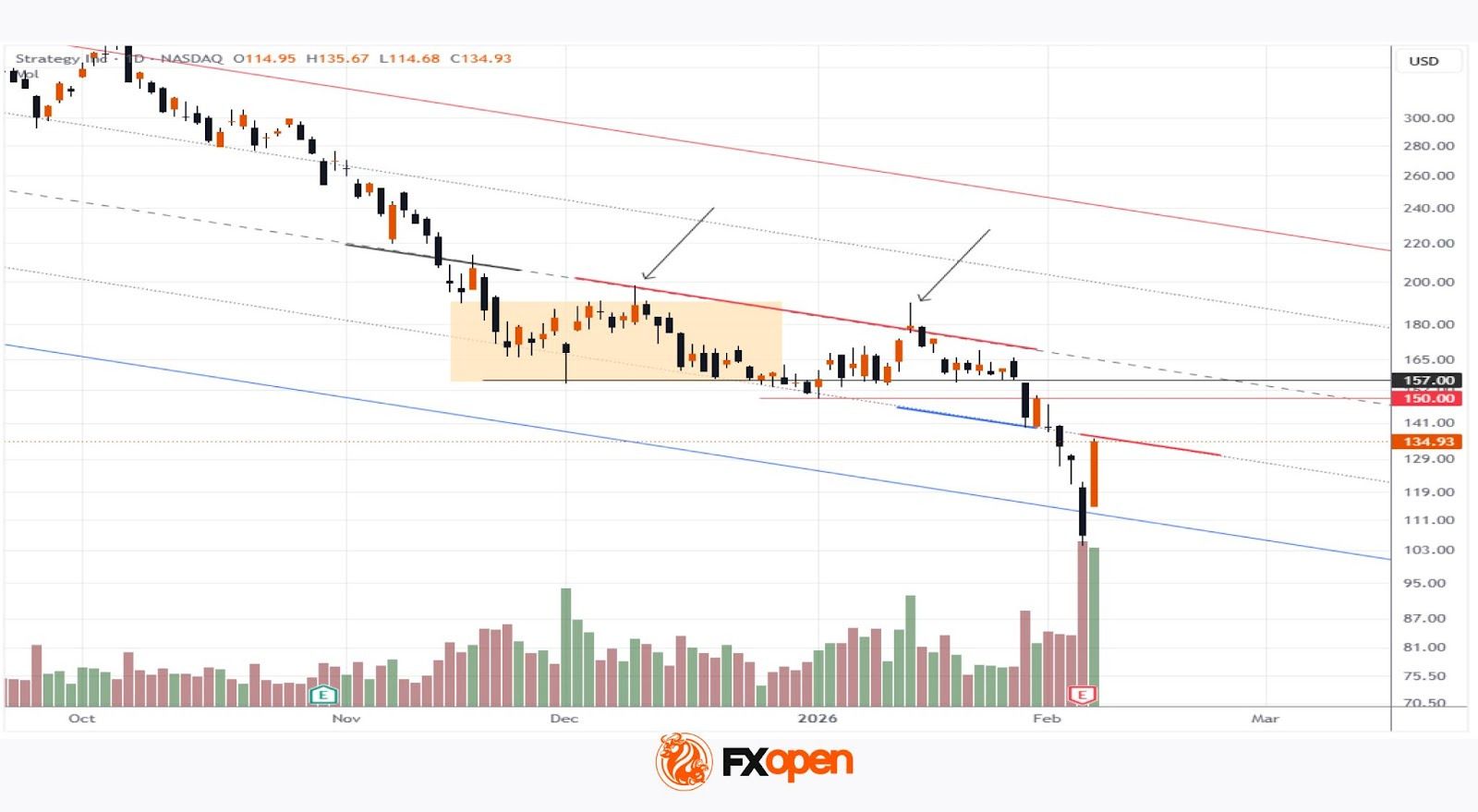
Shares of Strategy Incorporated (MSTR) suffered a severe collapse, falling by more than 75% from their July 2025 highs to last Thursday’s low. The main trigger was concern over the cryptocurrency market, as the company holds more than 700,000 coins on its balance sheet, with an average purchase price of around $76,000 per coin.
However, trading opened on Friday with a bullish gap, and MSTR surged by more than 20% during the session. Market sentiment shifted sharply due to two key factors:
→ Quarterly earnings release. Although earnings per share missed expectations, investors were reassured by statements from founder Michael Saylor and CEO Phong Le, who stressed that the decline in the price of the leading cryptocurrency does not threaten the company’s financial stability. Management confirmed that, despite unrealised losses, the core business generates sufficient cash flow to service debt, and the accumulation strategy remains unchanged.
→ Recovery in cryptocurrency prices. After forming a low on Thursday, the BTC/USD rate rebounded, finding support near the psychological $60,000 level.
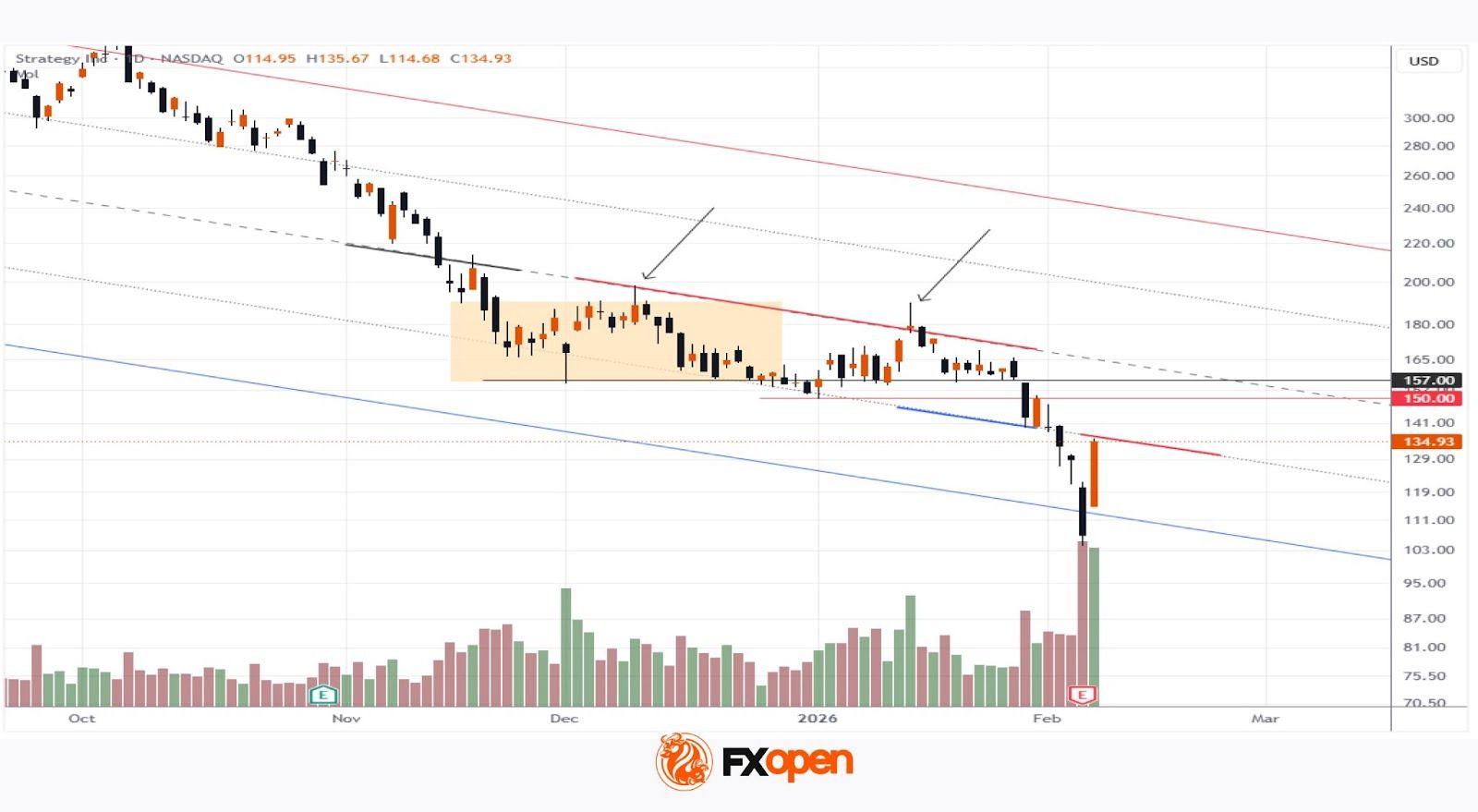
Back in early December, we noted that:
→ signs of demand were emerging on the chart, giving bulls hope for a recovery;
→ much would depend on the direction of BTC/USD.
Since then, MSTR shares initially stabilised, finding support around $157, but the downtrend later resumed, driven by:
→ renewed weakness in the cryptocurrency market;
→ resistance at the median of the descending channel, as shown by the arrows. A breakout attempt in mid-January failed, allowing bears to regain control.
The last two candles on the chart form a bullish engulfing pattern, reinforced by exceptionally high trading volumes — a sign of “smart money” activity, which may view current prices as attractive.
Positive sentiment could persist this week, but the key question is whether it will be strong enough to break above the line dividing the lower half of the channel into two quarters. If successful, a crucial test for the bulls would be the area around the psychological $150 level, which stands out as a major resistance zone.
Buy and sell stocks of the world’s biggest publicly-listed companies with CFDs on FXOpen’s trading platform. Open your FXOpen account now or learn more about trading share CFDs with FXOpen.
This article represents the opinion of the Companies operating under the FXOpen brand only. It is not to be construed as an offer, solicitation, or recommendation with respect to products and services provided by the Companies operating under the FXOpen brand, nor is it to be considered financial advice.
ETH is close to breaking below $2,000 again, XRP’s price is down by 3% daily.
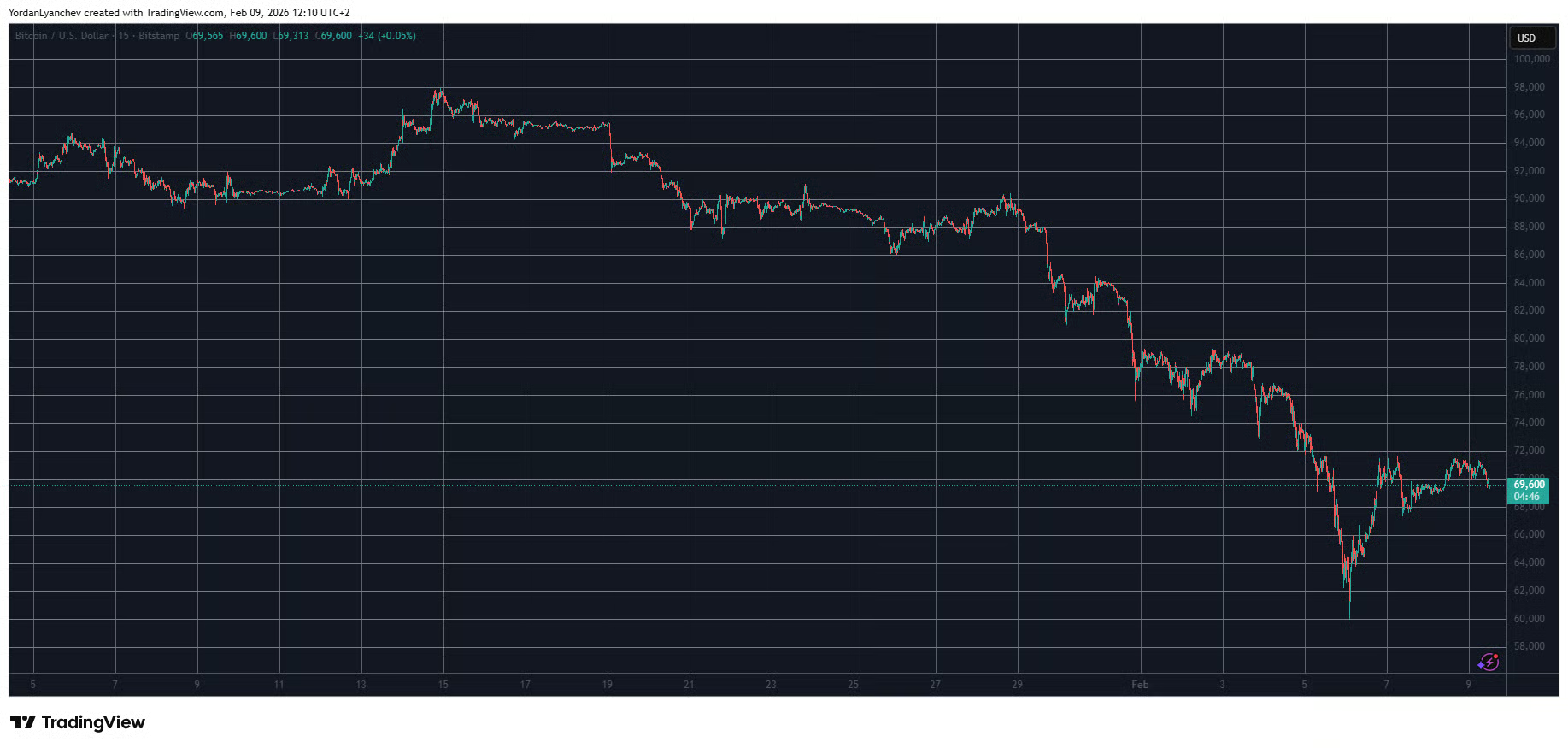
Bitcoin’s price ascent to $72,000 on Sunday failed in its tracks, and the asset has retraced by over two grand since that unsuccessful attempt.
Most larger-cap altcoins are in the red today after charting some gains over the weekend. WLFI and XMR are among the few exceptions.
BTC Below $70K Again
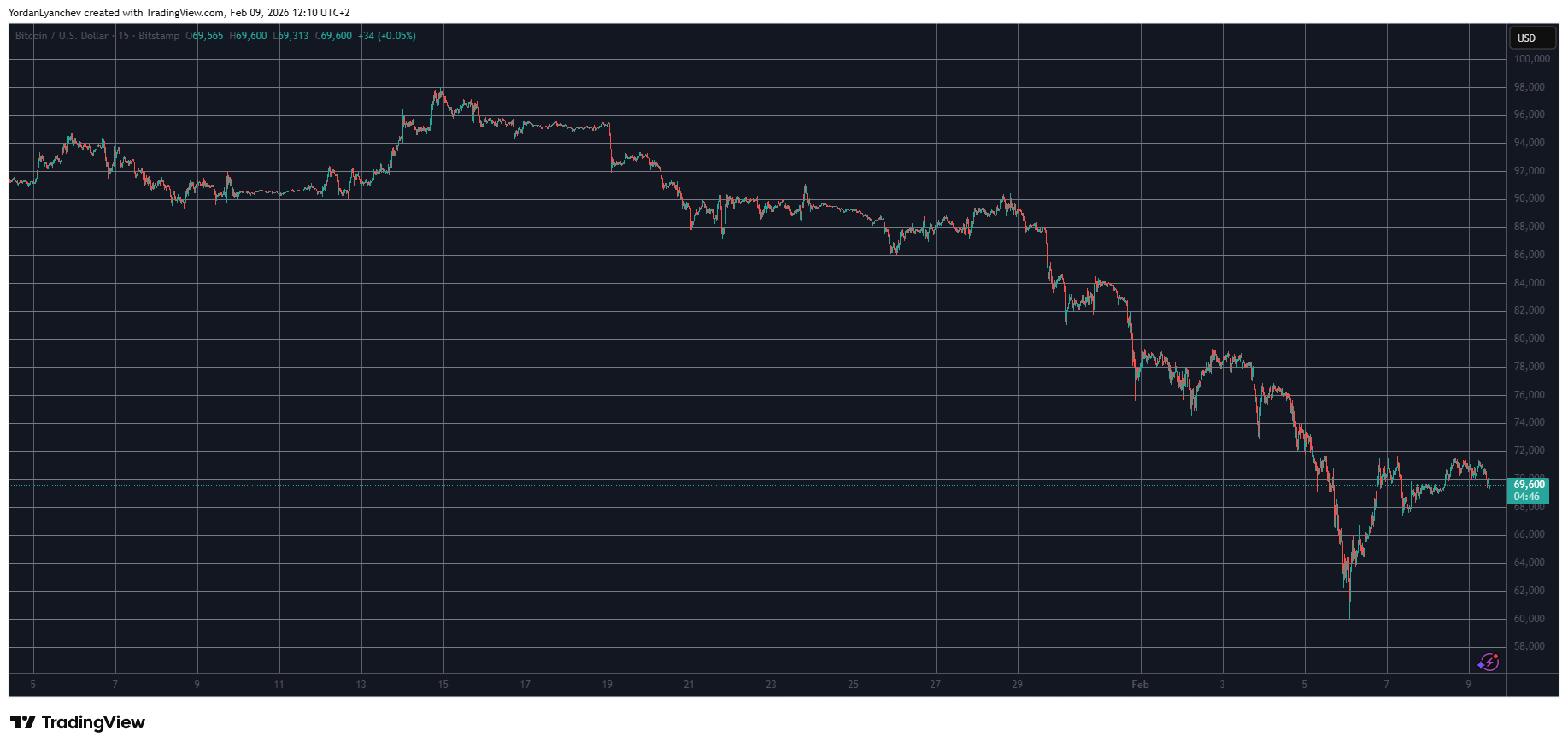
The primary cryptocurrency nosedived on several occasions in the past few weeks. On January 31, for example, it dumped from $84,000 to just under $76,000 after it had already dropped from a local peak of $90,000.
The bulls tried to intervene at this point, but their best effort took BTC to $79,000 a few days later. However, that was short-lived as the bears remained the predominant force in the market. As the selling pressure intensified over the business week, it culminated on Thursday and Friday morning when bitcoin plunged to $60,000.
This became its lowest price tag since before the US presidential elections in November 2024. After losing $30,000 in just over a week, the cryptocurrency finally rebounded and surged to $72,000 on Friday and Saturday morning. It failed there and dropped to $68,000, but tried once again on Sunday. However, it was stopped at $72,000 once again.
It has declined by $2,500 since then and now sits below $70,000. Its market capitalization is down to $1.390 trillion on CG, while its dominance over the alts is just over 57%.
WLFI Defies Market Trend
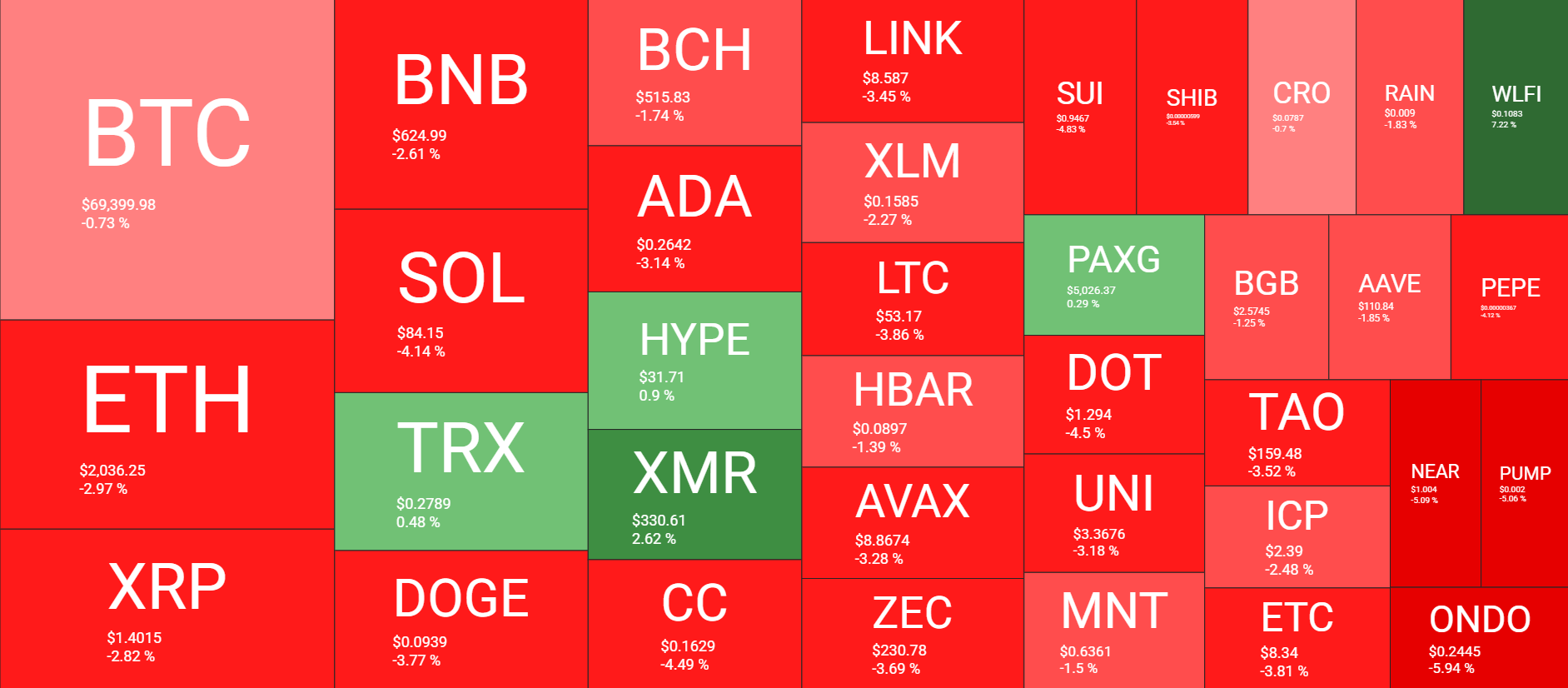
As mentioned above, the altcoins are back in the red today. Ethereum is down by 3% to $2,030, XRP is down to $1.40 after a similar decline, while BNB has slipped to $623. SOL and DOGE have dropped by 4%, while CC has shed 5% of value.
WLFI is among the few exceptions, with an 8% surge that has pushed it to almost $0.11. SKY, LEO, and XMR are also slightly in the green, while JUP, ONDO, and ARB have lost the most value daily, of up to 8%.
The total crypto market cap has declined by around $70 billion in a day and is below $2.430 trillion on CG.
SECRET PARTNERSHIP BONUS for CryptoPotato readers: Use this link to register and unlock $1,500 in exclusive BingX Exchange rewards (limited time offer).
Disclaimer: Information found on CryptoPotato is those of writers quoted. It does not represent the opinions of CryptoPotato on whether to buy, sell, or hold any investments. You are advised to conduct your own research before making any investment decisions. Use provided information at your own risk. See Disclaimer for more information.

China defends sentence for Hong Kong’s ex-publisher Jimmy Lai
Form 8K Expand Energy Corp For: 9 February

Samsung Stock Surges as Chipmaker Beats Micron in HBM4 Race


-

 Video7 days ago
When Money Enters #motivation #mindset #selfimprovement
-

 Tech5 days ago
Wikipedia volunteers spent years cataloging AI tells. Now there’s a plugin to avoid them.
-

 Politics20 hours ago
Why Israel is blocking foreign journalists from entering
-
 Sports2 days ago
JD Vance booed as Team USA enters Winter Olympics opening ceremony
-

 Tech3 days ago
First multi-coronavirus vaccine enters human testing, built on UW Medicine technology
-

 NewsBeat14 hours ago
Winter Olympics 2026: Team GB’s Mia Brookes through to snowboard big air final, and curling pair beat Italy
-

 NewsBeat6 days ago
US-brokered Russia-Ukraine talks are resuming this week
-
 Business19 hours ago
LLP registrations cross 10,000 mark for first time in Jan
-

 Sports9 hours ago
Benjamin Karl strips clothes celebrating snowboard gold medal at Olympics
-

 Politics22 hours ago
The Health Dangers Of Browning Your Food
-
Sports2 days ago
Former Viking Enters Hall of Fame
-
Sports3 days ago
New and Huge Defender Enter Vikings’ Mock Draft Orbit
-

 Business1 day ago
Julius Baer CEO calls for Swiss public register of rogue bankers to protect reputation
-
 NewsBeat3 days ago
Savannah Guthrie’s mother’s blood was found on porch of home, police confirm as search enters sixth day: Live
-

 Business4 days ago
Quiz enters administration for third time
-
 NewsBeat4 hours ago
Residents say city high street with ‘boarded up’ shops ‘could be better’
-

 NewsBeat7 days ago
GAME to close all standalone stores in the UK after it enters administration
-

 NewsBeat4 days ago
Still time to enter Bolton News’ Best Hairdresser 2026 competition
-
 NewsBeat2 days ago
Driving instructor urges all learners to do 1 check before entering roundabout
-

 Crypto World6 days ago
Russia’s Largest Bitcoin Miner BitRiver Enters Bankruptcy Proceedings: Report