
Crypto World
Thailand Tightens Crypto Rules While Expanding Bitcoin Products


Hidden Funders Face Shareholder-Level Scrutiny
Thailand is moving to tighten control over crypto ownership structures while expanding regulated market access. Authorities plan to track hidden financiers and restrict illicit capital flows. At the same time, regulators are opening pathways for Bitcoin-linked derivatives and exchange-traded products.
Ownership Reforms Expand Control Definitions
Thailand’s Securities and Exchange Commission is preparing rules to capture undisclosed financial backers of crypto firms. The proposal targets entities that provide significant funding support to formal shareholders. It aims to align their oversight with existing major shareholder approval standards.
The framework will cover guarantees, structured financing, and layered investment arrangements. Regulators believe these tools often obscure real control within crypto businesses. Therefore, the new approach will extend accountability beyond visible ownership records.
The rules will apply to licensed exchanges, brokers, and dealers under the digital asset business law. Authorities intend to close gaps that allow indirect influence without formal disclosure. As a result, firms must reassess relationships with silent financial partners.
AML Crackdown Intensifies as Market Opens
Earlier measures already tightened definitions of major shareholders within digital asset companies. Authorities now classify individuals with more than five percent voting rights as key stakeholders. Moreover, they include those exercising control through indirect or operational influence.
The Ministry of Finance introduced these updates to strengthen transparency across the sector. Regulators want to ensure that control reflects actual decision-making power. Consequently, firms must identify all parties exerting meaningful influence over management.
Companies have received a 180-day window to review and update ownership disclosures. They must submit approval requests for any newly identified major shareholders. This process aims to eliminate nominee arrangements and layered holding structures.
Authorities will also apply look-through tests to funding channels linked to ownership control. These checks will trace capital sources behind complex financial arrangements. Therefore, financiers shaping business outcomes will fall under regulatory supervision.
Thailand is increasing enforcement against money laundering activities tied to digital asset platforms. Authorities recently froze thousands of suspicious accounts linked to mule wallet operations. This move signals a stronger stance against illicit transaction networks.
Regulators are also advancing rules requiring transaction data sharing between crypto service providers. The framework will mandate identification details for both senders and recipients. This system aims to improve traceability across digital asset transfers.
Officials view these measures as essential for protecting market integrity and preventing fraud. They are integrating global compliance standards into domestic regulations. As a result, the ecosystem faces tighter monitoring and reporting obligations.
At the same time, Thailand is promoting regulated crypto investment products. Authorities now recognize cryptocurrencies as eligible underlying assets for derivatives markets. This shift supports the launch of structured financial products tied to digital assets.
Regulators are also preparing guidelines for crypto exchange-traded funds within the domestic market. The framework will allow limited portfolio exposure to digital assets. This approach balances innovation with controlled risk management.
Thailand’s dual strategy reflects stricter oversight alongside measured market expansion. Authorities aim to attract institutional participation while limiting financial crime risks. Consequently, the country is positioning itself as a regulated hub for digital asset activity.

A mechanical hand is on display at the Robot Mall, world’s first embodied intelligent robot 4S store, on August 13, 2025 in Beijing, China.
Vcg | Visual China Group | Getty Images
BEIJING — Alibaba Cloud is investing in a new type of artificial intelligence designed to better replicate the real world using a different approach from chatbots such as OpenAI’s ChatGPT.
The shift recognizes the limits of “large language models” trained primarily on text. Instead, developers are starting to focus more on “world models” built on videos and real-life physical scenarios.
To jump on the trend, Alibaba led a 2 billion yuan ($290 million) investment in ShengShu, the startup behind the AI video generation tool Vidu, the company announced Friday. TAL Education and Baidu Ventures also participated in the series B funding round.
The investment comes about two months after ShengShu raised 600 million yuan from Qiming Venture Partners and other backers. The startup declined to disclose its valuation.
ShengShu said the latest funding will support the development of a “general world model” that uses AI to bridge two currently separate domains: the digital world of games and AI-generated video, and the physical world of autonomous driving and robots.
“ShengShu believes that a general world model, built on multimodal data such as vision, audio, and touch, more naturally captures how the physical world works than large language models,” the three-year-old startup said in a statement.

“We aim to connect perception and action,” Zhu Jun, founder of ShengShu, added in a statement, allowing AI systems to better model and predict real-world behavior consistently.
ShengShu’s latest Vidu Q3 Pro model, released in January, ranks among the top 10 AI models for generating videos from text and images, according to Artificial Analysis.
The company launched Vidu globally months before OpenAI made its now-shuttered Sora tool for AI video generation widely available. Chinese short-video companies Kuaishou and ByteDance have also released similar competing AI tools for generating videos.
World model competition
Alibaba has expanded its investments in related startups.
The Chinese tech giant and Baidu Ventures last month led a $50 million investment in Tripo AI, a platform that uses AI to quickly generate digital 3D models from photographs. Tripo said it is also moving away from techniques used by language models toward AI tools grounded in physical space and is developing its own world model.
In September, Alibaba also led a $60 million investment in PixVerse, which released an AI world model earlier this year that allows users to direct how a video unfolds while it is being generated.
Alibaba, which got its start in e-commerce, has also released free, open-source AI models for video generation and, in February, launched one for powering robots.

Subscribe now
Shengshu said Friday it has strategic partnerships with companies developing embodied AI — systems such as humanoid robots that interact with the physical world — for use across industrial, commercial and home settings.
World models are critical for robotics because the technology needs more than LLMs to work, Kevin Kelly, co-founder of the U.S. tech magazine Wired, wrote last month on his Substack.
Ultimately, to replicate human intelligence, AI will need three things: reasoning, an understanding of the physical world and continuous learning, Kelly said. While AI for the learning category hasn’t been developed yet, LLM-powered chatbots have created the knowledge element, he said, making world models a key area requiring a breakthrough.


Mythos’ AI scare is real — enough for U.S. regulators to call an urgent meeting and assess what Anthropic’s advanced artificial intelligence model it could mean for banks.
The meeting happened Tuesday, with Treasury Secretary Scott Bessent and Fed Chair Jerome Powell sitting down with Wall Street bank CEOs to discuss possible cybersecurity risks linked to Mythos, people familiar with the matter told Bloomberg.
Participants included chief executives from Citigroup Inc, Morgan Stanley, Bank of America Corp.’, Wells Fargo & Co.’s, and Goldman Sachs Group Inc.’s. All these are designated as systemically important, meaning disruptions to their operations could have global repercussions.
Mythos, an advanced artificial intelligence model developed by Anthropic, is designed to identify and exploit vulnerabilities in software systems when prompted. Unlike typical consumer-facing AI tools, Mythos is geared toward cybersecurity software engineering and cybersecurity tasks. Its specialty is identifying critical software vulnerabilities and bugs, but it can also assemble sophisticated exploits.
The episode highlights a fundamental change in how regulators are framing AI risk, not merely as a technological challenge, but as a potential catalyst for systemic events.
This has already raised red flags in crypto, where experts are worried that Mythos’ capability of discovering and exploiting zero-day vulnerabilities in real-time at a low cost poses risk to the DeFi infrastructure.
Anthropic, therefore, has taken a cautious approach, releasing the product only for small group of large technology and financial firms under “Project Glasswing.”
Anthropic has previously disclosed that it consulted with U.S. officials ahead of Mythos’ release regarding both its defensive and offensive cyber capabilities. The company is also separately engaged in a legal dispute with the Pentagon, which has designated it a supply-chain risk — a classification Anthropic is contesting in court.
The US Central Intelligence Agency said it will embed “AI co-workers” directly into its analytics platforms to assist analysts with detecting spies and anticipating hostile moves by foreign adversaries.
“Within the next couple of years, we will have AI co-workers built into all of the agency’s analytic platforms — a kind of classified version of generative AI that will help our analysts with basic tasks,” CIA deputy director Michael Ellis reportedly said on Thursday during an event hosted by the Special Competitive Studies Project in Washington, DC.
According to Politico, Ellis said the AI co-workers would assist intelligence officers with drafting key judgments, testing analytical conclusions and identifying trends in intelligence that the agency gathers from abroad.
However, he said humans would continue to be the ones making the “key decisions.”

The CIA’s AI plans come amid a feud between the US Department of Defense and AI firm Anthropic. Despite having a $200 million contract with the Department of Defense, Anthropic prevented the use of its flagship AI product, Claude, for mass domestic surveillance and fully autonomous weapons.
US President Donald Trump ordered all federal agencies to immediately cease using Anthropic’s technology in March, while the Department of Defense declared Anthropic a supply chain risk.
The parties remain locked in a legal dispute over the designation, with a US appeals court on Wednesday denying Anthropic’s emergency request to temporarily pause the label.
While Ellis didn’t point out Anthropic, he said the CIA “cannot allow the whims of a single company” to constrain its capabilities.
The CIA has already adopted AI for other intelligence tasks, having tested about 300 AI projects last year to “bring new capabilities to our mission,” such as processing large data sets and language translation, Ellis said.
Ellis also noted that the CIA recently created its first intelligence report with AI while predicting that AI’s role in the agency’s work would continue to grow.
Related: North Korean cyber spies are no longer just remote threats
A major motivation for the CIA is to stay ahead of China, Ellis said, noting that the once-large gap between the US and China has narrowed significantly.
“Five to ten years ago, China was nowhere near America, in terms of technological innovation,” Ellis said. “That’s just not true today.”
Ellis likes the transparency of Bitcoin, crypto
In May, Ellis said Bitcoin and crypto were matters of national security, adding that the agency looks at blockchain data to assist with its counterintelligence operations.
“It’s another area of technological competition where we need to make sure the United States is well positioned against China and other adversaries.”
Magazine: ‘Dystopian death market’: Anger over Polymarket’s Iran war be

Morgan Stanley launches lowest-fee bitcoin ETF, intensifying market rivalry. Advisor network gives MSBT strong distribution edge over competitors. BlackRock retains liquidity lead despite new fee pressure from MSBT.
Wall Street competition intensified as Morgan Stanley launched its spot bitcoin ETF on April 8. The new product targets dominance in a fast-growing U.S. market. It directly challenges BlackRock and its leading fund.
The fund trades under the ticker MSBT on NYSE Arca with a 0.14% expense ratio. This pricing sets a new low across spot bitcoin ETFs. It signals a clear shift toward aggressive fee competition among issuers.
Bitcoin ETF Competition Shifts Toward Cost and Access
Bitcoin traded around recent market levels as ETF competition intensified across major issuers. MSBT entered the market with the lowest fee structure available. This move puts pressure on established players to reconsider pricing strategies.
BlackRock Continues to Dominate Through Its iShares Bitcoin Trust
The fund holds tens of billions in assets and leads in trading activity. Its liquidity supports large transactions and active strategies.
Morgan Stanley offers a different advantage through distribution strength. Its wealth division manages trillions in client assets. Advisors can now allocate capital directly into an in-house product.
Advisor Networks Drive Structural Market Shift
Financial advisors now play a larger role in ETF adoption and portfolio allocation. Earlier inflows came mainly from self-directed participants seeking liquidity. Now, integrated advisory platforms influence new capital flows more strongly.
Morgan Stanley allows advisors to allocate a portion of portfolios to bitcoin exposure. Internal guidance permits allocations based on client risk tolerance. This approach simplifies recommendations and reduces friction.
As a result, MSBT may attract flows through existing advisory relationships. BlackRock maintains an advantage in market depth. Replicating that liquidity may take time despite strong distribution channels.
Expansion Signals Broader Crypto Strategy
The MSBT launch marks a shift in how banks approach digital assets. Morgan Stanley now builds its own crypto investment vehicles, whereas previously it focused on distributing third-party ETF products.
The bank has also filed for additional crypto products linked to Ethereum and Solana. These filings suggest a long-term expansion strategy across digital asset classes. The firm continues to build infrastructure around custody and trading services.
The bank plans to integrate crypto trading into its E*Trade platform, connecting digital assets with its broader financial ecosystem. It reflects a wider trend among banks entering crypto markets directly.
The ETF market has already absorbed significant inflows since early 2024. MSBT now tests whether distribution strength can compete with established liquidity leaders. This competition may accelerate fee reductions across the sector.
The Strait of Hormuz, a critical route for roughly 20% of global oil flows, is now at the center of a broader debate that goes beyond geopolitics. It has pulled Bitcoin and XRP into a real-world test of how crypto functions during conflict.
Amid a fragile ceasefire in April, reports claim Iran is demanding a toll of about $1 per barrel from tankers crossing the strait. Payments are reportedly requested in Bitcoin or yuan, adding a new layer to how sanctions and trade routes intersect.
Bitcoin Enters the World’s Most Strategic Oil Route
Bitcoin has quickly become the focal point of this narrative. According to the reports, the IRGC enforces these payments with a very short time window, making tracking difficult under Western sanctions.
For a supertanker, this could mean fees reaching up to $2 million, or roughly 281 BTC.
Still, skepticism remains. Arthur Hayes publicly questioned the claims, saying he would only believe them after seeing a verifiable on-chain transaction tied to a vessel.
Until then, he suggested it could be noise or messaging rather than reality.
So far, no public on-chain evidence confirms these payments. Even so, the narrative alone pushed Bitcoin back above $70,000.
The episode reinforces a growing view. In moments of crisis, Bitcoin acts as a neutral settlement tool that operates outside traditional financial systems.
XRP’s Case: Built for Peace, Not Crisis
At the same time, the situation has triggered debate within the XRP community. Analyst Fran de Olza argued that Bitcoin’s narrative is shifting again.
In his view, it has moved from retail payments to a store of value, and now toward large-scale settlement use cases, like those implied in Hormuz.
He pointed out that terms like “neutral settlement” and “borderless money” are now widely used, even by Bitcoin advocates.
However, he argues that XRP already occupies this space, with years of development focused on institutional payments and cross-border settlement.
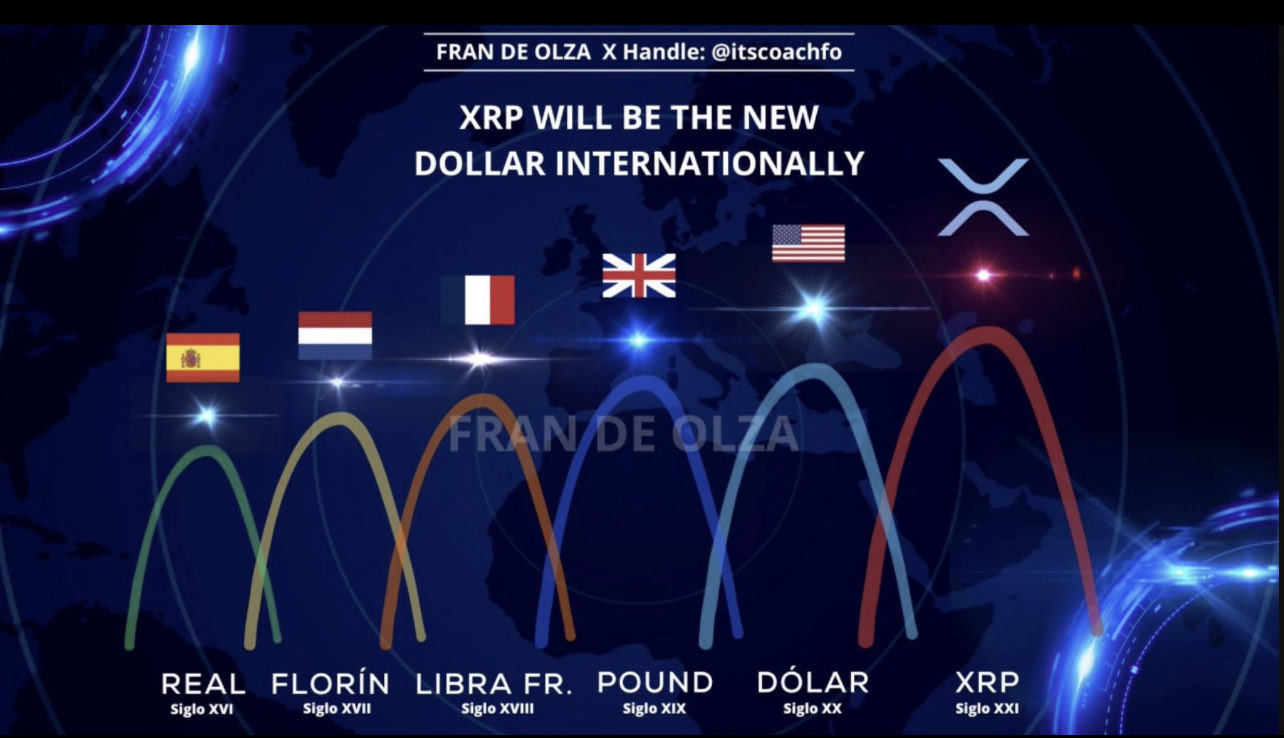
De Olza suggested that if a new global financial agreement emerges, similar to a modern Bretton Woods system, many could realize they were describing XRP’s role while assuming Bitcoin would fill it.
However, other analysts offered a more grounded view. Bitcoin’s strength in this case comes from its censorship resistance.
Iran’s priority is not efficiency but bypassing systems like SWIFT and the US dollar immediately. That makes Bitcoin useful in a sovereignty-driven scenario.
XRP, by contrast, is built for regulated financial systems operating at scale during stable periods. It focuses on institutional settlement, compliance, and integration with banking infrastructure.
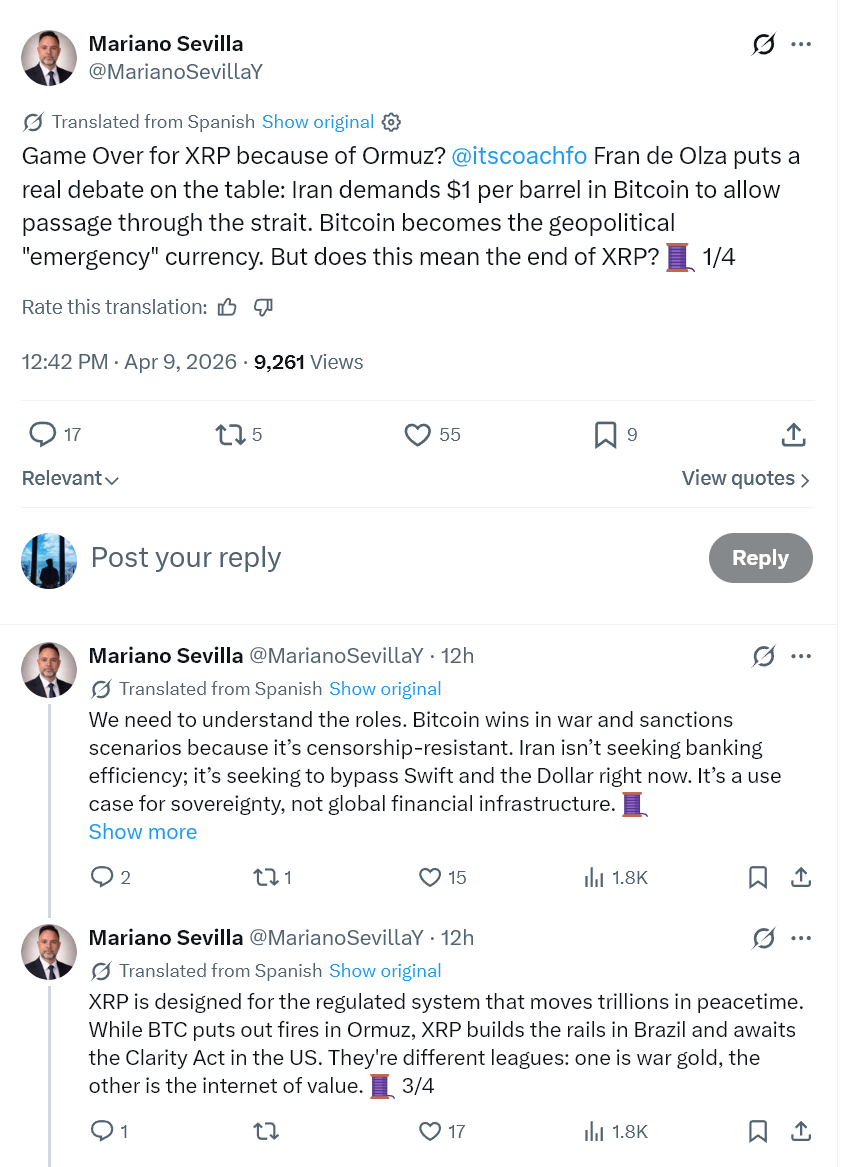
Bitcoin handles urgent, high-pressure scenarios, while XRP is designed to support long-term financial rails. Both can succeed without displacing each other.
The 2026 market is increasingly multichain, with Bitcoin serving as a reserve and crisis tool, while XRP targets institutional settlement.
For now, as tankers wait and analysts debate, one point stands out. Crypto is no longer just a speculative market. It is becoming part of how power, trade, and finance operate in a fragmented global system.
The post Hormuz and Bitcoin Link Means “Game Over” for XRP? This Is What Analysts Say appeared first on BeInCrypto.
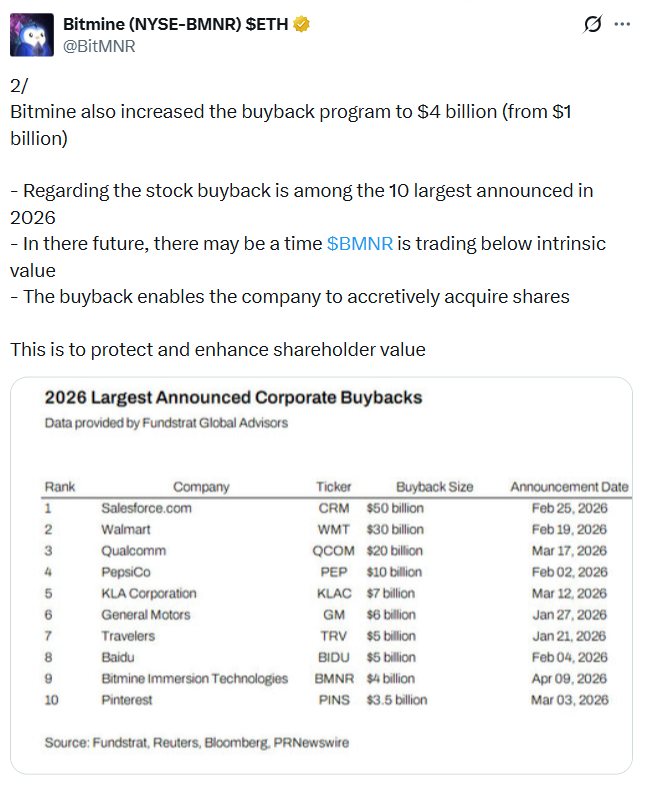
Ether treasury company Bitmine Immersion Technologies has started trading on the New York Stock Exchange after uplisting from NYSE American as the company expanded its share buyback program.
The Ether (ETH) treasury company’s stock began trading on the NYSE at market open on Thursday under its existing “BMNR” ticker symbol, Bitmine announced Thursday.
Bitmine chairman Tom Lee said it’s a major milestone for the company as the NYSE is considered one of the world’s top exchanges.
“The NYSE is the most prestigious venerable stock exchange with a storied history. The NYSE is the envy of capital markets around the world and Bitmine is proud to be the newest company traded on this exchange.”
NYSE American is designed for small-cap and growing companies. Bitmine’s uplisting to the NYSE suggests the company is gaining momentum, and increases the company’s exposure to larger capital pools.
NYSE listing process is extensive
The process to gain a listing on the NYSE requires a company to meet strict requirements covering financial health, share distribution and corporate governance. Some of the requirements include having more than 400 shareholders and 1.1 million publicly held shares.
A majority of directors involved in corporate governance must also be independent, with no significant financial interest in the company and audit, compensation and governance committees must be formed.
One of the final steps involves filing a registration statement with the US Securities and Exchange Commission. The NYSE review before a listing usually takes about four to eight weeks.
Chris Taylor, the NYSE Group’s chief development officer, said in a statement that Bitmine is a strong addition to the stock exchange.
Related: Ripple to buy back $750M in shares through April: Report
“We are pleased to welcome Bitmine to the New York Stock Exchange,” he said. “With its focus on advancing the Ethereum ecosystem, Bitmine is a strong addition to the NYSE community.”
Share buyback upped to $4 billion
Meanwhile, Bitmine’s board unanimously expanded the July 2025 share repurchase program from $1 billion to $4 billion, including shares previously repurchased.

“Bitmine’s expanded $4 billion buyback reflects our commitment to shareholders,” Lee said, adding that “there may be a time in the future when Bitmine shares are trading below intrinsic value, and the company wants to be in a position to accretively retire common shares.”
Bitmine stock (BMNR) closed Thursday at $21.08, down more than 64% in six months, according to Google Finance. Last September, analysts told Cointelegraph that treasury companies are using buybacks to boost stock price and legitimacy.
Magazine: Should users be allowed to bet on war and death in prediction markets?
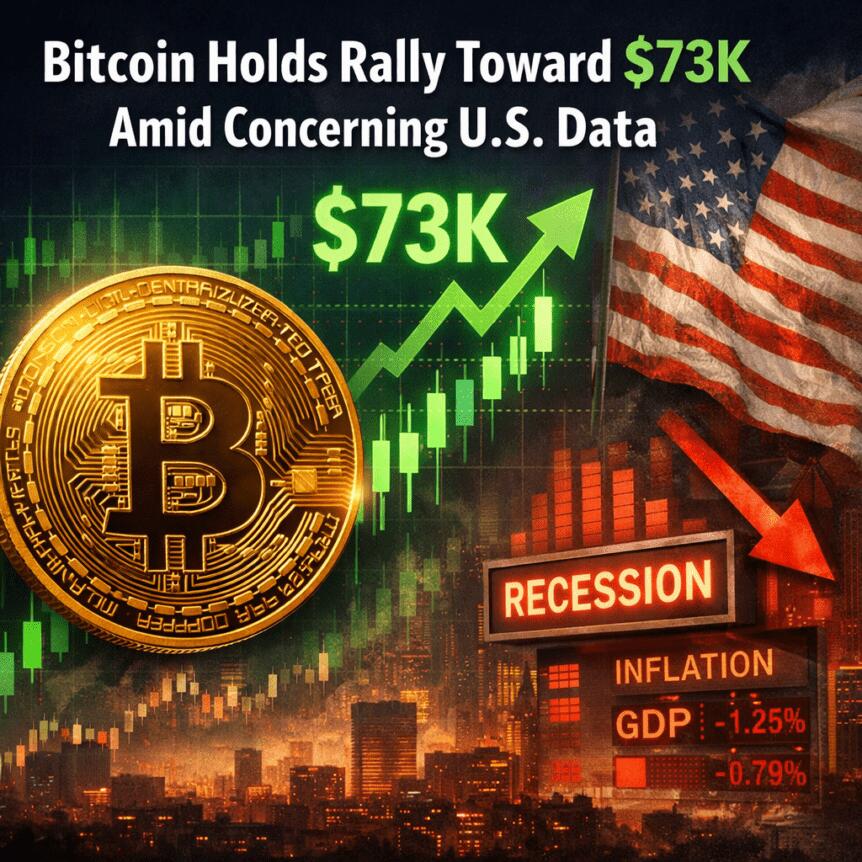
Bitcoin reclaimed the $72,000 level on Thursday as markets weighed a blend of persistent inflation signals, softer-than-robust growth data, and geopolitical tension in the Middle East. The ascent came despite data suggesting inflation remains stubborn and economic expansion cooled, underscoring a market environment where scarce assets can stay in demand even as macro headwinds persist.
On the inflation front, the US Bureau of Economic Analysis reported that the core Personal Consumption Expenditures (PCE) index rose 0.4% in February, reinforcing concerns about sticky price pressures. In the same week, the fourth-quarter gross domestic product was revised to a 0.5% annualized growth rate, a modest pace that keeps the economy on a fragile footing and adds to recession-talk among traders. Taken together, these readings suggest the trajectory for inflation and growth remains uncertain, fueling continued volatility in risk assets including Bitcoin.
Geopolitical headlines complicated the scene. Oil prices surged back toward the mid-$90s and briefly around $97 per barrel after Iranian leaders signaled that the United States and Israel had violated the ceasefire negotiated in the region. The market also watched the political dynamic in the United States, where reports anchored to the Dubai-based and U.S. commentary of a ceasefire circulated in the days prior. In this environment, Bitcoin traders noted that the perceived fragility of any truce could weigh on upside momentum, potentially pushing the price toward support around $68,000 if risk-off conditions intensify. The backdrop was further influenced by statements from Iranian parliamentary speaker Mohammad Bagher Ghalibaf, who highlighted alleged violations of the ceasefire by external actors, a narrative echoed in market chatter around Yahoo Finance reports.
Key takeaways
-
Bitcoin briefly moved back above $72,000, signaling sustained demand for scarce assets amid a uncertain macro backdrop.
-
Geopolitical tensions and a rebound in oil prices contributed to a guarded upside, with traders watching for signals about the durability of any Iran ceasefire and its implications for risk assets.
-
US core PCE rose 0.4% in February, while Q4 GDP was revised to a 0.5% annualized pace, underscoring persistent inflation and a slower growth path that heighten recession risk concerns.
-
The US dollar softened against a basket of currencies as liquidity expectations rose, but the macro mix kept the narrative complex for BTC and broader markets.
-
Equities remained resilient—with the S&P 500 trading within striking distance of its all-time highs—while concerns about private credit markets and AI-related debt costs did not trigger an immediate broad sell-off.
Bitcoin’s move amid a mixed macro and geopolitical backdrop
Bitcoin’s climb back toward the $72,000 mark occurred amid a market environment where inflation remains persistent, yet growth signals are tepid. The price action hints at a dynamic in which investors are prioritizing scarce assets as potential hedges against fiat weakness and continued liquidity provision, even as they weigh the probability of policy shifts from the Federal Reserve and the broader risk of a recession.
Some market observers interpret BTC’s strength as a response to liquidity expectations rather than a pure inflation hedge. The narrative suggests that traders may be leaning on Bitcoin as a conditional store of value in an environment where traditional fixed income offers less compelling real yields and where the dollar’s strength has ebbed slightly versus a broad basket of currencies. Yet the pace and durability of BTC’s rally remain tethered to broader risk sentiment, which can change quickly with new macro data or geopolitical headlines.
Trading activity around BTC also reflected a nuanced relationship with traditional risk assets. While Bitcoin has shown correlations with equities at times, the degree of coupling appeared variable in the current week, with some traders noting the asset’s sensitivity to liquidity conditions and the appetite for scarce stores of value as opposed to direct inflation hedges alone. The interplay between BTC and the S&P 500 has been a focal point for market analysis, highlighting how cryptos fit into a broader risk-on or risk-off framework rather than behaving as stand-alone inflation hedges.
Geopolitics, energy markets and risk sentiment
Oil markets provided a live read on the risk environment. After initial spikes tied to Middle East tensions, prices pulled back from the highs as traders weighed the potential for a ceasefire to hold and as headlines suggested a tempered near-term risk. The situation underscored a core market truth: energy prices often act as a barometer for risk appetite. When geopolitical headlines flare, oil reacts quickly, and the broader risk-on or risk-off impulse tends to color equities and crypto alongside it.
The market’s reaction to the ceasefire narrative also illustrated how a single development can ripple across asset classes. The S&P 500 futures reached multi-week highs as some observers interpreted the news as a reduction in near-term geopolitical risk, yet the specter of a fragile truce remained. In such an environment, Bitcoin’s path becomes less about a single data point and more about the evolving balance of inflation expectations, growth prospects, and liquidity provisioning by policymakers.
In parallel, the broader equity backdrop remained robust. The S&P 500 traded only a short distance from all-time highs, a signal that investors were not overly fixated on private-credit stress or the debt-cost pressures facing AI infrastructure firms. For Bitcoin, this translated into a day of price action that leaned into the risk-on narrative, even as traders remained vigilant for any signs of renewed risk-off pressure should geopolitical or macro data deteriorate.
Macro data, the dollar, and the evolving narrative for BTC
The macro backdrop continued to shape expectations for Bitcoin and the crypto market at large. Despite inflation’s persistence, a softer dollar tends to help scarce assets perform, particularly when liquidity support remains in play. The weaker dollar narrative aligned with a view that policy accommodations could persist longer than previously anticipated, a stance that supports Bitcoin’s appeal as a non-sovereign store of value in certain market conditions.
Importantly, the latest inflation and growth readings did not provide a clear blueprint for a rapid rally. Core PCE’s 0.4% uptick and the GDP revision signaling slower growth underscore a scenario where inflation remains a constraint on policy normalization, while growth risks limit the Fed’s capacity to curb liquidity without consequences for financial conditions. In such a setting, traders are watching for any fresh guidance from policymakers that could tilt the liquidity balance—either through rate expectations or balance-sheet actions.
From a market structure perspective, Bitcoin’s correlation with the S&P 500 remains an area of scrutiny. The 30-day relationship oscillates as traders parse whether BTC acts as a hedge, a risk asset-like instrument, or something in between. The current readings suggest a nuanced dynamic: BTC is influenced by risk sentiment, liquidity flows, and macro surprises just as traditional assets are, but with a unique sensitivity to the crypto market’s own structural developments and adoption cycles.
What lies ahead for Bitcoin and the macro regime
While the immediate path remains uncertain, the prevailing thread is clear: recession risks are rising from a backdrop of ongoing inflation and tepid growth, even as demand for scarce assets persists. For Bitcoin, this means opportunities to test new resistance levels exist, but a sustained move higher will likely require a clearer shift in the macro narrative—whether through stronger inflation relief signals, a more definitive pivot in Fed policy expectations, or a tangible easing of geopolitical tensions that reduces risk-off pressure on markets broadly.
Investors will want to monitor several developing threads in the coming weeks: the trajectory of US inflation data, the pace of GDP revisions, the evolution of the dollar, and ongoing developments in the Iran situation and oil markets. Each of these factors can tilt risk appetite and liquidity, shaping Bitcoin’s short-term trajectory as traders reassess the balance between macro risks and the demand for non-sovereign assets.
As the picture evolves, traders should remain cautious about reading a single data point as a signal. The combination of persistent inflation, modest growth, a fragile geopolitical backdrop, and a fluctuating dollar makes the near-term Bitcoin path highly contingent on how these factors interact. What remains uncertain is how quickly policymakers will calibrate liquidity support and how resilient risk appetite will prove when faced with new headlines or data surprises.
Readers should stay attentive to geopolitical updates, oil-price movements, and any fresh guidance from policymakers that could influence market liquidity. The next few sessions could redefine BTC’s support and resistance landscape as investors reassess risk, inflation, and the evolving horizon for crypto adoption.
Crypto World
BeInCrypto 100 Institutional Awards Nomination: Sygnum Bank for Best Digital Asset Custody Provider

For years, crypto was driven mostly by speculation. That phase is fading. What’s taking its place is slower, more practical work: rebuilding parts of the financial system using blockchain.
For banks and institutions, the focus has changed. Custody is no longer just about safekeeping assets. It’s about connecting those assets to the rest of the financial system in a way that is fast, compliant, and usable.
Sygnum Bank sits in the middle of that shift. And that’s why it is nominated for Best Digital Asset Custody Provider at the BeInCrypto 100 Institutional Awards 2026.
Custody Is No Longer Just Storage
Sygnum Bank has moved beyond the basic custody model. Instead of treating custody as a vault, it treats it as part of a broader financial service.
In a recent discussion with BeInCrypto’s Global Head of News, Brian McGleenon, Sygnum CIO Fabian Dori made that shift clear. He said security is no longer the main problem.
“The key aspect of providing a secure custody solution was one of the first challenges. At this point, it’s largely solved at the institutional level. The real challenge now is integration — connecting custody with value-add services.”
That point shows up in how Sygnum operates.
BeInCrypto reviewed its regulatory standing, partnerships, and product activity across public filings and disclosures.
Sygnum was founded in 2017 and now reports more than $5 billion in client assets, over $1 billion in assets under custody, and more than 2,000 clients across four jurisdictions.
| Founded | 2017 |
| Total Client Assets | $5B+ |
| Assets Under Custody (AUC) | $1B+ |
| Clients | 2,000+ |
| Jurisdictions | 4 |
| Valuation | $1B+ |
It became the first digital asset bank to receive a full banking and securities dealer licence from FINMA in 2019. Today, it operates under regulatory frameworks in Switzerland, Singapore, Abu Dhabi, and Luxembourg.
Its Protect off-exchange custody platform crossed $1 billion in assets in March 2026, with 900% year-on-year growth. Market maker Wintermute is one of its clients.
The bank has also pushed into settlement and tokenization.
In December 2025, Sygnum became the first European digital asset bank to work with BNY Mellon on USD settlement.
Through its Desygnate platform, it has tokenized real-world assets across multiple networks. This includes shares in Hamilton Lane’s $4.9 billion private assets fund on Polygon, and Fidelity International’s liquidity fund on zkSync Era.
It also supported a private debt tokenization with Float and Fasanara Capital.
On the investment side, its BTC Alpha Fund raised more than 750 BTC within four months and has delivered around 15% annualized returns since launch.
Trading activity across the platform grew more than 1,000% in 2024, partly driven by its infrastructure supporting over 20 partner banks.
Making Digital Assets Actually Usable
Client behavior is also changing. Dori said institutional clients are no longer satisfied with holding assets passively. They want to use them.
Sygnum’s model is built around that shift. Clients can access custody, lending, and yield strategies through a single interface, without moving assets across multiple platforms. The goal is to keep everything within a regulated environment while still allowing capital to be deployed.
Another issue the bank is trying to address is fragmentation.
Blockchains remain siloed. Different networks, standards, and systems create friction. Dori’s view is that clients should not have to deal with that complexity directly.
“What we aim to provide is unified access. Behind the scenes, we use different systems and tools to handle the fragmentation.”
That approach matters as tokenization grows.
Estimates suggest the market could reach tens of trillions of dollars by 2030. If that happens, the challenge will not be building new chains. It will be making them work together in a way that institutions can actually use.
Sygnum’s strategy is straightforward. Hide the complexity. Keep the compliance tight. Make digital assets usable within the existing financial system.
The technology is already here. The real work now is connecting it.
The post BeInCrypto 100 Institutional Awards Nomination: Sygnum Bank for Best Digital Asset Custody Provider appeared first on BeInCrypto.
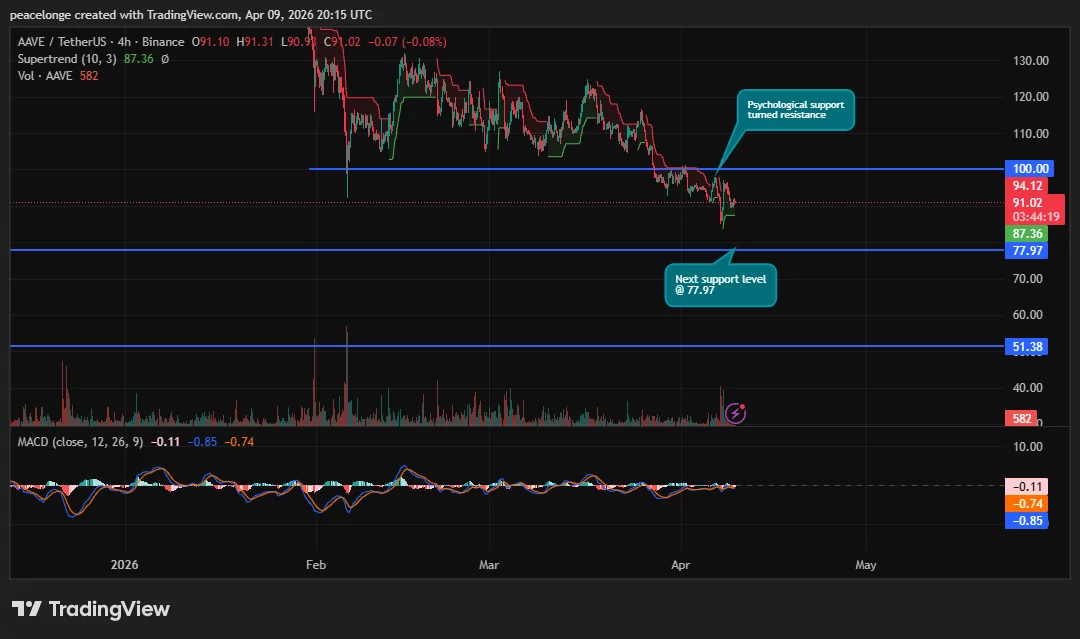
AAVE price is holding just below $100 on April 9, a level that has shifted from multi-week support to confirmed resistance following this week’s sharp breakdown. With the 4H Supertrend red and the MACD histogram printing at a deeply negative 0.85, the next meaningful floor sits at $77.97.
Summary
- AAVE price is trading at $91.02 on April 9, effectively flat on the session, as the $100 psychological level confirms its role as resistance following the intraday crash to $83.92 on April 6.
- The 4H Supertrend (10,3) is bearish at $87.36 and the MACD histogram is printing a deeply negative 0.85, with no reversal signal visible on either indicator.
- The next key support sits at $77.97; a break below it opens the $51.38 structural floor, while a daily close above $100 invalidates the bearish setup.
Aave (AAVE) price is trading at $91.02 on April 9, near flat on the session, as the $100 level confirms its transformation from support to resistance on the 4-hour chart. The Supertrend indicator is red at $87.36, the MACD histogram is printing a deeply negative reading of 0.85, and price has failed to reclaim $100 since breaking below that level following the sharp intraday drop to $83.92 on April 6. The next annotated floor on the chart sits at $77.97, the primary downside target if current levels give way.
The 4-hour chart confirms a clear structural shift at $100. AAVE spent much of February and March trading above that level, and the breakdown this week has left the zone acting as overhead resistance. The chart labels $100 explicitly as psychological support turned resistance, with the immediate intraday ceiling at $94.12 capping every recovery attempt since the break lower.
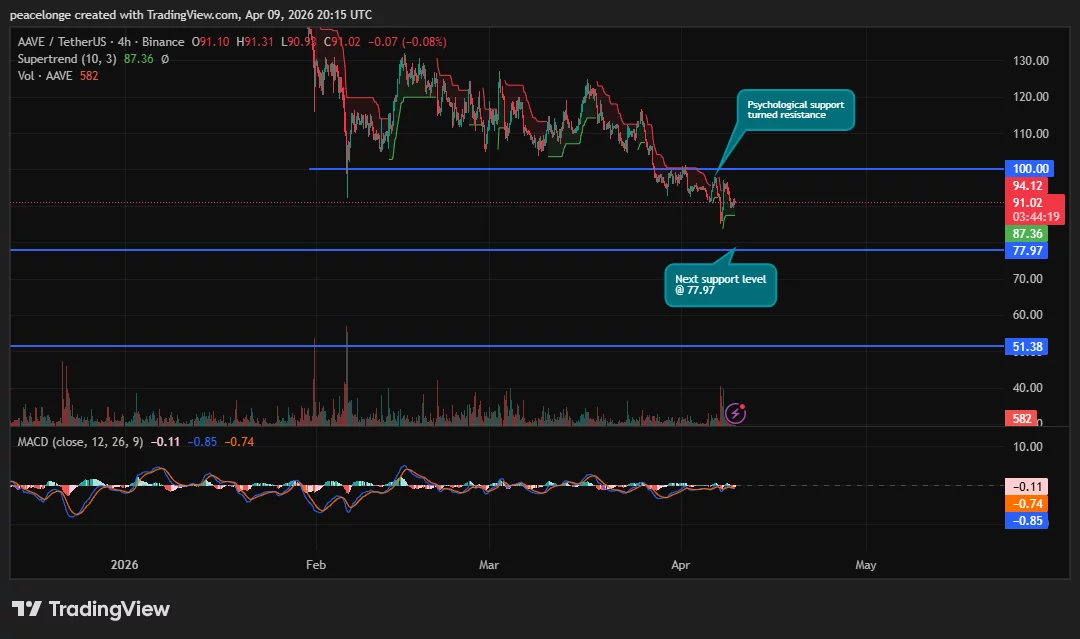
The 4H Supertrend (10,3) reads red at $87.36, a dynamic level now acting as a near-term downside magnet. The MACD (12,26,9) offers no relief: the MACD line is negative at 0.11, the signal negative at 0.74, and the histogram printing a deeply negative 0.85, placing sellers firmly in control of momentum with no reversal signal forming on either timeframe.
Aave founder Stani Kulechov stated on X that the protocol’s risk infrastructure has “historically processed over 1,200 payloads and 3,000 parameters without issues,” but the exit of BGD Labs as core technical contributor on April 1, citing governance tensions ahead of the V4 development cycle, continues to weigh on market confidence in the near term.
Key Levels: Support, Resistance, and Price Targets
The immediate resistance is $94.12, the intraday ceiling since the April 6 breakdown. Above that, $100 is the key structural level bulls must reclaim to shift the near-term bias. A daily close above $100 is the minimum condition for a structural recovery attempt and the invalidation level for the current bearish thesis.
On the downside, $87.36 marks the 4H Supertrend level. A 4H close below it removes the last dynamic buffer and opens $77.97, the next annotated support on the chart. Below $77.97, the $51.38 level represents major structural support, territory AAVE has not traded near in several years.
Invalidation: a daily close above $100.
On-Chain and Market Data Context
According to Coinglass, AAVE open interest remained elevated in the sessions following the April 6 liquidation event, with the intraday crash to $83.92 triggering significant forced selling before a partial recovery to current levels. AAVE has underperformed the broader market over the past 30 days, down approximately 20% as DeFi sector sentiment deteriorated.
The BGD Labs departure and the earlier exit of the Aave Chan Initiative have left the protocol navigating its V4 transition without several of its original technical contributors. Governance risk now compounds price risk for holders ahead of what was meant to be Aave’s most significant upgrade cycle.
If AAVE fails to reclaim $94.12 on a closing basis in the near term, $77.97 becomes the primary downside target, with $51.38 the structural floor below.
The US Department of the Treasury’s Office of Cybersecurity and Critical Infrastructure Protection (OCCIP) announced on Thursday that it is expanding its cybersecurity threat identification program to include digital asset companies.
Blockchain companies that choose to take part in the program will receive the same cybersecurity threat intelligence provided to traditional financial institutions at “no cost,” according to the Treasury’s announcement.
“Cyber threats targeting digital asset platforms are growing in frequency and sophistication,” Cory Wilson, the deputy assistant secretary for cybersecurity at the OCCIP, said.

The initiative fulfills policy recommendations from US President Donald Trump’s administration, outlined in its July 2025 report, titled “Strengthening American Leadership in Digital Financial Technology.”
Cointelegraph reached out to the Department of the Treasury but did not receive a response by the time of publication.
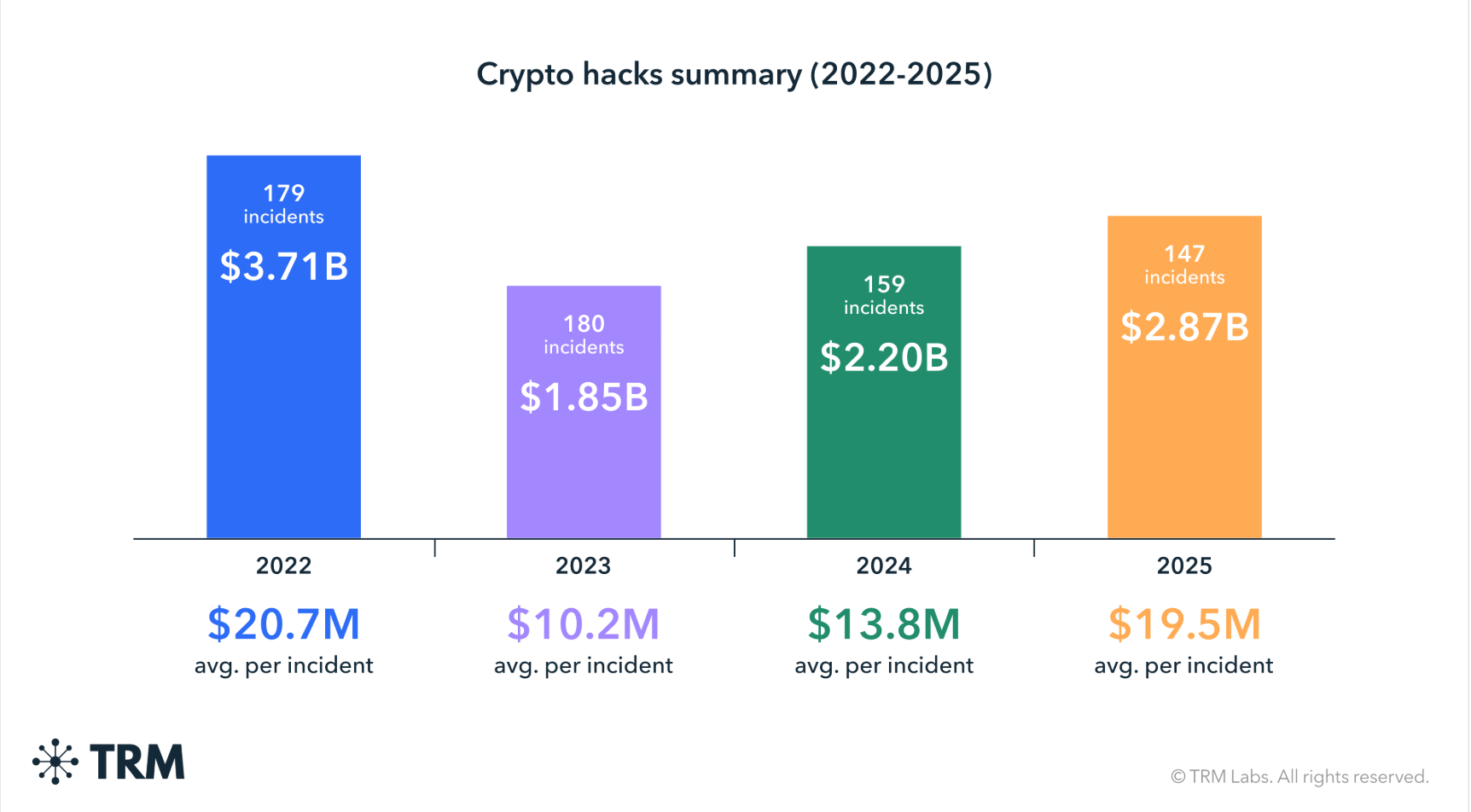
The initiative reflects the ongoing challenge of countering evolving cybersecurity threats impacting blockchain protocols and their users, as financial losses from decentralized finance (DeFi) platform hacks alone reached nearly $169 million in the first quarter of this year.
Related: Google Threat Intel flags ‘Ghostblade’ crypto-stealing malware
Foreign intelligence operatives continue infiltrating crypto projects and companies
Crypto projects and users are increasingly subject to evolving cybersecurity threats, which can be carried out by social engineering or infiltration by state-affiliated hackers, including the North Korean-linked Lazarus Group.
Drift Protocol, a decentralized cryptocurrency exchange, suffered a $280 million exploit this month at the hands of suspected North Korean-affiliated hackers.
The Drift team physically met the malicious actors at a “major” crypto industry conference and interacted with them for months after the initial meeting, according to a preliminary incident report from Drift Protocol.

During the months-long interaction, the hackers deployed crypto-stealing malware on the Drift team’s developer machines, which was activated in the April exploit.
The individuals who first approached the Drift team at the industry conference were not North Korean nationals, according to the report.
The Seals911 team, a group of blockchain cybersecurity specialists, said with “medium-high confidence” that the attack was likely carried out by the same hacker group responsible for the October 2024 hack of the Radiant Capital DeFi platform.
Magazine: Lazarus Group’s favorite exploit revealed — Crypto hacks analysis

Alibaba leads $290m investment for Shengshu Vidu AI world model

Young and the Restless: Cane’s Ruthless Redemption Plot Tied to Malcolm’s Fatal Illness?

EVERYTHING CHANGED BITCOIN 4 YEAR CYCLE IS DEAD CRYPTO DONE FOR? (ACCORDING TO MICHAEL SAYLOR)


-

 Fashion6 days ago
Weekend Open Thread: Spanx – Corporette.com
-

 Business4 days ago
Three Gulf funds agree to back Paramount’s $81 billion takeover of Warner, WSJ reports
-

 Sports5 days ago
India men’s 4x400m and mixed 4x100m relay teams register big progress | Other Sports News
-

 Business6 days ago
Expert Picks for Every Need
-

 Tech2 days ago
How Long Can You Drive With Expired Registration? What Florida Law Says
-

 Business5 days ago
No Jackpot Winner, Prize to Climb to $231 Million
-

 Fashion4 days ago
Massimo Dutti Offers Inspiration for Your Summer Mood Board
-

 Fashion2 days ago
Let’s Discuss: DEI in 2026
-
Politics7 days ago
Wings Over Scotland | The quality of mercy
-

 Crypto World1 day ago
Bitcoin recovers as US and Iran Agree a Ceasefire Deal
-

 Business5 days ago
Akebia Therapeutics, Inc. (AKBA) Discusses Pipeline Progress and Strategic Focus on Kidney Disease Treatments at R&D Day – Slideshow
-

 Politics7 days ago
Why so many children are now classified as ‘disabled’
-

 Crypto World14 hours ago
Canary Capital Files SEC Registration for PEPE ETF
-

 Politics6 days ago
The UK should not pay a penny in slavery reparations
-

 Politics7 days ago
Nuclear rockets, moon bases and NASA’s Mars plan
-

 Tech7 days ago
The Threadless Ball Screw Never Took Off, But Don’t Write It Off
-
 Business7 days ago
HPS FY 2025 slides: SaaS inflection drives 22% revenue growth
-

 Fashion7 days ago
Tory Burch’s Spring 2026 Campaign Goes on a Getaway
-

 Fashion7 days ago
Frugal Friday’s Workwear Report: Hammered Metallic Button Sweater Vest
-

 Fashion6 days ago
Weekly News Update, 4.3.26 – Corporette.com
You must be logged in to post a comment Login