According to Brooks, the primary narrative is not today’s anticipated rate hike, but rather the additional policy tightening expected later this year. Warsh may therefore struggle to deliver a message that aligns with the aggressive pricing currently seen in the markets.
“Tomorrow’s Fed meeting is a nightmare for Warsh. There’s no way he can live up to all the hikes priced, so the press conference will likely disappoint markets. The Dollar is likely to fall and long yields likely to rise,” Brooks said.
A weaker dollar typically supports dollar-denominated assets, including bitcoin and gold, reflecting a well-documented negative correlation between digital assets and the U.S. Dollar Index (DXY). Further, as Brooks noted, longer-duration Treasury yields are likely to rise if the press conference disappoints.
The yield catalyst
While rising yields are traditionally a bearish signal for non-yielding assets like bitcoin and gold, some observers note that the underlying driver matters. In this instance, yields are expected to climb due to an inflation signal from the Federal Reserve rather than an optimistic economic growth outlook, a crucial distinction that alters the typical market playbook.
Advertisement
According to a JPMorgan scenario analysis shared by Barchart, if the Fed hikes rates without delivering explicit, hawkish forward guidance, investors could conclude that current monetary policy remains too accommodative, prioritizing economic growth over restraining inflation.
Join Our Telegram channel to stay up to date on breaking news coverage
The US Senate rejected the CLARITY Act 49-50 on September 15, 11 votes short of the 60 needed to advance, sinking crypto’s flagship market-structure bill weeks before the November midterms.
The defeat came from an unlikely pairing. Senate Democrats objected to the bill’s ethics provisions, centered on President Trump’s reported $1.4 billion in cryptocurrency gains during 2025, while the banking lobby fought provisions that would let stablecoin issuers offer yield-bearing products. Banks saw those products as a threat to their deposit base, and the two objections together denied the bill its floor majority.
Two objections, one outcome
Senator Kirsten Gillibrand, who co-authored earlier crypto regulatory proposals, was among those who reversed course and voted against the bill. Her defection mattered because the legislation had cleared the Senate Banking Committee 15-9 in May with bipartisan support, which gave crypto advocates reason to believe the full Senate would follow.
Advertisement
The bill would have handed primary oversight of digital asset markets to the Commodity Futures Trading Commission rather than the Securities and Exchange Commission, the core structural change the industry sought. Its failure leaves that shift shelved for the rest of the current Congress.
The crypto lobby, which has spent an estimated $100 million to $225 million across recent election cycles, could not overcome the opposition on either front at once, and the vote failed 49-50.
Markets repriced within hours of the vote. Coinbase shares fell 12%, Circle dropped 13% and Bitcoin slid more than 5% intraday on September 15.
With the midterms weeks away, there is effectively zero chance of the legislation being revived in the current Congress.
Advertisement
Join Our Telegram channel to stay up to date on breaking news coverage
Zegler, 25, is now poised to bring her acclaimed portrayal of the former First Lady of Argentina to Broadway, with previews for the show beginning in February 2027. The musical’s highly anticipated New York City run will kick-start a chapter in which Zegler is also set to return to the big screen for the first time since starring in Disney’s 2025 live-action version of Snow White, and its assorted controversies—ranging from racist trolling about Zegler’s Colombian heritage to debates over her take on the 1937 animated original and heated commentary about the star’s political views.
“It’s a very important thing for all women, but particularly those in this industry, to learn that you’re never going to please everybody,” Zegler says of what she took away from that period of intense scrutiny. “If you are doing everything you can to be fulfilled and to do good work with good people, the rest of it is really just noise.”
Reflecting on how she was criticized for not being “enough of one thing” for her breakout role playing the Puerto Rican character Maria in Steven Spielberg’s West Side Story and “too much of another” for Snow White, Zegler maintains she will always be grateful for the formative impact of both films, despite the turbulence. “I was thrilled with the response for West Side Story. I won a Golden Globe when I was 20,” she says. “And similarly for Snow White, I was so proud of my performance. It was ultimately a really soul-filling learning experience.”
With a slate of forthcoming features in the pipeline, including indie dramedy She Gets It From Me, psychological thriller NDA, and the Lin-Manuel Miranda–directed Octet, Zegler is now looking ahead to new horizons. “I had one mission this year, which was to work with women and Latinos,” she says. She’s excited for the doors those films will open—“Not just for me, but for the amazing people I got to make them with, who in the past have been disenfranchised in this industry.”
Advertisement
Ultimately, Zegler refuses to let anyone put her in a box. “I love playing fully formed humans with complexities,” she says. “Human beings deserve to be represented for their flaws as well as the things that make them wonderful—I kind of think they’re one and the same.”
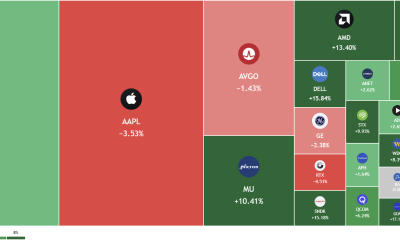
Futures for the Dow Jones Industrial Average and the other major stock indexes traded little changed ahead of Tuesday’s open. On Monday, the Dow Jones industrials declined 152 points as oil prices jumped amid continued Middle East conflict, while Wall Street reacted to a warning on artificial intelligence from leaders in the industry. Micron Technology (MU), Sandisk (SNDK) and Nvidia…
New developments extend BASIS across real-world asset and AI-native infrastructure while introducing automated reward restaking for BTC, ETH, SOL, and PAXG participants
BASIS, the institutional-grade crypto yield and staking platform built on market-neutral execution infrastructure, is continuing to expand its institutional footprint with three new developments: an ecosystem partnership with XDC Network, a collaboration with Zypher DAO, and Auto Earn – an automated reward restaking feature now live for BTC, ETH, SOL, and PAXG participants.
BASIS and XDC Network have announced a new partnership exploring opportunities at the intersection of crypto yield, real-world assets (RWAs), and the broader on-chain economy. XDC Network is an EVM-compatible Layer-1 blockchain powering payments, trade finance, and real-world asset solutions.
By combining BASIS’s market-neutral yield and staking infrastructure with XDC Network’s high-throughput, enterprise-oriented blockchain, the two teams are exploring how disciplined yield execution can connect with real-world financial infrastructure from tokenized assets to trade-finance ecosystems.
Advertisement
Verifiable AI Meets Market-Neutral Yield
BASIS has also entered into a collaboration with Zypher DAO (Zypher Network), an AI and Zero-Knowledge (ZK) powered Web4 ecosystem building AI-native blockchain infrastructure and intelligent digital economies.
The collaboration brings together Zypher’s verifiable AI and ZK capabilities with BASIS’s market-neutral yield infrastructure, with both teams exploring new possibilities across intelligent finance, verifiable execution, and on-chain asset management.
Auto Earn Automates Reward Restaking
Separately, BASIS has launched Auto Earn, an automated process that restakes eligible unclaimed staking rewards into a user’s existing position every Monday at 00:00 UTC.
Auto Earn touches accrued-but-unclaimed rewards only. It does not create a new position, add a new lock-up, reset the lock-up timer, or change the original maturity date or booster schedule. The feature is enabled by default, and users can turn it off or back on at any time in account settings. Full documentation is available at docs.basis.pro/economics-and-rewards/auto-earn.
Advertisement
About BASIS
BASIS is an institutional-grade crypto yield and staking platform for BTC, ETH, SOL, and PAXG, where participants can earn rewards by staking their assets on basis.pro with rates following the platform’s live Dynamic Reward Rate (DRR), which varies with market conditions and is not fixed or guaranteed. The platform executes market-neutral strategies designed to reduce directional exposure, with capital-preservation controls including risk constraints and circuit breakers embedded across its execution and operating framework.
BASIS is operated by BASIS DIGITAL INFRASTRUCTURE LTD, a Seychelles-registered IBC (LEI: 254900IX2F2KCWNSSS64), under ISO/IEC 27001:2022 and ISO/IEC 20000-1:2018 certified management systems, with execution research, systems modeling, and risk design contributed by Base58 Labs, a London-based independent research and engineering institution.
About XDC Network
Advertisement
XDC Network is an EVM-compatible Layer-1 blockchain powering payments, trade finance, and real-world asset solutions.
About Zypher Network (ZDAO)
Zypher Network (ZDAO) is an AI and Zero-Knowledge (ZK) powered Web4 ecosystem building the next generation of AI-native blockchain infrastructure and intelligent digital economies.
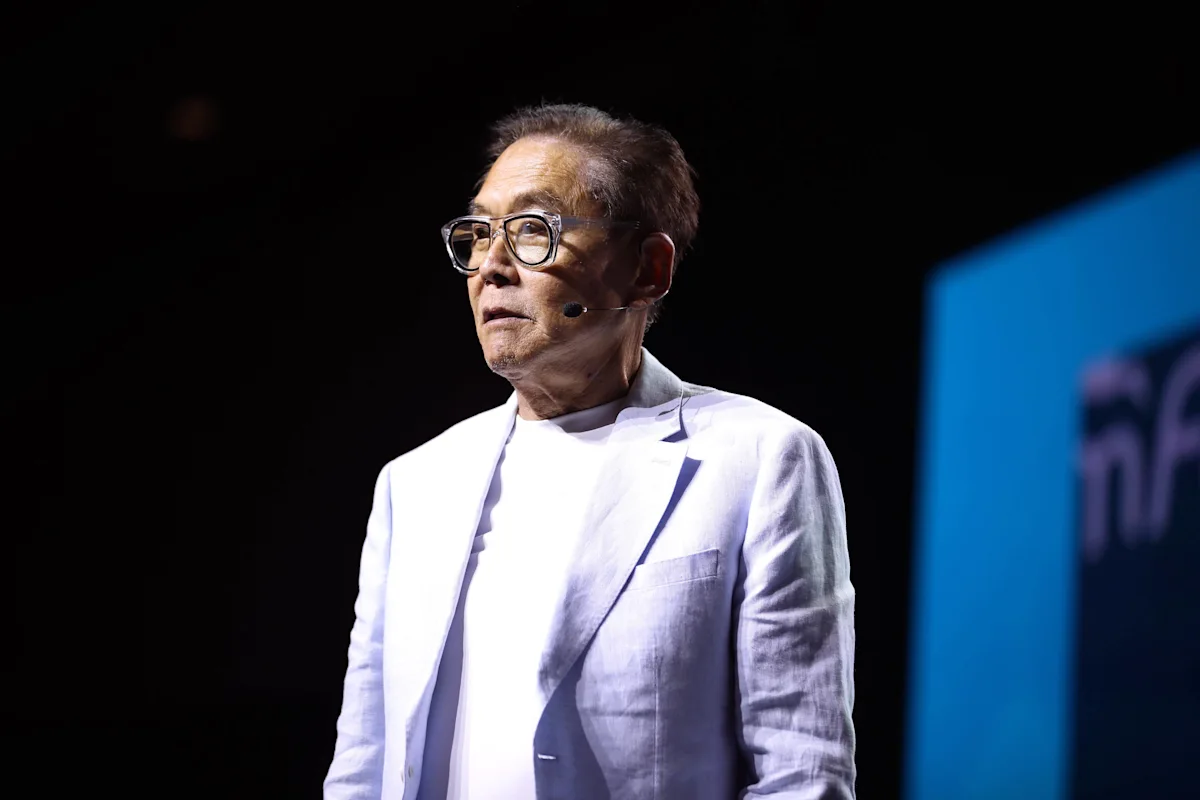
Robert Kiyosaki isn’t pulling punches this time. The “Rich Dad Poor Dad” author said on X early Tuesday that the “biggest crash in history has started,” pointing to turbulence in Europe and Japan as the opening act of a global downturn he says he predicted more than two decades ago.
Kiyosaki tied his warning to his 2002 book, “Rich Dad’s Prophecy,” which he said was written to help people “profit and not be victims” of a massive stock and bond market collapse.
He argues that the crash is now unfolding in 2026, driven by a mix of AI mania, geopolitical tensions including the war in Iran, excessive debt levels, and the retirement of the Baby Boom generation.
“In 2026, that crash started, in Europe and Japan and is spreading across the world. It’s caused by many factors, the AI frenzy, war in Iran, too much debt, and a retiring Baby Boom generation,” he wrote on X.
For investors with 401(k)s, IRAs, or similar retirement accounts, especially those over 40, the message is stark: you may be in trouble unless you act.
Kiyosaki drew a parallel to the Great Depression, which he said lasted 25 years from 1929 to 1954, noting that prepared families like the Kennedys used the period to grow wealth while others suffered.
The assets he’s backing
Kiyosaki has long urged followers to move beyond cash and paper assets.
His current playbook remains consistent: personal businesses, income-producing real estate, oil-producing wells, and hard assets like gold, silver, and Bitcoin.
Advertisement
He expects central banks to respond with more “fake money printing,” which in his view makes holding cash a losing strategy.
This aligns with his recent messaging on quantitative easing. In a post last month, Kiyosaki warned that new rounds of QE would reignite inflation and erode the dollar’s purchasing power, making savers “the biggest losers.”
He pointed to the Dollar Index (DXY) as a key signal: when it falls, every dollar saved buys less.
Four assets, one thesis
Kiyosaki’s core thesis is simple: own assets that rise when the dollar falls. He names four, gold, silver, Bitcoin, and select real estate, as rational hedges against a monetary system that punishes passive savers.
Advertisement
“Facts are educated investors who invest in assets that go up in value, such as gold, silver, Bitcoin, some real estate, get richer, while people who are financially uneducated, and invest in fake assets get poorer,” he wrote in his earlier post.
Phemex CEO Federico Variola has taken a critical stance on AI’s growing role in crypto, arguing that the technology is currently acting more like a drag than a catalyst for the sector. In comments on Cointelegraph’s Chain Reaction, Variola said AI has redirected liquidity away from crypto and intensified security risks—especially for smaller teams that cannot easily absorb rising defense costs.
While Phemex earlier this year outlined an AI-led shift in its own product and internal workflows, Variola’s latest remarks expanded the focus to the wider industry. He suggested the net effect of AI may be to push crypto further toward centralization rather than strengthening decentralization.
Key takeaways
Variola argues AI is diverting capital from crypto to other sectors while simultaneously increasing the power of threat actors.
He warns that higher cybersecurity burdens may concentrate security capacity among well-funded entities, potentially encouraging centralization.
Recent crypto incidents have been linked by industry figures to AI-enabled tactics, raising the perceived baseline risk for both self-custody and DeFi.
Even so, Variola sees practical uses for AI agents in portfolio support and decision-making, while stopping short of expecting full replacement of human judgment in trading.
Why Variola says AI is a “net negative”
Speaking during the episode, Variola said it is hard to be bullish about AI within crypto because it changes incentives on both sides of the equation. According to him, liquidity has been significantly rerouted into AI-related activity, reducing the competitive attention and funding available to the crypto industry itself.
At the same time, Variola argued AI is accelerating adversarial capabilities. In his view, AI is not simply raising the technical quality of code—it is also helping attackers exploit protocols and scale tactics that rely on automation, speed, and sophistication.
“It’s difficult to envision a world in which AI is going to favor crypto specifically as an industry, since a lot of the fixes that we see actually encourage more centralization rather than less centralization.”
For investors and builders, the core tension in Variola’s argument is straightforward: if staying safe increasingly requires large security budgets, then the economic pressure to centralize operations may intensify. That matters for an industry whose claims to value often depend on decentralization and broad participation.
Advertisement
Security pressure as AI changes the threat landscape
Variola’s skepticism lands alongside a period in which AI has repeatedly entered discussions around crypto security incidents. One example cited in the broader conversation is a July incident in which attackers reportedly drained roughly $116 million in Bitcoin from more than 5,200 addresses tied to a Coldcard hardware wallet flaw. The report framework around that incident has widely been tied—at least in industry narratives—to the malicious use of AI.
Coinkite CEO Rodolfo Novak also publicly warned developers at the time that the “sober reality” is that AI-assisted code review can uncover bugs faster than even experienced teams can keep up with. That perspective aligns with Variola’s concern: the same speed and scale that makes AI useful can also shorten the window between vulnerability discovery and exploitation.
Variola explicitly tied these risks to the economics of security staffing. He said small protocol teams may no longer be able to function effectively without “a massive cybersecurity budget,” implying that defensive measures may become structurally out of reach for many decentralized projects.
The stakes are not limited to protocol-level vulnerabilities. Variola also suggested that AI-driven threats could reduce the appeal of self-custody and decentralized finance for everyday users. He argued that as AI becomes more pervasive, attacks may increasingly take the form of device compromises or social engineering campaigns—conditions that could raise the number of risks retail users must actively manage.
Advertisement
“As AI becomes more pervasive, and whether it is your devices being hacked or social engineering, or all these kinds of strategies that are empowering threat actors, that makes DeFi a lot less appealing for a retail user because you have to worry about so many things that you didn’t have as much before.”
Defensive AI exists—but the trade-off may still be hard
Not everyone in the security community shares the same level of pessimism. The article notes that security experts have also highlighted AI’s defensive potential. For example, CertiK senior blockchain investigator Natalie Newson told Cointelegraph in April that “AI can also be one of the biggest defenses,” even while warning that attackers are simultaneously becoming more sophisticated.
This is a critical nuance for readers: the debate is not simply whether AI helps attackers or defenders. It is about pace, cost, and who can afford to respond quickly. If attackers can iterate faster while defenders face rising operational expenses, the overall balance may still tilt toward the party with resources—whether that is a centralized service, a large security team, or an entity able to purchase rapid incident response.
That framing supports Variola’s larger thesis: even if AI improves security tools, the resulting “fixes” may require organizational scale that decentralized projects struggle to replicate.
Where Variola sees room for AI in crypto
Despite his broader caution, Variola said he sees tangible benefits in AI agents—specifically for user-facing assistance such as helping investors build portfolios or improving trading decisions. However, he emphasized that these tools should be treated as decision support rather than autonomous replacements.
Advertisement
In his words, users would remain responsible for the final action: AI agents might help with information processing, strategy framing, or execution context, but they are not expected to fully replace the judgment involved in taking a trade.
For market participants, this distinction may be practical. Portfolio guidance and workflow automation can reduce friction for retail users, but security and risk management still depend heavily on human oversight—especially in a threat environment Variola describes as increasingly shaped by social engineering and device compromise.
As AI adoption accelerates across crypto platforms, readers should watch two closely connected questions: whether AI-enabled defenses meaningfully reduce real-world exploit frequency, and whether the cost of those defenses pressures the ecosystem toward larger, more centralized operators. The answers will likely determine whether AI ultimately broadens participation—or quietly narrows it.
Risk & affiliate notice: Crypto assets are volatile and capital is at risk. This article may contain affiliate links. Read full disclosure
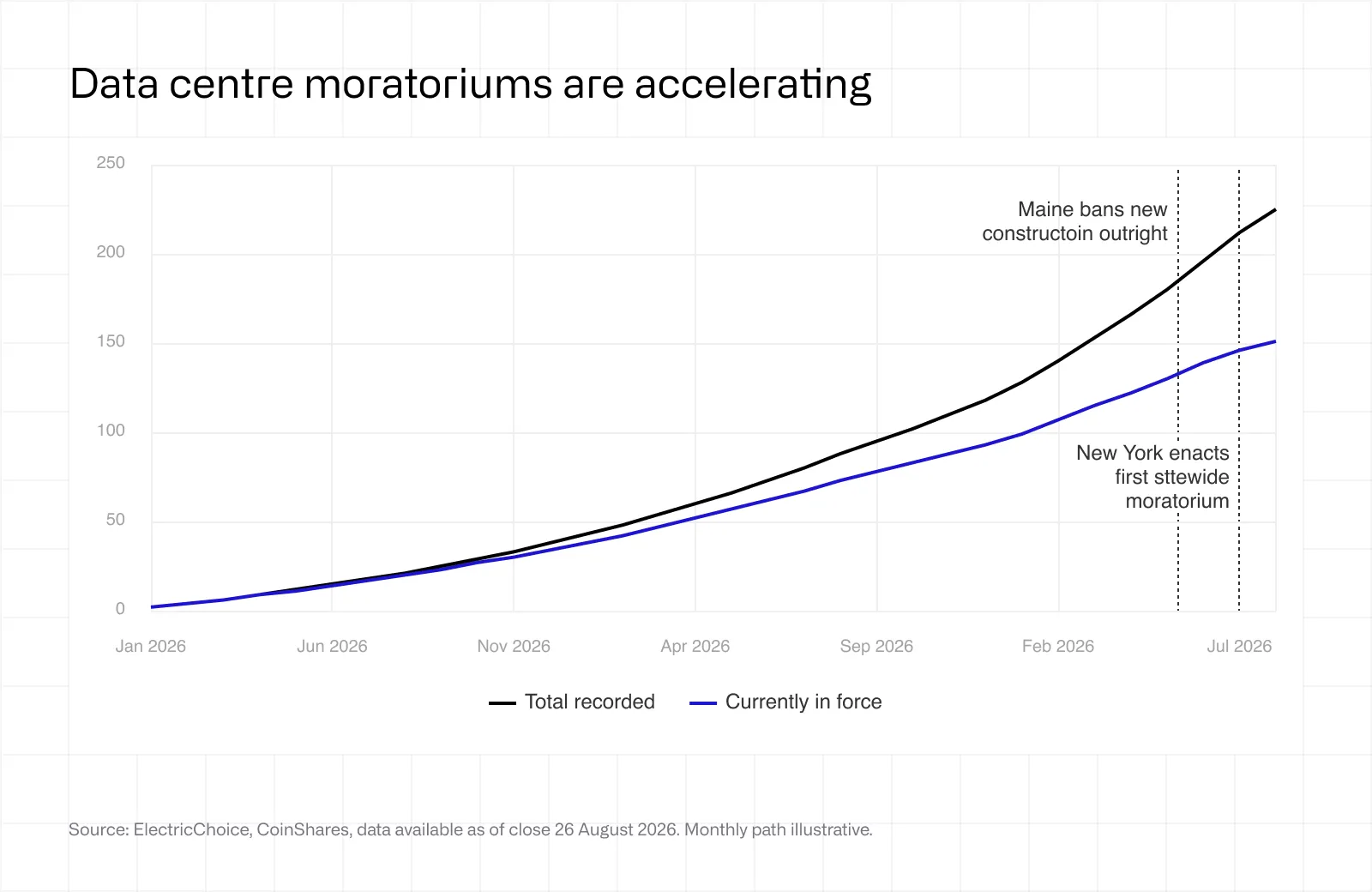
Bitcoin (BTC) mining sites have become some of the scarcest permitted power capacity in the United States. With 151 data center restrictions still active, AI developers face years of waiting to plug in anywhere new.
CoinShares cited at least 225 data center moratoriums or restrictions in its second-quarter mining report. The clampdown turns already energized capacity into a scarce asset.
States Are Closing the Door on New Power
The restrictions span 30 states, according to ElectricChoice tracking cited in the CoinShares report. Maine banned new data center construction outright in April.
Accelerating Data Center Moratoriums in the US. Source: CoinShares
CoinShares calls New York the most significant development. It paused environmental permits for facilities of 50 megawatts (MW) or more on July 14. Governor Kathy Hochul’s first statewide permit freeze runs for a year.
Restrictions have also spread at the county level across Ohio, Michigan, Georgia, and Indiana. More than a third of counties there have moved to limit development, according to the report.
New York exempted permits it had already deemed complete, and similar carve-outs are common. A finished approval is now worth something that a newcomer has no way to obtain.
The queue behind those rules is the harder problem. The US interconnection queue holds roughly 2,600GW, about double the country’s installed capacity.
Advertisement
Median waits from request to operation exceeded five years for projects completed in 2025, according to research from Lawrence Berkeley National Laboratory.
Texas shows the squeeze clearly. ERCOT’s own large-load queue data put data centers at 87% of 410 GW. In PJM, projects entering service in 2025 averaged more than seven years from request to operation.
“The practical consequence is that an energised site cannot be recreated within any commercially relevant timeframe, regardless of capital available,” CoinShares added.
Existing space has tightened alongside it. CBRE recorded primary market vacancy at a record 1.4% at the end of 2025, despite supply growing by 36%, with vacancy falling to 0.3% in Northern Virginia by the first quarter of 2026.
Against that backdrop, a $3.5 billion purchase of three leased Northern Virginia AI facilities set a benchmark near $27 million per MW. Listed miners with energized but unleased capacity, in contrast, trade below $3 million per MW in some cases.
Advertisement
The two numbers are not directly comparable. One reflects facilities with leases in place, while the other reflects how the market values capacity that has none.
Conversion is not free. Retrofitting mining infrastructure to AI-grade costs an estimated $8 million to $15 million per MW, compared with $700,000 to $1 million to build it for mining.
“The direction of travel is clear: regulation and grid congestion have inverted the historic discount applied to mining sites, converting what was once viewed as stranded, low grade infrastructure into some of the scarcest permitted power capacity in the US,” the report mentioned.
Operators who can fund conversion and lock in tenants, therefore, stand to capture most of that premium. Grid access is the entry requirement, not the whole business.
Ethereum sits at $2,400, dropping a brutal 4% on the day amid its bullish price prediction a week earlier. The largest altcoin absorbed a legislative gut-punch and is staring down a Fed decision that would rattle most assets, yet whale wallets are still buying.
The CLARITY Act failed to clear the 60-vote cloture threshold in the Senate on Tuesday, triggering an immediate 5% drop toward $2,400 as regulatory clarity got pushed further down the road. Despite that, the setback hasn’t broken the underlying bid.
Exchange netflow data shows reserves falling by 159K ETH over five days, while wallets holding 10K-100K ETH, or the whale cohort, added roughly 200K ETH to their stacks over the past week. Retail, meanwhile, dumped about 192K ETH, continuing a distribution pattern that’s held since January.
Add in $121 million of spot ETH ETF inflows on Monday, and $216.4 million on Friday, and the divergence between institutional accumulation and retail selling becomes the real story heading into Thursday’s FOMC decision.
Ethereum Price Prediction: Will ETH Hit $3,000 This Week?
ETH is consolidating in a triangle pattern between support at $2,405–$2,485 and resistance at $2,535–$2,600. The 20-day EMA near $2,425 has held as a floor through the recent pullback, and volume has stayed constructive rather than capitulatory, a sign this dip is more consolidation than reversal.
A decisive close above $2,600 would confirm the breakout, opening a run toward the $2,800–$3,000 zone that Bitget’s analysts are flagging as the next psychological target. If ETH instead grinds sideways, the $2,400–$2,550 range could hold until the Fed decision clears the calendar.
Ethereum (ETH)
24h7d30d1yAll time
A break below $2,350 would invalidate the setup and reopen the August lows near $1,880. With a 92.3% priced-in probability of a 25bp hike per the CME FedWatch tool. Thursday’s outcome is largely baked in, and the real risk is the accompanying commentary. Full breakdown available in this Ethereum price prediction.
LiquidChain Targets Early Mover Upside as Ethereum Tests Key Levels
ETH holders riding this consolidation are positioned reasonably well, but let’s be direct: a move from $2,400 to $3,000 on a trillion-dollar-plus asset is a solid 25% swing, not a multi-bagger. For traders chasing asymmetric upside, that math pushes attention toward earlier-stage infrastructure plays instead.
That’s the lane LiquidChain ($LIQUID) is building in. Liquid is a Layer 3 network fusing Bitcoin, Ethereum, and Solana liquidity into one execution environment. The presale is priced at $0.014956 with $960K raised so far.
Its pitch centers on a Unified Liquidity Layer and Single-Step Execution, letting developers deploy once and tap all three ecosystems rather than fragmenting liquidity across chains. Verifiable Settlement rounds out the architecture.
Benchmark 10-year government bond yields surged to decades-high levels across five major economies this week. The US and UK hit marks last seen in 2007, while Japan reached a level unseen since 1996.
Germany’s 10-year yield climbed to its highest point since 2009, while France’s reached a level not seen since 2008. Oil above $100 a barrel is reigniting inflation fears ahead of a cluster of central bank meetings this week.
A Synchronized Repricing
The moves mark one of the broadest bond selloffs in years. Renewed Middle East hostilities have pushed crude prices higher, threatening to reignite consumer inflation.
The 🇺🇸 10-year Treasury yield just climbed to its highest level since 2007 The German 🇩🇪 10-year yield just climbed to its highest level since 2009 The Japan 🇯🇵 10-year yield just climbed to its highest level since 1996 The United Kingdom 🇬🇧 10-year yield just climbed to its…
That pressure has pushed yields to levels Bitcoin has never seen since the asset’s creation.
Heavy government debt issuance is compounding the pressure. US bonds’ worst decade in more than two centuries adds to the supply investors must absorb. Japan’s debt load, above 200% of gross domestic product, leaves Tokyo especially exposed to rising borrowing costs.
Why Yield Matters
Higher long-term yields ripple into mortgage rates, corporate borrowing, and government budgets. Analysts single out France as the most exposed among major economies.
“The most vulnerable sovereigns are those combining large fiscal deficits, elevated debt burdens and reliance on external capital. France stands out among developed markets.”
Masahiko Loo, senior fixed income strategist at State Street Investment Management, told CNBC.
Advertisement
Markets are also bracing for the Fed’s rate decision this week, with traders pricing high odds of a hike. That could either steady or extend the global selloff.
The synchronized rise across the US, Europe, and Japan is not a single-country story. It reflects a broader repricing of sovereign risk and inflation expectations. Whether the trend stabilizes or accelerates further may hinge on how central banks respond in the coming days.













 ⟁
⟁





































You must be logged in to post a comment Login