
Crypto World
The Missing Pieces We Carry After 9/11


“The memories are so vivid,” says Lomonaco, who helped start a fund for the families of his staff and who has gone on to run several successful restaurants in the city. “A generation has grown up since then, but it still seems like yesterday to me.”
A 25th anniversary marks a swath of time that can be illuminating because, to someone who is younger than 30, it feels like an eternity. Or a lifetime, which to someone who actually is 25, it is. But to someone who is over 50, as I am, it feels like a chapter. A long one, perhaps. But, still, a part of something else.
9/11 is a hinge of time that separates generations. It shouldn’t be surprising—but it always is—when I ask young folks about 9/11, and they just can’t get their hearts around it. It’s something that they learned about in class or saw on YouTube. They don’t feel it like I do. Like we do.
Those of us who are moved by this anniversary—no matter how close we were to the actual tragedy—should find some way to talk about it. “We have an obligation,” Lomonaco says. “When we talk about the people who died, we’re acknowledging the significance of their lives.”

The native token of Pi Network has rebounded from its all-time low set earlier this summer, and many market observers now anticipate further gains in the near future.
Certain technical indicators also support the bullish perspective.
Breakout Setup?
PI currently trades at around $0.094 (per CoinGecko), representing a 13% monthly surge and a 34% increase from its July historic bottom. Its market capitalization has climbed back over the psychological $1 billion mark, making it the 68th-largest cryptocurrency.
X user OxNeena noted that the token is holding a key support zone around $0.09-$0.10 after a long consolidation, foreseeing a major push above $0.30 if bulls reclaim $0.20.
Nakamoto Files and CT News also weighed in. The former claimed that “something is moving behind the scenes” at Pi Network, arguing that PI might be gearing up for a move that nobody expects.
“The ecosystem is evolving. The pieces are falling into place. Is the PI wave finally coming?” they asked.
For their part, CT News highlighted Bitcoin’s solid performance throughout August, adding that PI remains near the floor. In their view, if the next altcoin rotation reaches Pi Network, the token could move much faster than people expect.
“The sleeping giant may not stay asleep forever,” the X user added.
PI’s Relative Strength Index (RSI) supports the positive scenario. The ratio has plunged to nearly 30 on a weekly scale, suggesting that the coin is nearing oversold territory, which is typically seen as a buying opportunity.

Of course, not all are so optimistic. Crypto With Gopal opined that PI has formed a rising wedge, with price grinding higher within the formation and momentum compressed near the $0.095 resistance.
“A breakdown could send PI toward the $0.085 target. Bears are watching the wedge closely – short-term sentiment leans bearish,” he estimated.
Burning Mechanism on the Way?
Lately, there has been growing speculation that the controversial crypto project is on the verge of integrating a burning program that could reduce the token’s supply and positively impact the price. Recall that years ago, the meme coin Shiba Inu implemented such a mechanism, and since then the team and community have burned over 410.8 trillion units.
According to the X account BSCN, there is little chance that Pi Network will run such an extensive burn program. PiNews360 also rejected the possibility, saying:
“Pi Network is never going to burn tokens from its 100 billion PI total supply. Pi is never going to be 100% mined; it will take hundreds of years to fully mine. Pi is going to be successful as a long-term project because of its simple mobile mining technology and its growing ecosystem.
Pi is going to become one of the most widely used cryptocurrencies for day-to-day activities, developing in parallel with AI. Pi is going to be a tough competitor to BTC, ETH, and XRP. The day Pi starts burning its token supply could be the beginning of Pi’s collapse, due to the failure of its inclusive model for a massive community.”
The post Top Pi Network Price Predictions as PI Rises 13% in a Month appeared first on CryptoPotato.
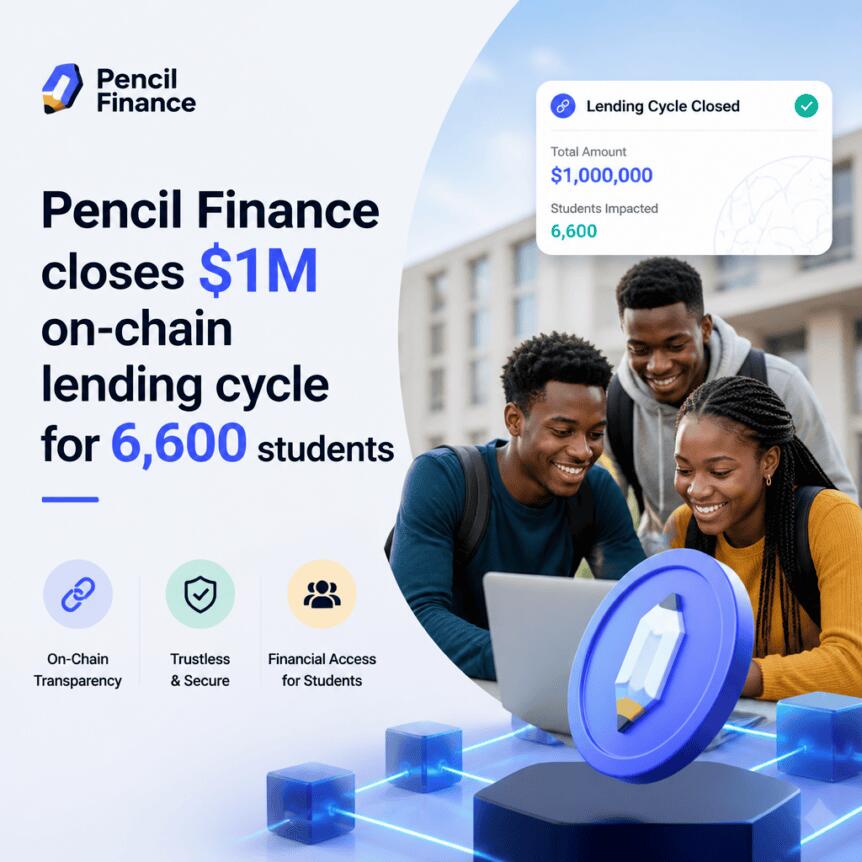
Student loan real-world asset (RWA) protocol Pencil Finance says it has completed its first “fully onchain” student lending cycle, deploying $1 million to fund education borrowers in Southeast Asia and then seeing repayments flow back to lenders.
In a Thursday announcement shared with Cointelegraph, the project described the full process as transparently recorded on the blockchain: capital was deployed onchain as a lender, borrowers repaid, and repayment was routed back to the bundle’s funders with yield.
Key takeaways
- Pencil Finance completed its first fully onchain student loan cycle using $1 million in deployed capital.
- The program supported about 6,600 students across 118 schools and universities in Southeast Asia.
- Funding was structured into senior (fixed returns) and junior (variable returns with first-loss risk) tranches.
- Pencil says roughly 1,050 students received direct funding, with 50% of borrowers female and 93% from lower-income households.
- The company frames the cycle as an example of blockchain-recorded lending for student financing that traditional lenders often overlook.
How Pencil Finance’s onchain loan cycle worked
Pencil Finance’s announcement centers on the mechanics of its student loan bundle being executed onchain from deployment through repayment. The protocol said it deployed $1 million in capital as a lender on the blockchain for a defined loan cycle, then received repayments from borrowers. Those repayments, according to the company, were distributed back to the bundle’s funders and produced yield.
The project also emphasized that the lending process was recorded onchain end to end, pointing to transparency as a core feature of the approach. Pencil claims the completed cycle is the first-ever “fully onchain lending cycle” that finances student loans with activity transparently captured on a blockchain network.
Tranche structure behind the $1 million bundle
While the overall figure is $1 million, Pencil’s program was funded through a structured tranche model. The company said the bundle was funded in July 2025 by Animoca Brands, Open Campus, and New Campus.
Under the arrangement described by Pencil, the capital was split into a senior tranche and a junior tranche. The senior tranche carries fixed returns, while the junior tranche provides variable returns and bears first-loss risk—meaning it is designed to absorb losses before the senior portion is impacted.
For investors and participants, this split is significant because it changes how risk and reward are distributed. Fixed-return exposure is paired with a loss-absorbing layer, which can make the senior tranche more attractive depending on the credit performance of the underlying borrowers, while still giving junior tranche holders potential upside commensurate with the added risk.
Who received financing, and where
Pencil Finance said the completed onchain loan cycle provided financing to roughly 6,600 students across 118 schools and universities in Southeast Asia. In its breakdown of direct funding, the protocol reported that about 1,050 of those students received direct funding.
Pencil also described borrower demographics and credit-gap positioning. The loans were intended for students underserved by traditional lenders, with the company reporting that 50% of borrowers were female and 93% came from lower-income households.
These figures matter because they frame the lending program not as a generalized education finance product, but as targeted support for segments that often struggle to access standard forms of credit. The scale across institutions—118 schools and universities—also suggests the protocol is aiming for broad distribution rather than a narrow pilot.
RWAs and tokenized credit: a broader trend
The Pencil announcement arrives as tokenized RWAs continue to move from theory into more operational examples—particularly in lending and asset-backed structures. In July, Cointelegraph reported that Brazil’s B3 stock exchange issued a loan denominated in 100,000 Brazilian reais (about $19,600), secured by “10 tokenized cows.” Each cow was represented by a unique digital token tied to an encrypted digital identity, while AI-powered smart collars from Cowmed were used to monitor each animal’s health. The comparison is useful because it highlights a recurring theme in the RWA sector: digitization of real-world collateral and processes to improve traceability and automation.
Student lending, however, differs from collateralized commodity examples. Instead of tokenizing a static asset like a cow, the onchain activity in Pencil’s model focuses on credit deployment, repayment flows, and the structured allocation of returns and risks across tranches. If the program’s claimed transparency and cycle execution can be repeated, it offers a blueprint for how tokenized credit could be operationalized for education financing—an area where data collection, verification, and enforcement are often the hardest parts for traditional lenders.
Still, several practical questions remain for observers: the long-term performance of the loans, how defaults (if any) affected tranche outcomes, and how the protocol scales the underwriting and administration needed to operate across many schools. Pencil says the first cycle is complete, but investors and partners will likely want to see follow-on cycles and more performance details over time.
For now, the key thing to watch is whether Pencil’s onchain lending flow—deployment, repayment routing, and tranche mechanics—holds up in subsequent cycles, and whether this model attracts additional capital for student borrowers in underserved regions.
Nvidia (NVDA) on Thursday announced a deal to buy AI developer platform Hugging Face for $12.93 billion in the company’s largest acquisition. Nvidia stock rose a fraction. “Together, we will scale Hugging Face’s platform, strengthen its infrastructure and expand access to AI for developers and institutions worldwide,” Nvidia Chief Executive Jensen Huang said in a blog post. “Hugging Face will…
Copyright ©2026 Investor’s Business Daily, LLC. All rights reserved. 87990cbe856818d5eddac44c7b1cdeb8
Arthur Hayes, the chief investment officer of crypto family office Maelstrom, said in an essay published Thursday that traders should stop paying attention to Fed Chair Kevin Warsh’s hawkish comments and instead watch the euro-yen exchange rate for early signs of fresh dollar liquidity.
He argued that mounting funding stress at French banks will eventually force the Federal Reserve to print money to keep the US repo market working, a dynamic he sees as bullish for Bitcoin and the wider crypto market.
Hayes Points to EUR/JPY as His Liquidity Gauge
Hayes said EUR/JPY, trading near 185 at the time of writing, will fall to 140 or lower by next June. He tied that forecast to Treasury Secretary Scott Bessent’s effort to weaken the euro and strengthen the currencies of US allies in Asia, meant to make American exports more competitive.
Rather than let Japan, South Korea, and Taiwan sell their dollar holdings outright, Hayes said the plan is to route that capital through the Fed’s FIMA repo facility, and he noted Bessent has already sold euros for yen through the Treasury’s Exchange Stabilization Fund.
The bigger risk, in his view, sits with French banks. He named BNP Paribas, Credit Agricole, and Societe Generale, which together handle roughly a fifth of US repo lending, and pointed to widening French government bond spreads and capital leaving French banks as signs that foreign lenders are pulling back.
If those banks retreat from repo lending, Hayes expects the New York Fed to lean harder on its RPM program, which already buys 39% of T-bill issuance, to keep the market funded.
That program has grown the balance sheet by about $22 billion a month since December, and Hayes said the pace could climb toward $100 billion if the Treasury steps up long-end bond purchases too.
He dismissed Warsh directly, writing, “I don’t pay attention to anything Warsh says.” Maelstrom’s portfolio, he added, keeps Bitcoin at its core long-term holding with year-end 2026 price targets of $10,000 for ETH and $0.50 for ENA.
A Hawkish Fed and a Choppy Bitcoin
Hayes’ essay comes about a week after Warsh’s hawkish Jackson Hole speech, which hit Bitcoin hard.
As CryptoPotato reported then, the OG cryptocurrency dropped by $3,000 within hours of that address, slipping under $77,000 after Warsh said the Fed’s 2% inflation target was “firm and fixed” and downplayed recent encouraging inflation data. Rate-hike odds for September then jumped from about a third to roughly 60% in the aftermath.
Bitcoin has stayed choppy since, with the asset turned away from $79,000 more than once before another leg down pushed it under $76,500, the lowest level in ten days, after renewed US-Iran strikes rattled markets.
However, at the time of writing, it had clawed its way back up and was trading closer to $78,000 than $77,000, pushing its gains over the last 30 days to almost 22%.
The post Arthur Hayes Says Ignore Warsh and Watch EUR/JPY for Bitcoin’s Next Move appeared first on CryptoPotato.
Crypto World
Australia is cracking down on crypto businesses as its strict new regulatory deadline nears


Firms that miss the deadline could breach financial services law from Oct. 1 and face civil or criminal penalties.


Standard Chartered will now hand institutional clients real Bitcoin (BTC) and Ether (ETH) in the United Arab Emirates. Those clients receive the coins themselves, not a derivative that only tracks the price.
The bank announced the desk on Thursday through its Dubai arm. Only 29 lenders worldwide carry the too big to fail label. Just one of them now delivers coins.
Standard Chartered’s Bitcoin Desk Sits Inside a Too Big to Fail Bank
The Financial Stability Board names those 29 banks every year. Its 2025 list puts Standard Chartered in the lowest risk bucket, carrying a 1% capital surcharge.
JPMorgan sits three tiers above it. Citigroup and HSBC sit two. Standard Chartered says no rival G-SIB offers the same deliverable spot service.
The smallest of the systemic banks moved first, not the biggest. Deliverable may be the key word here, seeing as the client ends up holding Bitcoin. This means someone at the bank must move real coins and guard them.
The appeal is the fee stream. The bank earns on the spread, the settlement and the custody, rather than losing that revenue to crypto exchanges.
Why Dubai Got This Before New York
Standard Chartered built the Dubai stack in pieces. Custody came first, in September 2024, with hedge fund Brevan Howard Digital as its opening client.
Spot trading followed in London in July 2025. The bank then added USDC minting there in July 2026. Execution was the last gap.
Every step cleared the Dubai Financial Services Authority. All four launches happened in Dubai or London, never in the United States.
Rivals, meanwhile, are behind. Citi is still readying bitcoin custody, a service Standard Chartered has run for two years.
Banks are not chasing a rally. They are building while the price is low, for clients rich enough to qualify. Retail is nowhere on that list.
The post A ‘Too Big to Fail' Bank Is Now Delivering Actual Bitcoin and Ethereum to Institutions appeared first on BeInCrypto.
Kraken is joining SoFi’s settlement network and list SoFiUSD as the companies link traditional banking with crypto markets.
Futures for the Dow Jones Industrial Average and the other major stock indexes traded mixed Thursday, as Treasury yields cooled off from recent gains. Meanwhile, artificial intelligence stock Broadcom (AVGO) sold off on the stock market today after the company’s earnings report while Snowflake (SNOW) rocketed higher. Ahead of Thursday’s open, Dow futures rose 0.2%, while S&P 500 futures hovered…
Copyright ©2026 Investor’s Business Daily, LLC. All rights reserved. 87990cbe856818d5eddac44c7b1cdeb8

For investors seeking a high-yield real estate investment trust that can hold up even if the economy weakens, UMH Properties (UMH) looks like a strong candidate — and the stock is currently in a buy zone. Headquartered in Freehold, N.J., UMH is a REIT specializing in manufactured home communities. The company owns a portfolio of 145 communities with more than…
Copyright ©2026 Investor’s Business Daily, LLC. All rights reserved. 87990cbe856818d5eddac44c7b1cdeb8
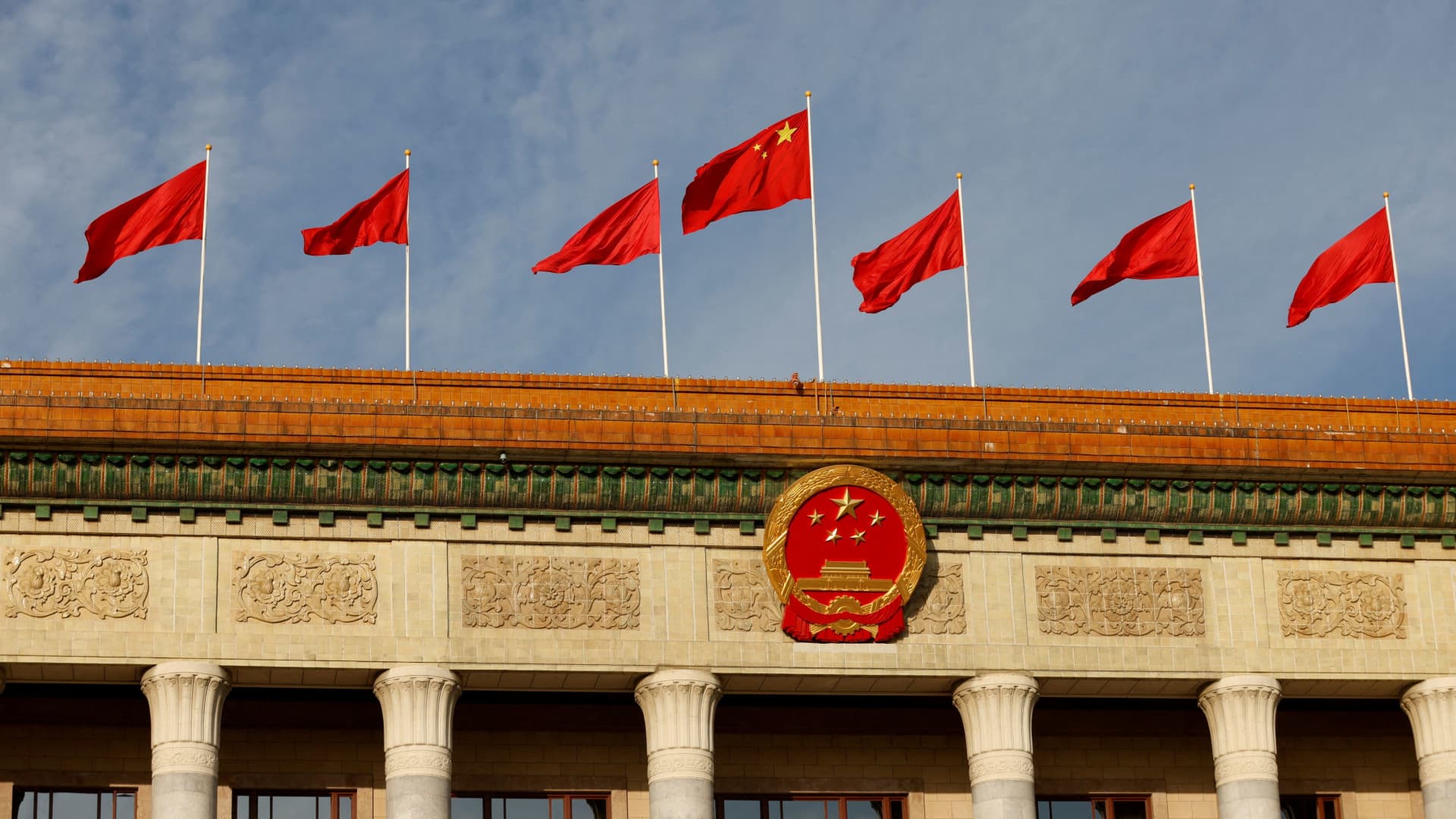
A Chinese flag flutters on top of the Great Hall of the People ahead of the opening ceremony of the Belt and Road Forum (BRF), to mark 10th anniversary of the Belt and Road Initiative, in Beijing, China October 18, 2023.
Edgar Su | Reuters
BEIJING — China has accused other G20 nations of “promoting protectionism,” after they criticized economies that rely heavily on exports.
U.S. Treasury Secretary Scott Bessent on Tuesday said 19 of the G20 members agreed to address the “unsustainable equilibrium” resulting from a “stream of cheap exports.” China was the only G20 member to dissent from a joint statement over references to such “imbalances.”
The Commerce Ministry on Thursday pushed back on trade complaints from the U.S. and Europe, calling them “an excuse to pressure and restrict China.”
“China believes that taking advantage of the G20 and other multilateral mechanisms to hype up so-called ‘economic imbalances’ and ‘overcapacity’ is essentially promoting protectionism,” Ling Huang, Commerce Ministry spokesperson, said in Chinese, translated by CNBC.
“China is firmly opposed,” she said during a weekly press conference. “This will only disrupt the global economic and trade order, and harm the healthy development of the global economy.”
The words come amid a flurry of different multilateral meetings and growing anticipation for Chinese President Xi Jinping’s trip to Washington, D.C. later this month.
When asked by CNBC about the latest U.S. anti-Iran sanctions, which can extend beyond Iranian entities to foreign companies or individuals accused of helping Iran, Huang said the U.S. should “immediately correct its wrong practices and lift sanctions against relevant Chinese companies and citizens.”
“Despite repeated requests from China, the U.S. has used Iran as an excuse for repeatedly imposing sanctions on Chinese companies and citizens, to which China is strongly dissatisfied and firmly opposes,” she said.
Early last week, Bessent announced that any entity, including Chinese banks, that facilitates money laundering or sanctions evasion on behalf of Iran could be cut off from the U.S. financial system.
Huang on Thursday also urged France to halt implementation of a new law aimed at curbing the low prices charged by Chinese e-commerce companies such as Temu.
“If France persists in its course of action, China will take necessary measures to safeguard the legitimate rights and interests of Chinese enterprises, and France will bear all consequences,” she said.
China and the European Union more broadly have also been engaged in trade talks this summer as Europe wants to reduce its record trade deficit with China by October. EU Trade Commissioner Maroš Šefčovič warned in an interview with Euronews this week that Beijing must deliver “concrete results” by October or face “harsher measures.”
Huang said China is willing to work with the EU, but said demands should not be made unilaterally, and threats should not be made to close markets.

XRP: “LOOKS LIKE WE’RE GONNA GET ANOTHER LEG UP SOON” Popular Analyst Predicts -Report

Nine arrested after immigration officers raid 34 fishing boats across Scotland

NetApp Stock Slides Despite Earnings Beat. Here’s Why.





-

 Fashion6 days ago
Weekend Open Thread: Maeve – Corporette.com
-

 Crypto World7 days ago
Bitcoin’s 22% rally now needs real demand to outlast Treasury liquidity boost
-

 Business7 days ago
Apple Confirms September 9 Keynote and Reveals Its Full Pre-Order Schedule
-

 Crypto World13 hours ago
CLARITY Act could advance within weeks, Atkins says
-

 Business7 days ago
Salesforce Stock Soars 19% as Blowout Earnings and Agentforce AI Growth Silence Software Skeptics
-

 Business5 days ago
Onto Innovation Stock: AI’s Next Bottleneck Is Yield (NYSE:ONTO)
-

 Crypto World6 days ago
Bitcoin price tests $82K resistance as Brandt stays long
-
 Tech5 days ago
Hugging Face built a $4.5 billion empire on free AI models. Now Nvidia is buying it for $12.9 billion
-

 Business6 days ago
iPhone 18 Pro Pre-Orders Could Shift to Saturday as Apple Reportedly Avoids September 11 Anniversary
-

 Crypto World6 days ago
Truflation calls for Fed rate cut after PCE forecast
-

 News Videos4 days ago
Charlie Munger on Robinhood: No one should believe that Robinhood’s trades are free
-
 Tech7 days ago
The fix for the AI agent that hijacked a company’s DNS: it can propose the change, but it can’t approve it
-

 Tech5 days ago
PaperCut releases second emergency patch for exploited flaws
-

 Crypto World1 day ago
Elon Musk Says Grok 4.7 Lands in 10 Days and Will Beat Every Model
-
 Entertainment6 days ago
‘Adults’ Creators Break Down Season 2’s Most Shocking Moments and Tease a Potential Season 3
-

 Tech5 days ago
Tamagotchi Ring Takes the 30-Year Digital Pet and Places it on Your Finger
-

 Tech5 days ago
As the influencer economy drives retail sales, Seattle startup raises $22M to play matchmaker
-
 Crypto World2 days ago
Bitcoin slips below $77.5K as macro pressure offsets ETF inflows
-
 NewsBeat4 days ago
Trump posts AI video of ‘Lake America’ being protected by an army of bequiffed ‘Donald Ducks’
-
 Entertainment4 days ago
Taylor Swift Reportedly ‘Frustrated’ With Travis Kelce After ‘Short’ Honeymoon
You must be logged in to post a comment Login