

Crypto World
the past, present, and future of crypto in 401(k) plans

Happy Thursday, advisors!
In today’s newsletter, David Lawant, head of research at Anchorage Digital reviews crypto’s evolving role in 401(k)s, as regulatory clarity is poised to open up investments.
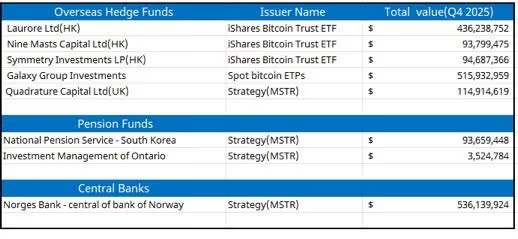
Then, in Ask an Expert, Kevin Tam answers questions about crypto adoption around the world looking at the recent 13F filings.
Happy Reading.
Modernizing the nest egg: the past, present, and future of crypto in 401(k) plans
The United States retirement system is about to reach a structural inflection point. For over a decade, the $10 trillion 401(k) market remained insulated from crypto assets due to regulatory ambiguity and litigation concerns. However, a decisive shift in federal policy is transforming 2026 into the year of integration, which in the long term will move crypto from the periphery into the institutional core of the American retirement system.
The regulatory shift from “extreme care,” to “principled neutrality,” to “democratizing access.”
The Department of Labor (DOL) is responsible for making sure that ERISA, the 1974 federal law that sets minimum standards for most voluntarily established retirement and health plans in private industry, is at the epicenter of this issue. In March 2022, it issued Compliance Assistance Release No. 2022-01. This release created a de facto ban on crypto assets in retirement plans by mandating that fiduciaries exercise “extreme care” and threatening targeted investigations for those engaging with crypto assets.
On May 28, 2025, the DOL formally abandoned the “extreme care” standard with the Compliance Assistance Release No. 2025-01. This release formally rescinded the restrictive 2022 guidance, stating that the previous stance had “deviated from the requirements of ERISA” and the department’s “historically neutral, principled-based approach”. The rescission re-established the legal standard set by the Supreme Court which holds that fiduciaries must act prudently based on a contextual evaluation of risk and return, rather than adhering to categorical bans on specific asset classes.
But the real catalyst came with President Donald Trump’s Executive Order 14330, signed on August 7, 2025. Titled “Democratizing Access to Alternative Assets for 401(k) Investors,” this directive fundamentally redefined the government’s stance, shifting from a cautionary tone to an affirmative mandate for facilitating access to “alternative assets,” which the order explicitly defined to include crypto assets among more established classes such as private equity and real estate.
Upcoming DOL guidance on alternative assets and what adoption could look like
This past January, the DOL submitted a proposed rule that would clarify its position on alternative assets and the appropriate fiduciary process. The document is not public yet and is still sitting with the Office of Management and Budget (OMB), but given that the 180-day White House deadline has already expired, there is expectation that it could be released for public comment quite soon.
For crypto specifically, attention hinges on the design of the upcoming fiduciary safe harbor. This regulatory ‘’checklist’ is intended to immunize fiduciaries from liability for investment losses, provided specific standards are met. Its critical pillars are expected to include qualified custody requirements, liquidity constraints and portfolio allocation caps.
Even after the major regulatory hurdle is cleared, however, broad adoption will likely unfold more akin to a glacial shift over several years than like a speculative spark.
The evolution from high-friction Self-Directed Brokerage Accounts (SDBAs) toward seamless inclusion in core menus and Target Date Funds relies on myriad critical factors, including fiduciary buy-in and platform compatibility. Investment consultants like Mercer, Aon and Willis Towers Watson serve as critical gatekeepers, and although they tend to move cautiously, allocation to alternatives is emerging as a top-of-mind issue. Simultaneously, the industry must bridge the gap between legacy ‘mutual fund plumbing’ and digital asset infrastructure to ensure 401(k) platforms can seamlessly handle the new asset class.
Still, the 401(k) market is critical not only due to its sheer size but also because of its unique flow profile acts as a mechanical volatility dampener. Because retirement participants are price-inelastic, their bi-weekly, non-discretionary payroll contributions provide a stabilizing bid that persists regardless of short-term market sentiment. This effect is reinforced by managed accounts and target-date funds (TDFs), which institutionalize “buying the dip” by automatically purchasing assets during market corrections to restore target weights.
Unlike the high-velocity debut of spot exchange-traded funds (ETFs), the move into retirement accounts will likely be an accumulating wave that will build over years. Yet the sheer size and unique stability of this investor base make 2026 the year crypto’s role in the American nest egg became an undeniable, permanent fixture.
– David Lawant, head of research, Anchorage Digital
Ask an Expert
Q: What do Norges Bank and overseas hedge funds have in common?
Overseas hedge funds from Hong Kong and the UK are showing a massive appetite for regulated exposure, heavily accumulating spot bitcoin ETFs to build their portfolios. Laurore Ltd. has newly emerged with a 100% portfolio concentration IBIT.
In Pension fund growth, South Korea’s National Pension Service increased its MSTR exposure to $93.6 million, far outpacing the $3.5 million position held by Investment Management of Ontario (IMCO).
In Q4, the Central Bank of Norway opened a new position of MSTR valued at $536 million.
Q: Is Canada’s bitcoin bet starting to cool off?
National Bank of Canada cut its stake in MSTR by 51% in Q4 2025, reducing shares simultaneously with the stock’s price drop. The bank’s position dropped from $659 million to $152 million in this quarter. Notably, the bank also holds $52.4 million in put options on MSTR.
Q: What does the global regulator roadmap tell us about bitcoin’s trajectory into 2026 and beyond?
The direction is towards legalization. Regulatory timelines show a coordinated global build-out with MiCAR implemented across the EU in June 2025, the GENUIS Act signed in the US in July 2025, and HK, Singapore andthe UAE all establishing formal digital asset frameworks. Looking further, Canadian Securities Administrators are expected to propose amendments enabling broader tokenization of securities and ETFs in Q4 2026.
Driven by regulatory clarity and the continued adoption of digital asset ETFs, institutional investors view them as strategic assets for diversification and long-term growth.

– Kevin Tam, digital asset research specialist
Keep Reading



One of the project’s co-founders explained the latest introduction by the team, which promises to take a “different approach.”
Although a growing number of its vast online community keeps lashing out at Pi Network’s lack of progress in certain areas, the Core Team continues to introduce new initiatives to improve the ecosystem.
One of the latest was the incorporation of Pi ecosystem tokens on Mainnet, and co-founder Chengdiao Fan explained in a detailed video their idea and purpose.
What Are Pi Ecosystem Tokens?
She began by indicating that these new assets are tokens created by the community itself and issued on Pi. They have already been released on the Testnet, while their launch on the Mainnet is being “finalized.” Fan acknowledged the importance of security and technology for the new tokens, but noted that their design is what will set them apart. She believes there’s a significant misalignment between token design and real innovation.
“Tokens on most other crypto networks function primarily as tools to raise capital. Yet, despite this approach, most projects frequently fail to provide real utility and innovation. We see this as a structural problem.”
She explained that Pi Network is positioned differently and its ecosystem allows its users to integrate crypto tokens for products and innovations. It “strongly encourages” real utility as the team believes this is the main driver for long-term stability and success for any blockchain project.
Utility Tokens for User Acquisitions
These assets, through the Pi launch programs, mean that “projects issue tokens to fulfill the need to acquire users for their products and integrate these tokens for utility-based use cases inside their products.” Users will get full access to these new coins through the launch programs and will be able to use them in the products.
Fan added that developing such user-engaging programs that allow them to operate within a startup ecosystem is typically a long and expensive process. However, they can reduce the costs significantly by using Web3 tools from Pi Network, such as the Pi ecosystem tokens. Simultaneously, they can involve users in their projects.
It’s worth noting that acquired users will be able to hold the products accountable for their services. Consequently, Fan said this would guarantee that users get the most for their funds, as weak products will naturally disappear in time.
You may also like:
“Pi ecosystem tokens are not about copying existing token models. In fact, we have deliberately sought to avoid the traditional approach. Because many of the problems in Web3 stem from how tokens have been traditionally designed. And this design will also evolve as it gets iterated in practice,” Fan concluded.
Binance Free $600 (CryptoPotato Exclusive): Use this link to register a new account and receive $600 exclusive welcome offer on Binance (full details).
LIMITED OFFER for CryptoPotato readers at Bybit: Use this link to register and open a $500 FREE position on any coin!
Disclaimer: Information found on CryptoPotato is those of writers quoted. It does not represent the opinions of CryptoPotato on whether to buy, sell, or hold any investments. You are advised to conduct your own research before making any investment decisions. Use provided information at your own risk. See Disclaimer for more information.
Key Takeaways
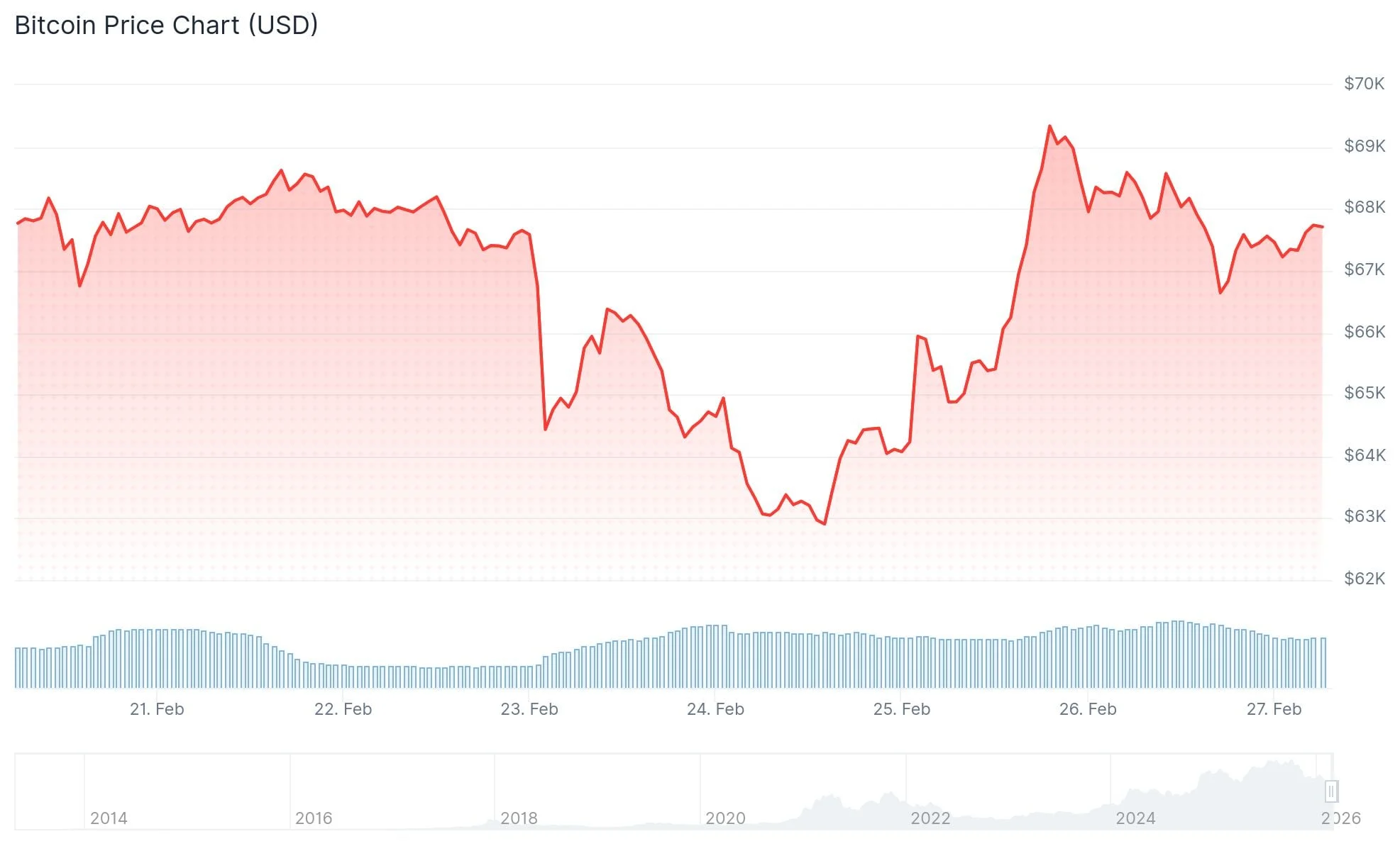
- Bitcoin declined 1.5% on Friday to approximately $67,766 while maintaining a modest 0.6% gain for the week within a constrained price channel
- Market observers characterize the downturn as a leverage liquidation event rather than a directional shift, with demand resuming by Friday’s open
- Alternative cryptocurrencies surpassed Bitcoin’s weekly performance — Cardano climbed 7%, Solana rose 5.5%, Ethereum gained 4.8%, BNB advanced 4.3% — while XRP declined 0.1%
- Nvidia (NVDA) dropped 5.5% following quarterly results, weighing on U.S. equity futures and dragging digital assets lower alongside traditional markets
- Asian stock markets are headed for their strongest February performance since 1998, siphoning investment flows from American exchanges
Bitcoin experienced downward pressure Friday as U.S. equity index futures retreated in the wake of Nvidia’s notable share price decline. The cryptocurrency weakness reflects a wider risk-averse sentiment spreading through international financial markets.
Bitcoin was changing hands near $67,766, representing a 1.5% daily decrease. However, the leading digital currency maintains a 0.6% weekly advance.
Ethereum decreased 1.5% over 24 hours to slightly above $2,047. Both leading cryptocurrencies continue trading within tight boundaries established following the Feb. 5 market correction.
Nvidia tumbled 5.5% Thursday despite surpassing fourth-quarter profit forecasts. The decline seemingly captured market skepticism regarding the sustainability of elevated artificial intelligence expenditure justifying current price levels.
Digital currencies mirrored equity weakness as market participants retreated from higher-risk instruments. This correlation has persisted for several weeks, with Bitcoin demonstrating strong sensitivity to Nasdaq movements.
“The current market action shows Bitcoin behaving like a conventional risk asset,” explained Daniel Reis-Faria, CEO of ZeroStack. “The Nasdaq retreated following Nvidia’s results, and cryptocurrency markets tracked that movement.”
He characterized the decline as a technical adjustment rather than a fundamental shift. “Considerable leverage had accumulated during the recent rally, and when equities weaken, crypto typically serves as the initial de-risking outlet for traders.”
By Friday’s trading session, hourly cryptocurrency returns had reversed into positive territory. This recovery pattern indicates renewed buying interest following overnight liquidations that eliminated excessive leveraged positions.
Alternative Tokens Show Weekly Strength Over Bitcoin
Cardano topped major cryptocurrency performance with a 7% weekly increase. Solana advanced 5.5%, Ethereum gained 4.8%, and BNB rose 4.3%, each surpassing Bitcoin’s weekly results.
XRP represented the sole major token posting negative seven-day returns, declining 0.1% weekly and 3.7% over 24 hours. This relative weakness proved notable considering most alternative cryptocurrencies weathered identical macroeconomic headwinds while preserving gains.
Equity Index Futures and International Capital Movements
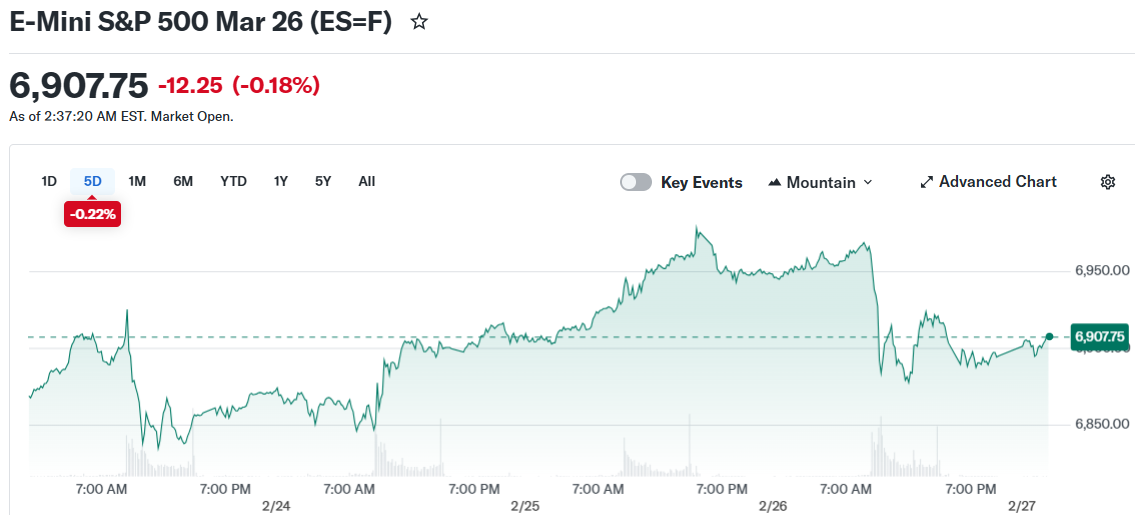
Dow futures retreated approximately 0.6%, S&P 500 futures fell 0.4%, and Nasdaq 100 futures declined 0.3% during Friday’s overnight session.
Asian stock markets are positioned for their most robust February showing since 1998. South Korean technology equities surged approximately 20% this month as capital flows favored AI infrastructure companies.
The MSCI Asia Pacific Index appears set to exceed S&P 500 returns for a third consecutive month. This geographical rotation has redirected investment capital from American markets.
Block shares surged over 23% in after-hours trading following CEO Jack Dorsey’s announcement of nearly 50% workforce reduction, attributing the restructuring to artificial intelligence capabilities transforming company operations.
Market attention now shifts to Friday’s producer price index release, with economic forecasters projecting a 0.3% monthly increase for both headline and core wholesale inflation metrics.

Ripple is transforming how funding and support are distributed across the XRP Ledger ecosystem, shifting toward a more distributed model.
The company announced the changes on February 26. It positions 2026 as a transition point in how builders access capital, mentorship, and technical support on XRPL.
XRP Ledger Enters New Phase as Ripple Expands Funding Channels in 2026
In a recent blog, Ripple noted that since 2017, it has deployed more than $550 million into XRP Ledger ecosystem initiatives, including non-equity grants, builder incentives, strategic partnerships, and growth programs.
The firm noted that 2026 introduces a transition toward a broader, more distributed funding structure. The stated goal is to give builders multiple funding channels.
“As the ecosystem matures, the focus is shifting toward expanding access to funding through more distributed and independent pathways so builders have multiple avenues to scale,” the blog read.
Follow us on X to get the latest news as it happens
As part of the plan, the organization introduced several new and scaled-up initiatives planned for 2026.
XAO DAO is a hybrid Decentralized Autonomous Organization (DAO) built for the XRP Ledger. It will empower members to collectively allocate resources through community grants, feedback loops, and direct DAO proposals. Additionally, this enables fast, low-friction funding for developers and early-stage projects.
“By shifting decision-making power toward a broader group of stakeholders, XAO DAO represents a significant step toward a more resilient and community-led governance model for the XRPL,” the firm said.
XRPL Commons, an independent organization, will continue supporting builders through initiatives like the GLOW program and The Aquarium, a 9-week incubator in Paris that has operated since 2023. The firm is also developing a new regional entity, XRP Asia, to serve the APAC builder community with localized funding and support.
In addition, the University Digital Asset Xcelerator (UDAX), which launched its inaugural cohort with UC Berkeley in fall 2025, is expanding in 2026 to Fundação Getulio Vargas in São Paulo, the University of Oxford, and UC Berkeley again in the fall.
On the institutional side, Ripple is launching a FinTech Builder Program to support startups building institutional-grade financial applications on XRPL.
The blog also revealed that a growing number of venture capital firms are mentoring teams, investing in startups, and connecting XRPL builders with global capital networks. Partner organizations include a100x Ventures, Superscrypt, Reforge, New Form Capital, Dragonfly, Pantera, Franklin Templeton, and Tenity. Their involvement signals broader institutional confidence in XRPL.
To enable access to this expanding ecosystem, Ripple announced that a new dedicated XRPL funding hub will soon launch. This will serve as a single entry point for builders to discover grants, accelerators, and support programs across the entire ecosystem.
XRP Price Slides Despite Ripple’s 2026 Expansion
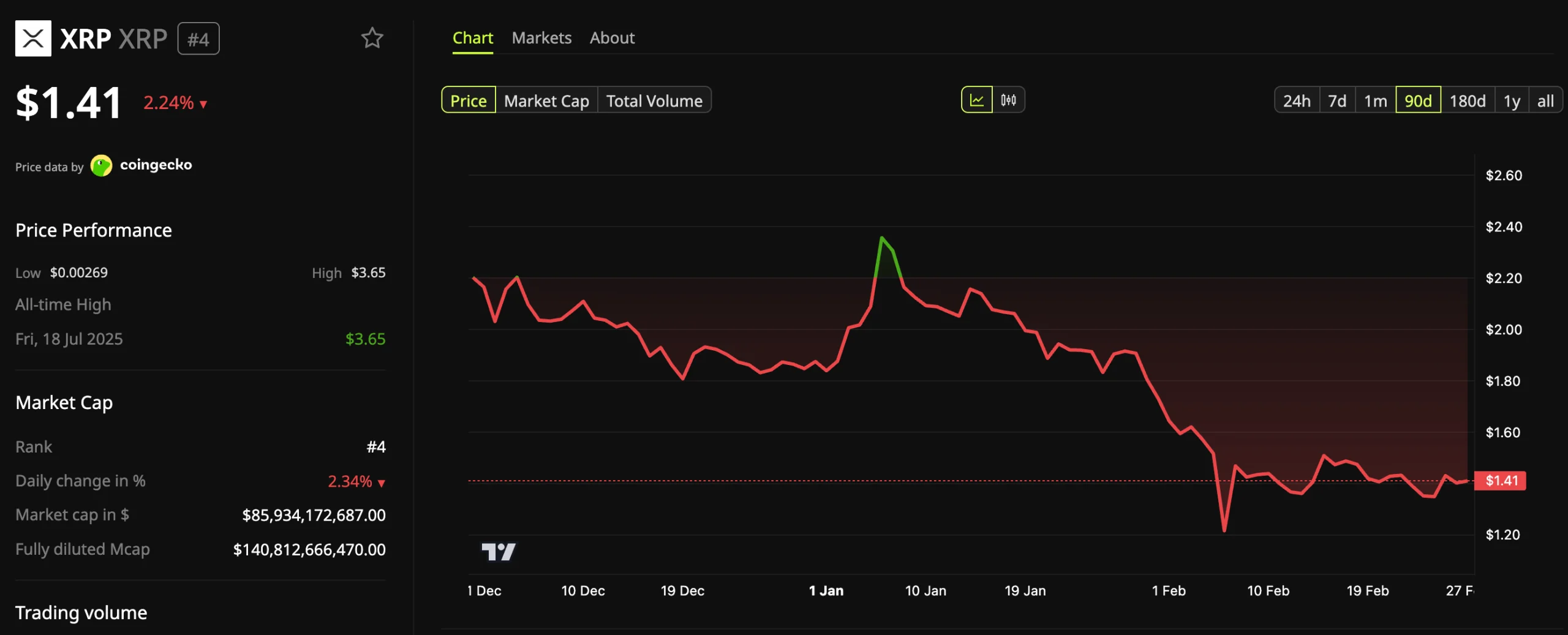
The new initiatives come as XRP’s performance continues to track the broader market. BeInCrypto Markets data shows that the altcoin declined 2.24% over the past day. At press time, XRP was trading at $1.41.
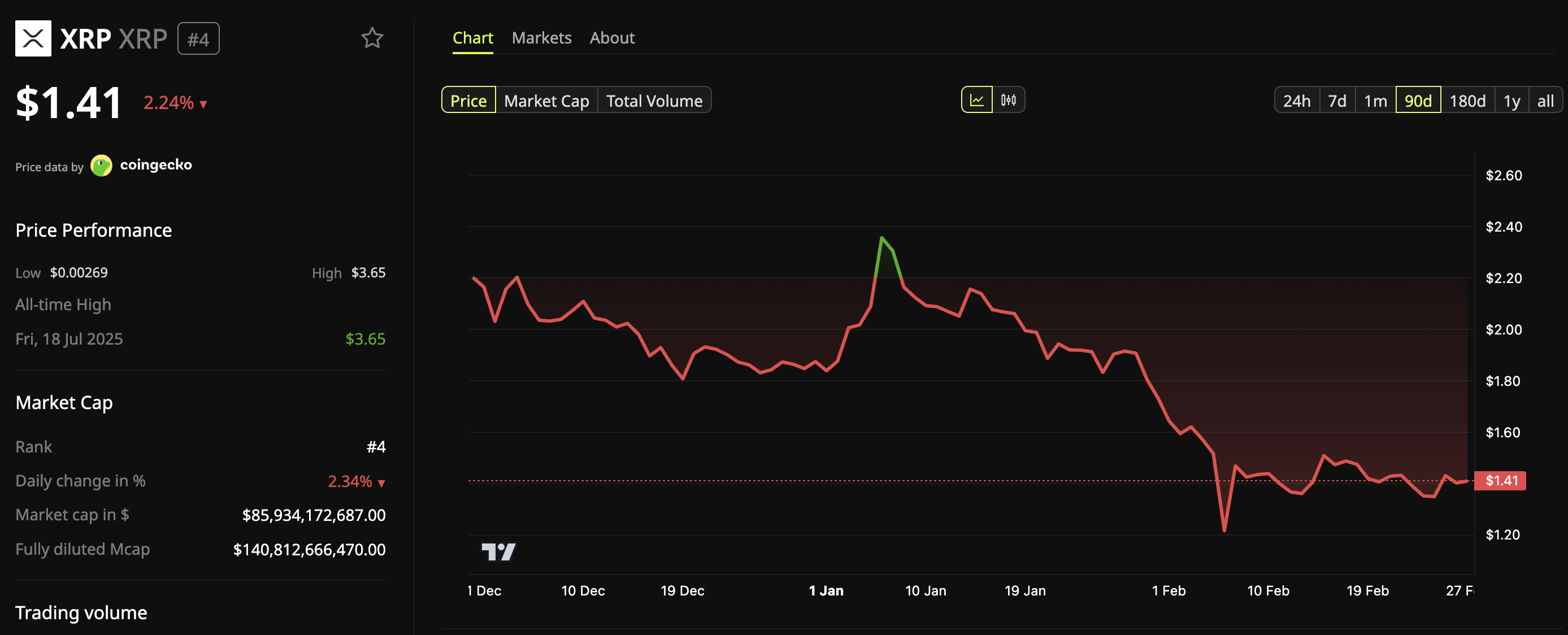
In the short term, the funding shift is unlikely to move XRP’s price. Market performance is typically driven by liquidity conditions, macro trends, and regulatory developments rather than ecosystem restructuring.
Over the medium- to long-term, the impact depends on execution. If the FinTech Builder Program, XAO DAO, and venture participation translate into higher on-chain activity, institutional pilots, and real financial applications, sentiment could strengthen.
Subscribe to our YouTube channel to watch leaders and journalists provide expert insights
Sustained adoption, transaction growth, and deeper integration of XRP into payment or tokenization flows would be required for any structural price effect to occur. Ultimately, usage metrics, not funding headlines, will determine whether this shift supports long-term valuation.


Morgan Stanley, a Wall Street bank managing nearly $9 trillion in assets, plans to offer clients Bitcoin (BTC) custody, trading, lending, and yield-generation services.
The firm is one of the largest financial institutions in the United States. In addition, the client base spans retail investors, high-net-worth individuals, and institutional players.
Why it matters:
- Morgan Stanley’s entry into BTC services would give clients direct access to Bitcoin through a regulated, trusted institution.
- Furthermore, adding yield and lending products expands BTC’s utility beyond simple custody, attracting clients seeking returns on digital asset holdings.
- Wall Street adoption at this scale signals Bitcoin’s shift from speculation to structural integration in global finance.
The details:
The big picture:
- In addition, River data shows Fidelity Investments, Bank of America, and Morgan Stanley each recommend clients allocate 1–5% of portfolios to BTC.
- Meanwhile, Morgan Stanley’s move follows a broader trend of major banks expanding crypto service offerings to institutional and retail clients.
[PRESS RELEASE – San Francisco, CA, USA, February 26th, 2026]
PACT, the leading on-chain credit and payments infrastructure protocol and #1 RWA protocol on Aptos, today announced that its native token, $PACT, is now supported on the world’s most trusted cryptocurrency exchanges, including Kraken, MEXC, and Gate.
PACT Expands Access as It Builds the Future of On-Chain Finance
PACT enables end-to-end, fully programmable credit infrastructure, supporting origination, servicing, repayments, covenants, waterfalls, and stablecoin settlement entirely on-chain. Unlike traditional RWA protocols that wrap off-chain credit in tokens, PACT embeds the credit system itself into blockchain rails.
Today, PACT technology is used by fintech lenders, asset managers, and financial institutions operating across emerging markets. Its infrastructure supports real-time, cross-border stablecoin flows and high-frequency micro-loan origination at scale. It enables fully automated credit facilities with built-in risk management and end-to-end repayment and settlement pipelines.
PACT runs on Aptos, leveraging its low-latency, high-throughput architecture to deliver real-time financial operations at scale. This allows credit markets – historically fragmented, slow, and opaque – to operate at the speed, automation, and transparency of a modern financial internet.
Understanding $PACT
The $PACT token serves as the core coordination and participation layer of the protocol, enabling users and stakeholders to directly shape the network’s evolution. As the native governance asset for the PACT DAO, $PACT empowers its decentralized community of token holders to propose, vote on, and implement protocol upgrades while guiding the long-term direction of PACT’s on-chain financial infrastructure. It’s used to facilitate ecosystem rewards, support community growth, and ensure transparent management of protocol revenue and treasury resources.
“Being supported by major exchanges opens the door for more people to join PACT’s community governance and contribute to the future of global credit markets. Every step like this brings us closer to a world where credit and financial access are open, transparent, natively on-chain, and available to everyone,” said Zander Rafael, Co-Founder Pact Labs.
The token underpins the system’s economic utility through staking, which strengthens network security, aligns incentives among participants, and distributes governance power based on long-term commitment.
These functions make $PACT an essential component of the protocol’s operation and the foundation for a sustainable, community-driven financial network.
A Year of Breakthrough Momentum
PACT’s ecosystem has expanded rapidly over the past year, achieving several major milestones:
- $1.9B+ total loans originated on-chain through PACT-powered fintech partners
- Hundreds of thousands of embedded wallets created through PACT SDKs
- 2,000+ loans per day originated
- Creation of end-to-end stablecoin payroll and credit flows
These achievements demonstrate the global demand for programmable, on-chain financial systems and the critical role PACT plays in making credit more accessible, transparent, and efficient.
A New Phase of Global Accessibility
Support on these exchanges introduces PACT to a broader global audience, making it easier for users, partners, and developers worldwide to access and interact with the PACT ecosystem.
Kraken, MEXC, and Gate’s listings reinforce PACT’s position as a leading protocol building the foundation for the next generation of blockchain-powered financial systems.
About PACT
PACT develops the core wallet, data, and payment rails that bring asset-based lending fully on-chain. Our infrastructure enables fintechs and asset managers to access stablecoin capital, manage repayment flows, and scale lending operations across borders. Unlike projects focused on wrapping large institutional loans, PACT proves the model with high-frequency lending, facilitating thousands of smaller loans each day through our partners. This approach reduces reliance on traditional intermediaries, lowers the cost of capital, and expands access to credit. By helping fintechs transition into stablecoin-powered financial institutions, PACT is advancing both stablecoin adoption and the modernization of global lending.
Users can follow PACT
X | Telegram | Discord | Medium | Web
Binance Free $600 (CryptoPotato Exclusive): Use this link to register a new account and receive $600 exclusive welcome offer on Binance (full details).
LIMITED OFFER for CryptoPotato readers at Bybit: Use this link to register and open a $500 FREE position on any coin!
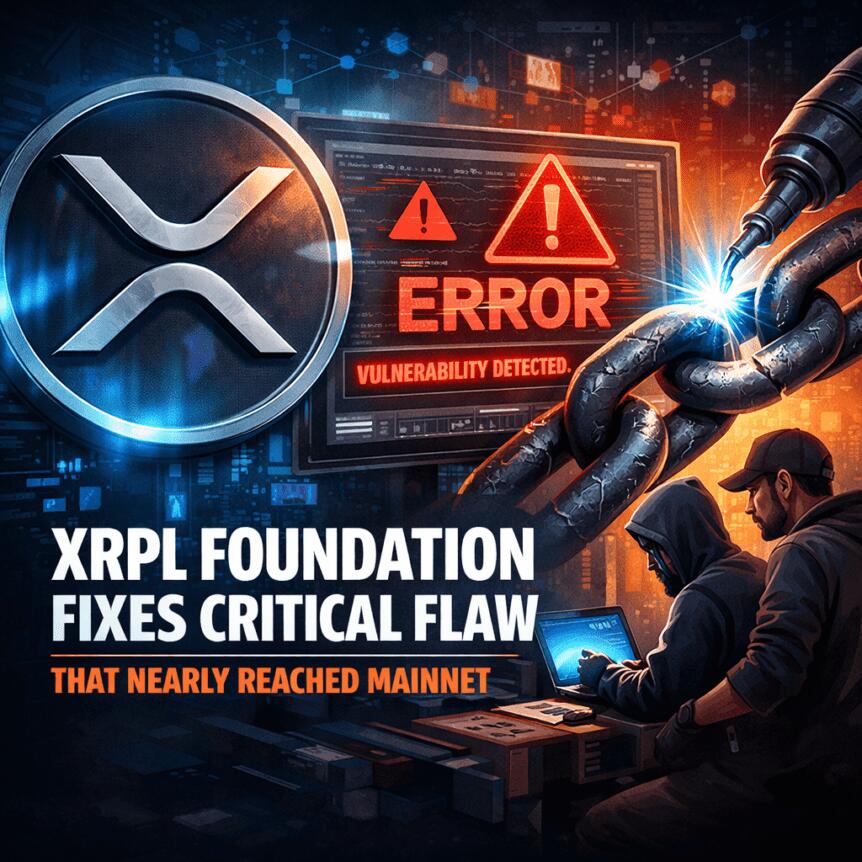
In a security-focused update, the XRP Ledger Foundation (CRYPTO: XRP) confirmed it patched a critical flaw in an upcoming amendment to Ripple’s XRP Ledger, averting a potential on-chain exploit. On February 19, a Cantina security engineer and its AI assistant detected a logic flaw in the signature-validation routine tied to a code batch amendment. The amendment had entered voting but had not activated on mainnet, and officials stressed that no funds were at risk at the time. The incident underscores how on-chain governance, automated discovery, and rapid patching interact in the evolving security landscape of public blockchains.
Key takeaways
- The flaw resided in the signature-validation logic of a code-batch amendment slated for the XRP Ledger, creating a theoretical path to unauthorized transactions if exploited.
- The amendment was still in the voting phase and had not been activated on mainnet, meaning funds were not exposed at the time of discovery.
- Cantina AI’s autonomous vulnerability hunter Apex identified the issue, highlighting the role of AI-powered tooling in proactive security workflows.
- The XRPL Foundation described the potential exploit as capable of eroding confidence in the XRP Ledger and destabilizing the broader ecosystem if left unpatched.
- An emergency patch, rippled 3.1.1, was released on February 23 to block the amendment from activating, reflecting a rapid, coordinated response by the Ripple engineering and validator communities.
Tickers mentioned: $XRP
Market context: The episode arrives amid increasing attention on governance safety, on-chain upgrade processes, and the growing use of AI-driven security tools to identify flaws before they can be exploited. While no funds were at risk in this instance, the incident underscores how rapid disclosure, responsible patching, and a mature validator environment help preserve confidence in public ledgers as the crypto industry navigates ongoing macro and regulatory uncertainties.
Why it matters
The XRPL ecosystem demonstrated a disciplined, defense-forward response to a potential class of vulnerability that could have had outsized consequences. In this case, the vulnerability lay in a signature-validation routine tied to a prospective amendment. Because the amendment had not yet activated on mainnet, the risk remained theoretical, but the XRPL Foundation’s decision to halt its momentum and push for a secure fix illustrates how governance processes can act as a safeguard against mischief or misconfigurations before they ever affect real users or funds.
Beyond the immediate incident, the episode spotlights the balance between improvement and risk in decentralized networks. Amendments that modify validation logic or consensus rules are powerful but carry operational risk; the governance cycle—proposal, testing, voting, and activation—must be coupled with robust security testing to prevent drift between code intent and on-chain behavior. The XRPL Foundation’s emphasis on a clear, auditable patch path reinforces the importance of reliability as developers push new features and optimizations onto a live ledger used by institutions and individuals alike.
On the security tooling front, the event contributes to a broader narrative about AI-enabled defense. Cantina AI’s autonomous discovery tool—Apex—identified the bug through static analysis of the rippled codebase and submitted a disclosure that allowed Ripple’s engineering teams to validate and patch the issue. This incident sits within a growing backdrop where AI-driven scanners and automated auditing are increasingly deployed to detect flaws that human inspectors might miss. Anthropic’s Claude Code Security, unveiled just days earlier, has already become a talking point in security circles, illustrating a trend toward AI-powered reasoning in vulnerability detection and remediation. As AI tools become more integrated into software development and security workflows, the industry may see faster mitigations but also a need to manage the risk of false positives and new threat surfaces introduced by automated processes.
A successful large-scale exploit could have caused substantial loss of confidence in XRPL, with potentially significant disruption for the broader ecosystem.
The investigation also aligns with broader discussions about the economics of security in crypto networks. Cantina’s Hari Mulackal has framed the potential impact in monetized terms, noting that the hypothetical loss could have been dramatic, given the scale of the XRP market capitalization. While the specific asset’s price is subject to broader market dynamics, the emphasis here is on preserving trust and functionality within the ledger’s architecture, rather than on short-term price moves.
In tandem with the technical response, the incident demonstrates how AI-enabled security tooling is reshaping incident response in crypto. The use of automated code analysis, prompt vulnerability disclosure, and rapid patching can shorten the window during which an attacker could act, shifting risk dynamics in favor of users and validators who uphold the network’s integrity. The ripple effect across ecosystems is unlikely to be isolated to one project; as more blockchains integrate similar tools, the bar for secure upgrade processes rises, potentially reducing the frequency and severity of major exploits in the future.
What to watch next
- Monitor updates on the amendment’s voting status and any new disclosures from XRPLF and Ripple’s engineering teams, including patch notes and rollback options if needed.
- Watch validator participation in rippled 3.1.1 adoption and downstream effects on on-chain performance and upgrade timelines.
- Follow Cantina AI’s ongoing research and any subsequent bug disclosures related to XRPL or comparable codebases embedded in other ledgers.
- Assess how AI-driven security tools influence governance and incident response timelines across the broader crypto ecosystem.
Sources & verification
- XRPL Foundation vulnerability disclosure report (xrpl.org/blog/2026/vulnerabilitydisclosurereport-bug-feb2026).
- XRPLF status update confirming the non-activation of the amendment on mainnet and the emergency mitigation (XRPL Foundation).
- Cantina AI and Spearbit leadership statements about the discovery and the Apex autonomous vulnerability hunter (X thread: https://x.com/hrkrshnn/status/2027191844988424343).
- Rippled 3.1.1 emergency patch details and rollout timing (XRPLF status updates).
What the wider story changes: patching a future risk
Bitcoin bulls managed to defend the $66K support level as the leading crypto asset reversed part of its strong gains yesterday that was partly fueled by a strong uptick in ETF inflows.
Summary
- Bitcoin price rebounded from above $66,000 support as its ETFs resumed an inflow trend.
- A bearish flag pattern has formed on the daily chart.
According to data from crypto.news, Bitcoin (BTC) price surged nearly 7% to roughly $70,000 on Thursday as investor sentiment for risk assets was boosted following the release of a bullish Nvidia earnings report that triggered a surge in tech stocks.
Rising equity prices often act as a catalyst for a risk-on rotation. As market confidence strengthens, capital flows out of defensive positions and into high-beta sectors like cryptocurrency.
The bellwether’s rally was also supported by a strong demand seen from institutional investors for spot Bitcoin ETFs. Data from SoSoValue shows that the 12 U.S. spot Bitcoin ETFs drew in $506 million in net inflows on Feb. 25, nearly double the figure recorded the prior day.
Shortly after its $70K rally, Bitcoin price had retraced nearly 4% to $66,641. This selloff was accompanied by a 2% drop in Nasdaq as investors booked profits after the stock’s notable run higher into the earnings event. The drawdown created a cooling effect across the broader financial landscape.
Bitcoin has since bounced back above $67,500 after bulls lodged another attempt to reclaim the $70K threshold. The momentum was supported by the $254 million inflows recorded by spot BTC ETFs on Thursday.
Despite today’s bounce, some analysts believe Bitcoin could continue its larger downtrend that began in early January before any meaningful trend reversal takes shape.
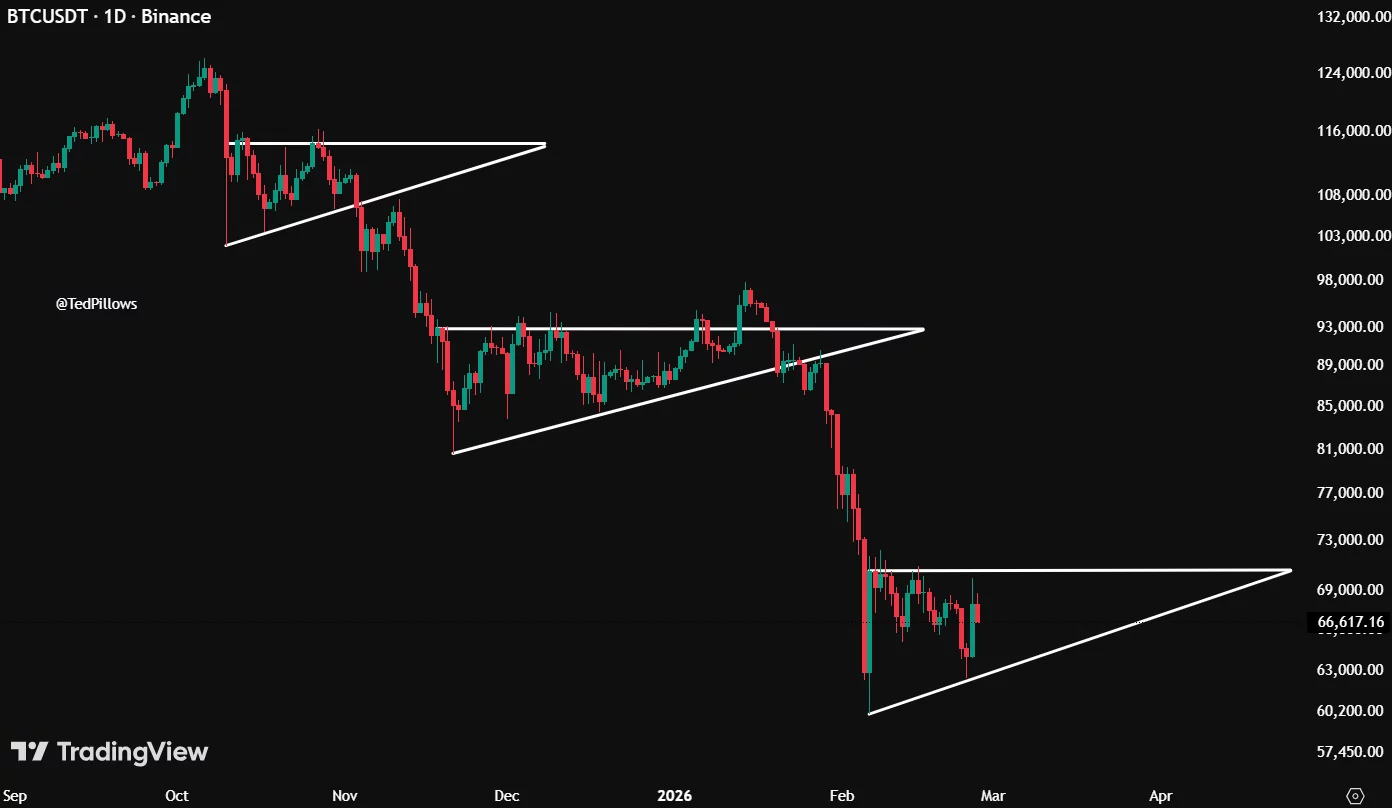
According to analyst Ted Pillows, Bitcoin price appears to be forming a recurring fractal pattern that has historically preceded downturns.
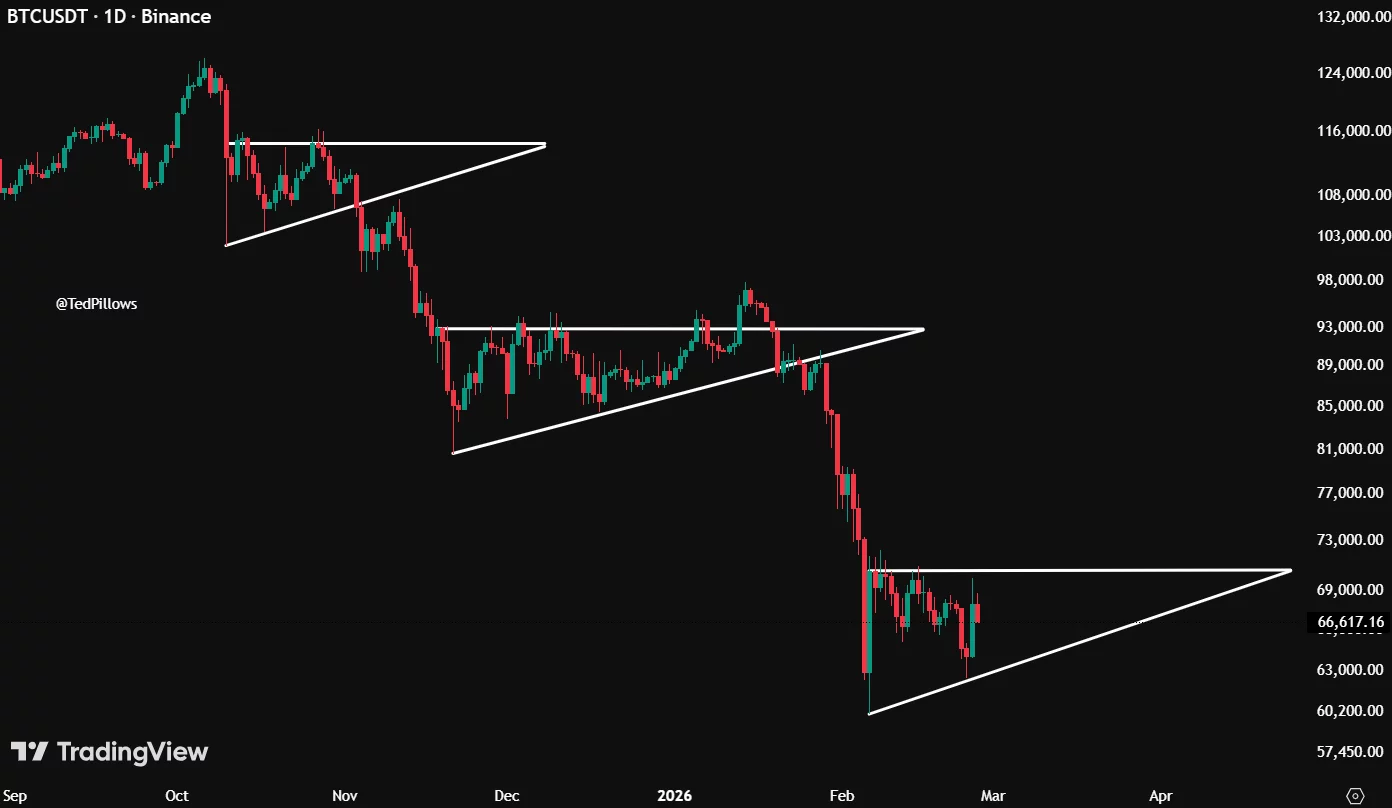
“Once more people are convinced $60,000 was the bottom, the next dump to a new low will start,” said Pillows in a Feb. 26 X post.
Bitcoin has formed a bearish flag pattern on the daily chart. This pattern consists of a sharp price decline followed by a period of steady, upward consolidation within two parallel lines.
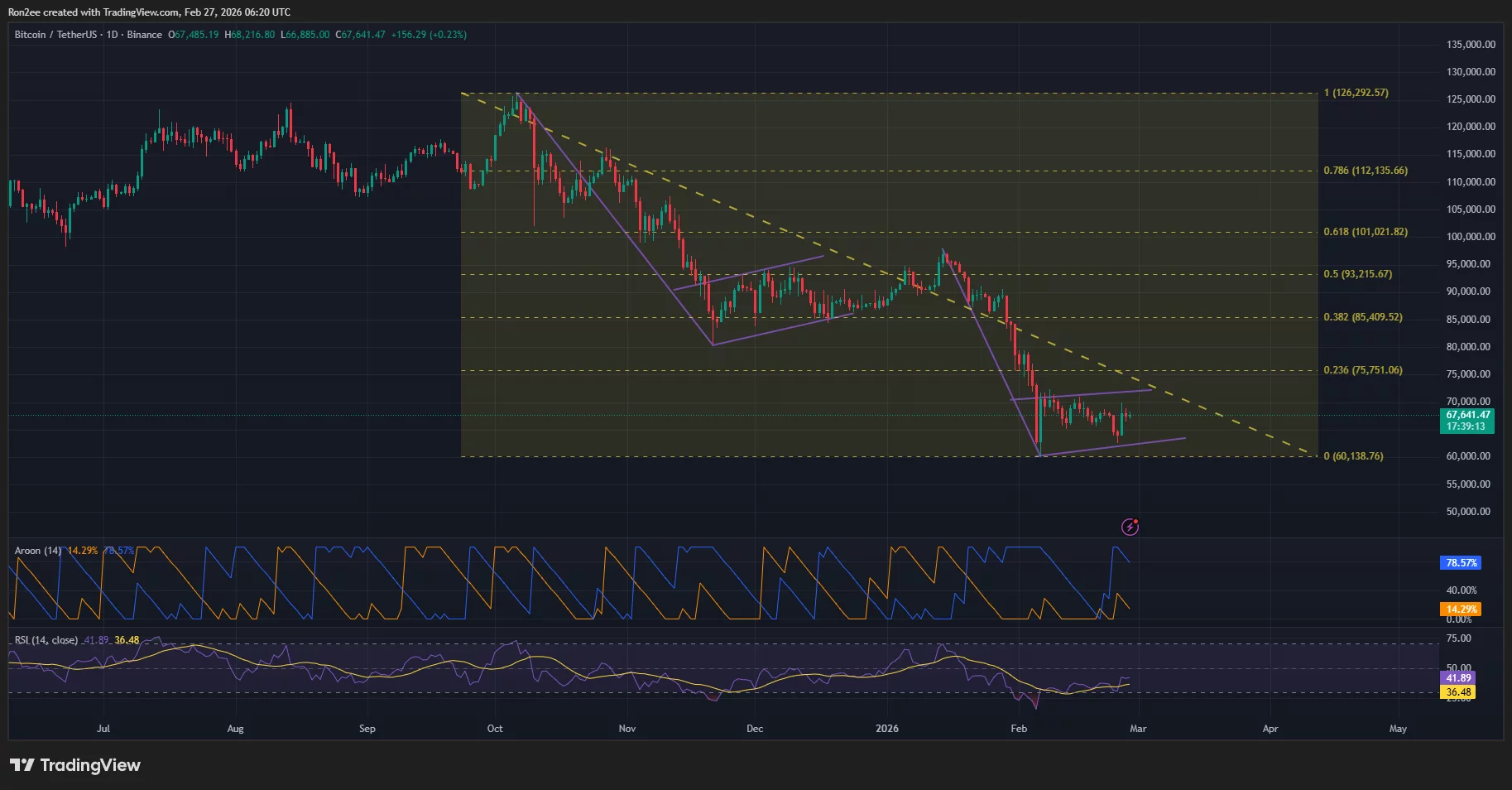
Historically, Bearish flags have confirmed the continuation of an ongoing downtrend after short periods of consolidation.
At press time, other technical indicators also seem to show bears are currently at an advantage. Notably, the Aroon Down was at 78.55, which is significantly higher than the Aroon Up, suggesting bears were still dominating the market trend.
The Relative Strength Index, which has moved closer toward the neutral thresholds, also indicates that there is potential room for more downside pressure before the asset hits oversold levels.
For now, $65,000 remains the key support level to watch. The level has acted as a psychological defensive line for nearly three weeks and seems to be holding strong for now, as a large cluster of buy orders and long positions was seen accumulating in this range.
A sharp drop under the $65K mark could lead bears to target $60K, a psychological level bears tried to penetrate during the Feb. 6 crash.
Disclosure: This article does not represent investment advice. The content and materials featured on this page are for educational purposes only.
TLDR
- Ethereum touched $2,150 this week before encountering resistance across several technical indicators
- The $2,100 level represents a critical threshold, matching the realized price for wallets containing 100,000+ ETH
- The 30-day realized volatility for ETH approaches 0.97, marking the highest point since March 2025
- Liquidations of short positions exceeded $220M across 48 hours, while funding rates shifted into positive territory
- ETF outflow pressure shows signs of weakening, although definitive accumulation trends remain absent
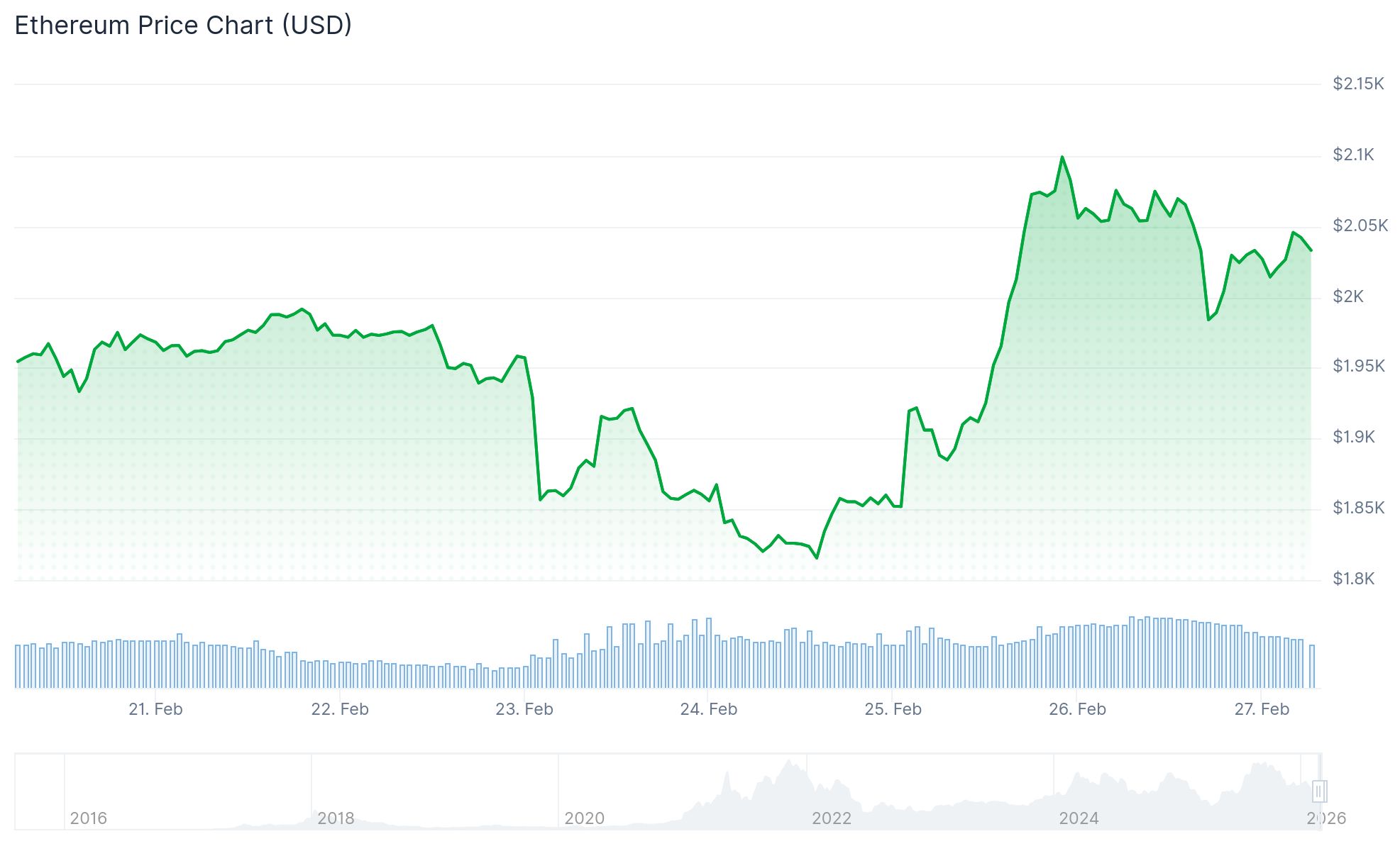
Ethereum surged to $2,150 during Thursday’s trading session before experiencing a retracement. The cryptocurrency continues navigating a narrow trading corridor, with $2,000 serving as crucial support and $2,100 emerging as the next significant barrier.
Closing above $2,100 on the daily timeframe carries particular significance as this price point corresponds to the realized price for addresses holding 100,000 ETH or greater. The realized price metric represents the average acquisition cost based on the last on-chain movement, providing insight into whether major stakeholders maintain profitable positions.
Historical data from 2020 onward reveals ETH has rarely traded beneath this whale cohort’s cost basis, with the most notable exception occurring throughout 2022’s bear cycle. Previous tests of this threshold have typically preceded price recoveries.
Futures and Funding Rates
The derivatives market witnessed short position liquidations exceeding $220 million during the previous 48-hour period, eliminating substantial leveraged positions. Binance funding rates, which plunged deeply negative in early May as bearish positions accumulated, have reversed course to reach positive 0.23%.
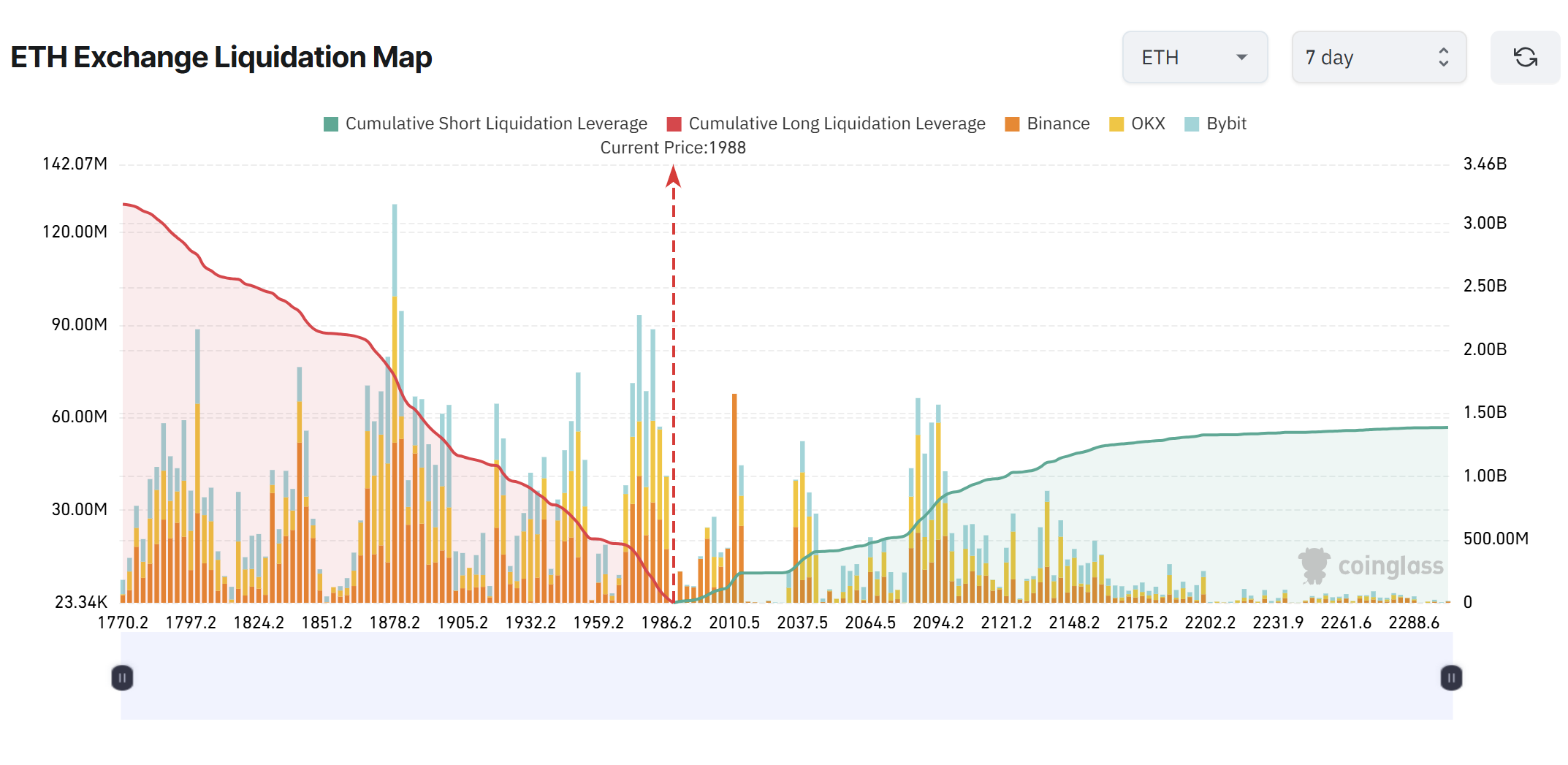
This reversal indicates that traders who opened shorts late in the cycle faced forced liquidations. Nevertheless, with funding rates now trading at elevated positive levels, the market structure favors long positions, creating potential vulnerability for a long squeeze toward $1,800 should upward momentum weaken.
Approximately $2.66 billion in long position liquidation exposure clusters around the $1,800 price zone, establishing a substantial liquidity pocket beneath current trading levels.
Volatility and ETF Flows
Ethereum’s 30-day realized volatility measured on Binance has climbed to approximately 0.97, representing the highest measurement recorded since March 2025. Heightened volatility during this phase may indicate market uncertainty and directional indecision rather than establishing a clear trend.
Price action continues trading beneath the 50-day, 100-day, and 200-day moving averages. Following the rejection near $4,800 in late 2025, each subsequent recovery attempt has established lower peaks, suggesting persistent distribution pressure.
Regarding ETF activity, selling pressure appears to be diminishing. Following substantial outflows throughout mid-2025, recent flow statistics indicate reduced movement in either direction. Institutional distribution seems to be decelerating, although convincing accumulation signals have yet to materialize.
Market analyst Leon Waidmann observed that retail participants with low conviction have predominantly exited their positions. Short interest continues declining, while highly leveraged long positions have been slow to establish meaningful presence.
Technical strategist IncomeSharks identified three overhead resistance zones, including multiple SuperTrend rejections and channel resistance positioned near $2,250. The analyst additionally highlighted April’s lows around $1,500 as a critical downside level should demand weaken once more.
At press time, ETH was changing hands at $2,034.


Bitcoin’s (BTC) downturn has spurred conspiracy theories around alleged market manipulation by firms. However, Bitwise’s Chief Investment Officer (CIO), Matt Hougan, argues that the primary reasons are more straightforward.
This narrative highlights the ongoing debate about what drives major crypto market moves, whether it’s institutional strategies, technological threats, or fundamental market cycles.
Why is Bitcoin’s Price Dropping?
Hougan addressed widespread speculation on social media that Bitcoin’s drop was the result of coordinated moves. BeInCrypto previously reported that some users made allegations against Binance.
More recently, some community members pointed to recurring patterns such as the alleged “10 AM Bitcoin dump” by Jane Street. The executive dismissed these narratives directly, calling the actual explanation “far more boring” than the theories suggest.
“The conspiracy theories are wild. First it was Binance and then it was Wintermute and then it was an unknown offshore macro hedge fund and then it was paper bitcoin and. today it is Jane Street and next week it will be someone else,” he said.
Follow us on X to get the latest news as it happens
Hougan said the “real reason Bitcoin is down” is that long-term holders have been reducing exposure. According to him, investors cut positions by selling spot Bitcoin, closing leveraged trades, and writing covered calls, creating downward pressure on the price.
The Bitwise CIO attributed selling behavior to three factors:
- The four-year market cycle theory.
- Concerns surrounding quantum computing.
- Capital rotation from crypto into artificial intelligence (AI) startups.
The quantum computing discussion has gained traction in the crypto community recently. While MicroStrategy co-founder Michael Saylor recently downplayed concerns about quantum risks, some investors remain cautious.
Kevin O’Leary, the Canadian businessman and Shark Tank investor, has warned that institutional investors are capping Bitcoin allocations at around 3% until the industry demonstrates a credible solution to quantum vulnerabilities. Jefferies’ global head of equity strategy, Christopher Wood, went further, removing a 10% Bitcoin allocation from the model portfolio over the same concerns.
Subscribe to our YouTube channel to watch leaders and journalists provide expert insights
Crypto Winter’s Timeline and Prospects for Recovery
Meanwhile, Hougan added that most of the selling is likely complete. He claimed that Bitcoin is in the “process of bottoming” and could eventually reach new all-time highs. According to him,
“This is a classic crypto winter and there will be a classic crypto spring.”
Hougan previously stated that the current crypto winter began in January 2025, and given the 13-month historical duration, the end could be near.
On-chain analyst Willy Woo offered a more nuanced view. He said the recent sell-off appears exhausted but cautioned that deteriorating spot and futures liquidity could cap any near-term rebound.
Woo’s timeline places the end of bearish conditions in Q4 2026, with bullish momentum potentially returning in Q1 or Q2 2027.
“~45k would be a typical bear market bottom. BTC has only ever existed in a secular global macro bull market 2009-2026. If global macro breaks down, then 30k is the fall back level of support, 16k as the final line to maintain BTC’s bull trend,” Woo wrote.
The distance between these timelines reflects a broader uncertainty about where exactly the market sits in its cycle. What analysts broadly agree on is that Bitcoin’s current weakness reflects structural and psychological forces, not manipulation.
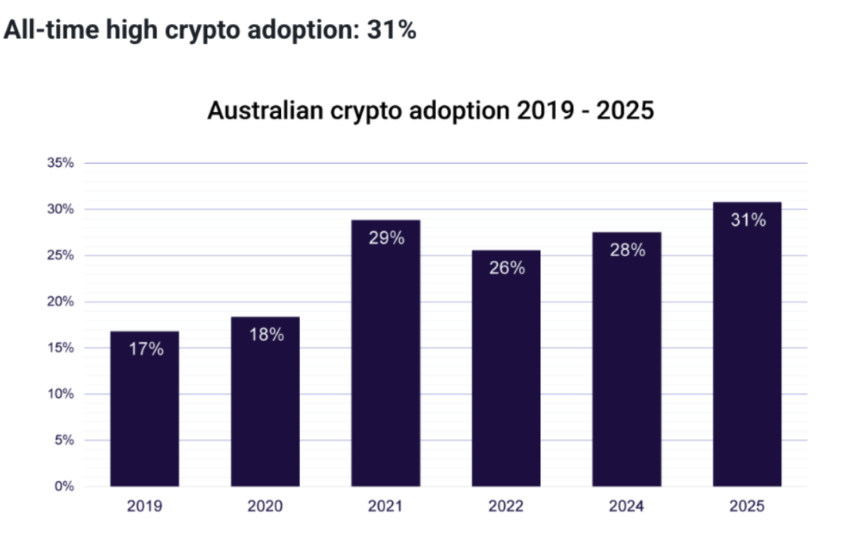
Australia’s crypto market is making progress in user growth and regulatory reforms, but there are still a range of issues to iron out in the sector, crypto executives told Cointelegraph.
On the sidelines of the XRP Australia 2026 event in Sydney on Friday, Coinbase APAC managing director John O’Loghlen said the country has seen positive regulatory momentum and growing expertise among those tasked with policing the industry.
“Multiple arms of government, mainly Treasury, who are writing the draft regulation and ASIC have thoroughly upskilled their teams and have pretty deep digital asset domain expertise internally. So I think there’s been pretty positive movement.”
O’Loghlen also said institutional interest and access are growing through products like crypto exchange-traded funds. Australia’s first ETF, which holds Bitcoin (BTC) directly, went live in June 2024, followed by an ETF that holds Ether (ETH) in October 2024.
He also noted that Coinbase Global’s inclusion in the Standard & Poor’s 500 (S&P 500) index offers Australian institutions a means to access crypto-related stocks, allowing them to learn “about the industry in a very passive way.”
A 2025 report from crypto exchange Independent Reserve found that crypto adoption among Australians reached 31%, up from 28% in 2024. Additionally, 29% said they planned to invest in the next 12 months.

Self-managed super fund investors eye crypto
OKX Australia CEO Kate Cooper noted that a significant area of growth for the exchange has come from sophisticated traders, self-managed super fund (SMSF) trustees and high-net-worth individuals.
At the same time, she said across the industry there are a growing number of new self-managed super funds being set up specifically so trustees can invest in digital assets, “because they currently can’t invest via the big super funds.”
SMSFs are retirement funds set up and managed by individuals, rather than conventional funds managed by large institutions on behalf of users.
In a yet-to-be-released OKX report on SMSFs, Cooper said many respondents were interested in digital assets to diversify their holdings.
“That’s the feedback that we got through the research: a significant number of people wanting a diversified portfolio, wanting not just crypto, but digital assets more broadly, to be held as part of their portfolio. And SMSF is one of the main ways to do that.”
Lingering issues remain in Australia’s crypto scene
Last September industry executives, including Cooper, told Cointelegraph that users in Australia still face banking barriers when engaging with exchanges and other crypto businesses.
“It’s absolutely still a challenge in the industry,” Cooper said. “I don’t think there’s been any improvements. And we’re working hard with governments to encourage them to set some standards around it.”
O’Loghlen also called for solutions to debanking, stronger protections for blockchain payments innovation and greater support for Australian stablecoins.
“Regulatory settings must support innovation rather than inadvertently constrain it,” he said.
Related: Crypto lobby slams Australian broadcaster’s ‘sensational’ Bitcoin article
“As the Regulation of Payment Service Providers reforms are developed, it will be important to ensure that non-custodial wallet developers and public blockchain infrastructure providers are not unintentionally captured within licensing regimes designed for intermediaries,” O’Loghlen added.
Australian legal and regulatory landscape in limbo
Meanwhile, Australian crypto lawyer Bill Morgan said the Australian legal and regulatory crypto landscape appears to be in “wait and see” mode at the moment, following the ongoing court case between the Australian Securities and Investments Commission (ASIC) and fintech firm Block Earner.
ASIC is appealing a Federal Court decision siding with Block Earner about whether it was required to hold a financial services license for its crypto-related products.
He also pointed to a change in government that could be slowing legislation down.
“I think to some extent it’s a function of having three-year terms. There was some momentum under the former Liberal National Party coalition government, but then, when Labor won its first term four years ago, it took a while for it to get going again.”
Magazine: 6 massive challenges Bitcoin faces on the road to quantum security

Gorton and Denton: welcome to Balkanised Britain

Brady Tkachuk addresses White House AI video showing him insulting Canada

Netflix backs out of Warner Bros. Discovery bidding war


-

 Politics5 days ago
Baftas 2026: Awards Nominations, Presenters And Performers
-

 Fashion7 days ago
Weekend Open Thread: Boden – Corporette.com
-

 Sports4 days ago
Women’s college basketball rankings: Iowa reenters top 10, Auriemma makes history
-

 Politics4 days ago
Nick Reiner Enters Plea In Deaths Of Parents Rob And Michele
-

 Business3 days ago
True Citrus debuts functional drink mix collection
-

 Politics8 hours ago
ITV enters Gaza with IDF amid ongoing genocide
-

 Crypto World3 days ago
XRP price enters “dead zone” as Binance leverage hits lows
-

 Business5 days ago
Mattel’s American Girl brand turns 40, dolls enter a new era
-

 Business5 days ago
Law enforcement kills armed man seeking to enter Trump’s Mar-a-Lago resort, officials say
-

 Tech3 days ago
Unsurprisingly, Apple's board gets what it wants in 2026 shareholder meeting
-

 NewsBeat1 day ago
Cuba says its forces have killed four on US-registered speedboat | World News
-
 NewsBeat1 day ago
Manchester Central Mosque issues statement as it imposes new measures ‘with immediate effect’ after armed men enter
-
 NewsBeat4 days ago
‘Hourly’ method from gastroenterologist ‘helps reduce air travel bloating’
-

 Tech5 days ago
Anthropic-Backed Group Enters NY-12 AI PAC Fight
-

 NewsBeat5 days ago
Armed man killed after entering secure perimeter of Mar-a-Lago, Secret Service says
-

 Politics5 days ago
Maine has a long track record of electing moderates. Enter Graham Platner.
-
 NewsBeat2 days ago
Police latest as search for missing woman enters day nine
-

 Business1 day ago
Discord Pushes Implementation of Global Age Checks to Second Half of 2026
-

 Crypto World2 days ago
Entering new markets without increasing payment costs
-

 Business11 hours ago
Only 4% of women globally reside in countries that offer almost complete legal equality