
Crypto World
The ‘tokenization of everything’ is no longer a theory



For a decade, the crypto industry has gathered at Consensus to discuss what was coming next. This year, something different is happening. The future has started arriving.
Real-world assets are being minted onchain. Stablecoins are quietly becoming the connective tissue of global commerce. Prediction markets are turning probability into a tradable asset class. The institutions that once dismissed all of this – Morgan Stanley, Nasdaq, the NYSE, DTCC, SWIFT, Franklin Templeton – are now sending their senior people to Miami to talk about how they fit in.
When Consensus 2026 convenes May 5–7 at the Miami Beach Convention Center, it won’t feel like a conference about crypto’s potential. It will feel like a summit about what happens next now that crypto’s promise has become the financial industry’s new reality.
The institutions have landed
For years, traditional finance circled the crypto industry from a cautious distance. That distance has collapsed.
The 2026 speaker roster reads like a who’s-who of institutional legitimacy: Mastercard, PayPal, T. Rowe Price, Nasdaq, NYSE, Morgan Stanley, SWIFT, and DTCC alongside crypto’s foundational builders. The sponsor list tells the same story: JPMorgan, Fidelity, Coinbase, Google, Bridge by Stripe, Broadridge, Circle, Grayscale, FTSE Russell and more. These are not exploratory delegations. They are bets.
“Consensus brings every pillar of the industry together for the largest crypto trade conference in North America,” says a Coinbase spokesperson. “That’s exactly where we want to be in order to move the needle.”
What drew them all in? The short answer is 24/7 markets. The longer answer is what those markets made possible.
Always on, everywhere at once
Blockchain infrastructure runs on internet time – no opening bell, no closing hour, no pause in price discovery. For years, traditional finance treated this as a quirk. They’ve since realized it’s a competitive advantage they don’t have.
In a world where capital moves at the speed of information and users expect their financial lives to work at midnight in Dubai as well as they do at noon in New York, always-on markets aren’t a novelty. They’re the standard. And now TradFi is racing to meet it.
The conversations at Consensus 2026 won’t debate whether 24/7 markets matter. They’ll debate the playbook: settlement rails, custody infrastructure, regulatory guardrails, and who controls the on-ramps.
Stablecoins: from bridge to backbone
Stablecoins were once described as a bridge between crypto and fiat. That framing is now outdated. Stablecoins have become infrastructure – the settlement layer for cross-border payments, the backbone of onchain commerce, and the first credible competitor to SWIFT for moving dollars at scale.
The next frontier is programmable money: protocols like x402 and Tempo’s Machine Payments Protocol are pointing toward a world where value moves as frictionlessly as data – without intermediaries, delays, or borders.
Expect stablecoins and their infrastructure to anchor multiple-stage conversations at the event. Cloudflare Chief Strategy Officer Stephanie Cohen, Robinhood SVP Johann Kerbrat, Ondo President Ian De Bode, and Tether US CEO Bo Hines will be among those shaping the conversation about stablecoins as a global settlement layer.
Everything gets tokenized
Tokenized treasuries. Onchain private credit. Fractional real estate. These sounded like thought experiments three years ago. Today, they are live products with real AUM, with institutions like Franklin Templeton and T. Rowe Price building on public blockchains.
What has changed is the convergence. Stablecoins provide the liquidity layer. Tokenized assets supply the product. Platforms like Coinbase create the access points. The infrastructure that once served only crypto-native users can now serve anyone with a brokerage account, a bank account, or a smartphone.
“Coinbase is now the Everything Exchange where you can trade crypto, stocks, commodities, prediction markets, and derivatives all in a single account,” says Max Branzburg, Coinbase’s head of consumer and business products. “Coinbase is also playing a central role as the trusted bridge that’s bringing the next trillion dollars of real-world assets onchain.”
That’s not a marketing line, it’s a roadmap. And Consensus is where that roadmap gets debated and amplified.
The unlikely onboarding ramp: prediction markets
Crypto’s new killer app may not be the one anyone expected. Prediction markets – platforms that let users trade on the outcomes of elections, economic events, sports results, and essentially anything quantifiable about the future – have quietly become one of the industry’s most powerful onboarding tools.
Kalshi, the CFTC-regulated prediction market leader, has shown that users arrive to take a position on inflation or a geopolitical flashpoint and leave having learned about wallets, tokens, and onchain transactions. The gamification is a gateway. The underlying infrastructure is the same blockchain rails that power DeFi and institutional RWA platforms.
Kalshi’s head of crypto John Wang will join Consensus to lay out his vision for the future of onchain sports betting and prediction markets – a sector that is growing faster than almost anything else in crypto and pulling in a user profile that traditional exchange products never could.
Miami: the right city for this moment
Consensus’ return to Miami is not incidental. The city has transformed into a nexus of finance, technology, and capital formation – a place where Latin American remittance flows, global wealth management, and crypto-native startup culture overlap in ways that feel unique to this moment in history.
“Miami is no longer just a leisure destination – it’s America 2.0,” says Ellie Platis, Solana’s Head of Events, who is hosting Solana Accelerate alongside Consensus. “A convergence point for the future of capital and culture. Its dynamic rise makes it the perfect place to showcase Solana’s role in powering the proliferation of Internet Capital Markets.”
With 20,000 expected attendees spanning crypto builders, Wall Street veterans, Washington insiders, and the next wave of onchain entrepreneurs, Consensus 2026 is less a conference about what’s coming and more a working summit for people who are already building it.
Why this year is different
Crypto has passed through several distinct eras. The ideologues arrived first, then the builders, then the speculators. The current wave is different: it’s the practitioners – asset managers, payment networks, regulators, and corporate treasurers – who are arriving not to explore but to deploy.
The technology has matured to meet them. Settlement is faster. Custody is institutional-grade. Regulation – slowly, fitfully, but unmistakably – is clarifying. The conditions for mainstream adoption are no longer aspirational. They are here.
Consensus 2026 is where that adoption gets a name, a framework, and a direction. The tokenization of everything isn’t coming. It’s already underway. Miami is where the industry decides what it looks like at scale.
Join 20,000+ industry leaders at Consensus 2026, May 5–7, in Miami. Register now at consensus.coindesk.com



U.S. Senator Thom Tillis is trying to haul the long‑stalled CLARITY Act into a Senate Banking markup that would simultaneously settle Washington’s stablecoin‑yield fight and advance Cynthia Lummis‑backed protections for non‑custodial crypto developers.
Summary
- Senator Thom Tillis wants the Clarity Act moved into Senate Banking’s markup stage after the May recess.
- Tillis says there is “significant consensus” on the bill and promises to release stablecoin yield text 4–5 days before a hearing.
- He also backs Senator Cynthia Lummis’ framework on limiting the use of 1960-era criminal laws against software developers.
U.S. Senator Thom Tillis is pushing to move the long-debated CLARITY Act into the Senate Banking Committee’s formal review process, setting up a decisive fight over how Washington will treat stablecoin yield and crypto developers. Crypto journalist Eleanor Terrett wrote on X that Tillis plans to “push the Clarity Act into the Senate Banking Committee’s markup stage as soon as possible,” adding that he told colleagues there is now “a significant consensus” on the path forward.
Speaking in Congress, Tillis said he will ask the committee chair to schedule a hearing after the upcoming congressional recess and pledged to publish updated legislative text on stablecoin yield “four to five days” before that session so industry and other stakeholders can review it in advance. He emphasized that “most concerns from the banking sector regarding the risks associated with stablecoin yield have been addressed” in recent negotiations and urged any institutions with remaining objections to “participate in good faith to improve the legislation.”
Those comments land after weeks of behind-the-scenes talks in which banks and crypto firms have clashed over whether paying yield on stablecoin balances should be tightly constrained or allowed under certain conditions, a dispute that has already delayed markup once. As FinTechWeekly reported, draft compromise language Tillis previously circulated would prohibit digital asset providers from offering yield “directly or indirectly on stablecoin balances” in ways that are economically equivalent to bank interest, while still permitting narrowly defined, activity-based rewards tied to payments or platform use.
Lummis framework and developer protections
In his latest remarks, Tillis also said he “generally supports” the legislative framework advanced by Senator Cynthia Lummis on issues such as the potential impact of applying 1960 criminal provisions to software developers and law enforcement’s role in crypto enforcement. That is a reference to concerns around 18 U.S.C. § 1960, the federal money-transmitting statute that some regulators have interpreted broadly enough to cover non‑custodial code, a reading Lummis has warned could “criminalize Americans offering non-custodial crypto asset software services,” according to a 2024 letter from her office.
Lummis and allies have pushed for clear protections for “non-controlling developers” who write or update open-source blockchain software without ever taking custody of user funds, arguing they should not be treated as money transmitters, while law enforcement continues to target actors that actually run financial services. A February proposal described by Cryptopolitan would codify that distinction so that only entities with actual control over customer assets face licensing and criminal exposure.
Taken together, Tillis’s comments signal that U.S. crypto legislation is moving into a more substantive phase on two fronts: defining what kinds of stablecoin rewards are permitted, and drawing a line between protocol developers and intermediaries that handle money. In a previous crypto.news story, market commentators warned that unresolved U.S. rules around yields and custody were already weighing on product design, while another crypto.news story underscored how regulatory clarity could help bridge the gap between on-chain signals and institutional participation in assets like Bitcoin.
The U.S. bid that drove April’s rally is fading.
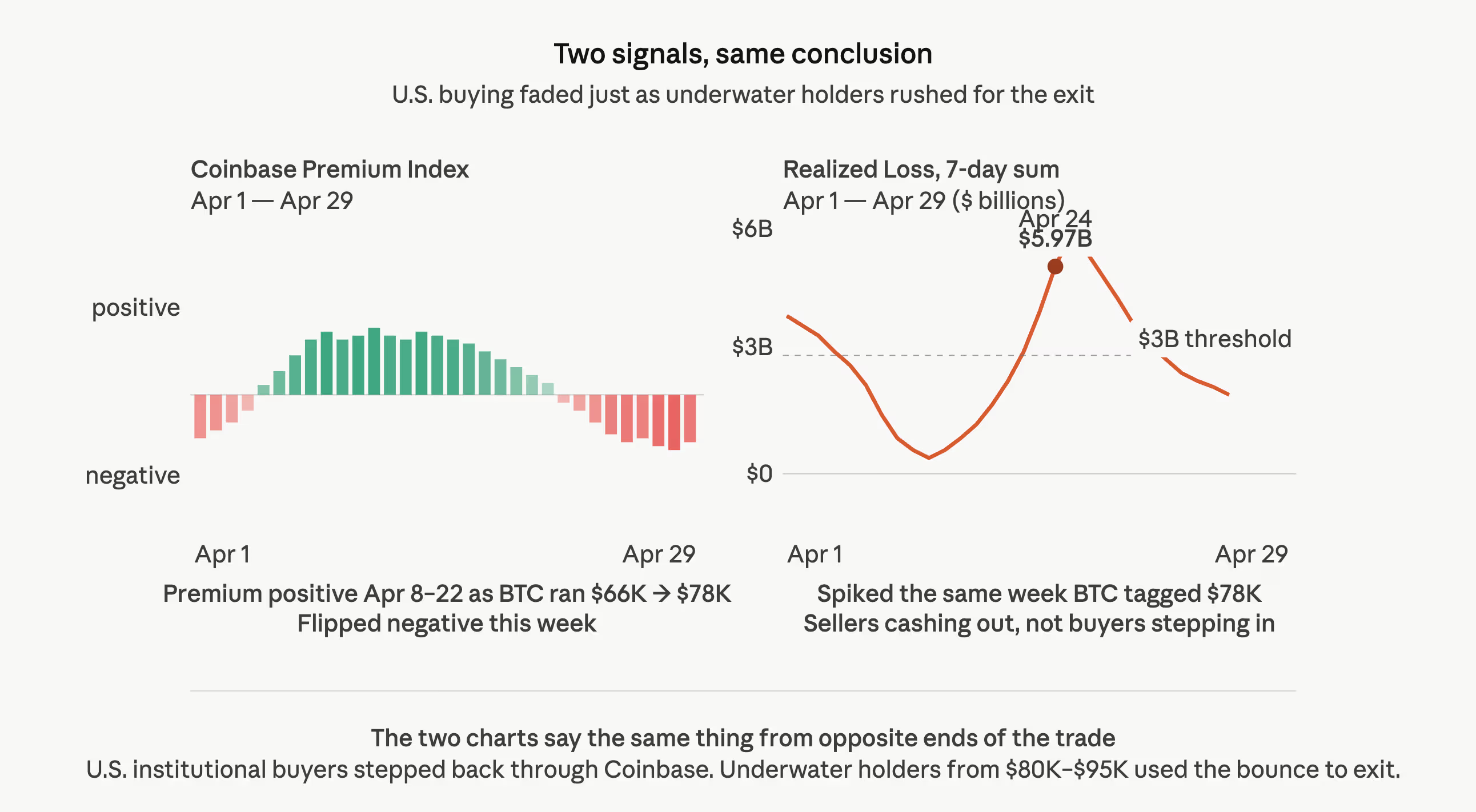
Bitcoin’s Coinbase Premium, the difference between the price on Coinbase (COIN) — which caters mainly to U.S. customers — and on offshore exchanges, flipped negative this week for the first time since early April, CryptoQuant data show.
The metric ran consistently positive from April 8 through April 22, the same window that took bitcoin from $66,000 to a local high near $78,000. The premium peaked around April 22 and has rolled over since.
Coinbase is widely used as a proxy for U.S. institutional and dollar-denominated flows, so a persistent negative reading means American investors are consistently paying less than the rest of the world. They’re either selling more aggressively or simply not showing up.
Onchain data tells the same story from the other side.
Bitcoin Realized Loss 7-day Sum, which tracks the total dollar value of coins moved at a loss across the network, spiked to $5.97 billion on April 24 as bitcoin traded near $78,000.
Realized Loss is recognized only when holders sell coins below the price at which they originally bought them.
A print near $6 billion at $78,000 means the sellers were buyers at higher prices. CryptoQuant analyst Axel Adler Jr. said in a report the cohort likely entered between $80,000 and $95,000 during late 2025 and early 2026, using the April bounce as an exit rather than a reentry point.

The two datasets are indicative of U.S. institutional buyers slowing their bid through Coinbase right as the holders increased selling activity. Bitcoin was recently trading around $76,000.
What traders watch from here is whether the Realized Loss metric continues to fall as the underwater supply works through. The reading has already declined from its April 24 peak to $4.7 billion by April 28, suggesting the seller cohort is thinning.


Four of the Magnificent Seven (Mag 7) tech giants are still on track to meet their massive artificial intelligence (AI) spending targets this year, according to their earnings report.
The companies that have reported quarterly earnings post-market on Wednesday are Microsoft (MSFT), Alphabet (GOOG), Meta (META) and Amazon (AMZ), with a combined market cap of approximately $12 trillion.
Previously, an analysis by Bridgewater Associates flagged that the four companies are expected to spend roughly $650 billion together on AI infrastructure in 2026. While most of them didn’t break out their AI spending in their latest earnings, they seem on track to continue their spending spree in the sector.
The investment has significant implications for the digital asset sector, particularly for bitcoin miners, who are increasingly pivoting away from mining toward hosting computers for AI as part of their revenue diversification strategy. The bitcoin miners already have data centers ready and powered up to host a massive amount of machines that are needed for AI computing. Facing a margin squeeze from lower bitcoin prices and increased competition, miners have started lending their data centers to AI firms to diversify their revenue streams.
AI-linked bitcoin mining stocks with exposure to hyperscaler infrastructure deals include IREN (IREN), which was down about 0.3%, TeraWulf (WULF) and Cipher Digital (CIFR), which fell 0.5%. Meanwhile, following the results, Microsoft was down over about 2.4% in after-hours trading, Alphabet up 6%, Meta down 6.6% and Amazon down 3.7%. Bitcoin was down about 0.9% in the last 24 hours.
The next big test of overall market sentiment and miners will come when chipmaker Nvidia reports earnings on May 20.
Here is what the tech giants reported and said during their earnings.
Microsoft
Microsoft reported fiscal Q3 2026 revenue of $82.9 billion, beating the $81.4 billion consensus, with EPS of $4.27 against the $4.06 estimate, according to FactSet data.
“We are focused on delivering cloud and AI infrastructure and solutions that empower every business to eval-max their outcomes in the agentic computing era,” said Satya Nadella, chairman and chief executive officer of Microsoft, noting that the firm’s AI business brought in $37 billion, up 123% year-over-year.
Alphabet
Alphabet pointed to AI as a core driver of growth and reported capital expenditures of $35.67 billion for the quarter, slightly below estimates of $36.39 billion.
“Our AI investments and full stack approach are lighting up every part of the business,” Alphabet CEO Sundar Pichai said, linking gains in Search and Cloud to AI-driven demand. Google Cloud revenue rose 63% to $20 billion, fueled in part by “enterprise AI Solutions and enterprise AI Infrastructure,” showing how AI is shaping both product usage and enterprise adoption.
Alphabet reported Q1 2026 revenue of $109.9 billion, beating the $107 billion consensus, with EPS of $2.81 against the $2.63 estimate.
Amazon
Amazon reported Q1 2026 revenue of $181.5 billion, beating the $177.2 billion consensus, with EPS of $2.78 against the $1.63 estimate. AWS revenue came in at $37.6 billion against the $36.92 billion estimate.
Amazon said free cash flow fell sharply over the past year, pointing to a surge in infrastructure spending. The company noted the drop was “driven primarily by a year-over-year increase of $59.3 billion in purchases of property and equipment,” adding that “this increase primarily reflects investments in artificial intelligence.” The shift shows how heavily Amazon is leaning into AI, even as it weighs on near-term cash generation.
Meta
Meta pointed to rising AI infrastructure costs as a key driver of spending, reporting $19.84 billion in capital expenditures for the quarter and raising its full-year outlook to $125–145 billion, up from its prior guidance of $115–$135 billion. The increase reflects “higher component pricing this year and, to a lesser extent, additional data center costs to support future year capacity,” the company said, underscoring how AI buildout is driving investment.
CEO Mark Zuckerberg framed the push more directly, calling it a “milestone quarter” tied to AI progress and adding, “We’re on track to deliver personal superintelligence to billions of people.”
Meta reported Q1 2026 revenue of $56.31 billion, beating the $55.5 billion consensus, with EPS of $10.44 against the $6.67 estimate.

This editorial note previews a high-stakes earnings week in which Amazon, Meta, Alphabet, Microsoft and Apple report results as the market weighs the returns from AI investments. The companies together account for roughly a quarter of the S&P 500, placing their earnings guidance and cash flow signals in the spotlight for investors. The release frames AI spending as a central growth driver, with cloud, advertising and consumer devices shaping the revenue trajectory. Key themes include Amazon’s AI-enabled AWS growth, Meta’s ad monetization, Alphabet’s cloud demand, Microsoft’s Copilot and Azure, and Apple’s Siri upgrade as an early AI test.
Key points
- Five major tech firms—Amazon, Meta, Alphabet, Microsoft and Apple—report this week, collectively accounting for about a quarter of the S&P 500.
- AI-related capex is expected to run near US$700 billion this year, shifting investor focus toward returns in growth, margins and cash flow.
- Amazon: AWS growth is seen re-accelerating in Q1; 2026 capex outlook of US$200 billion; AI revenue run rate in AWS around US$15 billion.
- Meta: Q1 revenue around US$56 billion, up about 33% YoY, with AI-enhanced monetization; capex near US$126 billion.
- Alphabet: Google Cloud ~50% growth in Q1; Anthropic multi-year deal; total revenue around US$107 billion; margins under pressure from a capital-intensive model.
Why it matters
These earnings will test whether AI investments translate into real returns and cash flow, shaping how investors value AI-driven growth. The results may indicate whether capital discipline is returning as AI scales, and how cloud, advertising, and platform initiatives contribute to near-term profitability.
What to watch
- Returns signals: observe margins and cash flow trends as AI-related spending continues.
- Cloud platform performance: AWS, Google Cloud and Azure growth rates and demand patterns, including strategic partnerships.
- AI monetization progress: Meta’s ad targeting and Alphabet’s compute demand supporting AI infrastructure.
- Apple progress on AI milestones: Siri upgrade timing as an early test of its AI roadmap.
Disclosure: The content below is a press release provided by the company or its PR representative. It is published for informational purposes.
Amazon, Meta, Alphabet, Microsoft and Apple Face AI Test in High-Stakes Earnings Week
Abu Dhabi, United Arab Emirates – April 29, 2026: This week marks one of the most consequential earnings periods of the year, with Amazon, Meta, Alphabet and Microsoft reporting on Thursday, followed by Apple on Friday. Together, these five companies account for nearly a quarter of the S&P 500, positioning their results as a key driver of broader market direction.
At the centre of attention is artificial intelligence. Collectively, these companies are expected to spend close to US$700 billion this year to fuel growth, but investor focus is shifting decisively from the scale of investment to the returns it can generate. This earnings cycle represents the first meaningful test of whether the AI trade can continue to justify elevated valuations.
Amazon remains a focal point, having outperformed peers year-to-date. AWS growth is expected to re-accelerate to around 28% in the first quarter, with full-year growth potentially approaching 36% as additional capacity comes online. The company has already flagged a US$15 billion AI revenue run rate within AWS, reinforcing confidence in demand.
However, capital expenditure remains the key risk. Amazon is expected to reiterate its US$200 billion capex outlook for 2026 — the largest in corporate history. While the business remains relatively efficient compared to other hyperscalers, rising investment has weighed on free cash flow. Any signs of stabilisation or improvement will be critical in shifting sentiment towards capital discipline.
Josh Gilbert, Market Analyst at eToro, commented: “This is the first real stress test for the AI trade. Markets have been willing to support massive investment, but now investors want to see clear returns. Growth, margins and cash flow all need to start moving in the right direction.”
Meta’s investment case is more straightforward, with its core advertising business continuing to fund its AI expansion. First-quarter revenue is expected to rise approximately 33% year-on-year to US$56 billion, with forward guidance pointing to continued strength. AI is already contributing to monetisation, improving both ad targeting and content ranking.
Recent results underline this trend, with Family of Apps ad revenue rising 24% year-on-year, supported by higher ad impressions and pricing. With capital expenditure expected to increase roughly 70% to US$126 billion this year, investors will be looking for continued evidence that AI-driven gains are scaling alongside spend.
Alphabet’s results will offer further insight into the balance between investment and returns. Google Cloud is expected to grow around 50% in the first quarter, supported by strong demand for AI infrastructure and key partnerships, including its multi-year agreement with Anthropic. This deal is emerging as a significant driver of compute demand.
Total revenue is forecast at US$107 billion, with Search remaining a core contributor. However, margin pressure remains a concern as Alphabet transitions towards a more capital-intensive model. The extent to which cloud growth offsets this pressure will be central to market reaction.
Microsoft enters the week under greater scrutiny following recent share price weakness. Azure growth is expected to remain robust at around 38%, while total revenue is forecast at US$81 billion. As an early leader in AI through its partnership with OpenAI, Microsoft now faces increasing competition, prompting a reassessment of its positioning.
Investor focus will centre on Azure performance and enterprise adoption of Copilot. Strong execution in these areas could reinforce confidence in its AI strategy, while any disappointment may amplify concerns around rising costs and competitive pressures.
Apple stands apart from its peers, with less immediate exposure to the current AI investment cycle. However, it continues to deliver strong underlying performance. Revenue for the quarter is expected to reach US$109.7 billion, driven by sustained iPhone demand, particularly in China, alongside continued growth in Services.
The company’s substantial cash generation provides flexibility to invest in AI at its own pace. Attention will turn to the upcoming Siri upgrade, which represents an early test of its AI roadmap. Execution here could set the tone ahead of its next iPhone cycle, while any delays may extend investor uncertainty around its long-term AI strategy.
Media Contact:
PR@etoro.com
About eToro
eToro is the trading and investing platform that empowers you to invest, share and learn. We were founded in 2007 with the vision of a world where everyone can trade and invest in a simple and transparent way. Today we have 40 million registered users from 75 countries. We believe there is power in shared knowledge and that we can become more successful by investing together. So we’ve created a collaborative investment community designed to provide you with the tools you need to grow your knowledge and wealth. On eToro, you can hold a range of traditional and innovative assets and choose how you invest: trade directly, invest in a portfolio, or copy other investors. You can visit our media centre here for our latest news.


On-chain data from Santiment shows 970,430 LINK tokens left centralized exchanges on April 27 in a single day, the largest LINK outflow since December 2, 2025, worth approximately $8.95 million, as exchange reserves continued a 25-day decline from 141.5 million to 130.9 million.
Summary
- The 970,430 LINK withdrawal on April 27 was worth approximately $8.95 million at the time and represents the largest single-day net outflow for Chainlink since December 2, 2025.
- Exchange reserves have fallen consistently since April 3, when a 15-million-token inflow spike pushed reserves to their 30-day peak of 141.5 million tokens before a sustained withdrawal trend reversed the entire move.
- LINK was trading near $9.23 with an RSI of 42.31, below all three major moving averages, with the $9.50 level as the near-term resistance analysts identify as the breakout trigger.
LINK outflow data published by Santiment on April 27 showed 970,430 tokens leaving centralized exchanges in a single session, the largest daily net outflow for Chainlink since December 2, 2025. NewsBTC reported that the Exchange Flow Balance has been consistently negative for nearly all of April, indicating sustained withdrawal activity throughout the month rather than a single isolated spike. The April 27 event was the most concentrated single-day expression of that trend, with withdrawal transactions dropping to just 119 during the session, the lowest count in the 30-day observation window, while inflow fell to approximately 179,800 LINK, near the floor of the entire observation period.
LINK Outflow Pattern Extends a 25-Day Exchange Reserve Decline
As crypto.news reported, the April 3 session saw 15 million LINK deposited onto exchanges in the largest inflow event of the 30-day window, pushing total exchange reserves to a peak of 141.5 million. Rather than converting to selling pressure, that deposit event marked the beginning of a sustained withdrawal trend: over 25 days, net outflows progressively reduced exchange reserves from 141.5 million to 130.9 million, erasing the entire April 3 inflow and returning the supply ratio to its pre-spike level. The supply ratio, measured by CryptoQuant, fell from 0.142 at the April 3 peak to approximately 0.130 by April 27. Exchange outflows at this scale can indicate accumulation by holders moving tokens to private custody rather than preparing to sell, but the data does not confirm directional conviction because a single large actor moving 970,430 LINK off an exchange could also represent an OTC desk transfer, a DeFi protocol deposit, or a cross-venue repositioning that eventually leads to a sale. LINK’s price did not break out following the withdrawal: it climbed briefly to $9.58 after the event before retracing to $9.23, suggesting the market did not interpret the outflow as a definitive accumulation signal.
XRP Saw a Simultaneous Outflow Spike in the Same Window
As crypto.news documented, XRP also recorded one of its largest daily outflow spikes of 2026 during the same week, with 34.94 million XRP worth approximately $48.6 million leaving exchange wallets in a single session. That simultaneous outflow across both LINK and XRP during the same week is consistent with a broader pattern of institutional-scale holders reducing exchange exposure across multiple assets simultaneously, a behavior that precedes either accumulation or OTC-mediated distribution depending on where those tokens move next.
Where LINK Price Stands After the Outflow
As crypto.news tracked, LINK entered 2026 in a structural downtrend with its 200-day simple moving average acting as resistance, and the April 27 outflow spike did not change that technical structure. LINK is trading below all three major moving averages, with the 50-day, 100-day, and 200-day all clustered between $9.35 and $9.37 at the time of the withdrawal. The RSI of 42.31 signals weak momentum without reaching the oversold threshold that typically triggers a technical reversal. The $9.50 level remains the near-term breakout trigger, and the $10.00 level is the larger resistance that would require sustained institutional follow-through to clear. LINK’s CCIP weekly cross-chain volume surged 260% to over $1.3 billion in the most recent reporting period, but price has remained range-bound as the broader market digests macro uncertainty from the FOMC and the Iran conflict.
LINK is not the only altcoin seeing large exchange outflows. Santiment data showed XRP recorded 34.94 million tokens in exchange outflows the same week, worth approximately $48.6 million, suggesting broader institutional-scale repositioning across the top altcoin cohort.


- Bitcoin dropped to lows of $74,958 before stabilizing above $75,000.
- The decline also coincided with tighter liquidity in traditional equity markets.
- Crypto stocks fell sharply as short‑term volatility hit risk assets.
Bitcoin price briefly slipped to below $75,000 on Wednesday as the Federal Reserve held interest rates steady, dimming hopes for near‑term rate cuts and triggering a broad‑based sell-off in risk assets.
The move weighed heavily on crypto‑linked equities, with Coinbase, Riot Platforms, and MicroStrategy among the hardest hit.
Bitcoin dips to $75k as Fed holds rates
Bitcoin fell to roughly the $75,000 level, trimming earlier gains after the US central bank opted to keep borrowing costs unchanged, signaling a more cautious stance on monetary easing.
The decision reinforced expectations of a higher‑for‑longer rate environment, prompting investors to pare back exposure to volatile assets tied to speculative growth narratives.
Market data as of writing showed that over the past 24 hours, Bitcoin had logged a modest decline of about 1.4% as it hovered around $75,156.
The combination of elevated yields and geopolitical uncertainty has continued to dampen risk appetite, capping BTC below $80,000.

Crypto stocks tumble amid weak trading signals
The Fed’s in‑line‑but‑hawkish‑leaning decision spilled into crypto‑related stocks, which had already been under pressure from disappointing revenue trends.
Robinhood (HOOD) led the slide, plunging 14% after reporting an almost 47% year‑over‑year drop in crypto‑related revenues for the first quarter.
The steep contraction was widely interpreted as a sign of weaker trading volumes and fading retail enthusiasm for digital assets.
The pessimism spread across the sector.
US crypto exchange Coinbase (COIN) fell 7%, while Bullish (BLSH), the institutional platform owned by CoinDesk’s parent company, likewise dropped 7%. Gemini (GEMI) declined 5%.
Bitcoin miners also sold off, with Riot Platforms (RIOT) and Marathon Digital Holdings (MARA) both slipping 4%–6% as the softer Bitcoin price and elevated energy costs squeezed margins.
MicroStrategy (MSTR), the largest corporate holder of Bitcoin, retreated 4%.
Oil surge adds to risk‑off mood
The deterioration in sentiment extended beyond crypto, as US equities broadly declined and energy prices spiked.
The Dow Jones Industrial Average shed more than 300 points, pressured in part by a surge in oil that followed President Trump’s comments on Iran.
In a Wednesday interview with Axios, Trump stated he would maintain a US blockade at the Strait of Hormuz until a nuclear‑related deal with Iran is reached, heightening concerns over supply disruptions in one of the world’s most critical oil chokepoints.
Brent crude climbed more than 4% above $111 per barrel, while US West Texas Intermediate (WTI) crude topped $106 per barrel, further fueling inflation‑sensitive market jitters and reinforcing the risk‑off tone that weighed on Bitcoin and crypto stocks.


Pi Network’s token climbed more than 5% on April 29 ahead of Consensus 2026 in Miami on May 5 to 7, where both co-founders Dr. Chengdiao Fan and Nicolas Kokkalis are confirmed speakers, marking the project’s most prominent mainstream industry appearance since its Mainnet launch.
Summary
- Dr. Chengdiao Fan will speak at Consensus 2026 on how Pi Network’s human verification model addresses AI-era identity challenges, while Nicolas Kokkalis will address the protocol’s proof-of-personhood infrastructure.
- PI has risen approximately 11% on a weekly basis as of April 29, outperforming most large-cap altcoins during a broader market decline driven by FOMC and Iran uncertainty.
- Pi Network sponsored Consensus 2026 and has 421,000 active Mainnet nodes, over 10 billion PI migrated to Mainnet, and the Protocol 23 smart contract upgrade now targeted for May 11.
Pi Network price gained more than 5% on April 29, BanklessTimes reported, as the market reacted to the confirmation that both Pi Network co-founders will appear at Consensus 2026 in Miami from May 5 to 7. Dr. Chengdiao Fan is scheduled to speak on proving human identity in the AI era, a topic directly connected to Pi’s core proof-of-personhood architecture, while Nicolas Kokkalis will address the protocol’s broader Mainnet development trajectory.
Pi Network Price Momentum Builds Around Its Biggest Institutional Stage Appearance
As crypto.news reported, Pi Network is an official sponsor of Consensus 2026 Miami, the largest annual blockchain industry conference, with both co-founders scheduled as named speakers alongside a roster that includes major institutional and government figures. Fan’s session on AI-era human identity verification is particularly strategically positioned: the intersection of proof-of-personhood and AI authentication is one of the most actively discussed governance topics in the industry in 2026, and Pi’s architecture, which verified over 60 million users through its Know Your Customer process, positions the project as a live production example of the model being theorized elsewhere. PI has defied the broader April 29 market decline, which saw Bitcoin fall 1.6%, Ethereum drop to a week low, and most large-cap altcoins close in the red, rising 5% on the day and 11% on a weekly basis to trade near $0.60 as of April 29. The move makes PI the top performer among the 50 largest altcoins on April 29 according to CryptoPotato data.
What Protocol 23 and the May 11 Deadline Add to the Consensus 2026 Appearance
As crypto.news documented, the Protocol 22.1 upgrade deadline passed on April 27, disconnecting nodes that failed to update and preparing the network for Protocol 23, which introduces full smart contract functionality across Pi Mainnet. The Protocol 23 deadline has since been moved from May 18 to May 11, one week earlier than previously announced, which aligns the smart contract launch more closely with the Consensus 2026 window. A successful Protocol 23 activation before or during the conference would give Fan and Kokkalis a concrete technical milestone to reference on stage, adding substance to the appearance beyond the community momentum the event alone generates. Protocol 23 would transform Pi from a transactional token into a programmable platform capable of hosting decentralized applications, exchanges, and automated tools.
Why the Market Is Treating This as a Sell-or-Hold Event to Watch
As crypto.news tracked, PI has historically responded to technical milestones as sell-the-news events rather than structural re-ratings, with nearly 3 million PI moving to centralized exchanges ahead of the Protocol 22 deadline and approximately 200 million PI scheduled for unlock over the next 30 days. The pre-Consensus rally faces a similar dynamic: if the Consensus 2026 appearances deliver substantial partnership announcements or a meaningful Protocol 23 update, the market response may extend the gains. If the appearances are primarily promotional with no new technical or commercial news, the 5% pre-event rally runs the risk of reversing into the event itself as holders reduce exposure ahead of unlock pressure. Galaxy Research put Pi at 50-50 odds of converting its community momentum into durable institutional adoption in 2026.
Pi Network has confirmed no Binance listing ahead of Consensus 2026, but a Binance listing rumor contributed to a prior price spike in the token’s history. Community speculation about a listing announcement at Consensus is circulating but unconfirmed as of April 29.

Tokenized Treasuries Expand Rapidly on XRPL
The XRP Ledger has experienced a sharp increase in tokenized U.S. Treasury assets over the past year. Data shows the total value has climbed from nearly $50 million to over $418 million. This shift reflects an eightfold increase within a relatively short period.
Rising Activity Signals Stronger Network Utility
Transaction data highlights a notable increase in activity compared to earlier periods. Transfer volumes have surged significantly from roughly $70 million recorded in previous comparable timelines. This increase demonstrates a faster pace of adoption and usage.
At the same time, asset issuers continue to expand their presence on the XRP Ledger. More institutions now tokenise traditional financial products using blockchain rails. This shift enhances efficiency and reduces operational friction.
Furthermore, consistent activity suggests that tokenised assets are not remaining idle on the network. Instead, users actively transfer and utilise these instruments across different applications. This trend supports the argument for sustained network relevance.
Growth in Real-World Assets Strengthens XRPL Position
The broader real-world asset sector on XRPL has also expanded alongside treasury tokenisation. Several platforms now contribute significantly to the ecosystem’s total value. These platforms help diversify offerings and increase overall network participation.
Projects such as Justoken, RLUSD, and VERT Capital have added substantial value to the ledger. Their combined contributions highlight the scale of institutional involvement in tokenised finance. Other initiatives continue to join and expand the ecosystem.
Additionally, recent asset tokenisation efforts include high-value projects such as diamond-backed digital assets. These developments show that XRPL supports various asset classes beyond government securities. This diversity strengthens its appeal to issuers and users.
Strategic Developments Support Continued Expansion
The growth follows ongoing developments tied to Ripple and its expanding partnerships. Collaborations with financial institutions continue to improve infrastructure and adoption pathways. These efforts contribute to broader usage of the XRP Ledger.
At the same time, validators and network participants report steady increases in asset issuance across categories. The network benefits from integrations that improve accessibility and distribution. These factors enhance XRPL’s position as a viable financial platform.
Meanwhile, the steady rise in tokenised assets reflects shifting preferences within financial markets. Institutions now explore blockchain solutions for efficiency and transparency. As this trend continues, XRPL appears positioned for further growth in digital finance.

Get ready.
Wenesday night is the main event for earnings season, with Alphabet, Amazon, Meta and Microsoft – four of the “Magnificent Seven” — set to report. Options traders are pricing in more than $800 billion of market cap movement after the bell.
If options prices are an indication, it will be a more volatile night than what we’ve seen over the past year. Current implied moves are bigger than the four-quarter average for three of the four names.
Meta is the exception, where options are pricing in a 7.3% move compared to the yearlong average of 9.3%. That’s despite the fact Meta has exceeded the implied move after its last three reports.
Google parent Alphabet, on the other hand, has a history of smaller moves that underperform the options pricing, and it looks like traders may be setting themselves up for a repeat disappointment. Options are pricing a near-6% move in the shares, compared to the four-quarter average of under 1.5%.
In terms of directional bias, options flows still lean bullish, with calls volumes and premiums outpacing puts in all four names, and flows showing more demand for upside exposure than for selloffs.
Amazon in particular saw bullish options flow Wednesday morning, with a few big call buyers spending more than $500,000 to get upside exposure. One trader spent $616,000 buying 581 of the 260-strike in-the-money calls expiring next Friday, while another trader looked to the September 18 expiry to buy 299 of the 265-strike calls, just out of the money in a trade that cost $731,000.
Even in Microsoft, the laggard of the group, bullish flows were notable in the 450-strike calls expiring mid-June, with almost $3 million of trades across that contract early in the session.
A pseudonymous researcher has posted a suspicious trade by a collection of Hyperliquid wallets that some crypto traders suspect of having a special relationship with Robinhood.
Continuing a pattern of curious trades, the “insider” opened a prescient short on Hyperliquid’s HOOD perpetual futures contracts — crypto derivatives that mimic the price of Robinhood’s common stock — mere hours before Robinhood’s scheduled first-quarter earnings release.
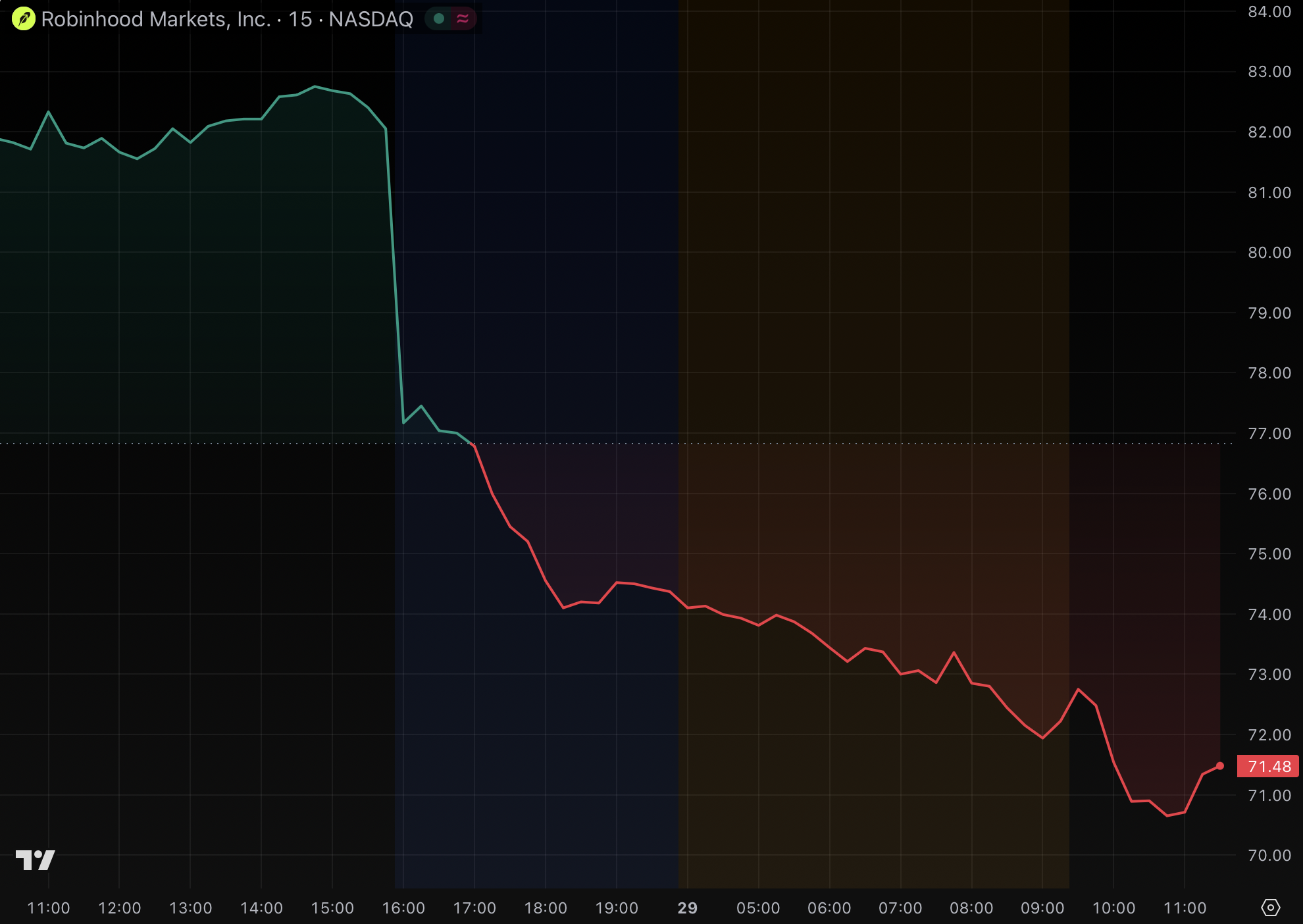
After its disappointing earnings, shares of Robinhood’s stock fell sharply yesterday evening, rewarding the traders’ leveraged short in after-hours trading.
The trader(s) at the center of the allegations are wallets ending in 177D, bc7b, acf9, and their various sockpuppets. They first transacted on July 16, 2025, and have gained attention from various Hyperliquid commentators.
Critics claim that the trader gained advance knowledge of Robinhood’s earnings results this week, secretly opening a directional bet against the stock via crypto exchanges to avoid actual stock short-sales that might have exposed them to greater regulatory scrutiny.
Robinhood trading correlation versus causation
Thoroughly convinced of the accusation that correlation equals causation, a researcher posted a thread about wallets that were funded by Robinhood withdrawals that subsequently traded on Hyperliquid and MEXC wallets ahead of Robinhood-related listing announcements.
Even though funds for some of the wallets trace to Coinbase, the researcher emphasized Robinhood-derived withdrawals and Robinhood-related news to allege the “insider” and even “employee” frame which is now circulating on social media.
However, correlation doesn’t necessarily equal causation, and the bridge between suspicious trading and wallets actually belonging to a Robinhood employee relies on thin evidence.
SEC insider trading ban
Robinhood, like any public company, has a formal insider trading policy, outlined in the company’s SEC filings.
The policy prohibits covered persons from trading Robinhood securities on material, non-public information, and from holding derivatives tied to the company’s performance using such special information.
Covered persons include employees, contractors, agents, and family members.
Trading US stocks while in possession of material non-public information is generally prohibited, including by law in US statutes.
The company hasn’t publicly addressed the conclusory allegations on social media as of Tuesday evening. Neither have critics disclosed how their “employee” or “insider” designations were made beyond corollaries like a suspicious series of events that could have numerous, alternative explanations.
Yesterday, Robinhood reported Q1 revenue slightly below a consensus of Wall Street estimates. However, the damage to its stock price resulted from crypto revenue year-over-year, which collapsed 47%, indicating dimmer prospects for growth.
As a result, shares closed sharply lower in Tuesday’s after-hours trading, closing at $74.41 by 8pm New York time after opening the day at $81.55.
HOOD opened today’s session even lower, at $72.30, down 11.3% in just 24 hours.
Protos reached out to Robinhood for comment but did not receive an immediate reply prior to publication.
Got a tip? Send us an email securely via Protos Leaks. For more informed news and investigations, follow us on X, Bluesky, and Google News, or subscribe to our YouTube channel.

FAITH IN THE COMMUNITY: Our 'Anna Cafe Church' is a godsend for the elderly

Extra Space Storage Inc. (EXR) Q1 2026 Earnings Call Transcript

Senator pushes Clarity Act forward as stablecoin yield fight nears markup

Manchester United reach agreement with Casemiro over contract clause amid transfer speculation

US brings back mandatory military draft registration

Steven Gerrard disagrees with Gary Neville over ‘shock’ Chelsea and Arsenal claim | Football


-

 Tech2 days ago
Register Renaming | Hackaday
-

 Fashion5 days ago
Weekend Open Thread – Corporette.com
-
 Crypto World4 days ago
Hyperliquid $HYPE Rally Builds Momentum as AI Sector Enters Prove-It Phase
-
 Business6 days ago
Patterson-UTI Energy, Inc. (PTEN) Q1 2026 Earnings Call Transcript
-
 Sports3 days ago
IPL 2026: Ruturaj Gaikwad registers slowest fifty of the season, enters all-time unwanted list | Cricket News
-

 Politics2 days ago
Drax board avoid their own AGM, accused of greenwashing & environmental racism
-

 NewsBeat4 days ago
LK Bennett closes all stores after entering administration
-

 Crypto World5 days ago
Michael Saylor says BTC winter is over. Market analyst disagrees, says bitcoin was in a pullback
-
 Sports7 days ago
Tim Bradley names the current best in the world: “Better than Inoue and Usyk”
-

 Fashion22 hours ago
Kylie Jenner’s KHY Enters a New Era with ‘Born in LA’
-
Entertainment6 days ago
Michael B. Jordan and Austin Butler's “Miami Vice” movie will bring the action back to the '80s
-
 Entertainment4 days ago
Mariah Carey Slams Deposition Claims In Brother’s Lawsuit
-
Business7 days ago
Altimmune prices $225 million public offering at $3 per share
-
Entertainment6 days ago
Russell Brand Had Sex With 16 Year Old When He Was 30
-

 Business23 hours ago
Most Commercial Energy Audits Miss the Real Losses
-
Crypto World6 days ago
Is Algorand One of the Few Quantum-Resistant Blockchains? Here’s What the Data Shows
-
 NewsBeat6 days ago
Trump threatens to review UK’s claim to Falkland Islands and punish Nato allies over Iran war disagreement
-

 Business7 days ago
SL Green Realty: Dividend Cut And Record Leasing Fuel Their Potential Recovery
-

 Sports6 days ago
2026 NFL Draft tonight: Time, TV channel, where to watch, order
-

 Tech2 days ago
Images of Samsung’s rumored smart glasses have leaked
You must be logged in to post a comment Login