

Crypto World
The Vast Majority of Crypto Wrench Attacks Happen in France: Report

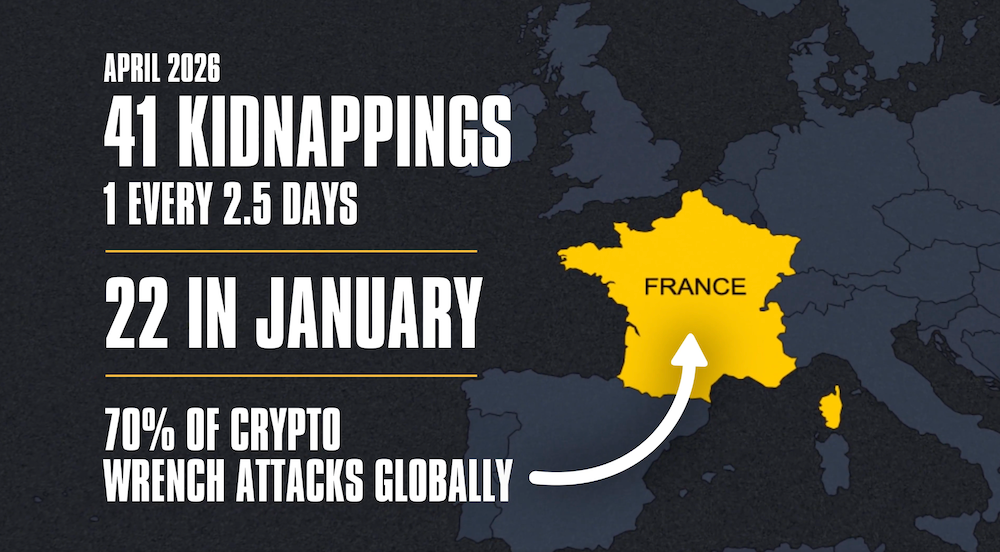
About 70% of all wrench attacks, physical attacks against crypto holders and their families, carried out in an attempt to steal digital assets, occur in France, according to Bitcoin journalist Joe Nakamoto.
There have been 41 crypto-related kidnappings in France so far in 2026, Nakamoto said, or about one attack every two and a half days, he added.
He attributed the rise in wrench attacks to know-your-customer data collection, which is stored in centralized servers that were compromised in several high-profile data leaks, including the 2020 leak of hardware wallet provider Ledger’s customer data.
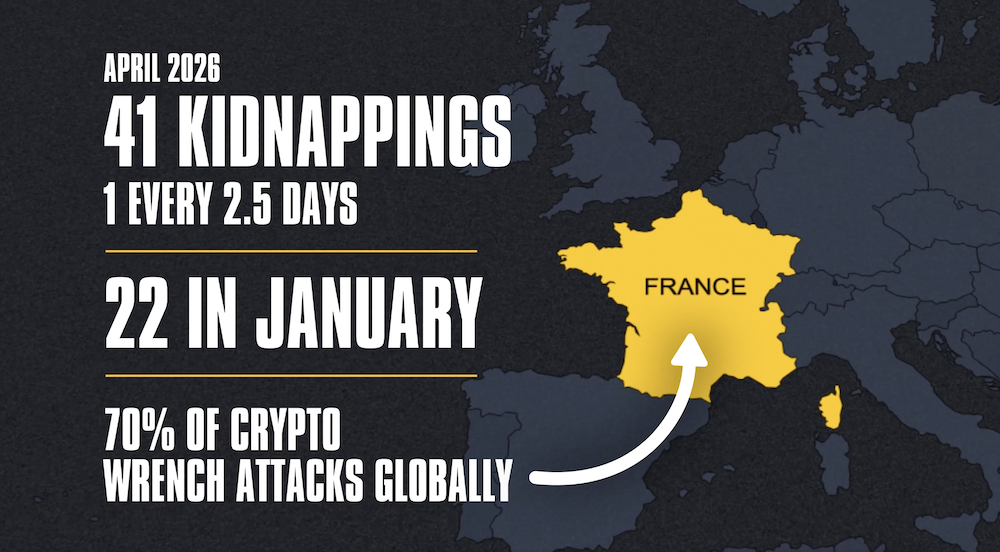
An overview of wrench attacks in France so far in 2026. Source: Joe Nakamoto
That data leak disclosed the identities, home addresses and emails of more than 270,000 customers worldwide, he added. Jameson Lopp, the CEO of crypto wallet and key management company Casa, said:
“France is the canary in the coal mine, demonstrating how financial regulations create a surveillance apparatus that causes direct harm to bitcoin holders.”
Opposition to know-your-customer data collection is mounting inside the crypto and Bitcoin communities, as digital asset holders continue to be targeted with physical attacks and kidnappings, prompting a need for increased security measures.
Related: Europe sees ‘hyperconcentration’ of crypto wrench attacks as losses hit $101M
Don’t become a target: Bitcoiners offer advice to safeguard against attacks
The attacks are typically orchestrated by criminals living abroad, who contract young people living in France to carry out the physical attacks, Nakamoto said.
Users can stay safe by using crypto custody services that offer security features like a pre-agreed-upon word or phrase that lets a custodial or key management company know the holder is being actively attacked.
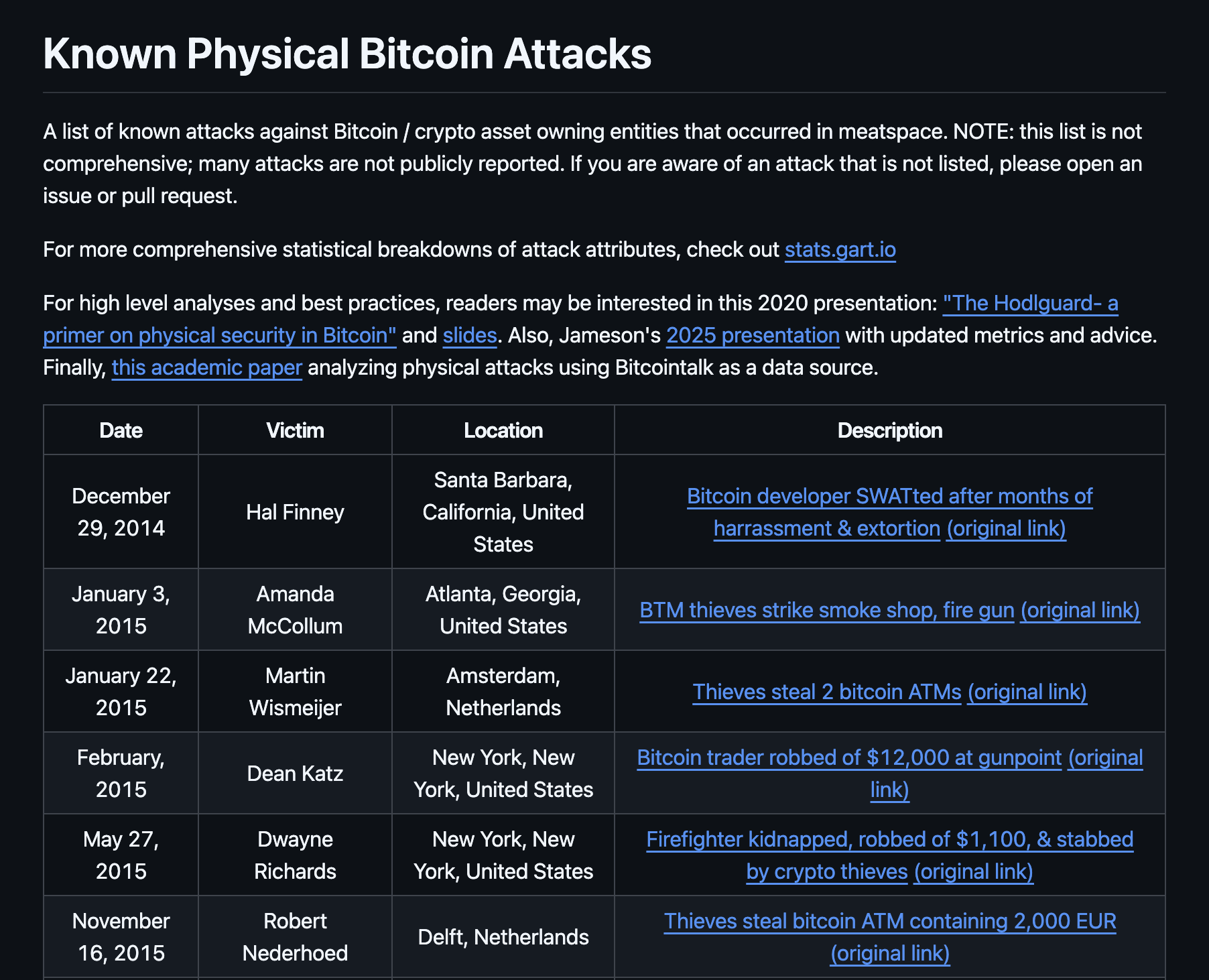
A database of known wrench attacks. Source: GitHub
The company can then freeze the assets, making sure they are not accessed by the attackers, and can even alert law enforcement authorities, he said.
He also suggested keeping a “decoy” crypto wallet with a small amount of funds to hand over to criminals in the event of an attack.
Finally, crypto holders should keep a low profile and not discuss crypto topics online or make it public knowledge that they hold digital assets, he added.
At least 88 individuals have been arrested in connection with crypto wrench attacks in France, according to Vanessa Perrée, the country’s national prosecutor for organized crime.
Magazine: Agent wastes 14 hours of scammers’ time, LLMs ‘poisoned’ by Iran: AI Eye

[PRESS RELEASE – Nicosia, Cyprus, June 18th, 2026]
The new engine lets businesses configure and modify crypto, fiat, and crypto-to-fiat payment processes in days instead of weeks, with built-in compliance reporting for every transaction.
FinHarbor, a provider of modular banking and crypto-acquiring infrastructure, has announced the launch of Money Flow, a payment orchestration module that manages the full lifecycle of every transaction on the platform – deposits, withdrawals, transfers, and exchanges across both fiat and crypto rails.
At the core of Money Flow is a set of orchestrators built on Temporal, a workflow engine designed for long-running distributed processes. Each payment operation runs as a stateful process that passes through AML screening, ledger accounting, and final execution in a bank or on a blockchain. If a service restarts mid-operation or an external counterparty takes days to respond, the workflow retains its state and resumes exactly where it stopped. When a response never arrives within the configured window, the system triggers a compensating action or escalates the case to support – funds do not sit in limbo.
The module changes how quickly payment logic can be adjusted. Modifications to an existing process that previously took about a week now ship in roughly a day, and a new process built on existing integrations can go live within days. All flow logic lives in a single service and follows a self-documenting code approach, so developers no longer need to study every subsystem to understand how a given operation works.
The design also shortens the distance between finance leadership and engineering. A CFO can describe a payment process in business terms, and developers translate it into code using a domain-specific language that remains readable to non-technical stakeholders. The result is that finance teams gain direct visibility into how money actually moves through the platform, rather than relying on second-hand descriptions of the logic.
“Payment infrastructure has traditionally been a black box for the people who are ultimately accountable for the money inside it,” said Ilya Podoynitsyn, CEO of FinHarbor. “With Money Flow, a finance director can read the logic of a withdrawal or an exchange almost like a business document, request a change, and see it in production within a day. That changes the conversation between the finance function and engineering.”
Compliance is handled as a dedicated layer within each workflow. AML rules are configured through a visual constructor by compliance officers themselves or by support staff acting on their instructions, depending on team structure. For every payment, the system generates a report that can be provided to a regulator or to the company’s anti-money-laundering officer, giving licensed businesses a documented audit trail across crypto-to-fiat operations.
Money Flow currently supports bank transfer and crypto withdrawals, payouts, pay-ins, exchanges, crypto and wire deposits, internal transfers, and administrative operations, with the list of supported flows expanding as new integrations are added.
“Most of the cost in payment systems comes from change, not from the original build,” Podoynitsyn added. “We designed Money Flow so that change becomes routine – retries, timeouts, and compensations are built into the engine, and teams spend their time on the logic of the business rather than on failure handling.”
The module is available to FinHarbor clients as part of the platform’s core infrastructure.
About FinHarbor
FinHarbor is a technical platform provider for launching compliant, modular financial products – from wallets and neobanks to crypto ramps and OTC desks. Built on years of real-world fintech experience, the platform covers onboarding, compliance, wallets, transactions, cards, and reporting, delivered with a microservice-based architecture (ISO/PCI DSS-certified), a robust API layer, and on-premise or cloud-ready deployment. FinHarbor supports fiat-only, crypto-native, and hybrid business models across markets in Europe, MENA, and beyond.
Users can learn more: www.finharbor.com
The post FinHarbor Launches Money Flow, a Payment Orchestration Module for Finance Teams appeared first on CryptoPotato.


The FIFA World Cup is always one of the hottest events for betting, but prediction markets are making this scene more explosive this year.
Who wins tonight? Who survives the group? Which favorite looks shaky? Which underdog has a real chance? While these are casual arguments for most football fans, crypto exchanges are turning them into monetizable user behavior.
That is why the 2026 World Cup has become a month-long attention engine, filled with live results, emotional swings, and daily predictions. Zoomex is one of the exchanges trying to plug into that rhythm through match predictions, trading tasks, rewards, and World Cup ticket access.
The campaign is less interesting as a one-off promotion and more useful as a sign of where exchange marketing is heading. Crypto firms are moving closer to live sport because sport already does what platforms want users to do: return daily, take a side, react quickly, and argue about the next outcome.
Every Fan Thinks They Can See the Future
The 2026 World Cup gives platforms a bigger stage than usual. It is the largest edition in tournament history, with 48 teams, three host countries, and 104 matches. That means more fixtures, more upsets, and more reasons for fans to check back every day.
Pew Research found that combined monthly trading volume on Kalshi and Polymarket rose from less than $5 billion in September 2025 to about $24 billion in April 2026.
Sports already drive much of that activity. Pew said sports accounted for 80% of Kalshi trading volume and 39% of Polymarket volume since July 2024.
So, football gives exchanges a simpler entry point than politics, macro data, or token prices. A match result is easy to understand. The uncertainty is the product.
Zoomex’s World Cup Prediction Campaign follows that logic. Users can predict match outcomes, group-stage results, knockout progress, finalists, and the eventual champion. The exchange is using football as a familiar doorway into prediction-style products.
The Prize Is the Match
Zoomex has also added a trading campaign built around volume-based tasks and rewards. Users can compete for USDT, vouchers, bonuses, and World Cup ticket packages. Some prizes include access to group-stage matches, semi-finals, and the final, depending on eligibility and campaign rules.
The ticket rewards give the campaign its sharper hook. World Cup access has become expensive this year. Reuters reported that face-value tickets for the 2026 final range from $2,030 to $6,370, a sharp jump from the 2022 final in Qatar.
That makes match access more powerful than a routine bonus. For a trader who also follows football, a World Cup ticket carries emotional weight. It turns a platform campaign into a possible real-world memory.
These campaigns usually come with KYC checks, trading-volume targets, reward caps, eligibility rules, risk-control reviews, and “up to” prize pools. Those details decide whether users see the campaign as useful or as another glossy exchange promotion.
Crypto Wants the Group Chat
The social layer is part of the strategy. Zoomex plans X Spaces with former footballers including Djibril Cissé, Didi Hamann, David James, Javier Mascherano, and Fernando Llorente. The goal is to keep the campaign inside football conversation, not just within the trading dashboards.
FIFA said the 2022 tournament generated 93.6 million social posts, with a cumulative reach of 262 billion and 5.95 billion engagements.
Crypto brands want a place inside that stream. They want the reply, the prediction, the share, and the return visit. During a World Cup, each match gives them a new reason to ask for one.
This is part of a longer sports push. Crypto companies spent heavily on sports sponsorships during the last bull cycle, using football, racing, and combat sports to reach people who did not spend their days on crypto Twitter.
The difference now is that campaigns are becoming more interactive. The brand no longer only wants visibility. It wants action.
The Hype Has Rules
The risk is that sports-themed campaigns can blur into aggressive user acquisition if the rules are unclear. Regulators are already watching crypto and trading links in sport more closely. The UK FCA recently warned football clubs about legal, money laundering, and reputational risks tied to unauthorised crypto and trading sponsors.
That does not make every campaign suspicious. It does mean execution is more critical than ever.
Zoomex has a timely idea because football predictions feel natural during the World Cup. The campaign will stand or fall on simpler questions. Are the rules clear? Are rewards distributed fairly? Does the prediction product work well? Does the football content feel real?
Overall, the bigger shift in the integration of crypto and sports events is already visible. The World Cup has become a live testing ground for crypto exchanges that want users to behave less like passive account holders and more like daily participants.
The post This Platform is Turning the World Cup Into a Trading and Prediction Experience appeared first on BeInCrypto.

In the latest XRP News, Ripple Swell 2026 is scheduled for October 27–29 at The Shed in Hudson Yards, New York City, and for the first time it absorbs XRPL Apex, Ripple’s developer summit, into a single three-day event.
The result is the largest Swell in the conference’s history: more than 1,500 attendees, 75+ speakers, 50+ sessions, and three simultaneous stages targeting institutions, ecosystem builders, and emerging tech separately.
The structural merger matters beyond headcount. Previous Swell events drew banking and fintech leadership; Apex drew XRPL developers.
Combining them signals Ripple’s intent to close the gap between institutional adoption and on-chain development, positioning the XRP Ledger as unified infrastructure rather than a payments corridor with a separate hobbyist layer.

David Schwartz, Ripple CTO Emeritus, set the tone in a June 17 post on X, framing the event around utility rather than spectacle. His focus on payments, tokenization, DeFi, interoperability, and AI, with an explicit invitation to builders, told you what Ripple wants the narrative to be heading into Q4.
Discover: The Best Crypto to Diversify Your Portfolio
XRP News: Ripple Swell 2026, What the Apex Merger Actually Changes
Ripple ran Swell and XRPL Apex as separate events for years, Swell for institutional audiences, Apex for developers building on the XRP Ledger.
The 2026 decision to merge them into one New York event is the most significant structural change the conference has seen since its 2017 launch.
Three dedicated tracks now run in parallel: Institution (banking and fintech integration), Ecosystem (XRPL developer tooling and infrastructure), and Innovation (emerging applications including AI and quantum-resistant security).
The content scope reflects that ambition. Official materials list real-world asset tokenization, global regulatory frameworks, institutional custody, stablecoins, capital markets and settlement, crypto ETFs, DeFi, financial inclusion, and treasury cash management as session topics.
That is not a payments conference with a tokenization sidebar; it is a deliberate attempt to cover the full institutional-to-developer stack in one venue.
Ripple’s call for speakers specifically requests case studies showing measurable outcomes: reduced settlement times, lower FX costs, new tokenization business lines.
That framing filters for practitioners over theorists, which should shape the quality of content across all three stages. More speaker and agenda announcements are expected to roll out over the course of mid-2026 as partner applications close.
Speaker Lineup: Who’s On Stage and Why It Matters
Brad Garlinghouse, Ripple CEO, and Monica Long, Ripple President, anchor the institutional track.
Garlinghouse has consistently cited XRP’s three-to-five-second settlement, fractions-of-a-penny transaction costs, and more than 4 billion completed transactions as the core payments proposition, expecting that framing to reappear with updated partnership context.
Schwartz’s presence as CTO Emeritus keeps the developer and protocol credibility layer intact.
The external speakers are worth reading carefully. Tom Farley, chairman and CEO of Bullish, brings a regulated exchange perspective at a moment when institutional-grade crypto infrastructure is under active regulatory scrutiny.
Billy Hult, CEO of Tradeweb, connects the XRP narrative directly to fixed-income and capital markets – Tradeweb processes trillions in institutional bond and derivatives volume, and his presence implies the tokenized-asset conversation has moved beyond proof-of-concept for that audience.
Matt Damon, co-founder of Water.org, sits outside the finance track entirely. His presence reinforces the financial inclusion and cross-border remittance angle that Ripple has consistently used to distinguish XRP’s payments use case from Bitcoin’s store-of-value positioning.
Swell 2025 in New York was already described as one of Ripple’s most consequential conferences, with deep institutional representation on stablecoins and tokenized assets – 2026 scales that format and adds the full developer summit on top.
Discover: The Best Token Presales
What to Watch at Swell 2026, and the Price Risk Traders Should Price In
Swell has historically functioned as a volatility catalyst for XRP. The ‘largest ever’ framing concentrates media coverage and liquidity attention into a tight three-day window in late October.
Ripple’s institutional backdrop heading into the event is unusually strong: an OCC conditional approval for a crypto trust bank charter, RLUSD expanding multichain, and Mastercard’s AI payments push naming Ripple as a partner.
That context raises the probability of multiple substantive announcements across the three-day agenda rather than a single headline moment.

The risk is equally legible: if the market prices in a strong announcement cluster before October 27, the event itself becomes a sell-the-news setup regardless of content quality.
Analyst price targets for XRP in the current cycle already reflect considerable optimism, which compresses the reactive upside if the Swell announcements meet rather than exceed expectations.
The more durable signal to watch is whether Swell 2026 produces verifiable institutional commitments, named banks integrating XRPL infrastructure, tokenization pilots with disclosed volumes, new regulated entity partnerships, rather than intent language.
Schwartz’s framing around builders and community participation suggests Ripple is positioning this as a deployment moment, not a roadmap event. The distinction matters for how XRP price action responds in the weeks that follow.
The post XRP News: Everything XRP Holders Need to Know About Ripple Swell 2026 appeared first on Cryptonews.

Canadian Bitcoin miner HIVE Digital Technologies is pushing deeper into artificial intelligence infrastructure, signing a three-year GPU cloud contract intended to support AI startup Cohere and its enterprise and government customers. The company says its BUZZ HPC arm will provide high-performance computing capacity at a Bell Canada data center in British Columbia.
HIVE disclosed that the agreement is valued at approximately $220 million and involves the deployment of 2,304 NVIDIA Grace Blackwell GPUs. Once the project is in service, HIVE expects the deal to generate about $70 million in contracted annual recurring revenue, lifting its contracted HPC revenue target to more than $100 million.
Key takeaways
- HIVE’s BUZZ HPC has signed a three-year GPU cloud contract worth about $220 million with Bell AI Fabric for Cohere.
- The contract calls for deploying 2,304 NVIDIA Grace Blackwell GPUs at a Bell Canada data center in British Columbia.
- After rollout, HIVE expects roughly $70 million in contracted annual recurring revenue from the project and a total HPC target above $100 million.
- HIVE plans to finance the AI infrastructure using proceeds from its April $115 million convertible note financing.
- The move aligns with a broader shift among miners toward AI and HPC, even as Bitcoin mining difficulty has recently fallen.
A major GPU cloud contract extends HIVE’s AI pivot
For HIVE, the new contract is part of a larger strategy to diversify beyond Bitcoin mining by monetizing HPC and AI infrastructure. The company’s BUZZ HPC unit will deliver the GPU capacity required for Cohere’s artificial intelligence models and services, according to the terms HIVE described.
The scale of the deployment—2,304 NVIDIA Grace Blackwell GPUs—signals a long-term commitment to serving AI workloads rather than treating AI compute as an incremental add-on. Instead, HIVE is positioning BUZZ HPC as a provider of dedicated GPU cloud capacity delivered from a major regional data center footprint.
HIVE also tied expected revenues directly to the project’s operating phase. The company said that once the deployment enters service, it anticipates about $70 million in contracted annual recurring revenue attributable to the contract. It further claims this would increase its contracted HPC revenue target to more than $100 million.
Funding plan and why contracted revenue matters
HIVE stated it will fund the AI infrastructure purchase using a portion of the proceeds from its April convertible note financing totaling $115 million. By pairing capital funding with a multi-year contract structure, HIVE is effectively aiming to reduce uncertainty around demand for compute capacity—at least for the specific workload allocation covered by the agreement.
From an investor perspective, contracted annual recurring revenue can be a more predictable indicator than ad hoc performance tied purely to market cycles. While Bitcoin mining economics depend heavily on network difficulty, power costs, and Bitcoin price, the company’s HPC revenue claims focus on signed arrangements intended to translate into recurring cash flows once infrastructure is deployed.
How this fits with HIVE’s recent operational trajectory
This latest contract arrives alongside other disclosures about HIVE expanding its AI footprint. In May, the company said its BUZZ HPC subsidiary planned a 320-megawatt AI data center campus near Toronto, designed to support more than 100,000 GPUs.
More recently, HIVE reported improvements in its HPC business. According to the company’s update, revenue from its HPC division rose to $19.5 million in fiscal 2026—nearly doubling from a year earlier. It also said contracted annual recurring revenue from the segment reached $35 million, supported by deployments of NVIDIA-powered GPU clusters and new enterprise contracts.
The company has also pointed to changes in its Bitcoin holdings. HIVE reported a decline in its Bitcoin treasury balance, falling to 150 BTC from 481 BTC earlier in the prior quarter, as tracked by BitcoinTreasuries.NET. While the note about treasury movement does not specify causation, readers should view it in the context of HIVE’s broader reallocation of capital toward AI and HPC infrastructure.
Mining difficulty declines as AI investment continues
While HIVE is building AI compute capacity, the Bitcoin network itself has been experiencing near-term downward pressure on mining difficulty. The Energy Mag (formerly The Miner Mag) reported that Bitcoin mining difficulty fell 10.09% on June 14—described as one of the largest downward adjustments in the network’s history. The outlet attributed the decline to weaker mining economics, Bitcoin’s price drop, seasonal power curtailment in Texas, and wider power-market dynamics.
The same report also raised a longer-term question: if miners divert some power and operational capacity toward AI and HPC projects, that could influence future hashrate growth by reducing the amount of capacity available for Bitcoin mining. In other words, the AI expansion trend could affect the balance between Bitcoin-secured hashpower and compute allocated to other high-demand workloads.
Cointelegraph previously reported that Bitcoin mining profitability had fallen to record lows, making it harder for some operators to stay profitable. Together with the difficulty drop, these signals suggest a more challenging near-term mining environment—even as capital investment and contract-making in AI compute continues to accelerate across parts of the mining sector.
Other firms have also continued moving into AI-adjacent infrastructure. Earlier this week, Cointelegraph reported that IREN completed its acquisition of Spanish data center developer Nostrum Group, while TeraWulf recently added a development site in Kentucky that it said could eventually support more than 1 gigawatt of AI and HPC capacity.
For HIVE and investors watching the broader miner-to-AI transition, the key next question is execution: whether contracted GPU capacity scales on schedule and whether additional enterprise and government AI contracts expand beyond the initial pipeline. With Bitcoin mining conditions fluctuating and difficulty recently stepping down, investors will likely monitor how quickly miners convert AI infrastructure commitments into sustained, measurable HPC revenue.

The Aster DEX unveiled a huge change to its tokenomics on June 17, allocating 99% of fees generated through its platform to an ASTER token buyback, with one-to-one burns from its reserves for each token purchase.
The #48-ranked cryptocurrency witnessed a massive rebound shortly after the announcement but has since given back most of those gains.
DEX Pushes Token Buybacks to 99% of Fees
In a post on X, the YZ Labs-supported perp exchange said its upgraded tokenomics model went live at 12:00 PM UTC on June 17. Under the new framework, 99% of daily platform fees will be used to automatically buy back ASTER through time-weighted average price purchases executed throughout the day and settled on-chain.
Every token bought back will trigger an equal burn from Aster’s reserve, with the team allocation burned first, resulting in what they called a 198% buyback: 99% repurchased and 99% burned from reserve.
However, the coins that’ll be bought back won’t disappear. They’ll go directly to stakers after being added to the protocol’s Loyalty Reward pool, which already distributes 300,000 ASTER in every epoch.
And the burn target is quite significant. Recall that the DEX launched with a total supply of 8 billion tokens, and it intends to burn that down to 3 billion, meaning more than 60% of that supply has been earmarked for destruction.
CoinGecko states that the present circulating supply is at about 2.68 billion, while the total supply is 7.82 billion, so there’s still a long way to go before the burn target is reached.
Where ASTER Stands Now
News of the new tokenomics mechanism had an immediate effect in the market. It saw ASTER’s value jump 23%, going from around $0.64 to $0.79 per CoinGecko. But it has since given back a fair bit of that gain and was trading near $0.65 at the time of writing, almost 73% below its September 2025 all-time high of $2.41.
Back in December 2025, the exchange announced a similar repurchase program, but at the time, the plan was to allocate 80% of daily fees to hoover up the token.
That was split between automatic daily buys, which took 40% of the fees, while another 20% to 40% was to be held in a discretionary strategic reserve, allowing the platform to conduct targeted purchases based on market conditions.
That announcement also coincided with a brief price uptick, with ASTER spiking 30% to $1.30, buoyed by news that ex-Binance CEO Changpeng Zhao was holding more than $2.5 million worth of the cryptocurrency.
The new plan has removed the strategic reserve approach entirely and pushed allocation much higher, with nearly all platform fee revenue going into automatic buybacks.
The post ASTER Flies 23% After DEX Redirects 99% Fees to Token Buybacks appeared first on CryptoPotato.
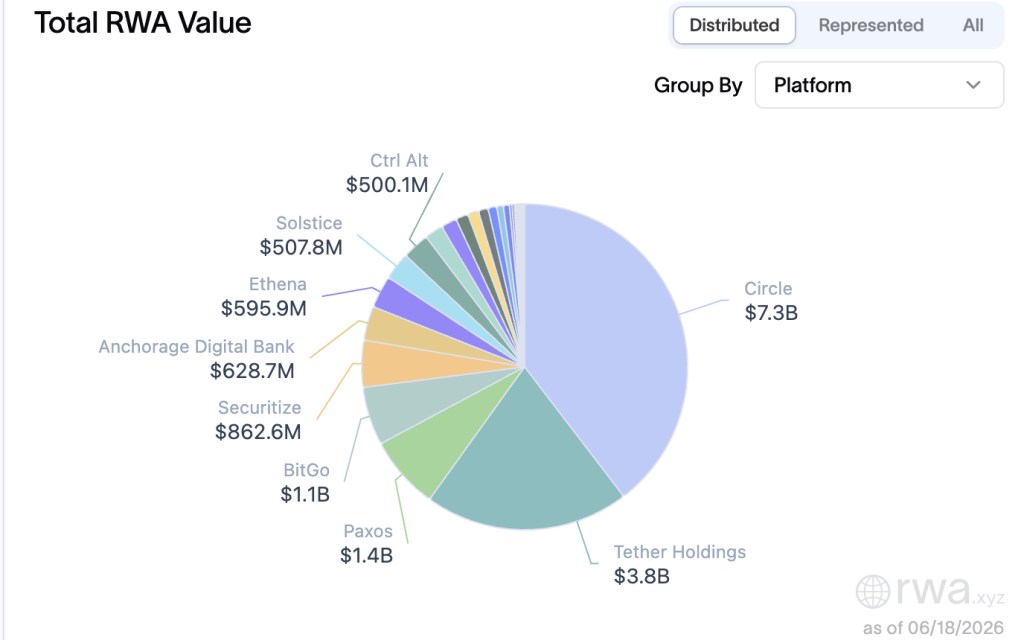
Breaking Solana news: Moody’s Ratings deployed its credit ratings infrastructure on Solana mainnet on June 17, 2026, through a partnership with AlphaLedger, making Solana the first major public, permissionless blockchain to carry live Moody’s credit ratings in machine-readable form.
The integration embeds ratings directly into the token metadata of tokenized bonds and other fixed income securities, meaning the credit signal travels with the asset on-chain rather than sitting behind a proprietary terminal.
For institutional participants building on Solana’s RWA stack, this closes one of the most obvious gaps in tokenized debt markets: access to standardized, independent credit analysis at the protocol level.
The distinction from Moody’s earlier Canton Network rollout matters structurally. Canton is a permissioned, institutional-grade blockchain with a defined set of vetted participants.
Solana is open infrastructure, any wallet, trading venue, or DeFi protocol can now query Moody’s credit data directly from on-chain token metadata without credentialing through a closed network. That shift from permissioned to permissionless delivery is what makes this announcement materially different from what Moody’s has done before.
Discover: The Best Crypto to Diversify Your Portfolio
Solana News: How the Token Integration Engine Actually Works on Solana
Moody’s Token Integration Engine, known as TIE, is designed as network-agnostic infrastructure: ratings are assigned off-chain using Moody’s standard methodology, then pushed on-chain via API through
AlphaLedger’s platform, where they are embedded into the token metadata of the underlying security. When a rating changes, upgrade or downgrade, that update propagates on-chain automatically, so any application consuming the data gets a live credit signal rather than a static snapshot.
The system was first validated in a June 2025 proof-of-concept on Solana’s devnet, where AlphaLedger simulated a municipal bond issuance, Moody’s ran a full credit assessment, and the resulting rating was written into the token’s metadata and made queryable by smart contracts.
The mainnet rollout scales that proof-of-concept to production, with early focus on U.S. municipal bonds and other fixed income instruments.
Manish Dutta, Chief Executive Officer of AlphaLedger, said the integration allows tokenized markets to use the same credit information that investors rely on in traditional fixed-income markets. That framing is precise: the goal is not to create a parallel ratings system but to make the existing one programmatically accessible on a public chain.
Rajeev Bamra, Head of Digital Economy Strategy at Moody’s Ratings, said investors increasingly need access to independent credit analysis in on-chain environments.
The specific problem TIE targets is automated risk management, giving DeFi protocols and digital asset platforms a trusted, machine-readable credit input they can use for collateral decisions, margin policies, and investment eligibility filters without routing through proprietary data feeds.
That use case has been largely theoretical in tokenized bond markets until now.
Discover: The Best Token Presales
Solana’s Institutional RWA Position: What This Integration Confirms
The Moody’s integration arrives as Solana’s institutional real-world assets pipeline has deepened considerably. Western Union launched a U.S. dollar stablecoin on the network targeting lower-cost remittances.
Blockchain developer R3, whose Corda network counts HSBC, Bank of America, the Bank of Italy, and the Monetary Authority of Singapore as participants, partnered with the Solana Foundation to port tokenized assets from Corda onto Solana.
Asset managers including BlackRock, Franklin Templeton, and Apollo have already launched tokenized investment products across the broader RWA space. Boston Consulting Group and Ripple estimate the tokenized asset market could reach $18.9 trillion by 2033.
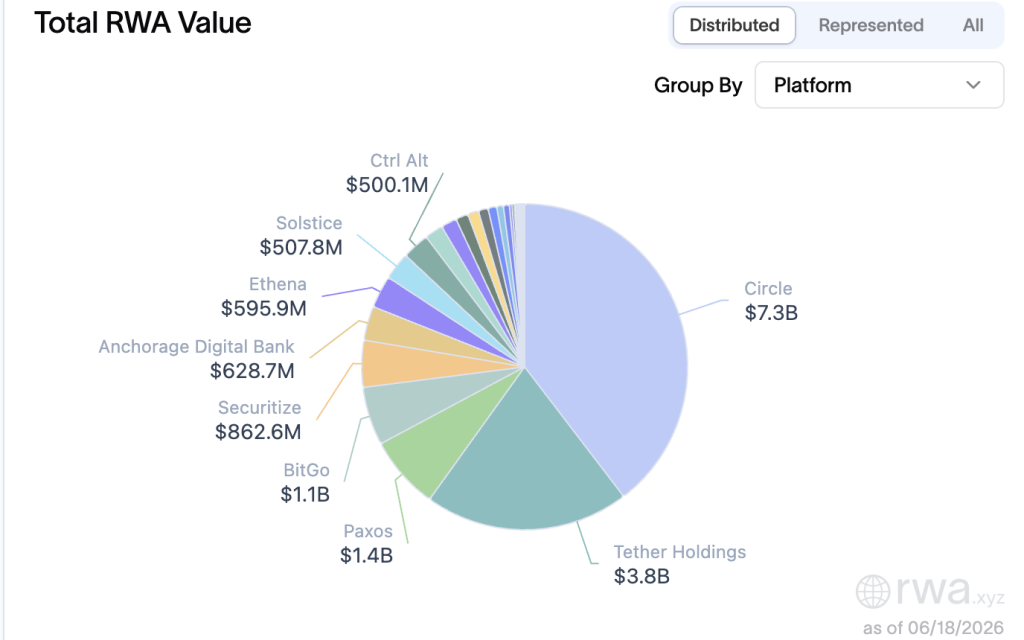
Nick Ducoff, Head of Institutional Growth at the Solana Foundation, said the Moody’s integration improves transparency and accessibility for tokenized assets on the network.
The more concrete read is that embedding Big Three credit ratings into on-chain securities removes a key objection from fixed income desks evaluating Solana-based products: the absence of standardized, independently verifiable credit data.
Institutional fixed income buyers do not price risk without Moody’s, S&P, or Fitch, having that layer queryable on a public chain is a structural prerequisite for serious adoption, not a cosmetic feature.
Moody’s has indicated TIE will expand beyond municipal bonds to corporate, sovereign, and structured finance instruments as tokenization volumes grow, and will extend to additional blockchains beyond Canton and Solana.
The multi-chain framing is deliberate, Moody’s is positioning TIE as ratings infrastructure for the tokenized debt market broadly, not as a Solana-exclusive product.
Solana’s accelerating institutional deal flow suggests the network is establishing a durable lead in public-chain RWA issuance, but the Moody’s deployment itself is chain-agnostic by design.
Whether that early-mover position compounds or gets competed away depends on how quickly issuers and protocols integrate TIE data into live products, and how fast the rest of the tokenized fixed income stack catches up to meet it.
SOL’s price performance has been tracking broader market conditions more than protocol-level news, which is consistent with where institutional adoption sits right now: real infrastructure progress, not yet reflected in near-term price catalysts.
The post Solana Scores Crypto’s First Moody’s Credit Ratings Onchain appeared first on Cryptonews.
Crypto World
Bitcoin News: Zimbabwe Just Regulated Crypto, But Could a Bitcoin Treasury Save Its Economy?
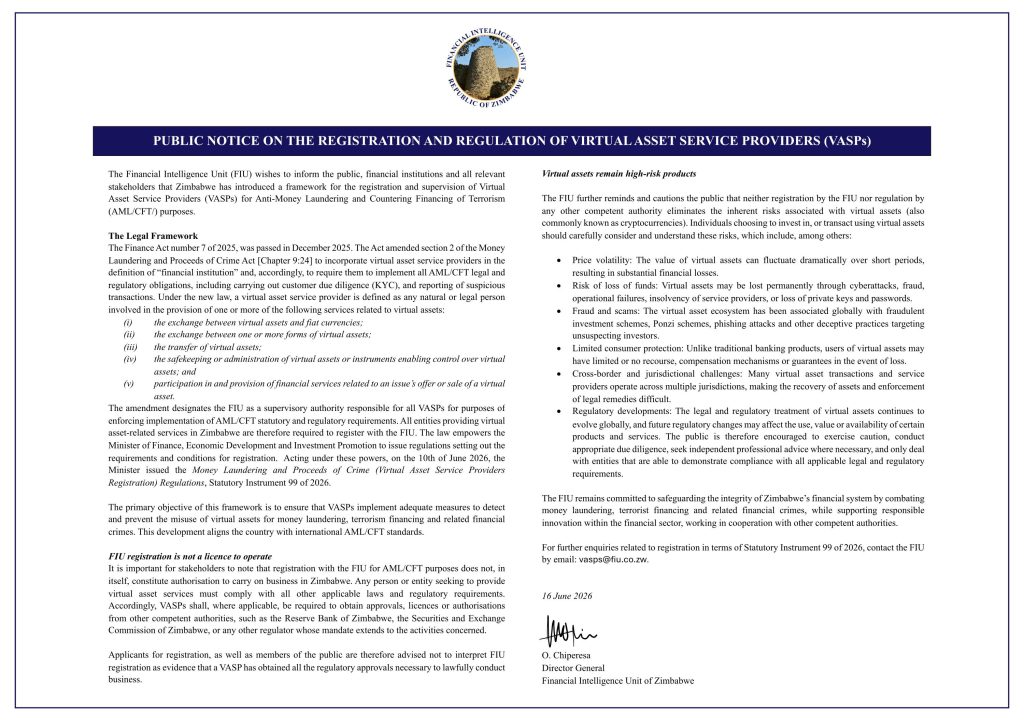
In the most recent Bitcoin News, Zimbabwe’s Financial Intelligence Unit issued a binding mandate on June 16, 2026 requiring all virtual asset service providers to register under Statutory Instrument 99 of 2026, the country’s first dedicated crypto regulatory framework, effective immediately, with criminal liability for non-compliance.
The framework formalizes what has been an eight-year grey market built largely on hyperinflation-driven demand for dollar-denominated alternatives to a succession of collapsing local currencies.
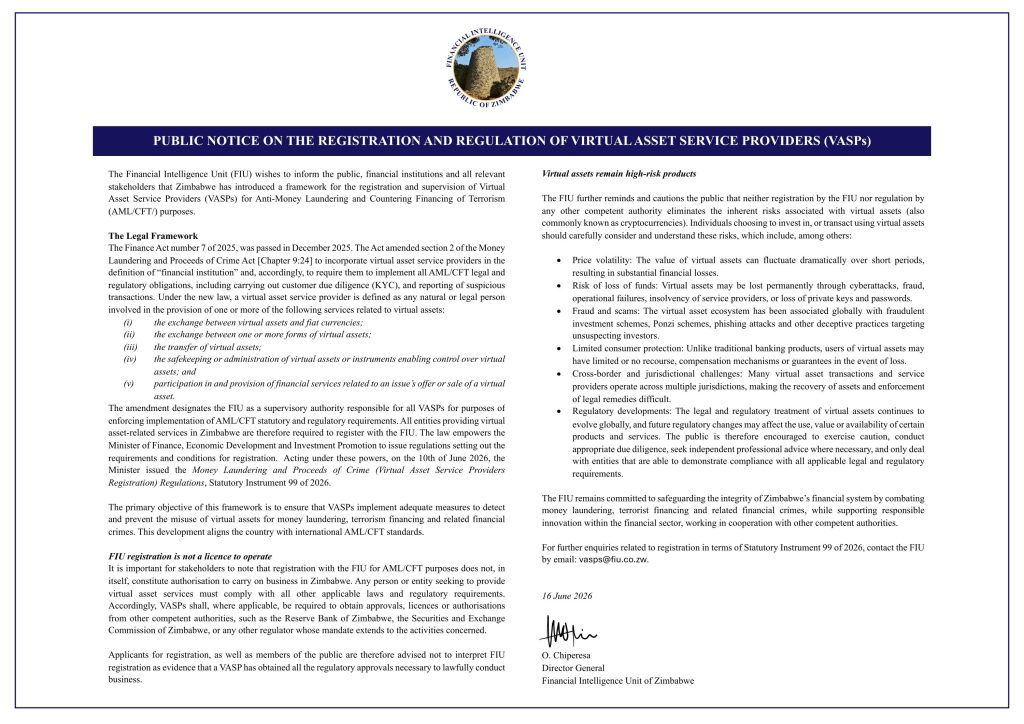
The regulatory event is straightforward. The question it reopens is not: if Zimbabwe can build the institutional scaffolding to supervise crypto, is there a coherent case for the state itself to hold a Bitcoin reserve as a monetary anchor? The answer cuts both ways, and the arithmetic deserves a serious look.
Discover: The Best Crypto to Diversify Your Portfolio
Bitcoin News: SI 99 of 2026: What the FIU Mandate Actually Covers
The legal chain is worth anchoring precisely. The Finance Act No. 7 of 2025, passed in December 2025, amended Section 2 of Zimbabwe’s Money Laundering and Proceeds of Crime Act to incorporate VASPs into the statutory definition of a financial institution.
Acting under those expanded powers, the Zimbabwean Minister of Finance gazetted the Money Laundering and Proceeds of Crime (Virtual Asset Service Providers Registration) Regulations on June 10, 2026, codified as Statutory Instrument 99, and the FIU issued its public enforcement mandate six days later.
The scope is broad and technology-neutral. Any entity exchanging cryptocurrencies for fiat, providing custody services, or facilitating crypto-related financial transactions must register. Notably, decentralization is not an exemption: if an operator can adjust smart contracts, route funds, or set transaction fees, the FIU considers them a VASP.
Registration carries a US$500 initial fee and US$400 annual renewals, requires a locally incorporated entity, director background checks, KYC implementation, transaction monitoring, and compliance with the FATF Travel Rule.
The FIU was explicit about what registration does not provide. “Registration with the FIU for AML/CFT purposes does not, in itself, constitute authorization to carry on business in Zimbabwe,” the public notice stated.
VASPs still need separate operational approvals from the Reserve Bank of Zimbabwe or the Securities and Exchange Commission of Zimbabwe, depending on their business model. This two-layer structure – crypto regulation for AML monitoring on one track, commercial licensing on another, is standard FATF architecture, and Zimbabwe is explicitly aligning itself with those international standards.
The historical context makes the policy shift sharper. In 2018, the RBZ issued Circular No. 2/2018 ordering all banks to cease servicing crypto exchanges and exit existing relationships within 60 days.
Local exchange Golix challenged the ban in court and obtained a provisional High Court order lifting it specifically against Golix, but broader regulatory uncertainty persisted for years.
SI 99 is effectively the formal end of that ambiguity, a supervised integration model replacing blanket exclusion, driven by the recognition that hyperinflation and chronic currency instability had already pushed citizens into crypto regardless of official policy.
Discover: The Best Token Presales
The post Bitcoin News: Zimbabwe Just Regulated Crypto, But Could a Bitcoin Treasury Save Its Economy? appeared first on Cryptonews.
Canadian Bitcoin miner HIVE Digital Technologies said its AI subsidiary BUZZ HPC has signed a three-year GPU cloud contract worth approximately $220 million with Bell AI Fabric for AI startup Cohere, expanding the company’s push into high-performance computing (HPC) and AI infrastructure.
The agreement calls for BUZZ HPC to deploy 2,304 NVIDIA Grace Blackwell GPUs at a Bell Canada data center in British Columbia, where the infrastructure will support Cohere’s artificial intelligence models and services for enterprise and government customers.
After the deployment enters service, HIVE expects the project to contribute about $70 million in contracted annual recurring revenue, increasing its contracted HPC revenue target to more than $100 million, according to the company.
HIVE said it will fund the purchase of the AI infrastructure using a portion of the proceeds from the $115 million convertible note financing it completed in April.
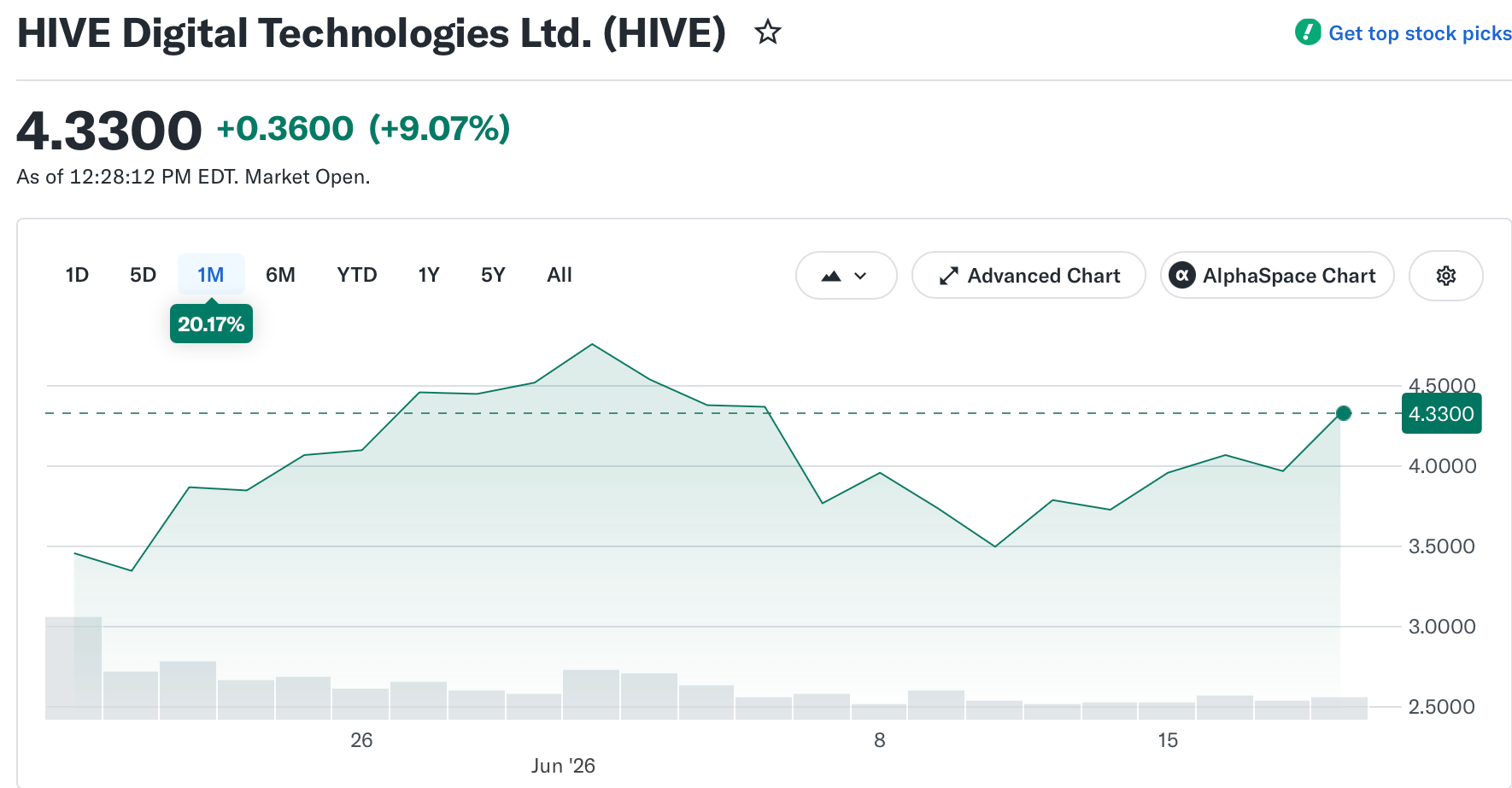
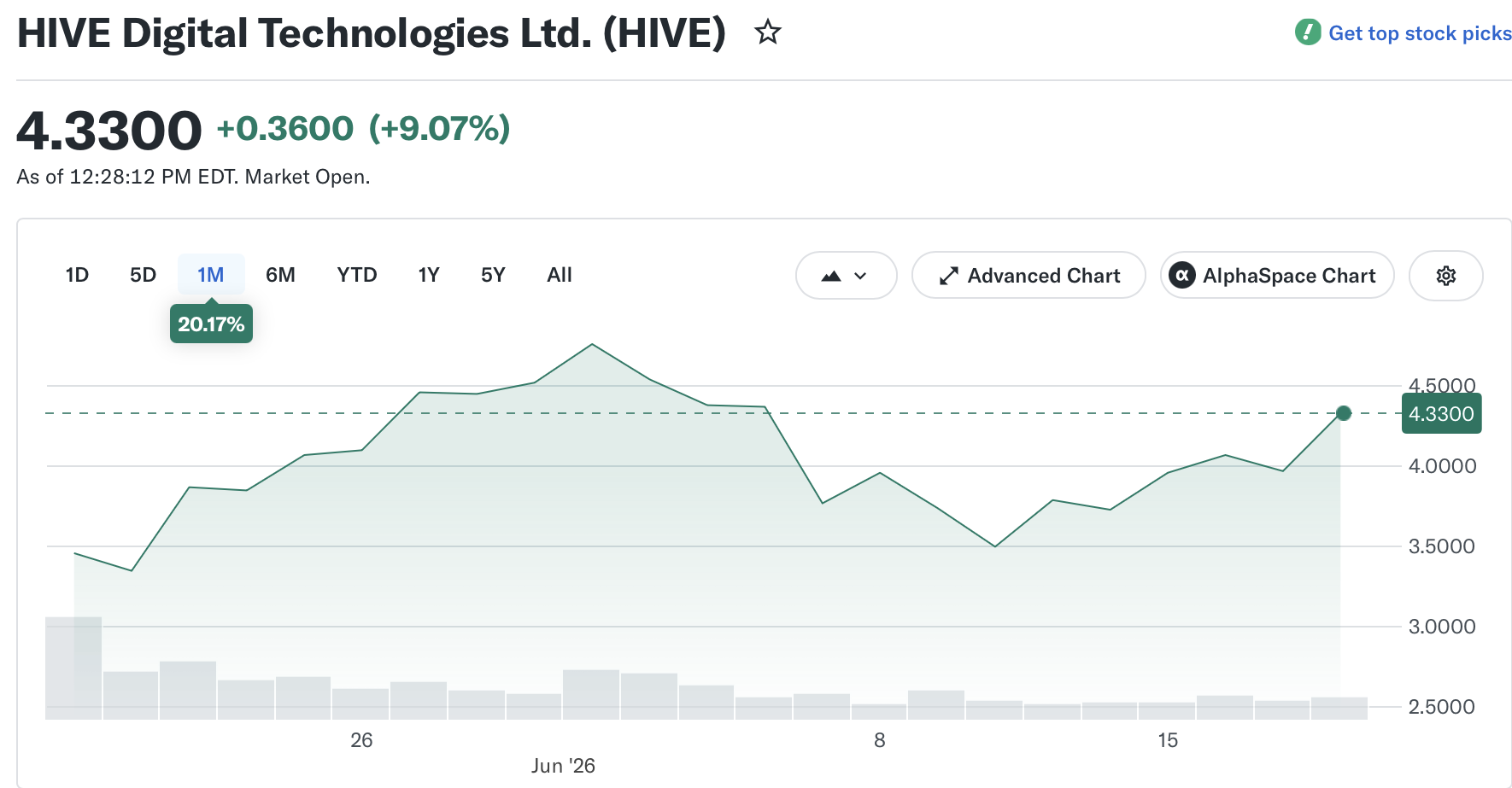
The company’s stock price was up around 9% at the time of writing and almost 24% in the past month, according to Yahoo Finance data. Sector tracking exchange-traded fund CoinShares Bitcoin Mining ETF (WGMI) was up 5.4% on the day, and up more than 30% in the past month. HIVE stock is the fund’s eighth-biggest holding.
Source: Yahoo Finance
Related: Georgia targets illegal crypto mining in Mestia crackdown: Report
HIVE grows AI business as Bitcoin holdings decline
The deal is the latest move in HIVE’s broader expansion into AI infrastructure. In May, the company said its BUZZ HPC subsidiary planned a 320-megawatt AI data center campus near Toronto, capable of supporting more than 100,000 GPUs.
Earlier this month, HIVE reported that revenue from its HPC division increased to $19.5 million in fiscal 2026, nearly doubling from a year earlier. The company also said contracted annual recurring revenue from the business reached $35 million, supported by deployments of Nvidia-powered GPU clusters and new enterprise contracts.
HIVE also reported a decline in its Bitcoin (BTC) treasury holdings, which fell to 150 BTC from 481 BTC a quarter earlier.

Source: BitcoinTreasuries.NET
Related: Nvidia’s $20 billion debt boom reinforces Bitcoin miners’ AI pivot
Hashrate declines as AI investments grow
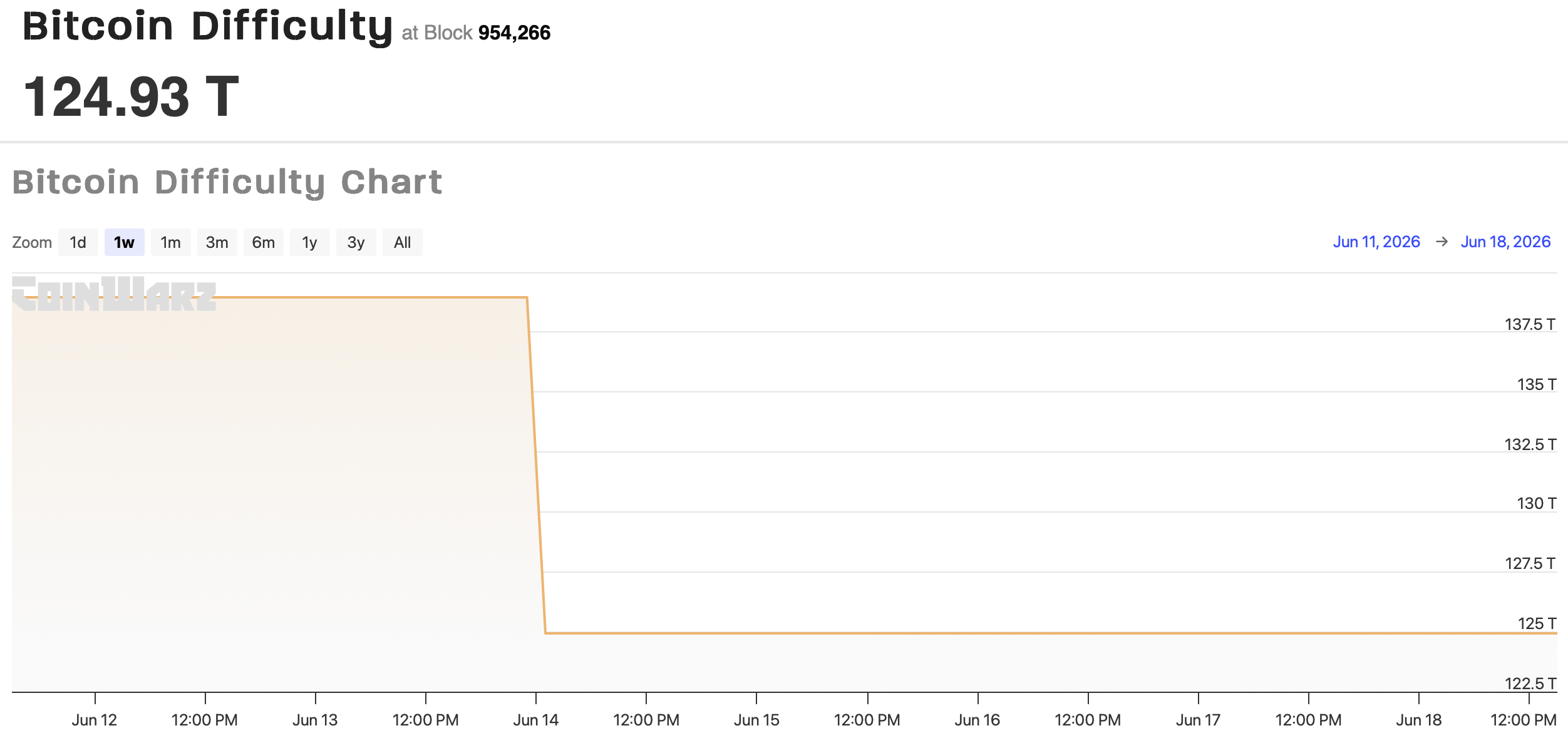
On Thursday, The Energy Mag (formerly The Miner Mag) noted that Bitcoin mining difficulty, a measure of how hard it is for miners to produce new blocks, fell 10.09% on June 14, one of the largest downward adjustments in the network’s history.
The publication attributed the decline to weaker mining economics, Bitcoin’s price decline, seasonal power curtailment in Texas and broader power-market dynamics. It also argued that miners dedicating power to AI and HPC projects could alter future hashrate growth by reducing the amount of capacity available for Bitcoin mining.
Bitcoin mining difficulty. Source: Coinwarz.com
The decline came days after Cointelegraph reported that Bitcoin mining profitability had fallen to record lows, making it harder for some operators to remain profitable.
Meanwhile, miners continue expanding into AI and high-performance computing. On Tuesday, IREN completed its acquisition of Spanish data center developer Nostrum Group, while TeraWulf recently added a Kentucky development site that it said could eventually support more than 1 gigawatt of AI and HPC capacity.
Magazine: Does ‘Paper Bitcoin’ mean there’s an unlimited supply of BTC?
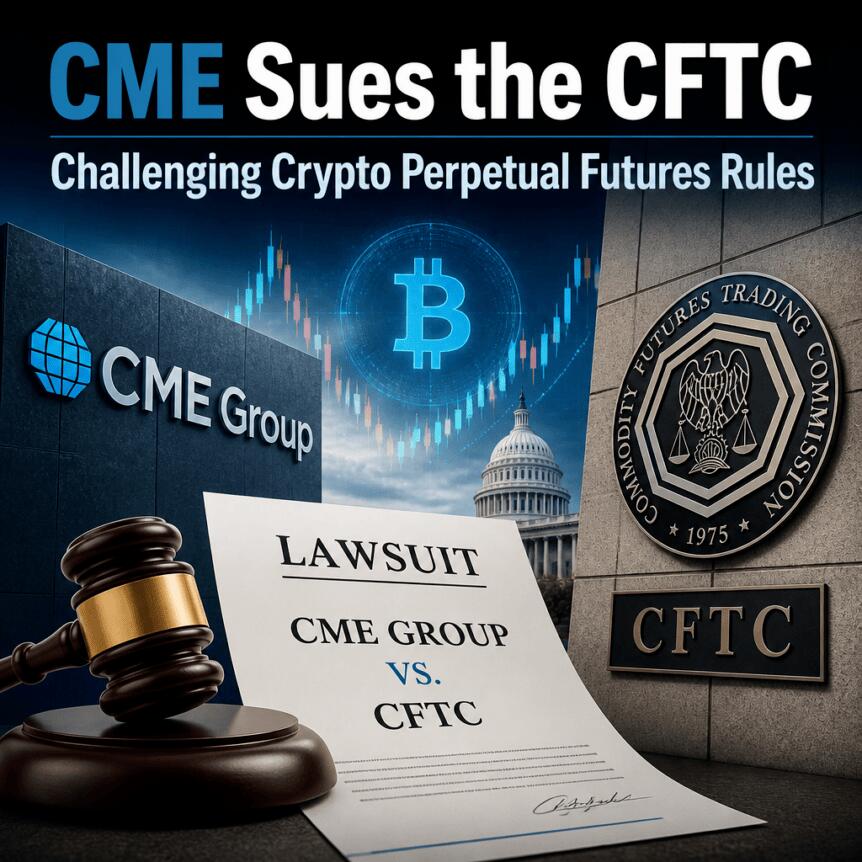
The Chicago Mercantile Exchange (CME) Group has filed a lawsuit in federal court challenging the U.S. Commodity Futures Trading Commission (CFTC) over its approvals of cryptocurrency-linked perpetual futures. The complaint, submitted to the U.S. District Court for the District of Columbia, targets the CFTC, its chair Michael Selig, and asks the court to vacate the agency’s actions.
The case highlights an expanding regulatory dispute over how U.S. derivatives rules apply to crypto products that do not fit neatly into traditional futures structures. For crypto exchanges, broker-dealers, market operators, and institutional investors, the outcome could affect product design, compliance expectations, and supervisory oversight of crypto derivatives—particularly where regulatory interpretations hinge on whether a contract is treated as a “futures” product or as a “swap” under the Commodity Exchange Act (CEA).
Key takeaways
- CME filed a D.C. federal lawsuit against the CFTC and chair Michael Selig relating to the agency’s approval of crypto perpetual futures tied to Bitcoin spot prices.
- The complaint centers on a CFTC notice dated May 29 involving Kalshi prediction market products and a no-action position for similar products involving Coinbase.
- CME alleges the CFTC improperly applied the CEA by effectively treating “futures” as “swaps” with expiration dates, and argues Selig acted without a full five-commissioner panel.
- The CFTC, through a spokesperson, rejected the claims as “frivolous” and characterized CME’s litigation approach as “lawfare.”
CME’s lawsuit challenges CFTC approvals for crypto perpetual futures
In its Thursday filing, CME sought judicial review of CFTC actions approving certain perpetual futures contracts linked to Bitcoin’s spot price. The dispute traces back to a May 29 CFTC notice that (1) approved perpetual futures contracts tied to Bitcoin for Kalshi, a platform operating prediction markets, and (2) issued a “no-action” position for similar perpetual products referenced in connection with Coinbase.
CME’s complaint argues that the CFTC’s approach conflicts with directives from Congress, particularly by treating “futures” as “swaps” for purposes of regulatory classification. Under CME’s theory, the classification matters because it determines which statutory and regulatory requirements apply to the relevant derivatives framework.
Beyond the substantive challenge, CME also raised procedural concerns. The exchange contends that Selig acted unilaterally rather than through a full panel of five CFTC commissioners, implying that the agency’s internal governance or decision-making process was not properly followed for the actions at issue.
“With one stroke of his pen, [Selig] overrode Congress’s definition of the term ‘swap’ and circumvented the regulatory regime Congress required for that form of derivative.”
CME further asserted that the CFTC’s handling of these approvals could harm competition and destabilize derivatives markets, arguing the agency failed to apply the CEA consistently and evenly.
Congress, contract classification, and why the dispute matters
At the core of CME’s legal argument is the classification of perpetual futures contracts—contracts that, in typical market practice, can be designed to trade without a fixed expiration date, while still resembling derivative instruments whose regulatory treatment depends on statutory definitions.
From a compliance standpoint, how a product is categorized can determine whether market participants must register, seek approvals, adopt particular operational controls, and comply with specific surveillance or reporting expectations under U.S. derivatives oversight. The lawsuit therefore sits at the intersection of contract engineering and statutory interpretation: market operators and intermediaries may need clarity on whether certain crypto-linked “perpetual” structures fit within futures frameworks or instead trigger swap-like regulatory pathways.
The broader institutional issue is that perpetual crypto derivatives have increasingly blurred lines between legacy derivative categories. That raises practical uncertainty for exchanges and clearing entities, and it can create compliance friction for financial institutions that must meet regulatory expectations for eligible contract types and risk controls. In that context, CME’s challenge is not merely a technical disagreement: it is aimed at shaping the legal boundaries that govern future approvals and market access.
Selig’s position and the CFTC’s response
The dispute escalated publicly shortly before CME’s filing. One day earlier, CME CEO Terrence Duffy said the exchange operator would take legal action against the CFTC. In a subsequent interview, Selig maintained that perpetual futures contracts “trade very similarly” to other derivatives and argued that the CEA does not define the term “futures contract.”
The CFTC rejected CME’s complaint. A CFTC spokesperson told Cointelegraph that CME had engaged in “lawfare” against the agency and the administration’s broader crypto policy approach, characterizing the lawsuit as “frivolous.” The exchange’s response, in turn, underscores a high-stakes policy conflict: if courts accept CME’s reading, it could compel the agency to revisit approvals tied to its prior interpretive stance and potentially adjust how it evaluates similar applications or regulatory notices.
CFTC leadership structure and timing: a procedural and policy flashpoint
CFTC chair Michael Selig was confirmed by the U.S. Senate in December 2025 and, as of the time of CME’s filing, remains the chair and sole commissioner in a leadership panel intended to include five commissioners. The lawsuit comes amid uncertainty about whether the CFTC’s full bipartisan composition will be restored in time for complex contested decisions—an issue that CME highlights through its allegation that Selig acted without a complete panel.
Political context also matters for the regulatory process. As of Thursday, President Donald Trump had not announced nominations to fill the CFTC seats, despite calls from members of Congress to do so. That governance vacuum can become consequential when markets depend on consistent, multi-member commission decision-making for contested interpretations of the CEA.
The dispute also arrives as crypto perpetual derivatives are proliferating across U.S. venues and regulated infrastructure. For example, Kraken announced it would offer perpetual futures to U.S. users through a CFTC-regulated platform, Bitnomial. While that development is separate from CME’s lawsuit, it reflects the practical stakes of regulatory clarity: product expansion continues, but the legal foundations supporting classification and approval pathways are actively contested.
What to watch next
Courts will determine whether CME’s claims succeed on statutory interpretation and whether the challenged approvals can stand procedurally under the CFTC’s decision-making requirements. For market participants, the most immediate watchpoints are how the court frames the futures-versus-swaps classification issue and whether the CFTC revises its approach to approvals of crypto perpetual derivatives pending the litigation’s outcome.
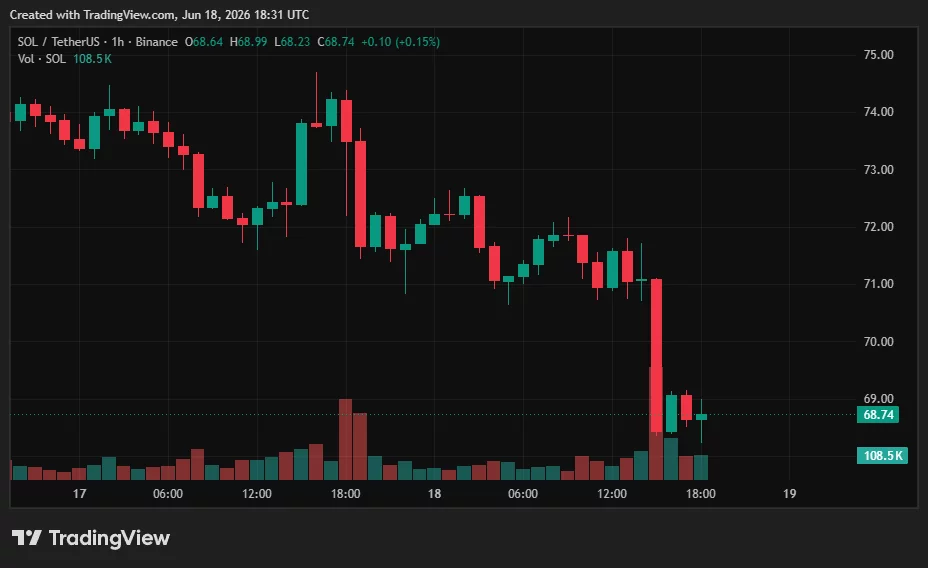
Kraken has expanded access to more than 2,500 Solana-based tokens through on-chain trading while SOL has fallen nearly 8% amid a wider crypto market selloff.
Summary
- Kraken has launched on-chain trading for more than 2,500 Solana-based tokens across 100+ countries.
- The feature gives users access to many unlisted Solana tokens using USD or USDC.
- SOL fell nearly 8% as a broader crypto market selloff outweighed the positive platform update.
According to Kraken, customers in the United States and more than 100 countries can now trade thousands of Solana ecosystem tokens directly through the exchange’s platform, including assets that have not yet been listed on centralized exchanges.
The rollout allows users to buy and sell eligible Solana tokens using USD or USDC without relying on separate self-custody wallets or external decentralized finance tools.
Kraken said the feature removes several steps that have traditionally required users to manage seed phrases, bridge assets between platforms, or interact with multiple applications.
Speaking on the launch, Kraken Chief Data Officer Kamo Asatryan said the company wants to simplify access to blockchain-based assets by reducing the complexity associated with activities such as paying gas fees and moving funds across networks.
Kraken expands beyond traditional exchange listings
Rather than focusing only on tokens that pass through the centralized exchange listing process, Kraken is opening access to a much larger segment of the Solana ecosystem. According to the company, many of the newly available assets are not listed on conventional trading platforms.
“Our customers in the US and more than 100 countries can now trade 2,500+ Solana-based tokens directly from the Kraken app they already use, including many not yet listed on any centralized exchange.”
The launch adds another product line to Kraken’s recent expansion efforts. As crypto.news reported on June 15, the exchange introduced perpetual futures for eligible U.S. customers through a Commodity Futures Trading Commission-regulated venue.
Following the rollout, eligible users can trade perpetual futures on Kraken Pro alongside spot, margin, and traditional futures products within a single account. The offering was enabled by Kraken parent company Payward’s acquisition of Bitnomial, a CFTC-licensed derivatives platform acquired earlier this year.
Kraken noted that support for additional blockchain networks is expected in the future, which would allow users to trade assets from ecosystems beyond Solana through the same interface.
Market weakness keeps pressure on SOL
Despite the exchange’s latest Solana-focused product launch, the token has remained under pressure as risk appetite continues to weaken across digital asset markets.
At the time of writing, Solana (SOL) was trading at $68.45, down nearly 7% over the previous 24 hours. The decline has unfolded alongside a broader market downturn that pushed the total cryptocurrency market capitalization down roughly 4% to $2.24 trillion.
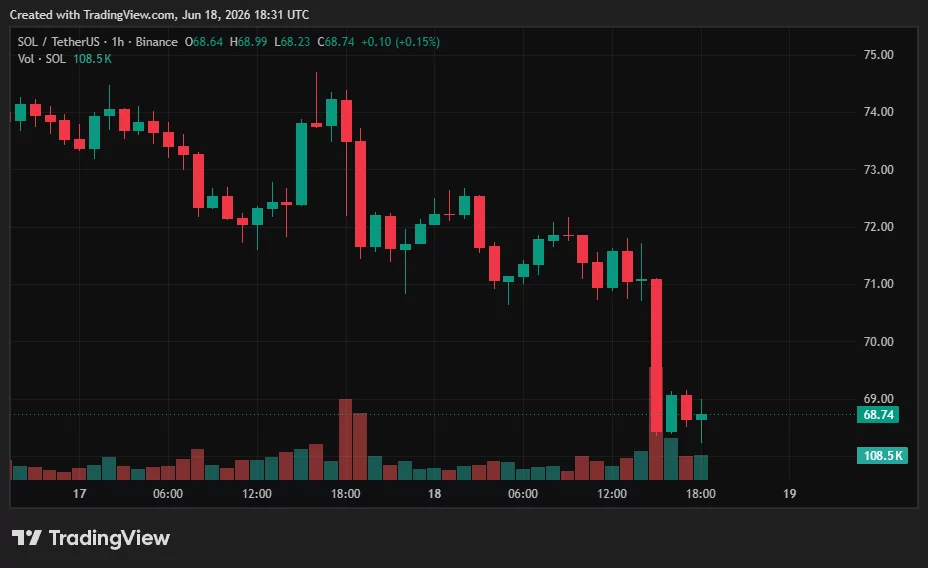
According to a previous crypto.news analysis, a break below the key $70 support level could shift attention back to the June low around $62 and increase the likelihood of a move toward the $60 region.
Elsewhere in the market, Bitcoin traded near $62,620 after falling more than 4%, adding to pressure across major altcoins and speculative digital assets.
Recent activity suggests Kraken continues to increase its presence across multiple parts of the crypto market.
In May, the exchange launched regulated margin trading services, while earlier this month it joined several industry organizations in urging the U.S. Senate to advance the CLARITY Act, legislation designed to establish a clearer regulatory framework for digital assets.
FinHarbor Launches Money Flow, a Payment Orchestration Module for Finance Teams

4 Sleep Rules For Better Ageing

College sports bill passes Senate committee despite SEC, Big Ten pushback

Blockchain.com files with SEC for U.S. IPO

No Jackpot Winner as $257 Million Prize Rolls Over to $269 Million Monday Draw

Israel says it has killed new Hamas military leader in Gaza City airstrikes

The Last Time The Financial System Shifted Like This, A New Class Of Millionaires Was Made

Trump says he does not consider American financial situations in Iran talks

So wirst du ganz leicht reich auf Hugosmp #hugosmp #deutsch #money #shorts
-
 Business4 days ago
No Jackpot Winner as $257 Million Prize Rolls Over to $269 Million Monday Draw
-

 Fashion6 days ago
Weekend Open Thread: Tuckernuck – Corporette.com
-
 Crypto World4 days ago
Zimbabwe Requires Crypto Businesses to Register Annually Under New FIU Regulations
-

 Crypto World6 days ago
Bitget enters Argentina’s regulated crypto market through PSAV registration
-

 Tech6 days ago
NanoClaw integrates JFrog registries to secure AI agent downloads
-

 Tech6 days ago
This Week In Security: Microsoft On Microsoft, Register Your Domains, Linux On ARM, And FreeBSD Joins The File Cache Club
-

 NewsBeat7 days ago
El Nino has formed in the Pacific and could set records, forecasters say
-

 NewsBeat6 days ago
FBI searches office of Ohio voter registration group
-
 Tech7 days ago
Anthropic is spending $150M to embed 1,000 AI fellows inside nonprofits. No degree required.
-
 Entertainment7 days ago
‘The Pitt’s Fan-Favorite Doctor Confirms Noah Wyle Gave His Blessing to Return [Exclusive]
-
 Tech7 days ago
Former AWS CEO Adam Selipsky to lead new $10B AI data center venture
-
 Crypto World7 days ago
Ripple and Bitso Bring MXNB Stablecoin to XRP Ledger
-
 Entertainment4 days ago
Matt Damon’s Viral Sci-Fi Thriller Has Taken Over HBO Max
-

 Business4 days ago
Anthropic staff to meet White House officials next week, Axios reports
-

 Tech4 days ago
As AI companies race to go public, who else is along for the ride?
-

 Business7 days ago
Justin Bieber Prepares for 2026 Tour Return with New Music and Promoter Talks
-
 Crypto World4 days ago
Bitcoin could crash to $48,000, if this historical pattern is triggered
-

 Politics4 days ago
“Israel’s” ban on ICRC visits ruled illegal, but Knesset moves to stop them permanently
-
 Tech7 days ago
Euro-Office 1.0 Arrives To Open-Source Infighting: ‘Compatibility Is Not Sovereignty’
-
Entertainment7 days ago
Ana Navarro unleashes explosive tirade on ex-Trump aide, Disney Channel star in epic on-air fight: 'Have you no shame?'
You must be logged in to post a comment Login