

Crypto World
Theo Allocates $20M to Fidelity International’s FILQ Fund

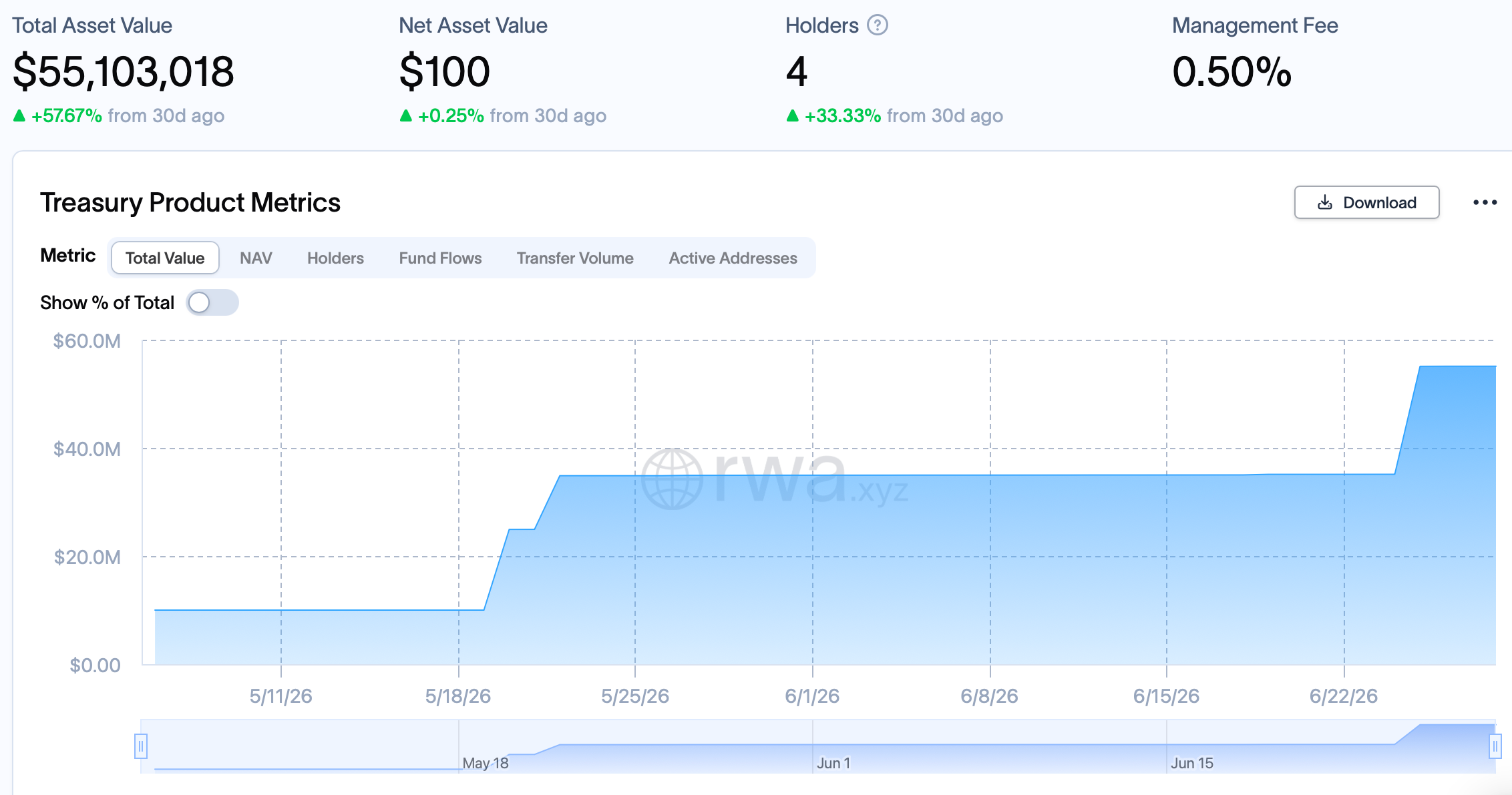
Theo, an onchain capital markets platform, has invested $20 million in Fidelity International’s USD Digital Liquidity Fund (FILQ). Theo said the investment makes it the first crypto-native platform to allocate capital to the asset manager’s tokenized fund.
Executed through Sygnum, a Swiss digital asset bank that provides regulated banking, custody and tokenization services for institutional clients, the allocation adds FILQ to Theo’s institutional tokenized Treasury product, thBILL.
FILQ is a Moody’s Aaa-mf-rated tokenized US dollar liquidity fund built on Sygnum’s Desygnate platform that invests in diversified short-term money market instruments designed to preserve capital and liquidity. Chainlink provides onchain net asset value and distribution data for the fund through its Runtime Environment, while JPMorgan receives and approves the daily NAV data, according to the release.
Fidelity International managed $1.06 trillion in total assets as of March 31, according to the company, while Theo said its products have processed more than $1 billion in cumulative trading volume across more than 80,000 users in over 60 countries.
RWA.xyz data shows FILQ currently manages about $55.1 million in onchain assets, suggesting Theo’s $20 million allocation represents a significant share of the fund.
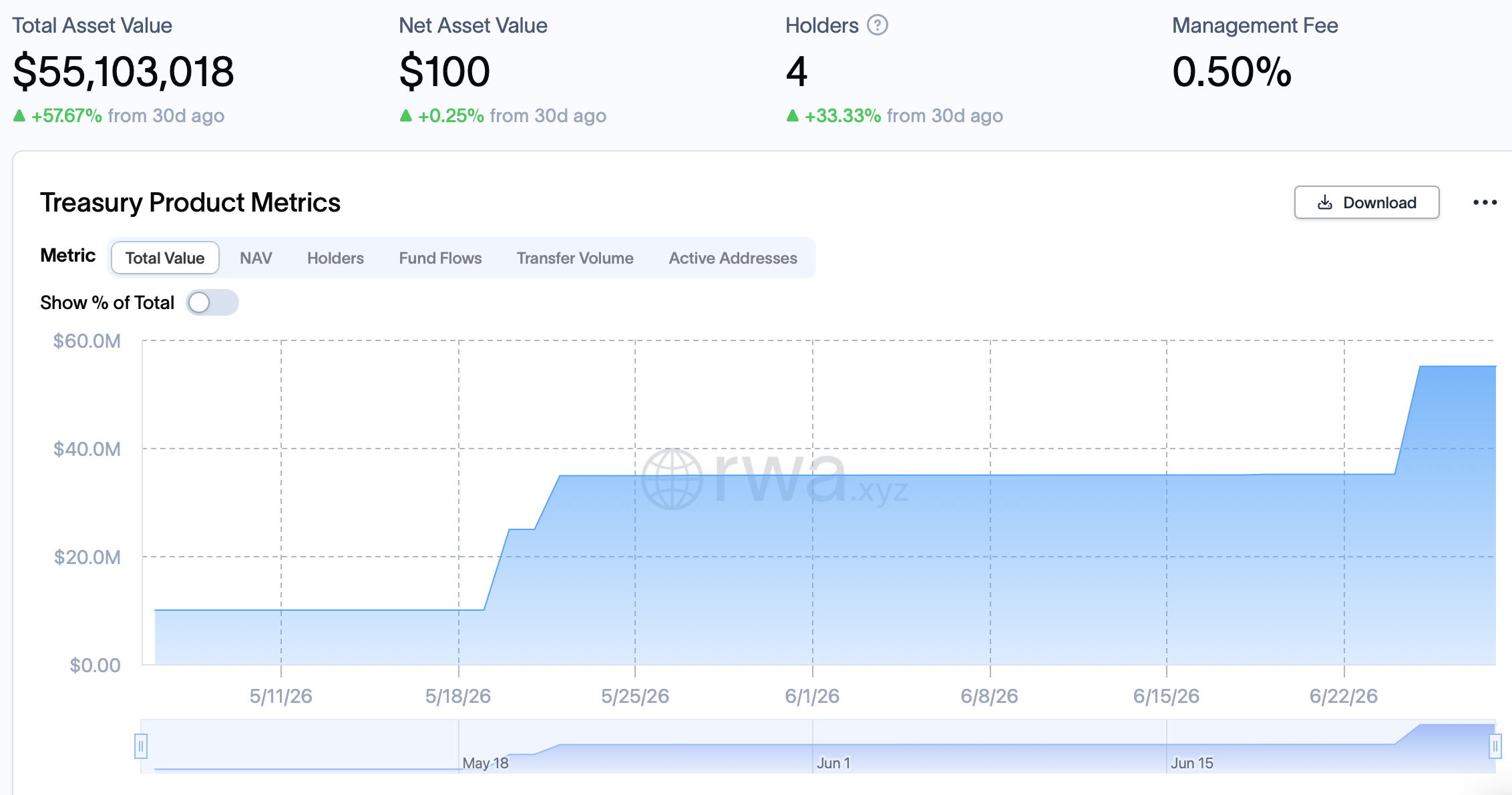
Source: RWA.xzy
Related: Franklin Templeton launches dedicated crypto division after closing 250 Digital acquisition
Traditional asset managers expand tokenized fund offerings
Tokenized US Treasury products have become the largest segment of the tokenized real-world asset market. According to RWA.xyz, the sector has more than doubled over the past year, growing from about $6.9 billion in distributed value in late June 2025 to approximately $14.6 billion as of late June 2026.
RWA.xyz tracks 83 tokenized Treasury products held by more than 64,000 investors, with offerings from Circle, BlackRock, Ondo, Franklin Templeton and Securitize each managing more than $2 billion in distributed value.
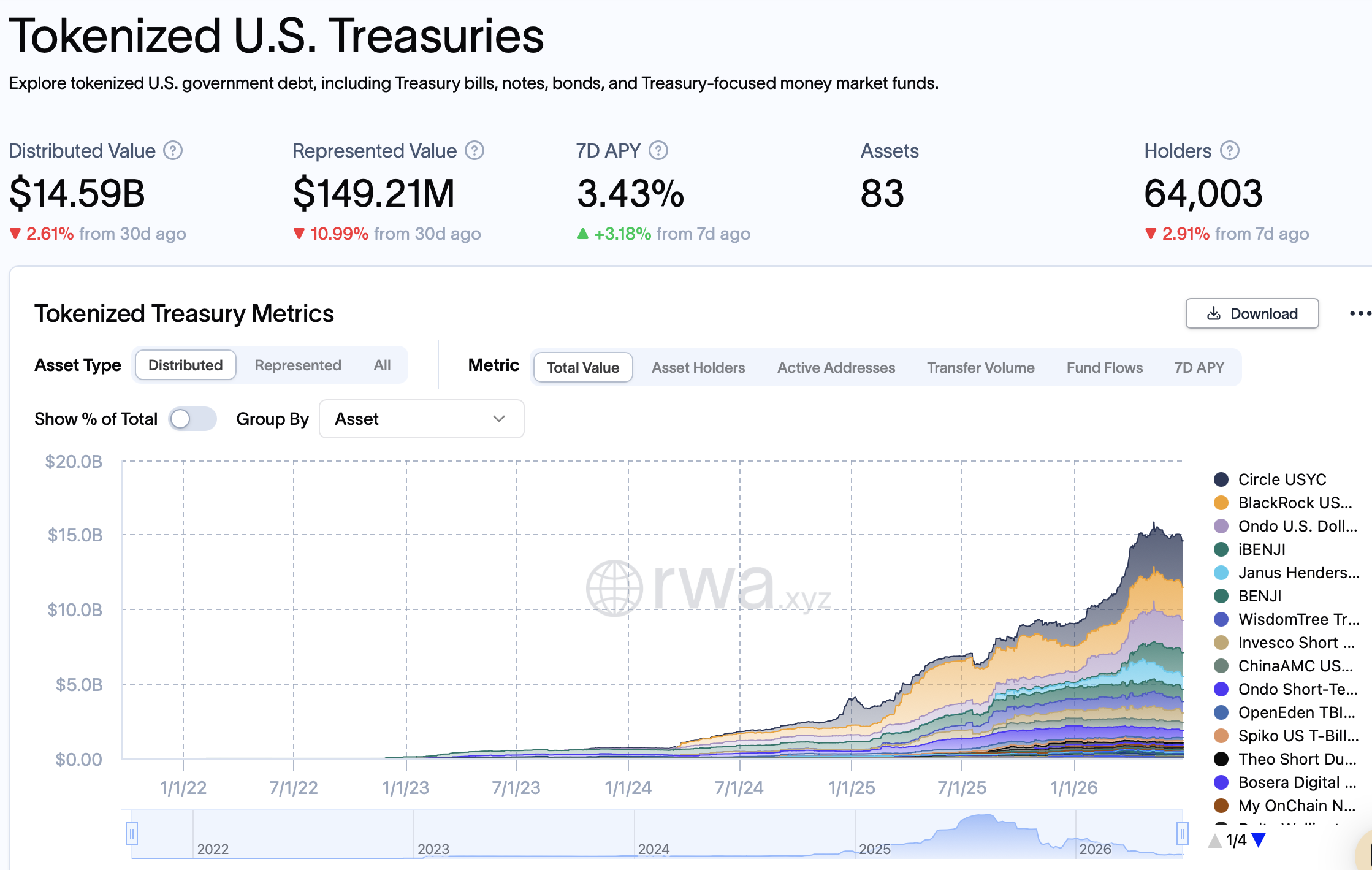
Tokenized US Treasuries. Source: RWA.xyz
The market’s growth has been accompanied by new fund launches and distribution partnerships from traditional financial firms. In May, JPMorgan launched JLTXX, a tokenized government money market fund on Ethereum (ETH) that invests in US Treasury bills and overnight repurchase agreements.
The following month, Franklin Templeton partnered with MoonPay to expand institutional access to its BENJI tokenized money market fund, allowing eligible institutions to move between supported stablecoins and tokenized fund exposure through an onchain trading workflow.
Magazine: Bitcoin decouples from tech stocks, Ether eyes ‘selling wave’: Market Moves



The crypto industry has contributed $189 million to the 2026 U.S. election cycle so far, pushing political spending beyond 2024 levels months before voters head to the polls.
Summary
- Public Citizen says the crypto industry has contributed $189 million to the 2026 U.S. election cycle, surpassing 2024 spending.
- Ripple- and Coinbase-backed PACs, led by Fairshake, remain among the biggest sources of crypto political spending.
- Rising voter interest in crypto and the ongoing CLARITY Act debate continue to shape the industry’s political influence.
According to a report published Tuesday by consumer advocacy group Public Citizen, crypto companies now account for roughly 37% of all corporate political contributions made during the 2026 election cycle. The nonprofit estimated that the industry has spent about $189 million with more than four months remaining before the November election.
Public Citizen said much of that spending has come through crypto-backed political action committees. Fairshake alone has spent more than $82 million during the current cycle, while MAGA Inc., a Super PAC largely backed by Crypto.com, has spent more than $56 million.
The nonprofit argued that these organizations operate independently of traditional party priorities, supporting or opposing candidates from either major party depending on their policy positions. Public Citizen said this approach follows the same strategy used during the 2024 election cycle.
Ripple and Coinbase remain central to crypto political funding
Among the largest industry-backed groups, Fairshake and its affiliated committees, Defend American Jobs and Protect Progress, continue to receive support from cryptocurrency companies including Coinbase and Ripple. Public filings cited by Public Citizen showed the network held a combined $193 million war chest as of January.
The report also pointed to newer political organizations created after the 2024 elections, including Fellowship PAC, which is backed by Cantor Fitzgerald. Public Citizen said the combined spending by crypto-backed PACs has already surpassed the roughly $170 million contributed during the previous federal election cycle, when the industry supported candidates viewed as favorable to digital assets.
Interest in crypto policy has also expanded among voters. As crypto.news previously reported, a DCG-Harris Poll found that 40% of registered voters now consider cryptocurrency a major election issue, up from 20% in 2024. The survey questioned 1,874 registered voters between May 8 and May 18 and included oversamples across Arizona, Georgia, Michigan, Nevada, North Carolina, Ohio, Pennsylvania and Texas.
DCG said the findings indicate that more voters are paying attention to how candidates address digital asset policy as Congress continues debating new crypto legislation.
Crypto lobbying grows alongside CLARITY Act debate
Congressional efforts to establish a regulatory framework have unfolded alongside the industry’s growing political activity. The CLARITY Act remains under Senate consideration, with supporters arguing that the legislation would define oversight responsibilities for U.S. crypto markets.
Earlier reporting from crypto.news noted that Coinbase, Ripple and more than 200 cryptocurrency organizations urged Senate leaders to schedule a vote on the bill.
Separate reporting by crypto.news also stated that Galaxy Digital lowered its estimated probability of the CLARITY Act becoming law in 2026 to 50%, citing a tightening Senate calendar, limited floor time before the August recess, and a lack of visible progress in negotiations.
Political spending has also reached individual congressional races. Colorado voters headed to the polls Tuesday for primary elections, where Public Citizen highlighted activity in the state’s 8th Congressional District.
According to the report, the You Can Push Back Super PAC, backed by Ripple Labs co-founder Chris Larsen, spent $1 million on media supporting Democratic candidate Manny Rutinel. The committee’s previous major expenditure totaled $3.3 million in support of Democrat Alex Bores in New York’s 12th Congressional District. Bores lost his primary last week to Micah Lasher, who had criticized Larsen’s involvement in the race.
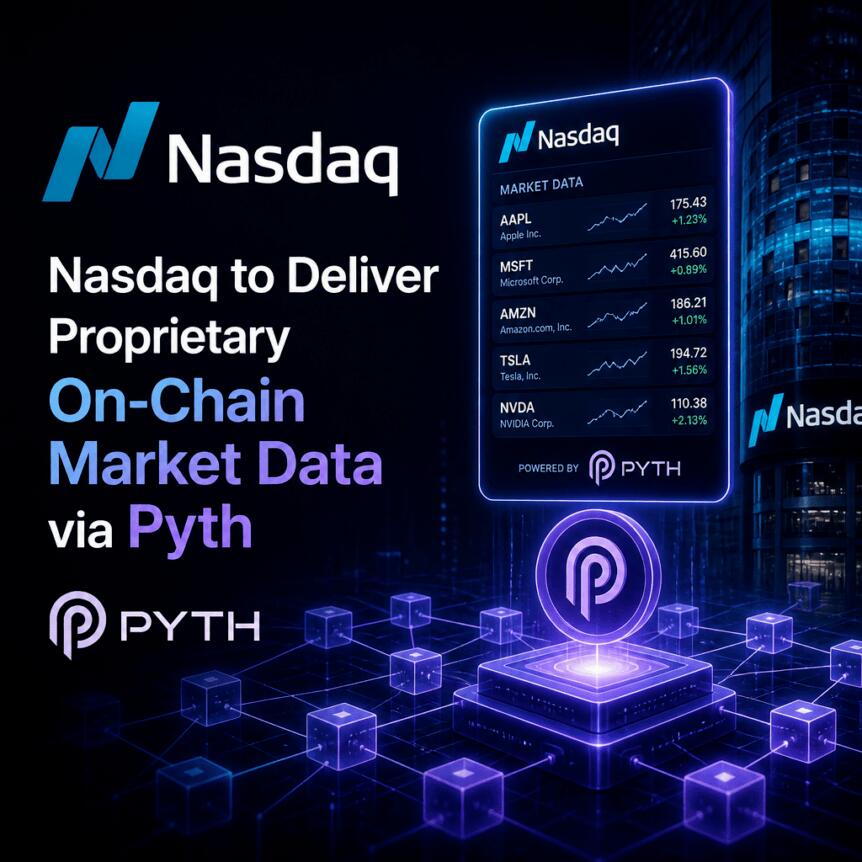
Nasdaq has chosen Pyth, an onchain financial data network, to distribute Nasdaq’s proprietary market data to blockchain applications and other software platforms, expanding how institutional trading feeds can be consumed by decentralized systems.
The collaboration begins with access to Nasdaq TotalView, the exchange’s depth-of-book data feed that captures every displayed bid and ask across price levels, along with order imbalance information around the opening and closing auctions. For traders and developers, the emphasis is on richer liquidity visibility than standard quote feeds, since a full order book can help power more informed execution, market-making analytics, and trading logic.
Key takeaways
- Nasdaq selected Pyth to make Nasdaq market data available to blockchain and other software platforms via onchain distribution.
- Initial coverage is Nasdaq TotalView, including full displayed order books and order imbalance data around opening and closing auctions.
- Pyth positions its integration as “single” access, aiming to simplify how applications obtain first-party market data.
- Nasdaq joins existing Pyth publishers such as Euronext, Tradeweb, Kalshi, Singapore Exchange (SGX FX), and the US Department of Commerce.
From exchange microstructure to onchain use
Traditional market data products typically serve low-latency trading systems and professional analytics, where order book visibility is critical. Nasdaq TotalView is designed for that purpose, offering a more complete picture of market liquidity by publishing the full displayed order book at each price level rather than relying only on top-of-book quotes.
By routing this type of feed through an onchain data network, Nasdaq is effectively lowering the integration barrier for applications that want to incorporate exchange-grade market information. According to Pyth, the service allows software applications to access first-party market data through a single integration, and it is intended for a range of use cases including blockchain applications, digital asset exchanges, prediction markets, and trading systems.
For builders, this matters because onchain trading and derivatives often struggle with a lack of consistent, high-quality market inputs. Depth-of-book and auction-related imbalance data can also support models that go beyond last-trade or index pricing, potentially improving how decentralized systems interpret liquidity conditions around times when participation and price formation are especially active.
Nasdaq’s broader digital-asset push
The Pyth partnership aligns with a series of moves by established exchange operators to expand into crypto-adjacent infrastructure and regulated market services.
In March, Nasdaq expanded its tokenization efforts through an agreement with crypto exchange Kraken and its infrastructure affiliate Backed to develop infrastructure aimed at linking traditional equities with blockchain networks. The company has framed this as part of a larger push to integrate tokenized assets with existing capital markets rails.
Nasdaq has also continued to deepen its regulated crypto derivatives strategy. The SEC approved Nasdaq’s proposal to list Bitcoin index options tied to the Nasdaq Bitcoin Index, with trading pending approval from the Commodity Futures Trading Commission. In parallel, Nasdaq partnered with CME Group to launch cryptocurrency index futures that track a basket of seven digital assets, including Bitcoin, Ether, Solana, and XRP, as part of its broader regulated derivatives lineup.
Exchange peers and the race for crypto product scope
Nasdaq is not alone in expanding beyond legacy exchange offerings. ICE—the parent of the New York Stock Exchange—has taken steps into crypto futures by partnering with OKX to launch perpetual futures tied to ICE’s Brent crude and West Texas Intermediate oil benchmarks. The announcement was described as the first product under that partnership.
ICE CEO Jeffrey Sprecher has also argued that regulators should allow traditional exchanges to offer 24/7 onchain perpetual futures. The core point is competitive: regulated venues should be able to contend with crypto-native platforms that already operate perpetual products around the clock.
While Nasdaq’s current Pyth deal is centered on market data distribution rather than trading products, it fits the same competitive theme—improving the ability of institutional-grade infrastructure to connect with blockchain applications. In practice, data access is often a prerequisite for building or operating decentralized systems that can respond to real liquidity conditions.
What to watch next
Investors and developers should keep an eye on how Nasdaq TotalView data is rolled out through Pyth beyond the initial scope, and whether additional Nasdaq market data offerings follow. As onchain applications increasingly seek higher-fidelity inputs, partnerships like this could become a differentiator for decentralized trading and prediction systems—provided integration remains practical and latency or data quality expectations can be met in real-world deployment.
Crypto World
Securitize Shareholders Approve Merger, Paving Way for First Publicly Traded Tokenization Company


Cantor Equity Partners II shareholders voted Monday to approve a merger with Securitize, clearing the final pre-close hurdle before the combined company lists on the New York Stock Exchange on July 2 as Securitize Corp., the first publicly traded tokenization company in the United States. The vote… Read the full story at The Defiant
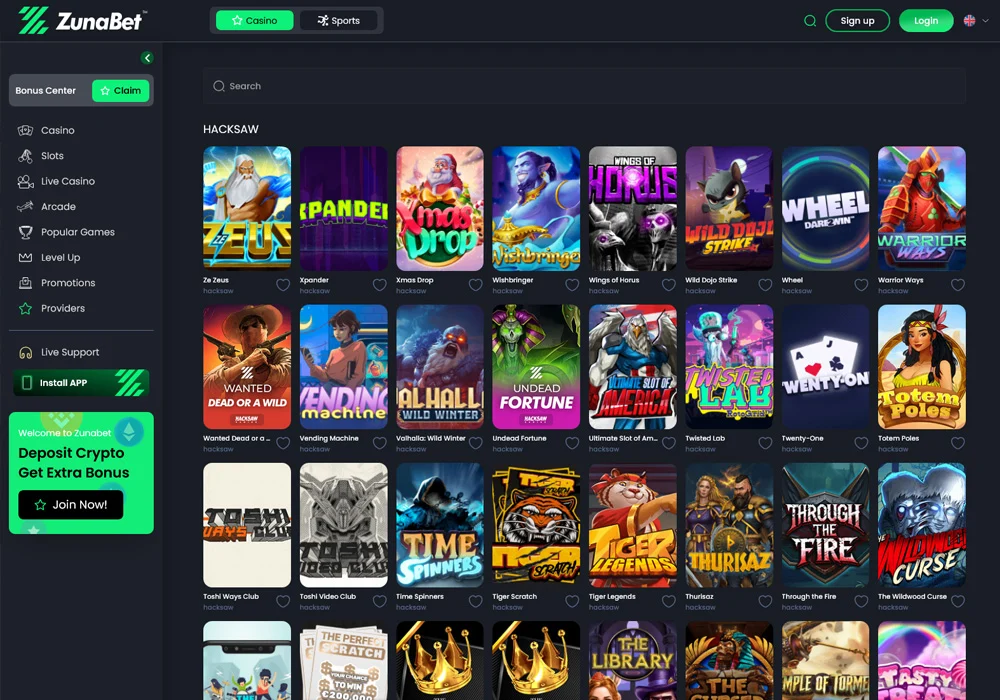
The 2026 online betting landscape continues to be shaped by FanDuel and BetMGM, two names that pull in the bulk of US market share through major league deals, sharp mobile apps, and consistent advertising. But the picture is widening. Crypto-first operators have started occupying real ground in the same discussions, and ZunaBet — which launched in 2026 — is one of the brands finding its place quickly within that shift.
Here’s how FanDuel and BetMGM compare today, and where ZunaBet’s setup positions it as part of the evolving landscape.
The Two US Market Leaders
FanDuel has been operating since 2009, beginning as a daily fantasy sports site before expanding into a full sportsbook and online casino. In 2026, it sits at the top of US sports betting across many states. The platform runs polished mobile apps, holds major league partnerships, and works on the standard fiat banking model — cards, bank transfers, and e-wallets.
BetMGM launched in 2018 as a joint venture between MGM Resorts and Entain, combining MGM’s long casino history with Entain’s online betting technology. The platform offers a full sportsbook and online casino, with crossover perks tied to MGM resorts — hotel stays, dining, and entertainment included. Like FanDuel, it deals only in dollars and runs under state-by-state licensing.
Both are dependable choices for players who want a regulated US experience. Both also share the constraints that come with the traditional operating model — state-by-state restrictions, withdrawal timelines that depend on chosen methods, libraries narrower than what global crypto operators carry, and loyalty programs that haven’t moved far from the standard tiered template.
Where ZunaBet Comes In
ZunaBet went live in 2026 under Strathvale Group Ltd, operating with an Anjouan gaming license. The defining separator from the older brands is in the architecture — crypto isn’t a feature added later but the foundation the whole platform was built on.
The casino library covers more than 11,000 titles from over 60 providers, including Pragmatic Play, Hacksaw Gaming, Yggdrasil, BGaming, and Evolution. That depth places it among the larger crypto-focused libraries available, easily exceeding what FanDuel or BetMGM can carry in most of their licensed markets. Slots, table games, and live dealer rooms all share a single account.
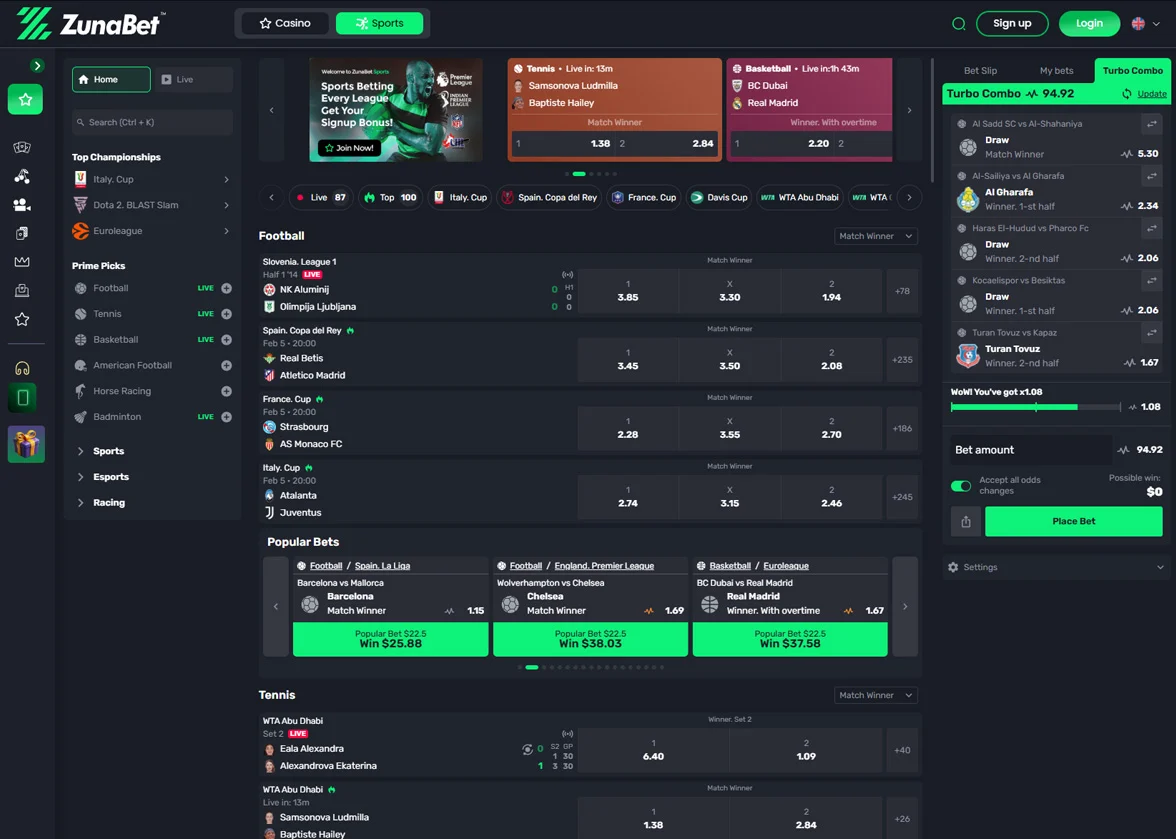
The sportsbook completes the platform. Football, basketball, tennis, NHL, and other major sports sit alongside esports like CS2, Dota 2, League of Legends, and Valorant. Virtual sports and combat sports finish out the menu. The hybrid arrangement matches the category FanDuel and BetMGM occupy, with broader market coverage rolled into one platform.
How the Banking Models Differ
This is where the operating gap is clearest. FanDuel and BetMGM run all money through traditional banking. The result is processing windows, possible holds, and withdrawal speeds that depend on which method the player chose at deposit.
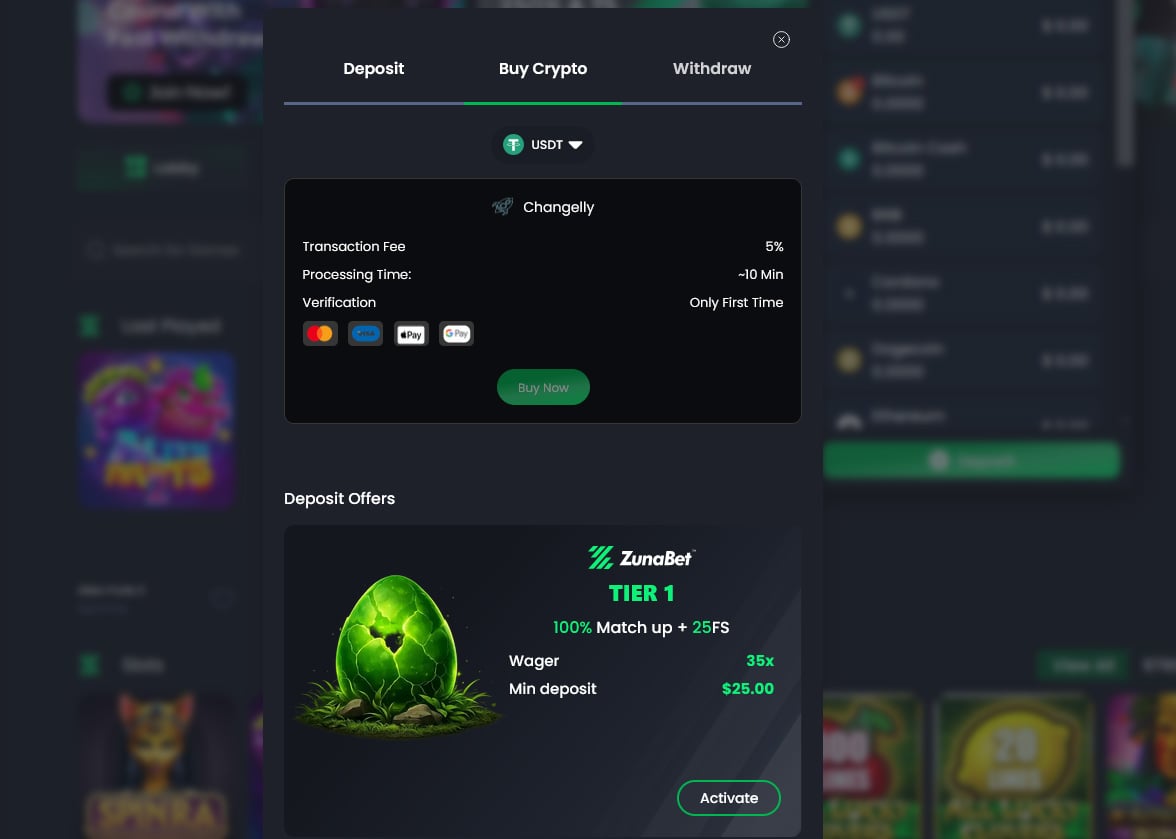
ZunaBet handles payments entirely in crypto, supporting more than 20 currencies — Bitcoin, Ethereum, USDT on multiple chains, Solana, Dogecoin, Cardano, and XRP all included. No platform fees apply on transactions, and withdrawals settle quickly. For players already comfortable holding crypto, the experience strips out the friction that comes with bank-routed payments.
There’s a reach factor too. Crypto-first operators don’t sit inside the same state-by-state licensing structure that US fiat brands work within. ZunaBet’s full platform is accessible across many regions where FanDuel and BetMGM can’t operate. For a generation already living in digital, crypto-friendly contexts, that aligns with how they expect any modern platform to work.
Welcome Bonus Comparison
FanDuel and BetMGM build welcome offers around deposit matches, bonus bets, or risk-free first bets. The exact terms shift by state, and wagering requirements often take close reading to navigate fully.
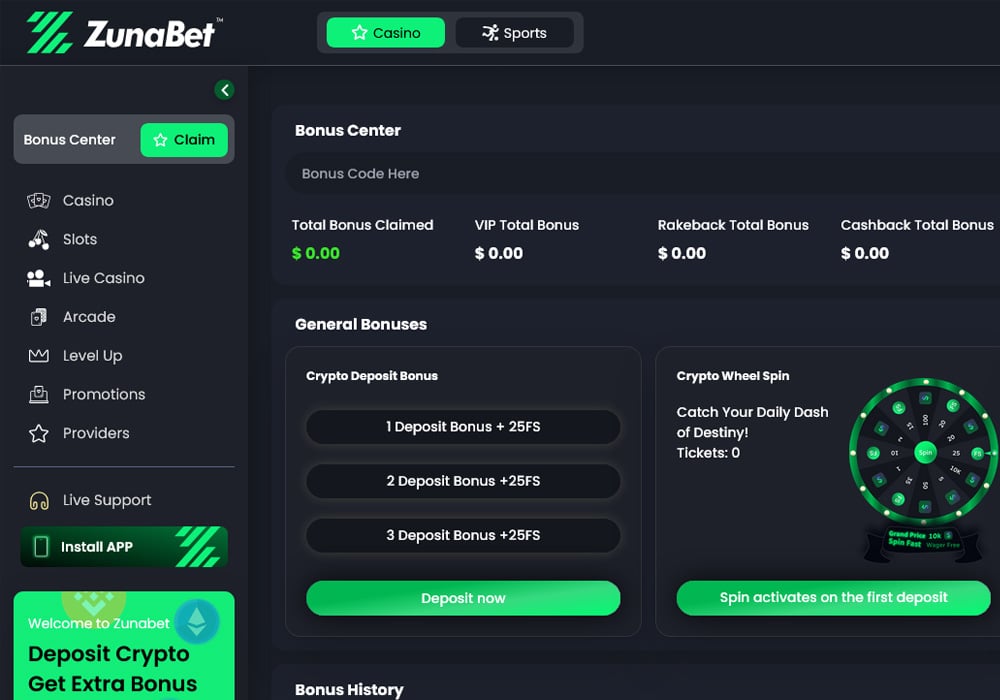
ZunaBet’s welcome offer runs up to $5,000 plus 75 free spins across three deposits. The first matches 100% up to $2,000 plus 25 spins. The second adds 50% up to $1,500 plus 25 spins. The third closes with 100% up to $1,500 plus another 25 spins. Marketed as a 250% bonus across three deposits, the layout gives new players more time and depth to explore than a single-deposit offer does.
Loyalty Programs Side by Side
FanDuel runs the FanDuel Rewards program, with points earned through play that can be exchanged for bonuses and perks. BetMGM uses MGM Rewards, which connects online play to perks at MGM resorts — hotel stays, dining, and entertainment among them. Both function effectively, but both stay close to the standard tiered loyalty model the industry has used for decades.
ZunaBet rebuilds the structure. The loyalty program runs on a dragon evolution theme, with a mascot named Zuno guiding players through six tiers. Squire opens at 1% rakeback, then Warden at 2%, Champion at 4%, Divine at 5%, Knight at 10%, and Ultimate at the top with 20% rakeback.
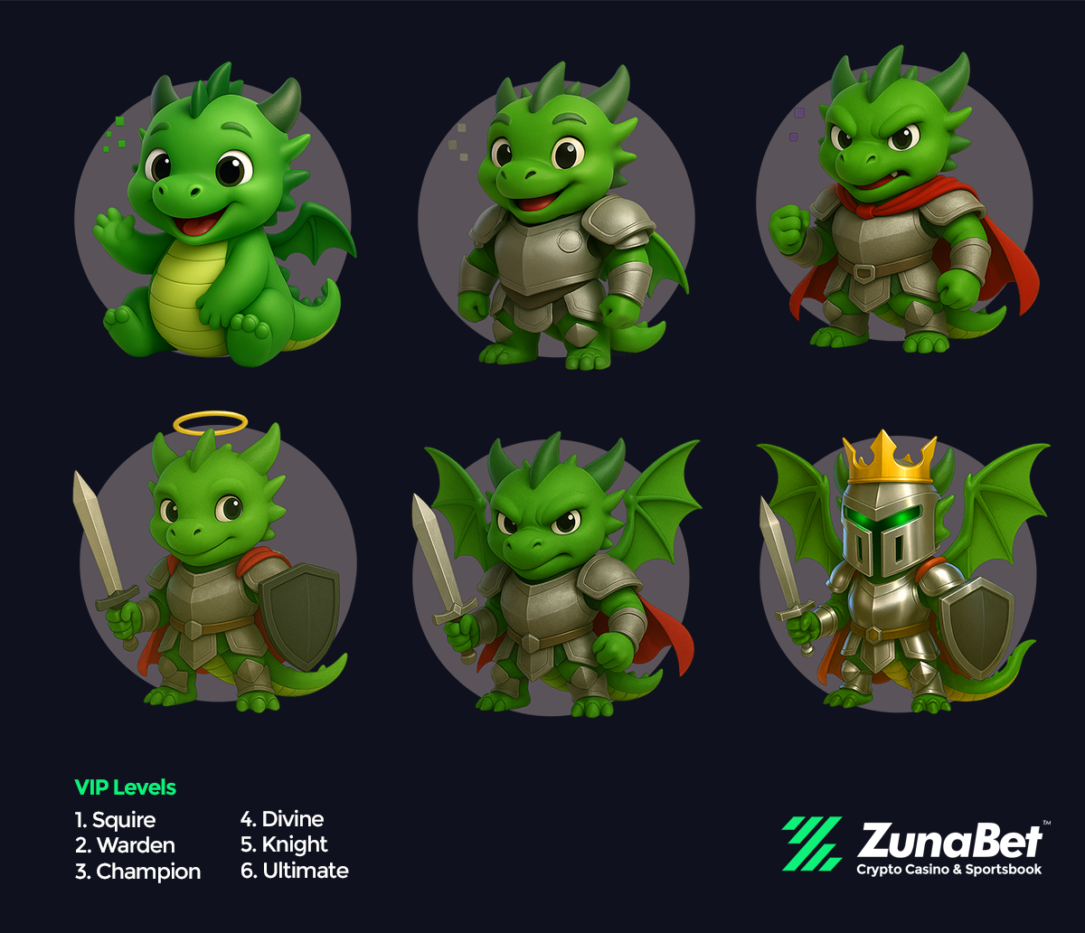
Tier movement unlocks more than rakeback. Free spins scale up with tier — reaching 1,000 spins at the highest level — along with VIP club access and double wheel spins through the climb. The format feels closer to in-game progression than collecting points toward a reward. For players already drawn to that kind of mechanic, the system creates engagement a flat VIP setup can’t match.
Why ZunaBet Fits the 2026 Landscape
FanDuel and BetMGM remain dependable choices for players who value regulation and a track record built over time. Neither brand is going anywhere. But the expectations players bring to these platforms in 2026 keep moving forward. Fast settlement, deep libraries, and engaging loyalty mechanics are turning into baseline features rather than premium ones.
ZunaBet was designed around those baselines from the start. The crypto-first core delivers quick payments and minimal fees. The library reaches beyond what most established brands offer. The sportsbook covers traditional sports and esports together. The dragon loyalty program adds direction and progression to regular play.
For players who want speed, variety, and a more current feel, ZunaBet sits among the more interesting platforms in the 2026 landscape. The brand is still in its early growth phase, but the trajectory is clear. A new generation of players treats crypto support, gamified rewards, and global access as starting points rather than features to request.
FanDuel and BetMGM built the online betting world that exists today. ZunaBet is one of the platforms working on what 2026 and beyond will look like — and players exploring it now are catching that direction early.


For the five years leading up to June 2025, Michael Saylor posted to X thousands of times, consistently praising BTC while disparaging credit and emphasising the legacy financial system’s emphasis on debt.
However, a social media audit pinpoints the exact moment when he pivoted.
Starting in June 2025, Saylor began lavishing praise on fiat-denominated credit in a series of online posts that culminated in the launch of STRC.
From August 2020 to June 2025, Saylor posted 3,494 times to X, with 75.8% of those posts mentioning BTC. He mentioned credit in fewer than one in 100.
When he did, he referred to credit as an insult aimed at fiat money, which BTC intended to supplant.
However, once he reversed his stance, his change in tone wasn’t subtle.
Read more: Strategy’s STRC hit another all-time low today
More bitcoin, but way more credit
According to Saylor’s bizarre dictionary of invented terminology, BTC was now called “digital capital,” his MSTR common stock was “digital equity,” and his dividend-paying STRC was “digital credit.”
In particular, he has emphasized STRC‘s aim of holding a USD par value while paying USD dividends.
References to fiat were also plastered across Strategy’s website and marketing materials, USD-denominated issuances arrived in a steady drip of dilution, and Saylor sold Strike with a special convertability bonus if the USD price of MSTR rallied high enough.
Strife and Stride launched with fiat dividends and USD credit seniority in the case of a bankruptcy.
STRC permanently ended the dominance of BTC in Saylor’s posts to X as credit- and debt-engineering vocabulary displaced BTC.
For a few months, things seemed to be going well. STRC held its $100 par value intermittently from October 2025 through May 2026.
Then, this month, the bottom fell out.
STRC, alongside MSTR, hit a series of new lows, eventually falling to $71.25, a terrifying 29% below where it should have been trading.
MSTR hit $82 last week, down $375 from its 52-week high.
Fiat games continue with BTC-branded dilution
While Saylor kept posting credit-focused quips on social media, investors read the fine print on Saylor’s debt engineering.
STRC, despite its marketing lingo, isn’t actually a corporate bond. What’s more, the company isn’t required to hold any assets to back it, offers shareholders no redemption rights at its $100 par value, and pledges no BTC as collateral.
Unlike many traditional credit products, Strategy provides no FDIC, SIPC, nor any type of insurance against losses incurred by its shares falling in price.
STRC is, after all, just a stock that the company has relententlessly diluted alongside its MSTR shareholders.
Saylor stopped calling BTC digital money. Instead, he simply called it a capital asset that, in his view, should compound near 30% a year, even though its actual five-year compounded annual growth rate through mid-2026 is closer to 12%.
As BTC underperformed, Saylor’s stocks performed even worse.
The stress test for Saylor’s de-emphasis of BTC has arrived in full force this summer. BTC has more than halved from its peak above $126,000, and Strategy’s common stock has shed 78% of its value over the past 12 months.
This month, the company’s enterprise value slipped below the value of its BTC for the first time. Worse, it made its first voluntary BTC sale since December 2022, breaking multiple years of guidance from Saylor that Strategy didn’t plan to sell BTC.
As shares cratered, Saylor posted that he remained focused on BTC, despite his obvious focus on credit.
STRC, Saylor’s flagship “credit” product that is supposed to trade at $100, opened for trading today at $81.
Got a tip? Send us an email securely via Protos Leaks. For more informed news and investigations, follow us on X, Bluesky, and Google News, or subscribe to our YouTube channel.
The controversial project Pi Network has been quite active lately, unveiling numerous announcements and rolling out important ecosystem updates.
However, these advancements have failed to trigger a price rally for the native token PI, which instead collapsed to a new all-time low.
Reaching New Bottom
The asset has been in a major decline over the past several months, and the community has been desperately looking for potential catalysts that could propel a long-awaited rebound. Many Pioneers have turned their attention to Pi2Day – a symbolic date celebrated annually on June 28, as it represents the mathematical constant 2π.
The Core Team did not stay quiet and introduced SoloHost, Pi Sign-in, and PiVerify – tools meant to push the ecosystem beyond native apps and into AI, digital identity, and third-party services. With these updates, Pi Network aims to evolve into a platform for Artificial Intelligence and decentralized computing rather than focusing only on blockchain features.
It seems the community was hoping for different news, and instead of experiencing a price rebound, PI dropped even further. As of press time, it trades just north of $0.11, representing the lowest level since the asset began trading. Its market capitalization has slipped to approximately $1.2 billion, making it the 57th-biggest cryptocurrency.
The crypto enthusiast Rizo highlighted PI’s drop and asked his followers whether the token is about to add another zero or if this level marks a potential bottom before a recovery. The majority of people see no hope, arguing that the coin is headed straight down to literally $0.
X user Tokocrypto also chipped in, noting that PI’s plunge mirrors the weakness in the broader crypto market and is not the result of any specific negative news surrounding the project. They wondered whether the token could stage a relief rally, pointing to the $0.0115-$0.12 area as a major support zone.
The Bullish Signs
PI’s Relative Strength Index (RSI) suggests that bears may loosen their grip in the near future. The technical indicator ratio has fallen to 14, reflecting extreme oversold territory, which has historically been a precursor to a revival. The index ranges from 0 to 100, with anything below 30 considered a buying opportunity and readings above 70 seen as pre-correction warnings.

The upcoming token unlocks are also worth mentioning. Over 127 million PI will be released in the next 30 days, which may sound substantial but is far less aggressive than those from previous months and could pave the way for price stabilization.

The post Pi Network (PI) Crashes to a New ATL: Going to Zero or Rebound Ahead? appeared first on CryptoPotato.
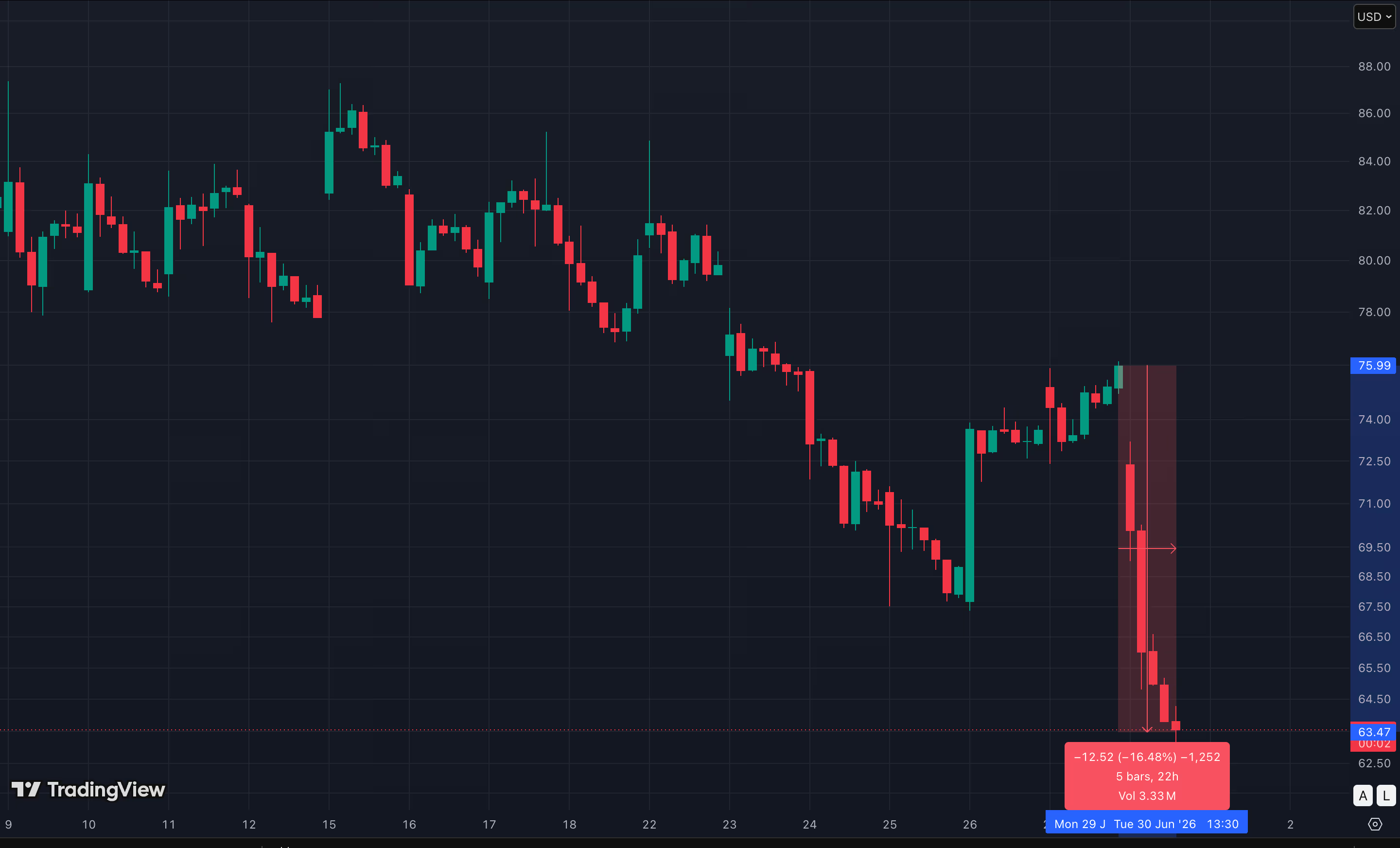
Still, he argued that the Circle’s 16% selloff on Tuesday went too far.
“I think it is an overreaction,” he told CoinDesk.

He pointed to Paxos’ Global Dollar Network (USDG), another consortium-backed stablecoin that shares reserve income with partners but has yet to gain significant market share. It has grown to a $3 billion supply since its launch in late 2024, lagging far behind USDC’s $73 billion and USDT’s $145 billion, according to CoinDesk data.
“The bigger question is how OUSD can convince consumers and end users to adopt them,” Lau said. “We don’t really know the answer until it is fully launched so that we can gauge the market cap and usage.”
Hadick also cautioned that building an industry consortium is rarely straightforward.
“Consortiums are hard and they break easily,” he said. “Incentives are broad and often misaligned.”
“So while the [Circle] stock selloff seems clearly reasonable, I also don’t expect this to be an easy or straightforward road for Open Standard and expect it to be harder to get to scale than expected,” Hadick added.
Details still missing
Others cautioned that the announcement left several important questions unanswered.
Noelle Acheson, author of the Crypto Is Macro Now newsletter, said Open Standard has assembled an impressive list of partners and is led by Bridge co-founder Zach Abrams, “who knows what he’s doing.”

Nasdaq has selected Pyth, an onchain financial data network, to distribute its proprietary market data to blockchain applications and other software platforms.
The partnership initially covers Nasdaq TotalView, the exchange’s depth-of-book data feed, which includes every displayed buy and sell order across all price levels as well as order imbalance data around the opening and closing auctions. The feed is widely used by professional traders because it provides a more complete view of market liquidity than standard market quotes by displaying the full order book.
According to Pyth, the marketplace gives software applications access to first-party market data through a single integration. The company said the service is intended for blockchain applications, digital asset exchanges, prediction markets, trading systems and other software platforms.
Nasdaq joins a group of publishers on Pyth that includes exchanges Euronext and OTC Markets, electronic trading platforms Tradeweb and Kalshi, market data provider Exchange Data International, Singapore Exchange’s SGX FX and the US Department of Commerce.
Related: Coinbase lets users transfer stock portfolios as exchange expands beyond crypto
Nasdaq and ICE deepen digital asset strategies
Nasdaq’s partnership with Pyth is the latest in a series of moves by established exchange operators to expand their digital asset businesses through cryptocurrency products, blockchain infrastructure and new market services.
In March, Nasdaq has expanded its tokenization efforts through a partnership with crypto exchange Kraken and its infrastructure affiliate Backed to develop infrastructure linking traditional equities with blockchain networks. The initiative builds on the exchange operator’s broader push to integrate tokenized assets with traditional market infrastructure.
The following month, the SEC approved Nasdaq’s proposal to list Bitcoin index options tied to the Nasdaq Bitcoin Index, paving the way for trading pending approval from the Commodity Futures Trading Commission. Nasdaq also partnered with CME Group to launch cryptocurrency index futures tracking a basket of seven digital assets, including Bitcoin, Ether, Solana and XRP, expanding its regulated crypto derivatives lineup.
Other exchange operators have pursued similar initiatives. ICE, the parent company of the New York Stock Exchange, partnered with crypto exchange OKX in May to launch perpetual futures tied to its Brent crude and West Texas Intermediate oil benchmarks, marking the first product announced under the companies’ broader partnership.

Source: OKX
Later, ICE CEO Jeffrey Sprecher called on regulators to allow traditional exchanges to offer 24/7 onchain perpetual futures, arguing regulated venues should be able to compete with crypto-native platforms already offering the products.
Magazine: Bitcoin slides to $58K, XRP hits $1 but onchain data promising: Market Moves
Trading activity in tokenized pre-IPO perpetual contracts surged sharply in May 2026 after several months of subdued activity, according to a new report by CoinGecko. Monthly trading volume climbed 1,059% from $60.51 million in April to $701.44 million in May.
Interestingly, SpaceX pre-IPO perpetuals led the market with $305 million in monthly trading volume, as it accounted for 43.5% of the total. The strong activity came ahead of the company’s highly anticipated Nasdaq listing on June 12.
SpaceX Pre-IPO Frenzy
AI companies OpenAI and Anthropic ranked second and third, respectively. All combined, contracts tied to SpaceX, OpenAI, and Anthropic accounted for over 95% of pre-IPO perpetual trading volume recorded in May, indicating that activity was heavily concentrated in just a few assets.
SpaceX’s pre-IPO prices also showed wide differences across major exchanges before its Nasdaq listing, but eventually moved closer together as more information became available.
In the week leading up to its market debut, CoinGecko found that SpaceX perpetual contracts traded at around $170 on exchanges including Binance and WEEX, while Coinbase, Gate, and OKX priced them lower at roughly $155. As details about the initial public offering became public, prices across the major exchanges gradually converged into the $160 to $165 range by June 10.
During the final two days before the listing, prices on the leading platforms continued rising together and climbed above $180. On June 12, the day of the listing, new information about the expected listing price was reflected in pre-IPO markets, leading to sharp price swings.
Despite the volatility, pre-IPO prices ultimately closed at an average of $157, 4.67% above SpaceX’s opening price of $150.
TradFi on Crypto Exchanges
Beyond SpaceX, several prominent crypto exchanges have been steadily expanding their tokenized real-world asset offerings. Since the start of 2025, MEXC has listed the largest number of RWA products. The platform added 199 spot assets and 159 TradFi perpetual contracts for a total of 358 listings.
Next up was Gate with 224 RWA products, including 146 perpetuals and 78 spot assets, while WEEX, which was ranked third, listed 192 assets across 84 spot and 108 perpetual offerings.
Exchanges such as HTX, Binance, Crypto.com, Coinbase, and OKX focused more on TradFi perpetual listings than spot RWAs. CoinGecko found that each of these exchanges recorded only one or two spot RWA listings over the past 17 months. Overall, exchanges averaged 75 perpetual listings compared with 37 spot RWA listings during the period.
The post SpaceX Dominates as Tokenized Pre-IPO Trading Volume Surges 1,060%: CoinGecko appeared first on CryptoPotato.

TLDR:
- Binance added Anchorage Digital to its Triparty Banking network for institutional crypto trading access.
- Eligible clients can trade on Binance while assets remain in segregated qualified custody off exchange.
- Institutions may pledge crypto, USD accounts, and selected tokenized assets as eligible collateral.
- The integration expands off-exchange settlement while improving capital efficiency for institutional trading.
Binance is expanding its institutional trading infrastructure through a new partnership with Anchorage Digital. The move gives eligible institutional clients another way to trade on Binance without placing assets directly on the exchange.
The integration strengthens off-exchange settlement services while introducing another custody option for professional market participants. It also reflects the growing demand for traditional financial market structures within crypto trading.
Binance and Anchorage Expand Institutional Crypto Trading Infrastructure
Binance announced it has partnered with Anchorage Digital to integrate the company’s Atlas settlement platform into its Triparty Banking network. The exchange also confirmed the development through its official X account alongside a detailed announcement published on its website.
The partnership allows eligible institutional and professional clients to keep digital assets in qualified, segregated custody with Anchorage Digital while accessing Binance’s trading liquidity. Instead of transferring collateral directly onto the exchange, institutions can continue holding assets with an independent custodian.
According to Binance, the arrangement separates custody from trade execution, a structure widely used across traditional financial markets. The model aims to reduce operational risks associated with prefunding exchange accounts while maintaining access to crypto liquidity.
Anchorage Digital becomes the latest banking partner within Binance’s Triparty Banking framework. Binance stated that this also marks the first crypto exchange integration supported through Anchorage Digital’s Atlas settlement platform.
Binance Triparty Banking Adds Capital Efficiency for Institutions
Binance first introduced Triparty Banking in 2023 as part of its effort to develop institutional-grade trading services. The company said the latest integration expands collateral management choices available to qualified clients.
Eligible institutions can pledge crypto assets alongside yield-bearing U.S. dollar accounts as collateral while trading on Binance. According to the exchange, this structure allows capital to remain productive instead of sitting idle in exchange wallets.
The platform also supports additional institutional workflows beyond trading. Binance said settlement, lending, and collateral management form part of the broader infrastructure available through its Triparty Banking service.
Subject to eligibility requirements, institutions may also use selected tokenized real-world assets as collateral. Binance listed products including BlackRock’s BUIDL, Circle’s USYC, and Franklin Templeton’s iBENJI among supported collateral options.
Binance noted that institutional demand increasingly favors market structures already familiar in traditional finance. Anchorage Digital also indicated that institutions continue seeking stronger custody standards and lower counterparty exposure before expanding digital asset participation.
The partnership adds another custody pathway without changing access to Binance’s exchange liquidity. As institutional participation grows, exchanges continue building infrastructure designed around established financial risk management practices rather than requiring direct custody transfers.


Fans Drag Her Watching Brian McKnight

pov : financial condition rn be like………..?

Lidl eyes former Seaham factory site for new supermarket





-

 Fashion4 days ago
Weekend Open Thread: Staud – Corporette.com
-

 Politics5 days ago
The House | Manchesterism won’t survive the painful trade-offs unless it gets citizens on board
-

 Crypto World17 hours ago
Strategy authorizes up to $1.25B in Bitcoin sales under new capital plan
-

 Politics5 days ago
Potential 2028er World Cup attendee leaderboard
-

 Business5 days ago
Asia stock markets slide as tech shares slump
-

 News Videos2 days ago
MAJOR BITCOIN & MARKET UPDATE!!!! (MUST WATCH ASAP!!!)
-

 Tech5 days ago
A Look At A Gaggle Of Transputer Boards
-

 Crypto World7 days ago
Securitize Wraps Roubini's SEC-Registered ETF as Dubai VARA Digital Security
-
Crypto World7 days ago
Bitcoin (BTC) Dips Below $62K, Ethereum (ETH) Plunges 6% Daily: Market Watch
-
 Crypto World5 days ago
Dell (DELL) Shares Tumble Over 5% Following Analyst Downgrade to Hold
-

 Crypto World3 days ago
Coinbase, Circle Deepen Crypto Stock Losses Despite Resilient S&P 500
-
Business7 days ago
Entergy settles forward sale agreements, raises $672 million in cash proceeds
-

 Crypto World4 days ago
Kraken's xStocks Opens Bending Spoons IPO Registration to EEA Retail
-

 Business16 hours ago
Australia treasurer says alleged access of prime minister’s bank data ’incredibly concerning’
-

 Sports4 days ago
FIH Pro League: India defeat Pakistan 7-1, register biggest win of campaign | Other Sports News
-

 Crypto World5 days ago
Bitcoin Sparks $600M Hourly Liquidations With $65,000 Set To Become Resistance
-

 Tech3 days ago
Bluekit phishing kit adopts browser-in-the-middle for login theft
-

 Tech3 days ago
Russian hackers now target Signal backup recovery keys
-
Crypto World4 days ago
Hyperliquid Named on Singapore MAS Investor Alert Register
-

 Crypto World6 days ago
Ripple and SBI launch RLUSD in Japan after JFSA approval
You must be logged in to post a comment Login