

Crypto World
Thiel’s Founders Fund Dumps ETHZilla Stake as ETH Treasuries Strain

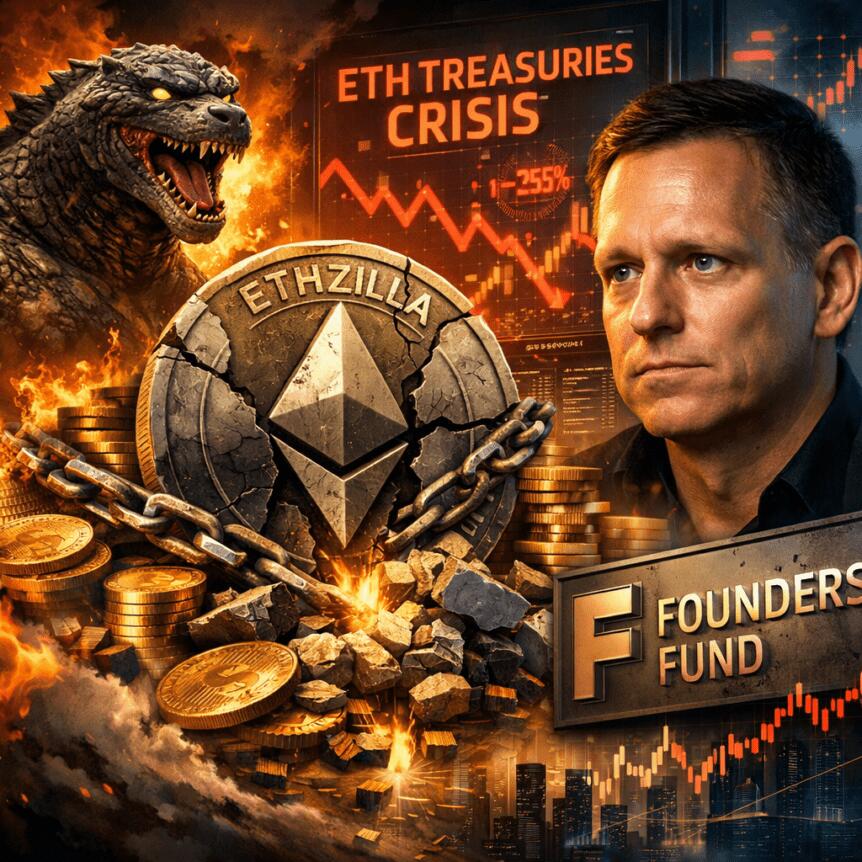
The exit by billionaire tech investor Peter Thiel’s Founders Fund from ETHZilla marks a notable pivot in how crypto treasuries are managed and disclosed. A Tuesday filing with the U.S. Securities and Exchange Commission shows affiliates of Thiel no longer hold any stake in the Ether-focused treasury company, signaling a retreat from a venture that once intersected biotech finance with a crypto strategy. The move comes after an Aug. 4, 2025 filing disclosed a 7.5% stake in 180 Life Sciences Corp., comprising 11,592,241 shares valued at roughly $40 million when shares traded near $3.50. In crypto markets, the timing of this exit underscores growing scrutiny of Ether‑heavy treasury models as investors reassess risk, liquidity, and regulatory clarity.
ETHZilla’s lineage traces back to a biotech outfit rebranding around a dedicated Ether treasury program. The rebirth into ETHZilla followed a July 2025 fundraising drive that raised about $425 million to launch an Ether treasury strategy and reposition the company under the new name. That period underscored the appetite among certain investors for backing Ether-centric balance sheets, even as Ether‑heavy strategies faced volatile price swings and evolving risk controls. The narrative around ETHZilla intensified as the firm subsequently pursued additional liquidity through convertible debt, expanding its Ether holdings in a bid to deploy capital across decentralized finance (DeFi) and tokenized assets.
The sequence of events in late 2025 paints a fuller picture of how these strategies evolved. In September, ETHZilla tapped investors for roughly $350 million via convertible bonds, enabling further expansion of its Ether holdings. At one point, the firm held more than 100,000 Ether, positioning its balance sheet as a significant, if high‑volatility, exposure to the largest smart contract platform’s native asset. The strategy sought to diversify across DeFi protocols and tokenized assets, but the market environment subsequently prompted reallocation and liquidity management moves as macro and crypto-specific tides shifted.
By December, ETHZilla began liquidating a portion of its Ether holdings to meet debt obligations. Specifically, 24,291 Ether were redeemed for about $74.5 million, executed at an average price near $3,068.69 per Ether, leaving roughly 69,800 ETH on the balance sheet. The liquidation underscores how even large treasury positions can be trimmed in response to funding needs or risk controls, particularly when market liquidity and asset correlations complicate balance sheet management. The exit by Founders Fund, paired with ETHZilla’s own liquidity actions, reinforces a broader move among Ether-based treasury actors to reassess capital allocation, leverage, and the durability of non‑Bitcoin crypto treasury playbooks.
Thiel’s withdrawal from ETHZilla is framed by broader tensions in crypto treasury models that favored Ether over Bitcoin (CRYPTO: BTC) in earlier disclosures. While some managers pursued diversified holdings across multiple assets, a number of high‑profile Ether accumulators have taken different paths. BitMine Immersion Technologies, the largest listed Ethereum holder, expanded its Ether stake by purchasing 40,613 ETH on Feb. 9, driving total holdings beyond 4.3 million ETH and pushing the value of its portfolio into the tens of billions of dollars at prevailing prices. In contrast, Trend Research moved to unwind a substantial position, selling 651,757 ETH for about $1.34 billion and locking in roughly $747 million of realized losses. The varying approaches illustrate a market segment wrestling with how to balance liquidity, yield, and risk in a rapidly evolving crypto landscape.
ETHZilla itself did not stay static after the initial pivot. The firm launched ETHZilla Aerospace, a subsidiary intended to provide tokenized exposure to leased jet engines, as part of a broader diversification effort beyond plain Ether holdings. The pivot to tokenized real‑world assets (RWA) and crypto yield initiatives reflects the broader industry push to build revenue streams that can complement or hedge against crypto market cycles. Yet Thiel’s exit amplifies the narrative that Ether‑centric treasury structures—once viewed as a strategic differentiator—face renewed scrutiny from investors seeking clearer governance, transparency, and diversification in an environment defined by price volatility and shifting liquidity regimes.
The evolving story of ETHZilla and its contemporaries sits within a wider context of institutional attention to crypto treasuries. While Ether remains a focal point for many on-chain treasury strategies, observers are weighing whether the sector has adequate risk controls, valuation discipline, and regulatory clarity to sustain large, illiquid holdings. The SEC filings—along with company disclosures and market actions—will be watched closely for any further changes in ownership, debt facilities, or new collateral arrangements that could influence Ether’s standing in corporate balance sheets and in broader market sentiment.
Key takeaways
- Founders Fund affiliate holdings of ETHZilla were reduced to zero shares via a Schedule 13G amendment filed with the SEC, signaling an exit from the vehicle that once included a 7.5% stake in 180 Life Sciences Corp.
- 180 Life Sciences rebranded to ETHZilla after a July 2025 fundraising round that raised about $425 million to back a dedicated Ether treasury strategy.
- ETHZilla pursued additional capital through a September 2025 convertible debt round, enabling expansion of its Ether holdings and deployment across DeFi and tokenized assets, at one point exceeding 100,000 ETH.
- December 2025 saw a liquidation of 24,291 ETH for roughly $74.5 million to repay debt, leaving about 69,800 ETH on the balance sheet.
- Thiel’s exit underscores ongoing strain on Ether‑centric treasury models as the market consolidates and investors reassess risk, liquidity, and governance around crypto treasuries.
- Ethically and strategically, ETHZilla diversified into tokenized jet‑engine exposure through ETHZilla Aerospace, signaling a broader push to blend real‑world assets with crypto yields.
Tickers mentioned: $BTC, $ETH
Market context: The move reflects broader liquidity and risk considerations shaping crypto treasuries as investors weigh yield against volatility and regulatory risk. Transparency via 13G filings intersects with a sector still building governance norms around crypto treasury management.
Why it matters
For investors and developers in the crypto space, the Thiel/ETHZilla episode highlights the fragility and adaptability of Ether‑heavy treasury models. The sequence—from a high‑profile rebrand and a large capital raise to a substantial liquidation and a major investor exit—reveals how treasuries anchored to Ether can be exposed to rapid swings in token prices, funding needs, and balance sheet constraints. The development underscores the importance of governance clarity, valuation discipline, and diversified asset mixes for corporate treasury strategies that ride on volatile digital assets.
From a market perspective, the episode amplifies the ongoing debate over whether Ether is a suitable long‑term treasury anchor for publicly traded or VC‑backed entities. While some firms have pursued aggressive Ether accumulation to maximize yield opportunities in DeFi and tokenized assets, others are retreating or retooling their strategies in response to liquidity spikes, drawdown risks, and the potential for regulatory changes that could affect custody, reporting, and capital adequacy.
For builders and operators of treasury platforms, the ETHZilla case reinforces the value of transparent public disclosures and flexible architectures that can accommodate both Ether holdings and structured debt, while offering pathways to tokenize real‑world assets and monetize yield streams. It also cautions that even well‑capitalized Ether portfolios must be prepared to realign in a market where price sensitivities and funding requirements can abruptly alter risk profiles.
What to watch next
- Follow any additional SEC disclosures or updates to ETHZilla’s corporate filings that could reveal new ownership structures or debt instruments.
- Monitor developments around ETHZilla Aerospace and any further tokenized real‑world asset projects that could broaden the firm’s revenue mix.
- Track the pace of Ether liquidity movements from large holders like BitMine and Trend Research to gauge how the sector is balancing yield, risk, and capital preservation.
- Observe broader regulatory signals related to crypto treasuries, custody standards, and reporting requirements that could influence future treasury strategies.
Sources & verification
- SEC filing: Schedule 13G for Founders Fund and ETHZilla holdings — primary_doc.xml — https://www.sec.gov/Archives/edgar/data/1690080/000199596426000003/xslSCHEDULE_13G_X01/primary_doc.xml
- SEC filing: Schedule 13G reporting a 7.5% stake in 180 Life Sciences Corp. (Aug. 4, 2025) — primary_doc.xml — https://www.sec.gov/Archives/edgar/data/1690080/000141588925021455/xslSCHEDULE_13G_X01/primary_doc.xml
- 180 Life Sciences rebrands to ETHZilla — Cointelegraph article — https://cointelegraph.com/news/down-99-biotech-firm-180-life-sciences-pivots-crypto-eth
- ETHZilla raises $350M via convertible bonds — Cointelegraph article — https://cointelegraph.com/news/ethzilla-raises-350m-expand-ether-holdings-defi-yield
- Bitmine staked Ether holdings and broader ETH treasury data — Cointelegraph article — https://cointelegraph.com/news/bitmine-staked-ether-holdings-annual-staking-revenue
- Trend Research reduces ETH holdings — Cointelegraph article — https://cointelegraph.com/news/trend-research-reduces-eth-holdings-325k-187k-eth-binance
- ETHZilla liquidates Ether and restructures debt — Cointelegraph article — https://cointelegraph.com/news/ethzilla-liquidates-ether-redeem-convertible-debt
- ETHZilla tokenized jet engines RWA — Cointelegraph article — https://cointelegraph.com/news/ethzilla-tokenized-jet-engines-rwa-ethereum-liquidity-io


TLDR:
- Coinbase onchain loans now accept XRP, DOGE, ADA, and LTC as collateral, capped at $100,000 in USDC.
- The lending product has surpassed $1.9 billion in total loan originations since its initial Bitcoin launch.
- Altcoin borrowers face a tighter 49% LTV limit, with liquidation triggering at 62.5% due to price volatility.
- Wrapping native assets like XRP for use on Base may constitute a taxable event under current U.S. tax rules.
Coinbase onchain loans have expanded to include four new cryptocurrencies as eligible collateral. XRP, Dogecoin (DOGE), Cardano (ADA), and Litecoin (LTC) holders in the U.S. can now borrow up to $100,000 in USDC.
The loans run through the Morpho lending protocol on Base, Coinbase’s Ethereum layer-2 network. Users post their crypto holdings as collateral and receive USDC without selling their assets. New York residents remain excluded from the service at this time.
Coinbase Expands Collateral Options Beyond Bitcoin and Ether
Coinbase originally launched its onchain loan product with Bitcoin support before adding Ether. That early offering allowed BTC holders to borrow up to $5 million and ETH holders up to $1 million in USDC. The product has now crossed $1.9 billion in total loan originations since its launch.
The four newly added assets carry a lower borrowing cap of $100,000 each. Their combined market capitalization stood at around $117 billion at the time of the announcement, according to CoinGecko data.
That figure is less than half of Ethereum’s total market value, though all four coins maintain a consistent retail following.
Jacob Frantz, product lead at Coinbase, explained the thinking behind the move:
“No matter what you’re holding, you should be able to leverage your crypto without having to sell. Being able to borrow against more tokens means more opportunity to make your crypto work for you.” — Jacob Frantz, Product Lead, Coinbase
Coinbase has indicated plans to extend the service internationally in the future.
Loan-to-Value Ratios Reflect Altcoin Volatility
The loan-to-value ratio, or LTV, is central to how these loans operate. It measures loan size against the current market value of the posted collateral. As collateral prices drop or interest builds, the LTV rises accordingly.
Bitcoin and Ether borrowers can access up to 75% LTV, with liquidation triggering at 86%. XRP, DOGE, ADA, and LTC holders face tighter terms, borrowing up to 49% LTV, with liquidation set at 62.5%. The stricter limits reflect the higher price volatility these altcoins carry compared to Bitcoin and Ether.
There is no fixed repayment schedule attached to these loans. However, borrowers must keep their LTV below the liquidation threshold at all times.
Coinbase sends alerts as frequently as every 30 minutes as a borrower’s ratio approaches the danger zone, providing an added layer of risk management.
Tax Considerations and Platform Restrictions Apply
Crypto-backed loans are often seen as a way to avoid triggering capital gains taxes. Since no sale occurs, the tax event is deferred. That said, liquidations can create taxable events, according to law firm Greenspoon Marder LLP.
There is also a wrapping issue to consider. Assets like XRP are wrapped before use on Base, Coinbase’s Ethereum-compatible network.
Under current U.S. tax rules, converting a native asset to its wrapped version counts as a taxable event. Coinbase has acknowledged this and noted it does not provide tax advice.
One additional restriction applies to loan proceeds. Borrowers cannot use the USDC received to trade on the Coinbase exchange.
This steers users toward practical uses, such as covering expenses or making purchases, rather than leveraged speculation.
Interest rates on Morpho markets fluctuate based on supply and demand within each lending pool, so rates are not fixed at the time of borrowing.
Crypto World
AlienWP Relaunches as Alien Wise Play: Expanding Into iGaming News, Casino Reviews, and a New Player Dashboard App

February 2026 — AlienWP.com, a long-established digital platform has officially relaunched as Alien Wise Play, a new independent hub focused on online casino reviews, iGaming news, and player-first safety tools.
The brand’s expansion marks a significant new chapter for the AlienWP domain, bringing its legacy of clarity, transparency, and user-focused guidance into the rapidly growing world of online gaming and digital gambling.
A New Focus on Trust, Transparency, and Smarter Play
Alien Wise Play has been created to help players navigate an increasingly complex online casino landscape, where licensing standards, bonus terms, payout reliability, and player protections can vary significantly between operators.
The platform provides structured casino reviews, clear educational content, and ongoing iGaming news coverage, with a focus on transparency rather than hype.
“At its core, Alien Wise Play is about helping players make smarter decisions online,” said a spokesperson for the project. “The casino space is crowded, and users deserve independent information they can actually trust.”
Introducing the Wise Play Score
A central feature of the new platform is the Wise Play Score, an independent rating system designed to assess casinos based on the factors that matter most to players.
Rather than relying on subjective star ratings or promotional rankings, the Wise Play Score evaluates operators across areas such as licensing, payment reliability, bonus fairness, game quality, and customer support — providing a clear trust-focused score from 0 to 10.
The company emphasised that scores cannot be bought or influenced through commercial partnerships, and that player safety remains the top priority.
Expanding Into iGaming News and Industry Coverage
Alongside casino reviews and rankings, Alien Wise Play is also launching as a growing source of iGaming news, covering major developments across the online gambling industry.
The site will publish updates on licensing changes, operator launches, regulatory trends, and emerging topics such as crypto gaming, responsible gambling tools, and player protection standards.
This broader editorial direction positions Alien Wise Play as more than an affiliate comparison site — aiming instead to become a trusted industry resource for both players and operators.
Future Plans: A Mobile-First Player Dashboard App
Looking ahead, Alien Wise Play confirmed that it is currently developing a new mobile-first web app designed to give players something the industry has long lacked: a personal dashboard to manage online casinos in one place.
The upcoming app will allow users to save favourite casinos, track bonuses, compare platforms using the Wise Play Score, and receive useful alerts.
The platform is being built as a utility layer above casinos, focused on organisation, safety, and informed decision-making.
The app is expected to launch in stages later this year.
About Alien Wise Play
Alien Wise Play is an independent online casino review and iGaming news platform built to promote transparency, player safety, and responsible gambling. The site provides structured casino profiles, trust-based scoring, bonus tracking tools, and educational content to help users play smarter.
Originally launched in 2013 as AlienWP, the platform has evolved into a modern resource focused on the future of online gaming and digital entertainment.
For more information, visit https://alienwp.com
Media Contact
Press & Partnerships
Email: contact@kooc.co.uk
Website: alienwp.com
M, HASH, and ZEC have plunged the most in the past 24 hours.
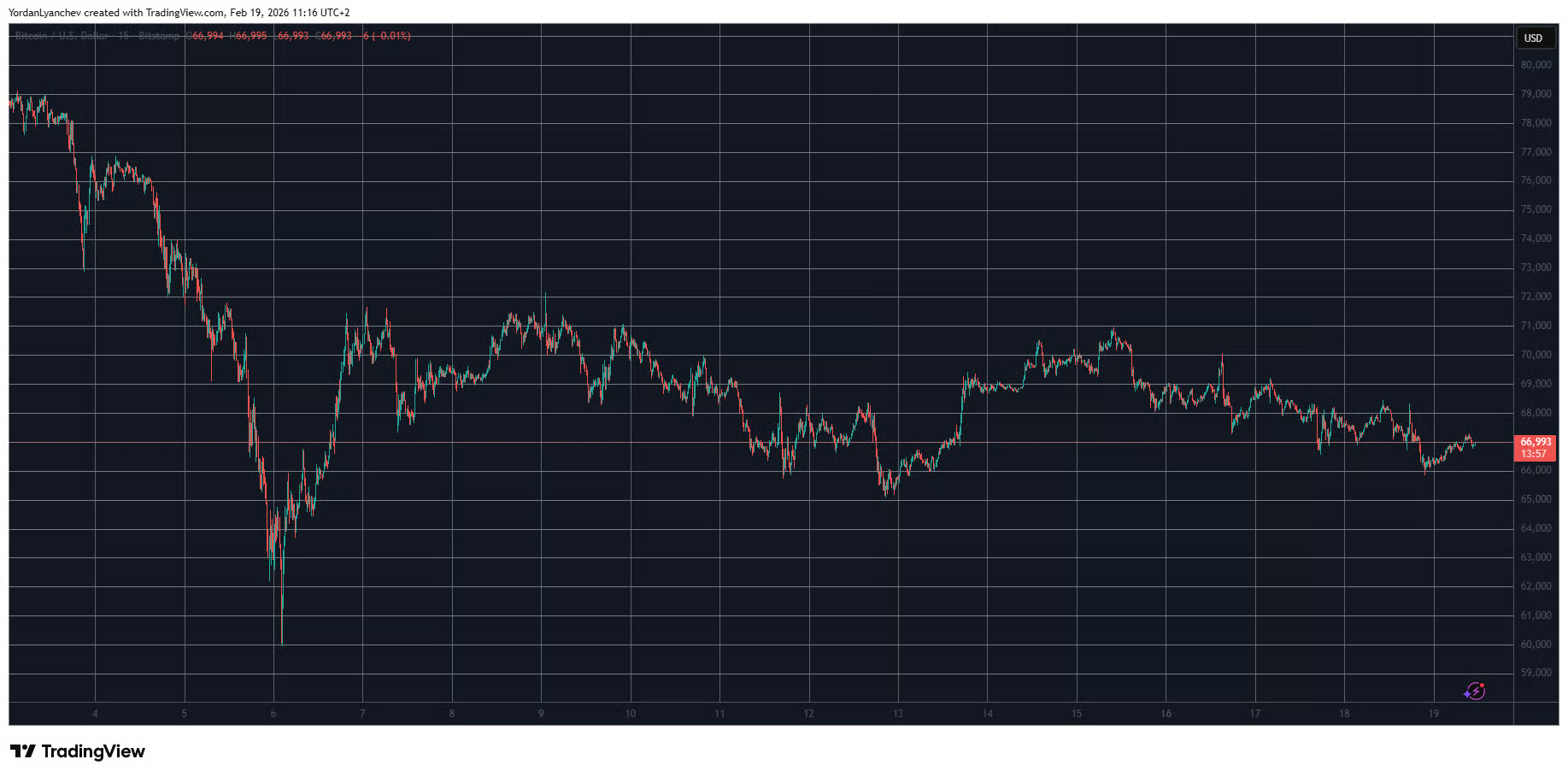
Bitcoin’s struggles since the beginning of the business week continued in the past 24 hours as the asset dipped below $66,000 before rebounding slightly to $67,000 as of now.
Most altcoins are in the red as well, with ETH losing the $2,000 support once again. XRP is among the poorest performers among the larger caps.
BTC Down to $67K
Although the primary cryptocurrency bounced off immediately on February 6 when it plunged to a 15-month low at $60,000 to $72,000, it has been unable to stage a more profound recovery since then. Just the opposite, it was rejected several times at the $71,000-$72,000 resistance, with the latest example taking place over the past weekend.
At the time, BTC jumped to $71,000 and was close to breaking above it. However, the bears quickly intercepted the move and drove the asset south to $67,000 on Tuesday. The adverse price moves continued yesterday, and bitcoin dipped below $66,000 for the first time since last Friday.
It managed to rebound since that weekly low, and now sits at $67,000. However, this still means that it’s over 1.5% down on the day. Its market capitalization has fallen below $1.340 trillion, while its dominance over the alts struggles below 56.5% on CG.
Alts Back in Red
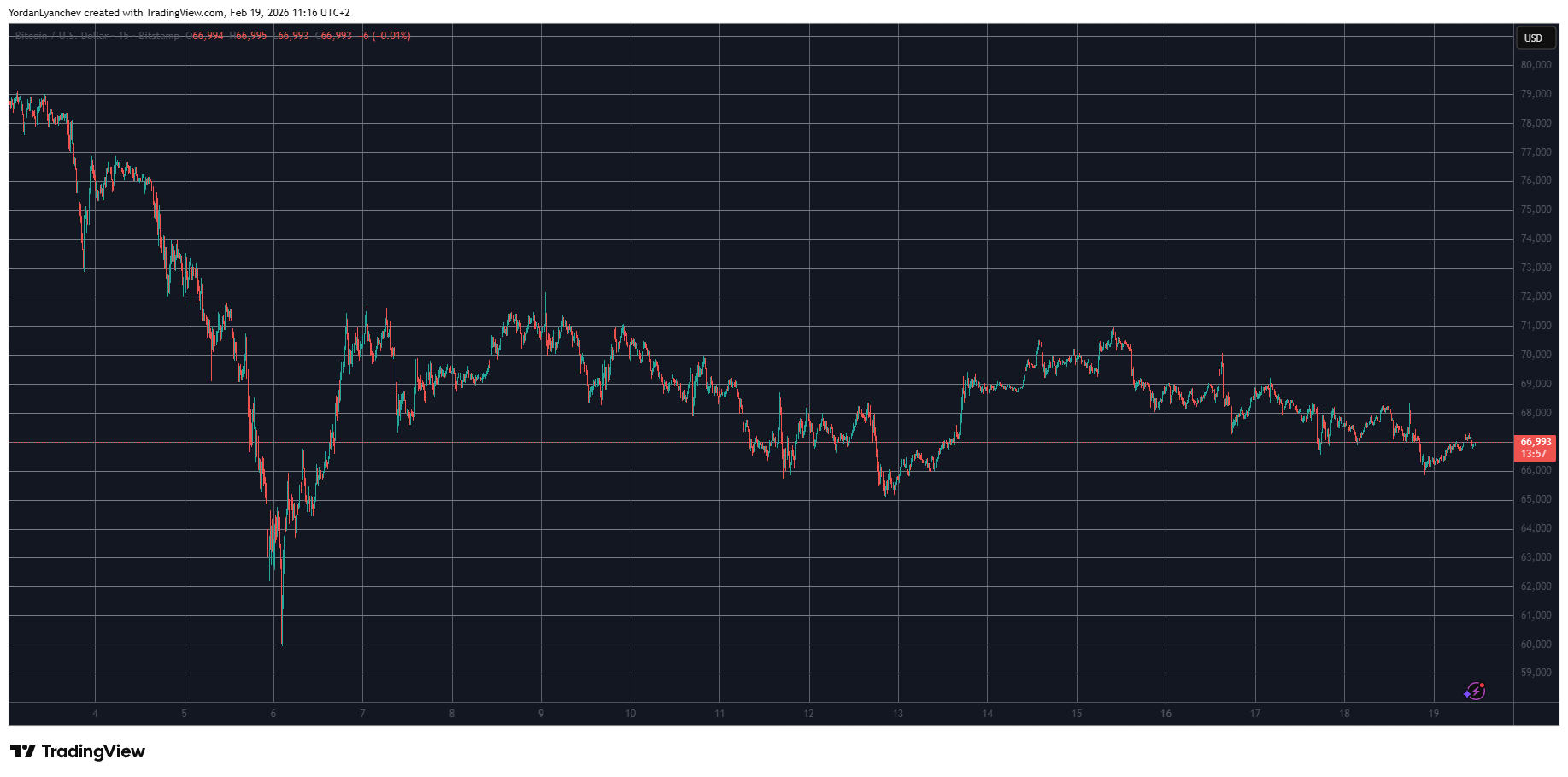
Almost all altcoins are in the red once again today. Ethereum’s adventure above $2,000 was short-lived once again, and the asset is back below it as of press time. XRP and SOL have dropped the most from the larger caps, with losses of nearly 5%. As a result, XRP trades inches above $1.40 while SOL is down to $82.
DOGE, ADA, BNB, LINK, and CC are also in the red by up to 4%, while ZEC has plunged by 8.5% to $260. Further losses are evident from M and Hash, both of which have dumped by more than 10%.
The total crypto market cap has erased another $50 billion daily and is down to $2.370 trillion on CG.
SECRET PARTNERSHIP BONUS for CryptoPotato readers: Use this link to register and unlock $1,500 in exclusive BingX Exchange rewards (limited time offer).
Disclaimer: Information found on CryptoPotato is those of writers quoted. It does not represent the opinions of CryptoPotato on whether to buy, sell, or hold any investments. You are advised to conduct your own research before making any investment decisions. Use provided information at your own risk. See Disclaimer for more information.

Coinbase CEO Brian Armstrong pushed back against what he described as Wall Street’s persistent underestimation of the crypto exchange, arguing that the company is navigating a classic “innovator’s dilemma” as traditional finance grapples with digital asset disruption.
Summary
- The CEO argued Wall Street underestimates the company as crypto disrupts traditional finance, describing the moment as an “innovator’s dilemma” with roughly half of major institutions now leaning into digital assets.
- Coinbase reported 156% year-over-year trading volume growth, a doubling of market share in 2025, tripled assets over three years, and 12 products generating over $100 million in annualized revenue.
- Some X users questioned Armstrong’s stock sales, security practices, product strategy and conviction in Ethereum, with one asking why he is not buying Coinbase shares if the company is truly undervalued.
In a post on X following an analyst AMA session, Armstrong said Coinbase is often “misunderstood or under-appreciated” by traditional financial analysts. While some major institutions are embracing crypto, others remain skeptical, he said, largely due to entrenched incentives within the legacy financial system.
“Five of the GSIB banks are starting to work with Coinbase,” Armstrong wrote, adding that roughly half of large financial institutions are leaning into crypto as regulatory clarity improves. At the same time, he suggested that lagging firms view digital assets as a competitive threat — comparing crypto’s rise to disruptions caused by Uber, Airbnb and SpaceX in their respective industries.
Armstrong argued that Coinbase and the broader crypto sector are in their strongest position yet, citing three years of revenue diversification and expanding institutional engagement. He also addressed recent earnings coverage, noting that GAAP net income includes unrealized gains and losses on crypto holdings. Adjusted net income, he said, showed profitability last quarter despite a weaker market environment.
Critics question Coinbase CEO’s claims
The remarks drew sharp responses from some users on X.
One critic argued that Coinbase appears “misunderstood” in part because Armstrong continues selling shares, questioning why investors should hold the stock if the CEO is not buying it. The same user accused the company of failing to prioritize customer security, making questionable product decisions, and lacking conviction in the Ethereum ecosystem by selling accumulated Base sequencer fees rather than holding or staking ETH.
Another user bluntly asked: “Why aren’t you buying your own stock then if it is so misunderstood?”
The company’s latest Q4 and full-year figures highlighted significant growth metrics. Total trading volume rose 156% year-over-year, while Coinbase’s crypto trading market share doubled in 2025.
Assets held on the platform have tripled over the past three years, Armstrong said, and the firm now has 12 products generating more than $100 million in annualized revenue. Both USDC balances and Coinbase One subscriptions reached new all-time highs.
Armstrong concluded that investors must be “early and right” to generate alpha, suggesting Coinbase remains undervalued by traditional analysts as the financial system undergoes structural transformation.
Crypto World
Will Pi Network price rally continue before first anniversary as multiple bullish patterns emerge?
Pi Network price has soared over 40% this week on community hype surrounding the first anniversary of its mainnet launch.
Summary
- Pi Network price rallied to a four-week high of $0.205 on Sunday, supported by increased trading activity ahead of Pi Network’s first anniversary.
- The token’s price action has formed multiple bullish patterns on the daily chart.
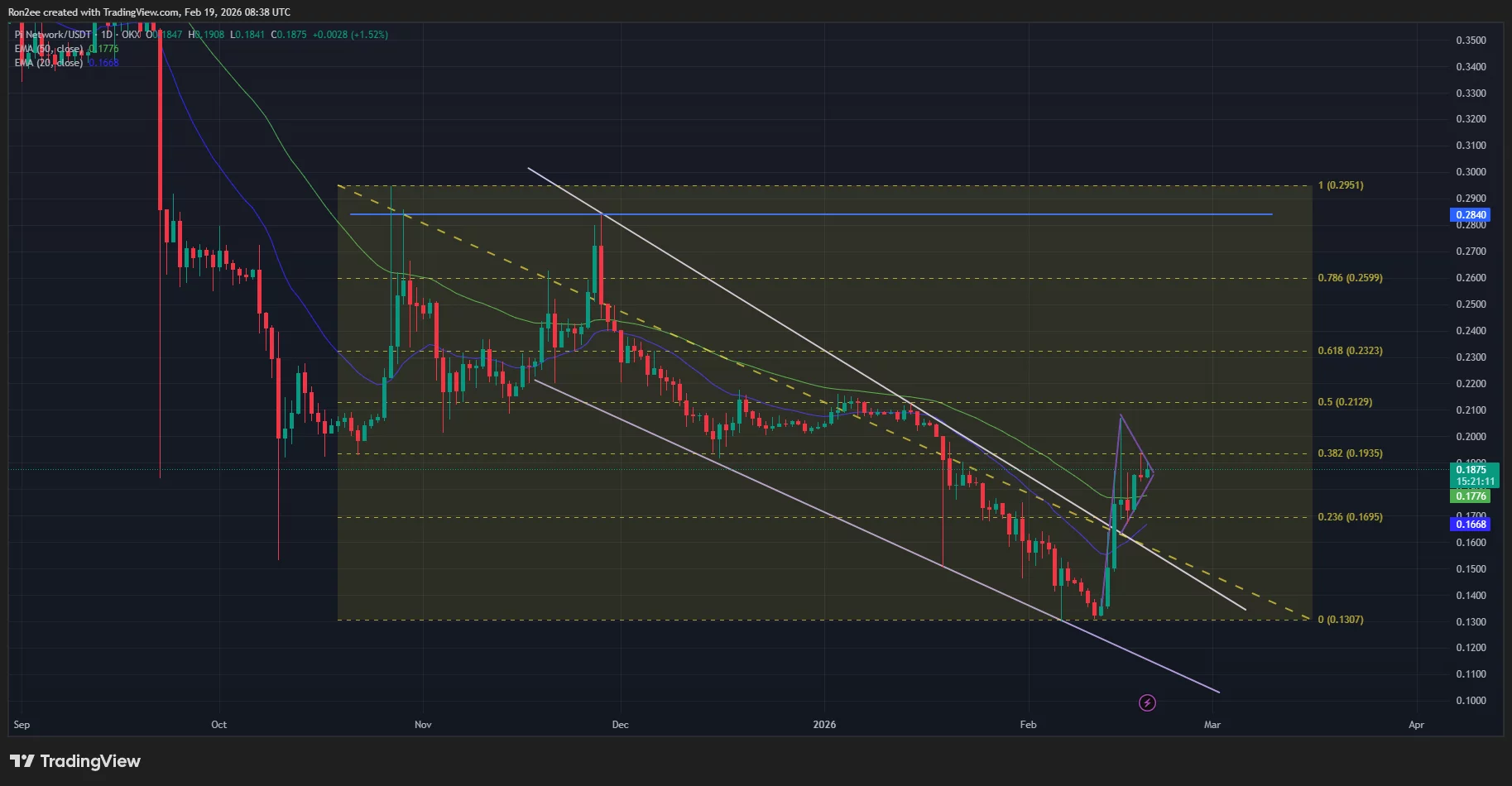
According to data from crypto.news, Pi Network (PI) price shot up to a four-week high of $0.205 last Sunday before settling at $0.187 at press time. This move reflects gains of over 40% over a seven-day period and has pushed its market cap up to $1.68 billion.
The biggest catalysts for the surge have been investor excitement over the celebration of the first anniversary of the Pi Network mainnet launch on Friday, Feb. 19. Traders seem to be pricing in the likelihood of developers revealing major announcements to commemorate the event.
At the same time, PI has significantly reduced monthly token unlocks, which has also contributed to the upside as reported earlier by crypto.news. There’s also significant community chatter around a potential Kraken listing, which is adding to the momentum.
At press time, Pi Network was trading close to the 38.2% Fibonacci Retracement level at $0.193.
Pi Network price has formed multiple bullish patterns on the daily chart, which suggest the token rally still has steam left for more upside this week.
First, Pi Network price has broken out of a falling wedge pattern that had been forming since late November last year. This pattern consists of two converging and descending lines. A breakout is confirmed when price moves above the upper trendline, typically signaling a shift in momentum from bears to bulls.
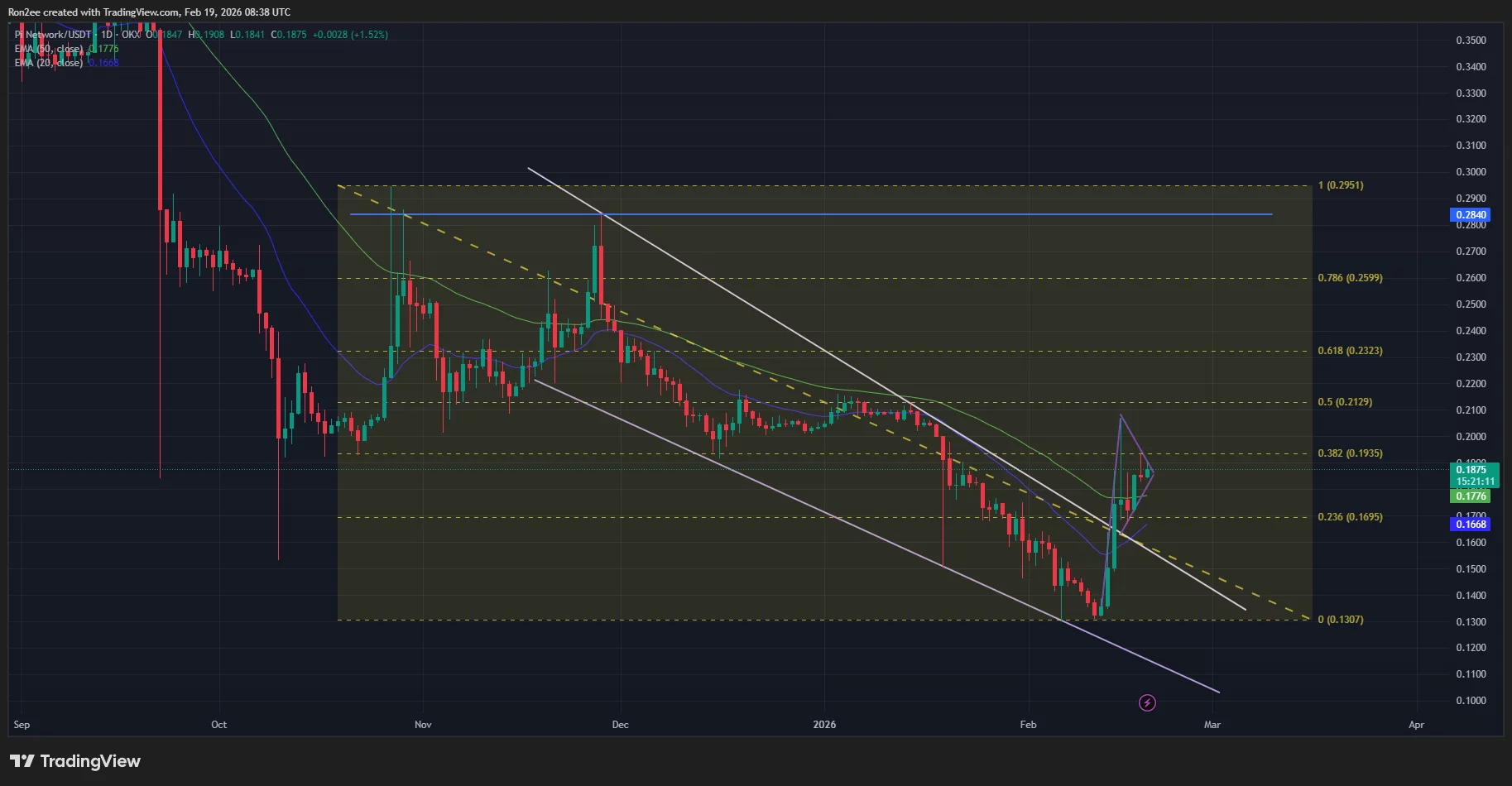
Second, the token’s price action has also formed a bullish pennant pattern marked by a flagpole and a consolidation triangle. Bullish pennant patterns are considered strong continuation signals, often preceding another leg higher.
Hence, if PI token can reclaim the 38.2% retracement level, which is widely considered the primary threshold for trend validation, it would signal that the bullish trend remains strong.
Subsequently, the coin may continue rising as bulls target the next key resistance level at $0.212, which marks its monthly high and aligns with the 50% Fibonacci Retracement level.
Disclosure: This article does not represent investment advice. The content and materials featured on this page are for educational purposes only.
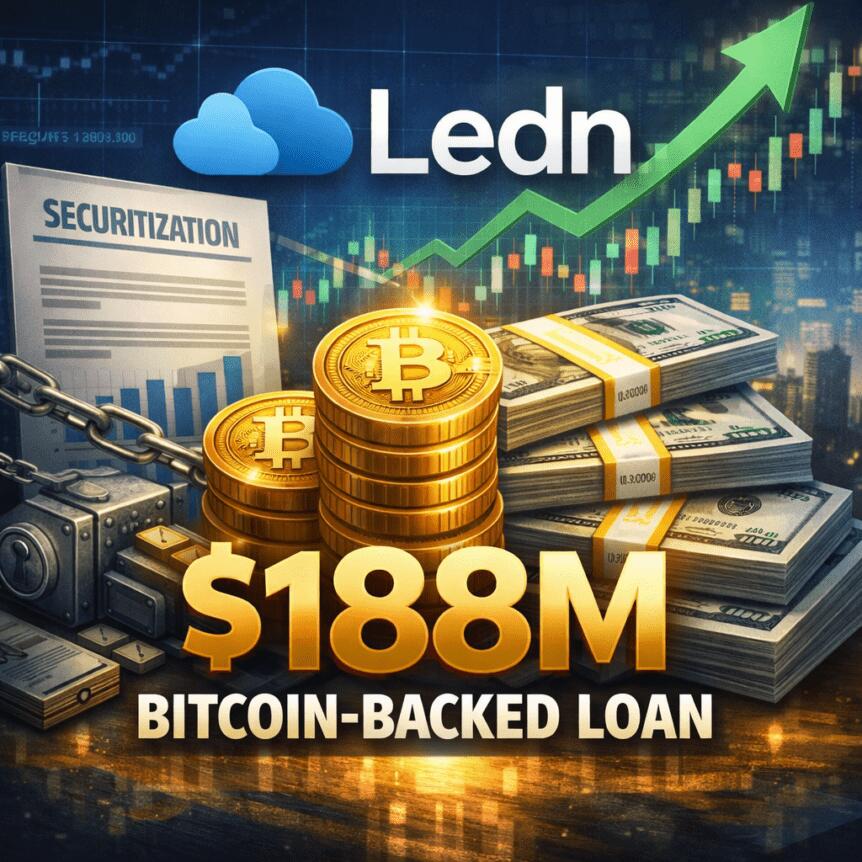
Ledn’s latest financing move marks a notable milestone for crypto-backed credit in traditional capital markets. The Bitcoin‑collateralized consumer loan platform is reported to have securitized roughly $188 million in bonds tied to a pool of small-dollar, short‑term loans, packaged as asset‑backed securities (ABS) through a vehicle called Ledn Issuer Trust 2026‑1. The issuance represents one of the first times bitcoin collateral has been embedded into a mainstream ABS structure, signaling growing interest from conventional fixed‑income investors in crypto‑linked credit risk. The deal, described by people familiar with the matter to Bloomberg, has set a precedent for how crypto collateral can be leveraged within regulated securitization channels.
Key takeaways
- The securitization is framed as a first‑of‑its‑kind ABS that pools 5,441 short‑term, fixed‑rate balloon loans extended to 2,914 U.S. borrowers and is secured by 4,078.87 Bitcoin (BTC).
- The deal’s senior tranche totals $160 million and carries a preliminary BBB‑ (sf) rating, while a $28 million subordinated tranche carries a preliminary B‑ (sf) rating, according to S&P Global Ratings’ documentation dated February 9.
- The investment‑grade Class A notes reportedly priced at a spread of about 335 basis points over a benchmark rate, implying an approximate 3.35% yield relative to riskless debt and reflecting investors’ pricing for crypto‑credit risk versus traditional consumer ABS.
- Jefferies Financial Group served as the sole structuring agent and bookrunner, bridging institutional fixed‑income buyers with this novel crypto‑linked exposure.
- The deal underscores Bitcoin as a form of collateral that traditional finance institutions are increasingly willing to accept, a trend highlighted by notable industry voices and ongoing collaboration between crypto lenders and traditional banks.
Tickers mentioned: $BTC
Sentiment: Neutral
Price impact: Neutral. The ABS issuance reflects growing institutional appetite for crypto‑backed credit exposure rather than a direct price move in Bitcoin itself.
Market context: The transaction arrives amid a broader shift toward integrating Bitcoin as usable collateral within regulated finance, a trend reinforced by lenders and banks expanding BTC‑backed products. The piece aligns with broader industry discussions about how liquidity can flow from crypto assets into traditional financing structures, while the market remains attentive to the evolving regulatory backdrop and the resilience of collateral performance during volatility.
Why it matters
The Ledn ABS illustrates a practical bridge between on‑chain asset dynamics and off‑chain credit markets. By securitizing a pool of loans secured by Bitcoin, the structure leverages a transparent, programmable asset class that can be tracked through conventional reporting channels, potentially broadening access to crypto‑backed lending for a wider base of institutions. The use of balloon payments in balloon loan structures is designed to keep near‑term cash outlays manageable for borrowers, while exposing investors to a larger principal balance at maturity. This mechanism can provide a clearer risk profile for buyers of crypto‑linked ABS who seek to diversify their exposure away from direct crypto ownership while retaining the upside of Bitcoin’s collateral cushion.
Industry participants see the inclusion of BTC as collateral in a traditional ABS framework as a signal that crypto assets are moving from speculative use cases into mainstream financial plumbing. In remarks cited by market observers, Andre Dragosch, head of research at Bitwise Europe, noted that packaging such loans into a familiar ABS format implies Bitcoin is increasingly viewed as safe and legitimate collateral by established financial institutions. Dragosch pointed to JPMorgan’s BTC‑backed loan offerings as a corroborating data point, suggesting that large banks are evolving their product menus to accommodate crypto collateral within standard risk frameworks. This sentiment reflects a broader trend: liquidity that was previously constrained within crypto‑native markets could gradually find channels into regulated financing ecosystems, potentially expanding the size and scope of BTC‑collateralized lending over time.
From a research standpoint, observers argue that the on‑chain traceability and programmable liquidation capabilities inherent to Bitcoin‑backed lending reduce opacity around collateral management, which can help attract institutional buyers who demand clear governance around defaults and recoveries. Jinsol Bok, research lead at Four Pillars Global Crypto Research, highlighted the potential for on‑chain transparency to lower information asymmetries for ABS investors and to unlock scalable liquidity as BTC‑collateralized loans diversify beyond boutique, crypto‑focused channels. The dynamic could unlock new lending products and broaden the ecosystem’s capacity to absorb capital against crypto collateral, particularly as issuance volumes in the crypto lending space have drawn attention for their growth and risk management approaches.
The catalytic elements of this transaction extend beyond the initial securitization. Ledn, founded in 2018, has amassed more than $9.5 billion in loan originations across over 100 countries, a figure that signals the company’s ability to scale crypto‑backed lending into traditional capital markets. The relationship with Tether, which invested strategically in Ledn in November 2025, adds a layer of credibility and institutional interest that could spur further collaboration between stablecoin issuers and crypto lenders. The broader implication for traders and borrowers alike is the potential for BTC‑backed lending to become a more common, lower‑cost, and more transparent instrument, with on‑chain asset tracking complementing off‑chain securitization disclosures.
As the market digests this development, analysts caution that investment‑grade ratings still sit at a relatively modest level of comfort, reflective of the embedded credit risk in crypto‑linked debt. BBB‑ (sf) for the senior notes signals adequate capacity to meet financial commitments but indicates heightened sensitivity to adverse conditions compared with higher‑rated debt. The subordinated B‑ (sf) tranche sits in the lower tiers of credit quality, signaling substantially higher risk of default relative to investment‑grade bonds. Yet the mere existence of such ratings demonstrates that risk‑adjusted access to funding can be extended to crypto‑backed assets within a structured finance framework, provided that collateral mechanics and liquidity remain robust enough to support timely repayments and potential liquidations in stressed markets.
What to watch next
- Final ratings and closing terms for Ledn Issuer Trust 2026‑1, including any adjustments to the BBB‑ sf and B‑ sf designations.
- Performance of the underlying loan pool, including delinquency rates and recovery rates on BTC collateral during market stress.
- Subsequent securitizations or new tranches announced by Ledn or other crypto lenders leveraging BTC collateral in ABS formats.
- Regulatory commentary or disclosures that could influence the appetite for crypto‑backed ABS and the permissible collateral standards for such securitizations.
Sources & verification
- S&P Global Ratings preliminary documentation for Ledn Issuer Trust 2026‑1 (ratings: BBB‑ sf for Class A; B‑ sf for Class B), dated Feb. 9.
- Bloomberg reporting on the transaction and pricing details (Feb. 18, 2026).
- Ledn’s platform history and loan origination figures (Ledn official materials).
- Tether’s strategic investment in Ledn, announced in late 2025.
Ledn’s Bitcoin‑backed ABS signals growing mainstream embrace of BTC collateral
Ledn’s securitization effort, structured through Ledn Issuer Trust 2026‑1, deploys a pool of 5,441 balloon loans to 2,914 U.S. borrowers and backs them with 4,078.87 Bitcoin (BTC). The single senior tranche, consisting of $160 million, carries a preliminary BBB‑ (sf) rating, while the $28 million subordinate class carries a preliminary B‑ (sf) rating, according to S&P Global Ratings’ early assessment published in February. The notes were positioned as an investment‑grade instrument with a spread of roughly 335 basis points above a benchmark rate, implying an all‑in yield around 3.35% for the senior notes, a level that reflects the perceived credit risk of crypto‑backed lending as opposed to traditional consumer ABS.
Jefferies Financial Group acted as the sole structuring agent and bookrunner, coordinating negotiations with fixed‑income investors who are now exposed to a new form of crypto‑linked credit. The approach demonstrates how traditional finance channels can absorb crypto collateral in a regulated setting, offering a pathway for more standardized risk assessment and investor protections. The presence of a clearly delineated pool of loans and collateral helps reduce some of the information asymmetries that have historically characterized crypto credit markets, while also exposing participants to the volatility of the underlying crypto asset under pressure.
From a wider industry perspective, the deal underscores a broader shift in how Bitcoin is viewed by banks and non‑bank lenders alike. Andre Dragosch, head of research Europe at Bitwise, observed that packaging BTC‑backed loans into a conventional ABS framework signals that Bitcoin is increasingly regarded as “safe and legit collateral” by institutional players. He pointed to JPMorgan’s BTC‑backed loan offerings to customers as a corroborating datapoint—an indication that large banks are integrating crypto collateral into their traditional product lines. Four Pillars’ Jinsol Bok added that this could unlock liquidity that has previously been locked up, potentially allowing the BTC‑collateralized lending market to expand far beyond its current scale as more lenders enter the space and refine their risk models.
Ledn’s growth—originating more than $9.5 billion in loans across over 100 countries since its founding in 2018—highlights the capacity of crypto lenders to scale these products to mainstream markets. The strategic investment from Tether in November 2025 further signals investor confidence in the platform’s risk controls and governance, a factor that could influence future securitizations and investor buy‑side demand for crypto‑linked debt. While the broader market remains mindful of regulatory uncertainties and volatility in crypto assets, the emergence of BTC as a credible collateral backbone for ABS demonstrates how the industry is evolving toward more mature, diversified financing structures that integrate crypto with traditional market mechanisms.
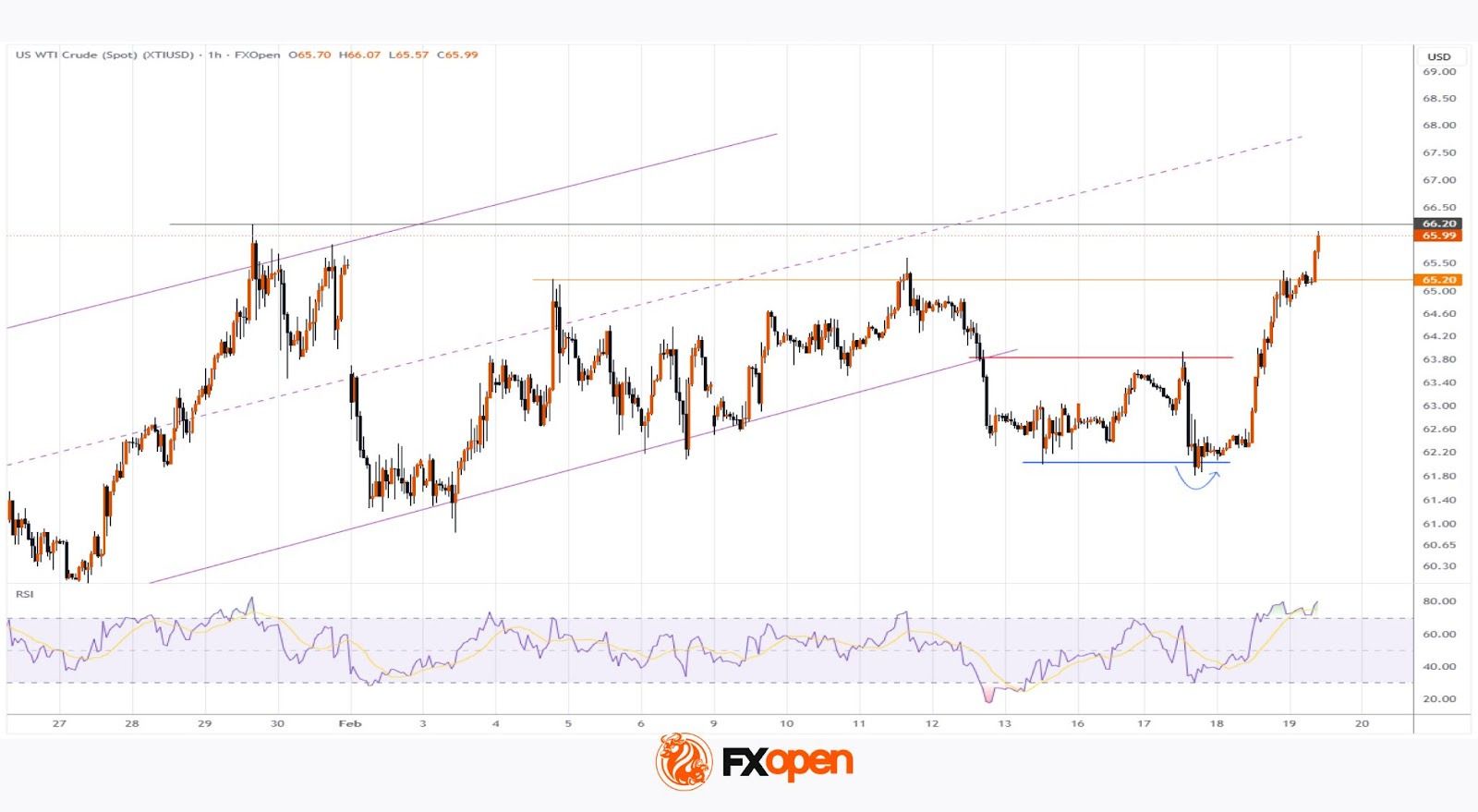
As the XTI/USD chart shows, the price of a barrel has today moved above the highs of 4 and 11 February, rising beyond the $66 level and marking its highest point since the start of the month. Bullish sentiment is being driven by escalating geopolitical tensions, primarily linked to Iran. According to media reports:
→ Negotiations between the parties remain inconclusive. Although Tehran stated that a “general agreement” had been reached with Washington on the framework of a potential nuclear deal, US Vice-President JD Vance indicated that Iran had failed to meet US demands.
→ President Donald Trump, in turn, maintains that the use of military force remains an option.
This raises the prospect of Iran attempting to block the Strait of Hormuz — a key route for global oil and gas shipments. Any US military action could evolve into a prolonged campaign, unlike the short-lived operation in Venezuela.
Heightened geopolitical risk is therefore pushing oil prices towards fresh yearly highs.
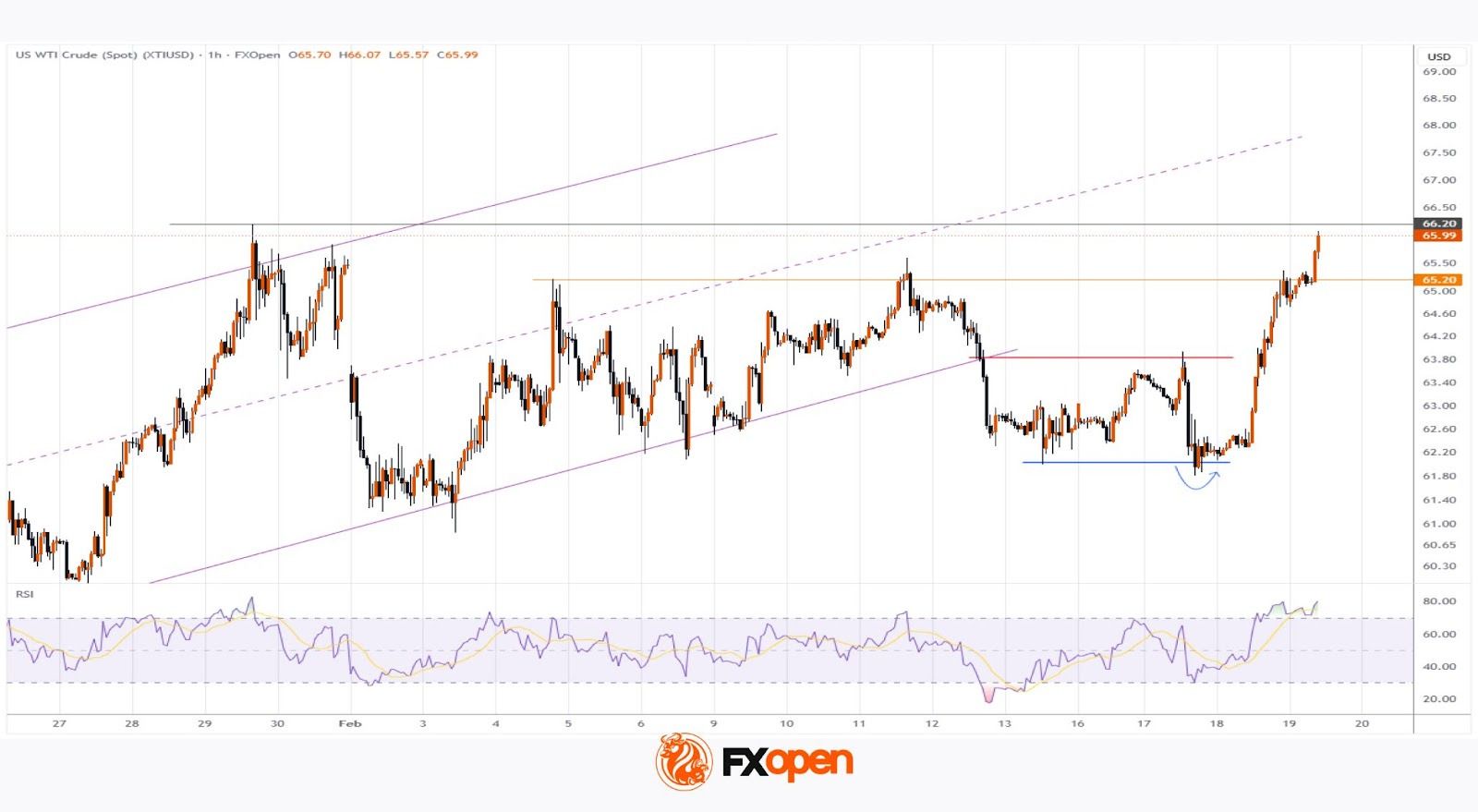
Technical Analysis of the XTI/USD Chart
When analysing the oil price chart on 12 February, we:
→ used WTI price swings to construct a broad ascending channel (shown in purple);
→ identified patterns suggesting that initiative was shifting to the bears.
Since then, oil prices not only retreated to the lower boundary of the channel but also broke below it on the same day. The breakout level later acted as local resistance on 17 February.
Subsequently, a false bearish breakout (indicated by the arrow) signalled that selling pressure had been exhausted. Bulls then capitalised on the tense news backdrop to push prices higher.
It is possible that the 65.20 level will now act as support, with scope for a fresh yearly high in the near term. Should signs of military action emerge, traders should be prepared for a scenario in which WTI prices move well above $66.20.
Start trading commodity CFDs with tight spreads (additional fees may apply). Open your trading account now or learn more about trading commodity CFDs with FXOpen.
This article represents the opinion of the Companies operating under the FXOpen brand only. It is not to be construed as an offer, solicitation, or recommendation with respect to products and services provided by the Companies operating under the FXOpen brand, nor is it to be considered financial advice.
TLDR:
-
- Japan’s LDP secured over two-thirds of seats, fast-tracking long-delayed crypto tax reform proposals.
- The FSA plans to reclassify Bitcoin and Ethereum as financial instruments, enabling spot ETFs.
- A flat 20% crypto tax rate has bipartisan support and is expected to move forward under the new cabinet.
- STARTALE’s Watanabe says regulatory clarity will draw foreign investment and unlock domestic Web3 growth.
- Japan’s LDP secured over two-thirds of seats, fast-tracking long-delayed crypto tax reform proposals.
Crypto asset tax reform in Japan has moved closer to reality following the inauguration of the second Takaichi Cabinet.
The Liberal Democratic Party secured more than two-thirds of seats in the House of Representatives elections. This strong political base is expected to accelerate long-pending regulatory changes.
STARTALE Group CEO Sota Watanabe told BeInCrypto that the election results could compress the reform timeline by months. Japan’s Web3 industry is now watching closely as key policy changes take shape.
New Administration Sets the Stage for Faster Regulatory Action
The second Takaichi Cabinet was officially inaugurated on the 18th of this month. With a commanding legislative majority, the new government now holds enough political capital to push through stalled reforms.
Watanabe noted that several proposals had already been drafted but were waiting for political prioritization.
Watanabe was direct about what the election outcome means for reform speed. “With Governor Takaichi’s landslide victory, the new administration has gained the political capital necessary to expedite the reforms that had already been drafted but were waiting to be prioritized,” he said.
He added that the outcome is expected to “accelerate the timeline for reform in months compared to divided governments and uncertain outcomes.”
Japan’s Financial Services Agency (FSA) has signaled its intent to reclassify crypto assets. Bitcoin and Ethereum could shift from “payment methods” to regulated financial instruments.
A flat 20% separate taxation on crypto trading gains is also on the table, with bipartisan support strengthening its chances of passing.
FSA Reclassification Could Unlock Spot ETFs and Institutional Products
If the FSA reclassification moves forward under the revised Financial Instruments and Exchange Act (FIEA), spot crypto ETFs become a real possibility.
Japan’s ETF market has already shown early momentum in this direction. Formalizing the framework would give institutional investors a regulated entry point into digital assets.
Watanabe described the reclassification as a foundational shift. “The FSA has already indicated its intention to reclassify many crypto assets, including Bitcoin and Ethereum, from payment methods to regulated financial instruments,” he explained.
“This is a foundational change that allows for institutional entry, ETF development, and a more mature market structure.”
The FIEA revision would also establish a framework for securitized crypto products. This aligns crypto assets with the same legal standing as stocks and other securities.
Watanabe noted that Japan is taking a framework-first approach, unlike the United States, which approved spot Bitcoin ETFs before establishing a unified federal regulatory structure.
Japan’s Position in Asia and Global Crypto Markets
Japan held the most comprehensive crypto regulatory framework in Asia for many years. However, that framework was also viewed as overly restrictive by many in the industry. That perception, according to Watanabe, is now beginning to shift.
On the global comparison, Watanabe was clear about where Japan stands. “If the amendment to the Financial Instruments and Exchange Act is passed and the 20% tax rate takes effect, Japan will become one of the countries with the most consistent end-to-end regulatory environment for digital assets in the world,” he said.
He also noted that while Hong Kong promotes its VASP licensing system aggressively, it “does not have the domestic consumer market and corporate ecosystem that Japan provides.”
On the global stage, Japan’s end-to-end regulatory clarity sets it apart from other markets. That consistency is what foreign businesses and institutional investors look for when choosing a base. The upcoming reforms are expected to solidify that position further.
STARTALE’s Strategic Role in Japan’s Web3 Infrastructure
STARTALE Group is currently co-developing Soneium, a Layer 2 blockchain, with Sony. The company is also working with SBI Holdings on a JPY-denominated stablecoin and a Layer 1 blockchain called Straivm. These projects reflect the kind of long-term institutional commitment that regulatory clarity makes possible.
Watanabe spoke directly about how regulatory uncertainty has affected operations. “We’ve seen firsthand how regulatory uncertainty can hold back both domestic builders and international partners,” he said.
“The results of this election eliminate that key variable.” He also noted that treating cryptocurrencies as financial instruments “changes the quality of interactions with institutional, bank, and corporate clients.”
For foreign companies, a flat tax rate and clear FIEA classifications make Japan one of the most attractive regulated markets globally. Japan already has one of the most active retail investor bases in the world.
As Watanabe put it, the reforms under consideration will “unleash a wave of domestic innovation and foreign investment that the Japanese Web3 sector has been waiting for.”


ETH fell ~60% from 2025 peak as Bitmine bought 45,759 ETH for $91m, lifting staked holdings to 3.04m.
Summary
- Bitmine bought 45,759 ETH for about $91m near $2k, roughly 62% below the 2025 >$5k peak.
- Total ETH holdings now 4.37m, with 3.04m staked, implying multi‑hundred‑million annualized rewards at current yields.
- ETH trades in a descending channel with liquidity‑driven volatility, while RWA tokenization and DeFi usage support long‑term network demand.
Bitmine Immersion Technologies, led by Tom Lee, purchased 45,759 Ethereum tokens valued at approximately $91 million during a market downturn, according to a company press release.
The acquisition increased Bitmine’s total Ethereum holdings to 4.37 million tokens, the company announced. Of that total, 3.04 million tokens are currently staked, generating ongoing staking rewards for the firm.
Lee stated in the press release that the price decline presented an attractive entry point from an Ethereum fundamentals perspective. The company believes Ethereum’s utility justifies a higher valuation than current market prices, according to the statement.
The purchase was completed as Ethereum experienced a price decline, though specific price levels were not disclosed in the announcement. The transaction represents a significant institutional bet on the second-largest cryptocurrency by market capitalization.
Bitmine’s staking operations generate annual income through validator rewards on the Ethereum network. Management expects substantial staking incentives that will contribute to the company’s return on investment, according to the press release.
The Ethereum network has recently seen growth in real-world asset tokenization, with on-chain RWA market capitalization surpassing a multi-billion-dollar milestone, according to blockchain analytics data. This development has reinforced Ethereum’s position in decentralized finance applications.
Bitmine Immersion Technologies recently completed a strategic acquisition, though details of that transaction were not specified in the announcement.
The company’s stock price has declined in recent trading sessions despite the substantial cryptocurrency accumulation. The divergence between stock price and underlying asset value is common among cryptocurrency-holding companies during volatile market periods.
Technical analysts have noted accumulation patterns in Ethereum addresses, with large purchases potentially establishing support levels. The cryptocurrency has traded in a descending channel pattern, with key support levels being monitored by market participants.
Market liquidity conditions could lead to increased price volatility in either direction, according to trading analysts.
The dollar strengthened following the release of the minutes from the Federal Open Market Committee, reflecting the regulator’s more hawkish tone. In the document, policymakers highlighted persistent inflationary risks and the need for a cautious approach to any potential policy easing. This reduced expectations of imminent rate cuts and supported demand for the US currency.
At the same time, the market remains focused on upcoming US macroeconomic releases due before the end of the week. Attention is centred on the Philadelphia Fed Manufacturing Index, initial jobless claims, trade data, and housing market statistics. These releases could either reinforce the impact of the minutes or partially offset it if the figures come in weaker than expected.
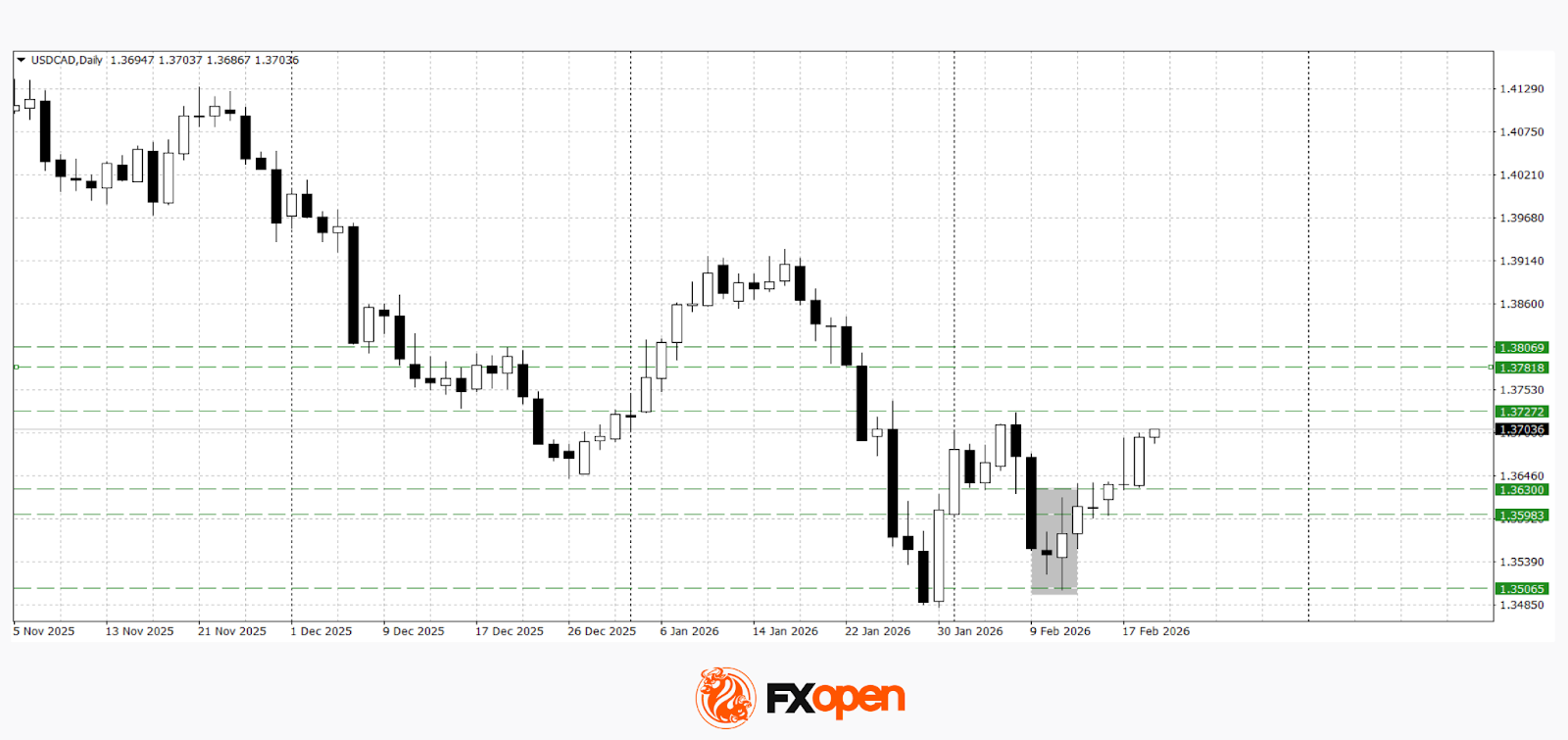
Overall, the dollar has rebounded from support levels after the publication of the minutes. However, the further development of the upward correction in USD/JPY and USD/CAD will depend on incoming data. Market sentiment remains neutral-analytical, as participants assess whether the data will confirm the resilience of the US economy or trigger a deeper dollar correction.
USD/JPY
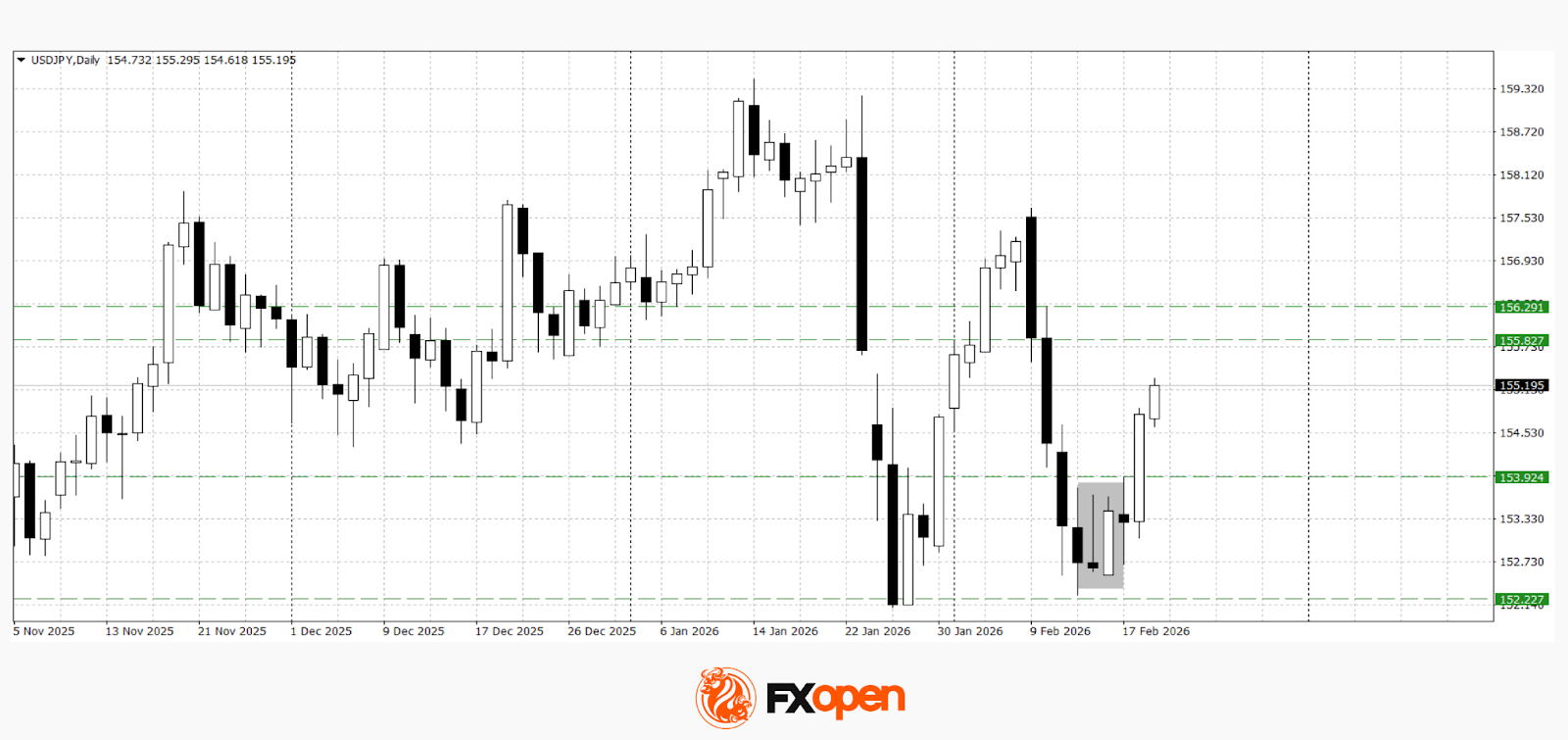
After testing the support zone near the January lows, USD/JPY has moved into an upward corrective phase. Technical analysis points to the potential for gains towards 155.80–156.30, as a bullish engulfing pattern has formed on the daily timeframe. The upside scenario would be invalidated by a sustained move below 154.00.
Key events for USD/JPY:
- today at 15:20 (GMT+2): speech by FOMC member Bostic;
- today at 15:30 (GMT+2): Philadelphia Fed Manufacturing Index (US);
- today at 15:30 (GMT+2): US initial jobless claims.
USD/CAD
USD/CAD has also rebounded from the January lows and formed a bullish reversal pattern. The pair is currently approaching the key resistance level at 1.3700. If buyers manage to secure a firm break above this level in the coming sessions, further gains towards 1.3730–1.3800 are possible. Conversely, a move below 1.3630–1.3590 could open the way for a retest of the 1.3500 area.
Key events for USD/CAD:
- today at 15:30 (GMT+2): Canada’s trade balance;
- today at 17:30 (GMT+2): Canadian export data;
- today at 19:00 (GMT+2): US crude oil inventories.
Trade over 50 forex markets 24 hours a day with FXOpen. Take advantage of low commissions, deep liquidity, and spreads from 0.0 pips (additional fees may apply). Open your FXOpen account now or learn more about trading forex with FXOpen.
This article represents the opinion of the Companies operating under the FXOpen brand only. It is not to be construed as an offer, solicitation, or recommendation with respect to products and services provided by the Companies operating under the FXOpen brand, nor is it to be considered financial advice.

Royal British Legion celebrates universally condemned Iraq war
Ex-Vikings GM Explains Franchise Tag Crunch Time

Where the “I” is not just intelligence, but I, the human


-

 Video3 days ago
Bitcoin: We’re Entering The Most Dangerous Phase
-

 Tech4 days ago
Luxman Enters Its Second Century with the D-100 SACD Player and L-100 Integrated Amplifier
-

 Crypto World2 days ago
Can XRP Price Successfully Register a 33% Breakout Past $2?
-

 Sports2 days ago
GB's semi-final hopes hang by thread after loss to Switzerland
-

 Video6 days ago
The Final Warning: XRP Is Entering The Chaos Zone
-
 Tech2 days ago
The Music Industry Enters Its Less-Is-More Era
-

 Business1 day ago
Infosys Limited (INFY) Discusses Tech Transitions and the Unique Aspects of the AI Era Transcript
-

 Video2 days ago
Financial Statement Analysis | Complete Chapter Revision in 10 Minutes | Class 12 Board exam 2026
-

 Entertainment21 hours ago
Kunal Nayyar’s Secret Acts Of Kindness Sparks Online Discussion
-
 Crypto World5 days ago
Bhutan’s Bitcoin sales enter third straight week with $6.7M BTC offload
-

 Tech1 day ago
Retro Rover: LT6502 Laptop Packs 8-Bit Power On The Go
-
 Sports6 hours ago
Clearing the boundary, crossing into history: J&K end 67-year wait, enter maiden Ranji Trophy final | Cricket News
-

 Entertainment12 hours ago
Dolores Catania Blasts Rob Rausch For Turning On ‘Housewives’ On ‘Traitors’
-
 NewsBeat4 days ago
The strange Cambridgeshire cemetery that forbade church rectors from entering
-

 Business7 days ago
Barbeques Galore Enters Voluntary Administration
-

 Crypto World6 days ago
Kalshi enters $9B sports insurance market with new brokerage deal
-

 Business1 day ago
Tesla avoids California suspension after ending ‘autopilot’ marketing
-

 Crypto World15 hours ago
WLFI Crypto Surges Toward $0.12 as Whale Buys $2.75M Before Trump-Linked Forum
-
 Crypto World7 days ago
Ethereum Price Struggles Below $2,000 Despite Entering Buy Zone
-
 NewsBeat4 days ago
Man dies after entering floodwater during police pursuit