

Crypto World
Three companies add MSTR’s STRC to treasury as shares return to par



Three companies have added Strategy’s perpetual preferred equity, Stretch (STRC), to their balance sheets as the security returns to its $100 par value.
Strategy said Prevalon Energy and Anchorage Digital disclosed during presentations at Strategy World 2026 in Las Vegas that each company has allocated a portion of its corporate treasury to STRC, Strategy’s Variable Rate Series A Perpetual Stretch Preferred Stock, during the “Bitcoin for Corporations” track. In separate remarks at the conference, OranjeBTC, a Brazilian bitcoin treasury company also confirmed it has added STRC to its balance sheet.
According to STRC.live, STRC briefly touched par during Wednesday’s trading session. Based on trading volume, it is estimated that roughly 22 BTC were purchased through STRC activity. In pre market trading, STRC is again at $100.
STRC is a short duration, high yield credit instrument that ranks senior to MSTR common stock and offers an 11.25% annual dividend, distributed monthly.
The conference also featured additional announcements, including 21Shares bringing STRC exposure to Europe through the Strategy Yield ETP on Euronext Amsterdam.
Separately, Morgan Stanley plans to introduce bitcoin trading, lending, yield, and custody services, with Amy Oldenburg, Head of Digital Asset Strategy at Morgan Stanley, confirming the plans during a panel discussion with Strategy CEO Phong Le.
Bitcoin is trading above $68,000, while MSTR rose 9% on Wednesday and is slightly lower in Thursday pre market trading at around $135.

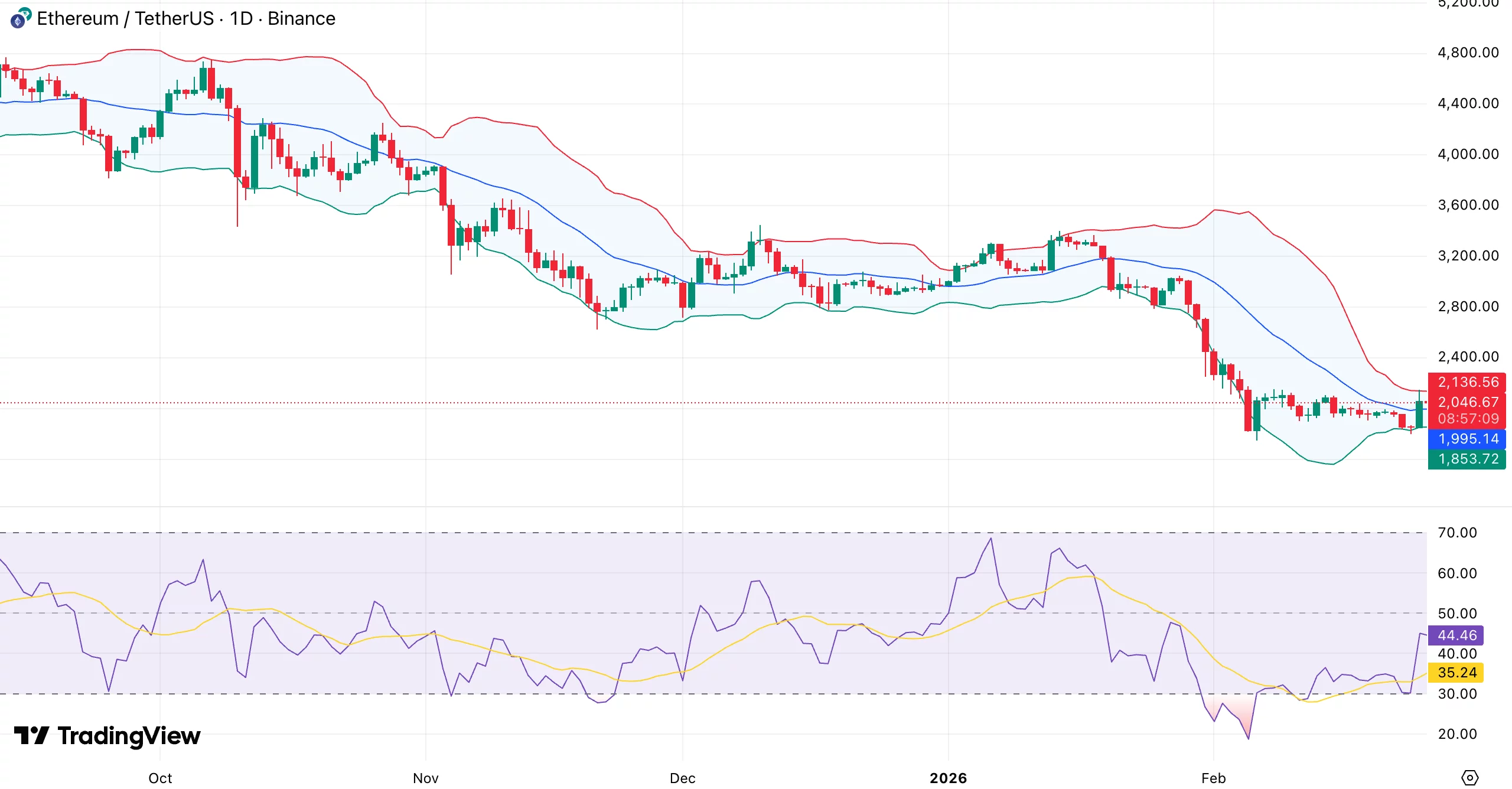
Ethereum price is trying to steady itself after a rough February, but the bigger question is whether this bounce has enough strength to push through the $2,500 ceiling.
Summary
- Ethereum has bounced above $2,000 after a sharp February drop but remains in a broader downtrend and well below the key $2,500 resistance.
- Funding rates on Binance have turned positive, easing short-term downside pressure, though high volatility suggests a bigger move is coming.
- To reclaim $2,500, ETH must hold $2,000 support and break above $2,200 with strong momentum
At press time, ETH was trading near $2,050, up about 3% over the past 24 hours. The move extends a week-long rebound of roughly 9%. Even so, the token is still down 30% over the past month and sits nearly 58% below its August 2025 peak of $4,946.
February started with Ethereum (ETH) trading between $2,200 and $2,400 before sellers took control mid-month. The slide accelerated around Feb. 24–25, when the price dipped toward $1,800. Since then, buyers have stepped back in, lifting the price back above the $2,000 mark.
Volatility spikes to highest level since March 2025
Derivative data shows a notable shift in positioning. According to a Feb. 26 analysis by CryptoQuant analyst PelinayPA, funding rates had remained positive for an extended period earlier this year, indicating that long traders were paying shorts.
Despite that optimism, the price failed to build a consistent rally. More recently, when short positions grew and the price faced pressure, funding went sharply negative.
Binance, which has the biggest share of global derivatives liquidity, often sets the tone during liquidation waves. The short- to mid-term trajectory of Ethereum is often affected by changes in Binance funding.
Funding has now flipped back to positive. This indicates that there is less immediate downside pressure now that many short positions have been cleared. Positive funding, however, does not prove a long-term recovery. The market could experience a long squeeze if it rises too quickly.
In a separate report, analyst Arab Chain revealed that Ethereum’s 30-day realized volatility on Binance has climbed to roughly 0.97, its highest level since March 2025.
Such high volatility often precedes a significant directional move, but if buying and selling pressure is evenly distributed, it can also occur during a prolonged period of sideways trading.
Ethereum price technical analysis
From a chart perspective, ETH is still in a clear daily downtrend, marked by lower highs and lower lows. Price recently bounced after touching the lower Bollinger Band near the $1,850–$1,900 zone. It now trades around $2,050, below key resistance areas.
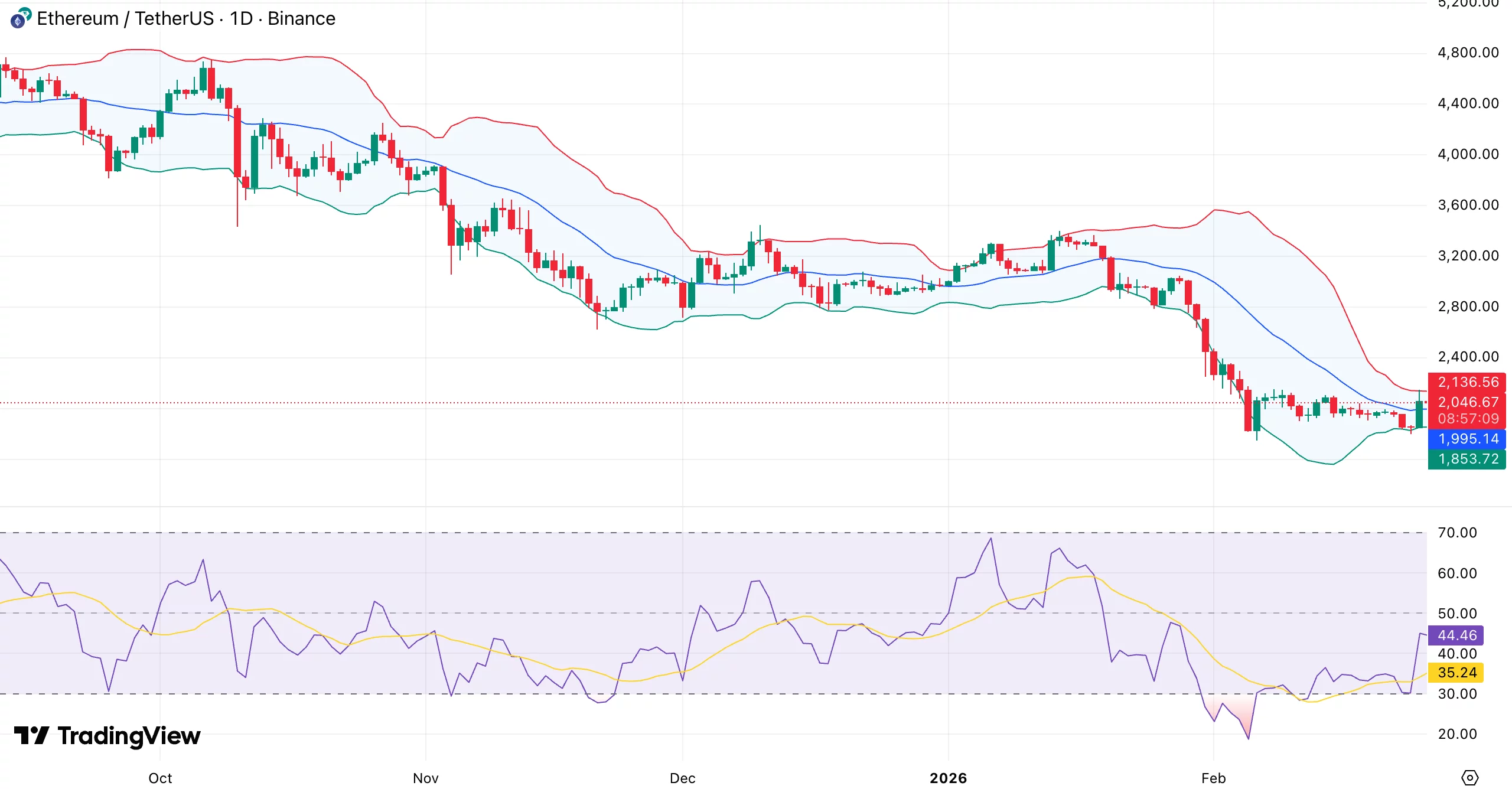
Immediate support sits near $2,000, followed by the recent low between $1,850 and $1,900. On the upside, supply is clustered around $2,130–$2,150, then $2,300–$2,350.
Because it corresponds with a previous breakdown area and has psychological weight, the $2,500 level continues to be the primary structural barrier.
Momentum is improving but not yet decisive. Following a recovery from oversold conditions, the relative strength index is close to 44.
A sustained move above 50 would strengthen the case for a shift in momentum. Bollinger Bands are starting to narrow after widening during the selloff, suggesting a possible attempt at a breakout.
For Ethereum to recover $2,500, it must clear the $2,200 area with substantial volume and maintain above $2,000 to form a higher low. The current move might turn out to be a relief bounce inside a bigger downward structure if there is no follow-through.


- Dogecoin price hovers near $0.10 amid fresh rejection above this level.
- Open interest has dropped below $1 billion.
- DOGE could drop to $0.08 if weakness intensifies.
Dogecoin’s latest price rally has hit a snag, with the meme coin slipping back under the key $0.10 threshold amid fading momentum in the meme coin sector.
On Thursday, February 26, 2026, DOGE hovered around $0.1004, clinging to modest daily gains after a volatile week that saw it dip as low as $0.0914 the previous day.
This retreat highlights persistent challenges for the meme-themed cryptocurrencies, once buoyed by celebrity endorsements but now grappling with broader market headwinds and technical barriers.
DOGE price retested highs above $0.10
Dogecoin briefly surged past $0.10 on Wednesday, fueled by a sharp rebound for Bitcoin and top altcoins.
Traders eyed momentum above the psychological level as a potential springboard for renewed interest, especially after DOGE touched $0.11 on February 25 before retreating.
However, the uptick proved short-lived, with selling pressure mounting as the token failed to sustain gains, retreating amid thinner trading volumes and scepticism over long-term catalysts.
A unique angle here is the role of retail investor fatigue.
On-chain metrics show smaller holders distributing positions after the spike, wary of the slide seen following Dogecoin price rallying to its peak in 2025.
CoinGlass data shows that open interest in Dogecoin futures has dropped to under $1 billion.
The dip has been progressive since the peak of over $5 billion in September 2025.
This shift highlights how community-driven hype, Dogecoin’s hallmark, is waning as macro factors overshadow viral buzz.
Dogecoin price analysis
Dogecoin is trading near $0.098 as of writing on Thursday, preserving about 4% of the advance from the prior session.
The slight dip from intraday highs aligns with the rejection at the upper boundary of a falling channel.
Dogecoin has also traded lower amid falling 50-day and 100-day SMAs.
Bulls, therefore, face the $0.10 and the SMA barriers as immediate resistance levels.

The daily MACD has climbed following a signal line rebound earlier in the week, pointing to budding bullish energy.
Buyers are also unwavering as RSI lingers near the 50 mark, hinting at neutral sentiment.
This means fresh gains could follow if buyers retake control.
Yet, a close below $0.10 could revive selling, targeting the February lows of $0.08 and exposing deeper corrections.
From a distinctive perspective, Dogecoin’s stall mirrors a “meme exhaustion pattern” seen in past cycles.
After quick pops, prices have often quickly pared gains.
With year-to-date declines persisting and Bitcoin’s surge also stalling, DOGE bulls need a decisive breakout to shift momentum.


The era of speculative mania is transitioning into the era of the automated on-chain economy, according to Animoca Brands co-founder Yat Siu.
In an interview with Korea Times, Siu declared this week that AI agents and blockchain will work in tandem behind the scenes while we get on with our lives, positing fascinating and ubiquitous use cases for blockchain that few talk about.
Siu argued that the convergence of artificial intelligence and blockchain infrastructure has reached a tipping point. The friction of gas fees, private keys, and complex bridging is about to disappear behind a layer of autonomous software.
The implication is that we will soon all be using AI and blockchain without knowing it.
Key Takeaways
- AI as the New Power User: Yat Siu posits that AI agents will replace humans as the primary on-chain executors, managing transactions and wallet security autonomously.
- The End of Complexity: By abstracting away seed phrases and gas fees, AI Agents remove the technical barriers currently preventing mainstream adoption.
- 2026 Inflection Point: Animoca forecasts a ‘Year of Utility’ where valuation models shift from speculation to functional usage within the Open Metaverse.
Yat Siu Believes This Year is Vital
Siu’s thesis is blunt: the speculative cycle is losing steam in favor of infrastructure that actually works.
While the market has fixated on price action, builders have been quietly integrating AI to handle the heavy lifting. Siu suggests that cryptocurrency/blockchain is a “natural foundation” for AI agents, as these autonomous digital entities require a permissionless, borderless medium of exchange.
Ultimately, Siu’s argument is that legacy banking is too slow and gated for AI; blockchain is the only rail fast enough for machine commerce.
“Tokenize or die” has been a rallying cry for Animoca, and the firm believes that businesses failing to adopt these Web3 standards will face the same obsolescence as pre-internet retailers.
Discover: The next crypto to explode
Agents Are Solving the UX Nightmare: Yat Siu
For years, blockchain usability has been the industry’s Achilles’ heel. Users are expected to manage alphanumeric strings, approve complex smart contracts, and understand gas topology. Siu argues that human users should never have to touch these layers.
In his vision, AI Agents act as the intermediaries. A user expresses an intent (“buy this asset” or “enter this game”), and the agent executes the necessary chain of transactions.
There are massive risks ahead, however. Recently, an AI crypto agent made a six-figure error that the market ironically rewarded, demonstrating that while the tech is nascent, the autonomy is real and needs careful guardrails.
In spite of the risks, AI integration with blockchain is critical for maintaining a scalable and useful abstraction layer. If digital property rights are to scale to billions of users, the management of those rights must be automated.
Animoca’s portfolio, which spans over 600 Web3 investments, including its own property, the metaverse game The Sandbox, is positioning itself for this automated future where digital assets are the cogs actively turning the wheels of the financial infrastructure.
Why is 2026 Pivotal to Onboarding The Next Billion Users?
Why is 2026 the specific target for this breakout? The timeline correlates with maturing infrastructure and potential regulatory clarity.
Siu has pointed to the potential progression of legislation like the U.S. CLARITY Act as a trigger for mass corporate tokenization. Institutional capital requires legal certainty, and autonomous agents require robust, finality-focused blockchains.
This infrastructure is visibly growing on chain. Ethereum developers are currently locking in upgrades like FOCIL to secure the consensus layer for higher throughput. These technical improvements are the bedrock required to support millions of AI agents transacting simultaneously without clogging the network.
If the regulatory landscape in the U.S. and Asia, particularly with Japan’s crypto master plan and Hong Kong’s Web3 push, aligns with this technical maturity, 2026 becomes a plausible window for mass utility.
Animoca’s potential plans for a public listing in Hong Kong or the Middle East further underscore their confidence in this timeline.
The question is no longer whether AI agents can navigate the blockchain. The technology exists. The question is whether the regulatory and liquidity layers can stabilize fast enough to support them by 2026.
Discover: The best meme coins on Solana
The post Animoca’s Yat Siu Says AI Agents Will Make 2026 the ‘Year of Utility’ appeared first on Cryptonews.
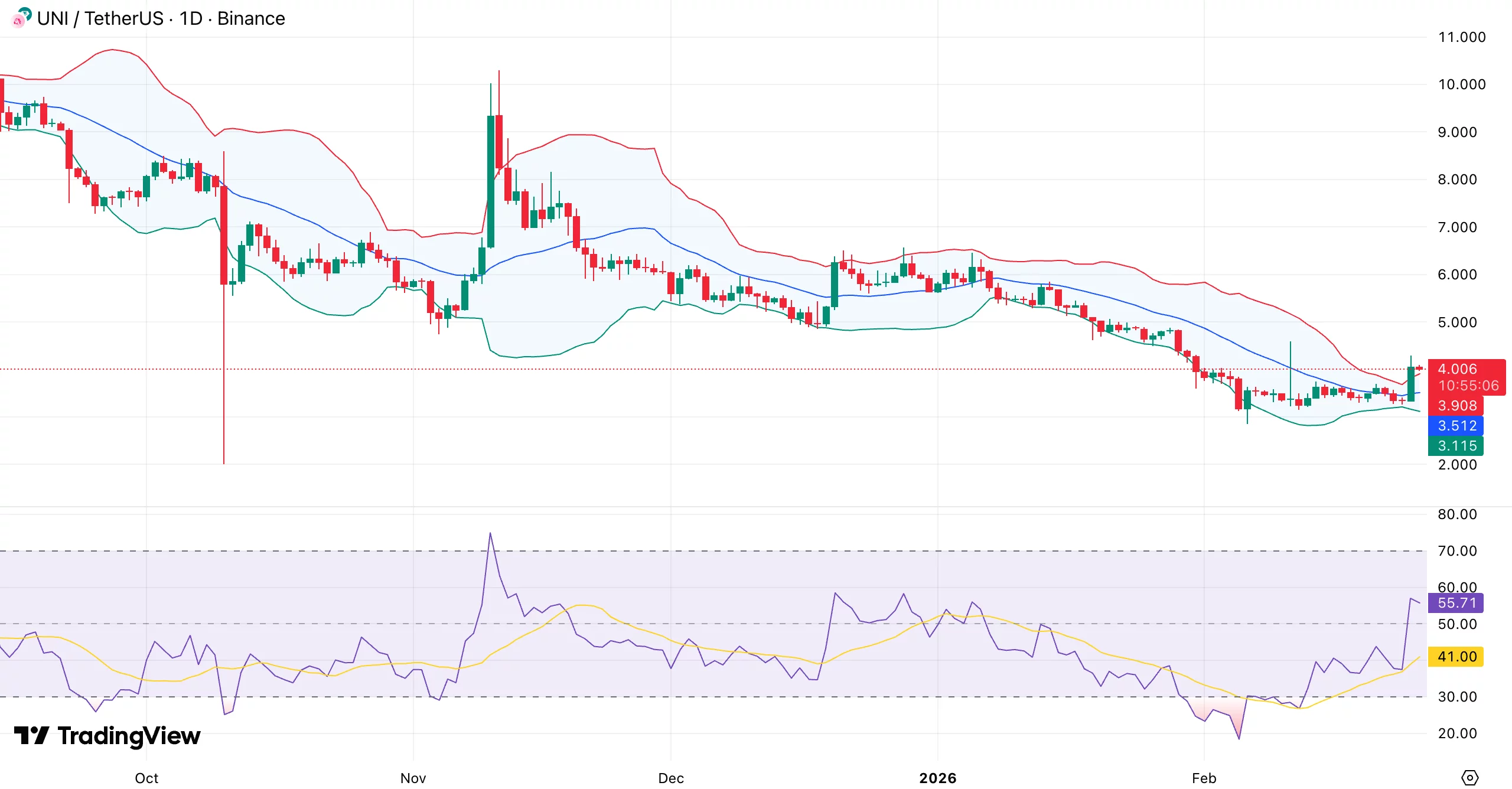
Uniswap price targets $4.55 prior breakdown level as traders position ahead of a governance vote that could expand fee burns and boost protocol revenue.
Summary
- UNI is holding $3.80 support after an 18% weekly rebound.
- A governance proposal could raise annual revenue to $61M through expanded fee burns.
- A breakout above $4.20 could open room toward the $4.55–$4.60 zone.
Uniswap (UNI) traded at $4.02 at press time, up about 10% in the past 24 hours. The token is trading near the top of its weekly range between $3.29 and $4.12.
UNI has gained 18% over the past week, showing a firm bounce from recent lows, though it is still 15% lower over the past month.
Spot trading volume jumped to $554 million, up 119% in one day. CoinGlass data shows futures volume climbing nearly 80% to $640.5 million, while open interest rose 15.2% to $285.6 million.
When both volume and open interest rise together, it usually means new positions are being opened rather than just shorts closing.
Fee switch expansion adds direct value to UNI
Uniswap governance is advancing a proposal to widen its fee switch system. It follows the 2025 UNIfication rollout, which began charging protocol fees on Ethereum and introduced UNI token burns.
Under the new proposal, protocol fees would also be applied across eight additional Layer 2 networks, including Arbitrum, Base, and Optimism. The plan would automate fee collection and send the proceeds back to Ethereum mainnet, where they would be used to buy and burn UNI tokens.
If approved, the expansion could lift annualized protocol revenue to about $61 million, up from $34 million. Part of swap fees would shift from liquidity providers to the treasury, directly linking trading activity to token supply reduction.
That dynamic tends to attract long-term holders because it means usage will translate into measurable value capture. Voting is split into two phases, with the first already live and the second scheduled between Feb. 27 and March 1.
Technical outlook: $4.60 in play if breakout holds
UNI has built a clear base around $3.70–$3.80. Price has held that zone multiple times, and recent candles show buyers stepping in on dips. With Bollinger Bands tightening, the market may be gearing up for a sharp move.
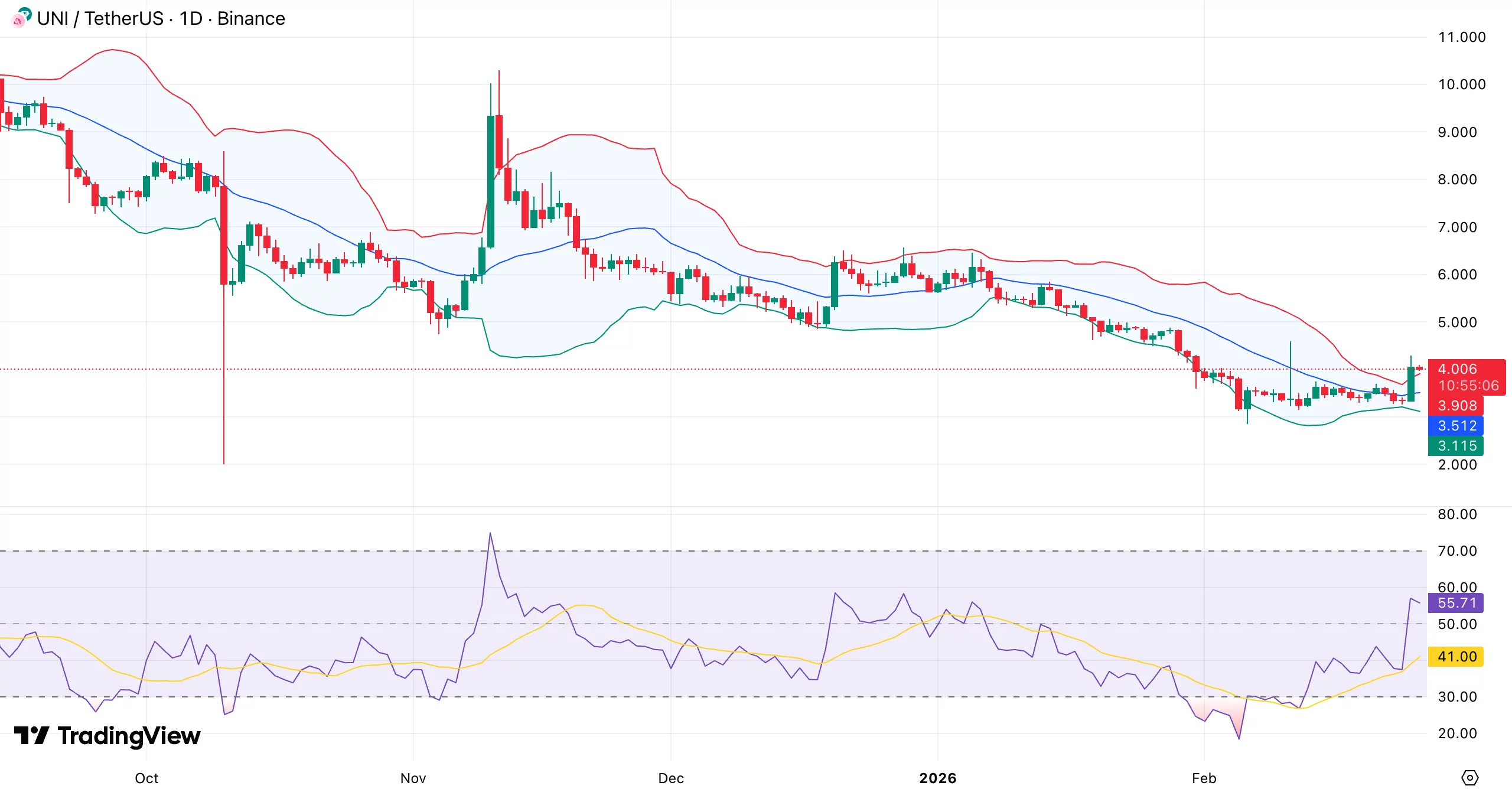
Momentum has improved, with relative strength index pushing back above the midline. Price is also testing a descending trendline from December highs and pressing against short-term moving averages.
Volatility had tightened during consolidation, and the recent expansion in volume suggests the market is preparing for a larger move. A 20% advance from the $3.80 floor projects a target near $4.55–$4.60, an area that lines up with prior breakdown levels and moving average resistance.
A firm break above $4.20 would strengthen the case for that move. If the price slips below $3.70, the recovery attempt would weaken, opening the door to a return toward $3.30.

Over the past five years, enterprises have invested aggressively in AI pilots, generative tools, and automation platforms. Yet most organizations remain trapped in experimentation mode. AI dashboards exist. Chatbots are deployed. Predictive models operate separately across teams, but enterprise-wide financial impact remains limited. The issue is not technological maturity; it is strategic orchestration. Scaling AI requires governance architecture, value engineering discipline, capital alignment, and executive-level integration. This is where a specialized AI strategy consulting Company creates transformational leverage. Through structured AI strategy and consulting services, enterprises convert fragmented innovation into measurable performance, building an AI-native operating model that drives durable competitive advantage.
The Hard Truth: AI Adoption Is Not AI Transformation
We work with enterprises that proudly report “AI adoption.” But adoption is not transformation. Most organizations face:
- Disconnected AI initiatives across departments
- Undefined ROI accountability
- No centralized governance framework
- Underdeveloped AI roadmap sequencing
- Weak alignment with corporate strategy
The result? Incremental gains instead of exponential impact. An effective enterprise AI strategy does not deploy AI tools. It redesigns the enterprise around intelligence. That requires structured AI strategy consulting for enterprises, not experimentation.
What Enterprise AI Strategy Actually Means
An enterprise AI strategy is a capital allocation decision. It determines where intelligence will generate the highest economic return across the organization. It defines how AI investments translate into measurable growth, efficiency, and long-term competitive advantage.
- Where AI will drive margin expansion
- How predictive intelligence will compress decision cycles
- Which workflows will become autonomous
- How governance will mitigate regulatory exposure
- How workforce capability will evolve
AI cannot sit in innovation labs. It must shape financial planning, operational architecture, and strategic differentiation. This is the mandate of the high-level AI Strategic Advisory.

The Role of a Leading AI Strategy Consulting Company
As a top-tier AI strategy consulting Company, our approach is not technology-first. It is value-first. We engage across five strategic pillars:
1. Enterprise AI Maturity & Readiness Diagnostics
Before scaling, we assess:
- Data infrastructure robustness
- Model lifecycle governance maturity
- Security & compliance architecture
- Executive AI fluency
- Operational integration readiness
Without clear maturity and strategic alignment, scaling AI initiatives only amplifies inefficiencies.
2. Strategic AI Use Case Engineering
Not every AI initiative deserves capital. We prioritize use cases based on:
- EBITDA impact potential
- Strategic defensibility
- Competitive moat creation
- Implementation scalability
- Time-to-value acceleration
This precision separates high-performing enterprises from reactive adopters.
3. Structured AI Roadmap Development
A disciplined AI roadmap development Company sequences AI initiatives across a phased transformation:
Phase I: Value Capture
Automation, predictive analytics, cost compression.
Phase II: Strategic Differentiation
AI-driven product innovation, customer intelligence, and dynamic pricing.
Phase III: AI-Native Enterprise
Autonomous systems, real-time decision intelligence, predictive capital allocation.
Sequencing protects capital efficiency while maximizing compounded returns.
AI Strategy and Consulting Services: Beyond Implementation
Premium AI strategy and consulting services go far beyond deploying tools or building models. They align artificial intelligence with enterprise vision, financial performance, and long-term competitive positioning. Instead of focusing only on technical execution, they design the strategic, operational, and governance architecture required to scale AI responsibly and profitably. Premium AI strategy and consulting services integrate:
- Strategic advisory
- Governance architecture
- Financial modeling
- Operational redesign
- Continuous optimization
Most AI vendors deploy tools. We engineer transformation.
AI Value Engineering: The Discipline That Changes Everything
AI investment without value engineering is speculation. Our AI value engineering services are built around a rigorous AI value engineering framework that ensures:
- Every initiative maps to financial KPIs
- ROI is forecasted before deployment
- Workflow redesign unlocks AI leverage
- Performance dashboards track measurable gains
Through AI strategy and value engineering services, we help enterprises quantify:
- Revenue uplift
- Margin expansion
- Cost reduction
- Risk mitigation
- Productivity improvement
This is how AI becomes an earnings multiplier.
AI Business Strategy Services: Embedding Intelligence into Enterprise Growth
AI Business Strategy Services ensure that artificial intelligence is not treated as an operational add-on, but as a core driver of enterprise growth and competitive positioning. Instead of limiting AI to efficiency gains, these services integrate intelligence directly into high-impact strategic decisions.
This includes embedding AI into:
- Market expansion and competitive positioning strategies
- Customer lifetime value prediction and personalization models
- Supply chain resilience and demand forecasting frameworks
- Capital allocation and scenario simulation planning
- Enterprise-wide risk forecasting and mitigation systems
AI should not simply optimize existing workflows. It should challenge assumptions, unlock new revenue models, and shape the future direction of the organization.
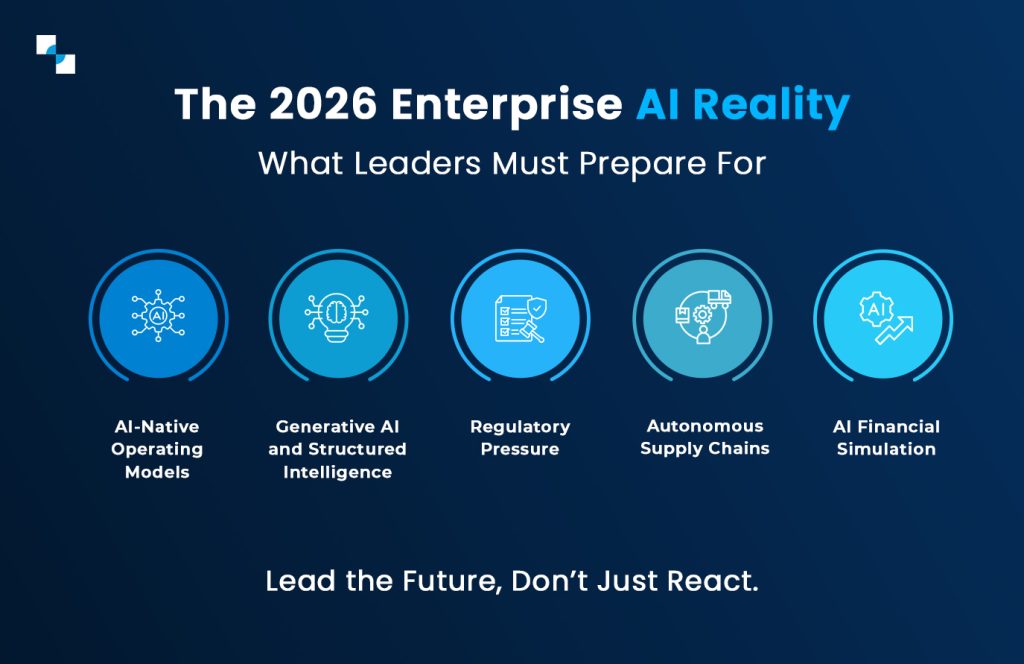
The 2026 Enterprise AI Reality: What Leaders Must Prepare For
AI transformation is accelerating. We see five dominant trends shaping global enterprises:
- AI-Native Operating Models
Organizations redesign workflows so that AI initiates decisions autonomously.
- Generative AI and Structured Intelligence
Enterprises are combining LLM capabilities with proprietary data ecosystems to create strategic decision engines.
- Regulatory Pressure Intensification
AI governance is becoming a board-level oversight priority.
- Autonomous Supply Chain Orchestration
Predictive systems manage procurement dynamically.
- AI-Driven Financial Simulation
Capital allocation is influenced by real-time scenario modeling.
A forward-looking AI Strategic Advisory partner ensures your enterprise is not reacting but leading.
Governance: The Competitive Signal Investors Watch
Scaling AI without governance creates:
- Regulatory exposure
- Ethical risk
- Brand vulnerability
- Investor skepticism
Advanced AI Consulting Services embed:
- Transparent model governance
- Ethical AI standards
- Compliance-by-design architecture
- Continuous audit mechanisms
Governance maturity is becoming a market differentiator.
AI Business Value Optimization: Driving Executive Accountability
Today’s C-suite no longer views AI as an innovation experiment; it is a performance mandate. Leadership teams increasingly demand clear financial transparency and measurable outcomes from every AI investment. They expect:
- Clearly quantified AI-driven ROI
- Direct margin impact attribution
- Risk-adjusted performance forecasting
- Measurable workforce productivity gains
Structured AI business value optimization transforms artificial intelligence into a board-level performance engine. It embeds AI metrics into financial reporting, strategic planning, and capital allocation decisions; shifting the conversation from technology spending to measurable enterprise performance and sustainable value creation.
Solving Enterprise-Level Challenges Through AI Strategy Consulting for Enterprises
Enterprise leaders do not struggle with ambition; they struggle with clarity, alignment, and execution discipline. That is where structured AI strategy consulting for enterprises becomes decisive.
We consistently address board-level concerns such as:
“Our AI investments lack measurable impact.”
We deploy structured AI value engineering services that connect every AI initiative directly to financial reporting, EBITDA contribution, and capital efficiency metrics.
“AI initiatives are fragmented across departments.”
We architect centralized enterprise AI strategy governance models that unify data, models, and accountability under a single transformation framework.
“We don’t know which AI initiatives deserve priority.”
Through disciplined sequencing led by an expert AI roadmap development Company, we identify high-leverage opportunities and phase investments for maximum compounded return.
“Regulatory uncertainty is increasing our exposure.”
We embed compliance-by-design architecture through advanced AI Strategic Advisory, ensuring governance maturity scales alongside innovation.
“We lack senior AI leadership internally.”
We provide executive-level AI strategy consulting for enterprises, equipping leadership teams with the frameworks, metrics, and oversight necessary to drive enterprise-wide transformation.
This is not technical assistance. This is enterprise reinvention through structured intelligence.
Why Strategic Timing Determines Market Leadership
AI advantage compounds over time. It behaves like a strategic flywheel; the earlier it is structured correctly, the faster it accelerates. When disciplined AI strategy and consulting services are deployed early:
- Data ecosystems mature faster and become proprietary assets
- Intelligence layers deepen with every operational cycle
- Decision velocity increases across the enterprise
- Competitive defensibility strengthens through accumulated insight
Organizations that delay structured AI transformation face widening capability gaps. Delay creates a structural disadvantage. Acceleration builds category leadership.
What Differentiates Elite AI Strategy Consulting Companies
Not all AI advisory firms operate at the same strategic depth. As AI implementation becomes increasingly accessible and technology tools commoditize, the true differentiator lies in strategic architecture, financial rigor, and enterprise-level execution capability. When evaluating a premium AI strategy consulting Company, enterprises should assess whether the firm brings:
- Advanced financial engineering capability – The ability to model AI investments against EBITDA impact, capital efficiency, and long-term value creation rather than surface-level ROI projections.
- Deep governance architecture expertise – Experience embedding compliance, ethical AI standards, model transparency, and regulatory safeguards into system design from day one.
- Cross-industry transformation depth – Proven experience scaling AI across diverse sectors, understanding both operational complexity and industry-specific regulatory environments.
- Structured and repeatable AI roadmap development frameworks – A disciplined methodology for sequencing AI initiatives to maximize compounding returns while minimizing disruption.
- Demonstrable AI business value optimization outcomes – Clear evidence of measurable financial impact, not just successful deployments.
AI implementation is increasingly standardized. Strategic AI transformation built on governance, economics, and long-term competitive positioning remains rare.
The Bigger Picture
Enterprise AI transformation is not achieved through isolated pilots or experimental deployments. It requires structured orchestration across governance, capital allocation, operational design, and measurable value realization. A specialized AI strategy consulting Company provides this architecture.
Through disciplined AI strategy and consulting services, advanced AI value engineering services, and integrated AI Business Strategy Services, organizations convert AI from technological capability into strategic dominance. The next competitive era will not reward experimentation; it will reward execution at scale.
Organizations that adopt a structured AI strategy today will secure tomorrow’s market leadership. As a premier AI strategy consulting Company, Antier designs enterprise-wide AI frameworks that align intelligence with financial and operational outcomes. Our expertise ensures AI initiatives are not just deployed, but systematically converted into measurable business impact and lasting competitive advantage.
Frequently Asked Questions
01. What is the main challenge organizations face in AI adoption?
The main challenge is not technological maturity but strategic orchestration, leading to disconnected AI initiatives, undefined ROI accountability, and a lack of centralized governance.
02. How does an effective enterprise AI strategy differ from simply deploying AI tools?
An effective enterprise AI strategy redesigns the organization around intelligence, focusing on capital allocation and measurable growth rather than just implementing AI tools.
03. What role does a specialized AI strategy consulting company play in AI transformation?
A specialized AI strategy consulting company helps enterprises convert fragmented innovation into measurable performance by providing structured consulting services that align AI initiatives with corporate strategy.

The price of Chainlink ($LINK) rebounded over 14% on Wednesday in a spectacularly quick comeback.
LINK traded at bottoms of $8.20 in the early morning hours of Tuesday UTC, according to Coingecko data. However, over the next 24 hours it rapidly shot up 14% to reclaim the $9.35 level, briefly going all the way up to $9.50 before dipping to its current price around $9.25.
This means LINK is trading around its highest price point since February 5. The sudden upward move is driven by a dual catalyst: a major integration with the Canton Network for real-world asset (RWA) tokenization and sustained institutional inflows into spot LINK ETFs.
JUST IN: @CantonNetwork adopts Chainlink data and interoperability standards to unlock institutional tokenization. — Chainlink (@chainlink) February 25, 2026
 Data Streams (incl. 24/5 equities) SmartData (NAV & AUM) Proof of Reserve CCIP
Canton  Chainlink pic.twitter.com/49UV9NNxJ3
Additionally, Chainlink is getting friendly with regulators. In February alone, Chainlink’s former executive lawyer Taylor Lindman joined the SEC’s crypto task force, while its founder and CEO Sergey Nazarov joined the CFTC’s Innovation Advisory Committee.
Key Takeaways
- The Catalyst: Canton Network integration unlocks institutional RWA data streams for Chainlink.
- The Data: Grayscale’s GLNK fund now holds $61 million in assets, defying broader ETF outflow trends.
- The Setup: $LINK must hold $9.16 to validate the breakout from oversold conditions.
Chainlink and Canton: The Bigger Picture
This is not a routine partnership announcement. It signals deep infrastructure entrenchment. Chainlink has integrated with Canton Network, a dominant player in the RWA tokenization sector.
The integration introduces critical data streams, including equities, proof of reserves, and Cross-Chain Interoperability Protocol (CCIP) support, directly into Canton’s institutional framework.
That matters because it moves Chainlink beyond simple price feeds. It positions the network as the connective tissue for institutional capital.
While recent macro catalysts have lifted Bitcoin, LINK’s specific outperformances are tied to utility.
Institutional funds are voting with their wallets. Grayscale’s Chainlink Trust (GLNK) fund now commands over $70 million in assets, while Bitwise’s CLNK holds over $11 million.
In a month where Bitcoin ETFs have shed billions, LINK products are accumulating.
On-chain accumulation supports the bullish thesis. Chainlink’s Strategic Reserves have jumped to over 2.17 million tokens, currently valued at over $20 million.
RESERVE UPDATE — Chainlink (@chainlink) February 19, 2026

Today, the Chainlink Reserve accumulated 136,898.30.
Total holdings: 2,172,261.86 pic.twitter.com/OIlDLvgVrn
The project is using off-chain fees to buy back its own token. That is a fundamental supply sink. When combined with emerging buy signals across the altcoin sector, the floor for LINK appears to be hardening around the $8.00 mark.
Discover: The top crypto to diversify your portfolio with
Chainlink Price Prediction: The Path to $10 and Beyond!
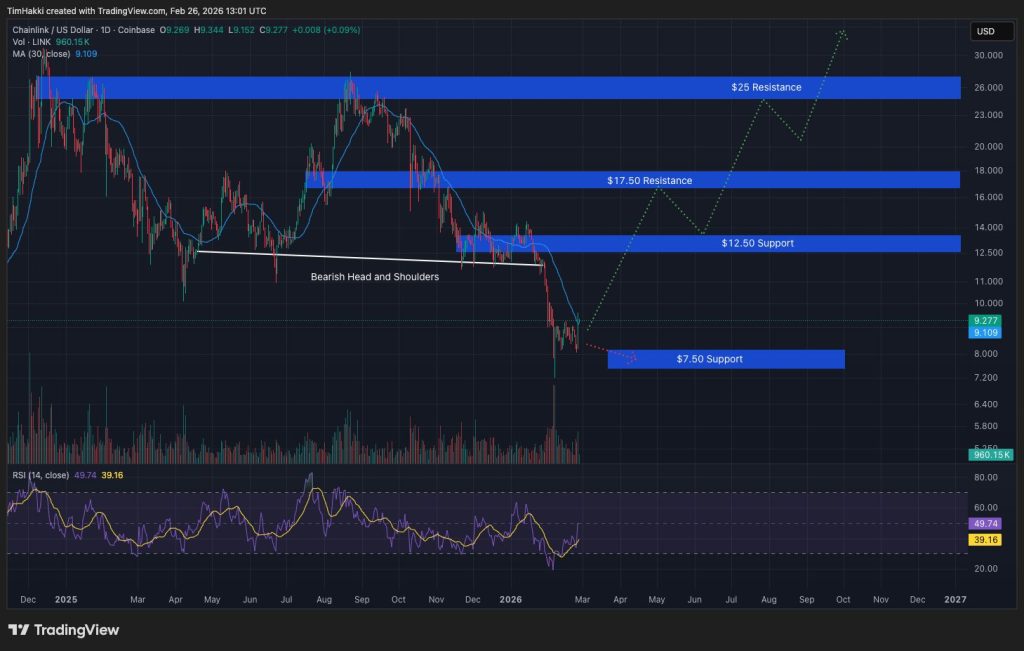
Momentum indicators favor the bulls. The RSI has bounced from 34 to 50 in a few hours, indicating huge buy orders have pushed it out of oversold territory and into a strong neutral zone.
Open interest is approaching $422 million, suggesting traders are stepping back in with leverage. If LINK clears the psychological $10.00 barrier, its next major challenges lie around $17.50 and $25.
Conversely, if price drops below the 30-day moving average again, the rally could collapse.
A close below $8.20 would invalidate the current rally and expose local support levels around $7.50.
Unfortunately, in the short-to-mid-term, the industry is still too tied to the fate of Bitcoin. If Bitcoin falters, it will likely drag LINK down regardless of the Canton news or regulatory developments.
Discover: The best crypto to buy now
The post Chainlink Price Surges: What’s Behind Today’s LINK Rally? appeared first on Cryptonews.


Centrifuge and Resolv said on Feb. 25 that they are deploying up to $100 million of JAAA, a tokenized AAA-rated credit fund, as leveraged collateral on Aave Horizon – marking decentralized finance’s (DeFi) largest real-world asset (RWA) loop trade to date.
Resolv – a protocol that maintains the USR stablecoin with a total value locked of $162 million – is adding JAAA (an on-chain version of Janus Henderson’s AAA-rated CLO investment fund) to its system using Centrifuge’s tokenization technology. Centrifuge currently has a TVL of $1.35 billion.
Instead of just holding the fund, Resolv will use JAAA as collateral inside Aave’s lending markets to generate yield and support its stablecoin. Aave is the largest DeFi protocol, with nearly $28 billion in total value locked, according to DeFiLlama, while Aave Horizon is its institution-focused deployment.
The move shows how tokenized assets are increasingly being used in real financial products rather than just existing on-chain. It also comes as the tokenized RWA market continues to grow, with distributed asset value now above $25 billion, up about 7% over the past month, according to RWA.xyz.
“Resolv allocating to JAAA and deploying it through Aave Horizon demonstrates the next phase of tokenization: utility at scale,” Nadim Chamoun, director of business development at Centrifuge Labs, told The Defiant.
Chamoun added that the strategy allows Resolv to manage risk more actively while earning the difference between traditional credit yields and on-chain borrowing rates.
For Resolv, the move is also part of a broader effort to diversify the sources of its returns. “Economically, diversification across markets makes clear sense for scalable capital allocators,” Tim Shekikhachev, co-founder of Resolv Labs, told The Defiant. “On-chain yields move with crypto leverage cycles, while global fixed-income markets are anchored in broader macro conditions.”
Shekikhachev added that when crypto rates fall, tokenized credit like JAAA can help balance returns.
“What’s finally unlocked now is that the full supply chain is functioning at scale: capital flows from Resolv USR, through Centrifuge’s tokenization infrastructure, into Aave Horizon’s leverage layer,” he said. “Ultimately, this ends up in AAA-rated assets managed by Anemoy and Janus Henderson, an industry leader in this segment. DeFi won’t replace traditional finance — it will scale by plugging into it.”

Bitcoin leads the crypto rebound in the past 2 days. After dipping to $64,758, BTC ripped higher and reclaimed $68,000 in a sharp reversal that squeezed late shorts. The move pushed total crypto market cap up over 4%, catching traders who were leaning bearish off guard.
As resistance levels got cleared, forced buybacks fueled the rally. But this was not just random volatility.
Under the surface, data tied to major stablecoin flows and infrastructure plays hints that the bounce may have deeper structural support behind it.
Key Takeaways
- The Catalyst: A sharp Bitcoin Rebound forced a short squeeze, reclaiming the critical $68,000 level after testing lows near $64,700.
- The Signal: Circle reported a 77% revenue jump, confirming massive Circle USDC expansion and deepening Market Liquidity.
- The Outperformer: NEAR Protocol surged 17% following the launch of ‘Confidential Intents,’ signaling a capital rotation into high-utility infrastructure.
Bitcoin Price Analysis: Is $68K the Crypto Rebound Launchpad?
This crypto rebound is likely a leverage driven one. As BTC dipped toward $64,000, traders piled into shorts. When spot demand stepped in around $64,758, price snapped higher and liquidations kicked in. More than $370M in positions were wiped out, fueling the vertical move through the $66,923 7day moving average.

Structurally, reclaiming the $66,000 zone shifted momentum. What was resistance is now acting as short term support, with a clear battle forming around the high $68,000 area.
Now the levels are simple. Hold above $66,500 and bulls stay in control, opening room toward $69,000 to $72,900. Clear that band and $74,000 comes into play. Lose $66,500 and the squeeze fades, exposing $60,000 to $62,000 again.
Circle Revenue as NEAR Protocol Outperforms on ‘Confidential Intents’
Price grabs attention, but liquidity tells the bigger story. Circle, the issuer of USDC, reported a 77% jump in revenue to $770M. That matters because stablecoin revenue usually grows when supply expands. More USDC minted means more dollars entering the crypto system.
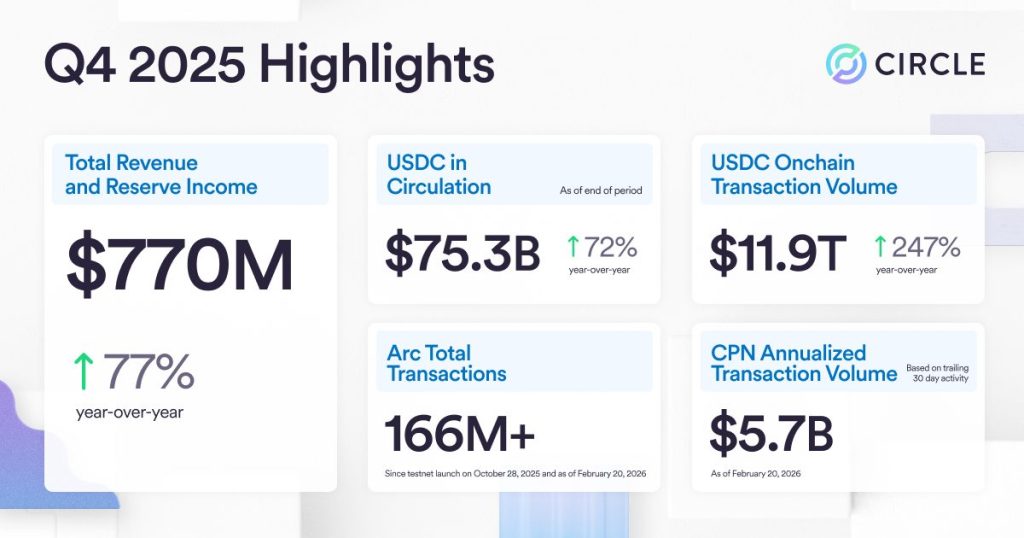
Every new stablecoin is potential buying power. Historically, stablecoin inflows often come before sustained rallies. Rising supply strengthens the bid under the market and improves absorption when sellers hit.
NEAR is not just riding Bitcoin’s bounce. It is outperforming the market as the token jumped around 17%, driven by the launch of “Confidential Intents.” The upgrade targets a key DeFi issue, privacy. It allows users to execute cross chain transactions without exposing trade details before settlement.
That positions NEAR as infrastructure for more sophisticated, potentially institutional flows. The broader theme is chain abstraction, making blockchain complexity invisible to users. That utility narrative is pulling capital in.
Discover: Here are the crypto likely to explode!
The post Crypto Rebound: Bitcoin Hits $68K, Circle Revenue Jumps, NEAR Outperforms appeared first on Cryptonews.
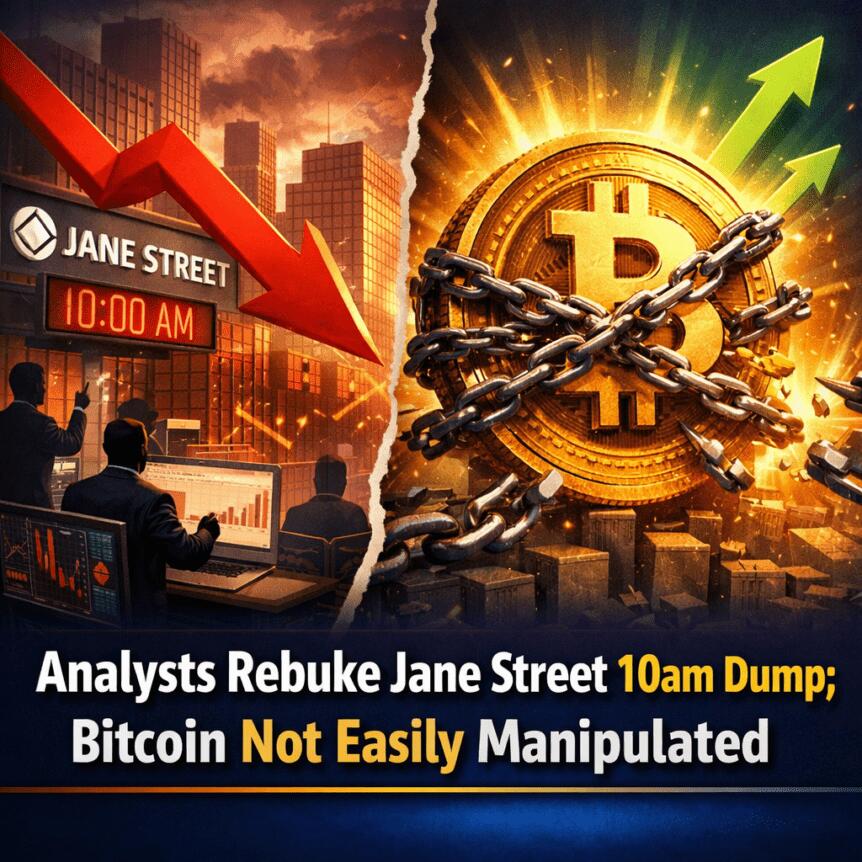
In online crypto circles, a persistent debate has emerged around whether a quantitative trading firm could nudge Bitcoin’s price at the moment U.S. markets open. Proponents point to a recognizable 10:00 a.m. Eastern Time pattern as potential evidence of coordinated selling, while critics caution that such a signal is not definitive proof of manipulation and may reflect broader market mechanics. The discussion intensified a day after a court-appointed administrator overseeing Terraform Labs’ affairs filed a suit against Jane Street, alleging insider trading tied to Terra’s May 2022 collapse. The intersection of high-speed trading, ETF liquidity, and opaque hedging strategies has kept traders watching the clock as BTC moves through daily cycles.
Key takeaways
- Allegations focus on a recurring 10:00 a.m. ET window at the market open, but analysts say this does not constitute conclusive manipulation or a sole driver of BTC’s price trajectory.
- Public filings show Jane Street’s exposure to BlackRock’s IBIT ETF, alongside stakes in Bitcoin mining firms, suggesting hedging and liquidity strategies rather than a simple directional bet.
- Industry voices argue that a single institution cannot control a global, liquid market as fragmented as Bitcoin, even if some trading strategies amplify volatility around open hours.
- Delta-neutral approaches—holding spot exposure while selling futures—are cited as a common method for capturing spreads rather than betting on direction, according to market observers.
- The discourse features a mix of on-chain data, trading analytics, and public posts from market observers, underscoring the complexity of disclosures and how net exposure can be obscured.
- Contextual factors such as geopolitical risk and competition for investor attention from AI-related equities are cited as broader drivers of BTC price moves beyond any single firm’s activity.
Tickers mentioned: $BTC, $IBIT
Sentiment: Neutral
Market context: The dialogue unfolds amid a broader crypto environment characterized by liquidity fluctuations, evolving ETF dynamics, and ongoing regulatory and macro influences shaping how traders price risk and opportunities.
Why it matters
The debate touches on the core questions facing crypto markets: how liquidity, disclosure, and algorithmic trading intersect with real-world price discovery. If a large player can influence the clock at which liquidity sweeps occur or how efficiently a spot market absorbs ETF-related flows, that could have implications for price integrity and market education. Yet the consensus among many analysts is that Bitcoin’s price formation remains a product of multiple forces, including macro risk appetite, capital allocation shifts, and competitive attention toward AI-driven tech and growth narratives.
At stake is trust in market transparency. For traders, the issue highlights the importance of understanding how publicly reported positions, hedges, and complex derivatives can mask net exposure. For regulators and exchanges, it underscores the need for clear, timely disclosures that help market participants distinguish legitimate liquidity activity from attempts to edge the price. For investors, the episode reinforces a prudent approach: interpret open-hour moves in the context of the broader market regime rather than attributing them to a single actor.
The discourse also intersects with ongoing legal and regulatory developments. The Terraform administrator’s lawsuit against Jane Street and the ongoing scrutiny of ETF structures like IBIT keep the conversation anchored in concrete questions about governance, disclosure requirements, and the boundaries of high-frequency market making in a frontier asset class. While proponents of a conspiracy narrative may highlight specific posts or data points, skeptics point to a broader pattern: markets are influenced by a constellation of participants with diverse strategies, and attribution to one firm oversimplifies the dynamics at play.
What to watch next
- Updates in the Terraform-related litigation against Jane Street, including any new filings or court rulings that may illuminate insider-trading claims.
- New or amended 13-F filings from Jane Street that shed light on hedging strategies, including positions in IBIT and mining-related equities, and any disclosed derivatives that could affect net Bitcoin exposure.
- On-chain and market data around the 10:00–10:30 a.m. ET window to assess whether any statistically significant patterns persist in the near term.
- Regulatory or industry guidance on disclosure practices for large ETF components and liquidity providers that could affect how market participants interpret “hidden” exposure.
- Monitoring broader market signals—geopolitical developments, liquidity conditions, and AI-sector performance—that could influence Bitcoin independently of any singular trading desk.
Sources & verification
- Court-appointed administrator filing related to Terra/Labs and Jane Street, alleging insider trading tied to the May 2022 collapse.
- Jane Street’s 13-F filings showing holdings in BlackRock’s IBIT ETF and stakes in Bitcoin mining companies such as Bitfarms, Cipher Mining, and Hut 8.
- Public posts and commentary from market observers, including Bechler’s discussions on 10:00 a.m. ET moves and the contention that IBIT-related hedging could conceal net exposure.
- CryptoQuant head of research Julio Moreno’s analysis on whether the described activity is unique to a single firm or part of delta-neutral trading patterns commonly used to capture spreads.
- Industry analysts’ assessments of whether a single actor can meaningfully drive BTC price given the structure and depth of the market, including critiques of the “10 a.m. dump” narrative by researchers such as Alex Krüger.
Market reaction and key details
Bitcoin (CRYPTO: BTC) has long been a magnet for debate over who moves the market and when. In recent weeks, observers have spotlighted a recurring pattern that some traders interpret as a 10:00 a.m. ET “dump” coinciding with the U.S. market open. Proponents of the theory argue that a firm with deep liquidity, such as Jane Street, could deploy algorithmic sales to reap benefits from ETF inflows and to acquire spot Bitcoin at a discount on the open. A prominent critic of the narrative, however, notes that a single actor is unlikely to set the tone for a market as diffuse as Bitcoin’s, where liquidity is drawn from a wide array of exchanges and participants across multiple jurisdictions.
One thread of the debate centers on Jane Street’s disclosed exposure to the IBIT ETF, alongside positions in mining-related equities. Bechler, a crypto influencer, suggested that if Jane Street carries roughly $790 million in IBIT, the actual net Bitcoin exposure could be largely hedged away, masked by options and futures combinations rather than a straightforward long or short bet. This line of reasoning emphasizes that public filings reveal only a fragment of a much larger, more complex risk posture, where hedges might offset or even invert visible positions.
Yet others push back on the idea that the activity is unique to Jane Street. CryptoQuant’s Julio Moreno cautioned that many funds employ delta-neutral strategies—buying spot exposure while selling futures—to capture spreads without committing to a directional bet. In practice, these maneuvers can appear as divergent price actions around the open while serving to maintain neutral exposure in volatile markets. Moreno’s observations underscore a broader point: the mechanics of hedging frequently blend with price movement in ways that are not easily ascribed to a single firm’s choice of timing or size.
In the eyes of some researchers, even a credible pattern around the open does not translate into a bear-market engine powered by one institution. Nick Puckrin of Coin Bureau argued that Bitcoin’s price dynamics are inherently multifactorial, and a solitary actor—even one as large as Jane Street—cannot unilaterally dictate longer-term moves. He framed the conversation as part of a more nuanced reality: price action is shaped by geopolitical risk, global liquidity conditions, and the ongoing competition for attention among high-growth tech sectors, including AI.
As the market digests these viewpoints, the intersection of legality, disclosure, and market structure remains a live area of inquiry. The Terra-related lawsuit and the ongoing discourse about ETF flows highlight the need for transparency in how large players interact with both spot markets and derivative instruments. The broader takeaway is not a verdict on manipulation, but a reminder that the Bitcoin market’s depth and fragmentation make it resistant to easy explanations or simple villains.
[PRESS RELEASE – San Francisco, CA, February 26th, 2026]
SolanaCDN delivers 3.8x faster shred propagation through a global mesh of 35,000+ nodes, provided as a public good for the Solana network
Pipe Network today announced the launch of SolanaCDN, a free, open-source Solana validator client with an integrated CDN acceleration layer. Built as a fork of Anza’s Agave, SolanaCDN gives every Solana validator access to faster shred propagation through Pipe’s global network of 35,000+ PoP (Point-of-Presence) nodes.
The client and CDN layer are both completely free. Pipe Network is providing SolanaCDN as public good infrastructure for the Solana ecosystem.
The problem SolanaCDN solves
Validator performance on Solana is heavily influenced by network geography. Validators closer to block producers see shreds earlier, vote sooner, and earn more rewards. Validators in less connected regions face slower propagation, missed votes, and reduced leader slot revenue regardless of their hardware.
SolanaCDN addresses this by giving validators a second, faster path for shred delivery alongside native gossip. Shreds and vote packets route through Pipe’s global mesh, which continuously measures every network path and routes traffic along the fastest available route in real time.
Native gossip still runs underneath. SolanaCDN adds a parallel fast lane.
Performance
SolanaCDN delivers 3.8x faster propagation than standard Turbine, with a P50 cross-region latency of approximately 78ms compared to the roughly 300ms baseline on standard gossip.
The client also ships with Pipe-built optimizations available out of the box before the CDN layer is enabled: optimized shred coalescing for leaders (Fast Shreds), snapshot downloads from Pipe’s global network, and restore progress with real-time ETAs during validator catchup.
Public good infrastructure
Faster propagation is a network effect. Every validator running SolanaCDN improves shred delivery globally, which means faster block finalization, fewer forks, and fewer missed slots across the entire Solana network.
“Validator performance shouldn’t be determined by geography,” said David Rhodus, CEO of Pipe Network. “SolanaCDN gives every validator access to the same fast infrastructure. The more validators that run it, the faster Solana gets for everyone.”
Technical design
SolanaCDN is a fully compatible Agave fork. Validators can install it as a drop-in replacement for their existing client. The CDN layer is optional, activated with a single configuration flag, and is non-consensus by design. It does not modify block production, consensus logic, leader scheduling, or voting rules. All CDN operations are non-blocking and fail-safe. If the CDN layer is unavailable, the validator continues operating normally.
Built-in Prometheus metrics and CDN-versus-gossip race data give operators full visibility into performance changes in their environment.
Availability
SolanaCDN is available now. The source code is published on GitHub and the client is ready to run on Solana mainnet-beta.
Website: https://solanacdn.com
GitHub: https://github.com/pipenetwork/agave-solana
About Pipe Network
Pipe Network is a global edge infrastructure company built on Solana. The network operates 35,000+ hyperlocal PoP nodes globally, providing distributed storage with fast reads and real-time data delivery. Pipe’s overlay network tracks latency, loss, and jitter across every path in real time and routes traffic along the fastest one.
Binance Free $600 (CryptoPotato Exclusive): Use this link to register a new account and receive $600 exclusive welcome offer on Binance (full details).
LIMITED OFFER for CryptoPotato readers at Bybit: Use this link to register and open a $500 FREE position on any coin!

Issa brothers’ property arm plans Marks and Spencer food hall in Lancashire

Will Ethereum price hit $2.5K as funding rates flip green?

The Raunchiest, R-Rated Comedy Of The 1980s Can’t Be Watched, Erased From Existence


-

 Video7 days ago
XRP News: XRP Just Entered a New Phase (Almost Nobody Noticed)
-

 Politics4 days ago
Baftas 2026: Awards Nominations, Presenters And Performers
-

 Fashion6 days ago
Weekend Open Thread: Boden – Corporette.com
-

 Sports3 days ago
Women’s college basketball rankings: Iowa reenters top 10, Auriemma makes history
-

 Politics3 days ago
Nick Reiner Enters Plea In Deaths Of Parents Rob And Michele
-

 Business2 days ago
True Citrus debuts functional drink mix collection
-

 Crypto World2 days ago
XRP price enters “dead zone” as Binance leverage hits lows
-

 Business4 days ago
Mattel’s American Girl brand turns 40, dolls enter a new era
-

 Business4 days ago
Law enforcement kills armed man seeking to enter Trump’s Mar-a-Lago resort, officials say
-

 Tech2 days ago
Unsurprisingly, Apple's board gets what it wants in 2026 shareholder meeting
-

 NewsBeat16 hours ago
Cuba says its forces have killed four on US-registered speedboat | World News
-
 NewsBeat18 hours ago
Manchester Central Mosque issues statement as it imposes new measures ‘with immediate effect’ after armed men enter
-
 NewsBeat3 days ago
‘Hourly’ method from gastroenterologist ‘helps reduce air travel bloating’
-

 Tech4 days ago
Anthropic-Backed Group Enters NY-12 AI PAC Fight
-

 NewsBeat4 days ago
Armed man killed after entering secure perimeter of Mar-a-Lago, Secret Service says
-

 Politics4 days ago
Maine has a long track record of electing moderates. Enter Graham Platner.
-
 NewsBeat2 days ago
Police latest as search for missing woman enters day nine
-

 Business12 hours ago
Discord Pushes Implementation of Global Age Checks to Second Half of 2026
-

 Crypto World2 days ago
Entering new markets without increasing payment costs
-
 Sports3 days ago
2026 NFL mock draft: WRs fly off the board in first round entering combine week