

Crypto World
Top altcoins to buy as Iran


Looking for the best altcoins to buy amid the ongoing Iran-US war volatility? This article highlights some of the top coins to buy for big gains as the war goes on and as many tokens become bargains.
Summary
- Hyperliquid is a top altcoin to buy because of its strong fundamentals.
- Pi Network will be listed on Kraken this Friday.
- Chainlink is the biggest oracle network in the crypto industry.
Hyperliquid
Hyperliquid (HYPE) has become one of the top beneficiaries of the ongoing war in Iran because of its perpetual oil futures product. This product has made it possible for people to trade crude oil during the weekend when most of the developments are happening.
Data shows that the volume in Hyperliquid has jumped this month. According to DeFi Llama, the network has processed perpetual futures contracts worth over $178 billion in the last 30 days. That amount is higher than that of Aster, Lighter, and TradeXYZ, combined.
The benefit of all this is that Hyperliquid’s fees have continued rising, which, in turn, has led to more token burns and buybacks.
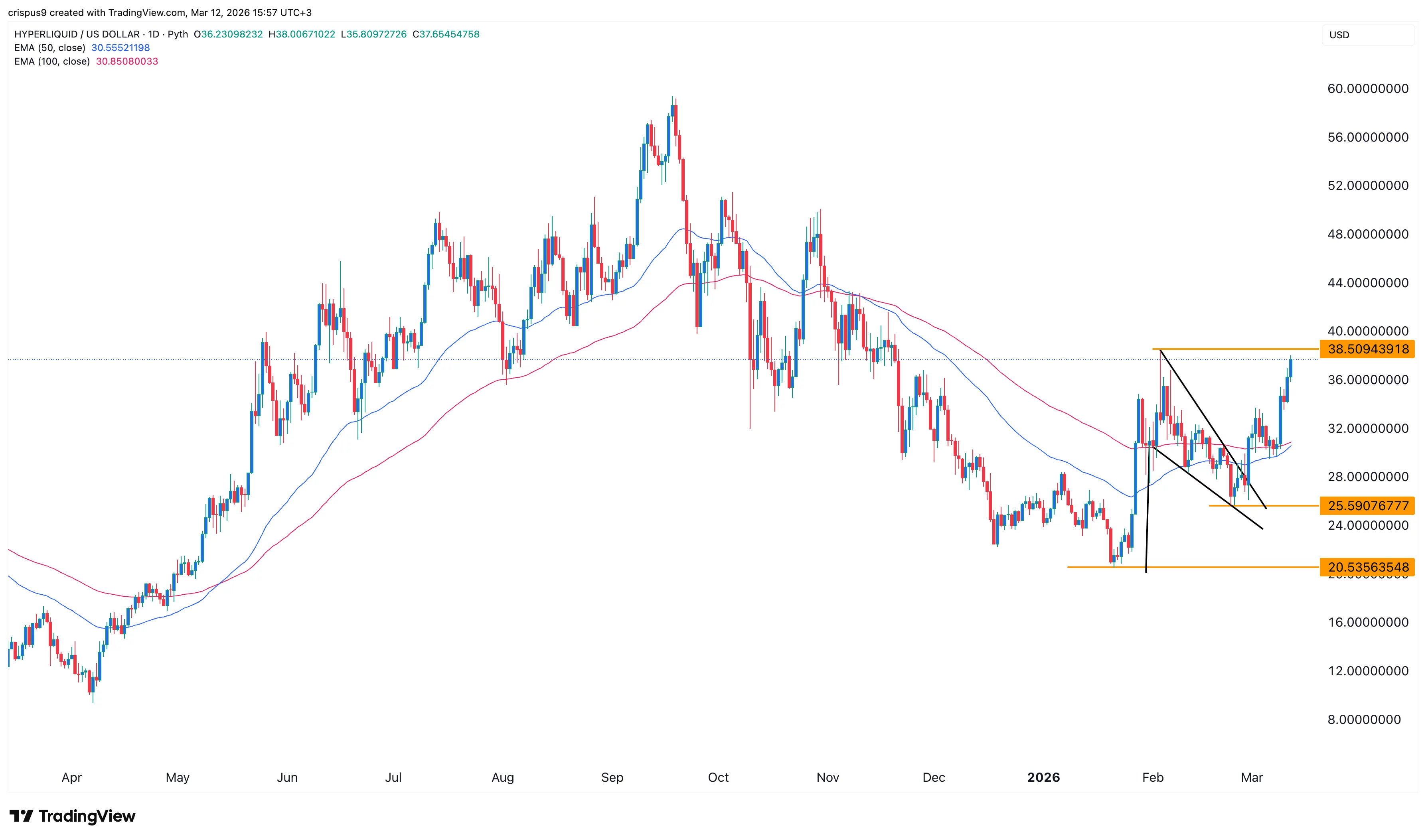
Technicals suggest that the HYPE price has more upside to go. It has already moved above the upper side of the falling wedge pattern. It also jumped above the 50-day and 100-day moving averages, pointing to more gains.
Pi Network
Pi Network (PI) is another top crypto to buy today. It has already jumped by over 80% from its lowest point this year and has numerous catalysts that may drive it higher in the coming weeks.
Kraken has already confirmed that it will list it on Friday. This listing is important as it will make it available in the United States for the first time. More exchanges may also decide to list it as it has become a top 50 coin.
The coin may continue rising because of the upcoming Pi Day event on Saturday and the ongoing network upgrades. Also, the developers are working on launching a KYC-as-a-Service solution. It is also becoming a top player in the artificial intelligence industry through its partnership with OpenMind.
Chainlink
Chainlink (LINK) is a top altcoin to buy for long-term gains because of it substantial market share in the oracle industry. It has a total value secured of over $50 billion, much higher than other oracles like RedStone and Pyth.
Chainlink is also a major player in the fast-growing real-world asset tokenization industry. It has large partnerships with companies like JPMorgan, Swift, ANZ Bank, and DTCC.
The Grayscale and Bitwise Chainlink ETFs have also accumulated $93 milion in inflows despite the ongoing crypto bear market.
There are other quality altcoins worth buying that will do well once a bull market starts. Some of the other notable ones are Ethereum, Solana, XRP, and Internet Computer.


TLDR
- Extreme slippage on Aave led to a devastating loss of nearly $50 million for one cryptocurrency trader in a single swap transaction.
- The transaction converted $50.4 million into approximately 327 AAVE tokens valued at just $36,000.
- The trader acknowledged and bypassed several explicit slippage warnings on mobile before executing the trade.
- An MEV bot executed a sandwich attack on the same transaction, extracting close to $10 million in profits.
- The Aave protocol announced plans to refund approximately $600,000 in protocol fees to the impacted trader.
On Thursday, March 12, 2026, a cryptocurrency trader experienced one of the most devastating losses in DeFi history, losing approximately $50 million in just one transaction. The incident occurred while executing a token swap on Aave, a prominent decentralized finance platform.
The wallet in question, freshly funded via Binance, contained $50,432,688 worth of aEthUSDT. These interest-bearing tokens represent Tether’s USDT stablecoin deposited within the Aave lending ecosystem operating on Ethereum.
The trader initiated a swap to exchange the entire balance for aEthAAVE, the tokenized version of Aave’s governance token. This transaction was processed through CoW Protocol and executed on the SushiSwap decentralized exchange.
Due to the massive size of the order relative to available pool liquidity, the swap suffered catastrophic slippage exceeding 99%. The final result was a mere 327 AAVE tokens worth roughly $36,000.
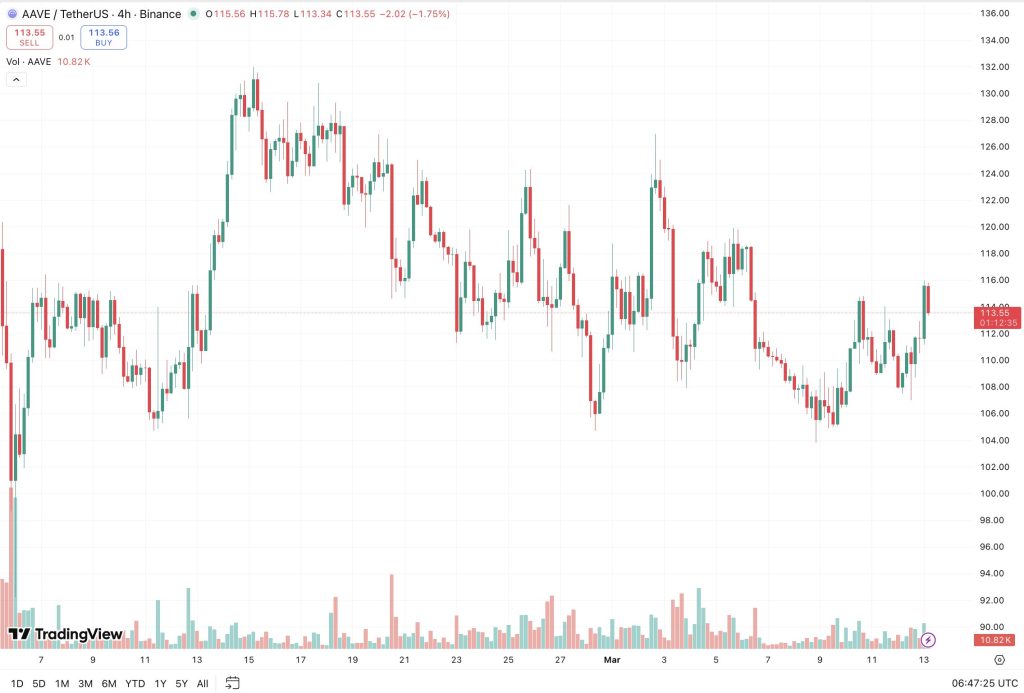
Effectively, the trader paid approximately $154,000 for each AAVE token when the prevailing market rate stood at around $114.
What the Warnings Said
Stani Kulechov, founder of Aave, verified that the platform’s user interface had displayed prominent warnings before execution. In a post on X, he explained that the system alerted the user about “extraordinary slippage” resulting from the “unusually large size of the single order.”
The platform mandated that users check a confirmation box acknowledging the risk. The trader completed this step on a mobile device and moved forward with the transaction.
“The transaction could not be moved forward without the user explicitly accepting the risk,” Kulechov stated. He emphasized that the CoW Swap routing system functioned exactly as designed.
CoW DAO released its own statement, explaining that “no DEX, DEX aggregator, public liquidity pool, or private liquidity pool would have been able to fill this trade at anywhere near a reasonable price.”
The MEV Bot Attack
Compounding the slippage disaster, an MEV bot launched a sophisticated “sandwich attack” targeting this transaction.
MEV bots constantly scan pending blockchain transactions for profitable opportunities. This particular bot identified the massive incoming AAVE purchase and positioned itself to exploit it.
The bot secured a flash loan of $29 million in wrapped Ether from Morpho, deployed it to purchase AAVE on Bancor (artificially inflating the price), then sold directly into the trader’s order on SushiSwap. This strategy generated approximately $9.9 million in profits for the bot operator.
The manipulation drove AAVE’s price significantly higher immediately before the trader’s order executed, amplifying an already catastrophic outcome.
This incident followed closely after approximately $27 million in liquidations on Aave, which some observers suggested might have been connected to a temporary pricing anomaly affecting the wstETH token.
Kulechov expressed sympathy for the affected trader. The Aave protocol intends to contact the user and reimburse approximately $600,000 in fees collected during the transaction.
CoW DAO similarly committed to refunding any protocol fees associated with the trade.


When a trader wipes out $50M in seconds, the industry usually assumes a bridge hack or a sophisticated exploit. Late on Thursday (March 12), however, a crypto whale incinerated nearly their entire balance with a single click of AAVE crypto swap.
The user attempted to swap $50M worth of USDT for AAVE in a single on-chain transaction. Due to a complete lack of liquidity for an order of that magnitude, the trade suffered catastrophic slippage, returning just 324 AAVE crypto, worth roughly $50,000, for the $50M spent.
Poor fellow swapped $50m -> $35k on eth mainnet — deebeez (@deeberiroz) March 12, 2026
 https://t.co/fYRYqGzXlt pic.twitter.com/QGW8NnTikh
Data from the transaction shows the wallet interacted with the Aave interface via CoW Swap. According to Aave Labs founder Stani Kulechov, the interface explicitly “warned the user about extraordinary slippage and required confirmation via a checkbox.”
In a statement on X, CoW Swap confirmed that clear price-impact warnings were displayed and that the transaction followed the signed parameters. This comes down to user error and a lack of self-preservation in not using MEV bot protection.
How a Single Swap Cost One Whale $50M While Buying AAVE Crypto
The mechanics behind this loss are brutal but standard. Decentralized exchanges (DEXs) rely on liquidity pools. When a buy order exceeds the available liquidity at the current price, the automated market maker (AMM) moves the price up the curve to fill the order.
To fill the $50M order, the protocol had to buy available AAVE at astronomically higher prices, resulting in an average entry price that wiped out the capital immediately.
This highlights why institutional players typically break such trades into thousands of smaller chunks or use OTC (over-the-counter) desks.
While Ethereum is quickly cementing itself as the backbone of institutional settlement, this event shows that the user interface layer still allows for catastrophic human error. Smart contracts do not judge the wisdom of a trade; it only executes the parameters signed by the wallet.
DISCOVER: The 16 Best Meme Coins to Buy in March 2025
What This Reveals About DeFi Market Structure
This event exposes the dangerous reality of “fat finger” trades in DeFi, where human intervention or flagging systems would likely pause such an anomaly in traditional finance.
Current liquidity on Aave, or almost any single DEX pool, cannot absorb $50M in a single tick without massive price distortion.
Interestingly, the AAVE crypto token is up +5% over the past 24 hours, a price surge that may have been buoyed by an unfortunate user who bought $50,000 worth of the token for $50M.
We have seen similar risks highlighted recently, as just yesterday, the Bonk.fun website was hijacked leading to user funds being drained.
While that incident involved malicious actors, the AAVE swap shows that users can cause similar losses to themselves without a compromised platform.
What Happens Next for the Whale and How to Avoid Their Mistake
There is no reversal button on the blockchain. However, Kulechov noted that Aave Labs is attempting to contact the user to return approximately $600,000 in fees collected from the transaction.
While a sympathetic gesture, it represents slightly more than 1% of the lost funds. For the broader market, the lesson is stark: liquidity warnings are not suggestions.
If the interface warns of “Extraordinary Slippage,” take note. And even for smaller transactions, let alone five-figure ones, always enable MEV protection when executing trades, protecting users from sandwich attacks and being front-ran.
EXPLORE: Best Crypto Presales to Buy in 2026
The post AAVE Crypto Swap Costs Nearly $50M Lost: ETH MEV Pocketed $9.9M appeared first on Cryptonews.
Update March 12, 1:21 pm UTC: This article has been updated to include comments from Gracy Chen, CEO of crypto exchange Bitget.
The US midterm elections may be the next catalyst to kickstart the crypto and stock market recovery, according to historical data shared by Binance Research.
According to a Wednesday report from Binance Research, US midterm election cycles have historically been followed by strong rebounds in stocks and Bitcoin (BTC), potentially setting up a recovery window for risk assets after the 2026 vote.
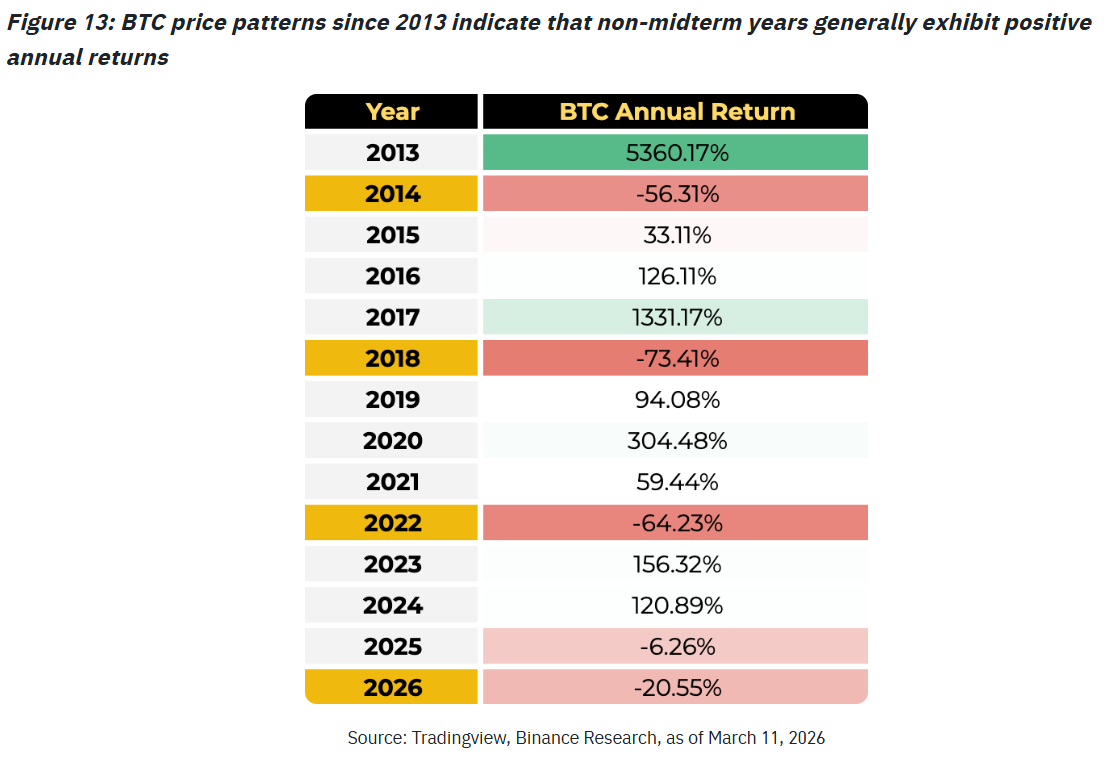
The 12 months following US midterm elections have resulted in an average 19% rise in the S&P 500 and 54% rise for Bitcoin in the three post-midterm years on record.
Binance Research said the year following the US midterms may prove the “strongest window in the cycle,” arguing that markets have historically rallied after election outcomes remove a major source of political uncertainty.
“Once election outcomes are determined and uncertainty is resolved, markets have historically staged powerful rallies.”
Bitcoin logged negative returns during previous midterm years, including a 56% drawdown in 2014, 73% decline in 2018 and a 64% retracement in 2022, but historic patterns showed a rebound in the following years.

The report comes nearly eight months before the Nov. 3 US midterm elections, which will determine the makeup of the 120th Congress.
Binance said near-term market direction is more likely to be driven by the conflict involving the US, Israel and Iran, warning that further escalation could push oil prices higher and keep risk assets under pressure.
Related: Can US lawmakers pass crypto market structure before the midterms?
Oil spike adds to market stress
Crude oil price briefly surged to $95 per barrel on Thursday as the conflict entered its 13th day, according to data from Trading Economics.
The price surge followed reports of Iran stepping up its attacks against energy infrastructure, as two fuel tankers were scorched by explosive-laden Iranian boats, Reuters reported earlier on Thursday.
A spokesperson for Iran’s military command told the news outlet that the world should prepare for oil prices of $200 per barrel due to the instability caused by the US.

The jump came a day after the International Energy Agency said member countries would carry out a 400 million-barrel emergency stock release, the largest coordinated drawdown on record.
Gracy Chen, CEO of crypto exchange Bitget, said the crypto market’s recovery hinges on a resolution to the conflict, as continued oil supply disruptions may “position oil to outperform gold as a hedge.”
“In this environment, crypto’s higher-beta profile means its upside potential could still exceed traditional equities should liquidity conditions stabilize once political uncertainty clears,” she told Cointelegraph.
Related: US Senate bill targets prediction markets on war and assassinations
Global markets in “wait-and-see” phase amid geopolitical escalations
The ongoing developments in the Middle East remain the key driver for global risk sentiment, as uncertainty surrounding energy supply and military escalations left markets in a “wait-and-see phase where policy and geopolitical risks intersect,” analysts at crypto derivatives exchange Bitunix told Cointelegraph:
“Currently, BTC is fluctuating repeatedly below the $70,000 level, indicating that market activity remains dominated by liquidity sweeps both above and below.”
The market structure suggests that Bitcoin will remain bound to this range until “macro events provide clearer directional signals,” the analysts said.
Magazine: Bitcoin is ‘funny internet money’ during a crisis: Tezos co-founder
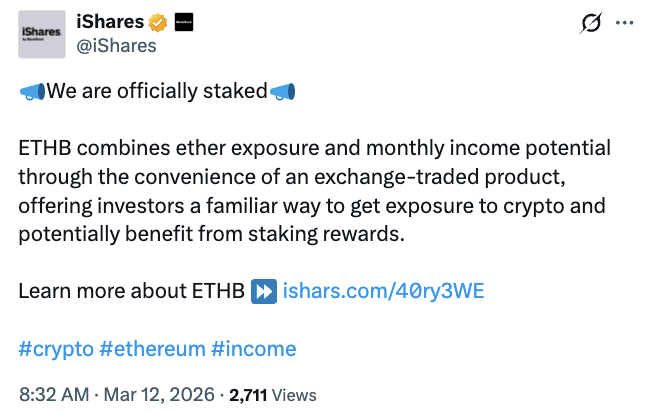
BlackRock is expanding its crypto investment lineup with a new Nasdaq-listed product tied to Ethereum staking.
BlackRock on Thursday introduced its iShares Staked Ethereum Trust ETF, or ETHB, describing it as an exchange-traded product (ETP) that combines spot Ether (ETH) exposure with “monthly income potential” by staking a portion of its ETH holdings.

The product expands BlackRock’s digital asset offerings, which include the iShares Bitcoin Trust ETF (IBIT) and the iShares Ethereum Trust ETF (ETHA). Both ETPs are the largest in their class, with more than $55 billion and $6.5 billion in assets under management, respectively.
“By bringing together spot ether exposure and staking rewards in an ETP, ETHB provides investors with an important new avenue to participate in the ecosystem’s evolution,” said Robert Mitchnick, BlackRock’s global head of digital assets.
ETHB will use Coinbase as custodian and staking provider
According to a prospectus with the Securities and Exchange Commission, BlackRock’s ETHB will use Coinbase as its custodian and staking provider.
The fund’s approved validators are currently limited to Figment, Galaxy Digital and Bitwise-owned Attestant.

Staking rewards are intended to be distributed monthly but “no less frequently than quarterly by the trust,” the filing notes.
Related: Vitalik Buterin envisions ‘one-click’ Ether staking for institutions
At launch, ETHB offers a 0.25% sponsor fee with a one-year waiver, reducing the fee to 0.12% on the first $2.5 billion assets under management.
Grayscale first to enable staking for Ether ETFs in the US
BlackRock’s Ether staking product arrives as several competitors have launched similar offerings.
Grayscale Investments, BlackRock’s largest crypto ETF competitor by assets under management, launched staking for the Grayscale Ethereum Trust ETF (ETHE) and the Grayscale Ethereum Mini Trust ETF (ETH) on Oct. 6, 2025, becoming the first US crypto issuer to do so.
The company also enabled staking on its Grayscale Solana Trust (GSOL), which began trading in late October. Additionally, Grayscale debuted the Grayscale Avalanche Staking ETF (GAVA) on Thursday.

Other issuers, including 21Shares and REX-Osprey, also support staking Ether ETFs. 21Shares in February announced its expected 2026 distribution dates for staking rewards from the 21Shares Ethereum ETF.
Magazine: 6 massive challenges Bitcoin faces on the road to quantum security
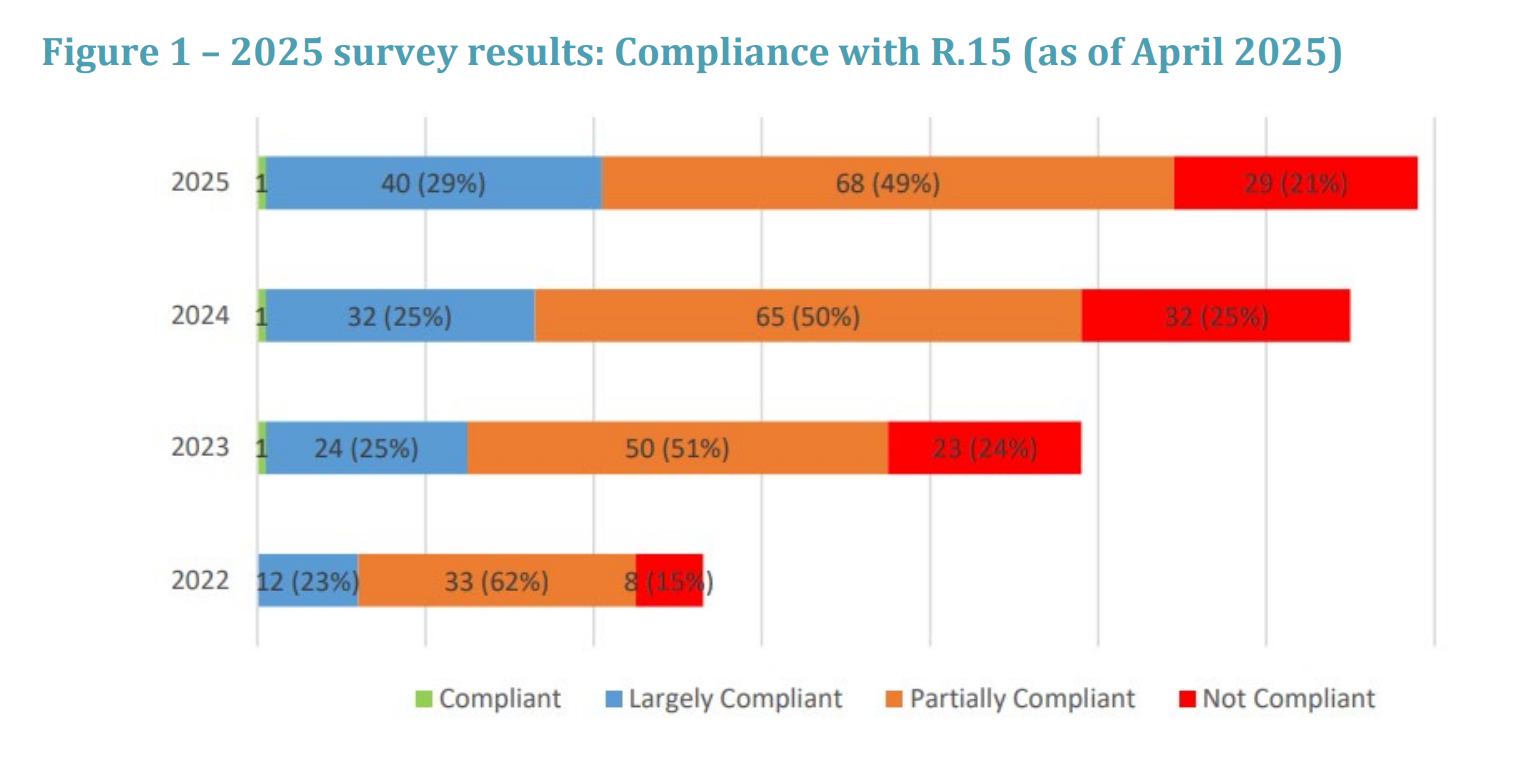
A new report from the Financial Action Task Force (FATF) warns that crypto service providers operating offshore pose risks of money laundering, sanctions evasion and other illicit financial activity.
In the report, titled “Understanding and Mitigating the Risks of Offshore Virtual Asset Service Providers (oVASPs),” the FATF said some offshore firms exploit gaps and differences in regulatory and supervisory coverage, making it harder for authorities to monitor activity and enforce Anti-Money Laundering (AML) and Counter-Terrorist Financing rules.
“As a result, effective international co-operation may not be possible, including with the relevant oVASP supervisor, thereby limiting the effectiveness of domestic risk-mitigation measures,” the report said.
The watchdog said the issue is particularly challenging because many offshore crypto firms operate across multiple jurisdictions. A company may be incorporated in one country, host infrastructure in another and serve customers worldwide through online platforms, leaving regulators uncertain about which authority has responsibility.
Related: Europe’s DeFi tax gap won’t last forever, says ex-OECD official
Regulators struggle to track offshore crypto
The FATF also said some countries struggle to identify offshore platforms providing services to local users. Without a local legal presence, authorities may have limited visibility into these businesses or the transactions they process.
To address the problem, FATF urged countries to strengthen oversight of crypto firms serving their markets, even if those companies are based abroad.

The organization recommended that governments require offshore VASPs to register or obtain licenses when offering services to domestic users. It also called for stronger cooperation between regulators and law enforcement agencies across borders.
Related: How Vietnam is using crypto to fix its FATF reputation
FATF flags P2P stablecoin transfers
The warning follows a separate FATF report last week on stablecoins and unhosted wallets, which said peer-to-peer transfers can weaken AML oversight when transactions occur without regulated intermediaries such as exchanges or custodians.
The FATF said this structure creates gaps in AML oversight as stablecoins expand into payments and cross-border transfers. The watchdog urged countries to assess the risks and introduce safeguards.
Magazine: Bitcoin may take 7 years to upgrade to post-quantum — BIP-360 co-author
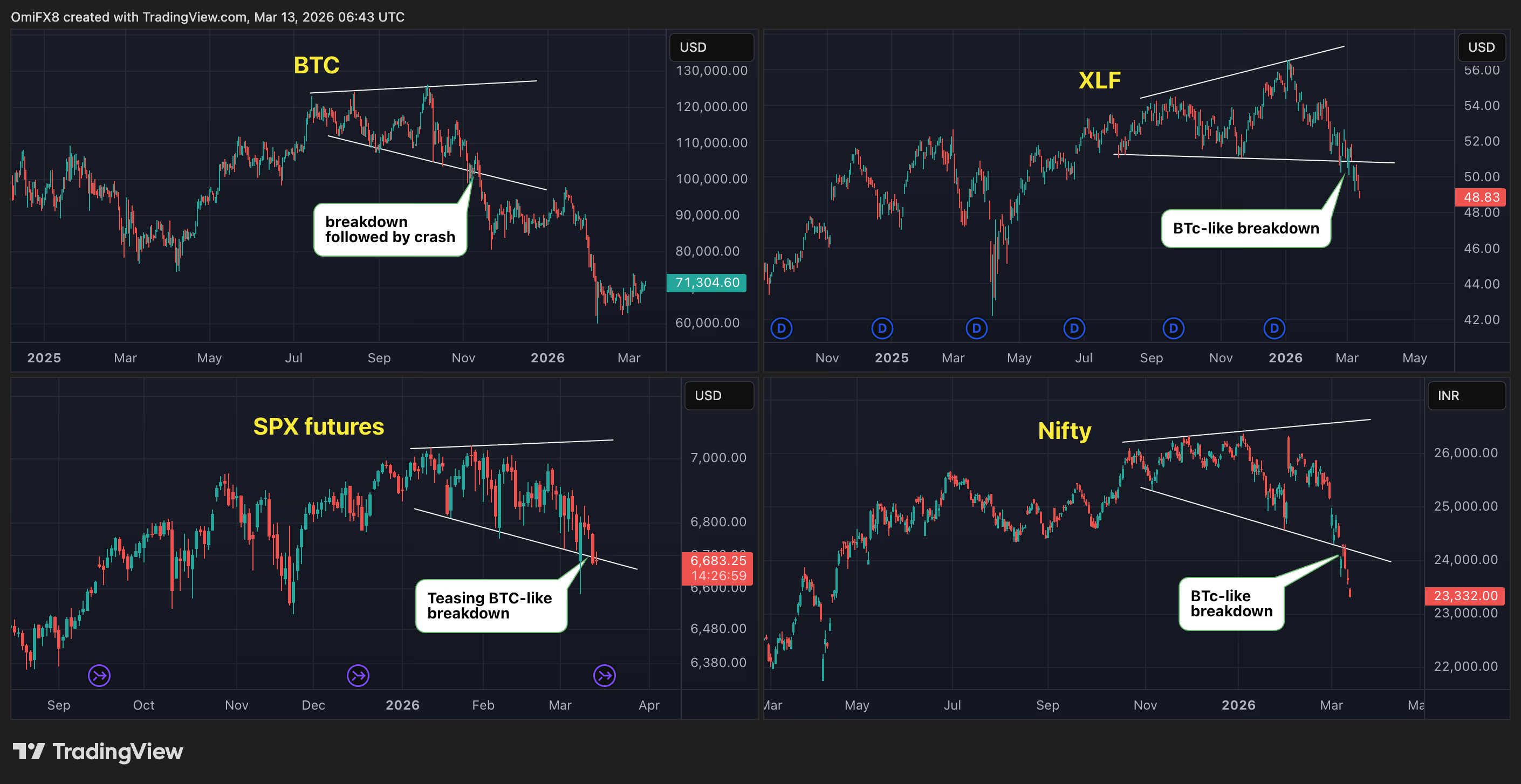
Many see bitcoin as a safe-haven and store-of-value asset, like gold. But some currency traders treat it as a lead indicator for broader market mood, and they’ve been proven right again: Before finding stability near $70,000 recently, bitcoin plunged sharply, presaging the ongoing global stock market swoon.
Bitcoin’s price peaked above $126,000 in early October and started falling, eventually hitting lows near $60,000 early last month. The sell-off featured rapid outflows from U.S.-listed spot ETFs. CoinDesk flagged this in January, questioning whether these flows – absent any clear crypto trigger – signaled an incoming macro economic blowup and stock market sell-off.
Fast forward to today: Global market sentiment has worsened, with the Iran war and oil price spike weighing heavily on Asian and European indices. The S&P 500 and Nasdaq have also come under pressure while the dollar index gains. Meanwhile, bitcoin has been rock steady around $70,000.
Here’s where it gets even more interesting: Key stock indices like the S&P 500 mirrored Bitcoin’s pre-crash back-and-forth trading in a broad range.

Bitcoin held above $100,000 for months in this volatile, expanding channel before plunging into bear territory. An identical setup has unfolded in the SPDR Financial Select Sector ETF (XLF), India’s Nifty (among the hardest hit), and S&P 500 futures.
Repeat of 2021-22
This isn’t the first time bitcoin has led price action in traditional risk assets. Over the years, the cryptocurrency has often foreshadowed equity trends, most clearly in late 2021-2022.

BTC peaked near $60,000 in November 2021 and quickly tanked to under $50,000 in a month. The bear market deepened in 2022. The Nasdaq and S&P 500 topped out two months later in January 2022, then followed suit with their own prolonged declines as the Federal Reserve raised borrowing costs rapidly.
Todd Stankiewicz, president and chief investment officer of SYKON Capital, in a blog post on the Chartered Market Technicial (CMT) Association website, noted bitcoin’s tendency to peak before the S&P 500 in three key instances: late 2017, weeks before the COVID crash, and late 2021.
“Bitcoin either rolled over or failed to make new highs while the S&P 500 pushed ahead. In each case, the equity rally eventually stalled and reversed,” Stankiewicz said.
All things considered, the takeaway is clear: Stock traders should start watching bitcoin trends closely from here.

Bitcoin miners are facing a tougher profit environment as the current market cycle yields thinner returns and higher capital pressures. Market-maker Wintermute outlines a path forward that centers on strategic treasury management and new revenue streams, such as hosting AI workloads, rather than relying solely on traditional mining economics. The firm notes that miners built out substantial, low-cost energy infrastructure over years in favorable jurisdictions, yet are now sitting on assets that the AI industry urgently needs. The narrative around consolidation and pivot is reinforced by public issuer activity, including MARA Holdings’ recent securities filing to signal a shift toward AI opportunities, while industry peers have already begun trimming BTC holdings to fund diversification. These developments build a picture of an industry recalibrating its business model in real time.
Key takeaways
- Miners collectively hold roughly 1% of the total BTC supply, a validation of the HODL-era mindset that Wintermute describes as a “legacy” asset-management posture rather than a productive treasury engine.
- Active treasury management—using derivatives, covered calls, and cash-secured puts—could unlock new yield streams for miners beyond simple price appreciation of BTC.
- The AI pivot is economically compelling but requires substantial capital expenditure and operational retooling, making it a drastic shift from a traditional, energy-intensive mining model.
- Bitcoin’s market cycle has underperformed relative to prior halvings, failing to generate the two-times price return observed in earlier cycles and pressuring margins amid rising energy costs.
- Public miners have started reallocation moves, with some selling BTC to fund AI or infrastructure upgrades, illustrating a broader trend of capital reallocation within the sector.
- Despite the pressures, Wintermute argues the current shakeup could drive efficiency and resilience in the mining sector over the longer term, potentially yielding a structural edge for operators that translate BTC into working capital.
Tickers mentioned: $BTC, $MARA
Sentiment: Neutral
Price impact: Negative. Margin pressure from energy costs and lower revenue per BTC mined is prompting asset reallocation and cost-cutting measures across the sector.
Trading idea (Not Financial Advice): Hold. The sector is in flux as miners test new revenue streams, but the outcome hinges on broader crypto prices and the pace of AI-adoption-related deployments.
Market context: The shift mirrors a broader macro backdrop where liquidity conditions and energy costs compress traditional mining economics, prompting operators to explore active treasury management and AI-hosting opportunities as potential long-horizon diversifications. The dynamic sits at the intersection of crypto-cycle mechanics, energy markets, and the growth of AI compute demand behind industrial-scale data centers.
Why it matters
The underlying message from Wintermute is that the current cycle is forcing a re-evaluation of how Bitcoin miners generate and protect value. If the market continues to deliver limited price appreciation and the difficulty of mining remains a fixed cost anchor, the incentive to extract yield from BTC holdings through active treasury strategies grows stronger. This could reframe Bitcoin as a working asset for miners rather than a passive reserve, effectively turning balance sheets into sources of ongoing cash flow rather than static exposure to price swings.
On one hand, the potential transition toward AI hosting and AI-era data-center utilization reflects a natural expansion of the sector beyond core cryptocurrency mining. The logic is straightforward: mining facilities already sit on scalable, energy-intensive infrastructure that can be repurposed to service AI workloads, HPC needs, and other compute-intensive applications. The March 3 SEC filing by MARA Holdings is emblematic of this shift, signaling intent to pivot toward technology-adjacent opportunities rather than relying solely on BTC production. Several peers have walked similar paths, as evidenced by industry reporting on miners’ asset disposition and strategic pivots.
However, the path is far from simple. Wintermute characterizes mining as a “structurally rigid” business model, which means that even if yield opportunities emerge, the transition requires not just capital but careful risk management, talent, and a new operating playbook. The idea of monetizing market risk through derivatives structures or using cash-secured puts and covered calls to generate consistent income contrasts with the historical emphasis on maximizing hash rate and energy efficiency. In a market where the fee stream is episodic and not structurally supportive, miners may need to treat BTC holdings as working capital rather than reserves available only for sale during favorable price environments.
The industry’s recent activity — including notable BTC sales by publicly listed miners to fund AI-related upgrades or diversification — underscores a pragmatic approach to capital allocation. Reports noting that more than 15,000 BTC have been sold since October illustrate the pressure to finance strategic shifts in a regime where revenue from mining, even with improved efficiency, has not kept pace with the halving-driven revenue reductions. In this context, the oil-and-gas-like discipline of treasury management could become a core competitive differentiator for those miners that adopt a more dynamic, yield-focused posture.
Wintermute’s assessment also highlights a broader ecosystem transformation: the AI demand for energy-hungry compute clusters could become a new anchor for miners who can redeploy their scale and marginal energy advantages. The AI-hosting pathway aligns with other industry narratives about high-performance computing (HPC) adoption among mining and big-tech operators. As industry players explore this convergence, the conversation is no longer solely about Bitcoin price dynamics but also about how crypto infrastructure owners can monetize their balance sheets in a multi-asset compute economy.
Ultimately, the cycle’s current stage represents a healthy shakeup that may yield a more efficient and resilient mining sector. The shifts could reduce the reliance on episodic price-driven upside and instead foster a more predictable set of cash flows through active treasury management and serviceable AI compute capacity. The balance between capital efficiency and the risk borne by large capex programs will determine which operators emerge with durable competitive advantages and which retreat to simpler, more traditional models.
What to watch next
- Updates on MARA Holdings’ SEC filing and progress toward AI-related capital deployment in 2026.
- Public miners’ ongoing BTC disposition patterns and how those sales correlate with AI or HPC investments.
- Adoption of derivatives-based yield strategies among miners and the development of crypto-native treasury-management tools.
- Any new AI-hosting deployments or partnerships announced by mining operators or their affiliates.
- Market data on energy costs and hash-rate dynamics that could impact the pace of a potential structural upgrade in mining economics.
Sources & verification
- Wintermute, Epoch 5—A structurally different BTC mining cycle (post on insights site).
- MARA Holdings SEC filing on March 3 signaling intent to pivot to AI opportunities.
- Cointelegraph reports on miners selling BTC activities, including CleanSpark’s February BTC proceeds article.
- Cointelegraph coverage of miners unwinding BTC treasuries and margin pressure in the sector.
Mining sector recalibrates as AI hosting beckons and treasury yields gain attention
Bitcoin (CRYPTO: BTC) miners built extensive, low-cost energy footprints in favorable markets over the past years, but the current cycle is challenging those economics. Wintermute’s analysis emphasizes that the sector’s large-scale infrastructure and capital commitments were designed for a different price and reward regime. With the two-times price return benchmark not materializing this time around, and energy costs squeezing margins, the incentive to reallocate capital toward new, higher-growth opportunities has risen. The company argues that the “full toolkit of treasury management remains largely untapped” and that miners who treat their BTC holdings as working capital could gain a lasting edge into the next halving.
The narrative is not merely about abandoning mining; it’s about augmenting it with strategic treasury management and new lines of business. The possibility of monetizing market exposure through structured products, coupled with passive avenues like lending, offers a multi-pronged approach to yield that was less discussed in earlier cycles. Wintermute’s stance is that active balance sheet management could become a central driver of profitability as the industry navigates lower marginal returns per mined BTC and episodic fee revenue. This is particularly relevant for operators with scale and access to cheap energy—the exact mix that could unlock AI-hosting use cases and HPC workloads as long-run growth vectors.
In that sense, the MARA Holdings filing signals a broader industry tilt toward capital reallocation, where AI and data-center capabilities may become the defining growth engines for crypto miners. The market has already observed related movements: several miners have divested BTC holdings to fund expansion or strategic pivots, underscoring a pragmatic approach to capital management in a market where steady cash flow matters more than speculative price surges alone. As these shifts unfold, the question becomes not only how much BTC is held or sold, but how effectively balance sheets can be transformed into operating assets that generate durable yields in a new compute-driven economy.
Industry observers will be watching whether these efforts translate into meaningful margin stabilization and clearer paths to profitability for the next cycle. If the AI-hosting pathway proves scalable and the associated demand for energy-intensive compute remains robust, there could be a meaningful rebalancing of risk and reward for miners who reposition their assets. In the near term, the sector’s performance will likely hinge on macro price movements for BTC, energy price trajectories, and the pace at which miners implement treasury-management strategies and AI-centric expansions. As Wintermute notes, this could represent the beginning of a structural shift rather than a temporary reallocation, with the potential to redefine miners’ role in a broader crypto and AI-enabled economy.

New research examines how investor behavior, wallet architectures, and operational security practices determine what genuine self-custody requires in 2026.

The foundational promise of cryptocurrency is decentralized, sovereign ownership. But this promise has run into a far more sobering reality, as a lot of funds held on centralized exchanges have been lost over the years. Users have learned the same lesson in different forms: Not your keys, not your coins.
Cointelegraph Research’s latest report, produced in collaboration with Trezor, the original hardware wallet, and titled “The Future of Self-Custody: Turning Ownership Into Security,” examines how this realization has reshaped investor behavior. Drawing on survey responses, post-mortem analyses of exchange failures, and a breakdown of modern wallet architectures, the report explains why self-custody should be a defining topic for crypto security in 2026.
Survey data shows a decisive erosion of trust in centralized exchanges. A majority of respondents now trust exchanges less than they did a year earlier, with the memory of the FTX collapse remaining a key psychological driver. Even regulatory frameworks such as MiCA, which improve custodial oversight, do not alter the underlying dynamic. Users increasingly recognize that custodial access can be restricted or withdrawn by decisions outside of their control. Migration into self-custody has therefore become a form of risk management.

Once assets move into self-custody, security no longer depends on institutional controls but on the user’s operational discipline. The survey shows that most users converge on a simple architecture, yet many still misunderstand that while hardware wallets meaningfully reduce the risk of remote compromise, they do not eliminate losses caused by the user.

As a result, the report shifts the focus from device choice to behavior: how transactions are verified, how recovery material is stored, and how users model real-world threats.

The central conclusion is that turning ownership into security is not achieved through regulation, branding, or devices alone. It is a behavioral practice that depends on disciplined use of devices and an accurate understanding of what custody does and does not protect against.
Read the full report to understand why self-custody is important
This article does not contain investment advice or recommendations. Every investment and trading move involves risk, and readers should conduct their own research when making a decision. This article is for general information purposes and is not intended to be and should not be taken as, legal, tax, investment, financial, or other advice. The views, thoughts, and opinions expressed here are the author’s alone and do not necessarily reflect or represent the views and opinions of Cointelegraph. Cointelegraph does not endorse the content of this article nor any product mentioned herein. Readers should do their own research before taking any action related to any product or company mentioned and carry full responsibility for their decisions. While we strive to provide accurate and timely information, Cointelegraph does not guarantee the accuracy, completeness, or reliability of any information in this article. This article may contain forward-looking statements that are subject to risks and uncertainties. Cointelegraph will not be liable for any loss or damage arising from your reliance on this information.

[PRESS RELEASE – Tel Aviv, Israel, March 12th, 2026]
Playnance, a Web3 infrastructure company focused on blockchain-based digital entertainment platforms, is set to launch G Coin on March 18th, the utility token powering activity across its ecosystem of on-chain gaming, prediction markets, and interactive financial platforms.
Unlike many token launches that precede product adoption, G Coin enters the market as part of a live ecosystem already processing significant daily activity. According to Playnance’s public tracker, the token currently has more than 200,000 holders, with approximately 13 billion G Coin distributed during the presale phase and an estimated market capitalization of around $38 million ahead of its Token Generation Event.
G Coin functions as the unified economic layer of the Playnance ecosystem, facilitating gameplay activity, predictions, settlements, rewards, and other forms of participation across the network’s platforms. The token operates on PlayBlock, Playnance’s blockchain infrastructure, which enables fast, gasless interactions while maintaining non-custodial ownership and on-chain transparency.
The broader Playnance ecosystem operates at scale across a network of digital entertainment platforms. The infrastructure supports more than 300,000 registered accounts, integrates with over 30 game studios, and runs more than 10,000 on-chain games. Across the network, platforms process approximately 2 million on-chain transactions per day and support interaction with more than 2.5 million sports events annually. Together, these platforms form a high-volume on-chain environment where millions of daily interactions are powered by G Coin across gaming, sports events, and financial prediction markets.
“On March 18, G Coin will enter the market with real adoption already in place,” said Pini Peter, CEO of Playnance. “With more than 200,000 holders and millions of daily on-chain interactions, G Coin introduces a usage-driven token economy designed to grow alongside its expanding global community. There are many other surprises on the way to take the entertainment world to the next level, stay tuned”
Recent ecosystem developments have reflected continued activity growth ahead of the token launch. Earlier this year, Playnance reported that its “Be The Boss” program surpassed $2 million in real cash payouts to participants, while the broader ecosystem generated more than $5.3 million in total revenue.
G Coin operates within a fixed supply model capped at 77 billion tokens, with no future minting. Supply management is handled through a structured lock and release mechanism designed to moderate circulating supply. Tokens lost through gameplay are locked for 12 months before returning to circulation according to their original loss date, while unsold tokens at the Token Generation Event are subject to a 12-month cliff followed by a 24-month linear vesting schedule.
With the launch of G Coin, Playnance formalizes the economic layer supporting its digital entertainment infrastructure, connecting gameplay, sports events, prediction markets, and partner platforms within a single on-chain ecosystem.
About Playnance
Founded in 2020, Playnance is a Web3 infrastructure company developing live, non-custodial, on-chain products designed to onboard mainstream Web2 users into blockchain environments. The company develops consumer-facing platforms built on shared wallet systems and high-volume on-chain execution, currently processing approximately 2 million transactions per day. Playnance focuses on reducing friction between user experience and blockchain infrastructure by abstracting complexity while maintaining full on-chain transparency and non-custodial architecture.
Binance Free $600 (CryptoPotato Exclusive): Use this link to register a new account and receive $600 exclusive welcome offer on Binance (full details).
LIMITED OFFER for CryptoPotato readers at Bybit: Use this link to register and open a $500 FREE position on any coin!
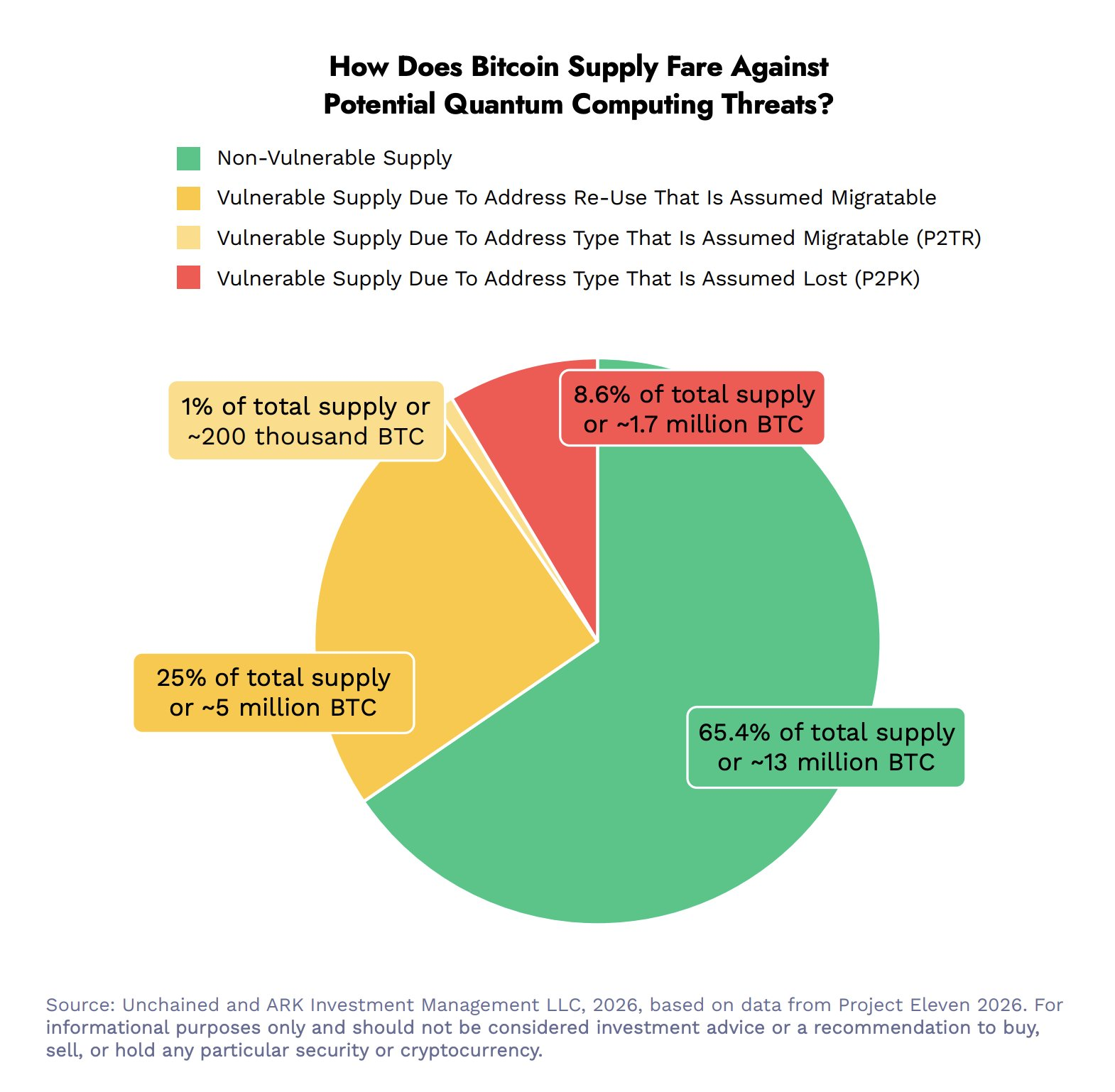
US investment manager Ark Invest claims that the lion’s share of the Bitcoin supply is already safe from the quantum computing breakthrough, leaving ample warning signals for builders to quantum-proof the rest of the supply.
Around 65.4% of the Bitcoin (BTC) supply is not vulnerable to the threat of a quantum computing breakthrough, but about 34.6% of the BTC supply remains at risk, according to a Wednesday white paper published by Ark Invest and Bitcoin-focused financial services company Unchained.
This includes around 5 million BTC, or 25% of the total supply, assumed migratable due to address re-use, and 1.7 million BTC, or 8.6% of the supply, assumed lost in P2PK (Pay-to- Public-Key) addresses, the earliest form of transaction script on the Bitcoin blockchain, which locked funds directly to public keys. Another 200,000 BTC (around 1%) is assumed to be migratable due to the address type P2TR (Pay-to-Taproot).
This supply would be vulnerable to quantum theft if quantum computers can break Bitcoin’s elliptic curve cryptography (ECC), which would require about 2,330 logical qubits and tens of millions to billions of quantum gates, the report argued.
“Even so, their practical feasibility would require quantum systems to reach performance levels that our research suggests will take much time to achieve.”

The paper’s estimates are far broader than those in a February CoinShares analysis, which said the realistically market-relevant portion of quantum-vulnerable Bitcoin was about 10,200 BTC, or roughly 0.05% of supply, even though legacy P2PK addresses account for a much larger theoretical exposure.
Separately, the first quantum computer facility with one million physical qubits (the equivalent of tens of billions of typical computers) is expected to be finished in 2027 by Chicago-based PsiQuantum, which raised $1 billion from BlackRock-linked funds.
Quantum breakthrough remains “long-term risk” for Bitcoin
Ark’s white paper argues that quantum risks will evolve over an extended period with “many intermediate warning signals” rather than an abrupt single point of failure.
Related: Cathie Wood says ARK’s $1.5M Bitcoin bull price hasn’t changed as markets eye rally
Quantum breakthrough remains a “long-term risk,” rather than an imminent threat to the Bitcoin network, which gives the community time to “research and make plans for protecting the network” against the protracted development of quantum capabilities, the paper states.
Ark Invest foresees five stages for quantum computing advancements, but said that only the final stage of advancements will break ECC quicker than Bitcoin’s 10-minute block time.
Bitcoin held in quantum-vulnerable addresses should not be at risk until stage 3, when a quantum computer can break the 256-bit ECC key.
The white paper said that the first public key may be broken in the mid-2030s, citing a consensus target by companies including Google, IBM and Microsoft.

Bitcoin must implement quantum-safe address formats despite governance challenge
Quantum computers will inevitably reach stage 4 and become a threat to the Bitcoin network, which means that Bitcoin must implement a quantum-safe address format, the paper argues.
The measure will require the integration of post-quantum cryptography (PQC) into Bitcoin, such as the ML-DSA lattice-based signature scheme and the SLH-DSA hash-based signature.
“Those standards give us confidence in the capabilities of post-quantum cryptography,” wrote Ark Invest, cautioning that upgrading to PQC on the consensus level will be more difficult due to Bitcoin’s decentralized governance structure, which requires the majority of network participants to agree to a soft fork.
The paper said Bitcoin will eventually need quantum-safe address formats and, over time, post-quantum cryptography. One draft path under discussion, BIP-360, proposes a Pay-to-Merkle-Root output type designed to reduce long-exposure quantum risk by removing Taproot’s key-path vulnerability, though it does not itself add post-quantum digital signatures.
Related: Whale’s $9B Bitcoin sale was not due to quantum concerns: Galaxy Digital
However, BIP-360 is not the final solution to Bitcoin’s quantum threat, according to Chris Tam, president and head of quantum innovation at BTQ Technologies.
“The proposal introduces a new address format but critically does not include post-quantum digital signatures, which are essential for any meaningful long-term defense against quantum attacks,” he told Cointelegraph.
Magazine: Bitcoin may take 7 years to upgrade to post-quantum: BIP-360 co-author

Keren Bartov’s My London: The Tate Britain, Panzer’s & the best Thai massage in town

Axsome Therapeutics, Inc. (AXSM) Presents at The Citizens Life Sciences Conference 2026 Transcript
DeFi Disaster: How Ignoring Slippage Warnings Cost One Trader $50 Million on Aave

Smart energy pays enters the US market, targeting scalable financial infrastructure

Why Israel is blocking foreign journalists from entering

Bitcoin: We’re Entering The Most Dangerous Phase

Iran BOMBS Dubai BREAKING: Iran’s Shahed Drones POUND Dubai Int’l Financial Centre | CHILLING VIDEO

Iran Attacks Dubai International Financial Centre As Tehran Continues To Pound Gulf, Watch!

Horrible Jobs Numbers…What This Means for Bitcoin
-
Business7 days ago
Form 8K Entergy Mississippi LLC For: 6 March
-

 News Videos4 days ago
10th Algebra | Financial Planning | Question Bank Solution | Board Exam 2026
-

 Fashion7 days ago
Weekend Open Thread: Ann Taylor
-

 Crypto World4 days ago
Paradigm, a16z, Winklevoss Capital, Balaji Srinivasan among investors in ZODL
-
 Tech2 days ago
A 1,300-Pound NASA Spacecraft To Re-Enter Earth’s Atmosphere
-

 Tech3 days ago
ChatGPT will now generate interactive visuals to help you with math and science concepts
-

 Politics7 days ago
Top Mamdani aide takes progressive project to the UK
-

 Business3 days ago
ExxonMobil seeks to move corporate registration from New Jersey to Texas
-

 Sports5 days ago
Three share 2-shot lead entering final round in Hong Kong
-

 Sports5 days ago
Braveheart Lakshya downs Lai in epic battle to enter All England Open final | Other Sports News
-

 NewsBeat2 days ago
Residents reaction as Shildon murder probe enters second day
-

 Entertainment6 days ago
Hailey Bieber Poses For Sexy Selfies In New Luscious Lip Thirst Traps
-

 Business5 days ago
Search for Nancy Guthrie Enters 37th Day as FBI Probes Wi-Fi Jammer Theory
-

 Business2 days ago
Search Enters Sixth Week With New Leads in Tucson Abduction Case
-
 NewsBeat3 days ago
Pagazzi Lighting enters administration as 70 jobs lost and 11 stores close across Scotland
-

 Tech4 days ago
Despite challenges, Ireland sixth in EU for board gender diversity
-

 Business4 days ago
Search Enters 39th Day with FBI Tip Line Developments and No Major Breakthroughs
-

 NewsBeat2 days ago
I Entered The Manosphere. Nothing Could Prepare Me For What I Found.
-

 Business6 days ago
Iran war enters second week as Trump demands ’unconditional surrender’
-

 Sports4 days ago
Skateboarding World Championships: Britain’s Sky Brown wins park gold