
Crypto World
Trend Research is back cycling ETH and USDC through Binance in size



Trend Research is again moving size through Binance, pulling 27,000 ETH off‑exchange while wiring in about $150m USDC, signaling fresh positioning after its brutal ETH unwind.
Summary
- An address tied to Trend Research withdrew 27,000 ETH from Binance, then sent roughly $150.47m in USDC back to the exchange in recent hours.
- Earlier this year the same firm dumped over 700m worth of ETH to Binance to repay Aave loans, realizing an estimated $700m‑plus loss on a looped long.
- The new pattern of ETH out and USDC in suggests Trend Research is rotating into fresh ETH strategies rather than simply de‑risking, making its flows a key ETH liquidity signal.
Trend Research is back moving size through Binance, this time cycling Ethereum (ETH) out and USDC in, in a way that looks like renewed ammo for directional ETH positioning rather than simple de‑risking.
Trend Research pulls ETH, then pushes USDC to Binance
On‑chain monitoring shows an address linked to Trend Research withdrawing 27,000 ETH from Binance in recent hours, before later transferring approximately $150.47 million in USDC back to the exchange. At current prices, the ETH withdrawal represents tens of millions of dollars in value, while the subsequent USDC inflow reloads the firm’s on‑exchange stablecoin balance. The sequence — assets out, stables in — fits a pattern seen before with Trend Research, where it actively rotates between ETH spot, derivatives exposure, and loan repayment.
This latest move comes against the backdrop of Trend Research’s highly publicized ETH strategy over the past months. The firm, associated with LD Capital, previously built a position of around 600,000–650,000 ETH using large Aave loans, then repeatedly transferred six‑figure ETH amounts to Binance to cut risk as prices moved against it, crystalizing hundreds of millions of dollars in realized losses.
Context: from forced selling to fresh firepower
Earlier this year on‑chain analysts tracked Trend Research sending 216,000 ETH — roughly $411 million — to Binance in a single day, having sold a total of 404,600 ETH at an average price of about $2,071 to avoid liquidation. In another episode, the firm was reported to have effectively “almost sold all of its ETH,” depositing 772,865 ETH back to Binance at around $2,326 after originally buying 792,532 ETH near $3,267, locking in an estimated $747 million loss. Those flows were clearly defensive, aimed at repayment and survival of a heavily leveraged book.
By contrast, the current pattern of withdrawing ETH while sending a fresh nine‑figure USDC tranche into Binance suggests Trend Research is again actively positioning rather than just unwinding. One plausible read is that ETH is being moved to self‑custody or DeFi while USDC sits on Binance as dry powder for new derivatives or spot entries, consistent with prior behavior where the firm borrowed stablecoins from Aave, sent them to Binance, and ran a large ETH carry and directional strategy.
What it signals for ETH traders
For market participants, Trend Research’s renewed activity matters because of sheer size. When a player that has moved hundreds of thousands of ETH and billions of dollars through Binance starts rotating again in 20,000–30,000 ETH clips and nine‑figure USDC transfers, it can affect short‑term liquidity, funding, and sentiment around key levels.
Traders watching ETH should monitor follow‑through: if on‑exchange ETH balances fall while USDC balances associated with Trend Research rise, that tilts toward accumulation or DeFi deployment; if the reverse happens and ETH deposits spike with spot selling, it points back to forced de‑risking. Either way, Trend Research’s flows remain a live barometer of how an over‑levered institutional whale is trying to navigate this phase of the cycle, and ignoring them is a luxury only small accounts can afford.

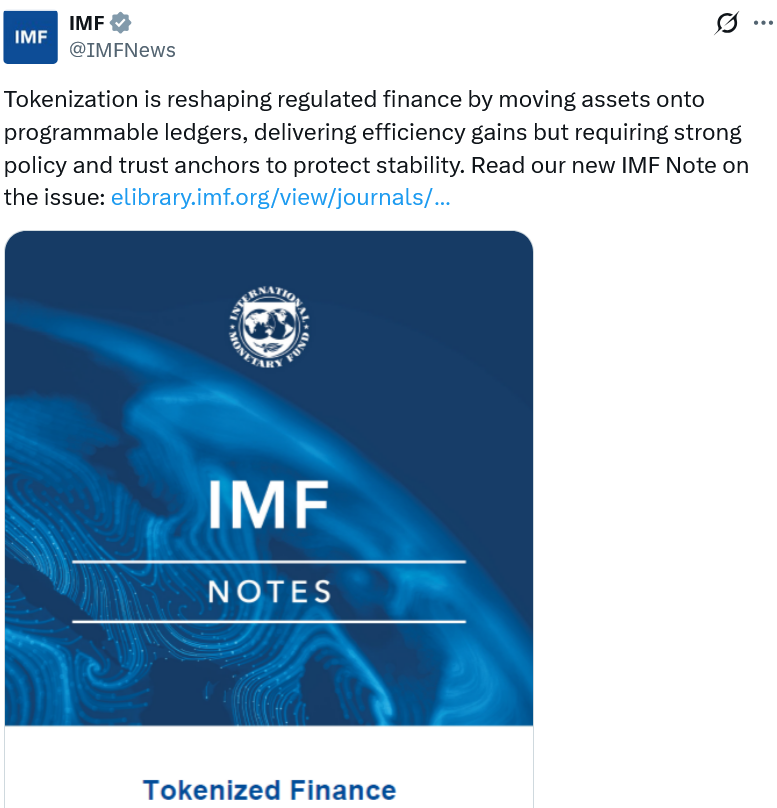
The International Monetary Fund said tokenization has the potential to remove friction and boost transparency in finance, but warned that the technology could also create challenges that affect financial stability.
“The net effect of tokenization on financial stability is uncertain,” the IMF said in a 23-page report on Thursday, stating that “atomic settlement and enhanced transparency reduce some traditional risks, but speed and automation introduce new ones.”

More than $27.6 billion worth of real-world assets, minus stablecoins, is currently tokenized onchain, data from RWA.xyz shows. Boston Consulting Group estimated in 2022 that the tokenization market could rise to $16 trillion by 2030, while McKinsey & Co in 2024 predicted a more conservative $2 trillion over the same time frame.
The IMF acknowledged that tokenization expands how securities and other financial products are issued, traded, settled and managed but said it shifts risks from the banking system to shared ledgers and smart contract code.
“Stress events in tokenized markets are likely to unfold faster than in traditional systems, leaving less time for discretionary intervention.”
The agency also said tokenization offers opportunities in emerging markets, such as faster cross-border payments and financial inclusion but added that it “raises the risk of volatile capital flows, rapid currency substitution, and erosion of monetary sovereignty.”
Wall Street advocates for tokenization
Blockchain tokenization has been pushed by Wall Street leaders such as BlackRock CEO Larry Fink, who is among those seeking to tokenize everything from stocks and bonds to money market funds and real estate.
The biggest RWA project by total value locked is Securitize — the tokenization platform behind the BlackRock USD Institutional Digital Liquidity Fund — at $3.38 billion, according to CryptoDep, citing data from April 1.
Tether Gold and Ondo Finance are close behind at $3.35 billion and $3.21 billion, respectively.

The New York Stock Exchange’s parent, Intercontinental Exchange, is also taking action, announcing in January that it would launch a tokenization platform for 24/7 trading and instant settlement of stocks and exchange-traded funds with a blockchain post-trade system.
Related: Liquidity, not novelty, determines tokenization’s value
However, the IMF said legal challenges present another obstacle, stating that without legal clarity over ownership records and settlement finality, tokenized markets risk being “fragmented and peripheral.”
The crypto industry has been developing solutions to address this problem, such as the Ethereum ecosystem’s ERC-3643 permissioned token standard, which ensures that only certain investors have access to tokenized products.
Coinbase Asset Management launched tokenized shares for the Coinbase Bitcoin Yield Fund on Ethereum layer 2 Base on March 20, with the help of financial services firm Apex Group, which implemented the ERC-3643 standard to ensure that token holder identity and eligibility were checked for compliance.
Magazine: Big Questions: Can Bitcoin save you from the dreaded Cantillon Effect?
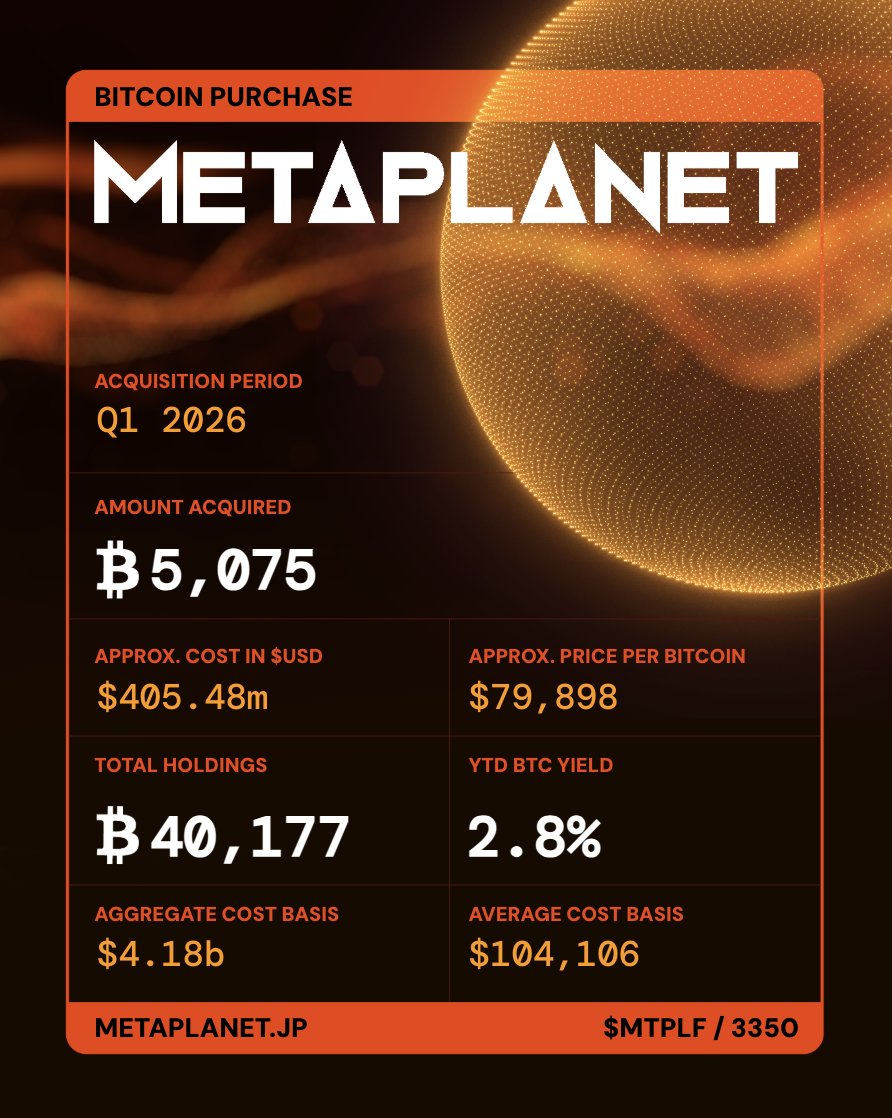
Metaplanet said it acquired 5,075 Bitcoin during the first quarter of 2026 for around $405 million or about $79,898 per coin, making the company the third-largest publicly-listed Bitcoin treasury, according to Bitcoin Treasuries data.
The Tokyo-listed company now holds a total of 40,177 Bitcoin (BTC) on its balance sheet, with an aggregate cost basis of roughly $4.18 billion and an average cost of $104,106 per coin, according to investor materials shared by chief executive Simon Gerovich.
Metaplanet also reported a year-to-date BTC Yield of 2.8% for 2026, a company metric that tracks growth in Bitcoin holdings on a per-share basis rather than income generated across the treasury.
The company separately announced first-quarter fiscal 2026 operating revenue of 2.97 billion Japanese yen (about $18.6 million) from its Bitcoin Income Generation business, which uses collateral-secured Bitcoin option strategies within a dedicated portfolio that is segregated from its long-term BTC stash.
That compares with full-year fiscal 2025 revenue of roughly $53.7 million from the same segment, taking trailing 12-month revenue to around $71.5 million, according to an April 2 filing.
The filings show Metaplanet is pursuing a two-track Bitcoin strategy by expanding its long-term treasury while using a ring-fenced options business to generate revenue that can later be recycled into additional Bitcoin purchases.

Capital strategy and market reaction
Capital from the income generation can be rolled into long-term Bitcoin holdings after option cycles conclude, allowing Metaplanet to convert derivatives revenue into additional BTC over time, the filing states.
Related: Twenty One Capital now 2nd-largest publicly traded BTC holder after MARA sale
The company left its consolidated revenue and operating profit forecast for the year ending Dec. 31, 2026, unchanged from guidance issued on Jan. 26, 2026. Metaplanet shares traded lower on Thursday, at $302 per share, down 1.95% from $308 at yesterday’s close, even after the announcement, according to data from Yahoo! Finance.

In the broader Bitcoin treasury space, fellow holding company Nakamoto disclosed Wednesday that it sold 284 BTC for $20 million in March and exited a large part of its Metaplanet stake at a loss in the first quarter, reflecting how listed Bitcoin vehicles remain highly sensitive to price swings and capital market conditions.
Magazine: Bitcoin may take 7 years to upgrade to post-quantum — BIP-360 co-author
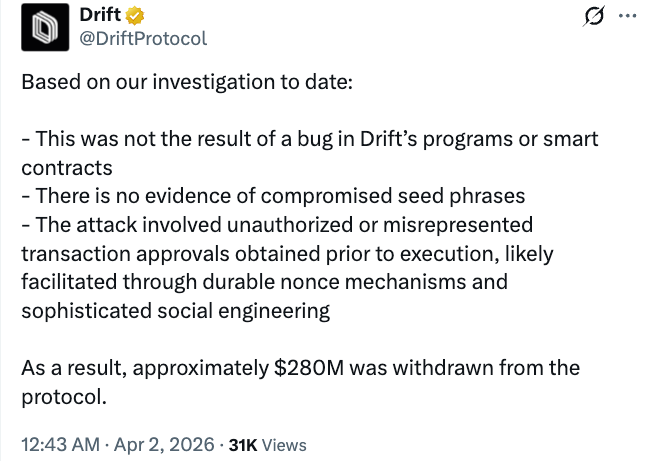
Drift Protocol, a Solana-based decentralized exchange (DEX), confirmed Thursday it was targeted in a roughly $280 million exploit, describing it as a “highly sophisticated operation.”
The platform took to X on to share its findings from a preliminary investigation, saying that the attackers exploited Solana’s durable nonces, a mechanism enabling pre-signed transactions, to seize control and drain funds. The protocol had earlier said it was experiencing an active attack and suspended deposits and withdrawals while coordinating with security firms, bridges and exchanges.
The attack began on Wednesday, with the theft involving multiple assets, including Circle’s USDC (USDC) and various altcoins. Onchain data later showed that the exploiter swapped the majority of assets into USDC, with the funds later bridged to Ethereum.
The incident has attracted scrutiny not only because it appears to involve abuse of a legitimate Solana transaction feature rather than a plain smart contract failure, but also for how funds moved across chains for hours without being frozen, raising questions about intervention by centralized stablecoin issuers.

What is Solana’s durable nonce feature?
Solana’s durable nonces are a unique feature allowing transactions to bypass certain expiration windows and enabling users to pre-sign transactions for future execution, offline signing, or complex multisig workflows.
Drift said the attacker used durable nonce-based, pre-signed transactions to gain unauthorized administrative access and execute malicious actions quickly after submission.

Durable nonces have not been widely associated with major exploits on their own, but developers have noted that features enabling delayed execution can introduce complexity and potential risks if misused or combined with other vulnerabilities.
Questions over Circle’s response
The incident has sparked criticism of the USDC issuer Circle, as the attacker took hours to swap $270 million to the stablecoin before bridging to Ethereum.
Onchain sleuth ZachXBT and others said the company had at least six hours to freeze funds but did not act, contrasting the response with previous cases where wallets were blacklisted.

Some industry figures pointed to the gap between Circle’s ability to freeze funds and any obligation to do so.
“Circle could freeze it. But they’re not required to,” pseudonymous user Molu wrote on X, adding that proposed regulatory frameworks such as the GENIUS Act could change that dynamic by requiring intervention under finalized rules.
Related: Balancer Labs shuts down 4 months after $100M+ exploit, protocol to continue
The incident marks yet another case in the ongoing debate over intervention by centralized platforms during attacks, with ZachXBT repeatedly criticizing Circle over the issue.
The investigator previously questioned Circle’s response to USDC tied to a Bybit-related hack in late February, prompting a response from Circle CEO Jeremy Allaire, who said the company acts on law enforcement requests before freezing funds.
Magazine: Nobody knows if quantum secure cryptography will even work

Big Tech names have joined the Linux Foundation’s newly formed x402 Foundation to govern and standardize the x402 protocol for agentic AI payments that bridge crypto rails with fiat. The Linux Foundation announced the formation of the x402 Foundation on Thursday with Coinbase as a contributor, positioning the open standard as a neutral, nonprofit home for the evolving payments layer that AI agents could use to autonomously pay for API access, data, and digital services.
Among the founding members are Google, Microsoft, and Amazon Web Services, alongside traditional payments and tech players such as American Express, Mastercard, Visa, Cloudflare, Shopify, Stripe, Circle, Base, Polygon Labs, the Solana Foundation, Thirdweb, and KakaoPay. The coalition signals broad industry appetite for a unified approach to AI-enabled payments that can operate across both crypto and traditional financial rails.
Linux Foundation CEO Jim Zemlin framed the move around open protocols, saying that “the internet was built on open protocols” and arguing for an open-source governance approach to x402. Coinbase emphasized that situating the protocol under the Linux Foundation lends a neutral, nonprofit ecosystem that could attract more widespread support from tech firms and developers than a corporate-branded launch would.
Beyond the structural shift, the effort taps into a longer-running market thesis: AI agents could become some of the dominant users of blockchain payments. Coinbase CEO Brian Armstrong echoed a view shared by Circle CEO Jeremy Allaire that AI-driven on-chain activity could reach scale fast, with Allaire predicting billions of AI agents transacting on-chain within a few years. Former Binance CEO Changpeng Zhao has also suggested crypto could serve as the “native currency for AI agents,” handling tasks from ticket purchases to bill payments without credit cards.
x402 is described as an open payment standard designed to enable AI agents and web services to autonomously pay for API access, data, and digital services. The protocol’s goal is to create a seamless, programmable payment layer that can operate across both blockchain networks and fiat rails, enabling new automated service models at scale.
Key takeaways
- Founding coalition includes Google, Microsoft, AWS, AmEx, Mastercard, Visa, Cloudflare, Shopify, Stripe, Circle, Base, Polygon Labs, Solana Foundation, Thirdweb, KakaoPay, and Coinbase, with Linux Foundation hosting the initiative.
- The Linux Foundation’s stewardship aims to lend legitimacy and openness to x402, potentially broadening developer and enterprise participation beyond corporate sponsorships.
- Industry leaders frame AI agents as major future users of on-chain payments, with optimistic projections about billions of autonomous transactions in coming years.
- On-chain activity data shows a dramatic surge in x402 transactions last November, followed by a sharp drop through 2026, suggesting early enthusiasm outpaced durable, broad-based adoption.
Founding members and the mission behind x402
The launch of the x402 Foundation marks a concerted effort to govern an open standard that could standardize how AI agents access paid services, from APIs to data feeds. By bringing together technology giants and payments specialists, the project aims to reduce fragmentation and foster interoperable payment flows across multiple rails. The Linux Foundation’s role as a trusted steward is central to this strategy, offering governance, governance processes, and an established ecosystem for collaboration among developers, researchers, and enterprises.
Jim Zemlin, the Linux Foundation’s chief, underscored the rationale for openness: the internet’s early growth relied on shared protocols that anyone could build upon. His framing points to a broader industry belief that AI agents will require a universal, permissionable, and auditable payment layer to function across devices, platforms, and geographies. Coinbase’s stance reinforces the value of a neutral venue that can welcome a broader constituency of participants, from tech platforms to merchant networks and fintech providers.
The Linux Foundation as a neutral hub for open protocols
The decision to anchor x402 within the Linux Foundation reflects a longstanding industry preference for governance through an impartial organization rather than a single corporate entity. Such positioning could be critical as regulators, enterprises, and developers weigh the regulatory and operational implications of autonomous payments that operate at the intersection of crypto rails and fiat systems. Coinbase noted that a nonprofit home could improve collaboration, reduce friction for newcomers, and help scale adoption beyond a handful of early pilots.
AI agents and the future of on-chain commerce
At the heart of the x402 push is a belief that AI agents will soon be one of the principal drivers of on-chain payment activity. Armstrong’s comment—“There will be more AI agents transacting online than humans very soon”—aligns with a broader industry forecast, including Allaire’s earlier observation that billions of AI agents could transact on-chain in three to five years. Zhao’s remark about crypto as the “native currency for AI agents” suggests a future where autonomous software agents handle routine financial tasks—ranging from ticketing to bill payment—without human intervention or traditional card rails.
In practice, x402 would enable autonomous agents and web services to procure API access, data streams, and digital services via programmable payments. If widely adopted, this could accelerate the automation of many online workflows and introduce new monetization models for AI-enabled tools. Yet the path to broad adoption will depend on ecosystem incentives, proven security and reliability, and the ability to demonstrate cost efficiency at scale.
As AI agents move from concept to deployment, the question for investors and builders is where true value will accrue. Will open, interoperable payment standards like x402 unlock durable business models for AI-driven services, or will fragmentation persist as competing standards and gatekeepers emerge? The answer will hinge on concrete pilots, measurable ROI, and regulators’ evolving stance on programmable payments and data access across borders.
Signals from on-chain activity: a tale of initial hype and later cooling
For a sense of traction, data from Dune Analytics tracks weekly activity on the x402 protocol. After peaking in November with a weekly total around 13.7 million transactions, followed by 13.66 million in the next week, activity has since cooled significantly. Current weekly totals have fluctuated between roughly 29,000 and 1.1 million transactions, illustrating a stark drop from the early frenzy. The chart labeled “Weekly transactions via the x402 protocol since May 2025” shows the post-peak erosion in use, raising questions about what it will take to sustain momentum in the near term.
The numbers reflect a broader challenge facing new open standards: translating theoretical potential into durable, real-world usage. While the coalition’s membership signals strong strategic interest, the actual adoption curve for x402 will likely hinge on successful pilots, clear return on investment, and the establishment of practical payment flows for AI-enabled services at scale.
What to watch next
Observers should monitor how the x402 Foundation evolves its governance, onboarding of additional partners, and real-world pilots that demonstrate repeatable, scalable use cases. Key uncertainties include whether large enterprises will embed x402 into mission-critical AI workflows, how regulators will treat autonomous payments across crypto and fiat rails, and whether the ecosystem can sustain higher-frequency, low-latency transactions that AI agents require. As AI agents become more prevalent in API access and digital service consumption, the coming quarters will reveal whether x402 can translate early interest into durable, long-term adoption.


Bitcoin is trading choppily around $66,600, as the extended holiday weekend sidelines potential buyers and gives bears greater control over price action.
With CME futures and ETF flows set to pause over Good Friday, the market is heading into a liquidity gap just as its most reliable source of support is already weakening.
Bitcoin’s $65,000 support is starting to look fragile as the market’s most active buyers turn out to be its most macro-dependent. In a recent report, CryptoQuant data show 30-day apparent demand at about -63,000 BTC, even as ETF and corporate purchases climb to multi-month highs, while Singapore-based market maker Enflux told CoinDesk in a note that the price floor is “partly underwritten by rate-cut expectations.”
ETF purchases rose to roughly 50,000 BTC over the past 30 days, the highest since October 2025, while Strategy accumulated about 44,000 BTC over the same period. Yet overall demand remained negative, with selling from other participants overwhelming those inflows.
The pressure is most visible among large holders, CryptoQuant wrote in a recent report. Wallets holding 1,000 to 10,000 BTC have flipped to net distribution, with their one-year balance change dropping to about negative 188,000 BTC from a positive 200,000 BTC at the 2024 cycle peak. Mid-sized holders have also slowed accumulation sharply, while the Coinbase Premium has remained negative, signaling weak U.S. spot demand.
The result is a market where rising institutional activity does not translate into stronger price support. As more capital shifts toward ETF wrappers and regulated futures markets, bitcoin is increasingly priced through macro-sensitive positioning such as hedging and allocation shifts rather than broad-based spot accumulation.
That positioning is now being tested by inflation data, Enflux wrote. The ISM prices-paid index jumped to 78.3 in March, its highest since June 2022, undermining expectations for near-term rate cuts. Enflux said the repricing has already begun to show up in flows, with $296 million in net ETF outflows during the week of March 24 and muted inflows in early April.
The long weekend removes a key stabilizer. With CME closed and ETF creation and redemption paused, the institutional bid that has increasingly anchored bitcoin’s price will be largely absent, leaving trading to spot markets where selling pressure has been most persistent.
CryptoQuant said any relief rally could face resistance between roughly $71,500 and $81,200, levels that have capped prior rebounds in the current bear-market structure.
The broader test comes with U.S. inflation data on April 9. If March core PCE exceeds February’s 3.1%, rate-cut expectations could fade further, strengthening bearish case in bitcoin.
Opinion by: Sebastián Serrano, founder and CEO of Ripio.
For much of the past decade, the crypto industry has tried to tokenize niche assets in an attempt to reinvent finance. While creative, this approach has largely missed the core economic truth about where tokenization actually creates value.
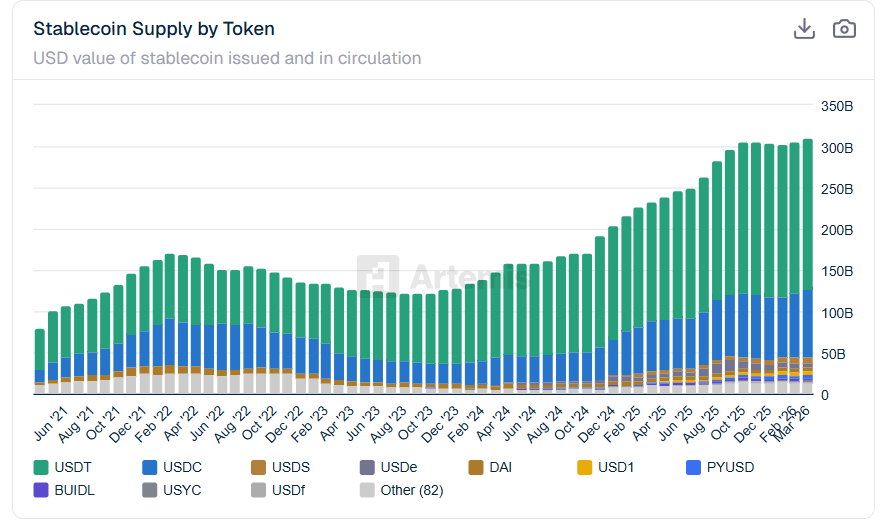
In these early stages of blockchain adoption, tokenization works best not at the fringes of the economy, but at its center. The industry’s first instinct — to tokenize illiquid assets — was a miscalculation. The most successful tokenization effort involved the most liquid asset in the world (the US dollar) in the form of USD-backed stablecoins.

Today, companies are piloting tokenized versions of other highly liquid assets like Treasury bills, smaller currencies and increasingly, stocks. This is not accidental. Tokenization is most powerful when applied to assets that already have massive demand and standardized legal and financial frameworks. Liquidity is the precondition that allows tokenization to move from novelty to infrastructure.
Tokenize what people want
Tokenization should start with assets that are already in high demand. Money, sovereign debt and major financial instruments are the base layer of the global economy. They are used daily by governments, corporations and individuals. When you tokenize these assets, you are not trying to create demand from scratch. You are upgrading the rails on which trillions of dollars already move.
If we look into our recent history, we find that electricity obviously wasn’t first used to power fancy art installations, but factories. Blockchains are no different. They reach their potential when they tokenize money and core financial primitives, not edge-case assets.
Stablecoins succeeded. They mapped directly onto an existing, massive use case. Stablecoins move dollars globally, quickly and cheaply. Tokenized treasuries are gaining traction for the same reason. They represent a real, high-demand asset that institutions already hold at scale.
Tokenization adds the most value where frictions are large and expensive. Bonds move trillions of dollars, but they do so inefficiently. Tokenization compresses settlement from days to minutes. Tokenization allows assets and cash to move together, in real time, without relying on intermediaries. That changes the cost structure and risk profile of financial operations.
Network effects only emerge around assets in very high demand, like money and sovereign debt. When you tokenize them, you create immediate interoperability. Everyone can build around the same unit of account. This is why stablecoins became the backbone of on-chain finance.
Related: Australia’s central bank backs tokenization as pilot finds $16.7B upside
NFTs and highly bespoke RWAs are the opposite. They are fragmented by design. Each asset is unique, legally ambiguous and difficult to standardize. That makes them incapable of becoming a shared economic layer. They may have cultural or speculative value, but they cannot anchor broad financial network effects.
Market effects of tokenizing liquid assets
Adding programmability to illiquid assets, you can fractionalize ownership or automate certain workflows. You do not, however, unlock new forms of economic coordination. The asset still does not trade frequently. It still lacks deep markets.
With liquid assets, however, tokenization unlocks entirely new financial behaviors. Continuous settlement, streaming payments, automated collateral management. These are just some of the novelties that tokenization can bring.
There are other considerations. Can you use a given tokenized asset as collateral? This is an important question, and the answer is that it mostly depends on liquidity. After all, liquid assets can be safely integrated as collateral into automated systems. Their valuations are transparent and updated in real time.

Illiquid assets, however, have sporadic trades, subjective valuations and wide bid-ask spreads. Their nature makes them very difficult to use as collateral. Tokenization doesn’t solve that problem. This reduces demand for the asset.
Capital efficiency also improves significantly for liquid assets. Tokenized liquid instruments can potentially be rehypothecated, fractionally deployed and programmatically allocated in real time. Capital moves faster across the system. But tokenization doesn’t produce continuous markets for illiquid assets.
Reducing risk through clarity
Dollars, government bonds and large corporate debt have well-established legal status, issuer accountability and regulatory frameworks. Tokenization can fit within existing financial law, making institutional adoption far more straightforward.
It’s harder for NFTs. Questions about ownership, custody, enforceability and investor protection can outweigh technical benefits. In practice, these uncertainties raise risk rather than reduce it. It’s natural for large, institutional tokenization endeavours to focus on liquid assets first.
The future of tokenization will be defined by assets that are economically central. Obviously, the crypto sector’s early experiments with NFTs were necessary and understandable. It was difficult for NFTs to succeed in the long term. They were focused on the wrong type of asset.
Stablecoins proved this by upgrading the most liquid asset in the world. Tokenized government bonds and equities are the logical next step. This is how blockchains move from experimental technology to foundational financial infrastructure.
Opinion by: Sebastián Serrano, founder and CEO of Ripio.
This opinion article presents the author’s expert view, and it may not reflect the views of Cointelegraph.com. This content has undergone editorial review to ensure clarity and relevance. Cointelegraph remains committed to transparent reporting and upholding the highest standards of journalism. Readers are encouraged to conduct their own research before taking any actions related to the company.
A new bill in Canada, if passed, would ban political parties and other third parties in elections from accepting cryptocurrency donations in a bid to prevent election interference.
The Strong and Free Elections Act would also ban contributions made by money orders and prepaid cards, citing these methods as difficult to track.
The bill notes the potential for foreign actors to influence elections through difficult-to-trace digital payment methods, ensuring Canadian elections “remain free, fair and secure at all times,” according to Government House Leader Steven MacKinnon.
Moreover, as the office of the Commissioner of Canada Elections told Cointelegraph, “The rapid and ongoing change in digital payments creates significant challenges and risks for law enforcement, including for our office.”
Crypto creates problems for election transparency, gov’t officials say
The rules for political financing in Canada are complex. Two offices, the Commissioner of Canada Elections and Elections Canada, play “distinct but complementary” roles under the Canada Elections Act’s (CEA). The bill banning crypto political donations would make changes to this Act.

Elections Canada, led by Chief Electoral Officer Stéphane Perrault, is responsible for conducting federal elections and administering the political financing regime.
The Commissioner of Canada Elections, currently Caroline J. Simard, “is responsible for ensuring that the rules under the Act are complied with and enforced,” a commissioner spokesperson said.
For both agencies, cryptocurrencies present challenges to maintaining free and transparent elections. For the commissioner’s office these include “potential difficulties associated with tracing the source of funding.”
Perrault shared a similar sentiment at an October appearance at the Procedure and House Affairs Committee.
“The problem with those instruments is that they do not provide transparency as to the original source of the contributor.”
He said that “a key principle of our system is that we know where the money comes from. There’s no, in my view, valid reason to use a prepaid instrument, a prepaid credit card, to provide money to a candidate or to a political party.”
Perrault acknowledged that they have legitimate uses elsewhere in the economy, “but in terms of financing parties and candidates, I do not believe they are appropriate.”
Crypto’s ‘non-moneyness’ creates an opening for foreign influence
Under current Canadian law, cryptocurrency qualifies as a legal, “non-monetary” contribution for political parties. Elections Canada told Cointelegraph they therefore must abide by certain reporting requirements.
“For contributions over $200, the political entity must report the contributor’s name and address in its financial return.”
However, contributions up to $200, if the donor is a Canadian citizen or permanent resident not in the crypto business, are deemed “nil.”
According to Perrault, the rules for non-monetary donations up to $200 were initially included in the CEA “to allow small-value gifts of goods and services—those valued under $200 and made by a person not in the business of providing such a good or service.” He gave an example of cooking food for campaign staff or lending the use of a personal vehicle.
This becomes more problematic when applied to crypto. Perrault said, “Although contributions of cryptocurrencies are non-monetary contributions under the CEA, the reality of cryptocurrency is that it functions increasingly like money.”
“If a contribution were made in cryptocurrency, it could be seen as a means by which unregulated resources could enter the federal political financing regime.”
He officially recommended that parliament “prohibit making contributions in cryptocurrency and untraceable instruments.”
While the potential for abuse is there, Elections Canada noted that “generally speaking, cryptocurrencies are not widely used to raise funds at the federal level in Canada.”
However, “the reporting framework for contributions does not currently require entities to disclose when a contribution was made via cryptocurrency, so Elections Canada does not have official figures on this.”
Crypto in Canadian politics: From convoys to Carney
Canada has displayed a relatively open, if cautious stance toward crypto. It became the first country to approve a spot Bitcoin exchange-traded fund in February 2021.
Crypto has appeared in the political discourse before as well. In 2022, a series of blockades and protests against COVID-19 vaccine mandates for truck drivers quickly ballooned into nationwide demonstrations. On Jan. 22 that year, the first convoy of over 1,000 vehicles departed for Ottawa. Over the next few weeks, crowds occupied the streets of downtown Ottawa to protest then-Prime Minister Justin Trudeau’s Liberal government.
When the government used the Emergencies Act to freeze convoy organizers’ bank accounts, they took donations in crypto. According to CBC, the convoy raised over $20 million in crypto donations, $8 million of which was still unaccounted for by April 2022.
Cryptocurrencies were hailed as a means to circumvent government control and take control over critical funding for the anti-vaccine protest movement.
Mathew Burgoyne, a digital currency lawyer based in Calgary, told the CBC, “There’s a huge limitation, as we’ve seen, with freeze orders when they relate to cryptocurrency wallets.”
Crypto entered the political arena again during the 2025 federal elections when Conservative candidate Pierre Poilievre made a number of statements and appearances promoting crypto and blockchain tech.
Related: Why Pierre Poilievre may not be Canada’s crypto savior
In one campaign lunch stop, he bought shawarma using the Bitcoin Lightning Network at Canadian chain Tahini’s, and he talked about Bitcoin while smoking hookah with the company’s vice president.
Under current Prime Minister Mark Carney, the Canadian crypto industry is growing, but with a “regulate first” attitude from policymakers. In November, Parliament introduced the Canada Stablecoin Act as part of the budget, giving the Bank of Canada the power to regulate stablecoins in the country.
As it concerns political donations, some in the industry believe there are higher priorities right now. One industry source at a Canadian crypto firm told Cointelegraph that issues like stablecoin regulation, tokenization and payments modernization take precedence over political donations, which are still quite marginal, in their estimation.
They said that the industry doesn’t support a ban, but there are other policy decisions that present clearer opportunities for the industry to make a difference.
Altura, a decentralized finance protocol founded by former Fidelity and PwC staff is launching an onchain gold arbitrage strategy aimed at retail investors, targeting 20% annualized returns, according to a Thursday release shared with Cointelegraph.
According to Altura, the product pools user deposits into a vault that recycles capital through short-duration physical gold trades. Unlike platforms like Robinhood or Revolut that offer passive gold price exposure, Altura claims to be tokenizing the underlying arbitrage process itself.
The company says it has raised $4 million in funding and has already facilitated the movement of about 185 kilograms of gold, representing roughly $28.5 million in cumulative transaction volume, per the release.
Matthew Pinnock, co-founder and chief operating officer of Altura, told Cointelegraph the goal is to “bring an institutional-style gold strategy onchain in a way that retail investors can actually access.”
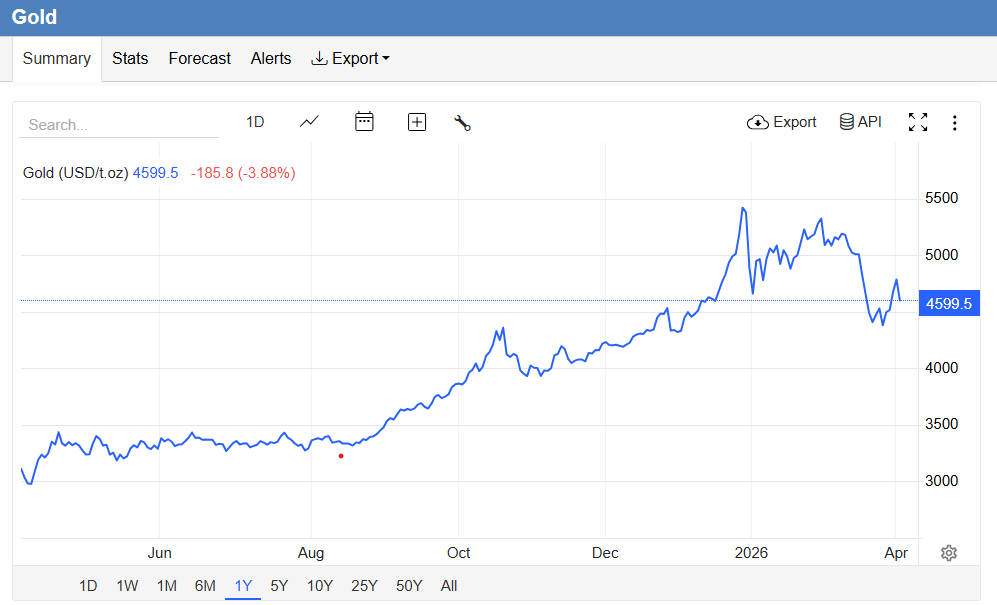
The launch comes as spot gold trades near record levels after surging to an all-time high above $5,300 an ounce in January, though it has since pulled back sharply. Altura’s launch points to a new phase in tokenized real-world assets, where projects are no longer just offering passive exposure to commodities but are trying to package institutional trading strategies as onchain DeFi yield products for retail users.
A strategy typically reserved for institutional traders
Pinnock said Altura’s “revenue-generating trading strategy” was historically used by institutional commodities desks, and that high capital requirements, legal complexity and counterparty risk in traditional bullion arbitrage have effectively kept smaller investors out of this type of trade.

Gold purchased on behalf of Altura by its trading partner Inessa is tokenized at acquisition, Pinnock said, with those tokens escrowed through each trade and custody transitions recorded via dual cryptographic signatures. Depositors do not hold direct title to bullion but gain exposure to returns generated by the trade flow, he added.
Altura’s setup depends on a network of offchain actors. The company says it is working with Aurellion Labs and Inessa, which in turn partners with air-cargo specialist Zeal Global, to execute and verify trades.
Related: Gold hits record high over $5K, further diverging from Bitcoin
On the targeted 20% yields, Pinnock said the strategy is structured to be “close to delta-neutral,” with trade terms agreed before logistics execution begins so that returns come from price discrepancies between counterparties rather than directional bets on the gold price.
Each arbitrage cycle typically completes within one to two days, allowing capital to be recycled multiple times and limiting exposure to spot moves, he said, while acknowledging that yields would compress if pricing inefficiencies narrow.
Related: Tokenized gold drives weekend price signals while CME futures are closed
Rising interest in real-world yields
The launch comes amid rising interest in “real-world” DeFi yields, as tokenized asset and RWA protocols grew to roughly $17 billion in total value locked in December 2025, according to DefiLlama data.
However, a joint report by RWA.io and Veritas Protocol in that same month found that losses from onchain operational failures in tokenized RWA markets rose to $14.6 million in the first half of 2025, a 143% increase from the previous year, highlighting how complex offchain structures can still translate into user losses.
Magazine: Bitcoin’s ‘biggest bull catalyst’ would be Saylor’s liquidation — Santiment founder
Murad Mahmudov, a crypto trader also known as the “Memecoin messiah,” has lost nearly $60 million across his bets in the past nine months. Still, he expects a bullish reversal.
Key takeaways:
-
Mahmudov thinks SPX6900, which is 96% of his memecoin portfolio, will rise 400,000%.
-
SPX6900 chart technicals signal another 20% decline in the coming weeks.
SPX6900 will reach $1 trillion market cap, claims Mahmudov
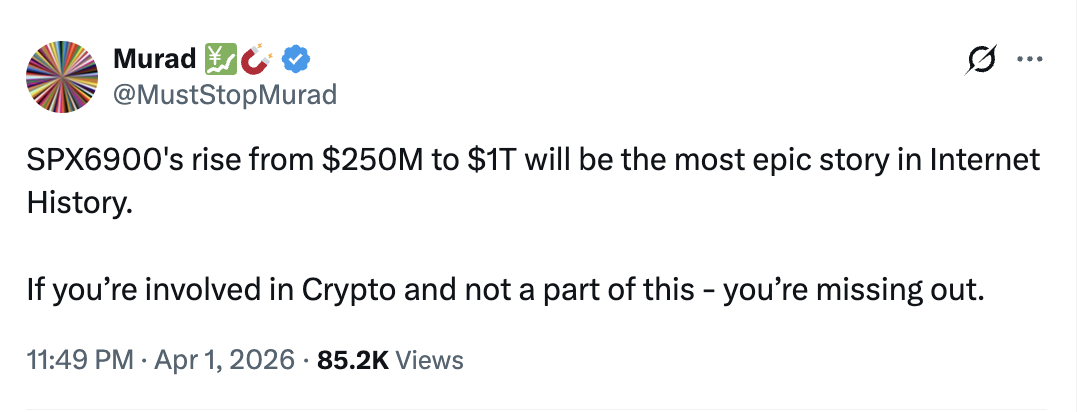
On Wednesday, Mahmudov said the market capitalization of SPX6900 (SPX), a memecoin on a mission to overtake the US benchmark S&P 500 index, will grow to $1 trillion from its current valuation of around $250 million, a nearly 400,000% increase.

For context, Bitcoin (BTC) is the only cryptocurrency that has been able to hit a $1 trillion mark so far, led by growing institutional demand.
Mahmudov’s publicly labeled wallets, tracked under the entity “Muststopmurad” by Arkham Intelligence, currently hold approximately 29.964 million SPX, valued at roughly $7.79 million.

This single position accounts for about 96% of his total tracked portfolio, currently valued at around $8.1 million.
At its peak in July last year, the same portfolio was worth around $67 million.
The drop since then amounts to an unrealized loss of roughly $60 million, as the broader memecoin sector, including SPX, corrected by more than 80% from its highs.
Mahmudov still holds SPX6900 and other memecoins
Mahmudov does not appear to be locking in the memecoin losses.
Portfolio tracker DropsTab shows no meaningful sales of SPX6900 or his other major positions, with realized profits and losses on the tracked holdings still at zero.

Importantly, the trader appears to be holding more than $6.22 million in unrealized gains instead of taking a profit.
Mahmudov’s refusal to sell also stands out because the broader memecoin market has been brutal toward its dedicated holders.
In a January report, CoinGecko said that 53.2% of all cryptocurrencies tracked since 2021 were inactive, with 11.6 million token failures recorded in 2025 alone that particularly “affected the memecoin sector.”
Related: Memecoins and art market share similar economics — Ki Young Ju
Mahmudov’s smaller wallet holdings also reveal the limits of memecoin conviction.
Public DEX data for ticker-level matches, including RETARDMAXX, HONK and CHAD, shows that some of these names are barely functional.
One RETARDMAXX pair had roughly $44,000 in liquidity but just six transactions and $89 in daily volume, while CHAD showed $842 in liquidity with zero trades and zero makers.

One HONK pair, meanwhile, had just $1 in liquidity and no recorded activity. Those tokens may still print a price on screen, but in a selloff, they offer little evidence of dependable exit liquidity.
SPX900 breakdown hints at more losses ahead
On the three-day chart, SPX6900 appears to be breaking down from a rising wedge, a bearish pattern that typically resolves lower after price slips below support.
SPX has already started losing the wedge’s lower trendline near $0.26 and remains below its 20-, 50- and 100-period exponential moving averages, underscoring weak momentum.

If the breakdown confirms, the measured move points to $0.205, about 20% below current levels.
A 20% drop in SPX would cut roughly $1.56 million from Mahmudov’s memecoin portfolio.
This article is produced in accordance with Cointelegraph’s Editorial Policy and is intended for informational purposes only. It does not constitute investment advice or recommendations. All investments and trades carry risk; readers are encouraged to conduct independent research before making any decisions. Cointelegraph makes no guarantees regarding the accuracy or completeness of the information presented, including forward-looking statements, and will not be liable for any loss or damage arising from reliance on this content.
French blockchain-based stock exchange Lightning Stock Exchange (Lise) is preparing to host what it describes as a fully onchain initial public offering (IPO), listing aerospace and defense SME ST Group as its inaugural company.
The company called the deal the first IPO on a natively tokenized exchange, where shares are issued and traded as digital tokens rather than recorded through traditional market infrastructure, according to a Thursday announcement shared with Cointelegraph.
CEO Mark Kepeneghian said it could fundamentally change “how markets are built, how companies raise capital, and how investors connect to the real economy.”
The IPO is scheduled for April 9 and is being structured with support from Allinvest Group, acting as both financial adviser and bookrunner. The platform introduces a first-come, first-served allocation for IPO orders and removes subscription and custody fees.
The IPO will test whether tokenized issuance can solve real capital market problems for smaller companies, rather than simply showcase blockchain-based market plumbing. Tokenized securities have long struggled with liquidity, investor access and regulatory friction, and it remains unclear whether a new venue can attract meaningful trading activity or operate smoothly at scale.
Related: NYSE taps Securitize for 24/7 tokenized securities platform
Lise secures license from French regulators
Lise said it holds multiple regulatory approvals, including an investment firm license from the French Prudential Supervision and Resolution Authority and a DLT Pilot Regime authorization from the European Securities and Markets Authority, allowing it to run trading and settlement on blockchain infrastructure, a company spokesperson told Cointelegraph.
Cointelegraph previously reported that the European Commission had proposed extending the DLT Pilot Regime as part of broader efforts to support tokenized financial markets in Europe.
“Lise operates both a Multilateral Trading Facility (MTF) and a Central Securities Depository (CSD) within a single unified platform, built natively on Hyperledger Besu (a private, permissioned blockchain),” the spokesperson said, adding that shares issued on Lise are born as security tokens on the DLT. “The DLT is the golden source for the securities registry,” they said.
Related: Franklin Templeton, Ondo to launch tokenized ETFs with 24/7 trading via crypto wallets
Tokenized stocks near $1 billion
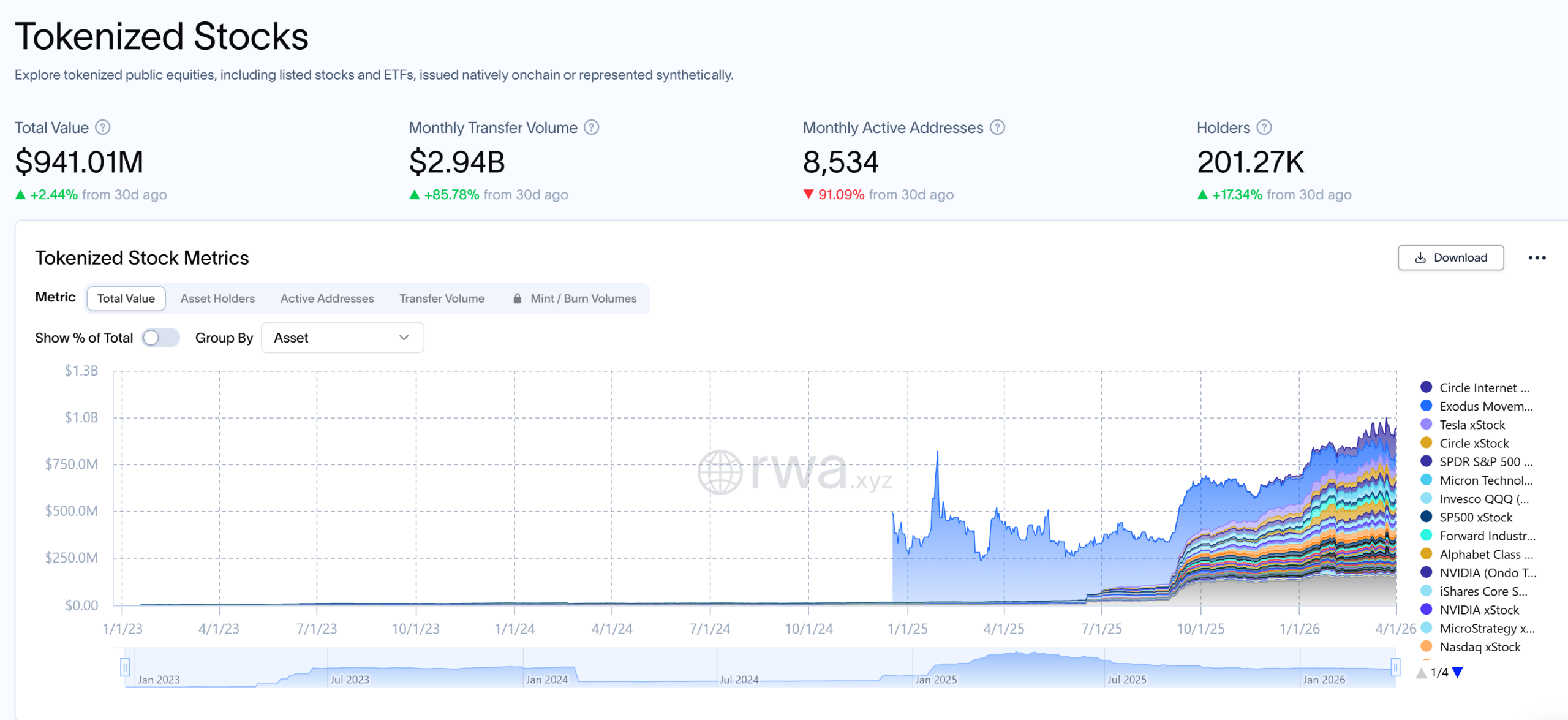
Investor demand for blockchain-based tokenized stocks is picking up, with total market value nearing the $1 billion mark. Tokenized equities reached about $941 million in total value, up 2.4% over the past 30 days, according to data from RWA.xyz.

Activity has grown sharply in some areas. Monthly transfer volume jumped 85% to $2.94 billion, while the number of holders climbed 17% to more than 201,000.
Magazine: Bitcoin may take 7 years to upgrade to post-quantum — BIP-360 co-author

Kim McGuinness holds Mayor Meets event on transport in Bishop Auckland

EuroEyes International Eye Clinic Limited (EUYSF) Q4 2025 Earnings Call Transcript

Effect of Tokenization on Financial Stability Not Clear


-

 NewsBeat6 days ago
The Story hosts event on Durham’s historic registers
-

 NewsBeat10 hours ago
Steven Gerrard disagrees with Gary Neville over ‘shock’ Chelsea and Arsenal claim | Football
-

 Sports6 days ago
Sweet Sixteen Game Thread: Tide vs Michigan
-
Entertainment4 days ago
Fans slam 'heartbreaking' Barbie Dream Fest convention debacle with 'cardboard cutout' experience
-
 Entertainment5 days ago
Lana Del Rey Celebrates Her Husband’s 51st Birthday In New Post
-
Crypto World3 days ago
Dems press CFTC, ethics board on prediction-market insider trades
-

 Crypto World1 day ago
Gold Price Prediction: Worst Month in 17 Years fo Save Haven Rock
-

 Tech4 days ago
The Pixel 10a doesn’t have a camera bump, and it’s great
-

 Sports3 days ago
Tallest college basketball player ever, standing at 7-foot-9, entering transfer portal
-

 Tech3 days ago
EE TV is using AI to help you find something to watch
-

 Business5 hours ago
No Jackpot Winner and $194 Million Prize Rolls Over
-

 Fashion5 days ago
Amazon Sundays: Soft Spring Layers
-

 Tech3 days ago
How to back up your iPhone & iPad to your Mac before something goes wrong
-

 Business1 day ago
Login and Checkout Issues Spark Merchant Frustration
-

 Tech4 days ago
Apple will hide your email address from apps and websites, but not cops
-

 Politics3 days ago
Should Trump Be Scared Strait?
-

 Crypto World3 days ago
U.S. rule change may open trillions in 401(k) funds to crypto
-

 Tech3 days ago
Flipsnack and the shift toward motion-first business content with living visuals
-

 Tech4 days ago
Avatar Legends: The Fighting Game comes out in July and it looks pretty slick
-

 Tech5 days ago
Elon Musk’s last co-founder reportedly leaves xAI
You must be logged in to post a comment Login