
Crypto World
Trump Again Threatens to Bomb Oman


“If Oman gets in the way, we’ll bomb the sh-t out of them,” Trump told Fox News reporter Trey Yingst on Monday.
Trump later told reporters, “I don’t think they [Oman] behaved very well, but we’d handle them very easily, just like we do other things.” It’s unclear what exactly Oman has done to upset the U.S. President. TIME has reached out to the White House for comment.
Tehran has said the Strait’s administration should remain strictly between the two coastal states. Iran also previously proposed collecting fees for passage through the waterway, while Oman proposed a system with voluntary fees in late July.
U.S.-Iran diplomacy meanwhile appears tenuous, with Iranian officials denying any direct talks and contradicting Trump’s claims that Iran is eager to make a deal. The 60-day deadline for the U.S. and Iran to negotiate a comprehensive peace agreement to end the war expired Monday without a deal. The two countries signed a memorandum of understanding (MOU) on June 17, which included the lifting of the U.S. naval blockade on Iran and toll-free passage through the Strait of Hormuz. The MOU stated that Iran would discuss with Oman the future administration of the waterway.


Key takeaways
- Zcash dipped 1% on Tuesday following Monday’s rally. day,
- The Ironwood shielded pool now holds 3.07 million ZEC, representing 70% of total shielded volume.
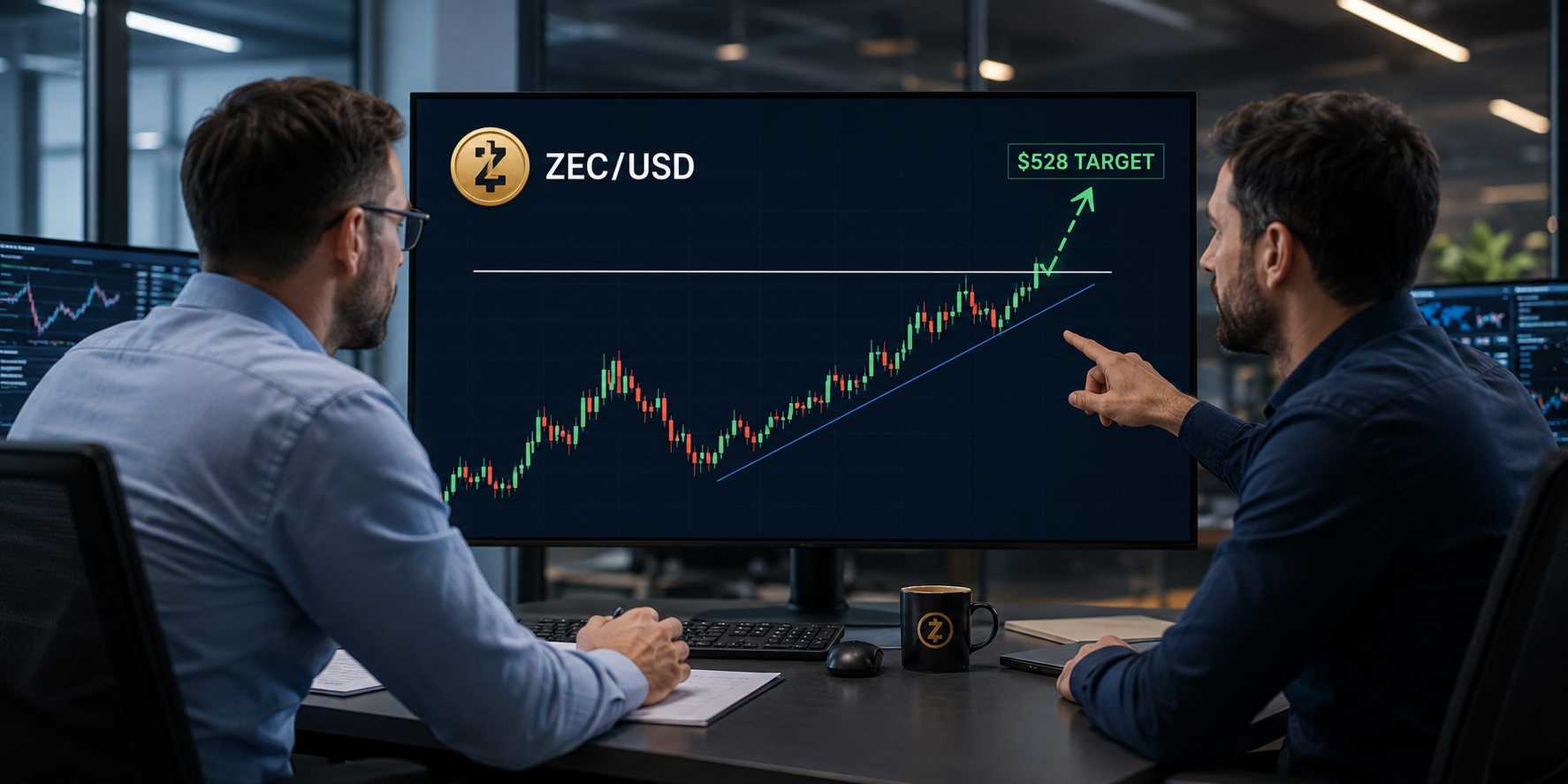
- ZEC is approaching the apex of a symmetrical triangle, with resistance near $528.
Zcash (ZEC) dipped 1% on Tuesday despite the massive rally on Monday. The surge earlier this week comes as rising Ironwood adoption and stronger derivatives activity supported demand.
The privacy coin trades above $500 and is approaching the apex of a symmetrical triangle pattern. A breakout above the upper trendline could strengthen the bullish outlook and bring the $600 region into focus.
Ironwood shielded volume crosses 3 million ZEC
Migration to Zcash’s Ironwood shielded pool continues to gain traction following the discovery of a counterfeiting vulnerability affecting the network’s older pool infrastructure.
Data from Zkp.baby shows that Ironwood’s shielded volume reached 3.07 million ZEC on Monday. The pool now accounts for approximately 70% of the total ZEC held in shielded pools.
Meanwhile, volume in the older Orchard pool has declined to 761,889 ZEC as users continue migrating their holdings.
The shift toward Ironwood indicates growing adoption of the updated shielded infrastructure. It also suggests that users are responding to the network’s security changes while maintaining demand for Zcash’s privacy features.
Zcash’s derivatives market is also showing renewed retail participation. CoinGlass data shows that ZEC futures Open Interest decreased 1% over the past 24 hours to $924.16 million. The decrease signals that traders are closing new positions or allocating more capital to existing contracts.
Zcash price outlook: ZEC approaches triangle breakout
Zcash trades above $500 on Tuesday, maintaining a mildly bullish technical outlook as it holds above the 50-day Exponential Moving Average at approximately $490.
The 200-day EMA near $420 also supports the broader bullish structure. Meanwhile, the price is contracting between two converging trendlines, forming a symmetrical triangle on the daily chart.
This pattern typically indicates declining volatility before a larger directional move. However, the triangle does not confirm whether the eventual breakout will be bullish or bearish.
Momentum indicators provide mixed but improving signals. The Relative Strength Index has risen above its neutral level to 55, suggesting renewed buying pressure.
The Moving Average Convergence Divergence indicator remains marginally below its signal line, pointing to some lingering downside pressure. A bullish crossover would provide additional confirmation that buyers are regaining control.
Zcash faces immediate resistance at the triangle’s upper trendline near $528. A sustained daily close above this level would confirm a bullish breakout and could propel ZEC toward the 78.6% Fibonacci retracement at approximately $595. This level is calculated from the decline between $690 and $250.

Clearing $595 would bring the psychologically important $600 level into focus and strengthen the prospect of a broader trend continuation.
On the downside, the 50-day EMA near $490 provides initial support. A breakdown below this moving average could extend the correction toward the 50% Fibonacci retracement at $470.
If selling pressure intensifies, the 200-day EMA at approximately $420 represents the next major support level. Holding above these moving averages would preserve Zcash’s broader recovery structure.

- The first question for any crypto prop firm is whether trades hit a real order book or a simulation.
- A crypto-native perpetuals trader gets the most from a crypto-first structure with verifiable payouts.
- HyroTrader is crypto only: USDT perpetual futures, no forex pairs, no indices, no metals.
Every crypto prop firm’s homepage makes the same pitch: six figures of buying power, a generous profit split, a challenge fee that looks small next to the capital on offer. Read five pricing pages in a row, and they blur into one.
The differences that decide whether a funded account survives live below the marketing.
They come down to three structural questions: where orders execute, how drawdown is measured, and what a payout actually is.
A trader who can answer all three about a firm knows more than most reviews will ever tell them.
Test one: where orders execute
The first question for any crypto prop firm is whether trades hit a real order book or a simulation.
Both architectures exist, and both can be honest; the failure mode is a simulation dressed up as the real thing.
HyroTrader put direct exchange execution at the center of its model in 2023, the first crypto prop firm to do it.
Traders connect to Bybit by API, and trade USDT perpetual futures on the trader’s own account against live order books, across more than 700 pairs.
The same firm shows what honest simulation looks like.
Its CLEO platform, built for traders in Bybit-restricted countries, prices from real-time Binance market data and order book depth while filling trades internally, and it simulates the unflattering parts: market impact, commissions, slippage landing in the position PnL at fill.
If a firm will not say plainly where fills happen, assume the answer costs you money.
Test two: how drawdown is measured
Two firms quoting the same daily limit can be selling different products, because what matters is the reference point.
HyroTrader’s standard daily drawdown is trailing: measured from the highest equity point reached during the day, unrealized profit included, so the risk line rises as the day goes well.
Its swing variant, sold as a paid upgrade, is static, measured from the day’s starting equity and reset once every 24 hours.
The daily limit itself is 4 percent on the one-step model and 5 percent on the two-step, calculated from initial capital.
A trailing limit punishes how you win. Ride a position up, give a third of the move back, and the giveback can trip the limit while the day is still green.
Crypto compounds the effect because volatility arrives in bursts; CoinJournal’s analysis of Bitcoin’s current tight range describes exactly the kind of compression that precedes them.
Test three: what a payout actually is
A payout policy is three numbers and a proof: how often, how fast, and whether anyone can verify it happened.
At HyroTrader, payouts are on demand, typically processed within 12 to 24 hours, in USDT or USDC, with no withdrawal commissions, and the first one can be requested as early as the day of the first trade.
Since April 2026, payouts through its vault system execute as Solana transactions with publicly verifiable IDs on Fireblocks infrastructure, so the proof does not depend on the firm’s word.
Cost belongs in the same test. HyroTrader’s challenge fees run one-time, from $59 for a 5,000 USDT account to $969 for 200,000 USDT, with no recurring charges, and the fee is refunded with the first profit split after passing.
A firm confident in its payout process has no reason to bury these numbers.
The honest trade-off
HyroTrader is crypto-only: USDT perpetual futures, no forex pairs, no indices, no metals.
A trader who wants gold or the S&P alongside BTC needs a multi-asset firm and accepts the different execution model that comes with it.
There are consistency rules too: during evaluation, no single day may contribute more than 40 percent of the result, though exceeding the cap only discounts the excess rather than failing the account.
The structure fits deliberate traders and frustrates all-in ones, which is the point.
Choosing by profile
A crypto-native perpetuals trader gets the most from a crypto-first structure with verifiable payouts, which is HyroTrader’s case.
A generalist who wants metals and indices in the same account belongs at a multi-asset firm: FTMO, which popularized the modern evaluation model, runs crypto as one market among forex, indices, and metals, and FundedNext brings similar breadth.
Whatever the profile, start from a crypto prop firm comparison that puts evaluation costs, drawdown types, and payout terms side by side, then read the full rulebooks of the two finalists. Pick the rulebook you can recite before you pay for it.
Figures come from the firms’ published terms as of August 2026; verify current numbers before purchasing an evaluation. Trading crypto derivatives carries substantial risk of loss.


The takeaway is that even as oil prices retreat from their second-quarter highs, oil products are getting more expensive. The broader market, including BTC, may not have fully priced that in yet.
A second detail is that oil itself may be due for a bounce. Crude has emerged from a four-month-long bearish trend (check the Daily Signal), and there’s still disruption of tanker traffic through the Strait of Hormuz.
Those two effects, combined with concerns about government debt levels, continue to push yields on U.S. Treasuries and other advanced-economy bonds higher. That raises the opportunity cost of holding other assets and may cap bitcoin’s gains, a dynamic CoinDesk recently flagged.
One factor is still working in bitcoin’s favor, at least for now: the U.S. currency. The Dollar Index fell to a two-and-a-half-month low of 99.29 on Monday and broke down out of a bullish trendline, a technical signal pointing to further losses ahead. A weaker dollar has historically been a supportive backdrop for bitcoin.
Taken together, it’s a genuinely mixed tape that leaves bitcoin trading in the middle of several narratives pulling in opposite directions. Stay alert!
Read more: For analysis of today’s activity in altcoins and derivatives, see Crypto Markets Today . For a comprehensive list of events this week, see CoinDesk’s “Crypto Week Ahead.”
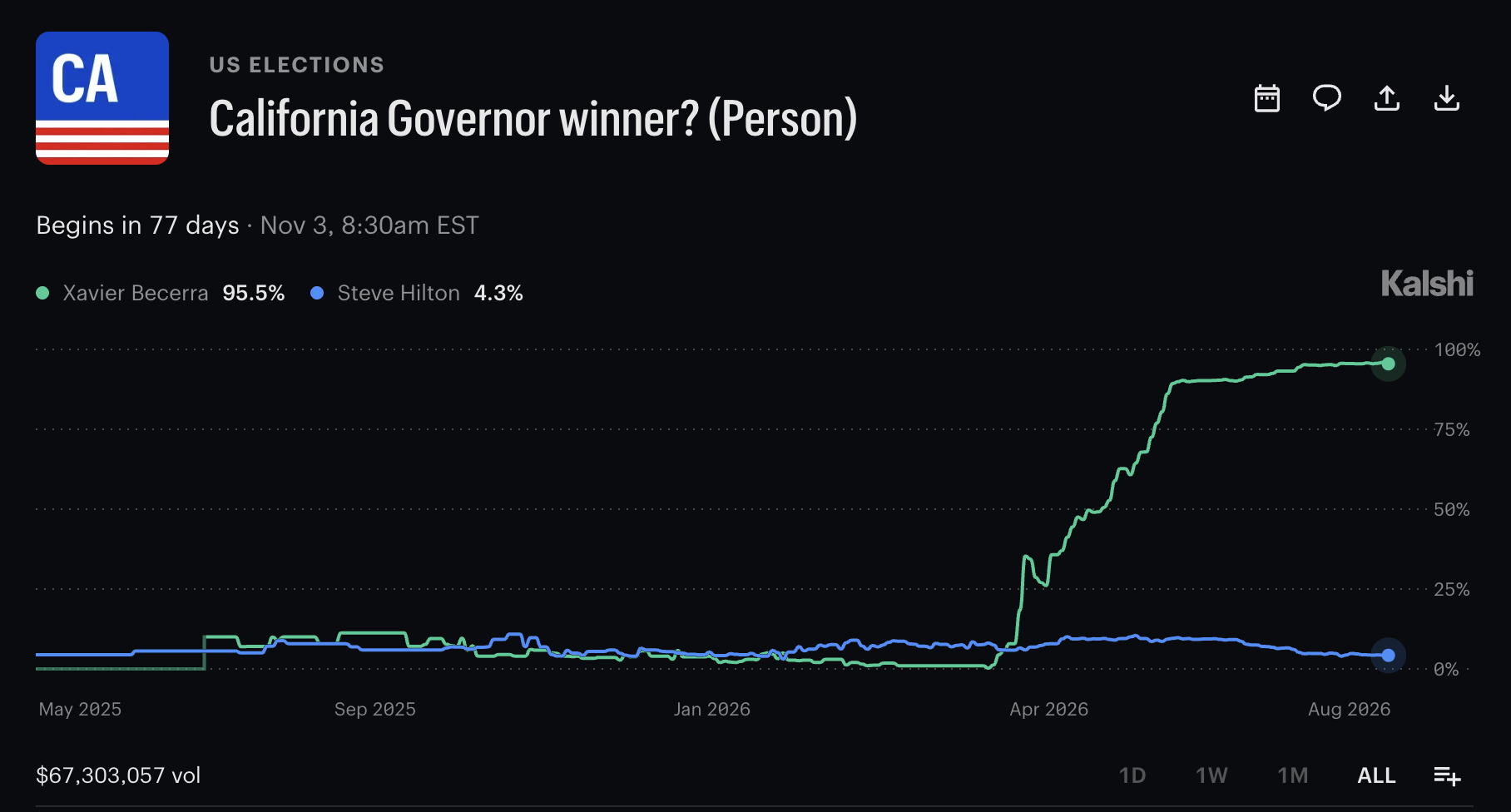
Prediction markets and polling odds pointed toward Xavier Becerra as the leading candidate in California crowded governor primary ahead of the vote. In Kalshi pricing published on primary day, Becerra was the favorite both to advance from the top-two primary and to win the governor’s race.
With only hours remaining before polls closed, Kalshi’s primary-advancer market placed Becerra at 95% to move on to the general election. Republican Steve Hilton was priced at 4%.
Recent surveys also put Becerra in front, though the order behind him varied. An Emerson College poll cited by Kalshi showed Becerra at 28%, Steyer at 22%, and Hilton at 21%. The Berkeley Institute of Governmental Studies placed Becerra at 25%, Hilton at 21%, and Steyer at 19%, while a Public Policy Institute of California poll showed Becerra at 23%, Hilton at 20%, and Steyer at 15%.

A separate report published before the primary described polling at 23% for Becerra and 20% for Hilton. It characterized the race as crowded, while identifying Becerra as the Democrat most likely to lead the field and Hilton as the Republican with the clearest route through the primary.
Discover: Trade the odds on Kalshi and get a free $25
California Governor Odds: Race Reshaped by a Changing Field
Kalshi reported that Becerra had entered the race polling at 5% and trading at less than 1% on its governor market in early April. The article linked his subsequent rise to Eric Swalwell’s departure from the contest and to setbacks affecting several other candidates.
Steyer remained a significant factor before the vote. Kalshi cited CalMatters reporting that he had heavily financed his campaign to a total of $200 million, including spending on social media influencers. Late primary-day movement also lifted Steyer from 33% to 40% in Kalshi’s advancers market before the article’s stated 39% takeaway figure.

Hilton’s campaign had the endorsement of President Donald Trump. Kalshi, citing The New York Times, reported that the endorsement may have hurt Hilton’s chances in California.
Prediction-market prices reflect trading at a particular time and can change as polling, campaign developments and voting information evolve. The June 2 Kalshi figures showed traders favoring Becerra, but they did not establish a final election outcome.
Discover: Trade the odds on Kalshi and get a free $25
The post California Governor Odds: Becerra Leads as Primary Day Nears appeared first on Cryptonews.
Bitcoin’s rather modest price revival that began yesterday continued earlier this morning as the asset climbed to $64,500 for the first time in just over a week.
Although it was stopped there, its daily performance is slightly more impressive than most altcoins, which is why its dominance over them has gradually increased.
BTC Dominance Jumps
The primary cryptocurrency began the previous business week on the wrong foot and was not really able to correct it. At the time, it traded above $65,000 before the bears stepped up and pushed it south to under $64,000. The two subsequent rebound attempts were halted at $64,400, and the following leg downs were quite painful. Especially the second one, which culminated on Friday, with a nosedive to a 10-day low of $62,500.
The bulls finally reemerged after this decline, but not in their full force. They helped bitcoin reclaim some ground to around $63,000, but lacked the power to push it further. The weekend was extremely stagnant as BTC spent it in a very tight range at around $63,000.
It dipped again on Monday to $62,650, but reacted better in the following hours. It quickly jumped to $63,600, where it faced some resistance but resumed its local run in the evening and earlier this morning. The peak came at $64,550, which was the highest level since the previous Monday’s drop.
Although it was stopped there, it remains above $64,000 as of press time. Moreover, its dominance over the alts is up by almost 0.5% in just a day to 57.2% on CG, while its market cap has neared $1.290 trillion.

Sluggish Alts
Most alts have failed to produce any large moves over the past day. ETH is slightly below $1,900, while XRP continues to fight for the $1.00 support despite the growing whale activity. SOL, TRX, HYPE, and LINK are with minor gains.
In contrast, CC has dropped by over 4%, while XLM is down by 3%. RAIN, XMR, ZEC, and DOGE are also slightly in the red. The biggest daily gains come from VVV (17%) and HASH (11%).
The total crypto market cap has added around $20 billion in a day and is up to $2.260 trillion on CG.

The post Bitcoin Dominance Rises as BTC Hits a Weekly High Above $64K: Market Watch appeared first on CryptoPotato.


In an interview with crypto.news, Selva Ozelli speaks with TEXITcoin founder Richard W. Wisher about the Proof-of-Work network, its Texas mining operations and how merge mining allows TXC to be mined alongside Litecoin and Dogecoin.
Summary
- TEXITcoin operates a Texas based Proof of Work network and uses merge mining alongside Litecoin and Dogecoin.
- The project has invested $5.5 million to expand mining sites in McKinney, Mansfield and Conroe.
- TEXITcoin is contesting a Texas State Securities Board case alleging unregistered investment offerings and misleading statements.
- Founder Richard W. Wisher argues that TXC mining involves a Proof of Work commodity rather than a security.
The discussion also covers regulation and the Texas State Securities Board case against TEXITcoin, MineTXC, Blockchain Mint and Wisher. The founder disputes the regulator’s allegations and argues that mining a Proof-of-Work commodity does not constitute a securities offering.
Tell us about your journey to establishing TEXITcoin (TXC)
I began minting coins in 2008, the same year Satoshi introduced Bitcoin. My goal was to provide money that no government can print. While gold and silver served this purpose for centuries, I wanted to bring that same security to the digital age. In 2012, I even testified before Congress to advocate for these alternative currencies. By 2017, I started laser-etching private keys onto physical coins to bridge the gap between digital assets and tangible wealth. This journey led to TEXITcoin. We built it as a Texas-rooted, Proof-of-Work network with no pre-mine and no special favors for the team. Honest money isn’t a slogan, it’s just money that has to be earned the same way for everybody who touches it, and that is the only kind of money I have ever wanted to build.
Which platforms does TXC trade on?
TXC trades on MEXC, XT.COM, BitMart, and Pionex, with wrapped TXC also available on Ethereum. We’re in discussions with a number of other exchanges right now, so this list is likely to change and grow as new partnerships come together.
Why does Texas rank at the top for crypto mining?
Texas offers a competitive energy market and a massive network of wind and solar power. You will find plenty of land here and a state government that welcomes your business. This environment allows us to build real, physical infrastructure. We mine TXC in the open, using verifiable hardware and actual electricity. Plus, you can power down quickly when the grid is busy, which helps everyone.
Of course, the process is not always easy. Miners face long waits to connect to the grid and unpredictable power prices. You will also deal with transmission limits and more oversight from officials. Despite these hurdles, Texas remains the strongest place to build.
TXC is described as using multi-level marketing to sell mining packages. What are the challenges and growth concerns for crypto mining in Texas?
TEXITcoin is a Layer 1 crypto network, meaning it operates as its own currency, much like Bitcoin. We crowdsourced our mining infrastructure, which fostered a community where people actively participate rather than just watch from the sidelines. If you value collaboration and building real connections, this project is for you. We have created something fundamentally different from traditional network marketing and the scams common in the space.
However, scaling in Texas comes with real challenges. Companies must navigate long grid wait times, volatile power prices, and high startup costs. We also address complex factors like curtailment economics, local noise concerns, and the need for complete transparency when offering products to the public. We are building a sustainable model that accounts for these realities head-on.
How does TXC rank among major crypto-mining companies operating large facilities across Texas?
Comparing TXC to public Bitcoin-mining companies is misleading. We are a Layer 1 network, not a massive mining corporation. We operate on a different scale, so measuring us by megawatts or market cap ignores our true purpose.
We focus on building real infrastructure. We recently invested $5.5 million to expand our mining sites in McKinney, Mansfield, and Conroe. That money bought hardware that performs actual work rather than chasing a leaderboard. I have no interest in claiming a rank that we have not earned. My priority is the growth, security, and utility of the TXC network. That is the only scoreboard that matters.
How do TXC merge mining and energy use work?
TXC uses Scrypt, just like Litecoin and Dogecoin. Because they share the same algorithm, one machine can secure all three networks at the same time. This is called merge mining. It is highly efficient because you do not waste computing power on redundant tasks.
However, it is important to be clear that merge mining does not make mining free. Your machines still consume real electricity. You must manage them carefully to stay profitable. Merge mining simply makes every watt of energy go further rather than make the energy costs disappear.
How is merge mining regulated at state and federal level?
Merge mining does not trigger its own specific set of regulations. Regulators are less worried about the technical labels you use, but instead are focused on your actual activities. You must still follow the rules that apply to any business. This includes things like local environmental permits, electricity market standards, and building codes. If your operations involve financial products or transactions, you must also comply with anti-money laundering, consumer protection, and other applicable laws. Ultimately, authorities judge you by what you do, not by the technology you choose to use.
How is merge mining taxed at federal and state level?
Federal law views mined digital assets as taxable income. You must report their value the moment they become usable. If you sell these assets later, any change in price results in a separate capital gain or loss.
If, like us, you mine as a business, you face additional self-employment or corporate taxes. Texas offers an advantage by having no state income tax, but your business is not exempt from other costs. You must still pay franchise, sales, property, and local taxes. Additionally, the IRS taxes rewards from every network you secure, regardless of your mining efficiency. Because tax laws are complex, please consult a professional regarding your specific business needs.
How could the Texas PUC v. Attorney General public-records case affect the mining industry?
This legal case is not about mining regulations. It is about whether the state must release private data on facility locations and power use. People often confuse these two issues, but they are separate.
If the court chooses confidentiality, it protects mining companies from security risks. This is the position held by the Public Utility Commission. However, if the court mandates disclosure, the public gains vital clarity about the demands these companies place on the Texas power grid.
It is important to note that this case does not excuse companies from complying with the rules. They must still report their data to regulators. The core disagreement is simply about who has the right to see that data. This decision is one small part of a larger debate about how Texas manages its energy grid and the public’s right to know how its power is being used.
How did the Texas Blockchain Council/EIA survey case affect the mining industry?
The 2024 EIA case demonstrates that agencies must follow the law when collecting data. The agency tried to force Bitcoin miners to complete an emergency survey without using the standard notice and comment process. A federal court stopped them with a restraining order, ultimately forcing the EIA to delete the data they had already collected.
That’s the real lesson here, government agencies cannot bypass rules to demand private information. They must follow the Paperwork Reduction Act and allow for public feedback. This decision does not mean the EIA cannot request energy data in the future. It also does not excuse miners from standard reporting requirements. Instead, it ensures that agencies follow the law instead of taking shortcuts.
TXC is a fork of Litecoin, which is a fork of Bitcoin. How does that affect TXC’s classification under Texas securities law and the SEC/CFTC interpretation issued March 17, 2026?
This is the regulatory clarity we have been waiting for. On March 17, the SEC and CFTC officially classified Litecoin as a commodity. TXC uses the exact same Proof-of-Work structure, issuance logic, and mechanics as Litecoin. The only difference is that TXC is built and mined in Texas.
Regulators have now confirmed that protocol mining does not turn an asset into a security. Miners contribute their own computing power, which is an administrative task rather than reliance on someone else’s management. Because TXC is a permissionless network built on this established foundation, its status as a commodity is clear. Our structure matches the model that regulators just validated, proving that TXC is a commodity from the ground up.
Tell us about the TSSB case, your counterarguments and its possible industry impact.
In February 2026, the Texas State Securities Board issued an order against TEXITcoin, MineTXC, Blockchain Mint, and me. They allege that we offered unregistered investments and made misleading statements. It is important to remember that these are unproven allegations, not facts determined by a hearing.
We retained Quinn Emanuel to represent us. We have requested a formal hearing to present our defense through the proper legal channels instead of the press.
Our position remains that we believe mining a Proof-of-Work commodity is not a security. Furthermore, our mining activity and equipment are real and fully verifiable. We look forward to proving this during the legal process. Because this case is ongoing, I will not speculate on the outcome or its impact on the industry. I prefer to let the facts of the legal record speak for themselves.
Can state regulators act independently even where a token is not treated as a security federally?
States do have their own security laws and regulators. Federal rules do not automatically replace them. However, these systems are deeply connected. Texas uses the same “Howey test” as the SEC and CFTC to define a security. When federal regulators decide an asset is not a security, that logic remains relevant at the state level. It does not simply disappear at the state border.
States should certainly protect consumers and stop fraud under their own authority. But that is different from labeling a legitimate Proof-of-Work asset a “security” just because it crossed a state line.
What are your views on the CLARITY Act and promises of daily passive mining returns?
The CLARITY Act is essential for fixing market structure. It draws clear lines between the SEC and the CFTC so builders know exactly which regulator oversees their work. This transparency rewards those who follow the rules.
In regard to the timeline, the process remains lengthy. We face a cloture vote on September 15, which requires 60 votes just to begin debate. After that, we have to navigate floor debates, amendments, and a final vote. Anyone suggesting this bill is already law is jumping to conclusions. I prefer to be honest about our progress rather than promise a result that is not yet guaranteed.
Anything else you would like to add?
Just that I’m excited for what’s ahead. We’re building real momentum right now, we’re investing in expanding our mining network, we’re pushing crypto payment adoption forward across Texas, and every day we get to bring the idea of honest money to more people who’ve never really had it explained to them properly before. That’s the work, and I’m genuinely excited to keep doing it.
How can people reach you?
You can visit our website at Texitcoin.org and keep up to date with everything we’re doing on X https://x.com/TEXITcoin.
About the Author:
Selva Ozelli Esq, CPA, is an international digital asset legal expert and author of Sustainably Investing in Digital Assets Globally and an award winning artist. Her writings are translated into 45 languages and republished in over 200 global publications. She is recognized as an expert media/TV commentator on global AI, digital asset regulation, tax, and technology matters.
Disclosure: The views and opinions expressed here belong solely to the author and do not represent the views and opinions of crypto.news’ editorial.
The Aussie enters this week with genuine hawkish backing. RBA Assistant Governor Christopher Kent reaffirmed that tighter policy is working as intended, with markets now pricing roughly a 70% chance of one final hike to 4.60% by early next year, even as inflation eased below forecasts last quarter. That combination of commodity strength, gold, iron ore and LNG all running above forecast, and a still-hawkish central bank has kept AUD broadly supported near multi-week highs, with all eyes now on Thursday’s July employment report.
The loonie tells an even stronger story. Canada’s economy expanded at a blistering 3.4% annualised pace in Q2, well above the Bank of Canada’s own 2.5% forecast, while July employment surged by 75,100 jobs against expectations of just 15,000, pulling unemployment down to a two-year low of 6.4%. That combination of surprising growth and labour market strength has fuelled speculation the BoC could hike if elevated energy prices persist, giving CAD real independent momentum of its own.
The result: two resource-linked currencies both riding genuinely hawkish narratives, leaving AUD/CAD’s next move to hinge on which central bank blinks first.
Technical Analysis of AUD/CAD
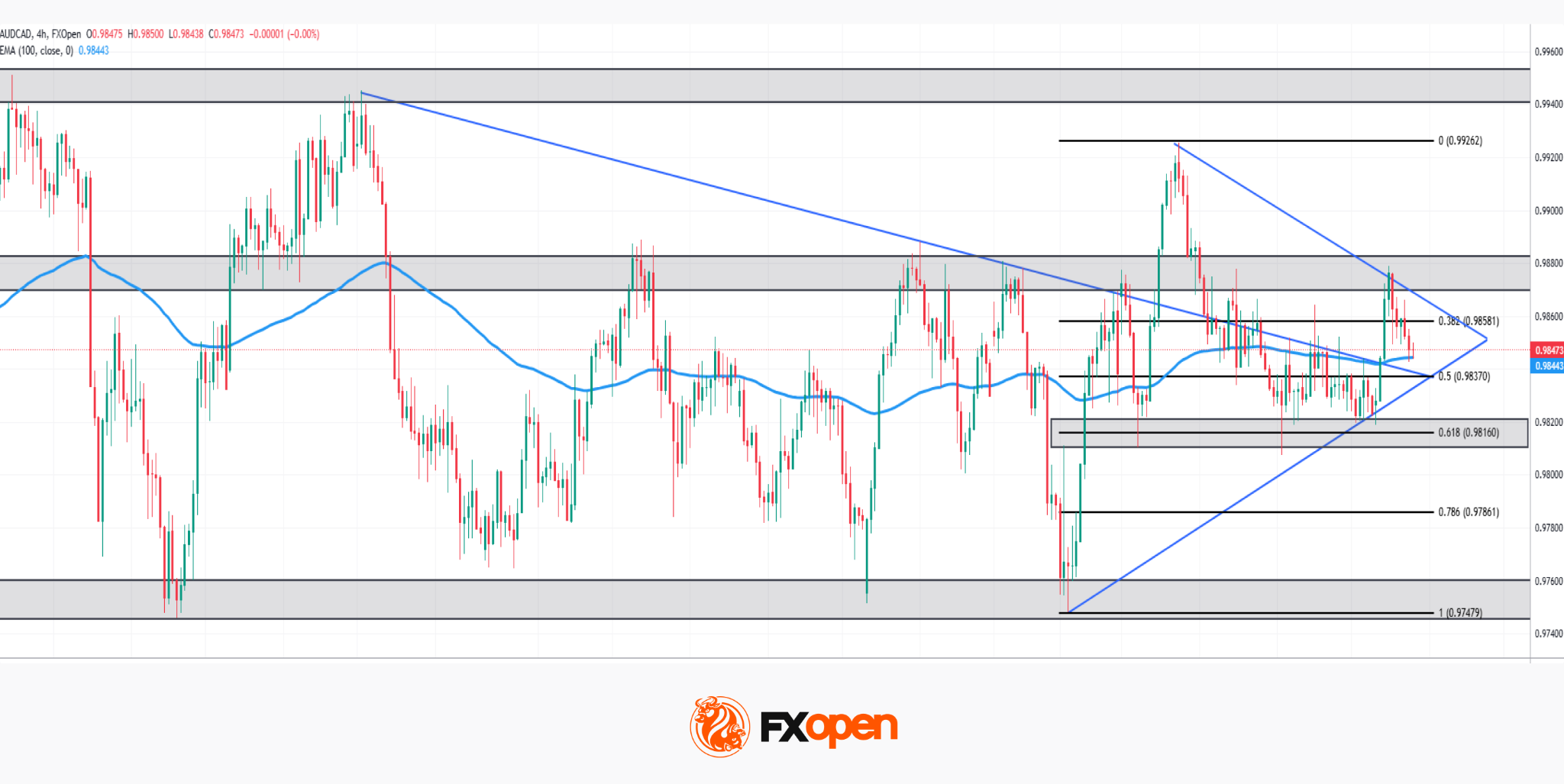
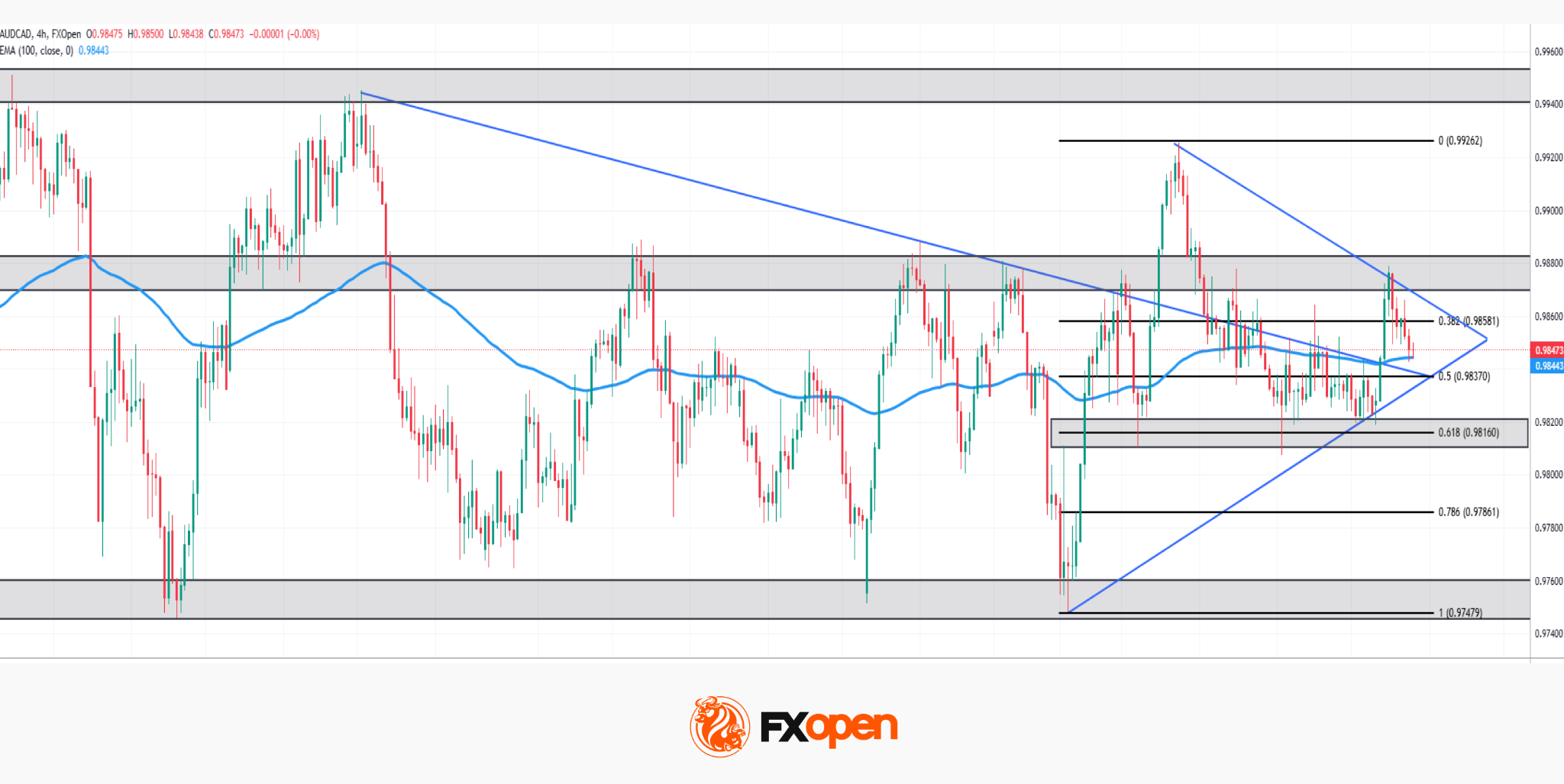
As the chart shows, AUD/CAD has been compressing into a symmetrical triangle since early August, with a descending trendline from the 0.9926 high converging with an ascending trendline off the 0.9748 low, both meeting right around current price near 0.9847, exactly where the 100-period EMA also sits.
Bullish Scenario
Should buyers break above the descending trendline and the 0.382 retracement near 0.9858, the path would open towards the 0 level at 0.9926, a confirmed breakout that would suggest genuine momentum returning to the pair.
Bearish Scenario
Conversely, a break below the ascending trendline and the 0.5 retracement near 0.9837 would expose the 0.618 level near 0.9816, with a deeper slide risking a retest of the 0.786 retracement around 0.9786, or even the 0.9748 low that anchored this entire structure.With price coiled right at the apex of this triangle, sitting exactly on the 100-period EMA, AUD/CAD looks primed for a decisive break, will the Aussie’s hawkish backing prove enough, or does the loonie’s stronger data ultimately win out?
Trade over 50 forex markets 24 hours a day with FXOpen. Take advantage of low commissions, deep liquidity, and spreads from 0.0 pips (additional fees may apply). Open your FXOpen account now or learn more about trading forex with FXOpen.
This article represents the opinion of the Companies operating under the FXOpen brand only. It is not to be construed as an offer, solicitation, or recommendation with respect to products and services provided by the Companies operating under the FXOpen brand, nor is it to be considered financial advice.


The newly authorized lenders will begin offering e-CNY services after completing operational and technical preparations.

As a writer, a university professor, artist, and designer, I worry about the risk that generative AI might destroy the delightful, human experience of carrying out acts of creation, not to mention making careers in the pursuit of that creativity unviable. Whether or not AI will improve work or destroy jobs, it already distances people from some of the moment-to-moment acts that might have felt gratifying just a few years ago. If AI can write your emails, then you don’t need to feel the click of keys under your fingertips or hear the clack they produce when you type with them. If AI can generate a gift list for the holidays or a vacation plan for Spring Break, then you don’t need to swipe through catalogs or thumb through guidebooks. In this way, AI can amplify the same dematerializing effects of technology people have encountered for years.
But that’s not the whole story. As critical of AI as I sometimes am, I have also found that AI can direct people back toward the physical world and the gratifying feelings it offers. LLMs can be quite adept at helping people figure out how to plan and carry out real-world tasks, such as fixing a plumbing leak, repairing a car, or learning a new hobby.
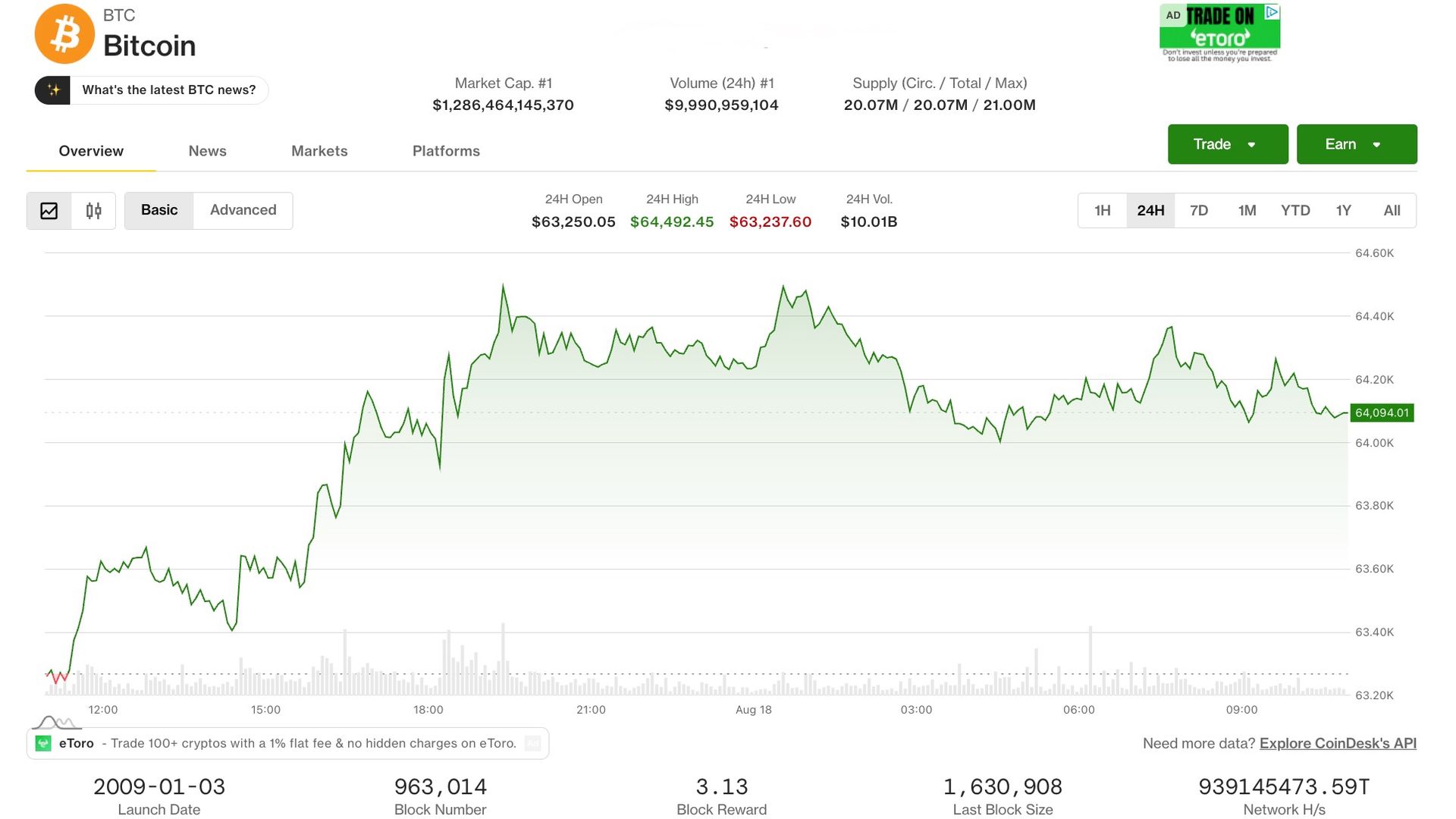
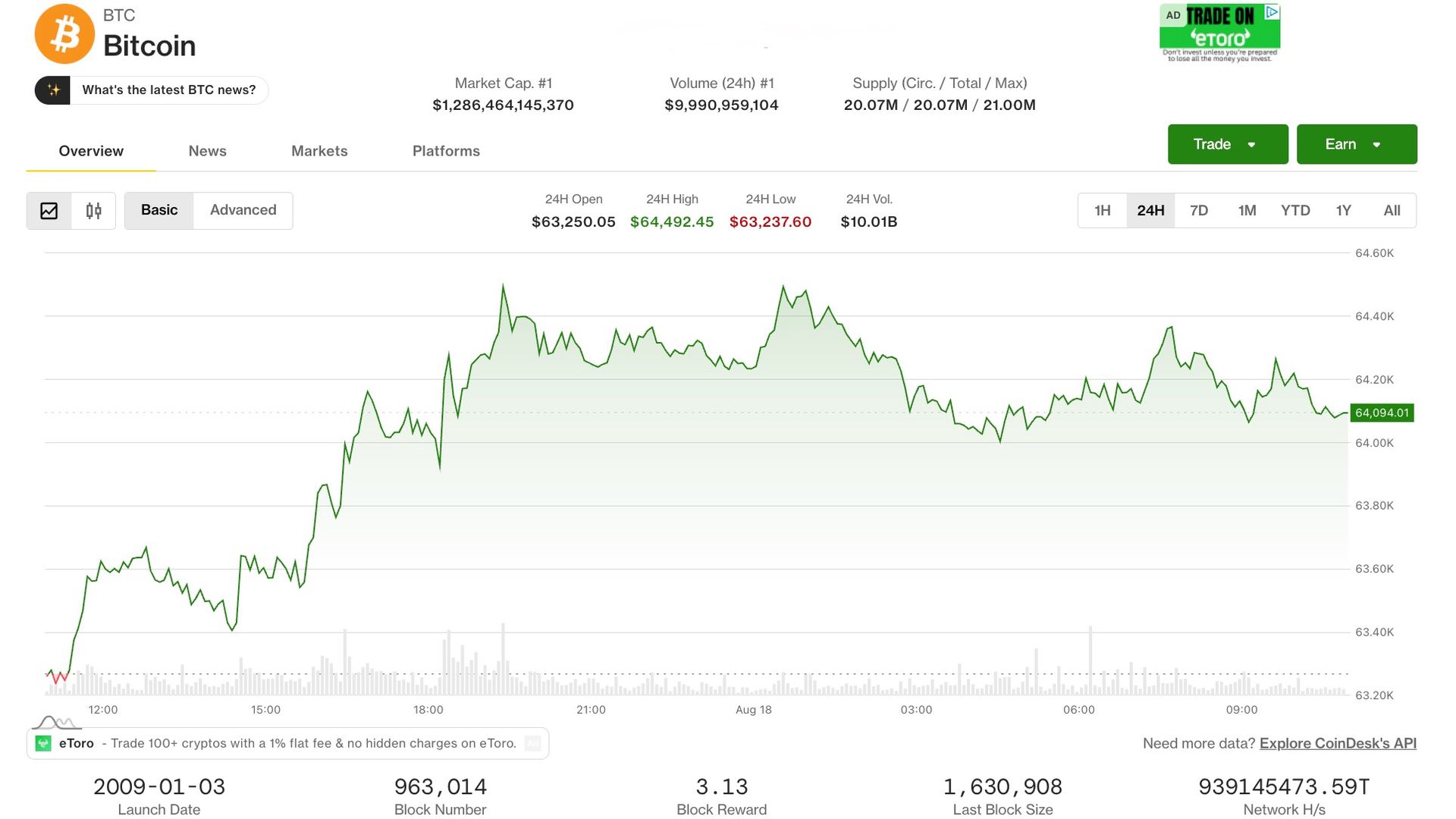
Bitcoin recently traded around $64,000, pausing after a rally that saw it rise from $62,600 on Monday. The largest cryptocurrency has dropped 0.6% since midnight UTC, trailing after Nasdaq 100 index futures, which lost 1.1% as U.S. Treasury bond yields and oil prices rose.
Ether lost around 1% since midnight and coins including SUI, XLM and TAO also dropped.
The increase in yields reflects unease ahead of the Federal Reserve minutes release due Wednesday after two consecutive softer inflation prints. Brent crude oil rose back to $94 per barrel after a 60-day US-Iran ceasefire expired Monday without a deal.
Also on Wednesday, U.S. President Donald Trump is expected to attend a meeting with crypto CEOs at the White House, with U.S. policy being a key driver of price action of late, contributing to the stop-start nature of bitcoin’s range-bound performance.
Derivatives positioning
- Taker ratio flips bullish: With BTC outperforming U.S. stocks on Monday, the long-short taker volume ratio in crypto futures flipped decisively from neutral to bullish, with longs accounting for over 51% of flow. Takers are traders who buy or sell at available prices, pulling liquidity from the order book.
- Funding rates confirm the chase for longs: BTC traders are chasing bullish bets, as evidenced by annualized perpetual funding rates surging to a 20-month high, according to data source CryptoQuant. Positive funding rates mean futures are trading at a premium to spot price, reflecting a bullish bias.
- BTC OI holds steady despite the move: Overall open interest (OI) in bitcoin futures remains near 750,000 BTC, a level it’s largely held for weeks.
- SOL sees a pickup in activity: OI in SOL futures rose to 66.88 million tokens, the most since July 10. Funding rates remain near zero.
- XLM shows a clear bearish tilt: The token has dropped nearly 3% to 15 cents since midnight, its lowest since May 27, reversing a pop to 27 cents at the end of May. Traders appear to be shorting the dip: OI in XLM futures rose 3.5% over the past 24 hours, the highest level since June 4. With annualized funding rates at -28%, that indicates a strong bearish bias. A negative 24-hour OI-adjusted cumulative volume delta (CVD) reinforces this picture, suggesting sellers are trading more aggressively via market orders rather than passive limit orders.
- Other notable OI movers: CC, DOGE and SUI are also among the notable OI gainers, though prices of all three are trading little-changed to negative. HBAR and CRO are notable OI losers.
- Bullishness looks selective, not broad-based: BTC is buoyant and showing buyer leadership, with a positive 24-hour CVD. Most of the other major cryptocurrencies, including ETH, SOL, LTC, LINK and DOGE, show negative CVD, suggesting the bullish sentiment is concentrated in BTC.
- Low volatility is inviting fresh positioning: Bitcoin and ether’s 30-day implied volatility indexes remain at the year’s lows. Trading firm TDX Strategies suggested using this low-vol environment to build tactical positioning favoring December optionality across BTC and select altcoins such as SOL and HYPE.
- Options flow leans toward upside bets: On Deribit, calls struck above BTC’s spot price continue to dominate 24-hour volume rankings. The $70,000-strike call expiring Sept. 25 is the most-traded bitcoin option of the past 24 hours. For ether, the $2,080 call expiring Aug. 28 leads.
Token talk
- PUMP rose 1.31%, holding a portion of Monday’s 7.8% surge that came alongside a 55% jump in daily trading volume to $90 million. The token has now stabilized above $0.00277.
- XMR added 0.59% since midnight to $417, taking the seven-day gain to more than 11%. The privacy coin has been one of August’s outperformers.
- SUI is the biggest laggard since midnight, sliding 4.62% to 64.36 cents, reversing a stretch of relative strength that had seen it outperform most layer-1s through late July.
- FET has shed 2.10% since midnight to 12.13 cents, extending a run of underperformance that has seen AI-adjacent tokens give back much of their late-July gains.
- LINK is down 1.45% at $9.39, retracing some of the gains that followed Standard Chartered’s prediction that called for it to rise by 2,000% by 2030. It remains up by 8% since that forecast.

Woman appears in court after two cops injured in Larkhall ‘hit and run’

How Investors Can Win The Strait of Hormuz: Oil, Tankers, And Gold

Zcash dips 1% as Ironwood adoption and futures demand strengthen


-

 Fashion4 days ago
Weekend Open Thread: Ann Taylor
-
 NewsBeat7 days ago
Communication cards help banking customers access services or report scams
-
 Sports4 days ago
This U.S. Amateur is a glimpse into golf’s future in more ways than you think
-

 Sports3 days ago
Birmingham 2026: Day 6 Timetable for Irish Athletes
-
 NewsBeat3 days ago
Myanmar says over 300,000 Rohingya refugees verified for repatriation as exodus enters ninth year
-

 Politics3 days ago
SEQ Code: The Three Letter Boarding Pass Code That Could Give You The Worst Seat
-
 Entertainment6 days ago
Keke Palmer Subtly Hints At Sean Evans Drama With Cryptic Post
-
 Tech4 days ago
11 Ways to Rank Your Videos
-

 Fashion7 days ago
Coffee Break: The Fonteyn Jane Flat
-

 Fashion7 days ago
Should you refinance your debt? Pros, cons, and real numbers
-

 Tech7 days ago
Zoom Screen-Sharing Bug Let People Fully Take Over Other Devices On A Call
-

 Fashion7 days ago
Claire Life: Kicking Off MVAAFF With the C Suite Luncheon Featuring Phylicia Rashad, Letoya Luckett, and More!
-
 Crypto World6 days ago
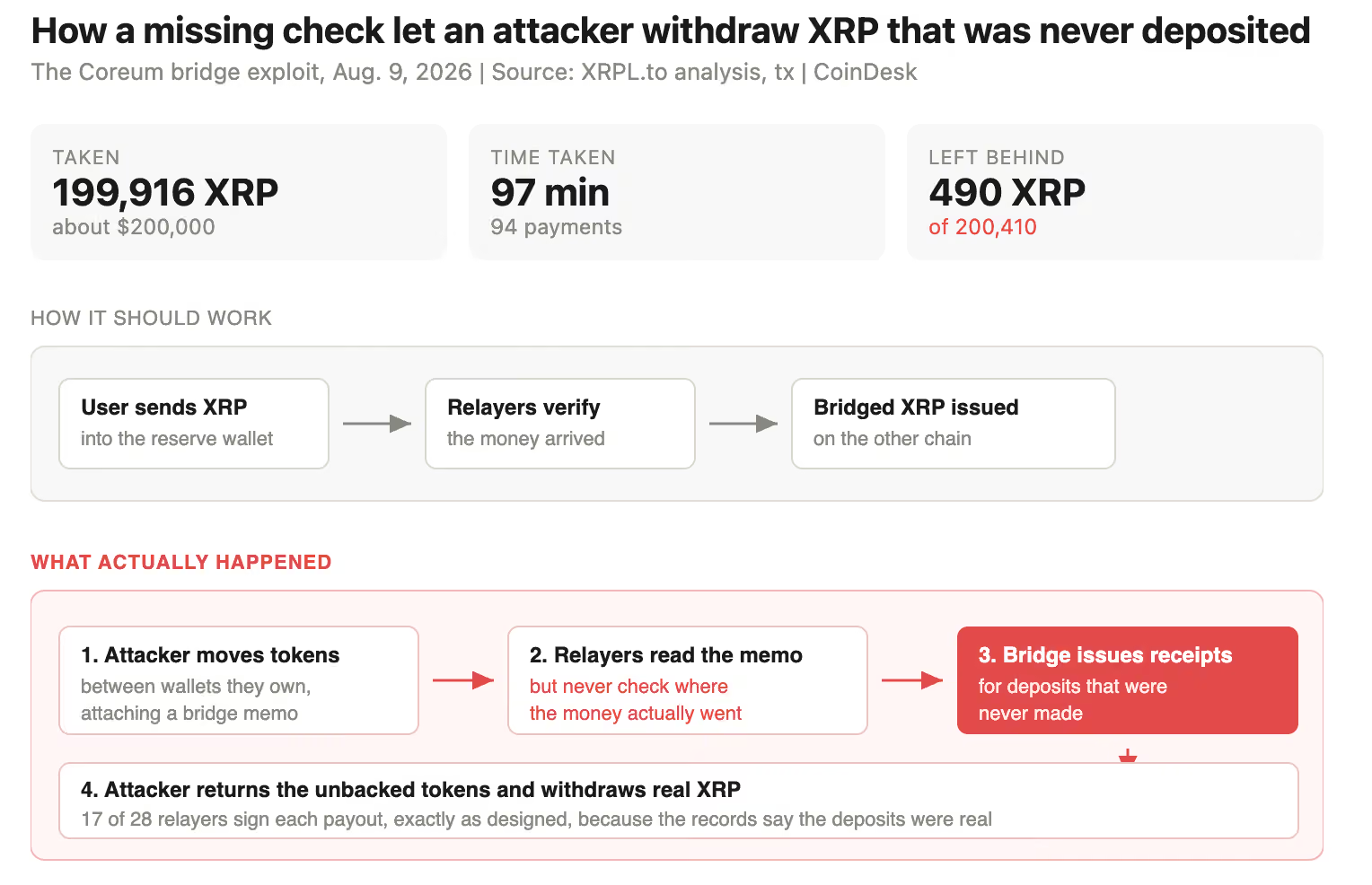
XRP bridge drained after software mistook fake deposits for real ones
-

 Tech5 days ago
DeepSeek Harness launches as open source rival to Claude Code, alongside V4-Pro on API with higher prices
-

 Sports6 days ago
DeQuan Jones in ‘high spirits’ after successful leg surgery
-

 Tech6 days ago
SpaceXAI’s Grok Bot turns agents into persistent digital coworkers that can operate your apps for $120-per-month
-

 Politics6 days ago
How Average Are You In The UK?
-
 Crypto World6 days ago
Perplexity AI Predicts an XRP Scenario Few Analysts Are Discussing
-

 Politics7 days ago
In the Chris Kaba case, the police watchdog capitulated to the mob
-

 Business6 days ago
Evolv Technologies Holdings, Inc. (EVLV) Q2 2026 Earnings Call Transcript
You must be logged in to post a comment Login