

Crypto World
Trump and Xi put AI on the Beijing summit agenda

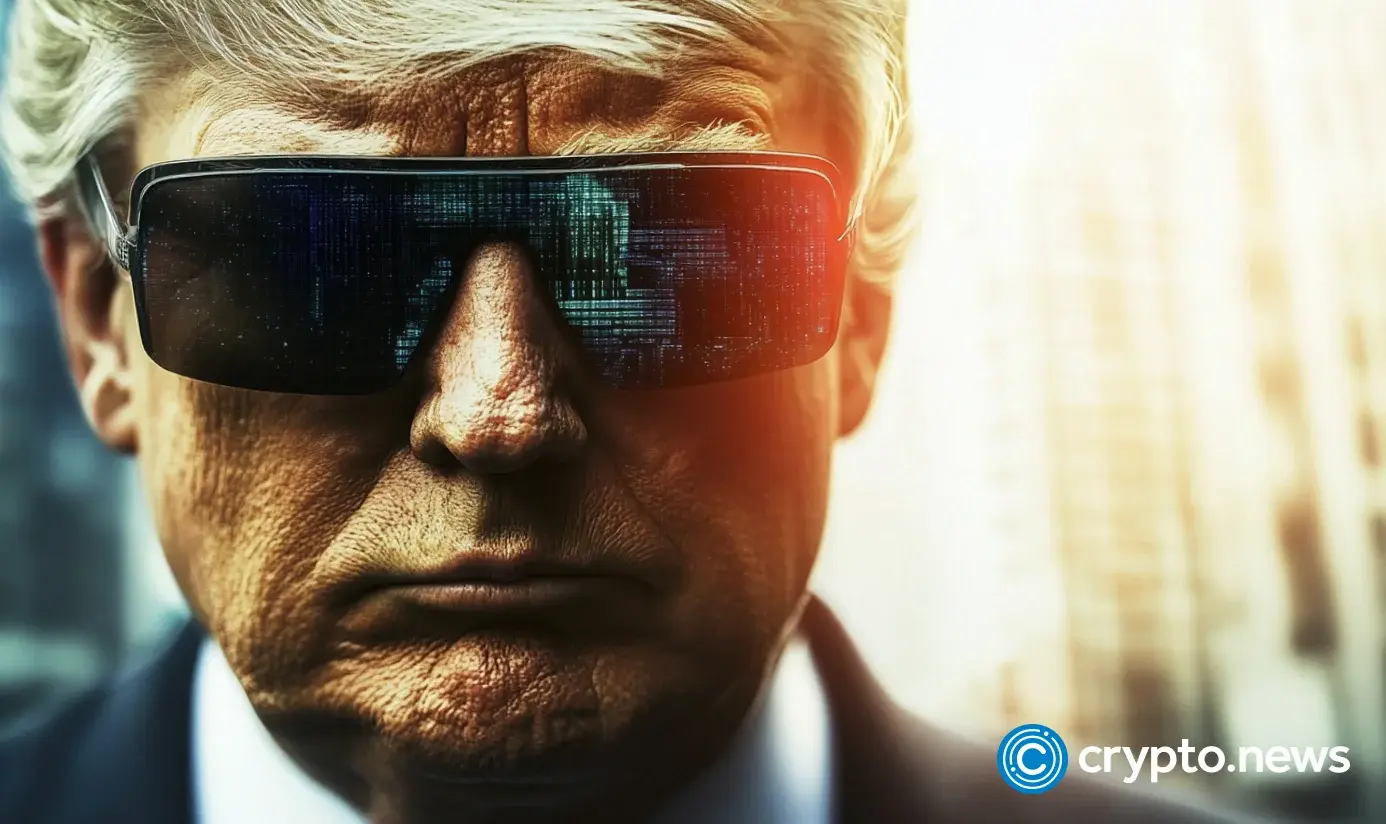
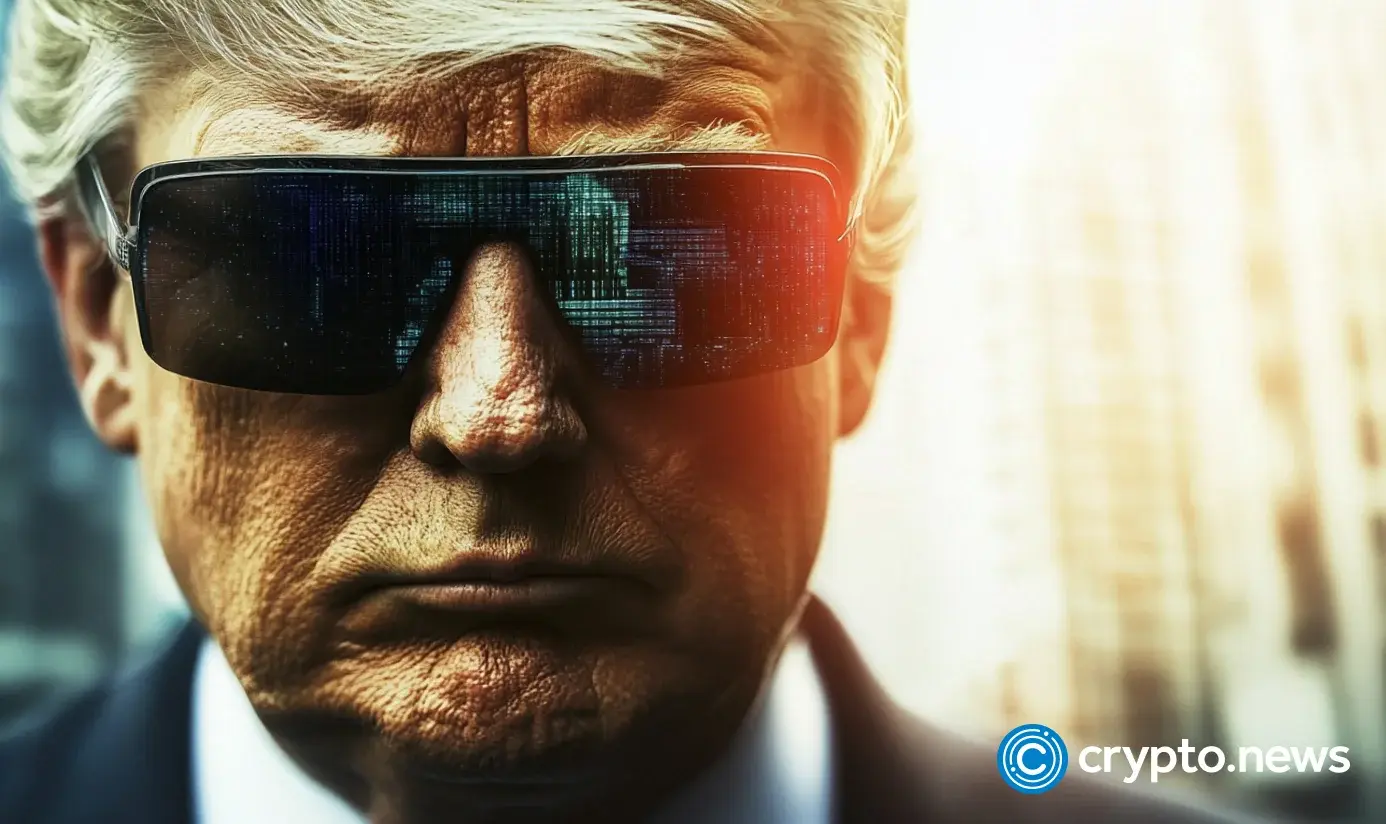
Trump and Xi may put AI risk talks on their May 14-15 Beijing summit agenda, US media reports said.
Summary
- The US and China are considering formal AI dialogue as part of the Trump-Xi summit in Beijing on May 14 and 15.
- Both sides are exploring a regular forum to address risks from unpredictable AI model behavior and autonomous military technologies.
- Analysts say Taiwan, trade, and rare earths will compete for summit time, with major breakthroughs considered unlikely.
The US and China are considering launching formal AI dialogue channels ahead of the Trump-Xi summit scheduled for May 14 and 15 in Beijing, according to multiple sources cited by The Wall Street Journal. The two sides envision a regular forum to address risks from unforeseen malfunctions in AI models.
The proposed dialogue would focus on risks from advanced AI systems, including unpredictable model behavior, autonomous military technologies, and misuse by non-state actors. The move signals that AI has risen from a background concern into a formal diplomatic priority between the world’s two largest economies.
What analysts expect from the summit
Analysts are urging low expectations for the summit. Jonathan Czin of the Brookings Institution warned that the US-China relationship remains “fragile,” defined more by an absence of friction than any affirmative agenda or deep dialogue on substantive differences.
On AI specifically, analysts say both governments could begin by opening official communication channels on AI risks, developing nonbinding safety guidelines, and sharing limited information about AI misuse or safety incidents. Trade, Taiwan, and rare earth access are also expected to dominate the agenda.
The White House accused China just weeks ago of running industrial-scale campaigns to steal US frontier AI models using tens of thousands of proxy accounts, adding a confrontational backdrop to any proposed AI safety dialogue.
Stanford’s 2026 AI Index found that the US performance advantage over China has nearly disappeared, with the leading American model ahead of the best Chinese model by just 2.7% on the Arena Leaderboard as of March 2026.
Why AI made the agenda
Both governments are considering formal AI discussions as part of the summit, an indication that AI development competition has emerged as a diplomatic priority alongside trade and security concerns. China-linked firms faced direct US scrutiny over alleged model theft in the weeks leading into the summit.
Trump’s trip to Beijing on May 14-15 would be the first visit by a US leader to China in almost a decade, as both sides attempt to stabilize a relationship strained by disputes over trade, Taiwan, technology controls, and the Iran conflict. Even a nonbinding AI safety declaration would mark the first structured bilateral framework on AI risk between the two powers.


Key Takeaways
- A markup hearing for the Digital Asset Market Clarity Act has been scheduled by the Senate Banking Committee for May 14
- Progress on the legislation halted earlier this year when Coinbase withdrew its backing due to concerns over stablecoin yield restrictions and DeFi provisions
- Senators Tillis and Alsobrooks negotiated a compromise on stablecoin yield regulations last week
- Major banking organizations remain skeptical and argue the bill requires additional refinement
- Senator Gillibrand is pushing for ethics safeguards to prevent government officials from profiting from crypto holdings
The Senate Banking Committee has officially scheduled May 14 for its markup session on the Digital Asset Market Clarity Act of 2025, commonly referred to as the Clarity Act. The proceedings are set to commence at 10:30 a.m.
This represents a critical milestone in the legislative journey of the bill. During a markup session, committee members examine, debate, and cast votes on proposed legislation prior to advancing it to the complete Senate chamber.
The legislation has experienced significant turbulence over recent months. Back in January, Coinbase CEO Brian Armstrong publicly announced the cryptocurrency exchange was withdrawing its endorsement. Armstrong cited multiple issues, including insufficient legal safeguards for developers working on open source software, prohibitions on stablecoin yield generation, and problematic decentralized finance regulations.
This withdrawal effectively brought the bill’s momentum to a standstill for several months.
Last week marked a turning point when Senators Thom Tillis and Angela Alsobrooks unveiled compromise language designed to resolve the stablecoin yield controversy. Under the proposed compromise framework, cryptocurrency platforms would be prohibited from paying yield on passive stablecoin reserves, while permitting rewards when stablecoins participate in active financial transactions.
Coinbase’s response to this development was enthusiastic. Paul Grewal, the company’s chief legal officer, shared on X: “It’s on like Donkey Kong.” Meanwhile, Faryar Shirzad, chief policy officer, characterized it as a “big step forward” and emphasized the bill’s critical importance for consumer protection and maintaining America’s leadership in crypto innovation.
Senator Cynthia Lummis, recognized as a prominent cryptocurrency advocate in the Senate, also expressed support, declaring on X: “Let’s pass the Clarity Act out of the Banking Committee on Thursday!”
Traditional Banking Sector Voices Reservations
Universal support remains elusive. A joint letter from multiple banking industry associations — including the American Bankers Association, the Bank Policy Institute, and the Independent Community Bankers of America — stated that “additional work is needed” on the bill’s wording. These organizations submitted detailed recommendations for modifying the compromise language unveiled last week.
Neverthstanding these reservations, the fact that a markup has been scheduled indicates Senate leadership is prepared to proceed with the legislation in its present form.
Debate Over Ethics Requirements Continues
Senator Kirsten Gillibrand, who has historically championed the cryptocurrency sector, has introduced an additional consideration. She is advocating for language in the bill that would prohibit senior government officials from financially benefiting from the crypto industry while simultaneously holding regulatory authority over it.
Polling data commissioned by CoinDesk revealed that 73% of registered US voters favor such restrictions.
Nevertheless, this ethics provision may be absent from the Senate Banking Committee’s iteration of the legislation. Following the Banking Committee’s markup process, the Senate must reconcile its version with the text produced by the Senate Agriculture Committee before the complete Senate body can hold a final vote.
Kara Calvert, Coinbase’s vice president of US policy, had forecast the markup timing during remarks at the Consensus 2026 conference just days prior. She additionally observed that the bill will require a minimum of 60 votes and bipartisan cooperation to secure passage.

Crypto World
This Week in Crypto: $1M Bitcoin Forecast, Senate CLARITY Vote, and Coinbase Losses Mount
Key Highlights
- Matthew Sigel from VanEck forecasted Bitcoin reaching $1 million over the next five years, drawing parallels to the video gaming sector’s expansion
- The Senate Banking Committee has scheduled May 14 for CLARITY Act deliberations, aimed at establishing clear definitions for crypto token categorization
- DTCC continues developing its tokenization initiative with collaboration from over 50 major financial institutions
- Coinbase reported its second consecutive quarterly deficit at $394.1 million, while revenues declined from $2.03 billion to $1.43 billion year-over-year
- Tether has frozen more than $514 million worth of USDT tokens on Ethereum and Tron networks during the last month
VanEck Executive Forecasts Seven-Figure Bitcoin Price Within Five Years
Matthew Sigel, who leads digital assets research at VanEck, made headlines this week by projecting Bitcoin could surge to $1 million over the coming five-year period.
The forecast garnered significant attention due to its source—a prominent institutional asset management firm rather than speculative social media voices.
Sigel’s thesis centers on the observation that millennial and Gen Z investors are progressively allocating larger portions of their portfolios toward cryptocurrency. He drew an analogy between Bitcoin’s adoption trajectory and the explosive expansion the video gaming industry experienced over past decades.
Bitcoin’s notorious price swings mean any seven-figure valuation scenario requires several conditions: broader mainstream acceptance, heightened institutional participation, and favorable macroeconomic conditions.
The statement contributes to ongoing debates about Bitcoin’s place in diversified investment strategies, particularly as exchange-traded funds and traditional money managers deepen their crypto market engagement.
Senate Banking Panel Sets CLARITY Act Hearing for Mid-May
According to Reuters reporting, the Senate Banking Committee has placed the CLARITY Act on its calendar for May 14 consideration.
The proposed legislation seeks to establish definitive guidelines determining whether digital tokens qualify as securities or commodities, while delineating regulatory authority among federal agencies.
A provision attracting considerable debate involves stablecoin yield restrictions. The current draft would prohibit platforms from offering rewards on dormant stablecoin balances while permitting incentives tied to active transactions.
This distinction carries weight because traditional banking institutions and cryptocurrency companies are debating whether stablecoins might siphon deposits from conventional financial institutions.
How the CLARITY Act review proceeds could establish the regulatory framework governing American crypto markets for the foreseeable future.
DTCC Broadens Digital Asset Initiative With Major Financial Players
The Depository Trust and Clearing Corporation has grown its blockchain-focused working group, which now incorporates expertise from more than 50 financial sector participants.
According to DTCC’s announcement, the collaborative effort concentrates on testing operational procedures and achieving cross-chain compatibility—two critical obstacles for tokenized financial instruments.
This development transcends the cryptocurrency ecosystem’s traditional boundaries. Established financial infrastructure providers are now seriously investigating blockchain applications for settlement processes, collateral administration, and securities handling.
Coinbase Suffers Back-to-Back Quarterly Deficits
Coinbase disclosed a $394.1 million net loss this week, marking its second straight quarter in the red.
Total revenue contracted to $1.43 billion from $2.03 billion recorded during the corresponding period last year. Transaction-based revenue plummeted 40% to reach $756 million.
The financial performance underscores how critically cryptocurrency exchanges rely on robust trading volumes. During market slowdowns, income streams contract dramatically.
Coinbase has pursued diversification through subscription services, stablecoin operations, derivatives products, and prediction markets, yet sluggish spot trading activity continues weighing on overall performance.
Tether Locks More Than Half a Billion USDT in One Month
Tether has frozen upward of $514 million in USDT tokens distributed across Ethereum and Tron blockchain addresses during the previous 30-day window, based on BlockSec data.
These freezing actions demonstrate the expanding enforcement role stablecoin issuers assume in cryptocurrency compliance and asset recovery operations.
Some observers interpret this as evidence that stablecoins are evolving toward greater regulatory compliance and cooperation with law enforcement agencies. Critics, however, question the implications of centralized authority over supposedly decentralized financial transactions.
Tether’s recent activity represents among the most extensive enforcement-related freezing campaigns the stablecoin issuer has executed in recent history.
Key Takeaways
- On May 7, U.S. Bitcoin spot ETFs experienced $277 million in net withdrawals, breaking a five-consecutive-day accumulation pattern
- IBIT from BlackRock recorded a single-day withdrawal of $98 million; Fidelity’s FBTC experienced consecutive outflow days
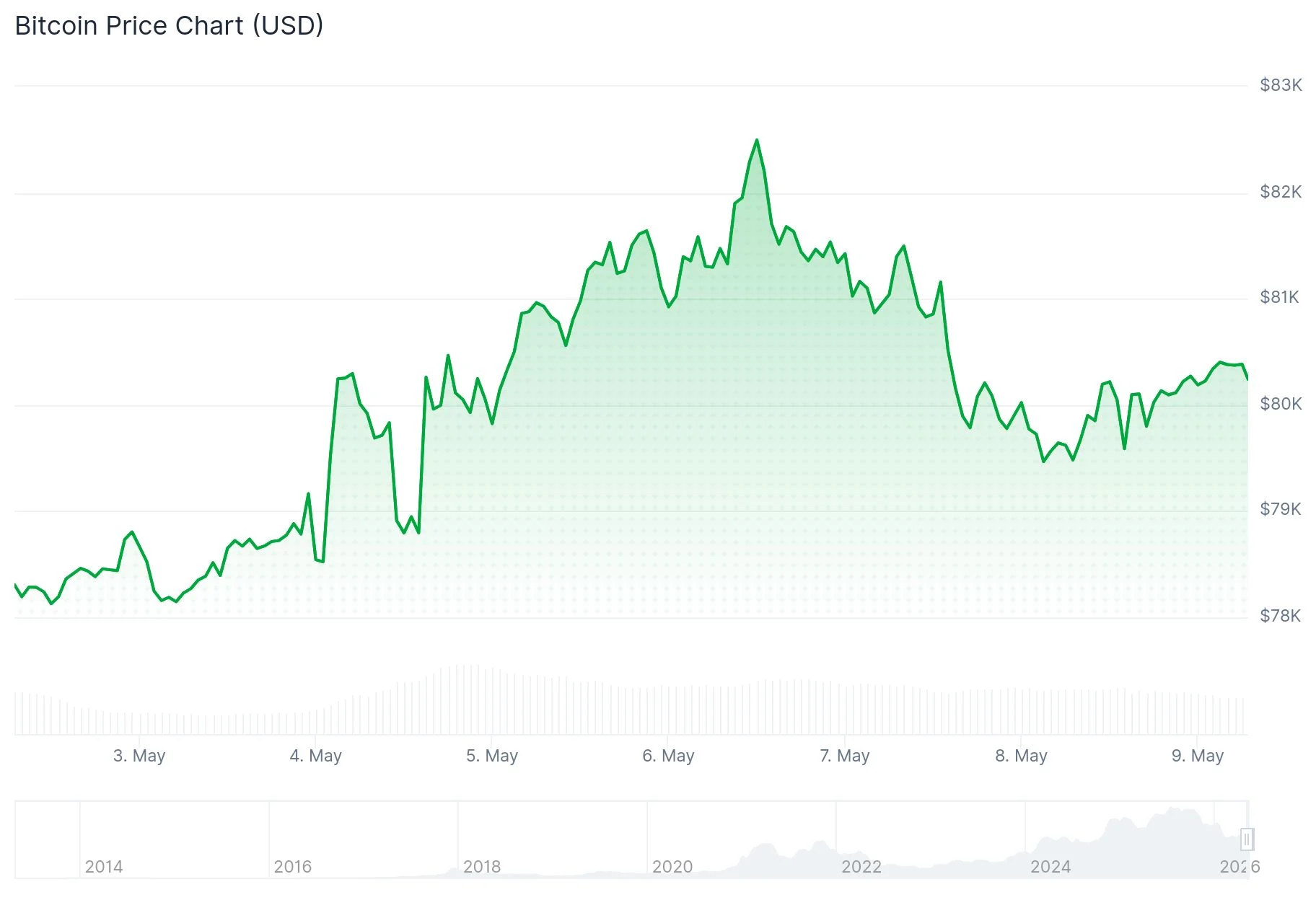
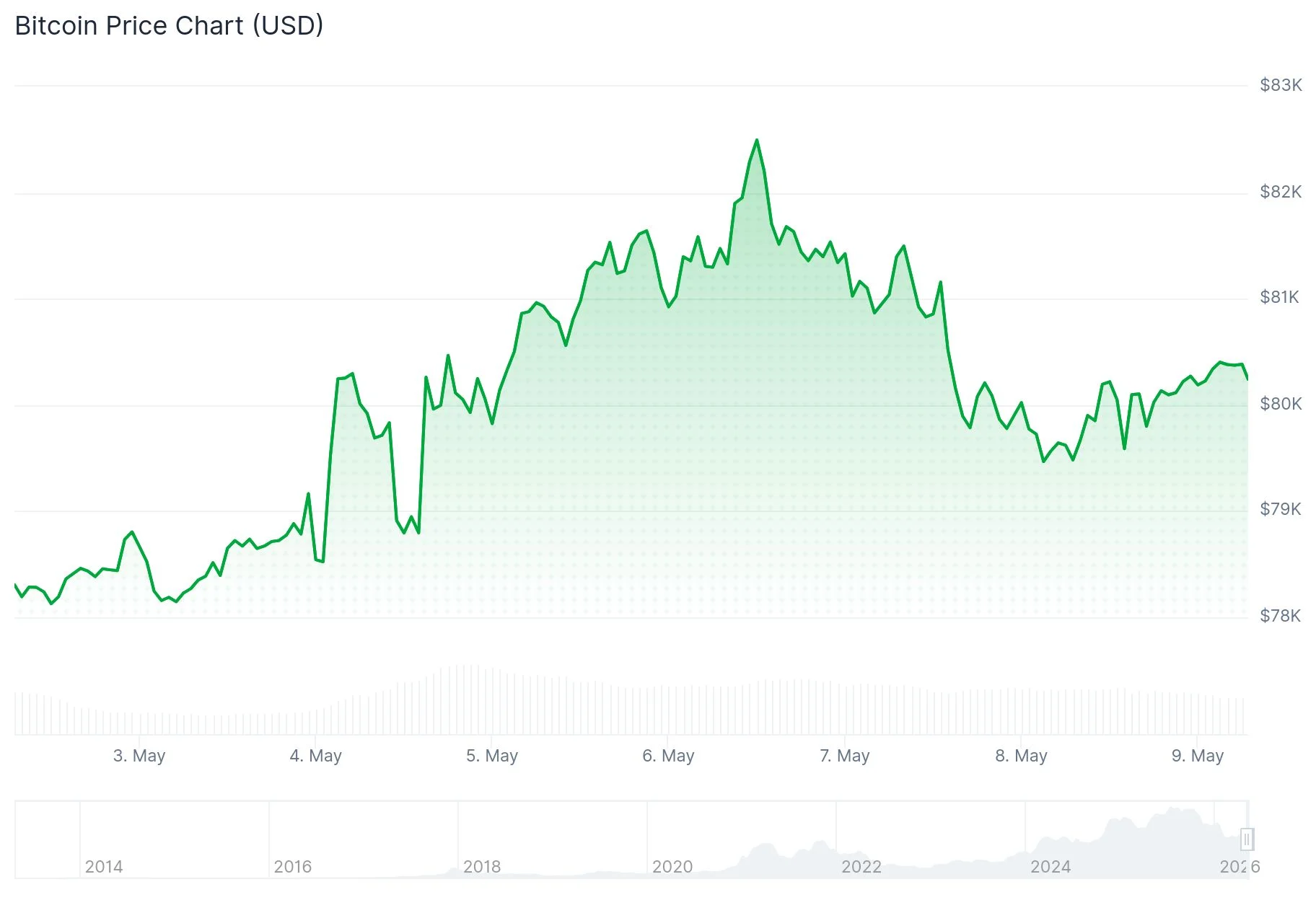
- Bitcoin retreated from $80,000 following rejection at the $82,000–$82,500 resistance level
- Coinbase and Robinhood reported revenue declines of 31% and 47% respectively in crypto operations, signaling diminished retail participation
- Dollar weakness and speculation surrounding a Strategic Bitcoin Reserve maintain long-term bullish sentiment
The streak of capital flowing into U.S. Bitcoin exchange-traded funds came to an abrupt halt on May 7, with institutional investors pulling $277.5 million from spot products. This reversal ended a remarkable accumulation phase that had attracted more than $1.6 billion since the beginning of May.
The iShares Bitcoin Trust (IBIT) from BlackRock experienced its largest single-day redemption, with $98 million exiting the fund. This marked a sharp contrast to the preceding five trading sessions, during which IBIT accumulated more than $1 billion in Bitcoin exposure. Despite the outflow, the fund maintains approximately $75.8 billion in total holdings.
Fidelity’s Wise Origin Bitcoin Fund (FBTC) witnessed outflows for the second consecutive session, with combined withdrawals reaching $167.94 million over the two-day period. The fund currently manages $15.24 billion in assets.
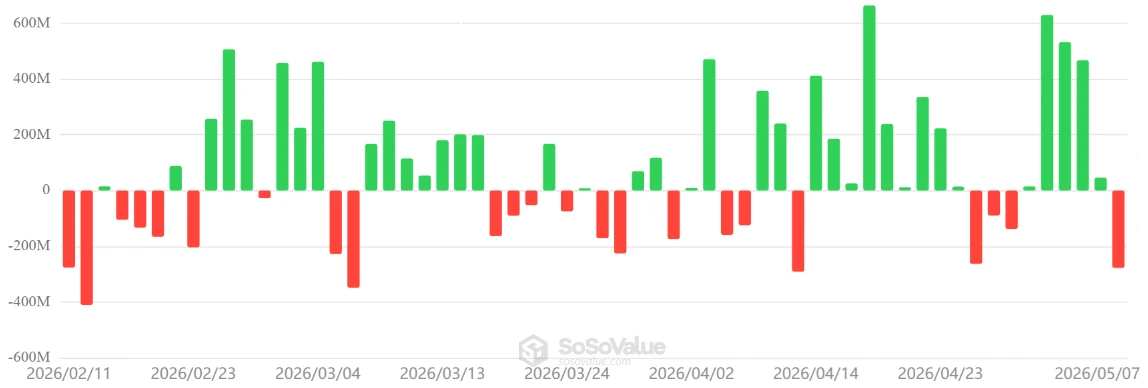
Collectively, the universe of U.S. spot Bitcoin ETFs maintains approximately $106.77 billion in Bitcoin holdings.
Bitcoin’s price action on Friday showed consolidation in the $79,700–$80,180 range, following a rejection at the $82,000–$82,500 resistance zone earlier in the week. The pullback triggered liquidations of leveraged long positions totaling approximately $270 million in a 24-hour window.
Weakening Retail Participation
Quarterly earnings reports from leading cryptocurrency platforms revealed declining retail engagement. Coinbase disclosed a 31% revenue contraction compared to the first quarter of 2025. Meanwhile, Robinhood’s cryptocurrency segment experienced a steeper 47% decline during the same timeframe.
Jake Kennis, who serves as senior research analyst at Nansen, observed that Bitcoin’s push above $81,000 was primarily fueled by institutional spot acquisitions and forced short closures — with minimal retail trader involvement. Notably, funding rates remained subdued throughout the price advance.
Lacie Zhang, research analyst at Bitget Wallet, suggested that absent a revival in retail interest, Bitcoin could face downward pressure toward the $75,000–$78,000 support range.
Data from major exchanges showed shifting sentiment among sophisticated traders. Top-tier Binance traders reduced their Bitcoin long exposure to levels not seen in more than four weeks. At OKX, the long-to-short ratio among leading traders plummeted to 0.27, a dramatic decline from 1.20 recorded just ten days prior.
Broader Economic Context: Employment Figures and Currency Weakness
The April U.S. nonfarm payrolls report delivered 115,000 new jobs — substantially exceeding the anticipated 62,000. Additionally, March figures were revised upward to 185,000. The unemployment rate remained steady at 4.3%.
While the robust employment data supported short-term risk appetite, the Federal Reserve’s capacity to implement rate cuts remains constrained by ongoing energy-related inflationary pressures.
The U.S. dollar has experienced depreciation against major global currencies over the past two months. Market analysts suggest this dynamic diminishes the attractiveness of U.S. Treasuries and may redirect capital toward scarce digital assets like Bitcoin.
Geopolitical tensions resurfaced as uncertainties regarding a U.S.-Iran ceasefire intensified. Iranian authorities alleged that Washington violated previously agreed-upon terms, while reports of renewed military action near the Strait of Hormuz drove crude oil prices higher on Friday.
In related developments, Kevin Warsh is anticipated to succeed Jerome Powell as Federal Reserve Chair. Warsh has publicly expressed favorable views toward Bitcoin and recently disclosed personal investments in cryptocurrency assets and industry-related companies.
Polymarket prediction markets indicate increasing probability that the U.S. Strategic Bitcoin Reserve could commence BTC accumulation by 2027.
According to CryptoQuant data, Bitcoin held on exchanges decreased by 9,832 BTC between May 1 and May 9, declining from 2,686,423 to 2,676,591.


Perché scegliere un bookmaker non AAMS affidabile?
Molti scommettitori italiani si chiedono se abbia senso puntare su un bookmaker non AAMS. La risposta è sì, a patto di selezionare solo operatori che dimostrino solidità, licenze internazionali riconosciute e una reputazione positiva tra i giocatori. Un bookmaker non AAMS affidabile può offrire quote più competitive, promozioni più generose e una gamma più ampia di mercati sportivi rispetto ai siti regolamentati dall’AAMS.
Il vantaggio principale è la libertà di scegliere tra più valute, metodi di pagamento e, spesso, un’esperienza di gioco più fluida. Tuttavia, la mancanza di una supervisione locale implica che il giocatore debba essere più attento a valutare la licenza, il supporto e le policy di sicurezza prima di depositare i propri fondi.
Come verificare l’affidabilità di un bookmaker non AAMS
Licenze internazionali e regolamentazioni
Le licenze più riconosciute sono quelle rilasciate da Malta Gaming Authority (MGA), United Kingdom Gambling Commission (UKGC) e Curacao eGaming. Controllare il numero di licenza sul sito dell’operatore è il primo passo: una licenza valida garantisce che il bookmaker segua standard di sicurezza, protezione dei dati e fair play.
Un altro indicatore di affidabilità è la presenza di audit indipendenti, solitamente effettuati da eCOGRA o iTech Labs. Queste entità testano i generatori di numeri casuali (RNG) e verificano che le percentuali di payout siano conformi a quanto pubblicizzato.
Le offerte di benvenuto sono spesso il biglietto d’ingresso più allettante, ma è fondamentale leggere le clausole. Tra gli elementi da valutare troviamo i requisiti di scommessa (wagering requirements), i giochi ammessi al conteggio del turnover e le limitazioni temporali.
Ecco una checklist rapida da usare prima di accettare un bonus:
- Percentuale di rollover (es. 30x)
- Giochi su cui il bonus è valido (solo slot o anche sport)
- Limiti massimi di vincita derivante dal bonus
- Scadenza del bonus e della quota di scommessa
Metodi di pagamento e velocità di prelievo
Un bookmaker non AAMS affidabile deve offrire diverse opzioni di deposito e prelievo, dal tradizionale bonifico bancario alle carte di credito, fino ai portafogli elettronici più diffusi. La velocità di pagamento è cruciale: pochi giorni per un prelievo possono rovinare l’esperienza, mentre i pagamenti istantanei aumentano la fiducia.
Di seguito una tabella comparativa dei metodi più comuni e dei tempi medi di elaborazione:
| Metodo | Deposito (tempo) | Prelievo (tempo) | Commissioni |
|---|---|---|---|
| Carte di credito/debito (Visa, MasterCard) | Immediato | 1‑3 giorni lavorativi | 0 % |
| Portafogli elettronici (Skrill, Neteller) | Immediato | Fino a 24 ore | 0‑2 % |
| Bonifico bancario | 1‑2 giorni | 2‑5 giorni lavorativi | 0 % |
| Paysafecard | Immediato | Non supportato per prelievi | 0 % |
Registrazione, verifica dell’identità (KYC) e sicurezza
La procedura di registrazione su un bookmaker non AAMS è spesso più rapida rispetto ai siti italiani, ma la verifica KYC rimane obbligatoria per prelievi superiori a una certa soglia. Documenti tipici richiesti sono una carta d’identità, un passaporto o una patente, accompagnati da una bolletta recente per confermare l’indirizzo.
Per garantire la sicurezza dei dati, scegli operatori che usano protocolli SSL a 256 bit e che abbiano politiche di privacy conformi al GDPR. Un ulteriore segnale di affidabilità è l’autenticazione a due fattori (2FA) per l’accesso al conto.
Esperienza mobile e app per scommesse sportive
Oggi la maggior parte dei giocatori utilizza lo smartphone per piazzare le proprie scommesse. Un bookmaker non AAMS affidabile deve offrire un’app dedicata per iOS e Android, ottimizzata per velocità, stabilità e accessibilità.
Caratteristiche da cercare nell’app:
- Interfaccia intuitiva e caricamento rapido
- Notifiche push per quote live e promozioni
- Supporto per deposito e prelievo direttamente dal dispositivo
- Sezione “responsible gambling” con limiti di deposito e autoesclusione
Assistenza clienti e supporto multilingua
Un servizio di assistenza disponibile 24/7 è fondamentale, soprattutto quando si scommette su eventi live. I canali più comuni sono chat live, email e, in alcuni casi, supporto telefonico. Verifica sempre la rapidità di risposta e la competenza degli operatori.
Molti bookmaker non AAMS offrono supporto in inglese, spagnolo, francese e, in misura minore, in italiano. Se la lingua è un ostacolo, cerca un operatore che fornisca FAQ dettagliate tradotte nella tua lingua.
Gioco responsabile e strumenti di protezione
La responsabilità del giocatore è una priorità anche per i bookmaker non AAMS. Strumenti come limiti di deposito giornalieri, settimanali o mensili, autoesclusione temporanea e la possibilità di impostare promemoria di tempo di gioco aiutano a mantenere il controllo.
Alcuni operatori collaborano con organizzazioni di supporto al gioco problematico, offrendo link a linee di assistenza e materiale informativo. Scegliere un bookmaker che promuove attivamente il gioco responsabile è un segno di serietà e affidabilità.
Confronto rapido di alcuni bookmaker non AAMS consigliati
Di seguito una panoramica sintetica dei bookmaker non AAMS più affidabili per gli utenti italiani, basata su licenza, bonus di benvenuto, velocità di prelievo e supporto mobile.
| Bookmaker | Licenza | Welcome Bonus | Tempo medio prelievo | App mobile |
|---|---|---|---|---|
| BetMaster | MGA | 100 % fino a €200 + 20 free bet | Fino a 24 h | iOS & Android |
| SportWin | UKGC | 150 % fino a €300 | Fino a 12 h | App dedicata |
| LuckyBet | Curacao | 50 % fino a €100 + 10 free spin | 2‑3 giorni | Web‑responsive |
Per vedere una lista aggiornata di casinò non ADM, visita il nostro portale casino non ADM. Ricorda che la scelta finale dipende dalle tue preferenze personali: quote, sport disponibili, bonus e soprattutto la sensazione di sicurezza che percepisci durante la navigazione.


After Bitcoin pushed into the $82,000–$83,000 band, short‑dated implied volatility has bounced from late‑2025 lows, with a roughly $2 billion short‑gamma pocket around $82,000 turning dealer hedging into a potential amplifier of every move.
Summary
- After Bitcoin pushed into the $82,000–$83,000 band, short-dated implied volatility has rebounded sharply, with 1‑week IV up about 6 vol points from its October 2025 lows, signaling renewed demand for short-term optionality.
- Glassnode says the 25‑delta skew is compressing toward neutral and the volatility risk premium has flipped positive, meaning options now price higher future volatility than the spot market has recently realized and short-term bearish hedging demand has weakened.
- A roughly $2 billion short gamma cluster around $82,000 and heavy call‑selling (81% of past‑day flow) suggest dealer hedging could amplify near-term price swings even as positioning tilts toward consolidation rather than panic.
On-chain analytics firm Glassnode notes that after Bitcoin (BTC) broke key resistance and traded into the $82,000–$83,000 area, options markets “snapped back to life,” with front-end implied volatility climbing meaningfully from cyclical lows. Studio data show at‑the‑money 1‑week implied volatility near 52% at the end of March, versus mid‑40s readings seen during the October 2025 lull, implying about a 6‑point rebound in short-dated IV as traders re-engage with near-term options.
At the same time, the classic 25‑delta skew — the gap between put and call IV at 25‑delta — has compressed toward zero across key tenors. Glassnode’s skew dashboards show BTC’s normalized 1‑week 25D skew near 10.5% in late March, down from more extreme put‑heavy readings seen during prior drawdowns, while an updated IBIT-specific 25D skew series is hovering close to flat for 1‑week maturities. In practice, that means traders are no longer willing to pay a steep premium for downside puts; demand for short‑term bearish hedges has faded as spot grinds higher and realized volatility stays contained.
Volatility risk premium turns positive
Crucially for options desks, Glassnode points out that the volatility risk premium has turned positive again. In other words, the implied volatility embedded in options prices has risen above the level of realized volatility observed in the spot market, reversing the deeply discounted IV regime that prevailed during the late‑2025 chop. Product updates published in January and December describe this as a central signal: when VRP is positive, option sellers can once again collect a premium for warehousing volatility risk, and buyers must pay up for tail protection or leveraged convexity.
Glassnode’s Week‑18 “Bulls Approach the Ceiling” note adds that the recent move has been driven mainly by the front end of the curve. One‑week and one‑month IV have repriced “sharply,” while three‑ and six‑month maturities are only up 1–2 vol points, reflecting “a short-term re-engagement in optionality without a broader shift in long-dated volatility expectations.” That term‑structure shape — steeper at the front, relatively anchored at the back — fits a market that expects choppy action around $80,000–$85,000 rather than a new secular regime shift.
$2 billion gamma short at $82,000 and heavy call selling
Positioning is where this becomes reflexive. Glassnode highlights a concentrated short‑gamma pocket around the $82,000 strike, with options open interest implying nearly $2 billion of negative gamma exposure in that region. As a separate Binance research post on the $80,000–$82,000 “gamma wall” explains, when dealers are short gamma at a given strike, they are forced to buy BTC as price rises and sell as it falls in order to stay delta‑neutral. That hedging pattern can mechanically amplify volatility: once spot trades into the cluster, relatively small moves can trigger disproportionately large hedge flows, exaggerating both squeezes and flushes around the level.
Glassnode adds that the last 24 hours of BTC options flow have been dominated by call overwriting, with “selling call options accounting for 81% of trading flow,” a clear sign that some traders are locking in profits rather than paying up for further upside. Combined with the neutralizing skew and positive VRP, that flow mix points to a market leaning toward consolidation and yield generation — selling topside volatility into strength — rather than panicked demand for downside insurance.
For directional crypto traders, the message is double‑edged. On the one hand, diminished put skew and a positive VRP are typical of late‑stage rallies that are still intact but maturing. On the other, the $2 billion gamma short cluster around $82,000 means that any decisive break above or below that zone could trigger mechanically driven volatility spikes, making the next leg as much about dealer hedging reflexes as about fundamentals.

Switzerland’s bid to compel the central bank to hold Bitcoin appears to have fallen short of a nationwide referendum. Organizers reported they gathered roughly half the 100,000 signatures required under Swiss law, a threshold they could not meet, according to Reuters.
The proposal would have amended the Swiss constitution to mandate the Swiss National Bank (SNB) hold Bitcoin alongside gold and foreign currency assets. The SNB has long opposed adding digital assets to its reserves, arguing that cryptocurrencies do not meet reserve-management standards due to volatility and liquidity concerns. Reuters cited the central bank’s persistent stance as a major hurdle for the initiative.
Campaign founder Yves Bennaim told Reuters the effort was always unlikely to succeed, but he said it still advanced the debate about Bitcoin’s place in global finance. Supporters argued that including Bitcoin could help diversify Switzerland’s reserves away from dollar- and euro-denominated assets, which Reuters noted account for roughly three-quarters of the SNB’s foreign currency holdings.
Key takeaways
- Swiss petition to force the SNB to hold Bitcoin failed to reach the required signatures for a national vote, signaling the practical difficulty of altering central-bank mandate through a popular referendum.
- The SNB has consistently opposed crypto inclusion in its reserves, citing volatility and liquidity risks that complicate sovereign-level risk management.
- Despite the setback in Switzerland, debates over Bitcoin’s role in sovereign reserves continue, with El Salvador and Bhutan cited as notable, though divergent, examples of government engagement with BTC.
- The broader trend remains cautious: while corporations embraced Bitcoin treasuries in 2025, sovereign adoption remains limited and uneven, reflecting regulatory, logistical, and political considerations.
- In the United States, a separate strategic posture toward Bitcoin has surfaced through an executive action establishing a Strategic Bitcoin Reserve, signaling a long-term, budgetary-strategy-oriented approach to digital assets.
Swiss bid tests the boundaries of monetary policy and crypto politics
The Swiss campaign aimed to constitutionalize a new reserve rule, aligning the SNB’s asset mix with the volatility-conscious framework central banks typically maintain. While the idea of a Bitcoin-inclusive reserve sparked debate about how a modern monetary authority could react to digital assets, the practical path to constitutional change proved blocked by signature collection hurdles and a central bank reticence that resonates with many policymakers worldwide.
Observers note that proponents framed Bitcoin as a potential hedge against traditional fiat exposure, while skeptics highlighted liquidity constraints, price swings, and the governance challenges that come with managing a state-level cryptocurrency position. The SNB’s stance remains rooted in risk management principles that prioritize stable, liquid assets for foreign reserves. A failed referendum does not eliminate the wider discussion, but it does curb the immediacy of a constitutional pivot in Switzerland.
For investors and markets, the episode reinforces the message that sovereigns continue to weigh the costs and benefits of crypto exposure at the central-bank level, distinct from the corporate treasury plays that gained traction in earlier years. The Swiss case also underscores how public appetite for bold monetary experiments can be tempered by institutional caution and the practical realities of reserve management.
Global trend: sovereigns toe the line on Bitcoin reserves
The year 2025 marked a notable wave of corporate treasuries embracing Bitcoin as a crypto-forward treasury tool, but sovereign adoption has remained deliberately restrained. El Salvador stands out as the most explicit national experiment, having incorporated Bitcoin into its policy framework and holdings. BitcoinTreasuries.com data indicate El Salvador currently holds 7,645 BTC as part of its sovereign approach, reflecting a deliberate, policy-driven accumulation strategy rather than opportunistic purchases.
Bhutan, often cited for its ambitious, hydro-powered crypto agenda, built much of its early BTC exposure through state-backed mining operations that leveraged surplus renewable energy to develop a digital economy. However, recent data from Arkham Intelligence shows a notable shift in Bhutan-related activity, with wallets linked to the country reporting a sizable reduction in reserves—from around 13,000 BTC at the end of 2024 to roughly 3,654 BTC by April 2026, following a sequence of large transfers and what appears to be asset-rotation activity.
Beyond these two cases, the three largest sovereign holders of Bitcoin—the United States, China and the United Kingdom—largely acquired their holdings through means other than ongoing market purchases. Analysts note that seized assets and forfeiture actions have contributed to the bulk of these totals, rather than explicit, budget-driven expansion of reserves through routine acquisitions.
In a related development, the U.S. government signaled a strategic posture toward Bitcoin through a high-profile policy action. On March 6, 2025, President Donald Trump signed an executive order establishing a Strategic Bitcoin Reserve and a United States Digital Asset Stockpile. The order states that BTC held by the reserve “shall not be sold” and would be maintained as reserve assets of the United States. While the executive action envisions exploring budget-neutral strategies for augmenting the BTC stockpile, the reserve is initially backed by BTC already held by the government through forfeiture proceedings. The move marks a formal, forward-looking stance on digital assets as part of national strategy, even as it leaves open questions about implementation, oversight, and long-term fiscal implications.
The broader implication of these developments is clear: even as some nations flirt with crypto as a tool for diversification and strategic autonomy, many others remain cautious, prioritizing proven liquidity and risk-management standards. The Swiss episode adds to the mosaic of ongoing experiments, indicating that the path to sovereign Bitcoin adoption remains selective and highly contingent on regulatory clarity, macroeconomic considerations, and political consensus.
As markets digest these moves, investors and policymakers alike will watch for evolving precedents. Will more countries consider referenda or constitutional amendments to embed crypto in national reserves, or will official reserve strategies continue to favor traditional assets and carefully managed exposure to digital currencies? The coming years will likely reveal a spectrum of approaches—from formal, policy-driven allocations to cautious, incremental experimentation—alongside continuing debates about the role and safety of Bitcoin in sovereign balance sheets.
What to watch next: policymakers’ responses to sovereign reserve experiments will shape both risk profiles and institutional trust in crypto as a macro tool. Watch for any new data on holdings, shifts in reserve-management guidelines, and the regulatory contours that could either unlock or constrain further sovereign engagement with Bitcoin.


Disclosure: This article does not represent investment advice. The content and materials featured on this page are for educational purposes only.
SHR Miner gains attention as investors seek stable crypto income amid Fed-driven market volatility.
Summary
- Market volatility after Fed updates is driving investors toward passive crypto income platforms like SHR Miner.
- SHR Miner combines AI-powered mining, global infrastructure, and multi-asset support for passive earning.
- As crypto markets fluctuate, SHR Miner attracts attention with compliance, security, and automated rewards.
Amid heightened macroeconomic volatility following the recent U.S. Federal Reserve policy update, the cryptocurrency market continues to draw investor attention. Over the past 24 hours, Bitcoin (BTC) traded around $80,185, Ether (ETH) at $2,294, and DOGE at $0.108, demonstrating resilient crypto price activity amid global monetary shifts.
During the most recent Federal Reserve policy cycle, market expectations for interest rate direction fluctuated repeatedly — investors bet on the Federal Reserve initiating an easing cycle to drive up asset prices, while simultaneously worrying about a lack of momentum after the positive news was priced in.
Amid this volatility, many crypto investors are turning to more stable, long-term passive income paths, such as earning daily mining rewards through the SHR Miner AI online mining platform, rather than relying solely on price fluctuations.
Market authorities weigh in on crypto trends
Leading industry voices are highlighting the nuanced impact of monetary policy on digital assets:
CoinDesk reports that while Bitcoin and Ether prices reflect some easing expectations, volatility remains elevated as markets digest policy nuances.
Analysts at The Block emphasize that cryptocurrency gains have been unevenly distributed as macro sentiment evolves.
Wall Street commentators caution that rate changes alone are not sufficient to sustain longterm price momentum, underscoring the importance of diversified income strategies.
These insights strengthen the case for passive, technology-driven strategies that generate consistent returns without solely relying on market price appreciation.
SHR Miner: Building a trusted global AI online mining leader
Founded in 2018 in the United Kingdom, SHR Miner has established itself as a world-class cloud mining platform supporting over 5 million users in more than 180 countries. With a broad global infrastructure and cutting-edge security, SHR Miner Platform Official Website delivers institutional-grade digital asset mining services at scale.
Key Strengths & Safety Features:
- Global Footprint: 150+ data centers deployed worldwide
- AIPowered Hashrate Scheduling: Smart allocation to high-yield mining channels
- MultiLayer Security: McAfee & Cloudflare protection, institutional custody with HSBC, Fireblocks cold wallet solution
- Licensed & Compliant: Registered with the UK Financial Conduct Authority (FCA) and U.S. Money Services Business (MSB)
- MultiAsset Support: BTC, ETH, DOGE, USDT, USDC, XRP, SOL, LTC, BCH, and more
- Advanced Reward Models: VIP plans and referral ecosystem for long-term passive income
- Zero Technical Barriers: Fully cloud-based dashboard, real-time reward visibility
SHR Miner bridges advanced mining infrastructure with global compliance and institutional security — providing users with reliable, transparent passive income opportunities.
Featured online AI mining contract yields (USD daily revenue)
SHR Miner offers a range of flexible cloud mining contracts tailored for different investment goals. Below are high-interest options with clear daily expected returns:
| Online mining machine contracts | Minimum Stake | Duration | Estimated Daily USD Yield |
| Daily CheckIn Contract | $15 | 1 day | $0.60 |
| New User Experience Contract | $100 | 2 days | $4.00 |
| Bitdeer Sealminer A2 Pro | $500 | 5 days | $6.25 |
| Litecoin Miner L9 | $1,000 | 10 days | $13.00 |
| MICROBT WhatsMiner M66 | $3,000 | 15 days | $40.50 |
Notes: Estimated yields may adjust based on real-time network difficulty and pricing. These figures are provided to help users quickly assess potential income generation.
Sample passive income scenarios
- A $100 starter contract can generate approximately $8 in aggregate rewards over its term — ideal for users seeking a low-entry proving ground.
- A $3,000 midterm contract can deliver over $600 in projected rewards over 15 days, offering a meaningful passive income component within a diversified crypto strategy.
These scenarios demonstrate how users can contextualize their income expectations based on contract selection.
Limited-time $15 free hashrate bonus
To help new users kickstart their passive crypto journey, SHR Miner is offering a limited-time $15 free hashrate reward upon registration.
How to Get Started:
1. Visit the official SHR Miner website.
2. Register and claim a $15 free hashrate bonus.
3. Download the app to monitor your rewards anytime.
Activate a bonus today and start earning passive crypto income powered by AIdriven cloud mining technology!
Disclosure: This content is provided by a third party. Neither crypto.news nor the author of this article endorses any product mentioned on this page. Users should conduct their own research before taking any action related to the company.
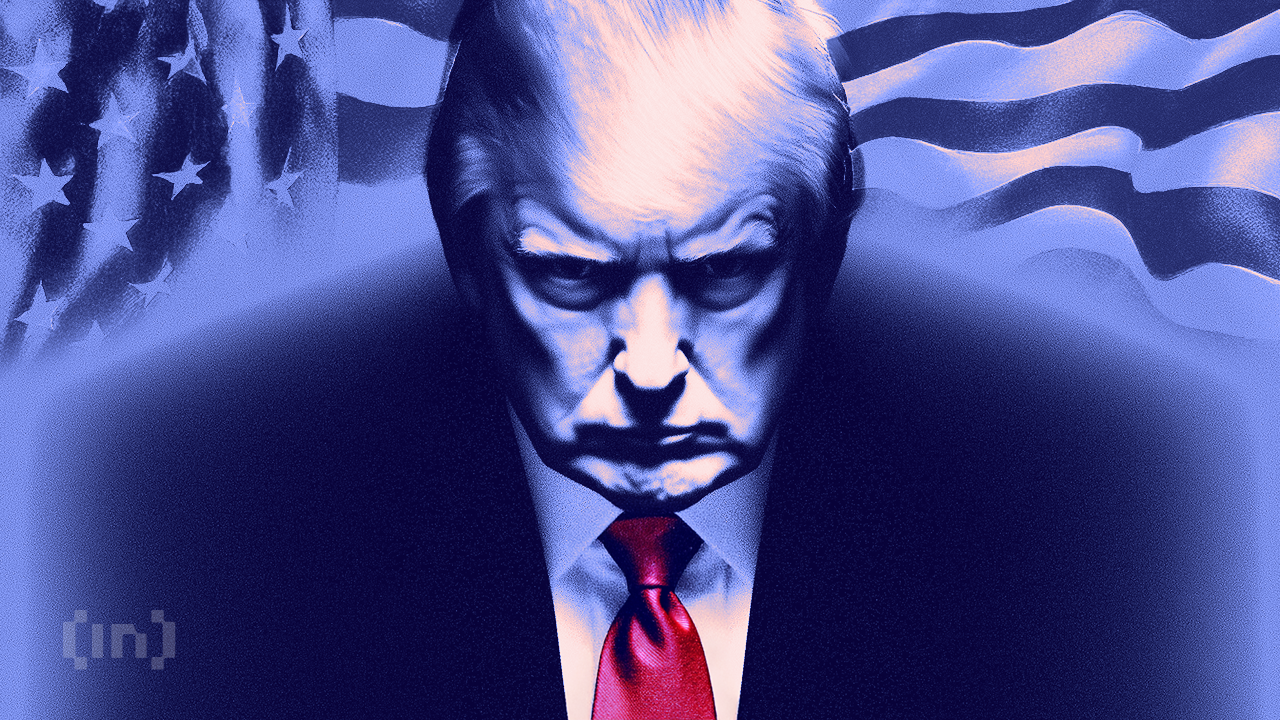
Trump Media & Technology Group (TMTG) posted a $405.9 million net loss for the first quarter of 2026, dominated by non-cash losses.
Unrealized losses on digital assets and equity securities reached $368.7 million, almost the entire shortfall. Stock-based compensation added $11.8 million, alongside $11.5 million of accreted interest.
Bitcoin Treasury Drives Paper Losses as Prices Drop
TMTG’s crypto treasury is valued at $821.9 million against a $1.24 billion cost basis, per CoinGecko data. The position is roughly $423.06 million underwater overall.
The treasury contains 9,542 Bitcoin (BTC) worth $767 million, acquired at an average cost of $118,529 per coin. TMTG’s Bitcoin balance dropped by 2,000 BTC in late February, down from 11,542 BTC.
Bitcoin fell roughly 22% during Q1 2026, marking its worst quarter since 2018. The company also holds 756 million Cronos (CRO), worth $54 million.
Follow us on X to get the latest news as it happens
Trump Media’s Financial Assets Climb to $2.1 Billion as Revenue Stays Thin
Meanwhile, the operator of Truth Social produced just $0.9 million in revenue. Operating cash flows totaled $17.9 million, marking the company’s fourth straight positive quarter.
The firm’s total assets reached $2.2 billion. The figure nearly tripled from $759 million a year earlier.
“Trump Media is using its strong balance sheet and positive operating cash flow to continue growing all our businesses and platform infrastructure. Even as we work toward advancing our proposed merger with TAE Technologies as quickly as possible, we’re identifying new growth opportunities and new ways to increase shareholder value,” Interim CEO Kevin McGurn said.
Trump Media also said it is developing new Truth Social features, including prediction-market tools, a sports section, expanded use of artificial intelligence across the platform, and more.
Subscribe to our YouTube channel to watch leaders and journalists provide expert insights
The post Crypto and Equity Markdowns Drive Trump Media’s $406 Million Q1 Loss appeared first on BeInCrypto.
TLDR
- Kraken’s parent entity Payward has submitted an application for a national trust company charter to the OCC
- Approval would establish Payward National Trust Company, providing federally supervised digital asset custody services
- This application complements Kraken’s current Wyoming SPDI banking license and Federal Reserve master account access
- The company has allocated more than $2.6 billion toward recent strategic acquisitions, including NinjaTrader, Bitnomial, and Reap Technologies
- According to co-CEO Arjun Sethi, Kraken has achieved roughly 80% readiness for a possible public offering targeted for 2027
Payward, which operates the Kraken cryptocurrency exchange, has submitted a formal application to the U.S. Office of the Comptroller of the Currency (OCC) seeking a national trust company charter. The submission was made public on Friday, May 8, 2026.
Should regulators grant approval, this charter would establish a separate legal entity named Payward National Trust Company (PNTC). The new organization would deliver custody and fiduciary solutions under federal regulation, with a primary focus on digital assets.
The OCC has previously granted comparable authorizations to several major industry players, including Coinbase, Ripple Labs, BitGo, Circle, Fidelity Digital Assets, and Paxos. Payward aims to join this exclusive group of federally chartered crypto institutions.
Co-CEO Arjun Sethi emphasized that the company prioritizes establishing robust regulatory infrastructure over racing to be first to market. “A national trust company provides the certainty institutions require,” he stated in the official announcement.
Building on Existing Banking Infrastructure
Payward’s regulatory foundation already includes a Wyoming Special Purpose Depository Institution (SPDI) charter held through Kraken Financial, which was secured in 2020. Kraken Financial achieved a significant milestone as the first digital asset banking entity to obtain a Federal Reserve master account, providing direct integration with the U.S. payments infrastructure.
The proposed OCC trust charter would operate in conjunction with the existing Wyoming authorization. Payward characterizes this approach as a “multi-charter” framework, incorporating both state-level and federal regulatory supervision.
According to the proposal, PNTC would leverage Payward’s established compliance infrastructure and risk management protocols. The primary objective is addressing the needs of institutional investors requiring a federally regulated qualified custodian.
The OCC operates under the leadership of Jonathan Gould, appointed during the Trump administration. The regulatory body greenlit multiple crypto charter applications in a significant wave during December 2025.
Acquisition Spending and IPO Plans
Payward has executed an aggressive expansion strategy through strategic acquisitions. During 2025, the company purchased retail futures trading platform NinjaTrader in a $1.5 billion transaction.
In April 2026, Payward entered into an agreement to acquire crypto derivatives platform Bitnomial for a deal valued at up to $550 million. This acquisition delivered a comprehensive suite of CFTC licenses encompassing brokerage, clearing, and exchange capabilities.
Most recently, the firm announced a $600 million agreement to purchase Reap Technologies, a Hong Kong-based payments company. This strategic move positions Kraken to expand into stablecoin-enabled cross-border payment solutions and card processing infrastructure throughout Asian markets.
Across these three major transactions, Payward has pledged investment exceeding $2.6 billion.
Notwithstanding this substantial acquisition activity, plans for a Kraken initial public offering remain active. Sethi indicated in May that the organization has reached “about 80% ready” status for a potential market debut by 2027.
Kraken has additionally revealed a strategic partnership with MoneyGram, supporting its broader expansion into payment services.
The OCC charter application is currently under regulatory review. The agency has not disclosed an expected timeline for rendering a determination.


Coinbase, Kraken and Gemini are lobbying Senate Agriculture leaders to strip a “not readily susceptible to manipulation” standard from a flagship digital asset bill, warning it would effectively bar small, low‑liquidity tokens from regulated U.S. exchanges and hand the CFTC a veto over future listings.
Summary
- Coinbase, Kraken, and Gemini have asked Senate Agriculture Committee leaders to delete a clause that limits listings to tokens “not readily susceptible to manipulation.”
- The firms argue the standard would effectively shut small, low‑liquidity tokens out of regulated venues and hand future CFTC chairs a blunt tool to choke innovation.
- The language sits inside a sweeping market‑structure bill that would give the CFTC new authority over digital commodity spot markets, including bitcoin and ethereum.
Crypto’s biggest U.S. exchanges are quietly lobbying to strip a key investor‑protection clause from the Senate’s flagship digital asset bill, warning that it would make listing “small coins” on regulated venues nearly impossible.
According to Politico, Coinbase, Kraken and Gemini submitted redlines to the Senate Agriculture Committee earlier this year urging lawmakers to remove a requirement that registered “digital commodity exchanges” may list only tokens “not readily susceptible to manipulation.”
In a joint letter, the three firms told senators that “millions of Americans are participating in digital asset markets without the federal regulatory protections they deserve” and insisted that “every element of our legislative engagement has been aimed at changing that — by expanding oversight, not limiting it.”
They added that importing the Commodity Exchange Act’s high bar for futures and swaps — where contracts must be “not readily susceptible to manipulation” — into the spot market would “significantly raise the bar for listing smaller, less liquid tokens” and could be weaponized by a future CFTC chair “to throttle innovation” by simply refusing to certify new assets.
Inside the Senate’s digital commodity bill
The provision sits inside the Senate Agriculture Committee’s draft Digital Commodity Intermediaries Act, a market‑structure framework first floated in late 2025 by Chair John Boozman and Sen. Cory Booker to give the Commodity Futures Trading Commission explicit authority over “digital commodities.”
A client alert from McGuireWoods on the discussion draft notes that any trading facility offering a cash or spot market in a digital commodity would have to register as a “digital commodity exchange,” with obligations modeled on existing CFTC rules for futures venues. Exchanges “may list only digital commodities ‘not readily susceptible to manipulation’ and must certify each listing to the CFTC,” including analysis showing that the token meets statutory criteria and that the venue has adequate surveillance and safeguards. McGuireWoods
The Agriculture Committee advanced its portion of the bill along party lines in late January, as highlighted in a committee release, but everyone expects major surgery before it hits the Senate floor. Politico reports that Republicans will need Democrats on both the Agriculture and Banking Committees to sign off on a final package that can clear the 60‑vote filibuster hurdle, and negotiators are already trading edits across panels.
Crypto.news previously broke down that broader effort in a story on the updated Senate Agriculture draft, noting that it would, for the first time, put federally registered spot intermediaries for bitcoin and ethereum squarely under CFTC supervision while leaving the SEC in charge of securities tokens. The same story highlighted unresolved fights over DeFi, staking and stablecoin rewards that still stand between the draft and a bipartisan deal.
Why Coinbase, Kraken and Gemini are fighting this clause
For Coinbase, Kraken and Gemini, the manipulation test is existential for their long‑tail business. As Politico reports, the exchanges “strongly support the readily susceptible to manipulation standard in traditional futures and swaps markets,” but argue that “importing a standard that doesn’t make sense for spot crypto” would “inadvertently hamstring the agency, the industry [and] consumers.”
Paul Grewal, Coinbase’s chief legal officer, told Bloomberg earlier this year that the company could even reconsider its support for the overall market‑structure package if it ends up with restrictions that go beyond “enhanced disclosure requirements” for products like stablecoin rewards. Crypto.news’ coverage of that standoff in a story underscored that Coinbase sees the bill as a trade‑off: clearer CFTC rules on one side, potential constraints on its core business on the other.
Now the same pattern is playing out around small‑cap listings. As Politico notes, industry sources say exchanges are also lobbying Senate Banking Committee members to soften related language, warning that if the manipulation test stays intact, many “small, low‑liquidity tokens” will simply never make it to regulated platforms. Instead, they will trade only on offshore venues and in DeFi, exactly where U.S. regulators have the least visibility and leverage.
In a sense, this is the central tension of the bill that crypto.news flagged in its earlier story: Washington wants to drag crypto into a familiar derivatives‑style regulatory box, while the industry is trying to keep enough slack in the system to list riskier assets and offer yield without strangling the business model. The fight over one phrase — “not readily susceptible to manipulation” — is where those two instincts are now colliding.
Digital Asset Market Clarity Act Heads to Senate Banking Markup This Week

WWE Backlash 2026: 5 Last-minute predictions

Department Of War Sets Up UFO Website, But There Isn’t Much To See

Manchester United reach agreement with Casemiro over contract clause amid transfer speculation

US brings back mandatory military draft registration

Steven Gerrard disagrees with Gary Neville over ‘shock’ Chelsea and Arsenal claim | Football


-
 Crypto World22 hours ago
HarrisX Poll Found 52% of Registered Voters Support the CLARITY Act
-

 NewsBeat6 days ago
Channel 5 – All Creatures Great and Small series 7 new post
-

 Crypto World2 days ago
Upbit adds B3 Korean won pair as Base token gains Korea access
-

 Tech4 days ago
Image AI models now drive app growth, beating chatbot upgrades
-
 NewsBeat2 days ago
NCP car park operator enters administration putting 340 UK sites at risk of closure
-

 News Videos6 days ago
AP Dhillon – Old Money (Official Audio)
-

 Fashion14 hours ago
Weekend Open Thread: Marianne Dress
-

 Sports6 days ago
Five killed in Texas plane crash identified as Amarillo pickleball players
-
Entertainment6 days ago
New Netflix Movies in May 2026 — My Top 3 Picks to Stream
-
Crypto World7 days ago
Pi Network Mandates Protocol 23 Upgrade for All Mainnet Nodes Before May 15 Deadline
-

 Entertainment6 days ago
Melissa Joan Hart and More Stars Attend 2026 Kentucky Derby
-
Entertainment6 days ago
Anna Nicole Smith’s Daughter Attends 2026 Kentucky Derby
-

 Crypto World6 days ago
Bitcoin mining equities rise in 2026 as BTC lags behind
-

 Business6 days ago
Luka Doncic Injury Update: Doncic’s Hamstring Recovery Slows Lakers’ Hopes Against Thunder: Can He Run Yet?
-
Entertainment6 days ago
Venus Williams’ Best Met Gala Looks Over the Years
-

 Business7 days ago
Kuwait International Airport Resumes Operations After Closure as Regional Tensions Ease in 2026
-
Entertainment6 days ago
“Storage Wars” star Darrell Sheets' ex-wife breaks silence on his death
-

 Sports6 days ago
Is Man United v Liverpool on TV? Channel, streaming and how to watch Premier League fixture
-
 Entertainment7 days ago
After 2 Years, This Taylor Sheridan Neo-Western Doesn’t Have a Single Bad Episode
-
Crypto World6 days ago
Q1 2026 Tech Layoffs AI Wave Hits 81,747 as Firms Shift to AI Infrastructure
You must be logged in to post a comment Login