

Crypto World
Trump-backed American Bitcoin hits 8,000 BTC as ABTC stock rebounds

American Bitcoin Corp. said its Bitcoin reserve has moved above 8,000 BTC after its latest treasury update.
Summary
- American Bitcoin adds 500 BTC, growing its treasury while ABTC shares stay under pressure.
- The 1-for-15 reverse split keeps Nasdaq compliance in focus after a steep 2026 stock slide.
- Hut 8 mining gives American Bitcoin scale, but losses still shadow its treasury growth plans.
In a July 6 post on X, the company said its Bitcoin reserve has grown more than threefold since its Nasdaq debut, while its satoshis-per-share metric has also grown nearly threefold.
BitcoinTreasuries data showed American Bitcoin holding 8,000 BTC, worth about $512 million, among publicly traded Bitcoin treasury companies. The same tracker ranked the company near the top tier of public corporate BTC holders, ahead of GD Culture Group and Galaxy Digital in the U.S. list.
ABTC stock rises after reverse split
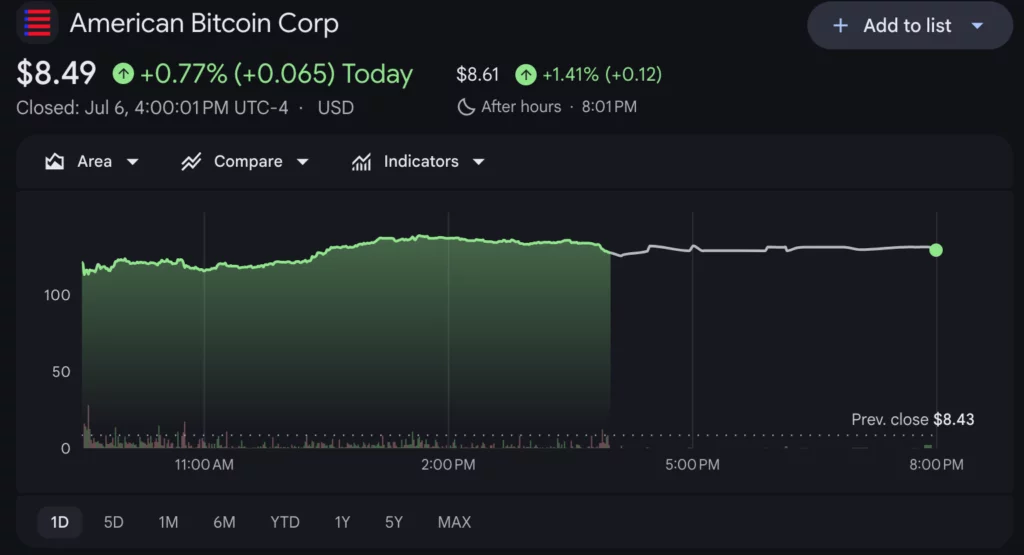
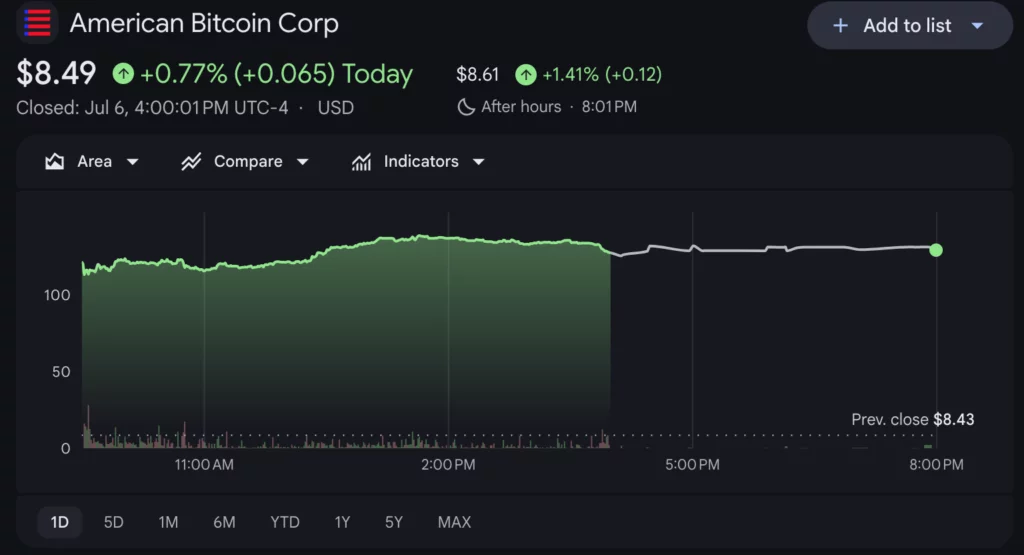
ABTC traded at $8.49 at the time of writing, up 14.1% on the day, according to Google Finance data. The stock opened at $7.98, touched an intraday high of $9.31, and fell as low as $7.40, with volume above 2.17 million shares.
The move followed American Bitcoin’s 1-for-15 reverse stock split. The company said the split became effective at 5:00 p.m. on July 2, with Class A shares set to trade on a split-adjusted basis on Nasdaq from July 6 under the same ABTC ticker.
American Bitcoin said the split would reduce issued shares from about 1.09 billion to roughly 73 million. The company said the action was mainly meant to lift the per-share price and help maintain compliance with Nasdaq’s minimum bid price rule.
Mining output supports treasury growth
As previously reported by crypto.news, American Bitcoin posted an $81.8 million net loss in the first quarter of 2026. The loss came as Bitcoin fell 22% during the quarter, which led to a $117.2 million non-cash charge on the company’s digital asset holdings.
The company still mined 817 BTC in the quarter and cut its cost per Bitcoin to $36,200. That was down 23% from $46,900 in the fourth quarter of 2025. American Bitcoin also bought 803 BTC during the quarter, taking its holdings to 7,021 BTC as of March 31.
CEO Mike Ho defended the operating result at the time. “The underlying business was profitable and we did not sell a single coin,” he said, referring to the company’s mark-to-market charge.
Hut 8 link remains central to ABTC strategy
American Bitcoin was launched by Hut 8 and Eric Trump in March 2025. Hut 8 said at the time that the company aimed to build a large pure-play Bitcoin miner while developing a strategic Bitcoin reserve.
As previously reported by crypto.news, American Bitcoin is backed by Eric Trump and Donald Trump Jr. The company has built its model around self-mining and treasury accumulation, rather than shifting away from mining toward artificial-intelligence data centers.
The latest treasury update shows that American Bitcoin continues to add BTC despite pressure on its share price earlier this year. The company’s stock rebound after the reverse split gives ABTC a higher trading price, but its performance still remains tied to Bitcoin prices, mining costs, and investor demand for public Bitcoin treasury firms.

Non-custodial multichain cryptocurrency wallet Ctrl Wallet will shut down its services, weeks after a security exploit, and told users on Tuesday to withdraw their assets within the next month.
Ctrl Wallet reported a security issue on June 23 effecting some Cardano wallets on the platform and said it entered a temporary “maintenance mode” to protect user assets until its engineering team restores full functionality.
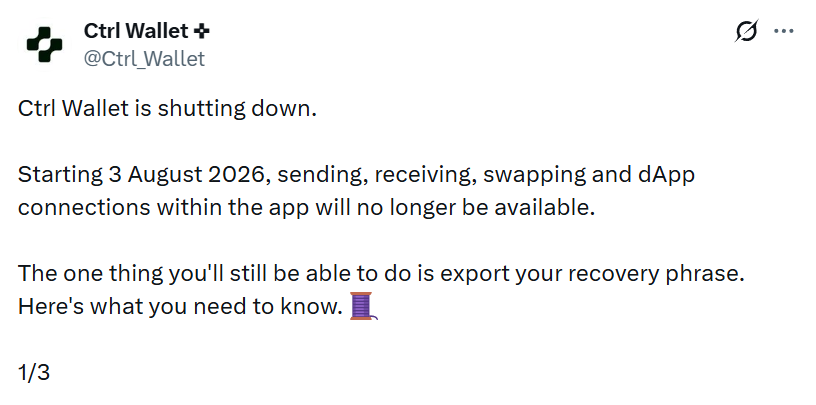
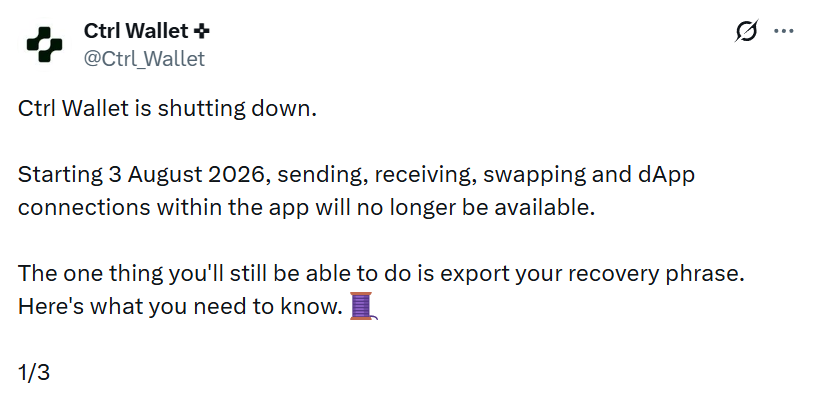
Earlier today, the wallet’s operators announced that starting Aug. 3, 2026, sending, receiving, swapping funds and all other actions within the app will be unavailable, except for exporting users’ recovery phrases.
The app will be removed from both app and browser extension stores, while downloads will be halted immediately, Ctrl Wallet said in a blog post.
Ahead of the Aug. 3 deadline, users can transfer their assets from Ctrl Wallet to another exchange or crypto wallet. After that, users will only be able to import their recovery phrase into another compatible wallet provider. Ctrl Wallet “strongly” recommended that users export their assets before Aug. 3.
Source: Ctrl Wallet
Ctrl Wallet said that users can export their 12-word or 24-word recovery phrase into compatible wallets, including MetaMask, Trust Wallet and Phantom.
The wallet provider said there will not be a migration token or an airdrop event and urged users to exercise caution when encountering fake social media posts or websites promising similar incentives.
Ctrl Wallet, formerly XDEFI Wallet, lists between 11 and 50 employees and over 650,000 monthly users on its LinkedIn page. The wallet supported over 2,500 blockchain networks, including Cardano and Midnight.
Related: Dormant $1.9M Bitcoin tied to New York lawsuit moves after nearly 15 years
Ctrl Wallet transitions under the Emurgo umbrella before SecondFi exploit
On April 29, Ctrl Wallet announced its transition under the Emurgo umbrella and said that its multichain architecture will continue inside the SecondFi wallet.
SecondFi is a self-custodial platform built on Cardano that rebranded from the Yoroi wallet in April 2026 and was developed by Emurgo, the “for-profit arm of Cardano.”
On June 24, a vulnerability in SecondFi enabled attackers to drain user funds, resulting in an estimated loss of around 16 million ADA, then worth about $2.4 million.
Days later, SecondFi revealed a recovery path to repay affected users across the 374 impacted wallet addresses. It also said it secured about 129 million ADA through emergency measures and transferred the funds to an independent third-party custodian, where they will remain until the verification and recovery process is complete.
Magazine: SBF will never get a pardon, Trump peace deal boosts Bitcoin: Hodlers Digest June 14-21


The treasury of Solana-based memecoin project, BONK, has been drained of over $21 million, via a malicious governance proposal.
A single address, accounting for 882 billion BONK, voted in favor — just enough to reach quorum.
Apparent disinterest from other holders led to just six other voters, and the proposal passed with 99.9% of votes in favor.
The proposal, BIP 76, was submitted on June 30 and ostensibly aimed to implement a new “Sowellian” governance model.
However, the camouflage was somewhat lacking in sophistication, with just two proposed actions: “Add Metadata,” and “Send 4.426.104.450.305 Bonk to 9bxWkN…”.
Blockchain forensics firm Chainalysis traced the “days-long BONK spree” which saw one wallet acquire $8 million worth of tokens “on mainstream exchange[s] and borrowed via DeFi.”
By Monday, the address had enough tokens to pass the proposal and made its move on the final day of the voting period. The 4.4 trillion BONK tokens were transferred once voting ended.
Chainalysis explains the majority of funds were transferred to a multisig, which appears to be a new BONK 2.0 DAO. The tokens acquired for voting are being liquidated.
Read more: DeFi platform Summer Finance loses $6M in vault exploit
Governance ‘attack’ or voter apathy?
Draining a DAO treasury of $20 million may sound a lot like an attack but, with such a straightforward and poorly-disguised proposal sitting in an open governance voting forum for a week, the incident also clearly demonstrates a lack of interest from token holders.
Crypto security expert Taylor Monahan examined the “pretty subjective and loosely defined” definition of a governance attack. The community’s “gut reaction” suggests so, she believes, but whether or not it would constitute wire fraud is another question.
Conversely, a pseudonymous advisor to World Liberty Financial, Ogle, simply asked “isn’t this just a functioning DAO?”
Read more: WLFI token falls 18% as governance vote branded a ‘scam’
Perhaps expecting rigorous governance oversight from a community of dog-themed memecoin holders is asking too much.
Despite once being seen as DeFi’s answer to hierarchical corporate governance, the wider DAO governance dream has been struggling lately.
In recent months, turbulence has come for some of the sector’s most well-established examples, including the Ethereum Name Service, Aave, Gnosis and more.
Got a tip? Send us an email securely via Protos Leaks. For more informed news and investigations, follow us on X, Bluesky, and Google News, or subscribe to our YouTube channel.
Crypto World
The Cryptographic Vault: How FHE and ZK-Proofs Unlock Corporate Privacy on Public Ledgers

Public blockchains have transformed how value moves across the internet. They offer instant settlement, global accessibility, 24/7 availability, and transparent record-keeping without relying on traditional intermediaries. For businesses, these advantages promise faster operations, reduced costs, and simplified financial reconciliation.
Yet the same transparency that makes public blockchains trustworthy also creates their greatest obstacle for enterprise adoption.
No corporation wants its competitors to monitor vendor payments, treasury balances, investment strategies, or trading positions in real time. Financial privacy is not a luxury—it is a competitive necessity.
This challenge has inspired one of blockchain’s most significant technological breakthroughs. Rather than abandoning public ledgers in favor of closed, permissioned systems, developers are building advanced cryptographic tools that preserve confidentiality while maintaining verifiable trust.
At the center of this transformation are Zero-Knowledge Proofs (ZKPs) and Fully Homomorphic Encryption (FHE). Together, they create a powerful privacy stack that allows organizations to prove information is correct and compute sensitive data without exposing the underlying details.
The result is a new model for enterprise blockchain adoption: trust without transparency.
Public blockchains were designed around openness. Every transaction, wallet balance, and smart contract interaction is visible to anyone with an internet connection.
For decentralized finance, this transparency improves accountability.
For corporations, however, it creates several critical risks:
- Competitors can monitor treasury movements.
- Trading strategies become publicly visible.
- Supplier payments reveal business relationships.
- Institutional orders become vulnerable to front-running.
- Sensitive financial information becomes permanently exposed.
These limitations have historically prevented many enterprises from embracing public blockchain infrastructure despite its operational advantages.
Instead of sacrificing privacy or abandoning public networks, cryptography is offering a third path.
Zero-Knowledge Proofs (ZKPs) answer a simple but powerful question:
Can you prove something is true without revealing why it is true?
The answer is yes.
Think of a ZKP as the API of trust.
Instead of sharing confidential information, a user generates mathematical proof that verifies a statement while keeping every underlying detail hidden.
Imagine proving you are over 18 years old without revealing your birthday, address, or even your identity.
Only the fact that matters is disclosed.
Nothing else.
Corporate Applications
Proof of Reserves
Banks, custodians, and exchanges can continuously demonstrate they have sufficient assets without disclosing portfolio composition.
Regulators receive verifiable assurance.
Competitors learn nothing.
Compliance Reporting
Financial institutions can automatically generate compliance reports every few minutes without exposing proprietary trading positions or confidential client information.
This enables real-time auditing while preserving corporate secrecy.
AML Verification
Instead of revealing wallet addresses publicly, institutions can prove statements such as:
- The sender is not sanctioned.
- The transaction complies with AML policies.
- Required identity checks were completed.
Observers verify compliance without learning who participated.
This concept is often described as compliant privacy.
Where ZKPs Reach Their Limit
Although extremely powerful, Zero-Knowledge Proofs primarily verify completed facts.
They excel at answering questions like:
- Is this statement true?
- Was this transaction valid?
- Did the protocol follow its rules?
However, they are not designed to perform continuous, complex computation on encrypted information.
That is where Fully Homomorphic Encryption enters the picture.
Fully Homomorphic Encryption: Computing Without Seeing
For decades, encryption has followed a familiar pattern:
- Encrypt data.
- Decrypt data.
- Perform calculations.
- Encrypt again.
The weakness is obvious.
Sensitive information must become visible during processing.
Fully Homomorphic Encryption changes that entirely.
With FHE, computers perform calculations directly on encrypted data without ever decrypting it.
The server never sees the original information.
It simply performs mathematical operations on encrypted values and returns an encrypted result that only the data owner can unlock.
It is often described as the holy grail of private computation.
Why 2026 Marks an Inflection Point
For years, Fully Homomorphic Encryption was viewed as theoretically revolutionary but practically too slow.
That perception is rapidly changing.
Advances in GPU acceleration, specialized FHE hardware, optimized cryptographic libraries, and threshold decryption have dramatically improved performance, making production deployments increasingly realistic for privacy-focused blockchain infrastructure.
Rather than remaining an academic concept, FHE is beginning to power confidential smart contracts and encrypted computation on specialized blockchain networks.
Corporate Applications of FHE
On-Chain Dark Pools
Institutional investors often execute enormous trades.
Publishing those orders publicly creates opportunities for:
- Front-running
- MEV exploitation
- Price manipulation
- Information leakage
With FHE, orders remain encrypted throughout execution.
Matching engines calculate outcomes without revealing order size, pricing, or participant identities.
Only the final settlement becomes visible.
Private Credit Scoring
Traditional lending requires exposing sensitive financial records.
FHE introduces a radically different approach.
Imagine a company submitting encrypted financial statements to a decentralized lending protocol.
The protocol evaluates:
- Cash flow
- Revenue stability
- Debt ratios
- Creditworthiness
Every calculation happens while the data remains encrypted.
The protocol never accesses the raw financial information.
Developers cannot inspect it.
Validators cannot read it.
Only the final lending decision is revealed.
The Hybrid Privacy Stack: Why ZKPs and FHE Work Together
It is tempting to think that Zero-Knowledge Proofs and Fully Homomorphic Encryption compete.
In reality, they solve different problems.
The strongest enterprise architectures combine both.
FHE performs the confidential computation.
ZKPs verify that the computation was executed correctly.
Example Workflow
Imagine an encrypted lending platform.
- A borrower submits encrypted financial data.
- FHE computes the company’s credit score.
- The computation remains confidential throughout.
- A Zero-Knowledge Proof is generated showing the calculation followed protocol rules.
- The blockchain verifies the proof.
- The loan is issued.
At no point does anyone except the borrower gain access to the underlying financial statements.
The blockchain verifies correctness without sacrificing confidentiality.
| Feature | Zero-Knowledge Proofs (ZKPs) | Fully Homomorphic Encryption (FHE) |
|---|---|---|
| Primary Role | Verifies statements about data | Computes directly on encrypted data |
| Data State | Data remains hidden while claims are proven | Data stays encrypted throughout computation |
| Best Used For | Identity verification, compliance reporting, Proof of Reserves, rollups | Dark pools, confidential smart contracts, private lending, encrypted analytics |
| Analogy | Showing a checkmark proving you’re old enough without revealing your ID | Baking a cake inside a locked box equipped with built-in gloves |
Together, these technologies create a complete privacy architecture rather than competing alternatives.
The Future of Enterprise Blockchain Privacy
Public blockchains were once considered unsuitable for corporate finance because openness and confidentiality appeared fundamentally incompatible.
That assumption is rapidly fading.
Modern cryptography has separated validity from visibility.
Organizations no longer need to expose confidential information to prove they are operating honestly.
This shift could reshape enterprise blockchain adoption over the coming years. Rather than relying on isolated permissioned blockchains—which often sacrifice liquidity, composability, and broad network effects—businesses may increasingly leverage public infrastructure enhanced with advanced cryptographic privacy.
In this emerging model, openness and confidentiality are no longer mutually exclusive.
They become complementary.
Final Thoughts
Enterprise adoption of Web3 will not be driven by transparency alone.
It will be driven by selective transparency—where every participant can verify correctness without accessing sensitive business information.
Zero-Knowledge Proofs provide verifiable trust.
Fully Homomorphic Encryption enables confidential computation.
Together, they transform public blockchains into secure environments capable of supporting banks, multinational corporations, institutional investors, and regulated financial markets.
In the next generation of enterprise Web3, privacy is not about concealing wrongdoing.
It is foundational infrastructure for protecting competitive advantage while participating in an open, globally connected financial system.
REQUEST AN ARTICLE
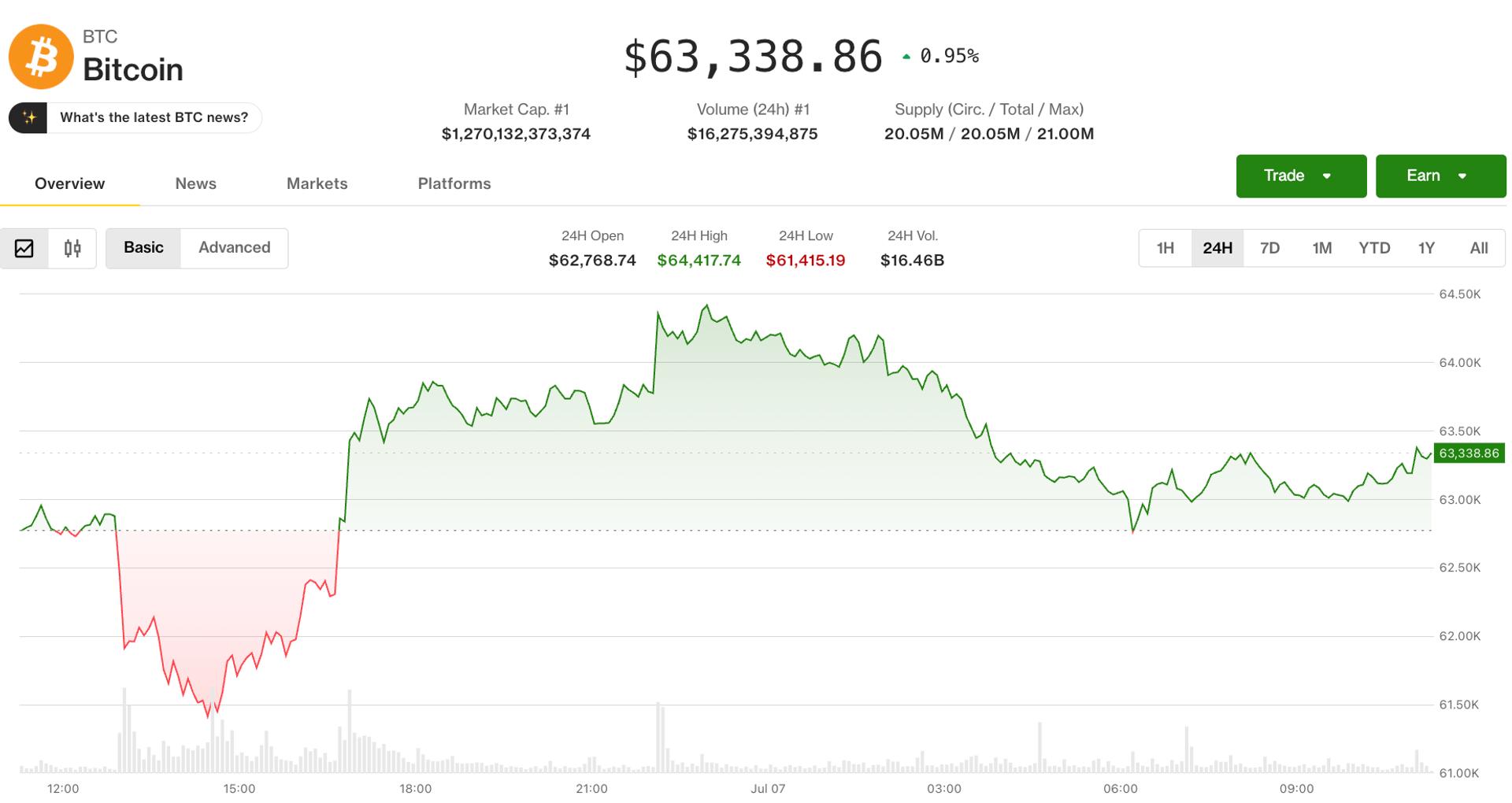
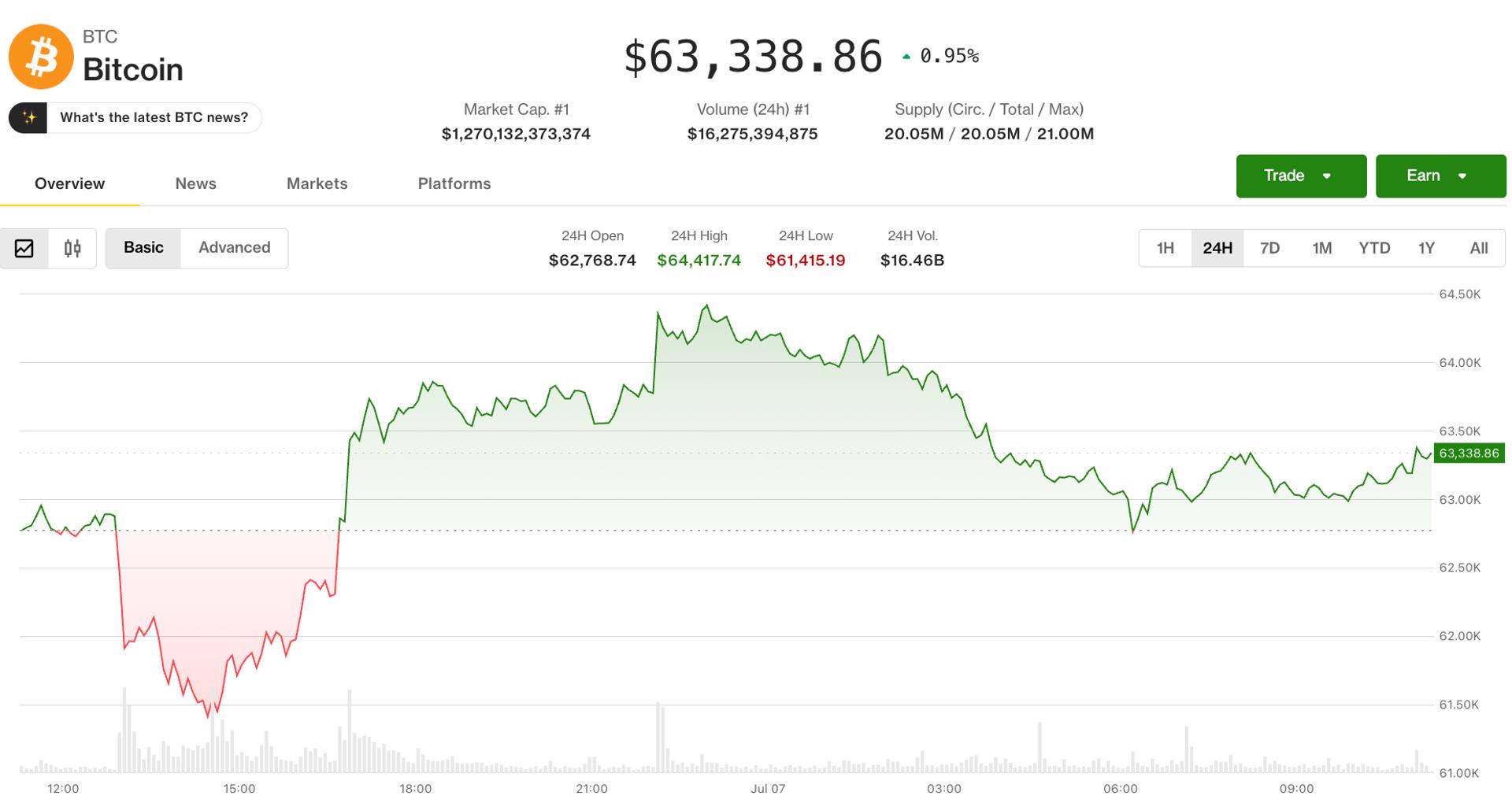
Bitcoin stalled on Tuesday, falling for the first time this month and breaking the longest stretch of gains since March. It had rallied to $64,500, its highest point in more than two weeks, on Monday.
Ether (ETH) tracked the larger cryptocurrency, dropping to $1,770 after hitting a high of $1,830 on Monday.
The July recovery can be attributed to a short-squeeze setup that was identified in late June, which saw heavy short interest despite bitcoin trading at its lowest point since 2024.
Bitcoin and other crypto tokens capitalized on a skew in short positions, recovering from oversold territory and advancing every day since the start of the month.
The total crypto market has grown by 8.4% since July 1, and is now worth $2.16 trillion.
U.S. equities fell in pre-market trading on Tuesday, with Nasdaq 100 index futures losing 0.9% since midnight UTC as the decline from June’s record high continues.
Derivatives positioning
- Over $500 million in leveraged crypto futures bets have been liquidated by exchanges in 24 hours, with shorts, or bearish positions, accounting for most of the tally for a sixth straight day.
- Despite the recent price strength, BTC’s futures open interest (OI) has slipped to 740K BTC, down from the July 3 high of 776K BTC. This shows that derivative traders are not participating in the price rise alongside a continued weakness in spot demand, as evidenced from ETF flows and the Coinbase premium. This raises questions about the sustainability of the gains.
- The same is true for ether (ETH), which recently outperformed BTC.
- OI in SOL has pulled back to 68 million tokens from the peak of over 76 million on June 24. The message is the same. The 10% rise in the token has so far failed to galvanize demand for leveraged plays.
- Canton Network’s CC token has declined by over 4% in 24 hours accompanied by a 3% uptick in the futures OI to 245.59 million tokens. This, coupled with negative funding rates and 24-hour OI-adjusted cumulative volume delta, points to a growing bearish bias.
- Most tokens have a negative OI-adjusted CVD, a sign of bears being more aggressive by shorting at market orders rather than passive limit order plays. It suggests potential for losses ahead.
- Bitcoin’s 30-day implied volatility index, BVIV, has jumped to 40%, snapping a six-day losing streak. Still, the gauge remains well below January highs near 60% in a positive sign for crypto bulls. The same is true for ether’s index, EVIV.
- On Deribit, options continue to showcase lingering downside concerns in both bitcoin and ether. Options volume in BTC paints a mixed picture with both calls and puts making it to the list of top traded bets in the past 24 hours.
- On decentralized exchange Derive, a large long call condor strategy on HYPE crossed the tape, indicating expectations for a range play between $75 and $80 till July 24.
Token talk
- The altcoin market continues to show internal contradictions. Tokens like FET, KASPA and WLD have all posted losses despite the broader marketwide recovery this week, while ETHFI and LIT have outperformed, adding more than 30% over the past seven days.
- was one of the top-performing tokens on Tuesday, rising 4.8. It’s worth noting that the token, linked to the family of President Donald Trump, is down by more than 89% since it was created last August.
- The decoupling of some altcoins demonstrates a maturing of the sector, with token performance based on underlying sentiment and onchain activity. Historically, the entire altcoin market moved in unison.
- CoinMarketCap’s Altcoin Season indicator is at 46/100, below Friday’s high and higher than in May, when it was consistently around 30/100.
Crypto World
XRP Moves Further Away From Key Support, BTC Recovers From Strategy-Driven Drop: Market Watch
Bitcoin’s price faced a real rollercoaster in the past 24 hours after Strategy announced another sale, this time a lot bigger than the previous. However, it managed to recover most of the losses and even spiked somewhat surprisingly.
Most altcoins have remained relatively sluggish on a daily scale. XRP has dipped further away from a critical support line after failing at $1.15 earlier.
BTC Rebounds After Strategy Drop
Bitcoin dipped below $58,000 on July 1 for the first time in nearly two years but reacted well and started to recover some of the losses almost immediately. It surged past $60,000 and kept climbing in the following days, even during the past weekend.
Its gradual rebound pushed the asset to over $63,500 on Sunday, where it faced resistance and slipped to under $63,000. Another leg up followed on Monday morning, with the bulls driving BTC to $64,000 for the first time in about two weeks.
However, then came the big news from Strategy. The largest corporate holder of BTC disposed of over 3,500 units, which led to an immediate price drop to $61,200. As the FUD kept spreading, though, the cryptocurrency rebounded instantly and surged past $64,500 by the end of the day to mark another local peak.
It couldn’t keep climbing and has returned to $63,000 as of now, the level it stood at yesterday before Strategy’s announcement. Its market cap remains above $1.260 trillion, while its dominance over the alts is still at 56.6% on CG.

XRP, DOGE in the Red
Most larger-cap alts have managed to defend their levels after yesterday’s volatility. Ethereum is still stuck between $1,750 and $1,800, while BNB remains below $580. XRP has dropped further away from the key support at $1.15 following a 1.3% daily decline to $1.1275.
Even more painful drops are evident from DOGE, ADA, XLM, and CC. While the first couple are down by 2-3%, the last has dumped by over 5% daily. In contrast, SOL, HYPE, RAIN, and ZEC have posted minor gains, while WLFI, AAVE, MORPHO, and DEXE have gained up to 8%.
The total crypto market cap continues to sit in a familiar range, currently at $2.240 trillion.

The post XRP Moves Further Away From Key Support, BTC Recovers From Strategy-Driven Drop: Market Watch appeared first on CryptoPotato.
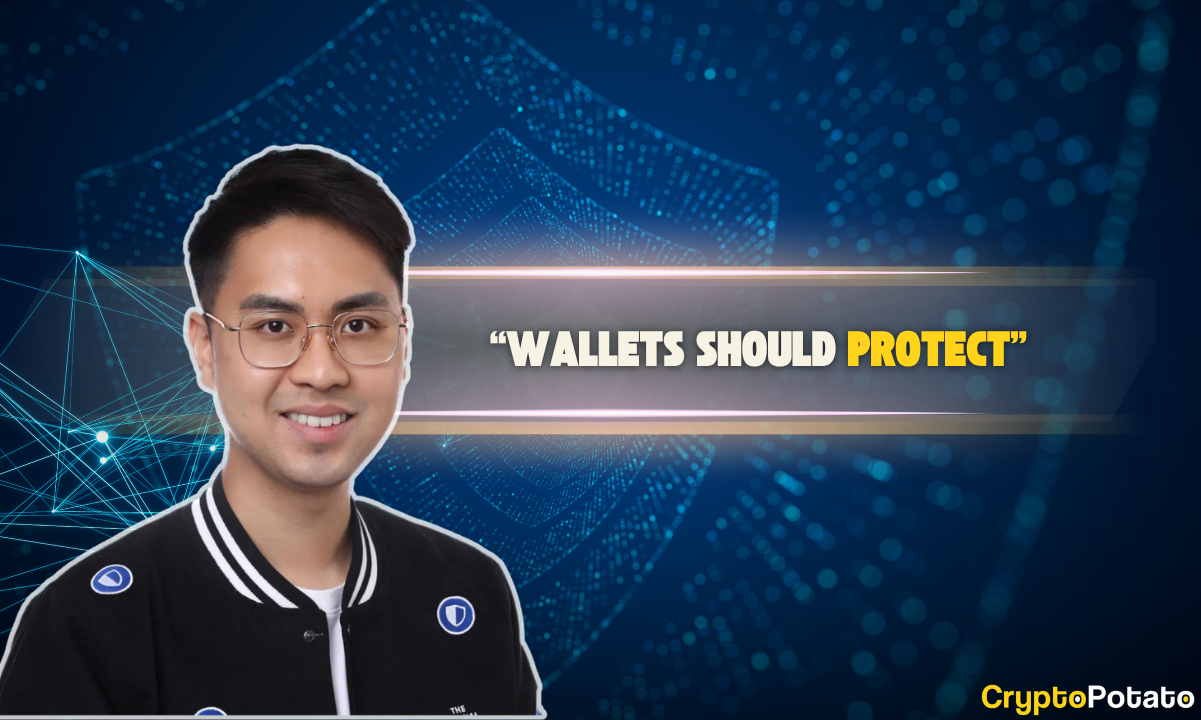
Crypto has spent many years asking users to accept complexity in exchange for ownership. But as self-custody moves closer and closer to the mainstream audience, Trust Wallet’s new CEO, Felix Fan, argues that the real challenge is no longer proving why people should control their assets – it’s making that control feel effortless.
In the following interview, we discuss the product lessons shaping Fan’s leadership, why wallets must take more responsibility for user protection, how payments, trading, stablecoins, AI agents, and clear regulation are pushing crypto into a more mature phase.
His message, however, is clear: self-custody may have won the philosophical argument, but the user experience has some catching up to do.
You’ve stepped into a new role at Trust Wallet at a moment when self-custody is becoming both more mainstream and more complex. What parts of your own journey prepared you most for leading a product used by hundreds of millions of people?
My expertise lies in product, complemented by my experience as a serial entrepreneur. Before Trust Wallet, I spent years thinking about how to make complex financial tools feel simple to people who don’t have time or patience to become experts.
Leading at this scale is different. Trust Wallet already has millions of users. The job isn’t only to convince people that self-custody is the future. It’s to make that future feel obvious in the product experience every day. That means listening, moving fast, and being ruthlessly honest about where we fall short so we can fix it quickly.
The part of my journey that prepared me most? Learning that the best products don’t have to explain themselves. If a user has to read a guide to understand what just happened, we haven’t finished building yet.
Before joining Trust Wallet, you were known as a product leader. How does that background shape the way you think about leadership, especially in a sector where user trust, security, and speed of execution all matter at once?
Product thinking means you start with the user problem, not the solution. That sounds obvious, but it’s genuinely rare in crypto, where the default is to lead with technology and hope users catch up.
When I look at trust, security, and execution speed as competing priorities, I don’t see a tension. I see a product sequencing problem. Security can’t be a tax on speed — if it slows users down in a way that’s perceptible, we lose them to worse choices. So the answer is to engineer security that protects users before they know they need protection.
That’s what our Security Scanner does $458 million in prevented losses from malicious contracts. Users didn’t have to become security experts for that to happen. The product did the work. That’s what good product leadership looks like in this sector.
Crypto has gone through several identity shifts — speculation, DeFi, NFTs, institutional adoption, stablecoins, AI agents, RWAs, and more. How would you define the current phase of the industry?
I’d call it the infrastructure coming of age. For years, crypto had the vision, but the experience was too rough for most people to stay. The phases you describe, “speculation, DeFi, NFTs”, each added something real, but also came with so much friction that only the committed stayed.
What’s different now is that the rails are catching up with the ideas. Onchain liquidity is deep enough to compete. Stablecoins have real-world utility. Tokenized RWAs are more accessible. AI is starting to interact with onchain systems in ways that weren’t possible two years ago.
We’re at the point where the question isn’t “Can crypto do this?”, it’s “Can we make it simple enough that the next hundred million people don’t need to already believe in it to try it?”
Self-custody is often framed as a principle, but for mainstream users it can still feel intimidating. What has to change for self-custody to become as intuitive as mobile banking without compromising ownership?
Three things, in order.
First, the language has to change. “Private keys,” “seed phrases,” “non-custodial” etc, these are terms that mean something to insiders and nothing to everyone else. We have to build products that protect users deeply without requiring them to understand the underlying mechanics. That’s how mobile banking worked. You don’t know how your bank’s authentication stack works. You just feel safe.
Second, recovery has to feel safe. The thing that stops most people from trying self-custody isn’t the setup — it’s the fear of losing access permanently. Better recovery options, designed for real humans, not cryptographers, are one of the most important problems the industry needs to solve.
Third, the surrounding experience has to match what people already use. If trading onchain is harder than using an app they already have, we lose. The gap is closing, though there’s still work to be done.
The principle of self-custody is already winning the argument. The product experience is what has to catch up.
Trust Wallet now sits at the intersection of wallets, DeFi, payments, stablecoins, and AI. Where do you see the biggest near-term use case for crypto: trading, payments, savings, identity, AI agents, or something else?
Payments and trading for the near term.
Trading because onchain liquidity has matured. With integrations like Hyperliquid for perps, prediction markets, and tokenized stocks through bStocks, users can do things inside a self-custodial wallet that they’d have needed a traditional brokerage account or CEX for a few years ago.
AI agents are the category I watch most carefully for the medium term. The ability to automate strategies within rules you set, while keeping keys on your device, could meaningfully change the financial landscape. But we’re at the early-infrastructure stage there. In the near term, payments and trading are where the real use is happening.
Security remains one of crypto’s biggest barriers to adoption. What responsibility should wallets take in protecting users, and where should the line be between user sovereignty and platform-level safeguards?
Self-custody wallets should take significant responsibility for protecting users, and I’d push back on the idea that this creates a tension with sovereignty.
The false version of user sovereignty is: “we give you total freedom and total exposure.” That’s not empowering; that’s abandonment. Real sovereignty means users have full control over their assets and real protection against threats they can’t always see.
Our Security Scanner feature has flagged over $458 million directed at malicious contracts, and helped alert users to more than $191 million in suspicious transactions in 2025 alone. Our Address Poisoning Protection, a feature that detects lookalike scam addresses in real-time and alerts users before they send funds, is the latest addition to Trust Wallet’s industry-leading security stack. Users don’t have to understand address poisoning or malicious smart contracts to be protected from them. That’s what we should expect from a wallet.
The line I draw is this: we warn, we protect, we give users the information to make a decision — but we don’t make decisions for them. If a user wants to interact with something our security systems flag as risky, we tell them clearly, and then we respect their choice. Sovereignty with information is the goal. Sovereignty without information isn’t freedom, it’s exposure.
Regulation is becoming clearer in some markets while others remain fragmented or uncertain. How should wallet companies like Trust Wallet navigate the balance between decentralization, compliance, and user access across different jurisdictions?
Regulatory clarity is genuinely good for this industry. Uncertainty can create more problems than it solves; for users, for builders, and for the long-term credibility of crypto.
What’s important to understand is what Trust Wallet is and isn’t. We’re a self-custodial software interface. We don’t hold customer funds, we don’t operate markets, we don’t match orders, and we’re not anyone’s counterparty. That’s a different regulatory conversation than the one centralized exchanges are having.
Our approach is to engage constructively where needed, be transparent about how the product works, and make sure the users have access to the best available services. When regulation creates real clarity, it helps us by setting clear expectations for the industry.
What I’d push back on is regulation as a barrier to access. The populations who benefit most from self-custody — people without access to traditional banking, people in economies with currency instability — are often the least served by fragmented regulatory environments. Good regulation should protect users, not exclude them.
The post Self-Custody Has Won the Argument, Now It Has to Work: Trust Wallet CEO (Interview) appeared first on CryptoPotato.
The largest US-based cryptocurrency exchange has expanded its scope of regulatory authorizations across the world by securing the necessary approval to provide investment services in the United Kingdom.
This is considered one of its most significant expansions in the market since launching there several years ago.
The statement from the company reveals that the approval will allow it to offer traditional financial products alongside cryptocurrencies through a single platform.
The new authorization enables the exchange to expand beyond digital assets and introduce a new set of products, such as derivatives and equities, to UK-based users.
Coinbase said institutional and advanced traders will gain access to crypto, equity, and commodity perpetual futures. At the same time, retail investors will be able to trade stocks directly on the platform for the first time.
The post Coinbase Wins UK License, Paving the Way for Stocks and Derivatives Trading appeared first on CryptoPotato.
UBS Group AG has told clients to buy SK Hynix’s planned US depositary receipts and sell its Seoul-traded stock, betting the new securities will command a premium.
The call came as the memory-chip maker began formally marketing its US listing on Monday amid surging investor demand for exposure to AI hardware.
Why UBS Favors the ADR Trade
SK Hynix is selling American depositary receipts (ADRs) representing about 17.79 million common shares. The offering is expected to be the second-biggest share sale in history after SpaceX.
According to Bloomberg’s report, UBS’s sales and trading desk said the receipts will be cheaper and more efficient for hedge funds to hold, making them more attractive.
UBS also said the ADRs could reach global portfolio managers who do not currently hold the Seoul-listed shares. The US line may give them a way to buy the stock.
The bank described the pair trade as scalable, with limited dollar-at-risk.
“It sounds like a no-brainer to be long depositary receipts and short the local line from day one. This is an extremely scalable trade given the very limited dollar at risk, as it is very unlikely that the depositary-receipt line goes to a discount,” the note read.
Follow us on X to get the latest news as it happens
The Conversion Question That Sets the SK Hynix ADR Premium
The Swiss bank noted that investors will focus on the “potential foreign headroom” SK Hynix receives for future conversions. Holders can cancel ADRs and receive Seoul shares, according to the SEC filing.
The reverse path is less certain, since converting Korean stock into ADRs may need approval from Korean regulators. According to the UBS,
“Without such headroom elasticity, the likelihood of inefficient and insufficient access is likely to result in the US line trading at a distinct and persistent premium.”
The pattern has precedent. Taiwan Semiconductor Manufacturing Co. (TSMC) ADRs traded at an average 16% premium to their Taiwanese shares this month, according to Bloomberg data.

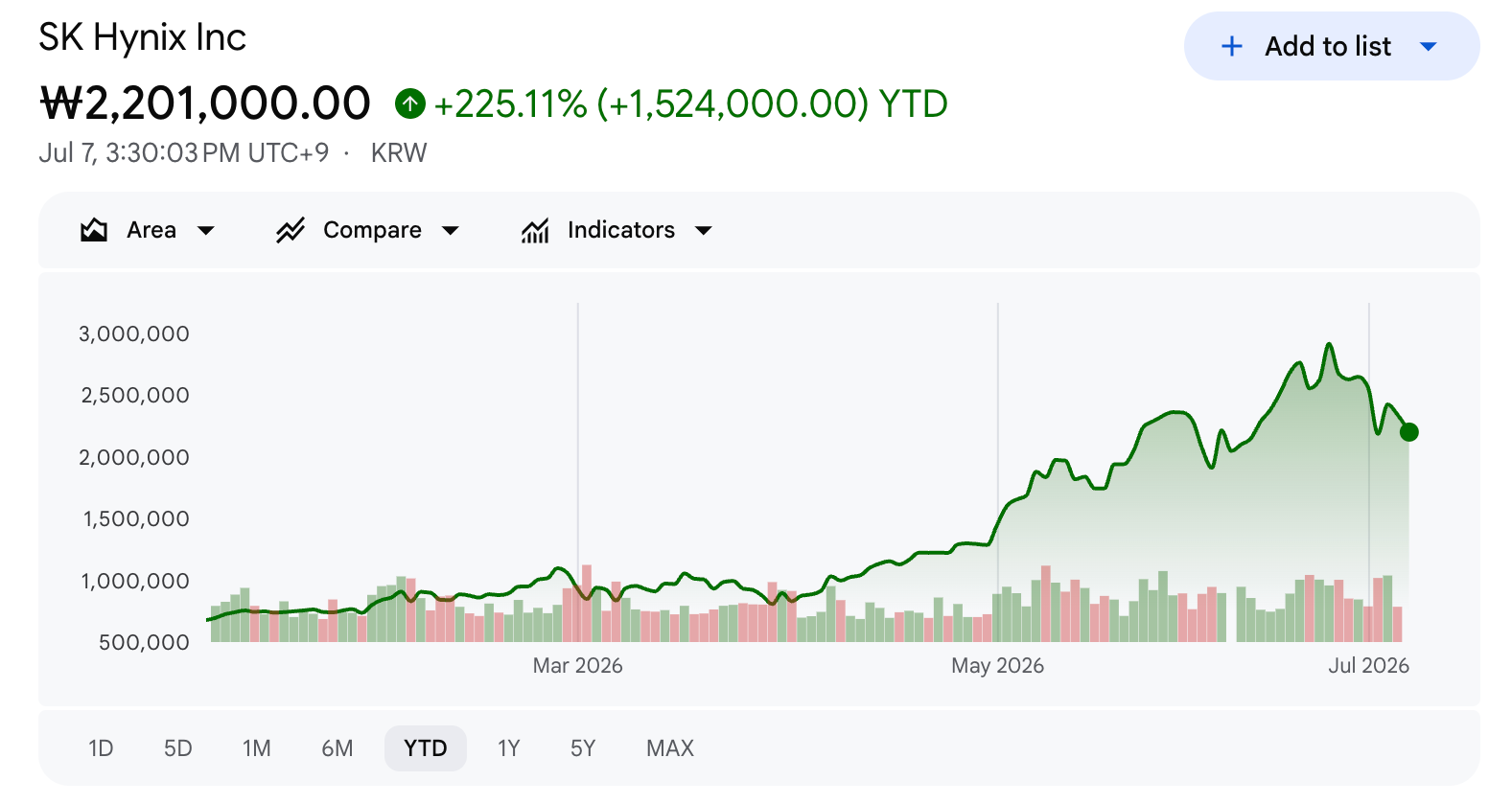
Meanwhile, SK Hynix’s Seoul-listed shares have climbed more than 220% this year, lifting its market value toward $1 trillion. Whether the premium holds will become clear once both lines trade side by side.
Subscribe to our YouTube channel to watch leaders and journalists provide expert insights
The post UBS Told Clients to Sell SK Hynix in One Market and Buy in Another: What is Happening? appeared first on BeInCrypto.
Two central banks, two hawkish tones — but only one dollar just took a hit. The ECB delivered a 25bp hike in June, its first since 2023, lifting the deposit rate to 2.25% as Middle East-driven energy costs pushed headline inflation to 3.2% in May before easing to 2.8% in June, with growth downgraded to 0.8% amid weaker confidence.
The Fed, under new Chair Kevin Warsh, held rates at 3.50%-3.75% for a fourth straight meeting, with a hawkish dot-plot shift initially fueling hike expectations. However, the June employment report—released on July 3rd—showed nonfarm payrolls rising by just 57K against 110K expected, the weakest reading in four months, while the unemployment rate dipped to 4.2% only due to a labor force participation rate falling to 61.5%, its lowest level in five years.
The result: both central banks’ communications currently lean hawkish, but with the Fed’s data now sending mixed signals. Which side ultimately prevails could well set the tone for EUR/USD’s trend into year-end.
EUR/USD Technical Analysis
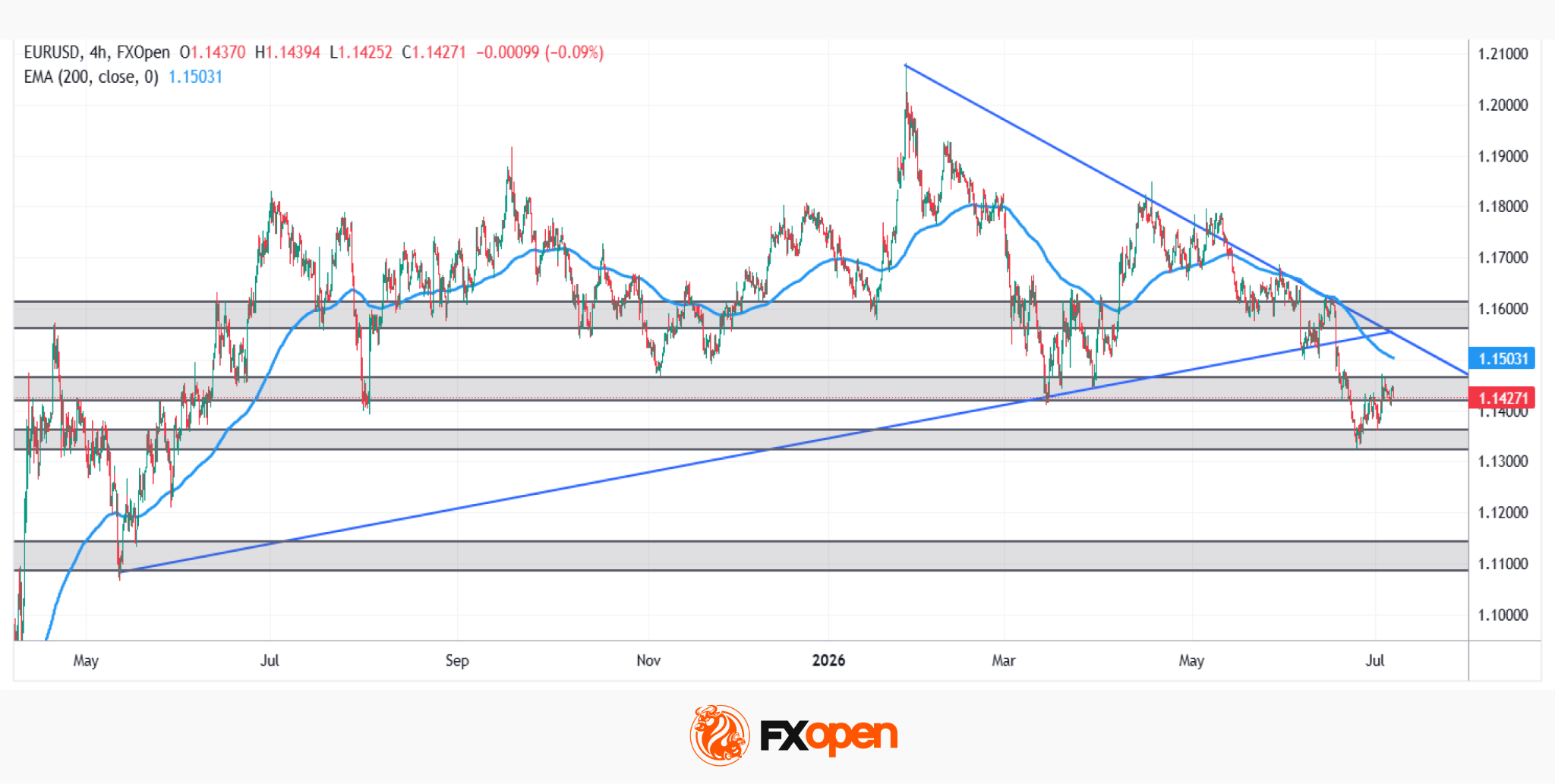
EUR/USD has spent roughly the past year confined within a broad consolidation range, as the chart illustrates, with price repeatedly oscillating between well-defined boundaries and no decisive breakout sustained in either direction.
Bullish Scenario
After briefly breaking below the range’s base support, price snapped back quickly, reclaiming the range almost as fast as it left it. For renewed bullish momentum to take hold, EUR/USD first needs to hold above the 1.1420-1.1460 support zone. The next, more decisive test lies with the descending trendline originating from January’s highs, which has been respected consistently throughout the year. This same area also converges with the 200-period EMA and the long-term ascending trendline broken to the downside in June. This confluence makes 1.1500-1.1550 the pivotal zone: a clean break above it would open the door for the euro to regain sustained strength against the dollar.
Bearish Scenario
The alternative reading is that price is currently only retesting the previously broken key support at 1.1420-1.1460. A decisive break below the low formed near 1.1320-1.1350 would confirm renewed downside momentum, clearing the path to resume the broader medium-term downtrend, where the next significant support comes into play around 1.1100-1.1150.
Either scenario will likely require confluence between technical structure and fundamentals, with central bank rhetoric and action remaining the key driver. ECB or Fed — which one becomes the catalyst for EUR/USD’s next major trend?
Trade over 50 forex markets 24 hours a day with FXOpen. Take advantage of low commissions, deep liquidity, and spreads from 0.0 pips (additional fees may apply). Open your FXOpen account now or learn more about trading forex with FXOpen.
This article represents the opinion of the Companies operating under the FXOpen brand only. It is not to be construed as an offer, solicitation, or recommendation with respect to products and services provided by the Companies operating under the FXOpen brand, nor is it to be considered financial advice.


- James said real pressure for keepers comes in the silence between shots.
- At Liverpool, City, Portsmouth and England, preparation shaped James.
- For traders too, instinct works only when built on the right information.
Zoomex hosted the third episode of its World Cup Edition X Space as part of the Zoomex World Cup Impact Pledge, bringing together England goalkeeper David James and a panel of traders: Crypto Kid, Farouk Bashar, and Theo Mercier.
Fernando Aranda hosted the session, which covered the knockout round, penalty psychology, goalkeeping philosophy, and England’s legitimate chances of winning the whole thing, a position James held without qualification and with obvious enjoyment.
The session continued the five-part charity initiative running across the series.
Zoomex is committing 1,000 USDT per episode to a charity of each football guest’s choosing, rising by an additional 5,000 USDT if the prediction proves correct.
James picked England to win the World Cup and nominated the UEFA Foundation as his charity of choice.
Last defence, last line, last save
The episode opened with a question every keeper answers differently, how do you describe the pressure of facing an unrelenting barrage of shots when your team is being outplayed?
James reframed the premise.
“I think the pressure is when you don’t have so much to do. When your team’s attacking and they’re not scoring and it goes down the other end and you’ve got to make the big save. That’s when the concentration has got to be there.”
He carried that logic across a career that spanned Liverpool, Manchester City, Portsmouth, and 53 caps for England.
The goalkeeper who is in the zone does not fear the next shot. He invites it. The trader who has done the homework does not fear the next candle. The preparation has already decided what happens next.
With the Congo goalkeeper the previous night, the opposite had been true. England were creating chances. The keeper was alert because the game required him to be.
“If you’re in the zone, then just keep shooting, keep shooting, because I’m going to be there.”
He was facing volume, but volume keeps a goalkeeper sharp. The danger is the long silence between saves.
The read on the England versus Congo game itself was direct. England won, which was the most important thing, but the Congo goalkeeper was exceptional for sixty or seventy minutes.
He had to be, James said, because England were creating the chances that required exceptional saves.
When Harry Kane’s header went in, and shortly after a thunderbolt from range made it two, the game was decided.
“There was a belief that there was going to be a second. And that’s where, the best goalkeepers in the world, they accept that goals go in, but don’t worry about the scoreline. They just say, OK, that shot beat me. Next shot, I will save. There’s no nerves.”
He was immediately thinking about the next fixture: Mexico at the Azteca. “Other than the final, it doesn’t get much better than that.”
He meant it as a compliment to the occasion, not a warning about the difficulty.
Penalties are about preparation, until they are about instinct
The panel spent substantial time on penalties, partly because the tournament had already produced defining moments in shootouts, and partly because the psychology maps almost exactly onto what traders describe as system versus gut reaction.
James described the two modes a goalkeeper can operate in during a shootout.
The first is pure preparation: the water bottle, the information, the tendencies logged from five or ten previous penalties by the same player, foot placement, the angle of the run-up, which way the non-kicking arm drops, whether there is a stutter in the approach.
All of that gets processed and the goalkeeper explodes at the last possible moment.
The second mode is instinct, and instinct, he said, can be wrong.
“When I thought I was the best goalie in the world and no one was going to beat me and I dived the wrong way, it was all instinct and sometimes your instincts are wrong. The more information you have, arguably, the better your instincts get.”
Crypto Kid connected it immediately.
“That phrase is very applicable to trading as well. Like the more information that you have in front of you, the more data that you can analyse, the better your instinct and ability to predict market movements get.”
Farouk had asked whether the goalkeeper’s rituals and routines in a shootout are natural or practiced. James was clear.
“My practice would be imagining the penalty shoot-out, imagining the crowd, even to the point where, if you’re playing in the Azteca, then you’re imagining being at one end or the other and what this is going to be like. And then you imagine yourself, how do you stand in that goal?”
Jordan Pickford’s approach has evolved over years from shouting and making faces to something more controlled. Whatever the method, James was confident it was rehearsed, not spontaneous.
On Bono specifically, who had already made a reputation in this tournament for his penalty-saving presence, James was thoughtful.
He had watched Bono in the last World Cup doing a particular movement with his feet: stepping one way, going the other. In subsequent shootouts, Bono was doing something slightly different.
“Now I’m thinking he’s doing something different because he knows everyone’s seen what he does. So the next penalty shootout in Morocco, the striker will be saying, “I think I know what you’re doing, but are you going to do something?”
The reputation itself becomes a variable. By the time the striker has processed what Bono is likely to do, Bono has already changed it.
You cannot learn to jump higher, you can learn to prepare better
Theo asked whether James had ever made a save and known in real time that it was a highlight moment.
The answer was yes, occasionally, but less often than people might assume, and for a reason worth sitting with.
“It’s very rare, especially with an experienced goalkeeper to be able to do something that you haven’t done before. You’re not going to be able to jump any higher than you have before. You’re not going to be able to spring. There might be some technical points where you’ve had to move into the position, react.”
The deflection save the Congo goalkeeper made the night before was one of those moments where instinct and body memory combine into something that looks miraculous from outside but feels like execution from inside.
“You look at it and go, OK, I’ve trained really hard to be able to make that save. I’m just so glad I made that save today. Rather than when you’re young and don’t know anything and you go, I’m fantastic, because I’ve never experienced it before.”
The same principle applies to mistakes. James described how the relationship with error has changed across his career and across the sport.
Twenty or thirty years ago, if you made a mistake, you might never see it properly again. It lived in the mind as an impression.
Now, by the hydration break, someone can show you exactly what happened, at what angle, at what moment the decision went wrong.
“A lot of it is, what happened there didn’t make sense. OK, now I know what happened, and you deal with it rather than thinking that it was something that it wasn’t.”
The practical outcome: errors become data rather than ghosts. Farouk brought up Uruguay and Bielsa’s decision to substitute the goalkeeper at half-time.
James had direct experience on the other side of that equation.
As a manager, he once brought a player off after twenty minutes.
“I knew that the game wasn’t going to get any better for the player. So I had to make changes. Fortunately, we ended up winning the game, but I had the conversation and explained why I did what I did.”
The substitution is not the hard part. The communication is. If the reasoning reaches the player, they move forward. If it does not, the confusion becomes a problem that outlasts the match.
France has eight players over 35 kilometres per hour
The question of which teams present the most difficult problems for a goalkeeper led James into statistics in the way he clearly enjoys them.
He had been tracking top-speed data across the tournament.
“If you look at players whose top speed in the World Cup is over 35 kilometres an hour, we have four. France have eight.”
He let the number land. The point was not just the count, but the distribution.
“It’s not just one or two players in similar positions. France is all over the place. They’ve got defenders, they’ve got wingers, they’ve got forwards.”
Whoever faces France in the knockout rounds is not defending against a fast team. They are defending against a team where the fast player could come from anywhere on the pitch at any moment.
His read on Mexico and Spain was built around a different kind of pressure: both teams had not yet conceded in the tournament. That sounds like strength. James described it as a form of fragility.
“When you haven’t conceded, you can think that we are unbeatable. But you can also fear that at some point you will get beaten, and it’s how you respond to conceding that first goal.”
Every other team in the competition had already made the adjustment.
They knew what it felt like to give one up and keep going. Mexico and Spain were still waiting for that moment, and it was coming.
The Cape Verde goalkeeper was the standout individual performance in the tournament so far. Forty years old. Three draws.
The performance against Spain in the first game, James said, was the reason Cape Verde were still in the competition.
“If it wasn’t for that performance against Spain in the first game, they’re going home. They’re going home without that performance. And now they have an opportunity to do something.”
He was waiting for the round of sixteen to identify the tournament’s best goalkeeper with more confidence.
The group stage had been one-sided in too many matches to draw firm conclusions. The round of thirty-two had continued that trend.
When the games tighten, distribution becomes the margin. “All the goalkeepers will be at the top level for the distribution, and the slight nuance in the quality of distribution will be the difference.”
Thierry Henry and Didier Drogba: Two of the loveliest guys you will ever meet
Fernando asked who made him most nervous across a career: the striker or midfielder who made him want to avoid the fixture.
“I was never nervous. I was just always disappointed.”
Then the answer: Thierry Henry and Didier Drogba. “Whenever it didn’t matter how good I felt. When I left the pitch, they’d won the game and usually one of them had scored.”
The frustration was not about fear. It was about the gap between preparation and outcome. He could feel ready. He could feel certain. And by the final whistle, one of them had still scored.
The more difficult detail: “Fernando, they are two of the loveliest guys you’re ever going to meet, which is even worse, because you want them to be horrible.”
He was clearer on goalkeeping evolution when Farouk raised the question. The rule changes have done more to alter the position than any tactical development.
When goal kicks moved from the box to open play, every goalkeeper had to develop a passing range that the position had never previously required. Distribution became structural rather than optional.
“When it comes to the actual physical side of goalkeeping, I’ve not seen any real evolution at all.”
The jumps are the same. The dives are the same. What has changed is the demand placed on the goalkeeper’s feet and decision-making inside the build-up.
He is pursuing his coaching badges partly to investigate whether the physical side of the position has scope for genuine development that the sport has not yet found.
Outfield, something has clearly happened. Players like Barcola and Dembélé are doing things at pace and in tight spaces that the best players in the world were not doing ten years ago.
Whether the goalkeeping position has evolved to match the players now running at it from eight different directions is a question James does not think has been fully answered.
England until we lose, and we have not lost
On England’s tournament prospects, James held the position he had taken before the first ball was kicked and was not moving from it.
Every argument that could be made for Spain, France, Brazil, or Argentina, he said, could be made equally for England. Until England lose, England are in it.
“I just think this year, this tournament, it’s all about England. So that’s my winner.”
He had watched Jude Bellingham pick up the Congo goalkeeper after a save, a moment of what he called friendly frustration, the recognition between two professionals that the other had done the job right.
Harry Kane had stepped up when it mattered. “For successful teams to be successful, there’s moments when the player steps up. And last night, Harry Kane stepped up.”
Crypto Kid supplied the external validation from outside the session: it is coming home, as the Prime Minister had apparently confirmed.
The panel’s own predictions spread across the obvious candidates. Theo saw Argentina or France one level above the rest. Farouk backed France on the basis of consistent performance across the group stage.
Crypto Kid was hoping for Argentina. Theo, asked to defend Brazil, admitted with some resignation that Brazil had the players but possibly not the structure.
On the prediction market, Olise was the consensus pick for top assists, with France likely to go deep enough in the tournament to give him the opportunities.
Mbappé and Messi split the golden boot votes.
The system does not have emotions, neither should you
James connected the work of a goalkeeper to the work of a trader in a way that the panel immediately recognised. Preparation decides the outcome before the event begins. Instinct is what preparation becomes when time runs out.
Crypto Kid had been thinking about the same parallel across the session.
“The more information that you have in front of you, the more data that you can analyse, the better your instinct and ability to predict market movements get. So it’s actually super, super related.”
The goalkeeper with the water bottle is running the same process as the trader who has backtested the position before opening it. The reading is faster at the moment because the thinking has already happened.
Farouk asked about goalkeeping rituals and whether they are learned or natural.
James’s answer extended into how the best professionals in any field develop their pre-performance routine: they rehearse the situation before it arrives, including the crowd, the specific stadium, the possible shooter, the possible market condition.
The routine is not superstition. It is a prior simulation under controlled conditions so that the real moment does not arrive as a surprise.
James’s closing advice to the audience was built on the same structure.
“I’ve done all my homework. Yes, I got the right result, but it’s because I’ve done my homework. Rather than when you’re young and don’t know anything and you go, I’m fantastic. It’s a lesson more about preparing yourself to do that than it is expecting something to happen that you’ve never practised or prepared for.”
He finished with a promise to return to the Zoomex X Space after swimming in Trafalgar Square fountain following England’s victory. Fernando said he would take a flight to be there.
The lesson from the Zoomex space
The thread that ran through the entire session was the relationship between information, preparation, and the moment of execution.
James’s career was built on narrowing that gap. A penalty is not decided when the ball is struck.
It is decided in the days of study that precede the shootout, in the mental rehearsal of the crowd, the shooter, the foot placement, the moment of explosion.
The moment itself is fast. The preparation is long. When the preparation is thorough, the fast moment goes the right way more often than it does not.
The traders described the same architecture. Farouk and Theo both described coming to the market with a position built before the session opens, and the discipline of not overriding that position when emotion says otherwise.
The goalkeeper who dives before the moment of information has arrived goes the wrong way on instinct alone. So does the trader who opens a position without a stop loss because the stomach says to hold.
David James’s specific answer to why he was never nervous, only ever disappointed, is worth sitting with.
He was disappointed because the preparation was thorough and the outcome still went against him. He was not nervous because nervousness means the preparation was incomplete.
The job of preparation is to remove the unknowns that produce nerves, and replace them with a plan that decides what happens when the situation changes.
The plan does not eliminate losing. It eliminates panicking while losing.
The Zoomex World Cup Impact Pledge continues across two more episodes. England are going to win the World Cup. David James said so, and 1,000 USDT for the UEFA Foundation is waiting on the other side of it.
About Zoomex
Founded in 2021, Zoomex is a global cryptocurrency trading platform with over 3 million users across more than 35 countries and regions, offering 600+ trading pairs.
Guided by its core values of “Simple × User-Friendly × Fast,” Zoomex is committed to fairness, integrity, and transparency in delivering a high-performance, low-barrier, trustworthy trading experience.
As an official partner of the Haas F1 Team and global brand ambassador partner of goalkeeper Emiliano Martínez, Zoomex brings the same focus on speed, precision, and discipline from the racetrack and the pitch to trading.
The platform holds regulatory licenses including Canada MSB, U.S. MSB, U.S. NFA, and Australia AUSTRAC, and has passed security audits conducted by Hacken.
This article is authored by a third party, and CoinJournal does not endorse or take responsibility for its content, accuracy, quality, advertisements, products, or materials. Readers should independently research and exercise due diligence before making decisions related to the mentioned company.
At Close of Business podcast July 7 2026

Ctrl Wallet Announces Shutdown Weeks after Security Exploit
How Many More ‘Dungeon Crawler Carl’ Books Will There Be?


-

 Fashion4 days ago
Weekend Open Thread: High Hopes
-

 Fashion19 hours ago
Open Thread: What Great Books Have You Read Recently?
-

 Politics4 days ago
The House | “Reframing the debate from a binary discussion of winners and losers”: Yuan Yang reviews ‘We Are Not Machines’
-
 NewsBeat2 days ago
Taylor Swift and Travis Kelce wedding staffer hilariously struggles to keep her cool while checking in megastars
-
 Crypto World6 days ago
Airdrop Registration Becomes Key Focus For Remittix As RTX Launch Updates Approach
-

 Sports6 days ago
Broncos roster: OL Ben Powers (No. 74) entering final year of contract
-

 Crypto World5 days ago
Binance stock trading tops $1B in first month after launch
-

 Crypto World4 days ago
Standard Chartered Secures MiCA License as ESMA Adds 37 New Crypto Firms
-

 NewsBeat7 days ago
Presenter Caroline Flack’s brother Paul Flack dies aged 55
-

 Crypto World5 days ago
Alibaba-affiliate Ant Group enters the humanoid robot market with 12 deals
-

 News Videos20 hours ago
Best Time to Enter Small Caps Right Now? Another Bull Run? | Financially Free
-

 Crypto World2 days ago
South Africa proposes crypto tax guidance under existing rules
-

 Business16 hours ago
AXT Shares Jump Nearly 14% as Semiconductor Materials Maker Rebounds on AI-Linked Indium Phosphide Demand
-

 Tech2 days ago
Lenovo laptops are now shipping with YMTC SSDs, a sign of Chinese NAND entering the mainstream
-

 Business6 days ago
Meta Platforms Stock Jumps 7% Today as Bloomberg Reports Company Plans to Enter the Cloud Business
-
 NewsBeat5 days ago
New exhibition reflects five decades of movement between island of Ireland and GB
-
Crypto World16 hours ago
SK hynix (000660.KS) Stock Dips as $28B Nasdaq ADR Offering Drives AI Memory Expansion
-

 News Videos7 hours ago
Whats Hidden Inside This Cash Register? #treasure #reselling #money
-

 Business4 days ago
What a 10 Percent Drop Means for Buyers, Sellers and Renters
-

 Crypto World5 days ago
Binance Re-Enters Philippines As EU MiCA Rules Restrict Access
You must be logged in to post a comment Login