
Crypto World
Trump whales load up ahead of Mar-a-Lago luncheon.


Whale activity around the TRUMP memecoin has intensified in the lead-up to a high-profile luncheon for top holders at Mar-a-Lago, even as the token’s price retraces from a March spike. On-chain data tracked by analytics firms shows several large transfers and new stash increases among the largest wallets, underscoring the ongoing tension between demand from retail participants and the concentration of supply among a handful of holders.
blockchain analytics firm Lookonchain highlighted the latest moves, including a whale who withdrew 105,754 OFFICIAL TRUMP (TRUMP) from Binance to augment a stash of about 1.13 million TRUMP — roughly $3.2 million at current prices — reported on Sunday. Earlier in the week, another large holder pulled 850,488 TRUMP from Bybit. On Solscan, a different wallet increased its TRUMP balance to more than 368,000 after an exit from BitMart, while a fourth wallet boosted holdings to above one million TRUMP following a Bybit withdrawal. These movements come as the top holders are slated for a private luncheon at Trump’s Mar-a-Lago estate on April 25, with the event billed as featuring the former president as keynote speaker and a private reception for the top 29 holders.
Critics have argued that the event blurs political power with fundraising and personal gain, a concern echoed by lawmakers who have proposed measures aimed at curbing profits from memecoins tied to political figures. The White House has not commented on the memecoin’s fundraising optics, but the policy debate around memecoins remains a constant background theme in coverage of this asset class.
TRUMP price drift and what it implies for holders
The token’s price has cooled considerably since its March surge tied to the luncheon announcement. TRUMP traded near $2.80 on Monday, down more than 33% from its March peak of about $4.35. Data from CoinGecko shows the retracement, even as on-chain activity suggests ongoing accumulation among the largest holders.
Analyst commentary from Dominick John at Zeus Research framed the move this way: the price decline appears driven by retail selling against a backdrop of thin liquidity, which makes it easier for modest selling pressure to push prices lower. He also noted that the insider supply overhang means even small distributions from concentrated wallets can absorb new bids, dampening upside momentum for the token.
CoinCarp’s data reinforces the sense of pronounced concentration: the platform lists 642,882 TRUMP holders, with more than 91% of the supply held by the top 10 wallets and over 97% held by the top 100 wallets. In other words, the distribution of supply remains highly centralized, a factor that can both stabilize and cap upside depending on how those wallets choose to act in any given moment.
Past milestones, present dynamics, and potential catalysts
Trump’s first “crypto gala” dinner in May 2025 marked a previous burst in TRUMP’s price, with the token peaking around $15.59 roughly a month before the event and then retreating in the run-up. In the months since, the price path has been markedly less pronounced, though traders and analysts have pointed to potential catalysts that could rekindle momentum. John at Zeus Research suggests that a broader market backdrop paired with event-driven announcements could help establish a usable floor for the token and stir reflexive upside among participants.
“One catalyst to watch is the potential for event-driven launches, such as a proposed Trump Billionaire Game, which could generate social buzz and translate into short-term upside momentum,” John said. He cautioned that the same concentration of supply could moderate gains if the large holders decide to distribute, even in the face of favorable headlines.
Looking ahead, the upcoming luncheon and any related corporate or political announcements could act as a sentiment lever for the TRUMP token. If institutional interest begins to show in early accumulation or if broader memecoin activity heats up around the same time, a floor could form, enabling a more resilient bounce. But observers caution that absent a broader rebalancing of the supply base, gains may remain predominantly tied to the whims of the top holders rather than a healthy, broad-based retail demand story.
From a market structure perspective, the potential for new, high-profile launches tied to Trump’s brand in the crypto space could add a novel driver for short-term upside. Still, investors should contend with a highly concentrated holder base and liquidity that can tighten quickly during pullbacks, a dynamic that has underscored past price fluctuations.
Beyond price, regulatory scrutiny continues to loom. Democratic lawmakers have signaled an intent to curb profits from memecoins associated with political figures, a thread that could influence both participation and sentiment in the space over the medium term. As policymakers weigh proposals, traders and builders will be watching for any clarity on how such tokens should be treated under securities or commodity frameworks and whether targeted restrictions could alter the economics of large-scale memecoin holdings.
The TRUMP token’s appeal appears to rest as much on social momentum and media visibility as on fundamentals. The luncheon at Mar-a-Lago, the album of on-chain movements by large wallets, and the narrative around political branding in crypto all contribute to a multifaceted story that transcends a single price point. For readers, the key takeaway is to watch how the top holders’ decisions, new event-driven catalysts, and regulatory signals intersect to shape the token’s trajectory in the near term.
In practice, the evolving mix of on-chain activity and market sentiment suggests that the next few weeks could be telling for TRUMP. If the pool of actively trading retail investors expands or if a credible new catalyst surfaces, the token could test a new range. If, however, the concentration among the top wallets remains a dominant feature, upside may be limited unless a decisive large-holder move triggers broader participation.
As always, readers should stay tuned to on-chain trackers and exchange flow summaries for the latest movements, while watching for any official commentary on the event’s political optics and potential regulatory implications that could influence investor appetite for memecoins tied to public figures.

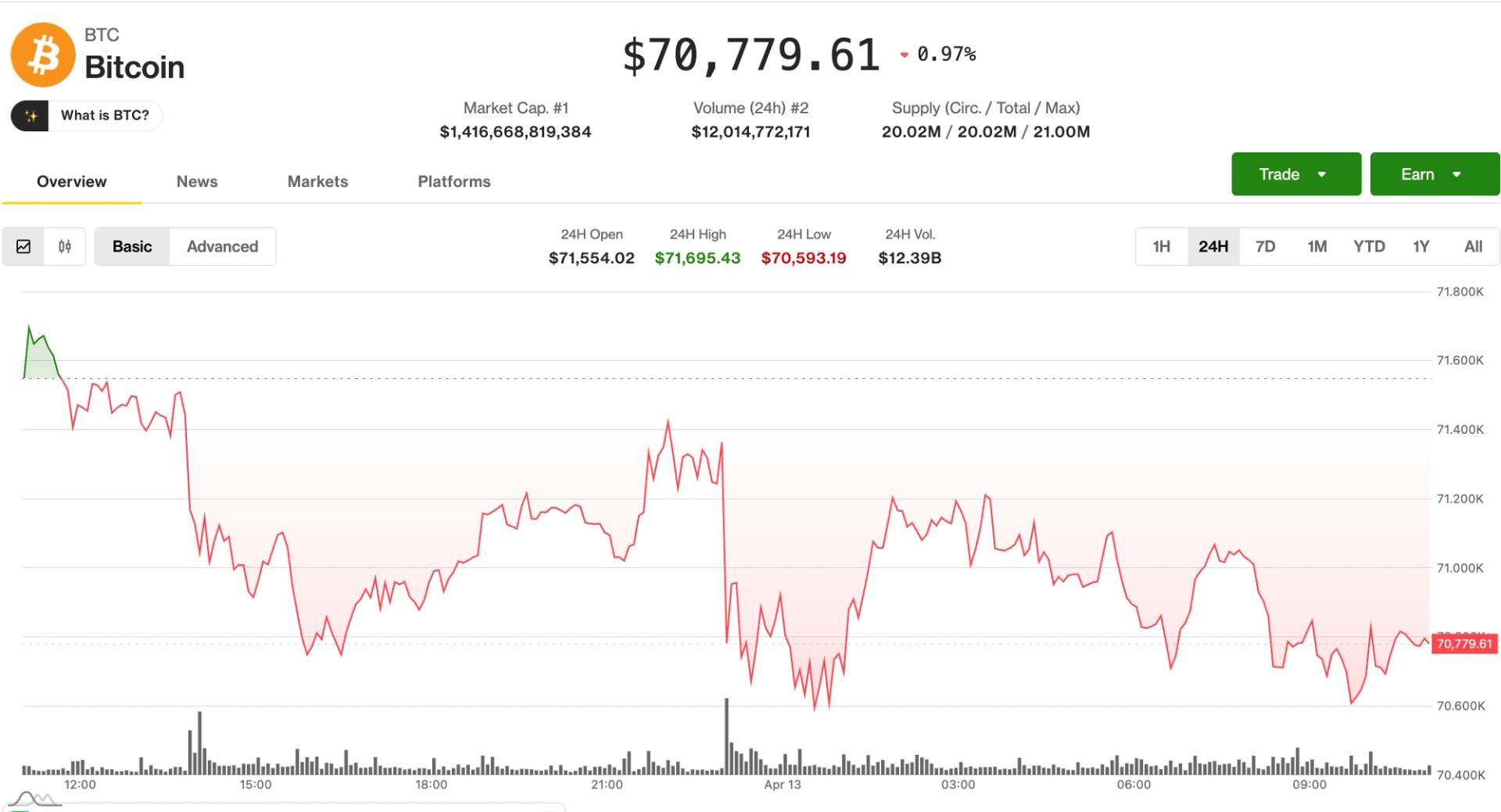
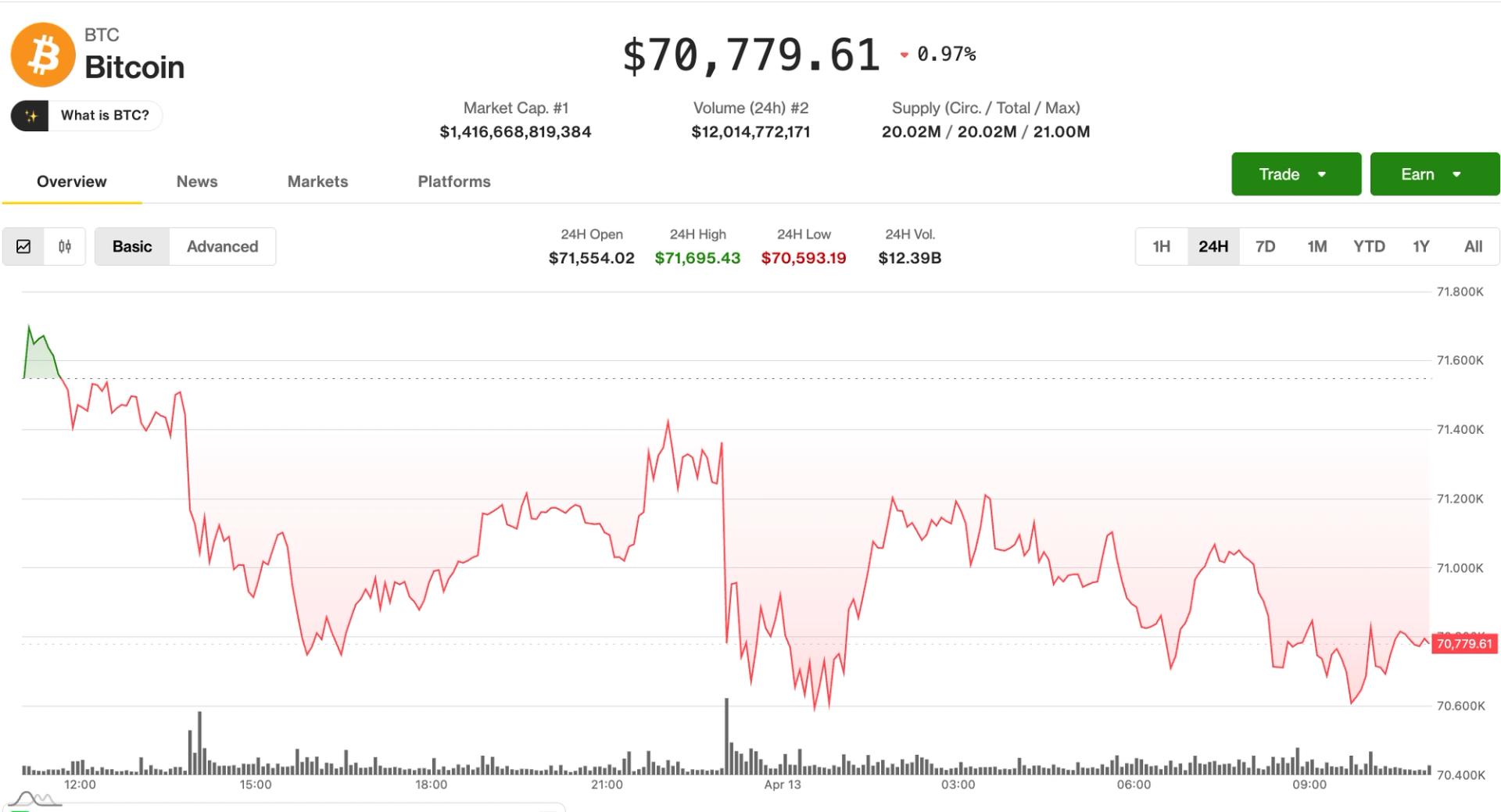
Bitcoin failed once more to break out of its monthslong trading range over the weekend, selling off below the key resistance level at $74,000 to trade recently at $70,600.
Ether (ETH) and the altcoin market followed suit, as ETH tumbled from April 11 high of $2,320 to $2,190. It remains little changed since midnight UTC.
The selloff came as Brent crude oil jumped back above $100 per barrel after U.S. President Donald Trump ordered a blockade at the Strait of Hormuz. The conflict with Iran has been a direct driver of risk asset price action over the past month, with U.S. equities and crypto being inversely correlated to oil and the U.S. dollar.
For now, bitcoin and the broader crypto market remain in a trading range that has persisted since early February, failing to break above $75,000 to the upside while holding firm above $63,000 to the downside.
Derivatives positioning
- Futures tied to most major tokens, including bitcoin and ether, have declined slightly over the past 24 hours. The move indicates traders are scaling back risk after President Trump ordered a blockade of the Strait of Hormuz, triggering a surge in oil prices.
- While oil prices have surged 5%, open interest (OI) in Binance’s crude futures declined by more than 1%. Activity on the decentralized platform Hyperliquid picked up over the weekend, with combined OI in Brent and WTI futures topping $1 billion.
- Futures tied to saw strong capital inflows, with open interest jumping to the most since Feb. 26. This is not necessarily bullish, as both perpetual funding rates and the 24-hour cumulative volume delta remain negative, suggesting that the inflows are being driven largely by traders chasing downside positioning or actively building short exposure rather than accumulating long positions.
- Except for HYPE, LINK, AVAX, TRX and ZEC, all top 25 coins have seen negative CVD, indicating that sell-side aggression is offsetting buy-side aggression across the market.
- A negative CVD indicates that more participants are selling by actively hitting bids than buying by lifting asks.
- Bitcoin and ether’s options-based implied volatility metrics remain low across most time frames, suggesting the market is pricing in calmer, slower price movements. The volatility curve is also fairly flat, showing no strong expectation of sudden future spikes.
- Still, downside concerns persist. BTC puts are currently trading at a 5-point or more premium across all time frames, indicating stronger demand for downside protection. ETH puts are also elevated, though to a noticeably lesser degree than BTC.
- Block flows featured call calendar spreads and straddles, with these two strategies accounting for over 50% of total activity over the past 24 hours, indicating investor preference for time decay and volatility over a clear directional bias.
Token talk
- The CoinDesk Memecoin Index (CDMEME) and the DeFi Select Index (DFX) were both in the black on Monday alongside the altcoin-dominant CoinDesk 100 (CD100), while the bitcoin and indexes dominated by the biggest tokens lost ground following oil’s price increase to above $100 per barrel.
- DeFi token AAVE was one of the top performers, rising around 5%, followed by HYPE and JUP, which added about 2%.
- But it was the memecoins that dominated Monday’s gains: BROCCOLI, BAN and 币安人生 posted gains in excess of 10%, demonstrating investor appetite for highly speculative tokens in what is otherwise a very flat market.
- CoinMarketCap’s “Altcoin Season” indicator is at 36/100, higher than February’s sub-20 low, but beneath the 50/100 it hit last month.


Third-party AI routing services are exposing users to significant security flaws that could result in the theft of cryptocurrency and cloud credentials.
Summary
- Researchers found that 26 third-party LLM routers are actively injecting malicious code and stealing credentials by exploiting their access to plaintext data.
- The study revealed that intermediaries can intercept private keys and cloud credentials because they terminate secure encryption to aggregate AI requests.
According to a paper published on Thursday by University of California researchers, the supply chain for Large Language Models (LLM) contains several vulnerabilities that allow for malicious code injection and credential extraction.
These intermediaries, which developers use to manage access to providers like Google or OpenAI, essentially act as a “middleman” that terminates secure encryption.
Because they have full plaintext access to every message sent through them, sensitive data like seed phrases or private keys can be intercepted by unverified infrastructure.
The researchers tested 400 free and 28 paid routers to measure the extent of these risks. Nine of these services actively injected malicious code, while 17 separate routers were caught accessing Amazon Web Services credentials owned by the team.
During the experiment, one router successfully drained Ether from a decoy wallet after the researchers provided a prefunded private key.
Although the team kept the balances low to ensure the total loss remained under $50, the result confirmed how easily a compromised intermediary can siphon funds.
“26 LLM routers are secretly injecting malicious tool calls and stealing creds,” co-author Chaofan Shou stated on X.
Identifying a malicious router is a difficult task for the average user. The researchers noted that because these services must read data to forward it, there is no visible difference between legitimate handling and active theft.
The danger increases when developers enable “YOLO mode,” a setting in many AI frameworks that lets an agent execute commands automatically without a human confirming the action.
This allows an attacker to send instructions that the user’s system will run instantly, often without the operator’s knowledge.
“The boundary between ‘credential handling’ and ‘credential theft’ is invisible to the client because routers already read secrets in plaintext as part of normal forwarding,” the study explained.
Previously reliable routers can become dangerous if they reuse leaked credentials through weak relays. To prevent these attacks, the research team suggested that developers should never allow private keys or sensitive phrases to pass through an AI agent session.
A permanent solution would require AI companies to use cryptographic signatures. Such a system would allow an agent to mathematically prove that instructions came from the actual model rather than a tampered third-party source.
“LLM API routers sit on a critical trust boundary that the ecosystem currently treats as transparent transport,” the paper concluded.


Nexus Core Systems has entered into a memorandum of understanding with Moroccan authorities to develop a $1.28 billion artificial intelligence facility.
Summary
- Nexus Core Systems signed a $1.28 billion MoU with Moroccan authorities at GITEX Africa 2026 to launch the Nexus AI Factory Platform.
- The project will roll out in two phases, combining an HPC data center, Center of Excellence, and innovation hub, with 36 MW capacity and 125 jobs by 2027.
- The initiative supports Morocco’s Digital 2030 strategy and is backed by technologies from Nvidia and Naver Cloud.
The agreement was formalized during GITEX Africa 2026, held from April 7 to 9 in Marrakech. It brings together Nexus Core Systems with the Ministry of Digital Transition and Administrative Reform, the Ministry of Investment, Convergence and Public Policy Evaluation, and the Moroccan Agency for Investment and Export Development.
The deal initiates the first phase of the “Nexus AI Factory Platform,” a project positioned as a key step in Morocco’s push to strengthen its role in advanced digital infrastructure.
According to Morocco’s Ministry of Digital Transition, the facility will combine a high-performance computing data center with a Center of Excellence focused on training and skills transfer. It will also house an innovation hub dedicated to next-generation AI applications.
The design will introduce what officials describe as an integrated, sovereign infrastructure capable of supporting both domestic needs and international operations. The broader roadmap also includes plans for a next-generation data center near Casablanca, with long-term ambitions to scale capacity significantly while relying on renewable energy sources.
Phased rollout and investment structure
The project will be deployed in two phases and is expected to generate 125 direct jobs by 2027. The initial phase will see Nexus Core Systems allocate 5 billion dirhams to develop a 16 megawatt facility in the Nouaceur region, marking the operational launch of the platform.
A second phase will follow with an additional 7 billion dirhams investment at a separate site, expanding capacity by 20 megawatts.
Together, these phases form part of a longer-term vision that positions the platform as a foundation for large-scale AI workloads and future expansion.
The initiative aligns with Morocco’s “Digital 2030” program, introduced in 2024, which targets increasing the digital economy’s contribution to gross domestic product to 5%.
The strategy also sets out goals to create 270,000 jobs, support the development of 3,000 startups, and accelerate the digitization of public services. The Nexus AI Factory Platform is expected to contribute to these targets by strengthening infrastructure and fostering innovation-led growth.
Officials highlight strategic and economic impact
Amal El Fallah Seghrouchni, minister of Digital Transition and Administrative Reform, said the project would reinforce Morocco’s technological capabilities.
“The launch of the Nexus AI Factory Platform contributes to the development of digital infrastructure and strengthens Morocco’s capabilities in digital technology and artificial intelligence,” she said.
Nexus Core Systems chief executive Jaap Zuiderveld pointed to Morocco’s investment climate and talent base as key factors behind the decision.
“Morocco offers a combination of political stability, forward-looking leadership and strong talent,” he said, adding that the company is “not only deploying high-performance infrastructure” but building “an integrated ecosystem” that includes a Center of Excellence and an innovation hub to support global operations.
Founded in 2025 in partnership with Lloyds Capital, Nexus Core Systems is pursuing a broader strategy to develop AI factories tailored for high-demand computing workloads worldwide.
The London-based firm relies on advanced technologies from Nvidia and Naver Cloud, positioning its infrastructure to meet rising demand for AI-driven processing capacity across global markets.
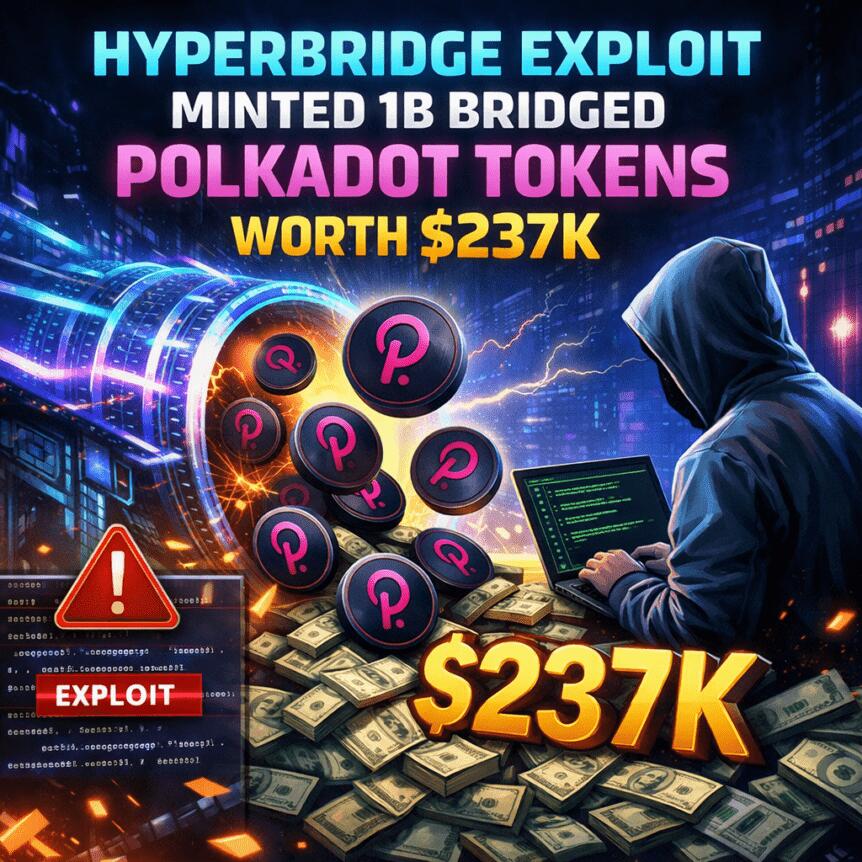
A hacker exploited the Polkadot-based cross-chain protocol Hyperbridge, minting 1 billion bridged DOT tokens on Ethereum and ultimately converting a portion into about 108.2 ETH, worth roughly $237,000, after liquidity constraints whittled the proceeds. The incident rekindles questions about the security of bridge infrastructure that underpins cross-chain token transfers.
CertiK researchers traced the minting to a forged message that altered the admin of the Polkadot token contract on Ethereum, enabling the attacker to generate the bridged DOT. However, the liquidity dynamics in Ethereum’s bridged-DOT pool capped the eventual profit, leaving a small fraction of the minted value realized on the open market.
Security researchers pointed to a potential replay vulnerability tied to the protocol’s Merkle Mountain Range (MMR) proofs. Blocksec Falcon described the likely root cause as an MMR proof replay vulnerability stemming from missing proof-to-request binding, though Hyperbridge has not publicly confirmed a final root-cause assessment.
Hyperbridge halted operations to implement an upgrade while investigators assess the breach. Early commentary from contributors suggested the fault may have involved a malicious proof that fooled the protocol’s Merkle-tree verifier, underscoring how cross-chain verification mechanisms can be a weak link in bridge design.
The incident sits alongside other bridge-related disclosures in recent weeks. Aethir disclosed a separate bridge exploit earlier this year, with user losses kept under $90,000, a reminder that multiple bridges remain targets in the nascent cross-chain ecosystem.
Polkadot noted that the incident affected only DOT on Ethereum bridged through Hyperbridge; native DOT tokens and the broader Polkadot ecosystem were not impacted. The DOT price faced pressure but recovered from a dip to about $1.16, with quotes placing it above $1.19 at the time of writing per CoinGecko data.
Key takeaways
- Hyperbridge’s breach involved minting 1 billion bridged DOT on Ethereum, with on-chain data showing approximately 108.2 ETH (about $237,000) recovered after the swap due to liquidity constraints.
- CertiK attributes the mint to a forged message that changed the admin of the Polkadot token contract on Ethereum, enabling the attack.
- Blocksec Falcon’s analysis points to an MMR proof replay vulnerability from missing proof-to-request binding, though a definitive root cause has not been publicly confirmed by Hyperbridge.
- The incident caused no broader DOT disruption beyond the Ethereum-bridged DOT via Hyperbridge; native DOT and the wider Polkadot network remained unaffected.
- Separately, SubQuery Network reported a $130,000 breach due to missing access controls that allowed an attacker to redirect staking withdrawals, highlighting ongoing bridge- and data-indexing-security challenges in DeFi infrastructure.
Hyperbridge breach: what happened and what’s at stake for cross-chain bridges
The attacker executed a single, high-impact operation: minting 1 billion DOT tokens through Hyperbridge by exploiting a forged message that altered the admin rights on the Ethereum-facing Polkadot contract. CertiK’s analysis emphasizes that the forge enabled token creation within the bridged layer, triggering a liquidity-driven liquidation that ultimately yielded about 108.2 ETH—roughly $237,000 at current prices—after the token swap.
Hyperbridge promptly paused its bridge services and initiated an upgrade to address the vulnerability. While the initial assessment suggests a malicious proof manipulated the Merkle-tree verifier, the protocol’s team has not yet released a formal, final root-cause statement. The incident demonstrates how a single forged control instruction in a cross-chain contract can unlock large token minting if the verification mechanism underpins the bridge is compromised.
Root-cause debate and the resilience of proof-based bridges
Industry researchers have highlighted potential weaknesses in the way cross-chain proofs are bound to requests. Blocksec Falcon articulated that an MMR proof replay scenario—driven by missing proof-to-request binding—could enable duplicate or fraudulent validations within a bridge’s verification layer. While this framing aligns with known class of proof-related exploits, confirmation from Hyperbridge regarding the exact cause remains pending, leaving investors and builders awaiting a definitive account and remediation plan.
Beyond the technical specifics, the incident reinforces a broader narrative: even protocols marketed as “full node security” for cross-chain interoperability can face material exploits if the underlying proof systems and admin controls are not airtight. The market’s reaction—at least in the DOT-ETH bridged segment—has been cautious, with liquidity-sensitive outcomes shaping the realized profits for attackers and shaping perceptions of risk around bridge deployments.
Broader ecosystem impact: DOT, SubQuery, and the DeFi security landscape
In parallel to the Hyperbridge incident, the data-indexing protocol SubQuery Network reported a separate breach of roughly $130,000, attributed to insufficient access control that allowed an attacker to designate a malicious contract as the withdrawal target for staking rewards. Security auditors emphasized that legacy code and long-running access-control gaps can create windows for misappropriation even years after initial deployment.
Looking at the broader security landscape, industry trackers note a marked decline in DeFi exploit losses year over year. For Q1 2026, hackers stole about $168 million across 34 protocols, a sharp drop from Q1 2025’s $1.58 billion in total exploits, which included the record $1.4 billion Bybit hack. The figures underline a continuing improvement in some security metrics, even as individual incidents—such as Hyperbridge and SubQuery—illustrate persistent risk at the protocol level.
From Polkadot’s vantage point, the incident underscores a targeted risk around cross-chain bridges rather than a flaw in native assets. Polkadot noted that native DOT and the broader network remained unaffected by the Hyperbridge event, which is an important nuance for users and investors navigating bridged ecosystems. The price reaction has been mixed, with DOT briefly dipping before stabilizing above $1.19 as liquidity responded to the incident and subsequent updates.
What comes next for users, developers, and the market
For users and developers, the episode emphasizes the need for robust admin-control hardening, tighter proof-binding between bridge requests and verifications, and ongoing runtime monitoring of bridge state. The Hyperbridge team’s upgrade path will be crucial to restoring trust in a protocol that positions itself as a secure conduit for cross-chain assets. Practitioners should watch for a published root-cause statement, a detailed remediation plan, and any proofs or audits that quantify the improved security posture.
Regulators and standard-setters are also eyeing cross-chain security as bridging becomes an increasingly common primitive in crypto infrastructure. For traders and investors, the events reinforce a cautious stance toward bridged assets and a need to monitor liquidity conditions that can magnify or shrink the realized value of an exploit. As the ecosystem matures, more robust risk controls, formal verification of cross-chain proofs, and explicit incident disclosure practices will likely shape the next wave of security-focused improvements in bridge design.
Readers should watch for Hyperbridge’s ongoing upgrade trajectory, any formal root-cause disclosures, and correlated developments across other bridge projects as the space seeks to harden its defenses against increasingly sophisticated attack patterns.

Key Takeaways
- SKYQ shares have surged more than 200% in early April, climbing 7.96% to $7.87 in Friday’s premarket session
- The rally correlates with increased strategic value of Sky Quarry’s Foreland Refinery in Nevada amid tightening regional fuel supplies
- President Trump’s remarks regarding Iran and the Strait of Hormuz drove crude oil prices up 2.31% to approximately $100.13 per barrel
- Technical indicators show the stock trading 114% above its 20-day SMA and 155.9% above its 100-day SMA, with RSI at 77.79 indicating overbought conditions
- The company’s financial position remains challenging: EBIT margin of -72.3%, debt-to-equity ratio of 3.57, and cash reserves of only $35,370
Sky Quarry (SKYQ) has emerged as one of April’s most dramatic performers. The shares have skyrocketed more than 200% within days, propelled by geopolitical developments and increasing focus on the company’s refining infrastructure in Nevada.
During Friday’s premarket session, SKYQ advanced 7.96%, reaching $7.87.
This explosive rally has been gaining momentum throughout the week, with Friday’s gains extending an already impressive multi-day advance. The movement isn’t attributable to any single trigger — rather, it reflects multiple catalysts aligning simultaneously.
Central to the narrative is Sky Quarry’s Foreland Refinery facility in Nevada. As regional refining capacity has become increasingly constrained, this asset has attracted renewed market attention. The company has previously announced ongoing negotiations with regional crude suppliers focused on expanding production capacity.
These strategic conversations have gained considerably more significance in recent days.
Middle East Tensions Drive Oil Prices Higher
President Trump took to Truth Social on Friday morning with pointed criticism of Iran regarding an alleged agreement concerning the Strait of Hormuz.
“Iran is doing a very poor job, dishonorable some would say, of allowing Oil to go through the Strait of Hormuz,” Trump stated. “That is not the agreement we have.”
The remarks immediately impacted energy markets. Crude oil futures surged 2.31% to approximately $100.13 per barrel during early New York trading hours.
Such geopolitical developments typically provide swift tailwinds for smaller energy-focused companies, and SKYQ has benefited from optimal positioning.
Technical Momentum Contrasts Sharply with Fundamental Reality
Looking at chart patterns, SKYQ displays extreme momentum characteristics. The shares are currently positioned 114% above the 20-day simple moving average and an extraordinary 155.9% above the 100-day SMA.
The Relative Strength Index reached 77.79, entering overbought territory midweek Wednesday. Resistance is positioned at $9.00, while support is identified around $3.50.
However, the underlying financial metrics present a contrasting narrative.
Sky Quarry shows an EBIT margin of -72.3%, with gross margins in negative territory at -24.8%. The company posted net losses totaling $28.65 million while generating merely $281,620 in standalone revenue against substantial operating expenses.
Total assets amount to $19.2 million, offset by liabilities of $16.03 million. Available cash stands at an alarmingly low $35,370.
With a debt-to-equity ratio of 3.57 and a current ratio of just 0.1, the company faces significant near-term liquidity constraints.
Return on equity registers at -37.36%. Operating cash flow remains negative, indicating the company’s ongoing dependence on external capital to sustain operations.
Market analysts maintain a negative outlook on SKYQ. Most industry watchers characterize the current price movement as momentum-driven speculation rather than a fundamental reassessment of company value.
The weekly trading range illustrates this speculative nature: SKYQ began the week at $5.32, reached a peak of $13.49, and experienced daily fluctuations between $4.90 and $12.52.
As of Friday’s premarket trading, SKYQ was changing hands at $7.87, representing a 7.96% gain for the session.

Crypto World
Trump Crypto Whales Accumulating Before Luncheon Schedule: Mar-A-Lago to Jump Start Memecoins?

TRUMP crypto token is trading near $2.80, with large-holder netflow registering a five-month high. 83 wallets now hold over 1 million tokens each. To put it into perspective, this level of concentration has not been seen since October 2025.
— BSCN (@BSCNews) March 21, 2026
 UPDATE: LUNCH WITH DONALD TRUMP COULD COST UP TO $6M
Donald Trump’s upcoming crypto luncheon at Mar-a-Lago is tied to $TRUMP token holdings.
Seats cost as little as $70,000 or climb to $6 million for top-ranked wallets, according to @CoinDesk.
Attendance is capped at 297… pic.twitter.com/IaFLVbjfF0
The catalyst is an exclusive crypto luncheon scheduled for April 25 at Donald Trump’s Mar-a-Lago residence in Florida, restricted to the top 297 token holders by position size. The accumulation looks like conviction, but it could also be front-running a sell-the-news setup.
Discover: The best crypto to diversify your portfolio with
Crypto Data Shows Whales Pulling TRUMP Off Exchanges
Whale wallet “8DHkza” withdrew 850,488 TRUMP tokens, or approximately $2.4 million, from Bybit over the past 48 hours. This is direct custody, which historically signals long-term holding intent rather than short-term trading.
Another wallet, “7EtuAt,” pulled 105,754 tokens (~$298,000) from Binance 17 hours ago, bringing its total position to 1.13 million tokens worth as much as $3.2 million.
Whales are accumulating $TRUMP ahead of Trump April 2025 Luncheon — Karan Singh Arora (@thisisksa) April 12, 2026

850K+ pulled from Bybit
Another 100K+ withdrawn from Binance
One wallet now holding 1.13M $TRUMP
Feels less like conviction and more like exit liquidity getting primed.
Stay cautious. pic.twitter.com/n7cI8L9Lio
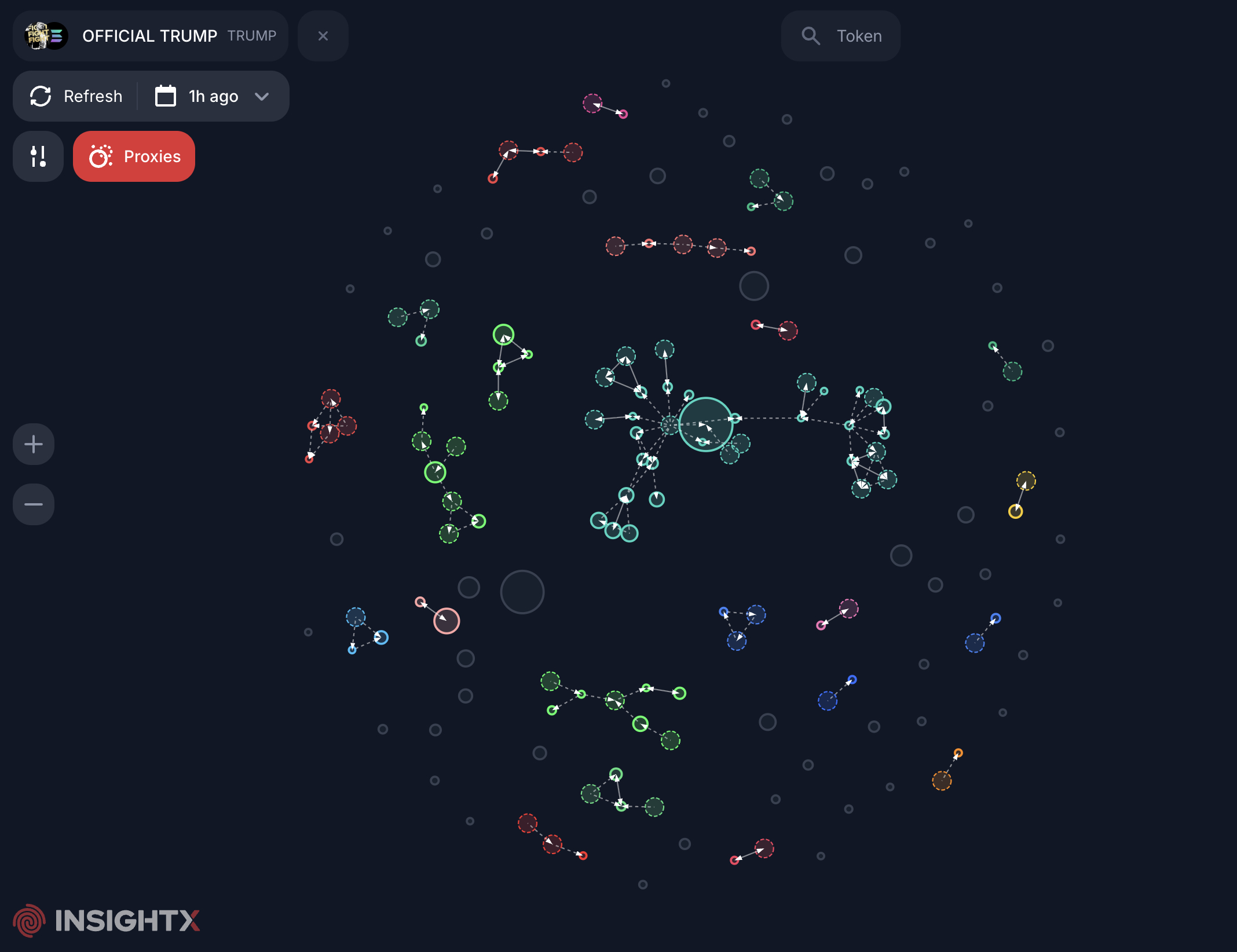
Data confirms the broader picture: 83 wallets above the 1-million-token threshold mark the highest reading since October 2025, when the MAGA token first caught institutional-adjacent attention on the back of Trump’s crypto endorsement wave.
Supply distribution data adds a sharper edge, 91% of all TRUMP supply sits in the top 10 wallets, 97% in the top 100. That’s extreme concentration, even by memecoin standards. Similar whale accumulation patterns in other tokens have preceded sharp directional moves.
But can Trump crypto moves lift up the memecoin scene?
Discover: The best pre-launch token sales
Missed the TRUMP Entry? This Presale Token Targets Early-Mover Upside
While Trump crypto latest moves look like they have been priced in, or worse, a buy-the-news situation, Maxi Doge ($MAXI), a new ERC-20 project that has already raised more than $4,7 Million in its presale phase.
Maxi Doge differentiates itself from potential competitors by targeting a specific subculture: the leverage addict. Branded as a 240-lb canine juggernaut, the project’s USP revolves around its “Leverage King” culture and holder-only trading competitions.
The roadmap avoids vague promises, focusing instead on a “Maxi Fund” treasury designed to inject liquidity and sustain market operations, and the entry price represents a specific opportunity for early movers.
Currently priced at $0.000281, the token offers an accessible entry point compared to established caps. The platform also boasts 66% APY rewards, incentivizing holders to lock supply to reduce sell pressure.
Check out the Maxi Doge Presale
The post Trump Crypto Whales Accumulating Before Luncheon Schedule: Mar-A-Lago to Jump Start Memecoins? appeared first on Cryptonews.

Disclosure: This article does not represent investment advice. The content and materials featured on this page are for educational purposes only.
BlockchainFX gains traction as presale nears soft cap, attracting early investor attention.
Summary
- BlockchainFX (BFX) presale nears $15m softcap as demand rises for multi-asset crypto trading platforms
- BFX positions as a Super App, combining crypto, stocks, forex, and ETFs in one on-chain platform
- Strong early adoption and bonus incentives drive last-minute interest ahead of BlockchainFX launch
Timing is everything in crypto, and right now, one project is making serious noise heading into its launch. BlockchainFX has been turning heads across the trading community, and for good reason.
With its presale closing in on the $15m softcap and the LAUNCH50 bonus code offering 50% extra tokens, the window for getting in early is nearly shut. If finding the best new crypto presale before it pops is the goal, this one deserves full attention.

BlockchainFX is not an average exchange token. It is a full-on trading super app that brings crypto, stocks, forex, ETFs, and commodities under one roof, completely on-chain. The platform has already been awarded “Best New Crypto Trading App of 2025,” and with 23,000+ participants already on board, the early crowd clearly sees something here. Here is the full breakdown.
BlockchainFX: The super app that actually lives up to the name
BlockchainFX is a next-generation decentralized exchange that does something no major platform like Binance or Coinbase currently does: it gives users access to traditional financial markets alongside crypto, all from a single self-custody wallet. No switching between five different apps, no handing over control of assets to a centralized custodian. The platform is already live in beta, licensed and regulated by the Anjouan Offshore Finance Authority (AOFA), and has already processed millions in daily trading volume. That is not a roadmap promise, that is live activity.
The presale has raised over $14.2m against a $15m softcap, with the current token price sitting at $0.035 and a launch price set at $0.05. Analysts tracking the project have floated a $1 post-launch price target, which would represent a massive return from the current entry point. Daily staking rewards in both BFX and USDT are already live, with payouts reaching up to $25,000 USDT, and the BFX Visa Card allows users to spend globally with no limits. This is not a passive hold-and-hope situation.
LAUNCH50: 50% more tokens before the clock runs out
Here is where things get genuinely exciting. To celebrate the final presale stretch before launch, BlockchainFX has released a limited-time bonus code LAUNCH50, which gives buyers 50% extra BFX tokens on any purchase. Take a $5,000 investment at the current price of $0.035, which gets roughly 142,857 BFX tokens normally. With LAUNCH50 applied, that jumps to approximately 214,285 tokens for the exact same spend. At the launch price of $0.05, that stack is already worth $10,714. If the $1 analyst prediction plays out post-launch, that same investment becomes $214,285, which is a return that is hard to ignore at any market condition.
The presale hits its $15m target and BFX launches. Spending $100 or more on BFX also enters buyers into the $500,000 Gleam giveaway, with prizes starting at $250,000 in BFX for first place.
Launch is near, and the presale clock is ticking
The numbers tell one story, but the momentum tells another. BlockchainFX is sitting just $800,000 away from its $15m softcap, and once that is crossed, the presale closes, and exchange listings begin. Anyone waiting for “the right moment” is essentially watching the door close in slow motion.
This is the best new crypto presale entering its final hours, and the LAUNCH50 code will not be available once the cap is hit. Getting in now at $0.035 before the launch price of $0.05 kicks in means locking in a 43% gain before the token even sees a single exchange. Early is relative, and right now, early still exists.

The Verdict: One opportunity left on the table
Based on the latest research and market activity, the best new crypto presale in April 2026 is BlockchainFX. With real trading infrastructure already running, a licensed and regulated platform, 23,000+ active participants, and a launch imminent, BFX checks every box that serious investors look for at the ground floor.
The LAUNCH50 bonus code adds 50% more tokens for a limited time, making this the strongest entry point available before the token lists publicly. Visit the BlockchainFX website, apply the code, and secure a position before the next price move makes today’s price look like a distant memory.
For more information, visit the official website, X, and Telegram.
Disclosure: This content is provided by a third party. Neither crypto.news nor the author of this article endorses any product mentioned on this page. Users should conduct their own research before taking any action related to the company.
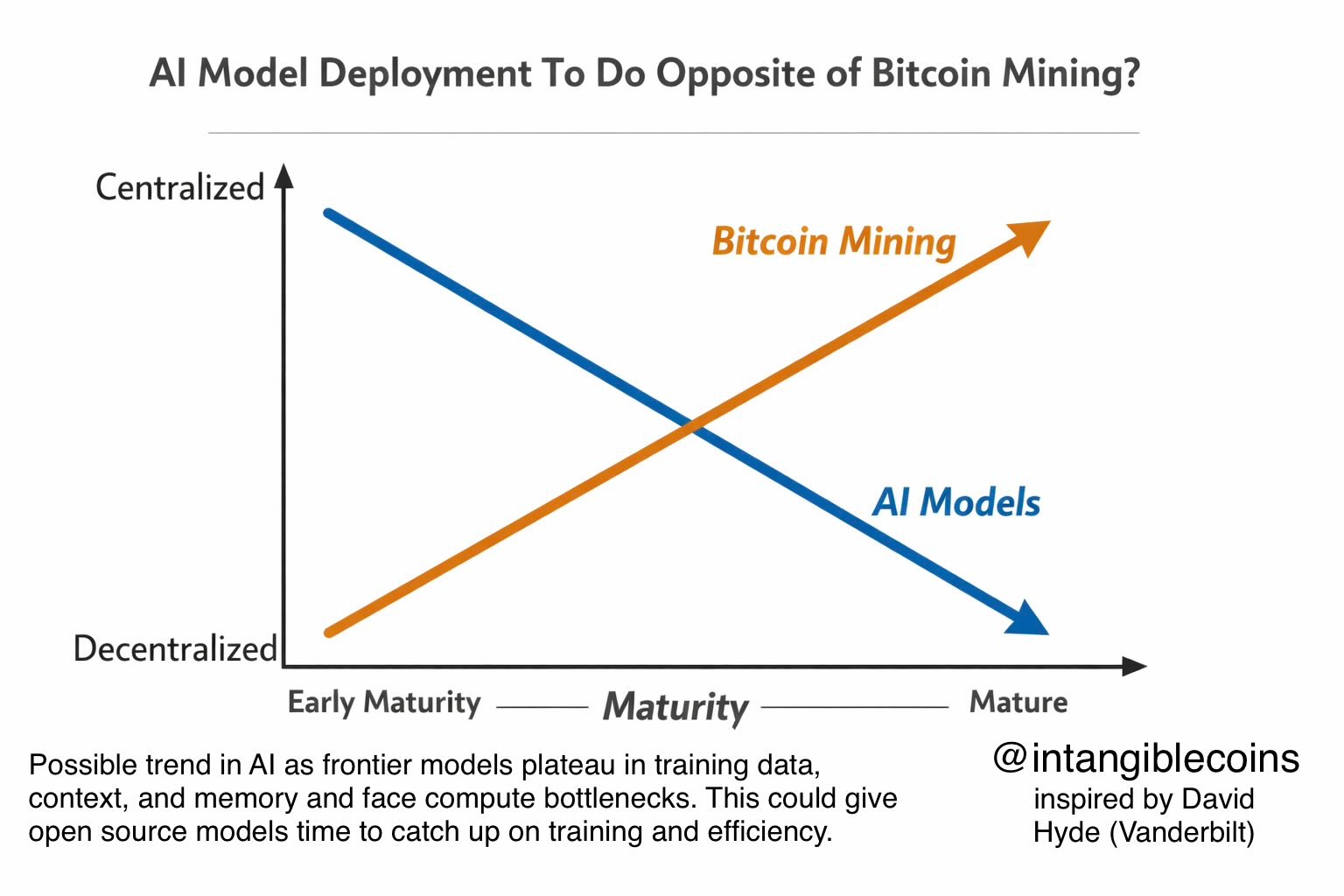
Bitcoin mining runs the risk of becoming more centralized as time goes on, while artificial intelligence could be moving in the opposite direction, according to Galaxy Research head Alex Thorn.
Thorn said that while Bitcoin mining began decentralized, with users mining Bitcoin on their personal computers, it has since become far more centralized, requiring ASIC miners or industrial-scale farms.
“AI may follow the opposite path,” Thorn said, explaining that AI began in centralized clusters but could decentralize as open-source models close the gap.
“If local models keep getting smaller, cheaper, and more efficient, AI may become increasingly personal and on-device.”
The divergence strikes at the heart of crypto’s core promise: decentralization. If Bitcoin mining were to continue down a path of centralization, it could begin to raise concerns about the network’s long-term resilience.

Edge AI market to grow 300% in the next eight years
Edge AI computing refers to the deployment and running of AI models directly on local devices or “at the edge” of the network, rather than sending all data to centralized cloud servers or massive data centers for processing.
The global AI edge market is anticipated to grow from about $25 billion in 2025 to a projected $119 billion by 2033, according to Grand View Research.
Related: Researchers discover malicious AI agent routers that can steal crypto
The edge market is experiencing significant growth driven by the “rapid expansion of IoT (Internet of Things) and connected devices,” stated GVR.
This increases the demand for real-time and low-latency data processing, growing the adoption of AI-enabled automation across industries, and “rising focus on data privacy and localized intelligence at the network edge,” GVR added.

Bitcoin mining is decentralizing geographically
Crypto exchange KuCoin reported on Friday that Bitcoin mining has become increasingly unviable in the United States as the cost to mine a single BTC has surpassed $100,000 in some regions due to surging energy costs.
This is resulting in a geographic migration with hash rate actively moving toward the “Global South,” with Paraguay and Ethiopia emerging as the leading destinations due to surplus hydroelectric power.
This could help to decentralize mining, at least from a geographical perspective.
“This decentralization of mining power across different continents enhances the security of the network by making it less vulnerable to any single country’s political or environmental shocks,” it stated.
Magazine: Bitcoin quantum-safe without upgrade? CZ’s 2031 crypto vision: Hodler’s Digest
Bitcoin (BTC) held $70,000 at the weekly close as markets reacted to a breakdown in US-Iran negotiations and escalating tensions around the Strait of Hormuz.
-
A breakdown in US-Iran negotiations sends oil surging above $100 per barrel, with the Strait of Hormuz now blockaded.
-
US PPI inflation data is due amid signs that the oil crisis is far from the only driver of price increases.
-
Bitcoin manages a weekly close above $70,000, but a trader says new lows remain on the roadmap.
-
Profit-taking is what keeps Bitcoin unable to hold the $70,000 mark for long, analysis confirms.
-
Overall sell-side pressure is easing, while long-term holders boost BTC exposure on Binance.
Iran breakdown sends oil above $100
The US-Iran war is once again the main topic of debate among market participants after the sudden breakdown in negotiations over the weekend.
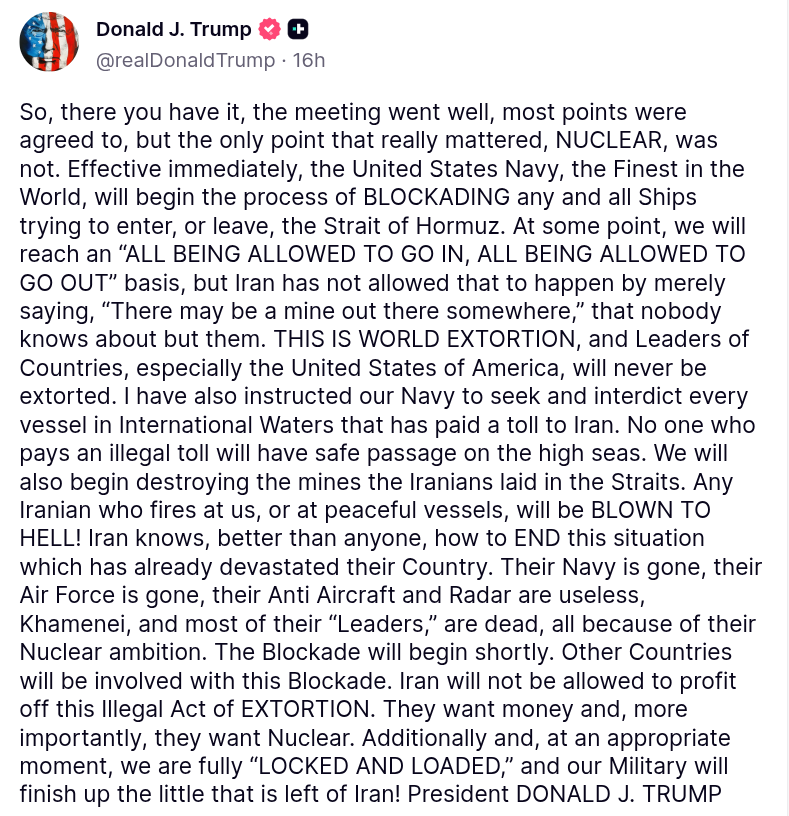
On Sunday, US President Donald Trump announced sweeping measures to blockade the Strait of Hormuz with an eye to controlling oil transport in the future.
In one of several posts on Truth Social, Trump wrote that “at some point, we will reach an ‘ALL BEING ALLOWED TO GO IN, ALL BEING ALLOWED TO GO OUT’ basis” on Hormuz.
“It appears that Trump’s long-term plan is to blockade Hormuz, gain control, then begin letting traffic flow freely,” trading resource The Kobeissi Letter commented in a response on X.
“However, if this is possible to fully obtain, it will be a long process that would further restrict the flow of traffic for at least another 2 months, according to our analysis.”

Fears immediately focused on markets’ reaction, but this ended up tempered, with S&P 500 futures losing around 0.6%. Oil, however, gained rapidly, trading near $105 per barrel after 8% daily upside.

Kobeissi added that in the absence of diplomacy, Hormuz now appeared to be the US’ “top priority” going forward.
“We expect a volatile week ahead,” it added.
US PPI due as analysis warns of inflation contagion
As Cointelegraph reported, oil prices have a pronounced impact on US inflation gauges, notably the Consumer Price Index (CPI), which was released last week.
The coming days will see the March print of the Producer Price Index (PPI), this also set to reflect the start of the war.
Commenting, trading resource Mosaic Asset Company warned that recent inflation data was already pointing to catalysts beyond the conflict.
“While headlines coming out of the Middle East are capturing investor attention, a pair of consumer inflation reports released last week continues showing upward pressure on prices,” it wrote in the latest edition of its regular newsletter, “The Market Mosaic.”
Mosaic flagged both CPI and Federal Reserve’s “preferred” measure, the Personal Consumption Expenditures (PCE) index, the latest update for which was released on April 9.
PCE revealed “more recent annualized rates over the past three and six months are accelerating higher.”
“That shows inflation pressures outside of what’s expected following war in the Middle East and impact on energy prices,” Mosaic added.

As a result, the Fed may end up enacting “tighter” monetary policy, keeping interest rates steady or even raising them, despite repeated demands by Trump and other officials to do the opposite.
The latest data from CME Group’s FedWatch Tool shows that markets already see no rate cuts coming before the second half of 2027.

Bitcoin often exhibits volatile reactions to US inflation reports, particularly when those differ considerably from expected values.
Trader: Bitcoin price needs “one more low”
Bitcoin managed to avoid major losses on the back of the latest geopolitical setback, wicking to near $70,500, per data from TradingView.
The weekly close at around $70,850 thus preserved key price levels in the form of the 200-week exponential moving average (EMA) trend line and the old 2021 all-time high.

With the spot trading range still narrowing, trader Roman said that a true high-time frame (HTF) trend flip required another BTC price correction.
$BTC 1W
We are here – compared to 2022.
This is not the bottom. pic.twitter.com/It6OGj1BX5
— Roman (@Roman_Trading) April 12, 2026
“Why haven’t we bottomed yet? Because AT LEAST 1 more low would give us reversal signals on HTF,” he told X followers in a post on Sunday.
Roman has long been among those calling for deeper long-term lows for BTC/USD, with his targets circling the $50,000 mark.
One of the prerequisites for abandoning the bear market, he said, was a bullish divergence on the relative strength index (RSI) versus price.
“RSI bull divs, bear momentum loss, likely see volume start to shift, & possible reversal pattern. All things we saw at the 2022 bottom,” he added.

As Cointelegraph reported, RSI is already beginning to offer key bullish signals, with another trader saying that the indicator was copying the end of the 2022 bear market “nearly perfectly.”
Profit taking caps BTC price upside
Macro events aside, Bitcoin continues to suffer from a familiar problem on short time frames, analysis says.
In an X post at the weekend, onchain analytics platform Glassnode said that each time BTC/USD passes $70,000, the urge to take profit among traders results in the rally quickly fizzling.
“Another bounce to >$70k range was exhausted by >$20M/Hour profit realization,” it confirmed.
The phenomenon was recorded last week after Bitcoin made multiple attempts to flip the $70,000 to support.
“As price probed the $70K region, Realized Profit/hour spiked above $20M, signalling a local exhaustion,” Glassnode wrote at the time.
“A pattern consistent since February 2026: Every approach to the $70k–$80K band meets thin liquidity and profit-taking pressure, capping the bounce.”

Sellers ease off as “calmer phase” enters
Talk of Bitcoin “short squeezes” getting easier has surfaced among analysts recently amid increasing signs of seller exhaustion.
Related: Bitcoin analysis sees $55K BTC price ‘iron bottom’ by December 2026
In its latest commentary, onchain analytics platform CryptoQuant added evidence to support the theory that bulls could retake control of the market at current levels.
“Bitcoin’s short-term holder pressure on Binance has entered a calmer phase,” contributor Amr Taha reported in one of its “Quicktake” blog posts on Monday.
Taha referred to more recent Bitcoin investor cohorts hodling coins for up to six months without selling.
“The 7-day standard deviation of realized profit/loss pressure fell to 217, marking its lowest reading since February, compared with the previous low of 277,” he reported about their profit/loss ratio.
“The move signals that short-term holders are sending coins to Binance with less aggressive profit-taking and less panic-driven loss realization, reducing near-term distribution pressure on the market.”

A further post additionally revealed rising demand for BTC on major global exchange Binance.
“Bitcoin is showing a healthier holding structure as whale transfer pressure to Binance continues to ease while long-term holder demand strengthens,” Taha added.
The increase in long-term holders’ realized cap — the combined value of their BTC holdings when they last moved — passed the $50 billion mark for the first time in nearly a year this week.

This article is produced in accordance with Cointelegraph’s Editorial Policy and is intended for informational purposes only. It does not constitute investment advice or recommendations. All investments and trades carry risk; readers are encouraged to conduct independent research before making any decisions. Cointelegraph makes no guarantees regarding the accuracy or completeness of the information presented, including forward-looking statements, and will not be liable for any loss or damage arising from reliance on this content.

Key Highlights
- On April 10, 2026, Principal Financial Officer Snizhana P. Quan exercised options and sold 20,000 shares of Lightwave Logic, netting approximately $207,000 at $10.36 per share.
- The transaction reduced her direct stake by 26.3%, though she maintains ownership of 51,125 shares plus 55,000 unexercised options.
- Shares of LWLG have skyrocketed 939% in the trailing twelve months, propelling market capitalization to $1.58 billion.
- Annual revenue from licensing reached only $106,855 in 2025, while the company recorded a net loss exceeding $20.3 million.
- Recent strategic milestones include a collaboration agreement with Tower Semiconductor and integration into the GDSFactory design platform.
Over the past year, Lightwave Logic (LWLG) has emerged as one of the market’s most explosive performers, with shares rocketing upward by 939%. Against this backdrop, a key financial executive has monetized a portion of her equity stake.
Snizhana P. Quan, serving as the company’s Principal Financial Officer, completed a same-day exercise-and-sale transaction on April 10, 2026, involving 20,000 employee stock options. The shares were sold at a weighted average of $10.36 each, producing proceeds of approximately $207,000.
LWLG shares settled at $10.60 when the market closed that day.
This form of transaction—exercising options and immediately selling the underlying stock—is common among corporate officers. It generally serves liquidity needs or addresses tax obligations associated with equity compensation, rather than signaling pessimism about future prospects.
Quan transitioned from her previous position as corporate controller to the PFO role in January 2026. After completing this sale, she continues to own 51,125 shares outright, along with 4,800 shares held indirectly via a domestic partner.
Additionally, she holds 55,000 vested stock options that remain unexercised, preserving substantial economic exposure to the company’s performance.
SEC disclosures reveal that Director Craig Ciesla executed similar option exercises and share sales during the same period. Both insiders acted following a secondary offering and the stock’s extraordinary price appreciation.
The Financial Reality Behind the Valuation
While the stock price has soared, Lightwave Logic’s actual revenue generation remains extremely limited. For the full year 2025, the company recognized merely $106,855 from licensing and royalty streams. Net losses for the period totaled $20.3 million.
A year ago, the company’s market capitalization hovered below $150 million. Today, it commands a valuation of $1.58 billion.
The disparity between market value and revenue generation is substantial. The firm ended 2025 holding $69 million in cash reserves, providing a multi-year financial cushion based on current operating expenditures. However, meaningful product-based income has yet to materialize.
Strategic Foundry Collaborations Provide Development Momentum
From a technology standpoint, Lightwave Logic has executed two significant initiatives drawing investor attention. The company successfully embedded its electro-optic polymer solution into the GDSFactory process design kit and established a formal development partnership with Tower Semiconductor (TSEM).
These advances carry weight because they streamline the path for prospective clients to incorporate LWLG’s polymer technology within established foundry manufacturing flows.
The firm is positioning itself to serve data center and artificial intelligence interconnect applications, where appetite for enhanced optical component performance continues expanding. Embedding its materials within standard foundry processes represents a critical milestone toward achieving commercial-scale adoption.
Valuation estimates from the Simply Wall St community span a remarkably broad range—from approximately $0.02 to $14.50 per share—underscoring the polarized views among market participants.
At market close on April 10, 2026, LWLG was changing hands at $10.60 per share.

Memecoins outperform as bitcoin traders turn defensive

Why Peter Capaldi Turned Down The Celebrity Traitors Season 2

NFL Draft prospect Rueben Bain cited in unreported 2024 deadly crash


-

 Politics3 days ago
US brings back mandatory military draft registration
-

 Fashion3 days ago
Weekend Open Thread: Veronica Beard
-
 Sports3 days ago
Man United discover Nico Schlotterbeck transfer fee as defender reaches Dortmund agreement
-

 Tech6 days ago
How Long Can You Drive With Expired Registration? What Florida Law Says
-

 Politics20 hours ago
World Cup exit makes Italy enter crisis mode
-

 Crypto World4 days ago
Canary Capital Files SEC Registration for PEPE ETF
-

 Business3 days ago
Tesla Model Y Tops China Auto Sales in March 2026 With 39,827 Registrations, Beating Cheaper EVs and Gas Cars
-

 Fashion7 days ago
Massimo Dutti Offers Inspiration for Your Summer Mood Board
-

 Politics3 days ago
Malcolm In The Middle OG Turned Down ‘Buckets Of Money’ To Appear In Reboot
-

 Fashion6 days ago
Let’s Discuss: DEI in 2026
-

 Crypto World5 days ago
Bitcoin recovers as US and Iran Agree a Ceasefire Deal
-
 NewsBeat12 hours ago
Pep Guardiola and Gary Neville agree over Arsenal title problem that benefits Man City
-

 Business3 days ago
OpenAI Halts Stargate UK Data Centre Project Over Energy Costs and Copyright Row
-

 Business2 days ago
Ireland Fuel Protests Enter Day 5 as Blockades Spark Shortages and Government Prepares Support Package
-

 Politics3 days ago
LBC Presenter Mocks Trump Over Iran War Failures
-

 Crypto World2 days ago
Federal judge blocks Arizona from bringing criminal charges against Kalshi
-

 Tech3 days ago
A version of Windows 10 released a decade ago is now eligible for additional security patches
-
 NewsBeat1 day ago
JD Vance announces ‘no agreement’ with Iran over nuclear weapons fear
-
Sports2 days ago
1st-Round WR Enters Vikings Mock Draft Orbit
-
 Entertainment4 days ago
Alfred Hitchcock’s 10 Most Suspenseful Masterpieces, Ranked
You must be logged in to post a comment Login