
Crypto World
Trump’s DOJ drops probe that stood in way of president’s pick to run Federal Reserve

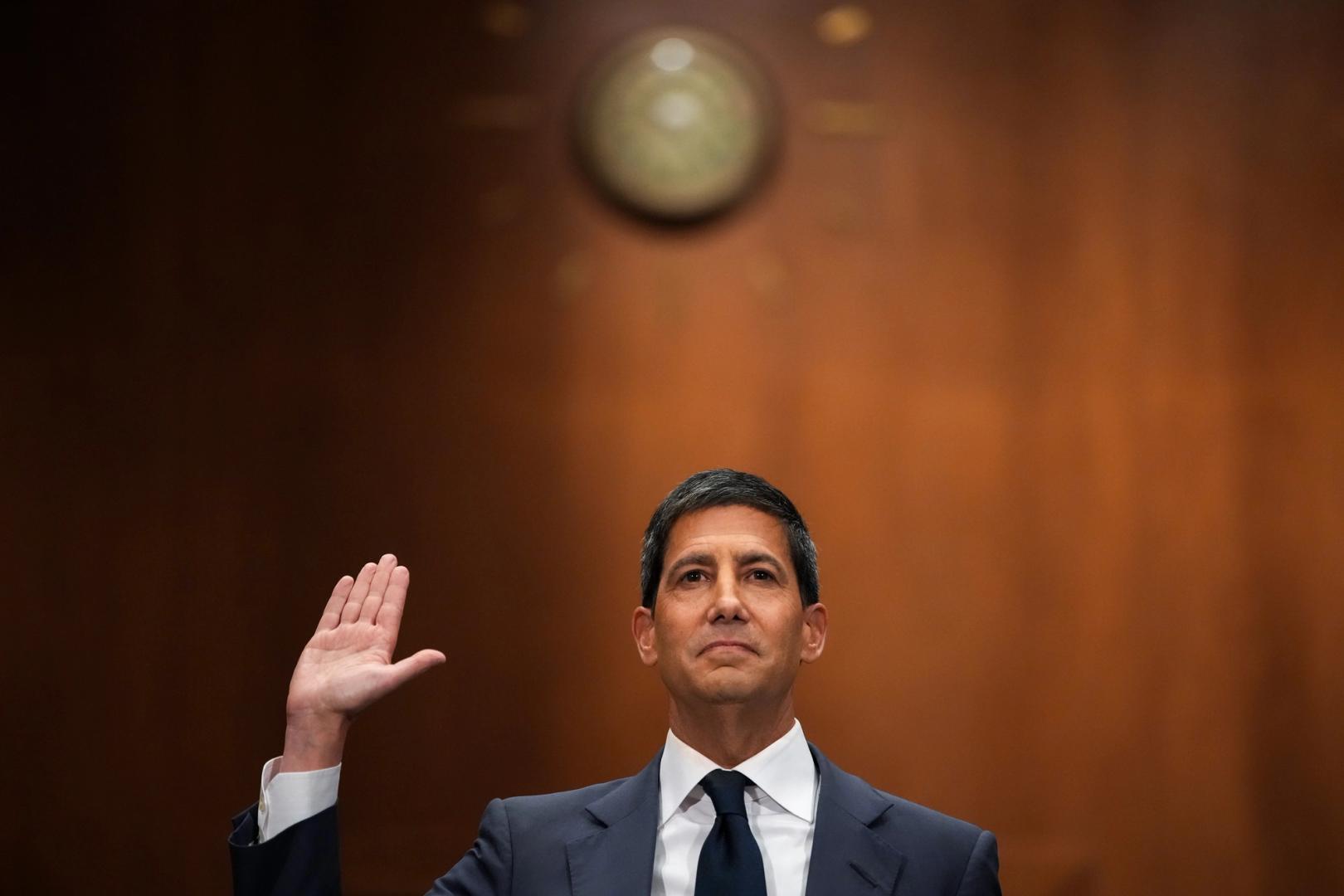
President Donald Trump’s command of U.S. financial and economic policy may have taken a step closer now that his Department of Justice has backed down from an investigation of Federal Reserve Chair Jerome Powell, meaning his nominee to replace Powell may now have an open path to confirmation.
Fed chair nominee Kevin Warsh, whose own considerable wealth includes some crypto-world assets, is awaiting a final vote from the Senate after appearing in a confirmation hearing this week. Trump, who has relentlessly blamed Powell for maintaining overly high U.S. interest rates, chose Warsh to remedy that, but Republican Senator Thom Tillis had promised to block the confirmation as long as the DOJ pressed an investigation against Powell for cost overruns in a Fed building project.
That criminal probe was dropped on Friday, and Attorney General Jeanine Pirro said the DOJ asked the Fed’s inspector general to look into the renovation situation and issue a report. When the news emerged, Kalshi’s prediction betting on Walsh’s confirmation before May 15 shot up from about 30% odds to more than 80%.
“I expect a comprehensive report in short order and am confident the outcome will assist in resolving, once and for all, the questions that led this office to issue subpoenas,” Pirro wrote in a post on social media site X. “Accordingly, I have directed my office to close our investigation as the IG undertakes this inquiry. Note well, however, that I will not hesitate to restart a criminal investigation should the facts warrant doing so.”
Putting his own people atop the Federal Reserve not only equates with Trump’s greater influence over U.S. monetary policy, but it also leaves him with more allies on the Fed board as it makes decisions about financial policy — including implementing rules that govern the crypto industry and stablecoin issuers.
Because of Tillis’ threat, Warsh may have been in a holding pattern as long as the DOJ pursued its investigation, which could have left Powell in charge of the Fed indefinitely, well beyond the May 15 expiration of his term. Now, the Republican-majority Senate may be able to move more quickly toward confirmation of the nominee, who insisted during his hearing that he would act independently of White House direction.
Senator Elizabeth Warren, the ranking Democrat on the Senate Banking Committee that’s considering his nomination, dismissed the move and noted the administration is still pursuing Fed Governor Lisa Cook in court.
“This is just an attempt to clear the path for Senate Republicans to install President Trump’s sock pocket Kevin Warsh as Fed chair,” Warren said in a statement. “Let’s be clear what the Justice Department announced today: They threatened to restart the bogus criminal investigation into Fed Chair Powell at any time while failing to drop their ridiculous criminal probe against Governor Lisa Cook.”
Tillis called Warsh a “great nominee.” In his own posting this week on X, the senator said he’d vote yes on Warsh once the DOJ backs off of Powell:
“I look forward to supporting him out of committee once the DOJ drops their bogus investigation into Chairman Powell that threatens the independence of the Fed.”



The House Foreign Affairs Committee advanced two bipartisan bills on April 23 that would give Congress direct oversight authority over US AI chip exports to China and other adversaries, in a direct challenge to the Trump administration’s handling of advanced semiconductor sales.
Summary
- The House Foreign Affairs Committee advanced two bipartisan bills on April 23 targeting AI chip exports to China, including the AI Overwatch Act and the Chip Security Act.
- The AI Overwatch Act would give Congress 30 days to review and potentially block export licenses for advanced chips to adversarial countries, similar to existing arms sale review authority.
- The bills face resistance from both the White House AI czar David Sacks and Nvidia CEO Jensen Huang, who argue restricting chip exports to China would harm US companies more than China.
The House Foreign Affairs Committee advanced two bipartisan AI chip export bills on April 23, reflecting deepening congressional unease with the Trump administration’s approach to selling advanced Nvidia chips to China. The committee voted with all but two members in favor of the AI Overwatch Act, while also advancing the Chip Security Act, which targets hardware verification and diversion tracking.
AI Chip Export Bills Target Loopholes Congress Says the White House Has Left Open
The AI Overwatch Act, introduced by Foreign Affairs Committee Chair Brian Mast, would give the House Foreign Affairs Committee and the Senate Banking Committee a 30-day window to review and block export licenses for advanced AI chips issued to China, Russia, Iran, North Korea, Cuba, and Venezuela, mirroring the review authority Congress already holds over arms sales. The bill would also cancel all existing export licenses to countries of concern until the administration submits a detailed strategy explaining how those chips would not impact military or intelligence capabilities. “We are in an AI arms race, and it’s important that we know where the AI arms dealers are selling,” Mast said. A companion bill in the Senate already carries bipartisan support from Senators Jim Banks and Elizabeth Warren. As crypto.news reported, Nvidia CEO Jensen Huang had warned the prior week that China possesses ghost datacenters with sufficient infrastructure to match US frontier AI, a statement that has complicated Nvidia’s simultaneous lobbying against the export restriction bills.
The Chip Security Act Addresses Hardware Diversion
The second bill advanced by the committee, the Chip Security Act, takes a hardware-level approach to the same problem. It would require that exported advanced chips contain a technical mechanism capable of verifying the chip’s physical location, and would obligate exporters to notify the government if a chip turns up at an unauthorized location. Both provisions are designed to close what lawmakers describe as a fundamental verification gap in current export rules: the US can approve a chip sale to an approved buyer in a permissible country, but has no reliable mechanism to confirm the chip has not been subsequently diverted to a Chinese military or intelligence facility. As crypto.news documented, Nvidia disclosed $5.5 billion in expected charges in April 2025 when the government required export licenses for H20 chips sold to China, demonstrating how directly semiconductor export policy translates into market impact for AI-adjacent assets.
White House and Nvidia Push Back, but Congress Is Not Backing Down
The bills face serious resistance before they can reach a floor vote. White House AI czar David Sacks publicly opposed the AI Overwatch Act on X, reposting commentary arguing the bill handicaps Trump’s ability to strategically position the US favorably against China. Nvidia CEO Jensen Huang has personally lobbied lawmakers, arguing that the more US chips are used in China, the more US companies will dominate the global AI market. Mast pushed back directly, saying the talking points he heard from Sacks matched those Nvidia had been circulating. As crypto.news tracked, markets have already shown sensitivity to US-China chip export policy, with Nvidia shares dropping sharply each time restrictions tighten. If the bills advance through the full House and Senate, they would represent a significant transfer of export control authority from the executive branch to Congress.
Both bills still need to clear the full House, pass the Senate, and be signed by the president before becoming law, a path that faces considerable resistance from the White House despite strong bipartisan committee support.

Key Highlights
- Nvidia shares climbed as high as 5.2% Friday, driving market capitalization beyond the $5 trillion threshold.
- Intel’s impressive first-quarter results and robust CPU demand outlook fueled the semiconductor surge.
- Intel shares jumped 20% following its third straight quarter of revenue and earnings beats.
- AMD and Arm Holdings both posted gains of approximately 14% riding the Intel-fueled wave.
- The Philadelphia Semiconductor Index continues an 18-session winning streak.
Nvidia shares reached approximately $209 on Friday, approaching its record intraday peak of $212.19 achieved on October 29, 2025. This valuation pushed the chipmaker’s market capitalization back above the $5 trillion mark, establishing a $1 trillion lead over Alphabet, the second-largest company by market value.
If these gains persist through market close, Nvidia would secure a new record closing price.
The primary driver behind Friday’s surge wasn’t company-specific developments. Instead, Intel provided the momentum. Following a challenging period, Intel reported its third consecutive quarter beating both revenue and earnings per share expectations Thursday evening, sending its stock soaring 20% Friday — positioning it for a historic closing high.
Strong CPU Demand Commentary Energizes Chip Stocks
Investors weren’t merely impressed by Intel’s financial performance. CEO Lip-Bu Tan highlighted accelerating CPU demand driven by the transition from inference-focused AI to agentic AI applications.
“A shift from inference to agentic AI is significantly increasing the need for Intel’s CPUs,” Tan stated during the quarterly earnings call.
This demand commentary carries important implications for Nvidia as well. The graphics chip leader began offering standalone CPU products in early 2026, a strategic expansion CEO Jensen Huang discussed at Nvidia’s annual conference in March.
“We never thought we will be selling CPUs standalone, but we are selling a lot of CPUs standalone,” Huang explained. “This will for sure be a multi-billion dollar business for us.”
Nvidia touched an intraday peak of $210.95 Friday, marking its highest trading level since November 2025.
The semiconductor sector broadly capitalized on this momentum. AMD posted 14% gains, ranking among the top S&P 500 performers for the session. Arm Holdings matched that performance with a 14% advance.
April Rebound Follows Difficult First Quarter
Nvidia faced headwinds entering 2026. The stock declined 6.4% during the first quarter through March’s conclusion.
The April picture has reversed dramatically. Nvidia has surged 20% over the past month, benefiting from sustained strength in semiconductor equities.
The Philadelphia Semiconductor Index — commonly called the SOX — has posted gains for 18 consecutive sessions, representing one of its most extended winning periods on record. Broadcom, Taiwan Semiconductor, Micron, AMD, Intel, and Texas Instruments have all contributed to this rally.
Intel’s corporate recovery narrative added additional momentum Friday. The company weathered uncertainty surrounding former CEO Pat Gelsinger’s departure, but Lip-Bu Tan’s appointment has restored investor confidence. Intel’s successful on-schedule delivery of its 18A manufacturing process node has earned endorsement from industry collaborators and the U.S. government alike.
Nvidia shares traded at $209.56 as of Friday afternoon, representing a 4.97% daily gain.

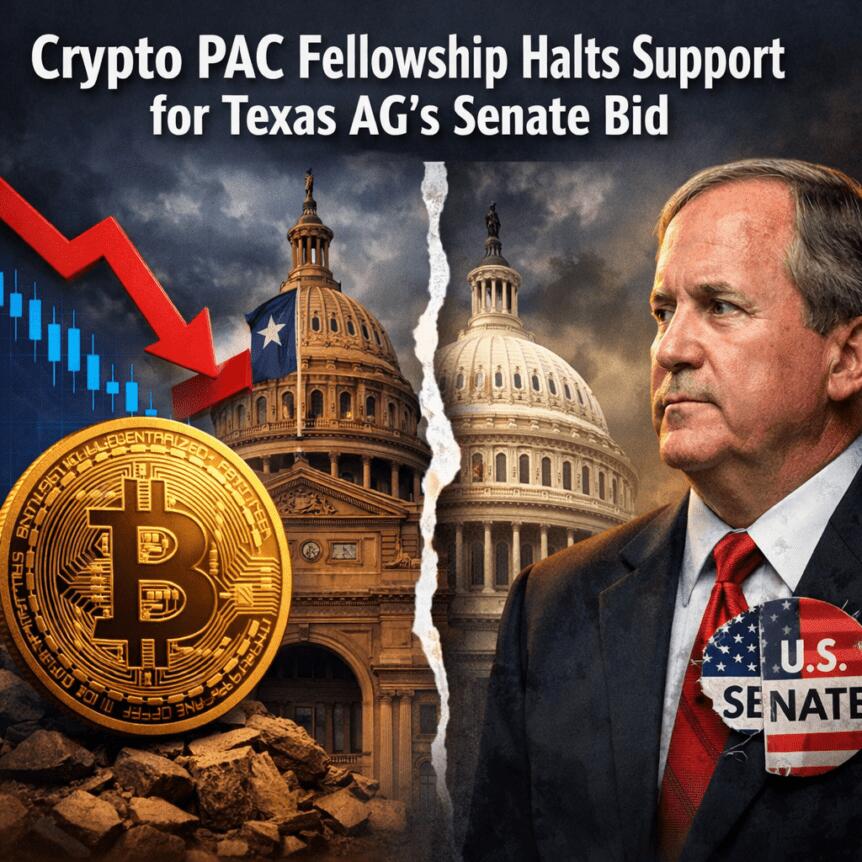
Fellowship, a political action committee aligned with cryptocurrency interests, reportedly withdrew from a paid advertising arrangement intended to bolster Texas Attorney General Ken Paxton in a pivotal U.S. Senate contest. The move, described by Axios, comes amid questions from Republican leaders about the PAC’s backers and its broader influence strategy in a high-stakes midterm cycle.
According to Axios, Republican lawmakers contacted U.S. Commerce Secretary Howard Lutnick over Fellowship’s links and funding sources. Fellowship has been described as having substantial financing from crypto-adjacent financiers, including partial backing from Cantor Fitzgerald. Lutnick—famed as a former president and CEO of Cantor Fitzgerald with his sons now leading the firm’s financial services arm—has faced inquiries about Fellowship’s role in pausing or altering support for Paxton, who recently disclosed spending of about $1.75 million on supportive advertising. The expenditure, disclosed through the marketing firm Nxum Group to the Federal Election Commission (FEC), apparently was never executed.
Cointelegraph’s coverage notes that Fellowship disclosed the $1.75 million advertising plan to the FEC, and that the filing remained publicly accessible as of the latest reporting. The PAC did not respond to requests for comment at press time. In the broader crypto-political arena, this episode underscores how crypto-linked fundraising networks can become focal points for intra-party pressure and regulatory scrutiny, even when those networks are reportedly in flux or retracting active advertising commitments.
Beyond Fellowship, other crypto-aligned committees—such as Fairshake and additional groups—are anticipated to deploy substantial sums in U.S. midterm campaigns as part of a sustained effort to influence policy outcomes. The evolving dynamic illustrates how crypto-interest groups participate in political advocacy across party lines, even as campaign financing disclosures remain a central compliance concern for firms operating under U.S. election laws.
In Texas politics, Paxton failed to secure the nomination outright in a March primary against incumbent Senator John Cornyn and will face a runoff in May before the November general election. The eventual Republican candidate will contest Democrat James Talarico for one of the state’s U.S. Senate seats, a race closely watched for its potential regulatory and policy implications for the crypto sector at the national level.
Key takeaways
- Fellowship reportedly halted a $1.75 million advertising commitment in support of Paxton, with the expenditure never placed as disclosed to the FEC.
- The PAC’s funding profile includes Cantor Fitzgerald connections, prompting questions from Republican leadership about the sources and influence of crypto-aligned financing.
- Public disclosures through the FEC and reporting by Axios highlight ongoing scrutiny of crypto-connected political committees and their coordination with party officials.
- Crypto-interest groups are anticipated to deploy substantial resources in U.S. midterm elections, reflecting a broader strategy to shape regulatory and policy outcomes.
- Separately, the regulatory landscape for crypto market structure remains contentious, with legislative action stalled amid procedural delays, ethics concerns, and questions about stablecoin yield.
Fellowship and the evolving crypto-political finance landscape
The Fellowship case sits at the intersection of campaign finance transparency and the broader push by crypto interests to influence public policy. The reported withdrawal from the Paxton ad buy, coupled with the disclosure of a sizable but possibly unexecuted expenditure, raises questions about how crypto-linked money is deployed in high-profile races and how party leadership responds when donors come under scrutiny. While crypto PACs historically fund candidates from both major parties, leadership in Congress has shown a renewed interest in ensuring that campaign contributions comply with legal standards and disclosure requirements. The underlying issue is less about partisan alignment and more about governance, accountability, and the risk profile associated with opaque funding streams in a rapidly evolving industry.
From a regulatory perspective, the episode underscores the ongoing need for robust AML/KYC controls and financing-disclosure frameworks within the crypto ecosystem and in relation to political contributions. For institutions embedded in or adjacent to crypto markets—exchanges, liquidity providers, and financial firms—these dynamics amplify the importance of transparent, auditable political-financial relationships and the potential implications for licensing, oversight, and compliance programs. The U.S. election-laws regime, enforced by the FEC and related bodies, governs such disclosures independently of the sector-specific regulatory agenda, but it interacts with broader policy initiatives that govern crypto market function and corporate governance standards.
Market-structure reform: momentum, obstacles, and policy context
Separately, the legislative trajectory of crypto market-structure reform remains a focal point for industry participants and policymakers. Since mid-2025, the Senate has contemplated a comprehensive market-structure bill that would shape how digital assets are traded, cleared, and regulated. The GENIUS Act, which addresses stablecoins and related settlement mechanisms, represents a key component of the broader policy framework. Delays have persisted due to government-operations constraints, ethics reviews, and unsettled questions around stablecoin yield models. No full-chamber vote has been scheduled for the principal market-structure package as of the latest updates.
In response, more than 120 entities affiliated with the crypto and blockchain sectors urged Senate Banking Committee leaders to expedite consideration and to proceed to a markup. A markup would be a critical step toward unlocking a formal debate and potential floor vote on the CLARITY Act, the overarching market-structure measure. The push reflects a broader and growing consensus among industry groups that timely legislative action is essential to provide regulatory clarity, preserve financial stability, and reduce legal risk for participants operating across borders and across banking rails.
The policy environment continues to be shaped by the balance of political power in Washington. With Republicans holding a narrow Senate majority since early 2025, the dynamic has favored quicker movement on certain pro-crypto measures, including stablecoins regimes and licensing frameworks. However, a shift in control after the 2026 midterms could alter the legislative calculus and affect how crypto markets are regulated, taxed, and integrated with traditional banking systems. The ongoing debate centers on how to harmonize innovation with consumer protection, systemic risk mitigation, and cross-border regulatory harmonization—issues that regulatory bodies and market participants monitor closely.
The current push to advance market-structure legislation sits within this broader regulatory landscape. If enacted, the package would influence not only trading venues and liquidity provisioning but also enforcement priorities for agencies such as the SEC, CFTC, and DOJ, and would feed into compliance frameworks for custodians, broker-dealers, and settlement infrastructures. The stakes extend to stablecoins and the broader issue of how crypto assets are treated for prudential supervision and retail protections, including the implications for banking relationships and access to traditional financial rails.
For observers, the convergence of political finance, regulatory advocacy, and legislative timing underscores the interconnectedness of policy design and market structure in crypto. The path forward will likely hinge on the ability of lawmakers to reconcile divergent views on risk, innovation, and enforcement while maintaining a transparent, predictable framework for industry participants and investors alike.
Cointelegraph is committed to independent, transparent journalism. This coverage reflects the outlet’s editorial standards and aims to present timely information that supports analysis, compliance review, and institutional decision-making. Readers should verify details through official filings and primary sources as developments unfold.

TLDR:
- TRON hosts over $85 billion in circulating USDT and processes $21 billion in daily transfer volume.
- LI.FI’s universal API now gives developers direct access to TRON’s deep stablecoin liquidity pools.
- The integration removes the need for separate bridge setups, cutting complexity for blockchain developers.
- TRON’s low transaction fees combined with LI.FI’s multichain reach strengthens global stablecoin payment flows.
TRON’s integration with LI.FI Protocol marks a notable step in cross-chain stablecoin infrastructure. The partnership connects TRON’s high-throughput blockchain to LI.FI’s universal liquidity layer.
Developers building on LI.FI can now access TRON’s deep stablecoin pools directly. This removes the need for managing separate bridge integrations. The move expands multichain access for both builders and end users globally.
TRON Brings Deep Stablecoin Liquidity to LI.FI’s Ecosystem
TRON has established itself as a leading settlement layer for stablecoin activity. The network currently hosts over $85 billion in circulating USDT.
It also processes more than $21 billion in daily transfer volume. These figures place TRON among the most active stablecoin networks in production today.
The LI.FI integration now channels that liquidity into a broader multichain framework. Applications using LI.FI can access USDT and other stablecoins moving in and out of TRON.
This comes with improved pricing, better liquidity access, and greater efficiency. The combination supports smoother stablecoin flows across both EVM and non-EVM networks.
TRON’s consistently low transaction fees make it a practical environment for high-frequency transfers. Paired with LI.FI’s multi-chain distribution, this creates strong infrastructure for remittances and payments.
Builders no longer need to manage separate integrations to tap into TRON’s ecosystem. End users can swap and bridge stablecoins directly within supported applications.
Sam Elfarra, Community Spokesperson for TRON DAO, addressed the development directly. “Connecting to LI.FI’s orchestration layer further strengthens access to TRON’s infrastructure across the entire blockchain ecosystem,” he said.
He added that the integration reduces friction for developers and users moving assets between TRON and other blockchains. Elfarra also noted it supports TRON’s standing as a leading settlement layer for global stablecoin activity.
LI.FI’s API Opens a Simpler Path to TRON’s Stablecoin Market
LI.FI’s universal API gives developers a single point of access to multiple blockchain ecosystems. With TRON now included, that access extends to one of crypto’s largest stablecoin markets.
Developers can integrate TRON’s liquidity without building and maintaining separate bridge connections. This reduces technical overhead and speeds up deployment timelines.
Philipp Zentner, CEO and Co-Founder of LI.FI, weighed in on the partnership as well. “As a market leader of global stablecoin infrastructure, integrating TRON into LI.FI’s orchestration layer is a natural next step,” he stated.
He noted that combining TRON’s deep stablecoin liquidity with LI.FI’s powerful API removes complexity for developers. Zentner added that this streamlines composability with one of the largest stablecoin markets in production today.
Stablecoins continue to grow in relevance for cross-border settlement and everyday payments. TRON’s position at the center of that activity makes this integration strategically sound.
As more developers adopt LI.FI, TRON’s ecosystem gains wider exposure across the decentralized finance landscape. The partnership supports broader interoperability goals for both networks going forward.
Bitcoin held above $77,000 on Friday, consolidating after hitting its strongest level since early February earlier in the week.
The largest cryptocurrency is up about 13.6% in April, putting it on track for its best monthly performance in a year, according to CoinGlass data. The rebound follows a rough stretch, with crypto markets logging their longest losing streak since 2018, posting consecutive monthly declines from October through February.
The turnaround comes as the broader macro backdrop has improved. U.S. equities have staged a strong recovery, with the S&P 500 and Nasdaq climbing back to record highs after briefly slipping into correction territory earlier this year.
But there’s a crypto-specific driver behind the move, too.
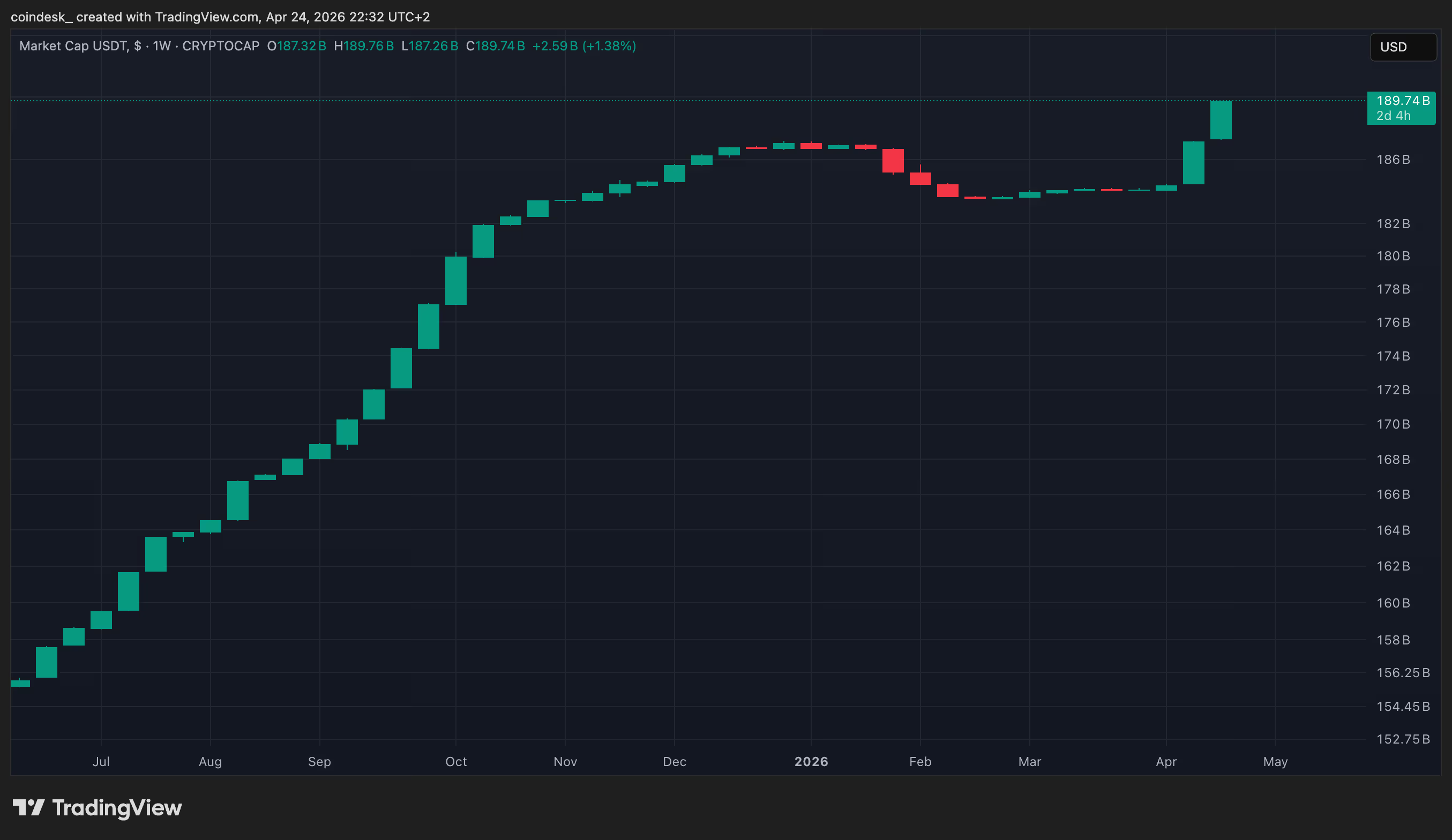
The supply of Tether’s USDT , the largest and most popular stablecoin, has surged to just under $150 billion, adding about $5 billion over the past two weeks after months of stagnation.
That matters because stablecoins — cryptocurrencies tied to fiat money like the U.S. dollar — act as liquidity in crypto markets, the capital traders use to buy digital assets in the blockchain economy. Analysts often interpret stablecoin growth as a cue for capital flowing to the crypto market, a healthy signal for asset prices.

Markets ‘stopped caring’ about Iran war
Still, the macro picture hasn’t cleared yet. Geopolitical tensions in the Middle East and uncertainty around the Iran war persist, keeping oil prices at elevated levels.
But for now, markets seem to be looking past it, said Jasper de Maere, OTC trader at Wintermute.
“The equities and crypto markets seem to have stopped caring about intricate headlines on the conflict’s direction,” de Maere. “This shows a certain level of fatigue and potentially complacency.”
He noted that strong corporate earnings and resilient equity markets are helping offset concerns about higher energy costs and geopolitical risks.
FOMC test coming
In that environment, bitcoin is hovering near the top of its trading range while the $79,000 level proved the be mighty cap with traders taking profits.
That level “matters structurally because heavy institutional overhead supply sits just above it,” said Adam Haeems, head of asset management at Tesseract Group.
Whether BTC can break through will depend on what drives the move and who’s doing the buying. Moves driven mainly by short covering tend to fade once momentum cools, while a breakout backed by sustained institutional demand can mark a more durable shift, he said.
The next test comes soon with the April Fed meeting that could determine whether the current rally holds, Haeems said.
If ETF inflows continue through that event, he said, $79,000 could turn from resistance into support, opening the door for a higher trading range. If flows fade, bitcoin may slip back into the $75,000–$77,000 range.

Nakamoto launched a Bitcoin derivatives program with Bitwise and Kraken, aiming to generate options premiums and hedge part of its BTC treasury exposure.
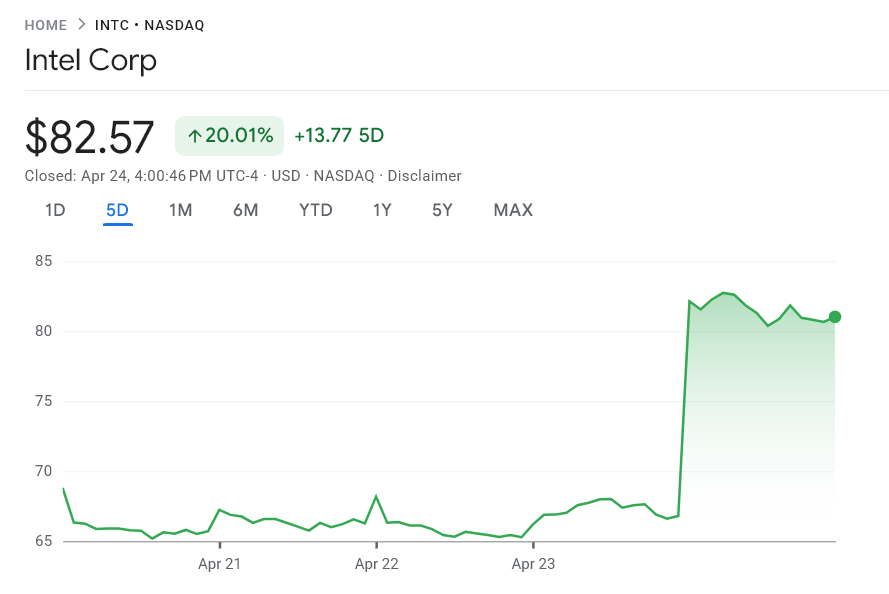
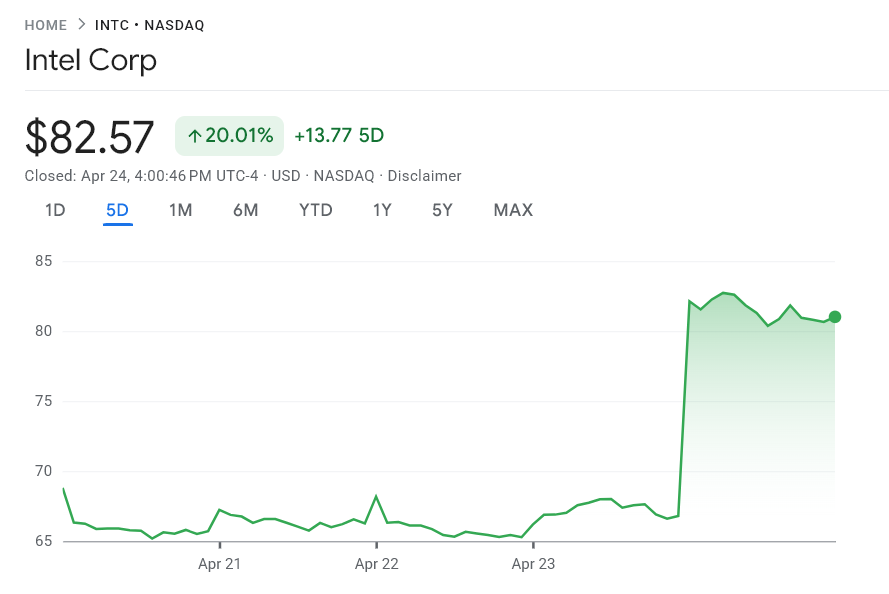
Intel shares surged to a new all-time high on April 24 after investors received the clearest sign yet that the company may finally be benefiting from the AI boom.
The stock jumped more than 24% to around $83 in early trading, passing its dot-com-era peak from 2000 and lifting Intel’s market value above $416 billion.
The rally followed stronger-than-expected earnings and guidance that suggested demand for Intel’s server CPUs is rising faster than Wall Street expected.
AI Demand Is Moving Back Toward CPUs
The main driver is a shift in AI infrastructure. The first phase of the AI boom centered on GPUs, led by Nvidia.
Now, more AI models are moving from training to deployment, where CPUs play a larger role.
Intel said demand from AI service providers was so strong in the first quarter that it sold chips it had previously written off.
CFO David Zinsner said tight supply also allowed the company to raise prices and sell older inventory it had not expected to move.
That changed the market’s view of Intel. Investors are starting to see the company as a direct beneficiary of AI inference, where models answer user queries and handle more complex workloads.
Earnings Gave the Rally Fuel
Intel reported first-quarter revenue of $13.58 billion, above estimates of $12.42 billion. Its data center and AI segment generated $5.1 billion, also ahead of expectations.
Guidance mattered even more. Intel expects second-quarter revenue between $13.8 billion and $14.8 billion, compared with Wall Street’s $13.07 billion estimate.
Analysts responded quickly. At least 23 brokerages raised their price targets after the results, with HSBC pointing to demand for Intel’s Xeon server CPUs.
Can the Rally Continue?
The rally can continue if Intel proves this demand is durable. The Tesla 14A manufacturing deal and growing AI CPU demand give investors a stronger turnaround story.
Still, the stock now trades at around 90 times forward earnings, far above AMD and Nvidia. That leaves little room for disappointment.
Intel has momentum. To keep it, the company must show that today’s surge was the start of sustained AI-driven growth, not a one-quarter inventory and pricing boost.
The post Why Intel Stock Hit an All-Time High Today appeared first on BeInCrypto.

The Bitcoin community continues to debate whether cryptographically relevant quantum computers are imminent or decades away.
White House Office of Science and Technology Policy director Michael Kratsios circulated a memo on April 23 accusing Chinese entities of conducting deliberate, industrial-scale campaigns to distil and steal US frontier AI systems, using tens of thousands of proxy accounts and jailbreaking techniques, days before a scheduled Trump-Xi summit.
Summary
- The White House OSTP memo accuses Chinese entities principally based in China of running coordinated campaigns to distil US frontier AI systems from OpenAI, Anthropic, and other American labs.
- The memo says attackers used tens of thousands of proxy accounts to evade detection and jailbreaking techniques to expose proprietary model information from closed-source American AI systems.
- The administration will share intelligence with US AI companies about active distillation campaigns and explore accountability measures against foreign actors responsible.
White House OSTP director Michael Kratsios circulated a memo to US government agencies on April 23 stating that foreign entities “principally based in China” are “engaged in deliberate, industrial-scale campaigns to distil US frontier AI systems.” The accusation represents the most formal and direct statement the Trump administration has made about Chinese AI intellectual property theft from American laboratories and arrives days before a scheduled Trump-Xi summit.
White House China AI Theft Accusation Names Distillation as the Attack Vector
Distillation is the technical process by which smaller AI models are trained on the outputs of larger, proprietary ones, allowing a lab to approximate frontier performance without paying the full training cost associated with building from scratch. According to the Kratsios memo, Chinese actors are using tens of thousands of proxy accounts to make large-scale queries to American AI systems, evading the rate limits and detection systems that companies have built to flag suspicious usage patterns. Jailbreaking techniques are then applied to strip safety filters and expose the proprietary behavior of models, which is captured as training data for distilled copies. Both OpenAI and Anthropic have previously accused DeepSeek publicly of distilling their models. The Financial Times reported that the memo is addressed to US government agencies and signals that the administration will begin sharing intelligence about active distillation campaigns directly with US AI companies. As crypto.news reported, Nvidia CEO Jensen Huang had warned days earlier that China possesses ghost datacenters with enormous computing infrastructure capable of matching US frontier AI capabilities.
DeepSeek’s V4 Launch Sharpened the Timing of the Accusation
DeepSeek released preview versions of its V4 model on April 24, built to run on Huawei’s Ascend chips, one day after the Kratsios memo surfaced. Chinese rivals Zhipu AI and MiniMax fell 9% and 7% respectively on the V4 launch day, reading the release as a competitive threat. DeepSeek has denied allegations of illegal use of synthetic training data, insisting its data is collected through organic web searches. The Chinese Embassy in Washington called the White House accusations “baseless” and said Beijing “attaches great importance to the protection of intellectual property rights.” The Foreign Ministry urged Washington to “abandon biases.” As crypto.news documented, US AI companies including Nvidia, Microsoft, and Meta have been navigating compounding geopolitical exposure to China throughout 2026, with the IRGC designation of American tech companies as targets earlier in April adding a second layer of pressure on top of the theft accusations.
What the Administration Has Said It Will Do
The memo says the administration will share intelligence about distillation campaigns with American AI companies and “explore a range of measures to hold foreign actors accountable.” Separately, Commerce Secretary Howard Lutnick confirmed on April 23 that no Nvidia advanced AI chip shipments had actually cleared through to China despite the conditional January approval, adding a chip supply dimension to a dispute already being fought at the model and data levels. The question of whether the Trump-Xi summit scheduled for the coming days will address AI intellectual property directly is being watched closely by industry executives, given that both the distillation accusations and the chip supply dispute are now active points of contention between the two governments. As crypto.news tracked, Nvidia’s revenue has already been materially affected by the chip export restriction tightening that escalated through 2025 and into 2026, making a diplomatic resolution on AI trade highly consequential for the US semiconductor industry.
The White House memo did not name specific Chinese companies or individuals, and it did not announce any immediate sanctions, penalties, or executive actions against the entities accused of the distillation campaigns.
The National Cyber Security Centre (NCSC) and 15 international partners issued a joint advisory. It warns that China-linked threat actors are hiding attacks behind networks of compromised everyday internet devices.
The advisory details a major tactical shift. Groups affiliated with Beijing now route activity through hundreds of thousands of compromised home routers and smart devices. That approach replaces dedicated attacker infrastructure.
Botnets Built From Compromised Home Devices
The document identifies a pattern across Volt Typhoon and Flax Typhoon operations. In each case, traffic passes through compromised small office and home office routers before reaching its target.
These covert networks help China-linked operators scan targets, deliver malware, and exfiltrate data. They also obscure the origin of each attack.
Raptor Train, one such network, infected more than 200,000 devices worldwide in 2024, according to the NCSC. The FBI attributed its management to Integrity Technology Group, a Beijing-based cybersecurity firm.
The United Kingdom sanctioned the company in December 2025 for reckless cyber activity against its allies.
Many of the compromised machines are end-of-life web cameras, video recorders, firewalls, and network storage devices. These no longer receive security patches from manufacturers. That leaves them easy targets for bulk exploitation.
Western Infrastructure Already Pre-Positioned
Volt Typhoon has used a separate covert network called the KV Botnet. The group established footholds on critical national infrastructure across the United States and allied countries.
Department of Justice filings referenced in the advisory support this finding. Energy grids, transport systems, and government networks are named as active targets.
Paul Chichester, NCSC Director of Operations, flagged a separate problem known as indicator of compromise extinction. Identifiers used to track attackers disappear almost as fast as researchers publish them.
The problem mirrors wider difficulties in tracking state-backed hacking campaigns across both critical infrastructure and financial sectors.
In recent years, we have seen a deliberate shift in cyber groups based in China utilising these networks to hide their malicious activity in an attempt to avoid accountability,” Paul Chichester, NCSC Director of Operations.
The advisory urges organisations to baseline normal network traffic and adopt dynamic threat feeds. It also recommends tracking China-linked covert networks as advanced persistent threats in their own right.
2024 recorded more than $2 billion in digital-asset losses from cyber activity. The coming months will test whether defenders can keep pace. The adversary has made attribution itself the first victim.
The post 15 Cyber Agencies Issue Joint Warning on China-Linked Covert Botnet Threat appeared first on BeInCrypto.

Only 5 Action Movies in the 2020s Can Be Considered True Masterpieces

XRP JUST IN! ELON MUSK AI JUST PREDICTED THE PRICE OF XRP AND IT WILL SHOCK YOU!

Foodie train trips launched on North Yorkshire Moors Railway

Manchester United reach agreement with Casemiro over contract clause amid transfer speculation

US brings back mandatory military draft registration

Steven Gerrard disagrees with Gary Neville over ‘shock’ Chelsea and Arsenal claim | Football


-

 Business5 days ago
Powerball Result April 18, 2026: No Jackpot Winner in Powerball Draw: $75 Million Rolls Over
-
Entertainment5 days ago
NBA Analyst Charles Barkley Chimes in on Ice Spice McDonald’s Fiasco
-

 Tech6 days ago
Auto Enthusiast Scores Running Tesla Model 3 for Two Grand and Turns It Into Bare-Bones Go-Kart
-

 Politics5 days ago
Zack Polanski demands ‘council homes not luxury flats for foreign investors’
-

 Politics4 days ago
Gary Stevenson delivers timely reminder to register to vote as deadline TODAY
-

 Crypto World7 days ago
Russia Pushes Bill to Criminalize Unregistered Crypto Services
-

 Politics2 days ago
Making troops accountable for war crimes threatens US alliance, ex-SAS colonel warns
-

 Business2 days ago
Rolls-Royce Voted UK’s Most Iconic Trade Mark as IPO Register Hits 150
-

 Politics2 days ago
Disabled people challenge government SEND proposals over segregation concerns
-

 Crypto World7 days ago
Russia Introduces Bill To Criminalize Unregistered Crypto Services
-

 Politics2 days ago
Zack Polanski responds to home secretary’s taser threat
-

 Politics2 days ago
Starmer handler McSweeney to be dragged from shadows by Foreign Affairs Committee
-
Politics2 days ago
Wings Over Scotland | How To Get Away With Crimes
-
Crypto World6 days ago
Kelp DAO rsETH Bridge Hack Drains $292M as DeFi Losses Top $600M in Two Weeks
-

 Politics2 days ago
‘Iran is still a nuclear threat’
-

 News Videos7 days ago
AP Politics, Buggana Analyzes Reasons For Financial Instability Due To Amaravati
-

 Crypto World3 days ago
New York sues Coinbase, Gemini over prediction market offerings
-

 Business3 days ago
The Job Benefits Most Men Don’t Know to Negotiate
-

 Crypto World11 hours ago
Michael Saylor says BTC winter is over. Market analyst disagrees, says bitcoin was in a pullback
-

 Politics5 days ago
Reform investigating candidate who ‘hates’ the NHS
You must be logged in to post a comment Login