

Crypto World
TxFlow L1 Introduces Probly as Its Second Channel, Marking the Next Stage of Its Multi-Application Ecosystem with Prediction Markets

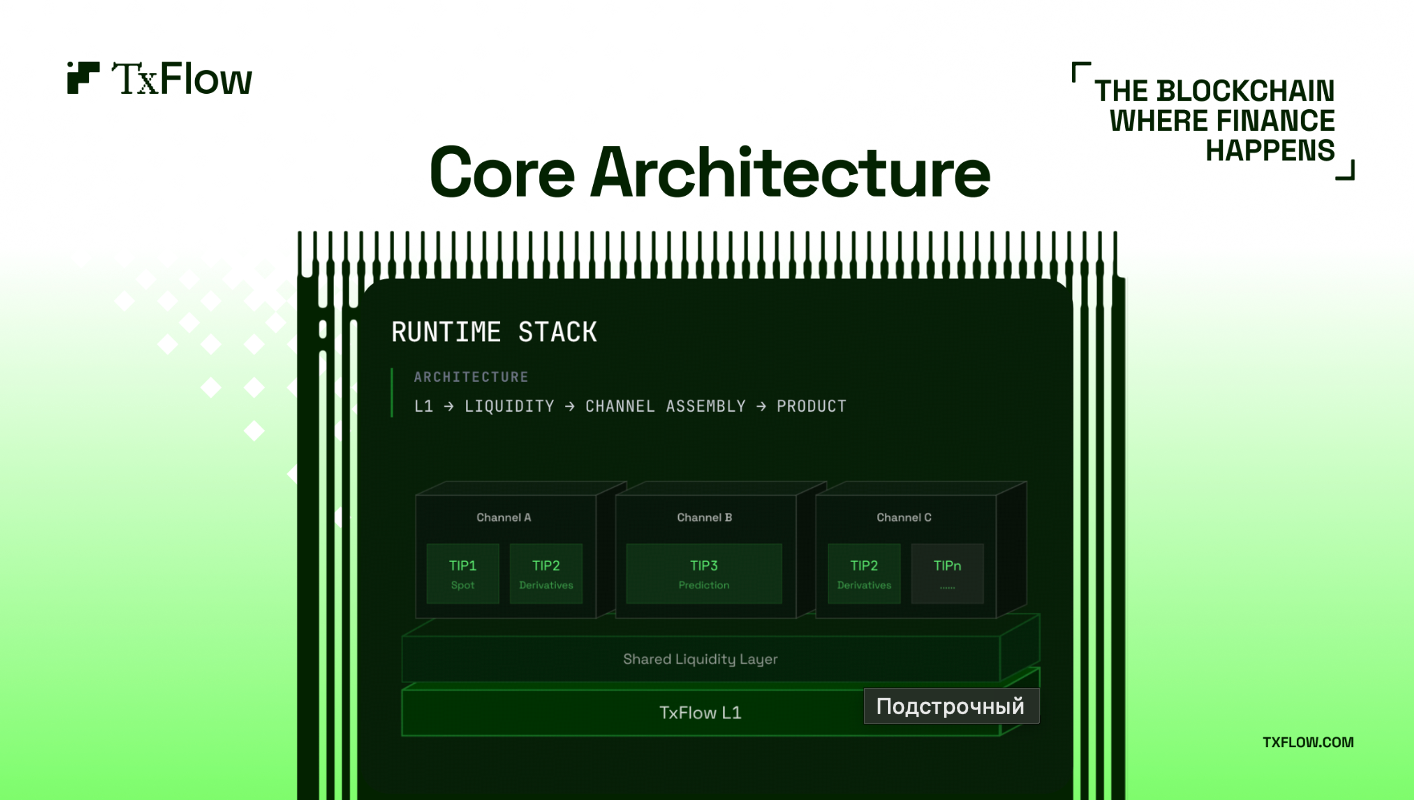
TxFlow L1, the Layer 1 blockchain powering a multi-application onchain financial ecosystem built around its TIP Liquidity Standards, today announced its second Channel: Probly, the first prediction-market application built on TxFlow Improvement Protocol 3 (TIP3).
Following TxFlow DEX—the blockchain’s first application and a central limit order book (CLOB) decentralized exchange for perpetual trading, Probly expands the TxFlow L1 ecosystem into real-time prediction markets. At launch, the platform offers 172 live markets covering more than 7,000 events, including continuously rolling markets with durations as short as five minutes, backed by fully onchain settlement and TxFlow L1’s shared financial infrastructure. The launch marks the next stage in TxFlow L1’s expansion from a network anchored by a flagship onchain exchange into a multi-application financial ecosystem.
TxFlow L1 was designed around a different structure. Through its TxFlow Improvement Protocol standards and Channel architecture, financial applications can operate on the same purpose-built network while connecting to shared execution and settlement infrastructure. Probly extends the ecosystem into prediction markets as the second.
TIP3(TxFlow Improvement Protocol 3) Makes Prediction Markets Native to TxFlow L1
TxFlow Improvement Protocol, or TIP, is the standards framework that defines how financial products are built and connected on TxFlow L1.
Within the framework, TIP1 supports spot markets, TIP2 supports derivatives and TIP3 establishes the standard for prediction-market Channels. TIPn remains open for future products, including real-world assets, structured products and financial instruments that have not yet been developed onchain.

TIP3 defines how prediction-market applications connect to TxFlow L1’s execution, settlement and Shared Liquidity Layer. Rather than operating through an independent infrastructure stack, a TIP3 Channel can build on the same financial foundation supporting the wider TxFlow L1 ecosystem. Its architecture uses DAG-based parallel execution and a multi-threaded processing pipeline, enabling non-conflicting transactions to be processed simultaneously. Market activity and settlement records are executed onchain, providing an open and verifiable system. Probly therefore settles directly on TxFlow L1 instead of relying on a shared general-purpose network or a centralized offchain ledger.
Markets are resolved through designated oracle sources. Automatically resolved price-source markets can settle immediately, while manually adjudicated markets are expected to settle within 24 to 72 hours. Following resolution, eligible settlement amounts are credited automatically in USDC without a separate claim step.
This creates a direct infrastructure advantage for Probly: fully onchain settlement and native connectivity to the broader TxFlow L1 ecosystem.
Probly Brings Real-Time Probability Signals to TxFlow TIP3

Probly comes from “probably”, the word we use when the future is still open. Inspired by P(A), the notation for the probability of an event, Probly turns individual perspectives into a live collective signal: before it happens. At launch, Probly features 172 live event pages across 15 categories, including politics, sports, crypto, finance, geopolitical events. Discovery tools help users explore trending, highly active, fast-moving and soon-to-conclude events, while lightweight polls offer a simple way to engage with topics attracting attention.

Probly also introduces continuously refreshed five-minute, 15-minute, one-hour and four-hour experiences covering BTC, ETH, SOL and XRP price movements. Each page includes live data, a real-time countdown and automatically refreshed rounds, helping users follow changing expectations as events unfold. The platform combines fully onchain infrastructure with a clear, accessible interface designed for both new and experienced users. Probly presents real-time information, probability changes and event timelines in one streamlined experience. Users can access Probly through an email-based embedded wallet without managing a seed phrase, or connect compatible wallets including MetaMask, Coinbase Wallet, Phantom and Uniswap Wallet.
A consolidated account interface provides a clear view of activity, history and ongoing event engagement. Combined with TxFlow L1’s transparent onchain infrastructure and automated resolution process, these features reduce friction from access through completion.
A Different Infrastructure Approach to Prediction Markets
Probly enters a prediction-market category shaped by platforms such as Polymarket and Kalshi, but is built on a different infrastructure model. Probly operates and settles directly on TxFlow L1, a Layer 1 designed for onchain financial applications, bringing real-time probability signals, verifiable onchain records and automatic USDC settlement into one financial stack. Probly extends the same architecture into prediction markets through TIP3.
About Probly
Probly is a prediction market built on TxFlow L1 through TxFlow Improvement Protocol 3 (TIP3). It turns views about future events into continuously updated market signals across sports, crypto, economics, news, culture, weather and other real-world categories.
Probly combines real-time markets, broad event coverage, fully onchain settlement and self-custodied USDC infrastructure. Its mission is to make collective expectations more immediate, transparent and useful by converting uncertainty into a price.
Before It Happens.
About TxFlow L1
TxFlow L1 is a high-performance blockchain built for on-chain financial infrastructure, organized around TIP Liquidity Standards that define how financial products are built, composed, and settled on-chain. TxFlow DEX is the first Channel on TxFlow L1, a CLOB orderbook DEX for perpetual trading, processing over 250,000 TPS with one-block finality. Through its TxFlow Improvement Protocol standards and Channel architecture, TxFlow enables spot markets, derivatives, prediction markets and future financial products to operate on the same chain while connecting to shared execution and settlement infrastructure where all finance happens.
TxFlow L1 is building an open, composable and community-owned financial ecosystem in which each new application can strengthen the infrastructure available to those that follow.
Important Notice
This press release is provided for informational purposes only and does not constitute an offer, solicitation, recommendation or invitation to access or participate in any financial, event-based or prediction-market product.
Probly is available only to eligible users in jurisdictions where access is permitted under applicable law. Product availability, market coverage and functionality may vary by jurisdiction and are subject to applicable terms, eligibility requirements and geographic restrictions.
Participation in prediction markets involves risk, including the possible loss of funds. Market prices reflect participant expectations at a particular time and do not guarantee any outcome. Nothing in this release constitutes financial, investment, trading, legal, tax or any other advice.
The post TxFlow L1 Introduces Probly as Its Second Channel, Marking the Next Stage of Its Multi-Application Ecosystem with Prediction Markets appeared first on BeInCrypto.

Ethereum whales kept buying this week. A selection of newly created wallets pulled roughly 50,000 ETH off exchanges in under 48 hours.
The move comes as the ETH/BTC ratio jumped 6% in a week, adding fresh weight to the case that altcoin season may be building. ETH traded at $1,917, up 2.22% on the day. Bitcoin sat at $64,554, slightly down on the day, according to BeInCrypto data.
Whales And BitMine Keep Accumulating
On-chain tracker Lookonchain flagged a few large buys this week. One address, from a newly created wallet, 0xf31d, withdrew 8,239 ETH worth $14.5 million from several exchanges. A separate wallet, 0x363A, accumulated 11,843 ETH worth $20.8 million in just three hours.
A few days later, three newly created wallets withdrew a combined 30,000 ETH, worth $57.66 million, from Coinbase Prime.
Institutional buying continued alongside the independent wallets. Tom Lee’s BitMine bought another 6,000 ETH, worth $11.18 million, from FalconX on July 15. The purchase extends Bitmine’s aggressive buying streak toward its long-standing goal of holding 5% of Ethereum’s total supply.
Altcoin Season Index Drops as Ratio Breaks Higher
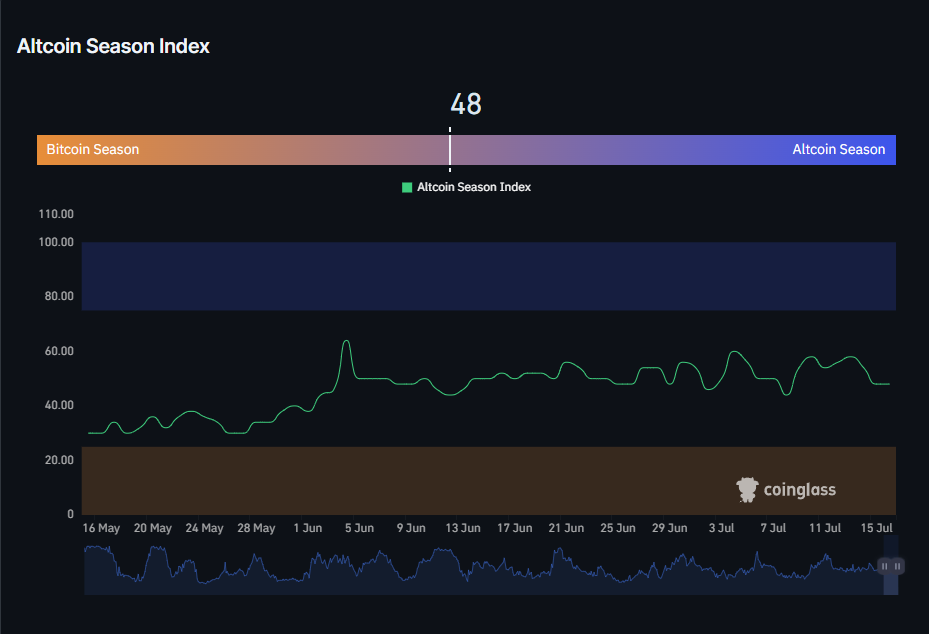
The renewed accumulation actually lands as the Altcoin Season Index drops. CoinGlass’s version of the index has fallen to 48, down from 58 earlier this week. This sees it fall further below the 75 threshold that would confirm a genuine altcoin season, but bubbling interesting in Ethereum could point towards a move away from BTC.

The ETH/BTC ratio is showing promising growth. The pair traded at 0.02971 on Binance, up 6.14% over the past week and 9.75% over the past month, according to TradingView data. That marks a sharp reversal from the 0.0275 low Wintermute flagged in May.
Ethereum is now gaining ground against Bitcoin on a relative basis. That shift is one of the clearer signals that capital is rotating down the risk curve instead of parking in Bitcoin.

This week’s combination of whale buying and a strengthening ETH/BTC ratio could mark the start of a durable altcoin rotation, or another head fake.
Much depends on the Bitcoin dominance and which direction it heads through the rest of July. It also depends on whether the ETH price can keep pace with the ratio’s gains against Bitcoin.
The post Fresh Ethereum Wallets Buy 50,000 ETH as ETH/BTC Ratio Jumps 6% appeared first on BeInCrypto.


A bitcoin address that had not spent a coin in eight years moved 5,908 BTC worth about $383 million on Thursday, data shows.
The wallet took in the coins when bitcoin traded at around $16,000, a level the market saw in December 2017 and early January 2018, within weeks of a cycle peak near $20,000.
The stack cost roughly $100 million then and is worth about $383 million now, a gain of about 284%. It was worth $726 million at bitcoin’s lifetime in October 2025.
The entry date is what makes the holding unusual. Bitcoin fell about 80% through 2018 to near $3,200. It recovered to $69,000 in 2021, then collapsed to about $15,500 in November 2022, which briefly put this position underwater five years after it was built.
The wallet stayed shut then, and again last year when bitcoin cleared $122,000, roughly seven times the entry price. It is opening now, with bitcoin near $64,800 and about half the 2025 high behind it.


Bitcoin’s funds are still lurching, however. U.S. spot bitcoin ETFs shed $424 million on July 13, then took back $181 million the next day. Money leaving and returning inside 48 hours is not indicative of an allocator building a position.
As such, the ether bid is narrower. Of the $53.8 million that came in on Wednesday, BlackRock’s ETHA absorbed $45.3 million and its smaller ETHB fund took $4 million, leaving the other eight products to split less than $5 million between them.
Grayscale’s original ether trust, which charges 2.5% against BlackRock’s 0.25%, has now bled $5.3 billion since launch.
Ether also picked up a demand source that did not exist three weeks ago. Robinhood Chain, the layer-2 network the brokerage switched on July 1, pays gas in ether and settles to Ethereum, and it has been clearing more than $800 million in daily decentralized exchange volume, most of it memecoin trading.
Bitcoin is steadier than its ETF flows suggest, however. Nansen data shows exchange outflows holding through the escalation in the Middle East, with no meaningful rotation into stablecoins, the move that usually marks wallets stepping back.
Funding rates are near zero, which is suggestive of the overleveraged longs that fuelled June’s liquidation cascades have already been cleared out. Bitcoin dominance is 58.3%.

U.S. President Donald Trump is scheduled to meet with multiple senators at the White House this Thursday to discuss the status of the crypto market structure bill—commonly referred to as the CLARITY Act—and how momentum for the legislation can be sustained.
According to Politico, Senator Bernie Moreno said a group of senators will brief the president on the bill and “its path to success,” with Senator Cynthia Lummis also expected to attend, according to a Senate Republican aide. The meeting arrives as lawmakers try to finalize a revised version of the bill before the Senate’s August recess.
Key takeaways
- Trump is set to meet with senators Thursday on progress toward passing the CLARITY Act.
- Lawmakers are racing to agree on unresolved provisions and move toward a Senate vote before the August recess.
- Senator Cynthia Lummis says a new draft will be introduced in the coming days and could reach the Senate floor next week.
- Prediction market pricing currently implies a higher likelihood of a pre-recess Senate vote than of the bill becoming law this year.
White House meeting signals push for urgency
The White House discussion is framed as part of a broader push to keep the CLARITY Act moving through the legislative process. Moreno, speaking to Politico, said senators would review “the entirety of the bill” with the president, adding that Trump has been closely engaged with the effort.
Moreno’s remarks underscore how the initiative is being treated as a political and regulatory priority rather than a routine bill. For investors and builders, the potential stakes are straightforward: a clearer federal market-structure framework could affect how crypto-related products and services are regulated, what compliance pathways look like, and how market participants prepare for enforcement risk.
The meeting also points to how timing has become central. The push is being designed around the Senate calendar, with lawmakers seeking what they describe as the last realistic chance to pass the bill before midterm elections.
Lawmakers seek agreement before the August recess
According to Politico, senators are aiming to reach agreement by the end of this week. Senator Thom Tillis—identified by Politico as one of the lawmakers working through “unresolved provisions”—said he is hoping negotiators can come to terms before the August recess window closes.
“I think it’s critical if we’re going to try and get this across the floor before August recess.”
That statement highlights the bill’s current status: while the legislative push is moving forward, negotiators still appear to be addressing remaining sticking points that could determine whether the bill can secure enough support to advance.
Lawmakers are reportedly awaiting a revised draft of the legislation, which is expected to clarify or adjust the provisions that have slowed progress. The existence of an updated draft matters because it can change what senators consider “vote-ready,” and because revisions often influence how stakeholders—such as financial intermediaries, exchanges, and compliance teams—assess operational readiness.
Senator Lummis: revised bill soon, Senate vote likely next week
In an interview on Fox Business on Wednesday, Senator Lummis said a new draft version of the CLARITY Act will be introduced in the next few days and that she expects it to be on the Senate floor next week.
The prospect of a refreshed text entering the floor schedule suggests that negotiations are nearing a stage where the remaining questions are either narrowed or resolved enough to allow a formal vote process to begin. For market participants, the practical implication is that uncertainty may be compressed quickly—though the exact policy content of the revised draft is what ultimately determines whether support broadens or fractures.
Cointelegraph attempted to reach Lummis for further comment.
Prediction markets: pre-recess vote seems more likely than passage into law
While lawmakers try to close the gap on legislative details, traders are also publishing their expectations through prediction markets. On Kalshi, traders have assigned a 79% chance that the Senate will vote on the CLARITY Act before the August recess, up from 68.8% the previous day, according to the current market view on the platform.
At the same time, those markets still reflect skepticism about the bill becoming law within the same calendar year. A $3 million Kalshi market gives the legislation a 36% chance of becoming law in 2026, and a 62% chance of doing so before the end of 2027.
Polymarket traders similarly place the chance lower for near-term enactment, pricing a 39% probability that the CLARITY Act will be signed into law this year.
Together, these two sets of odds point to a common pattern in Washington timelines: a vote can be scheduled well before final enactment, but turning that vote into signed legislation can require additional steps, bargaining, or reconciliation of competing priorities.
What to watch next
The next key developments are the arrival of the revised CLARITY Act draft and whether it secures enough support to get scheduled for a Senate floor vote—especially given the compressed timeline ahead of the August recess. Traders and lawmakers will likely treat the updated text as the moment when remaining unresolved issues move from negotiation to decisional politics, with follow-through into final passage still far from guaranteed.


Some observers remain skeptical of the sustainability of this inflation-led bounce, arguing that the collapse in oil prices mainly drove the slower growth in the cost of living in June and that the recent bounce in oil makes that data obsolete.
“The 3.5% [CPI] number was driven by a 10% drop in gasoline through June, and that move had already reversed before the report was published, with Brent at a one-month high as the Hormuz situation escalates,” Ryan Lee, chief analyst at crypto exchange Bitget, said in an email.
“Markets are rallying on a June photograph, while July develops differently, and the July print will be the first to carry the war premium,” Lee added.
Jasper De Maere, OTC trader at lading market maker Wintermute, also called for caution, while acknowledging inflation-led bounce and profit-taking near $65,000.
“While the inflation data is genuinely constructive and while positive headlines are very refreshing, it’s worth noting the backdrop hasn’t cleared with U.S. strikes on Iran are into a fourth consecutive day, and the Fear & Greed Index only moved from 22 to 25, still Extreme Fear. One soft CPI print against an active military escalation is not the same as a durable regime shift in risk appetite,” he said in an email.


US President Donald Trump is set to meet with several senators at the White House on Thursday to discuss progress on the crypto market structure bill.
According to Politico, Senator Bernie Moreno said a group of senators will brief the president on the bill and “its path to success.” Senator Cynthia Lummis will also attend, according to a Senate Republican aide.
“We’ll be talking about the entirety of the bill. I mean, obviously the president’s been very engaged in this bill,” said Moreno. “He’s the one who’s really driven the innovation that I think will pay dividends.”
The meeting comes as lawmakers race to pass the crypto market structure bill, known as the CLARITY Act, before the Senate’s August recess. Many lawmakers see it as the last realistic opportunity to pass the legislation before the midterm elections.
“I’m hoping that we can come up with some agreement by the end of this week,” Senator Thom Tillis, who has been helping work through the CLARITY Act’s unresolved provisions, told Politico.
“I think it’s critical if we’re going to try and get this across the floor before August recess.”
Lawmakers are awaiting a revised draft of the bill.
In an interview with Fox Business on Wednesday, Lummis said a new draft version of the bill will be introduced in the next few days and expects it to be on the Senate floor next week.
Cointelegraph reached out to Senator Lummis for comment.
Prediction market odds on CLARITY Act success
Traders on prediction market Kalshi have put a 79% chance on the CLARITY Act being voted on by the Senate before the August recess, up from 68.8% the previous day.
Related: Three US senators oppose CLARITY Act on ethics grounds with vote expected soon
However, traders remain less optimistic that the CLARITY Act will become law this year.
A $3 million prediction market on Kalshi gives the crypto bill a 36% chance of becoming law in 2026, and a 62% chance of doing so before the end of 2027.
Polymarket traders, meanwhile, have put the chance of the CLARITY Act being signed into law this year at 39%.
Magazine: Is Robinhood Chain’s success bullish or bearish for ETH the asset?
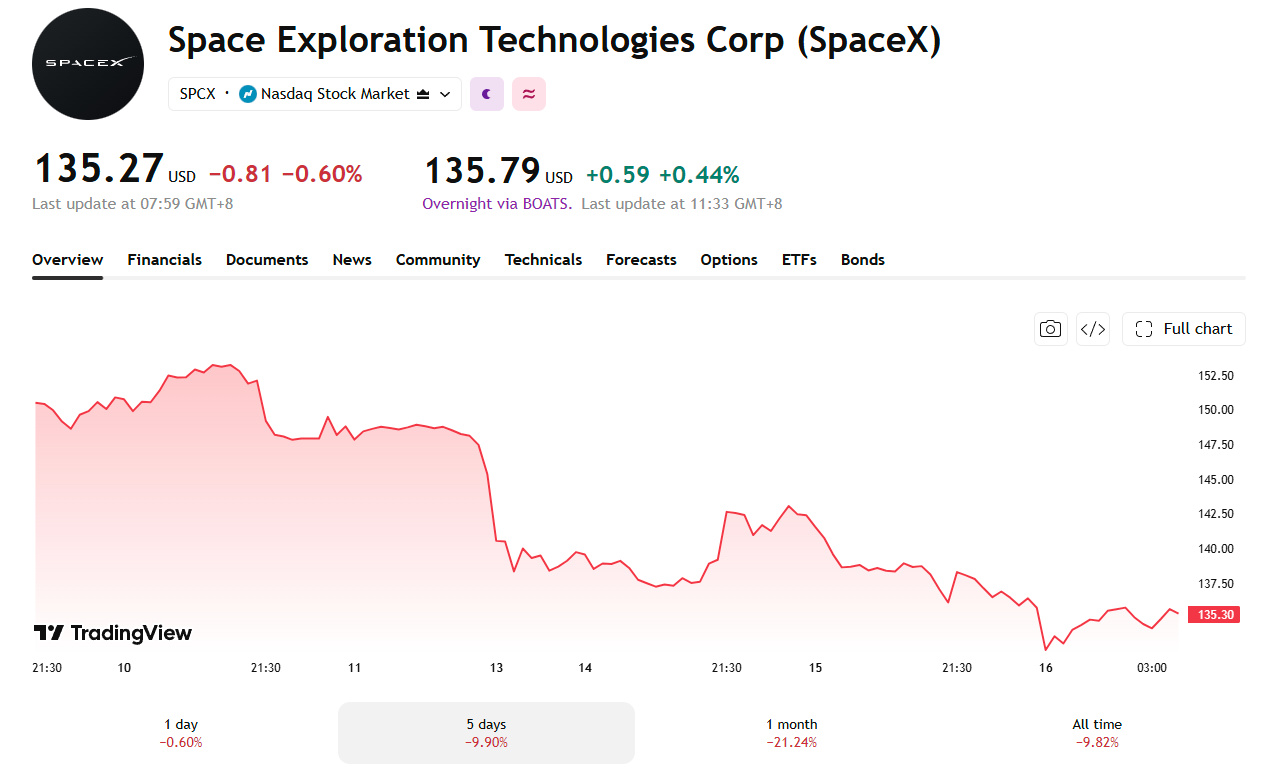
SpaceX (SPCX) shares closed at $135.27 on Wednesday. That sits just above the company’s $135 initial public offering (IPO) price, after an intraday low of $132.28.
The dip marks SPCX’s first close below its IPO price since the stock’s Nasdaq debut on June 12. It also lands weeks before dates that could reshape how the stock trades.
A Shrinking Float Meets an Expanding One
Roughly 95% of SpaceX’s shares remain locked following the IPO. That leaves only about 5% of the company freely tradable. That scarcity helped fuel the stock’s early run past $2.6 trillion in valuation.

That structure starts changing soon. SpaceX will release additional 7% tranches through August and September. A larger release follows third-quarter results later this year. Elon Musk’s 6.4 billion-share stake remains locked separately until June 2027.
Earnings Day Doubles as Unlock Day
Analysts expect SpaceX to report its first quarterly results in the first week of August. The same earnings window also triggers the first scheduled unlock. It frees roughly 20% of previously restricted shares for sale.
A bonus 10% tranche unlocks early if shares trade 30% above the IPO price. That threshold requires five of the ten trading days before the report to close above $175.50. SPCX currently trades well below that mark.
The stock’s Nasdaq-100 inclusion failed to reverse the slide, and shares have already fallen dramatically from their peak. Still, some technical analysts still see a rebound scenario forming with $158 in view.
Whether the August report gives insiders reason to hold or sell into a newly available float remains uncertain. That decision may reveal as much as the earnings numbers themselves.
The post SPCX Stock Struggles Ahead of August Earnings and Share Unlocks appeared first on BeInCrypto.
Crypto World
Crypto Social Activity Just Hit a Multi-Month Low: Why That Could Be Bullish for Bitcoin

Discussion surrounding cryptocurrencies across X, Reddit, Telegram, and other social platforms has dropped to its second-lowest daily level since October 2024. This comes even as Bitcoin continues trading around the mid-$60,000 range.
According to the latest findings by Santiment, while the lack of conversation may appear bearish at first glance, it also reflects weak retail interest, which has often coincided with market turning points.
Crypto Chatter Fades
The current sense of “deadness” across social timelines can feel bearish, but Santiment described this disinterest as one of crypto’s “most underrated forms of FUD,” while adding that when people stop posting, debating, and reacting to every market move, conditions become more favorable for large investors.
The analytics platform said markets can become easier for large investors to influence because fewer retail traders are actively crowding trades during periods of low engagement. “Whales don’t need a euphoric crowd to accumulate,” it explained while adding that some of crypto’s strongest rebounds have formed when retail attention was low, sentiment was exhausted, and markets faced less resistance on the way higher.
Bitcoin continues to face pressure from macroeconomic uncertainty, swings in spot ETF flows, and a cautious risk appetite. According to Santiment, when discussion rates are this low, even a modest change in demand can have a more noticeable effect on prices “than the headline mood suggests.”
While history does not guarantee another rebound, previous market cycles have repeatedly rewarded periods when whales had room to accumulate before retail investors realized the market had already begun to recover.
Macro Risks Remain
Bitcoin briefly touched $65,000 before undergoing a minor pullback. It is currently trading a little above $64,500. Bitunix analyst Dean Chen believes if the crypto asset manages to hold above this level, “it stands a good chance of sustaining this upward momentum.”
The stronger-than-expected CPI reading has lifted near-term market sentiment, but Bitcoin’s next move is still expected to hinge on several macroeconomic developments, Chen said.
These include whether inflation continues to cool even if energy prices rebound, whether the Federal Reserve sticks to its data-driven approach when making policy decisions, and whether changes in Japanese capital flows lead to shifts in global liquidity.
The post Crypto Social Activity Just Hit a Multi-Month Low: Why That Could Be Bullish for Bitcoin appeared first on CryptoPotato.


Summer.fi will wind down operations after a $6.04 million exploit hit its Lazy Summer Protocol on July 6, wiping out the capital the team needed to rebuild.
The five-year-old Decentralized Finance (DeFi) platform said the app will remain live until August 31.
Summer.fi Closes Doors as July 6 Exploit Wipes Out Rebuild Runway
In a blog post, the team tied DeFi’s wider slump to the Stream Finance fallout of October 2025. It described the July exploit as a “devastating moment” for users and the surrounding ecosystem.
BeInCrypto reported losses of roughly $6 million. The attacker manipulated the share price across two of the protocol’s USDC vaults on Ethereum (ETH).
Follow us on X to get the latest news as it happens
The damage landed unevenly between the two pools. LazyVault_LowerRisk_USDC (0x98C49e13…EcF17) took a net loss of nearly 5.64 million USDC. LazyVault_HigherRisk_USDC (0xE9cDA459…cB06) lost about 0.40 million USDC.
The team said a meaningful portion of its own capital was held in the affected vaults. That loss removed the runway required to recover.
“After exploring every alternative, we have concluded that ceasing operations is the only viable path forward, even though it gives us great sadness,” the team said.
Despite the shutdown, Summer.fi noted that the Lazy Summer DAO is working to restore withdrawals and redemptions across all vaults, including the two affected by the exploit. Once those processes are complete, full vault functionality will be reinstated through the Summer.fi interface.
Summer.fi joins a growing list of protocols that could not survive a breach. Radiant Capital wound down in June after a $50 million exploit. Step Finance closed in February following a treasury hack. In each case, the exploit proved terminal rather than survivable.
Subscribe to our YouTube channel to watch leaders and journalists provide expert insights
The post $6 Million Vault Exploit Forces DeFi Platform Summer.fi to Wind Down appeared first on BeInCrypto.

Revolut has received in-principle approval from Dubai’s Virtual Assets Regulatory Authority (VARA) to expand its crypto-related offerings in the United Arab Emirates. The UK-based financial firm said the regulator’s green light would allow it to provide a range of virtual-asset services to users in the UAE through its app and its Revolut X exchange.
The development comes after the UAE Central Bank approved Revolut’s payment activities. In its Wednesday notice, Revolut stated that VARA granted the company in-principle clearance to operate broker-dealer, management and investment, and exchange services in the UAE, framing the move as a step toward deploying “trusted virtual asset services within a regulated environment.”
Key takeaways
- VARA approval in principle positions Revolut to offer broker-dealer, management and investment, and exchange services for digital assets in the UAE.
- The go-ahead follows UAE Central Bank approval for Revolut’s payment activities, signaling coordination across regulators.
- Revolut expects UAE users to be able to buy, sell, and hold digital assets via the Revolut app and Revolut X.
- The UAE move follows Revolut’s March UK banking license and is part of broader, ongoing expansion plans.
- Separately, Revolut previously said it plans to delist USDT for EEA and Switzerland starting in August under MiCA-linked risk and licensing review.
VARA’s in-principle approval gives Revolut a regulated UAE runway
In a statement shared this week, Revolut said VARA’s in-principle authorization would enable it to introduce virtual asset services through its existing user interface while operating under Dubai’s virtual asset licensing framework. The firm did not describe the precise next licensing steps required to fully implement these activities, but it characterized the approval as laying “the foundation” for its rollout within a regulated environment.
For investors and market participants, the significance lies in how rapidly established financial platforms are aligning with UAE’s emerging regulatory architecture. VARA’s approach—granting “in-principle” approvals alongside full licenses—creates a structured path for operators to expand while still meeting regulatory conditions.
VARA maintains a public register of licensed entities. As of the time of publication, the regulator listed 51 companies licensed to offer crypto-related services in the UAE, with 22 entities granted in-principle approval.
Payments first: the Central Bank condition and what it implies
Revolut noted that the VARA decision followed “a green light” from the Central Bank of the UAE for payment-related activities. That sequencing suggests that, at least for Revolut’s roadmap, crypto services are being bundled with—rather than treated as separate from—broader payment and financial compliance processes.
The practical outcome for users is that Revolut’s app-based experience for digital asset transactions can be rolled out with fewer friction points, since the company is addressing payments oversight alongside virtual-asset regulation. It also provides a useful signal for other fintechs: in the UAE, crypto expansion may depend on satisfying cross-regulatory requirements, not only virtual-asset licensing.
Expansion momentum: from UK banking license to pending US and Peru filings
Revolut’s UAE announcement builds on its recent progress in traditional finance licensing. The firm had received a UK banking license in March, according to earlier reporting. Revolut’s stated expansion plans also include similar applications pending for a US banking charter and for licensing in Peru.
From a sector perspective, Revolut’s pattern is telling: it continues to use regulatory milestones in core banking to support downstream products, including digital assets. While crypto access is still heavily shaped by licensing frameworks, the ability to operate within regulated payment and banking environments can matter for settlement flows, custody/handling models, and compliance controls.
UAE approval lands amid shifting crypto product decisions in Europe
Even as Revolut moves forward in the UAE, the company has also signaled adjustments to its crypto offerings elsewhere. Last week, a Revolut spokesperson told Cointelegraph that the firm planned to delist Tether USDt (USDT) starting in August for the European Economic Area and Switzerland.
Revolut linked that decision to a review of its crypto services and risk considerations under the European Union’s Markets in Crypto-Assets (MiCA) framework. MiCA requires crypto-asset service providers to be licensed by July 1, and Revolut’s approach indicates how firms may rework their stablecoin lineup rather than carry all products through the licensing transition.
That contrast—gaining in-principle approval in the UAE while trimming exposure in Europe—highlights a broader reality for crypto platforms: regulatory compliance can drive both expansion and contraction depending on jurisdictional requirements, product classifications, and risk assessment outcomes.
What to watch next
Revolut’s UAE in-principle approval is a meaningful step, but users and market observers should watch for the subsequent regulatory milestones needed for full implementation, as well as how the firm’s approach to stablecoins and licensing evolves under MiCA in Europe.

Google Home Speakers Turn the Google TV Streamer Into a $300 Spatial Audio System, But Is It Really Dolby Atmos?

This Soap Has Money In It

Wales breaking news plus weather and traffic updates (Thursday, July 16)


-

 Fashion7 days ago
Loro Piana Fall 2026 Enters Houston’s Art Scene
-

 Fashion5 days ago
Weekend Open Thread: Nutriplenish Leave-In Conditioner
-
 Sports7 days ago
2026 Genesis Scottish Open Thursday TV coverage: Round 1
-

 Sports6 days ago
Super Eagles star Moses Simon opens up on Liverpool transfer regret
-

 Tech7 days ago
Character.AI enters the microdrama arena with its own productions, but there’s a twist
-

 Politics17 hours ago
Young campaigners urge incoming PM to act on outdoor junk food ads
-

 News Videos1 day ago
XRP BOMBSHELL… XRP OMBOARDED FOR TRANSACTIONS!!!
-

 Tech2 days ago
Get Your ESP32 Sunny Side Up With This Solar Dev Board
-

 Tech1 day ago
Dark Secrets Emerge When Jailbreaking LLMs
-
 Sports8 hours ago
New Cornerback Enters Vikings Trade Rumor Mill
-
 Entertainment12 hours ago
Disney’s Most Ambitious Failed Star Wars Attraction Is Coming to SDCC
-

 Tech7 days ago
Level Infinite Launches Gangstar Mirage City in India with Pre-Registrations
-
 NewsBeat7 days ago
Major update after Huntingdon train attack as man enters plea
-

 News Videos3 days ago
how to make coin bank box with cardboard #scienceproject #money #diy #shorts
-
 Tech2 days ago
Cloudflare Precursor Watches Your Mouse and Keyboard To Decide If You Are Human
-
 Entertainment11 hours ago
Vicki Gunvalson Defends Discussing Heather Dubrow’s Money
-

 NewsBeat8 hours ago
Watch: Is Donald Trump facing a popular backlash on immigration?
-
Crypto World2 days ago
Ripple, Coinbase, Circle Join Linux x402 Foundation to Help Shape AI Payments
-

 Sports5 hours ago
Michigan officials not expected to discuss AD Warde Manuel at Thursday meeting
-
 NewsBeat7 hours ago
Firefighters issue update on Dovestone moorland blaze as fire enters fourth day
You must be logged in to post a comment Login