

Crypto World
U.S. Treasury may boost T-Bill issuance as stablecoins eye $2 trillion market cap: StanChart

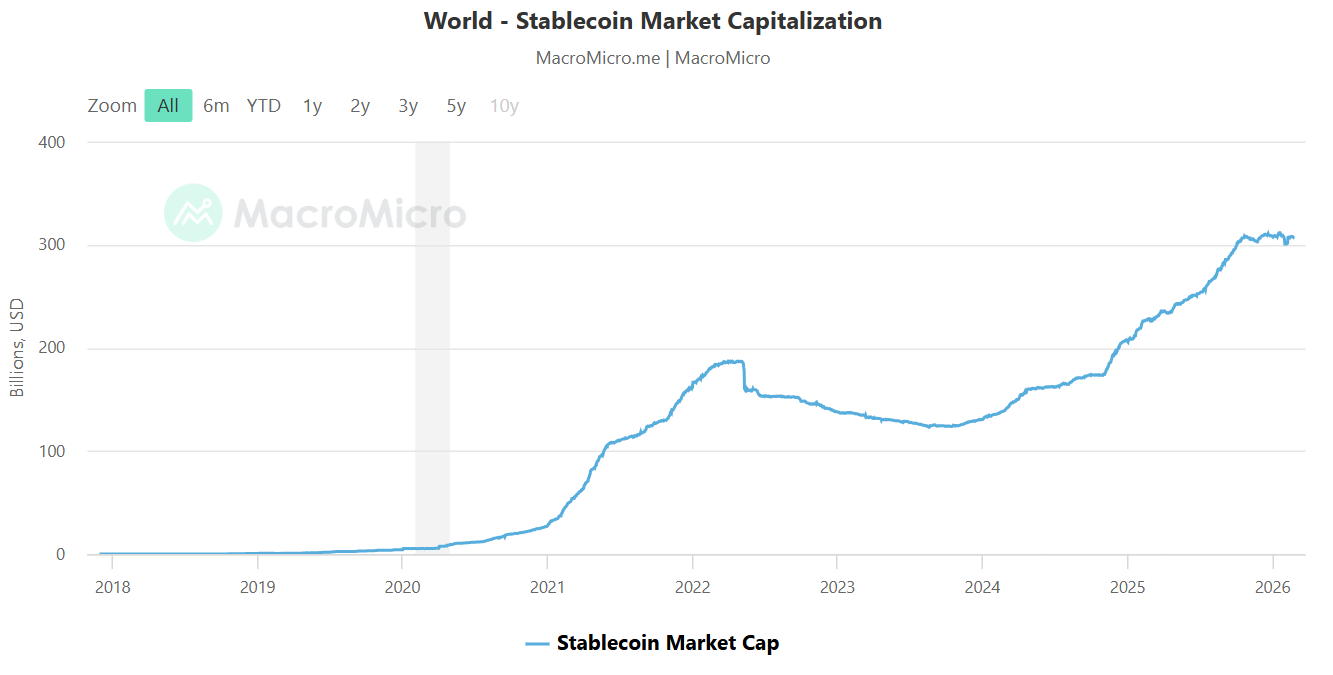
Standard Chartered still expects the stablecoin market to reach $2 trillion by the end of 2028, which should translate into around $1 trillion in new Treasury bill demand, the bank said in a Monday report.
As of early 2026, the total stablecoin market capitalization is roughly $300-$320 billion.
“This will result in c. $0.8-$1.0 trillion of fresh demand for T-bills (for use as reserves) from stablecoin issuers over that period,” wrote Geoff Kendrick, head of digital asset research, and U.S. rates strategist John Davies.
Combined with $1-$1.2 trillion in projected Federal Reserve buying, total new T-bill demand could hit about $2.2 trillion through 2028, the report said. That compares with roughly $1.3 trillion in net new supply if bills’ share of total debt remains unchanged, implying a potential shortfall of $0.9 trillion.
Stablecoin issuers such as Tether and Circle (CRCL) have become major buyers of short-term U.S. government debt, holding tens of billions of dollars in Treasury bills as reserves backing tokens such as USDT and USDC.
Tether alone has disclosed T-bill holdings that rival those of mid-sized sovereign investors, while Circle also keeps a significant share of its reserves in short-dated Treasuries via money market funds.
As the stablecoin market grows, issuers typically park new inflows into T-bills to earn yield while maintaining liquidity, effectively channeling crypto-driven capital into U.S. government financing and reinforcing demand at the front end of the yield curve.
The Treasury said in its February 4 Quarterly Refunding Announcement (QRA) that it “is monitoring SOMA purchases of Treasury bills and growing demand for Treasury bills from the private sector,” a trend Standard Chartered expects to intensify.
The analysts said the projected excess demand gives Treasury Secretary Scott Bessent scope to lift T-bills’ share of issuance. Raising that share by 2.5 percentage points over three years would create about $0.9 trillion in additional bill supply, offsetting the gap.
Reallocating that amount from longer-dated bonds could effectively suspend 30-year auctions for three years and ease upward pressure on long-term yields, according to the report.
While not its base case, the bank expects the 10-year yield to reach 4.6% by end-2026, as the analysts warned of rising risks of front-end scarcity.
Stablecoin growth has recently stalled just above $300 billion, up from $238 billion in April 2025, as crypto prices weakened and post-GENIUS Act issuance slowed. Bitcoin has fallen more than 50% from its $126,000 October 2025 peak, dampening trading-driven demand. Standard Chartered views these headwinds as cyclical and maintains that stablecoins could add nearly $1 trillion in incremental T-bill demand by 2028, reshaping U.S. rate markets.
Read more: Standard Chartered sees bitcoin sliding to $50,000, ether to $1,400 before recovery



BTC is trading around $68,000, slightly up on the day but down over the week, and Robinhood’s crypto head says their users are using this environment to buy dips and diversify beyond just BTC and ETH.
Summary
- BTC trades near recent lows after multi-week decline amid persistent ETF outflows and extreme fear readings.
- Robinhood users increasingly rotate from just BTC, ETH into a broader basket of tokens during the downturn.
- Staking demand for ETH and SOL on Robinhood remains strong since its December launch, signaling active on-chain use, not passive holding.
Cryptocurrency investors are diversifying their holdings beyond Bitcoin and Ethereum during the current market decline, according to a Robinhood executive.
Johann Kerbrat, head of crypto at Robinhood, stated in a recent interview that many platform users view the ongoing market downturn as an opportunity to purchase digital assets at lower prices. However, trading activity has expanded beyond the largest cryptocurrencies, Kerbrat said.
“Customers see the current market as a buying opportunity. However, they are expanding their transactions beyond the two or three most popular cryptocurrencies to include a wider range of assets,” Kerbrat stated.
The executive reported that clients are actively using their tokens rather than simply holding them on the platform. Interest in staking has remained strong since Robinhood launched the feature in December, according to Kerbrat.
The shift in investor behavior comes as overall market sentiment remains at extreme levels of fear, according to market indicators. U.S. spot Bitcoin exchange-traded funds have experienced net outflows for several weeks, data shows.
Despite the negative market conditions, interest in decentralized finance use cases is increasing, Kerbrat noted.
Bitcoin and altcoin prices have continued to decline in recent weeks, extending losses across the cryptocurrency market.
Stablecore, a digital asset infrastructure company, has joined the Jack Henry Fintech Integration Network, enabling banks and credit unions on the platform to offer stablecoin and tokenized asset services through their existing systems.
Jack Henry supplies core processing and digital banking technology to approximately 1,670 banks and credit unions in the United States. Many of those institutions also rely on its Banno Digital Platform, which powers online and mobile banking services for more than 1,000 financial institutions.
On Monday, Stablecore said the integration will connect blockchain-based products to traditional core banking infrastructure.
Participating institutions could roll out stablecoin accounts with 24/7 payment capabilities, crypto on- and off-ramps for assets such as Bitcoin (BTC), digital asset–backed lending, tokenized deposits and staking features where permitted.
Embedding these services within existing banking apps would reduce reliance on standalone wallets or external crypto platforms. It also reflects a broader shift toward incorporating blockchain-based assets into regulated financial channels as demand for compliant, onchain cash-management tools continues to grow.
Related: Wall Street’s crypto debate is over as banks go all-in on BTC, stablecoins, tokenized cash
Stablecoin infrastructure race accelerates
As Cointelegraph reported, Stablecore raised $20 million last year to help smaller banks and credit unions integrate digital asset services, especially stablecoins, following the passage of the landmark US GENIUS Act, which established a federal framework for payment stablecoins.
Stablecore is part of a growing cohort of companies building stablecoin infrastructure to expand access to digital dollars. Proponents argue stablecoins can reduce settlement times, cut cross-border payment costs and provide uninterrupted transfer capabilities compared to traditional banking rails.
Momentum has been building across both fintech and traditional finance.
Last week, payments operations provider Modern Treasury unveiled an integrated payment service that supports stablecoin transactions alongside wire and ACH transfers through a partnership with the Paxos network, signaling greater interoperability between blockchain-based dollars and legacy payment systems.

Meanwhile, asset management giant Fidelity Investments has introduced the Fidelity Digital Dollar, a stablecoin due to launch this month and designed to facilitate faster and more efficient international settlements.
Large banks are also exploring in-house issuance. Citigroup executives have publicly discussed the possibility of launching a native stablecoin as financial institutions seek to modernize cross-border payments and liquidity management.
Related: USDCx appears on Aleo as privacy-focused blockchains seek stablecoin access
The Board of Peace established by US President Donald Trump, which requires a $1 billion contribution for membership, is reportedly exploring a stablecoin for use in rebuilding Gaza’s economy following two years of war triggered by a Hamas terror attack in October 2023.
According to a Monday Financial Times report, the board is in the preliminary stages of discussing whether a stablecoin could be used to help rebuild Gaza’s economy. A person familiar with the project reportedly said the stablecoin would not be a meme coin or a replacement for fiat currency, but rather “a means to allow Gazans to transact digitally.”
Trump announced the formation of the board in January. Membership requires countries to contribute $1 billion for a permanent, renewable role, while the US, according to Trump’s social media announcement, pledged $10 billion. The majority of countries in western Europe declined invitations to join, while 26 countries including Israel, Saudi Arabia, Hungary, and El Salvador were founding members.
The FT report did not state which entity could be responsible for issuing a stablecoin should the board move forward. However, the Trump administration has supported policies allowing broader use of stablecoins in the US, including the president signing the GENIUS Act into law in July.
Related: Israel crypto industry pushes regulatory changes amid strong public support
“The current proposal for the Gaza stablecoin is still very premature,” Snir Levi, CEO of blockchain intelligence platform Nominis, told Cointelegraph. “[O]ver the last two years, OTC desks in Gaza have moved over $100 million in stablecoins with almost no restrictions, without the proper framework, same thing will happen with the Gaza stablecoin.”
Trump also reportedly considering tokenized postwar Gaza plan
There has been a ceasefire agreement in place for Gaza officially since October 2025, though Israeli forces have reportedly repeatedly violated the deal. A significant portion of populated areas in the territory have been destroyed or heavily damaged since 2023.
As a result, members of the Trump administration, including the president and his son-in-law Jared Kushner have proposed plans for developing the area.
Trump reportedly mulled a plan to tokenize land and use digital tokens to relocate and rehouse residents during a US occupation of the territory. He said in February 2025 that the US should “take over” Gaza and make it the “Riviera of the Middle East” before a ceasefire was in place.
Magazine: Hong Kong stablecoins in Q1, BitConnect kidnapping arrests: Asia Express


Bitcoin trades near 200-week EMA; loss of support could spark 30–60% capitulation.
Summary
- Bitcoin trades around $68.4k, above the ~$68.3k 200-week EMA that marks the key cycle support line.
- In 2018 and 2022, a weekly close below the 200-week EMA followed by a failed retest turned it into resistance and led to sharp selloffs.
- Analyst Rekt Capital says multiple weekly closes above the EMA keep downside “unconfirmed,” but a breakdown from this level could again trigger accelerated capitulation.
A cryptocurrency analyst has warned that Bitcoin (BTC) could experience a significant price decline similar to events in 2018 and 2022 if the digital asset fails to maintain a critical technical support level.
The analyst, known by the pseudonym Rekt Capital, told 563,100 followers on social media platform X that Bitcoin faces potential downside risk if it loses support at the 200-week exponential moving average (EMA), according to statements posted on the platform.
Historical data shows that a weekly close below the 200-week EMA, followed by a post-breakdown retest of the EMA into new resistance, has triggered bearish acceleration in previous market cycles, the analyst stated.
“The 200-week EMA represents the key level,” Rekt Capital wrote, adding that a weekly close below it followed by a bearish retest would likely position Bitcoin for additional downside over time.
The analyst noted that Bitcoin has posted weekly closes above the 200-week EMA for two consecutive weeks, which has prevented bearish confirmation in the near term. However, the analyst cautioned that Bitcoin remains vulnerable without sustained upward momentum.
According to the analysis, historical patterns suggest Bitcoin may struggle to generate significant upward price movement from the 200-week EMA level before an eventual breakdown occurs.
The analyst stated that a convincing breakout above the 200-week EMA resistance level would be necessary to invalidate the likelihood of a price collapse.
Bitcoin experienced major capitulation events in both 2018 and 2022, when the cryptocurrency lost significant value following extended bear markets.
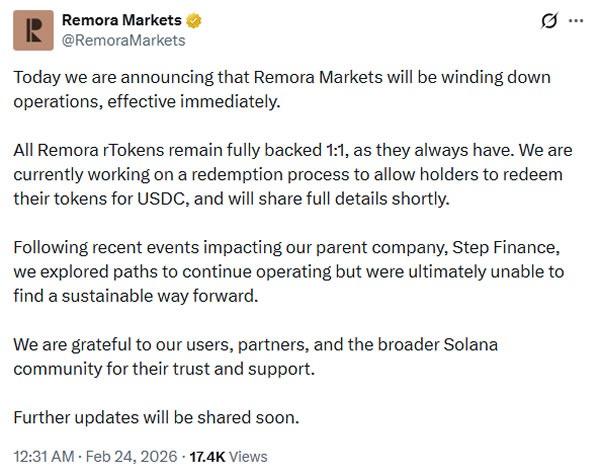
Three Solana-based platforms have announced they are shutting down after a Step Finance hack at the end of January that has been deemed unrecoverable.
Solana portfolio dashboard and DeFi aggregator Step Finance announced on Monday that it would be winding down operations. The closure also extends to subsidiaries Solana NFT analytics and the ecosystem media outlet SolanaFloor, as well as lending and yield protocol Remora Markets.
“Following the hack at the end of January, we explored every possible path forward, including financing and acquisition opportunities,” it stated, referring to a $27 million security breach of its treasury wallets in January.
The team said they were “unable to secure a viable outcome,” resulting in the decision to “end all operations effective immediately.”
The DeFi platform said it is working on a buyback for holders of its native token, STEP, based on a snapshot taken before the incident. There will also be a redemption process for Remora rToken holders, they said.

Step suffers $27 million security breach
Step Finance reported a “breach of security for some of our treasury wallets” on Jan. 31 and asked cybersecurity firms to assist with the investigation.
Blockchain security firm CertiK reported that 261,854 Solana (SOL), worth roughly $27 million at the time, was unstaked and transferred during the incident.
Related: Solana treasuries sitting on over $1.5B in paper SOL losses
Crypto investor Mike Dudas said he was contacted by Step Finance about participating in a bridge round, but requested a security post-mortem first and received no response.
Step Finance co-founder George Harrap said on Tuesday that “Some people have reached out on acquiring various businesses, and we will pursue those if serious and have interest, but we are on a time crunch.”
The platform’s native STEP token tanked 96% in the days following the hack. It slumped a further 36% following the announcement of the closure on Monday and is currently trading at $0.00057, according to CoinGecko.
STEP hit an all-time high of $10.20 in August 2021.

Solana DeFi total value locked tanks 50%
The triple closure is another blow to decentralized finance on Solana, which has seen total on-chain value tank 52% since its September peak. Solana DeFi TVL currently stands at just $6.3 billion, according to DeFiLlama.
Meanwhile, SOL prices have lost a further 1.8% on the day, falling to $78, according to CoinGecko. The asset is now 74% down from its January 2025 all-time high of $293, hit during the peak of memecoin mania.
Magazine: Bitcoin may take 7 years to upgrade to post-quantum: BIP-360 co-author

Taylor Lindman, the deputy general counsel at blockchain firm Chainlink Labs, has joined the Securities and Exchange Commission’s Crypto Task Force as its new chief counsel, filling a role left by now-CFTC chair Michael Selig.
In an X post on Monday, Chainlink Labs announced Lindman’s departure after five years and confirmed his official appointment to the SEC’s Crypto Task Force.
“We thank Taylor for his great five years as a key part of the Chainlink Labs team in his role as deputy general counsel. We all look forward to modernizing the US financial system together, taking it to the next level of its development and rapid growth,” Chainlink Labs said.
SEC Commissioner Hester Peirce, who leads the Crypto Task Force, also confirmed Lindman’s new appointment on X, predicting “great things!” ahead.

A chief counsel typically serves as the senior legal advisor, guiding legal interpretation, ensuring compliance, managing risk and supporting leadership decision-making.
Lindman brings a decade of legal experience to the SEC
Lindman spent more than five years at Chainlink, according to his LinkedIn profile, across various roles, including deputy general counsel and associate general counsel.
During his tenure at Chainlink, Lindman was responsible for ensuring compliance with US and international regulations and was also part of a delegation that met with the Crypto Task Force in March 2025 to discuss crypto regulation, including token taxonomy and securities record-keeping requirements.
Before Chainlink, Lindman was an associate at Perkins Coie from 2018 to 2021 and at Debevoise & Plimpton from 2016 to 2018.
Lindman succeeds Selig, who held the role until December of last year, when he became chair of the Commodity Futures Trading Commission.
Other experienced crypto hands at the SEC
Peirce announced the original lineup of 14 Crypto Task Force members in March 2025, which included several crypto industry natives along with staff taken from the chair’s office and other divisions and offices across the commission.
Landon Zinda, a former policy director at Coin Center from March 2023 until February 2025, is on the task force as a senior advisor.
Related: US SEC crypto task force to tackle financial surveillance and privacy
Veronica Reynolds, also a senior advisor on the task force, previously worked as an associate at Baker Hostetler, a law firm with a practice group focused on digital assets and Web3 technology.
The SEC Crypto Task Force was established following a friendlier policy shift from the incoming Trump administration. Since then, the task force has held roundtable events and tours to gather feedback from the crypto industry, academics and market participants on digital asset regulation.
Magazine: Is China hoarding gold so yuan becomes global reserve instead of USD?
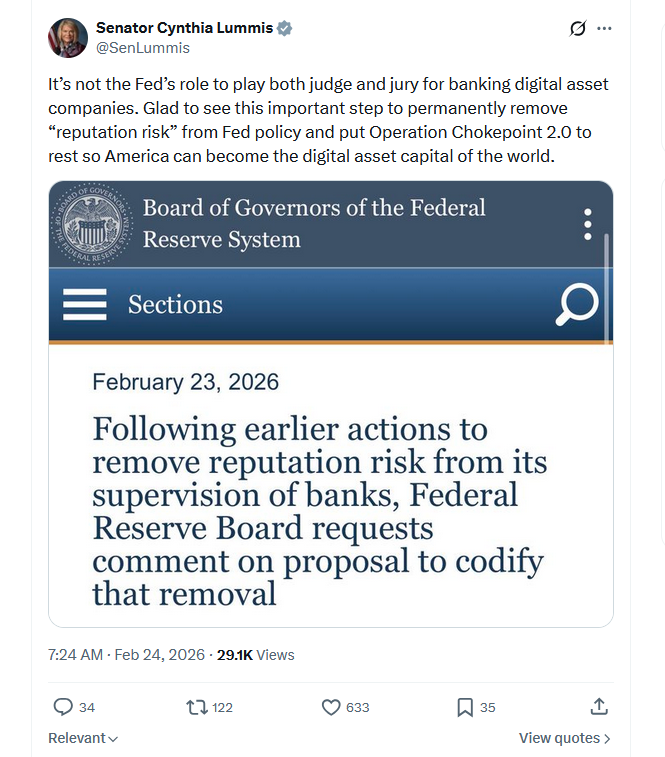
The US Federal Reserve is seeking to codify a rule removing “reputation risk” from banking supervision, which some have blamed for a wave of crypto debanking in recent years.
The Fed initially began making changes in June last year, announcing that it had directed its supervisors to stop pressuring banks to shut down client accounts over reputation risk, meaning banks can only make decisions on clients based on financial risk management.
In a press release on Monday, the Fed said that it is requesting feedback on a proposal to turn this into law. The Fed has set a 60-day deadline for submitting comments.
“We have heard troubling cases of debanking — where supervisors use concerns about reputation risk to pressure financial institutions to debank customers because of their political views, religious beliefs, or involvement in disfavored but lawful businesses,” said vice chair for supervision Michelle Bowman.
“Discrimination by financial institutions on these bases is unlawful and does not have a role in the Federal Reserve’s supervisory framework,” she added.
In an X post on Monday, Lummis praised the move, adding that it is “not the Fed’s role to play both judge and jury for banking digital asset companies.”
“Glad to see this important step to permanently remove ‘reputation risk’ from Fed policy and put Operation Chokepoint 2.0 to rest so America can become the digital asset capital of the world.”

Galaxy Digital’s head of firmwide research, Alex Thorn, also praised the move, noting via X on Monday that “chokepoint 2.0 rollback continues.”
Operation Chokepoint 2.0 is a term used by many in the crypto industry to describe what they felt was a coordinated effort by the Joe Biden-led US government and banking sector to cut crypto firms off from using traditional banking services.
The current US administration has made a concerted push to end debanking in the US, with US President Donald Trump initially exploring a draft order in August to direct bank regulators to investigate debanking claims from crypto firms and conservatives.
Related: SEC allows broker-dealers to take 2% ‘haircut’ on stablecoins
It also sought to direct bank regulators to scrap any policies that led banks to cut ties with such clients due to reputational risk.
Trump himself is currently in a $5 billion legal stoush with JPMorgan over debanking, alleging that the firm unlawfully closed his accounts for political reasons back in 2021.
While JPMorgan has argued that the case has no merit, a former executive recently acknowledged in court that the bank had closed Trump’s account following the Jan. 6 Capitol Hill riots.
Magazine: Is China hoarding gold so yuan becomes global reserve instead of USD?


Summary
- Bitcoin briefly dropped below $64.5k, erasing weekend gains and sending the Crypto Fear & Greed Index back into extreme fear.
- Around 140k traders were liquidated, with total wrecked positions nearing $500M; the largest single hit was a $61.5M BTC long on HTX’s BTC/USDT pair.
- Machi Big Brother was partially liquidated on his ETH longs but still holds 1,700 ETH (~$3.2M) with a liquidation price near $1,819, after losses topping $28.8M.
Bitcoin (BTC) dropped to its lowest level in more than two weeks during early trading hours, triggering widespread liquidations across cryptocurrency markets, according to industry data.
The rapid decline resulted in approximately 140,000 traders experiencing liquidated positions within hours, data from CoinGlass showed. The total value of liquidated positions increased significantly during the period.
An unidentified whale trader faced a substantial liquidation in the past 24 hours during the bitcoin downturn, according to market observers. The liquidation occurred on the HTX exchange and involved the bitcoin trading pair.
Taiwanese-American entrepreneur and former musician Jeffrey Huang, known as Machi Big Brother, was partially liquidated on his Ethereum position during the decline, according to data from blockchain analytics firm Lookonchain. Huang’s cryptocurrency portfolio had previously fallen below earlier levels, posting losses, CryptoPotato reported days earlier.
Following the latest liquidation, Huang continued to maintain long positions in Ethereum (ETH), currently holding 1,700 tokens, according to the data.
Ethereum’s price declined over the weekend after facing resistance at higher levels, marking its first significant drop since the February 6 market downturn.
Key Insights:
- XRP drops over 30% in February, trades 61% below its $3.66 all-time high.
- Whales accumulated 3.17B XRP since October, controlling 17.04% supply.
- XRP ETFs hold $1B+ AUM despite mixed February inflows.
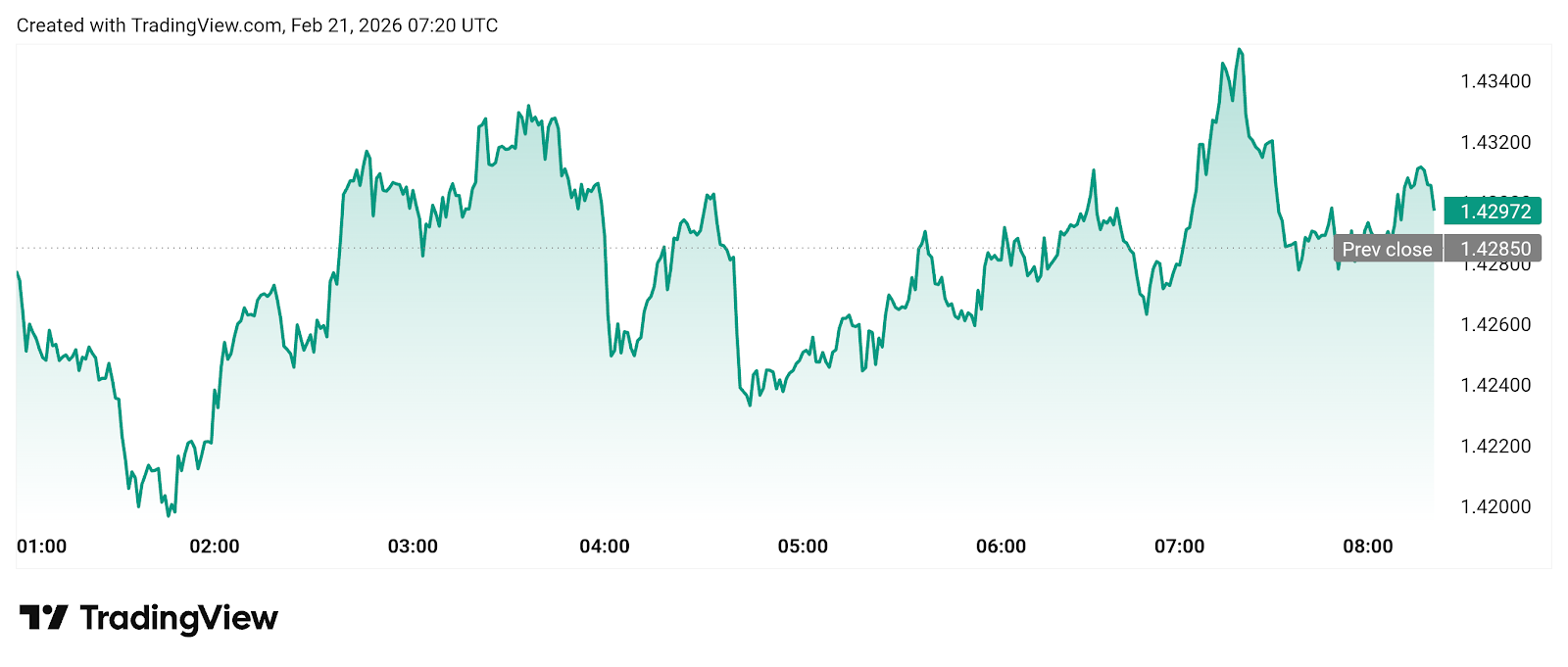
XRP is set to close February in negative territory as it trades near $1.43, down more than 30% from its early-month level of $2.05. The token fell to a monthly low of $1.11 before rebounding into the $1.40 range.
Despite strong whale accumulation and expanding institutional activity on the XRP Ledger, broader crypto market weakness continues to pressure price action. The downward trend experienced in February, marks one of weakest months in XRP history, reinforcing a cautious sentiment among traders.
Since 2014, XRP has recorded losses in seven of 11 February trading periods. The highest monthly drops reached 33.4% in 2014 and 22.1% in 2018. With only a few days remaining, the asset would require a rally of more than 40% to end the month positive. With this in mind, analysts believe that this is not likely to happen under the current circumstances. The market capitalization of the token is over 87 billion and the 24-hour volume is approximately 1.7 billion. XRP is still about 61% below its all-time high of $3.66 in July 2025.
Institutional Adoption Expands Despite Price Weakness
The XRP Ledger adoption metrics indicate further growth. Network-based tokenized real-world assets have surpassed $354 million in the last month, and the report indicates that 63% of tokenized U.S. Treasurys are issued on XRPL infrastructure.
Banking organizations such as DBS Group and Franklin Templeton are establishing trading and lending infrastructures over tokenized money market funds on the ledger. In payments, Deutsche Bank is partnering with Ripple to modernize cross-border transfers, signaling continued enterprise engagement.
ETF Flows and Whale Accumulation Signal Divergence
Seven XRP spot exchange-traded funds now trade in the United States, with combined assets exceeding $1 billion and roughly 790 million XRP locked. The funds recorded 43 consecutive trading days without outflows after launch. However, flows turned mixed between Feb. 11 and Feb. 20, with only one positive inflow day totaling $4.5 million.
On-chain data from Santiment shows wallets holding between 10 million and 100 million XRP accumulated 3.17 billion tokens since October 2025, now controlling 17.04% of the asset circulating supply. The exchange balances decreased by 55 percent to 1.7 billion XRP. On Binance, the funding rates dropped to negative 0.028%, historically associated to short-term rebounds.
Ahead of the month-end, traders are keeping a watch on funding rates, ETF flows, and overall crypto sentiment. Stay in touch with Crypto Breaking News as we continue uncovering the XRP price outlook, February 2026.
XRP slid ~3% in 24h, stuck in a descending channel after failed breakout.
Summary
- XRP trades near $1.39, down about 2.9% day-on-day and ~46% year-on-year, hovering mid-range between key supply and demand zones.
- Price sits inside a descending channel, with lower highs and lows; a failed move above the mid-channel caused a liquidity sweep before spot selling forced price back into the range.
- As long as XRP remains below the channel’s mid-line and overhead supply, rallies face selling, while a break of current support would expose the lower channel boundary and raise downside risk.
Ripple’s XRP (XRP) token declined alongside broader cryptocurrency markets on Monday, continuing a pattern of weakness within a descending price structure, according to technical analysis from Cryptopotato.
The digital asset is currently trading within a defined range as market participants await a decisive move to establish the next directional trend, the analysis stated.
On the daily timeframe, XRP attempted to break above a channel’s middle boundary but failed to sustain the move, according to the report. The brief push beyond this level resulted in what technical analysts term a liquidity sweep, where buy-side positions were triggered before selling pressure returned and pushed the asset lower.
The price subsequently moved back into the established range and continues to trade between an upper supply zone and lower demand base, the analysis indicated. The current structure suggests ongoing consolidation rather than an immediate trend reversal, according to the report.
Technical analysts noted that unless the token reclaims and holds above the channel’s middle boundary, the market is likely to remain range-bound, with activity on both sides of the range contributing to short-term volatility.
On shorter timeframes, XRP remains within a descending structure, forming lower highs and lower lows within channel boundaries, the analysis stated. A recent bounce from a lower demand zone was characterized as corrective in nature.
The asset is consolidating around intraday support levels, according to the report. As long as it remains below the channel’s mid-structure and key supply zone, upward moves are expected to face selling pressure, technical analysts said.
A loss of current support levels would expose the lower boundary of the channel and increase the probability of further downside movement, according to the analysis.

Water, power, and transparency: Amazon’s $12B data center deal signals a new era of accountability

XRP: And It’s About To HAPPEN AGAIN! -Report
DWP statement over ‘earnings’ changes for anyone born after this year


-

 Crypto World7 days ago
Can XRP Price Successfully Register a 33% Breakout Past $2?
-

 Video4 days ago
XRP News: XRP Just Entered a New Phase (Almost Nobody Noticed)
-

 Fashion3 days ago
Weekend Open Thread: Boden – Corporette.com
-

 Politics2 days ago
Baftas 2026: Awards Nominations, Presenters And Performers
-

 Sports9 hours ago
Women’s college basketball rankings: Iowa reenters top 10, Auriemma makes history
-

 Politics10 hours ago
Nick Reiner Enters Plea In Deaths Of Parents Rob And Michele
-

 Business6 days ago
Infosys Limited (INFY) Discusses Tech Transitions and the Unique Aspects of the AI Era Transcript
-

 Entertainment6 days ago
Kunal Nayyar’s Secret Acts Of Kindness Sparks Online Discussion
-

 Video7 days ago
Financial Statement Analysis | Complete Chapter Revision in 10 Minutes | Class 12 Board exam 2026
-

 Tech6 days ago
Retro Rover: LT6502 Laptop Packs 8-Bit Power On The Go
-
 Sports5 days ago
Clearing the boundary, crossing into history: J&K end 67-year wait, enter maiden Ranji Trophy final | Cricket News
-

 Business2 days ago
Mattel’s American Girl brand turns 40, dolls enter a new era
-

 Business1 day ago
Law enforcement kills armed man seeking to enter Trump’s Mar-a-Lago resort, officials say
-

 Entertainment5 days ago
Dolores Catania Blasts Rob Rausch For Turning On ‘Housewives’ On ‘Traitors’
-

 Business6 days ago
Tesla avoids California suspension after ending ‘autopilot’ marketing
-
 NewsBeat18 hours ago
‘Hourly’ method from gastroenterologist ‘helps reduce air travel bloating’
-

 Politics7 days ago
Eurovision Announces UK Act For 2026 Song Contest
-

 Tech1 day ago
Anthropic-Backed Group Enters NY-12 AI PAC Fight
-

 NewsBeat1 day ago
Armed man killed after entering secure perimeter of Mar-a-Lago, Secret Service says
-

 Politics2 days ago
Maine has a long track record of electing moderates. Enter Graham Platner.