

Crypto World
UK Court Sentences Two Hackers in $115M Crypto Ransom Case


The UK’s National Crime Agency (NCA) and the Metropolitan Police’s City of London Police have announced prison sentences for two men tied to the “Scattered Spider” cybercrime group. Both defendants entered guilty pleas at their first court appearance and were later sentenced at Woolwich Crown Court.
According to an NCA press release, the men pleaded guilty on June 22 and were sentenced on Thursday to a combined term of five years and six months in prison. Authorities said the case underscores how ransomware operators increasingly use cryptocurrency to monetize intrusions and extort victims.
Key takeaways
- The NCA and City of London Police say two Scattered Spider affiliates received five years and six months for hacking-related offenses.
- UK investigators linked the group to ransomware and cryptocurrency extortion activity affecting companies in both the UK and the US.
- US prosecutors previously associated Scattered Spider with large-scale crypto ransom collection, including at least $115 million from US companies.
- The group has also been tied to major incidents such as a public transport intrusion in London and separate claims involving Caesars Entertainment.
UK sentencing in the Scattered Spider case
The NCA said the two men were convicted in connection with cybercriminal activity associated with Scattered Spider, a group investigators have linked to ransomware and extortion schemes that use cryptocurrency payments.
In the court process described in the NCA update, both defendants pleaded guilty at their first appearance on June 22. The sentencing then took place on Thursday at Woolwich Crown Court, as reported in the NCA’s release.
For crypto-focused observers, the significance is less about the jail terms alone and more about how law enforcement continues to connect real-world extortion campaigns to digital asset flows—an area where blockchain analytics and custody investigations often determine whether perpetrators can be financially disrupted.
London transport network intrusion and reported losses
British authorities said the Scattered Spider group was involved in the infiltration of London’s public transport network in September 2024. The incident was reported to have resulted in losses and recovery costs of about £29 million (roughly $38.9 million).
While the sentencing announcement is specific to the two defendants, the underlying allegations tie back to a broader campaign pattern: gaining access to high-value targets, disrupting operations, and demanding payments—often in cryptocurrency—under time-sensitive pressure.
Investors and builders watching these cases generally look for a clear signal on enforcement priorities: when high-profile systems are targeted, governments typically respond with both criminal prosecution and efforts to trace and seize assets connected to extortion.
US DOJ links: crypto extortion at large scale
In a separate Department of Justice statement from September, US prosecutors said Scattered Spider was tied to collecting $115 million in cryptocurrency ransom payments from at least 47 US companies. That same DOJ release also described broader disruptions attributed to the group, including attacks impacting critical infrastructure and the federal court system.
The scale described by the DOJ matters because it suggests Scattered Spider is not a one-off operation. Instead, prosecutors portrayed it as a campaign capable of repeatedly compromising organizations and converting the resulting leverage into crypto-linked revenue.
The DOJ statement also described a broader investigation into the group’s activities, including repeated network intrusions. In such cases, sentencing outcomes in one jurisdiction can be interpreted as pieces of a larger enforcement strategy, where cases in the UK and US collectively strengthen the evidentiary record around the same actors and methods.
FBI seizure and earlier crypto ransom allegations
According to the DOJ’s September release, the FBI seized approximately $36 million worth of cryptocurrency from wallets linked to Scattered Spider in July 2024. Prosecutors said investigators traced and seized digital assets allegedly controlled by members of the group as part of the wider case.
US prosecutors further said Scattered Spider was accused of breaching Caesars Entertainment and stealing a large customer database in September 2023. Prosecutors said Caesars ultimately paid a $15 million ransom in Bitcoin (BTC). That earlier allegation fits the same overall pattern of using crypto as the payments mechanism for extortion demands.
The combination of wallet-linked seizures and later courtroom sentences highlights the practical leverage of crypto intelligence for law enforcement: tracking transfers and correlating wallet activity with criminal conduct can support both asset recovery and prosecution.
In the DOJ’s account, investigators said the group was responsible for at least 120 computer network intrusions. The NCA sentencing announcement does not enumerate those numbers, but it aligns with the DOJ’s broader framing of an expanding threat. For victims and compliance teams, the message is consistent: crypto-enabled ransomware operations continue to attract coordinated international responses, even when the extortion attempts cross borders.
“These malicious attacks caused widespread disruption to US businesses and organizations, including critical infrastructure and the federal court system, highlighting the significant and growing threat posed by brazen cybercriminals,” said Matthew Galeotti, then acting assistant attorney general of the Justice Department’s Criminal Division.
What to watch next
With Scattered Spider affiliates now facing prison time in the UK and prosecutors having described large crypto-related seizures and ransom totals in the US, the next key question is whether additional defendants—along with more wallet-linked assets—will be identified and targeted across jurisdictions. For companies and crypto traders alike, continued enforcement can meaningfully shape how ransomware groups attempt to move funds and how quickly investigators can disrupt those flows.

Crypto World
Virtual Protocol Sees Breakout Opportunity Amid Increasing Momentum in the AI Ecosystem Expansion

Virtual Protocol is being closely monitored by traders to see if improved technical strength and ecosystem development could help the cryptocurrency move past important resistance levels. Despite VIRTUAL still trading below its downtrend line, constant defense of key support levels is helping drive the accumulation bias.
However, the positioning in derivatives markets is also neutral, which indicates that market participants are waiting for more proof before taking more leveraged bets. This, coupled with continued development in AI infrastructure, agent commerce, and robotics, keeps the overall outlook interesting.
Technical Structure Suggests Critical Turning Point
Virtual Protocol could continue trading below value due to its prolonged correction, according to recent market analyst Tanaka. Rather than dwelling on its price movements in the short term, it is worth mentioning the ecosystem expansion and development plan that the project is building. The weekly chart provides additional evidence for this viewpoint.
After dropping by almost 90% since its peak levels, VIRTUAL slowly stabilized, creating a downtrend in the form of a descending resistance trendline with consecutive lows. The price is currently trading right under the persistent resistance level, which brings us to a critical turning point for the token.
Price action keeps squeezing between the resistance and the solid support area. Buyers keep entering the market in the accumulation zone, whereas selling activity looks much weaker than before the start of the correction.
Currently, Virtual Protocol is priced at $0.6357, representing an increase of 5.13% over the previous day and 21.73% within the last week. Trading volume for the day amounts to about $102.44 million.
Expanding the AI Ecosystem Serves to Strengthen the Long-Term Narrative
Other than price movements, Virtual Protocol continues to expand the ecosystem of the protocol focusing on AI. One of the primary goals of the protocol is the creation of a system for intelligent AI agents where they can transact autonomously. The process of agent payments, task execution, and autonomous interactions forms an important part of the project’s long-term plan.
The other notable development is the Agent Commerce Protocol, which aims to enable independent AI agents to find each other, negotiate services, and make payments autonomously. This commerce layer might prove to be one of the most useful long-term aspects of the protocol, according to Tanaka.
VIRTUAL also acts as the key asset in the entire ecosystem. The agent tokens make use of the VIRTUAL trading pairs for their liquidity, whereas transactions made between AI agents through commerce are done using the token.
Further growth of the ecosystem is continuing via integrations with Base, Robinhood Chain, and robotics programs. Eastworlds is also collaborating with Unitree Robotics to experiment with the physical implementation of AI. Although this will contribute to making the future outlook of the platform more positive, validation of adoption and revenue generation is still needed.
Funding Rates Are Evidence of Well-Balanced Positioning
The analysis of derivatives data reveals a similarly balanced view of the prevailing market positioning. OI-weighted funding rates stayed relatively neutral despite prolonged market weakness. There was neither any domination of bulls nor bears during the latest period of trading activities, implying balanced market participation in perpetual futures trading.
Previously, in case of the price decline, there were occasional moments when funding rates went below the zero level due to increasing bearish positioning. But these were never extremely low values that indicate a state of market capitulation. Recently, funding rates moved around the equilibrium point along with the price consolidation in a narrow range.
Resistance Breakout Is the Critical Technical Level
For now, the key technical factors for Virtual Protocol are the positive improvement in technical stability, ecosystem development, and the neutral derivatives sentiment. Virtual Protocol still builds infrastructure through AI agents, autonomous commerce, and robotics and enjoys positive support from the long-term accumulation area.
Despite that, the falling resistance trendline is the main technical barrier at the moment. Its breakout might confirm bullish momentum and change the market structure, while inability to do that will keep the ongoing range. Until this critical move takes place, traders will watch whether accumulation, ecosystem development, and stable market positioning can help form the next trend for Virtual Protocol.
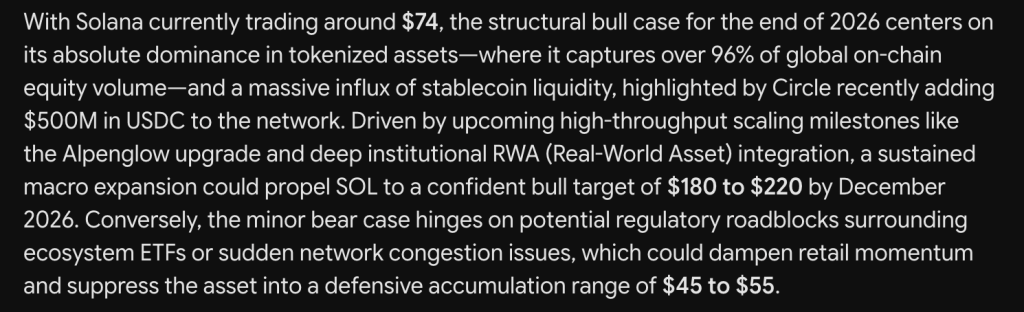
Google Gemini AI predicts a Solana price target that skips the usual talking points and goes straight to a number that made us pause.
Over 96% of global on-chain equity volume runs through Solana right now. That is not a growing market share story; that is a market that has already been won.
From $74, Gemini puts the December 2026 target at $180 to $220. Stablecoin liquidity is doing real work here too, with Circle adding $500M in USDC to the network in a single move.
The forward-looking piece is the Alpenglow upgrade, aimed at pushing throughput into territory that makes high-frequency use cases viable on chain for the first time. Pair that with deep institutional integration into real-world assets, and Gemini’s thesis is less about speculation and more about infrastructure quietly becoming unavoidable.
A sustained macro expansion is the condition attached to all of it. Without a broader risk appetite returning, even dominant infrastructure sits underpriced.
The bear case Gemini offers is almost an afterthought by comparison. Regulatory roadblocks around ecosystem ETFs or a sudden bout of network congestion could dampen retail momentum and push SOL into a defensive range of $45 to $55.
That is a specific, bounded downside rather than a collapse scenario. It reads more like a pause than a reversal.

Discover: The Best Token Presales
Solana Price Prediction: SOL RSI Just Crossed A Line It Has Not Held Since October
Price closed at $74.67, down 0.78%, with the session ranging between $74.12 and $75.69. On its own, that is an unremarkable day, but the chart underneath it tells a longer and more interesting story.
SOL peaked near $257 in September 2025, and the decline from there was almost uninterrupted through the February crash below $80. Since that crash, price has spent five months carving a wide range between roughly $60 and $100, with three separate rally attempts, March, May, and now July, each stalling near the same $95 to $100 ceiling.
That repetition matters. A level that rejects price three times stops being a coincidence and starts being the market’s actual opinion on fair value.
Support sits at $70, then the June low near $60 that has held twice now. Resistance stacks at $80, then $85, then that stubborn $95 to $100 zone.
The RSI panel shows something worth pausing on. RSI reads 46.03 with the signal line at 54.63, and that signal line has been climbing steadily since the June bottom, tracking the price recovery closely.
The current gap is negative, meaning short-term momentum has cooled slightly after the recent bounce, but the broader trend in the signal line itself is the more telling detail. It has not been this elevated since October, back when SOL was still trading above $200.
For Gemini AI, as it predicts, a $180 prediction becomes plausible. Solana needs to finally close above $100 with conviction, something it has failed to do three separate times since February. The infrastructure case may already be true. The chart has not been asked to agree with it yet.
Discover: The best crypto to diversify your portfolio with
Don’t Miss Out on Our $1,000 USDT Airdrop on ByBit
You Might Like What Gemini AI Predicts About This New Layer 3 Called LiquidChain
The money that wins cycles never waits at resistance.
Large caps are stuck. Bitcoin, Ethereum, and XRP keep testing the same ceilings with nothing breaking through. Every macro catalyst has a new arrival date. Every institutional wave has a new quarter attached. Waiting on someone else’s decision is not a trade.
Small market cap infrastructure plays operate on completely different physics. A rotation that vanishes as noise at Bitcoin’s scale reprices an undiscovered project by multiples. The opportunity lies in the gap between what something is genuinely worth and what the market has assigned it. That gap closes permanently the moment discovery happens.
Multi-chain fragmentation is one of the most expensive unsolved problems in DeFi. Bitcoin, Ethereum, and Solana run as completely isolated systems. No shared architecture. No native interoperability. Every time value crosses those boundaries it pays in fees, slippage, and failed transactions.
LiquidChain makes the crossing free. Gemini AI predicts and agrees. All 3 networks inside one execution environment. Single deployment. Complete ecosystem access. No tax on any interaction.
The presale is at $0.01454 with just over $900,000 raised. Early and undiscovered. That combination does not last long.
Explore the LiquidChain Presale
The post Google Gemini AI Reveals Shocking Solana Price Target for 2026 appeared first on Cryptonews.
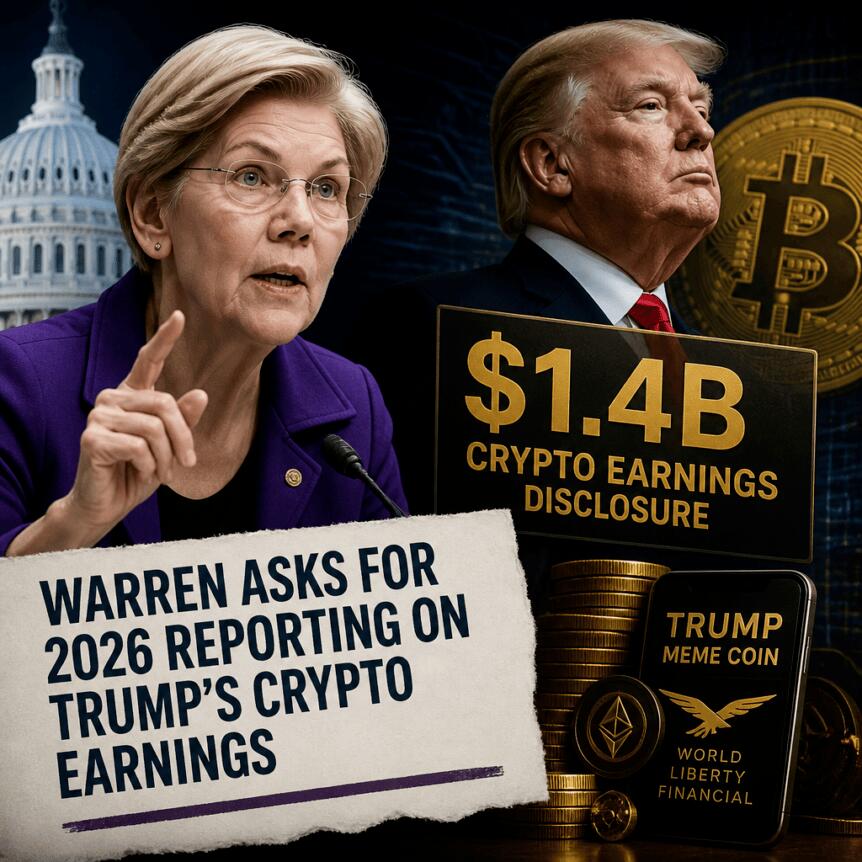
Senator Elizabeth Warren has urged President Donald Trump to provide updated financial disclosures covering his cryptocurrency earnings for the first half of 2026, arguing the information is especially important as the US Senate weighs legislation that could reshape the crypto market.
In a letter sent on Thursday, Warren requested that Trump voluntarily release a report detailing crypto-related income between Jan. 1 and July 15. The request comes amid heightened scrutiny of how crypto policy might affect the value of the president’s and his family’s reported holdings.
Key takeaways
- Elizabeth Warren is asking Trump to disclose crypto earnings for Jan. 1–July 15, ahead of the president’s normal filing timeline for 2026.
- Warren pointed to Trump’s 2025 disclosures, which reportedly showed $1.4 billion in crypto-related earnings.
- The senator’s concern ties directly to pending Senate action on the Digital Asset Market Clarity (CLARITY) Act.
- Majority Leader John Thune indicated the Senate aims to hold a vote on the bill before August states work periods begin.
- On the House side, a CLARITY hearing was held in New York, while some Democrats have signaled they will require stronger ethics guardrails before supporting the bill.
Warren presses for earlier crypto earnings disclosures
Warren’s letter asks Trump to publish updated financial disclosures covering crypto earnings for the period from Jan. 1 to July 15. She framed the timing as crucial because the Senate is considering the Digital Asset Market Clarity (CLARITY) Act, legislation intended to clarify rules for digital assets and market structure.
Warren said Trump’s disclosure raises “key questions” about whether presidents, senior administration officials, members of Congress, and their families should profit from the crypto industry while the federal government debates rules that could influence market outcomes.
She also emphasized that, under current disclosure requirements, Trump is not expected to file his full 2026 annual report until May 2027. Still, Warren requested voluntary publication by July 23 so it aligns with the Senate’s consideration of the CLARITY bill.
What Warren cited from Trump’s 2025 disclosures
The pressure is grounded in disclosures Warren referenced from Trump’s 2025 earnings reporting. Earlier coverage cited filings showing Trump earned $1.4 billion from crypto-related ventures in 2025, including through his memecoin, Official Trump (TRUMP), and through World Liberty Financial, according to the reporting linked in the article.
That point is central to Warren’s argument: she contends that legislation under debate could “turbocharge” conflicts of interest if ethics guardrails are not tightened, potentially increasing the value of holdings held by the president and his family.
“[W]ithout adequate guardrails, [CLARITY] would turbocharge the President’s significant conflicts of interest and almost certainly boost the value of his and his family’s crypto holdings.”
House and Senate movement on CLARITY, with ethics concerns looming
The Warren letter arrives as Congress advances CLARITY through committee and floor planning. According to Senate Majority Leader John Thune, the chamber intends to hold a vote on the crypto bill before the Senate breaks for August states work periods.
At the same time, the political dynamics around the bill appear closely tied to ethics conditions. The article notes that many Democrats have said they would not support any legislation without clear ethics provisions, with some pointing to potential conflicts of interest linked to Trump’s crypto investments.
Earlier in the process, Trump has publicly denied wrongdoing related to his crypto activity. The article references a July 2 interview in which Trump said there was “nothing illegal” and “nothing wrong” with profiting from his crypto investments while in office.
House committee hearing highlights bipartisan claims—and missing Democrats
While the Senate focuses on timing for a full-vote window, House activity has been moving in parallel. On Friday, the House Financial Services Committee’s Subcommittee on Digital Assets, Financial Technology, and Artificial Intelligence held a field hearing in New York City on the CLARITY Act.
The bill has already passed the House, in July 2025. If the Senate approves it with 60 votes, it would return to the chamber for final consideration. Representative French Hill, who chairs the full committee and attended the hearing, described CLARITY as a “bipartisan priority” for Congress.
However, the hearing reportedly did not include Democratic representatives from the committee. Cointelegraph reached out to Democratic lawmakers for comment but did not receive an immediate response, according to the article.
With the Senate vote reportedly targeting a pre-August window, the immediate question for investors and policy watchers is whether ethics requirements—especially disclosures and guardrails—will be strengthened enough to address concerns raised by Warren and other Democrats. The requested July 23 disclosure deadline may become an early test of how closely market structure legislation and conflict-of-interest scrutiny will be linked in practice.
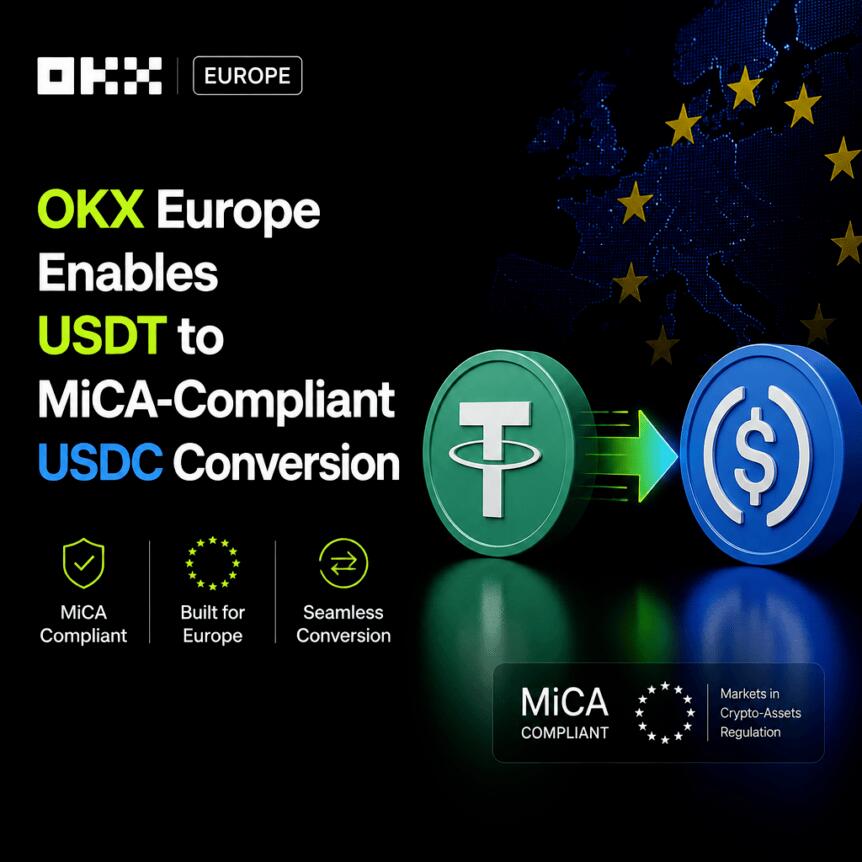
OKX Europe has introduced a “one-way conversion” option that allows customers to deposit USDT and convert it into USDC within the exchange, creating a regulated off-ramp as Europe’s Markets in Crypto-Assets (MiCA) framework restricts support for non-authorized stablecoins.
In a company announcement provided to Cointelegraph, OKX Europe said users can send Tether’s USDt (USDT) to their OKX Europe account and then convert the deposit into USDC, a stablecoin that is among the major options compliant with MiCA’s requirements. The feature is positioned as a migration path for customers whose existing platforms no longer accept USDT or are moving them to alternatives.
Key takeaways
- OKX Europe lets customers convert deposited USDT into USDC on the exchange, rather than keeping USDT balances active.
- The change reflects MiCA constraints: Tether has not obtained authorization for USDT issuance under MiCA.
- OKX Europe says conversions are initiated at the customer’s discretion, not pushed through a platform-imposed deadline.
- The decision underscores how USDT accessibility in Europe is tightening even as it remains the largest stablecoin globally.
- OKX Europe operates for users across 30 EU and European Economic Area (EEA) countries under its MiCA license.
MiCA’s stablecoin licensing pressure reaches everyday flows
MiCA’s rollout has affected how European platforms handle stablecoins—particularly those whose issuers have not secured authorization to issue the relevant asset under the new regime. According to OKX Europe’s announcement, its new one-way conversion feature is aimed at customers who are dealing with service changes elsewhere and still want to maintain stablecoin exposure, but in an asset that fits the MiCA-compliant environment.
The core problem stems from the fact that Tether has not obtained MiCA authorization for USDT issuance. As MiCA took full effect across the EU on July 1 (per the article’s timeline), many crypto platforms moved to restrict USDT deposits, remove or limit trading pairs, or automatically shift customer balances toward compliant alternatives.
OKX Europe’s approach is notable because it does not present conversion as an after-the-fact compliance step imposed by a fixed cutoff. Instead, the exchange said conversions can be completed at the customer’s discretion, which may help reduce forced timing decisions for users managing their own balances.
Why USDT still matters—even as platforms reroute users
The rollout comes as USDT remains dominant in global stablecoin usage. DefiLlama data cited in the announcement indicates Tether controls roughly 59% of the stablecoin market, with market capitalization around $184 billion out of nearly $310 billion in total stablecoin value. By comparison, Circle’s USDC is shown at about $73 billion market cap.
This imbalance helps explain why MiCA-compliant migration tools are likely to remain in demand: even if a region limits USDT functionality, USDT still represents a large portion of users’ circulating balances and trading inventory. Features that allow “in-exchange” conversion can therefore act as a bridge—keeping liquidity moving into compliant stables without forcing users to seek off-platform solutions.
Tether’s stance on MiCA—and the ripple effect in Europe
Tether’s decision not to seek MiCA authorization for USDT has been a persistent point of contention. Tether has defended that position even as exchanges across the EU adjusted their offerings in response to the regulatory framework’s start in late 2024, according to earlier reporting attributed to Cointelegraph.
In a May 2025 interview with Cointelegraph, Tether CEO Paolo Ardoino criticized MiCA’s reserve requirements. He argued the framework could introduce unnecessary risk for stablecoin issuers by requiring part of reserves to be held with European credit institutions. In that context, Ardoino suggested Tether chose not to pursue authorization despite the likelihood that USDT would lose support on European exchanges.
Ardoino has reiterated a similar posture since then. In a July 2025 post on X referenced in the original reporting, he said Tether would reconsider applying for MiCA authorization only “when MiCA becomes safer for consumers and stablecoin issuers,” signaling that the company views the current structure as fundamentally unfavorable rather than merely temporary.
Meanwhile, other companies have already acted on the basis of regulatory and operational risk. Earlier coverage cited in the article notes that digital banking platform Revolut said it would stop supporting USDT for customers in the EEA and Switzerland, giving users until Aug. 31 to sell or withdraw their holdings before any remaining balances are automatically converted into their base currency. That kind of consumer-facing change illustrates how MiCA’s stablecoin restrictions are not confined to exchanges but can propagate through payment and custody layers as well.
What OKX Europe’s conversion feature changes for users
For OKX Europe customers, the practical implication is straightforward: if they hold USDT, they can still move value into the exchange and then convert into USDC—potentially preserving stablecoin utility without running into deposit restrictions or trading-pair limitations that some platforms have applied.
OKX Europe also framed the tool as a way for users to adapt when “existing platforms” no longer accept USDT or when migration happens automatically. By allowing conversions at the customer’s discretion rather than attaching them to a strict, platform-set deadline, OKX Europe appears to be trying to reduce friction around the timing of stablecoin transitions.
Still, the change is a reminder that USDT access in Europe is increasingly conditional on regulatory structure. Until Tether’s USDT issuance becomes MiCA-authorized—or until the regulatory posture of specific platforms changes—users should expect more “migration” mechanics like this to appear across major trading venues.
As MiCA licensing expands and platforms continue adjusting their stablecoin support, readers should watch whether more exchanges adopt similar conversion-only flows and whether any shift occurs in Tether’s stance on seeking authorization; the next wave will likely depend on both regulatory decisions and how quickly compliant stablecoins can absorb migrating liquidity.
Crypto World
Senator Warren Requests 2026 Reporting for Trump’s Crypto Earnings after $1.4B Disclosure
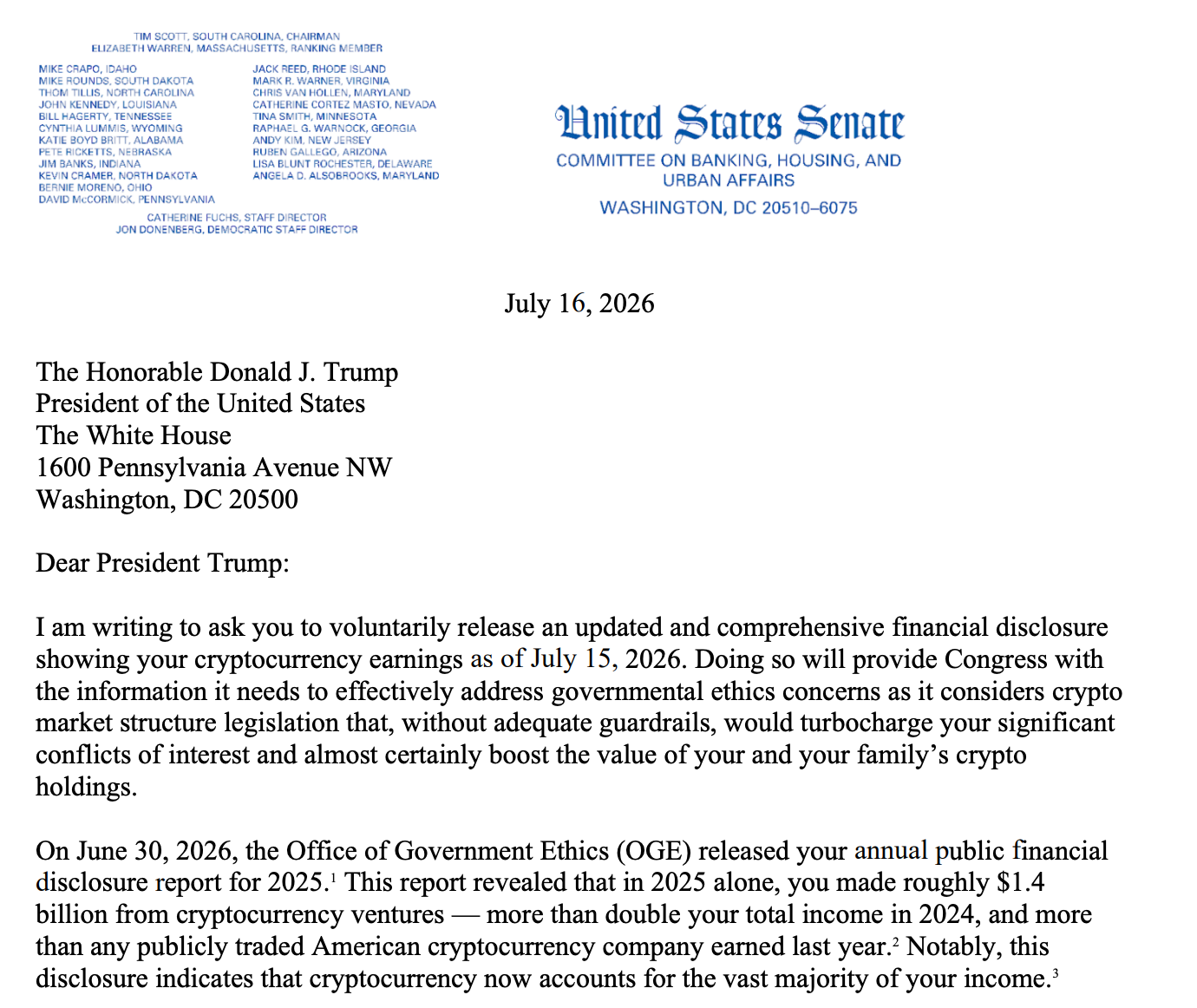
Senator Elizabeth Warren, one of the more outspoken voices in the US Congress associating digital assets with illicit activities, has called on President Donald Trump to release additional information on his crypto investments ahead of a mandated deadline.
In a Thursday letter, Warren requested Trump voluntarily release a financial disclosure report on his earnings related to cryptocurrency between Jan. 1 and July 15. The request came after Trump’s 2025 financial disclosures showed he had earned $1.4 billion from crypto-related ventures in 2025, including through his memecoin, Official Trump (TRUMP), and his family’s company World Liberty Financial.
“Your financial disclosure raises key questions about the appropriateness of Presidents, Vice Presidents, senior administration officials, members of Congress, and their families profiting off the crypto industry, just as the US Senate debates crypto market structure legislation that has the potential to increase the value of your crypto holdings,” said Warren.
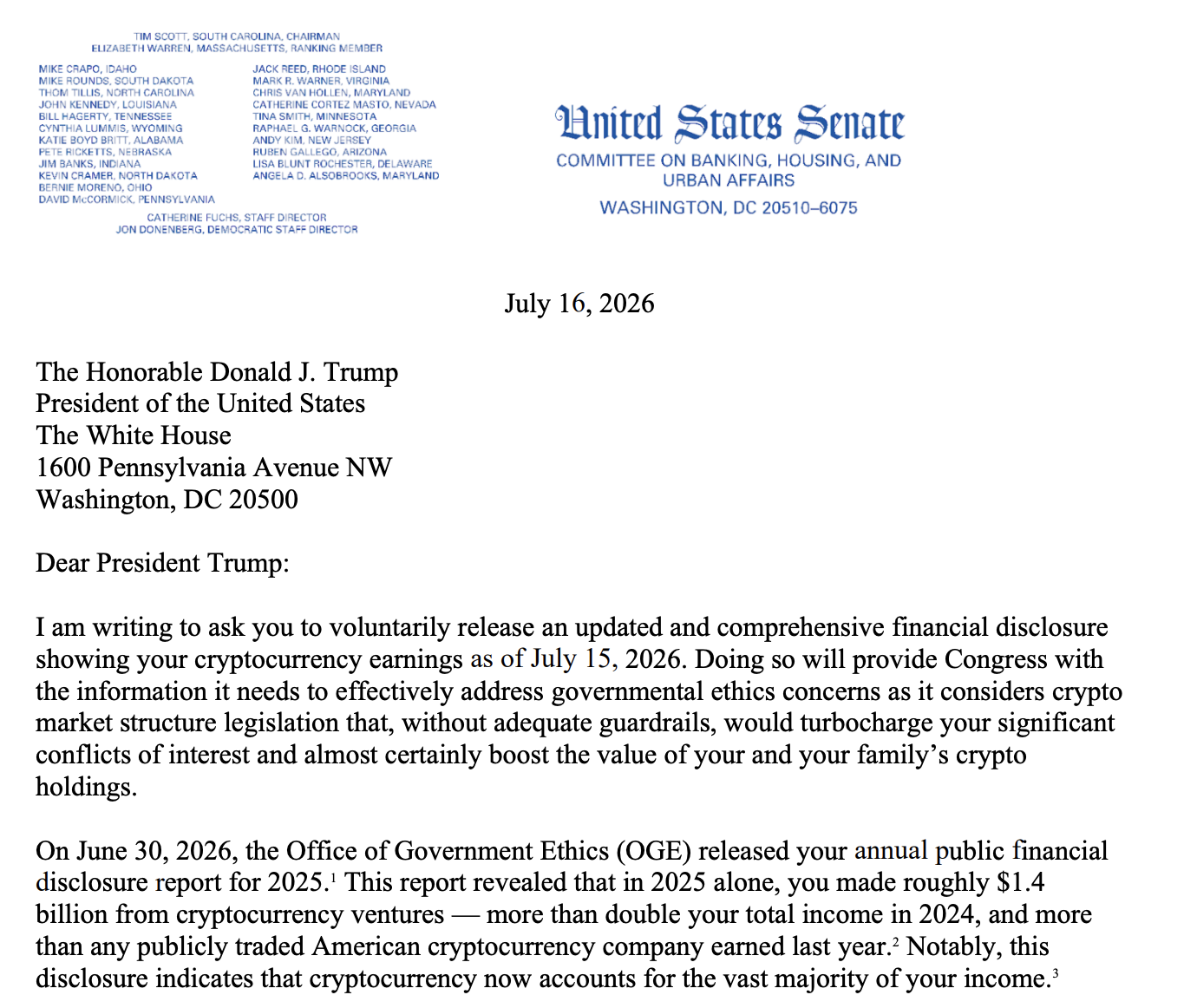
Thursday letter from Elizabeth Warren requesting financial disclosures from Donald Trump. Source: Senate Banking Committee
Trump’s 2025 disclosure was filed on June 30 as part of a US Office of Government Ethics mandate to prevent conflicts of interest with elected officials. Warren noted that the president was not required to file his 2026 annual report until May 2027, but requested that he do so voluntarily by July 23 as the Senate considers a crypto market structure bill, the Digital Asset Market Clarity (CLARITY) Act.
Warren added:
“[W]ithout adequate guardrails, [CLARITY] would turbocharge the President’s significant conflicts of interest and almost certainly boost the value of his and his family’s crypto holdings.”
Related: US indicts crypto investor over alleged $20M fraud scheme
Cointelegraph reached out to the White House and Warren’s office for comment but did not receive an immediate response. In a July 2 interview, Trump said that there was “nothing illegal” and “nothing wrong” with profiting from his crypto investments as president.
According to Senate Majority Leader John Thune, the chamber will hold a vote on the crypto bill before the Senate breaks for August states work periods. However, many Democrats have publicly said that they will not support any legislation without clear provisions on ethics, with some citing Trump’s potential conflicts of interest.
House Republicans hold CLARITY hearing as Senate debates bill
On Friday, the House Financial Services Committee’s Subcommittee on Digital Assets, Financial Technology, and Artificial Intelligence held a field hearing in New York City on the CLARITY Act. Although the bill was already passed by the House of Representatives in July 2025, it will return to the chamber if approved with 60 votes in the Senate.
Representative French Hill, who chairs the full committee and attended on Friday, said CLARITY has been “a bipartisan priority” for Congress. However, no Democratic representatives appeared to be present at the hearing. Cointelegraph reached out to Democratic lawmakers on the committee for comment but did not receive an immediate response.
Magazine: Crypto’s CLARITY Act faces partisan fight over ethics on Senate floor
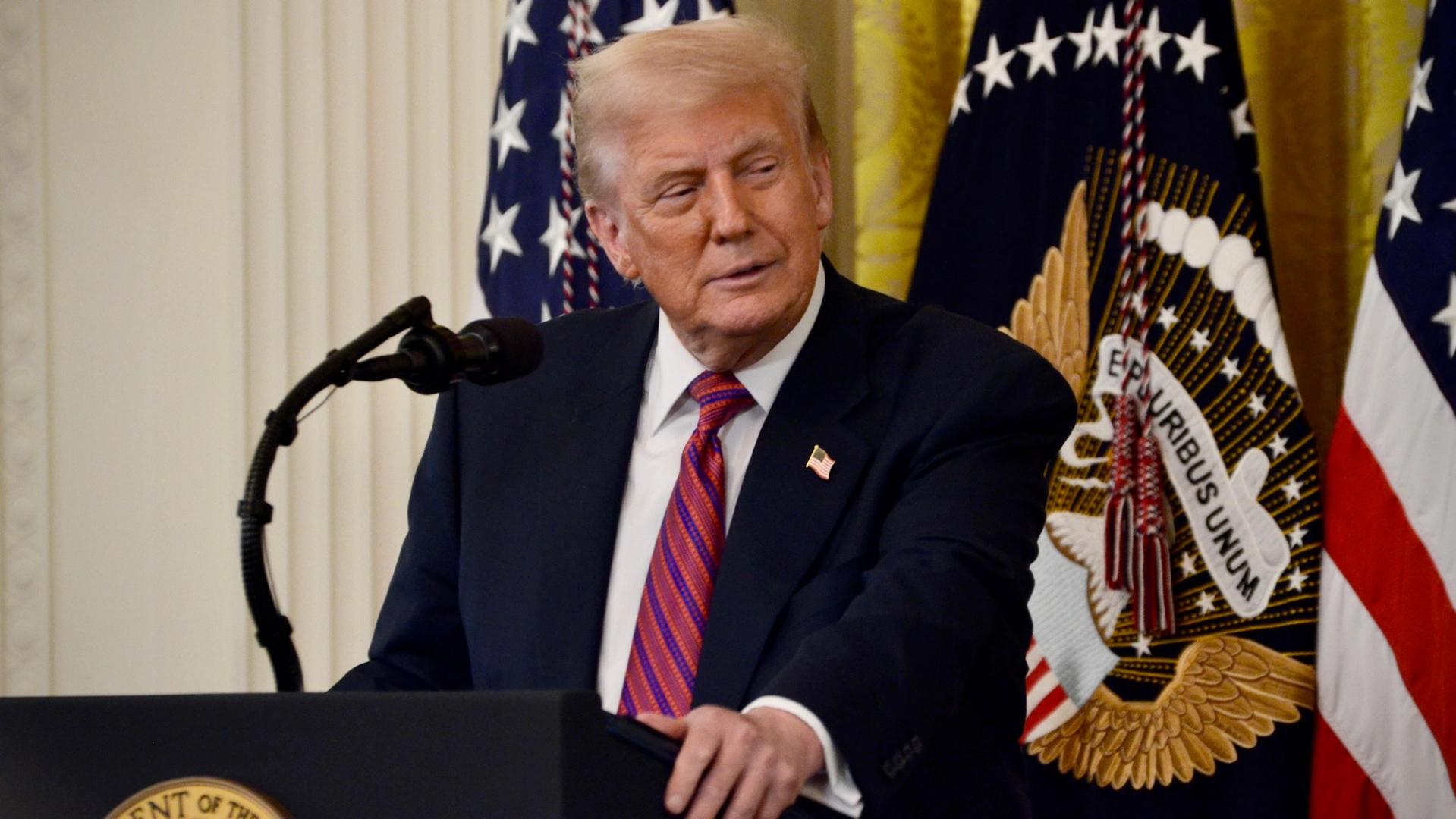
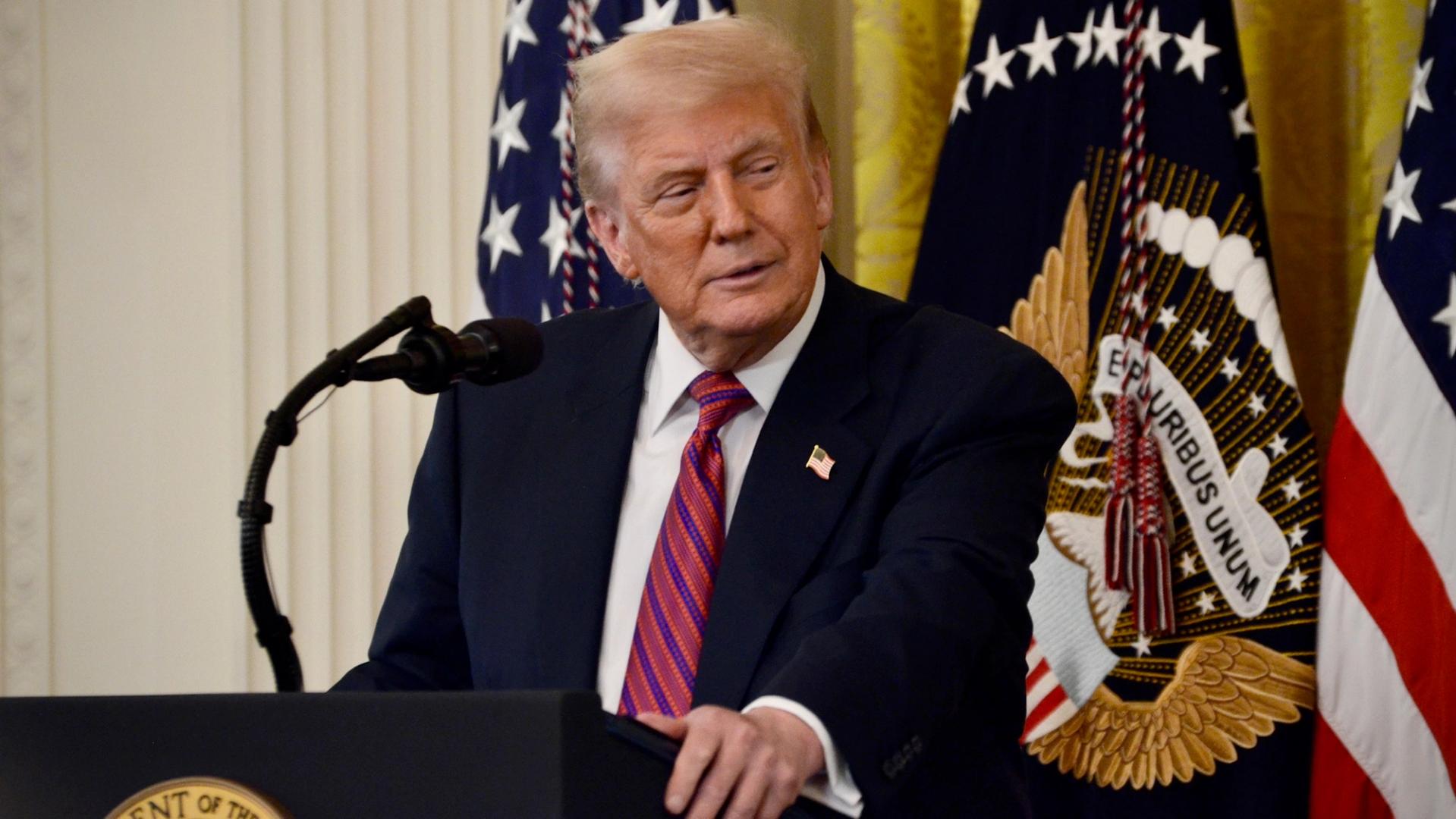
The lack of an ethics provision remains one of the biggest sticking points. Sen. Ruben Gallego (D-Ariz.), one of two Democrats who voted to advance the bill out of the Senate Banking Committee, has repeatedly said he will not support the legislation on the Senate floor without a bipartisan ethics provision. Other Democrats have raised similar concerns over conflicts of interest involving public officials and digital assets.
As of Friday, there had been no public readout from Thursday’s White House meeting, and no bipartisan ethics language had emerged, leaving one of the bill’s largest obstacles unresolved.
If passed, the Clarity Act would establish a federal framework for digital asset markets by drawing a clearer line between assets regulated by the Securities and Exchange Commission (SEC) and those overseen by the Commodity Futures Trading Commission (CFTC). Supporters argue the measure would replace years of regulation through enforcement with rules written by Congress.
Industry executives reiterated that message during a House hearing Friday marking one year since the chamber passed the legislation.
“The community has already done the hard work,” Nova Labs executive Sarah Aberg told lawmakers, arguing that regulatory uncertainty delayed investment in the Helium wireless network after the SEC sued the company in a case that was later settled. “Clarity is not a call for deregulation; it is a call for the right regulation from the right regulator.”


“Both Stripe and PayPal do approximately the same amount of payment volume, but Stripe has about one-fifth the net revenue,” Hadick said. “From a financial perspective, this is obviously accretive, and it helps them connect their merchant processing business, which is at risk of being commoditized, with a broad subset of PayPal’s more than 400 million accounts.”
Hadick also cautioned that executing a deal of that size would be difficult. “M&A integration in something of this size is incredibly hard,” he said.
Beyond merchant payments
Eric Queathem, CEO of Velocity, said the acquisition would also give Stripe access to one of the world’s largest consumer payments ecosystems, providing a platform to expand beyond merchant payments.
The proposed acquisition would also determine who controls the consumer side of blockchain-based payment infrastructure, complementing Stripe’s existing merchant network and stablecoin capabilities.
Several executives said the competitive focus has shifted from proving blockchain technology works to controlling distribution.
Pankaj Bengani, founder and CEO of Meld, agreed with Larbi that the race is on.
“The race has shifted from proving the technology works to owning distribution,” said Bengani, adding that “stablecoins have graduated from experiment to core payments infrastructure.”
Citi analysts reached a similar conclusion in a research note, writing that stablecoin competition has become “a default-setting game,” with scale accruing to whichever stablecoin becomes the default across the largest merchant, consumer wallet or autonomous transaction base, rather than to the issuer with the best technology.


China’s Kimi K3 has climbed to first place on the Frontend Code Arena, prompting former White House crypto czar David Sacks to warn that US regulation could weaken America’s position in the AI race.
Summary
- Kimi K3 topped the Frontend Code Arena and posted strong results across other AI benchmarks.
- David Sacks warned that strict US rules could weaken America’s position against China.
- Moonshot AI plans to release Kimi K3’s open weights by July 27.
Sacks described the benchmark result as concerning because Kimi K3 also performed close to leading models across several other evaluations. He argued that restrictions on data centers, state-level rules and proposed federal reviews could slow American developers while Chinese companies continue building advanced systems.
“This is how you lose the AI race,” Sacks wrote.
According to Sacks, the United States became a technology leader during the internet era by allowing companies to develop products without seeking government approval in advance. He believes Washington should follow a similar approach to AI while using targeted rules to address specific safety risks.
Kimi K3 strengthens China’s position in advanced AI development
Moonshot AI built Kimi K3 with 2.8 trillion parameters, a one-million-token context window and native multimodal capabilities. The company designed the model for lengthy coding assignments and agent-based workflows that require systems to complete several connected tasks.
Moonshot AI reported that its Kimi Delta Attention system delivers decoding speeds up to 6.3 times faster when processing one-million-token contexts. Its Attention Residuals technology also improves training efficiency by about 25% while adding less than 2% to the total cost, according to the company.
Beyond the Frontend Code Arena, Kimi K3 recorded an Elo score of 1,668 on GDPval v2. The reported result placed it above GLM-5.2, GPT-5.5, and Claude Opus 4.8, although Claude Fable 5 retained a higher score.
On AutomationBench-AA, the Chinese model achieved a 53% score and took first place in the test for agent-led software-as-a-service workflows. Results published through nextjs.org/evals also placed Kimi K3 ahead of Fable while showing comparable task success in less time, according to the report.
Moonshot AI has released Kimi K3 through Kimi.com, Kimi Work, Kimi Code and the Kimi API. The company expects to make the model’s open weights available by July 27, giving developers another way to test and adapt its capabilities.
US restrictions face scrutiny as foreign AI models advance
Sacks linked Kimi K3’s performance to an intensifying debate over how Washington should oversee frontier AI. His criticism covered proposals for federal pre-approval, limits on data center construction and the growing number of AI rules introduced by individual states.
At the federal level, the US government has approved limited access to Anthropic’s Claude Mythos 5 for roughly 100 businesses and agencies. In a letter to Anthropic co-founder Tom Brown, Commerce Secretary Howard Lutnick said selected partners could use the model under specific safeguards.
“I have determined that appropriate safeguards are in place to permit certain trusted partners to access the Claude Mythos 5 Model.”
While Sacks acknowledged that AI safety requires government attention, he argued that other countries would not copy American restrictions. Under his assessment, rules that delay infrastructure construction or model development could leave US companies competing against foreign laboratories operating under fewer limits.
President Donald Trump has also used competition with China to support his technology and digital-asset agenda. Trump has urged the Senate to pass the CLARITY Act, arguing that delayed crypto legislation could allow China to gain ground, while his administration has promoted the United States as the “crypto capital of the world.”
Sacks’ response to Kimi K3 applies the same competitive argument to artificial intelligence: address clear risks without placing approval barriers in front of US developers.
Apple overtook Nvidia as the world’s most valuable publicly traded company after it hit an all-time high of $334.95 per share just 10 minutes into Friday’s trading session.
This valuation put the company above $4.92 trillion.
At the same time, Nvidia traded at $199.38, down 4% from Thursday’s close. This valued the company at $4.83 trillion — more than $100 billion behind Apple.
Although it was an all-time high for Apple, it wasn’t its first time atop the world’s leaderboard. It was also the world’s most valuable publicly-traded company in April 2025.
Nvidia has worn the crown for the vast majority of the past year, including 12 months since June 2025.
The switchover had more to do with Nvidia dropping than Apple rallying. Apple’s shares barely moved in morning trading, whereas Nvidia dropped more than 3%.
Apple rewarded for conservative AI spending
Wall Street spent July backing away from AI’s biggest spenders and reallocating to stalwarts. Apple entered Friday up 22% this year, far outperforming Nvidia’s more modest 7% after Nvidia’s 2025 outperformance.
Investment has slowly rotated out of pure AI names into memory component makers like Micron and Sandisk.
A bit of discretion about spending on AI has benefited Apple.
HSBC upgraded Apple to buy Friday with a $366 target, citing modest CapEx of 2.5% of sales versus the far more aggressive 39% of sales by hyperscalers.
Apple’s AI suite, meanwhile, cleared a registration hurdle with Beijing’s internet regulator this week — opening up a major market.
Nvidia’s slide is two months old. The stock peaked in mid-May and has shed more than $800 billion since. Apple, in contrast, has added that much back to its market cap since last month.
This morning’s selloff briefly left Nvidia trading near 20 times forward earnings, its cheapest in about seven years and less than even chocolate maker Hershey at 21x.
Apple, re-crowned for opting out of the biggest expenditures during the AI arms race, costs about 34x times forward earnings.
Read more: South Korea’s stock market is officially more volatile than BTC
Nvidia and Apple still racing neck-and-neck
Nvidia’s business has obviously not broken.
On Thursday, it announced 27,500 Rubin GPUs for Japan, billed as “the world’s first national AI infrastructure for physical AI.” The project is bankrolled by a Tokyo sovereign ministry.
The chipmaker also became the first company worth $4 trillion last July, and the first past $5 trillion in October.
Commenting on Apple overtaking Nvidia today, Segal Marco Advisors’ Benjamin Hall told Reuters, “I don’t see any meaningful distinction. Nvidia [is] likely to be a significant participant in whatever happens going forward.”
The market agreed quickly. By 10:30am in New York, Nvidia reclaimed its top spot at about $4.94 trillion. Apple’s turn this morning lasted about 50 minutes in total.
As prices continue to fluctuate intraday, it is possible that Apple could regain its top slot before the close of trading.
Got a tip? Send us an email securely via Protos Leaks. For more informed news and investigations, follow us on X, Bluesky, and Google News, or subscribe to our YouTube channel.

Nvidia’s venture arm NVentures likely owns 141,834 Revolut shares worth about $196 million, UK filings suggest. Neither company has ever said how big the stake is.
A routine paper trail revealed what no press release did. It links the world’s top AI chipmaker to a bank with 16 million crypto users.
The Stake Nvidia and Revolut Never Announced
Tech Funding News spotted the filings on Friday. A statement at Companies House, Britain’s company registry, lists a likely NVentures LLC entry with 141,834 shares.
At the price from Revolut’s last round, that comes to roughly $195.9 million. It works out to about $1,380 per share. Insiders had rumored a figure near $200 million.
NVentures bought in through the November 2025 share sale. That deal valued Revolut at $75 billion. Coatue, Greenoaks, Dragoneer, and Fidelity led it, per Revolut’s announcement. Revolut said Nvidia’s money would deepen their AI work together. It gave no number.
“This sale also included investment from NVentures (NVIDIA’s venture capital arm), deepening Revolut’s collaboration with the global technology leader in key areas including AI.”
Follow us on X to get the latest news as it happens
The valuation is backed by real profit. Revolut’s 2024 revenue grew 72% to $4 billion. Pretax profit climbed 149% to $1.4 billion.
The price may soon climb again. Bloomberg reported in June that Revolut weighs a new share sale at $115 billion. That is a 53% jump in about seven months.
CEO Nik Storonsky has ruled out an IPO before 2028. Until then, these sales are the only way staff and early backers can cash out.
For Nvidia, the timing is notable. The chipmaker just briefly lost its crown as the world’s most valuable company to Apple.
Crypto Licenses Stack From London to Dubai
Why bet on Revolut? Its license shelf keeps filling up.
In March, Revolut launched as a fully licensed UK bank for its 13 million British customers. A US bank charter application awaits a decision.
On July 15, Dubai’s Virtual Assets Regulatory Authority (VARA) gave Revolut in-principle approval for a crypto license. It covers trading and brokerage through the app and Revolut X, its standalone crypto exchange. Final sign-off is still pending.
The UAE is moving fast on crypto rules. A regulated dirham stablecoin just reached exchanges there.
Europe tells the same story. Revolut moved to delist Tether’s USDT under MiCA rules. The ECB also picked it to test the digital euro.
Each new license makes Nvidia’s quiet $196 million look more deliberate. The next filing may show whether it doubles down at $115 billion.
The post NVIDIA Quietly Holds $196 Million Stake in Crypto-Friendly Revolut appeared first on BeInCrypto.

4 Of The Best Exercises For Lower Back Pain

LeBron James denies a 76ers hint after ‘trust the process’ comment

FBI Arrests Man Accused of Using Steam Games To Drain Victims’ Crypto Wallets


-

 Fashion7 days ago
Weekend Open Thread: Nutriplenish Leave-In Conditioner
-
 NewsBeat1 day ago
London Mayor Sadiq Khan handed a peerage by Keir Starmer alongside 15 other Labour figures… just days before the PM leaves No10
-

 Crypto World2 days ago
CFTC blocks Kalshi from unwinding Michigan trades after court order
-

 Politics2 days ago
Young campaigners urge incoming PM to act on outdoor junk food ads
-

 Business2 days ago
Nvidia Stock Slips After Big Tuesday Rally as Huang Confirms Vera Rubin Chip Is Now in Production Today
-
 Entertainment2 days ago
Disney’s Most Ambitious Failed Star Wars Attraction Is Coming to SDCC
-

 News Videos3 days ago
XRP BOMBSHELL… XRP OMBOARDED FOR TRANSACTIONS!!!
-

 Tech4 days ago
Get Your ESP32 Sunny Side Up With This Solar Dev Board
-

 Crypto World22 hours ago
Injective Submits SEC Transfer-Agent Registration to Onchain Ownership Records
-

 NewsBeat7 hours ago
Registration is now open for March for Men with Kev 2026
-

 Tech3 days ago
Dark Secrets Emerge When Jailbreaking LLMs
-

 Business2 days ago
Palantir Shares Rise After Expanded Nvidia Partnership and Fresh Analyst Upgrades Ahead of Earnings Day
-

 News Videos12 hours ago
Money | Class 12 Economics | CBSE Board Exam 2026-27
-
 Sports2 days ago
New Cornerback Enters Vikings Trade Rumor Mill
-

 Business17 hours ago
Banco Bilbao Vizcaya Argentaria, S.A. (BBVA) Discusses Global Macro Environment and Economic Outlook for Core Markets Transcript
-
 Tech4 days ago
Cloudflare Precursor Watches Your Mouse and Keyboard To Decide If You Are Human
-

 News Videos4 days ago
how to make coin bank box with cardboard #scienceproject #money #diy #shorts
-
 Entertainment2 days ago
Vicki Gunvalson Defends Discussing Heather Dubrow’s Money
-
Crypto World3 days ago
Ripple, Coinbase, Circle Join Linux x402 Foundation to Help Shape AI Payments
-

 Crypto World20 hours ago
Claude Fable 5 Slips to Second in AI Coding Leaderboard
You must be logged in to post a comment Login