
Crypto World
Uniform Labs’ Multiliquid and Metalayer Launch RWA Redemption Facility on Solana



Multiliquid and Metalayer Ventures have launched a facility that allows instant redemption (liquidity) for tokenized real-world assets (RWAs) on Solana.
In a press release shared with CryptoNews, the firm said the facility is positioned as the first dedicated vehicle intended to solve one of tokenization’s most persistent challenges: liquidity at redemption.
Raised and managed by Metalayer Ventures with support from Uniform Labs, it is designed to scale over time based on market feedback and performance, offering a blueprint for future redemption-liquidity deployments across tokenized markets.
The RWA Liquidity Gap
The launch comes as Solana’s tokenized RWA ecosystem surpasses $1 billion in on-chain assets, making it the third-largest blockchain network for tokenization.
Despite rapid growth, much of the RWA market—particularly non-Treasury assets such as private credit, private equity, and real estate—remains structurally illiquid. Redemptions are typically limited to issuer-controlled windows, rather than continuous secondary markets.
This mismatch is becoming more visible even in ostensibly “cash-like” products. The Bank for International Settlements has warned that tokenized money market funds face liquidity mismatches between on-chain instruments and off-chain settlement, a dynamic that could amplify stress during periods of elevated redemption demand.
“Traditional finance has repo markets, prime brokerage, and overnight lending facilities. Tokenized markets have had nothing comparable, until now,” said Will Beeson, founder and CEO of Uniform Labs.
How the Facility Works
Metalayer Ventures acts as the capital provider, raising and managing the pool of capital that allows instant redemptions. Multiliquid—developed by Uniform Labs—supplies the smart contract infrastructure, issuer relationships, and liquidity platform that underpin pricing, compliance enforcement, interoperability, and swaps.
Instead of waiting days or weeks for issuer-led redemptions, holders can convert supported tokenized assets into stablecoins instantly, 24/7. The facility purchases assets at a dynamic discount to net asset value (NAV), compensating liquidity providers for offering immediate access to capital.
Institutional-Grade Infrastructure on Solana
Uniform Labs expects a two-layer liquidity ecosystem to emerge: active market participants pricing real-time exits, and larger balance-sheet allocators warehousing assets to redemption for steadier yield.
The model is expected to gain traction as tokenized assets are increasingly used as collateral across DeFi and institutional venues.
The facility will initially support assets from issuers including VanEck, Janus Henderson, and Fasanara, spanning tokenized Treasury funds and select alternative assets. Integrations with Solana DeFi protocols such as Kamino are under discussion.
Nick Ducoff, head of institutional growth at the Solana Foundation, said reliable redemptions are becoming “critical infrastructure” as Solana’s RWA market scales, positioning the network as a leading venue for issuance, trading, and redemption of tokenized assets.
The post Uniform Labs’ Multiliquid and Metalayer Launch RWA Redemption Facility on Solana appeared first on Cryptonews.


TLDR
- IQVIA’s stock dropped 8.5% following the company’s weaker-than-expected 2026 profit forecast.
- The company’s adjusted earnings forecast for 2026 ranged from $12.55 to $12.85 per share, missing Wall Street’s estimate of $12.95.
- Despite strong fourth-quarter results, IQVIA’s revenue of $4.36 billion and adjusted profit of $3.42 per share were overshadowed by the weak outlook.
- Investors focused on the disappointing guidance, causing the stock to decline, even after a solid quarterly performance.
- IQVIA’s stock has been volatile, with 10 price moves greater than 5% in the past year, signaling ongoing market uncertainty.
Shares of IQVIA (NYSE: IQV) dropped 8.5% in the morning session following the company’s weak profit forecast for 2026. The clinical research firm’s outlook for adjusted earnings fell short of Wall Street expectations. Investors focused on the disappointing guidance rather than strong fourth-quarter results, pushing the stock lower.
IQVIA’s Full-Year 2026 Forecast Misses Wall Street Expectations
IQVIA projected adjusted earnings for 2026 to range from $12.55 to $12.85 per share. This forecast was below the analysts’ average estimate of $12.95 per share. Despite the company’s solid fourth-quarter performance, which included revenue of $4.36 billion and an adjusted profit of $3.42 per share, the weak guidance overshadowed the positive results.
The disappointing forecast caused concern among investors, as it reflected a potential slowdown in future growth. As a result, IQVIA’s stock took a sharp decline in response to the news. Investors appeared to be more focused on the company’s outlook rather than its recent achievements, leading to a market reaction that drove the price lower.
Strong Fourth-Quarter Results Fail to Offset Weak Guidance
IQVIA exceeded expectations in the fourth quarter, posting strong revenue and earnings figures. The company’s revenue of $4.36 billion surpassed estimates, and its adjusted profit of $3.42 per share also beat consensus forecasts. However, despite these positive results, the stock market’s attention shifted quickly to the lowered profit projections for 2026.
The focus on the weaker future guidance led to a significant drop in IQVIA’s share price. Investors seem to have placed more weight on the company’s forward-looking expectations than its recent performance. This resulted in a sell-off, which has left the stock struggling to recover from the early loss.
IQV Stock Volatility Continues to Influence Investor Sentiment
IQVIA’s stock has shown volatility in recent months, with 10 moves greater than 5% over the past year. Today’s 8.5% drop fits within this pattern, but it also signals that the market views the news as impactful yet not a major shift in the company’s overall outlook. The recent downturn represents a continuation of IQVIA’s unpredictable stock movements.
Despite the recent fall, IQVIA’s stock price remains down 17% for the year. The company’s shares are trading at $187.09, a significant 23.4% below their 52-week high of $244.29. Investors who have held IQVIA stock for five years have seen a modest return, with their investment now valued at $1,005 for every $1,000 invested.

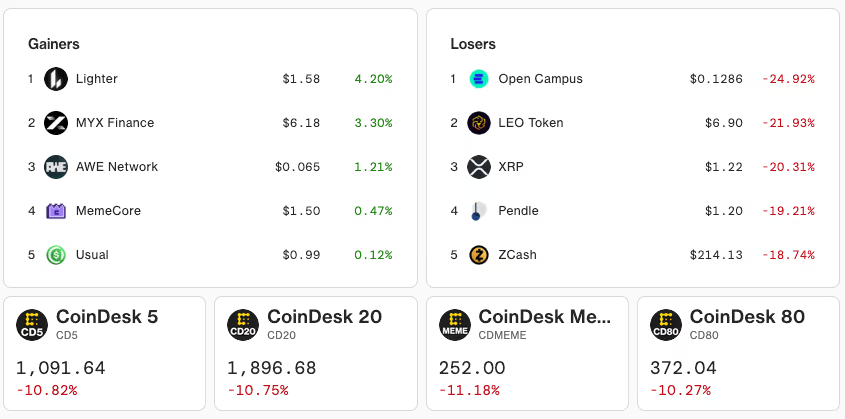
Bitcoin tumbled below $66,000 during early afternoon U.S. hours as this week’s crypto selloff accelerated into a bloodbath on Thursday.
The largest cryptocurrency fell more than 10% over the past 24 hours to a session low of $65,156, according to CoinDesk data, the weakest level since October 2024 and below the 2021 peak.
Feb. 5 could be one of the worst days in bitcoin’s history. BTC is on track to suffer its steepest one-day drawdown — 10.5% since midnight UTC at current prices — since Nov. 8, 2022, when the collapse of crypto exchange FTX sent BTC below $16,000 after a 14.3% drop on the day.
Crypto wasn’t the only asset class under relentless selling pressure. Silver also plunged 15% during the day, and is now almost 40% below its record high just a week ago. Gold also fell more than 2.8% to $4,820, but that selloff wasn’t as bad as silver. The precious metal is now trading about 15% below its record last week.
Software stocks, often moving in lockstep with bitcoin, continued to selloff, with the thematic iShares Expanded Tech-Software ETF (IGV) declining more than 3% and down 24% year to date. The S&P 500 and the tech-heavy Nasdaq were also 1% lower.
Crypto stocks weren’t spared either. Coinbase (COIN), Galaxy (GLXY), Strategy MSTR) and BitMine (BMNR) tumbled more than 10%, while several crypto miners, including Bitfarms (BITF), CleanSpark (CLSK), Hut 8 (HUT), and Mara (MARA), saw similar losses.
“One big factor is just very thin liquidity,” said Adrian Fritz, chief investment strategist at 21shares. “If there is a bit of a sell pressure, it usually triggers a lot of liquidations.”
In a fragile market environment with only a few buy and sell orders to cushion trades, even modest sell-offs can trigger a large price reaction, in turn triggering further liquidations.
While some have said the worst is over for weeks now, Fritz believes otherwise.
“There’s still no signal that we bottomed out. I think it’s too early. There’s no confirmed turnaround,” he said.
He points to the 200-moving-day average — currently around $58,000 to $60,000 — as a key support level to watch. That level also aligns with bitcoin’s “realized price,” or the average cost basis of all bitcoin holders, which he believes could serve as a strong, multi-year support.
Read more: Bitcoin can still fall further. Historical data shows $60,000 will be the bottom
Altcoins decimated
Bitcoin’s performance could seem minor compared to the brutal selloff in altcoins.
Almost all CoinDesk index prices, including major tokens and memecoins, are down by more than 10% over the last 24 hours.

XRP, which fell 19% over the same 24-hour period, underperformed most other large-cap cryptos.
While Fritz said he believes there’s no specific trigger that puts extra pressure on the token, he said that “from a technical point of view, there’s not a lot of support levels for XRP.”
Read more: Here is what industry veterans are saying as bitcoin tumbles below $70,000
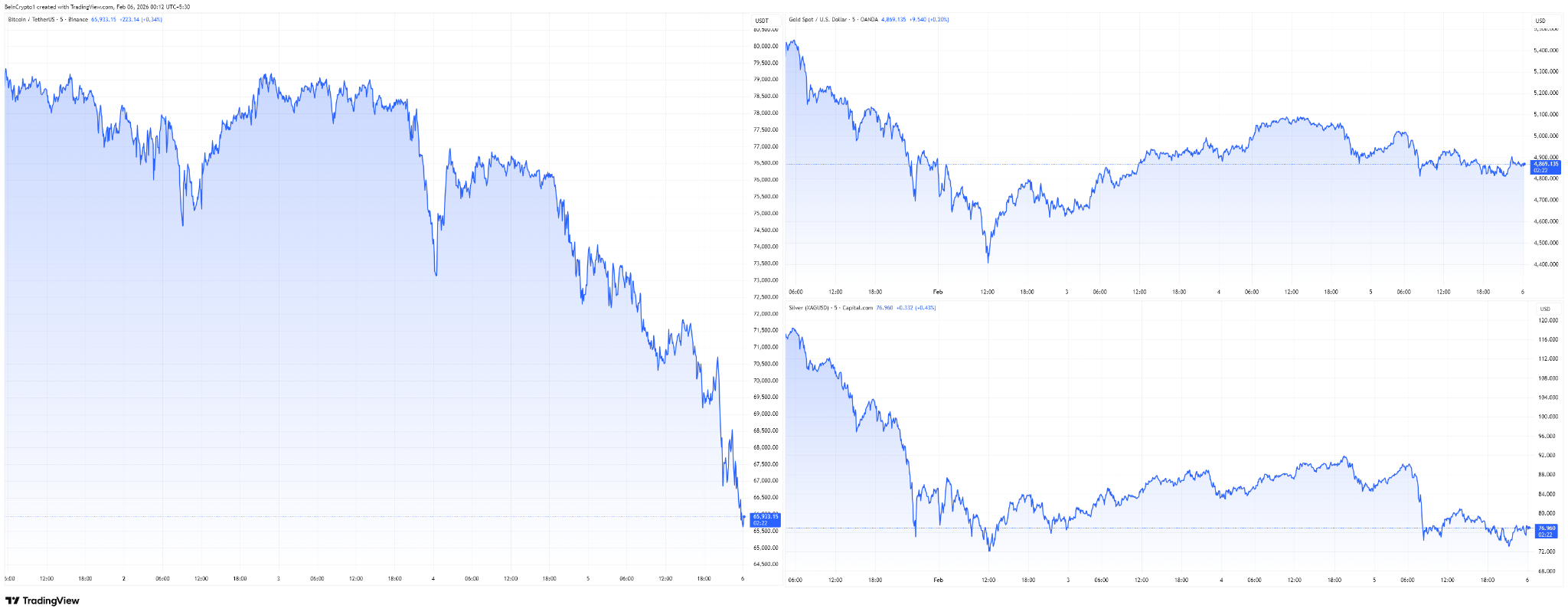
Global markets sold off sharply this week, hitting cryptocurrencies, equities, and even traditional safe havens like gold and silver. The synchronized decline points to a broader liquidity shock rather than asset-specific weakness.
Bitcoin led losses in risk assets, while gold and silver posted their steepest weekly drops in months. The unusual correlation signals forced de-risking across portfolios, not a shift in investor preference.
A Liquidity Squeeze, Not a Rotation
Normally, stress in crypto pushes capital toward gold or cash. This time, investors sold everything that could be sold.
That pattern typically emerges when leverage unwinds. Traders facing margin calls liquidate liquid assets first, including Bitcoin, gold, and silver. The selling is mechanical, not ideological.
Fed Actions Failed to Calm Markets
At the center of the turmoil is confusion around US monetary conditions. The Federal Reserve halted quantitative tightening in December and began buying short-dated Treasury bills to stabilize bank reserves.
When the Fed halted QT, it stopped actively draining cash from the financial system. For banks, this means reserve levels are no longer shrinking. For households and businesses, it reduces the risk of sudden funding stress in the banking system.
By buying short-term government debt, the Fed ensures banks have enough cash to meet daily funding needs and keep money markets functioning smoothly.
These actions support the financial system’s plumbing, not market prices. They do not lower borrowing costs for consumers, reduce mortgage rates, or encourage risk-taking.
Long-term interest rates remain elevated, and financial conditions remain restrictive.
As a result, markets interpreted the move as a sign of underlying stress rather than relief.
Jobs Data Added Pressure Instead of Clarity
US labor data released this week deepened uncertainty. Job openings continued to fall. Hiring slowed. Layoffs rose. Consumer confidence dropped to its lowest level since 2014.
At the same time, unemployment remains relatively low and inflation has not cooled enough to justify rapid rate cuts. This left markets trapped between slowing growth and tight financial conditions.
Why Gold and Silver Fell with Crypto
Gold and silver declined despite rising uncertainty because investors needed cash. Both assets had rallied strongly earlier this year, making them easy sources of liquidity.
In addition, real yields remained elevated and the dollar strengthened during the sell-off. That combination removed short-term support for precious metals.
Cryptocurrencies fell more sharply because they sit at the bottom of the liquidity hierarchy. When leverage unwinds, crypto is sold first.
Bitcoin derivatives data showed long positioning had built up in recent weeks. As prices dropped, liquidations accelerated. ETF inflows slowed at the same time, reducing demand.
A Broader Market Reset is Underway
The last two weeks reflect a single theme: markets priced in easier conditions too early. Liquidity did not expand fast enough to support those bets.
As a result, risk assets corrected together. The move reset positioning across crypto, equities, and commodities.
What this Means Going Forward
This sell-off does not signal a failure of Bitcoin or gold as long-term hedges. It reflects a short-term liquidity stress phase that often appears before policy or macro clarity improves.
For now, markets remain fragile. Until liquidity expectations stabilize or economic data decisively weaken, volatility is likely to persist.
The post US Economy is Crashing Every Market, And It’s Not a Crypto Problem appeared first on BeInCrypto.

TLDR
- BitMine holds 4.29 million ETH, now worth $8 billion less than its initial investment.
- Ethereum’s price drop to below $2,000 has caused significant unrealized losses for the company.
- BitMine’s stock has fallen 88% from its peak in July, reflecting investor concerns over Ethereum exposure.
- The company continues to accumulate Ethereum and generates income through staking despite the downturn.
- BitMine is not under pressure to liquidate its assets as it used equity issuance to fund its ETH purchases.
BitMine Immersion Technologies, led by Wall Street strategist Thomas Lee, has faced substantial losses as Ethereum (ETH) dropped below $2,000. The company’s position is now worth nearly $8 billion less than its initial investment of approximately $16.4 billion. The downturn has caused BitMine’s stock to fall sharply, reflecting a significant loss on its Ethereum holdings.
BitMine’s Ethereum Bet and Unrealized Losses
BitMine holds around 3.55% of Ethereum’s total circulating supply, with 4.29 million ETH accumulated through equity issuance. The company’s massive ETH stake was once worth $16.4 billion but is now valued at just $8.4 billion, marking a $8 billion unrealized loss. Despite the decrease in Ethereum’s value, BitMine has maintained a strategy of holding and staking its Ether, generating income despite the ongoing market volatility.
The company’s approach of using equity issuance instead of debt financing has shielded it from immediate liquidation pressure. With $538 million in cash and nearly $200 million in annual staking revenue from its ETH holdings, BitMine is positioned to ride out the current market challenges. “There is no pressure to sell any ETH at these levels,” Thomas Lee stated, defending the firm’s strategy of holding through market downturns.
Stock Price Declines Alongside Ethereum’s Drop
The recent downturn in Ethereum has coincided with a sharp decline in BitMine’s stock price. Shares of BMNR have fallen by 88% from their peak in July, reflecting growing concerns over the company’s heavy exposure to Ethereum. The stock hit new multi-month lows, paralleling Ethereum’s 30% drop over the past month, and investors are scrutinizing BitMine’s ability to weather the market downturn.
Bitmine Immersion Technologies, Inc., BMNR
Despite the loss in stock value, BitMine’s strategy of staking 2.9 million ETH has provided some cushion. The firm has also continued accumulating Ether, adding more to its holdings even during this difficult market period. Investors are keenly watching how BitMine manages its exposure to Ethereum amid the current price fluctuation.
No Immediate Need for Liquidation
Lee’s defense of BitMine’s strategy highlights that the company has no immediate need to sell its Ethereum holdings. Unlike other firms with significant debt, BitMine has no obligations forcing it to liquidate at a loss. Instead, the firm focuses on earning consistent revenue through staking, which has allowed it to manage liquidity even as Ethereum’s price continues to decline.
BitMine’s strategy centers on long-term growth, with the firm continuing to bet on the future of Ethereum. While the value of its holdings has dropped, the company remains optimistic about the long-term potential of its Ethereum position.

CoinCatch has moved into a post-suspension phase, outlining a tightly defined window for users to withdraw remaining assets before the company proceeds with liquidation. Following the halt of trading and core operations in late January 2026, the platform is maintaining a limited technical framework designed solely to facilitate withdrawals. The arrangement, which runs until 30 March 2026 (UTC), is positioned as a final remedial measure for users who have not yet recovered funds, after which any remaining balances will be handled as part of a formal liquidation process.
Key takeaways
- CoinCatch suspended all trading and operational activity as of 30 January 2026.
- A restricted withdrawal-only system will remain active until 30 March 2026 (UTC).
- No account changes, transfers, or identity resets are supported during this period.
- Assets not withdrawn by the deadline will be addressed through liquidation under applicable law.
- The company plans to appoint a third-party liquidator experienced in BVI procedures.
Sentiment: Neutral
Price impact: Neutral. The notice focuses on asset recovery and liquidation mechanics rather than market activity.
Market context: Platform suspensions and structured wind-downs have become more common as exchanges face regulatory pressure, liquidity stress, and heightened scrutiny over custodial practices.
Why it matters
For users, the announcement establishes a clear and final timeline to recover assets without relying on manual claims or legal proceedings. The limited withdrawal window reduces uncertainty but also places responsibility squarely on account holders to act promptly.
For the broader market, the move highlights how centralized platforms are increasingly formalizing shutdown and liquidation processes. Clear communication and defined deadlines can mitigate disorderly outcomes, even as they underscore ongoing risks associated with custodial crypto services.
What to watch next
- User withdrawal activity as the 30 March 2026 deadline approaches.
- Appointment of a third-party voluntary liquidator.
- Details on how residual assets will be treated under liquidation law.
- Any further official notices published on the CoinCatch website.
Sources & verification
- Official CoinCatch suspension and withdrawal notices.
- The published withdrawal deadline and system limitations.
- Statements regarding liquidation planning and third-party appointment.
Withdrawal deadline and liquidation roadmap
CoinCatch’s latest notice clarifies the operational status of the platform following its suspension announcement on 24 December 2025. After normal system-based withdrawals were halted on 30 January 2026, the company transitioned into what it describes as a post-suspension asset handling phase. This phase is not intended to restart business activities, but to provide a narrow technical pathway for users to retrieve assets already recorded in internal systems.
Under the current arrangement, CoinCatch confirms that it no longer conducts trading, transfers, or any form of operational service. The system has been pared back to three core functions only: displaying announcements, allowing user login, and processing withdrawals. Features such as account information updates, identity verification changes, or factor resets are explicitly excluded.
The company frames this setup as a temporary and transitional measure. It is designed to avoid additional manual handling or risk exposure while offering users a final opportunity to complete withdrawals using their original accounts. CoinCatch emphasizes that this should not be interpreted as a resumption of operations or an open-ended extension of withdrawal access.
Communication has been a central element of the process. According to the notice, users were informed of the suspension and withdrawal terms through multiple channels, including the official website and email notifications. After the initial withdrawal period ended, the restricted system was kept online as a remedial option, allowing users to submit claims directly through the platform rather than through ad hoc or manual processes.
To remove ambiguity, CoinCatch specifies that references to logging in or using original accounts mean accessing the official homepage and authenticating through the sole login entry provided there. No alternative access routes or support mechanisms are offered.
The deadline is unambiguous. Limited system-based withdrawals will remain available until 30 March 2026 (UTC). Once this date passes, the withdrawal function will be permanently disabled. The company states that it will not process any further asset recovery requests, whether through automated systems or manual intervention.
Assets that remain unwithdrawn after the cutoff will move into a different legal and procedural category. CoinCatch indicates that such balances will no longer be handled through platform systems and will instead be addressed during liquidation. Based on existing backend records, these assets will be treated as residual company property and managed in accordance with applicable law.
Looking ahead, CoinCatch confirms it has entered the preparatory stage for liquidation. Future phases are expected to include the appointment of a third-party voluntary liquidator with experience in British Virgin Islands company liquidation and dissolution procedures. The role of this liquidator will be to oversee a lawful wind-down, relying on the company’s existing systems and records rather than any renewed operations.
Once the limited withdrawal period concludes, CoinCatch plans to cease all forms of user service entirely and cooperate with the liquidation process through to deregistration. No ongoing business activity is anticipated beyond fulfilling statutory and procedural requirements.
For users who still hold balances on the platform, the message is direct. Access the official site, log in using original credentials, and complete withdrawals before the end of March. After that point, recovery options will depend on liquidation outcomes rather than platform functionality.
The full notice is available via CoinCatch’s support portal at the company’s official website.
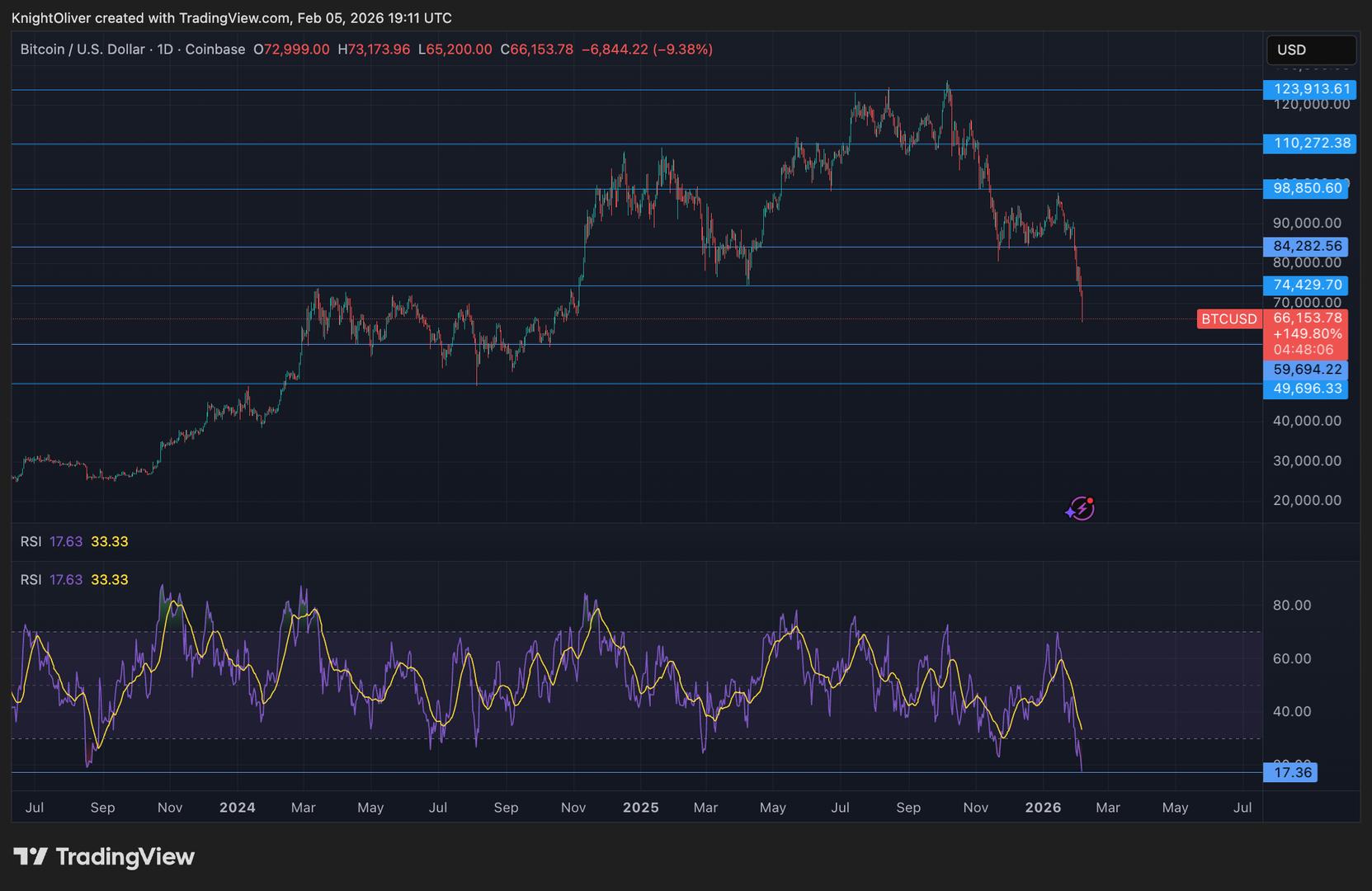
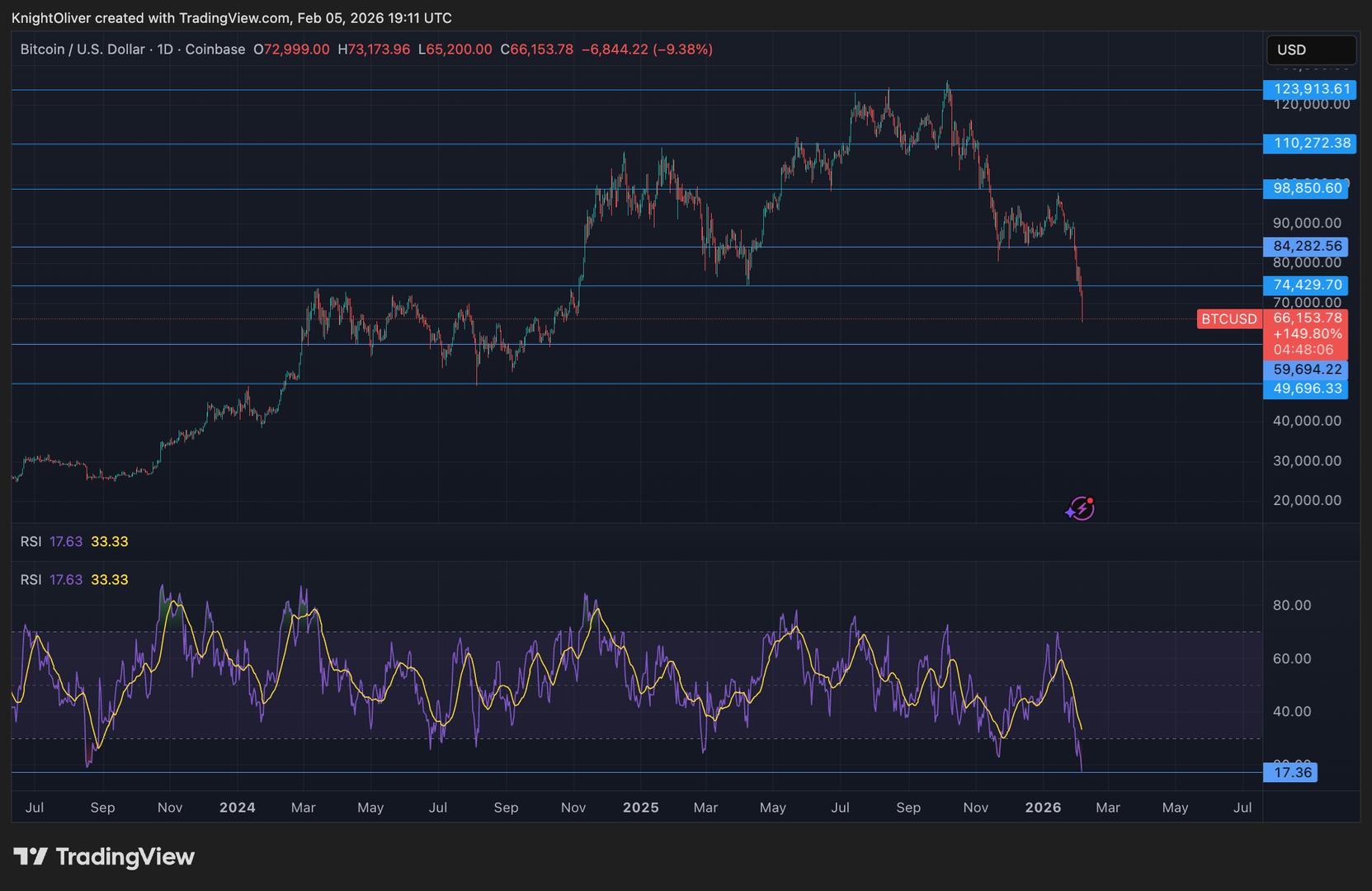
Bitcoin tumbled to around $65,000 on Thursday amid a wave of liquidations driven by heavily bearish sentiment, but one technical indicator suggests the cryptocurrency could be set for not just a bounce, but a major move higher.
Bitcoin’s daily Relative Strength Index (RSI), which is a popularly used momentum oscillator that assesses whether an asset is oversold or overbought, flashed 17.6 (on a scale of 0-100) on Thursday — heavily oversold conditions that were topped in the modern BTC era by the Covid crash in 2020, when it fell to 15.6, and the 2018 market bottom, when it dropped to 9.5.
On both of those previous occasions, bitcoin rewarded buyers with violent upside moves. In 2018, BTC more than quadrupled over the ensuing 8 months from $3,150 to $13,800. In 2020, bitcoin soared from $3,900 to a cycle high of $65,000 just more than one year later.
Thursday’s market carnage liquidated more than $1.5 billion across crypto derivatives. While the temptation might be to sell when an asset is weak, astute traders will see the oversold territories as an opportunity — especially as liquidity between $70,000 and $80,000 has effectively been wiped out.
While retail traders hold or accumulate ETH, on-chain data shows US institutions selling Ethereum at a discount.
Ethereum (ETH) broke below the crucial $2,100 price level after a fresh 8% decline amid a severe market correction. On-chain data now points to a major shift in sentiment among US investors.
In fact, those market participants are aggressively de-risking the world’s largest altcoin, even pushing the Coinbase Premium to its most negative reading since July 2022.
Institutional Exit
According to CryptoQuant, the Ethereum Coinbase Premium Index, measured on a 30-day moving average, has fallen to its lowest level since July 2022. The index tracks the price difference between the ETH/USD pair on Coinbase Pro, which is widely used as a proxy for US institutional trading activity, and the ETH/USDT pair on Binance, often viewed as a proxy for global retail participation.
CryptoQuant said that the deeply negative reading on the 30-day basis indicates that selling pressure is largely coming from US entities. While global retail traders may be holding positions or buying into the price decline, US institutions appear to be actively de-risking or exiting their Ethereum holdings.
The analytics platform revealed that the last time the Coinbase Premium Index reached similarly negative levels was during the depths of the 2022 bear market. Based on this comparison, it detailed two possible interpretations. One is that bearish momentum could continue, as US demand, described as an important driver of crypto market rallies, is currently absent, potentially limiting any near-term price recovery.
The alternative interpretation presented is that such extreme negative premiums have historically aligned with capitulation phases, which can sometimes coincide with local market bottoms once aggressive selling pressure is exhausted. CryptoQuant concluded that the $2,100 level represents an important psychological and technical zone, and added that a reversal would likely require the Coinbase Premium to normalize or turn positive.
“As long as US investors are selling at a discount compared to the global market, upside momentum will likely remain capped.”
Another Historical Warning Signal
A sharp increase in Ethereum network activity has further raised questions about potential market risks. Ethereum’s total transfer count surged to 1.17 million on January 29th, in one of the highest recorded levels for the metric, and represents a sudden, vertical rise in transaction activity across the network. Historical comparisons reveal that similar spikes have previously occurred around major turning points in ETH’s price cycle. In January 2018, for example, a comparable surge in transfer counts coincided with the market cycle top and was followed by a prolonged bear market.
You may also like:
A similar pattern appeared on May 19, 2021, when a sharp increase in transfers aligned with a major market crash and a steep price correction. While high network activity is often associated with growing usage, CryptoQuant stated that rapid and parabolic increases near price highs have historically reflected periods of market stress.
Such conditions can indicate high volatility, large-scale asset movements, or distribution by long-term holders moving funds, potentially to exchanges. Based on these historical precedents, the current spike places the crypto asset in a “high-risk” zone, where past patterns have been followed by notable price drawdowns.
SECRET PARTNERSHIP BONUS for CryptoPotato readers: Use this link to register and unlock $1,500 in exclusive BingX Exchange rewards (limited time offer).

The Aster decentralized crypto exchange (DEX) and perpetual futures platform announced on Thursday that its layer-1 blockchain testnet is now live for all users, with a potential rollout of the Aster layer-1 mainnet in Q1 2026.
Several new features are slated for a Q1 launch, including fiat currency on-ramps, the release of the Aster code for builders and the upcoming L1 mainnet, according to the Aster roadmap.
Aster will focus on infrastructure, token utility and building its ecosystem and community in 2026, according to the roadmap.

Aster rebranded as a perpetual futures DEX in March 2025 and is a direct competitor to the Hyperliquid perpetual futures DEX, which also runs on its own application-specific layer-1 blockchain network.
The launch of a dedicated layer-1 chain for Aster reflects the trend of Web3 projects shifting to custom-tailored blockchains to support high-throughput transaction volume, rather than relying on general-purpose chains like Ethereum or Solana, which host mixed traffic.
Related: Perp DEXs will ‘eat’ expensive TradFi in 2026: Delphi Digital
2025 was the year perp DEXs gained momentum
The success of Hyperliquid, a perpetual decentralized exchange (perp DEX), helped spur interest in other perpetual DEXs, such as Aster.
Traditional futures contracts feature an expiry date and must be manually rolled over, whereas a perpetual futures contract has no expiration date.
Instead, traders pay a funding rate to keep their positions open indefinitely, allowing markets to run 24 hours a day, seven days a week.
Perp DEX cumulative trading volume nearly tripled in 2025, surging from about $4 trillion to over $12 trillion by the end of the year.
About $7.9 trillion of this cumulative trading volume was generated in 2025, according to DefiLlama data.

Monthly trading volume on perpetual exchanges hit the $1 trillion milestone in October, November and December, data from DefiLlama shows.
The sharp rise in trading volume during 2025 signals growing interest and investor demand for crypto derivatives products and platforms, as more of the world’s financial transactions come onchain.
Magazine: Back to Ethereum: How Synt,hetix, Ronin and Celo saw the light

Gold prices extended gains for a second day, climbing back above $5,100 as a historical pullback from record highs offered a buying opportunity for investors.
In early trading, New York futures rose 3.4% to $5,102.90 a troy ounce following a 6% jump in the previous session.
The recent correction doesn’t signal a change in gold’s underlying drivers, with the medium-term outlook supported by continued central-bank buying, firm ETF demand, and persistent geopolitical and economic uncertainty.


BitMine’s ethereum (ETH) holdings have made unrealized losses of over $8 billion today as part of a wider crypto crash that the firm’s chairman, Tom Lee, described as “a feature, not a bug.”
The former JP Morgan strategist became chairman of the bitcoin (BTC) mining firm BitMine Immersion Technologies in June 2025 as it pivoted towards buying up ether (ETH).
Since August 24, 2025, when ETH’s hit an all-time high of $4,946, BitMine has spent over $10.6 billion purchasing over 2.76 million ETH, according to data from DropsTab.
Five months on, and ETH has fallen by almost 60%, resulting in BitMine’s ETH holdings losing over $8 billion in unrealized losses.
The firm has invested $16.4 billion in ETH since it pivoted last year and has no realized profit to date. It owns 4.29 million ETH, just over 3.5% of the entire circulating supply.
Read more: Tom Lee’s BitMine is performing as bad as Strategy
After users began to point out that BitMine’s ETH holdings hit over $6 billion in unrealized losses, Lee claimed that these sort of downturns are “a feature, not a bug,” and noted that the point of his ETH is to “outperform over the cycle (think up ETH).”
Just one day before, he noted that this crypto winter isn’t like other crypto winters, and that while prices are lagging, daily transactions are still surging.
He also noted that Binance’s actions on October 10 may have contributed to the “languished” price actions today.
ETH, BTC fall in wider crypto crash
CoinGecko claims that around $820 billion has been shed from the overall cryptocurrency market cap since January 15 this year.
ETH has shed $146 billion from its market cap over the past month, while BTC’s has lost $490 billion since last month.
Read more: Eric Trump removes ‘thank me later’ from ETH promo
This crash may not have been foreseen by the Trump family, as if somebody held onto any ETH they bought when Donald Trump’s son Eric endorsed buying ETH last year, they’d be down 31% today.
Got a tip? Send us an email securely via Protos Leaks. For more informed news, follow us on X, Bluesky, and Google News, or subscribe to our YouTube channel.

Quentin Jiles Names Politicians He Thinks Would Lose on ‘The Traitors’

Ini cara terbaik kalian investasiin Rp500.000 ke crypto #bitcoin #ethereum #crypto #investasi

Catwalk model and ex-footballers daughter found dead in Costa del Sol

![I’m Bullish On This Bitcoin Crash [Preparing For Strong Bounce]](https://wordupnews.com/wp-content/uploads/2026/02/1770323025_maxresdefault-80x80.jpg)
-

 Crypto World6 days ago
Smart energy pays enters the US market, targeting scalable financial infrastructure
-
 Crypto World7 days ago
Software stocks enter bear market on AI disruption fear with ServiceNow plunging 10%
-

 Politics6 days ago
Why is the NHS registering babies as ‘theybies’?
-
 Crypto World7 days ago
Adam Back says Liquid BTC is collateralized after dashboard problem
-

 Video3 days ago
When Money Enters #motivation #mindset #selfimprovement
-

 Fashion6 days ago
Weekend Open Thread – Corporette.com
-

 Tech2 days ago
Wikipedia volunteers spent years cataloging AI tells. Now there’s a plugin to avoid them.
-

 NewsBeat7 days ago
Donald Trump Criticises Keir Starmer Over China Discussions
-

 Politics4 days ago
Sky News Presenter Criticises Lord Mandelson As Greedy And Duplicitous
-

 Crypto World5 days ago
U.S. government enters partial shutdown, here’s how it impacts bitcoin and ether
-

 Sports5 days ago
Sinner battles Australian Open heat to enter last 16, injured Osaka pulls out
-
 Crypto World5 days ago
Bitcoin Drops Below $80K, But New Buyers are Entering the Market
-
 Crypto World3 days ago
Market Analysis: GBP/USD Retreats From Highs As EUR/GBP Enters Holding Pattern
-

 Business2 hours ago
Quiz enters administration for third time
-

 Crypto World6 days ago
KuCoin CEO on MiCA, Europe entering new era of compliance
-
Business6 days ago
Entergy declares quarterly dividend of $0.64 per share
-

 Sports3 days ago
Shannon Birchard enters Canadian curling history with sixth Scotties title
-

 NewsBeat9 hours ago
Still time to enter Bolton News’ Best Hairdresser 2026 competition
-

 NewsBeat3 days ago
GAME to close all standalone stores in the UK after it enters administration
-

 NewsBeat3 days ago
US-brokered Russia-Ukraine talks are resuming this week